EP4455384A1 - Procédé de préparation d'un corps absorbant - Google Patents
Procédé de préparation d'un corps absorbant Download PDFInfo
- Publication number
- EP4455384A1 EP4455384A1 EP23892044.1A EP23892044A EP4455384A1 EP 4455384 A1 EP4455384 A1 EP 4455384A1 EP 23892044 A EP23892044 A EP 23892044A EP 4455384 A1 EP4455384 A1 EP 4455384A1
- Authority
- EP
- European Patent Office
- Prior art keywords
- super absorbent
- absorbent polymer
- adhesive
- absorbent body
- polymer
- Prior art date
- Legal status (The legal status is an assumption and is not a legal conclusion. Google has not performed a legal analysis and makes no representation as to the accuracy of the status listed.)
- Pending
Links
Images
Classifications
-
- D—TEXTILES; PAPER
- D06—TREATMENT OF TEXTILES OR THE LIKE; LAUNDERING; FLEXIBLE MATERIALS NOT OTHERWISE PROVIDED FOR
- D06M—TREATMENT, NOT PROVIDED FOR ELSEWHERE IN CLASS D06, OF FIBRES, THREADS, YARNS, FABRICS, FEATHERS OR FIBROUS GOODS MADE FROM SUCH MATERIALS
- D06M15/00—Treating fibres, threads, yarns, fabrics, or fibrous goods made from such materials, with macromolecular compounds; Such treatment combined with mechanical treatment
- D06M15/19—Treating fibres, threads, yarns, fabrics, or fibrous goods made from such materials, with macromolecular compounds; Such treatment combined with mechanical treatment with synthetic macromolecular compounds
- D06M15/21—Macromolecular compounds obtained by reactions only involving carbon-to-carbon unsaturated bonds
- D06M15/263—Macromolecular compounds obtained by reactions only involving carbon-to-carbon unsaturated bonds of unsaturated carboxylic acids; Salts or esters thereof
-
- A—HUMAN NECESSITIES
- A61—MEDICAL OR VETERINARY SCIENCE; HYGIENE
- A61L—METHODS OR APPARATUS FOR STERILISING MATERIALS OR OBJECTS IN GENERAL; DISINFECTION, STERILISATION OR DEODORISATION OF AIR; CHEMICAL ASPECTS OF BANDAGES, DRESSINGS, ABSORBENT PADS OR SURGICAL ARTICLES; MATERIALS FOR BANDAGES, DRESSINGS, ABSORBENT PADS OR SURGICAL ARTICLES
- A61L15/00—Chemical aspects of, or use of materials for, bandages, dressings or absorbent pads
- A61L15/16—Bandages, dressings or absorbent pads for physiological fluids such as urine or blood, e.g. sanitary towels, tampons
- A61L15/22—Bandages, dressings or absorbent pads for physiological fluids such as urine or blood, e.g. sanitary towels, tampons containing macromolecular materials
- A61L15/24—Macromolecular compounds obtained by reactions only involving carbon-to-carbon unsaturated bonds; Derivatives thereof
-
- A—HUMAN NECESSITIES
- A61—MEDICAL OR VETERINARY SCIENCE; HYGIENE
- A61F—FILTERS IMPLANTABLE INTO BLOOD VESSELS; PROSTHESES; DEVICES PROVIDING PATENCY TO, OR PREVENTING COLLAPSING OF, TUBULAR STRUCTURES OF THE BODY, e.g. STENTS; ORTHOPAEDIC, NURSING OR CONTRACEPTIVE DEVICES; FOMENTATION; TREATMENT OR PROTECTION OF EYES OR EARS; BANDAGES, DRESSINGS OR ABSORBENT PADS; FIRST-AID KITS
- A61F13/00—Bandages or dressings; Absorbent pads
- A61F13/15—Absorbent pads, e.g. sanitary towels, swabs or tampons for external or internal application to the body; Supporting or fastening means therefor; Tampon applicators
- A61F13/15577—Apparatus or processes for manufacturing
- A61F13/15617—Making absorbent pads from fibres or pulverulent material with or without treatment of the fibres
- A61F13/15658—Forming continuous, e.g. composite, fibrous webs, e.g. involving the application of pulverulent material on parts thereof
-
- A—HUMAN NECESSITIES
- A61—MEDICAL OR VETERINARY SCIENCE; HYGIENE
- A61F—FILTERS IMPLANTABLE INTO BLOOD VESSELS; PROSTHESES; DEVICES PROVIDING PATENCY TO, OR PREVENTING COLLAPSING OF, TUBULAR STRUCTURES OF THE BODY, e.g. STENTS; ORTHOPAEDIC, NURSING OR CONTRACEPTIVE DEVICES; FOMENTATION; TREATMENT OR PROTECTION OF EYES OR EARS; BANDAGES, DRESSINGS OR ABSORBENT PADS; FIRST-AID KITS
- A61F13/00—Bandages or dressings; Absorbent pads
- A61F13/15—Absorbent pads, e.g. sanitary towels, swabs or tampons for external or internal application to the body; Supporting or fastening means therefor; Tampon applicators
- A61F13/53—Absorbent pads, e.g. sanitary towels, swabs or tampons for external or internal application to the body; Supporting or fastening means therefor; Tampon applicators characterised by the absorbing medium
- A61F13/534—Absorbent pads, e.g. sanitary towels, swabs or tampons for external or internal application to the body; Supporting or fastening means therefor; Tampon applicators characterised by the absorbing medium having an inhomogeneous composition through the thickness of the pad
-
- A—HUMAN NECESSITIES
- A61—MEDICAL OR VETERINARY SCIENCE; HYGIENE
- A61F—FILTERS IMPLANTABLE INTO BLOOD VESSELS; PROSTHESES; DEVICES PROVIDING PATENCY TO, OR PREVENTING COLLAPSING OF, TUBULAR STRUCTURES OF THE BODY, e.g. STENTS; ORTHOPAEDIC, NURSING OR CONTRACEPTIVE DEVICES; FOMENTATION; TREATMENT OR PROTECTION OF EYES OR EARS; BANDAGES, DRESSINGS OR ABSORBENT PADS; FIRST-AID KITS
- A61F13/00—Bandages or dressings; Absorbent pads
- A61F13/15—Absorbent pads, e.g. sanitary towels, swabs or tampons for external or internal application to the body; Supporting or fastening means therefor; Tampon applicators
- A61F13/53—Absorbent pads, e.g. sanitary towels, swabs or tampons for external or internal application to the body; Supporting or fastening means therefor; Tampon applicators characterised by the absorbing medium
- A61F13/539—Absorbent pads, e.g. sanitary towels, swabs or tampons for external or internal application to the body; Supporting or fastening means therefor; Tampon applicators characterised by the absorbing medium characterised by the connection of the absorbent layers with each other or with the outer layers
-
- A—HUMAN NECESSITIES
- A61—MEDICAL OR VETERINARY SCIENCE; HYGIENE
- A61L—METHODS OR APPARATUS FOR STERILISING MATERIALS OR OBJECTS IN GENERAL; DISINFECTION, STERILISATION OR DEODORISATION OF AIR; CHEMICAL ASPECTS OF BANDAGES, DRESSINGS, ABSORBENT PADS OR SURGICAL ARTICLES; MATERIALS FOR BANDAGES, DRESSINGS, ABSORBENT PADS OR SURGICAL ARTICLES
- A61L15/00—Chemical aspects of, or use of materials for, bandages, dressings or absorbent pads
- A61L15/16—Bandages, dressings or absorbent pads for physiological fluids such as urine or blood, e.g. sanitary towels, tampons
- A61L15/42—Use of materials characterised by their function or physical properties
- A61L15/58—Adhesives
-
- A—HUMAN NECESSITIES
- A61—MEDICAL OR VETERINARY SCIENCE; HYGIENE
- A61L—METHODS OR APPARATUS FOR STERILISING MATERIALS OR OBJECTS IN GENERAL; DISINFECTION, STERILISATION OR DEODORISATION OF AIR; CHEMICAL ASPECTS OF BANDAGES, DRESSINGS, ABSORBENT PADS OR SURGICAL ARTICLES; MATERIALS FOR BANDAGES, DRESSINGS, ABSORBENT PADS OR SURGICAL ARTICLES
- A61L15/00—Chemical aspects of, or use of materials for, bandages, dressings or absorbent pads
- A61L15/16—Bandages, dressings or absorbent pads for physiological fluids such as urine or blood, e.g. sanitary towels, tampons
- A61L15/42—Use of materials characterised by their function or physical properties
- A61L15/60—Liquid-swellable gel-forming materials, e.g. super-absorbents
-
- A—HUMAN NECESSITIES
- A61—MEDICAL OR VETERINARY SCIENCE; HYGIENE
- A61F—FILTERS IMPLANTABLE INTO BLOOD VESSELS; PROSTHESES; DEVICES PROVIDING PATENCY TO, OR PREVENTING COLLAPSING OF, TUBULAR STRUCTURES OF THE BODY, e.g. STENTS; ORTHOPAEDIC, NURSING OR CONTRACEPTIVE DEVICES; FOMENTATION; TREATMENT OR PROTECTION OF EYES OR EARS; BANDAGES, DRESSINGS OR ABSORBENT PADS; FIRST-AID KITS
- A61F13/00—Bandages or dressings; Absorbent pads
- A61F13/15—Absorbent pads, e.g. sanitary towels, swabs or tampons for external or internal application to the body; Supporting or fastening means therefor; Tampon applicators
- A61F13/53—Absorbent pads, e.g. sanitary towels, swabs or tampons for external or internal application to the body; Supporting or fastening means therefor; Tampon applicators characterised by the absorbing medium
- A61F2013/530481—Absorbent pads, e.g. sanitary towels, swabs or tampons for external or internal application to the body; Supporting or fastening means therefor; Tampon applicators characterised by the absorbing medium having superabsorbent materials, i.e. highly absorbent polymer gel materials
Definitions
- the present disclosure relates to a preparation method for an absorbent body.
- hygiene articles such as various diapers, sanitary pads, or incontinence pad include an absorbent body containing super absorbent polymer particles. It was common that the absorbent body mainly includes the super absorbent polymer particles and pulp to properly fix the super absorbent polymer particles while maintaining the shape of the absorbent body and hygiene articles.
- the present disclosure relates to a preparation method for an absorbent body exhibiting excellent shape retention even after moisture absorption, which can contribute to thinning the absorbent body by properly fixing the super absorbent polymer particles within the absorbent body without using pulp and can improve the filling rate by uniformly applying a super absorbent polymer.
- the absorbent body prepared according to the preparation method of the present disclosure has excellent shape retention even after moisture absorption by properly fixing the super absorbent polymer without using pulp, and also has excellent absorption performance. According to the above preparation method, a slimmer and thinner absorbent body can be manufactured without using pulp, the manufacturing costs can also be reduced, and the rewet deviation can also be reduced by fixing the super absorbent polymer.
- the terms "the first”, “the second”, “the third”, and the like are used to describe a variety of components, and these terms are merely employed to distinguish a certain component from other components.
- polymer in the present disclosure is in a state in which a water-soluble ethylene-based unsaturated monomer is polymerized, and may include all moisture content ranges, or all particle diameter ranges.
- a polymer having a moisture content of about 40 wt% or more after polymerization and before drying may be referred to as a hydrogel polymer, and particles in which the hydrogel polymer is pulverized and dried may be referred to as a cross-linked polymer.
- super absorbent polymer particle refers to a particulate material containing a cross-linked polymer in which an acrylic acid-based monomer having at least partially neutralized acidic groups is polymerized and cross-linked by an internal cross-linking agent.
- the terminology "super absorbent polymer” is used to encompass all of a cross-linked polymer in which an acrylic acid-based monomer having at least partially neutralized acidic groups is polymerized or a base resin in the form of powder consisting of super absorbent polymer particles in which the cross-linked polymer is pulverized, and the cross-linked polymer or the base resin further processed, for example, surface cross-linking, fine reassembling, drying, pulverization, classification, etc., to be in a state suitable for commercialization, depending on the context. Accordingly, the terminology “super absorbent polymer " may be interpreted as including a plurality of super absorbent polymer particles.
- the present inventors studied a preparation method for an absorbent body in which an adhesive and a super absorbent polymer are sequentially applied multiple times without using pulp.
- the SAP retention rate was improved and the filling rate was also improved by uniformly applying the super absorbent polymer within the absorbent body, thereby confirming that the absorbent body had excellent shape retention and absorption performance and completing the present invention.
- an adhesive and a super absorbent polymer are applied on a first nonwoven fabric to form a super absorbent polymer layer in which the adhesive and the super absorbent polymer are alternately laminated, thereby fixing the super absorbent polymer layer having absorption performance to the nonwoven fabric.
- the first nonwoven fabric has a structure without a nap. According to the preparation method according to one embodiment of the present disclosure, even without a nap, the super absorbent polymer can be fixed to the nonwoven fabric through repeated application of the adhesive and the super absorbent polymer.
- the nonwoven fabric is not particularly limited as long as it is a nonwoven fabric commonly used in absorbent body.
- the nonwoven fabric may be a polypropylene-based nonwoven fabric, a polyethylene-based nonwoven fabric, a polyolefin-based multicomponent nonwoven fabric (e.g., a PE/PP bicomponent nonwoven layer), a nonwoven fabric made of PLA (Poly lactic acid)/PBS (Poly butyl succinate), or a non-woven fabric made of various other materials.
- PLA Poly lactic acid
- PBS Poly butyl succinate
- Each of these nonwoven fabrics can be manufactured directly according to a typical nonwoven fabric manufacturing method or obtained commercially. Therefore, further explanation regarding this will be omitted.
- the adhesive can be applied without a specific pattern. "Applied without a pattern” means that the adhesive is applied at a substantially uniform application density over the entire application area, or the adhesive is applied randomly over the entire application area, rather than applied to a certain area.
- the method of fixing the super absorbent polymer by inserting an adhesive pattern into the core of the absorbent body causes an empty space inside the core due to the pattern, which lowers the filling rate of the super absorbent polymer and reduces physical properties such as retention capacity of the diapers. Meanwhile, if the adhesive is applied in the form of a network, the retention rate of the super absorbent polymer in the absorbent body may be reduced.
- the adhesive may be applied according to the methods known to those skilled in the art.
- the adhesive can be sprayed, rolled, or spun on the nonwoven fabric or super absorbent polymer surface.
- the type of the adhesive is also not particularly limited as long as it is an adhesive commonly used in absorbent body.
- the adhesive may be hydrophilic, hydrophobic, biodegradable, bio-derived, or a combination thereof.
- the super absorbent polymer layer and the nonwoven fabric exist continuously without bond sites spaced between the super absorbent polymer layer and the nonwoven fabric.
- a single application amount of adhesive (product name: FLC7228AZP, manufacturer: HB Fuller) on a 350 cm 2 nonwoven fabric is preferably 0.3 to 3 g, and the total application amount may vary depending on the number of applications.
- the total amount of adhesive (product name: FLC7228AZP, manufacturer: HB Fuller) applied on a 350 cm 2 nonwoven fabric may be 0.3 to 10 g.
- the super absorbent polymer includes a base resin including a cross-linked polymer of an acrylic acid-based monomer having at least partially neutralized acidic groups and an internal cross-linking agent; and a surface cross-linked layer formed on the base resin, wherein the cross-linked polymer is further cross-linked using a surface cross-linking agent.
- the super absorbent polymer may have a water centrifugal retention capacity (CRC) of 32 g/g to 40 g/g, as measured according to EDANA NWSP 241.0.R2 (15).
- CRC water centrifugal retention capacity
- the water centrifugal retention capacity of the super absorbent polymer may be 32 g/g or more, 33 g/g or more, or 33.4 g/g or more, and 40 g/g or less, 39 g/g or less, or 38.7 g/g or less.
- the super absorbent polymer may have an extractable content of 10 wt% or less, as measured after swelling for 16 hours according to EDANA NWSP 270.0.R2 (15).
- the super absorbent polymer may have an extractable content of 9 wt% or less, 8 wt% or less, or 7.7 wt% or less, and 1 wt% or more, 3 wt% or more, or 5 wt% or more, as measured after swelling for 16 hours.
- the super absorbent polymer may have an absorption rate (vortex time) by the vortex method of 30 seconds or less. Preferably, it may be 29 seconds or less, or 28 seconds or less. As the lower vortex time can be evaluated as the better, the lower limit is theoretically 0 seconds, but may be about 10 seconds or more, 15 seconds or more, 18 seconds or more, 20 seconds or more, 21 seconds or more, or 22 seconds or more. When the absorption rate of the super absorbent polymer exceeds 30 seconds, there is a problem in that rewet performance is also reduced.
- the super absorbent polymer with an absorption rate of less than 10 seconds is not only difficult to manufacture, but also has a leakage problem because the super absorbent polymer absorbs the salt water only locally. The method of measuring the absorption rate of the super absorbent polymer will be described in more detail in Experimental Examples to be described later.
- the super absorbent polymer may have a bulk density of 0.55 g/ml or more and 0.65 g/ml or less, as measured according to EDANA NWSP 251.0.R2 (15).
- the bulk density of the super absorbent polymer may be 0.56 g/ml or more, 0.57 g/ml or more, or 0.58 g/ml or more, and 0.63 g/ml or less, 0.62 g/ml or less, or 0.60 g/ml or less.
- a fast absorption rate means that the specific surface area of the particles is large
- super absorbent polymer particles with a fast absorption rate have a low bulk density. If the bulk density is low, a large amount of super absorbent polymer is required, increasing manufacturing costs, so it is desirable for the bulk density to be moderately high. Considering the balance with the absorption rate, the above range of 0.55 g/ml or more and 0.65 g/ml or less is appropriate. When the bulk density is less than 0.55 g/ml, a problem of non-uniform super absorbent polymer input may occur during the manufacturing process, and when it exceeds 0.65 g/ml, flowability may be reduced.
- the acrylic acid-based monomer is a compound represented by the following Chemical Formula 1: [Chemical Formula1] R 1 -COOM 1 in Chemical Formula 1,
- the acrylic acid-based monomer may include at least one selected from the group consisting of acrylic acid, methacrylic acid, and a monovalent metal salt, a divalent metal salt, an ammonium salt and an organic amine salt thereof.
- the acrylic acid-based monomers may be those having acidic groups which are at least partially neutralized.
- the acrylic acid-based monomer partially neutralized with an alkali substance such as sodium hydroxide, potassium hydroxide, ammonium hydroxide, or the like may be used.
- a degree of neutralization of the acrylic acid-based monomer may be 40 to 95 mol%, 40 to 80 mol %, or 45 to 75 mol%. The range of the degree of neutralization can be adjusted according to final properties. An excessively high degree of neutralization causes the neutralized monomers to be precipitated, and thus polymerization may not readily occur. On the contrary, an excessively low degree of neutralization not only deteriorates absorbency of the polymer, but also gives the polymer hard-to-handle properties, such as those of an elastic rubber.
- a concentration of the acrylic acid-based monomer may be about 20 to 60 wt%, or about 40 to 50 wt% based on the monomer composition containing the raw materials of the super absorbent polymer and the solvent, and properly controlled in consideration of polymerization time and reaction conditions.
- concentration of the monomer is excessively low, the yield of the super absorbent polymer is low and there may be a problem in economic efficiency.
- concentration is excessively high, it may cause problems in processes in that some of the monomer may be extracted or the pulverization efficiency of the polymerized hydrogel polymer may be lowered in the pulverization process, and thus physical properties of the super absorbent polymer may be deteriorated.
- the terminology 'internal cross-linking agent' used herein is different from a surface cross-linking agent for cross-linking the surface of the super absorbent polymer particles to be described later, and the internal cross-linking agent polymerizes unsaturated bonds of the water-soluble ethylene-based unsaturated monomers by cross-linking.
- the cross-linking in the above step proceeds both on the surface and on the inside, but when the surface cross-linking process of the super absorbent polymer particles to be described later is in progress, the surface of the particles of the finally prepared super absorbent polymer has a structure cross-linked by a surface cross-linking agent, and the inside of the particles has a structure cross-linked by the internal cross-linking agent.
- the internal cross-linking agent any compound may be used as long as it allows the introduction of cross-linking bonds during polymerization of the acrylic acid-based monomer.
- the internal cross-linking agent may be a cross-linking agent having one or more ethylene-based unsaturated groups in addition to the functional group which may react with the water-soluble substituents of the acrylic acid-based monomer; or a cross-linking agent having two or more functional groups which may react with the water-soluble substituents of the monomer and/or the water-soluble substituents formed by hydrolysis of the monomer.
- the internal cross-linking agent may be an epoxy compound.
- the internal cross-linking agent any compound may be used as long as it allows the introduction of cross-linking bonds during polymerization of the acrylic acid-based monomer.
- the internal cross-linking agent may be a cross-linking agent having one or more ethylene-based unsaturated groups in addition to the functional group which may react with the water-soluble substituents of the acrylic acid-based monomer; or a cross-linking agent having two or more functional groups which may react with the water-soluble substituents of the monomer and/or the water-soluble substituents formed by hydrolysis of the monomer.
- the internal cross-linking agent may be an epoxy compound or a polyethylene glycol-based polymer.
- a multifunctional cross-linking agent may be used alone or in combination of two or more.
- the internal cross-linking agent include an acrylate-based compound such as N,N'-methylenebisacrylamide, trimethylpropane tri(meth)acrylate, ethylene glycol di(meth)acrylate, polyethylene glycol (meth)acrylate, polyethylene glycol di(meth)acrylate, propylene glycol di(meth)acrylate, polypropylene glycol (meth)acrylate, butanediol di(meth)acrylate, butylene glycol di(meth)acrylate, diethylene glycol di(meth)acrylate, hexanediol di(meth)acrylate, triethylene glycol di(meth)acrylate, tripropylene glycol di(meth)acrylate, tetraethylene glycol di(meth)acrylate, tripropylene glyco
- the epoxy-based compound may be used as the internal cross-linking agent.
- the internal cross-linking agent may be a divalent or higher polyvalent epoxy compound, for example, ethylene glycol diglycidyl ether.
- foaming by the foaming agent can be stably achieved due to the hydrophobic particles.
- the internal cross-linking agent may be used in an amount of 0.01 to 5 parts by weight based on 100 parts by weight of the acrylic acid-based monomer.
- the internal cross-linking agent may be used in an amount of 0.01 parts by weight or more, 0.05 parts by weight or more, 0.1 parts by weight, or 0.15 parts by weight or more, and 5 parts by weight or less, 3 parts by weight or less, 2 parts by weight or less, 1 part by weight or less, or 0.7 parts by weight or less based on 100 parts by weight of the water-soluble ethylene-based unsaturated monomer.
- cross-linking polymerization of the water-soluble ethylene-based unsaturated monomer in the presence of an internal cross-linking agent may be performed by thermal polymerization, photopolymerization or hybrid polymerization in the presence of a polymerization initiator with or without a thickener, a plasticizer, a preservation stabilizer, an antioxidant, etc., but the specific details will be described later.
- the super absorbent polymer further includes a surface cross-linked layer formed by further cross-linking the cross-linked polymer in the base resin using a surface cross-linking agent on at least a part of the surface of the base resin. This is to increase the surface cross-linking density of the super absorbent polymer.
- the super absorbent polymer further includes a surface cross-linked layer, it has a structure having higher cross-linking density on the outside than inside.
- any surface cross-linking agent that has been conventionally used in the preparation of a super absorbent polymer may be used without any particular limitation.
- at least one selected from the group consisting of a polyalcohol-based compound, a polyepoxy-based compound, a polyamine compound, a haloepoxy compound, a condensation product of a haloepoxy compound, an oxazoline-based compound, and an alkylene carbonate-based compound may be used.
- polyalcohol-based compound mono-, di-, tri-, tetra- or polyethylene glycol, monopropylene glycol, 1,3-propanediol, dipropylene glycol, 2,3,4-trimethyl-1,3-pentanediol, polypropylene glycol, glycerol, polyglycerol, 2-butene-1,4-diol, 1,4-butanediol, 1,3-butanediol, 1,5-pentanediol, 1,6-hexanediol, or 1,2-cyclohexane dimethanol may be used.
- polyepoxy-based compound ethylene glycol diglycidyl ether, or glycidol may be used.
- polyamine compound ethylenediamine, diethylenetriamine, triethylenetetraamine, tetraethylenepentamine, pentaethylenehexamine, polyethyleneimine or polyamide polyamine may be used.
- haloepoxy compound epichlorohydrin, epibromohydrin, or ⁇ -methylepichlorohydrin may be used.
- oxazoline-based compound mono-, di-, or polyoxazolidinone may be used.
- alkylene carbonate-based compound ethylene carbonate, propylene carbonate, or glycerol carbonate may be used.
- the surface cross-linking agents described above may be used alone or in combination with each other.
- an alkylene carbonate compound such as ethylene carbonate may be used as the surface cross-linking agent.
- the super absorbent polymer may contain 10 wt% or less of particles having a particle diameter of 710 ⁇ m or more and 850 ⁇ m or less based on the super absorbent polymer. Additionally, the super absorbent polymer may contain 10 wt% or less of particles having a particle diameter of 150 ⁇ m or less. The particle diameter of these super absorbent polymer particles can be measured according to the EDANA WSP 220.3 (European Disposables and Nonwovens Association, EDANA).
- the super absorbent polymer may include hydrophobic particles.
- hydrophobic particles refer to particles having a water contact angle of 50° or more or water-insoluble particles that do not dissolve in water. Particles with a water contact angle of less than 50° and water-soluble particles may be dissolved in a monomer composition in the form of an aqueous solution, making it difficult to capture bubbles generated during the polymerization process.
- hydrophobic particles are located at the interface between the neutralizing solution and hydrophobic bubbles such as carbon dioxide in the neutralizing solution, and can effectively capture and stabilize the bubbles.
- the hydrophobic particles have a water contact angle of 50° or more. More specifically, the hydrophobic particles may have a water contact angle of 70° or more, 100° or more, 120° or more, or 150° or more, and 175° or less.
- the contact angle of the hydrophobic particles can be measured by the following method. First, a coating solution in which the hydrophobic particles are dispersed in a methylene chloride solvent at a concentration of 5 wt% is prepared. Next, this coating solution is spin-coated on a wafer without surface roughness and then dried at room temperature to remove the remaining solvent. Afterwards, water is dropped dropwise on this coating layer to measure the contact angle, which is defined as the contact angle of each hydrophobic particle.
- the hydrophobic particles have an average particle diameter of 0.2 ⁇ m to 50 ⁇ m. If the average particle diameter of the hydrophobic particles is less than 0.2 ⁇ m, it is difficult to effectively collect bubbles generated during the manufacturing process, and there is a problem in that uniform pores are not formed. If the hydrophobic particles have an average particle diameter of more than 50 ⁇ m, the resulting pore size may become too large, making it difficult to improve the absorption rate of the super absorbent polymer. Specifically, the hydrophobic particles may have an average particle diameter ( ⁇ m) of 0.5 or more, 1 or more, 2 or more, or 4 or more, and 40 or less, 35 or less, or 30 or less.
- the average particle diameter of the hydrophobic particles means D50
- the particle diameter "Dn” means a particle diameter at the n% point of the cumulative distribution of the number of particles according to particle diameters.
- D50 is a particle diameter at the 50% point of the cumulative distribution of the number of particles according to particle diameters
- D90 is a particle diameter at the 90% point of the cumulative distribution of the number of particles according to particle diameters
- D10 is a particle diameter at the 10% point of the cumulative distribution of the number of particles according to particle diameters.
- the Dn may be measured using a laser diffraction method. Specifically, the powder to be measured is dispersed in the dispersion medium and introduced into a commercially available particle size measuring device (e.g., Microtrac S3500).
- a particle size distribution is obtained by measuring a difference in diffraction patterns according to particle diameters when the particles pass through the laser beam.
- D10, D50 and D90 can be obtained by calculating a particle diameter at a point of reaching 10%, 50% and 90% of the cumulative distribution of the number of particles according to particle diameters.
- the hydrophobic particles may be at least one selected from the group consisting of hydrophobic silica, a metal salt of a C7 to C24 fatty acid, and hydrophobic organic particles.
- hydrophobic silica is a generic term for silica having a water contact angle of 50° or more due to a small content of silanol (-SiOH) on its surface, and hydrophobic silica known in the art may be used without limitation.
- the metal salt of a C7 to C24 fatty acid refers to a compound in which a metal cation is bonded instead of a hydrogen ion of a carboxyl group at the end of an unsaturated or saturated fatty acid having a linear structure while having 7 to 24 carbon atoms in the molecule, and may be a monovalent metal salt, or a polyvalent metal salt of divalent or higher.
- the hydrophobic particles are a metal salt of a fatty acid having less than 7 carbon atoms, it is not possible to capture the bubbles generated in the form of particles by ionization in an aqueous solution.
- the hydrophobic particles are a metal salt of a fatty acid having more than 24 carbon atoms, the chain of the fatty acid becomes long, which may cause difficult dispersion.
- the metal salt of the fatty acid when it is a monovalent metal salt, it has a structure in which one fatty acid carboxylate anion is bonded to an alkali ion, which is a monovalent metal cation.
- the metal salt of the fatty acid when it is a polyvalent metal salt of divalent or higher, it has a structure in which as many as fatty acid carboxylate anions as the number of the valence of the metal cation are bonded to the metal cation.
- the hydrophobic particles may be a metal salt of a C12 to C20 saturated fatty acid.
- the hydrophobic particles may be at least one metal salt of a saturated fatty acid selected from the group consisting of a metal salt of lauric acid containing 12 carbon atoms in the molecule; a metal salt of tridecyl acid containing 13 carbon atoms in the molecule; a metal salt of myristic acid containing 14 carbon atoms in the molecule; a metal salt of pentadecanoic acid containing 15 carbon atoms in the molecule; a metal salt of palmitic acid containing 16 carbon atoms in the molecule; a metal salt of margaric acid containing 17 carbon atoms in the molecule; a metal salt of stearic acid containing 18 carbon atoms in the molecule; a metal salt of nonadecylic acid containing 19 carbon atoms in the molecule; and a metal salt of arachidic acid containing 20 carbon atoms in the molecule.
- the metal salt of a fatty acid may be a metal salt of stearic acid.
- it may be at least one metal salt of stearic acid selected from the group consisting of calcium stearate, magnesium stearate, sodium stearate, zinc stearate and potassium stearate.
- the hydrophobic organic particles may be at least one selected from the group consisting of an ethylene polymer, a propylene polymer, a styrene polymer, a butadiene polymer, a styrene-butadiene copolymer, an alkyl acrylate polymer, an alkyl methacrylate polymer, an alkyl acrylate-acrylonitrile copolymer, an acrylonitrile-butadiene copolymer, an acrylonitrile-butadiene-styrene copolymer, an acrylonitrile-alkyl acrylate-styrene copolymer, an alkyl methacrylate-butadiene-styrene copolymer, and an alkyl acrylate-alkyl methacrylate copolymer.
- the adhesive and the super absorbent polymer may be applied alternately two or more times.
- the application is repeated twice' means that (1) the application of an adhesive and (2) the application of a super absorbent polymer proceed in the order of (1)>(2)>(1)>(2).
- the number of applications is not limited, as long as they can be applied uniformly and the super absorbent polymer is fixed in the absorbent body.
- the adhesive and the super absorbent polymer may be applied alternately 2 or more times, or 3 or more times, and 10 times or less, 8 times or less, 6 times or less, or 5 times or less.
- the amount of super absorbent polymer used in each application of two or more application processes may be different or the same, and the amount of adhesive used in each application of two or more application processes may be different or the same.
- the amount of super absorbent polymer used in each application of two or more application processes may be the same, and the amount of adhesive used in each application of two or more application processes may be the same.
- the super absorbent polymer does not contain pulp. Since the super absorbent polymer does not contain pulp, the mixing process with pulp is omitted in the preparation method, and a cost reduction effect can be expected.
- the application of the first step can preferably be performed using only the adhesive and the super absorbent polymer. Even if only the adhesive and the super absorbent polymer are applied as described above, the SAP retention rate in the absorbent body can be increased by repeated application, and the filling rate of the super absorbent polymer can also be improved by uniform application.
- a total thickness of the adhesive and the super absorbent polymer applied in the first step and the second step described later may be 5 mm or less, 4 mm or less, or 3 mm or less.
- the thinner the total thickness of the adhesive and the super absorbent polymer applied in the first step the better the wearing comfort. For example, it may be 1 mm or more. If the thickness exceeds 5 mm, it becomes difficult to obtain thin and slim sanitary products.
- the super absorbent polymer applied in the first step may include 110 g or more of a super absorbent polymer per unit area (m 2 ).
- it may be 110 g or more, 120 g or more, 130 g or more, 140 g or more, or 150 g or more, and 300 g or less, 250 g or less, 240 g or less, 230 g or less, 220 g or less, 210 g or less, or 200 g or less.
- the super absorbent polymer content per unit area (m 2 ) of the super absorbent polymer applied in the first step is less than 100 g, the absolute amount of super absorbent polymer is insufficient, which not only deteriorates absorption performance, but also makes it difficult to maintain the shape of the absorbent core.
- the super absorbent polymer content per unit area (m 2 ) exceeds 300 g, the volume of the absorbent body increases, making it difficult to thin and slim.
- the retention rate obtained by measuring the amount of super absorbent polymer remaining in the absorbent body without leakage after vibrating the absorbent body up and down 100 times at a frequency of 65 times/min and an amplitude of 15 mm may be 90% or more.
- the retention rate may be 95% or more, 97% or more, 98% or more, 99% or more, or 99.1% or more, and 100% or less.
- a filling rate may be 90% or more, wherein the filling rate is the area of a dyed part measured with a color meter after dyeing the absorbent body with a dye and drying it to confirm that only the super absorbent polymer part is selectively dyed.
- the filling rate may be 95% or more, 97% or more, 98% or more, 99% or more, or 99.5% or more, and 100% or less.
- the last layer applied on the first nonwoven fabric is a super absorbent polymer, so that an adhesive is applied on the super absorbent polymer in the second step, thereby preparing an absorbent body by subsequent attachment with the second nonwoven fabric.
- the adhesive used in the second step may be the same material as the adhesive in the first step.
- the absorbent body is manufactured by attaching the second nonwoven fabric on the first nonwoven fabric to which the adhesive has been applied through the second step, followed by sealing.
- the second nonwoven fabric used in the third step may be the same material as the first nonwoven fabric in the first step, and preferably, the second nonwoven fabric does not have a nap.
- Step 1 While stirring at 5000 rpm after adding 100 g of water to a high shear mixer, hydrophobic silica with an average particle diameter of 0.3 ⁇ m and a water contact angle of 130° and hydrophobic silica with an average particle diameter of 3 ⁇ m and a water contact angle of 130° were slowly added to be dispersed in an amount of 0.2 wt% and 2 wt% based on the total weight of the final aqueous dispersion, respectively. When the silica was completely added, stirring was performed at 8000 rpm for 30 minutes at a temperature of 45 °C. At this time, the pH of the obtained aqueous dispersion of hydrophobic silica was 9.
- Step 2 A monomer solution was prepared by mixing 100 parts by weight of acrylic acid, 0.01 parts by weight of PEGDA 400 (polyethylene glycol diacrylate 400) as an internal cross-linking agent, and 0.1 part by weight of phenylbis(2,4,6-trimethylbenzoyl)phosphine oxide as a photoinitiator.
- PEGDA 400 polyethylene glycol diacrylate 400
- a monomer composition was prepared by continuously adding 160 parts by weight of a 24 wt% aqueous solution of sodium hydroxide while continuously supplying the monomer solution using a metering pump, and then high-speed mixing 3 parts by weight of 4 wt% aqueous solution of sodium persulfate, 5 parts by weight of 4 wt% ethylene glycol diglycidyl ether (EJ1030s), and 5 parts by weight of 4 wt% aqueous solution of sodium bicarbonate, and 5 parts by weight of the aqueous dispersion of hydrophobic silica prepared in Step 1 containing 0.2 wt% of hydrophobic silica with an average particle diameter of 0.3 ⁇ m and 2 wt% of hydrophobic silica with an average particle diameter of 3 ⁇ m.
- the monomer composition was added to a polymerization reactor including a moving conveyor belt, and UV polymerization was performed for 3 minutes by irradiating ultraviolet rays through a UV irradiation device to prepare a sheet-type hydrogel polymer.
- Step 3 The hydrogel polymer was cut to an average size of about 300 mm or less, and then placed in a pulverizing machine (equipped with a perforated plate containing a plurality of holes with a diameter of 15 mm) to pulverize the hydrogel. Thereafter, the pulverized hydrogel was dried in a dryer capable of changing wind direction up and down. The hydrogel was dried uniformly by flowing hot air at 180 °C so that the moisture content of the dried powder was about 5% or less.
- Step 4 The dried polymer was pulverized with a pulverizing machine and then classified to obtain a base resin with a size of 150 to 850 ⁇ m.
- the used pulverizing machine was PULVERISETTE 19 from FRITSCH.
- a 12 mm sieve cassette was installed in the pulverizing machine, and the dried hydrogel was first pulverized.
- the sieves W.S. Tylor, 8" STAINLESS - STAINLESS TEST SIEVE
- the sieves with mesh number of 24/32/48/100/pan were installed sequentially.
- the pulverized particles were added to the top of the #24 mesh, fixed on a sieve shaker, and classified at 1.5 amplitude for 10 minutes.
- the polymer content at the top of the #24 mesh was measured, and 50 wt% or more of particles were measured compared to the total amount of dried hydrogel added.
- the particles at the top of the #24 mesh were subjected to second pulverization.
- a 1.0 mm sieve cassette was installed in the pulverizing machine and the dried hydrogel was pulverized.
- the sieves W.S. Tylor, 8" STAINLESS - STAINLESS TEST SIEVE
- the sieves with mesh number of 20/32/48/100/pan were installed sequentially.
- the particles that had undergone the second pulverization were added to the top of the #20 mesh, fixed on a sieve shaker, and classified at 1.5 amplitude for 10 minutes.
- Step 5 8 parts by weight of an aqueous surface cross-linking solution containing 1.2 parts by weight of ethylene carbonate, 0.5 parts by weight of propylene carbonate, 0.5 parts by weight of propylene glycol, and 0.5 parts by weight of hydrophilic water-dispersed silica (snotex) was sprayed onto 100 parts by weight of the base resin powder obtained by classification, and stirred at room temperature to ensure that the surface cross-linking solution was evenly distributed on the base resin powder. Thereafter, the base resin powder mixed with the surface cross-linking solution was added to a surface cross-linking reactor and a surface cross-linking reaction was performed.
- an aqueous surface cross-linking solution containing 1.2 parts by weight of ethylene carbonate, 0.5 parts by weight of propylene carbonate, 0.5 parts by weight of propylene glycol, and 0.5 parts by weight of hydrophilic water-dispersed silica (snotex) was sprayed onto 100 parts by weight of the base resin powder obtained by classification, and stirred
- the temperature of the base resin powder was gradually increased from an initial temperature around 80 °C, and it was operated to reach a maximum reaction temperature of 190 °C after 30 minutes. After reaching this maximum reaction temperature, the reaction was further performed for 15 minutes and a sample of the finally produced super absorbent polymer was taken.
- the super absorbent polymer of Example 1 having a particle size of 150 ⁇ m to 850 ⁇ m was prepared by classification with a ASTM standard mesh.
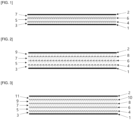
- the process of preparing the first application layer (4) of the super absorbent polymer and the first application layer (5) of the adhesive was repeated one more time to produce a second application layer (6) of the super absorbent polymer and an adhesive layer (second application layer of adhesive, 7).
- an absorbent body was manufactured by attaching a second nonwoven fabric (product name: Softhann ® , manufacturer: Sambo) (2).
- the amount of adhesive used in each adhesive layer was the same as 0.4 g, and the amount of super absorbent polymer used in each super absorbent polymer layer was the same as 6 g.
- the process of preparing the first application layer (4) of the super absorbent polymer and the first application layer (5) of the adhesive was repeated two more times to produce a second application layer (6) of the super absorbent polymer, a second application layer (7) of the adhesive, a third application layer (8) of the super absorbent polymer, and an adhesive layer (third application layer of adhesive, 9).
- an absorbent body was manufactured by attaching a second nonwoven fabric (product name: Softhann ® , manufacturer: Sambo) (2).
- the amount of adhesive used in each adhesive layer was the same as 0.3 g, and the amount of super absorbent polymer used in each super absorbent polymer layer was the same as 4 g.
- the process of preparing the first application layer (4) of the super absorbent polymer and the first application layer (5) of the adhesive was repeated three more times to produce a second application layer (6) of the super absorbent polymer, a second application layer (7) of the adhesive, a third application layer (8) of the super absorbent polymer, a third application layer (9) of the adhesive, a fourth application layer (10) of the super absorbent polymer, and an adhesive layer (11).
- an absorbent body was manufactured by attaching a second nonwoven fabric (product name: Softhann ® , manufacturer: Sambo) (2).
- the amount of adhesive used in each adhesive layer was the same as 0.24 g, and the amount of super absorbent polymer used in each super absorbent polymer layer was the same as 3 g.
- a first nonwoven fabric product name: Softhann ® , manufacturer: Sambo
- an adhesive product name: FLC7228AZP, manufacturer: HB Fuller
- a first nonwoven fabric product name: Softhann ® , manufacturer: Sambo
- 12 g of the super absorbent polymer prepared in Preparation Example was uniformly applied thereto at a feed rate of 2 g/s to prepare a super absorbent polymer application layer.
- 0.6 g of an adhesive was applied thereon in the same manner to prepare an adhesive layer, and then a second nonwoven fabric (product name: Softhann ® , manufacturer: Sambo) was attached thereto to prepare an absorbent body.
- the SAP retention rate in nonwoven fabric is tested by measuring the leakage of core super absorbent polymer in the nonwoven fabric.
- the amount of super absorbent polymer remaining in the absorbent body without leakage after vibrating each absorbent body of Examples and Comparative Examples was measured, and represented as a percentage.
- the vibration was performed by fixing a part 1 cm away from the top of the absorbent body to a vibration device (device name: BLM512OHP-100S, manufacturer: oriental motor), and then vibrating it 100 times in the vertical direction at a frequency of 65 times/min and an amplitude of 15 mm.
- the retention rate was calculated as (W1/WO)*100, where WO is the weight of the absorbent body before vibration and W1 is the weight of the absorbent body after vibration. This allows us to know the degree of SAP departure within the absorbent body due to vibration, so the above value is used as an indicator to check how much SAP is fixed in the absorbent body.
- the SAP filling rate refers to the area ratio occupied by the super absorbent polymer within the absorbent body, and is measured as follows:
- the absorbent body was dyed with a dye (product name: FD&C BLUE NO. 1 POWDER, manufacturer: SENSIENT) and dried. After confirming that only the super absorbent polymer part was selectively dyed, the area of the dyed part was measured with a color meter (device name: Labscan XE, manufacturer: Hunter lab) under the conditions of a spectral range of 400 nm to 700 nm, and a wavelength resolution of ⁇ 3 nm.
- W 4 (g) is a weight of the paper that absorbed the liquid emerged from the absorbent body for 2 minutes, 2 minutes after injecting physiological saline into the absorbent body under no pressure
- W 5 (g) is an initial weight of the paper
- W 6 (g) is a weight of the paper that absorbed the liquid emerged from the absorbent body for 2 minutes at a load of 0.42 psi after injecting physiological saline into the absorbent body under no pressure and under pressure.
Landscapes
- Health & Medical Sciences (AREA)
- Engineering & Computer Science (AREA)
- Chemical & Material Sciences (AREA)
- Public Health (AREA)
- Veterinary Medicine (AREA)
- Epidemiology (AREA)
- Life Sciences & Earth Sciences (AREA)
- Animal Behavior & Ethology (AREA)
- General Health & Medical Sciences (AREA)
- Materials Engineering (AREA)
- Hematology (AREA)
- Biomedical Technology (AREA)
- Heart & Thoracic Surgery (AREA)
- Vascular Medicine (AREA)
- Dispersion Chemistry (AREA)
- Chemical Kinetics & Catalysis (AREA)
- Manufacturing & Machinery (AREA)
- Textile Engineering (AREA)
- Absorbent Articles And Supports Therefor (AREA)
Applications Claiming Priority (3)
| Application Number | Priority Date | Filing Date | Title |
|---|---|---|---|
| KR20220153920 | 2022-11-16 | ||
| KR1020230158380A KR20240072069A (ko) | 2022-11-16 | 2023-11-15 | 흡수체의 제조방법 |
| PCT/KR2023/018479 WO2024106981A1 (fr) | 2022-11-16 | 2023-11-16 | Procédé de préparation d'un corps absorbant |
Publications (2)
| Publication Number | Publication Date |
|---|---|
| EP4455384A1 true EP4455384A1 (fr) | 2024-10-30 |
| EP4455384A4 EP4455384A4 (fr) | 2025-05-21 |
Family
ID=91085025
Family Applications (1)
| Application Number | Title | Priority Date | Filing Date |
|---|---|---|---|
| EP23892044.1A Pending EP4455384A4 (fr) | 2022-11-16 | 2023-11-16 | Procédé de préparation d'un corps absorbant |
Country Status (4)
| Country | Link |
|---|---|
| US (1) | US20250135063A1 (fr) |
| EP (1) | EP4455384A4 (fr) |
| JP (1) | JP2025503290A (fr) |
| WO (1) | WO2024106981A1 (fr) |
Family Cites Families (11)
| Publication number | Priority date | Publication date | Assignee | Title |
|---|---|---|---|---|
| JP3908403B2 (ja) * | 1999-02-22 | 2007-04-25 | 株式会社リブドゥコーポレーション | 使い捨て製品の吸収用積層体 |
| EP1473010A4 (fr) * | 2002-02-04 | 2008-03-26 | Nippon Catalytic Chem Ind | Materiau absorbant, procede de production de ce materiau et article absorbant a base de ce materiau |
| US8324446B2 (en) * | 2004-06-30 | 2012-12-04 | Kimberly-Clark Worldwide, Inc. | Unitary absorbent core with binding agents |
| JP2012183175A (ja) * | 2011-03-04 | 2012-09-27 | Sumitomo Seika Chem Co Ltd | 吸水シート構成体 |
| RU2568565C2 (ru) * | 2011-06-10 | 2015-11-20 | Дзе Проктер Энд Гэмбл Компани | Одноразовые подгузники |
| JP6316575B2 (ja) * | 2013-11-27 | 2018-04-25 | 株式会社リブドゥコーポレーション | 吸収体およびこれを備えた吸収性物品 |
| EP3389587A1 (fr) * | 2015-12-15 | 2018-10-24 | The Procter and Gamble Company | Noyau absorbant avec adhésif sans agent poisseux |
| KR102577709B1 (ko) * | 2018-01-16 | 2023-09-11 | 주식회사 엘지화학 | 고흡수성 수지의 제조 방법 |
| JP2020137685A (ja) * | 2019-02-27 | 2020-09-03 | 日本製紙クレシア株式会社 | 吸収性物品 |
| JP7549995B2 (ja) * | 2020-08-31 | 2024-09-12 | 日本製紙クレシア株式会社 | 吸収性物品 |
| US12491495B2 (en) * | 2021-01-14 | 2025-12-09 | Lg Chem, Ltd. | Method for preparing super absorbent polymer |
-
2023
- 2023-11-16 WO PCT/KR2023/018479 patent/WO2024106981A1/fr not_active Ceased
- 2023-11-16 JP JP2024545200A patent/JP2025503290A/ja active Pending
- 2023-11-16 EP EP23892044.1A patent/EP4455384A4/fr active Pending
- 2023-11-16 US US18/836,851 patent/US20250135063A1/en active Pending
Also Published As
| Publication number | Publication date |
|---|---|
| EP4455384A4 (fr) | 2025-05-21 |
| JP2025503290A (ja) | 2025-01-30 |
| US20250135063A1 (en) | 2025-05-01 |
| WO2024106981A1 (fr) | 2024-05-23 |
Similar Documents
| Publication | Publication Date | Title |
|---|---|---|
| EP3540001B1 (fr) | Résine hautement absorbante et procédé pour sa production | |
| EP3984633B1 (fr) | Agent absorbant l'eau | |
| JP4380873B2 (ja) | 吸水性樹脂粉末およびその用途 | |
| JP5374784B2 (ja) | 高吸収性を有する吸水性ポリマー構造体 | |
| EP2535361B1 (fr) | Résine absorbante, dont la surface est modifiée par un composé polymère cationique | |
| KR101719352B1 (ko) | 고흡수성 수지 조성물 | |
| EP3757153A1 (fr) | Polymère superabsorbant et procédé de fabrication de celui-ci | |
| EP4190843A1 (fr) | Polymère superabsorbant et son procédé de préparation | |
| EP3159361B1 (fr) | Résine absorbante et son procédé de préparation | |
| CN1305946C (zh) | 由吸水性的、主要开孔的交联酸官能加成聚合物泡沫形成的制品在卫生用品中的用途 | |
| EP1882701A1 (fr) | Procédé pour la production de particules de résine absorbant l'eau, particules de résine absorbant l'eau fabriquées par le procédé et absorbants et articles absorbants fabriqués en utilisant les particules | |
| JPH10505521A (ja) | 相異なる橋かけ結合度の区域を有する吸収性構造体およびその製法 | |
| KR20180019558A (ko) | 폴리(메트)아크릴산(염)계 입자상 흡수제 및 제조 방법 | |
| MXPA02007359A (es) | Articulo absorbente. | |
| JP2011074401A (ja) | 表面処理された吸水性樹脂およびその製造方法 | |
| JP2011511653A (ja) | 吸水剤を有する吸収性物品 | |
| US20240110018A1 (en) | Preparation Method of Super Absorbent Polymer and Super Absorbent Polymer Therefrom | |
| EP4317260A1 (fr) | Polymère superabsorbant et son procédé de production | |
| EP4455384A1 (fr) | Procédé de préparation d'un corps absorbant | |
| KR20220088354A (ko) | 고흡수성 수지 및 이의 제조 방법 | |
| EP4461280A1 (fr) | Corps absorbant et article d'hygiène | |
| US20250143938A1 (en) | Absorbent Body and Hygiene Article | |
| KR20240072069A (ko) | 흡수체의 제조방법 | |
| EP4446365A1 (fr) | Article absorbant | |
| EP4691627A1 (fr) | Absorbant d'eau particulaire, absorbeur contenant ledit absorbant d'eau particulaire, et produit sanitaire contenant ledit absorbeur |
Legal Events
| Date | Code | Title | Description |
|---|---|---|---|
| STAA | Information on the status of an ep patent application or granted ep patent |
Free format text: STATUS: THE INTERNATIONAL PUBLICATION HAS BEEN MADE |
|
| PUAI | Public reference made under article 153(3) epc to a published international application that has entered the european phase |
Free format text: ORIGINAL CODE: 0009012 |
|
| STAA | Information on the status of an ep patent application or granted ep patent |
Free format text: STATUS: REQUEST FOR EXAMINATION WAS MADE |
|
| 17P | Request for examination filed |
Effective date: 20240723 |
|
| AK | Designated contracting states |
Kind code of ref document: A1 Designated state(s): AL AT BE BG CH CY CZ DE DK EE ES FI FR GB GR HR HU IE IS IT LI LT LU LV MC ME MK MT NL NO PL PT RO RS SE SI SK SM TR |
|
| REG | Reference to a national code |
Ref country code: DE Ref legal event code: R079 Free format text: PREVIOUS MAIN CLASS: D04H0001407000 Ipc: D06M0015263000 |
|
| A4 | Supplementary search report drawn up and despatched |
Effective date: 20250417 |
|
| RIC1 | Information provided on ipc code assigned before grant |
Ipc: A61F 13/539 20060101ALI20250414BHEP Ipc: A61F 13/15 20060101ALI20250414BHEP Ipc: A61F 13/534 20060101ALI20250414BHEP Ipc: A61L 15/60 20060101ALI20250414BHEP Ipc: A61L 15/58 20060101ALI20250414BHEP Ipc: D06M 15/263 20060101AFI20250414BHEP |
|
| DAV | Request for validation of the european patent (deleted) | ||
| DAX | Request for extension of the european patent (deleted) |