EP4456234A1 - Micro-batterie électrochimique flexible et biorésorbable en ions na - Google Patents
Micro-batterie électrochimique flexible et biorésorbable en ions na Download PDFInfo
- Publication number
- EP4456234A1 EP4456234A1 EP23170468.5A EP23170468A EP4456234A1 EP 4456234 A1 EP4456234 A1 EP 4456234A1 EP 23170468 A EP23170468 A EP 23170468A EP 4456234 A1 EP4456234 A1 EP 4456234A1
- Authority
- EP
- European Patent Office
- Prior art keywords
- ion
- micro
- sodium
- battery according
- biocompatible
- Prior art date
- Legal status (The legal status is an assumption and is not a legal conclusion. Google has not performed a legal analysis and makes no representation as to the accuracy of the status listed.)
- Pending
Links
Images



Classifications
-
- H—ELECTRICITY
- H01—ELECTRIC ELEMENTS
- H01M—PROCESSES OR MEANS, e.g. BATTERIES, FOR THE DIRECT CONVERSION OF CHEMICAL ENERGY INTO ELECTRICAL ENERGY
- H01M10/00—Secondary cells; Manufacture thereof
- H01M10/05—Accumulators with non-aqueous electrolyte
- H01M10/054—Accumulators with insertion or intercalation of metals other than lithium, e.g. with magnesium or aluminium
-
- H—ELECTRICITY
- H01—ELECTRIC ELEMENTS
- H01M—PROCESSES OR MEANS, e.g. BATTERIES, FOR THE DIRECT CONVERSION OF CHEMICAL ENERGY INTO ELECTRICAL ENERGY
- H01M10/00—Secondary cells; Manufacture thereof
- H01M10/36—Accumulators not provided for in groups H01M10/05-H01M10/34
-
- H—ELECTRICITY
- H01—ELECTRIC ELEMENTS
- H01M—PROCESSES OR MEANS, e.g. BATTERIES, FOR THE DIRECT CONVERSION OF CHEMICAL ENERGY INTO ELECTRICAL ENERGY
- H01M4/00—Electrodes
- H01M4/02—Electrodes composed of, or comprising, active material
- H01M4/36—Selection of substances as active materials, active masses, active liquids
- H01M4/38—Selection of substances as active materials, active masses, active liquids of elements or alloys
- H01M4/381—Alkaline or alkaline earth metals elements
-
- H—ELECTRICITY
- H01—ELECTRIC ELEMENTS
- H01M—PROCESSES OR MEANS, e.g. BATTERIES, FOR THE DIRECT CONVERSION OF CHEMICAL ENERGY INTO ELECTRICAL ENERGY
- H01M4/00—Electrodes
- H01M4/02—Electrodes composed of, or comprising, active material
- H01M4/36—Selection of substances as active materials, active masses, active liquids
- H01M4/48—Selection of substances as active materials, active masses, active liquids of inorganic oxides or hydroxides
- H01M4/50—Selection of substances as active materials, active masses, active liquids of inorganic oxides or hydroxides of manganese
- H01M4/505—Selection of substances as active materials, active masses, active liquids of inorganic oxides or hydroxides of manganese of mixed oxides or hydroxides containing manganese for inserting or intercalating light metals, e.g. LiMn2O4 or LiMn2OxFy
-
- H—ELECTRICITY
- H01—ELECTRIC ELEMENTS
- H01M—PROCESSES OR MEANS, e.g. BATTERIES, FOR THE DIRECT CONVERSION OF CHEMICAL ENERGY INTO ELECTRICAL ENERGY
- H01M4/00—Electrodes
- H01M4/02—Electrodes composed of, or comprising, active material
- H01M4/36—Selection of substances as active materials, active masses, active liquids
- H01M4/58—Selection of substances as active materials, active masses, active liquids of inorganic compounds other than oxides or hydroxides, e.g. sulfides, selenides, tellurides, halogenides or LiCoFy; of polyanionic structures, e.g. phosphates, silicates or borates
- H01M4/5825—Oxygenated metallic salts or polyanionic structures, e.g. borates, phosphates, silicates, olivines
-
- H—ELECTRICITY
- H01—ELECTRIC ELEMENTS
- H01M—PROCESSES OR MEANS, e.g. BATTERIES, FOR THE DIRECT CONVERSION OF CHEMICAL ENERGY INTO ELECTRICAL ENERGY
- H01M4/00—Electrodes
- H01M4/02—Electrodes composed of, or comprising, active material
- H01M4/62—Selection of inactive substances as ingredients for active masses, e.g. binders, fillers
- H01M4/621—Binders
-
- H—ELECTRICITY
- H01—ELECTRIC ELEMENTS
- H01M—PROCESSES OR MEANS, e.g. BATTERIES, FOR THE DIRECT CONVERSION OF CHEMICAL ENERGY INTO ELECTRICAL ENERGY
- H01M4/00—Electrodes
- H01M4/02—Electrodes composed of, or comprising, active material
- H01M4/62—Selection of inactive substances as ingredients for active masses, e.g. binders, fillers
- H01M4/624—Electric conductive fillers
-
- H—ELECTRICITY
- H01—ELECTRIC ELEMENTS
- H01M—PROCESSES OR MEANS, e.g. BATTERIES, FOR THE DIRECT CONVERSION OF CHEMICAL ENERGY INTO ELECTRICAL ENERGY
- H01M4/00—Electrodes
- H01M4/02—Electrodes composed of, or comprising, active material
- H01M4/64—Carriers or collectors
- H01M4/66—Selection of materials
-
- H—ELECTRICITY
- H01—ELECTRIC ELEMENTS
- H01M—PROCESSES OR MEANS, e.g. BATTERIES, FOR THE DIRECT CONVERSION OF CHEMICAL ENERGY INTO ELECTRICAL ENERGY
- H01M50/00—Constructional details or processes of manufacture of the non-active parts of electrochemical cells other than fuel cells, e.g. hybrid cells
- H01M50/10—Primary casings; Jackets or wrappings
- H01M50/102—Primary casings; Jackets or wrappings characterised by their shape or physical structure
- H01M50/105—Pouches or flexible bags
-
- H—ELECTRICITY
- H01—ELECTRIC ELEMENTS
- H01M—PROCESSES OR MEANS, e.g. BATTERIES, FOR THE DIRECT CONVERSION OF CHEMICAL ENERGY INTO ELECTRICAL ENERGY
- H01M50/00—Constructional details or processes of manufacture of the non-active parts of electrochemical cells other than fuel cells, e.g. hybrid cells
- H01M50/10—Primary casings; Jackets or wrappings
- H01M50/116—Primary casings; Jackets or wrappings characterised by the material
- H01M50/121—Organic material
-
- H—ELECTRICITY
- H01—ELECTRIC ELEMENTS
- H01M—PROCESSES OR MEANS, e.g. BATTERIES, FOR THE DIRECT CONVERSION OF CHEMICAL ENERGY INTO ELECTRICAL ENERGY
- H01M2220/00—Batteries for particular applications
- H01M2220/30—Batteries in portable systems, e.g. mobile phone, laptop
-
- H—ELECTRICITY
- H01—ELECTRIC ELEMENTS
- H01M—PROCESSES OR MEANS, e.g. BATTERIES, FOR THE DIRECT CONVERSION OF CHEMICAL ENERGY INTO ELECTRICAL ENERGY
- H01M2300/00—Electrolytes
- H01M2300/0085—Immobilising or gelification of electrolyte
-
- Y—GENERAL TAGGING OF NEW TECHNOLOGICAL DEVELOPMENTS; GENERAL TAGGING OF CROSS-SECTIONAL TECHNOLOGIES SPANNING OVER SEVERAL SECTIONS OF THE IPC; TECHNICAL SUBJECTS COVERED BY FORMER USPC CROSS-REFERENCE ART COLLECTIONS [XRACs] AND DIGESTS
- Y02—TECHNOLOGIES OR APPLICATIONS FOR MITIGATION OR ADAPTATION AGAINST CLIMATE CHANGE
- Y02E—REDUCTION OF GREENHOUSE GAS [GHG] EMISSIONS, RELATED TO ENERGY GENERATION, TRANSMISSION OR DISTRIBUTION
- Y02E60/00—Enabling technologies; Technologies with a potential or indirect contribution to GHG emissions mitigation
- Y02E60/10—Energy storage using batteries
Definitions
- the present invention relates to the field of electrochemical accumulators, and more particularly sodium-ion (Na-ion) accumulators.
- the invention aims primarily to propose a new architecture of such accumulators, which allows them to be both bendable (flexible) and bioresorbable in an animal or a human body.
- An accumulator according to the invention can be implemented for powering implantable electronic systems.
- an accumulator to the invention can be used to power an Organic light-emitting diode (OLED), which is implantable in an animal or a human body.
- OLED Organic light-emitting diode
- an accumulator to the invention can be useful to fulfill the performances requirements of miniaturized sensors for Internet of Things (IoT) applications, such as electronic textiles, skin patches, drug delivery microchips, cochlear implants, etc...
- IoT Internet of Things
- a lithium-ion battery or accumulator normally comprises at least one electrochemical cell consisting of an electrolyte component 1 between a positive electrode or cathode 2 and a negative electrode or anode 3, a current collector 20 connected to the cathode 2, a current collector 30 connected to the anode 3 and, finally, a packaging 4 arranged to contain the electrochemical cell tightly while being passed through by a part of the current collectors 20, 30.
- the architecture of the conventional lithium-ion batteries comprises an anode, a cathode and an electrolyte.
- Several types of geometry of conventional architecture are known:
- the electrolyte component 1 can be in solid, liquid or gel form.
- the component can comprise a separator made of polymer, of ceramic or of microporous composite soaked with organic electrolyte or aqueous electrolytes or of ionic liquid type which allows the displacement of the lithium ion from the cathode to the anode for a charge and in reverse for a discharge, which generates the current.
- the electrolyte is generally a mixture of organic solvents, for example carbonates to which is added a lithium salt, typically LiPF6.
- the positive electrode or cathode 2 is composed of lithium cation insertion materials which are generally composite, like LiFePO 4 , LiCoO 2 , LiNi 0.33 Mn 0.33 Co 0.33 O 2 .
- the negative electrode or anode 3 is very often composed of graphite carbon or of Li 4 TiO 5 O 12 (titanate material), possibly also based on silicon or composite formed based on silicon.
- the current collector 20 connected to the positive electrode is generally made of aluminum.
- the current collector 30 connected to the negative electrode is generally made of copper, of nickel-plated copper or of aluminum.
- Electrodes 2, 3 for Li-ion accumulators are usually made according to a continuous process by a technique of coating the active insertion material on a metal strip, as current collector, to constitute the active continuous layer. These coating techniques are known by the terms “slot die” or “roll to roll transfer”.
- a lithium-ion battery or accumulator can obviously comprise a plurality of electrochemical cells which are stacked on top of one another.
- a Li-ion battery or accumulator uses a pair of materials on the anode and the cathode allowing it to operate at a high voltage level, typically equal to 3.6 volt.
- the aim is to produce either a thin and flexible lithium-ion accumulator or a rigid accumulator: the packaging is then either flexible or rigid and in the latter case constitutes a kind of housing.
- the flexible packagings are usually manufactured from a multilayer composite material, composed of a stacking of aluminum layers covered by one or more polymer films laminated by bonding.
- the rigid packagings are, for their part, used when the applications targeted are restrictive where a long lifetime is sought, with, for example, much higher pressures to be withstood and a stricter required tightness level, typically less than 10 -8 mbar.l/s, or in highly restrictive environments such as the aeronautic or space field.
- LOB Linear fiber-shaped Li-ion Batteries
- Bioresorbable micro-batteries are particularly attractive for powering implantable electronic systems, but such body safe devices have also a strong impact for a larger spectrum of Internet of Things (IoT) applications such as electronic textiles, skin patches, drug delivery microchips, cochlear implants, etc.
- IoT Internet of Things
- biodegradable batteries are highly interesting for providing energy to environment friendly wearable devices like abandoned sensors and solving the crucial issue of material recycling.
- rechargeable microgenerators for low-consumption electronics relies mainly on the lithium (Li) based technologies (LIBs) owing to several advantages such as high energy and power densities, versatility, span life...: [1], [2] and in terms of abundance, uniform distribution, low cost, and easy recycling: [3].
- Li lithium
- bioresorbable devices consist of primary systems using metallic electrodes, e.g., Mg, Zn, Mo, etc., and liquid electrolytes, in general a biological fluid like blood, saliva, urine, which are responsible for fluctuating electrochemical performances.
- metallic electrodes e.g., Mg, Zn, Mo, etc.
- liquid electrolytes in general a biological fluid like blood, saliva, urine, which are responsible for fluctuating electrochemical performances.
- the ideal batteries for IoT dedicated to medical implants should also be ultrathin, light, flexible, and fully integrable. Their manufacturing should also be compatible with Integrated Circuit technologies and microelectronic processes.
- the challenging task is to design flexible energy storage micro batteries showing high electrochemical performances that can be degraded by biological fluids and safely removed by the body.
- the very recent Sodium-ion Batteries offer a promising alternative as the main components of the batteries can be non-toxic and biocompatible.
- the electrolyte is a key component that governs the electrochemistry in a battery, but related research for SIBs is currently at the early stage.
- organic electrolytes have poor thermal stability, high flammability, and low heat capacity. In addition, organic electrolytes are potential hazards due to their volatility and toxicity.
- Solid polymer electrolytes still suffer from key drawbacks, including their low ionic conductivity and high interfacial resistance.
- Gel polymer electrolytes on the other hand combine the advantages of SPEs and conventional liquid electrolytes and provide a route toward the rational design of SIBs with improved safety performance and especially flexibility.
- GPEs Gel polymer electrolytes
- 3D-printed SIMs has been also investigated: [8].
- the resulting thick SIMs of a thickness of 1200 ⁇ m thick, showed a rate capability of 3.6 mAh.cm -2 at 40 mA.cm -2 and robust long-term cycle life up to 6000 cycles.
- Symmetric SIMs obtained from interdigitated Na 2 VTi(PO 4 ) 3 /C based electrodes and different aqueous electrolytes like simulated body fluids have been also tested: [10].
- SIM Na-ion micro-battery
- the aim of the invention is to address such need at least partly.
- the invention relates, under one of its aspects, to a Na-ion micro-battery (SIM), comprising:
- the first and/or the second collector is made of magnesium (Mg).
- Mg magnesium
- Other biocompatible materials can be implementable, such as Mo, Fe, Z, and alloys, e.g., FeCuZn, etc.
- the active material of the electrodes can be layered onto current collectors.
- the current collectors can also be deposited onto the slurry of the active material before subsequent deposition of the encapsulating material of the substrate, like PLGA.
- sodium manganate materials can be considered as positive electrode material.
- the active materials are then formulated as electrode slurries, with binder and carbon.
- Aqueous processing using CMC binder improve the sustainability and environmental impact of the battery technology.
- Na-CMC has been selected as it is not toxic and shows good solubility in water, low cost, biodegradability, and biocompatibility.
- the weight percentages of the active material, conductive carbon and binder components can be adapted.
- Na 0.44 MnO 2 (NMO) has been designated as it is regarded as one of the most promising (SIB) cathodes owing to its low cost, simple preparation, large capacity of 121 mAh.g -1 , and high stability: [10].
- the active material of the positive electrode is made of Na 0.44 MnO 2 (NMO). All biocompatible sodiated oxide materials can be implemented as active material of the positive electrode.
- the material is obtained by mixing 80 wt % NMO with 15 wt % acetylene black and with 5 wt % Na-carboxymethylcellulose (Na-CMC) using water as a solvent.
- NMO orthorhombic structure are favorable to transport the relatively large Na+ and capable of tolerating the stress generated during charging/discharging.
- NaTi 2 (PO 4 ) 3 (NTP) which large capacity of 133 mAh.g -1 , has been selected as negative electrode material due to delivering high performance toward NMO:[11].
- carbon composite NTP-C are preferred and prepared by a solid-state sintering method: [12].
- the active material of the negative electrode is made of a NaTi 2 (PO 4 ) 3 carbon (NTP-C) composite. All biocompatible materials, such as oxide materials or porous silicon can be implemented as active material of the negative electrode.
- the material is obtained by mixing 80 wt % NTP-C with 15 wt % acetylene black and with 5 wt % Na-carboxymethylcellulose (Na-CMC) using water as a solvent.
- the polymer electrolyte is a gel polymer composed of an ionic conductor polymer, Na salt, and plasticizer.
- the ionic conductor polymer may be selected among sodium carboxymethyl cellulose (Na-CMC), polyethylene glycol (PEG) .... Biocompatible Gel Polymer Electrolyte (GPE) can be implemented as polymer electrolyte.
- Na-CMC sodium carboxymethyl cellulose
- PEG polyethylene glycol
- GPE Biocompatible Gel Polymer Electrolyte
- the Na salt may be selected among Na 2 SO 4 , Na 2 SO 3 ....All biocompatible sodium salts, such as NaCl, can be implemented.
- the micro-battery can comprise an additional biocompatible and degradable film, as an electrical insulating separator, arranged between the two 3D electrodes (2; 3), preferably made of sodium carboxymethyl cellulose (Na-CMC).
- an additional biocompatible and degradable film as an electrical insulating separator, arranged between the two 3D electrodes (2; 3), preferably made of sodium carboxymethyl cellulose (Na-CMC).
- the thickness of the flexible encapsulating substrate is between 1 to 100 ⁇ m.
- the invention consists essentially in a sodium-ion micro-battery only composed of biocompatible materials that can be degraded and eliminated by biological fluids with 3D electrode design with micropillars which can ensure the mechanical features and enhanced electrochemical performance in terms of areal capacity, notably superior to 1mAh.cm -2 , cycling stability, and rate capability to power various implanted bioelectronic devices.
- the battery design relies on the assembling of two flexible thin film of foils forming the current collectors each carrying arrays of micropillar electrodes, which can insert reversibly Na+ ions and separated by a polymer electrolyte.
- the invention also concerns a use a micro-battery such as mentioned above to electrically supply a connected and communicating object, a biomedical device, a human implant, a bioelectronic device and a human/machine interface.
- the invention can truly lay the foundation of a future energy solution for healthcare IoT by powering subdermal implanted devices and systems for in-vivo sensing, able to operate in the body for a prescribed time and detect specific disease biomarkers/drugs, transmit physiologic relevant data on-demand and wirelessly (e.g., red/NIR light or radio frequency - RFID) through the skin, until the entire system will be fully and safely bio-resorbed.
- physiologic relevant data on-demand e.g., red/NIR light or radio frequency - RFID
- a micro-battery according to the invention can also deeply penetrate other IoT markets as the crucial recycling issue of toxic components can be overcome.
- Figures 1 to 2 relate to different examples of Li-ion accumulators, with flexible packagings according to the state of the art.
- Figure 3 represents a Na-ion micro-battery according to the invention which is configured to be implantable under skin and entirely bioresorbable.
- the micro-battery A includes the following components:
- the active materials are detailed below. They have been formulated as electrode slurries, with binder and carbon. Aqueous processing using CMC binder improves the sustainability and environmental impact of the battery technology.
- Na-CMC has been selected as it is not toxic and shows good solubility in water, low cost, biodegradability and biocompatibility.
- the weight percentages of the active material, conductive carbon and binder components are optimized.
- the flexible substrate 6 may be made of PLGA or polyester urethane polymers used to encapsulate the electrochemical core 1, 2, 3.
- the thickness of the encapsulating flexible substrate 6 can be adjusted between 1 ⁇ m to 100 ⁇ m to control the degradation starting date of the micro-battery.
- Each of the electrode formulations is deposited on a Mg thin film as current collector 20, 30 by doctor blade technique.
- Laser ablation is used to create vertical arrays of micropillars 24, 34 which are extending from the current collectors 20, 30.
- the technics can be made according to the procedure in [13]. Size and spacing between adjacent micropillars 24, 34 can be adjusted to improve the capacity by a factor 5 while ensuring the flexible feature of the electrodes 2, 3.
- a polymer material is used as the electrolyte.
- a polymer layer acting also as separator can be deposited by drop-casting or spin-coating on flexible microstructured electrodes before assembling the full cells.
- a bioresorbable separator e.g., a cellulose based membrane, can also be used to avoid the risk of short-circuit.
- the active material 23 of the cathode 3 is Na 0.44 MnO 2 (NMO). This material is a sodium-ion biocompatible cathode, and its advantages are low cost, simple preparation, large capacity (121 mAh.g-1 vs. Na+/Na) and high stability.
- NMO powder was synthesized using the co-precipitation route.
- the as-prepared NMO has been characterized by XRD and Raman spectroscopy, as shown on Figure 5 , respectively a) and b). The results agree with previous reports, such as [15].
- the cathode paste was prepared by mixing 80 wt % active material (i.e., as-prepared NMO) with 15 wt % acetylene black (biocompatible conductive agent) and 5 wt % Na-CMC as the biocompatible binder using water as a solvent and was deposited on Al current collector.
- active material i.e., as-prepared NMO
- acetylene black biocompatible conductive agent
- Na-CMC as the biocompatible binder
- Figures 6 a) and b) illustrate respectively the typical charge/discharge profile and the cycling performance at 0.1C rate (10 hours of charge or discharge, respectively).
- the capacity obtained at the second cycle is 1.1 mAh cm -2 (110 mAhg -1 ) and retention of 94% of initial capacity was observed after 30 cycles.
- This paste cathode formulation is therefore achieving our objective in terms of capacity and stability.
- the active material 33 of the anode 2 is a titanium based NASICON compound, typically NaTi2(PO4)3 (NTP). This material is considered as super ionic conductor and biocompatible electrode material that possess high specific capacity, good structural stability, and cyclability for non-aqueous sodium ion batteries.
- NTP suffers from poor electronic conductivity, so in order to remove the electronic conductivity limitation the synthesis of NTP is further optimized by mixing it with carbon in order to obtain ultrafast rate capability and superior high-rate cycling stability.
- NTP-C The synthesis of NTP-C has been achieved by a solid-state method.
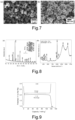
- Figure 7 are SEM images of the NTP-C composite morphology with an aggregate size in the range of 0.1-0.4 ⁇ m intimately encapsulated by the carbon black.
- the NTP crystallites have equiaxed shape and are consistent with that reported in literature [16].
- the as-prepared NTP-C has been characterized by XRD and Raman spectroscopy, as shown on Figure 8 , respectively a) and b). The results agree with previous report, such as [17].
- the negative electrode paste was obtained by mixing 80 wt % active material (i.e., as-prepared NTP-C) with 15 wt % acetylene black (biocompatible conductive agent) and 5 wt % Na-CMC as the biocompatible binder using water as a solvent and was deposited on Al current collector.
- active material i.e., as-prepared NTP-C
- acetylene black biocompatible conductive agent
- the profiles exhibit a flat potential plateau at around 2.1 V delivering a discharge capacity of 125 mAhg -1 (1.25 mAh.cm -2 ) at first cycle.
- This paste electrode formulation is therefore achieving the required performances in terms of capacity and stability.
- Porous Si membranes have been also tested as potential anode material. Unfortunately, the general performance was poor due to the irreversible insertion of Na ions leading to the complete loss of capacity after the first discharge, as shown on Figure 10 .
- Various polymer electrolytes were prepared by using sodium carboxymethyl cellulose (Na-CMC) or polyvinyl alcohol (PVA) as polymer material, sodium sulphate (Na2SO4) as salt (mass ratio 3:1), glycerin as plasticizer, and deionized water (DI) as solvent.
- Na-CMC sodium carboxymethyl cellulose
- PVA polyvinyl alcohol
- Na2SO4 sodium sulphate
- DI deionized water
- Table 1 summarizes the composition of each constituent of the polymer electrolytes and the corresponding electrochemical response.
- Electrolyte Number Polymer Salt Plasticizer Solvent Electrochemical response 1 Na-CMC Na 2 SO 4 ---------- DI - 2 Na-CMC Na 2 SO 4 50 ⁇ l of glycerin DI - 3 PVA Na 2 SO 4 ---------- DI - 4 PVA Na 2 SO 4 50 ⁇ l of glycerin DI - 5 Na-CMC Na 2 SO 4 5 ml of glycerin DI +++
- Electrolyte formulations carrying no plasticizer, or a low amount of glycerin revealed a rigid morphology while electrolyte N°5 exhibited a gel type texture.
- Electrochemical tests performed in a half-cell configuration using anode and cathode previously described have shown no electrochemical activity (battery is not charging) due to the low ionic conductivity of Na+ in solid-state electrolytes.
- electrolyte N°5 promoting a fast Na+ transport has been selected for the design of a full electrochemical cell 1,2,3.
- Figure 11 a) and b) show respectively the biodisintegration rate of (a) electrolyte covered-NMO based paste and (b) electrolyte covered-NTP-C based paste.
- Disintegration of electrolyte-coated electrodes 2, 3 in physiological fluid was calculated as the percentage of difference in mass of electrode material to the initial mass.
- Figure 12 are SEM images of cathode (a) before disintegration, (b) after 6 days; Electrolyte-covered cathode (c) before disintegration, (d) after 6 days; Anode (e) before disintegration, (f) after 6 days; Electrolyte-covered anode (g) before disintegration, and (h) after 6 days.
- a micro-battery composed of electrolyte 1 coated anode 2 and cathode 3 materials was assembled and electrochemically characterized to obtain the charge-discharge profile.
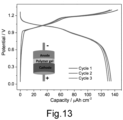
- Figure 13 shows the first three charge-discharge cycles of the first NTP/polymer electrolyte/NMO prototype at a current of 10 ⁇ A.
- the discharge capacity of the full micro-battery attains 138 ⁇ Ah.cm - 2 .
- micro-battery prototype provided charge storage properties and it can be fully disintegrated in a biological medium.
- High performance biodegradable micro batteries for implantable applications can be foreseen.
- an additional biocompatible and degradable film as an electrical insulating separator.
- This additional film is preferably made of sodium carboxymethyl cellulose (Na-CMC).
- a thin layer of gold can be layered for example by evaporation onto said collector.
Landscapes
- Chemical & Material Sciences (AREA)
- Chemical Kinetics & Catalysis (AREA)
- Electrochemistry (AREA)
- General Chemical & Material Sciences (AREA)
- Engineering & Computer Science (AREA)
- Materials Engineering (AREA)
- Inorganic Chemistry (AREA)
- Manufacturing & Machinery (AREA)
- Crystallography & Structural Chemistry (AREA)
- Battery Electrode And Active Subsutance (AREA)
- Secondary Cells (AREA)
Priority Applications (4)
| Application Number | Priority Date | Filing Date | Title |
|---|---|---|---|
| EP23170468.5A EP4456234A1 (fr) | 2023-04-27 | 2023-04-27 | Micro-batterie électrochimique flexible et biorésorbable en ions na |
| KR1020257039832A KR20260010711A (ko) | 2023-04-27 | 2024-04-25 | Na-이온 생체흡수성 및 유연성 전기화학 마이크로-배터리 |
| CN202480035784.3A CN121399746A (zh) | 2023-04-27 | 2024-04-25 | Na离子生物可吸收型柔性电化学微电池 |
| PCT/EP2024/061457 WO2024223772A1 (fr) | 2023-04-27 | 2024-04-25 | Micro-batterie électrochimique biorésorbable ey flexible à ions na |
Applications Claiming Priority (1)
| Application Number | Priority Date | Filing Date | Title |
|---|---|---|---|
| EP23170468.5A EP4456234A1 (fr) | 2023-04-27 | 2023-04-27 | Micro-batterie électrochimique flexible et biorésorbable en ions na |
Publications (1)
| Publication Number | Publication Date |
|---|---|
| EP4456234A1 true EP4456234A1 (fr) | 2024-10-30 |
Family
ID=86272383
Family Applications (1)
| Application Number | Title | Priority Date | Filing Date |
|---|---|---|---|
| EP23170468.5A Pending EP4456234A1 (fr) | 2023-04-27 | 2023-04-27 | Micro-batterie électrochimique flexible et biorésorbable en ions na |
Country Status (4)
| Country | Link |
|---|---|
| EP (1) | EP4456234A1 (fr) |
| KR (1) | KR20260010711A (fr) |
| CN (1) | CN121399746A (fr) |
| WO (1) | WO2024223772A1 (fr) |
Citations (10)
| Publication number | Priority date | Publication date | Assignee | Title |
|---|---|---|---|---|
| US20060121348A1 (en) | 2004-11-09 | 2006-06-08 | Satoshi Mizutani | Anode active material and battery |
| US7335448B2 (en) | 2002-05-30 | 2008-02-26 | Matsushita Electric Industrial Co., Ltd. | Lithium ion secondary battery |
| US7338733B2 (en) | 2002-04-30 | 2008-03-04 | Sanyo Electric Co., Ltd. | Battery pack |
| US20080057392A1 (en) | 2006-08-31 | 2008-03-06 | Nissan Motor Co., Ltd. | Battery module |
| US20080060189A1 (en) | 2006-09-08 | 2008-03-13 | Nec Tokin Corporation | Method for production of stacked battery |
| US7348098B2 (en) | 2000-10-13 | 2008-03-25 | Matsushita Electric Industrial Co., Ltd. | Flat prismatic battery |
| US20100087885A1 (en) * | 2008-10-03 | 2010-04-08 | Cardiac Pacemakers, Inc | Biosorbable battery and related methods |
| US20100119941A1 (en) * | 2007-04-02 | 2010-05-13 | Koninklijke Philips Electronics N.V. | Electrochemical energy source and electronic device provided with such an electrochemical energy source |
| US20150118526A1 (en) * | 2012-04-30 | 2015-04-30 | Carnegie Mellon University | A water-activated, ingestible battery |
| KR20190110777A (ko) * | 2018-03-21 | 2019-10-01 | 서울대학교산학협력단 | 생분해성 2차 전지 |
-
2023
- 2023-04-27 EP EP23170468.5A patent/EP4456234A1/fr active Pending
-
2024
- 2024-04-25 CN CN202480035784.3A patent/CN121399746A/zh active Pending
- 2024-04-25 KR KR1020257039832A patent/KR20260010711A/ko active Pending
- 2024-04-25 WO PCT/EP2024/061457 patent/WO2024223772A1/fr not_active Ceased
Patent Citations (10)
| Publication number | Priority date | Publication date | Assignee | Title |
|---|---|---|---|---|
| US7348098B2 (en) | 2000-10-13 | 2008-03-25 | Matsushita Electric Industrial Co., Ltd. | Flat prismatic battery |
| US7338733B2 (en) | 2002-04-30 | 2008-03-04 | Sanyo Electric Co., Ltd. | Battery pack |
| US7335448B2 (en) | 2002-05-30 | 2008-02-26 | Matsushita Electric Industrial Co., Ltd. | Lithium ion secondary battery |
| US20060121348A1 (en) | 2004-11-09 | 2006-06-08 | Satoshi Mizutani | Anode active material and battery |
| US20080057392A1 (en) | 2006-08-31 | 2008-03-06 | Nissan Motor Co., Ltd. | Battery module |
| US20080060189A1 (en) | 2006-09-08 | 2008-03-13 | Nec Tokin Corporation | Method for production of stacked battery |
| US20100119941A1 (en) * | 2007-04-02 | 2010-05-13 | Koninklijke Philips Electronics N.V. | Electrochemical energy source and electronic device provided with such an electrochemical energy source |
| US20100087885A1 (en) * | 2008-10-03 | 2010-04-08 | Cardiac Pacemakers, Inc | Biosorbable battery and related methods |
| US20150118526A1 (en) * | 2012-04-30 | 2015-04-30 | Carnegie Mellon University | A water-activated, ingestible battery |
| KR20190110777A (ko) * | 2018-03-21 | 2019-10-01 | 서울대학교산학협력단 | 생분해성 2차 전지 |
Non-Patent Citations (15)
| Title |
|---|
| F. GEBERT ET AL.: "Polymer electrolytes for sodium-ion batteries", ENERGY STORAGE MATER, vol. 36, 2021, pages 10 |
| G. XU ET AL., ELECTROCHIM. ACTA, vol. 254, 2017, pages 328 |
| J. MA ET AL.: "3D Printing Flexible Sodium-Ion Micro batteries with Ultrahigh Areal Capacity and Robust Rate Capability", ADV. MATER., vol. 34, 2022, pages 2205569 |
| LE T.N. HUYNH ET AL., ENERGY STORAGE, vol. 2, 2020, pages e121 |
| M. NASRELDINR. DELATTREB. MARCHIORIM. RAMUZS. MARIAJ. L. DE BOUGRENETT. DJENIZIAN: "Microstructured electrodes supported on serpentine interconnects for stretchable electronics", APL. MATER, vol. 7, 2019, XP012235695, DOI: 10.1063/1.5085160 |
| P. JOHANSSON ET AL.: "Na-Ion Batteries - State of the Art and Prospects, in Series on Chemistry, Energy and the Environment", PROSPECTS FOR LI-ION BATTERIES AND EMERGING ENERGY ELECTROCHEMICAL SYSTEMS, 2018, pages 161 - 235 |
| S. MUKHERJEEA. ALBERTENGOT. DJENIZIAN: "Beyond flexible Li-ion battery systems for soft electronics", ENERGY STORAGE MATER, vol. 42, 2021, pages 773 |
| S. STAUSS ET AL.: "Biocompatible Batteries-Materials and Chemistry, Fabrication, Applications, and Future Prospects", BULL. CHEM. SOC. JPN., vol. 91, 2018, pages 492 |
| S. ZHENG ET AL.: "Ionogel-based sodium ion micro-batteries with a 3D Na-ion diffusion mechanism enable ultrahigh rate capability", ENERGY ENVIRON. SCI., vol. 13, 2020, pages 821 |
| X. CAO ET AL.: "Facile synthesis of NaTi (PO ) -carbon composite through solid state method and its application in aqueous sodium ion battery", MATER. LETT., vol. 231, 2018, pages 183, XP085449115, DOI: 10.1016/j.matlet.2018.08.020 |
| X. HE ET AL., NANO ENERGY, vol. 27, 2016, pages 602 |
| X. HUANG ET AL.: "A Fully Biodegradable Battery for Self-Powered Transients Implants", SMALL, vol. 14, 2018, pages 1800994, XP055934505, DOI: 10.1002/smll.201800994 |
| X. ZHOU ET AL.: "Research progress of tunnel-structured Na0.44Mn02 cathode for sodium-ion batteries: a mini review", ELECTROCHEM. COM., vol. 122, 2021, pages 106897 |
| Z. GUO ET AL.: "Multi-functional Flexible Aqueous Sodium-ion Batteries with High Safety", CHEM, vol. 3, 2017, pages 348 |
| Z. LI ET AL., ADV. ENERGY MATER., vol. 3, 2013, pages 290 |
Also Published As
| Publication number | Publication date |
|---|---|
| KR20260010711A (ko) | 2026-01-21 |
| WO2024223772A1 (fr) | 2024-10-31 |
| CN121399746A (zh) | 2026-01-23 |
Similar Documents
| Publication | Publication Date | Title |
|---|---|---|
| KR101862665B1 (ko) | 펄스 전류 소결 방식에 의한 고체 상태의 배터리 제조 방법 | |
| KR100416098B1 (ko) | 캐소드 전극, 이의 제조방법 및 이를 채용한 리튬 설퍼 전지 | |
| ES2373931T3 (es) | Generador electroquímico de litio que funciona con un electrolito acuoso. | |
| US11362366B2 (en) | Secondary battery composite electrolyte, secondary battery, and battery pack | |
| EP1994592B1 (fr) | Microbatterie tridimensionnelle | |
| US12243980B2 (en) | Multi-layer electrolyte assembly for lithium batteries | |
| KR101876861B1 (ko) | 전고체 리튬이차전지용 복합 고체전해질 및 그의 제조방법 | |
| EP2658012A1 (fr) | Batterie rechargeable au lithium | |
| US9564641B2 (en) | Active material, electrode, lithium ion secondary battery, and method for manufacturing active material | |
| US11223088B2 (en) | Low-temperature ceramic-polymer nanocomposite solid state electrolyte | |
| CN1551385A (zh) | 锂二次电池用正极及锂二次电池 | |
| US20230155168A1 (en) | All Solid-State Lithium-Ion Battery Incorporating Electrolyte-Infiltrated Composite Electrodes | |
| KR101905777B1 (ko) | 비결정-합금 집전체를 구비한 애노드 격실 | |
| EP4216331A1 (fr) | Membrane électrolytique solide et batterie entièrement solide comprenant celle-ci | |
| US8460831B2 (en) | Paste-like mass with inorganic, liquid conductors and layers and electrochemical elements produced therefrom | |
| CN1938895A (zh) | 具有非水中间层构造的受保护的活性金属电极和电池组电池结构 | |
| WO2023018449A1 (fr) | Électrolytes polymères en gel sec | |
| KR20250004914A (ko) | 전극 적층체, 그 제조 방법 및 전기 화학 소자 | |
| EP4456234A1 (fr) | Micro-batterie électrochimique flexible et biorésorbable en ions na | |
| EP4685902A1 (fr) | Accumulateur électrochimique bio-éliminable aux ions sodium comprenant des pastilles d'électrode enrobées par un film mince collecteur de courant, procédé de fabrication associé et solution de recharge sans fil | |
| Pei et al. | A solid composite electrolyte of 3D framework Li6. 25La3Sn1. 25Bi0. 75O12 for rechargeable solid-state batteries | |
| KR101115397B1 (ko) | 고체 나트륨 전지 및 그의 제조 방법 | |
| CN115966756A (zh) | 一种固态电解质材料及其制备方法与应用 | |
| JP2011003450A (ja) | 全固体型ポリマー電池 | |
| EP4625511A1 (fr) | Batterie secondaire à l'état solide et procédés de préparation et de charge de la batterie secondaire batterie secondaire à l'état solide |
Legal Events
| Date | Code | Title | Description |
|---|---|---|---|
| PUAI | Public reference made under article 153(3) epc to a published international application that has entered the european phase |
Free format text: ORIGINAL CODE: 0009012 |
|
| STAA | Information on the status of an ep patent application or granted ep patent |
Free format text: STATUS: THE APPLICATION HAS BEEN PUBLISHED |
|
| AK | Designated contracting states |
Kind code of ref document: A1 Designated state(s): AL AT BE BG CH CY CZ DE DK EE ES FI FR GB GR HR HU IE IS IT LI LT LU LV MC ME MK MT NL NO PL PT RO RS SE SI SK SM TR |
|
| STAA | Information on the status of an ep patent application or granted ep patent |
Free format text: STATUS: REQUEST FOR EXAMINATION WAS MADE |
|
| 17P | Request for examination filed |
Effective date: 20250430 |