EP4459492A1 - Verfahren und system zur erzeugung anonymisierter 3d-daten - Google Patents
Verfahren und system zur erzeugung anonymisierter 3d-daten Download PDFInfo
- Publication number
- EP4459492A1 EP4459492A1 EP23171257.1A EP23171257A EP4459492A1 EP 4459492 A1 EP4459492 A1 EP 4459492A1 EP 23171257 A EP23171257 A EP 23171257A EP 4459492 A1 EP4459492 A1 EP 4459492A1
- Authority
- EP
- European Patent Office
- Prior art keywords
- data
- alternative
- pattern
- patterns
- feature
- Prior art date
- Legal status (The legal status is an assumption and is not a legal conclusion. Google has not performed a legal analysis and makes no representation as to the accuracy of the status listed.)
- Pending
Links
Images

Classifications
-
- G—PHYSICS
- G06—COMPUTING OR CALCULATING; COUNTING
- G06F—ELECTRIC DIGITAL DATA PROCESSING
- G06F21/00—Security arrangements for protecting computers, components thereof, programs or data against unauthorised activity
- G06F21/60—Protecting data
- G06F21/62—Protecting access to data via a platform, e.g. using keys or access control rules
- G06F21/6218—Protecting access to data via a platform, e.g. using keys or access control rules to a system of files or objects, e.g. local or distributed file system or database
- G06F21/6245—Protecting personal data, e.g. for financial or medical purposes
- G06F21/6254—Protecting personal data, e.g. for financial or medical purposes by anonymising data, e.g. decorrelating personal data from the owner's identification
-
- G—PHYSICS
- G06—COMPUTING OR CALCULATING; COUNTING
- G06T—IMAGE DATA PROCESSING OR GENERATION, IN GENERAL
- G06T17/00—Three-dimensional [3D] modelling for computer graphics
- G06T17/20—Finite element generation, e.g. wire-frame surface description, tesselation
-
- G—PHYSICS
- G06—COMPUTING OR CALCULATING; COUNTING
- G06T—IMAGE DATA PROCESSING OR GENERATION, IN GENERAL
- G06T19/00—Manipulating three-dimensional [3D] models or images for computer graphics
-
- G—PHYSICS
- G06—COMPUTING OR CALCULATING; COUNTING
- G06T—IMAGE DATA PROCESSING OR GENERATION, IN GENERAL
- G06T19/00—Manipulating three-dimensional [3D] models or images for computer graphics
- G06T19/20—Editing of three-dimensional [3D] images, e.g. changing shapes or colours, aligning objects or positioning parts
-
- G—PHYSICS
- G06—COMPUTING OR CALCULATING; COUNTING
- G06T—IMAGE DATA PROCESSING OR GENERATION, IN GENERAL
- G06T3/00—Geometric image transformations in the plane of the image
- G06T3/40—Scaling of whole images or parts thereof, e.g. expanding or contracting
-
- G—PHYSICS
- G06—COMPUTING OR CALCULATING; COUNTING
- G06T—IMAGE DATA PROCESSING OR GENERATION, IN GENERAL
- G06T5/00—Image enhancement or restoration
- G06T5/50—Image enhancement or restoration using two or more images, e.g. averaging or subtraction
-
- G—PHYSICS
- G06—COMPUTING OR CALCULATING; COUNTING
- G06T—IMAGE DATA PROCESSING OR GENERATION, IN GENERAL
- G06T7/00—Image analysis
- G06T7/10—Segmentation; Edge detection
- G06T7/11—Region-based segmentation
-
- G—PHYSICS
- G06—COMPUTING OR CALCULATING; COUNTING
- G06V—IMAGE OR VIDEO RECOGNITION OR UNDERSTANDING
- G06V10/00—Arrangements for image or video recognition or understanding
- G06V10/40—Extraction of image or video features
- G06V10/44—Local feature extraction by analysis of parts of the pattern, e.g. by detecting edges, contours, loops, corners, strokes or intersections; Connectivity analysis, e.g. of connected components
-
- G—PHYSICS
- G06—COMPUTING OR CALCULATING; COUNTING
- G06V—IMAGE OR VIDEO RECOGNITION OR UNDERSTANDING
- G06V40/00—Recognition of biometric, human-related or animal-related patterns in image or video data
- G06V40/10—Human or animal bodies, e.g. vehicle occupants or pedestrians; Body parts, e.g. hands
- G06V40/16—Human faces, e.g. facial parts, sketches or expressions
- G06V40/168—Feature extraction; Face representation
-
- G—PHYSICS
- G06—COMPUTING OR CALCULATING; COUNTING
- G06T—IMAGE DATA PROCESSING OR GENERATION, IN GENERAL
- G06T2207/00—Indexing scheme for image analysis or image enhancement
- G06T2207/20—Special algorithmic details
- G06T2207/20212—Image combination
- G06T2207/20221—Image fusion; Image merging
-
- G—PHYSICS
- G06—COMPUTING OR CALCULATING; COUNTING
- G06T—IMAGE DATA PROCESSING OR GENERATION, IN GENERAL
- G06T2219/00—Indexing scheme for manipulating 3D models or images for computer graphics
- G06T2219/20—Indexing scheme for editing of 3D models
- G06T2219/2021—Shape modification
Definitions
- the present invention pertains to a computer-implemented method and a computer system for generating anonymized three-dimensional (3D) data relating to a 3D mesh or point cloud.
- the 3D data is anonymized by removing sensitive 3D information from the mesh or point cloud and replacing it with 3D information that appears natural so that the anonymization is not apparent to a human user ("Deep Natural Anonymization").
- the sensitive 3D information to be anonymized may comprise human faces, 3D texts or similar shapes.
- image data of the same environment is anonymized together with the 3D data, e.g. in order to generate an anonymized colorized 3D point cloud.
- the 3D data may be captured by a laser scanner or an arrangement of time-of-flight cameras and be stored as a mesh or a point cloud.
- the image data may be used for providing colour and brightness information to the 3D data, e.g. as a colorized 3D point cloud.
- EP 3 333 541 A2 discloses a surveying system for capturing images and 3D point clouds of a surrounding, wherein faces and license plates may be recognized in the images and then are anonymized the 3D point cloud by removing or blurring the respective points of the point cloud.
- a first aspect of the invention pertains to a computer-implemented method for generating anonymized three-dimensional data (3D data) of a surrounding, the surrounding comprising a multitude of three-dimensional features (3D features) of a plurality of feature categories, the plurality of feature categories including a first feature category, 3D features of which being designated for anonymization.
- the method comprises providing 3D data of the surrounding, the 3D data comprising information about a mesh or a point cloud comprising three-dimensional patterns (3D patterns) of a plurality of pattern types, the 3D patterns corresponding to the 3D features in the surrounding, wherein a first pattern type corresponds to the first feature category.
- At least a first portion of the mesh or point cloud that comprises at least a first 3D pattern of the first pattern type, the first portion of the mesh or point cloud corresponding to a first data portion of the 3D data.
- At least one alternative 3D pattern for the first pattern type is obtained, each alternative 3D pattern comprising pre-defined or generated 3D data.
- An anonymization algorithm is used to replace the first data portion with alternative 3D data comprising at least one alternative 3D pattern of the first pattern type to generate anonymized 3D data.
- identifying the first portion of the mesh or point cloud is based on the 3D data, particularly only based on the 3D data.
- identifying the first portion of the mesh or point cloud is performed by the anonymization algorithm.
- identifying the first portion of the mesh or point cloud comprises detecting, in the 3D data, at least one shadow on a surface in the surrounding, which shadow results from a 3D feature that is positioned between the surface and a reality capture device capturing the 3D data (shadow-casting feature), wherein the shadow-casting feature belongs to the first feature category.
- Replacing the 3D data comprises replacing the detected shadow with alternative 3D data corresponding to the alternative 3D pattern of the first pattern type used for replacing the shadow-casting feature.
- the shadow may be a data gap on the surface, fully or partially having the shape of the shadow-casting feature. However, the shadow itself does not need to belong to the first pattern type.
- the method comprises receiving anonymization information about one or more designated feature categories, features of which being designated for anonymization.
- the anonymization information is received as a user input, the user input designating one or more feature categories for anonymization. For instance, one or more feature categories are provided to a user and the user input comprises a selection of one or more feature categories, wherein features belonging to the selected feature categories are designated for anonymization.
- the user input may comprise at least one alphanumeric character, e.g. a text or number comprising plurality of alphanumeric characters, and/or a typeface for the alphanumeric characters, e.g. at least one of a font, size, weight, slope and width.
- alphanumeric character e.g. a text or number comprising plurality of alphanumeric characters
- typeface for the alphanumeric characters e.g. at least one of a font, size, weight, slope and width.
- the anonymization algorithm receives image data of the surrounding, correlates the image data with the 3D data, and replaces a first portion of the image data with alternative image data, the first portion of the image data corresponding to the first portion of the mesh or point cloud.
- a set of alternative image data is then assigned to each of the alternative 3D patterns and the image data is replaced with at least a part of the set of alternative image data assigned to the alternative 3D data replacing the first portion of the 3D data.
- the method comprises identifying at least a first portion in the image data that images at least one feature of the first feature category, identifying the first portion in the mesh or point cloud comprises determining, based on the 3D data, whether the feature in the first portion of the image data is a 3D feature, and the first portion of the 3D data and the first portion of the image data are only replaced if the feature is three-dimensional.
- the first feature category comprises only 3D features.
- the method comprises determining a pose of the first 3D pattern.
- the alternative 3D patterns comprise pre-defined patterns comprising pre-defined 3D data
- replacing the 3D data comprises selecting, based on the determined pose, an alternative pattern to replace the 3D data.
- replacing the 3D data comprises adjusting a pose of the alternative 3D pattern based on the determined pose. Preferably, a pose of the selected alternative 3D pattern matches the determined pose.
- replacing the 3D data comprises adjusting a size and/or resolution of the alternative 3D pattern to match a size and/or resolution, respectively, of the first pattern.
- the method comprises providing an indicator to indicate that the 3D data has been replaced.
- it can be added directly to the replaced 3D data or to 2D data corresponding to the replaced 3D data.
- the indicator may be provided as meta information and not be directly visible in the mesh or point cloud or the 2D data.
- the alternative 3D patterns comprise pre-defined patterns comprising pre-defined 3D data, the pre-defined patterns being retrieved from a database comprising a plurality of pre-defined 3D patterns for a plurality of pattern types, and the method comprises determining a pattern type of the first 3D pattern from the plurality of pattern types.
- the alternative 3D patterns comprise user-defined patterns comprising 3D data that is generated based on a user input.
- the alternative 3D patterns comprise user-adapted patterns comprising pre-defined 3D data that is adapted based on a user input.
- the alternative 3D patterns comprise pre-defined patterns comprising pre-defined 3D data
- the method comprising presenting a plurality of pre-defined patterns for the first pattern type to a user and receiving a user input with a selection of a pre-defined pattern, wherein the 3D data is replaced with the pre-defined 3D data of the selected pre-defined pattern.
- the 3D data is point cloud data comprising information about a point cloud including spatial coordinates of a multitude of points in the surrounding, the 3D features in the surrounding corresponding to 3D patterns in the point cloud, and the pre-defined or generated 3D data is pre-defined or generated point cloud data.
- providing the 3D data of the surrounding comprises capturing the 3D data using a reality capture device comprising at least one laser scanner and/or time-of-flight camera.
- the method may be performed by the reality capture device and comprises providing the anonymized 3D data to one or more external devices.
- Some embodiments pertain to a computer-implemented method for generating an anonymized colorized point cloud of a surrounding, the surrounding comprising a multitude of 3D features of a plurality of feature categories, the plurality of feature categories including at least a first feature category, 3D features of which being designated for anonymization.
- a method comprises providing image data and point cloud data of the surrounding, and correlating the image data with the point cloud data, the point cloud data comprising information about a point cloud including spatial coordinates of a multitude of points in the surrounding, the 3D features in the surrounding corresponding to 3D patterns in the point cloud, wherein a first pattern type corresponds to the first feature category.
- Such a method further comprises an anonymization algorithm
- a second aspect of the invention pertains to a computer system that is configured for performing the method according to the first aspect of the invention.
- the computer system may be a part of a reality capture device comprising at least one laser scanner and/or time-of-flight camera or comprise such a reality capture device, wherein the reality capture device may capture the 3D data.
- a third aspect of the invention pertains to a computer program product comprising program code for performing the method according to the first aspect, for instance when running on the computer system according to the second aspect.
- the computer program product may be a non-transitory computer-readable device having instructions stored thereon that, when executed by at least one computing device, causes the at least one computing device to perform the method.
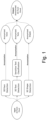
- a 3D point cloud is to be anonymized.
- 3D point cloud data is provided as input (other 3D data than point cloud data may be used similarly, e.g. data related to a 3D mesh).
- a detection algorithm detects certain features in the point cloud data that relate to sensitive information and should be made unrecognizable in the 3D data. In the shown example, this pertains to faces, as well as sensitive texts and shapes that are visible in the 3D data.
- the detection algorithm searches the point cloud for 3D faces, 3D texts and other pre-defined shapes. Other pre-defined shapes, e.g. may comprise human poses or geometric company logos.
- 3D texts it may optionally be determined whether they relate to classified or otherwise sensitive information.
- a sensitive-text classification algorithm could distinguish between public and sensitive information, e.g. names of people or companies, phone numbers, license plates etc.
- the determined faces, texts and other shapes that are to be anonymized are then replaces by generic, user- or computer-generated faces, texts and shapes, respectively. This results in an anonymized 3D point cloud as output.
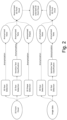
- image data of the same environment is available and to be anonymized.
- an anonymized colorized 3D point cloud can be generated as output.
- the goal of this workflow is to process a 3D point cloud coupled with related 2D image data to remove sensitive information from the final colorized 3D point cloud.
- Typical use-cases include anonymization of human faces, license plates, sensitive documents etc.
- Many reality capture devices include, both, 2D cameras for capturing images of a surrounding, and means for simultaneously capturing 3D data - such as laser scanners or time-of-flight (TOF) cameras.
- 3D data - such as laser scanners or time-of-flight (TOF) cameras.
- TOF time-of-flight
- the image data can be used to support the identification of portions of the 3D data which comprise 3D features that need to be anonymized. If such a feature, e.g. a face or text, has been detected in the images, the 3D data may be used to determine whether the feature is two- or three-dimensional. If the feature is two-dimensional, no anonymization of the 3D data is needed.
- a feature e.g. a face or text
- two-dimensional features may not have to be anonymized in the images.
- faces depicted on posters or billboards may not have to be anonymized.
- 3D data 2D faces and 3D faces in the surrounding can easily be distinguished from one another and only 3D faces are then anonymized in the images and the 3D data.
- the image data may be used to confirm whether a 3D feature detected in the point cloud is really a human face that needs to be anonymized. For instance, faces of display dummies or mannequins need not be replaced.
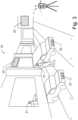
- Figure 3 shows a reality capture device 1 capturing 3D data, e.g. as a point cloud, of its surrounding 10 - optionally together with image data.
- Point clouds might be produced by a sensor (laser scanner, TOF camera) or by photogrammetry (i.e. from 2D images).
- the reality capture device 1 may be configured as or comprise a hand-held, backpack, car-mounted, autonomous or static laser scanner.
- 3D data Anonymization of 3D data is possible on different levels.
- the simplest approach is to focus solely on 2D image data, anonymize it and then re-colorize the 3D point cloud. Disadvantageously, only colour information is changed with this approach, while the geometry stays the same. Thus, information that would allow recognize faces, texts or other 3D shapes may still be present in the 3D data.
- a more sophisticated approach takes advantage of the 3D point cloud data from the very beginning and applies 3D modifications, making the data unrecognizable on both the colour and geometry information level. This approach can also be further extended to combine the strengths of both approaches. Using both 2D and 3D modalities has the potential to greatly increase the quality of the final result, stemming from more complete information.
- artefacts which may be present in only one modality can be detected and tackled.
- examples of such artefacts may include poor lighting conditions (artefact appears in 2D but not in 3D) or transparent materials causing reflections (artefact appears in 3D but not in 2D).
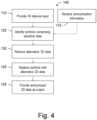
- Figure 4 shows a flow chart illustrating a first exemplary embodiment of a computer-implemented method 100 according to the invention that allows generating anonymized 3D data of a surrounding.
- the surrounding may comprise a multitude of 3D features of a plurality of different feature categories. At least one feature category relates to 3D features that are designated for anonymization.
- 3D data of the surrounding is provided 110 as input.
- the 3D data for instance may comprise information about a mesh or a point cloud that comprise 3D patterns corresponding to the 3D features in the surrounding.
- Providing 110 the 3D data may involve a reality-capture device capturing the data using a laser scanner or one or more TOF cameras.
- providing 110 the 3D data may comprise receiving the 3D data from the reality-capture device or from a data base.
- the method further comprises receiving 115 anonymization information about feature categories that should be anonymized.
- the anonymization information may be received as a user input, wherein a user designates one or more feature categories for anonymization.
- One or more feature categories may be provided to a user and the user input comprises a selection of one or more feature categories, wherein features belonging to the selected feature categories are designated for anonymization.
- the anonymization information may also comprise information on whether 2D faces should be anonymized or not, or what kinds of texts or logos should be anonymized.
- An algorithm then identifies 120 those portions of the 3D data, e.g. of the point cloud, that comprise patterns of a pattern type that should be anonymized, e.g. faces and license plates.
- a user may select pattern types that have been identified by the algorithm for anonymization, and/or perform the identification 120 without the help of the algorithm.
- the identification 120 may comprise identifying data gaps in the shape of a pattern type that should be anonymized, i.e. the portions may be identified based on a lack of 3D data. This may include 2D and 3D features that become visible, e.g. as data gaps, in the 3D data due to a high reflectivity of their surfaces or a transparency of the material (e.g. glass).
- the identification 120 may also comprise identifying 2D features that are visible in the 3D data.
- adhesive stickers or labels might be provided on reflecting or transparent surfaces, such as mirrors or windows, in the surrounding. If such a sticker or labels has a 2D shape that is recognizable in the 3D data and represents a feature that should be anonymized, also such 2D features need to be identified 120.
- such 2D features may be a number of stickers provided on a display window, each sticker having the shape of a numeral, together forming a phone number, which needs to be anonymized.
- 2D features may be identified 120 by data gaps. For instance, on a window a sticker may be provided that comprises a text that is cutout from the sticker or otherwise made transparent. Thus, in the 3D data, data gaps in the shape of the text appear on the window plane.
- Identified features may cast a "shadow" in the 3D data.
- 3D data may appear on a wall behind the window plane.
- the 2D features on the window plane will cast a shadow on this wall, either as a data gap ("positive" shadow) or as data points having the shape of the gap on the window plane ("negative” shadow).
- Both, the gaps on the window plane and the 3D data behind the window plane need to be anonymized and should therefore be identified 120.
- Another example is a shadowing of a facial profile in the 3D data: a person standing close to a plane background such as a wall will lead to a shadow in the 3D data on that background that has the shape of the face (“positive" shadow).
- this shadow might need anonymization and therefore needs to be identified 120.
- alternative 3D data for the identified portions is obtained 130. This may comprise retrieving pre-defined 3D patterns, generating new 3D patterns and/or adapting existing 3D patterns.
- Pre-defined 3D patterns may be retrieved from a database comprising a plurality of pre-defined 3D patterns for a plurality of pattern types.
- Obtaining 130 the alternative 3D data may comprise determining the pattern type and selecting a suitable pre-defined pattern for replacing the sensitive 3D data. For instance, this may include automatically determining the pattern type by an algorithm and manually selecting a replacement pattern by the user. To facilitate the selection process, a user selecting one out of a multitude of proposed data replacements can be provided with the proposed data replacements in isolation, with the context of the surrounding 3D data and for multiple patterns at once.
- Generated 3D patterns may be computer-generated, e.g. using machine learning algorithms for changing faces or texts to suitable replacements. Generating the 3D patterns may also involve interaction with a user. For instance, the 3D patterns may be user-defined, e.g. being generated completely or partially based on a user input, or user-adapted, e.g. pre-defined 3D data that is adapted at least partially based on a user input. Also, a pre-selected plurality of pre-defined patterns may be presented to a user, and the user may select one of the pre-defined patterns, and optionally adapt it.
- obtaining 130 the alternative 3D data may be based on adapting the original 3D data, e.g. by a user with the help of an algorithm or fully automatically.
- a user interface may provide artistic control about the modifications to the user. For instance, such an interface might comprise sliders to modify facial features, e.g. length and width of features such as eyes, nose, chin, forehead etc., or to perform face morphing with 3D data of another face.
- an algorithm then replaces 140 the 3D data of the identified portion completely or partially with the obtained alternative 3D data, i.e. with pre-defined, computer-generated, user-generated, user-adapted or user-selected 3D data to generate anonymized 3D data.
- the original point cloud part that needs to be anonymized can be used by the algorithm to decide on the visual characteristics of the replacement data.
- each data gap is replaced 140 by a data gap having a different shape, e.g. that of a different numeral. If the portion to be replaced casts a ("positive" or "negative") shadow in the 3D data, this shadow is also anonymized.
- the shadow is preferably anonymized in such a way that it matches the alternative 3D data, e.g. as if the alternative 3D data would have casted the shadow.
- steps 120, 130 and 140 i.e. identifying portions of the 3D data, obtaining replacement data and replacing portions of the data
- steps 120, 130 and 140 can be performed fully automatically by the anonymization algorithm.
- Figure 5 shows a flow chart illustrating a second exemplary embodiment of a computer-implemented method 102 according to the invention that allows generating anonymized 3D and image data of a surrounding.
- the surrounding may comprise a multitude of features of a plurality of different feature categories. Some of the features are three-dimensional, others are visible in 2D RGB images. At least one feature category relates to 3D features that are designated for anonymization.
- 3D data and image data of the surrounding are provided 112 as input.
- the 3D data for instance may comprise information about a mesh or a point cloud that comprise 3D patterns corresponding to the 3D features in the surrounding.
- Providing 112 the 3D data and the image data may involve a reality-capture device capturing the data using one or more 2D RGB cameras and a laser scanner or one or more TOF cameras.
- the 2D image data may be captured simultaneously with the 3D data.
- providing 112 the data may comprise receiving the data from the reality-capture device or from a data base.
- the method further comprises receiving 115 anonymization information about feature categories that should be anonymized.
- the anonymization information may be received as a user input, wherein a user designates one or more feature categories for anonymization.
- One or more feature categories may be provided to a user and the user input comprises a selection of one or more feature categories, wherein features belonging to the selected feature categories are designated for anonymization.
- the anonymization information may also comprise information on whether 2D faces should be anonymized or not, or what kinds of texts or logos should be anonymized.
- An algorithm then identifies 122 those portions of the 3D data, e.g. of the point cloud, that comprise patterns of a pattern type that should be anonymized, e.g. faces and license plates. As described with respect to Figure 4 , also data gaps, 2D features and/or shadows may be identified 122 in the 3D data.
- the image data may be correlated with the 3D data. This allows identifying the patterns in the 3D data also based on the 2D data. For instance, only those portions of the 3D data are searched for patterns to be anonymized, for which the 2D data indicates their presence.
- both the 3D data and the image data are to be anonymized.
- the method comprises identifying portions in the image data that images at least one feature to be anonymized. If only 3D features should be anonymized, it may be determined, based on the 3D data, whether the respective feature shown in the images is a 3D feature.
- Alternative 3D data and image data for the identified portions is retrieved 132.
- the alternative 3D data comprises a pre-defined or generated 3D pattern
- the alternative image data comprises pre-defined or generated image data.
- pre-defined 3D patterns may be retrieved from a database comprising a plurality of pre-defined 3D patterns for a plurality of pattern types, or 3D patterns may be computer-generated, user-defined or user-adapted.
- image data may be retrieved from a database or generated by a computer and/or user.
- the retrieved alternative 3D data and alternative image data are matching each other, e.g. are generated together or are provided in a database together.
- 3D data may be retrieved, and matching image data is generated based on the retrieved 3D data, or image data is retrieved and matching 3D data is generated based on the retrieved image data.
- the 3D data and image of the identified portion are then completely or partially replaced 142 with the alternative 3D data and the alternative image data, respectively, i.e. with pre-defined, computer-generated, user-generated, user-adapted or user-selected 3D and image data to generate anonymized 3D and image data, for instance an anonymized colorized point cloud.
- an indicator may be added to the replaced 3D data or to a corresponding part of 2D data mapping the 3D data, to indicate that the replaced 3D data is not original data but has been replaced for anonymization reasons.
- the indicator may also indicate that the corresponding 2D data has been replaced.
- a user may upload the data to be anonymized (i.e. 3D data or 3D and 2D data) and possibly further information such as the anonymization information to a remote server or a cloud, where the identification 120, 122 and replacement 140, 142 are performed as a service.
- the user may then be presented with the anonymized data or with a selection of several differently anonymized sets of data.
Landscapes
- Engineering & Computer Science (AREA)
- Physics & Mathematics (AREA)
- Theoretical Computer Science (AREA)
- General Physics & Mathematics (AREA)
- Health & Medical Sciences (AREA)
- Software Systems (AREA)
- Computer Vision & Pattern Recognition (AREA)
- General Health & Medical Sciences (AREA)
- Computer Graphics (AREA)
- Multimedia (AREA)
- Oral & Maxillofacial Surgery (AREA)
- Computer Hardware Design (AREA)
- General Engineering & Computer Science (AREA)
- Bioethics (AREA)
- Geometry (AREA)
- Human Computer Interaction (AREA)
- Architecture (AREA)
- Medical Informatics (AREA)
- Databases & Information Systems (AREA)
- Computer Security & Cryptography (AREA)
- Processing Or Creating Images (AREA)
Priority Applications (2)
| Application Number | Priority Date | Filing Date | Title |
|---|---|---|---|
| EP23171257.1A EP4459492A1 (de) | 2023-05-03 | 2023-05-03 | Verfahren und system zur erzeugung anonymisierter 3d-daten |
| US18/652,661 US12608887B2 (en) | 2023-05-03 | 2024-05-01 | Method and system for generating anonymized 3D data |
Applications Claiming Priority (1)
| Application Number | Priority Date | Filing Date | Title |
|---|---|---|---|
| EP23171257.1A EP4459492A1 (de) | 2023-05-03 | 2023-05-03 | Verfahren und system zur erzeugung anonymisierter 3d-daten |
Publications (1)
| Publication Number | Publication Date |
|---|---|
| EP4459492A1 true EP4459492A1 (de) | 2024-11-06 |
Family
ID=86328998
Family Applications (1)
| Application Number | Title | Priority Date | Filing Date |
|---|---|---|---|
| EP23171257.1A Pending EP4459492A1 (de) | 2023-05-03 | 2023-05-03 | Verfahren und system zur erzeugung anonymisierter 3d-daten |
Country Status (2)
| Country | Link |
|---|---|
| US (1) | US12608887B2 (de) |
| EP (1) | EP4459492A1 (de) |
Families Citing this family (1)
| Publication number | Priority date | Publication date | Assignee | Title |
|---|---|---|---|---|
| CN120805192B (zh) * | 2025-09-11 | 2025-12-26 | 先临三维科技股份有限公司 | 数据处理方法、扫描设备、计算设备及存储介质 |
Citations (6)
| Publication number | Priority date | Publication date | Assignee | Title |
|---|---|---|---|---|
| EP3333541A2 (de) | 2014-05-05 | 2018-06-13 | Hexagon Technology Center GmbH | Vermessungssystem |
| US20200027200A1 (en) * | 2018-07-20 | 2020-01-23 | Stefano Celestini | Systems, methods, and storage media for anonymizing at least one feature in a scene |
| WO2020126123A2 (en) | 2018-12-21 | 2020-06-25 | Leica Geosystems Ag | Reality capture with a laser scanner and a camera |
| US20210295581A1 (en) * | 2020-03-18 | 2021-09-23 | Robert Bosch Gmbh | Anonymization apparatus, surveillance device, method, computer program and storage medium |
| EP4095561A1 (de) | 2021-05-27 | 2022-11-30 | Leica Geosystems AG | Realitätserfassungsvorrichtung |
| EP4167195A1 (de) * | 2021-10-15 | 2023-04-19 | Brighter AI Technologies GmbH | System zur verarbeitung persönlicher daten |
Family Cites Families (2)
| Publication number | Priority date | Publication date | Assignee | Title |
|---|---|---|---|---|
| US20230244815A1 (en) * | 2022-02-01 | 2023-08-03 | Ford Global Technologies, Llc | Anonymizing personally identifiable information in sensor data |
| US12039082B2 (en) * | 2022-08-09 | 2024-07-16 | Motorola Solutions, Inc. | System and method for anonymizing a person captured in an image |
-
2023
- 2023-05-03 EP EP23171257.1A patent/EP4459492A1/de active Pending
-
2024
- 2024-05-01 US US18/652,661 patent/US12608887B2/en active Active
Patent Citations (6)
| Publication number | Priority date | Publication date | Assignee | Title |
|---|---|---|---|---|
| EP3333541A2 (de) | 2014-05-05 | 2018-06-13 | Hexagon Technology Center GmbH | Vermessungssystem |
| US20200027200A1 (en) * | 2018-07-20 | 2020-01-23 | Stefano Celestini | Systems, methods, and storage media for anonymizing at least one feature in a scene |
| WO2020126123A2 (en) | 2018-12-21 | 2020-06-25 | Leica Geosystems Ag | Reality capture with a laser scanner and a camera |
| US20210295581A1 (en) * | 2020-03-18 | 2021-09-23 | Robert Bosch Gmbh | Anonymization apparatus, surveillance device, method, computer program and storage medium |
| EP4095561A1 (de) | 2021-05-27 | 2022-11-30 | Leica Geosystems AG | Realitätserfassungsvorrichtung |
| EP4167195A1 (de) * | 2021-10-15 | 2023-04-19 | Brighter AI Technologies GmbH | System zur verarbeitung persönlicher daten |
Also Published As
| Publication number | Publication date |
|---|---|
| US20240371099A1 (en) | 2024-11-07 |
| US12608887B2 (en) | 2026-04-21 |
Similar Documents
| Publication | Publication Date | Title |
|---|---|---|
| CN110660117B (zh) | 确定图像控键位置 | |
| US20180357819A1 (en) | Method for generating a set of annotated images | |
| US8913847B2 (en) | Replacement of a person or object in an image | |
| CN107507217B (zh) | 证件照的制作方法、装置及存储介质 | |
| US12094163B2 (en) | Method, apparatus, and computer program product for displaying virtual graphical data based on digital signatures | |
| KR20100134079A (ko) | 이미지 내의 자동 얼굴 검출 및 식별 마스킹, 및 그 응용 | |
| EP2194504A1 (de) | Erzeugung einer Tiefenkarte | |
| CN109934047A (zh) | 基于深度学习的人脸识别系统及其人脸识别方法 | |
| US12608887B2 (en) | Method and system for generating anonymized 3D data | |
| CN109919149B (zh) | 基于物体检测模型的物体标注方法及相关设备 | |
| WO2015013626A2 (en) | System and method for creating a virtual backdrop | |
| EP4537180A1 (de) | Vorrichtungen, medien und verfahren zur abbildung und messung von wänden und dekorartikeln | |
| CN117830687A (zh) | 变电站设备的元器件状态识别方法、装置、设备及介质 | |
| CN117336415A (zh) | 一种应用于书画扫描的高光谱扫描系统及其扫描方法 | |
| JP7314509B2 (ja) | 情報処理装置、情報処理方法及びプログラム | |
| US10964096B2 (en) | Methods for detecting if an object is visible | |
| US20240319930A1 (en) | Method for preflighting a graphics artwork file | |
| JP2019066909A (ja) | 物体分布推定装置 | |
| CN111931008A (zh) | 一种视觉传达设计信息管理系统 | |
| EP2466548A1 (de) | Verfahren zur Verarbeitung einer objektbasierten Bilddatei mit inhaltstypabhängigen Bildverarbeitungsalgorithmen | |
| CN113298593A (zh) | 商品推荐及图像检测方法、装置、设备和存储介质 | |
| JP7528682B2 (ja) | 印刷物処理装置及びプログラム | |
| CN108052555A (zh) | 一种照片分类方法和系统 | |
| WO2021129213A1 (zh) | 主题图标的生成方法及其装置、计算机设备 | |
| Xu et al. | Uncovering the Metaverse within Everyday Environments: a Coarse-to-Fine Approach |
Legal Events
| Date | Code | Title | Description |
|---|---|---|---|
| PUAI | Public reference made under article 153(3) epc to a published international application that has entered the european phase |
Free format text: ORIGINAL CODE: 0009012 |
|
| STAA | Information on the status of an ep patent application or granted ep patent |
Free format text: STATUS: THE APPLICATION HAS BEEN PUBLISHED |
|
| AK | Designated contracting states |
Kind code of ref document: A1 Designated state(s): AL AT BE BG CH CY CZ DE DK EE ES FI FR GB GR HR HU IE IS IT LI LT LU LV MC ME MK MT NL NO PL PT RO RS SE SI SK SM TR |
|
| STAA | Information on the status of an ep patent application or granted ep patent |
Free format text: STATUS: REQUEST FOR EXAMINATION WAS MADE |
|
| 17P | Request for examination filed |
Effective date: 20250502 |
|
| RAP1 | Party data changed (applicant data changed or rights of an application transferred) |
Owner name: HEXAGON INNOVATION HUB GMBH |