EP4459941A1 - Procédé et appareil de communication, et dispositif associé - Google Patents
Procédé et appareil de communication, et dispositif associé Download PDFInfo
- Publication number
- EP4459941A1 EP4459941A1 EP22914712.9A EP22914712A EP4459941A1 EP 4459941 A1 EP4459941 A1 EP 4459941A1 EP 22914712 A EP22914712 A EP 22914712A EP 4459941 A1 EP4459941 A1 EP 4459941A1
- Authority
- EP
- European Patent Office
- Prior art keywords
- information
- model
- function
- case
- output
- Prior art date
- Legal status (The legal status is an assumption and is not a legal conclusion. Google has not performed a legal analysis and makes no representation as to the accuracy of the status listed.)
- Pending
Links
Images
Classifications
-
- H—ELECTRICITY
- H04—ELECTRIC COMMUNICATION TECHNIQUE
- H04W—WIRELESS COMMUNICATION NETWORKS
- H04W24/00—Supervisory, monitoring or testing arrangements
- H04W24/02—Arrangements for optimising operational condition
-
- H—ELECTRICITY
- H04—ELECTRIC COMMUNICATION TECHNIQUE
- H04B—TRANSMISSION
- H04B7/00—Radio transmission systems, i.e. using radiation field
- H04B7/02—Diversity systems; Multi-antenna system, i.e. transmission or reception using multiple antennas
- H04B7/04—Diversity systems; Multi-antenna system, i.e. transmission or reception using multiple antennas using two or more spaced independent antennas
- H04B7/0413—MIMO systems
- H04B7/0456—Selection of precoding matrices or codebooks, e.g. using matrices antenna weighting
-
- H—ELECTRICITY
- H04—ELECTRIC COMMUNICATION TECHNIQUE
- H04B—TRANSMISSION
- H04B7/00—Radio transmission systems, i.e. using radiation field
- H04B7/02—Diversity systems; Multi-antenna system, i.e. transmission or reception using multiple antennas
- H04B7/04—Diversity systems; Multi-antenna system, i.e. transmission or reception using multiple antennas using two or more spaced independent antennas
- H04B7/06—Diversity systems; Multi-antenna system, i.e. transmission or reception using multiple antennas using two or more spaced independent antennas at the transmitting station
- H04B7/0613—Diversity systems; Multi-antenna system, i.e. transmission or reception using multiple antennas using two or more spaced independent antennas at the transmitting station using simultaneous transmission
- H04B7/0615—Diversity systems; Multi-antenna system, i.e. transmission or reception using multiple antennas using two or more spaced independent antennas at the transmitting station using simultaneous transmission of weighted versions of same signal
- H04B7/0619—Diversity systems; Multi-antenna system, i.e. transmission or reception using multiple antennas using two or more spaced independent antennas at the transmitting station using simultaneous transmission of weighted versions of same signal using feedback from receiving side
- H04B7/0621—Feedback content
- H04B7/0626—Channel coefficients, e.g. channel state information [CSI]
-
- H—ELECTRICITY
- H04—ELECTRIC COMMUNICATION TECHNIQUE
- H04B—TRANSMISSION
- H04B7/00—Radio transmission systems, i.e. using radiation field
- H04B7/02—Diversity systems; Multi-antenna system, i.e. transmission or reception using multiple antennas
- H04B7/04—Diversity systems; Multi-antenna system, i.e. transmission or reception using multiple antennas using two or more spaced independent antennas
- H04B7/06—Diversity systems; Multi-antenna system, i.e. transmission or reception using multiple antennas using two or more spaced independent antennas at the transmitting station
- H04B7/0613—Diversity systems; Multi-antenna system, i.e. transmission or reception using multiple antennas using two or more spaced independent antennas at the transmitting station using simultaneous transmission
- H04B7/0615—Diversity systems; Multi-antenna system, i.e. transmission or reception using multiple antennas using two or more spaced independent antennas at the transmitting station using simultaneous transmission of weighted versions of same signal
- H04B7/0619—Diversity systems; Multi-antenna system, i.e. transmission or reception using multiple antennas using two or more spaced independent antennas at the transmitting station using simultaneous transmission of weighted versions of same signal using feedback from receiving side
- H04B7/0636—Feedback format
- H04B7/0639—Using selective indices, e.g. of a codebook, e.g. pre-distortion matrix index [PMI] or for beam selection
-
- H—ELECTRICITY
- H04—ELECTRIC COMMUNICATION TECHNIQUE
- H04L—TRANSMISSION OF DIGITAL INFORMATION, e.g. TELEGRAPHIC COMMUNICATION
- H04L41/00—Arrangements for maintenance, administration or management of data switching networks, e.g. of packet switching networks
- H04L41/16—Arrangements for maintenance, administration or management of data switching networks, e.g. of packet switching networks using machine learning or artificial intelligence
-
- H—ELECTRICITY
- H04—ELECTRIC COMMUNICATION TECHNIQUE
- H04B—TRANSMISSION
- H04B17/00—Monitoring; Testing
- H04B17/30—Monitoring; Testing of propagation channels
- H04B17/373—Predicting channel quality or other radio frequency [RF] parameters
Definitions
- This application pertains to the field of communications technologies, and specifically relates to a communication method and apparatus, and a related device.
- AI Artificial intelligence
- AI is a new technical science that studies and develops theories, methods, technologies, and application systems for simulating, extending, and expanding human intelligence, and has attracted widespread attention, seeing increasingly widespread application of AI.
- the purpose, input format, and output format of the AI model are not yet clear, resulting in poor performance of the AI model during the communication process.
- Embodiments of this application provide a communication method and apparatus, and a related device, which can resolve the problem of poor performance of an AI model in the existing communication process.
- a communication method includes:
- a communication apparatus including:
- a terminal includes a processor and a memory, and a program or instructions capable of running on the processor are stored in the memory.
- the program or the instructions are executed by the processor, the steps of the communication method according to the first aspect are implemented.
- a terminal including a processor and a communication interface.
- the processor is configured to obtain first information, and perform a communication operation using an AI model based on the first information, where the first information is used for indicating at least one of the following: a function of an artificial intelligence AI model, input information of the AI model, and output information of the AI model.
- a network-side device includes a processor and a memory, and a program or instructions capable of running on the processor are stored in the memory.
- the program or the instructions are executed by the processor, the steps of the communication method according to the first aspect are implemented.
- a network-side device including a processor and a communication interface, where the processor is configured to obtain first information, and perform a communication operation using an AI model based on the first information, where the first information is used for indicating at least one of the following: a function of an artificial intelligence AI model, input information of the AI model, and output information of the AI model.
- a readable storage medium where a program or instructions are stored in the readable storage medium, and when the program or the instructions are executed by a processor, the steps of the communication method according to the first aspect are implemented.
- a chip includes a processor and a communication interface, the communication interface is coupled to the processor, and the processor is configured to run a program or instructions to implement the communication method according to the first aspect.
- a computer program/program product is provided, where the computer program/program product is stored in a storage medium, and the computer program/program product is executed by at least one processor to implement the steps of the communication method according to the first aspect.
- the function of the AI model, the input information of the AI model, and the output information of the AI model that are to be used by the first end during a communication operation are clarified, so as to avoid the problem that the AI model has poor performance due to an unclear function of the AI model or incorrect input information and output information of the AI model. This ensures that the AI model has relatively good performance in the communication process and also ensures that the first end can have relatively good communication performance.
- first and second are intended to distinguish between similar objects but do not necessarily indicate a specific order or sequence. It should be understood that the terms used in this way is interchangeable in appropriate circumstances so that the embodiments of this application can be implemented in other orders than the order illustrated or described herein, and “first” and “second” are usually for distinguishing same-type objects but not limiting the number of objects, for example, there may be one or more first objects.
- first and second are usually for distinguishing same-type objects but not limiting the number of objects, for example, there may be one or more first objects.
- “and/or” in this specification and claims indicates at least one of connected objects, and the symbol “/" generally indicates that the associated objects are in an "or” relationship.
- LTE Long Term Evolution
- LTE-A LTE-advanced
- LTE-A LTE-Advanced
- CDMA code division multiple access
- TDMA time division multiple access
- FDMA frequency division multiple access
- OFDMA Orthogonal Frequency Division Multiple Access
- SC-FDMA single-carrier Frequency-Division Multiple Access
- system and “network” in the embodiments of this application are usually used interchangeably. Techniques described herein may be used in the aforementioned systems and radio technologies, and may also be used in other systems and radio technologies.
- New Radio New Radio
- NR New Radio
- NR terms are used in most of the following descriptions, although these technologies may also be applied to other applications than an NR system application, for example, the 6th generation (6 th Generation, 6G) communication system.
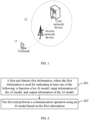
- FIG. 1 is a block diagram of a wireless communication system to which the embodiments of this application are applicable.
- the wireless communication system includes a terminal 11 and a network-side device 12.
- the terminal 11 may be a terminal-side device, such as a mobile phone, a tablet computer (Tablet Personal Computer), a laptop computer (Laptop Computer) or a notebook computer, a personal digital assistant (Personal Digital Assistant, PDA), a palmtop computer, a netbook, an ultra-mobile personal computer (Ultra-Mobile Personal Computer, UMPC), a mobile Internet device (Mobile Internet Device, MID), an augmented reality (Augmented Reality, AR)/virtual reality (Virtual Reality, VR) device, a robot, a wearable device (Wearable Device), vehicle user equipment (Vehicle User Equipment, VUE), pedestrian user equipment (Pedestrian User Equipment, PUE), a smart home device (a home device with wireless communication function, such as a refrigerator, a television, a washing machine, or a furniture),
- the wearable device includes: a smart watch, a wrist band, smart earphones, smart glasses, smart jewelry (smart bracelet, smart wristband, smart ring, smart necklace, smart anklet, smart ankle bracelet, or the like), smart wristband, smart clothing, and the like. It should be noted that a specific type of the terminal 11 is not limited in the embodiments of this application.
- the network-side device 12 may include an access network device or a core network device, where the access network device may also be referred to as a radio access network device, a radio access network (Radio Access Network, RAN), a radio access network function, or a radio access network unit.
- RAN Radio Access Network
- the access network device may include a base station, a wireless local area network (Wireless Local Area Network, WLAN) access point, a wireless fidelity (Wireless Fidelity, WiFi) node, or the like.
- the base station may be referred to as a NodeB, an evolved NodeB (eNB), an access point, a base transceiver station (Base Transceiver Station, BTS), a radio base station, a radio transceiver, a basic service set (Basic Service Set, BSS), an extended service set (Extended Service Set, ESS), a home NodeB, a home evolved NodeB, a transmission and reception Point (Transmitting Receiving Point, TRP), or another appropriate term in the art.
- the base station is not limited to a specific technical term. It should be noted that in the embodiments of this application, the base station in the NR system is merely used as an example, and a specific type of the base station is not limited.
- the core network device may include but is not limited to at least one of the following: a core network node, a core network function, a mobility management entity (Mobility Management Entity, MME), an access mobility management function (Access and Mobility Management Function, AMF), a session management function (Session Management Function, SMF), a user plane function (User Plane Function, UPF), a policy control function (Policy Control Function, PCF), a policy and charging rules function (Policy and Charging Rules Function, PCRF), an edge application service discovery function (Edge Application Server Discovery Function, EASDF), a unified data management (Unified Data Management, UDM), a unified data repository (Unified Data Repository, UDR), a home subscriber server (Home Subscriber Server, HSS), a centralized network configuration ( Centralized network configuration, CNC), a network repository function (Network Repository Function, NRF), a network exposure function (Network Exposure Function, NEF), a local NEF (Local NEF, or L-NEF
- FIG. 2 is a flowchart of a communication method according to an embodiment of this application. As shown in FIG. 2 , the communication method includes the following steps.
- Step 201 A first end obtains first information, where the first information is used for indicating at least one of the following: a function of an AI model, input information of the AI model, and output information of the AI model.
- the first information is indication information sent by a second end, or the first information may be information specified in a protocol.
- the first end receives first information sent by the second end, where the first information is used for indicating the function of the AI model.
- the first end is one of a terminal and a network-side device
- the second end is the other of the terminal and the network-side device.
- the first end is a terminal and the second end is a network-side device; or the first end is a network-side device and the second end is a terminal.
- the terminal sends first information to the network-side device, or the network-side device may send first information to the terminal.
- the first end and the second end are different nodes of the terminal, for example, a first node of the terminal can send first information to a second node, or the second node can send first information to the first node.
- the first end and the second end are different nodes of the network-side device, for example, a third node of the network-side device can send first information to a fourth node, or the fourth node may send first information to the third node.
- the first information is used for indicating at least one of the following: a function of an artificial intelligence AI model, input information of the AI model, and output information of the AI model.
- a function of an artificial intelligence AI model there may be an association between the function of the AI model and the input information and output information of the AI model.
- the first information is merely used for indicating the function of the AI model, and during determining of the function of the AI model based on the first information, the first end can determine the input information and output information corresponding to the AI model based on the association.
- the first information is merely used for indicating the input information of the AI model, and the first end can determine the function of the AI model and the corresponding output information of the AI model based on the input information of the AI model.
- the first information is merely used for indicating the output information of the AI model, and the first end can determine the function of the AI model and the corresponding input information of the AI model based on the output information of the AI model. It can be understood that the first information can alternatively be used for indicating two or three of the function of the AI model, the input information of the AI model, and the output information of the AI model, which is not illustrated herein.
- Step 202 The first end performs a communication operation using an AI model based on the first information.
- the first end after obtaining the first information, can determine a to-be-used AI model based on content indicated by the first information, and can also determine the input information and output information of the AI model; then the first end performs a communication operation using the AI model.
- the communication operation may refer to inputting the input information of the AI model into the AI model and/or performing processing on information output by the AI model, so as to meet a format or related requirements of the output information of the AI model.
- the network-side device can perform a communication operation based on the AI model
- the network-side device determines the function of the AI model, the input information of the AI model, and the output information of the AI model
- the network-side device can send the first information to the terminal, so as to indicate the function of the AI model, the input information of the AI model, and the output information of the AI model.
- the terminal can determine an AI model that needs to be used, and can perform information input to the AI model based on the input information of the AI model, and perform information output from the AI model based on the output information of the AI model, so that the terminal can align the function of the AI model and the input information and output information of the AI model with the network-side device during the communication operation using the AI model.
- This ensures the communication performance between the terminal and the network-side device, avoiding the problems of an unclear function of the AI model or incorrect input information and output information of the AI model, and guarantees the performance of the AI model in the communication process.
- the function of the AI model, the input information of the AI model, and the output information of the AI model that are to be used by the first end during a communication operation are clarified, so as to avoid the problem that the AI model has poor performance due to an unclear function of the AI model or incorrect input information and output information of the AI model. This ensures that the AI model has relatively good performance in the communication process and also ensures that the first end can have relatively good communication performance.
- the function of the AI model includes at least one of the following: channel state information (Channel State Information, CSI) coding, CSI decoding, positioning, channel estimation, tracking reference signal (Tracking Reference Signal, TRS) estimation, phase tracking reference signal (Phase Tracking Reference Signal, PTRS) estimation, beam management, signal calibration, and digital pre-distortion (Digital Pre-Distortion, DPD).
- the first information is used for indicating that the function of the AI model is used for CSI coding, and the first end can perform a communication operation using an AI model for CSI coding based on the first information.
- the first information is used for indicating that the function of the AI model is used for CSI coding and channel estimation, and the first end performs a communication operation using an AI model for CSI coding and an AI model for channel estimation based on the first information.
- the first information being used for indicating the function of the AI model may further include other possible cases, which are not listed here.
- the first information may be further used for indicating at least one of the following:
- the function of the AI model is used for CSI coding
- the AI model that needs to be used by the first end is an AI model for CSI coding
- the first information is used for indicating that the input information of the AI model is a CSI reference signal.
- the function of the AI model being used for CSI coding may alternatively be indicated by the first information.
- the first information is used for indicating that the input information of the AI model is a reference signal, for example, various types of reference signals such as a CSI reference signal, a demodulation reference signal (Demodulation Reference Signal, DMRS), or an SRS.
- a reference signal for example, various types of reference signals such as a CSI reference signal, a demodulation reference signal (Demodulation Reference Signal, DMRS), or an SRS.
- the input information of the AI model is channel quality of various reference signals, for example, reference signal received power (Reference Signal Received Power, RSRP), reference signal received quality (Reference Signal Received Quality, RSRQ), and signal-to-noise and interference ratio (Signal-to-noise and Interference Ratio, SINR) of a reference signal such as a synchronization signal and physical broadcast channel signal block (Synchronization Signal and PBCH block, SSB), a CSI-RS, or an SRS.
- the channel quality further includes beam quality of layer 1 and/or beam quality of layer 3.
- the function of the AI model there is a corresponding association between the function of the AI model and the input information of the AI model, that is, in a case that the function of the AI model is determined, the corresponding input information of the AI model can be determined based on the function of the AI model.
- the first information being used for indicating the input information of the Al model may also be other possible cases, which will not be repeated here.
- the first information may be further used for indicating at least one of the following:
- the first information is used for indicating that the output information of the AI model is CSI and/or channel related information obtained through CSI processing.
- the CSI may be a channel matrix, precoding information, channel quality, rank, and the like, and the channel related information obtained through CSI processing may be precoding information of multiple users or the like.
- the first information is used for indicating that the output information of the AI model is location information and location related information in channel information.
- the output information of the AI model may be timing time/timing (Timing), time of arrival (Timing of arrival, TOA), round-trip time (Round-Trip Time, RTT), observed time difference of arrival (Observed Time Difference of Arrival, OTDOA), time difference of arrival (Time Difference of Arrival, TDOA), angle of arrival (Angle of arrival, AOA), angle of departure (Angle of departure, AOD), or the like.
- the output information of the AI model may be beam quality of a current beam and/or beam quality of a future beam that may be selected.
- the first information is used for indicating that the output information of the AI model is a pre-distorted signal to counter nonlinear distortion of other functional modules (such as a power amplifier module).
- the first information is used for indicating that a format of the target information includes at least one of the following:
- the target information is the input information of the AI model.
- the input information of the AI model includes resources of a plurality of domains (such as time domain, frequency domain, and spatial domain), for example, two resources in time domain and two resources in frequency domain, the resources of the two domains included in the input information of the AI model can be arranged in a preset order.
- the preset order may be an order of cyclic hierarchy of different domains.
- the input information of the AI model includes a first resource and a second resource in time domain and a first resource and a second resource in frequency domain; then, the order of the resources in the input information of AI model is: a frequency domain first resource on the first resource in time domain, a frequency domain second resource on the first resource in time domain, a frequency domain first resource on the second resource in time domain, and a frequency domain second resource on the second resource in time domain.
- the content of the plurality of domains in the output information of the AI model may alternatively be arranged in a preset order, as described above, in the order of the cyclic hierarchy of different domains, which is not listed here.
- the arrangement order of the content of the plurality of domains in the input information of the same AI model may be the same as the arrangement order of the content of the plurality of domains in the output information of the AI model, so as to ensure that the format of the input information of the same AI model is aligned with or matches the format of the output information.
- the first information is further used to indicate that the content of the plurality of domains in the target information is converted into a corresponding matrix, where dimensions of the matrix match the number of domains, and then the dimensions of the matrix are used to determine which dimension of the plurality of dimensions a domain in the target information belongs to.
- the target information is the input information of the AI model. If the input information of the AI model includes two domains, the input information of the AI model can be converted into a two-dimensional matrix, and the two dimensions of the matrix correspond to the two domains respectively.
- the target information is the output information of the AI model. If the output information of the AI model includes three domains, the output information of the AI model can be converted into a three-dimensional matrix, and the three dimensions of the matrix correspond to the three domains respectively.
- an input format and/or output format of the content of the plurality of domains in the input information and/or output information of the AI model is limited by the first information.
- the first information is used for indicating input information corresponding to at least one of the input interfaces of the AI model; and/or, in a case that the AI model includes a plurality of output interfaces, the first information is used for indicating output information corresponding to at least one of the output interfaces of the AI model.
- the first information may be used for indicating input information corresponding to each interface of the AI model.
- the first information may not indicate the input information of these input interfaces.
- the first information indicates that at least one input interface of the AI model has no input information, or the first information indicates that at least one input interface of the AI model is closed.
- one of the input interfaces may correspond to one type of input information, or one of the input interfaces may correspond to a plurality of types of input information, or a plurality of input interfaces may correspond to one type of input information.
- the first information may be used for indicating output information corresponding to each output interface of the AI model.
- the first information may not indicate the output information of these output interfaces.
- the first information indicates that at least one output interface of the AI model has no output information, or the first information indicates that at least one output interface of the AI model is closed.
- one of the output interfaces may correspond to one type of output information, or one of the output interfaces may correspond to a plurality of types of output information, or a plurality of output interfaces may correspond to one type of output information.
- the first information in a case that the first information is used for indicating the input information of the AI model, the first information is further used to indicate whether the input information of the AI model needs preprocessing; and/or in a case that the first information is used for indicating the output information of the AI model, the first information is further used to indicate whether the output information of the AI model needs post-processing.
- the preprocessing may refer to processing performed before the input information is input into the AI model
- the post-processing may refer to processing performed after the output information of the AI model is output.
- the preprocessing or post-processing includes at least one of transform domain processing, power processing, amplitude processing, and phase processing.
- the transform domain processing may include Fourier transform, Fast Fourier Transform (Fast Fourier Transform, FFT), discrete Fourier transform, fractional Fourier transform, short-time Fourier transform, Laplace transform (Laplace transform), Z transform, wavelet transform, discrete wavelet transform, and continuous wavelet transform; or may include inverse Fourier transform, inverse fast Fourier transform, inverse discrete Fourier transform, inverse fractional Fourier transform, inverse short-time Fourier transform, inverse Laplace transform (Laplace transform), inverse Z transform, inverse wavelet transform, inverse discrete wavelet transform, and inverse continuous wavelet transform.
- FFT Fast Fourier Transform
- discrete Fourier transform discrete Fourier transform
- Laplace transform Laplace transform
- Z transform wavelet transform
- wavelet transform inverse discrete wavelet transform
- inverse discrete wavelet transform inverse discrete wavelet transform
- inverse continuous wavelet transform inverse continuous wavelet transform
- the power processing may be to perform resource group division for the input information of the AI model and/or the output information of the AI model, and the total power of each resource group is processed as a fixed value.
- division is performed based on orthogonal frequency division multiplex (Orthogonal Frequency Division Multiplex, OFDM) symbols in time domain for the input information of the AI model, and the total power of all frequency domain resource blocks (Resource Block, RB) or subbands on each OFDM symbol obtained through division is normalized to a fixed value.
- OFDM Orthogonal frequency division multiplex
- RB Resource Block
- the power processing can also be performed by using one of the divided resource groups as a target resource group and normalizing the total power of each of other resource groups.
- the total power of each resource group after power processing is equal to the total power of the resource group before processing divided by the total power of the target resource group.
- the phase processing may be phase normalization processing.
- resource group division is performed for the input information of the AI model and/or the output information of the AI model, one of the divided resource groups is used as the target resource group, and a phase of each of other resource groups is normalized based on the target resource group.
- the input information of the AI model and/or the output information of the AI model further includes preset information, and the preset information includes at least one of channel environment information and device information.
- the channel environment information includes timing information, signal-to-noise ratio, noise information, interference information, moving performance, moving speed, moving direction, beam quality, channel quality, location of the first end, and the like.
- the device information may include terminal type, terminal identity (Identity, ID), cell ID, terminal status, and so on.
- the terminal status includes an idle state, an inactive state, and a connected state.
- the preset information may be a separate indication independent of the first information.
- the method further includes the following step: obtaining, by the first end, second information, where the second information is used for indicating at least one of the following: the preset information and a format of the preset information.
- the first end may obtain the second information before obtaining the first information, or may obtain the second information after obtaining the first information, or obtain them at the same time.
- the second information is used for indicating the preset information and/or a format of the preset information.
- the format of the preset information may refer to a specific type of preset information.
- the second information is used for indicating that the format of the preset information is beam quality, and the input information of the AI model and/or the output information of the AI model may also include beam quality.
- the method further includes at least one of the following:
- the first end in a case that the first information is obtained, can determine an AI model to be used, and at least one of the function of the AI model, the input information of the AI model, and the output information of the AI model.
- the first end Before performing information input for the AI model, the first end applies the channel environment information and device information to the input information of the AI model, and then performs the information input for the AI model, for example, the input information input into the AI module further includes the channel environment information and device information. Applying the preset information to the input information of the AI model in advance can avoid affecting the format of the output information of the AI model.
- the first end may alternatively apply the preset information to the output information of the AI model, for example, the output information of the AI model includes the preset information. Then the output information of the AI model including the preset information is sent to a next function module, so as to avoid affecting the format of the output information of the AI model.
- the input information of the AI model and/or the output information of the AI model may also have missing partial information.
- the method further includes: performing, by the first end, at least one of the following:
- the missing part of the input information of the AI model can be supplemented based on a default value, for example, the missing part is defaulted as a constant.
- the missing part may be supplemented with input information adjacent to the input information of the AI model, for example, based on previous input information of the input information of the AI model.
- the missing part may be supplemented by a plurality of input information adjacent to the input information of the Al model, for example, a linear average of the first three pieces of input information in the input information of the AI model is calculated, and the missing part is supplemented based on the linear average.
- the missing part can also be supplemented based on the foregoing manner, which is not specifically described in detail here.
- the first information obtained by the first end further includes at least one of a calibration set and an error of the calibration set, and before the communication operation is performed using the AI model, the method further includes:
- the calibration set is a set of input information and output information used for information format calibration, where the input information of information format calibration is in one-to-one correspondence to the format of the input information of the AI model, and/or the output information of information format calibration is in one-to-one correspondence to the format of the output information of the AI model.
- the AI model is used for CSI coding.
- An input information format for information format calibration is a two-dimensional matrix; a first dimension is spatial domain, 32 elements represent 32 antennas of a base station, a second dimension is frequency domain, and 13 elements represent 13 subbands.
- the input information of the AI model is a CSI reference signal
- the format is a two-dimensional matrix
- a first dimension is 32 elements in spatial domain
- a second dimension is 13 elements in frequency domain
- the formats of the two are in one-to-one correspondence to each other.
- the first end can determine at least one of the calibration set and the error of the calibration set based on the first information, and the first end can arbitrarily perform processing on the input information and/or the output information of the AI model, and an error for the processed input information of the AI model and/or the processed output information of the AI model is smaller than the error of the calibration set.
- the first end performs processing on the input information of the AI model based on the first information and inputs it into the AI model to obtain the output information of the AI model, and compares the output information of the AI model with the corresponding output information in the calibration set to obtain an error. If the error is less than or equal to the preset threshold, it is considered that the processing on the input information of the AI model by the first end satisfies the error of the calibration set, and if the error is greater than the preset threshold, it is considered that the processing on the input information of the AI model by the first end does not satisfy the error of the calibration set.
- the performing the communication operation using the AI model includes: performing a communication operation on the processed target information by using the AI model, where information output by the AI model meets the error of the calibration set.
- the communication operation is that the first end arbitrarily performs processing on the input information of the AI model and then inputs it into the AI model, and the information output by the AI model meets the error of the calibration set.
- the communication operation is as follows: after arbitrarily processing the output information of the AI model, the first end uses the processed output information of the AI model as the output information of the AI model, and the output information of the AI model meets the error of the calibration set.
- the first information can indicate the calibration set and/or the error of the calibration set, and then the first end can arbitrarily perform processing on the input information of the AI model and/or the output information of the AI model using the AI model during the communication process to ensure that the processed input information and/or the output information of the AI model meets the error of the calibration set.
- the execution subject can be a communication apparatus.
- the communication method being performed by the communication apparatus is used as an example to describe the communication apparatus provided in the embodiments of this application.
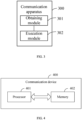
- FIG. 3 is a structural diagram of a communication apparatus according to an embodiment of this application. As shown in FIG. 3 , the communication apparatus 300 includes:
- the function of the AI model includes at least one of the following: channel state information CSI coding, CSI decoding, positioning, channel estimation, tracking reference signal TRS estimation, phase tracking reference information PTRS estimation, beam management, signal calibration, and digital predistortion DPD.
- the first information is used for indicating at least one of the following:
- the first information is used for indicating at least one of the following:
- the first information is used for indicating that a format of the target information includes at least one of the following:
- the first information is used for indicating input information corresponding to at least one of the input interfaces of the AI model.
- the preprocessing or post-processing includes at least one of transform domain processing, power processing, amplitude processing, and phase processing.
- the input information of the AI model and/or the output information of the AI model further includes preset information, and the preset information includes at least one of channel environment information and device information.
- the obtaining module 301 is further configured to: obtain second information, where the second information is used for indicating at least one of the following: the preset information and a format of the preset information.
- the execution module 302 is further configured to perform at least one of the following:
- the execution module 302 is further configured to perform at least one of the following:
- the first information further includes at least one of a calibration set and an error of the calibration set
- the execution module 302 is further configured to:
- the execution module 302 is further configured to: perform a communication operation on the processed target information by using the AI model, where information output by the AI model meets the error of the calibration set.
- the first information is indication information sent by a second end, or the first information is information specified in a protocol.
- the apparatus is one of a terminal and a network-side device, and the second end is the other of the terminal and the network-side device; or the apparatus and the second end are different nodes of the terminal; or
- the apparatus and the second end are different nodes of the network-side device.
- the function of the AI model, the input information of the AI model, and the output information of the AI model that are to be used by the communication apparatus 300 during a communication operation are clarified, so as to avoid the problem that the AI model has poor performance due to an unclear function of the AI model or incorrect input information and output information of the AI model. This ensures that the AI model has relatively good performance in the communication process and also ensures that the communication apparatus 300 can have relatively good communication performance.
- the communication apparatus 300 in this embodiment of this application may be an electronic device, such as an electronic device with an operating system, or a component in the electronic device, such as an integrated circuit or a chip.
- the electronic device may be a terminal or other devices than the terminal.
- the terminal may include, but is not limited to, the types of the terminal 11 listed above, and other devices may be a server, a network attached storage (Network Attached Storage, NAS), and the like. This is not limited in the embodiments of this application.
- the communication apparatus 300 provided in this embodiment of this application is capable of implementing the processes implemented in the communication method embodiment shown in FIG. 2 , with the same technical effects achieved. To avoid repetition, details are not described herein again.
- an embodiment of this application further provides a communication device 400, including a processor 401, a memory 402, and a program or instructions stored in the memory 402 and capable of running on the processor 401.
- a communication device 400 including a processor 401, a memory 402, and a program or instructions stored in the memory 402 and capable of running on the processor 401.
- the communication device 400 is a terminal and when the program or the instructions are executed by the processor 401, the steps of the foregoing embodiments of the communication method shown in FIG. 2 are implemented, with the same technical effects achieved.
- the communication device 400 is a network-side device and when the program or the instructions are executed by the processor 401, the steps of the foregoing embodiments of the communication method shown in FIG. 2 are implemented, with the same technical effects achieved. To avoid repetition, details are not described herein again.
- An embodiment of this application further provides a terminal, including a processor and a communication interface, where the processor is used for obtaining first information, and performing a communication operation based on the first information using an AI model.
- the terminal embodiments correspond to the foregoing terminal-side method embodiments, and the implementation processes and implementations of the foregoing method embodiments can be applied to the terminal embodiments, with the same technical effects achieved.
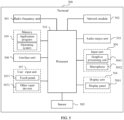
- FIG. 5 is a schematic diagram of a hardware structure of a terminal for implementing the embodiments of this application.
- the terminal 500 includes but is not limited to at least part of components such as a radio frequency unit 501, a network module 502, an audio output unit 503, an input unit 504, a sensor 505, a display unit 506, a user input unit 507, an interface unit 508, a memory 509, and a processor 510.
- components such as a radio frequency unit 501, a network module 502, an audio output unit 503, an input unit 504, a sensor 505, a display unit 506, a user input unit 507, an interface unit 508, a memory 509, and a processor 510.
- the terminal 500 may further include a power supply (for example, a battery) supplying power to the components, and the power supply may be logically connected to the processor 510 through a power management system. In this way, functions such as charge management, discharge management, and power consumption management are implemented by using the power management system.
- a power supply for example, a battery
- functions such as charge management, discharge management, and power consumption management are implemented by using the power management system.
- the structure of the terminal shown in FIG. 5 does not constitute any limitation on the terminal.
- the terminal may include more or fewer components than shown in the figure, or a combination of some components, or the components disposed differently. Details are not described herein again.
- the input unit 504 may include a graphics processing unit (Graphics Processing Unit, GPU) 5041 and a microphone 5042.
- the graphics processing unit 5041 processes image data of a still picture or video obtained by an image capture apparatus (such as a camera) in a video capture mode or an image capture mode.
- the display unit 506 may include a display panel 5061, and the display panel 5061 may be configured in a form of a liquid crystal display, an organic light-emitting diode, and the like.
- the user input unit 507 may include at least one of a touch panel 5071 and other input devices 5072.
- the touch panel 5071 is also referred to as a touchscreen.
- the touch panel 5071 may include two parts: a touch detection apparatus and a touch controller.
- the other input devices 5072 may include but are not limited to a physical keyboard, a function key (such as a volume control key or a power on/off key), a trackball, a mouse, a joystick, and the like. Details are not described herein.
- the radio frequency unit 501 receives downlink data from a network-side device, and then sends the downlink data to the processor 510 for processing. In addition, the radio frequency unit 501 may sends uplink data to the network-side device.
- the radio frequency unit 501 includes but is not limited to an antenna, an amplifier, a transceiver, a coupler, a low noise amplifier, a duplexer, and the like.
- the memory 509 may be configured to store software programs or instructions and various data.
- the memory 509 may include a first storage area for storing a program or instructions and a second storage area for storing data.
- the first storage area may store an operating system, an application program or instruction required by at least one function (for example, a sound playback function or an image playback function), and the like.
- the memory 509 may include a volatile memory or a non-volatile memory, or the memory 509 may include both a volatile memory and a non-volatile memory.
- the non-volatile memory may be a read-only memory (Read-Only Memory, ROM), a programmable read only memory (Programmable ROM, PROM), an erasable programmable read-only memory (Erasable PROM, EPROM), and an electrically erasable programmable read-only memory (Electrically EPROM, EEPROM), or flash memory.
- ROM Read-Only Memory
- PROM programmable read only memory
- Erasable PROM Erasable PROM
- EPROM erasable programmable read-only memory
- Electrically erasable programmable read-only memory Electrically erasable programmable read-only memory
- the volatile memory can be a random access memory (Random Access Memory, RAM), a static random access memory (Static RAM, SRAM), a dynamic random access memory (Dynamic RAM, DRAM), a synchronous dynamic random access memory (Synchronous DRAM, SDRAM), a double data rate synchronous dynamic random access memory (Double Data Rate SDRAM, DDRSDRAM), an enhanced synchronous dynamic random access memory (Enhanced SDRAM, ESDRAM), a synchlink dynamic random access memory (Synch link DRAM, SLDRAM), and a direct rambus random access memory (Direct Rambus RAM, DRRAM).
- RAM Random Access Memory
- SRAM static random access memory
- DRAM dynamic random access memory
- DRAM synchronous dynamic random access memory
- SDRAM double data rate synchronous dynamic random access memory
- Enhanced SDRAM, ESDRAM enhanced synchronous dynamic random access memory
- Synch link DRAM, SLDRAM synchlink dynamic random access memory
- Direct Rambus RAM Direct Rambus RAM
- the processor 510 may include one or more processing units.
- an application processor and a modem processor may be integrated in the processor 510.
- This application processor primarily processes operations involving an operating system, user interfaces, application programs, and the like.
- the modem processor primarily processes radio communication signals, for example, being a baseband processor. It can be understood that the modem processor may alternatively be not integrated in the processor 510.
- the processor 510 is configured to:
- the function of the AI model includes at least one of the following: channel state information CSI coding, CSI decoding, positioning, channel estimation, tracking reference signal TRS estimation, phase tracking reference information PTRS estimation, beam management, signal calibration, and digital predistortion DPD.
- the first information is used for indicating at least one of the following:
- the first information is used for indicating at least one of the following:
- the first information is used for indicating that a format of the target information includes at least one of the following:
- the first information is used for indicating input information corresponding to at least one of the input interfaces of the AI model.
- the preprocessing or post-processing includes at least one of transform domain processing, power processing, amplitude processing, and phase processing.
- the input information of the AI model and/or the output information of the AI model further includes preset information, and the preset information includes at least one of channel environment information and device information.
- the processor 510 is further configured to: obtain second information, where the second information is used for indicating at least one of the following: the preset information and a format of the preset information.
- the processor 510 is configured to perform at least one of the following:
- the processor 510 is further configured to perform at least one of the following:
- the first information further includes at least one of a calibration set and an error of the calibration set
- the processor 510 is further configured to:
- the processor 510 is further configured to: perform a communication operation on the processed target information by using the AI model, where information output by the AI model meets the error of the calibration set.
- the first information is indication information sent by a second end, or the first information is information specified in a protocol.
- the second end is a network-side device; or the second end is a node of a terminal.
- the function of the AI model, the input information of the AI model, and the output information of the AI model that are to be used by the terminal during a communication operation are clarified, so as to avoid the problem that the AI model has poor performance due to an unclear function of the AI model or incorrect input information and output information of the AI model. This ensures that the AI model has relatively good performance in the communication process and also ensures that the terminal can have relatively good communication performance.
- An embodiment of this application further provides a network-side device, including a processor and a communication interface, where the processor is configured to obtain first information, and perform a communication operation using an AI model based on the first information, where the first information is used for indicating at least one of the following: a function of an artificial intelligence AI model, input information of the AI model, and output information of the AI model.
- the network-side device embodiments correspond to the foregoing network-side device method embodiments shown in FIG. 2 , and the implementation processes and implementations of the foregoing method embodiments can be applied to the network-side device embodiments, with the same technical effects achieved.
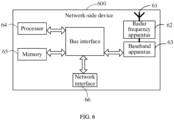
- the network-side device 600 includes an antenna 61, a radio frequency apparatus 62, a baseband apparatus 63, a processor 64, and a memory 65.
- the antenna 61 is connected to the radio frequency apparatus 62.
- the radio frequency apparatus 62 receives information by using the antenna 61, and sends the received information to the baseband apparatus 63 for processing.
- the baseband apparatus 63 processes to-be-sent information, and sends the information to the radio frequency apparatus 62; and the radio frequency apparatus 62 processes the received information and then sends the information out by using the antenna 61.
- the method executed by the network-side device in the foregoing embodiments can be implemented in the baseband apparatus 63, and the baseband apparatus 63 includes a baseband processor.
- the baseband apparatus 63 may include, for example, at least one baseband board, where a plurality of chips are disposed on the baseband board. As shown in FIG. 6 , one of the chips is, for example, a baseband processor, and is connected to the memory 65 through the bus interface, to invoke a program in the memory 65 to perform the operations of the network device shown in the foregoing method embodiments.
- the network-side device may further include a network interface 66, where the interface is, for example, a common public radio interface (Common Public Radio Interface, CPRI).
- CPRI Common Public Radio Interface
- the network-side device 600 in this embodiment of this application further includes: instructions or a program stored in the memory 65 and capable of running on the processor 64.
- the processor 64 invokes the instructions or program in the memory 65 to execute the method executed by the modules shown in FIG. 3 , with the same technical effects achieved. To avoid repetition, details are not repeated herein.
- An embodiment of this application further provides a readable storage medium, where a program or an instruction is stored in the readable storage medium.
- a program or an instruction is stored in the readable storage medium.
- the processor is a processor in the terminal described in the foregoing embodiments.
- the readable storage medium includes a computer-readable storage medium, for example, a computer read only memory, a random access memory, a magnetic disk, or an optical disc.
- An embodiment of this application further provides a chip, where the chip includes a processor and a communication interface.
- the communication interface is coupled to the processor, and the processor is configured to run a program or an instruction to implement the processes of the foregoing communication method embodiments in FIG. 2 , with the same technical effects achieved. To avoid repetition, details are not described herein again.
- the chip mentioned in the embodiments of this application may also be referred to as a system-level chip, a system chip, a chip system, a system-on-chip, or the like.
- An embodiment of this application further provides a computer program/program product, where the computer program/program product is stored in a storage medium, and when being executed by at least one processor, the computer program/program product is configured to implement the processes of the foregoing communication method embodiments in FIG. 2 , with the same technical effects achieved. To avoid repetition, details are not repeated herein.
- the computer software product is stored in a storage medium (such as a ROM/RAM, a magnetic disk, or an optical disc), and includes several instructions for instructing a terminal (which may be a mobile phone, a computer, a server, a network device, or the like) to perform the methods described in the embodiments of this application.
- a storage medium such as a ROM/RAM, a magnetic disk, or an optical disc
Landscapes
- Engineering & Computer Science (AREA)
- Computer Networks & Wireless Communication (AREA)
- Signal Processing (AREA)
- Artificial Intelligence (AREA)
- Computer Vision & Pattern Recognition (AREA)
- Databases & Information Systems (AREA)
- Evolutionary Computation (AREA)
- Medical Informatics (AREA)
- Software Systems (AREA)
- Physics & Mathematics (AREA)
- Mathematical Physics (AREA)
- Mobile Radio Communication Systems (AREA)
Applications Claiming Priority (2)
| Application Number | Priority Date | Filing Date | Title |
|---|---|---|---|
| CN202111672336.9A CN116418693A (zh) | 2021-12-31 | 2021-12-31 | 通信方法、装置及相关设备 |
| PCT/CN2022/142110 WO2023125458A1 (fr) | 2021-12-31 | 2022-12-26 | Procédé et appareil de communication, et dispositif associé |
Publications (2)
| Publication Number | Publication Date |
|---|---|
| EP4459941A1 true EP4459941A1 (fr) | 2024-11-06 |
| EP4459941A4 EP4459941A4 (fr) | 2025-07-30 |
Family
ID=86997817
Family Applications (1)
| Application Number | Title | Priority Date | Filing Date |
|---|---|---|---|
| EP22914712.9A Pending EP4459941A4 (fr) | 2021-12-31 | 2022-12-26 | Procédé et appareil de communication, et dispositif associé |
Country Status (4)
| Country | Link |
|---|---|
| US (1) | US20240356819A1 (fr) |
| EP (1) | EP4459941A4 (fr) |
| CN (1) | CN116418693A (fr) |
| WO (1) | WO2023125458A1 (fr) |
Families Citing this family (9)
| Publication number | Priority date | Publication date | Assignee | Title |
|---|---|---|---|---|
| CN117242750A (zh) * | 2023-07-28 | 2023-12-15 | 北京小米移动软件有限公司 | 通信管理方法、装置、存储介质及系统 |
| CN119485270A (zh) * | 2023-08-11 | 2025-02-18 | 维沃移动通信有限公司 | 信息上报方法、信息接收方法及设备 |
| CN121174173A (zh) * | 2024-06-17 | 2025-12-19 | 华为技术有限公司 | 通信方法及装置 |
| CN121333503A (zh) * | 2024-07-10 | 2026-01-13 | 维沃移动通信有限公司 | 信息传输方法、装置及通信设备 |
| CN121367646A (zh) * | 2024-07-19 | 2026-01-20 | 华为技术有限公司 | 通信系统中模型功能对齐的方法和通信装置 |
| CN121645539A (zh) * | 2024-09-02 | 2026-03-10 | 维沃移动通信有限公司 | 通信方法、装置及设备 |
| WO2026060705A1 (fr) * | 2024-09-23 | 2026-03-26 | Oppo广东移动通信有限公司 | Procédés et appareils de configuration de modèle, dispositifs et support de stockage |
| CN121888275A (zh) * | 2024-10-17 | 2026-04-17 | 华为技术有限公司 | 一种通信方法及相关装置 |
| CN120568464B (zh) * | 2025-07-30 | 2025-12-26 | 荣耀终端股份有限公司 | 通信方法及装置 |
Family Cites Families (10)
| Publication number | Priority date | Publication date | Assignee | Title |
|---|---|---|---|---|
| CN105577314B (zh) * | 2014-10-08 | 2019-08-23 | 展讯通信(上海)有限公司 | 一种捕获指示检测方法及移动终端 |
| CN106559872B (zh) * | 2015-09-30 | 2021-01-29 | 华为技术有限公司 | 一种资源分配方法、装置及无线接入系统 |
| CN107155199B (zh) * | 2016-03-04 | 2023-09-26 | 华为技术有限公司 | 一种空口技术的配置方法、装置及无线通信系统 |
| US12044789B2 (en) * | 2016-04-22 | 2024-07-23 | Azar Zandifar | Systems and methods for occupancy detection using WiFi sensing technologies |
| CN107765104B (zh) * | 2017-09-04 | 2020-02-14 | 华为技术有限公司 | 一种相控阵校测的方法以及校测装置 |
| US11595847B2 (en) * | 2019-12-19 | 2023-02-28 | Qualcomm Incorporated | Configuration of artificial intelligence (AI) modules and compression ratios for user-equipment (UE) feedback |
| CN113194531B (zh) * | 2020-01-14 | 2023-01-20 | 维沃移动通信有限公司 | 定位方法及通信设备 |
| WO2021163895A1 (fr) * | 2020-02-18 | 2021-08-26 | Oppo广东移动通信有限公司 | Procédé de gestion de modèle de réseau, procédé d'établissement ou de modification de session, et appareil |
| EP3876567B1 (fr) * | 2020-03-05 | 2023-08-09 | Fujitsu Limited | Procédé dans un réseau de communication sans fil et dans une station de base et réseau de communication sans fil et station de base |
| KR102710819B1 (ko) * | 2020-03-19 | 2024-09-26 | 엘지전자 주식회사 | Ai를 이용한 이동통신 방법 |
-
2021
- 2021-12-31 CN CN202111672336.9A patent/CN116418693A/zh active Pending
-
2022
- 2022-12-26 EP EP22914712.9A patent/EP4459941A4/fr active Pending
- 2022-12-26 WO PCT/CN2022/142110 patent/WO2023125458A1/fr not_active Ceased
-
2024
- 2024-06-28 US US18/758,337 patent/US20240356819A1/en active Pending
Also Published As
| Publication number | Publication date |
|---|---|
| CN116418693A (zh) | 2023-07-11 |
| EP4459941A4 (fr) | 2025-07-30 |
| US20240356819A1 (en) | 2024-10-24 |
| WO2023125458A1 (fr) | 2023-07-06 |
Similar Documents
| Publication | Publication Date | Title |
|---|---|---|
| EP4459941A1 (fr) | Procédé et appareil de communication, et dispositif associé | |
| US20240414073A1 (en) | Data Collection Method And Device | |
| US20250220647A1 (en) | Resource configuration method and apparatus, and terminal and network side device | |
| US12604304B2 (en) | Beam control method and apparatus for intelligent surface device and electronic device | |
| CN116156541B (zh) | 感知测量方法、感知测量指示方法、终端及网络侧设备 | |
| US20240388927A1 (en) | Information Transmission Method, Terminal, and Network Side Device | |
| CN117692945A (zh) | 感知信号处理方法、装置及通信设备 | |
| CN116506271B (zh) | 信号处理方法、装置及通信设备 | |
| EP4462713A1 (fr) | Procédé de mappage de ports de signal de référence de sondage, et terminal | |
| CN117545087A (zh) | 下行参考信号发送方法、装置、终端及网络侧设备 | |
| EP4465711A1 (fr) | Procédé de prédiction de réseau de communication, terminal et dispositif côté réseau | |
| EP4598200A1 (fr) | Procédé et appareil d'analyse de dci, procédé de détermination de commutation de forme d'onde dynamique, procédé de détermination de réception de liaison montante, terminal et dispositif côté réseau | |
| CN116866891A (zh) | 传输方法、装置、终端及存储介质 | |
| WO2024017025A1 (fr) | Procédé et dispositif de configuration de paramètre de fréquence pilote | |
| US20250038801A1 (en) | Method and apparatus for transmitting information, terminal, and network side device | |
| CN117858071A (zh) | 数据集生成方法、信息发送方法、装置及相关设备 | |
| CN117997457A (zh) | 参考信号确定方法、终端及网络侧设备 | |
| US20250023686A1 (en) | Demodulation Reference Signal Transmission Method and Apparatus, Terminal, and Network-Side Device | |
| US20240137781A1 (en) | Spatial relation indication method and device | |
| WO2023208042A1 (fr) | Procédé et appareil de traitement de pré-distorsion, et dispositif | |
| US20250037030A1 (en) | Method for determining a model input and communication device | |
| CN116418467B (zh) | 探测参考信号的配置方法、装置、终端及网络侧设备 | |
| EP4572392A1 (fr) | Procédé et appareil de transmission de signaux, terminal, et support de stockage | |
| US20250373388A1 (en) | Method for obtaining channel state information, terminal, and network-side device | |
| CN121643828A (zh) | 相位信息指示方法、装置、终端及网络侧设备 |
Legal Events
| Date | Code | Title | Description |
|---|---|---|---|
| STAA | Information on the status of an ep patent application or granted ep patent |
Free format text: STATUS: THE INTERNATIONAL PUBLICATION HAS BEEN MADE |
|
| PUAI | Public reference made under article 153(3) epc to a published international application that has entered the european phase |
Free format text: ORIGINAL CODE: 0009012 |
|
| STAA | Information on the status of an ep patent application or granted ep patent |
Free format text: STATUS: REQUEST FOR EXAMINATION WAS MADE |
|
| 17P | Request for examination filed |
Effective date: 20240718 |
|
| AK | Designated contracting states |
Kind code of ref document: A1 Designated state(s): AL AT BE BG CH CY CZ DE DK EE ES FI FR GB GR HR HU IE IS IT LI LT LU LV MC ME MK MT NL NO PL PT RO RS SE SI SK SM TR |
|
| DAV | Request for validation of the european patent (deleted) | ||
| DAX | Request for extension of the european patent (deleted) | ||
| RIC1 | Information provided on ipc code assigned before grant |
Ipc: H04W 24/02 20090101ALI20250311BHEP Ipc: H04L 41/16 20220101AFI20250311BHEP |
|
| A4 | Supplementary search report drawn up and despatched |
Effective date: 20250701 |
|
| RIC1 | Information provided on ipc code assigned before grant |
Ipc: H04L 41/16 20220101AFI20250625BHEP Ipc: H04W 24/02 20090101ALI20250625BHEP |