EP4464997B1 - Verfahren und vorrichtung zur überwachung des status eines mechanischen systems eines fahrzeugs unter verwendung von schwellen, die abhängig von den betriebsparametern des systems variieren - Google Patents
Verfahren und vorrichtung zur überwachung des status eines mechanischen systems eines fahrzeugs unter verwendung von schwellen, die abhängig von den betriebsparametern des systems variieren Download PDFInfo
- Publication number
- EP4464997B1 EP4464997B1 EP24159969.5A EP24159969A EP4464997B1 EP 4464997 B1 EP4464997 B1 EP 4464997B1 EP 24159969 A EP24159969 A EP 24159969A EP 4464997 B1 EP4464997 B1 EP 4464997B1
- Authority
- EP
- European Patent Office
- Prior art keywords
- context
- values
- health
- mechanical system
- initial
- Prior art date
- Legal status (The legal status is an assumption and is not a legal conclusion. Google has not performed a legal analysis and makes no representation as to the accuracy of the status listed.)
- Active
Links
Images



Classifications
-
- B—PERFORMING OPERATIONS; TRANSPORTING
- B64—AIRCRAFT; AVIATION; COSMONAUTICS
- B64F—GROUND OR AIRCRAFT-CARRIER-DECK INSTALLATIONS SPECIALLY ADAPTED FOR USE IN CONNECTION WITH AIRCRAFT; DESIGNING, MANUFACTURING, ASSEMBLING, CLEANING, MAINTAINING OR REPAIRING AIRCRAFT, NOT OTHERWISE PROVIDED FOR; HANDLING, TRANSPORTING, TESTING OR INSPECTING AIRCRAFT COMPONENTS, NOT OTHERWISE PROVIDED FOR
- B64F5/00—Designing, manufacturing, assembling, cleaning, maintaining or repairing aircraft, not otherwise provided for; Handling, transporting, testing or inspecting aircraft components, not otherwise provided for
- B64F5/60—Testing or inspecting aircraft components or systems
-
- G—PHYSICS
- G01—MEASURING; TESTING
- G01M—TESTING STATIC OR DYNAMIC BALANCE OF MACHINES OR STRUCTURES; TESTING OF STRUCTURES OR APPARATUS, NOT OTHERWISE PROVIDED FOR
- G01M13/00—Testing of machine parts
- G01M13/02—Gearings; Transmission mechanisms
- G01M13/028—Acoustic or vibration analysis
-
- G—PHYSICS
- G01—MEASURING; TESTING
- G01D—MEASURING NOT SPECIALLY ADAPTED FOR A SPECIFIC VARIABLE; ARRANGEMENTS FOR MEASURING TWO OR MORE VARIABLES NOT COVERED IN A SINGLE OTHER SUBCLASS; TARIFF METERING APPARATUS; MEASURING OR TESTING NOT OTHERWISE PROVIDED FOR
- G01D21/00—Measuring or testing not otherwise provided for
- G01D21/02—Measuring two or more variables by means not covered by a single other subclass
-
- B—PERFORMING OPERATIONS; TRANSPORTING
- B64—AIRCRAFT; AVIATION; COSMONAUTICS
- B64D—EQUIPMENT FOR FITTING IN OR TO AIRCRAFT; FLIGHT SUITS; PARACHUTES; ARRANGEMENT OR MOUNTING OF POWER PLANTS OR PROPULSION TRANSMISSIONS IN AIRCRAFT
- B64D45/00—Aircraft indicators or protectors not otherwise provided for
-
- G—PHYSICS
- G01—MEASURING; TESTING
- G01H—MEASUREMENT OF MECHANICAL VIBRATIONS OR ULTRASONIC, SONIC OR INFRASONIC WAVES
- G01H1/00—Measuring characteristics of vibrations in solids by using direct conduction to the detector
- G01H1/003—Measuring characteristics of vibrations in solids by using direct conduction to the detector of rotating machines
-
- G—PHYSICS
- G01—MEASURING; TESTING
- G01H—MEASUREMENT OF MECHANICAL VIBRATIONS OR ULTRASONIC, SONIC OR INFRASONIC WAVES
- G01H17/00—Measuring mechanical vibrations or ultrasonic, sonic or infrasonic waves, not provided for in the other groups of this subclass
-
- G—PHYSICS
- G01—MEASURING; TESTING
- G01M—TESTING STATIC OR DYNAMIC BALANCE OF MACHINES OR STRUCTURES; TESTING OF STRUCTURES OR APPARATUS, NOT OTHERWISE PROVIDED FOR
- G01M13/00—Testing of machine parts
- G01M13/02—Gearings; Transmission mechanisms
- G01M13/025—Test-benches with rotational drive means and loading means; Load or drive simulation
-
- G—PHYSICS
- G01—MEASURING; TESTING
- G01M—TESTING STATIC OR DYNAMIC BALANCE OF MACHINES OR STRUCTURES; TESTING OF STRUCTURES OR APPARATUS, NOT OTHERWISE PROVIDED FOR
- G01M13/00—Testing of machine parts
- G01M13/04—Bearings
- G01M13/045—Acoustic or vibration analysis
-
- G—PHYSICS
- G01—MEASURING; TESTING
- G01M—TESTING STATIC OR DYNAMIC BALANCE OF MACHINES OR STRUCTURES; TESTING OF STRUCTURES OR APPARATUS, NOT OTHERWISE PROVIDED FOR
- G01M15/00—Testing of engines
- G01M15/04—Testing internal-combustion engines
- G01M15/12—Testing internal-combustion engines by monitoring vibrations
-
- G—PHYSICS
- G06—COMPUTING OR CALCULATING; COUNTING
- G06F—ELECTRIC DIGITAL DATA PROCESSING
- G06F18/00—Pattern recognition
- G06F18/20—Analysing
- G06F18/27—Regression, e.g. linear or logistic regression
-
- G—PHYSICS
- G06—COMPUTING OR CALCULATING; COUNTING
- G06N—COMPUTING ARRANGEMENTS BASED ON SPECIFIC COMPUTATIONAL MODELS
- G06N5/00—Computing arrangements using knowledge-based models
- G06N5/01—Dynamic search techniques; Heuristics; Dynamic trees; Branch-and-bound
-
- G—PHYSICS
- G06—COMPUTING OR CALCULATING; COUNTING
- G06Q—INFORMATION AND COMMUNICATION TECHNOLOGY [ICT] SPECIALLY ADAPTED FOR ADMINISTRATIVE, COMMERCIAL, FINANCIAL, MANAGERIAL OR SUPERVISORY PURPOSES; SYSTEMS OR METHODS SPECIALLY ADAPTED FOR ADMINISTRATIVE, COMMERCIAL, FINANCIAL, MANAGERIAL OR SUPERVISORY PURPOSES, NOT OTHERWISE PROVIDED FOR
- G06Q50/00—Information and communication technology [ICT] specially adapted for implementation of business processes of specific business sectors, e.g. utilities or tourism
- G06Q50/10—Services
-
- G—PHYSICS
- G08—SIGNALLING
- G08B—SIGNALLING SYSTEMS, e.g. PERSONAL CALLING SYSTEMS; ORDER TELEGRAPHS; ALARM SYSTEMS
- G08B21/00—Alarms responsive to a single specified undesired or abnormal condition and not otherwise provided for
- G08B21/18—Status alarms
- G08B21/182—Level alarms, e.g. alarms responsive to variables exceeding a threshold
-
- G—PHYSICS
- G08—SIGNALLING
- G08B—SIGNALLING SYSTEMS, e.g. PERSONAL CALLING SYSTEMS; ORDER TELEGRAPHS; ALARM SYSTEMS
- G08B21/00—Alarms responsive to a single specified undesired or abnormal condition and not otherwise provided for
- G08B21/18—Status alarms
- G08B21/187—Machine fault alarms
-
- B—PERFORMING OPERATIONS; TRANSPORTING
- B64—AIRCRAFT; AVIATION; COSMONAUTICS
- B64D—EQUIPMENT FOR FITTING IN OR TO AIRCRAFT; FLIGHT SUITS; PARACHUTES; ARRANGEMENT OR MOUNTING OF POWER PLANTS OR PROPULSION TRANSMISSIONS IN AIRCRAFT
- B64D45/00—Aircraft indicators or protectors not otherwise provided for
- B64D2045/0085—Devices for aircraft health monitoring, e.g. monitoring flutter or vibration
Definitions
- the present invention lies in the field of health monitoring systems for mechanical systems.
- the present invention relates to a method and a device for monitoring the health of a mechanical system equipping a vehicle using variable thresholds according to operating parameters of the system.
- a mechanical system may have several moving parts, for example several rotating parts, such as an input shaft and an output shaft.
- a mechanical system may include one or more bearings to guide the rotation of an input shaft and an output shaft or even one or more intermediate rotating members.
- a bearing includes, for example, a rolling bearing equipped with one or more rows of rolling elements such as balls, rollers or others.
- a mechanical system can also be equipped with at least one toothed wheel, one pinion, one toothed crown.
- An aircraft can thus include an on-board monitoring system to monitor the health of a mechanical system in order to increase flight safety.
- Such a monitoring system can, regardless of the mechanical system being monitored, measure and record operational data of the mechanical system, in particular of a vibration nature. This monitoring system can then determine health indicator values based on this operational data and compare them to predefined thresholds to detect a potential anomaly linked to an emerging mechanical defect.
- the value of each threshold can be obtained by experience or by a statistical analysis of a history of measurements from several similar mechanical systems acquired during testing or validation phases or during the first hours of use of such a mechanical system.
- the thresholds can, for example, be estimated from a parametric modeling of the health indicator statistics with the assumption that the mechanical system is healthy, i.e. without anomalies, malfunctions or defects.
- each threshold can be constant over the entire operating range of the mechanical system.
- Each detection threshold can alternatively have several constant values relating respectively to specific phases of operation of the mechanical system.
- a health indicator may take the form of a vibration indicator evaluated using at least one sensor, this sensor being able to include at least one accelerometer, a tachometer.
- a health indicator may be defined using a signal provided by a single sensor, for example by being equal to the maximum amplitude of a temporal vibration signal provided by an accelerometer or by combining the signals from several sensors. This is for example the case of health monitoring systems designated by the acronym HUMS for "Health and Usage Monitoring System" in English
- One health indicator may be used to monitor a mechanical system as a whole, while other health indicators may be specific to a particular type of fault that may appear on a particular part of the mechanical system.
- the documents US 7684936 , US 2017/0023438 , US 8442778 , US 8131420 , CN 102963533 And US 2011/0166799 describe HUMS monitoring systems.
- the documents US 8442778 And US 2017/0023438 are intended in particular for the monitoring of wind turbines.
- the documents US 8131420 , CN 102963533 And US 2011/0166799 are dedicated to rotary wing aircraft.
- the document CN 102963533 presents a monitoring system.
- This monitoring system includes an onboard system that can identify a risk in real time and generate an alert, as well as a remote ground-based system capable of downloading and analyzing data acquired in flight in order to plan the necessary maintenance operations.
- the document US 2011/0166799 describes a monitoring system determining a health indicator whose value is adjusted according to an operating parameter of the monitored mechanical system, and in particular according to a torque exerted on a rotating organ. This health indicator can then be compared to a threshold to estimate a risk of a fault occurring.
- Such monitoring systems are interesting but the usual health indicators are dependent on the operating conditions of the mechanical system. These operating conditions are, for example, characterized by context parameters. These context parameters are, for example, the altitude or forward speed of the aircraft, the torque exerted within a transmission box, the rotation speed of a rotor, etc. This dependence can result in a non-stationarity of the health indicators over the entire operating range of the mechanical system and/or the aircraft. Therefore, these health indicators may only be usable during specific operating regimes. As a result, the health monitoring of a mechanical system may be restricted. at certain periods of use, excluding any transient regime in particular, which can delay the detection of a fault, or on the contrary cause the detection of false failures.
- the document EP 2345894 describes a method for indicating a fault propagating in a rotating shaft. After data measurements corresponding to a health indicator of the shaft and measurements of an input factor, for example a torque exerted on the shaft, a relationship between the health indicator and the input factor is determined. A filtered health indicator is then determined based on this relationship and an effect of the input factor on the health indicator, this effect being estimated using a Kalman filter, recursive least squares estimation and/or a particle filter.
- the document EP 4091945 describes a method for detecting faults in an aircraft transmission system. This method proposes to acquire, during several time intervals, a signal relating to the dynamic behavior of the transmission system as well as values of flight parameters of the aircraft. Groups of indicators relating to each time interval are determined from these signals. An estimate of the probability that the values of the indicators of a group of indicators are abnormal compared to a predefined learning condition is calculated for each indicator of the group of indicators, taking into account the measured flight parameters. Health indicators are determined according to this probability estimate, then compared with a threshold to identify the presence of a fault.
- the document WO 2011/023596 describes a method and system for monitoring vibrations in a wind turbine.
- a range of characteristic vibration values is predicted from real-time operating data of an electrical generator of the wind turbine according to rules extracted from a rule set.
- a real-time comparison of the generator's characteristic operating values with a calculated threshold is performed to detect and signal a possible fault on the electrical generator.
- the document US 2022/0163428 discloses a system and method for monitoring the condition of a damper of a gas turbine.
- a gas turbine includes a rotating component, a bearing operatively coupled to the rotating component, and a damper associated with the bearing, as well as sensors and a controller.
- the controller receives data relating to sensed and/or calculated parameters, and generates a damper-related index based on this data and characteristic of a health condition of the damper. When this index exceeds a predetermined threshold, a notification indicating the health condition of the damper is generated.
- a type of fault experienced by the damper and a remaining useful life of the shock absorber can also be determined.
- the present invention relates, for example, to a method for monitoring the health of a mechanical system equipping a vehicle, the mechanical system comprising at least one moving member as well as at least one vibration sensor emitting a vibration signal, the mechanical system or the vehicle comprising at least one context sensor emitting a context signal relating to at least one context parameter, said at least one context parameter being chosen from a list comprising at least one or more functional parameters of the mechanical system, one or more navigation parameters of the vehicle and one or more atmospheric parameters.
- one or more CI health indicators are determined during the initial phase from measurements from said at least one vibration sensor, then a threshold variation model is defined for each CI health indicator as a function of the values of this CI health indicator and the measurements from said at least one context sensor on this initial phase using regressions on quantile distribution parameters.
- a threshold variation model is defined for each CI health indicator as a function of the values of this CI health indicator and the measurements from said at least one context sensor on this initial phase using regressions on quantile distribution parameters.
- at least one decision tree is used to define one or more ranges of the context parameter(s) for which the threshold relating to the CI health indicator is statistically constant.
- a threshold relating to a CI health indicator is considered to be statistically constant, over a range of contiguous values of a context parameter, if for any division of said range of values into two sub-ranges of contiguous values, the thresholds estimated respectively on the two sub-ranges of values are considered identical according to a statistical test.
- a statistical test may be for example a Welch test.
- each is used for convenience, both in the presence of a single CI health indicator and CI health indicators for ease of reading.
- the initial phase can thus be a learning period allowing the threshold variation model to be defined for each CI health indicator of the mechanical system.
- This initial phase is carried out following the first use of the vehicle or following a significant maintenance operation, for example following the replacement of the mechanical system. During this learning period, the mechanical system is considered to be fault-free. This initial phase thus makes it possible to determine the threshold variation model of the mechanical system considered to be healthy for the vehicle.
- the health monitoring of the mechanical system is ensured using the threshold variation model during the operational monitoring phase.
- the method according to the invention thus makes it possible to adapt the threshold value to which a CI health indicator is compared to the context parameters, which makes it possible to improve the detection of a mechanical defect, or of an anomaly linked to an emerging mechanical defect, while reducing the false detection rate.
- context parameters may include operating parameters of the mechanical system, such as the rotational speed of one or more rotating shafts, the torque(s) at this or these shafts, the temperature of the mechanical system for example.
- the context parameters may include operating parameters of the vehicle, and in particular of an aircraft, equipped with the mechanical system, such as the forward speed of this vehicle, its possible vertical speed, its altitude, the rotation speed of a rotor for example.
- Context parameters may also include atmospheric parameters, such as the temperature and atmospheric pressure outside the mechanical system, for example.
- the context sensor(s) make it possible to measure context characteristics relating to the operation of the mechanical system, and/or the vehicle as such, as well as relating to the environment, and to emit a temporal context signal, carrying information relating to these context characteristics, to a computer for example.
- the temporal context signal carries the initial context values during the initial phase of defining a threshold variation model, and the operational context values during the operational monitoring phase of the mechanical system.
- the vibration signal and the context signal can be generated simultaneously, or even synchronously.
- a computer can be present in the vehicle or present on a station separate from the vehicle.
- the vibration and context signals can be stored in a computer memory or in a memory present in the vehicle and possibly connected to the computer by a wired or wireless connection for example.
- the method according to the invention may comprise one or more of the following characteristics, taken alone or in combination.
- the definition of the threshold variation model may be performed using a single decision tree.
- the definition of the threshold variation model may be performed by aggregating at least two decision trees.
- the definition of the threshold variation model can be carried out with a predetermined minimum false alarm rate and a predetermined confidence rate in the minimum false alarm rate.
- the use of this minimum false alarm rate corresponding to a probability of issuing false alarms, thus makes it possible to reduce the false detection rate, and consequently, the false alarm issue rate, thus limiting the immobilizations of the mechanical system and the vehicle while no fault is present.
- the initial phase may comprise an analysis step to analyze a sensitivity of each CI health indicator to the context parameters and to select influential context parameters. This analysis step is carried out after the determination of several initial health values of each CI health indicator and before the definition of a threshold variation model.
- the initial phase may include a preselection step to select context parameters taken into account by the method from a multitude of context parameters measured by context sensors. This preselection step is carried out before the measurements of the initial vibration and context values.
- the context parameters most influential on the variations of each CI health indicator are selected prior to carrying out the initial phase, for example by an empirical analysis of measurements on other mechanical systems, for example equivalent or similar. Consequently, only these previously selected context parameters are taken into account in defining the threshold variation model for each CI health indicator and, subsequently, to determine the variable threshold.
- said initial values of said at least one CI health indicator can be calculated from a decomposition into Fourier coefficients of the successive initial vibrational values modeled with a hypothesis of cyclostationarity of order one and two of the vibrational signal, which follows a Chi-square law, generalized by a GAMMA distribution.
- the present invention also relates to a computer program comprising instructions which, when the program is executed, lead to the implementation of the various examples of the monitoring method described above.
- This computer program can be stored for example in a memory of a computer present in the vehicle, or in a memory located in the vehicle and connected to the computer, or even in a memory of a station separate from the vehicle.
- This computer program may be implemented entirely by a computer present in the vehicle or a vehicle computer, or jointly by such a computer or computer present in the vehicle and by a station separate from the vehicle.
- the present invention also relates to a monitoring device configured to monitor a mechanical system equipping a vehicle, the mechanical system comprising at least one moving member, the monitoring device comprising at least one vibration sensor emitting a vibration signal, at least one context sensor emitting at least one context signal relating to at least one context parameter and a calculator.
- the monitoring device is configured to implement the various examples of the health monitoring method previously described.
- the computer may include a single computing unit embedded in the vehicle. Therefore, the entire monitoring process can be carried out in the vehicle, whether the vehicle is stationary or in operation.
- the calculator may comprise a single calculation unit separate from the vehicle, and present for example in a station external to the vehicle.
- the step of measuring the initial vibration values and the initial context values is carried out in the vehicle in operation during the initial phase of defining a threshold variation model, then the station receives these initial vibration values and these initial context values, the calculation unit of the station carrying out the steps of determining the initial health values of each CI health indicator, and of defining the threshold variation model.
- the step of measuring the vibration operational values and the context operational values is carried out in the vehicle in operation, while the steps of determining the operational health value of each CI health indicator, determining the threshold specific to the operational health value of each CI health indicator, and triggering an alert of a risk of the presence of a fault on the mechanical system if the operational health value of at least one CI health indicator is greater than the determined threshold are carried out by the computing unit of the station.
- the calculator may comprise a calculation unit embedded in the vehicle and a calculation unit separate from the vehicle, and present for example in a station external to the vehicle.
- the step of measuring the initial vibration values and the initial context values of the initial phase and the step of measuring the operational vibration values and the operational context values of the operational phase are carried out in the vehicle in operation.
- the other steps of the method may be carried out either in the vehicle in operation or when stopped, or in the station external to the vehicle which receives these initial vibration values and these initial context values as well as these operational vibration values and these operational context values.
- FIG. 1 represents a vehicle 1, and a rotary wing aircraft of the rotorcraft type in particular.
- This vehicle 1 comprises a mechanical system 10 provided with one or more moving members 15. These members 15 are for example rotating around an axis AX of rotation.
- the mechanical system 10 may for example comprise an output shaft or an input shaft.
- the mechanical system 10 may also comprise one or more rotational guide bearings, for example for the rotational guidance of at least one rotating member.
- a bearing comprises for example a rolling bearing provided with rolling elements.
- a mechanical system 10 may be, for example, a gearbox or a power transmission box of the vehicle 1.
- This mechanical system 10 may be connected, for example, to one or more engines 2, via respectively one or more input shafts and may drive a rotor in rotation via an output shaft, such as for example a main rotor 3 or an auxiliary rotor 4 of a rotorcraft as shown in the Figure 1 .
- a mechanical system 10 may be a rotary wing.
- such a mechanical system 10 may, for example, be arranged in a gearbox or a power transmission box of a vehicle 1 or any other mechanical equipment.
- the mechanical system 10 also comprises a monitoring device 9 intended to monitor the mechanical system 10 in order to detect and identify the presence of a fault, or a risk of a fault occurring.
- the monitoring device 9 comprises one or more vibration sensors 20, one or more context sensors 25 and a computer 50.
- the computer 50 can be dedicated to the monitoring device 9 or be shared with other devices of the vehicle 1.
- Each vibration sensor 20 can emit a temporal vibration signal relating to a vibration behavior of the mechanical system 10 as a whole, or to a particular vibration behavior of a member 15 of the mechanical system 10, for example a shaft, a bearing or even a gear.
- the temporal vibration signal carries successive vibration values relating to the vibrations of the mechanical system 10, for example according to a sampling frequency.
- the vibration sensor(s) 20 may comprise, for example, an accelerometer, a tachometer or others.
- Each context sensor 25 can emit a temporal context signal relating to a context characteristic linked to the operation of the mechanical system 10 and/or the vehicle 1 as well as to the environment.
- the temporal context signal carries successive initial context values relating to a context parameter linked to the mechanical system 10, to the vehicle 1 and/or to the environment, according to for example a sampling frequency.
- the context parameters may include operating parameters of the mechanical system 10, such as the rotational speed of one or more rotating shafts, the torque(s) at this or these shafts, the temperature of the mechanical system 10 for example.
- One or more context sensors 25 may then include different types of sensors associated with each operating parameter of the mechanical system 10, such as for example an accelerometer, a tachometer, a torque meter, or others.
- One or more context sensors 25 may also include an angular sensor, such as an encoder type sensor, making it possible to measure a variation in the angular position of a rotating member 15 of the mechanical system 10 in order, for example, to synchronize the vibration signals and the context signals with the rotation and the angular positions of this rotating member 15.
- the context parameters may be managed by an onboard system designated by the acronym UMS corresponding to the English designation “Usage Monitoring System”.
- the context parameters may include operating parameters of the vehicle 1, such as its forward speed, its vertical speed, its altitude, the rotation speed of a rotor 3, 4 for example.
- One or more context sensors 25 may then include different types of sensors associated with each operating parameter of the vehicle 1, such as for example an accelerometer, a tachometer, an altimeter, or others.
- the context parameters may also include atmospheric parameters related to atmospheric conditions, such as the temperature outside the mechanical system 1 and the atmospheric pressure, for example.
- One or more context sensors 25 may then include a thermometer and/or a barometer, for example.
- the calculator 50 may comprise a single calculation unit 51 on board the vehicle 1.
- the calculator 50 may comprise a single calculation unit 55 separate from the vehicle 1, and present for example in a station 40 external to the vehicle 1.
- the calculator 50 may comprise a calculation unit 51 embedded in the vehicle 1 and a calculation unit 55 separate from the vehicle 1, and present for example in a station 40 external to the vehicle 1.
- Each computing unit 51, 55 may comprise at least one processor and at least one memory 6', at least one integrated circuit, at least one programmable system or at least one logic circuit, these examples not limiting the scope given to the expression "computing unit”.
- the computer 50 may also be connected to a memory 6', 56 present in the vehicle 1 or in the station 40, by a wired connection or a wireless connection.
- the computer 50 may also include a 6' memory.
- the vibration and context signals can thus be stored in the 6.6' memory after having been transmitted to this 6.6' memory, by a wired link or a wireless link, the vibration and context signals being able to be analog or digital, electrical or optical signals.
- the memory 6,6',56 can also store a computer program comprising instructions which, when the program is executed, lead to the performance of a method for monitoring the health of the mechanical system 10.
- This method for monitoring the health of the mechanical system 10 is dedicated to monitoring the health, for example vibration, of the mechanical system 10.
- each vibration sensor 20 and each context sensor 25 can continuously emit a vibration signal and a context signal respectively.
- a vibration signal and a context signal may be signals formed by raw measurements emitted respectively by a vibration sensor and a context sensor or by measurements obtained by more or less complex signal processing carried out by a processing unit, for example integrated into the corresponding sensor, from such raw measurements, for example via standard filtering or sampling, or the application of transformations.
- the method for monitoring the health of the mechanical system 10 comprises two phases 100, 200 as shown in the diagram of the Figure 2 .
- a threshold variation model H is defined, the threshold varying as a function of the parameter(s) of context and being intended to be compared to a health indicator CI for monitoring the health of the mechanical system 10.
- an operational monitoring phase 200 is executed during which monitoring of the mechanical system 1 is carried out using the threshold determined with the model as a function of the context parameter(s).
- the mechanical system 10 is considered healthy, and therefore without anomaly or fault.
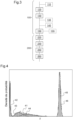
- the initial phase 100 has several steps as shown in the Figure 3 .
- the initial phase 100 may firstly comprise a preselection step 110 for selecting context parameters taken into account by the method from a multitude of context parameters measured by the context sensor(s) 25. Indeed, a very large number of context parameters, for example more than 1000 context parameters, may be measured on complex systems, and in particular on a vehicle 1 such as an aircraft. In fact, in order to limit the context parameters used by the method according to the invention, only a portion of these measured context parameters are taken into account. This selection may be carried out by feedback on the basis of similar mechanical systems or vehicles, the selected context parameters being the most influential parameters for these similar mechanical systems or vehicles.
- the selected context parameters may be stored in the memory 6, 6', 56.
- This preselection step 110 is not essential to carrying out the method according to the invention and is therefore optional.
- successive initial vibration values and initial context values originating respectively from the vibration sensor(s) 20 and the context sensor(s) 25 are measured and transmitted to the memory. 6.6' on board to be stored there and/or are sent directly to the computing unit 51.
- each health indicator CI is determined in the usual manner as a function of the initial vibration values measured during the measurement step 120, using the calculator 50.
- the different initial health values of each health indicator CI correspond respectively to different times of the initial phase 100.
- An initial health value of a CI health indicator is for example equal to an initial value from a single vibration sensor 20 or the result of a law involving initial values respectively from several vibration sensors 20.
- these initial health values of CI health indicators are for example determined using a system designated by the acronym HMS corresponding to the English designation “Health Monitoring System”.
- each initial health value of a CI health indicator is then associated with the initial context value of the one or more context parameters measured substantially simultaneously with the initial vibration value(s) used to determine the initial health value of this CI health indicator.
- an initial health value of a CI health indicator is associated with an initial context value of three distinct context parameters.
- This determination step 130 can be carried out by the calculation unit 51 of the calculator 50 which is on board the vehicle 1.
- Each initial value of a health indicator CI can then be stored in the on-board memory 6,6'.
- Each initial value of the health indicator(s ) CI can thus be calculated during the use of vehicle 1, substantially in real time, or when vehicle 1 stops.
- the initial phase 100 may then comprise, as an alternative or in addition to the preselection step 110, an analysis step 140 for analyzing a sensitivity of each CI health indicator to the context parameters and for selecting influential context parameters.
- This analysis step makes it possible to determine and select, from among the context parameters used, the context parameters that are most influential on the variations of each CI health indicator.
- This analysis step 140 may be carried out by the calculation unit 51 on board the vehicle 1 or by the calculation unit 55 of the calculator 50 of the station 40.
- a threshold variation model H is defined for each health indicator CI as a function of the initial health values of this health indicator CI, considered as characterizing a healthy mechanical system 10, and initial context values of the context parameter(s) previously determined and stored.
- This definition step 150 requires a significant number of initial health values for each health indicator CI so that this threshold variation model H is reliable and robust. This significant number of initial health values must cover a large part of the area of use of the vehicle 1 in order to subsequently allow a reliable and safe threshold to be determined throughout the area of use of the vehicle 1. This significant number of initial health values is obtained during a minimum learning duration t a of use of the vehicle 1, for example equal to 50 hours, corresponding substantially to the duration of the initial phase 100.
- this definition step 150 can be carried out by the calculation unit 55 of the calculator 50 of the station 40, with the initial values of the CI health indicator(s) and the initial context values stored in the memory 6,6' of the vehicle 1, after the vehicle 1 has stopped.
- the initial context values and the initial values of the CI health indicator(s) are in this case transmitted from the memory 6,6' present in the vehicle 1 to the computing unit 55 of the station 40, for example during a transmission sub-step 155.
- the threshold variation model H can then be stored in the memory 56 of the station 40.
- this definition step 150 can still be carried out by the calculation unit 55 of the station 40, with the initial values of the health indicator(s ) CI and the initial context values stored in the memory 56 of the station 40, after the vehicle 1 has stopped.
- the threshold variation model H can then be stored in the memory 56 of the station 40.
- the function f ( ⁇ ) can be estimated from a method using decision tree regressions on the quantile distribution parameters via an aggregation of decision trees often referred to in English as "Bagging Decision Tree”.
- a quantile q ⁇ is a value that separates a data set according to a proportion defined by a probability ⁇ .
- the function f ( ⁇ ) is a density of probability that characterizes the quantile distribution p ( q ⁇ ( ⁇ )) as a function of the context parameters ⁇ .
- the quantile distribution p ( q ⁇ ( ⁇ )) is defined by the mean ⁇ ⁇ ⁇ ⁇ and variance ⁇ ⁇ ⁇ ⁇
- the function f ( ⁇ ) thus characterizes the relationship between the quantile distributions and the context parameters ⁇ .
- the average ⁇ ⁇ ⁇ ⁇ ⁇ and variance ⁇ ⁇ ⁇ ⁇ can be estimated from the image of the function f ( ⁇ ) for a context parameter space ⁇ of dimension p, where p is also the number of context parameters ⁇ used.
- p is also the number of context parameters ⁇ used.
- the method according to the invention can use statistical modeling of the distribution of the CI health indicator. Furthermore, it is known that the CI health indicators estimated from the Fourier coefficients of a vibration signal modeled under the hypothesis of cyclostationarity of order one or two, follow, in the case where the mechanical system 10 does not have a defect, a chi-square law. The generalization of this law is a gamma law ⁇ with two parameters, a shape parameter ⁇ and a scale parameter ⁇ . The statistical distribution of the CI health indicator is thus modeled by a mixture of gamma distributions. Such modeling advantageously makes it possible to consider more complex data distributions and therefore offers greater flexibility.
- the parameters of the mixture model ⁇ ⁇ k , ⁇ k , ⁇ k ⁇ are estimated with an expectation-maximization algorithm known as "Expectation Maximization" while the number of gamma distributions K is estimated from a Bayesian information criterion called BIC for "Bayesian Information Criterion", with the condition K ⁇ N ⁇ where N ⁇ is the maximum number of components of the gamma distribution to be estimated.
- the minimum argument ( argmin ) of a function represents the value of the variable for which the value of the function concerned reaches its minimum, the value for which the function is minimized being unique.
- a parametric modeling of the CI health indicator conditioned on one or more context parameters is carried out by a mixture of Gamma distributions.
- FIG. 4 illustrates a histogram 41 of the probability density of a CI health indicator, according to the x value of this CI health indicator.
- Curves 42,43,44 represent the variations of the Gamma components identified by the mixture model according to the x value of this CI health indicator.
- Histogram 45 corresponds to the quantile sample estimated and modeled by a Log Normal distribution 46.
- the method performs a recursive division of the context parameter space in order to divide it into several ranges for which the threshold relating to the CI health indicator is statistically constant, namely that, for a range of values of a given context parameter, two distinct thresholds resulting from a further division of the range of values of the context parameter into two sub-ranges have for example a statistical difference lower than a predetermined value.
- This value predetermined is for example equal to the critical value of the Welch statistic.
- the indices j and k denote respectively the index j of the context parameter ⁇ j , j varying from 1 to p, and the iteration indicating the index k of traversal on this context parameter ⁇ j , N b being the dimension of the quantile sample Q ⁇ .
- the index k of traversal is an iterator indexed on the vector defined by the context parameter ⁇ j .
- the means of the samples Q ⁇ of quantiles ⁇ ⁇ 1 ( k ) and ⁇ ⁇ 2 ( k ) as well as the variances ⁇ ⁇ 1 ( k ) and ⁇ ⁇ 2 ( k ) are estimated from the health indicator CI conditioned on the context parameter ⁇ j at the path index k .
- a maximum value of the Welch statistic can be determined over the entire context parameter space and can be used to determine the value of the context parameter and the context parameter to be discretized.
- This discretization coordinate ⁇ j ⁇ k ⁇ allows to separate a range of values of a context parameter into two sub-ranges.
- the recursive division process on the context parameter space can stop when, for example, at least one of the following two conditions is verified, allowing to conclude that the threshold relating to the CI health indicator is statistically constant over these two sub-ranges.
- a hypothesis H 0 For a second condition, a hypothesis H 0 , according to which two means of quantile distributions are no longer statistically different, cannot be rejected.
- This hypothesis H 0 cannot be rejected if the value of the Welch statistic S j ( k ) is lower than the critical value estimated from the inverse distribution of the Student law according to a probability level ⁇ .
- a low value of the parameter ⁇ favors the acceptance of the hypothesis H 0 .
- This number v of degrees of freedom conditions the critical value of the Welch statistic and depends on the variance of the quantile sample as well as the dimension of Q ⁇ .
- a minimum number N m of values x of the health indicator CI conditioned on the context parameters ⁇ as well as a maximum number N ⁇ of gamma distributions for the mixture model must be fixed.
- the averages ⁇ ⁇ 1 and ⁇ ⁇ 2 as well as the variances ⁇ ⁇ 1 and ⁇ ⁇ 2 are estimated at a probability level ⁇ .
- the Welch statistic s j ( k ) is also calculated.
- a maximum value of the Welch statistic can be determined over the entire context parameter space, the discretization coordinate ⁇ j ⁇ k ⁇ being defined equal to this maximum value S 1 ⁇ of Welch's statistics as shown in the Figure 7 .
- the values x of the CI health indicator are then separated, according to a two-dimensional discretization of the CI health indicator for each of the two context parameters ⁇ 1 , ⁇ 2 into two subsets designated for example "data sets" with the value and the context parameter determined previously.
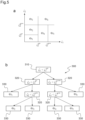
- figure 8 represents such a two-dimensional discretization as a function of the context parameters ⁇ 1 and ⁇ 2 following the process of constructing a decision tree.
- the two left and right blocks are separated at the coordinate ⁇ 1 ⁇ .
- a decision node 320 of the decision tree 300 is then created, or even a root node 310 if it is the first node of the tree 300.
- the procedure for constructing a single decision tree 300 is thus complete when each branch ends with a leaf node 330.
- An example using an aggregation of N t decision trees t 1 , ... ,t N t is represented on the figure 9 , the procedure for constructing such a set of N t decision trees being similar.
- N t ⁇ x, ⁇ ⁇ N t is carried out.
- the different decision trees thus constructed can then be used during the operational phase 200 by averaging the parameters of the quantile distributions of each decision tree traversed for a value x of the health indicator CI and the associated context parameter values ⁇ .
- the function f ( ⁇ ) can then be estimated following the creation of a correlation between the quantile distributions as a function of the context parameters ⁇ .
- each decision tree t has a leaf node I( ⁇ I ,t).
- An average ⁇ ⁇ i ⁇ and a variance ⁇ ⁇ i ⁇ of the quantile distribution can be estimated at the leaf node I ( ⁇ I ,t ) respecting the condition
- a model varying with threshold H ( ⁇ , ⁇ , ⁇ ) as represented on the Figure 10 can be defined for a value x of the health indicator CI as a function of two context parameters ⁇ 1 , ⁇ 2 with a probability level ⁇ of false alarms equal to 0.9999 and with three different confidence rates, also called uncertainty levels ⁇ , equal respectively to 0.05 (5%), 0.55 (55%) and 0.95 (95%).
- the operational monitoring phase 200 can be carried out at each use of the vehicle 1 involving the operation of the mechanical system 10, as long as a significant maintenance operation likely to call into question the reliability of the threshold variation model of a mechanical system 10 of the vehicle 1 is not carried out.
- the operational monitoring phase 200 comprises the following steps.
- successive vibration operational values and context operational values originating respectively from the vibration sensor(s) 20 and the context sensor(s) 25 are measured and transmitted to the memory 6, 6' to be stored there and/or possibly transmitted directly to the computer 50.
- This measurement step 220 is similar to the measurement step 120 of the initial vibration values and the successive initial context values originating respectively from the vibration sensor(s) 20 and the context sensor(s) 25.
- a determination step 230 several operational health values of each health indicator CI are determined in the usual manner based on the vibration operational values, using the calculator 50.
- This determination step 230 is similar to the determination step 130 of multiple initial health values of each CI health indicator, and each operational health value of a CI health indicator is associated with one of the context operational values of one or more context parameters.
- the determination step 230 of several operational health values of each health indicator CI can be carried out by the calculation unit 51 on board the vehicle 1, during the use of the vehicle 1 for example, or by the calculation unit 55 of the station 40 after the vehicle 1 has stopped.
- Each operational value of a health indicator CI can then be stored either in the memory 6,6' present in the vehicle 1, or in the memory 56 of the station 40.
- a threshold specific to the operational health value of each health indicator CI is determined using the threshold variation model and the associated context operational value(s).
- FIG. 11 represents values x of a CI health indicator as a function of time t, as well as curves 31,32,33 of variation of the threshold relating to this CI health indicator with respectively an uncertainty level ⁇ equal to 0.05, 0.55 and 0.95 and with a probability level ⁇ of false alarms equal to 0.9999.
- the threshold variation curves 31, 32, 33 can be higher or lower than the algebraically constant threshold 35, depending on the time intervals. For example, over a first time interval 37, the algebraically constant threshold 35 is lower than the threshold variation curves 31, 32, 33 and therefore higher. penalizing in the sense of potentially triggering false alarms.
- an alert is triggered to indicate to an operator or a driver of the vehicle 1 a risk of the presence of a fault on the mechanical system 10 if the operational health value of each health indicator CI is greater than the determined threshold.
Landscapes
- Physics & Mathematics (AREA)
- General Physics & Mathematics (AREA)
- Engineering & Computer Science (AREA)
- Business, Economics & Management (AREA)
- Theoretical Computer Science (AREA)
- Acoustics & Sound (AREA)
- Data Mining & Analysis (AREA)
- Tourism & Hospitality (AREA)
- Emergency Management (AREA)
- Aviation & Aerospace Engineering (AREA)
- General Engineering & Computer Science (AREA)
- Evolutionary Computation (AREA)
- Artificial Intelligence (AREA)
- Marketing (AREA)
- General Business, Economics & Management (AREA)
- Strategic Management (AREA)
- Primary Health Care (AREA)
- Human Resources & Organizations (AREA)
- Health & Medical Sciences (AREA)
- General Health & Medical Sciences (AREA)
- Economics (AREA)
- Transportation (AREA)
- Manufacturing & Machinery (AREA)
- Computer Vision & Pattern Recognition (AREA)
- Bioinformatics & Computational Biology (AREA)
- Evolutionary Biology (AREA)
- Bioinformatics & Cheminformatics (AREA)
- Life Sciences & Earth Sciences (AREA)
- Computational Linguistics (AREA)
- Computing Systems (AREA)
- Mathematical Physics (AREA)
- Software Systems (AREA)
- Combustion & Propulsion (AREA)
- Chemical & Material Sciences (AREA)
- Testing Of Devices, Machine Parts, Or Other Structures Thereof (AREA)
- Emergency Alarm Devices (AREA)
Claims (13)
- Verfahren zur Statusüberwachung eines mechanischen Systems (10) in einem Transportmittel (1), wobei das mechanische System (10) mindestens ein bewegliches Element (15) sowie mindestens einen Schwingungssensor (20) umfasst, der ein Schwingungssignal aussendet, wobei das mechanische System (10) oder das Transportmittel (1) mindestens einen Kontextsensor (25) aufweist, der ein Kontextsignal in Bezug auf mindestens einen Kontextparameter aussendet, wobei der mindestens eine Kontextparameter aus einer Liste ausgewählt wird, die mindestens einen oder mehrere Funktionsparameter des mechanischen Systems (10), einen oder mehrere Navigationsparameter des Transportmittels (1) und einen oder mehrere atmosphärische Parameter enthält, wobei das Verfahren aus einer Anfangsphase des Definierens eines Schwellenwertänderungsmodells in Abhängigkeit von dem mindestens einen Kontextparameter, gefolgt von einer Phase des operativen Überwachens des mechanischen Systems, besteht,wobei die Anfangsphase (100) die folgenden Schritte umfasst:- Messen (120) von von dem mindestens einen Schwingungssensor (20) stammenden aufeinanderfolgenden Schwingungsanfangswerten und von von dem mindestens einen Kontextsensor (25) stammenden aufeinanderfolgenden Kontextanfangswerten,- Bestimmen (130) mehrerer Statusanfangswerte mindestens eines Statusindikators CI für das mechanische System (10) mit Hilfe eines Rechners (5, 55) in Abhängigkeit von den Schwingungsanfangswerten, wobei jeder Statusanfangswert einem der Kontextanfangswerte des mindestens einen Kontextparameters zugeordnet ist,- Definieren (150) eines Schwellenwertänderungsmodells für jeden Statusindikator CI, wobei das Schwellenwertänderungsmodell in Abhängigkeit von den Statusanfangswerten des Statusindikators CI und den Anfangskontextwerten des mindestens einen Kontextparameters definiert wird, durch Aufteilen eines durch die Kontextanfangswerte des mindestens einen Kontextparameters gebildeten Bereichs in mehrere Wertebereiche, wobei der auf den Statusindikator CI bezogene Schwellenwert in jedem Wertebereich statistisch konstant ist, wobei jeder Wertebereich mehreren der Kontextanfangswerte zugeordnet ist, und durch Bestimmen von Werten des Schwellenwerts mit einem Verfahren, das Regressionen auf von Kontextparametern abhängige Quantilenverteilungsparameter und Bereichsaufteilungen des mindestens einen Kontextparameters unter Verwendung mindestens eines Entscheidungsbaums verwendet,wobei die operative Überwachungsphase (200) während des Betriebs des mechanischen Systems (10) die folgenden Schritte umfasst:- Messen (220) von von dem mindestens einen Schwingungssensor (20) stammenden aufeinanderfolgenden operativen Schwingungswerten und von von dem mindestens einen Kontextsensor (25) stammenden aufeinanderfolgenden operativen Kontextwerten,- Bestimmen (230) eines operativen Statuswerts mindestens eines Statusindikators CI anhand der operativen Schwingungswerte mit dem Rechner (5, 55), wobei der operative Statuswert mindestens eines Statusindikators CI einem der auf einen oder mehrere Kontextparameter bezogenen operativen Kontextwerte zugeordnet ist,- Bestimmen (250) des für den operativen Statuswert des mindestens einen Statusindikators CI spezifischen Schwellenwerts mit Hilfe des Schwellenwertänderungsmodells und des mindestens einen zugeordneten operativen Kontextwerts,- Auslösen (260) einer Warnmeldung, die auf das Risiko eines Fehlers im mechanischen System (10) hinweist, wenn der operative Statuswert des mindestens einen Statusindikators CI den ermittelten Schwellenwert überschreitet.
- Verfahren nach Anspruch 1,
bei dem das Definieren (150) des Schwellenwertänderungsmodells durch Aggregieren von mindestens zwei Entscheidungsbäumen erfolgt. - Verfahren nach einem der Ansprüche 1 bis 2,
bei dem das Definieren (150) des Schwellenwertänderungsmodells mit einer vorgegebenen Mindestfehlerquote und einer vorgegebenen Quote der Konfidenzquote in die Mindestfehlerquote erfolgt. - Verfahren nach einem der Ansprüche 1 bis 3,
bei dem die Statusanfangswerte des mindestens einen Statusindikators CI aus einer Fourier-Zerlegung der unter der Annahme einer Zyklostationarität erster und zweiter Ordnung des Schwingungssignals modellierten aufeinanderfolgenden Schwingungsanfangswerte berechnet werden, das einer durch eine GAMMA-Verteilung verallgemeinerten Chi-Quadrat-Verteilung folgt. - Verfahren nach einem der Ansprüche 1 bis 4,
bei dem die Anfangsphase (100) einen Analyseschritt (140) umfasst, um eine Empfindlichkeit des mindestens einen Statusindikators CI gegenüber den Kontextparametern zu analysieren und einflussreiche Kontextparameter auszuwählen. - Verfahren nach einem der Ansprüche 1 bis 4,
bei dem die Anfangsphase (100) einen Vorauswahlschritt (110) zum Auswählen von von dem Verfahren berücksichtigten Kontextparametern aus einer Mehrzahl von von dem mindestens einen Kontextsensor (25) gemessenen Kontextparametern umfasst. - Verfahren nach einem der Ansprüche 1 bis 6,
bei dem der Schwellenwert für den mindestens einen Statusindikator CI über einen zusammenhängenden Wertebereich eines Kontextparameters als statistisch konstant angesehen wird, wenn bei jeder Unterteilung des Wertebereichs in zwei zusammenhängende Teilwertebereiche die jeweils für die beiden Teilwertebereiche geschätzten Schwellenwerte anhand eines statistischen Tests als identisch angesehen werden. - Computerprogramm mit Anweisungen, die bei Ausführung des Programms dazu führen, dass das Verfahren nach einem der Ansprüche 1 bis 7 durchgeführt wird.
- Überwachungsvorrichtung (9), die zur Überwachung eines mechanischen Systems (10) in einem Transportmittel (1) konfiguriert ist, wobei das mechanische System (10) mindestens ein bewegliches Element (15) umfasst, wobei die Überwachungsvorrichtung (9) mindestens einen Schwingungssensor (20), der ein Schwingungssignal aussendet, mindestens einen Kontextsensor (25), der mindestens ein Kontextsignal in Bezug auf mindestens einen Kontextparameter aussendet, und den Rechner (50) umfasst,
dadurch gekennzeichnet, dass die Überwachungsvorrichtung (9) zur Durchführung des Verfahrens nach einem der Ansprüche 1 bis 7 konfiguriert ist. - Überwachungsvorrichtung (9) nach Anspruch 9,
bei der der Rechner (50) eine in dem Transportmittel (1) eingebaute Recheneinheit (51) und einen Speicher (6, 6') umfasst. - Überwachungsvorrichtung (9) nach einem der Ansprüche 9 bis 10,
bei der der Rechner (50) eine von dem Transportmittel (1) getrennte Recheneinheit (56) und einen Speicher (56) umfasst. - Mechanisches System (10) mit mindestens einem beweglichen Element (15),
dadurch gekennzeichnet, dass das mechanische System (10) eine Überwachungsvorrichtung (9) gemäß einem der Ansprüche 9 bis 11 umfasst. - Luftfahrzeug (1) mit einem mechanischen System (10) und einer Überwachungsvorrichtung (9) gemäß einem der Ansprüche 9 bis 11.
Applications Claiming Priority (1)
| Application Number | Priority Date | Filing Date | Title |
|---|---|---|---|
| FR2304803A FR3148842B1 (fr) | 2023-05-15 | 2023-05-15 | Procédé et dispositif de surveillance de santé d’un système mécanique d’un véhicule en utilisant des seuils variables selon des paramètres de fonctionnement du système |
Publications (2)
| Publication Number | Publication Date |
|---|---|
| EP4464997A1 EP4464997A1 (de) | 2024-11-20 |
| EP4464997B1 true EP4464997B1 (de) | 2025-06-25 |
Family
ID=88207585
Family Applications (1)
| Application Number | Title | Priority Date | Filing Date |
|---|---|---|---|
| EP24159969.5A Active EP4464997B1 (de) | 2023-05-15 | 2024-02-27 | Verfahren und vorrichtung zur überwachung des status eines mechanischen systems eines fahrzeugs unter verwendung von schwellen, die abhängig von den betriebsparametern des systems variieren |
Country Status (5)
| Country | Link |
|---|---|
| US (1) | US20240383617A1 (de) |
| EP (1) | EP4464997B1 (de) |
| KR (1) | KR102857521B1 (de) |
| CN (1) | CN118960824A (de) |
| FR (1) | FR3148842B1 (de) |
Families Citing this family (2)
| Publication number | Priority date | Publication date | Assignee | Title |
|---|---|---|---|---|
| CN120805106B (zh) * | 2025-09-16 | 2026-01-23 | 浪潮通用软件有限公司 | 一种区间分位数的依赖结构分析方法、设备及介质 |
| CN120846425B (zh) * | 2025-09-19 | 2025-12-05 | 四川省林业和草原调查规划院(四川省林业和草原生态环境监测中心) | 一种基于古树保护的生长环境多因素综合监测方法及系统 |
Family Cites Families (10)
| Publication number | Priority date | Publication date | Assignee | Title |
|---|---|---|---|---|
| US8131420B2 (en) | 2008-02-27 | 2012-03-06 | Simmonds Precision Products, Inc. | Vehicle health and usage monitoring system and method |
| US7684936B2 (en) | 2008-05-07 | 2010-03-23 | Simmonds Precision Products, Inc. | Method, apparatus and computer program product for determining a future time of a component |
| CN101995290B (zh) | 2009-08-28 | 2013-04-24 | 威能极公司 | 风力发电机振动监测的方法和系统 |
| EP2502174B1 (de) | 2009-11-16 | 2018-06-13 | Simmonds Precision Products, Inc. | Datenerfassungssystem für bedingungsbasierte pflege |
| US8355879B2 (en) | 2010-01-06 | 2013-01-15 | Simmonds Precision Products, Inc. | Trending of vibration data taking into account torque effect |
| CN102963533B (zh) | 2012-12-14 | 2015-06-10 | 中国航空工业集团公司上海航空测控技术研究所 | 一种监测直升机完好性与使用状态的系统及其监测方法 |
| DE102014218698A1 (de) * | 2014-09-17 | 2016-03-17 | Volkswagen Aktiengesellschaft | Baukastensystem für ein Fahrzeug |
| CN107218997A (zh) | 2017-05-16 | 2017-09-29 | 南京南瑞继保电气有限公司 | 一种基于工况识别的水电机组振动监测通道异常检测方法 |
| US20220163428A1 (en) * | 2020-11-23 | 2022-05-26 | General Electric Company | Damper condition monitoring for a damper of a gas turbine engine |
| EP4091945B1 (de) | 2021-05-18 | 2023-09-06 | Leonardo S.p.a. | Verfahren und system zur detektion von anomalien im zusammenhang mit komponenten eines getriebesystems eines luftfahrzeugs, insbesondere eines hubschraubers |
-
2023
- 2023-05-15 FR FR2304803A patent/FR3148842B1/fr active Active
-
2024
- 2024-02-27 EP EP24159969.5A patent/EP4464997B1/de active Active
- 2024-03-18 US US18/608,150 patent/US20240383617A1/en active Pending
- 2024-03-21 CN CN202410324255.7A patent/CN118960824A/zh active Pending
- 2024-03-25 KR KR1020240040247A patent/KR102857521B1/ko active Active
Also Published As
| Publication number | Publication date |
|---|---|
| CN118960824A (zh) | 2024-11-15 |
| US20240383617A1 (en) | 2024-11-21 |
| KR102857521B1 (ko) | 2025-09-08 |
| FR3148842A1 (fr) | 2024-11-22 |
| KR20240165260A (ko) | 2024-11-22 |
| FR3148842B1 (fr) | 2025-04-11 |
| EP4464997A1 (de) | 2024-11-20 |
Similar Documents
| Publication | Publication Date | Title |
|---|---|---|
| EP4464997B1 (de) | Verfahren und vorrichtung zur überwachung des status eines mechanischen systems eines fahrzeugs unter verwendung von schwellen, die abhängig von den betriebsparametern des systems variieren | |
| EP2627982B1 (de) | System zur überwachung eines flugzeugmotortestbettes | |
| EP3123139B1 (de) | Schätzverfahren von einem normalen oder nicht normalen karakter eines gemessenen wertes eines physischen parameters von einem maschinenmotor | |
| EP2966526B1 (de) | Verfahren und system zur zusammenführung von überwachungsindikatoren einer vorrichtung | |
| EP3097455B1 (de) | Verfahren zur vorhersage einer fehlfunktion in der anlage eines flugzeugs oder einer flugzeugflotte | |
| EP2912526B1 (de) | System zur überwachung einer gruppe von komponenten einer vorrichtung | |
| EP2850499B1 (de) | Verfahren zur überwachung des verschleisses einer bordinternen vorrichtung eines flugzeugs mit automatischer bestimmung einer entscheidungsschwelle | |
| EP3215903B1 (de) | Werkzeug zur validierung eines systems zur überwachung eines flugzeugtriebwerks | |
| FR3035232A1 (fr) | Systeme de surveillance de l'etat de sante d'un moteur et procede de configuration associe | |
| EP4407282B1 (de) | Verfahren zur bestimmung der zyklostationären eigenschaften eines schwingungssignals in bezug auf ein mechanisches system, zur anordnung von schwingungssensoren zur überwachung eines solchen systems und zur überwachung | |
| WO2017077247A1 (fr) | Système et procédé de surveillance d'une turbomachine avec fusion d'indicateurs pour la synthèse d'une confirmation d'alarme | |
| EP4407290B1 (de) | Verfahren und vorrichtung zur erkennung eines fehlers in einem mechanischen system mit mindestens einem rotierenden element | |
| EP3593101B1 (de) | Verfahren zur detektion eines defekts in einem vibrationssensor, zugehörige vorrichtung und computerprogramm | |
| CA3121061A1 (fr) | Procede et systeme de controle d'un niveau d'endommagement d'au moins une piece d'aeronef, aeronef associe | |
| EP4643108A1 (de) | Verfahren zur bestimmung eines indikators für strukturelle defekten | |
| EP2784616B1 (de) | Verfahren zur Erkennung und Berücksichtigung einer abrupten Veränderung mindestens eines Überwachungsindikators einer Vorrichtung | |
| EP4042007B1 (de) | Vorrichtung, verfahren und computerprogramm zur überwachung eines flugzeugtriebwerks | |
| FR2957170A1 (fr) | Outil de conception d'un systeme de surveillance d'un moteur d'aeronef | |
| EP4559769A1 (de) | Verfahren zur überwachung der temperatur der bremsen eines flugzeugfahrwerks | |
| FR3144662A1 (fr) | Procédé de détermination d’un indicateur de défaut structurel | |
| EP4281743B1 (de) | Verfahren zur zustandsüberwachung von mechanischen komponenten auf einer wellenleitung, zugehörige überwachungsvorrichtung und system | |
| EP4449218A1 (de) | Verfahren, vorrichtung, computerprogrammprodukt und aufzeichnungsmedium mit dem programm zur erkennung einer anomalie in einem mechanischen oder elektromechanischen system |
Legal Events
| Date | Code | Title | Description |
|---|---|---|---|
| PUAI | Public reference made under article 153(3) epc to a published international application that has entered the european phase |
Free format text: ORIGINAL CODE: 0009012 |
|
| STAA | Information on the status of an ep patent application or granted ep patent |
Free format text: STATUS: THE APPLICATION HAS BEEN PUBLISHED |
|
| AK | Designated contracting states |
Kind code of ref document: A1 Designated state(s): AL AT BE BG CH CY CZ DE DK EE ES FI FR GB GR HR HU IE IS IT LI LT LU LV MC ME MK MT NL NO PL PT RO RS SE SI SK SM TR |
|
| STAA | Information on the status of an ep patent application or granted ep patent |
Free format text: STATUS: REQUEST FOR EXAMINATION WAS MADE |
|
| 17P | Request for examination filed |
Effective date: 20241122 |
|
| P01 | Opt-out of the competence of the unified patent court (upc) registered |
Free format text: CASE NUMBER: APP_62396/2024 Effective date: 20241122 |
|
| RBV | Designated contracting states (corrected) |
Designated state(s): AL AT BE BG CH CY CZ DE DK EE ES FI FR GB GR HR HU IE IS IT LI LT LU LV MC ME MK MT NL NO PL PT RO RS SE SI SK SM TR |
|
| GRAP | Despatch of communication of intention to grant a patent |
Free format text: ORIGINAL CODE: EPIDOSNIGR1 |
|
| STAA | Information on the status of an ep patent application or granted ep patent |
Free format text: STATUS: GRANT OF PATENT IS INTENDED |
|
| INTG | Intention to grant announced |
Effective date: 20250313 |
|
| RIN1 | Information on inventor provided before grant (corrected) |
Inventor name: CAMERINI, VALERIO Inventor name: MACCHI, LUCAS Inventor name: MEUTERLOS, MAXIME |
|
| GRAS | Grant fee paid |
Free format text: ORIGINAL CODE: EPIDOSNIGR3 |
|
| GRAA | (expected) grant |
Free format text: ORIGINAL CODE: 0009210 |
|
| STAA | Information on the status of an ep patent application or granted ep patent |
Free format text: STATUS: THE PATENT HAS BEEN GRANTED |
|
| AK | Designated contracting states |
Kind code of ref document: B1 Designated state(s): AL AT BE BG CH CY CZ DE DK EE ES FI FR GB GR HR HU IE IS IT LI LT LU LV MC ME MK MT NL NO PL PT RO RS SE SI SK SM TR |
|
| REG | Reference to a national code |
Ref country code: GB Ref legal event code: FG4D Free format text: NOT ENGLISH |
|
| REG | Reference to a national code |
Ref country code: CH Ref legal event code: EP |
|
| REG | Reference to a national code |
Ref country code: CH Ref legal event code: EP |
|
| REG | Reference to a national code |
Ref country code: IE Ref legal event code: FG4D Free format text: LANGUAGE OF EP DOCUMENT: FRENCH |
|
| REG | Reference to a national code |
Ref country code: DE Ref legal event code: R096 Ref document number: 602024000231 Country of ref document: DE |
|
| PG25 | Lapsed in a contracting state [announced via postgrant information from national office to epo] |
Ref country code: FI Free format text: LAPSE BECAUSE OF FAILURE TO SUBMIT A TRANSLATION OF THE DESCRIPTION OR TO PAY THE FEE WITHIN THE PRESCRIBED TIME-LIMIT Effective date: 20250625 |
|
| REG | Reference to a national code |
Ref country code: LT Ref legal event code: MG9D |
|
| PG25 | Lapsed in a contracting state [announced via postgrant information from national office to epo] |
Ref country code: GR Free format text: LAPSE BECAUSE OF FAILURE TO SUBMIT A TRANSLATION OF THE DESCRIPTION OR TO PAY THE FEE WITHIN THE PRESCRIBED TIME-LIMIT Effective date: 20250926 Ref country code: NO Free format text: LAPSE BECAUSE OF FAILURE TO SUBMIT A TRANSLATION OF THE DESCRIPTION OR TO PAY THE FEE WITHIN THE PRESCRIBED TIME-LIMIT Effective date: 20250925 |
|
| PG25 | Lapsed in a contracting state [announced via postgrant information from national office to epo] |
Ref country code: BG Free format text: LAPSE BECAUSE OF FAILURE TO SUBMIT A TRANSLATION OF THE DESCRIPTION OR TO PAY THE FEE WITHIN THE PRESCRIBED TIME-LIMIT Effective date: 20250625 |
|
| PG25 | Lapsed in a contracting state [announced via postgrant information from national office to epo] |
Ref country code: HR Free format text: LAPSE BECAUSE OF FAILURE TO SUBMIT A TRANSLATION OF THE DESCRIPTION OR TO PAY THE FEE WITHIN THE PRESCRIBED TIME-LIMIT Effective date: 20250625 |
|
| PG25 | Lapsed in a contracting state [announced via postgrant information from national office to epo] |
Ref country code: RS Free format text: LAPSE BECAUSE OF FAILURE TO SUBMIT A TRANSLATION OF THE DESCRIPTION OR TO PAY THE FEE WITHIN THE PRESCRIBED TIME-LIMIT Effective date: 20250925 |
|
| PG25 | Lapsed in a contracting state [announced via postgrant information from national office to epo] |
Ref country code: LV Free format text: LAPSE BECAUSE OF FAILURE TO SUBMIT A TRANSLATION OF THE DESCRIPTION OR TO PAY THE FEE WITHIN THE PRESCRIBED TIME-LIMIT Effective date: 20250625 |
|
| REG | Reference to a national code |
Ref country code: NL Ref legal event code: MP Effective date: 20250625 |
|
| PG25 | Lapsed in a contracting state [announced via postgrant information from national office to epo] |
Ref country code: NL Free format text: LAPSE BECAUSE OF FAILURE TO SUBMIT A TRANSLATION OF THE DESCRIPTION OR TO PAY THE FEE WITHIN THE PRESCRIBED TIME-LIMIT Effective date: 20250625 |
|
| PG25 | Lapsed in a contracting state [announced via postgrant information from national office to epo] |
Ref country code: PT Free format text: LAPSE BECAUSE OF FAILURE TO SUBMIT A TRANSLATION OF THE DESCRIPTION OR TO PAY THE FEE WITHIN THE PRESCRIBED TIME-LIMIT Effective date: 20251027 |
|
| REG | Reference to a national code |
Ref country code: AT Ref legal event code: MK05 Ref document number: 1806864 Country of ref document: AT Kind code of ref document: T Effective date: 20250625 |
|
| PG25 | Lapsed in a contracting state [announced via postgrant information from national office to epo] |
Ref country code: IS Free format text: LAPSE BECAUSE OF FAILURE TO SUBMIT A TRANSLATION OF THE DESCRIPTION OR TO PAY THE FEE WITHIN THE PRESCRIBED TIME-LIMIT Effective date: 20251025 |
|
| PG25 | Lapsed in a contracting state [announced via postgrant information from national office to epo] |
Ref country code: AT Free format text: LAPSE BECAUSE OF FAILURE TO SUBMIT A TRANSLATION OF THE DESCRIPTION OR TO PAY THE FEE WITHIN THE PRESCRIBED TIME-LIMIT Effective date: 20250625 Ref country code: SM Free format text: LAPSE BECAUSE OF FAILURE TO SUBMIT A TRANSLATION OF THE DESCRIPTION OR TO PAY THE FEE WITHIN THE PRESCRIBED TIME-LIMIT Effective date: 20250625 |
|
| PG25 | Lapsed in a contracting state [announced via postgrant information from national office to epo] |
Ref country code: CZ Free format text: LAPSE BECAUSE OF FAILURE TO SUBMIT A TRANSLATION OF THE DESCRIPTION OR TO PAY THE FEE WITHIN THE PRESCRIBED TIME-LIMIT Effective date: 20250625 |
|
| PG25 | Lapsed in a contracting state [announced via postgrant information from national office to epo] |
Ref country code: PL Free format text: LAPSE BECAUSE OF FAILURE TO SUBMIT A TRANSLATION OF THE DESCRIPTION OR TO PAY THE FEE WITHIN THE PRESCRIBED TIME-LIMIT Effective date: 20250625 |
|
| PG25 | Lapsed in a contracting state [announced via postgrant information from national office to epo] |
Ref country code: EE Free format text: LAPSE BECAUSE OF FAILURE TO SUBMIT A TRANSLATION OF THE DESCRIPTION OR TO PAY THE FEE WITHIN THE PRESCRIBED TIME-LIMIT Effective date: 20250625 |
|
| PG25 | Lapsed in a contracting state [announced via postgrant information from national office to epo] |
Ref country code: SK Free format text: LAPSE BECAUSE OF FAILURE TO SUBMIT A TRANSLATION OF THE DESCRIPTION OR TO PAY THE FEE WITHIN THE PRESCRIBED TIME-LIMIT Effective date: 20250625 |
|
| PG25 | Lapsed in a contracting state [announced via postgrant information from national office to epo] |
Ref country code: ES Free format text: LAPSE BECAUSE OF FAILURE TO SUBMIT A TRANSLATION OF THE DESCRIPTION OR TO PAY THE FEE WITHIN THE PRESCRIBED TIME-LIMIT Effective date: 20250625 |
|
| PG25 | Lapsed in a contracting state [announced via postgrant information from national office to epo] |
Ref country code: DK Free format text: LAPSE BECAUSE OF FAILURE TO SUBMIT A TRANSLATION OF THE DESCRIPTION OR TO PAY THE FEE WITHIN THE PRESCRIBED TIME-LIMIT Effective date: 20250625 |
|
| PGFP | Annual fee paid to national office [announced via postgrant information from national office to epo] |
Ref country code: DE Payment date: 20260218 Year of fee payment: 3 |
|
| PGFP | Annual fee paid to national office [announced via postgrant information from national office to epo] |
Ref country code: IT Payment date: 20260228 Year of fee payment: 3 |
|
| PGFP | Annual fee paid to national office [announced via postgrant information from national office to epo] |
Ref country code: FR Payment date: 20260219 Year of fee payment: 3 |
|
| PLBE | No opposition filed within time limit |
Free format text: ORIGINAL CODE: 0009261 |
|
| STAA | Information on the status of an ep patent application or granted ep patent |
Free format text: STATUS: NO OPPOSITION FILED WITHIN TIME LIMIT |