EP4474032A1 - Fonctionnement à charge alternée d'une installation de méthanol - Google Patents
Fonctionnement à charge alternée d'une installation de méthanol Download PDFInfo
- Publication number
- EP4474032A1 EP4474032A1 EP23177928.1A EP23177928A EP4474032A1 EP 4474032 A1 EP4474032 A1 EP 4474032A1 EP 23177928 A EP23177928 A EP 23177928A EP 4474032 A1 EP4474032 A1 EP 4474032A1
- Authority
- EP
- European Patent Office
- Prior art keywords
- reactant
- gas stream
- feed gas
- methanol
- reactor arrangement
- Prior art date
- Legal status (The legal status is an assumption and is not a legal conclusion. Google has not performed a legal analysis and makes no representation as to the accuracy of the status listed.)
- Pending
Links
Images
Classifications
-
- C—CHEMISTRY; METALLURGY
- C07—ORGANIC CHEMISTRY
- C07C—ACYCLIC OR CARBOCYCLIC COMPOUNDS
- C07C29/00—Preparation of compounds having hydroxy or O-metal groups bound to a carbon atom not belonging to a six-membered aromatic ring
- C07C29/15—Preparation of compounds having hydroxy or O-metal groups bound to a carbon atom not belonging to a six-membered aromatic ring by reduction of oxides of carbon exclusively
- C07C29/151—Preparation of compounds having hydroxy or O-metal groups bound to a carbon atom not belonging to a six-membered aromatic ring by reduction of oxides of carbon exclusively with hydrogen or hydrogen-containing gases
-
- B—PERFORMING OPERATIONS; TRANSPORTING
- B01—PHYSICAL OR CHEMICAL PROCESSES OR APPARATUS IN GENERAL
- B01D—SEPARATION
- B01D5/00—Condensation of vapours; Recovering volatile solvents by condensation
- B01D5/0003—Condensation of vapours; Recovering volatile solvents by condensation by using heat-exchange surfaces for indirect contact between gases or vapours and the cooling medium
-
- B—PERFORMING OPERATIONS; TRANSPORTING
- B01—PHYSICAL OR CHEMICAL PROCESSES OR APPARATUS IN GENERAL
- B01J—CHEMICAL OR PHYSICAL PROCESSES, e.g. CATALYSIS OR COLLOID CHEMISTRY; THEIR RELEVANT APPARATUS
- B01J19/00—Chemical, physical or physico-chemical processes in general; Their relevant apparatus
- B01J19/0006—Controlling or regulating processes
Definitions
- the present invention relates to a method and a device for the synthesis of methanol, in particular in alternating load operation.
- Scheduled alternating load operation of the synthesis loop with a synthesis reactor arrangement is generally not planned.
- operation under very low partial load is not usual.
- Minimum loads in production operation are typically at least 50% to 70% of the plant capacity. Partial load can be planned for longer periods with reduced gas availability over several weeks or months in winter.
- Load changes and process adjustments between defined stationary states occur very slowly over hours to days in order to protect the equipment and catalysts of the methanol plant from damage.
- Common feed gas from industrial processes mainly contains hydrogen, carbon monoxide and carbon dioxide.
- the synthesis of methanol can basically be carried out with hydrogen, which is produced by an electrolyzer.
- the electrolyzer can be operated with renewable energies, among other things. This operation with renewable energies is faced with the challenge that hydrogen production is subject to fluctuations.
- the fluctuations in the amount of hydrogen produced from renewable energies depend, for example, on the available solar energy and the available wind energy. For example, solar energy drops at night or wind power drops during a summer lull. Typical load changes can take place within a few seconds to minutes. Changes in the load of the Electrolyzers are possible on a similar scale. However, load changes in fluctuating renewable energies and the electrolyzer are an order of magnitude faster than the load changes in the synthesis reactor arrangement. Furthermore, the permissible operating range of the synthesis reactor arrangement is more restricted than that of the electrolyzer and renewable energies.
- the synthesis reactor arrangement for the synthesis of methanol behaves sluggishly in this case.
- the synthesis loop with the synthesis reactor arrangement runs under almost constant pressure and temperature conditions, which means a uniform operating state for the apparatus, machines and the catalyst of the methanol plant.
- the pressure in the synthesis loop can be kept constant using a pressure-maintaining valve, which releases inert components and unreacted reactants as well as non-separated products as soon as the synthesis loop pressure exceeds a certain pressure.
- fluctuating operation i.e. when the reactants are not supplied at a constant level, it is challenging to maintain the operating pressure in the synthesis loop and to enable a high conversion of the reactants in the synthesis reactor arrangement.
- One way to increase the conversion of the reactants is to recirculate unreacted reactants in the synthesis loop (recycle).
- recycling can cause inert gas contained in the reactant gas streams to accumulate in the synthesis loop and stabilize the pressure in the synthesis loop. If the reactant gas streams contain a small amount of inert gas, this stabilization of the pressure can be too slow to follow the fluctuations of a second reactant stream and thus cannot be used or can only be used to a limited extent. This effect is also not usable if the proportion of inerts in the reactant streams is very low or even zero.
- the pressure in the synthesis loop drops without additional measures such as changing the recycle flow rate.
- the synthesis loop initially still contains reactant-rich recirculated recycle gas, which reacts in the reactor and forms methanol.
- the methanol is separated in the separator. This leads to the gas phase in the synthesis loop losing mass.
- the partial pressure of the gaseous reactants drops.
- the pressure of the constant volume of the synthesis loop also drops as a result.
- the pressure control valve cannot compensate for the pressure drop. prevent this, as this can only release increased pressure by opening the valve.
- the present invention is based on the object of enabling alternating load operation in the synthesis of methanol.
- a method for synthesizing methanol wherein a feed gas stream comprises at least a first reactant and a second reactant, which is fed to a synthesis reactor arrangement.
- methanol is produced using the first reactant and the second reactant.
- a production rate of the methanol is reduced at least temporarily by reducing a proportion of the first reactant in the feed gas stream.
- the first reactant and the second reactant can be mixed to form a feed gas stream.
- the feed gas stream is fed to the synthesis reactor arrangement.
- the first reactant and the second reactant can react to form methanol as a product and optionally to form one or more by-products.
- the first reactant and the second reactant are preferably gaseous.
- the synthesis reactor arrangement can consist of a reactor system of suitable reactors.
- the synthesis reactor arrangement preferably comprises one reactor, preferably several reactors connected in parallel or in series.
- the synthesis reactor arrangement can in particular be formed by a water-cooled and/or gas-cooled reactor.
- the mass flow in the gas phase in the synthesis reactor arrangement can decrease due to the stoichiometry of the methanol formation reaction. This means that the "number" of molecules in the gas phase decreases due to the reaction, which causes the pressure to drop. A reduced mass flow in the gas phase can cause the pressure in the synthesis loop to drop, unless the amount of substance lost from the gas phase is replenished with the feed gas entering the synthesis loop.
- the mass flow can be given, for example, in kmol per unit of time.
- the first reactant in the feed gas to the synthesis loop is preferably present in a lower proportion than the second reactant.
- a ratio of the first reactant to the second reactant in the range of one to three with a variance of 5% or one to two with a variance of 5% is preferred.
- the term proportion here means the molar fraction in mol% of the feed gas stream.
- a ratio of one to three with a variance of 5% is particularly preferred for carbon dioxide and hydrogen.
- a ratio of one to two with a variance of 5% is particularly preferred for carbon monoxide and hydrogen.
- the synthesis loop preferably comprises the synthesis reactor arrangement and all lines connecting the outlet of the synthesis reactor arrangement to the inlet of the synthesis reactor arrangement.
- the pressure in the synthesis loop can essentially be determined by the amount of substance in the gas phase, the temperature and the synthesis loop volume.
- the reduction in the mass flow in the gas phase can be caused by the reaction of the first reactant and the second reactant to form methanol in the synthesis reactor arrangement and the condensation and separation of the methanol.
- the pressure drop The efficiency of the synthesis loop can be higher the more product is formed and separated, unless the amount of material lost from the gas phase is replenished with the feed gas.
- the first reactant preferably has a higher solubility than the second reactant in a methanol-water mixture, so that the proportion of the first reactant in the gas phase can be further reduced by solubility in this methanol-water mixture.
- the condensation of the methanol formed in the synthesis reactor arrangement can take place in two steps.
- the product gas mixture at the outlet of the synthesis reactor arrangement is cooled via a heat exchanger in countercurrent operation.
- the gas flow at the inlet of the synthesis reactor arrangement is heated via the heat exchanger.
- the product gas mixture at the outlet of the synthesis reactor arrangement including partially condensed methanol and unreacted reactants, is cooled to the final temperature of the separator in one or more air- or water-cooled heat exchangers, whereby further methanol condenses.
- the reaction rate of the first reactant and the second reactant to form methanol can be determined in the synthesis reactor arrangement at constant temperature and constant catalyst quantity by the partial pressures of the first reactant and the second reactant. Furthermore, due to the equilibrium reaction, the reaction rate can also be determined by the partial pressure of the methanol and the partial pressure of one or more by-products.
- Alternating load operation refers to the operation of the synthesis reactor arrangement with a changing load, ie changing reactor inlet gas flow, in particular as a result of a changing reactant flow that is fed to the synthesis loop.
- the so-called load range for the reactant flow that is fed to the synthesis loop is preferably between 0% and 100% of the plant capacity at any time during the process, preferably between 20% and 100% of the plant capacity.
- a load of 100% is also referred to as full load.
- a load range below 100% is also referred to as partial load.
- the mass flow rate of the feed gas stream is reduced.
- the mass flow rate of the feed gas stream can decrease.
- the mass flow of the first reactant and/or the mass flow of the second reactant decreases.
- the synthesis reactor arrangement initially continues to convert the reactants as in the higher load range. However, with the reduced mass flow rate, a deficit of the first reactant and/or the second reactant can arise and thus a pressure drop in the partial pressures of the first reactant and/or the second reactant.
- the rate of methanol production is reduced, at least temporarily.
- This has the advantage that the partial pressure of the first reactant is reduced, which inhibits the reaction and reduces the rate of methanol production.
- This has the further advantage that the amount of substance in the gas phase is stabilized and the pressure in the synthesis loop does not drop or at least only drops slightly. Since the rate of methanol production is reduced, less of the first reactant and less of the second reactant is converted. Thus, due to the reduced reactant molar flow rate per unit of time, less methanol is formed, which means that the pressure in the synthesis reactor arrangement drops less sharply due to the stoichiometry of the methanol formation reaction. The deficit of the first or second reactant therefore contributes to stabilizing the pressure in the synthesis reactor arrangement.
- the first reactant makes up a smaller proportion in terms of the amount of substance in the feed gas flow into the synthesis loop and into the synthesis reactor arrangement than the second reactant. Inhibiting the reaction can therefore be achieved relatively easily by reducing the proportion of the first reactant.
- This has the advantage that a reduction in the amount of substance in relation to the total amount of reactants can be minimized, which results in a small partial pressure drop and thus has a smaller influence on the total pressure drop.
- the method described is particularly suitable for reacting to relatively rapid fluctuations in the feed gas flow. Slower fluctuations can also be reacted to in other ways. In order to achieve an advantage over a conventional method, it is therefore sufficient that in at least a first case of a reduction in the molar flow rate of the feed gas flow, the methanol production rate is at least temporarily reduced by reducing a proportion of the first reactant in the feed gas flow.
- the change in the supply of the first reactant can also be carried out before a load change is initiated, i.e. before the supply of a second reactant (H2 from electrolysis) changes.
- the ratio of the reactants in the feed gas flow when the molar flow rate of the feed gas flow is increased is generally not important for controlling the pressure in the synthesis loop.
- the ratio of the reactants in the feed gas flow is also irrelevant when the feed gas flow is constant. It is sufficient that in at least a first case of an (expected) reduction in a molar flow rate of the feed gas stream, a methanol production rate is at least temporarily reduced in order to compensate for the effects of the reduction in the molar flow rate of the feed gas stream in the short term.
- the pressure in the pipeline system can be influenced in other ways in addition to influencing the ratio of the reactants in the feed gas stream.
- all options that are also used in a conventional arrangement for synthesizing methanol come into consideration here. For example, excessive pressure can be released via a pressure relief valve, which can react comparatively quickly. The risk of excessive pressure is therefore qualitatively different from the risk of too little pressure.
- the proportion of the first reactant in the feed gas stream is reduced each time the molar flow rate of the feed gas stream is reduced. It is sufficient that the proportion of the first reactant in the feed gas stream is reduced at least in a first case of a reduction in the molar flow rate of the feed gas stream, i.e. at least once when carrying out the method. In particular in the case of a slow reduction in the molar flow rate of the feed gas stream, it may not be necessary to react with a reduction in the proportion of the first reactant in the feed gas stream.
- the proportion of the first reactant in the feed gas stream is reduced each times when the molar flow rate of the feed gas stream decreases faster than a pressure change limit and/or each time the molar flow rate of the feed gas stream decreases to a value below a pressure change limit.
- the proportion of the first reactant in the feed gas stream is reduced by adding a buffer gas to the feed gas stream.
- the reaction rate of the reactants to form methanol can be reduced by reducing the partial pressure of the reactants.
- the probability of the first reactant and the second reactant reacting to form methanol decreases with lower partial pressure.
- Adding a buffer gas to the feed gas stream at a defined total pressure reduces the proportion of reactants in the feed gas stream and thus their partial pressure.
- Reducing the production rate is beneficial because the first reactant and the second reactant react to form methanol and the reacted amount of substance is removed from the gas phase of the synthesis loop, thus promoting a drop in pressure. If less methanol is produced, less reactant is consumed.
- This embodiment preferably serves to reduce the partial pressure of the first reactant and the second reactant, to inhibit the reaction and to produce less methanol.
- a further advantage of this embodiment is that the buffer gas can stabilize a pressure drop by filling the missing amount of substance in the gas phase to maintain the pressure in the synthesis loop and stabilizing the total pressure in the synthesis loop.
- the proportion of the first reactant in the feed gas stream is reduced by reducing an amount of the first reactant in the feed gas stream relative to an amount of the second reactant in the feed gas stream.
- the amount of the second reactant fluctuates.
- a fluctuation means the change in the mass flow and/or the partial pressure of the second reactant over time.
- This embodiment preferably serves to reduce the rate of methanol production by reducing the partial pressure of the first reactant to such an extent that the reaction is inhibited.
- the mass flow rate of the second reactant can be increased.
- the reaction can be inhibited by a shortage of the first reactant, and the excess of the second reactant compensates for the shortage of the mass of the first reactant.
- the pressure in the synthesis loop can be stabilized in this way.
- the disadvantage of this possibility is that the second reactant is not readily available.
- the feed gas flow can be reduced, especially if the second reactant is temporarily less available.
- the molar flow rate of the first reactant is reduced before the second reactant drops due to fluctuation.
- the ever-decreasing first reactant reacts with the second reactant to form methanol, which reduces the proportion of the first reactant in the synthesis loop.
- the content of a second reactant in the synthesis loop increases. If less second reactant is available due to the fluctuation that occurs, the feed gas flow can be reduced and the pressure in the synthesis loop is stable due to the inhibited reaction.
- the proportion of the first reactant in the feed gas stream in the at least one first case can be reduced to such an extent that the first reactant is present in substoichiometric amounts in the synthesis loop.
- methanol is separated from an exit stream of the synthesis reactor arrangement and the remaining exit stream of the synthesis reactor arrangement is at least partially re-supplied as a recycle gas stream, wherein in the at least one first case a ratio of a molar flow rate of the recycle gas stream to a molar flow rate of the feed gas stream is increased.
- the ratio of the molar flow rate of the recycle gas stream to the molar flow rate of the feed gas stream is also called the recycle ratio.
- a recycle ratio of 2 to 200 is present.
- a recycle ratio of 3 to 30 is preferred.
- the mixed feed gas stream and recycle gas stream at the inlet of the synthesis reactor arrangement have a molar ratio of the first reactant to the second reactant in the range from 0.001 to 0.33, preferably in the range from 0.005 to 0.33.
- This embodiment preferably serves to increase the conversion of the reactants and to accumulate inert gases and unreacted reactants as buffers.
- the first reactant and the second reactant can be mixed in the inlet of the synthesis reactor arrangement and/or before the inlet of the synthesis reactor arrangement.
- Other streams such as the recycle gas stream and the buffer gas can be mixed into the feed gas stream in the inlet and/or before the inlet of the synthesis reactor arrangement.
- the mass flow rate of the feed gas stream is preferably increased.
- a production rate of methanol is at least temporarily increased by increasing the proportion of the first reactant in the feed gas stream.
- any increase in pressure in the synthesis loop is released by increasing the molar flow rate via a purge gas line.
- the outlet stream of the synthesis reactor arrangement is at least partially removed as purge gas. This allows the second reactant, which is present in excess of stoichiometric amounts in the synthesis loop, and/or the buffer gas to be removed from the synthesis loop.
- the partial pressure of the first reactant is increased with the new amount of first reactant fed into the loop and no longer inhibits the reaction.
- the increased molar flow rate of the feed gas stream then increases the rate of methanol production accordingly.
- This embodiment preferably serves to rapidly increase the production rate of methanol in the at least one second case and to prevent the total pressure in the synthesis reactor arrangement from increasing.
- the proportion of the first reactant in the feed gas stream is increased by increasing an amount of the first reactant in the feed gas stream relative to an amount of the second reactant in the feed gas stream.
- the second reactant may be present in the synthesis loop in excess of stoichiometric amounts.
- the methanol production rate may initially be too low. This may result in increasing pressure in the synthesis loop.
- the proportion of the first reactant in the feed gas flow is increased, at least temporarily. The partial pressure of the first reactant increases and no longer inhibits the methanol production rate.
- This increased proportion of the first reactant can react with the second reactant, which is present in excess of stoichiometric amounts, and increase the methanol production rate, so that the first reactant and the second reactant to form methanol. This has the effect that the excess mass flow is broken down by the increased feed gas flow through the reaction of the first reactant and the second reactant to form methanol.
- This embodiment preferably serves to increase the production rate of methanol in the at least one second case and not to allow the total pressure in the synthesis loop to rise.
- the first reactant is carbon dioxide or carbon monoxide.
- the second reactant is hydrogen
- the second reactant comes from water electrolysis using renewable energy.
- the feed gas stream preferably comprises 0 mol% to 35 mol% carbon dioxide and 65 mol% to 100 mol% hydrogen.
- the feed gas stream comprises 15 mol% to 30 mol% carbon dioxide and 70 mol% to 85 mol% hydrogen.
- the buffer gas contains one or more inert gases and/or methane and/or hydrogen.
- the inert gas is preferably argon.
- the inert gas is particularly preferably nitrogen. Several inert gases can also be mixed.
- the inert gas preferably contains a mixture of argon and/or nitrogen.
- a total pressure in the synthesis reactor arrangement fluctuates during the implementation of the process by not more than 40%, preferably not more than 20%, preferably not more than 10%.
- a desired total pressure is an operating pressure of the synthesis reactor arrangement that is independent of the load range. High pressure fluctuations increase the demands on the piping and equipment used, as these must be designed for pressure fluctuations.
- the described process is particularly useful when the synthesis of methanol is to be made possible in alternating load operation, especially when the feed gas flow is to be reduced. This can happen if the second reactant fluctuates. Instead of completely replacing the reduced reactant mass flow with a buffer gas, to prevent a drop in pressure, the reaction to methanol can be inhibited by reducing the first reactant mass flow. It is particularly advantageous to reduce the first reactant mass flow before the second reactant mass flow is reduced by fluctuation.
- a device for the synthesis of methanol which comprises a synthesis reactor arrangement, a first reactant gas source for a first reactant, a second reactant gas source for a second reactant and a control device, wherein the first reactant gas source and the second reactant gas source are connected to an inlet of the synthesis reactor arrangement, and wherein the control device is configured to operate the device using the described method.
- the first reactant gas source can preferably be a carbon dioxide separation process or a carbon dioxide line.
- the first reactant is preferably carbon dioxide and/or carbon monoxide.
- the second reactant gas source is preferably a water electrolysis process.
- the water electrolysis process is preferably operated with a supply of renewable energy, which can fluctuate.
- the second reactant is preferably hydrogen.
- the gas composition, the mass flow and the pressure are preferably measured at different points.
- the feed gas flow in particular, it is preferably examined which proportion of the first reactant, the second reactant and any residual components such as inert gases are present before entering the synthesis loop. Additional measuring points can be provided at the inlet of the synthesis reactor arrangement or at the outlet of the synthesis reactor arrangement. If a recycle gas flow is present, the gas composition, the mass flow and the pressure can be measured in the recycle line.
- the device further comprises a buffer gas source for a buffer gas, wherein the buffer gas source is connected to an inlet of the synthesis reactor arrangement.
- This embodiment preferably serves to reduce the proportion of the first reactant in the feed gas stream in the at least one first case by adding a buffer gas to the feed gas stream.
- the device further comprises a recycling line via which an outlet of the synthesis reactor arrangement is connected to an inlet of the synthesis reactor arrangement.
- the conversion of the reactants to methanol can be increased and inert gases and unreacted reactants can be accumulated as buffers.
- the device further comprises a purge gas line which branches off from the recycling line.
- an increased pressure in the synthesis loop can be controlled to be maintained or reduced within a defined range in response to a spontaneously increased feed gas flow.
- the use of a device designed as described has the advantage that alternating load operation is possible in the synthesis of methanol.
- the alternating load operation can occur by reducing and increasing the feed gas flow and can be based on a fluctuating second reactant.
- the reaction rate can be controlled and the total pressure in the synthesis loop can thus be controlled.
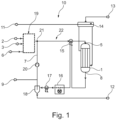
- Fig. 1 shows a schematic representation of a device 10 according to the invention for the synthesis of methanol, which comprises a synthesis reactor arrangement 1, a first reactant gas source 2 for a first reactant, a second reactant gas source 3 for a second Educt, a buffer gas source 6 for a buffer gas and a control device (not shown), wherein the first educt gas source 2, the second educt gas source 3 and the buffer gas source 6 are connected to an inlet 5 of the synthesis reactor arrangement 1.
- the first educt, the second educt and the buffer gas, if a buffer gas is introduced, are compressed via a first compressor 19.
- the first educt is carbon dioxide.
- the second educt is hydrogen, which comes from an electrolysis process using renewable energy.
- the device 10 further comprises a recycling line 7, via which an outlet 8 of the synthesis reactor arrangement 1 is connected to the inlet 5 of the synthesis reactor arrangement 1.
- the recycling line 7 comprises a heat exchanger 15, a synthesis air cooler 16, a final water cooler 17 and a separator 18.
- a synthesis loop 22 comprises the synthesis reactor arrangement 1, the recycling line 7 and a line from a mixing point 21 to the inlet 5 of the synthesis reactor arrangement 1.
- the synthesis reactor arrangement 1 produces methanol and water vapor from carbon dioxide and hydrogen.
- the condensation of the methanol formed in the synthesis reactor arrangement 1 takes place in two steps.
- the product gas mixture at the outlet of the synthesis reactor arrangement 1 is cooled via the heat exchanger 15 in countercurrent operation.
- the gas flow of the synthesis loop 22 is heated up.
- the synthesis loop flow contains the feed gas flow and the recycle gas flow.
- the product gas mixture at the outlet of the synthesis reactor arrangement 1 as well as the partially condensed methanol and the unreacted reactants are cooled to the final separation temperature in the synthesis air cooler 16 and the final water cooler 17.
- liquid methanol is separated from the gas flow.
- the methanol is discharged at a methanol outlet 12.
- a purge gas line 9 branches off from the recycle line 7.
- the recycle gas flow in the recycle line 7 is compressed to an operating pressure in a second compressor 20.
- the feed gas flow and the buffer gas flow are mixed with the recycle gas flow in the mixing point 21.
- a fresh water source 11 supplies water to a steam boiler 14. This produces water vapor 13 and hot water and/or saturated steam.
- the temperature the synthesis reactor arrangement 1 can be kept constant during the fluctuation of the feed gas flow, either by cooling the reaction heat and evaporation of water on the shell side of the synthesis reactor arrangement 1 or by heating in case of insufficient reaction waste heat by additional supply of saturated steam or hot water on the shell side from the steam boiler 14.
- the control device is designed to operate the device 10 with the following method for synthesizing methanol.
- a feed gas stream comprises carbon dioxide and hydrogen and is fed to the synthesis reactor arrangement 1, wherein methanol is produced in the synthesis reactor arrangement 1 with carbon dioxide and hydrogen, wherein in at least a first case of reducing a molar flow rate of the feed gas stream, a production rate of the methanol is temporarily reduced by reducing a proportion of the carbon dioxide in the feed gas stream.
- the proportion of carbon dioxide in the feed gas stream is reduced by adding a buffer gas made of nitrogen and hydrogen to the feed gas stream. Furthermore, in the at least one first case, the proportion of carbon dioxide in the feed gas stream is reduced by reducing an amount of carbon dioxide in the feed gas stream relative to an amount of hydrogen in the feed gas stream. The proportion of carbon dioxide in the feed gas stream is reduced such that the carbon dioxide in the feed gas stream is substoichiometric.
- the methanol from an exit stream of an outlet 8 of the synthesis reactor arrangement 1 is separated and the remaining exit stream of the synthesis reactor arrangement 1 is partially fed back as a recycle gas stream, and wherein in the at least one first case a ratio of a molar flow rate of the recycle gas stream to a molar flow rate of the feed gas stream is increased.
- the recycle ratio in the at least one first case is, for example, 20.
- the production rate of methanol is temporarily increased by the proportion of carbon dioxide in the feed gas stream is increased.
- the outlet stream of the synthesis reactor arrangement 1 is partially removed as purge gas.
- the proportion of carbon dioxide in the feed gas stream is increased by increasing an amount of carbon dioxide in the feed gas stream relative to an amount of hydrogen in the feed gas stream.
- the total pressure in the synthesis reactor arrangement 1 fluctuates by no more than 10% during the process.
Landscapes
- Chemical & Material Sciences (AREA)
- Organic Chemistry (AREA)
- Chemical Kinetics & Catalysis (AREA)
- Organic Low-Molecular-Weight Compounds And Preparation Thereof (AREA)
Priority Applications (3)
| Application Number | Priority Date | Filing Date | Title |
|---|---|---|---|
| EP23177928.1A EP4474032A1 (fr) | 2023-06-07 | 2023-06-07 | Fonctionnement à charge alternée d'une installation de méthanol |
| CN202480035182.8A CN121194822A (zh) | 2023-06-07 | 2024-05-07 | 甲醇装置的交替负荷操作 |
| PCT/EP2024/062648 WO2024251451A1 (fr) | 2023-06-07 | 2024-05-07 | Fonctionnement en charge alternative d'une installation de méthanol |
Applications Claiming Priority (1)
| Application Number | Priority Date | Filing Date | Title |
|---|---|---|---|
| EP23177928.1A EP4474032A1 (fr) | 2023-06-07 | 2023-06-07 | Fonctionnement à charge alternée d'une installation de méthanol |
Publications (1)
| Publication Number | Publication Date |
|---|---|
| EP4474032A1 true EP4474032A1 (fr) | 2024-12-11 |
Family
ID=86732057
Family Applications (1)
| Application Number | Title | Priority Date | Filing Date |
|---|---|---|---|
| EP23177928.1A Pending EP4474032A1 (fr) | 2023-06-07 | 2023-06-07 | Fonctionnement à charge alternée d'une installation de méthanol |
Country Status (3)
| Country | Link |
|---|---|
| EP (1) | EP4474032A1 (fr) |
| CN (1) | CN121194822A (fr) |
| WO (1) | WO2024251451A1 (fr) |
Citations (3)
| Publication number | Priority date | Publication date | Assignee | Title |
|---|---|---|---|---|
| WO2017121978A1 (fr) * | 2016-01-11 | 2017-07-20 | Johnson Matthey Public Limited Company | Procédé de synthèse du méthanol |
| WO2017153304A1 (fr) | 2016-03-08 | 2017-09-14 | Thyssenkrupp Industrial Solutions Ag | Procédé et installation pour la production d'un produit gazeux sous des conditions de charge variables |
| US20230137755A1 (en) * | 2020-05-18 | 2023-05-04 | Topsoe A/S | Method for the control of pressure in a loop for the preparation of ammonia or methanol |
-
2023
- 2023-06-07 EP EP23177928.1A patent/EP4474032A1/fr active Pending
-
2024
- 2024-05-07 CN CN202480035182.8A patent/CN121194822A/zh active Pending
- 2024-05-07 WO PCT/EP2024/062648 patent/WO2024251451A1/fr not_active Ceased
Patent Citations (3)
| Publication number | Priority date | Publication date | Assignee | Title |
|---|---|---|---|---|
| WO2017121978A1 (fr) * | 2016-01-11 | 2017-07-20 | Johnson Matthey Public Limited Company | Procédé de synthèse du méthanol |
| WO2017153304A1 (fr) | 2016-03-08 | 2017-09-14 | Thyssenkrupp Industrial Solutions Ag | Procédé et installation pour la production d'un produit gazeux sous des conditions de charge variables |
| US20230137755A1 (en) * | 2020-05-18 | 2023-05-04 | Topsoe A/S | Method for the control of pressure in a loop for the preparation of ammonia or methanol |
Also Published As
| Publication number | Publication date |
|---|---|
| WO2024251451A1 (fr) | 2024-12-12 |
| CN121194822A (zh) | 2025-12-23 |
Similar Documents
| Publication | Publication Date | Title |
|---|---|---|
| EP3426601B1 (fr) | Procédé et installation pour la production d'un produit gazeux sous des conditions de charge variables | |
| DE69617878T2 (de) | Herstellung von Ammoniak mittels Reformierung mit angereicherter Luft und Stickstoffeinspritzung im Synthesekreislauf | |
| EP3205622A1 (fr) | Procede de synthese de methanol | |
| EP4605345B1 (fr) | Procédé de conduite d'une synthèse d'ammoniac en charge partielle et synthèse d'ammoniac en charge partielle | |
| EP3150549A1 (fr) | Procede et installation de production de gaz de synthese presentant une composition variable | |
| EP3219697B1 (fr) | Synthese de methanol a partir de gaz de synthese ayant un manque d'hydrogene | |
| EP3782974A1 (fr) | Procédé et installation de fabrication de méthanol à partir de gaz de synthèse à teneur augmentée en dioxyde de carbone | |
| EP3816145B1 (fr) | Procédé et système de fabrication de méthanol à partir de gaz de synthèse riche en hydrogène | |
| EP2598618B1 (fr) | Procédé de production de gaz naturel de substitution | |
| DE2430769A1 (de) | Verfahren zur durchfuehrung einer stark exothermen chemischen reaktion | |
| DE102021122602B4 (de) | Anlage und Verfahren zur kontinuierlichen Herstellung von Ammoniak unter Verwendung von erneuerbaren Energien | |
| EP4334242B1 (fr) | Procédé de synthèse d'ammoniac et installation de production d'ammoniac | |
| EP3802410B1 (fr) | Procédé et dispositif de réalisation d'une conversion du gaz à l'eau | |
| EP3770140B1 (fr) | Procédé et installation de synthèse de méthanol | |
| EP4324786A1 (fr) | Procédé et installation pour la préparation de gaz de synthèse et pour la production de méthanol | |
| EP4479347A1 (fr) | Synthèse électrochimique et chimique d'ammoniac | |
| DE69801883T2 (de) | Sauerstoff- und stickstoffhinzufügung zur erhöhung der ausbeute der herstellung von ammonia | |
| BE1029985B1 (de) | Verfahren zur Ammoniaksynthese und Anlage zur Herstellung von Ammoniak | |
| EP4474033B1 (fr) | Synthèse de méthanol | |
| LU103279B1 (de) | Anlage und Verfahren zur gemeinsamen Verdichtung von Wasserstoff und Erdgas | |
| LU103148B1 (de) | Verfahren und Anlage zur Synthese von Methanol | |
| WO2025195682A1 (fr) | Procédé de fonctionnement d'un processus de synthèse d'ammoniac au niveau d'une charge partielle, et processus de synthèse d'ammoniac à charge partielle | |
| WO2025195683A1 (fr) | Procédé de fonctionnement d'un procédé de synthèse d'ammoniac au niveau d'une charge partielle, et processus de synthèse d'ammoniac à charge partielle | |
| DE102023115491A1 (de) | Verfahren und Anlage zur Synthese von Methanol | |
| EP4685112A1 (fr) | Procédé et installation de production d'un produit d'ammoniac |
Legal Events
| Date | Code | Title | Description |
|---|---|---|---|
| PUAI | Public reference made under article 153(3) epc to a published international application that has entered the european phase |
Free format text: ORIGINAL CODE: 0009012 |
|
| STAA | Information on the status of an ep patent application or granted ep patent |
Free format text: STATUS: THE APPLICATION HAS BEEN PUBLISHED |
|
| AK | Designated contracting states |
Kind code of ref document: A1 Designated state(s): AL AT BE BG CH CY CZ DE DK EE ES FI FR GB GR HR HU IE IS IT LI LT LU LV MC ME MK MT NL NO PL PT RO RS SE SI SK SM TR |
|
| STAA | Information on the status of an ep patent application or granted ep patent |
Free format text: STATUS: REQUEST FOR EXAMINATION WAS MADE |
|
| 17P | Request for examination filed |
Effective date: 20250611 |
|
| TPAC | Observations filed by third parties |
Free format text: ORIGINAL CODE: EPIDOSNTIPA |