EP4475155A1 - Dichtkörper und elektrolytkondensator - Google Patents
Dichtkörper und elektrolytkondensator Download PDFInfo
- Publication number
- EP4475155A1 EP4475155A1 EP23770228.7A EP23770228A EP4475155A1 EP 4475155 A1 EP4475155 A1 EP 4475155A1 EP 23770228 A EP23770228 A EP 23770228A EP 4475155 A1 EP4475155 A1 EP 4475155A1
- Authority
- EP
- European Patent Office
- Prior art keywords
- elastomer
- sealing body
- acid
- cross
- linking density
- Prior art date
- Legal status (The legal status is an assumption and is not a legal conclusion. Google has not performed a legal analysis and makes no representation as to the accuracy of the status listed.)
- Pending
Links
Images

Classifications
-
- H—ELECTRICITY
- H01—ELECTRIC ELEMENTS
- H01G—CAPACITORS; CAPACITORS, RECTIFIERS, DETECTORS, SWITCHING DEVICES, LIGHT-SENSITIVE OR TEMPERATURE-SENSITIVE DEVICES OF THE ELECTROLYTIC TYPE
- H01G9/00—Electrolytic capacitors, rectifiers, detectors, switching devices, light-sensitive or temperature-sensitive devices; Processes of their manufacture
- H01G9/004—Details
- H01G9/08—Housing; Encapsulation
- H01G9/10—Sealing, e.g. of lead-in wires
-
- H—ELECTRICITY
- H01—ELECTRIC ELEMENTS
- H01G—CAPACITORS; CAPACITORS, RECTIFIERS, DETECTORS, SWITCHING DEVICES, LIGHT-SENSITIVE OR TEMPERATURE-SENSITIVE DEVICES OF THE ELECTROLYTIC TYPE
- H01G2/00—Details of capacitors not covered by a single one of groups H01G4/00-H01G11/00
- H01G2/10—Housing; Encapsulation
-
- H—ELECTRICITY
- H01—ELECTRIC ELEMENTS
- H01G—CAPACITORS; CAPACITORS, RECTIFIERS, DETECTORS, SWITCHING DEVICES, LIGHT-SENSITIVE OR TEMPERATURE-SENSITIVE DEVICES OF THE ELECTROLYTIC TYPE
- H01G2/00—Details of capacitors not covered by a single one of groups H01G4/00-H01G11/00
- H01G2/10—Housing; Encapsulation
- H01G2/103—Sealings, e.g. for lead-in wires; Covers
-
- H—ELECTRICITY
- H01—ELECTRIC ELEMENTS
- H01G—CAPACITORS; CAPACITORS, RECTIFIERS, DETECTORS, SWITCHING DEVICES, LIGHT-SENSITIVE OR TEMPERATURE-SENSITIVE DEVICES OF THE ELECTROLYTIC TYPE
- H01G9/00—Electrolytic capacitors, rectifiers, detectors, switching devices, light-sensitive or temperature-sensitive devices; Processes of their manufacture
- H01G9/004—Details
- H01G9/022—Electrolytes; Absorbents
- H01G9/025—Solid electrolytes
-
- H—ELECTRICITY
- H01—ELECTRIC ELEMENTS
- H01G—CAPACITORS; CAPACITORS, RECTIFIERS, DETECTORS, SWITCHING DEVICES, LIGHT-SENSITIVE OR TEMPERATURE-SENSITIVE DEVICES OF THE ELECTROLYTIC TYPE
- H01G9/00—Electrolytic capacitors, rectifiers, detectors, switching devices, light-sensitive or temperature-sensitive devices; Processes of their manufacture
- H01G9/004—Details
- H01G9/022—Electrolytes; Absorbents
- H01G9/025—Solid electrolytes
- H01G9/028—Organic semiconducting electrolytes, e.g. TCNQ
-
- H—ELECTRICITY
- H01—ELECTRIC ELEMENTS
- H01G—CAPACITORS; CAPACITORS, RECTIFIERS, DETECTORS, SWITCHING DEVICES, LIGHT-SENSITIVE OR TEMPERATURE-SENSITIVE DEVICES OF THE ELECTROLYTIC TYPE
- H01G9/00—Electrolytic capacitors, rectifiers, detectors, switching devices, light-sensitive or temperature-sensitive devices; Processes of their manufacture
- H01G9/004—Details
- H01G9/022—Electrolytes; Absorbents
- H01G9/035—Liquid electrolytes, e.g. impregnating materials
-
- H—ELECTRICITY
- H01—ELECTRIC ELEMENTS
- H01G—CAPACITORS; CAPACITORS, RECTIFIERS, DETECTORS, SWITCHING DEVICES, LIGHT-SENSITIVE OR TEMPERATURE-SENSITIVE DEVICES OF THE ELECTROLYTIC TYPE
- H01G9/00—Electrolytic capacitors, rectifiers, detectors, switching devices, light-sensitive or temperature-sensitive devices; Processes of their manufacture
- H01G9/004—Details
- H01G9/04—Electrodes or formation of dielectric layers thereon
- H01G9/048—Electrodes or formation of dielectric layers thereon characterised by their structure
-
- H—ELECTRICITY
- H01—ELECTRIC ELEMENTS
- H01G—CAPACITORS; CAPACITORS, RECTIFIERS, DETECTORS, SWITCHING DEVICES, LIGHT-SENSITIVE OR TEMPERATURE-SENSITIVE DEVICES OF THE ELECTROLYTIC TYPE
- H01G9/00—Electrolytic capacitors, rectifiers, detectors, switching devices, light-sensitive or temperature-sensitive devices; Processes of their manufacture
- H01G9/004—Details
- H01G9/04—Electrodes or formation of dielectric layers thereon
- H01G9/048—Electrodes or formation of dielectric layers thereon characterised by their structure
- H01G9/055—Etched foil electrodes
-
- H—ELECTRICITY
- H01—ELECTRIC ELEMENTS
- H01G—CAPACITORS; CAPACITORS, RECTIFIERS, DETECTORS, SWITCHING DEVICES, LIGHT-SENSITIVE OR TEMPERATURE-SENSITIVE DEVICES OF THE ELECTROLYTIC TYPE
- H01G9/00—Electrolytic capacitors, rectifiers, detectors, switching devices, light-sensitive or temperature-sensitive devices; Processes of their manufacture
- H01G9/145—Liquid electrolytic capacitors
-
- H—ELECTRICITY
- H01—ELECTRIC ELEMENTS
- H01G—CAPACITORS; CAPACITORS, RECTIFIERS, DETECTORS, SWITCHING DEVICES, LIGHT-SENSITIVE OR TEMPERATURE-SENSITIVE DEVICES OF THE ELECTROLYTIC TYPE
- H01G9/00—Electrolytic capacitors, rectifiers, detectors, switching devices, light-sensitive or temperature-sensitive devices; Processes of their manufacture
- H01G9/15—Solid electrolytic capacitors
-
- C—CHEMISTRY; METALLURGY
- C08—ORGANIC MACROMOLECULAR COMPOUNDS; THEIR PREPARATION OR CHEMICAL WORKING-UP; COMPOSITIONS BASED THEREON
- C08K—Use of inorganic or non-macromolecular organic substances as compounding ingredients
- C08K3/00—Use of inorganic substances as compounding ingredients
- C08K3/01—Use of inorganic substances as compounding ingredients characterized by their specific function
- C08K3/013—Fillers, pigments or reinforcing additives
-
- C—CHEMISTRY; METALLURGY
- C08—ORGANIC MACROMOLECULAR COMPOUNDS; THEIR PREPARATION OR CHEMICAL WORKING-UP; COMPOSITIONS BASED THEREON
- C08K—Use of inorganic or non-macromolecular organic substances as compounding ingredients
- C08K7/00—Use of ingredients characterised by shape
-
- Y—GENERAL TAGGING OF NEW TECHNOLOGICAL DEVELOPMENTS; GENERAL TAGGING OF CROSS-SECTIONAL TECHNOLOGIES SPANNING OVER SEVERAL SECTIONS OF THE IPC; TECHNICAL SUBJECTS COVERED BY FORMER USPC CROSS-REFERENCE ART COLLECTIONS [XRACs] AND DIGESTS
- Y02—TECHNOLOGIES OR APPLICATIONS FOR MITIGATION OR ADAPTATION AGAINST CLIMATE CHANGE
- Y02E—REDUCTION OF GREENHOUSE GAS [GHG] EMISSIONS, RELATED TO ENERGY GENERATION, TRANSMISSION OR DISTRIBUTION
- Y02E60/00—Enabling technologies; Technologies with a potential or indirect contribution to GHG emissions mitigation
- Y02E60/13—Energy storage using capacitors
Definitions
- the present disclosure relates to a sealing body sealing a casing of an electrolytic capacitor and an electrolytic capacitor including the sealing body.
- Electrolytic capacitors include valve action metal, such as tantalum or aluminum, as anode foil and cathode foil.
- a surface of the anode foil is enlarged by making the valve action metal into a sintered body or a shape such as etching foil, and the enlarged surface has dielectric oxide film thereon.
- Electrolytic solution intervenes between the anode foil and the cathode foil. The electrolytic solution closely contacts with the uneven surface of the anode foil and acts as a true cathode. This electrolytic capacitor obtains anode-side capacity by dielectric polarization action of the dielectric oxide film.
- a capacitor element formed by filling the electrolytic solution between the anode foil and the cathode foil is sealed using a casing and a sealing body to suppress transpiration of the electrolytic solution formed by adding an electrolyte (refer Patent Document 1).
- the sealing body is a member to seal an opening of the bottomed casing in which the capacitor element is housed.
- This sealing body adheres to the opening of the casing by a press-fitting process and is formed by an elastic member of appropriate hardness to improve sealing performance.
- the sealing body includes an elastomer member such as butyl rubber. The elastomer member is produced by vulcanization to cause cross-linking reaction.
- the electrolytic capacitor is expected to be used under high-temperature environment such as in-vehicle application.
- the sealing body may thermally oxidatively deteriorates on the outer side of the casing. That is, the C-H bond of the elastomer molecule cleaves, and radicals are produced. Firstly, the radical attacks other C-H bonds of the elastomer molecule and facilitates further cleavage. Secondly, oxygen is added to the radical, and peroxides are produced. The peroxide is degraded by heat and produces radicals at an accelerated rate, and this radical attacks other C-H bonds of the elastomer molecules and facilitate further cleavage.
- the length of the chain of the elastomer molecule becomes shorter, and the elastomer member becomes softer.
- the elastomer with low molecular weight easily vaporizes.
- the density of the elastomer increases. Therefore, the elastomer member shrinks.
- the shrinking of the elastomer member is significant on the outer side of the casing where is exposed to heat and oxygen, the degree of the shrinking decreases from the outer side to the inner side of the casing.
- the swelling of the elastomer occurs due to the electrolytic solution on the internal side of the casing. Then, the shrunk portion and swelled portion are produced inside the sealing body, forming a crack in the elastomer member of the sealing body.
- the sealing body cracks leakage of the electrolytic solution, an increase in the transpiration of the electrolytic solution, and contamination such as moisture to the electrolytic capacitor easily occur, such that the lifetime of the electrolytic capacitor becomes short.
- the proposal of the Patent Document 1 is to suppress the swelling of the elastomer member by reducing the chance for the electrolytic solution and the elastomer member to contact with each other inside the casing of the sealing body by using resin. Furthermore, the proposal of the Patent document 2 is to keep the elasticity of the elastomer member even under thermal oxidative deterioration by reducing the cross-linking density. These proposals of the Patent Documents 1 and 2 are in the premise of the thermal oxidative deterioration and does not suppress the thermal oxidative deterioration.
- the present disclosure has been proposed to solve the above problems, and an objective is to provide a sealing body that can suppress the thermal oxidative deterioration, and an electrolytic capacitor including the sealing body.
- a sealing body of the present disclosure includes an elastomer member containing an elastomer, in which an initial cross-linking density of the elastomer is 1.8 ⁇ 10 -3 mol/g or more, and a content of the elastomer relative to a total of the elastomer member is 30 wt% or less.
- the cross-linking suppresses the vibration of the elastomer due to thermal energy, and it becomes difficult for the elastomer to cleave. That is, the elastomer member less softens.
- the cross-linking density decreases over time.
- the content of the elastomer relative to a total of the elastomer member is 30 wt% or less, the decrease in the cross-linking density is suppressed. By this, the cleavage of the elastomer is suppressed for a long time.
- the initial cross-linking density of the elastomer may be 2.5 ⁇ 10 -3 mol/g or more.
- the strong cross-linking density suppress the reduction in the cross-linking density, and together with the reduction suppression effect for the cross-linking density of the content of the elastomer relative to the total of the elastomer member that is 30 wt% or less, further suppresses the cleavage of the elastomer, and the shrinking of the elastomer member becomes further slower. That is, the thermal oxidative deterioration can be further suppressed for a long time.
- the elastomer member may further contain carbon and an inorganic filler.
- the interaction between the elastomer and the carbon or inorganic filler too expresses the reduction suppression effect for the cross-linking.
- the inorganic filler may include a flat inorganic filler.
- the flat inorganic filler may be talc, mica, or both. The flat inorganic filler further improves the reduction suppression effect for the cross-linking due to the interaction with the elastomer.
- the elastomer may be resin cross-linked.
- the resin cross-linking is strong among the cross-linking of the elastomer, and the strong cross-linking suppress the reduction in the cross-linking density
- the elastomer may be butyl rubber.
- Butyl rubber has higher heat resistance than other elastomers, making it difficult to oxidatively deteriorate, and butyl rubber is non-polar while an organic solvent used for electrolytic solution is polar. Therefore, butyl rubber less swell than other elastomers due to the electrolytic solution. Then, when the elastomer is butyl rubber, it is difficult for the difference between the volume of the sealing body on the outer side of the casing shrinking by thermal oxidative deterioration and the volume of the sealing body on the inner side of the casing to occur. Thus, the cracks less likely occur in the sealing body.
- the change rate of the cross-linking density when exposed under the temperature environment of 150 °C for 500 hours may be within -60% relative to the initial cross-linking density.
- the change in hardness when exposed under the temperature environment of 150 °C for 1000 hours may be within -2 relative to the initial hardness.
- the change in hardness is within -2, the shrinking of the sealing body becomes slower.
- An electrolytic capacitor including the sealing body, a casing sealed by the sealing body, and a capacitor element which is housed in the casing, has anode foil and cathode foil with dielectric oxide film facing each other, and is impregnated with electrolytic solution is also an aspect of the present disclosure.
- the electrolytic capacitor may further include a solid electrolyte layer containing a conductive polymer and formed in the capacitor element.
- the reduction suppression effect for the cross-linking density makes the shrinking of the elastomer member slow, suppress the thermal oxidative deterioration for a long time, and prevents oxygen from entering into the electrolytic capacitor from the outside. Therefore, the oxidative deterioration of the conductive polymer of the electrolytic capacitor is suppressed, in addition to the thermal oxidative deterioration of the sealing body/ By this, the deterioration over time of the capacitance and the dissipation factor (tan ⁇ ) due to the oxidative deterioration of the conductive polymer is reduced. Thus, long lifetime of the electrolytic capacitor including the electrolytic solution and the solid electrolyte layer is achieved.
- the thermal oxidative deterioration of the sealing body can be suppressed.
- Electrolytic capacitors are passive elements that store and discharge electric charges according to capacitance.
- the capacitor element of the electrolytic capacitor includes anode foil, cathode foil, a separator, and electrolytic solution, and has a wound-shape or a laminated-shape.
- Dielectric oxide film is formed on a surface of the anode foil.
- the anode foil and the cathode foil face each other via the separator.
- the electrolytic solution is filled into voids of the capacitor element, closely contacts with the dielectric oxide film, and acts as true cathode.
- An electrolyte of the electrolytic capacitor may contain only electrolytic solution or may contain electrolytic solution and a solid electrolyte together. Furthermore, the electrolytic solution may be kept in liquid form or may be gelated.
- the capacitor element is housed in the casing and is sealed by the sealing body.
- the casing is an bottomed cylinder to house the capacitor element therein, and for example made of aluminum.
- the sealing body is attached to an opening of the casing by a crimping process and seals the opening of the casing. Lead terminals are connected to the anode foil and the cathode foil, and external terminals are electrically connected to these connection terminals. The external terminal is lead out to the outside through a through hole of the sealing body.
- the sealing body includes an elastomer member with elasticity to improve adhesion to the casing by a crimping process and to ensure insulation.
- the elastomer member contains an elastomer.
- the elastomer may be isobutylene isoprene rubber called butyl rubber, ethylene propylene diene rubber called EPDM, styrene butadiene rubber, isoprene rubber, fluorine rubber, acrylic rubber, and natural rubber.
- EPDM ethylene propylene diene rubber
- styrene butadiene rubber isoprene rubber
- fluorine rubber acrylic rubber
- natural rubber and natural rubber.
- These elastomers may be produced by vulcanization such as resin vulcanization, peroxide vulcanization, sulfur vulcanization, quinoid vulcanization, and polyol vulcanization, and may be thermoplastic elastomers.
- One or two types or more elastomers may be used
- Vulcanizing agent may be benzoyl peroxide, dicumyl peroxide, 2,5-dimethyl-2,5-bis(t-butylperoxy)hexane, and alkyl phenol formaldehyde resin.
- a cross-linking accelerator may be zinc oxide, magnesium oxide, lead peroxide, dibenzothiazyl, disulfide, 1,2-polybutadiene, triallyl cyanurate methacrylic acid and acrylic acid metal salt, and N,N'-metaphenylenedimaleinoside ester stearate, etc.
- the initial cross-linking density of the elastomer can be adjusted by combining single or multiple vulcanizing agent and cross-linking accelerator and selecting them for each type of the elastomer.
- the elastomer member may contain carbon and an inorganic filler, in addition to the elastomer. When the carbon and inorganic filler are added, the elastomer less likely cleaves and softening thereof is suppressed.
- the inorganic filler may be talc, mica, silica, kaolin, titania, alumina, and mixtures thereof, and talc and mica with flat shape are preferable. The inorganic filler with flat shape facilitates the cross-linking and is suitable for adjusting the cross-linking density.
- the initial cross-linking density of the elastomer is adjusted to be 1.8 ⁇ 10 -3 mol/g or more.
- the initial cross-linking density is cross-linking density before the sealing body is exposed under high-temperature atmospheric environment for a long time.
- the initial cross-linking density includes the cross-linking density at the stage of manufacturing the sealing body and the cross-linking density at the stage of assembling the manufactured sealing body in the electrolytic capacitor.
- the electrolytic capacitor is exposed under the high-temperature environment in the aging process and the reflow process, since these processes takes relatively short time of about few seconds to six hours at maximum, the cross-linking density does not largely change.
- the cross-linking density of the sealing body of the electrolytic capacitor after the aging process and the reflow process is also included in the initial cross-linking density.
- the content of the elastomer relative to a total of the elastomer member is adjusted to 30 wt% or less.
- the content of the elastomer relative to a total of the elastomer member is 30 wt% or less, the reduction over time in the cross-linking density is suppressed. Therefore, when the initial cross-linking density of the elastomer is 1.8 ⁇ 10 -3 mol/g or more and the content of the elastomer relative to a total of the elastomer member is 30 wt% or less, high cross-linking density is maintained for a long time.
- the cross-linking density when the cross-linking density is high, the cross-linking suppresses well the vibration of the elastomer due to thermal energy, and it becomes difficult for the elastomer to cleave. Then, when high cross-linking density is maintained fort a long time, the cleavage of the elastomer during that time advances slowly and the recombination of the elastomer advances slowly, and thus the shrinking of the sealing body advances slowly. That is, the thermal oxidative deterioration of the sealing body is suppressed.
- the elastomer is butyl rubber
- resin vulcanization it is preferable to select resin vulcanization for the vulcanization.
- butyl rubber is resin-vulcanized, strong cross-linking structure is achieved, and the reduction of the cross-linking density can be suppressed.
- the initial cross-linking density of the elastomer is preferably 2.5 ⁇ 10 -3 mol/g or more.
- the initial cross-linking density is adjusted as high as 2.5 ⁇ 10 -3 mol/g or more, by adjusting the content of the elastomer relative to the total of the elastomer member to 30 wt% or less, the cleavage of the elastomer becomes further slower. That is, the softening of the elastomer member can be further suppressed.
- the content of the elastomer relative to the total of the elastomer member is preferably 27 wt% or less. When the content of the elastomer is 27 wt% or less, high cross-linking density is maintained for a long time, and the final softening of the elastomer member can be mildly reduced.
- the elastomer is isobutylene isoprene rubber that is also called butyl rubber.
- the electrolytic solution less permeates through the elastomer member containing butyl rubber, and the swelling of the elastomer member on the inner side of the casing is suppressed. Therefore, in the elastomer member containing butyl rubber, the difference between the volume of the sealing body on the outer side of the casing shrinking by thermal oxidative deterioration and the volume of the sealing body on the inner side of the casing swelling due to permeation of the electrolytic solution becomes small. Therefore, the cracks less likely occur in the elastomer member.
- the sealing body may be provided by laminating a hard resin plate on the elastomer member or by including a hard resin plate in the elastomer member.
- the hard resin plate improves the sealing in the electrolytic capacitor and protects the elastomer member from the electrolytic solution and heat.
- the electrolytic capacitor is produced by fitting the sealing body in an opening of the casing housing the capacitor element.
- the anode foil and the cathode foil of the electrolytic capacitor are foil bodies formed of valve acting metal.
- the valve action metal is aluminum, tantalum, niobium, niobium oxide, titanium, hafnium, zirconium, zinc, tungsten, bismuth, and antimony, etc.
- the purity of the anode foil is desirably 99.9% or more, and the purity of the cathode foil is desirably about 99% or more, however, impurities such as silicon, iron, copper, magnesium, and zinc may be included.
- An enlarged surface layer with an enlarged surface structure is formed on one surface or both surface of the anode foil.
- the cathode foil may be plane foil without the enlarged surface structure, or may also have the enlarged surface structure like the anode foil.
- the enlarged surface layer is formed by tunnel-shaped pits, spongy pits, or air gaps between dense powder.
- the enlarged surface layer is formed by electrolytic etching, chemical etching, or sandblasting, and the like, or formed by vapor-depositing or sintering metal particles and the like, on a foil body.
- dielectric oxide film of the anode foil is oxide film formed on a surface layer of the anode foil, and when the anode foil is formed of aluminum, it is aluminum oxide obtained by oxidizing the enlarged surface layer.
- This dielectric oxide film is formed by chemical conversion treatment in which voltage is applied solution without halogen ions.
- the solution without halogen ions is aqueous solution of adipic acid, boric acid, or phosphoric acid, etc.
- the oxide film may be naturally or intentionally formed on the surface layer of the cathode foil by this chemical conversion treatment.
- a solvent of the electrolytic solution is not particularly limited, and a protic organic polar solvent or an aprotic organic polar solvent may be used.
- Typical protic polar solvent may be monohydric alcohol, polyhydric alcohol, oxyalcohol compounds, and water.
- Typical aprotic polar solvent may be sulfones, amides, lactones, cyclic amides, nitriles, and sulfoxides.
- the monohydric alcohol may be ethanol, propanol, butanol, pentanol, hexanol, cyclobutanol, cyclopentanol, cyclohexanol, and benzyl alcohol, etc.
- Polyhydric alcohol and oxyalcohol compound may be ethylene glycol, propylene glycol, glycerin, methyl cellosolve, ethyl cellosolve, methoxypropylene glycol, dimethoxypropanol, and diethylene glycol etc.
- the sulfone may be dimethyl sulfone, ethylmethyl sulfone, diethyl sulfone, sulfolane, 3-methyl sulfolane, and 2,4-dimethyl sulfolane, etc.
- the amide may be N-methylformamide, N,N-dimethylformamide, N-ethylformamide, N,N-diethylformamide, N-methylacetamide, N,N-dimethylacetamide, N-ethylacetamide, N,N-diethylacetamide, and hexamethylphosphoricamide, etc.
- the lactone and the cyclic amide may be ⁇ -butyrolactone, ⁇ -valerolactone, ⁇ -valerolactone, N-methyl-2-pyrrolidone, ethylene carbonate, propylene carbonate, butylene carbonate, and isobutylene carbonate, etc.
- the nitrile may be acetonitrile, 3-methoxypropionitrile, and glutaronitrile, etc.
- the sulfoxide may be dimethyl sulfoxide, etc.
- the electrolytic solution may contain solutes.
- the solute contained in the electrolytic solution contains anion and cation components, and is typically organic acid or salt thereof, inorganic acid or salt thereof, or composite compounds of organic acid and inorganic acid or salt thereof, and may be used in single or in combination of two or more. Acid that is the anion and base that is the cation may be separately added to the electrolytic solution as solute components.
- Organic acid may be carbxylic acid such as oxalic acid, succinic acid, glutaric acid, pimelic acid, suberic acid, sebacic acid, phthalic acid, isophthalic acid, terephthalic acid, maleic acid, adipic acid, benzoic acid, toluyl acid, enanthic acids, malonic acids, 1,6-decandicarboxylic acid, 1,7-octanedicarboxylic acid, azelaic acid, undecanedioic acid, dodecanedioic acid, and tridecanedioic acid, phenols, and sulfonic acid, etc.
- carbxylic acid such as oxalic acid, succinic acid, glutaric acid, pimelic acid, suberic acid, sebacic acid, phthalic acid, isophthalic acid, terephthalic acid, maleic acid, adipic acid, benzoic acid, toluyl acid,
- the inorganic acid may be boric acid, phosphoric acid, phosphorus acid, hypophosphorous acid, carbonic acid, and silicic acid, etc.
- the composite compound of organic acid and inorganic acid may be borodisalicylic acid, borodioxalic acid, and borodiglycolic acid.
- the salt of the organic acid, the inorganic acid, and the composite compound of organic acid and inorganic acid may be ammonium salt, quaternary ammonium salt, quaternary amidinium salt, amine salt, sodium salt, and potassium salt, etc.
- Quaternary ammonium ions of the quaternary ammonium salt may be tetramethylammonium, triethylmethylammonium, and tetraethylammonium, etc.
- the quaternary amidinium salt may be ethyldimethylimidazolinium and tetramethylimidazolinium, etc.
- Amines in the amine salt may be primary amines, secondary amines, and tertiary amines.
- the primary amine may be methylamine, ethylamine, propylamine, and the like
- the secondary amine may be dimethylamine, diethylamine, ethylmethylamine and dibutylamine, and the like
- the tertiary amine may be trimethylamine, triethylamine, tributylamine, ethyldimethylamine, ethyldiisopropylamine, and the like.
- the additive may be polyethylene glycol, polypropyrene glycol, polyoxyethyleneglycerin, complex compounds of boric acid and polysaccharides (mannit, sorbit, etc.), complex compounds of boric acid and polyhydric alcohol, borate esters, nitro compounds, phosphate esters, and colloidal silica, etc. These may be used in single or in combination of two or more.
- the nitro compound suppresses an amount of hydrogen gas produced in the electrolytic capacitor.
- the nitro compound may be o-nitrobenzoic acid, m-nitrobenzoic acid, p-nitrobenzoic acid, o-nitrophenol, m-nitrophenol, and p-nitrophenol, etc.
- a polymer holding such electrolytic solution is a monopolymer of a single monomer or a copolymer of two or more types of monomers, and is cross-linked to form three-dimensional network structure.
- the monomer is not particularly limited, and for example, one type or two or more types are selected from a group of hydroxyethylacrylamide, 2-(diethylamino)ethyl methacrylate, 2-(tert-butylamino)ethyl methacrylate, N -isopropylacrylamide, diacetoneacrylamide, N-tert-butylacrylamide, N,N-diethylacrylamide, N-vinylacetamide, 2-hydroxyethyl methacrylate, methacrylic acid, or methoxy polyethylene glycol methacrylate, etc.
- the solid electrolyte layer is a layer containing a conductive polymer.
- the conductive polymer is a conjugated polymer or a doped conjugated polymer.
- the conjugated polymer may be polypyrrole, polythiophene, polyfuran, polyaniline, polyacetylene, polyphenylene, polyphenylenevinylene, polyacene, and polythiophenevinylene, etc. These conjugated polymers may be used in single or or in combination of two or more, and may further be a copolymer of two or more types of monomers.
- conjugated polymers formed by polymerizing thiophene or derivatives thereof is preferable, and conjugated polymers in which 3,4-ethylenedioxythiophene (that is, 2,3-dihydrothieno[3,4-b][1,4]dioxin), 3-alkylthiophene, 3-alkoxythiophene, 3-alkyl-4-alkoxythiophene, 3,4-alkylthiophene, 3,4-alkoxythiophene, or derivatives thereof are polymerized are preferable.
- 3,4-ethylenedioxythiophene that is, 2,3-dihydrothieno[3,4-b][1,4]dioxin
- 3-alkylthiophene 3-alkoxythiophene
- 3-alkyl-4-alkoxythiophene 3-alkyl-4-alkoxythiophene
- 3,4-alkylthiophene, 3,4-alkoxythiophene, or derivatives thereof are polymerized
- the thiophene derivatives may preferably be compounds selected from thiophene with substituents at 3-position and 4-position, and the 3-position and 4-position substituents of the thiophene ring may form a ring together with the 3-position and 4-position carbon.
- the number of carbon of alkyl and alkoxy groups is suitably from 1 to 16, and in particular, a polymer of 3,4-ethylenedioxythiophene called EDOT, that is, poly(3,4-ethylenedioxythiophene) called PEDOT is particularly preferable.
- an alkylated ethylenedioxythiophene in which an alkyl group is added to 3,4-ethylenedioxythiophene may be used, and for example, a methylated ethylenedioxythiophene (that is, 2-methyl-2,3-dihydro-thieno[3,4-b][1,4] dioxin), ethylated ethylenedioxythiophene (that is, 2-ethyl-2,3-dihydro-thieno[3,4-b][1,4] dioxin), and the like may be used.
- the dopant may be inorganic acid such as boric acid, nitric acid, and phosphoric acid, and organic acid such as acetic acid, oxalic acid, citric acid, ascot acid, tartaric acid, squaric acid, logisonic acid, croconic acid, salicylic acid, p-toluenesulfonic acid, 1,2-dihydroxy-3,5-benzenedisulfonic acid, methanesulfonic acid, trifluoromethanesulfonic acid, borodisalicylic acid, bisoxalate borate acid, sulfonylimide acid, dodecylbenzenesulfonic acid, propylnaphthalenesulfonic acid, and butylnaphthalenesulfonic acid, etc.
- organic acid such as acetic acid, oxalic acid, citric acid, ascot acid, tartaric acid, squaric acid, logisonic acid, croconic acid, sal
- Polyanions may be polyvinyl sulfonic acid, polystyrene sulfonic acid, polyallyl sulfonic acid, polyacrylic sulfonic acid, polymethacrylic sulfonic acid, poly(2-acrylamide-2-methylpropanesulfonic acid), polyisoprene sulfonic acid, polyacrylic acid, polymethacrylic acid, and polymaleic acid, etc.
- the conductive polymer may be poly(3,4-ethylenedioxythiophene), which is called PEDOT, doped with polystyrene sulfonic acid (PSS).
- PEDOT poly(3,4-ethylenedioxythiophene)
- PSS polystyrene sulfonic acid
- the solid electrolyte layer is formed by immersing the capacitor element in dispersion formed by dispersing the conductive polymer in the solvent, and drying the capacitor element.
- the anode foil, the cathode foil, and the separator may be immersed in the dispersion separately before being assembled, or the dispersion may be applied dropwise or may be applied by spraying.
- the separator includes cellulose such as kraft, Manila hemp, esparto, hemp, rayon, and mixed papers thereof, polyester resin such as polyethylene terephthalate, polybutylene terephthalate, polyethylene naphthalate, and derivatives thereof, polytetrafluoroethylene resin, polyvinylidene fluoride resin, vinylon resin, polyamide resin such as aliphatic polyamide, semi-aromatic polyamide, and total aromatic polyamide, polyimide resin, polyethylene resin, polypropylene resin, trimethylpentene resin, polyphenylene sulfide resin, acrylic resin, polyvinyl alcohol resin and the like, and the resin may be used in single or in combination.
- polyester resin such as polyethylene terephthalate, polybutylene terephthalate, polyethylene naphthalate, and derivatives thereof, polytetrafluoroethylene resin, polyvinylidene fluoride resin, vinylon resin, polyamide resin such as aliphatic polyamide, semi-aromatic polyamide
- the long lifetime of the electrolytic capacitor is achieved when the shrinking of the sealing body is slow and the thermal oxidative deterioration of the sealing body is suppressed for a long time. That is, since the transpiration of the electrolytic solution to the outside of the through the sealing body is suppressed, the deterioration over time of the capacitance of the electrolytic capacitor and the dissipation factor (tan ⁇ ) is reduced.
- the electrolytic capacitor is a so-called hybrid type which has the electrolytic solution ad the solid electrolyte layer, the oxidative deterioration of the conductive polymer can be suppressed. That is, the deterioration over time of the capacitance and the dissipation factor (tan ⁇ ) due to the oxidative deterioration of the conductive polymer can be reduced, and this hybrid type electrolytic capacitor can achieve particularly ling lifetime.
- Sealing bodies of the examples 1 and 2 and the comparative examples 1 to 2 were produced. Each sealing body had only the elastomer member.
- the elastomer member was produced by mixing butyl rubber polymer, carbon, and alkyl phenol aldehyde resin as the inorganic filler and vulcanizing agent, and then performing cross-linking by resin vulcanization.
- the examples 1 and 2 and the comparative example 2 used talc as the inorganic filler.
- the comparative examples 1 used clay as the inorganic filler.
- stearic acid, zinc oxide, and silane coupling agent were mixed as the remaining composition.
- the sealing bodies of the examples 1 and 2 and the comparative examples 1 to 2 were produced by adjusting the composition ratio of butyl rubber polymer, carbon, and the inorganic filler, and adjusting the cross-linking density. Each composition ratio was relative to the total weight of the elastomer member.
- Example 1 Example 2 Comparative Example 1 Comparative Example 2 Butyl Rubber Polymer (wt%) 30 27 33 32 Carbon (wt%) 15 19 17 16 Inorganic Filler (wt%) 45 41 43 41 Vulcanization Resin Vulcanization Resin Vulcanization Resin Vulcanization Cross-Linking Density ( ⁇ 10 -3 mol/g) 1.8 2.5 1.1 2.2
- the elastomer members of each example and comparative example with approximately 2 mm in thickness, 1cm ⁇ 1cm in size, and approximately 0.3 g per one test piece in weight were produced.
- the volume V0 of the elastomer member before swelling was calculated from the initial weight and specific gravity.
- the elastomer member was put in the cyclohexane solution of 15 ml and was placed still in the dark under the room temperature of 20 to 25 °C for 72 hours. After this placing still was completed, the weight of the elastomer member after swelling was measured. After the measurement, the elastomer member was dried under the vacuum environment at 100 °C for 1 hour to remove cyclohexane.
- the volume of cyclohexane impregnated in the elastomer member was calculated from the weight of the elastomer member after drying and after swelling.
- the volume of the elastomer member after swelling was calculated from the volume of cyclohexane, and the volume of the elastomer member and the volume of cyclohexane was added to calculate the volume v after swelling. Note that the molecular weight of cyclohexane was 84.16 g/mol, the density of cyclohexane was 0.78 g/cm3, and the interaction coefficient x between butyl rubber polymer and cyclohexane was 0.44 in the calculation.
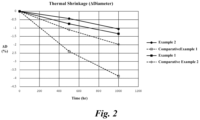
- Example 2 shows a graph in which the horizontal axis indicates the time elapsed and the vertical axis indicates the thermal shrinkage.
- Table 2 Change in Hardness ( ⁇ HS) Time (h) Example 1 Example 2 Comparative Example 1 Comparative Example 2 0 0 0 0 0 100 0.8 2 -1.4 0.1 500 -1.6 1.3 -4.8 -5.4 1000 -1.7 1.7 7 -5.5
- Table 3 Thermal shrinkage ( ⁇ D) Time (h)
- Example 1 Comparative Example 1 Comparative Example 2 0 0 0 0 0 0 100 -0.7 -0.4 -2.4 -1.1 500 -1.3 -1.1 -3.9 -2.0
- the softening in the comparative examples 1 and 2 advanced to about -5 after 500 hours had elapsed.
- the softening in the example 1 was kept at about - 1.7 after 1000 hours had elapsed, and further softening did not occur. From these, it was observed that, the cleavage of the elastomer advanced much in the sealing bodies of the comparative examples 1 and 2, and the cleavage of the elastomer in the sealing body of the example 1 was suppressed.
- the change in hardness was a positive value, meaning that the cleavage of the elastomer is suppressed to the level the change in hardness was not apparent.
- the cross-linking density of the comparative example 2 was higher than the cross-linking density of the example 1.
- the softening is more suppressed in the example 1 than the comparative example 2, and as a result, the thermal shrinkage of the example 1 is suppressed.
- the change in the cross-linking density of the example 1 and the comparative example 1 was measured. That is, the sealing bodies of each example and comparative example were exposed under the temperature environment of 150 °C, and the cross-linking density before exposed under the temperature environment and the cross-linking density after exposed under the temperature environment for 500 hours and 1000 hours were measured to calculate the change rate of the cross-linking density. The results are shown in Table 4.
- the cross-linking density significantly decreased below the cross-linking density of the example 1 after 500 hours.
- the sealing body of the comparative example 2 did not maintain high cross-linking density for a long time and the cross-linking density decreased quickly, that is since the cleavage of the elastomer was suppressed only for a short time and was aggressively, the shrinking of the comparative example 2 was larger than the example 1.
- the difference between the example 1 and the comparative example 2 was the content ratio of elastomer relative to the elastomer member.
- the change in cross-linking density became slow, the cleavage of the elastomer was suppressed, and the shrinking of the elastomer member was suppressed. That is, the thermal oxidative deterioration of the sealing body was suppressed.
- the electrolytic capacitors of the example 3 and 4 and the comparative example 3 were produced using the sealing bodies of the examples 1 and 2 and the comparative example 2. These electrolytic capacitors were so-called hybrid type in which the electrolytic solution and the solid electrolyte layer were used together.
- the anode foil and the cathode foil were aluminum foil, and the surface thereof was enlarged by etching and the oxide film was formed thereon by chemical conversion treatment.
- the chemical conversion treatment voltage was applied in the aqueous solution of adipic acid.
- the oxide film of the anode foil was the dielectric oxide film of the electrolytic capacitor.
- the anode foil and the cathode foil were each connected to lead wire and were wound to face each other via a cellulose separator.
- the capacitor element was immersed in aqueous solution of ammonium dihydrogen phosphate of the same concentration for 10 minutes to perform restorative conversion.
- the dispersion of polyethylene dioxythiophene (PEDOT/PSS) doped with polystyrene sulfonic acid of the same product was prepared as the conductive polymer.
- the capacitor element was immersed in the dispersion, was pulled out and was dried at 150 °C for 30 minutes. By this, the solid electrolyte layer was formed on the capacitor element.
- Ethylene glycol was selected as the solvent of the electrolytic solution.
- ammonium azelaate that is ion-dissociative salt was selected as the solute of the electrolytic solution.
- the solvent and the solute were mixed at the ratio of 5 wt% of ammonium azelaate relative to the electrolytic solution.
- the capacitor element on which the solid electrolyte had been formed was immersed in the electrolytic solution to impregnate the electrolytic solution in the capacitor element.
- the capacitor elements were housed in the aluminum casings with the same dimension and shape.
- the opened end of the aluminum casing was attached with the sealing body of the example 1 and was sealed by a crimping process.
- the electrolytic capacitor of the example 4 was attached with the sealing body of the example 2 and was sealed by a crimping process.
- the electrolytic capacitor of the comparative example 3 was attached with the sealing body of the comparative example 2 and was sealed by a crimping process.
- the lead wire drawn out from the capacitor element was drawn out from the sealing body so that the element can be conducted. Voltage was applied for 45 minutes under the temperature environment of 115 °C, and aging was performed on each solid electrolytic capacitor.
- the size of the capacitor element of respective electrolytic capacitor was 6.3 mm in diameter and 5.8 mm in height, and each electrolytic capacitor had the rated withstand voltage of 35 WV and the capacity of 47 ⁇ F.
- the solid electrolytic capacitors of the examples 3 and 4 and the comparative example 2 were exposed under the high-temperature environment of 170 °C. Then, the dissipation factor (tan ⁇ ), the capacitance (Cap), and the electrolytic solution loss ( ⁇ wt) of the electrolytic capacitor before exposed under the high-temperature environment, and after exposed under the high-temperature environment for 1200 hours were measured. Furthermore, a decrease rate ( ⁇ Cap) of the capacitance after 2000 hours had elapsed relative to the capacitance of before exposed under the high-temperature environment was measured.
- the initial properties of the electrolytic capacitors of the examples 3 and 4 and the comparative example 3 were the same.
- the properties varied between the group of the examples 3 and 4 and the comparative example 3. That is, after 1200 hours, the electrolytic solution loss ⁇ wt from the electrolytic capacitors of the examples 3 and 4 were smaller than the comparative example 3.
- the reduction in Cap and the deterioration of tan ⁇ of the electrolytic capacitors of the examples 3 and 4 was suppressed more than the comparative example 3.
Landscapes
- Engineering & Computer Science (AREA)
- Power Engineering (AREA)
- Microelectronics & Electronic Packaging (AREA)
- Chemical & Material Sciences (AREA)
- Chemical Kinetics & Catalysis (AREA)
- Electrochemistry (AREA)
- Compositions Of Macromolecular Compounds (AREA)
Applications Claiming Priority (2)
| Application Number | Priority Date | Filing Date | Title |
|---|---|---|---|
| JP2022042966A JP2023137002A (ja) | 2022-03-17 | 2022-03-17 | 封口体及び電解コンデンサ |
| PCT/JP2023/005296 WO2023176268A1 (ja) | 2022-03-17 | 2023-02-15 | 封口体及び電解コンデンサ |
Publications (2)
| Publication Number | Publication Date |
|---|---|
| EP4475155A1 true EP4475155A1 (de) | 2024-12-11 |
| EP4475155A4 EP4475155A4 (de) | 2025-05-07 |
Family
ID=88022907
Family Applications (1)
| Application Number | Title | Priority Date | Filing Date |
|---|---|---|---|
| EP23770228.7A Pending EP4475155A4 (de) | 2022-03-17 | 2023-02-15 | Dichtkörper und elektrolytkondensator |
Country Status (7)
| Country | Link |
|---|---|
| US (1) | US20250279248A1 (de) |
| EP (1) | EP4475155A4 (de) |
| JP (1) | JP2023137002A (de) |
| KR (1) | KR20240166982A (de) |
| CN (1) | CN118591857A (de) |
| TW (1) | TW202337988A (de) |
| WO (1) | WO2023176268A1 (de) |
Families Citing this family (1)
| Publication number | Priority date | Publication date | Assignee | Title |
|---|---|---|---|---|
| WO2025047620A1 (ja) | 2023-08-25 | 2025-03-06 | 国立大学法人東京農工大学 | ペプチド、ドロプレット形成用キット、ドロプレット形成方法、疎水性物質の濃縮方法、及びタンパク質フォールディング方法 |
Family Cites Families (7)
| Publication number | Priority date | Publication date | Assignee | Title |
|---|---|---|---|---|
| JPS5980925A (ja) * | 1982-10-30 | 1984-05-10 | 株式会社東立工業 | 電解コンデンサ用ラミネ−ト封口栓の製造方法 |
| JPH05283302A (ja) * | 1992-03-31 | 1993-10-29 | Nippon Valqua Ind Ltd | コンデンサ封口シール用ゴム |
| JP5133983B2 (ja) * | 2007-04-25 | 2013-01-30 | 日本ケミコン株式会社 | 電解コンデンサの封口体とその封口体を用いた電解コンデンサ |
| JP2010232449A (ja) * | 2009-03-27 | 2010-10-14 | Nippon Chemicon Corp | 電解コンデンサ用封口部材 |
| WO2019035431A1 (ja) * | 2017-08-14 | 2019-02-21 | 日立化成株式会社 | 封止用樹脂組成物、封止用樹脂組成物の製造方法、半導体装置及び半導体装置の製造方法 |
| JP7340805B2 (ja) * | 2018-11-30 | 2023-09-08 | パナソニックIpマネジメント株式会社 | 電解コンデンサ |
| KR102772994B1 (ko) * | 2019-01-17 | 2025-02-27 | 덴카 주식회사 | 봉지제, 경화체, 유기 일렉트로 루미네센스 표시 장치 및 장치의 제조 방법 |
-
2022
- 2022-03-17 JP JP2022042966A patent/JP2023137002A/ja active Pending
-
2023
- 2023-02-15 CN CN202380018446.4A patent/CN118591857A/zh active Pending
- 2023-02-15 WO PCT/JP2023/005296 patent/WO2023176268A1/ja not_active Ceased
- 2023-02-15 US US18/847,008 patent/US20250279248A1/en active Pending
- 2023-02-15 EP EP23770228.7A patent/EP4475155A4/de active Pending
- 2023-02-15 KR KR1020247024435A patent/KR20240166982A/ko active Pending
- 2023-03-15 TW TW112109514A patent/TW202337988A/zh unknown
Also Published As
| Publication number | Publication date |
|---|---|
| KR20240166982A (ko) | 2024-11-26 |
| US20250279248A1 (en) | 2025-09-04 |
| JP2023137002A (ja) | 2023-09-29 |
| WO2023176268A1 (ja) | 2023-09-21 |
| EP4475155A4 (de) | 2025-05-07 |
| TW202337988A (zh) | 2023-10-01 |
| CN118591857A (zh) | 2024-09-03 |
Similar Documents
| Publication | Publication Date | Title |
|---|---|---|
| JP7226593B2 (ja) | 固体電解コンデンサ | |
| JP7616313B2 (ja) | 固体電解コンデンサ及びその製造方法 | |
| WO2020017530A1 (ja) | 固体電解コンデンサ | |
| JP7702648B2 (ja) | 電解コンデンサ | |
| WO2023054502A1 (ja) | 固体電解コンデンサ | |
| EP4475154A1 (de) | Elektrolytischer kondensator | |
| EP4475155A1 (de) | Dichtkörper und elektrolytkondensator | |
| JP2023137005A (ja) | 電解コンデンサ | |
| WO2025192529A1 (ja) | 電解コンデンサ及び製造方法 | |
| JP7294494B2 (ja) | 固体電解コンデンサ及びその製造方法 | |
| EP4386797A1 (de) | Festelektrolytkondensator und verfahren zur herstellung davon | |
| WO2024143420A1 (ja) | 固体電解コンデンサ及び製造方法 | |
| EP4383295A1 (de) | Elektrolytischer kondensator | |
| JP7509337B1 (ja) | 固体電解コンデンサ及び製造方法 | |
| EP4383296A1 (de) | Festelektrolytkondensator und herstellungsverfahren | |
| WO2026070419A1 (ja) | 封口体、電解コンデンサ及び封口体の製造方法 | |
| JP2024093013A (ja) | 固体電解コンデンサ | |
| WO2023171618A1 (ja) | 固体電解コンデンサ用電解液、及び固体電解コンデンサ | |
| WO2024181509A1 (ja) | 固体電解コンデンサ及び製造方法 | |
| CN117941021A (zh) | 电解电容器 | |
| WO2024070288A1 (ja) | 固体電解コンデンサ及び製造方法 | |
| JP2024050386A (ja) | 固体電解コンデンサ及び製造方法 |
Legal Events
| Date | Code | Title | Description |
|---|---|---|---|
| STAA | Information on the status of an ep patent application or granted ep patent |
Free format text: STATUS: THE INTERNATIONAL PUBLICATION HAS BEEN MADE |
|
| PUAI | Public reference made under article 153(3) epc to a published international application that has entered the european phase |
Free format text: ORIGINAL CODE: 0009012 |
|
| STAA | Information on the status of an ep patent application or granted ep patent |
Free format text: STATUS: REQUEST FOR EXAMINATION WAS MADE |
|
| 17P | Request for examination filed |
Effective date: 20240903 |
|
| AK | Designated contracting states |
Kind code of ref document: A1 Designated state(s): AL AT BE BG CH CY CZ DE DK EE ES FI FR GB GR HR HU IE IS IT LI LT LU LV MC ME MK MT NL NO PL PT RO RS SE SI SK SM TR |
|
| REG | Reference to a national code |
Ref country code: DE Ref legal event code: R079 Free format text: PREVIOUS MAIN CLASS: H01G0009100000 Ipc: C08L0023220000 |
|
| A4 | Supplementary search report drawn up and despatched |
Effective date: 20250404 |
|
| RIC1 | Information provided on ipc code assigned before grant |
Ipc: H01G 9/145 20060101ALI20250331BHEP Ipc: H01G 9/15 20060101ALI20250331BHEP Ipc: H01G 9/10 20060101ALI20250331BHEP Ipc: H01G 2/10 20060101ALI20250331BHEP Ipc: C08K 7/00 20060101ALI20250331BHEP Ipc: C08K 3/04 20060101ALI20250331BHEP Ipc: C08K 3/34 20060101ALI20250331BHEP Ipc: C08L 23/22 20060101AFI20250331BHEP |
|
| DAV | Request for validation of the european patent (deleted) | ||
| DAX | Request for extension of the european patent (deleted) |