EP4477370A1 - Systeme und verfahren zur verarbeitung von obst und gemüse - Google Patents
Systeme und verfahren zur verarbeitung von obst und gemüse Download PDFInfo
- Publication number
- EP4477370A1 EP4477370A1 EP23425034.8A EP23425034A EP4477370A1 EP 4477370 A1 EP4477370 A1 EP 4477370A1 EP 23425034 A EP23425034 A EP 23425034A EP 4477370 A1 EP4477370 A1 EP 4477370A1
- Authority
- EP
- European Patent Office
- Prior art keywords
- produce
- produce item
- conveyor belt
- item
- sliced
- Prior art date
- Legal status (The legal status is an assumption and is not a legal conclusion. Google has not performed a legal analysis and makes no representation as to the accuracy of the status listed.)
- Pending
Links
Images







Classifications
-
- B—PERFORMING OPERATIONS; TRANSPORTING
- B26—HAND CUTTING TOOLS; CUTTING; SEVERING
- B26D—CUTTING; DETAILS COMMON TO MACHINES FOR PERFORATING, PUNCHING, CUTTING-OUT, STAMPING-OUT OR SEVERING
- B26D1/00—Cutting through work characterised by the nature or movement of the cutting member or particular materials not otherwise provided for; Apparatus or machines therefor; Cutting members therefor
- B26D1/01—Cutting through work characterised by the nature or movement of the cutting member or particular materials not otherwise provided for; Apparatus or machines therefor; Cutting members therefor involving a cutting member which does not travel with the work
- B26D1/02—Cutting through work characterised by the nature or movement of the cutting member or particular materials not otherwise provided for; Apparatus or machines therefor; Cutting members therefor involving a cutting member which does not travel with the work having a stationary cutting member
-
- A—HUMAN NECESSITIES
- A23—FOODS OR FOODSTUFFS; TREATMENT THEREOF, NOT COVERED BY OTHER CLASSES
- A23N—MACHINES OR APPARATUS FOR TREATING HARVESTED FRUIT, VEGETABLES OR FLOWER BULBS IN BULK, NOT OTHERWISE PROVIDED FOR; PEELING VEGETABLES OR FRUIT IN BULK; APPARATUS FOR PREPARING ANIMAL FEEDING- STUFFS
- A23N15/00—Machines or apparatus for other treatment of fruits or vegetables for human purposes; Machines or apparatus for topping or skinning flower bulbs
- A23N15/04—Devices for topping fruit or vegetables
-
- B—PERFORMING OPERATIONS; TRANSPORTING
- B26—HAND CUTTING TOOLS; CUTTING; SEVERING
- B26D—CUTTING; DETAILS COMMON TO MACHINES FOR PERFORATING, PUNCHING, CUTTING-OUT, STAMPING-OUT OR SEVERING
- B26D1/00—Cutting through work characterised by the nature or movement of the cutting member or particular materials not otherwise provided for; Apparatus or machines therefor; Cutting members therefor
- B26D1/01—Cutting through work characterised by the nature or movement of the cutting member or particular materials not otherwise provided for; Apparatus or machines therefor; Cutting members therefor involving a cutting member which does not travel with the work
- B26D1/12—Cutting through work characterised by the nature or movement of the cutting member or particular materials not otherwise provided for; Apparatus or machines therefor; Cutting members therefor involving a cutting member which does not travel with the work having a cutting member moving about an axis
- B26D1/14—Cutting through work characterised by the nature or movement of the cutting member or particular materials not otherwise provided for; Apparatus or machines therefor; Cutting members therefor involving a cutting member which does not travel with the work having a cutting member moving about an axis with a circular cutting member, e.g. disc cutter
- B26D1/143—Cutting through work characterised by the nature or movement of the cutting member or particular materials not otherwise provided for; Apparatus or machines therefor; Cutting members therefor involving a cutting member which does not travel with the work having a cutting member moving about an axis with a circular cutting member, e.g. disc cutter rotating about a stationary axis
-
- B—PERFORMING OPERATIONS; TRANSPORTING
- B26—HAND CUTTING TOOLS; CUTTING; SEVERING
- B26D—CUTTING; DETAILS COMMON TO MACHINES FOR PERFORATING, PUNCHING, CUTTING-OUT, STAMPING-OUT OR SEVERING
- B26D3/00—Cutting work characterised by the nature of the cut made; Apparatus therefor
- B26D3/24—Cutting work characterised by the nature of the cut made; Apparatus therefor to obtain segments other than slices, e.g. cutting pies
- B26D3/26—Cutting work characterised by the nature of the cut made; Apparatus therefor to obtain segments other than slices, e.g. cutting pies specially adapted for cutting fruit or vegetables, e.g. for onions
-
- B—PERFORMING OPERATIONS; TRANSPORTING
- B26—HAND CUTTING TOOLS; CUTTING; SEVERING
- B26D—CUTTING; DETAILS COMMON TO MACHINES FOR PERFORATING, PUNCHING, CUTTING-OUT, STAMPING-OUT OR SEVERING
- B26D3/00—Cutting work characterised by the nature of the cut made; Apparatus therefor
- B26D3/30—Halving devices, e.g. for halving buns
-
- B—PERFORMING OPERATIONS; TRANSPORTING
- B26—HAND CUTTING TOOLS; CUTTING; SEVERING
- B26D—CUTTING; DETAILS COMMON TO MACHINES FOR PERFORATING, PUNCHING, CUTTING-OUT, STAMPING-OUT OR SEVERING
- B26D7/00—Details of apparatus for cutting, cutting-out, stamping-out, punching, perforating, or severing by means other than cutting
- B26D7/06—Arrangements for feeding or delivering work of other than sheet, web, or filamentary form
- B26D7/0625—Arrangements for feeding or delivering work of other than sheet, web, or filamentary form by endless conveyors, e.g. belts
- B26D7/0633—Arrangements for feeding or delivering work of other than sheet, web, or filamentary form by endless conveyors, e.g. belts by grippers
-
- B—PERFORMING OPERATIONS; TRANSPORTING
- B26—HAND CUTTING TOOLS; CUTTING; SEVERING
- B26D—CUTTING; DETAILS COMMON TO MACHINES FOR PERFORATING, PUNCHING, CUTTING-OUT, STAMPING-OUT OR SEVERING
- B26D7/00—Details of apparatus for cutting, cutting-out, stamping-out, punching, perforating, or severing by means other than cutting
- B26D7/06—Arrangements for feeding or delivering work of other than sheet, web, or filamentary form
- B26D7/0641—Arrangements for feeding or delivering work of other than sheet, web, or filamentary form using chutes, hoppers, magazines
-
- B—PERFORMING OPERATIONS; TRANSPORTING
- B26—HAND CUTTING TOOLS; CUTTING; SEVERING
- B26D—CUTTING; DETAILS COMMON TO MACHINES FOR PERFORATING, PUNCHING, CUTTING-OUT, STAMPING-OUT OR SEVERING
- B26D9/00—Cutting apparatus combined with punching or perforating apparatus or with dissimilar cutting apparatus
-
- B—PERFORMING OPERATIONS; TRANSPORTING
- B26—HAND CUTTING TOOLS; CUTTING; SEVERING
- B26D—CUTTING; DETAILS COMMON TO MACHINES FOR PERFORATING, PUNCHING, CUTTING-OUT, STAMPING-OUT OR SEVERING
- B26D7/00—Details of apparatus for cutting, cutting-out, stamping-out, punching, perforating, or severing by means other than cutting
- B26D7/06—Arrangements for feeding or delivering work of other than sheet, web, or filamentary form
- B26D7/0608—Arrangements for feeding or delivering work of other than sheet, web, or filamentary form by pushers
Definitions
- Items of produce such as fruits and vegetables, often grow in configurations that substantially differ from how they are stored, transported, sold, or consumed. For example, in some instances it may be desirable to slice produce (e.g., lemons, limes, apples, oranges, tomatoes) into halves, quarters, or smaller sections during a produce processing phase. These smaller sections, or "slices," of the fruit can then be provided to consumers for use and consumption. For instance, a consumer (e.g. grocery shopper) or food-provider (e.g. restaurant) may prefer to purchase prepackaged, pre-sliced produce, rather than purchase produce in a more raw form to cut themselves. In many instances, it is also important to limit contamination of the sliced produce during preparation, particularly for interior portions of the produce to be consumed.
- slice produce e.g., lemons, limes, apples, oranges, tomatoes
- Systems and methods are provided for cutting produce (e.g. lemons, limes, tomatoes) and then preparing the produce to be packaged.
- produce e.g. lemons, limes, tomatoes
- processing produce items for individual sliced packaging can present several challenges.
- the present disclosure allows for the top and bottom sections of a produce item to be quickly removed, thereby allowing for a uniform packaging height.
- slicing and presenting sliced produce items to a packaging picker in a manner that the external skin of the produce item is substantially exposed to an apparatus e.g., a picker
- an apparatus e.g., a picker
- the present disclosure can allow for the processing and sale of individual produce items (e.g. lemon slices) at scale.
- the present disclosure provides a system for processing produce.
- the system may include a grabbing mechanism configured to secure a produce item by contacting a middle section of the produce item, wherein a top section and a bottom section of the produce item remain exposed when secured by the grabbing mechanism, a first rotating blade configured to remove the top section of the produce item while the produce item is secured by the grabbing mechanism, and a second rotating blade configured to remove the bottom section of the produce item while the produce item is secured by the grabbing mechanism.
- the present disclosure provides a system for processing produce.
- the system may include a conveyor belt having a transport section, the conveyor belt configured to convey a sliced produce item along at least part of the transport section, wherein the transport section of the conveyor belt includes an angled portion having an angle configured to present an exterior portion of the sliced produce item in a substantially horizontal direction.
- the present disclosure provides a method for processing produce.
- the method may include securing a produce item using a grabbing mechanism, removing a top section and a bottom section of the produce item using at least one rotating blade, pressing the produce item against a wedge assembly in order to slice the produce item into two halves, the wedge assembly having a stationary blade and a wedge with at least one curved side, wherein the curved side is configured so that the interior side of one of the halved produce items will slide from a vertical position down the curved side into a horizontal position, slicing the halved produce item in half using a rotating blade to produce a quartered produce item, transporting the quartered produce item along a conveyor belt having an angled portion, wherein the angled portion has an angle configured to present an exterior portion of the quartered produce item in a substantially horizontal direction, and removing the quartered produce item from the conveyor belt by contacting only the exterior portion of the quartered produce item.
- System and methods as described herein provide processing techniques that may allow for the swift resizing of a produce items by removing a top and a bottom section of the produce item. Additionally, among numerous other advantages, the techniques described herein allow for various additional produce processing, including cutting produce into slices and properly presenting those slices to a picker in a manner that the exterior of the produce item may be exposed to the picker instead of internal sections intended for consumption. Although many of the examples described herein are specifically tailored to fruits, and more specifically to citrus fruits (e.g. lemons, limes, oranges) that have a specific shape and internal construction, it should be appreciated that many of the techniques described herein can be readily applied to other kinds of produce that would benefit from slicing, including but not limited to, tomatoes, watermelons, and apples.
- citrus fruits e.g. lemons, limes, oranges
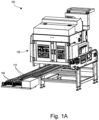
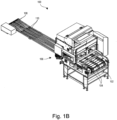
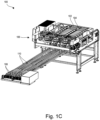
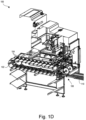
- FIGs. 1A-1D depict various views of a system 100 for processing produce.
- the system 100 includes an input conveyor belt 102 on which unsliced produce items may be loaded.
- unprocessed lemons 104 are placed onto the input conveyor belt 102, where they are then transported to the slicing mechanisms 106 of the system 100.
- the resulting sliced produce items 108 may be transported away from the slicing mechanisms 106 using a number of product conveyor belts 110.
- the product conveyor belts 110 may present the sliced produce items 108 in a manner that they may be easily grabbed off of the product conveyor belts 110 by contacting the exterior portion of the sliced produce items 108 (in this case, the outer peel surface of the lemons). Once one of the sliced produce items 108 has been selected from the product conveyor belts 110 by a picker, it may then undergo a packaging process, before ultimately being sold and provided to consumers. Accordingly, the system 100 can allow for the rapid processing of a high volume of produce items.
- FIG. 2 depicts example slicing mechanisms 200 that may be used in a produce processing system, such as the system depicted in FIGs. 1A-1D .
- produce items 204 may be transported to the slicing mechanism subsystems via an input conveyor belt 202.
- the system may include a grabbing mechanism 220 configured to secure one of the produce items 204 by contacting a middle section of the produce item 204.
- the grabbing mechanism may be configured to transport each produce item 204 towards a pair of rotating blades 230, 232.
- the top rotating blade 230 may be configured to remove the top section of the produce item 204 while the produce item is secured by the grabbing mechanism 220, while the bottom produce item 232 may be configured to remove the bottom section of the produce item 204.
- the grabbing mechanism 220 may reposition the produce item below a press 240.
- the press 240 may be configured to push the produce item 204 into a stationary blade of a wedge assembly 242, thereby further slicing the produce item 204 in half.
- the halved produce items may be transported on output conveyor belts 210, where they may be further sliced by a vertical rotating blade 250 before being transported down the output conveyor belts 210 and presented for selection and packaging.
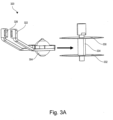
- FIGs. 3A-3B depict an example grabbing mechanism 320, formed of a first arm 322 and a second arm 326, pushing a produce item 304 in a lateral direction into a first rotating blade 330 and a second rotating blade 332, and then pulling the produce item 304 away from the pair of rotating blades 330, 332.
- both a top and a bottom section of the produce item 304 may be simultaneously cut off by this process.
- the top and bottom section of the produce item 304 may instead be removed sequentially, removing both portions simultaneously can reduce processing times and eliminate system complexity.
- each rotating blade 330, 332 may instead have its own axle and be positioned on separate axes.
- the rotating blades are shown to have a substantially circular construction, it should be appreciated that alternative rotating blade forms may be used.
- a non-rotating blade may be alternatively used; for example, the produce item 304 may be simultaneously forced against two non-rotating blades to remove the top and bottom sections.
- the top rotating blade 330 and bottom rotating blade 332 may have a fixed distance between them in order to account for size limitations due to standardized packing for individual slices.
- a fixed distance between the two blades 330, 332 may remove more produce material from the tops and bottoms of some produce items than from others, but the resulting product slices may advantageously have a uniform height.
- This predetermined distance, as well as the diameter of the rotating blades may be adjusted depending on the type and size of the produce item 304 being processed. Beyond allowing for a uniform packaging height, removal of the top and/or bottom of the produce item 304 may further assist in the processing of the produce item by, for instance, providing a flat surface for a blade to contact and therefore providing a more controlled cut.
- FIGs. 4A-4B depict various views of a grabbing mechanism 420 having a first arm 422 and a second arm 426.
- the first and second arms 422, 426 may each include connector components 423, 427 configured to attach the grabbing mechanism to another component of a processing system.
- Each arm 422, 426 may have extended flat body sections 424, 428 and grabbing components 425, 429.
- the grabbing components 425, 429 may be specifically sized and shaped to contact a produce item in a manner that pressure applied from the grabbing components 425, 429 may be more uniformly distributed to the produce item.
- the grabbing components 425, 429 may include a curved contacting surface.
- At least one of the first arm 422 and the second arm 426 may be configured to move a direction towards and away from the other arm, thereby allowing a produce item located in between to be secured or released.
- the extended flat body sections 424, 428 and the grabbing components 425, 429 may have a vertical height that does not exceed the height of a middle section of the produce to be sliced. In this manner, a top section and a bottom section of a produce item may remain exposed when secured by the grabbing mechanism 420.
- the vertical height may be less than half of the size of the produce to be sliced, or more specifically less than 5 centimeters. Accordingly, the two arms 422, 426 may be moved in a lateral direction between two stationary rotating blades in order to cut off the top and bottom sections of a produce item without risk of the arms 422, 426 contacting either blade.
- the grabbing mechanism 420 is depicted as two clamping arms in this illustration, it should be appreciated that other forms may be used to secure a produce item while its top and bottom sections are removed.
- a single arm with a claw-type grabbing component or a suction component may be used.
- the grabbing mechanism 420 may be substantially stationary while the cutting of the produce item occurs, wherein the blades are moved relative to the grabbing mechanism 420.
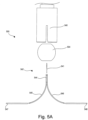
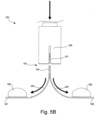
- FIGs. 5A-5B depict various slicing components 500 for further processing and cutting of a produce item 504.
- a press 540 may be configured to apply pressure to the produce item 504 in a direction that forces the produce item against a stationary blade 544 of a wedge assembly 542, thereby slicing the produce item 504 in half.
- Each half of the produce item 506, 508 may then slide down the curved edges 545, 546 of a wedge 544 onto respective platforms 547, 548 and come to rest in a horizontal position with the interior sections of the produce item halves 506, 508 contacting each platform 506, 508.
- each curved side 545, 546 may be configured so that the interior side of one of the halved produce items 506, 508 will slide from a vertical position down the curved side to a horizontal position.
- the height of each curved edge may be limited to being larger than the height of the produce item, and the curvature of each curved side 545, 546 may be approximately 90 degrees.
- the produce item 504 may be positioned between the press 540 and the stationary blade 541 of the wedge assembly 542 by a grabbing mechanism (not depicted).
- the illustrated wedge assembly is configured to split the produce item in half, it should be appreciated that the wedge may be instead configured to further split the produce item (e.g. into quarters) provided that the resulting sliced sections can be controllably transferred onto respective platforms for further processing and transport.
- the stationary blade 541 is depicted as a separate detached component, the stationary blade 541 could be alternatively integrated into the top edge of the wedge 544.
- the wedge assembly 542 may include only a single wedge with an integrated top blade.
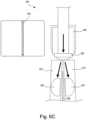
- FIGs. 6A-6C depict various slicing components 600 for additional processing and cutting of a produce item 604.
- a halved produce item 608 may slide onto a horizontal platform 648, as shown in FIG. 6A .
- the horizontal platform 648 may be configured to rotate so that a top section of the produce item 608 is perpendicular with a vertical rotation blade 660, as shown in FIG. 6B .
- a horizontal press 662 may extend to push the halved produce item 608 onto two conveyor belts 670, 674, where the halved produce item 608 is further sliced into quarter slices 607, 609 by the vertical rotating blade 660.
- the quartered produce items 607, 609 may then be transported down the conveyor belts 670, 674.
- FIG. 7 depicts a first conveyor belt 770 and a second conveyor belt 774 each having a top surface transport section 771, 775 configured to convey sliced produce items 707, 709.
- supporting components e.g. conveyor belt pulleys
- each conveyor belt 770, 774 may have an angled portion 772, 776 having an angle configured to present exterior portions of the sliced produce items 707, 709 in a substantially horizontal direction.
- Presenting each sliced produce item in this manner may have numerous benefits. For instance, providing the exterior portions of the sliced produce items 707, 709 in a horizontal direction may allow for a picker to grab each sliced produce item (e.g.
- a downward facing scanner may better locate and position a picker arm if presented with only an exterior portion of the produce item, which can often have different optical properties (e.g. color) from an interior section of the produce item.
- a vertical rotating blade 760 may be positioned between the first and second conveyor belts 770, 774 in a manner that a halved produce item may be further sliced and the resulting slices 707, 709 may then be separately transported on their respective conveyor belts 770, 774.
- the conveyor belts may be angled so that the sliced produce items 707, 709 may gain some spatial separation prior to being presented to a picker.
- Each conveyor belt 770, 774 may have a portion of the top surface transport section 771, 775, such as an area near the vertical rotating blade 760, that is substantially flat and orthogonal to the direction of gravity.
- each belt may be smooth, in order to ensure that the produce sliced produce items 707, 709 are properly transported down the conveyor belts 770, 774, each belt may have a textured surface and/or a plurality of belt flights (e.g. vertical blocks) prevent sliding or sticking of the produce items.
- the belt flights may be spaced at appropriate lengths along the conveyor belt so that each belt flight is configured to contact a single sliced produce item being transported along the transport section 771.
- the conveyor belts 770, 774 may have walls or guiding elements to keep the produce items from falling off.
- FIG. 8 depicts a front view of a sliced produce item 880 having an exterior portion (e.g. shell, skin, peel) 882 and an interior portion (e.g. pulp) 884 being transported along an angled portion 870 of a conveyor belt above a shaping element 886.
- the shaping element 886 may help to maintain the angled portion 870 at a desired angle, ⁇ , at which the sliced produce item 880 may be removed from the conveyor belt. As shown, the shaping element 886 may contact a bottom surface of the angled portion 870 of the conveyor belt.
- the shaping element may be formed of any suitable material, and may have a top surface that provides the desired angle, ⁇ .
- at least one of the end pulleys of the conveyor belt may instead be angled relative to the direction of gravitational pull, thereby producing the desired angle, ⁇ , for the angled portion 870.
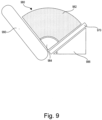
- FIG. 9 depicts a front view of a sliced produce item 980, having an exterior portion 982 and an interior portion (e.g. pulp) 984, being transported along an angled portion 970 of a conveyor belt above a shaping element 986 and also along a support surface 990.
- the support surface 990 may be positioned adjacent to the angled portion 970 of the conveyor belt and configured to contact an interior surface of the sliced produce item 980, while the angled portion 970 is configured to contact a second interior surface of the sliced produce item 980.
- the support surface may also help maintain the desired angle, ⁇ , of the sliced produce item 980 when being presented to a picker.
- presenting an exterior portion of a sliced produce item in a substantially horizontal direction may specifically be defined to include providing the sliced produce item on a surface that is not substantially orthogonal to the directional pull of gravity.
- the angled surface of a conveyor belt on which a sliced produce item is presented may have a positive, non-zero angle, ⁇ .
- an exterior portion (e.g. peel side) of the sliced produce item may be tilted in a horizontal direction to be more accessible from above than it otherwise would be if the sliced produce item was on a flat non-angled surface.
- the interior sides of the sliced produce item may form a point that faces, at least partially, in a downward direction.
- the angle at which the produce item is presented may be at least 20 degrees, at least 30 degrees, at least 35 degrees, at least 40 degrees, or at least 45 degrees.
- the angle, ⁇ may specifically be about 45 degrees in order to provide the maximum surface area of the exterior portion for a picker grabbing the quartered produce item from above.
- the desired angle, ⁇ may depend on the slice angle of the produce item. For instance, if the produce item has a slice angle that is smaller than 90 degrees (i.e.
- the angle, ⁇ of the angled portion of the conveyor belt may need to be larger.
- presenting an exterior portion of a sliced produce item in a substantially horizontal direction may require that the angled portion of the conveyor belt have an angle configured to present the exterior portion so that an interior portion of the sliced produce item is completely underneath the exterior portion.
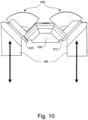
- FIG. 10 depicts a front view of two produce items 1080 being transported along an angled portion 1070 of conveyor belts above shaping elements 1086.
- the two produce items are supported by a support member 1090 having multiple angled surfaces configured to contact each of the produce items 1080.
- the shaping elements 1086 may be configured to extend and retract in a vertical direction, which allows the shaping elements 1086 to selectively contact the angled portion 1070 of the conveyor belts.
- the conveyor belts may remain in a flat, horizontal position.
- the shaping elements 1086 may be configured to move to contact the angled portions 1070 of the conveyor belts only when the conveyor belts are in a stationary state (i.e.
- An example workflow may therefore include: transporting the sliced produce items 1080 down the conveyor belt to the angled portions 1070, contacting the conveyor belt with the shaping elements 1086 to produce the desired angle, ⁇ , removing the sliced produce items 1080 from the conveyor belts, disengaging and retracting the shaping elements 1086, and then transporting additional sliced produce items down the conveyor belts to the angled portions 1070.
- the conveyor belt may be operated while in a flat, horizontal position, which can help to prevent stress on the conveyor belts by belt drive gears and to ensure that the conveyor belt stays properly connected to its drive system.
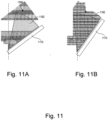
- FIGs. 11A-11B depict a sliced produce item 1180 on an angled portion 1170 of a conveyor belt with and without angles configured to present the exterior portion so that an interior portion 1184 of the sliced produce item is completely underneath the exterior portion 1182. Accordingly, FIG. 11B may be more suitable for a picker grabbing the sliced produce item from above, as more of the exterior portion and none of the interior portion of the produce item can be seen from a top-down view.
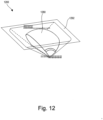
- FIG. 12 depicts a produce product 1200 including an individual sliced produce item 1280 contained within packaging 1292.
- the packaging 1292 may be specifically sized and shaped to accommodate a single sliced produce item 1280.
- the sliced produce item 1280 may be placed into the triangular-shaped packaging 1292 in a manner that the exterior portion of the sliced produce item 1280 is presented in a horizontal direction, with two interior sides of the produce item 1180 forming a downward facing point.
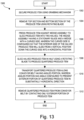
- FIG. 13 depicts a flowchart of a method for processing produce.
- a produce item may be secured using a grabbing mechanism.
- a top section and a bottom section of the produce item may be removed using at least one rotating blade.
- the produce item may be pressed against a wedge assembly in order to slice the produce item into two halves.
- the wedge assembly may have a stationary blade and a wedge with at least one curved side, and the curved side may be configured so that the interior side of one of the halved produce items will slide from a vertical position down the curved side into a horizontal position.
- the halved produce item may be sliced in half using a rotating blade to produce a quartered produce item.
- the quartered produce item may be transported along a conveyor belt having an angled portion, wherein the angled portion may have an angle configured to present an exterior portion of the quartered produce item in a substantially horizontal direction.
- the quartered produce item may be removed from the conveyor belt by contacting only the exterior portion of the quartered produce item.
Landscapes
- Life Sciences & Earth Sciences (AREA)
- Engineering & Computer Science (AREA)
- Forests & Forestry (AREA)
- Mechanical Engineering (AREA)
- Chemical & Material Sciences (AREA)
- Food Science & Technology (AREA)
- Polymers & Plastics (AREA)
- Structure Of Belt Conveyors (AREA)
Priority Applications (2)
| Application Number | Priority Date | Filing Date | Title |
|---|---|---|---|
| EP23425034.8A EP4477370A1 (de) | 2023-06-16 | 2023-06-16 | Systeme und verfahren zur verarbeitung von obst und gemüse |
| PCT/EP2024/066353 WO2024256534A1 (en) | 2023-06-16 | 2024-06-13 | Systems and methods for processing produce |
Applications Claiming Priority (1)
| Application Number | Priority Date | Filing Date | Title |
|---|---|---|---|
| EP23425034.8A EP4477370A1 (de) | 2023-06-16 | 2023-06-16 | Systeme und verfahren zur verarbeitung von obst und gemüse |
Publications (1)
| Publication Number | Publication Date |
|---|---|
| EP4477370A1 true EP4477370A1 (de) | 2024-12-18 |
Family
ID=87474270
Family Applications (1)
| Application Number | Title | Priority Date | Filing Date |
|---|---|---|---|
| EP23425034.8A Pending EP4477370A1 (de) | 2023-06-16 | 2023-06-16 | Systeme und verfahren zur verarbeitung von obst und gemüse |
Country Status (2)
| Country | Link |
|---|---|
| EP (1) | EP4477370A1 (de) |
| WO (1) | WO2024256534A1 (de) |
Citations (6)
| Publication number | Priority date | Publication date | Assignee | Title |
|---|---|---|---|---|
| US2577086A (en) * | 1945-04-07 | 1951-12-04 | Basic Vegets Le Products Co | Onion halving device |
| US3656529A (en) * | 1969-09-05 | 1972-04-18 | Fmc Corp | Processing of contour peeled fruit halves |
| EP0085184A1 (de) * | 1982-01-29 | 1983-08-10 | KRONES AG Hermann Kronseder Maschinenfabrik | Verfahren und Vorrichtung zum Überführen von in Reihen nebeneinander auf einem Zuförderer aufrecht ankommenden Flaschen in eine einzelne Flaschenreihe auf einem Abförderer |
| US4658713A (en) * | 1984-05-14 | 1987-04-21 | Nagaokaseiki Seisakusho Co. Ltd. | Apparatus for cutting off a head and a root of bulbs |
| EP0327146A1 (de) * | 1988-02-02 | 1989-08-09 | Instituut Voor Bewaring En Verwerking Van Landbouwprodukten | Schälmaschine für Zwiebeln oder Knollen- oder Wurzelgewächsen |
| EP3954195A1 (de) * | 2019-05-07 | 2022-02-16 | Fujian Sanan Sino-Science Photobiotech Co., Ltd. | Vorrichtung zur automatischen ernte von kultursprösslingen ohne erde |
-
2023
- 2023-06-16 EP EP23425034.8A patent/EP4477370A1/de active Pending
-
2024
- 2024-06-13 WO PCT/EP2024/066353 patent/WO2024256534A1/en not_active Ceased
Patent Citations (6)
| Publication number | Priority date | Publication date | Assignee | Title |
|---|---|---|---|---|
| US2577086A (en) * | 1945-04-07 | 1951-12-04 | Basic Vegets Le Products Co | Onion halving device |
| US3656529A (en) * | 1969-09-05 | 1972-04-18 | Fmc Corp | Processing of contour peeled fruit halves |
| EP0085184A1 (de) * | 1982-01-29 | 1983-08-10 | KRONES AG Hermann Kronseder Maschinenfabrik | Verfahren und Vorrichtung zum Überführen von in Reihen nebeneinander auf einem Zuförderer aufrecht ankommenden Flaschen in eine einzelne Flaschenreihe auf einem Abförderer |
| US4658713A (en) * | 1984-05-14 | 1987-04-21 | Nagaokaseiki Seisakusho Co. Ltd. | Apparatus for cutting off a head and a root of bulbs |
| EP0327146A1 (de) * | 1988-02-02 | 1989-08-09 | Instituut Voor Bewaring En Verwerking Van Landbouwprodukten | Schälmaschine für Zwiebeln oder Knollen- oder Wurzelgewächsen |
| EP3954195A1 (de) * | 2019-05-07 | 2022-02-16 | Fujian Sanan Sino-Science Photobiotech Co., Ltd. | Vorrichtung zur automatischen ernte von kultursprösslingen ohne erde |
Also Published As
| Publication number | Publication date |
|---|---|
| WO2024256534A1 (en) | 2024-12-19 |
Similar Documents
| Publication | Publication Date | Title |
|---|---|---|
| US7866130B2 (en) | Automated method for placing sliced food stacks in packages | |
| EP1238763A1 (de) | Verfahren und Vorrichtung zum Schneiden einer Anzahl von Artikeln, insbesondere Tomaten in eine Vielzahl von dünnen uniformen Scheiben in einer einzelnen Handlung | |
| EP3140091B1 (de) | Lebensmittelproduktschneidvorrichtung | |
| JP6116659B2 (ja) | 移動させられる食品の横方向切断 | |
| EP1893390B1 (de) | Vorrichtung zum schneiden von äpfeln | |
| EP2671643A1 (de) | konkaves konisches Lebensmittelprodukt, Verfahren und Vorrichtung zur Herstellung eines derartigen Produkts | |
| US20160113320A1 (en) | Fruit chunking and spear forming method and apparatus | |
| CN105979784B (zh) | 用于将食品切割成较小食品的切割设备和方法 | |
| US7740528B1 (en) | Apparatus for cutting elongated meat | |
| US20090047403A1 (en) | Pomegranate processing machine | |
| US11019826B2 (en) | System and methods of cutting and packaging tortillas | |
| NL8501082A (nl) | Pelmachine. | |
| EP1764195A2 (de) | Vorrichtung zum Schneiden von Obst und Gemüse | |
| US3605840A (en) | Apparatus for comminuting comestibles | |
| WO2024256534A1 (en) | Systems and methods for processing produce | |
| US6951168B1 (en) | Vegetable delivery device for vegetable cutting apparatus | |
| WO2011123926A1 (en) | Cutting apparatus for a produce corer | |
| JP6535512B2 (ja) | 食品細割装置 | |
| WO2011123925A1 (en) | Positioning apparatus for a produce corer | |
| US20180020713A1 (en) | Fruit flesh extracting machine | |
| JPH08149916A (ja) | 結球野菜収穫機 | |
| EP4595780A1 (de) | Verfahren und systeme zum schälen von produkten | |
| CN223289917U (zh) | 一种具有压料效果的食品切片成型装置 | |
| US20200079553A1 (en) | Fruit processing, packaging and retail display system | |
| NL1030671C2 (nl) | Werkwijze en inrichting voor het bewerken van een karkasdeel van geslacht gevogelte. |
Legal Events
| Date | Code | Title | Description |
|---|---|---|---|
| PUAI | Public reference made under article 153(3) epc to a published international application that has entered the european phase |
Free format text: ORIGINAL CODE: 0009012 |
|
| STAA | Information on the status of an ep patent application or granted ep patent |
Free format text: STATUS: THE APPLICATION HAS BEEN PUBLISHED |
|
| AK | Designated contracting states |
Kind code of ref document: A1 Designated state(s): AL AT BE BG CH CY CZ DE DK EE ES FI FR GB GR HR HU IE IS IT LI LT LU LV MC ME MK MT NL NO PL PT RO RS SE SI SK SM TR |
|
| STAA | Information on the status of an ep patent application or granted ep patent |
Free format text: STATUS: REQUEST FOR EXAMINATION WAS MADE |
|
| 17P | Request for examination filed |
Effective date: 20241217 |
|
| STAA | Information on the status of an ep patent application or granted ep patent |
Free format text: STATUS: EXAMINATION IS IN PROGRESS |
|
| 17Q | First examination report despatched |
Effective date: 20250825 |