EP4477427A2 - Feuille décorative, procédé de fabrication d'une feuille décorative et procédé de décoration d'un substrat cible - Google Patents
Feuille décorative, procédé de fabrication d'une feuille décorative et procédé de décoration d'un substrat cible Download PDFInfo
- Publication number
- EP4477427A2 EP4477427A2 EP24209891.1A EP24209891A EP4477427A2 EP 4477427 A2 EP4477427 A2 EP 4477427A2 EP 24209891 A EP24209891 A EP 24209891A EP 4477427 A2 EP4477427 A2 EP 4477427A2
- Authority
- EP
- European Patent Office
- Prior art keywords
- layer
- decorative
- thickness
- range
- adhesive
- Prior art date
- Legal status (The legal status is an assumption and is not a legal conclusion. Google has not performed a legal analysis and makes no representation as to the accuracy of the status listed.)
- Pending
Links
Images


Classifications
-
- B—PERFORMING OPERATIONS; TRANSPORTING
- B42—BOOKBINDING; ALBUMS; FILES; SPECIAL PRINTED MATTER
- B42D—BOOKS; BOOK COVERS; LOOSE LEAVES; PRINTED MATTER CHARACTERISED BY IDENTIFICATION OR SECURITY FEATURES; PRINTED MATTER OF SPECIAL FORMAT OR STYLE NOT OTHERWISE PROVIDED FOR; DEVICES FOR USE THEREWITH AND NOT OTHERWISE PROVIDED FOR; MOVABLE-STRIP WRITING OR READING APPARATUS
- B42D25/00—Information-bearing cards or sheet-like structures characterised by identification or security features; Manufacture thereof
- B42D25/40—Manufacture
- B42D25/405—Marking
- B42D25/425—Marking by deformation, e.g. embossing
-
- B—PERFORMING OPERATIONS; TRANSPORTING
- B05—SPRAYING OR ATOMISING IN GENERAL; APPLYING FLUENT MATERIALS TO SURFACES, IN GENERAL
- B05D—PROCESSES FOR APPLYING FLUENT MATERIALS TO SURFACES, IN GENERAL
- B05D5/00—Processes for applying liquids or other fluent materials to surfaces to obtain special surface effects, finishes or structures
- B05D5/06—Processes for applying liquids or other fluent materials to surfaces to obtain special surface effects, finishes or structures to obtain multicolour or other optical effects
-
- B—PERFORMING OPERATIONS; TRANSPORTING
- B05—SPRAYING OR ATOMISING IN GENERAL; APPLYING FLUENT MATERIALS TO SURFACES, IN GENERAL
- B05D—PROCESSES FOR APPLYING FLUENT MATERIALS TO SURFACES, IN GENERAL
- B05D7/00—Processes, other than flocking, specially adapted for applying liquids or other fluent materials to particular surfaces or for applying particular liquids or other fluent materials
- B05D7/02—Processes, other than flocking, specially adapted for applying liquids or other fluent materials to particular surfaces or for applying particular liquids or other fluent materials to macromolecular substances, e.g. rubber
- B05D7/04—Processes, other than flocking, specially adapted for applying liquids or other fluent materials to particular surfaces or for applying particular liquids or other fluent materials to macromolecular substances, e.g. rubber to surfaces of films or sheets
-
- B—PERFORMING OPERATIONS; TRANSPORTING
- B05—SPRAYING OR ATOMISING IN GENERAL; APPLYING FLUENT MATERIALS TO SURFACES, IN GENERAL
- B05D—PROCESSES FOR APPLYING FLUENT MATERIALS TO SURFACES, IN GENERAL
- B05D7/00—Processes, other than flocking, specially adapted for applying liquids or other fluent materials to particular surfaces or for applying particular liquids or other fluent materials
- B05D7/24—Processes, other than flocking, specially adapted for applying liquids or other fluent materials to particular surfaces or for applying particular liquids or other fluent materials for applying particular liquids or other fluent materials
- B05D7/26—Processes, other than flocking, specially adapted for applying liquids or other fluent materials to particular surfaces or for applying particular liquids or other fluent materials for applying particular liquids or other fluent materials synthetic lacquers or varnishes
-
- B—PERFORMING OPERATIONS; TRANSPORTING
- B05—SPRAYING OR ATOMISING IN GENERAL; APPLYING FLUENT MATERIALS TO SURFACES, IN GENERAL
- B05D—PROCESSES FOR APPLYING FLUENT MATERIALS TO SURFACES, IN GENERAL
- B05D7/00—Processes, other than flocking, specially adapted for applying liquids or other fluent materials to particular surfaces or for applying particular liquids or other fluent materials
- B05D7/50—Multilayers
- B05D7/56—Three layers or more
- B05D7/58—No clear coat specified
-
- B—PERFORMING OPERATIONS; TRANSPORTING
- B29—WORKING OF PLASTICS; WORKING OF SUBSTANCES IN A PLASTIC STATE IN GENERAL
- B29C—SHAPING OR JOINING OF PLASTICS; SHAPING OF MATERIAL IN A PLASTIC STATE, NOT OTHERWISE PROVIDED FOR; AFTER-TREATMENT OF THE SHAPED PRODUCTS, e.g. REPAIRING
- B29C70/00—Shaping composites, i.e. plastics material comprising reinforcements, fillers or preformed parts, e.g. inserts
- B29C70/04—Shaping composites, i.e. plastics material comprising reinforcements, fillers or preformed parts, e.g. inserts comprising reinforcements only, e.g. self-reinforcing plastics
- B29C70/28—Shaping operations therefor
- B29C70/30—Shaping by lay-up, i.e. applying fibres, tape or broadsheet on a mould, former or core; Shaping by spray-up, i.e. spraying of fibres on a mould, former or core
- B29C70/34—Shaping by lay-up, i.e. applying fibres, tape or broadsheet on a mould, former or core; Shaping by spray-up, i.e. spraying of fibres on a mould, former or core and shaping or impregnating by compression, i.e. combined with compressing after the lay-up operation
-
- B—PERFORMING OPERATIONS; TRANSPORTING
- B32—LAYERED PRODUCTS
- B32B—LAYERED PRODUCTS, i.e. PRODUCTS BUILT-UP OF STRATA OF FLAT OR NON-FLAT, e.g. CELLULAR OR HONEYCOMB, FORM
- B32B17/00—Layered products essentially comprising sheet glass, or glass, slag, or like fibres
- B32B17/06—Layered products essentially comprising sheet glass, or glass, slag, or like fibres comprising glass as the main or only constituent of a layer, next to another layer of a specific material
- B32B17/10—Layered products essentially comprising sheet glass, or glass, slag, or like fibres comprising glass as the main or only constituent of a layer, next to another layer of a specific material of synthetic resin
-
- B—PERFORMING OPERATIONS; TRANSPORTING
- B32—LAYERED PRODUCTS
- B32B—LAYERED PRODUCTS, i.e. PRODUCTS BUILT-UP OF STRATA OF FLAT OR NON-FLAT, e.g. CELLULAR OR HONEYCOMB, FORM
- B32B27/00—Layered products comprising a layer of synthetic resin
- B32B27/06—Layered products comprising a layer of synthetic resin as the main or only constituent of a layer, which is next to another layer of the same or of a different material
-
- B—PERFORMING OPERATIONS; TRANSPORTING
- B32—LAYERED PRODUCTS
- B32B—LAYERED PRODUCTS, i.e. PRODUCTS BUILT-UP OF STRATA OF FLAT OR NON-FLAT, e.g. CELLULAR OR HONEYCOMB, FORM
- B32B27/00—Layered products comprising a layer of synthetic resin
- B32B27/06—Layered products comprising a layer of synthetic resin as the main or only constituent of a layer, which is next to another layer of the same or of a different material
- B32B27/08—Layered products comprising a layer of synthetic resin as the main or only constituent of a layer, which is next to another layer of the same or of a different material of synthetic resin
-
- B—PERFORMING OPERATIONS; TRANSPORTING
- B32—LAYERED PRODUCTS
- B32B—LAYERED PRODUCTS, i.e. PRODUCTS BUILT-UP OF STRATA OF FLAT OR NON-FLAT, e.g. CELLULAR OR HONEYCOMB, FORM
- B32B33/00—Layered products characterised by particular properties or particular surface features, e.g. particular surface coatings; Layered products designed for particular purposes not covered by another single class
-
- B—PERFORMING OPERATIONS; TRANSPORTING
- B32—LAYERED PRODUCTS
- B32B—LAYERED PRODUCTS, i.e. PRODUCTS BUILT-UP OF STRATA OF FLAT OR NON-FLAT, e.g. CELLULAR OR HONEYCOMB, FORM
- B32B7/00—Layered products characterised by the relation between layers; Layered products characterised by the relative orientation of features between layers, or by the relative values of a measurable parameter between layers, i.e. products comprising layers having different physical, chemical or physicochemical properties; Layered products characterised by the interconnection of layers
- B32B7/04—Interconnection of layers
- B32B7/06—Interconnection of layers permitting easy separation
-
- B—PERFORMING OPERATIONS; TRANSPORTING
- B32—LAYERED PRODUCTS
- B32B—LAYERED PRODUCTS, i.e. PRODUCTS BUILT-UP OF STRATA OF FLAT OR NON-FLAT, e.g. CELLULAR OR HONEYCOMB, FORM
- B32B7/00—Layered products characterised by the relation between layers; Layered products characterised by the relative orientation of features between layers, or by the relative values of a measurable parameter between layers, i.e. products comprising layers having different physical, chemical or physicochemical properties; Layered products characterised by the interconnection of layers
- B32B7/04—Interconnection of layers
- B32B7/12—Interconnection of layers using interposed adhesives or interposed materials with bonding properties
- B32B7/14—Interconnection of layers using interposed adhesives or interposed materials with bonding properties applied in spaced arrangements, e.g. in stripes
-
- B—PERFORMING OPERATIONS; TRANSPORTING
- B42—BOOKBINDING; ALBUMS; FILES; SPECIAL PRINTED MATTER
- B42D—BOOKS; BOOK COVERS; LOOSE LEAVES; PRINTED MATTER CHARACTERISED BY IDENTIFICATION OR SECURITY FEATURES; PRINTED MATTER OF SPECIAL FORMAT OR STYLE NOT OTHERWISE PROVIDED FOR; DEVICES FOR USE THEREWITH AND NOT OTHERWISE PROVIDED FOR; MOVABLE-STRIP WRITING OR READING APPARATUS
- B42D25/00—Information-bearing cards or sheet-like structures characterised by identification or security features; Manufacture thereof
- B42D25/30—Identification or security features, e.g. for preventing forgery
- B42D25/36—Identification or security features, e.g. for preventing forgery comprising special materials
- B42D25/373—Metallic materials
-
- B—PERFORMING OPERATIONS; TRANSPORTING
- B42—BOOKBINDING; ALBUMS; FILES; SPECIAL PRINTED MATTER
- B42D—BOOKS; BOOK COVERS; LOOSE LEAVES; PRINTED MATTER CHARACTERISED BY IDENTIFICATION OR SECURITY FEATURES; PRINTED MATTER OF SPECIAL FORMAT OR STYLE NOT OTHERWISE PROVIDED FOR; DEVICES FOR USE THEREWITH AND NOT OTHERWISE PROVIDED FOR; MOVABLE-STRIP WRITING OR READING APPARATUS
- B42D25/00—Information-bearing cards or sheet-like structures characterised by identification or security features; Manufacture thereof
- B42D25/40—Manufacture
- B42D25/45—Associating two or more layers
- B42D25/455—Associating two or more layers using heat
-
- B—PERFORMING OPERATIONS; TRANSPORTING
- B42—BOOKBINDING; ALBUMS; FILES; SPECIAL PRINTED MATTER
- B42D—BOOKS; BOOK COVERS; LOOSE LEAVES; PRINTED MATTER CHARACTERISED BY IDENTIFICATION OR SECURITY FEATURES; PRINTED MATTER OF SPECIAL FORMAT OR STYLE NOT OTHERWISE PROVIDED FOR; DEVICES FOR USE THEREWITH AND NOT OTHERWISE PROVIDED FOR; MOVABLE-STRIP WRITING OR READING APPARATUS
- B42D25/00—Information-bearing cards or sheet-like structures characterised by identification or security features; Manufacture thereof
- B42D25/40—Manufacture
- B42D25/45—Associating two or more layers
- B42D25/46—Associating two or more layers using pressure
-
- B—PERFORMING OPERATIONS; TRANSPORTING
- B42—BOOKBINDING; ALBUMS; FILES; SPECIAL PRINTED MATTER
- B42D—BOOKS; BOOK COVERS; LOOSE LEAVES; PRINTED MATTER CHARACTERISED BY IDENTIFICATION OR SECURITY FEATURES; PRINTED MATTER OF SPECIAL FORMAT OR STYLE NOT OTHERWISE PROVIDED FOR; DEVICES FOR USE THEREWITH AND NOT OTHERWISE PROVIDED FOR; MOVABLE-STRIP WRITING OR READING APPARATUS
- B42D25/00—Information-bearing cards or sheet-like structures characterised by identification or security features; Manufacture thereof
- B42D25/40—Manufacture
- B42D25/45—Associating two or more layers
- B42D25/465—Associating two or more layers using chemicals or adhesives
- B42D25/47—Associating two or more layers using chemicals or adhesives using adhesives
-
- B—PERFORMING OPERATIONS; TRANSPORTING
- B44—DECORATIVE ARTS
- B44C—PRODUCING DECORATIVE EFFECTS; MOSAICS; TARSIA WORK; PAPERHANGING
- B44C5/00—Processes for producing special ornamental bodies
- B44C5/04—Ornamental plaques, e.g. decorative panels, decorative veneers
- B44C5/0453—Ornamental plaques, e.g. decorative panels, decorative veneers produced by processes involving moulding
-
- B—PERFORMING OPERATIONS; TRANSPORTING
- B32—LAYERED PRODUCTS
- B32B—LAYERED PRODUCTS, i.e. PRODUCTS BUILT-UP OF STRATA OF FLAT OR NON-FLAT, e.g. CELLULAR OR HONEYCOMB, FORM
- B32B2255/00—Coating on the layer surface
- B32B2255/10—Coating on the layer surface on synthetic resin layer or on natural or synthetic rubber layer
-
- B—PERFORMING OPERATIONS; TRANSPORTING
- B32—LAYERED PRODUCTS
- B32B—LAYERED PRODUCTS, i.e. PRODUCTS BUILT-UP OF STRATA OF FLAT OR NON-FLAT, e.g. CELLULAR OR HONEYCOMB, FORM
- B32B2255/00—Coating on the layer surface
- B32B2255/20—Inorganic coating
-
- B—PERFORMING OPERATIONS; TRANSPORTING
- B32—LAYERED PRODUCTS
- B32B—LAYERED PRODUCTS, i.e. PRODUCTS BUILT-UP OF STRATA OF FLAT OR NON-FLAT, e.g. CELLULAR OR HONEYCOMB, FORM
- B32B2255/00—Coating on the layer surface
- B32B2255/20—Inorganic coating
- B32B2255/205—Metallic coating
-
- B—PERFORMING OPERATIONS; TRANSPORTING
- B32—LAYERED PRODUCTS
- B32B—LAYERED PRODUCTS, i.e. PRODUCTS BUILT-UP OF STRATA OF FLAT OR NON-FLAT, e.g. CELLULAR OR HONEYCOMB, FORM
- B32B2255/00—Coating on the layer surface
- B32B2255/28—Multiple coating on one surface
-
- B—PERFORMING OPERATIONS; TRANSPORTING
- B32—LAYERED PRODUCTS
- B32B—LAYERED PRODUCTS, i.e. PRODUCTS BUILT-UP OF STRATA OF FLAT OR NON-FLAT, e.g. CELLULAR OR HONEYCOMB, FORM
- B32B2451/00—Decorative or ornamental articles
Definitions
- the invention relates to a decorative film, in particular laminating film, hot stamping film and/or cold stamping film, a method for producing a decorative film and a method for decorating a target substrate with a decorative film.
- the applied adhesive layer is in particular only partially applied and can, for example, be designed in the form of a pattern.
- the decorative film tears at the outer edge of the adhesive layer.
- this can lead to undefined cracks in the overall paint layer far from the outer edge of the adhesive layer, resulting in an unclean decoration.
- the invention is based on the object of specifying an improved decorative film, an improved method for producing a decorative film and an improved method for decorating a target substrate.
- the object is achieved by a decorative film according to claim 1.
- This object is further achieved by a method for producing a decorative film according to claim 15.
- At least a partial region of the at least one region is arranged on at least one surface of the at least one surface of the carrier film, wherein this at least partially covers at least one surface of the at least one surface of the carrier film.
- this object is achieved by a method for decorating a target substrate according to claim 18.
- At least a partial region of the at least one region is arranged on at least one surface of the at least one surface of the target substrate, wherein this at least partially covers at least one surface of the at least one surface of the target substrate.
- the present invention achieves improved opacity and a cleaner appearance of the decoration compared to conventional decorative films, since the reduced carrier film thickness reduces the initial tear force and the tear propagation force, which are crucial for high-quality decoration of the target substrate.
- the carrier film is peeled off from the overall paint layer, the carrier film is bent, resulting in tensions, particularly across the entire cross-section of the decorative film.
- the reduced carrier film thickness allows these stresses to be reduced and the resulting tear initiation force and tear propagation force are also reduced.
- the fluctuations in the force amplitude of the tear propagation force are significantly reduced, which further improves the release behavior and promotes clean decoration.
- a decorative film with a carrier film thickness in the range of 3.0 ⁇ m to 10.0 ⁇ m reduces the amount of plastic waste compared to conventional decorative films.
- Another advantage is that longer film strips can be wound up while maintaining the same film roll diameter. This is particularly advantageous in logistics and transport.
- the total lacquer layer has a thickness in the range from 1.0 ⁇ m to 2.5 ⁇ m, in particular from 1.0 ⁇ m to 1.7 ⁇ m.
- the overall paint layer breaks particularly well at the predefined edges, which are defined by the outer edge of the adhesive layer. This allows a clean decoration of the decorative film on the target substrate to be achieved.
- the ratio of the carrier film thickness to the total paint layer thickness is in a range from 1.8:1 to 7.0:1, preferably from 2.5:1 to 5.8:1, wherein the carrier film has a thickness in a range from greater than or equal to 3 ⁇ m to less than or equal to 7 ⁇ m and/or the ratio of the carrier film thickness to the total paint layer thickness is in a range from 4.1:1 to 10.0:1, preferably from 4.4:1 to 8.3:1, wherein the carrier film has a thickness in a range from greater than or equal to 7 ⁇ m to less than or equal to 10 ⁇ m
- Such conditions promote good detachment of the carrier film from the overall paint layer. This is because, under such conditions, lower tensions occur when the carrier film is removed from the overall paint layer than with conventional decorative films. This also improves the quality of the decoration.
- the carrier film comprises a material or a combination of materials selected from: PET, PMMA, PC, PE, PVC, PS, ABS, PU, PBS, PLA, PAN and/or glass.
- the overall lacquer layer has at least one release layer and/or at least one protective lacquer layer and/or at least one decorative layer and/or at least one primer layer and/or at least one adhesive layer and/or at least one color layer.
- At least one release layer of the at least one release layer comprises a material or a combination of materials selected from: waxes, silicones, polyurethanes and/or polymers, preferably acrylate copolymers, polyester copolymers, polystyrene copolymers, polycarbonate copolymers.
- the tear force indicates the force that must be applied to separate two layers from each other; between the tear force of a first layer from a There is a positive correlation between the adhesion between the first and second layers.
- the adhesion of at least one color layer of the at least one color layer to at least one area of the total lacquer layer of the decorative film transferred to a target substrate was determined immediately after printing and one day after printing using the following Tesa test at room temperature: A test sample in the form of a target substrate with the total lacquer layer applied to it and at least one color layer printed on at least one area of the total lacquer layer was placed in a material testing machine from ZwickRoell GmbH & Co. KG, type Z005. A 13 to 16 cm long strip of Tesa tape of the Tesa brand and type 4104 with a width of 19 mm was stuck onto the test sample so that about 5 cm to 7 cm of the Tesa tape protruded over the edge of the substrate.
- the Tesa tape was then pressed down three to four times with the thumb and finally pulled off the test sample at a peel angle of 90° at a speed of 500 mm/min, and the force required to separate the at least one color layer of the at least one color layer from the total lacquer layer was measured.
- the test was deemed to have been passed if 90% of the printing ink remained on the test sample or the test sample itself was torn.
- the overall lacquer layer has at least one color layer on at least one surface, wherein the adhesive force between at least one color layer of the at least one color layer and the overall lacquer layer is at least 25 cN, preferably at least 30 cN.
- At least one release layer of the at least one release layer has a thickness in the range of 0.01 ⁇ m to 0.50 ⁇ m, preferably from 0.10 ⁇ m to 0.30 ⁇ m.
- This comparatively low thickness of the release layer allows the entire lacquer layer to be removed from the carrier film with sharp edges and cleanly.
- the accuracy and resolution that can be achieved can correspond comparatively precisely to the layout of the at least one adhesive layer of the at least one adhesive layer applied partially, preferably on the target substrate, without deviating significantly from it, whereby a high level of register accuracy of the film layout with any existing print layout made from conventional printing inks can be achieved.
- register or fitter or register accuracy or fitter accuracy preferably refer to the positioning accuracy of two or more elements and/or layers.
- the register accuracy should be within a specified tolerance and as low as possible. At the same time, the register accuracy of several elements, layers, and sub-areas relative to one another is an important feature in order to increase process reliability.
- markings in particular by means of sensor-detectable, preferably optically detectable registration marks or register marks.
- markings in particular registration marks or register marks, preferably represent either special separate elements or areas or layers or are preferably themselves part of the elements or areas or layers to be positioned.
- the low thickness of the detachment layer means that only very small and very few so-called flakes are created, i.e. small layer residues of the total lacquer layer of the decorative film, which can be disruptive in subsequent process steps and/or can disturb the optical appearance of the coated target substrate.
- the comparatively low thickness of the detachment layer means that resolutions can be achieved that are below the resolution of the human eye.
- At least one release layer of the at least one release layer is transparent and/or translucent and/or opaque and/or colored and/or at least partially colored and/or crystal clear.
- the layers of the overall lacquer layer have long-chain, in particular high-molecular, polymers.
- the layers of the overall lacquer layer have short-chain, in particular low-molecular, polymers.
- the polymers, in particular acrylate copolymers, polyester copolymers, polycarbonate copolymers, polystyrene copolymers and/or SMA copolymers and/or combinations thereof, of the overall lacquer layer have a molar mass in the range from 1000 g/mol to 100000 g/mol, preferably from 3000 g/mol to 35000 g/mol.
- the opacity is a measure of the number of defects in a target substrate decorated with a continuous full surface. With 100% opacity, no defects or holes appear within this full surface on the decorated target substrate.
- the defects can be microscopic, i.e. not resolvable by the human eye, or macroscopic, i.e. resolvable by the human eye.
- a low and homogeneous tear force enables a high opacity of the decoration.
- At least one protective lacquer layer of the at least one protective lacquer layer has a thickness in the range from 0.5 ⁇ m to 3 ⁇ m, in particular from 0.8 ⁇ m to 1.3 ⁇ m.
- the protective lacquer layer provides, in particular, protection against mechanical and/or chemical stress on the entire lacquer layer on a target substrate.
- At least one protective lacquer layer of the at least one protective lacquer layer is preferably possible for at least one protective lacquer layer of the at least one protective lacquer layer to be transparent and/or translucent and/or opaque and/or colored and/or at least partially colored and/or crystal clear.
- At least one decorative layer of the at least one decorative layer comprises at least one metallic layer and/or at least one dielectric layer.
- At least one decorative layer of the at least one decorative layer has a thickness in the range of 8 nm to 500 nm, preferably of 8 nm to 60 nm, particularly preferably from 10 nm to 30 nm.
- the decorative film has a permeability for UV radiation in the wavelength range from 250 nm to 400 nm in the range of 5% to 70%, in particular from 10% to 40%.
- This enables a particularly rapid and in particular sufficient hardening of a cold adhesive based on an adhesive that crosslinks under UV irradiation on the target substrate, which further improves the adhesion of the entire paint layer to the target substrate.
- the decisive factor for the UV permeability of a decorative film is the layer of a decorative film that has the lowest UV permeability of all existing layers.
- At least one metallic layer of the at least one metallic layer comprises a material or a combination of materials selected from: aluminum, silver, gold, copper, nickel, chromium and/or an alloy comprising at least two of these metals.
- HRI High Refractive Index
- HRI High Refractive Index
- a decorative layer has a diffractive and/or refractive relief structure to produce optically variable effects and/or a macrostructure to produce three-dimensional effects or depth effects.
- Diffractive and/or refractive relief structures which are formed in particular in a transparent lacquer layer or replication lacquer layer, can be used to achieve different optical effects, so-called optically variable effects, depending on the viewing angle, such as holograms, three-dimensional representations with a viewing angle-dependent, kinematic effect, etc.
- a highly reflective metallic layer and/or dielectric HRI layer with a comparatively high to very high refractive index, in particular made of a metal oxide.
- HRI High Refractive Index
- Such a highly reflective layer is preferably formed over the entire surface or in a pattern.
- At least one decorative layer of the at least one decorative layer has at least one replication lacquer layer with a surface structure molded into at least one replication lacquer layer of the at least one replication lacquer layer, in particular selected from: diffractive surface structure, refractive surface structure, lens structure, matt structure and/or blaze grating.
- At least one decorative layer of the at least one decorative layer has at least one layer generating an optically variable effect.
- At least one decorative layer of the at least one decorative layer has at least one reflection layer, in particular at least one reflection layer formed in a pattern in the form of a first piece of information.
- At least one decorative layer of the at least one decorative layer prefferably has at least one color layer formed in a pattern in the form of a second piece of information.
- At least one decorative layer of the at least one decorative layer has at least one thin film layer element for generating a viewing angle-dependent color shift effect.
- At least one decorative layer of the at least one decorative layer with optically variable pigments, luminescent substances, magnetic or electrically conductive substances, a color lacquer layer, a thin film stack with viewing angle-dependent interference color effect, a liquid crystal layer, or also a combination of the above-mentioned layers comprising metallic layers, dielectric layers, etc., as at least one decorative layer of the at least one decorative layer.
- At least one primer layer of the at least one primer layer has a thickness in the range from 0.1 ⁇ m to 2 ⁇ m, preferably from 0.2 ⁇ m to 0.8 ⁇ m.
- At least one primer layer of the at least one primer layer is transparent and/or translucent and/or opaque and/or colored and/or at least partially colored and/or crystal clear.
- the contrast to the target substrate is increased and a particularly high-quality optical impression or effect is achieved.
- At least one primer layer of the at least one primer layer has a surface roughness in the range from 100 nm to 200 nm, preferably from 120 nm to 160 nm.
- the surface roughness is determined, among other things, by the application method and the formulation of the primer layer. It was found that a lower surface roughness, but surprisingly also a higher surface roughness of the primer layer, leads to a reduction in the achievable adhesion between a cold adhesive and the transfer layer or overall paint layer.
- the surface roughness of the primer layer was determined using interference microscopy.
- the overall paint layer may comprise several primer layers that differ in their chemical and/or physical properties, so that optimum adhesion is achieved with the adjacent layers.
- the overall paint layer it is possible to achieve optimum adhesion in the direction of at least one decorative layer of the at least one decorative layer and on the other hand to achieve optimal adhesion towards at least one adhesive layer of the at least one adhesive layer.
- a tesa-resistant adhesion (Tesate test, see above) is achieved between the transfer layer and the substrate, whereby when using a conventionally drying cold adhesive, the Tesa test could be considered passed after just a few minutes and when using a UV adhesive, the Tesa test could be assessed as passed immediately after irradiation with UV light. Over 90% of the transfer layer remained on the target substrate.
- At least one adhesive layer of the at least one adhesive layer covers at least a first region of the overall lacquer layer at least partially or over its entire surface.
- At least one adhesive layer of the at least one adhesive layer does not cover at least a second region of the overall lacquer layer, in particular wherein at least a second region of the at least one second region does not overlap at least a first region of the at least one first region or overlaps at least partially or over the entire surface.
- At least a first region of the at least one first region and/or at least a second region of the at least one second region comprises at least one of the following design elements or a combination of the following design elements: alphanumeric character, character, symbol, micro-font, image, photo, logo, portrait, pictogram, pattern, in particular endless pattern, grid, in particular periodic grid, amplitude-modulated grid, dot grid, line grid, motif.
- the entire paint layer ideally tears at the outer edge, in particular at the front edge in the feed direction, of at least one adhesive layer of the at least one adhesive layer.
- the force that must be applied to start the tear in the entire paint layer is referred to as the tear force.
- the force that must be applied to start the tear in the entire paint layer at the rear edge in the feed direction of at least one adhesive layer of the at least one adhesive layer is referred to as the tear force.
- the desired area is then decorated by detaching the entire paint layer from the carrier film.
- the force required for this is called the tear force.
- the tear force is therefore the force required to separate the entire paint layer from the carrier film or, analogously, to separate the carrier film from the entire paint layer adhering to at least one adhesive layer of the at least one adhesive layer.
- a low and homogeneous tear force across the entire surface or area to be decorated enables high opacity and a clean finish.
- the tear force of the entire lacquer layer from the carrier film is in a range of 2 cN to 8 cN.
- the tear force is constant on average, but irregularities in the layer structure of the overall paint layer can lead to fluctuations in the tear force. These fluctuations in the force amplitude of the tear force should be kept as small as possible so that a homogeneous tear force can be achieved and a high covering power can be achieved. For this reason, it is particularly useful if the tear force exhibits fluctuations in the force amplitude around its mean value in a range of greater than or equal to -0.5 cN to less than or equal to 0.5 cN.
- the quality of the decoration can be improved by a low and homogeneous tear force.
- This is also referred to as point perception.
- Point perception is preferably an indicator of a pinpoint-precise film decoration for individually applied adhesive dots. Pinpoint-precise in this context means that the decoration covers the entire adhesive dot and does not protrude beyond the adhesive dot. Accordingly, it is preferred if the overall lacquer layer has an opacity when decorating a continuous full surface of greater than or equal to 99.5%, preferably 100%, and a decoration or point perception when decorating a 10% halftone field of greater than or equal to 99.5%, preferably 100%.
- any area of a target substrate is provided with adhesive dots in such a way that 10% of the arbitrary area of the target substrate is covered with adhesive dots.
- the adhesive dots are preferably arranged equidistantly, in a pattern, in a grid and/or at a distance from one another.
- the ratio of the thickness of the carrier film to the thickness of the total lacquer layer is in a range from 1.8:1 to 7.0:1, preferably from 2.5:1 to 5.8:1, wherein the carrier film has a thickness in a range from greater than or equal to 3 ⁇ m to less than or equal to 7 ⁇ m and/or that the ratio of the thickness of the carrier film to the thickness of the total lacquer is in a Range from 4.1:1 to 10.0:1, preferably from 4.4:1 to 8.3:1, wherein the carrier film has a thickness in a range from greater than or equal to 7 ⁇ m to less than or equal to 10 ⁇ m.
- the total lacquer layer in step b) it is preferably possible for the total lacquer layer in step b) to have a thickness in the range from 1.0 ⁇ m to 2.5 ⁇ m, preferably from 1.0 ⁇ m to 1.7 ⁇ m.
- the overall lacquer layer in step b) has at least one release layer and/or at least one protective lacquer layer and/or at least one decorative layer and/or at least one primer layer and/or at least one adhesive layer and/or at least one color layer.
- step b) at least one release layer of the at least one release layer and/or at least one protective lacquer layer of the at least one protective lacquer layer and/or at least one decorative layer of the at least one decorative layer and/or at least one primer layer of the at least one primer layer and/or at least one adhesive layer of the at least one adhesive layer and/or at least one color layer of the at least one color layer is applied by means of gravure printing and/or screen printing and/or letterpress printing and/or pad printing and/or inkjet printing and/or offset printing and/or flexographic printing and/or casting techniques.
- the at least one adhesive layer is applied as a hot-melt adhesive, a thermoplastic adhesive, a cold adhesive, a radiation-curable adhesive, in particular an adhesive curable by means of electromagnetic radiation and/or electron radiation and/or by means of UV radiation, or an oxidatively curing adhesive and/or a low-migration adhesive.
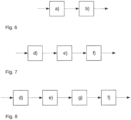
- step b) further comprises the following step and/or that the following step is carried out after step b): c) applying at least one adhesive layer of the at least one adhesive layer such that at least one adhesive layer of the at least one adhesive layer covers at least a first region of the overall lacquer layer at least partially or over its entire surface and/or does not cover a second region of the overall lacquer layer, in particular wherein at least a second region of the at least one second region does not overlap at least a first region of the at least one first region or at least partially or over its entire surface.
- the areas not covered by the adhesive layer are not decorated with the decorative film. This makes it possible to create negative lettering and/or negative patterns.
- At least a first region of the at least one first region and/or at least a second region of the at least one second region comprises at least one of the following design elements or a combination of the following design elements: alphanumeric character, character, symbol, micro-font, image, photo, logo, portrait, pictogram, pattern, in particular endless pattern, grid, in particular periodic grid, amplitude-modulated grid, dot grid, line grid, motif.
- step f) g) applying at least one adhesive layer to the decorative film in such a way that at least one adhesive layer of the at least one adhesive layer at least partially or completely covers at least a first region of the overall paint layer and/or does not cover at least a second region of the overall paint layer, in particular wherein at least a second region of the at least one second region does not overlap at least a first region of the at least one first region or at least partially or completely overlaps, and/or applying at least one adhesive layer to the target substrate in such a way that at least one adhesive layer of the at least one adhesive layer at least partially or completely covers at least a third region of the target substrate and/or does not cover at least a fourth region of the target substrate, in particular wherein at least a fourth region of the at least one fourth region does not overlap at least a third region of the at least one third region or at least partially or completely overlaps.
- the first and second regions are preferably located in a plane spanned by the entire lacquer layer.
- the spanned plane comprises at least one surface of the entire lacquer layer.
- the third and fourth regions are preferably located in a plane spanned by the target substrate. In this case, it is particularly provided that the spanned plane comprises at least one surface of the target substrate.
- the first and second regions can be arranged next to each other, spaced apart, partially overlapping and/or fully overlapping each other.
- the third and fourth regions can be arranged next to each other, spaced apart are arranged next to each other, partially overlapping and/or fully overlapping each other.
- At least a first and/or third region of the at least one first and/or third region and/or at least a second and/or fourth region of the at least one second and/or fourth region comprises at least one of the following design elements or a combination of the following design elements: alphanumeric character, character, symbol, micro-font, image, photo, logo, portrait, pictogram, pattern, in particular endless pattern, grid, in particular periodic grid, amplitude-modulated grid, dot grid, line grid, motif.
- At least one adhesive layer of the at least one adhesive layer in step g) is formed from a hot-melt adhesive, a thermoplastic adhesive, a cold adhesive, a radiation-curable adhesive, in particular an adhesive curable by means of electromagnetic radiation and/or electron radiation and/or by means of UV radiation, and/or an oxidatively curing adhesive and/or a low-migration adhesive.
- step g) at least one adhesive layer of the at least one adhesive layer is applied by means of gravure printing and/or screen printing and/or letterpress printing and/or pad printing and/or inkjet printing and/or offset printing and/or flexographic printing and/or casting techniques.
- At least a first and/or third region of the at least one first and/or third region is decorated by the overall lacquer layer and/or at least a second and/or fourth region of the at least one second and/or fourth region is not decorated by the overall lacquer layer.
- At least a first and/or third region of the at least one first and/or third region, which is at least partially or completely covered by the at least one adhesive layer of the at least one adhesive layer, is decorated by the overall lacquer layer.
- At least one color layer is applied to at least one surface of the overall paint layer after step f), so that the adhesive force between at least one color layer of the at least one color layer and the overall paint layer is at least 25 cN, preferably at least 30 cN.
- the total lacquer layer after step f) has an opacity when decorating a continuous solid surface of greater than or equal to 99.5%, preferably 100%, and a decoration or point perception when decorating a 10% halftone field of greater than or equal to 99.5%, preferably 100%.
- step f) Peeling off the carrier film from the overall lacquer layer, wherein the peeling angle between the carrier film and the overall lacquer layer is in a range from 0° to 120°, preferably from 0° to 90°.
- step f) and/or after step f) the following step is carried out: h) Pressing the decorative film with at least one pressing stamp and/or at least one pressing roller.
- At least one pressure stamp of the at least one pressure stamp and/or at least one pressure roller of the at least one pressure roller in step h) is designed as a heated surface and/or forming stamp and/or a heated roller is designed, wherein this/these activates at least one adhesive layer of the at least one adhesive layer at least partially and/or in at least one first and/or third region of the at least one first and/or third region and connects the decorative film to the target substrate.
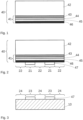
- the total lacquer layer 41 has a thickness in the range from 1.0 ⁇ m to 2.5 ⁇ m, in particular from 1.0 ⁇ m to 1.7 ⁇ m.
- the overall lacquer layer 41 comprises a release layer 43, a protective lacquer layer 44, a decorative layer 45 and a primer layer 46.
- the overall lacquer layer 41 has at least one release layer 43 and/or at least one protective lacquer layer 44 and/or at least one decorative layer 45 and/or at least one primer layer 46 and/or at least one adhesive layer 47 and/or at least one color layer.
- the ratio of the carrier film thickness to the total paint layer thickness is in a range from 1.8:1 to 7.0:1, preferably from 2.5:1 to 5.8:1, wherein the carrier film 42 has a thickness in a range from greater than or equal to 3 ⁇ m to less than or equal to 7 ⁇ m and/or that the ratio of the carrier film thickness to the total paint layer thickness is in a range from 4.1:1 to 10.0:1, preferably from 4.4:1 to 8.3:1, wherein the carrier film 42 has a thickness in a range from greater than or equal to 7 ⁇ m to less than or equal to 10 ⁇ m.
- the decorative film 40 has a transmittance for UV radiation in the wavelength range from 250 nm to 400 nm in the range from 5% to 70%, in particular from 10% to 40%.
- the carrier film 42 comprises a material or a combination of materials selected from: PET, PMMA, PC, PE, PVC, PS, ABS, PU PBS, PLA, PAN and/or glass.
- At least one release layer 43 of the at least one release layer 43 has a thickness in the range from 0.01 ⁇ m to 0.50 ⁇ m, preferably from 0.10 ⁇ m to 0.30 ⁇ m.
- At least one release layer 43 of the at least one release layer 43 comprises a material or a combination of materials selected from: Waxes, silicones, polyurethanes and/or polymers, preferably acrylate copolymer, polyester copolymer, polycarbonate copolymer, polystyrene copolymer.
- At least one release layer 43 of the at least one release layer 43 is transparent and/or translucent and/or opaque and/or colored and/or at least partially colored and/or crystal clear.
- the protective lacquer layer 44 is an optional layer which serves in particular to protect the decorative layer 45 from mechanical and/or chemical stress.
- the protective lacquer layer 44 is in particular a lacquer layer based on nitrocellulose and acrylate polymers, polyester copolymer, polycarbonate copolymer, polystyrene copolymer and/or SMA copolymers.
- At least one protective lacquer layer 44 of the at least one protective lacquer layer 44 has a thickness in the range from 0.5 ⁇ m to 3 ⁇ m, in particular from 0.8 ⁇ m to 1.3 ⁇ m.
- At least one protective lacquer layer 44 of the at least one protective lacquer layer 44 is transparent and/or translucent and/or opaque and/or colored and/or at least partially colored and/or crystal clear.
- At least one protective lacquer layer 44 of the at least one protective lacquer layer 44 comprises a material or a combination of materials selected from: polymers, in particular acrylate copolymers, polyester copolymers, polystyrene copolymers, polycarbonate copolymers, and/or SMA copolymers.
- the polymers in particular acrylate copolymers and/or SMA copolymers, polyester copolymers, polycarbonate copolymers, polystyrene copolymers or combinations thereof, of the total lacquer layer 41 have a molar mass in the range from 1000 g/mol to 100,000 g/mol, preferably from 3000 g/mol to 35,000 g/mol.
- At least one decorative layer 45 of the at least one decorative layer 45 comprises at least one metallic layer and/or at least one dielectric layer.
- At least one metallic layer of the at least one metallic layer comprises a material or a combination of materials selected from: aluminum, silver, gold, copper, nickel, chromium and/or an alloy comprising at least two of these metals.
- At least one dielectric layer of the at least one dielectric layer to comprise a material or a combination of materials selected from: metal oxide, polymer, lacquer and/or HRI material, in particular MgO, TiO n , Al 2 O 3 , ZnO, ZnS and/or SiO n , wherein the variable n is preferably in the range from greater than or equal to 0 to less than or equal to 3.
- At least one decorative layer 45 of the at least one decorative layer 45 has a thickness in the range from 8 nm to 500 nm, preferably from 8 nm to 60 nm, particularly preferably from 10 nm to 30 nm.
- at least one metallic layer of the at least one metallic layer has a thickness in the range from 8 nm to 60 nm, preferably from 10 nm to 30 nm. This layer thickness guarantees that a high permeability for UV radiation is achieved for at least one metallic layer of the at least one metallic layer.
- At least one decorative layer 45 of the at least one decorative layer 45 has at least one layer that generates an optically variable effect. This makes it possible to achieve particularly high-quality optical properties of the decorative film 40. It is also possible that these are security elements that are preferably forgery-proof.
- At least one decorative layer 45 of the at least one decorative layer 45 has at least one replication lacquer layer with a surface structure molded into at least one replication lacquer layer of the at least one replication lacquer layer, in particular selected from: diffractive surface structure, refractive surface structure, lens structure, matt structure and/or blaze grating.
- At least one decorative layer 45 of the at least one decorative layer 45 has at least one color layer formed in a pattern in the form of a second piece of information.
- At least one decorative layer 45 of the at least one decorative layer 45 has at least one thin-film layer element for generating a viewing angle-dependent color shift effect.
- At least one primer layer 46 of the at least one primer layer 46 has a thickness in the range from 0.1 ⁇ m to 2 ⁇ m, particularly preferably from 0.2 ⁇ m to 0.8 ⁇ m.
- At least one primer layer 46 of the at least one primer layer 46 is transparent and/or translucent and/or opaque and/or colored and/or at least partially colored and/or crystal clear.
- at least one primer layer 46 of the at least one primer layer 46 is at least partially colored and/or tinted, the advantage arises that the contrast to the target substrate 10 is increased and this creates a particularly high-quality optical impression or effect.
- At least one primer layer 46 of the at least one primer layer 46 has a surface roughness in the range from 100 nm to 200 nm, preferably from 120 nm to 160 nm.
- the overall paint layer 41 may comprise several primer layers 46 which differ in their chemical and/or physical properties, so that optimum adhesion is achieved with the adjacent layers.
- the overall paint layer 41 it is possible to achieve optimum adhesion towards at least one decorative layer 45 of the at least one decorative layer 45 on the one hand and on the other side to achieve optimal adhesion in the direction of at least one adhesive layer 47 of the at least one adhesive layer 47.
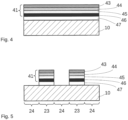
- the decorative film 40 has the same structure as in Fig. 1 shown, except that an adhesive layer 47 covers a surface of the overall lacquer layer 41 in the first regions 21 and does not cover it in the second regions 22.
- At least one adhesive layer 47 of the at least one adhesive layer 47 covers at least a first region 21 of the overall lacquer layer 41 at least partially or over its entire surface.
- At least one adhesive layer 47 of the at least one adhesive layer 47 does not cover at least a second region 22 of the overall lacquer layer 41, in particular wherein at least a second region 22 of the at least one second region 22 does not overlap at least a first region 21 of the at least one first region 21 or at least partially or completely overlaps.
- At least one adhesive layer 47 of the at least one adhesive layer 47 is formed from a hot melt adhesive and/or a thermoplastic adhesive and/or a cold adhesive and/or a radiation-curable adhesive, in particular an adhesive that can be cured by means of electromagnetic radiation and/or electron radiation and/or by means of UV radiation, and/or an oxidatively curing adhesive and/or a low-migration adhesive.
- At least one adhesive layer 47 of the at least one adhesive layer 47 completely covers at least one surface of the target substrate 10.
- a decorated target substrate in Fig. 4 in its sectional view.
- at least one adhesive layer 47 of the at least one adhesive layer 47 is arranged such that it completely covers a surface of the target substrate 10.
- the decorated target substrate comprises a total lacquer layer 41 of the decorative film 40, wherein the carrier 42 has already been removed from the decorative film 40.
- the carrier 42 it can also be provided that the carrier 42 remains on the decorative film 40.
- the release layer 43 is transferred to the target substrate 10 and does not remain or only partially remains on the carrier film 42. In an alternative embodiment not shown in detail, it is also possible for the release layer 43 to remain on the peeled-off carrier film 42 or for only very few areas of the release layer 43 to be transferred to the target substrate 10.
- At least a first and/or third region 21, 23 of the at least one first and/or third region 21, 23 is decorated by the overall lacquer layer 41 and/or at least a second and/or fourth region 22, 24 of the at least one second and/or fourth region 22, 24 is not decorated by the overall lacquer layer 41.
- the overall lacquer layer 41 has at least one color layer on at least one surface, wherein the adhesive force between at least one color layer of the at least one color layer and the overall lacquer layer 41 is at least 25 cN, preferably at least 30 cN.
- the total lacquer layer 41 in step b) prefferably has a thickness in the range from 1.0 ⁇ m to 2.5 ⁇ m, preferably from 1.0 ⁇ m to 1.7 ⁇ m.
- the ratio of the carrier film thickness to the total paint layer thickness is in a range from 1.8:1 to 7.0:1, preferably from 2.5:1 to 5.8:1, wherein the carrier film 42 has a thickness in a range from greater than or equal to 3 ⁇ m to less than or equal to 7 ⁇ m and/or that the ratio of the carrier film thickness to the total paint layer thickness is in a range from 4.1:1 to 10.0:1, preferably from 4.4:1 to 8.3:1, wherein the carrier film 42 has a thickness in a range from greater than or equal to 7 ⁇ m to less than or equal to 10 ⁇ m.
- the overall lacquer layer in step b) has at least one release layer 43 and/or at least one protective lacquer layer 44 and/or at least one decorative layer 45 and/or at least one primer layer 46 and/or at least one adhesive layer 47 and/or at least one color layer.
- the at least one adhesive layer 47 is applied as a hot melt adhesive, a thermoplastic adhesive, a cold adhesive, a radiation-curable adhesive, in particular an adhesive curable by means of electromagnetic radiation and/or electron radiation and/or by means of UV radiation, or an oxidatively curing adhesive and/or a low-migration adhesive. It is also possible for the adhesive layer 47 to be applied at least partially to a surface of the overall lacquer layer 41.
- step b) further comprises the following step and/or that the following step is carried out after step b): c) applying at least one adhesive layer 47 of the at least one adhesive layer 47 such that at least one adhesive layer 47 of the at least one adhesive layer 47 covers at least a first region 21 of the overall lacquer layer 41 at least partially or over its entire surface and/or does not cover a second region 22 of the overall lacquer layer 41, in particular wherein at least a second region 22 of the at least one second region 22 does not overlap at least a first region 21 of the at least one first region 21 or at least partially or over its entire surface.
- At least a first region 21 of the at least one first region 21 and/or at least a second region 22 of the at least one second region 22 comprises at least one of the following design elements or a combination of the following design elements: alphanumeric character, character, symbol, micro-font, image, photo, logo, portrait, pictogram, pattern, in particular endless pattern, grid, in particular periodic grid, amplitude-modulated grid, dot grid, line grid, motif.
- step f) g) applying at least one adhesive layer 47 to the decorative film 40 such that at least one adhesive layer 47 of the at least one adhesive layer 47 covers at least one first region 21 of the overall lacquer layer 41 at least partially or over its entire surface and/or does not cover at least one second region 22 of the overall lacquer layer 41, in particular wherein at least one second region 22 of the at least one second region 22 does not overlap at least one first region 21 of the at least one first region 21 or overlaps at least partially or over its entire surface, and/or applying at least one adhesive layer 47 to the target substrate 10 such that at least one adhesive layer 47 of the at least one adhesive layer 47 covers at least one third region 23 of the target substrate 10 at least partially or over its entire surface and/or does not cover at least one fourth region 24 of the target substrate 10, in particular wherein at least one fourth Region 24 of the at least one fourth region 24 does not overlap or at least partially or completely overlaps at least one third region 23 of
- At least a first and/or third region 21, 23 of the at least one first and/or third region 21, 23 and/or at least a second and/or fourth region 22, 24 of the at least one second and/or fourth region 22, 24 comprises at least one of the following design elements or a combination of the following design elements: alphanumeric character, character, symbol, micro-font, image, photo, logo, portrait, pictogram, pattern, in particular endless pattern, grid, in particular periodic grid, amplitude-modulated grid, dot grid, line grid, motif.
- At least one adhesive layer 47 of the at least one adhesive layer 47 in step g) is formed from a hot-melt adhesive, a thermoplastic adhesive, a cold adhesive, a radiation-curable adhesive, in particular an adhesive curable by means of electromagnetic radiation and/or electron radiation and/or by means of UV radiation, and/or an oxidatively curing adhesive and/or a low-migration adhesive.
- step g) at least one adhesive layer 47 of the at least one adhesive layer 47 is applied by means of gravure printing and/or screen printing and/or letterpress printing and/or pad printing and/or inkjet printing and/or offset printing and/or flexographic printing and/or casting techniques.
- At least one color layer is applied to at least one surface of the overall paint layer 41 after step f), so that the adhesive force between at least one color layer of the at least one color layer and the overall paint layer 41 is at least 25 cN, preferably at least 30 cN.
- the total lacquer layer 41 after step f) has an opacity when decorating a continuous solid area of greater than or equal to 99.5%, preferably 100%, and a decoration or point perception when decorating a 10% halftone field of greater than or equal to 99.5%, preferably 100%.
- step f) and/or after step f) the following step is carried out: h) Pressing the decorative film 40 with at least one pressing stamp and/or at least one pressing roller.
- At least one pressure stamp of the at least one pressure stamp and/or at least one pressure roller of the at least one pressure roller in step h) is designed as a heated surface and/or form stamp and/or a heated roller is designed, wherein this/these activates at least one adhesive layer 47 of the at least one adhesive layer 47 at least partially and/or in at least one first and/or third region 21, 23 of the at least one first and/or third region 21, 23 and connects the decorative film 40 to the target substrate 10.
- step f) peeling off the carrier film 42 from the overall lacquer layer 41, wherein the peeling angle between the carrier film 42 and the overall lacquer layer 41 is in a range from 0° to 120°, preferably from 0° to 90°.
- the surface or area to be decorated is decorated by detaching the entire lacquer layer 41 from the carrier film 42.
- the force required for this is referred to as the tearing force and is generally smaller than the initial tearing force, since the entire lacquer layer 41 does not have to be broken through.
- a low and homogeneous tearing force over the entire area to be decorated ensures high opacity and reduces the number of decoration defects.
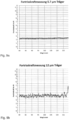
- Fig. 9a and 9b are examples of the force progressions of the tear force for a decorative film 40 according to the invention with a thickness of the carrier film 42 of 5.7 ⁇ m ( Fig. 9a ) and a decorative film 40 according to the state of the art ( Fig. 9b ) with a carrier film thickness of 12 ⁇ m, with the tear force in cN being given over the distance in mm.
- the two decorative films 40 tested have the identical layer structure and the identical material composition, except that the carrier film thicknesses are different.
- the carrier film 42 to be removed has a width of 13.5 mm and a length of 41 mm.
- the carrier film 42 is removed in the longitudinal direction at a speed of 100 mm/min.
- the average tear force for a decorative film 40 with a carrier film thickness of 5.7 ⁇ m is approximately 2.75 cN (see Fig. 9a ), whereas the mean The tear force for a decorative film 40 with a carrier film thickness of 12 ⁇ m is approximately 4.5 cN (see Fig. 9b ).
- the fluctuations in the force amplitude are for a decorative film 40 with a carrier film thickness of 5.7 ⁇ m ( Fig. 9a ) is lower than for a decorative film 40 with a carrier film thickness of 12 ⁇ m ( Fig. 9b ).
- the fluctuations in the force amplitude are less than ⁇ 0.5 cN for a decorative film 40 with a carrier film thickness of 5.7 ⁇ m, whereas for a decorative film 40 with a carrier film thickness of 12 ⁇ m, fluctuations in the force amplitude around the mean value of up to ⁇ 1 cN occur.
- both the absolute tear force for a decorative film 40 with a carrier film thickness of 5.7 ⁇ m is lower than for a decorative film 40 with a carrier film thickness of 12 ⁇ m, and the fluctuations in the force amplitude around its mean value for a decorative film 40 with a carrier film thickness of 5.7 ⁇ m are significantly lower than for a decorative film 40 with a carrier film thickness of 12 ⁇ m.
- the tear force behaves particularly homogeneously, resulting in improved decoration and improved opacity.
- a target substrate 10 is previously decorated with a decorative film 40 with a carrier film thickness of 5.7 ⁇ m (A) and a target substrate 10 is previously decorated with a decorative film 40 with a carrier film thickness of 12 ⁇ m (B) and after the adhesive layer 47 has hardened, the carrier film 42 is separated from the overall lacquer layer 41.
- this process is also carried out for several target substrates 10, in which the adhesive layer 47 is applied in a solid field, i.e. with a 100% surface coverage.
- a decorative film 40 with a carrier film thickness of 5.7 ⁇ m In the 10% grid, all 8240 adhesive dots are decorated by a decorative foil 40 with a carrier foil thickness of 5.7 ⁇ m, this is also the case in Fig. 10a In contrast, with a decorative film 40 with a carrier film thickness of 12 ⁇ m, only 62% of the adhesive dots are decorated, as in Fig. 10b Accordingly, a decorative film 40 with a carrier film thickness of 5.7 ⁇ m can be said to have a clean appearance or a high point perception. This is because 100% of the adhesive points are decorated and thus the entire paint layer 41 breaks optimally at the tear edge and/or at the tear edge.
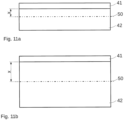
- Figures 11a and 11b where a neutral fiber 50 for a decorative film 40 with a carrier film thickness of 5.7 ⁇ m ( Fig. 11a ) and for a decorative film 40 with a carrier film thickness of 12 ⁇ m ( Fig. 11b ).
- the neutral fiber 50 runs along the geometric center plane or center line of the decorative film 40.
- the neutral fiber 50 is the fiber whose length does not change when twisted and/or bent, i.e. the neutral fiber 50 is not subject to any tensile or compressive stresses.
- the distance x from the neutral fiber to the overall paint layer 41 is also shown. The smaller the carrier film thickness of the decorative film 40, the smaller the distance x.
- the normal stress of the overall paint layer 41 is then reduced as a result of bending.
- the reduced normal stress of the overall paint layer 41 in the case of a decorative film 40 with a carrier film thickness in the range of 3 ⁇ m to 10 ⁇ m ensures that undefined and/or random local breaks in the overall paint layer 41 do not occur before the carrier film is detached. This allows a clean expression or a very high point perception to be achieved.
- the tear-away force exhibits fluctuations in the force amplitude around its mean value in a range from greater than or equal to -0.5 cN to less than or equal to 0.5 cN.
- the total lacquer layer 41 has an opacity when decorating a continuous solid surface of greater than or equal to 99.5%, preferably 100%, and a decoration or point perception when decorating a 10% halftone field of greater than or equal to 99.5%, preferably 100%.
- the tear force of the entire lacquer layer 41 from the carrier film 42 is in a range from 2 cN to 8 cN.
Landscapes
- Engineering & Computer Science (AREA)
- Manufacturing & Machinery (AREA)
- Wood Science & Technology (AREA)
- Life Sciences & Earth Sciences (AREA)
- Chemical & Material Sciences (AREA)
- Mechanical Engineering (AREA)
- Composite Materials (AREA)
- Health & Medical Sciences (AREA)
- Chemical Kinetics & Catalysis (AREA)
- General Chemical & Material Sciences (AREA)
- General Health & Medical Sciences (AREA)
- Toxicology (AREA)
- Laminated Bodies (AREA)
- Decoration By Transfer Pictures (AREA)
Applications Claiming Priority (3)
| Application Number | Priority Date | Filing Date | Title |
|---|---|---|---|
| DE102019132787.3A DE102019132787A1 (de) | 2019-12-03 | 2019-12-03 | Dekorfolie, Verfahren zur Herstellung einer Dekorfolie und Verfahren zur Dekoration eines Zielsubstrats |
| PCT/EP2020/082896 WO2021110439A2 (fr) | 2019-12-03 | 2020-11-20 | Film décoratif, procédé de fabrication d'un film décoratif et procédé de décoration d'un substrat cible |
| EP20811302.7A EP4069522B1 (fr) | 2019-12-03 | 2020-11-20 | Film décoratif, procédé de fabrication d'un film décoratif et procédé de décoration d'un substrat cible |
Related Parent Applications (2)
| Application Number | Title | Priority Date | Filing Date |
|---|---|---|---|
| EP20811302.7A Division EP4069522B1 (fr) | 2019-12-03 | 2020-11-20 | Film décoratif, procédé de fabrication d'un film décoratif et procédé de décoration d'un substrat cible |
| EP20811302.7A Division-Into EP4069522B1 (fr) | 2019-12-03 | 2020-11-20 | Film décoratif, procédé de fabrication d'un film décoratif et procédé de décoration d'un substrat cible |
Publications (2)
| Publication Number | Publication Date |
|---|---|
| EP4477427A2 true EP4477427A2 (fr) | 2024-12-18 |
| EP4477427A3 EP4477427A3 (fr) | 2024-12-25 |
Family
ID=73543274
Family Applications (2)
| Application Number | Title | Priority Date | Filing Date |
|---|---|---|---|
| EP20811302.7A Active EP4069522B1 (fr) | 2019-12-03 | 2020-11-20 | Film décoratif, procédé de fabrication d'un film décoratif et procédé de décoration d'un substrat cible |
| EP24209891.1A Pending EP4477427A3 (fr) | 2019-12-03 | 2020-11-20 | Feuille décorative, procédé de fabrication d'une feuille décorative et procédé de décoration d'un substrat cible |
Family Applications Before (1)
| Application Number | Title | Priority Date | Filing Date |
|---|---|---|---|
| EP20811302.7A Active EP4069522B1 (fr) | 2019-12-03 | 2020-11-20 | Film décoratif, procédé de fabrication d'un film décoratif et procédé de décoration d'un substrat cible |
Country Status (23)
| Country | Link |
|---|---|
| US (2) | US12220935B2 (fr) |
| EP (2) | EP4069522B1 (fr) |
| JP (2) | JP2023504508A (fr) |
| KR (1) | KR20220108140A (fr) |
| CN (2) | CN114746282B (fr) |
| AR (1) | AR120651A1 (fr) |
| AU (2) | AU2020397089A1 (fr) |
| CA (2) | CA3157974A1 (fr) |
| DE (1) | DE102019132787A1 (fr) |
| DK (1) | DK4069522T3 (fr) |
| ES (2) | ES2940586T3 (fr) |
| FI (1) | FI4069522T3 (fr) |
| HR (1) | HRP20241788T1 (fr) |
| HU (1) | HUE070570T2 (fr) |
| LT (1) | LT4069522T (fr) |
| MA (1) | MA68599B1 (fr) |
| MX (1) | MX2022006644A (fr) |
| PL (1) | PL4069522T3 (fr) |
| PT (1) | PT4069522T (fr) |
| RS (1) | RS66358B1 (fr) |
| SI (1) | SI4069522T1 (fr) |
| TW (2) | TWI878373B (fr) |
| WO (1) | WO2021110439A2 (fr) |
Families Citing this family (3)
| Publication number | Priority date | Publication date | Assignee | Title |
|---|---|---|---|---|
| DE102019132787A1 (de) | 2019-12-03 | 2021-06-10 | Leonhard Kurz Stiftung & Co. Kg | Dekorfolie, Verfahren zur Herstellung einer Dekorfolie und Verfahren zur Dekoration eines Zielsubstrats |
| TWI894712B (zh) * | 2023-11-29 | 2025-08-21 | 岱稜科技股份有限公司 | 複合膜、裝飾膜及目標基材的裝飾方法 |
| DE102024127058A1 (de) | 2024-09-19 | 2025-06-18 | Leonhard Kurz Stiftung & Co. Kg | Dekorfolie, Verfahren zur Herstellung einer Dekorfolie und Verfahren zur Dekoration eines Zielsubstrats |
Family Cites Families (38)
| Publication number | Priority date | Publication date | Assignee | Title |
|---|---|---|---|---|
| DE4311200A1 (de) | 1993-04-05 | 1994-10-06 | Zweckform Buero Prod Gmbh | Schmucketiketten und Verfahren zu ihrer Herstellung |
| DE4433858C1 (de) | 1994-09-22 | 1996-05-09 | Kurz Leonhard Fa | Übertragungsfolie |
| GB2299035B (en) | 1995-03-20 | 1998-06-03 | Whiley Foils Ltd | Hot-stamping foils |
| DE20209576U1 (de) | 2002-06-20 | 2002-08-29 | Leonhard Kurz GmbH & Co. KG, 90763 Fürth | Dekorationselement mit erhöhtem UV- und Abriebschutz |
| DE10227430B4 (de) | 2002-06-20 | 2009-04-16 | Leonhard Kurz Gmbh & Co. Kg | Heißprägefolie mit erhöhtem UV- und Abriebschutz sowie deren Verwendung zum Prägen |
| US6909444B2 (en) | 2002-09-09 | 2005-06-21 | Dai Nippon Printing Co., Ltd. | Transfer ribbon, image expressing medium and method for production of them |
| DE102004017093B4 (de) * | 2004-04-07 | 2007-09-20 | Leonhard Kurz Gmbh & Co. Kg | Prägefolie zur Herstellung fälschungssicherer Kraftfahrzeug-Nummernschilder und fälschungssicheres Kraftfahrzeug-Nummernschild mit einer solchen Prägefolie sowie Verwendung |
| EP1886837A4 (fr) | 2005-03-11 | 2011-04-27 | Dainippon Printing Co Ltd | Pellicule de transfert et matiere de formation d'image utilisant cette pellicule |
| WO2007048563A2 (fr) | 2005-10-27 | 2007-05-03 | Ovd Kinegram Ag | Procede de transfert d'un corps multicouche et feuille de transfert |
| AU2006327567B2 (en) | 2005-12-01 | 2012-12-20 | Arrow Coated Products Ltd. | Method of producing a high security film and high security film produced by the said method |
| CN101049773B (zh) | 2006-08-17 | 2011-01-05 | 杭州兴甬复合材料有限公司 | 一种热烫印膜 |
| DE102008003629A1 (de) * | 2008-01-09 | 2009-07-23 | Ls Industrielacke Gmbh | Thermische Transferfolie und Verfahren zur lösungsmittelfreien Lackierung |
| DE102008047095A1 (de) * | 2008-09-12 | 2010-03-18 | Leonhard Kurz Stiftung & Co. Kg | Transferfolie zur Verwendung in einem Kaltfolientransferverfahren |
| DE102008062149B3 (de) | 2008-12-16 | 2010-04-29 | Ovd Kinegram Ag | Verfahren zur Herstellung eines Sicherheitselements sowie Transferfolie |
| CN202271680U (zh) | 2011-09-30 | 2012-06-13 | 绍兴虎彩激光材料科技有限公司 | 一种冷烫膜 |
| MY175082A (en) | 2012-01-19 | 2020-06-04 | Bayer Ip Gmbh | Plastic film for printing by dye diffusion thermal transfer printing |
| EP2977221B1 (fr) | 2012-02-29 | 2020-02-19 | Dai Nippon Printing Co., Ltd. | Support de transfert intermédiaire |
| DE102012112556B4 (de) | 2012-12-18 | 2018-09-27 | Isimat Gmbh Siebdruckmaschinen | Verfahren und Vorrichtung zum Kaltprägen auf dreidimensionale Gegenstände |
| DE102014118365A1 (de) | 2014-12-10 | 2016-06-16 | Leonhard Kurz Stiftung & Co. Kg | Absorptionsmedium, Transferfolie, Sicherheitselement und Verfahren zum Individualisieren eines Sicherheitselements |
| HUE059600T2 (hu) | 2015-03-23 | 2022-11-28 | Leonhard Kurz Stiftung & Co Kg | Eljárás és berendezés egy fólia alkalmazására |
| JP6693519B2 (ja) * | 2015-06-15 | 2020-05-13 | 王子ホールディングス株式会社 | 加飾用積層体 |
| KR102255602B1 (ko) * | 2015-06-15 | 2021-05-24 | 오지 홀딩스 가부시키가이샤 | 점착 필름, 적층체 및 가식 성형체 |
| DE102015109642A1 (de) | 2015-06-17 | 2016-12-22 | Leonhard Kurz Stiftung & Co. Kg | Folie, Verfahren zum Dekorieren eines Gegenstands und Gegenstand |
| CN104999823B (zh) * | 2015-08-04 | 2017-11-21 | 任福海 | 一种具有金属爆裂效果的烫金膜及其制作工艺 |
| DE102015112909B3 (de) | 2015-08-05 | 2017-02-09 | Leonhard Kurz Stiftung & Co. Kg | Verfahren und Vorrichtung zum Herstellen einer Mehrschichtfolie |
| CN107949487B (zh) * | 2015-09-28 | 2020-12-11 | 大日本印刷株式会社 | 转印箔 |
| DE102015121849A1 (de) * | 2015-12-15 | 2017-06-22 | Ovd Kinegram Ag | Verfahren zur Herstellung eines Sicherheitselements sowie Transferfolie |
| CN205364877U (zh) | 2016-01-19 | 2016-07-06 | 扬州市祥华新材料科技有限公司 | 一种高光泽电化铝烫金箔 |
| CN205836293U (zh) | 2016-06-12 | 2016-12-28 | 扬州市祥华新材料科技有限公司 | 一种抗氧化烫印箔 |
| DE202016105566U1 (de) * | 2016-10-06 | 2016-10-21 | Lisa Dräxlmaier GmbH | Geprägtes Faserdekor für ein Kraftfahrzeug |
| DE102017101595B3 (de) | 2017-01-27 | 2018-05-30 | Leonhard Kurz Stiftung & Co. Kg | Transferfolie, deren Verwendung und Verfahren zur Herstellung einer Transferfolie sowie Verfahren zur Herstellung eines mit einer Transferlage einer Transferfolie dekorierten Spritzgussartikels |
| DE102017110387A1 (de) | 2017-05-12 | 2018-11-15 | Leonhard Kurz Stiftung & Co. Kg | Thermotransferfolie zur Herstellung eines Echtfarbenbildes sowie Verfahren zur Herstellung eines Echtfarbenbildes und Echtfarbenbild |
| DE102017118904A1 (de) | 2017-08-18 | 2019-02-21 | Leonhard Kurz Stiftung & Co. Kg | Transferfolie, Verfahren zur Herstellung eines folienbeschichteten Artikels und folienbeschichteter Artikel |
| CN208754626U (zh) * | 2018-07-25 | 2019-04-16 | 深圳市弘海电子材料技术有限公司 | 一种新型的fpc用复合型电磁屏蔽膜 |
| DE102018123473A1 (de) | 2018-09-24 | 2020-03-26 | Leonhard Kurz Stiftung & Co. Kg | Dekorfolie, Transferfolie, Verwendung einer Transferfolie, Verfahren zur Herstellung einer Transferfolie, Verfahren zum Dekorieren eines Kunststoffformteils sowie Kunststoffformteil |
| TWI843761B (zh) | 2018-11-12 | 2024-06-01 | 德商利昂哈德 庫爾茲公司 | 元件製造方法及射出成型裝置 |
| DE102018128194A1 (de) * | 2018-11-12 | 2020-05-14 | Leonhard Kurz Stiftung & Co. Kg | Verfahren zur Herstellung eines Bauteils sowie Spritzgießvorrichtung |
| DE102019132787A1 (de) | 2019-12-03 | 2021-06-10 | Leonhard Kurz Stiftung & Co. Kg | Dekorfolie, Verfahren zur Herstellung einer Dekorfolie und Verfahren zur Dekoration eines Zielsubstrats |
-
2019
- 2019-12-03 DE DE102019132787.3A patent/DE102019132787A1/de active Pending
-
2020
- 2020-11-04 TW TW109138443A patent/TWI878373B/zh active
- 2020-11-04 TW TW114106718A patent/TWI887189B/zh active
- 2020-11-20 DK DK20811302.7T patent/DK4069522T3/da active
- 2020-11-20 CA CA3157974A patent/CA3157974A1/fr active Pending
- 2020-11-20 PL PL20811302.7T patent/PL4069522T3/pl unknown
- 2020-11-20 WO PCT/EP2020/082896 patent/WO2021110439A2/fr not_active Ceased
- 2020-11-20 HR HRP20241788TT patent/HRP20241788T1/hr unknown
- 2020-11-20 JP JP2022533060A patent/JP2023504508A/ja active Pending
- 2020-11-20 KR KR1020227022640A patent/KR20220108140A/ko active Pending
- 2020-11-20 ES ES20811302T patent/ES2940586T3/es active Active
- 2020-11-20 CN CN202080083959.XA patent/CN114746282B/zh active Active
- 2020-11-20 MA MA68599A patent/MA68599B1/fr unknown
- 2020-11-20 EP EP20811302.7A patent/EP4069522B1/fr active Active
- 2020-11-20 HU HUE20811302A patent/HUE070570T2/hu unknown
- 2020-11-20 PT PT208113027T patent/PT4069522T/pt unknown
- 2020-11-20 RS RS20241429A patent/RS66358B1/sr unknown
- 2020-11-20 US US17/780,090 patent/US12220935B2/en active Active
- 2020-11-20 SI SI202030548T patent/SI4069522T1/sl unknown
- 2020-11-20 AU AU2020397089A patent/AU2020397089A1/en active Pending
- 2020-11-20 CN CN202510186183.9A patent/CN120039058A/zh active Pending
- 2020-11-20 MX MX2022006644A patent/MX2022006644A/es unknown
- 2020-11-20 LT LTEP3599522T patent/LT4069522T/lt unknown
- 2020-11-20 FI FIEP20811302.7T patent/FI4069522T3/fi active
- 2020-11-20 EP EP24209891.1A patent/EP4477427A3/fr active Pending
- 2020-11-20 ES ES24209891T patent/ES3015533T1/es active Pending
- 2020-11-20 CA CA3291544A patent/CA3291544A1/en active Pending
- 2020-12-01 AR ARP200103340A patent/AR120651A1/es active IP Right Grant
-
2024
- 2024-12-10 US US18/975,116 patent/US20250100316A1/en active Pending
-
2025
- 2025-08-14 JP JP2025134961A patent/JP2025159130A/ja active Pending
- 2025-09-30 AU AU2025242129A patent/AU2025242129A1/en active Pending
Also Published As
Similar Documents
| Publication | Publication Date | Title |
|---|---|---|
| EP2938496B1 (fr) | Procédé et dispositif d'estampage à froid sur des objets tridimensionnels | |
| EP1440133B1 (fr) | Procede pour fabriquer une pellicule pouvant etre marquee au laser | |
| EP0330733B1 (fr) | Elément de sécurité en forme de fil ou de bande destiné à être incorporé dans un document de sécurité et procédé pour sa fabrication | |
| EP4069522B1 (fr) | Film décoratif, procédé de fabrication d'un film décoratif et procédé de décoration d'un substrat cible | |
| EP1972463A2 (fr) | Elément de sécurité | |
| DE102014001688A1 (de) | Herstellung eines Sicherheitselements mit Farbänderungseigenschaften | |
| DE102011102999A1 (de) | Folie und deren Herstellungsverfahren | |
| EP2941355B1 (fr) | Procédé de réalisation d'un élément de sécurité comprenant une couche d'enregistrement sensible au rayonnement laser | |
| DE102012105854A1 (de) | Verfahren und Vorrichtung zum Versehen eines Substrats mit einem Aufdruck, sowie mit Aufdruck versehenes Substrat | |
| DE3906695C2 (fr) | ||
| DE102018005697A1 (de) | Sicherheitselement mit Linsenrasterbild | |
| EP3747666B1 (fr) | Procédé de gaufrage à froid | |
| WO2001059745A1 (fr) | Etiquette munie d'une inscription effectuee par faisceau laser, procede et dispositif permettant de la produire | |
| EP2988154B1 (fr) | Procede de fabrication d'un element optique et element optique | |
| DE102024127058A1 (de) | Dekorfolie, Verfahren zur Herstellung einer Dekorfolie und Verfahren zur Dekoration eines Zielsubstrats | |
| DE10326501B4 (de) | Laserstrahlbeschriftbares mehrschichtiges Etikettenmaterial | |
| EP1584647B1 (fr) | Matériau en feuille ayant des caractéristiques optiques | |
| WO2008043351A1 (fr) | Procédé de préparation pour hologramme et documents présentant un hologramme | |
| EP2276637B1 (fr) | Procédé de fabrication d'une feuille pouvant être marquée au laser en plusieurs couleurs | |
| DE4411404B4 (de) | Schichtverbund zum Übertragen von optisch variablen Einzelelementen auf zu sichernde Gegenstände, Sicherheitsdokument und ein Verfahren zur Herstellung eines Schichtverbunds | |
| DE102018128608A1 (de) | Folienverbund zur Beschichtung einer Kennzeichenplatine sowie Kennzeichenplatine, Verfahren und Vorrichtung zu deren Herstellung | |
| DE102016009437A1 (de) | Sicherheitselement und Verfahren zur Herstellung eines Sicherheitselements | |
| EP2276636A1 (fr) | Procédé de fabrication d'une feuille pouvant être marquée au laser présentant un éclat superficiel métallique | |
| DE102024109645A1 (de) | Sicherheitselement mit verschiedenfarbigen Teilbereichen, Wertdokument und Herstellungsverfahren | |
| DE112005003280T5 (de) | Verglasung |
Legal Events
| Date | Code | Title | Description |
|---|---|---|---|
| PUAI | Public reference made under article 153(3) epc to a published international application that has entered the european phase |
Free format text: ORIGINAL CODE: 0009012 |
|
| STAA | Information on the status of an ep patent application or granted ep patent |
Free format text: STATUS: REQUEST FOR EXAMINATION WAS MADE |
|
| REG | Reference to a national code |
Ref country code: DE Ref legal event code: R079 Free format text: PREVIOUS MAIN CLASS: B42D0025460000 Ipc: B42D0025425000 |
|
| PUAL | Search report despatched |
Free format text: ORIGINAL CODE: 0009013 |
|
| 17P | Request for examination filed |
Effective date: 20241030 |
|
| AC | Divisional application: reference to earlier application |
Ref document number: 4069522 Country of ref document: EP Kind code of ref document: P |
|
| AK | Designated contracting states |
Kind code of ref document: A2 Designated state(s): AL AT BE BG CH CY CZ DE DK EE ES FI FR GB GR HR HU IE IS IT LI LT LU LV MC MK MT NL NO PL PT RO RS SE SI SK SM TR |
|
| AK | Designated contracting states |
Kind code of ref document: A3 Designated state(s): AL AT BE BG CH CY CZ DE DK EE ES FI FR GB GR HR HU IE IS IT LI LT LU LV MC MK MT NL NO PL PT RO RS SE SI SK SM TR |
|
| RIC1 | Information provided on ipc code assigned before grant |
Ipc: B42D 25/46 20140101ALI20241120BHEP Ipc: B42D 25/425 20140101AFI20241120BHEP |
|
| REG | Reference to a national code |
Ref country code: ES Ref legal event code: BA2A Ref document number: 3015533 Country of ref document: ES Kind code of ref document: T1 Effective date: 20250509 |
|
| STAA | Information on the status of an ep patent application or granted ep patent |
Free format text: STATUS: EXAMINATION IS IN PROGRESS |
|
| 17Q | First examination report despatched |
Effective date: 20260327 |