EP4480444A2 - Dispositif de retenue pour une ébauche dentaire - Google Patents
Dispositif de retenue pour une ébauche dentaire Download PDFInfo
- Publication number
- EP4480444A2 EP4480444A2 EP24211110.2A EP24211110A EP4480444A2 EP 4480444 A2 EP4480444 A2 EP 4480444A2 EP 24211110 A EP24211110 A EP 24211110A EP 4480444 A2 EP4480444 A2 EP 4480444A2
- Authority
- EP
- European Patent Office
- Prior art keywords
- holding device
- ring element
- adhesive
- dental blank
- adhesive gap
- Prior art date
- Legal status (The legal status is an assumption and is not a legal conclusion. Google has not performed a legal analysis and makes no representation as to the accuracy of the status listed.)
- Pending
Links
Images



Classifications
-
- B—PERFORMING OPERATIONS; TRANSPORTING
- B23—MACHINE TOOLS; METAL-WORKING NOT OTHERWISE PROVIDED FOR
- B23Q—DETAILS, COMPONENTS, OR ACCESSORIES FOR MACHINE TOOLS, e.g. ARRANGEMENTS FOR COPYING OR CONTROLLING; MACHINE TOOLS IN GENERAL CHARACTERISED BY THE CONSTRUCTION OF PARTICULAR DETAILS OR COMPONENTS; COMBINATIONS OR ASSOCIATIONS OF METAL-WORKING MACHINES, NOT DIRECTED TO A PARTICULAR RESULT
- B23Q3/00—Devices holding, supporting, or positioning work or tools, of a kind normally removable from the machine
- B23Q3/02—Devices holding, supporting, or positioning work or tools, of a kind normally removable from the machine for mounting on a work-table, tool-slide, or analogous part
- B23Q3/06—Work-clamping means
- B23Q3/062—Work-clamping means adapted for holding workpieces having a special form or being made from a special material
-
- B—PERFORMING OPERATIONS; TRANSPORTING
- B23—MACHINE TOOLS; METAL-WORKING NOT OTHERWISE PROVIDED FOR
- B23C—MILLING
- B23C3/00—Milling particular work; Special milling operations; Machines therefor
-
- B—PERFORMING OPERATIONS; TRANSPORTING
- B23—MACHINE TOOLS; METAL-WORKING NOT OTHERWISE PROVIDED FOR
- B23Q—DETAILS, COMPONENTS, OR ACCESSORIES FOR MACHINE TOOLS, e.g. ARRANGEMENTS FOR COPYING OR CONTROLLING; MACHINE TOOLS IN GENERAL CHARACTERISED BY THE CONSTRUCTION OF PARTICULAR DETAILS OR COMPONENTS; COMBINATIONS OR ASSOCIATIONS OF METAL-WORKING MACHINES, NOT DIRECTED TO A PARTICULAR RESULT
- B23Q3/00—Devices holding, supporting, or positioning work or tools, of a kind normally removable from the machine
- B23Q3/02—Devices holding, supporting, or positioning work or tools, of a kind normally removable from the machine for mounting on a work-table, tool-slide, or analogous part
- B23Q3/06—Work-clamping means
-
- B—PERFORMING OPERATIONS; TRANSPORTING
- B23—MACHINE TOOLS; METAL-WORKING NOT OTHERWISE PROVIDED FOR
- B23Q—DETAILS, COMPONENTS, OR ACCESSORIES FOR MACHINE TOOLS, e.g. ARRANGEMENTS FOR COPYING OR CONTROLLING; MACHINE TOOLS IN GENERAL CHARACTERISED BY THE CONSTRUCTION OF PARTICULAR DETAILS OR COMPONENTS; COMBINATIONS OR ASSOCIATIONS OF METAL-WORKING MACHINES, NOT DIRECTED TO A PARTICULAR RESULT
- B23Q3/00—Devices holding, supporting, or positioning work or tools, of a kind normally removable from the machine
- B23Q3/02—Devices holding, supporting, or positioning work or tools, of a kind normally removable from the machine for mounting on a work-table, tool-slide, or analogous part
- B23Q3/06—Work-clamping means
- B23Q3/08—Work-clamping means other than mechanically-actuated
- B23Q3/084—Work-clamping means other than mechanically-actuated using adhesive means
-
- B—PERFORMING OPERATIONS; TRANSPORTING
- B25—HAND TOOLS; PORTABLE POWER-DRIVEN TOOLS; MANIPULATORS
- B25B—TOOLS OR BENCH DEVICES NOT OTHERWISE PROVIDED FOR, FOR FASTENING, CONNECTING, DISENGAGING, OR HOLDING
- B25B11/00—Work holders not covered by any preceding group in the subclass, e.g. magnetic work holders, vacuum work holders
-
- A—HUMAN NECESSITIES
- A61—MEDICAL OR VETERINARY SCIENCE; HYGIENE
- A61C—DENTISTRY; APPARATUS OR METHODS FOR ORAL OR DENTAL HYGIENE
- A61C13/00—Dental prostheses; Making same
- A61C13/0003—Making bridge-work, inlays, implants or the like
- A61C13/0022—Blanks or green, unfinished dental restoration parts
-
- A—HUMAN NECESSITIES
- A61—MEDICAL OR VETERINARY SCIENCE; HYGIENE
- A61C—DENTISTRY; APPARATUS OR METHODS FOR ORAL OR DENTAL HYGIENE
- A61C3/00—Dental tools or instruments
Definitions
- the present invention relates to a holding device for a round dental blank and a method for clamping a round dental blank.
- Dental blanks for the manufacture of dental objects in dental manufacturing equipment often have manufacturing-related tolerances.
- the diameter of circular or round dental blanks can vary. If these are arranged in conventional holding devices, they have play. This leads to inaccuracies when manufacturing dental objects, for example using a milling process.
- chipping can occur on the peripheral notch.
- the technical problem is solved by a holding device for a round dental blank, with an open ring element for laterally gripping the Dental blank; and a closing element for closing the ring element in several positions.
- the holding device has the technical advantage that dental blanks with different diameters can also be securely fastened in the holding device, since the ring element can always be closed under tension. If the circumference of the dental blank is larger, the closing element is closed in a wider position and if the circumference of the dental blank is smaller, the closing element is closed in a narrower position. This means that dental blanks with manufacturing tolerances can also be pre-tensioned and fastened without play.
- the holding device can adapt to the different diameters of the dental blanks.
- the closing element comprises a tongue and a recess for inserting or locking the tongue.
- the tongue can have locking elements that engage in larger locking geometries on the opposite side of the ring element.
- the larger locking geometries can also compensate for the manufacturing tolerances.
- the circumference of the ring element can be continuously changed in the range of the length of the tongue or the depth of the recess.
- the recess or tongue can also be designed with positive or negative locking geometries that engage in corresponding opposing locking geometries.
- the tongue or the recess comprises one or more locking geometries.
- the locking geometries can comprise welding ribs, for example. This For example, the technical advantage is achieved that the tongue can be effectively welded to the recess.
- one end of the ring element comprises a first clamping geometry for engaging a first mandrel and the other end of the ring element comprises a second clamping geometry for engaging a second mandrel.
- the clamping geometries can be formed as recesses into which the respective mandrel can be inserted. This achieves the technical advantage, for example, that the ring element can be closed with a high tension and can be subjected to a preload.
- the ring element comprises an adhesive gap for inserting an adhesive or a fastening gap.
- the adhesive gap or the fastening gap can be arranged between an upper peripheral edge and a lower peripheral edge of the ring element.
- the adhesive can be arranged in the adhesive gap in advance, during injection molding of the holding device.
- the holding points and/or support feet can penetrate the material in a pointed design and thereby improve the hold. In the case of hard dental blanks, these can be deformed or squashed without penetrating the material of the dental blank.
- the fastening of the holding device can be improved by means of the holding points and/or support feet. This achieves the technical advantage, for example, that the holder of the dental blank is additionally stabilized. This is also advantageous in the case of temperature fluctuations that occur during Transport to different climate zones. This allows the different thermal expansion coefficients of the materials to be compensated for when temperatures fluctuate.
- the adhesive gap comprises at least one circumferential excess recess for receiving the excess adhesive. This achieves the technical advantage, for example, that the liquid adhesive cannot ooze out of the adhesive gap.
- the adhesive gap comprises a first circumferential excess trough which runs adjacent to an upper circumferential edge and a second circumferential excess trough which runs adjacent to a lower circumferential edge.
- the adhesive gap comprises several protruding holding points. This achieves the technical advantage, for example, that a temporary fastening of the dental blank can be achieved before the adhesive has hardened.
- the holding points are distributed along the adhesive gap and/or are arranged in the middle of the adhesive gap. This achieves the technical advantage that a high pressure is applied to the circumference of the dental blank, thereby improving the fixation of the dental blank.
- the adhesive gap comprises several protruding support feet. This achieves the technical advantage, for example, of achieving better adhesion. As adhesive gap thinners, the support feet increase the adhesive surface and create greater rigidity.
- the support feet are distributed along the adhesive gap and/or arranged in pairs. This achieves the technical advantage, for example, of achieving even better adhesion.
- the ring element has a joint notch on its outer circumference. This achieves the technical advantage that it can be expanded and easily arranged around the dental blank. In addition, a defined expansion or opening is made possible.
- the joint notch is arranged opposite the closing element. This achieves the technical advantage that the ring element can be opened wide.
- the joint notch can also make the ring element elastic in the longitudinal direction. In this case, the ring element always rests against the dental blank.
- the ring element comprises at least one Edge protection element for gripping an edge of the dental blank. This provides the technical advantage that damage to the edges of the dental blank can be prevented.
- the technical problem is solved by a method for clamping a round dental blank with a holding device according to the first aspect.
- the method achieves the same technical advantages as the holding device.
- Fig. 1 shows a view of a holding device 100 for a round dental blank 200.
- the round dental blank can be a circular disk-shaped, a cylindrical or an oval Dental blank 200.
- the holding device is suitable for all forms of dental blanks that can be enclosed by means of the ring element 101.
- the holding device 100 comprises an open, belt-shaped ring element 101 for laterally gripping the dental blank 200.
- the edge of the ring element 101 can be rounded at the top and bottom.
- the holding device 100 comprises a closing element 103 for closing the ring element 101 at several positions.
- the holding device 100 is made of plastic, such as polyamide (PA12).
- the dental blank 200 is a circular disk-shaped blank, such as made of zirconium, from which dental objects can be milled.
- the ring element 101 By closing the ring element 101 at different positions, it can be ensured that the ring element 101 is always tensioned around the dental blank 200 with sufficient pre-tension. For smaller dental blanks 200, the ring element 101 is closed at a narrower position. For larger dental blanks 200, the ring element 101 is closed at a wider position.
- the ring element 101 comprises an adhesive gap 111 along its length, into which a liquid adhesive is introduced.
- the adhesive additionally connects the holding device 100 to the dental blank 200.
- the adhesive gap 111 additionally comprises tapered and protruding holding points 117, which rest on the side surface of the dental blank 200.
- a liquid polymer that hardens with atmospheric moisture can be used as the adhesive.
- a fastening gap 111 can also be provided, which increases the elasticity of the ring element 101 and serves to fasten the holding device 100.
- the adhesive gap or the fastening gap 111 comprises Support feet 119, which are arranged at the same height as the outer walls of the ring element 101.
- the elongated support feet 119 ensure optimized adhesion. As adhesive gap thinners, the support feet 119 increase the adhesive surface and create greater rigidity of the ring element 101. The support feet 119 can achieve immediate adhesion as quickly as possible.
- Fig. 2 shows a cross-sectional view through the holding device 100.
- the adhesive gap 111 for receiving the adhesive runs between an upper peripheral edge 113-1 and a lower peripheral edge 113-2 of the ring element 101.
- the adhesive gap 111 has, for example, a depth of 0.2 mm and is arranged in the middle of the ring element 101.
- the surface of the adhesive gap 111 can be roughened so that the adhesive adheres better. This can be achieved by a sandblasted surface of an injection-molded workpiece.
- An upper circumferential excess trough 115-1 runs adjacent to an upper circumferential edge 113-1 and a lower circumferential excess trough 115-2 runs adjacent to a lower circumferential edge 113-1.
- the excess troughs 115-1 and 115-2 absorb excess adhesive so that it cannot escape from the adhesive gap 111.
- the excess trough has a depth of 0.4 mm, for example, and is therefore 0.2 mm lower than the adhesive gap 111.
- the ring element 101 preferably comprises tapered holding points 117 in the middle of the adhesive gap 111.
- the holding points 117 prevent the holding device 100 from slipping until the adhesive has hardened.
- the Retaining points 117 are distributed along the adhesive gap 111 and have, for example, a projection of 0.1 mm.
- the retaining points 117 are pressed and deformed or penetrate into the dental blank 200. In this way, they are subjected to a pre-tension.
- the retaining points 117 prevent slipping during subsequent processing steps, such as printing, labeling or packaging.
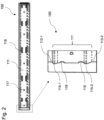
- Fig. 3 shows several views of a closing element 103. Elevations and depressions interlock.
- the ring element 101 has an opening with which the holding device 100 can be attached to the dental blank 200.
- the ring element 101 To close the ring element 101, it comprises a closing element 103 which is provided with an overlap at which the two ends of the ring element can be welded together.
- the overlap is formed by a tongue 105 which is arranged at one end of the ring element 101 and a recess 107 for inserting the tongue 105 which is arranged at another end of the ring element 101.
- the tongue 105 can be continuously pushed into the recess 107.
- the holder device 100 can be continuously closed in numerous positions and thus adapt to the diameter of the dental blank 200. Depending on the position, a different inner diameter of the holder device 100 is achieved.
- the ring element 101 can be attached to the dental blank 200 not only by gluing but also by shrinking, ie without glue.
- the holder device 100 can be fixed by gluing and/or shrinking.
- the overlap on the tongue 105 and the recess 107 has raised welding ribs 109.
- the elongated welding ribs extend in the insertion direction of the tongue 105 and the recess 107.
- the welding ribs as a possible closure geometry 109 create defined contact areas between the tongue 105 and the recess 109, where the material can be melted in a targeted manner using an ultrasonic welding process in order to connect the two ends of the ring element 101 to one another.
- the closing element can also be closed using hot stamping or quick gluing.
- the overlap by the closing element 103 is designed in such a way that it is possible to wrap around dental blanks 200 with different diameters.
- the overlap during welding is, for example, 4 to 6 mm.
- small dental blanks 200 can have a front gap of 1 mm on the welding side and large dental blanks 200 can have a front gap of 4 mm.
- two additional overlaps can be added at the welding point.
- Fig. 4 shows a view of a joint notch 121.
- the joint notch 121 is formed by a V-shaped recess in the ring element 101 and enables the ring element to bend like a joint. This allows the ring element 101 to be opened and placed around the dental blank 200.
- the joint notch 121 enables the ring element 101 to expand in a defined manner.
- the joint notch 121 is arranged opposite the closing element 103.
- Fig. 5 shows a cross-sectional view through the holding device 100.
- the holding device 100 comprises a Edge protection element 123 for protecting or enclosing an edge 125 of the dental blank 200.
- the angled or straight edge protection element 123 extends from the ring element 101.
- Fig. 6 shows a view of a closing device 300 for closing a closing element 103 with a tongue 105.
- the adhesive is applied radially to the dental blank 200 by means of an application device before the ring element 101 is attached.
- the dental blank 200 rotates and the adhesive is applied.
- the advantage is that the adhesive does not come into contact with the user after the ring element 101 has been attached. Furthermore, no adhesive feed channels are necessary.
- the closing device 300 has a system for pressing the ring element 101.
- the system clamps the ring element 101 onto the dental blank 200 with a force.
- the closing device 300 can apply a defined force to the ring element 101 via a cylinder and a reinforcing spring.
- one end of the ring element 101 comprises a first clamping geometry 127-1 for engaging a first clamping mandrel 129-1 and the other end of the ring element 101 comprises a second clamping geometry 127-2 for engaging a second clamping mandrel 129-2.
- the clamping geometries 127-1 and 127-2 are formed, for example, as recesses or depressions in the ring element 101.
- the ring preload can be precisely adjusted using the clamping geometries 127-1 and 127-2.
- the clamping geometries 127-1 and 127-2 can be arranged in different configurations, such as square, rectangular, round, or oval, at a suitable location radially around the ring element 101 or at the edges of the ring element 101.
- the clamping geometries 127-1 and 127-2 can be used to pull the Ring element 101 so that it can be closed with a preload.
- the preload can be achieved precisely by applying compressed air pressure to the cylinder of the preload device.
- the preload force can be measured using a load cell.
- the preload of the ring element 101 can be applied to different degrees.
- the overlapping closing element 103 is closed by means of ultrasonic welding, hot stamping or quick-drying adhesive.
- an ultrasonic welding head 131 is pressed onto the closing element 103. This heats and fuses the closing element 103.
- the welding is not visible from the outside.
- the adhesion of the welding can be achieved with simple welding parameters and is above the required adhesion.
- An overlap occurs at the welding point so that the dental blank 200 cannot be seen from the front.
- All method steps can be implemented by devices suitable for carrying out the respective method step. All functions performed by material features can be a method step of a method.
Landscapes
- Engineering & Computer Science (AREA)
- Mechanical Engineering (AREA)
- Health & Medical Sciences (AREA)
- Life Sciences & Earth Sciences (AREA)
- Dentistry (AREA)
- Epidemiology (AREA)
- Oral & Maxillofacial Surgery (AREA)
- Animal Behavior & Ethology (AREA)
- General Health & Medical Sciences (AREA)
- Public Health (AREA)
- Veterinary Medicine (AREA)
- Dental Tools And Instruments Or Auxiliary Dental Instruments (AREA)
- Jigs For Machine Tools (AREA)
Priority Applications (1)
| Application Number | Priority Date | Filing Date | Title |
|---|---|---|---|
| EP24211110.2A EP4480444A3 (fr) | 2022-03-08 | 2022-03-08 | Dispositif de retenue pour une ébauche dentaire |
Applications Claiming Priority (2)
| Application Number | Priority Date | Filing Date | Title |
|---|---|---|---|
| EP24211110.2A EP4480444A3 (fr) | 2022-03-08 | 2022-03-08 | Dispositif de retenue pour une ébauche dentaire |
| EP22160824.3A EP4241732B1 (fr) | 2022-03-08 | 2022-03-08 | Dispositif de retenue pour une ébauche dentaire |
Related Parent Applications (1)
| Application Number | Title | Priority Date | Filing Date |
|---|---|---|---|
| EP22160824.3A Division EP4241732B1 (fr) | 2022-03-08 | 2022-03-08 | Dispositif de retenue pour une ébauche dentaire |
Publications (2)
| Publication Number | Publication Date |
|---|---|
| EP4480444A2 true EP4480444A2 (fr) | 2024-12-25 |
| EP4480444A3 EP4480444A3 (fr) | 2025-01-22 |
Family
ID=80684140
Family Applications (2)
| Application Number | Title | Priority Date | Filing Date |
|---|---|---|---|
| EP24211110.2A Pending EP4480444A3 (fr) | 2022-03-08 | 2022-03-08 | Dispositif de retenue pour une ébauche dentaire |
| EP22160824.3A Active EP4241732B1 (fr) | 2022-03-08 | 2022-03-08 | Dispositif de retenue pour une ébauche dentaire |
Family Applications After (1)
| Application Number | Title | Priority Date | Filing Date |
|---|---|---|---|
| EP22160824.3A Active EP4241732B1 (fr) | 2022-03-08 | 2022-03-08 | Dispositif de retenue pour une ébauche dentaire |
Country Status (7)
| Country | Link |
|---|---|
| US (1) | US12151332B2 (fr) |
| EP (2) | EP4480444A3 (fr) |
| JP (1) | JP7678013B2 (fr) |
| KR (1) | KR20230132390A (fr) |
| CN (1) | CN116728121A (fr) |
| CA (1) | CA3191615A1 (fr) |
| ES (1) | ES3006507T3 (fr) |
Families Citing this family (1)
| Publication number | Priority date | Publication date | Assignee | Title |
|---|---|---|---|---|
| US12458475B1 (en) * | 2024-09-05 | 2025-11-04 | King Saud University | Dental system including a ceramic block holding assembly and a ceramic block coupleable with the ceramic block holding assembly, and a method of using the dental system |
Family Cites Families (22)
| Publication number | Priority date | Publication date | Assignee | Title |
|---|---|---|---|---|
| JPS4924857U (fr) * | 1972-06-09 | 1974-03-02 | ||
| JPH0625609U (ja) * | 1992-08-31 | 1994-04-08 | 加藤発条株式会社 | ハーネスクリップ |
| US5390395A (en) * | 1993-12-09 | 1995-02-21 | Hans Oetiker Ag Maschioen- Und Apparatefabrik | Earless, stepless clamp structure |
| DE9407491U1 (de) * | 1994-05-05 | 1995-02-23 | Hintersehr, Josef, 64347 Griesheim | Halteelement für Werkstücke, die in eine Haltevorrichtung eingespannt werden, um eine exakte Plazierung des Rohmaterials zu ermöglichen |
| US6908123B2 (en) * | 2000-10-27 | 2005-06-21 | Fluidmaster, Inc. | Bayonet quick coupler |
| US7698014B2 (en) | 2006-01-20 | 2010-04-13 | 3M Innovative Properties Company | Local enforcement of accuracy in fabricated models |
| US7568567B2 (en) * | 2006-08-02 | 2009-08-04 | Gm Global Technology Operations, Inc. | Snap-ring with additional loop |
| KR20130045861A (ko) * | 2010-04-29 | 2013-05-06 | 덴탈 라브라토리 밀링 서플라이즈, 엘. 엘. 씨. | 블랭크들로 제품을 제조하기 위한 방법들, 시스템들 및 장치들 |
| DE102015100666A1 (de) * | 2015-01-19 | 2016-07-21 | Dentsply International Inc. | Halterung für einen Rohling |
| DE102015204174A1 (de) * | 2015-03-09 | 2016-09-15 | Precis Glashütte GmbH | Haltevorrichtung für Dentalrohlinge |
| CN107427346B (zh) * | 2015-03-19 | 2021-09-24 | 可乐丽则武齿科株式会社 | 被加工单元 |
| WO2016148288A1 (fr) * | 2015-03-19 | 2016-09-22 | クラレノリタケデンタル株式会社 | Unité à façonner, et procédé de fabrication de celle-ci |
| US10080406B2 (en) * | 2016-02-12 | 2018-09-25 | Aro-Sac, Inc. | Adjustable bracelet |
| US11806202B2 (en) * | 2016-08-17 | 2023-11-07 | Shofu Inc. | Mill blank for dental CAD/CAM with cutout portion for positioning |
| US11858083B2 (en) * | 2017-03-09 | 2024-01-02 | Global Dental Science, LLC | Dental blank positioning device |
| EP3372192B1 (fr) * | 2017-03-10 | 2020-11-11 | Global Dental Science LLC | Dispositif de positionnement d'ébauche dentaire |
| CN208784961U (zh) * | 2017-12-05 | 2019-04-26 | 朱连芳 | 使用于制造义齿的氧化锆盘的伸缩框件 |
| DE202017006526U1 (de) * | 2017-12-20 | 2018-06-26 | General Camdent Gmbh | Werkstückhalter für Dentalrohlinge bestehend aus zwei mit Stüzvorsprüngen versehenen radial geschlitzten Ringen. |
| FR3085730B1 (fr) * | 2018-09-06 | 2021-01-15 | Sogefi Suspensions | Bague pour corps cylindrique |
| CN211276678U (zh) * | 2020-01-08 | 2020-08-18 | 漯河医学高等专科学校第二附属医院 | 一种适用于义齿雕铣机的饼料夹持装置 |
| EP3995106B1 (fr) | 2020-11-06 | 2024-10-02 | Ivoclar Vivadent AG | Anneau de support de flan circulaire dentaire |
| EP3995107B1 (fr) | 2020-11-06 | 2024-09-25 | Ivoclar Vivadent AG | Support de flan circulaire dentaire et agencement du support et du flan circulaire dentaire |
-
2022
- 2022-03-08 EP EP24211110.2A patent/EP4480444A3/fr active Pending
- 2022-03-08 EP EP22160824.3A patent/EP4241732B1/fr active Active
- 2022-03-08 ES ES22160824T patent/ES3006507T3/es active Active
-
2023
- 2023-03-01 CA CA3191615A patent/CA3191615A1/fr active Pending
- 2023-03-04 JP JP2023033267A patent/JP7678013B2/ja active Active
- 2023-03-07 US US18/179,857 patent/US12151332B2/en active Active
- 2023-03-07 KR KR1020230029994A patent/KR20230132390A/ko active Pending
- 2023-03-08 CN CN202310220385.1A patent/CN116728121A/zh active Pending
Also Published As
| Publication number | Publication date |
|---|---|
| KR20230132390A (ko) | 2023-09-15 |
| US12151332B2 (en) | 2024-11-26 |
| JP2023131133A (ja) | 2023-09-21 |
| JP7678013B2 (ja) | 2025-05-15 |
| ES3006507T3 (en) | 2025-03-18 |
| EP4241732A1 (fr) | 2023-09-13 |
| EP4480444A3 (fr) | 2025-01-22 |
| US20230286090A1 (en) | 2023-09-14 |
| CA3191615A1 (fr) | 2023-09-08 |
| CN116728121A (zh) | 2023-09-12 |
| EP4241732B1 (fr) | 2024-11-27 |
Similar Documents
| Publication | Publication Date | Title |
|---|---|---|
| EP2573410B1 (fr) | Moyen de fixation avec un processus axial destiné à la saisie d'un élément de format | |
| CH679945A5 (fr) | ||
| DE19754645A1 (de) | Dichtungseinsatz und Verfahren zu seiner Herstellung | |
| EP4241732B1 (fr) | Dispositif de retenue pour une ébauche dentaire | |
| DE102019110701A1 (de) | Halteelement zum halten eines zu befestigenden bauteils und haltesystem mit einem solchen | |
| DE102008019077B4 (de) | Verpackungsmaschine für Gebinde von Getränkebehältern, Führungselement hierfür und Verfahren zum Verpacken von Gebinden | |
| WO2014169978A1 (fr) | Rail de tension ou de guidage muni d'une garniture antifriction rivetée | |
| WO2004004021A2 (fr) | Actionneur piezoelectrique et procede de fabrication | |
| EP4112949A1 (fr) | Boulon de verrouillage, module électronique et procédé de fabrication | |
| EP3300088A2 (fr) | Element de mise sous tension mécanique pour un parafoudre, son procédé de fabrication et parafoudre l'utilisant | |
| DE2458616A1 (de) | Halteoesen fuer schrauben | |
| EP2817549B1 (fr) | Raccord d'assemblage de pièces cylindriques | |
| EP3393929B1 (fr) | Objet en plastique en forme de bande | |
| WO2021023626A1 (fr) | Contre-écrou | |
| DE1476044A1 (de) | Mehrteilige OElabstreifringanordnung | |
| DE2929461C2 (de) | Haltedübel | |
| DE1924662U (de) | Mit befestigungsgliedern kombinierte platte. | |
| DE102022114488A1 (de) | Befestigungssystem mit einem Verbindungselement | |
| EP1724495A1 (fr) | Transmission à courroie crantée et procédé de fabrication d'un poulie pour transmission à courroie crantée | |
| DE10224117A1 (de) | Kunststoffdübel | |
| DE102009001406A1 (de) | Vorrichtung zum Befestigen eines konzentrischen Teils auf einem Zapfen eines Zylinders einer Druckmaschine | |
| EP4261446B1 (fr) | Dispositif de fixation, ensemble comprenant un dispositif de fixation et procédé de fabrication d'un dispositif de fixation | |
| AT523291B1 (de) | Steckverbinder sowie Verfahren zu dessen Herstellung | |
| DE3884762T2 (de) | Metallischer Behälter und Verfahren zu seiner Herstellung. | |
| DE2460100A1 (de) | Loesbare drehsicherung fuer ein mit einem umfangsprofil versehenes teil |
Legal Events
| Date | Code | Title | Description |
|---|---|---|---|
| PUAI | Public reference made under article 153(3) epc to a published international application that has entered the european phase |
Free format text: ORIGINAL CODE: 0009012 |
|
| STAA | Information on the status of an ep patent application or granted ep patent |
Free format text: STATUS: REQUEST FOR EXAMINATION WAS MADE |
|
| PUAL | Search report despatched |
Free format text: ORIGINAL CODE: 0009013 |
|
| 17P | Request for examination filed |
Effective date: 20241106 |
|
| AC | Divisional application: reference to earlier application |
Ref document number: 4241732 Country of ref document: EP Kind code of ref document: P |
|
| AK | Designated contracting states |
Kind code of ref document: A2 Designated state(s): AL AT BE BG CH CY CZ DE DK EE ES FI FR GB GR HR HU IE IS IT LI LT LU LV MC MK MT NL NO PL PT RO RS SE SI SK SM TR |
|
| AK | Designated contracting states |
Kind code of ref document: A3 Designated state(s): AL AT BE BG CH CY CZ DE DK EE ES FI FR GB GR HR HU IE IS IT LI LT LU LV MC MK MT NL NO PL PT RO RS SE SI SK SM TR |
|
| RIC1 | Information provided on ipc code assigned before grant |
Ipc: A61C 13/00 20060101AFI20241217BHEP |
|
| STAA | Information on the status of an ep patent application or granted ep patent |
Free format text: STATUS: EXAMINATION IS IN PROGRESS |
|
| 17Q | First examination report despatched |
Effective date: 20251106 |