EP4480916A2 - Systèmes et procédés de fabrication de poudres céramiques et de produits céramiques - Google Patents
Systèmes et procédés de fabrication de poudres céramiques et de produits céramiques Download PDFInfo
- Publication number
- EP4480916A2 EP4480916A2 EP24196929.4A EP24196929A EP4480916A2 EP 4480916 A2 EP4480916 A2 EP 4480916A2 EP 24196929 A EP24196929 A EP 24196929A EP 4480916 A2 EP4480916 A2 EP 4480916A2
- Authority
- EP
- European Patent Office
- Prior art keywords
- precursor mixture
- ceramic powder
- additive
- amount
- morphology
- Prior art date
- Legal status (The legal status is an assumption and is not a legal conclusion. Google has not performed a legal analysis and makes no representation as to the accuracy of the status listed.)
- Pending
Links
- 239000000843 powder Substances 0.000 title claims abstract description 146
- 239000000919 ceramic Substances 0.000 title claims abstract description 113
- 238000000034 method Methods 0.000 title claims abstract description 75
- 239000000654 additive Substances 0.000 claims abstract description 143
- 230000000996 additive effect Effects 0.000 claims abstract description 123
- 239000000203 mixture Substances 0.000 claims abstract description 114
- 239000002243 precursor Substances 0.000 claims abstract description 114
- 239000002245 particle Substances 0.000 claims abstract description 96
- 238000009826 distribution Methods 0.000 claims abstract description 85
- 230000001788 irregular Effects 0.000 claims abstract description 49
- 239000003153 chemical reaction reagent Substances 0.000 claims abstract description 20
- 229910052751 metal Inorganic materials 0.000 claims abstract description 16
- 239000002184 metal Substances 0.000 claims abstract description 16
- 239000000956 alloy Substances 0.000 claims abstract description 10
- 229910045601 alloy Inorganic materials 0.000 claims abstract description 10
- 150000003839 salts Chemical class 0.000 claims abstract description 10
- OKTJSMMVPCPJKN-UHFFFAOYSA-N Carbon Chemical compound [C] OKTJSMMVPCPJKN-UHFFFAOYSA-N 0.000 claims description 39
- 229910052799 carbon Inorganic materials 0.000 claims description 32
- ZOXJGFHDIHLPTG-UHFFFAOYSA-N Boron Chemical compound [B] ZOXJGFHDIHLPTG-UHFFFAOYSA-N 0.000 claims description 28
- 229910052796 boron Inorganic materials 0.000 claims description 28
- 239000007789 gas Substances 0.000 claims description 28
- 230000008569 process Effects 0.000 claims description 25
- 238000006243 chemical reaction Methods 0.000 claims description 17
- QYEXBYZXHDUPRC-UHFFFAOYSA-N B#[Ti]#B Chemical compound B#[Ti]#B QYEXBYZXHDUPRC-UHFFFAOYSA-N 0.000 claims description 15
- 229910033181 TiB2 Inorganic materials 0.000 claims description 15
- 229910052742 iron Inorganic materials 0.000 claims description 15
- 239000006227 byproduct Substances 0.000 claims description 9
- 229910052759 nickel Inorganic materials 0.000 claims description 9
- 229910052721 tungsten Inorganic materials 0.000 claims description 9
- 229910002804 graphite Inorganic materials 0.000 claims description 7
- 239000010439 graphite Substances 0.000 claims description 7
- 239000001257 hydrogen Substances 0.000 claims description 6
- 229910052739 hydrogen Inorganic materials 0.000 claims description 6
- 229910052804 chromium Inorganic materials 0.000 claims description 5
- JKWMSGQKBLHBQQ-UHFFFAOYSA-N diboron trioxide Chemical compound O=BOB=O JKWMSGQKBLHBQQ-UHFFFAOYSA-N 0.000 claims description 5
- 229910052756 noble gas Inorganic materials 0.000 claims description 5
- RTAQQCXQSZGOHL-UHFFFAOYSA-N Titanium Chemical compound [Ti] RTAQQCXQSZGOHL-UHFFFAOYSA-N 0.000 claims description 4
- 239000010936 titanium Substances 0.000 claims description 4
- 229910052719 titanium Inorganic materials 0.000 claims description 4
- 239000000926 atmospheric chemistry Substances 0.000 claims description 2
- 125000004435 hydrogen atom Chemical class [H]* 0.000 claims 1
- 239000000543 intermediate Substances 0.000 description 56
- GWEVSGVZZGPLCZ-UHFFFAOYSA-N Titan oxide Chemical compound O=[Ti]=O GWEVSGVZZGPLCZ-UHFFFAOYSA-N 0.000 description 40
- 238000001878 scanning electron micrograph Methods 0.000 description 20
- XEEYBQQBJWHFJM-UHFFFAOYSA-N iron Substances [Fe] XEEYBQQBJWHFJM-UHFFFAOYSA-N 0.000 description 19
- 239000004408 titanium dioxide Substances 0.000 description 19
- 239000000047 product Substances 0.000 description 16
- 239000000463 material Substances 0.000 description 12
- PXHVJJICTQNCMI-UHFFFAOYSA-N nickel Substances [Ni] PXHVJJICTQNCMI-UHFFFAOYSA-N 0.000 description 11
- 229910052717 sulfur Inorganic materials 0.000 description 10
- XKRFYHLGVUSROY-UHFFFAOYSA-N Argon Chemical compound [Ar] XKRFYHLGVUSROY-UHFFFAOYSA-N 0.000 description 6
- KGBXLFKZBHKPEV-UHFFFAOYSA-N boric acid Chemical compound OB(O)O KGBXLFKZBHKPEV-UHFFFAOYSA-N 0.000 description 6
- 239000004327 boric acid Substances 0.000 description 5
- 239000003638 chemical reducing agent Substances 0.000 description 5
- 239000011651 chromium Substances 0.000 description 5
- 239000011362 coarse particle Substances 0.000 description 5
- 238000010438 heat treatment Methods 0.000 description 5
- 238000004519 manufacturing process Methods 0.000 description 5
- 238000002156 mixing Methods 0.000 description 5
- 239000007787 solid Substances 0.000 description 5
- KDLHZDBZIXYQEI-UHFFFAOYSA-N Palladium Chemical compound [Pd] KDLHZDBZIXYQEI-UHFFFAOYSA-N 0.000 description 4
- ATUOYWHBWRKTHZ-UHFFFAOYSA-N Propane Chemical compound CCC ATUOYWHBWRKTHZ-UHFFFAOYSA-N 0.000 description 4
- 239000010419 fine particle Substances 0.000 description 4
- 150000002431 hydrogen Chemical class 0.000 description 4
- VNWKTOKETHGBQD-UHFFFAOYSA-N methane Chemical compound C VNWKTOKETHGBQD-UHFFFAOYSA-N 0.000 description 4
- 230000037361 pathway Effects 0.000 description 4
- 229910052786 argon Inorganic materials 0.000 description 3
- 230000008901 benefit Effects 0.000 description 3
- 229910052810 boron oxide Inorganic materials 0.000 description 3
- 239000011572 manganese Substances 0.000 description 3
- 239000000376 reactant Substances 0.000 description 3
- 239000000126 substance Substances 0.000 description 3
- 229910052580 B4C Inorganic materials 0.000 description 2
- CURLTUGMZLYLDI-UHFFFAOYSA-N Carbon dioxide Chemical compound O=C=O CURLTUGMZLYLDI-UHFFFAOYSA-N 0.000 description 2
- OTMSDBZUPAUEDD-UHFFFAOYSA-N Ethane Chemical compound CC OTMSDBZUPAUEDD-UHFFFAOYSA-N 0.000 description 2
- 229910017709 Ni Co Inorganic materials 0.000 description 2
- 229910003267 Ni-Co Inorganic materials 0.000 description 2
- 229910003262 Ni‐Co Inorganic materials 0.000 description 2
- NINIDFKCEFEMDL-UHFFFAOYSA-N Sulfur Chemical compound [S] NINIDFKCEFEMDL-UHFFFAOYSA-N 0.000 description 2
- 230000001419 dependent effect Effects 0.000 description 2
- 235000013766 direct food additive Nutrition 0.000 description 2
- 238000011143 downstream manufacturing Methods 0.000 description 2
- CJNBYAVZURUTKZ-UHFFFAOYSA-N hafnium(iv) oxide Chemical compound O=[Hf]=O CJNBYAVZURUTKZ-UHFFFAOYSA-N 0.000 description 2
- 238000001513 hot isostatic pressing Methods 0.000 description 2
- 238000007731 hot pressing Methods 0.000 description 2
- 238000001272 pressureless sintering Methods 0.000 description 2
- 239000001294 propane Substances 0.000 description 2
- 230000009257 reactivity Effects 0.000 description 2
- 239000011593 sulfur Substances 0.000 description 2
- 238000003786 synthesis reaction Methods 0.000 description 2
- UGFAIRIUMAVXCW-UHFFFAOYSA-N Carbon monoxide Chemical compound [O+]#[C-] UGFAIRIUMAVXCW-UHFFFAOYSA-N 0.000 description 1
- VYZAMTAEIAYCRO-UHFFFAOYSA-N Chromium Chemical compound [Cr] VYZAMTAEIAYCRO-UHFFFAOYSA-N 0.000 description 1
- 229910017061 Fe Co Inorganic materials 0.000 description 1
- 229910017060 Fe Cr Inorganic materials 0.000 description 1
- UFHFLCQGNIYNRP-UHFFFAOYSA-N Hydrogen Chemical compound [H][H] UFHFLCQGNIYNRP-UHFFFAOYSA-N 0.000 description 1
- PWHULOQIROXLJO-UHFFFAOYSA-N Manganese Chemical compound [Mn] PWHULOQIROXLJO-UHFFFAOYSA-N 0.000 description 1
- ZOKXTWBITQBERF-UHFFFAOYSA-N Molybdenum Chemical compound [Mo] ZOKXTWBITQBERF-UHFFFAOYSA-N 0.000 description 1
- MCMNRKCIXSYSNV-UHFFFAOYSA-N ZrO2 Inorganic materials O=[Zr]=O MCMNRKCIXSYSNV-UHFFFAOYSA-N 0.000 description 1
- QVGXLLKOCUKJST-UHFFFAOYSA-N atomic oxygen Chemical compound [O] QVGXLLKOCUKJST-UHFFFAOYSA-N 0.000 description 1
- 238000011021 bench scale process Methods 0.000 description 1
- 230000015572 biosynthetic process Effects 0.000 description 1
- INAHAJYZKVIDIZ-UHFFFAOYSA-N boron carbide Chemical compound B12B3B4C32B41 INAHAJYZKVIDIZ-UHFFFAOYSA-N 0.000 description 1
- 229910002092 carbon dioxide Inorganic materials 0.000 description 1
- 239000001569 carbon dioxide Substances 0.000 description 1
- 229910002091 carbon monoxide Inorganic materials 0.000 description 1
- 229910010293 ceramic material Inorganic materials 0.000 description 1
- 239000010941 cobalt Substances 0.000 description 1
- 229910017052 cobalt Inorganic materials 0.000 description 1
- GUTLYIVDDKVIGB-UHFFFAOYSA-N cobalt atom Chemical compound [Co] GUTLYIVDDKVIGB-UHFFFAOYSA-N 0.000 description 1
- 230000000052 comparative effect Effects 0.000 description 1
- 150000001875 compounds Chemical class 0.000 description 1
- 230000003247 decreasing effect Effects 0.000 description 1
- 239000006185 dispersion Substances 0.000 description 1
- 239000012467 final product Substances 0.000 description 1
- 239000012535 impurity Substances 0.000 description 1
- 239000011261 inert gas Substances 0.000 description 1
- 229910052748 manganese Inorganic materials 0.000 description 1
- 238000005259 measurement Methods 0.000 description 1
- 238000012986 modification Methods 0.000 description 1
- 230000004048 modification Effects 0.000 description 1
- 229910052750 molybdenum Inorganic materials 0.000 description 1
- 239000011733 molybdenum Substances 0.000 description 1
- 239000001301 oxygen Substances 0.000 description 1
- 229910052760 oxygen Inorganic materials 0.000 description 1
- RVTZCBVAJQQJTK-UHFFFAOYSA-N oxygen(2-);zirconium(4+) Chemical compound [O-2].[O-2].[Zr+4] RVTZCBVAJQQJTK-UHFFFAOYSA-N 0.000 description 1
- 238000012856 packing Methods 0.000 description 1
- 229910052763 palladium Inorganic materials 0.000 description 1
- 238000012545 processing Methods 0.000 description 1
- 238000011002 quantification Methods 0.000 description 1
- 230000009467 reduction Effects 0.000 description 1
- 238000001179 sorption measurement Methods 0.000 description 1
- 230000002194 synthesizing effect Effects 0.000 description 1
- WFKWXMTUELFFGS-UHFFFAOYSA-N tungsten Chemical compound [W] WFKWXMTUELFFGS-UHFFFAOYSA-N 0.000 description 1
- 239000010937 tungsten Substances 0.000 description 1
Images




Classifications
-
- C—CHEMISTRY; METALLURGY
- C01—INORGANIC CHEMISTRY
- C01B—NON-METALLIC ELEMENTS; COMPOUNDS THEREOF; METALLOIDS OR COMPOUNDS THEREOF NOT COVERED BY SUBCLASS C01C
- C01B35/00—Boron; Compounds thereof
- C01B35/02—Boron; Borides
- C01B35/04—Metal borides
-
- C—CHEMISTRY; METALLURGY
- C04—CEMENTS; CONCRETE; ARTIFICIAL STONE; CERAMICS; REFRACTORIES
- C04B—LIME, MAGNESIA; SLAG; CEMENTS; COMPOSITIONS THEREOF, e.g. MORTARS, CONCRETE OR LIKE BUILDING MATERIALS; ARTIFICIAL STONE; CERAMICS; REFRACTORIES; TREATMENT OF NATURAL STONE
- C04B35/00—Shaped ceramic products characterised by their composition; Ceramics compositions; Processing powders of inorganic compounds preparatory to the manufacturing of ceramic products
- C04B35/515—Shaped ceramic products characterised by their composition; Ceramics compositions; Processing powders of inorganic compounds preparatory to the manufacturing of ceramic products based on non-oxide ceramics
- C04B35/52—Shaped ceramic products characterised by their composition; Ceramics compositions; Processing powders of inorganic compounds preparatory to the manufacturing of ceramic products based on non-oxide ceramics based on carbon, e.g. graphite
-
- C—CHEMISTRY; METALLURGY
- C04—CEMENTS; CONCRETE; ARTIFICIAL STONE; CERAMICS; REFRACTORIES
- C04B—LIME, MAGNESIA; SLAG; CEMENTS; COMPOSITIONS THEREOF, e.g. MORTARS, CONCRETE OR LIKE BUILDING MATERIALS; ARTIFICIAL STONE; CERAMICS; REFRACTORIES; TREATMENT OF NATURAL STONE
- C04B35/00—Shaped ceramic products characterised by their composition; Ceramics compositions; Processing powders of inorganic compounds preparatory to the manufacturing of ceramic products
- C04B35/515—Shaped ceramic products characterised by their composition; Ceramics compositions; Processing powders of inorganic compounds preparatory to the manufacturing of ceramic products based on non-oxide ceramics
- C04B35/58—Shaped ceramic products characterised by their composition; Ceramics compositions; Processing powders of inorganic compounds preparatory to the manufacturing of ceramic products based on non-oxide ceramics based on borides, nitrides, i.e. nitrides, oxynitrides, carbonitrides or oxycarbonitrides or silicides
-
- C—CHEMISTRY; METALLURGY
- C04—CEMENTS; CONCRETE; ARTIFICIAL STONE; CERAMICS; REFRACTORIES
- C04B—LIME, MAGNESIA; SLAG; CEMENTS; COMPOSITIONS THEREOF, e.g. MORTARS, CONCRETE OR LIKE BUILDING MATERIALS; ARTIFICIAL STONE; CERAMICS; REFRACTORIES; TREATMENT OF NATURAL STONE
- C04B35/00—Shaped ceramic products characterised by their composition; Ceramics compositions; Processing powders of inorganic compounds preparatory to the manufacturing of ceramic products
- C04B35/515—Shaped ceramic products characterised by their composition; Ceramics compositions; Processing powders of inorganic compounds preparatory to the manufacturing of ceramic products based on non-oxide ceramics
- C04B35/58—Shaped ceramic products characterised by their composition; Ceramics compositions; Processing powders of inorganic compounds preparatory to the manufacturing of ceramic products based on non-oxide ceramics based on borides, nitrides, i.e. nitrides, oxynitrides, carbonitrides or oxycarbonitrides or silicides
- C04B35/5805—Shaped ceramic products characterised by their composition; Ceramics compositions; Processing powders of inorganic compounds preparatory to the manufacturing of ceramic products based on non-oxide ceramics based on borides, nitrides, i.e. nitrides, oxynitrides, carbonitrides or oxycarbonitrides or silicides based on borides
- C04B35/58064—Shaped ceramic products characterised by their composition; Ceramics compositions; Processing powders of inorganic compounds preparatory to the manufacturing of ceramic products based on non-oxide ceramics based on borides, nitrides, i.e. nitrides, oxynitrides, carbonitrides or oxycarbonitrides or silicides based on borides based on refractory borides
- C04B35/58071—Shaped ceramic products characterised by their composition; Ceramics compositions; Processing powders of inorganic compounds preparatory to the manufacturing of ceramic products based on non-oxide ceramics based on borides, nitrides, i.e. nitrides, oxynitrides, carbonitrides or oxycarbonitrides or silicides based on borides based on refractory borides based on titanium borides
-
- C—CHEMISTRY; METALLURGY
- C04—CEMENTS; CONCRETE; ARTIFICIAL STONE; CERAMICS; REFRACTORIES
- C04B—LIME, MAGNESIA; SLAG; CEMENTS; COMPOSITIONS THEREOF, e.g. MORTARS, CONCRETE OR LIKE BUILDING MATERIALS; ARTIFICIAL STONE; CERAMICS; REFRACTORIES; TREATMENT OF NATURAL STONE
- C04B35/00—Shaped ceramic products characterised by their composition; Ceramics compositions; Processing powders of inorganic compounds preparatory to the manufacturing of ceramic products
- C04B35/622—Forming processes; Processing powders of inorganic compounds preparatory to the manufacturing of ceramic products
- C04B35/626—Preparing or treating the powders individually or as batches ; preparing or treating macroscopic reinforcing agents for ceramic products, e.g. fibres; mechanical aspects section B
-
- C—CHEMISTRY; METALLURGY
- C04—CEMENTS; CONCRETE; ARTIFICIAL STONE; CERAMICS; REFRACTORIES
- C04B—LIME, MAGNESIA; SLAG; CEMENTS; COMPOSITIONS THEREOF, e.g. MORTARS, CONCRETE OR LIKE BUILDING MATERIALS; ARTIFICIAL STONE; CERAMICS; REFRACTORIES; TREATMENT OF NATURAL STONE
- C04B35/00—Shaped ceramic products characterised by their composition; Ceramics compositions; Processing powders of inorganic compounds preparatory to the manufacturing of ceramic products
- C04B35/622—Forming processes; Processing powders of inorganic compounds preparatory to the manufacturing of ceramic products
- C04B35/626—Preparing or treating the powders individually or as batches ; preparing or treating macroscopic reinforcing agents for ceramic products, e.g. fibres; mechanical aspects section B
- C04B35/63—Preparing or treating the powders individually or as batches ; preparing or treating macroscopic reinforcing agents for ceramic products, e.g. fibres; mechanical aspects section B using additives specially adapted for forming the products, e.g.. binder binders
- C04B35/632—Organic additives
- C04B35/634—Polymers
-
- C—CHEMISTRY; METALLURGY
- C04—CEMENTS; CONCRETE; ARTIFICIAL STONE; CERAMICS; REFRACTORIES
- C04B—LIME, MAGNESIA; SLAG; CEMENTS; COMPOSITIONS THEREOF, e.g. MORTARS, CONCRETE OR LIKE BUILDING MATERIALS; ARTIFICIAL STONE; CERAMICS; REFRACTORIES; TREATMENT OF NATURAL STONE
- C04B35/00—Shaped ceramic products characterised by their composition; Ceramics compositions; Processing powders of inorganic compounds preparatory to the manufacturing of ceramic products
- C04B35/71—Ceramic products containing macroscopic reinforcing agents
- C04B35/78—Ceramic products containing macroscopic reinforcing agents containing non-metallic materials
- C04B35/80—Fibres, filaments, whiskers, platelets, or the like
- C04B35/83—Carbon fibres in a carbon matrix
-
- C—CHEMISTRY; METALLURGY
- C04—CEMENTS; CONCRETE; ARTIFICIAL STONE; CERAMICS; REFRACTORIES
- C04B—LIME, MAGNESIA; SLAG; CEMENTS; COMPOSITIONS THEREOF, e.g. MORTARS, CONCRETE OR LIKE BUILDING MATERIALS; ARTIFICIAL STONE; CERAMICS; REFRACTORIES; TREATMENT OF NATURAL STONE
- C04B2235/00—Aspects relating to ceramic starting mixtures or sintered ceramic products
- C04B2235/02—Composition of constituents of the starting material or of secondary phases of the final product
- C04B2235/30—Constituents and secondary phases not being of a fibrous nature
- C04B2235/32—Metal oxides, mixed metal oxides, or oxide-forming salts thereof, e.g. carbonates, nitrates, (oxy)hydroxides, chlorides
- C04B2235/3231—Refractory metal oxides, their mixed metal oxides, or oxide-forming salts thereof
- C04B2235/3241—Chromium oxides, chromates, or oxide-forming salts thereof
-
- C—CHEMISTRY; METALLURGY
- C04—CEMENTS; CONCRETE; ARTIFICIAL STONE; CERAMICS; REFRACTORIES
- C04B—LIME, MAGNESIA; SLAG; CEMENTS; COMPOSITIONS THEREOF, e.g. MORTARS, CONCRETE OR LIKE BUILDING MATERIALS; ARTIFICIAL STONE; CERAMICS; REFRACTORIES; TREATMENT OF NATURAL STONE
- C04B2235/00—Aspects relating to ceramic starting mixtures or sintered ceramic products
- C04B2235/02—Composition of constituents of the starting material or of secondary phases of the final product
- C04B2235/30—Constituents and secondary phases not being of a fibrous nature
- C04B2235/32—Metal oxides, mixed metal oxides, or oxide-forming salts thereof, e.g. carbonates, nitrates, (oxy)hydroxides, chlorides
- C04B2235/3231—Refractory metal oxides, their mixed metal oxides, or oxide-forming salts thereof
- C04B2235/3258—Tungsten oxides, tungstates, or oxide-forming salts thereof
-
- C—CHEMISTRY; METALLURGY
- C04—CEMENTS; CONCRETE; ARTIFICIAL STONE; CERAMICS; REFRACTORIES
- C04B—LIME, MAGNESIA; SLAG; CEMENTS; COMPOSITIONS THEREOF, e.g. MORTARS, CONCRETE OR LIKE BUILDING MATERIALS; ARTIFICIAL STONE; CERAMICS; REFRACTORIES; TREATMENT OF NATURAL STONE
- C04B2235/00—Aspects relating to ceramic starting mixtures or sintered ceramic products
- C04B2235/02—Composition of constituents of the starting material or of secondary phases of the final product
- C04B2235/30—Constituents and secondary phases not being of a fibrous nature
- C04B2235/32—Metal oxides, mixed metal oxides, or oxide-forming salts thereof, e.g. carbonates, nitrates, (oxy)hydroxides, chlorides
- C04B2235/327—Iron group oxides, their mixed metal oxides, or oxide-forming salts thereof
- C04B2235/3272—Iron oxides or oxide forming salts thereof, e.g. hematite, magnetite
-
- C—CHEMISTRY; METALLURGY
- C04—CEMENTS; CONCRETE; ARTIFICIAL STONE; CERAMICS; REFRACTORIES
- C04B—LIME, MAGNESIA; SLAG; CEMENTS; COMPOSITIONS THEREOF, e.g. MORTARS, CONCRETE OR LIKE BUILDING MATERIALS; ARTIFICIAL STONE; CERAMICS; REFRACTORIES; TREATMENT OF NATURAL STONE
- C04B2235/00—Aspects relating to ceramic starting mixtures or sintered ceramic products
- C04B2235/02—Composition of constituents of the starting material or of secondary phases of the final product
- C04B2235/30—Constituents and secondary phases not being of a fibrous nature
- C04B2235/32—Metal oxides, mixed metal oxides, or oxide-forming salts thereof, e.g. carbonates, nitrates, (oxy)hydroxides, chlorides
- C04B2235/327—Iron group oxides, their mixed metal oxides, or oxide-forming salts thereof
- C04B2235/3275—Cobalt oxides, cobaltates or cobaltites or oxide forming salts thereof, e.g. bismuth cobaltate, zinc cobaltite
-
- C—CHEMISTRY; METALLURGY
- C04—CEMENTS; CONCRETE; ARTIFICIAL STONE; CERAMICS; REFRACTORIES
- C04B—LIME, MAGNESIA; SLAG; CEMENTS; COMPOSITIONS THEREOF, e.g. MORTARS, CONCRETE OR LIKE BUILDING MATERIALS; ARTIFICIAL STONE; CERAMICS; REFRACTORIES; TREATMENT OF NATURAL STONE
- C04B2235/00—Aspects relating to ceramic starting mixtures or sintered ceramic products
- C04B2235/02—Composition of constituents of the starting material or of secondary phases of the final product
- C04B2235/30—Constituents and secondary phases not being of a fibrous nature
- C04B2235/32—Metal oxides, mixed metal oxides, or oxide-forming salts thereof, e.g. carbonates, nitrates, (oxy)hydroxides, chlorides
- C04B2235/327—Iron group oxides, their mixed metal oxides, or oxide-forming salts thereof
- C04B2235/3279—Nickel oxides, nickalates, or oxide-forming salts thereof
-
- C—CHEMISTRY; METALLURGY
- C04—CEMENTS; CONCRETE; ARTIFICIAL STONE; CERAMICS; REFRACTORIES
- C04B—LIME, MAGNESIA; SLAG; CEMENTS; COMPOSITIONS THEREOF, e.g. MORTARS, CONCRETE OR LIKE BUILDING MATERIALS; ARTIFICIAL STONE; CERAMICS; REFRACTORIES; TREATMENT OF NATURAL STONE
- C04B2235/00—Aspects relating to ceramic starting mixtures or sintered ceramic products
- C04B2235/02—Composition of constituents of the starting material or of secondary phases of the final product
- C04B2235/30—Constituents and secondary phases not being of a fibrous nature
- C04B2235/40—Metallic constituents or additives not added as binding phase
- C04B2235/405—Iron group metals
-
- C—CHEMISTRY; METALLURGY
- C04—CEMENTS; CONCRETE; ARTIFICIAL STONE; CERAMICS; REFRACTORIES
- C04B—LIME, MAGNESIA; SLAG; CEMENTS; COMPOSITIONS THEREOF, e.g. MORTARS, CONCRETE OR LIKE BUILDING MATERIALS; ARTIFICIAL STONE; CERAMICS; REFRACTORIES; TREATMENT OF NATURAL STONE
- C04B2235/00—Aspects relating to ceramic starting mixtures or sintered ceramic products
- C04B2235/02—Composition of constituents of the starting material or of secondary phases of the final product
- C04B2235/30—Constituents and secondary phases not being of a fibrous nature
- C04B2235/42—Non metallic elements added as constituents or additives, e.g. sulfur, phosphor, selenium or tellurium
-
- C—CHEMISTRY; METALLURGY
- C04—CEMENTS; CONCRETE; ARTIFICIAL STONE; CERAMICS; REFRACTORIES
- C04B—LIME, MAGNESIA; SLAG; CEMENTS; COMPOSITIONS THEREOF, e.g. MORTARS, CONCRETE OR LIKE BUILDING MATERIALS; ARTIFICIAL STONE; CERAMICS; REFRACTORIES; TREATMENT OF NATURAL STONE
- C04B2235/00—Aspects relating to ceramic starting mixtures or sintered ceramic products
- C04B2235/02—Composition of constituents of the starting material or of secondary phases of the final product
- C04B2235/30—Constituents and secondary phases not being of a fibrous nature
- C04B2235/42—Non metallic elements added as constituents or additives, e.g. sulfur, phosphor, selenium or tellurium
- C04B2235/422—Carbon
- C04B2235/425—Graphite
-
- C—CHEMISTRY; METALLURGY
- C04—CEMENTS; CONCRETE; ARTIFICIAL STONE; CERAMICS; REFRACTORIES
- C04B—LIME, MAGNESIA; SLAG; CEMENTS; COMPOSITIONS THEREOF, e.g. MORTARS, CONCRETE OR LIKE BUILDING MATERIALS; ARTIFICIAL STONE; CERAMICS; REFRACTORIES; TREATMENT OF NATURAL STONE
- C04B2235/00—Aspects relating to ceramic starting mixtures or sintered ceramic products
- C04B2235/02—Composition of constituents of the starting material or of secondary phases of the final product
- C04B2235/50—Constituents or additives of the starting mixture chosen for their shape or used because of their shape or their physical appearance
- C04B2235/52—Constituents or additives characterised by their shapes
-
- C—CHEMISTRY; METALLURGY
- C04—CEMENTS; CONCRETE; ARTIFICIAL STONE; CERAMICS; REFRACTORIES
- C04B—LIME, MAGNESIA; SLAG; CEMENTS; COMPOSITIONS THEREOF, e.g. MORTARS, CONCRETE OR LIKE BUILDING MATERIALS; ARTIFICIAL STONE; CERAMICS; REFRACTORIES; TREATMENT OF NATURAL STONE
- C04B2235/00—Aspects relating to ceramic starting mixtures or sintered ceramic products
- C04B2235/02—Composition of constituents of the starting material or of secondary phases of the final product
- C04B2235/50—Constituents or additives of the starting mixture chosen for their shape or used because of their shape or their physical appearance
- C04B2235/52—Constituents or additives characterised by their shapes
- C04B2235/5292—Flakes, platelets or plates
-
- C—CHEMISTRY; METALLURGY
- C04—CEMENTS; CONCRETE; ARTIFICIAL STONE; CERAMICS; REFRACTORIES
- C04B—LIME, MAGNESIA; SLAG; CEMENTS; COMPOSITIONS THEREOF, e.g. MORTARS, CONCRETE OR LIKE BUILDING MATERIALS; ARTIFICIAL STONE; CERAMICS; REFRACTORIES; TREATMENT OF NATURAL STONE
- C04B2235/00—Aspects relating to ceramic starting mixtures or sintered ceramic products
- C04B2235/02—Composition of constituents of the starting material or of secondary phases of the final product
- C04B2235/50—Constituents or additives of the starting mixture chosen for their shape or used because of their shape or their physical appearance
- C04B2235/54—Particle size related information
- C04B2235/5418—Particle size related information expressed by the size of the particles or aggregates thereof
- C04B2235/5436—Particle size related information expressed by the size of the particles or aggregates thereof micrometer sized, i.e. from 1 to 100 micron
-
- C—CHEMISTRY; METALLURGY
- C04—CEMENTS; CONCRETE; ARTIFICIAL STONE; CERAMICS; REFRACTORIES
- C04B—LIME, MAGNESIA; SLAG; CEMENTS; COMPOSITIONS THEREOF, e.g. MORTARS, CONCRETE OR LIKE BUILDING MATERIALS; ARTIFICIAL STONE; CERAMICS; REFRACTORIES; TREATMENT OF NATURAL STONE
- C04B2235/00—Aspects relating to ceramic starting mixtures or sintered ceramic products
- C04B2235/65—Aspects relating to heat treatments of ceramic bodies such as green ceramics or pre-sintered ceramics, e.g. burning, sintering or melting processes
- C04B2235/658—Atmosphere during thermal treatment
- C04B2235/6586—Processes characterised by the flow of gas
Definitions
- the invention relates to systems and methods of making ceramic materials. More specifically, the present disclosure relates to carbothermically synthesizing various metal boride ceramic powders to tailor particular characteristics and/or properties of the powder product (i.e. particle shape, particle size distribution).
- the powder can be used as a final product or processed into final ceramic products for a wide variety of applications.
- a method comprising: adding a sufficient amount of additives to a plurality of reagents to form a precursor mixture so that when the precursor mixture is carbothermically reacted the precursor mixture forms a ceramic powder, wherein the additive includes at least one of: an oxide, a salt, a pure metal, or an alloy of elements ranging from atomic numbers 21 through 30, 39 through 51, and 57 through 77 and combinations thereof; and carbothermically reacting the precursor mixture to form a ceramic powder, wherein the ceramic powder comprises: a) a morphology selected from the group consisting of irregular, equiaxed, plate-like, and combinations thereof, and b) a particle size distribution selected from the group consisting of fine, intermediate, coarse, and combinations thereof.
- the sufficient amount of the additive is less than 0.75 wt. % based on a total weight of the ceramic powder.
- the method further comprises: removing an undesired byproduct of the carbothermic reaction via exposing the precursor mixture to a process gas flow during the carbothermic reacting step.
- exposing the precursor mixture further comprises: directing the process gas flow through the precursor mixture during the carbothermic reacting step.
- the process gas is selected from the group consisting of: a noble gas, hydrogen, and combinations thereof.
- the ceramic powder comprises a metal boride ceramic.
- the precursor mixture comprises: an amount of an oxide comprising a titanium source, an amount of a carbon source; and an amount of a boron source.
- the oxide is 20 weight percent (wt.%) to 50 wt.% based a total weight of the precursor mixture.
- the carbon source is present in the precursor mixture in an amount of 10 wt.% to 35 wt.% based on a total weight of the precursor mixture.
- the carbon source comprises graphite.
- the boron source is present in the precursor mixture in an amount of 30 wt.% to 70 wt.% based on a total weight of the precursor mixture.
- the ceramic powder comprises titanium diboride.
- the sufficient amount of additive of 0.7 wt. %, comprising 0.2 wt % Fe and 0.5 wt. % Cr provides a TiB2 morphology of fine particle size distribution of equiaxed grains.
- the sufficient amount of additive of 0.4 wt. %, comprising 0.2 wt. % Fe and 0.2 wt. % S provides a TiB2 morphology of a coarse particle size distribution of plate-like grains.
- the sufficient amount of additive of 0.26 wt. %, comprising Fe, Ni, Co, and W provides a TiB2 morphology of a fine particle size distribution of irregular grains.
- the sufficient amount of additive of 4 wt. % S provides a TiB2 morphology of a coarse particle size distribution of equiaxed grains.
- a method comprising: adding a sufficient amount of additives to a plurality of reagents to form a precursor mixture so that when the precursor mixture is carbothermically reacted the precursor mixture forms a ceramic powder, wherein the plurality of reagents comprise a first amount of a reducing agent; a second amount of a reactant, and wherein the additive includes at least one of: an oxide, a salt, a pure metal, or an alloy of elements ranging from atomic numbers 21 through 30, 39 through 51, and 57 through 77 and combinations thereof; and carbothermically reacting the precursor mixture to form a ceramic powder, wherein the ceramic powder comprises: a) a morphology selected from the group consisting of irregular, equiaxed, plate-like, and combinations thereof, and b) a particle size distribution selected from the group consisting of fine, intermediate, coarse, and combinations thereof.
- the sufficient amount of the additive is less than 0.75 wt. % based on a total weight of the ceramic powder.
- the method further comprises: removing an undesired byproduct of the carbothermic reaction via exposing the precursor mixture to a process gas flow during the carbothermic reacting step.
- exposing the precursor mixture further comprises: directing the process gas flow through the precursor mixture during the carbothermic reacting step.
- the term "irregular" powder morphology means the powder grains are angular and have no specific shape.
- a scanning electron microscope (“SEM") image of an "irregular" powder morphology taken at 2500X magnification with an Aspex Instruments Model PSEM II in backscatter electron mode is shown in Figure 1 .
- the term "equiaxed" powder morphology means the powder grains have a shape with a thickness equal to or near equal to width and length. In some embodiments, the powder grains of an equiaxed powder morphology have an aspect ratio of about 1:1:1.
- An SEM image of an "equiaxed" powder morphology taken at 2500X magnification with an Aspex Instruments Model PSEM II in backscatter electron mode is shown in Figure 2 .
- plate-like powder morphology means the powder grains have a shape with one dimension much smaller than other dimensions of the powder grains.
- An SEM image of a "plate-like" powder morphology taken at 2500X magnification with an Aspex Instruments Model PSEM II in backscatter electron mode is shown in Figure 3 .
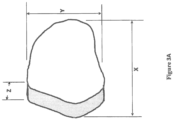
- the "shape factors" associated with a particle mean a ratio of multiple dimensions of the particle.
- the shape factors associated with the particle shown in Figure 3A include a ratio of the x, y and z dimensions of the particle.
- the shape factors associated with the SEM images shown in Figures 1, 2, and 3 are detailed below: TABLE 1 Figure Typical Dimension Ratio X Y Z 1 1 1 1 10 1 1 2 5 5 3 3 10 10 1
- a powder may have particles with a range of shape factors.
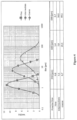
- a "fine" particle size distribution means the median (D50) size of the powder grains is less than 3 microns.
- a non-limiting example of a "fine" particle size distribution is shown in Figure 4 .
- an “intermediate” particle size distribution means the median (D50) size of the powder grains is 3 to 10 microns.
- D50 median size of the powder grains
- Figure 4 A non-limiting example of an “intermediate” particle size distribution is shown in Figure 4 .
- a "coarse” particle size distribution means the median (D50) size of the powder grains is greater than 10 microns.
- D50 median size of the powder grains is greater than 10 microns.
- Figure 4 A non-limiting example of a “coarse” particle size distribution is shown in Figure 4 .
- bothermic reaction means a reaction that includes the reduction of substances using carbon as the reducing agent at elevated temperatures that typically ranging from about 500 to about 2,500 degrees Celsius.
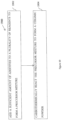
- Figure 19 depicts a flow chart of a method 1900 for forming ceramic powders.
- the method 1900 begins at 1902 by adding a sufficient amount of additives to a plurality of reagents to form a precursor mixture.
- the reagents comprise a first amount of titanium dioxide; a second amount of a carbon source; a third amount of a boron source (e.g. boric acid (H 3 BO 3 ), boron oxide (B 2 O 3 )); and a sufficient amount of an additive (e.g. type and amount to tailor the resulting ceramic powder product to a particular morphology (shape factor and particle size)).
- the additive includes at least one of an oxide, a salt, a pure metal or an alloy of elements ranging from atomic numbers 21 through 30, 39 through 51, and 57 through 77, and combinations thereof.
- the additive includes iron (Fe), nickel (Ni), cobalt (Co), tungsten (W), chromium (Cr), manganese (Mn), molybdenum (Mo), palladium (Pd), sulfur (S), or combinations thereof.
- the additive includes Fe.
- the additive includes Ni.
- the additive includes Co.
- the additive includes W.
- the additive includes Cr.
- the additive includes Mn.
- the additive includes Mo.
- the additive includes Pd.
- the additive includes S.
- the additive includes Fe and Ni. In some embodiments, the additive includes Fe, Ni and Co. In some embodiments, the additive includes Fe, Ni, Co and W. In some embodiments, the additive includes Fe, Ni, Co, W, and S. In some embodiments, the additive includes Fe, Co, W. In some embodiments, the additive includes S and Co. In some embodiments, the additive includes S and Fe.
- the first amount of the titanium dioxide is 20 weight percent (wt.%) to 50 wt.% based a total weight of the precursor mixture. In some embodiments, the first amount of the titanium dioxide is 25 wt.% to 50 wt.% based a total weight of the precursor mixture. In some embodiments, the first amount of the titanium dioxide is 30 wt.% to 50 wt.% based a total weight of the precursor mixture. In some embodiments, the first amount of the titanium dioxide is 35 wt.% to 50 wt.% based a total weight of the precursor mixture. In some embodiments, the first amount of the titanium dioxide is 40 wt.% to 50 wt.% based a total weight of the precursor mixture. In some embodiments, the first amount of the titanium dioxide is 45 wt.% to 50 wt.% based a total weight of the precursor mixture.
- the first amount of the titanium dioxide is 20 wt.% to 45 wt.% based a total weight of the precursor mixture. In some embodiments, the first amount of the titanium dioxide is 20 wt.% to 40 wt.% based a total weight of the precursor mixture. In some embodiments, the first amount of the titanium dioxide is 20 wt.% to 35 wt.% based a total weight of the precursor mixture. In some embodiments, the first amount of the titanium dioxide is 20 wt.% to 30 wt.% based a total weight of the precursor mixture. In some embodiments, the first amount of the titanium dioxide is 20 wt.% to 25 wt.% based a total weight of the precursor mixture.
- the first amount of the titanium dioxide is 25 wt.% to 45 wt.% based a total weight of the precursor mixture. In some embodiments, the first amount of the titanium dioxide is 30 wt.% to 40 wt.% based a total weight of the precursor mixture.
- the carbon source is graphite and/or a carbonaceous gas such as methane, ethane, propane or the like. In some embodiments, the carbon source is graphite. In some embodiments, the carbon source is a carbonaceous gas.
- the second amount of the carbon source is 10 wt.% to 35 wt.% based on a total weight of the precursor mixture. In some embodiments, the second amount of the carbon source is 15 wt.% to 35 wt.% based on a total weight of the precursor mixture. In some embodiments, the second amount of the carbon source is 20 wt.% to 35 wt.% based on a total weight of the precursor mixture. In some embodiments, the second amount of the carbon source is 25 wt.% to 35 wt.% based on a total weight of the precursor mixture. In some embodiments, the second amount of the carbon source is 30 wt.% to 35 wt.% based on a total weight of the precursor mixture. In some embodiments, the amount of carbonaceous gasses is sufficient to satisfy the carbon requirements of the synthesis reaction.
- the second amount of the carbon source is 10 wt.% to 30 wt.% based on a total weight of the precursor mixture. In some embodiments, the second amount of the carbon source is 10 wt.% to 25 wt.% based on a total weight of the precursor mixture. In some embodiments, the second amount of the carbon source is 10 wt.% to 20 wt.% based on a total weight of the precursor mixture. In some embodiments, the second amount of the carbon source is 10 wt.% to 15 wt.% based on a total weight of the precursor mixture.
- the second amount of the carbon source is 15 wt.% to 30 wt.% based on a total weight of the precursor mixture. In some embodiments, the second amount of the carbon source is 15 wt.% to 25 wt.% based on a total weight of the precursor mixture. In some embodiments, the second amount of the carbon source is 20 wt.% to 25 wt.% based on a total weight of the precursor mixture.
- the third amount of the boron source is 30 wt.% to 70 wt.% based on a total weight of the precursor mixture. In some embodiments, the third amount of the boron source is 30 wt.% to 65 wt.% based on a total weight of the precursor mixture. In some embodiments, the third amount of the boron source is 30 wt.% to 60 wt.% based on a total weight of the precursor mixture. In some embodiments, the third amount of the boron source is 30 wt.% to 55 wt.% based on a total weight of the precursor mixture.
- the third amount of the boron source is 30 wt.% to 50 wt.% based on a total weight of the precursor mixture. In some embodiments, the third amount of the boron source is 30 wt.% to 45 wt.% based on a total weight of the precursor mixture. In some embodiments, the third amount of the boron source is 30 wt.% to 40 wt.% based on a total weight of the precursor mixture. In some embodiments, the third amount of the boron source is 30 wt.% to 35 wt.% based on a total weight of the precursor mixture.
- the third amount of the boron source is 35 wt.% to 70 wt.% based on a total weight of the precursor mixture. In some embodiments, the third amount of the boron source is 40 wt.% to 70 wt.% based on a total weight of the precursor mixture. In some embodiments, the third amount of the boron source is 45 wt.% to 70 wt.% based on a total weight of the precursor mixture. In some embodiments, the third amount of the boron source is 50 wt.% to 70 wt.% based on a total weight of the precursor mixture.
- the third amount of the boron source is 55 wt.% to 70 wt.% based on a total weight of the precursor mixture. In some embodiments, the third amount of the boron source is 60 wt.% to 70 wt.% based on a total weight of the precursor mixture. In some embodiments, the third amount of the boron source is 65 wt.% to 70 wt.% based on a total weight of the precursor mixture.
- the third amount of the boron source is 35 wt.% to 65 wt.% based on a total weight of the precursor mixture. In some embodiments, the third amount of the boron source is 40 wt.% to 60 wt.% based on a total weight of the precursor mixture. In some embodiments, the third amount of the boron source is 45 wt.% to 55 wt.% based on a total weight of the precursor mixture.
- the method 1900 further comprises carbothermically reacting the precursor mixture to form a ceramic powder having a morphology and a particle size distribution.
- particle morphology may control properties of the resultant ceramic powder including, but not limited to, abrasiveness, tribology, thermal reactivity, chemical reactivity, chemical adsorption, mass transport, packing, crystallographic orientation, electrical conductivity, and dispensability.
- carbothermic reactions forming TiB2 ceramic powders are shown in the following equations, also providing the reaction temperature and Gibb's Free Energy (delta H) for each reaction: (eq.
- the ceramic powder is titanium diboride.
- the sufficient amount of the additive results in the titanium diboride powder having the morphology selected from the group consisting of irregular, equiaxed, plate-like, and combinations thereof and the particle size distribution is selected from the group consisting of fine, intermediate, coarse, and combinations thereof.
- the method further includes exposing the precursor mixture to a process gas.
- the process gas is an inert gas.
- the process gas is selected from the group consisting of any noble gas, hydrogen, and combinations thereof.
- adding the sufficient amount of the additive results in the powder having the morphology selected from the group consisting of irregular, equiaxed, plate-like, and combinations thereof and the particle size distribution is selected from the group consisting of fine, intermediate, coarse, and combinations thereof.
- the morphology is irregular and the particle size distribution is fine. In some embodiments, the morphology is equiaxed and the particle size distribution is fine. In some embodiments, the morphology is plate-like and the particle size distribution is fine. In some embodiments, the morphology is irregular and the particle size distribution is intermediate. In some embodiments, the morphology is equiaxed and the particle size distribution is intermediate. In some embodiments, the morphology is plate-like and the particle size distribution is intermediate. In some embodiments, the morphology is irregular and the particle size distribution is coarse. In some embodiments, the morphology is equiaxed and the particle size distribution is coarse. In some embodiments, the morphology is plate-like and the particle size distribution is coarse.
- the powder has more than one morphology.
- the morphology is irregular and plate-like and the particle size distribution is fine.
- the morphology is irregular and equiaxed and the particle size distribution is fine.
- the morphology is plate-like and equiaxed and the particle size distribution is fine.
- the morphology is irregular and plate-like and the particle size distribution is intermediate. In some embodiments, the morphology is irregular and equiaxed and the particle size distribution is intermediate. In some embodiments, the morphology is plate-like and equiaxed and the particle size distribution is intermediate.
- the morphology is irregular and plate-like and the particle size distribution is coarse. In some embodiments, the morphology is irregular and equiaxed and the particle size distribution is coarse. In some embodiments, the morphology is plate-like and equiaxed and the particle size distribution is coarse.
- each morphology may be associated with each particle size distribution.
- a morphology that is irregular and plate-like with a particle size distribution that is fine and intermediate means the irregular grains have a particle size distribution of fine or intermediate and the plate-like grains have a particle size of fine or intermediate.
- the morphology is irregular and plate-like and the particle size distribution is fine and intermediate. In some embodiments, the morphology is irregular and plate-like and the particle size distribution is fine and coarse. In some embodiments, the morphology is irregular and plate-like and the particle size distribution is intermediate and coarse.
- the morphology is irregular and equiaxed and the particle size distribution is fine and intermediate. In some embodiments, the morphology is irregular and equiaxed and the particle size distribution is fine and coarse. In some embodiments, the morphology is irregular and equiaxed and the particle size distribution is intermediate and coarse.
- the morphology is plate-like and equiaxed and the particle size distribution is fine and intermediate. In some embodiments, the morphology is plate-like and equiaxed and the particle size distribution is fine and coarse. In some embodiments, the morphology is plate-like and equiaxed and the particle size distribution is intermediate and coarse.
- the morphology is plate-like, equiaxed, and irregular and the particle size distribution is fine. In some embodiments, the morphology is plate-like, equiaxed, and irregular and the particle size distribution is intermediate. In some embodiments, the morphology is plate-like, equiaxed, and irregular and the particle size distribution is coarse. In some embodiments, the morphology is plate-like, equiaxed, and irregular and the particle size distribution is fine and intermediate. In some embodiments, the morphology is plate-like, equiaxed, and irregular and the particle size distribution is fine and coarse. In some embodiments, the morphology is plate-like, equiaxed, and irregular and the particle size distribution is intermediate and coarse. In some embodiments, the morphology is plate-like, equiaxed, and irregular and the particle size distribution is fine, intermediate and coarse. In some embodiments, the morphology is plate-like, equiaxed, and irregular and the particle size distribution is fine, intermediate and coarse. In some embodiments,
- the morphology is irregular and plate-like and the particle size distribution is intermediate and fine. In some embodiments, the morphology is irregular and plate-like and the particle size distribution is coarse and fine.
- the sufficient amount of the additive is less than 0.75 wt.% based on a total weight of the powder. In some embodiments, the wt.% of the sufficient amount of the additive is calculated as the total weight of the metal in the additive divided by the total weight of the powder. In some embodiments, the sufficient amount of the additive is 0.001 to 0.75 wt.%. In some embodiments, the sufficient amount of the additive is 0.005 to 0.75 wt.%. In some embodiments, the sufficient amount of the additive is 0.01 to 0.75 wt.%. In some embodiments, the sufficient amount of the additive is 0.03 to 0.75 wt.%. In some embodiments, the sufficient amount of the additive is 0.05 to 0.75 wt.%.
- the sufficient amount of the additive is 0.06 to 0.75 wt.%. In some embodiments, the sufficient amount of the additive is 0.0625 to 0.75 wt.%. In some embodiments, the sufficient amount of the additive is 0.07 to 0.75 wt.%. In some embodiments, the sufficient amount of the additive is 0.085 to 0.75 wt.%. In some embodiments, the sufficient amount of the additive is 0.1 to 0.75 wt.%. In some embodiments, the sufficient amount of the additive is 0.15 to 0.75 wt.%. In some embodiments, the sufficient amount of the additive is 0.2 to 0.75 wt.%. In some embodiments, the sufficient amount of the additive is 0.25 to 0.75 wt.%.
- the sufficient amount of the additive is 0.3 to 0.75 wt.%. In some embodiments, the sufficient amount of the additive is 0.35 to 0.75 wt.%. In some embodiments, the sufficient amount of the additive is 0.4 to 0.75 wt.%. In some embodiments, the sufficient amount of the additive is 0.45 to 0.75 wt.%. In some embodiments, the sufficient amount of the additive is 0.5 to 0.75 wt.%. In some embodiments, the sufficient amount of the additive is 0.55 to 0.75 wt.%. In some embodiments, the sufficient amount of the additive is 0.6 to 0.75 wt.%. In some embodiments, the sufficient amount of the additive is 0.65 to 0.75 wt.%.
- the sufficient amount of the additive is 0.001 to 0.65 wt.%. In some embodiments, the sufficient amount of the additive is 0.001 to 0.6 wt.%. In some embodiments, the sufficient amount of the additive is 0.001 to 0.55 wt.%. In some embodiments, the sufficient amount of the additive is 0.001 to 0.5 wt.%. In some embodiments, the sufficient amount of the additive is 0.001 to 0.45 wt.%. In some embodiments, the sufficient amount of the additive is 0.001 to 0.4 wt.%. In some embodiments, the sufficient amount of the additive is 0.001 to 0.35 wt.%. In some embodiments, the sufficient amount of the additive is 0.001 to 0.3 wt.%.
- the sufficient amount of the additive is 0.001 to 0.25 wt.%. In some embodiments, the sufficient amount of the additive is 0.001 to 0.2 wt.%. In some embodiments, the sufficient amount of the additive is 0.001 to 0.15 wt.%. In some embodiments, the sufficient amount of the additive is 0.001 to 0.1 wt.%. In some embodiments, the sufficient amount of the additive is 0.001 to 0.085 wt.%. In some embodiments, the sufficient amount of the additive is 0.001 to 0.07 wt.%. In some embodiments, the sufficient amount of the additive is 0.001 to 0.0625 wt.%.
- the sufficient amount of the additive is 0.001 to 0.06 wt.%. In some embodiments, the sufficient amount of the additive is 0.001 to 0.05 wt.%. In some embodiments, the sufficient amount of the additive is 0.001 to 0.03 wt.%. In some embodiments, the sufficient amount of the additive is 0.001 to 0.01 wt.%. In some embodiments, the sufficient amount of the additive is 0.001 to 0.005 wt.%.
- the sufficient amount of the additive is 0.001 wt.%. In some embodiments, the sufficient amount of the additive is 0.005 wt.%. In some embodiments, the sufficient amount of the additive is 0.01 wt.%. In some embodiments, the sufficient amount of the additive is 0.03 wt.%. In some embodiments, the sufficient amount of the additive is 0.05 wt.%. In some embodiments, the sufficient amount of the additive is 0.06 wt.%. In some embodiments, the sufficient amount of the additive is 0.0625 wt.%. In some embodiments, the sufficient amount of the additive is 0.07 wt.%. In some embodiments, the sufficient amount of the additive is 0.085 wt.%.
- the sufficient amount of the additive is 0.1 wt.%. In some embodiments, the sufficient amount of the additive is 0.1125 wt.%. In some embodiments, the sufficient amount of the additive is 0.15 wt.%. In some embodiments, the sufficient amount of the additive is 0.2 wt.%. In some embodiments, the sufficient amount of the additive is 0.25 wt.%. In some embodiments, the sufficient amount of the additive is 0.2625 wt.%. In some embodiments, the sufficient amount of the additive is 0.3 wt.%. In some embodiments, the sufficient amount of the additive is 0.35 wt.%. In some embodiments, the sufficient amount of the additive is 0.4 wt.%.
- the sufficient amount of the additive is 0.45 wt.%. In some embodiments, the sufficient amount of the additive is 0.5 wt.%. In some embodiments, the sufficient amount of the additive is 0.5125 wt.%. In some embodiments, the sufficient amount of the additive is 0.55 wt.%. In some embodiments, the sufficient amount of the additive is 0.6 wt.%. In some embodiments, the sufficient amount of the additive is 0.65 wt.%. In some embodiments, the sufficient amount of the additive is 0.7 wt.%. In some embodiments, the sufficient amount of the additive is 0.75 wt.%.
- the method includes mixing reagents to form a precursor mixture, wherein the reagents comprise a first amount of a reducing agent; a second amount of a reactant wherein the reactant is a boron source, such as boron oxide, boric acid, or boron carbide and a metal source such as titanium dioxide, hafnium dioxide, zirconium dioxide, and a sufficient amount of an additive (e.g. type and amount of additive to tailor the ceramic powder product to a particular morphology).
- the additive includes at least one of an oxide, a salt, a pure metal or an alloy of elements ranging from atomic numbers 21 through 30, 39 through 51, and 57 through 77 and combinations thereof.
- the additive may include one or more of the elements as detailed above.
- the sufficient amount of the additive is as detailed above for the titanium diboride powder.
- the method further includes reacting the precursor mixture to form a powder having a morphology and a particle size distribution.
- the sufficient amount of the additive results in the powder having the morphology selected from the group consisting of irregular, equiaxed, plate-like, and combinations thereof and the particle size distribution selected from the group consisting of fine, intermediate, coarse, and combinations thereof.
- the morphology and particle size distribution of the powder is as detailed above for the titanium diboride powder.
- the reducing agent includes, but is not limited to, a carbon source in the form of a carbonaceous gas, including but not limited to, methane, ethane, propane or the like.
- the method includes mixing reagents to form a precursor mixture, wherein the reagents comprise a first amount of a carbon source; a second amount of a titanium source, a third amount of a boron source and a sufficient amount of an additive (e.g. type and/or amount in order to tailor the ceramic powder product to a particular morphology).
- the additive includes at least one of an oxide, salt, pure metal or alloy of elements ranging from atomic numbers 21 through 30, 39 through 51, and 57 through 77 and combinations thereof.
- the additive may include one or more of the elements as detailed above.
- the sufficient amount of the additive is as detailed above for the titanium diboride powder.
- lower weight percentages of additives produce fine irregular shaped grains with smaller concentration of plate-like and equiaxed grains.
- increasing process gas flow produces finer morphology types.
- sulfur generally produces either equiaxed or plate like grains, although particle size may increase with additive concentration and with decreased process gas flows.
- the mixing (e.g. the precursors to form a precursor mixture) is conducted in any conventional mixer including, but not limited to, a ribbon blender, a V-blender, a cone screw blender, a screw blender, a double cone blender, a double planetary mixer, a high viscosity mixer, a counter-rotating mixer, a double & triple shaft mixer, a vacuum mixer, a high shear rotor stator, dispersion mixers, a paddle mixer, a jet mixer, drum blenders, and/or planetary mixer.
- the process gas is selected from the group consisting of any noble gas, hydrogen, and combinations thereof.
- hydrogen is added to the reactor when low partial pressures of oxygen are required.
- the process gas is argon.
- the flow rate of the process gas is sufficient so as to result in removal of reaction byproducts.
- the reaction byproducts include carbon monoxide, carbon dioxide, or vapors from high vapor pressure solids in the precursor mixture or powders.
- the reaction byproducts include undesirable intermediates that detract from the main reaction.
- the flow rate of the process gas is sufficient to remove or reduce the concentration of the reaction byproducts in the reactor and/or sufficient to manage atmospheric chemistry in the reactor. In some embodiments, the process gas flow rate is based, at least in part, on the precursor mixture volume and configuration, the desired powder morphology, the temperature profile within the reactor and/or precursor mixture and/or other process conditions related to the powder production.
- the method includes exposing the precursor mixture to a sufficient temperature for a sufficient time to form a TiB 2 powder product via carbothermic reaction of the reagents in the precursor mixture.
- the sufficient temperature is dependent on type of reagents and powder.
- the sufficient temperature is 950 degrees Celsius to 1800 degrees Celsius.
- the sufficient temperature is 1000 degrees Celsius to 1400 degrees Celsius.
- the sufficient temperature is 1100 degrees Celsius to 1300 degrees Celsius.
- the sufficient time is dependent on type of reagents and powder and the sufficient temperature. In some embodiments, the sufficient time is 0.5 hour to 12 hours. In some embodiments, the sufficient time is 0.5 hour to 11 hours. In some embodiments, the sufficient time is 0.5 hour to 10 hours. In some embodiments, the sufficient time is 0.5 hour to 9 hours. In some embodiments, the sufficient time is 0.5 hour to 8 hours. In some embodiments, the sufficient time is 0.5 hour to 7 hours. In some embodiments, the sufficient time is 0.5 hour to 6 hours. In some embodiments, the sufficient time is 0.5 hour to 5 hours. In some embodiments, the sufficient time is 0.5 hour to 4 hours. In some embodiments, the sufficient time is 0.5 hour to 3 hours. In some embodiments, the sufficient time is 0.5 hour to 2 hours. In some embodiments, the sufficient time is 0.5 hour to 1 hours.
- the sufficient time is 1 hour to 12 hours. In some embodiments, the sufficient time is 2 hours to 12 hours. In some embodiments, the sufficient time is 3 hours to 12 hours. In some embodiments, the sufficient time is 4 hours to 12 hours. In some embodiments, the sufficient time is 5 hours to 12 hours. In some embodiments, the sufficient time is 6 hours to 12 hours. In some embodiments, the sufficient time is 7 hours to 12 hours. In some embodiments, the sufficient time is 8 hours to 12 hours. In some embodiments, the sufficient time is 9 hours to 12 hours. In some embodiments, the sufficient time is 10 hours to 12 hours. In some embodiments, the sufficient time is 11 hours to 12 hours.
- the sufficient time is 1 hour to 8 hours. In some embodiments, the sufficient time is 1 hour to 6 hours. In some embodiments, the sufficient time is 1 hour to 4 hours. In some embodiments, the sufficient time is 1 hour to 2 hours. In some embodiments, the sufficient time is 2 hour to 11 hours. In some embodiments, the sufficient time is 3 hour to 10 hours. In some embodiments, the sufficient time is 4 hour to 9 hours. In some embodiments, the sufficient time is 5 hour to 8 hours. In some embodiments, the sufficient time is 6 hour to 7 hours.
- the sufficient temperature and sufficient time are combination of the temperate and times detailed above.
- the heating of the precursor mixture in the reactor may be achieved using any suitable heating device. In some embodiments, the heating of the precursor mixture in the reactor is achieved using a furnace. In some embodiments, the heating device is positioned external from the reactor. In some embodiments, the heating device is positioned internal to the reactor.
- the method results in a ceramic powder having a morphology selected from the group consisting of irregular, equiaxed, plate-like, and combinations thereof and a particle size distribution selected from the group consisting of fine, intermediate, coarse, and combinations thereof. In some embodiments, the method results in a ceramic powder having a morphology and particle size distribution described herein.
- the present invention is a method comprising: mixing reagents to form a precursor mixture, wherein the reagents comprise: titanium dioxide; carbon source; boron source (e.g. boric acid, boron oxide); and a sufficient amount of an additive; wherein the additive includes at least one of an oxide, salt, pure metal or alloy of elements ranging from atomic numbers 21 through 30, 39 through 51, and 57 through 77 and combinations thereof; carbothermically reacting the precursor mixture to form a titanium diboride powder having a morphology and a PSD; wherein the sufficient amount of the additive results in the titanium diboride powder having the morphology selected from the group consisting of irregular, equiaxed, plate-like, and combinations thereof and the PSD selected from the group consisting of fine, intermediate, coarse, and combinations thereof; and wherein the sufficient amount of the additive is 0.001 wt.% to 0.75 wt. % based on a total weight of the titanium diboride powder.
- the reagents comprise: titanium dioxide; carbon
- the present invention is a method comprising: mixing reagents to form a precursor mixture, wherein the reagents comprise: titanium dioxide; reducing agent; boric acid; and a sufficient amount of an additive; wherein the additive includes at least one of an oxide, salt, pure metal or alloy of elements ranging from atomic numbers 21 through 30, 39 through 51, and 57 through 77 and combinations thereof; reacting the precursor mixture to form a titanium diboride powder having a morphology and a PSD; wherein the sufficient amount of the additive results in the titanium diboride powder having the morphology selected from the group consisting of irregular, equiaxed, plate-like, and combinations thereof and the PSD selected from the group consisting of fine, intermediate, coarse, and combinations thereof; wherein the sufficient amount of the additive is 0.001 wt.% to 0.75 wt. % based on a total weight of the titanium diboride powder.
- the ceramic powders detailed herein may be used for multiple applications.
- the ceramic powders are specifically tailored to be processed via ceramics processing techniques in order to form ceramic products (wherein the ceramic products are tailored for their application, based on the morphology of the ceramic powder product).
- Figure 18 depicts a schematic of an embodiment of a method in accordance with the instant disclosure, including: providing a ceramic powder product having a specific morphology, for the utility of creating a ceramic part from the ceramic powder in accordance with ceramic production pathways (e.g., hot pressing, pressureless sintering, and/or hot isostatic pressing).
- the as-reacted ceramic powder is still solid and/or semi-solid shape based on the configuration of the precursor mixture, such that a deagglomeration step is completed on the ceramic powder product prior to downstream processing.
- forming includes forming a green form (e.g. which is then further processed to form a final ceramic product).
- Non-limiting examples of the ceramic compounds produced using an embodiment of the method of the present invention are shown in Table 2, where the precursor mixture was reacted in a tube furnace (e.g. a bench scale reactor having about a 25g capacity).
- the "TiB 2 Type 1", "TiB 2 Type 2", examples are comparative examples.
- the examples in Table 2 were conducted as follows: Mixtures containing stoichiometric and near-stoichiometric molar ratios of titanium dioxide, boric acid and carbon; and the specified wt.% of additive shown in Table 2 were fed to a graphite reactor and exposed to a temperature of 1500 degrees Celsius.
- the titanium dioxide, boric acid, carbon, and additive, if present, were also exposed to argon gas in the graphite reactor as shown in Table 2.
- SEM images of the resultant powder were taken at a 2500X magnification using an Aspex Instruments PSEM II in backscatter electron mode. Based on each SEM image, the morphology and particle size distribution of the powder was determined as shown in Table 2. Select SEM images of the examples are shown in Figures 5 to 16 .
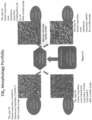
- Figure 17 provides a schematic outline of various production pathways to make TiB2 ceramic powder having different morphologies, in accordance with various embodiments of the instant disclosure, based on the data obtained in the bench top furnace.
- a method comprising:
- exposing the precursor mixture comprises directing the process gas flow through the precursor mixture during the carbothermic reacting step.
- the precursor mixture comprises an oxide comprising a titanium source, a carbon source; and a boron source.
- the precursor mixture comprises from 20 wt.% to 50 wt.% of the oxide.
Landscapes
- Chemical & Material Sciences (AREA)
- Engineering & Computer Science (AREA)
- Ceramic Engineering (AREA)
- Organic Chemistry (AREA)
- Manufacturing & Machinery (AREA)
- Materials Engineering (AREA)
- Structural Engineering (AREA)
- Inorganic Chemistry (AREA)
- Composite Materials (AREA)
- Chemical Kinetics & Catalysis (AREA)
- Powder Metallurgy (AREA)
- Compositions Of Oxide Ceramics (AREA)
- Oxygen, Ozone, And Oxides In General (AREA)
Applications Claiming Priority (3)
| Application Number | Priority Date | Filing Date | Title |
|---|---|---|---|
| US201662353880P | 2016-06-23 | 2016-06-23 | |
| EP17816315.0A EP3475246A4 (fr) | 2016-06-23 | 2017-06-23 | Systèmes et procédés de fabrication de poudres céramiques et de produits céramiques |
| PCT/US2017/039048 WO2017223481A1 (fr) | 2016-06-23 | 2017-06-23 | Systèmes et procédés de fabrication de poudres céramiques et de produits céramiques |
Related Parent Applications (1)
| Application Number | Title | Priority Date | Filing Date |
|---|---|---|---|
| EP17816315.0A Division EP3475246A4 (fr) | 2016-06-23 | 2017-06-23 | Systèmes et procédés de fabrication de poudres céramiques et de produits céramiques |
Publications (2)
| Publication Number | Publication Date |
|---|---|
| EP4480916A2 true EP4480916A2 (fr) | 2024-12-25 |
| EP4480916A3 EP4480916A3 (fr) | 2025-03-26 |
Family
ID=60784831
Family Applications (2)
| Application Number | Title | Priority Date | Filing Date |
|---|---|---|---|
| EP17816315.0A Pending EP3475246A4 (fr) | 2016-06-23 | 2017-06-23 | Systèmes et procédés de fabrication de poudres céramiques et de produits céramiques |
| EP24196929.4A Pending EP4480916A3 (fr) | 2016-06-23 | 2017-06-23 | Systèmes et procédés de fabrication de poudres céramiques et de produits céramiques |
Family Applications Before (1)
| Application Number | Title | Priority Date | Filing Date |
|---|---|---|---|
| EP17816315.0A Pending EP3475246A4 (fr) | 2016-06-23 | 2017-06-23 | Systèmes et procédés de fabrication de poudres céramiques et de produits céramiques |
Country Status (11)
| Country | Link |
|---|---|
| US (1) | US11753345B2 (fr) |
| EP (2) | EP3475246A4 (fr) |
| JP (1) | JP7186621B2 (fr) |
| CN (1) | CN109415270A (fr) |
| AU (2) | AU2017281911B2 (fr) |
| BR (1) | BR122024000714A2 (fr) |
| CA (1) | CA3026766A1 (fr) |
| DK (1) | DK180800B1 (fr) |
| EA (1) | EA201990099A1 (fr) |
| WO (1) | WO2017223481A1 (fr) |
| ZA (1) | ZA201900111B (fr) |
Families Citing this family (1)
| Publication number | Priority date | Publication date | Assignee | Title |
|---|---|---|---|---|
| EP4127272A4 (fr) | 2020-03-25 | 2024-09-04 | Alcoa USA Corp. | Articles en diborure de titane revêtus de cuivre |
Family Cites Families (29)
| Publication number | Priority date | Publication date | Assignee | Title |
|---|---|---|---|---|
| US3013862A (en) * | 1960-07-21 | 1961-12-19 | American Potash & Chem Corp | Purification of titanium diboride |
| US4266977A (en) | 1975-02-03 | 1981-05-12 | Ppg Industries, Inc. | Submicron carbon-containing titanium boride powder and method for preparing same |
| US4282195A (en) * | 1975-02-03 | 1981-08-04 | Ppg Industries, Inc. | Submicron titanium boride powder and method for preparing same |
| US4275026A (en) * | 1979-11-02 | 1981-06-23 | Ppg Industries, Inc. | Method for preparing titanium diboride shapes |
| EP0177092A3 (fr) * | 1984-09-24 | 1986-12-30 | Cabot Corporation | Corps en diborure de titane lié par réaction |
| US4921531A (en) * | 1984-10-19 | 1990-05-01 | Martin Marietta Corporation | Process for forming fine ceramic powders |
| US4673550A (en) * | 1984-10-23 | 1987-06-16 | Serge Dallaire | TiB2 -based materials and process of producing the same |
| JPS6279021A (ja) * | 1985-10-03 | 1987-04-11 | 株式会社日立ホームテック | 調理機の回転軸保持筒 |
| US4888166A (en) * | 1986-09-03 | 1989-12-19 | Georgia Tech Research Corporation | Process for making highly reactive sub-micron amorphous titanium diboride powder |
| US5110565A (en) * | 1988-02-05 | 1992-05-05 | The Dow Chemical Company | Apparatus for producing uniform, fine ceramic powder |
| US5194234A (en) | 1988-02-05 | 1993-03-16 | The Dow Chemical Company | Method for producing uniform, fine boron-containing ceramic powders |
| US4968348A (en) * | 1988-07-29 | 1990-11-06 | Dynamet Technology, Inc. | Titanium diboride/titanium alloy metal matrix microcomposite material and process for powder metal cladding |
| US5047372A (en) * | 1988-12-29 | 1991-09-10 | Ucar Carbon Technology Corporation | Alloyed powder and method of preparing same |
| US5087592A (en) * | 1990-05-25 | 1992-02-11 | Alcan International Limited | Method of producing platelets of borides of refractory metals |
| US5100845A (en) | 1991-03-13 | 1992-03-31 | Union Carbide Coatings Service Technology Corporation | Process for producing titanium diboride and boron nitride powders |
| JPH06279021A (ja) * | 1993-03-24 | 1994-10-04 | Sumitomo Chem Co Ltd | 二ホウ化チタン微粉末の製造方法 |
| AUPM933094A0 (en) * | 1994-11-08 | 1994-12-01 | Australian National University, The | Production of borides |
| SE506982C2 (sv) * | 1996-07-19 | 1998-03-09 | Sandvik Ab | Framställning av TiB2-whiskers |
| JPH10167833A (ja) * | 1996-12-04 | 1998-06-23 | Mitsubishi Materials Corp | 硼化物セラミックス及びその製造方法 |
| JP4195920B2 (ja) | 2002-08-06 | 2008-12-17 | 勝廣 西山 | 二ホウ化チタン粉末の製造方法 |
| US7518229B2 (en) | 2006-08-03 | 2009-04-14 | International Business Machines Corporation | Versatile Si-based packaging with integrated passive components for mmWave applications |
| US8142749B2 (en) | 2008-11-17 | 2012-03-27 | Kennametal Inc. | Readily-densified titanium diboride and process for making same |
| US20100176339A1 (en) * | 2009-01-12 | 2010-07-15 | Chandran K S Ravi | Jewelry having titanium boride compounds and methods of making the same |
| CN104087973B (zh) | 2009-07-28 | 2018-01-09 | 美铝美国公司 | 用于制造铝熔炼中的可润湿阴极的组合物 |
| RU2572425C2 (ru) * | 2009-10-30 | 2016-01-10 | Алкоа Инк. | Реактор для карботермического получения диборида титана |
| RU2629299C2 (ru) | 2012-06-06 | 2017-08-28 | Алкоа Инк. | Повторная переработка материалов диборида титана |
| WO2014204883A1 (fr) | 2013-06-19 | 2014-12-24 | Alcoa Inc. | Plaque d'enfournement pour le frittage |
| US9732422B2 (en) * | 2015-01-23 | 2017-08-15 | United Technologies Corporation | Method of coating metallic powder particles |
| WO2018009687A1 (fr) | 2016-07-06 | 2018-01-11 | Alcoa Usa Corp. | Produits céramiques et leurs procédés de fabrication |
-
2017
- 2017-06-23 AU AU2017281911A patent/AU2017281911B2/en active Active
- 2017-06-23 EP EP17816315.0A patent/EP3475246A4/fr active Pending
- 2017-06-23 JP JP2018567219A patent/JP7186621B2/ja active Active
- 2017-06-23 CN CN201780039387.3A patent/CN109415270A/zh active Pending
- 2017-06-23 EP EP24196929.4A patent/EP4480916A3/fr active Pending
- 2017-06-23 EA EA201990099A patent/EA201990099A1/ru unknown
- 2017-06-23 CA CA3026766A patent/CA3026766A1/fr active Pending
- 2017-06-23 BR BR122024000714-2A patent/BR122024000714A2/pt not_active Application Discontinuation
- 2017-06-23 WO PCT/US2017/039048 patent/WO2017223481A1/fr not_active Ceased
-
2018
- 2018-12-20 US US16/228,295 patent/US11753345B2/en active Active
-
2019
- 2019-01-02 DK DKPA201970003A patent/DK180800B1/en active IP Right Grant
- 2019-01-08 ZA ZA2019/00111A patent/ZA201900111B/en unknown
-
2021
- 2021-11-04 AU AU2021261929A patent/AU2021261929B2/en active Active
Also Published As
| Publication number | Publication date |
|---|---|
| US11753345B2 (en) | 2023-09-12 |
| DK201970003A8 (en) | 2021-07-08 |
| DK180800B1 (en) | 2022-04-01 |
| JP2019522619A (ja) | 2019-08-15 |
| AU2021261929A1 (en) | 2021-12-09 |
| WO2017223481A1 (fr) | 2017-12-28 |
| DK201970003A1 (en) | 2019-01-07 |
| JP7186621B2 (ja) | 2022-12-09 |
| ZA201900111B (en) | 2022-08-31 |
| CN109415270A (zh) | 2019-03-01 |
| BR112018076285A2 (pt) | 2019-03-26 |
| EP3475246A1 (fr) | 2019-05-01 |
| EA201990099A1 (ru) | 2019-05-31 |
| US20190127282A1 (en) | 2019-05-02 |
| AU2021261929B2 (en) | 2023-07-20 |
| AU2017281911B2 (en) | 2021-08-05 |
| EP4480916A3 (fr) | 2025-03-26 |
| AU2017281911A1 (en) | 2019-01-17 |
| BR122024000714A2 (pt) | 2024-02-27 |
| EP3475246A4 (fr) | 2020-01-08 |
| CA3026766A1 (fr) | 2017-12-28 |
| DK201970003A9 (en) | 2020-05-07 |
Similar Documents
| Publication | Publication Date | Title |
|---|---|---|
| US11292723B2 (en) | Tungsten carbide powder and production thereof | |
| US6793875B1 (en) | Nanostructured carbide cermet powders by high energy ball milling | |
| CN1073532C (zh) | 生产过渡金属碳化物的方法 | |
| KR102403390B1 (ko) | 탄화텅스텐을 포함하는 분말 | |
| CN1246102A (zh) | 碳氮化物粉末及其制备方法和应用 | |
| CN112846170A (zh) | 一种(Ti,W)C固溶体粉末及其制备方法 | |
| CN108840681B (zh) | 一种纳米碳化硼及其制备方法 | |
| AU2021261929B2 (en) | Systems and methods for making ceramic powders and ceramic products | |
| US5169832A (en) | Synthesis of refractory metal boride powders of predetermined particle size | |
| JP5618364B2 (ja) | 超微粒かつ均質なチタン系炭窒化物固溶体粉末の製造方法 | |
| US9238854B2 (en) | Method of producing carbide and carbon nitride powders containing binder, and cermet obtained from the same | |
| JP4695173B2 (ja) | 窒化チタン粉末の調製方法 | |
| EA046668B1 (ru) | Системы и способы получения керамических порошков и керамических продуктов | |
| JP5907532B2 (ja) | Na−Si−B組成を有するホウ化物、ホウ化物の多結晶反応焼結体及びその製造方法 | |
| KR101588292B1 (ko) | TaC 분말 및 이의 제조방법 | |
| BR112018076285B1 (pt) | Método para preparar uma mistura precursora |
Legal Events
| Date | Code | Title | Description |
|---|---|---|---|
| PUAI | Public reference made under article 153(3) epc to a published international application that has entered the european phase |
Free format text: ORIGINAL CODE: 0009012 |
|
| STAA | Information on the status of an ep patent application or granted ep patent |
Free format text: STATUS: REQUEST FOR EXAMINATION WAS MADE |
|
| 17P | Request for examination filed |
Effective date: 20240828 |
|
| AC | Divisional application: reference to earlier application |
Ref document number: 3475246 Country of ref document: EP Kind code of ref document: P |
|
| AK | Designated contracting states |
Kind code of ref document: A2 Designated state(s): AL AT BE BG CH CY CZ DE DK EE ES FI FR GB GR HR HU IE IS IT LI LT LU LV MC MK MT NL NO PL PT RO RS SE SI SK SM TR |
|
| REG | Reference to a national code |
Ref country code: DE Ref legal event code: R079 Free format text: PREVIOUS MAIN CLASS: C01B0035040000 Ipc: C04B0035580000 |
|
| PUAL | Search report despatched |
Free format text: ORIGINAL CODE: 0009013 |
|
| AK | Designated contracting states |
Kind code of ref document: A3 Designated state(s): AL AT BE BG CH CY CZ DE DK EE ES FI FR GB GR HR HU IE IS IT LI LT LU LV MC MK MT NL NO PL PT RO RS SE SI SK SM TR |
|
| RIC1 | Information provided on ipc code assigned before grant |
Ipc: C01B 35/04 20060101ALI20250217BHEP Ipc: C04B 35/634 20060101ALI20250217BHEP Ipc: C04B 35/83 20060101ALI20250217BHEP Ipc: C04B 35/52 20060101ALI20250217BHEP Ipc: C04B 35/58 20060101AFI20250217BHEP |