EP4481375A2 - Réactifs de détection et agencements d'électrodes pour éléments de test de diagnostic multi-analytes, ainsi que leurs procédés d'utilisation - Google Patents
Réactifs de détection et agencements d'électrodes pour éléments de test de diagnostic multi-analytes, ainsi que leurs procédés d'utilisation Download PDFInfo
- Publication number
- EP4481375A2 EP4481375A2 EP24211207.6A EP24211207A EP4481375A2 EP 4481375 A2 EP4481375 A2 EP 4481375A2 EP 24211207 A EP24211207 A EP 24211207A EP 4481375 A2 EP4481375 A2 EP 4481375A2
- Authority
- EP
- European Patent Office
- Prior art keywords
- analyte
- electrode
- msec
- sec
- glucose
- Prior art date
- Legal status (The legal status is an assumption and is not a legal conclusion. Google has not performed a legal analysis and makes no representation as to the accuracy of the status listed.)
- Pending
Links
Images







Classifications
-
- C—CHEMISTRY; METALLURGY
- C12—BIOCHEMISTRY; BEER; SPIRITS; WINE; VINEGAR; MICROBIOLOGY; ENZYMOLOGY; MUTATION OR GENETIC ENGINEERING
- C12Q—MEASURING OR TESTING PROCESSES INVOLVING ENZYMES, NUCLEIC ACIDS OR MICROORGANISMS; COMPOSITIONS OR TEST PAPERS THEREFOR; PROCESSES OF PREPARING SUCH COMPOSITIONS; CONDITION-RESPONSIVE CONTROL IN MICROBIOLOGICAL OR ENZYMOLOGICAL PROCESSES
- C12Q1/00—Measuring or testing processes involving enzymes, nucleic acids or microorganisms; Compositions therefor; Processes of preparing such compositions
- C12Q1/001—Enzyme electrodes
- C12Q1/004—Enzyme electrodes mediator-assisted
-
- C—CHEMISTRY; METALLURGY
- C12—BIOCHEMISTRY; BEER; SPIRITS; WINE; VINEGAR; MICROBIOLOGY; ENZYMOLOGY; MUTATION OR GENETIC ENGINEERING
- C12Q—MEASURING OR TESTING PROCESSES INVOLVING ENZYMES, NUCLEIC ACIDS OR MICROORGANISMS; COMPOSITIONS OR TEST PAPERS THEREFOR; PROCESSES OF PREPARING SUCH COMPOSITIONS; CONDITION-RESPONSIVE CONTROL IN MICROBIOLOGICAL OR ENZYMOLOGICAL PROCESSES
- C12Q1/00—Measuring or testing processes involving enzymes, nucleic acids or microorganisms; Compositions therefor; Processes of preparing such compositions
- C12Q1/001—Enzyme electrodes
- C12Q1/005—Enzyme electrodes involving specific analytes or enzymes
-
- C—CHEMISTRY; METALLURGY
- C12—BIOCHEMISTRY; BEER; SPIRITS; WINE; VINEGAR; MICROBIOLOGY; ENZYMOLOGY; MUTATION OR GENETIC ENGINEERING
- C12Q—MEASURING OR TESTING PROCESSES INVOLVING ENZYMES, NUCLEIC ACIDS OR MICROORGANISMS; COMPOSITIONS OR TEST PAPERS THEREFOR; PROCESSES OF PREPARING SUCH COMPOSITIONS; CONDITION-RESPONSIVE CONTROL IN MICROBIOLOGICAL OR ENZYMOLOGICAL PROCESSES
- C12Q1/00—Measuring or testing processes involving enzymes, nucleic acids or microorganisms; Compositions therefor; Processes of preparing such compositions
- C12Q1/001—Enzyme electrodes
- C12Q1/005—Enzyme electrodes involving specific analytes or enzymes
- C12Q1/006—Enzyme electrodes involving specific analytes or enzymes for glucose
-
- G—PHYSICS
- G01—MEASURING; TESTING
- G01N—INVESTIGATING OR ANALYSING MATERIALS BY DETERMINING THEIR CHEMICAL OR PHYSICAL PROPERTIES
- G01N27/00—Investigating or analysing materials by the use of electric, electrochemical, or magnetic means
- G01N27/26—Investigating or analysing materials by the use of electric, electrochemical, or magnetic means by investigating electrochemical variables; by using electrolysis or electrophoresis
- G01N27/28—Electrolytic cell components
- G01N27/30—Electrodes, e.g. test electrodes; Half-cells
- G01N27/327—Biochemical electrodes, e.g. electrical or mechanical details for in vitro measurements
- G01N27/3271—Amperometric enzyme electrodes for analytes in body fluids, e.g. glucose in blood
- G01N27/3272—Test elements therefor, i.e. disposable laminated substrates with electrodes, reagent and channels
-
- G—PHYSICS
- G01—MEASURING; TESTING
- G01N—INVESTIGATING OR ANALYSING MATERIALS BY DETERMINING THEIR CHEMICAL OR PHYSICAL PROPERTIES
- G01N27/00—Investigating or analysing materials by the use of electric, electrochemical, or magnetic means
- G01N27/26—Investigating or analysing materials by the use of electric, electrochemical, or magnetic means by investigating electrochemical variables; by using electrolysis or electrophoresis
- G01N27/28—Electrolytic cell components
- G01N27/30—Electrodes, e.g. test electrodes; Half-cells
- G01N27/327—Biochemical electrodes, e.g. electrical or mechanical details for in vitro measurements
- G01N27/3271—Amperometric enzyme electrodes for analytes in body fluids, e.g. glucose in blood
- G01N27/3273—Devices therefor, e.g. test element readers, circuitry
-
- G—PHYSICS
- G01—MEASURING; TESTING
- G01N—INVESTIGATING OR ANALYSING MATERIALS BY DETERMINING THEIR CHEMICAL OR PHYSICAL PROPERTIES
- G01N27/00—Investigating or analysing materials by the use of electric, electrochemical, or magnetic means
- G01N27/26—Investigating or analysing materials by the use of electric, electrochemical, or magnetic means by investigating electrochemical variables; by using electrolysis or electrophoresis
- G01N27/28—Electrolytic cell components
- G01N27/30—Electrodes, e.g. test electrodes; Half-cells
- G01N27/327—Biochemical electrodes, e.g. electrical or mechanical details for in vitro measurements
- G01N27/3275—Sensing specific biomolecules, e.g. nucleic acid strands, based on an electrode surface reaction
- G01N27/3276—Sensing specific biomolecules, e.g. nucleic acid strands, based on an electrode surface reaction being a hybridisation with immobilised receptors
-
- G—PHYSICS
- G01—MEASURING; TESTING
- G01N—INVESTIGATING OR ANALYSING MATERIALS BY DETERMINING THEIR CHEMICAL OR PHYSICAL PROPERTIES
- G01N27/00—Investigating or analysing materials by the use of electric, electrochemical, or magnetic means
- G01N27/26—Investigating or analysing materials by the use of electric, electrochemical, or magnetic means by investigating electrochemical variables; by using electrolysis or electrophoresis
- G01N27/28—Electrolytic cell components
- G01N27/30—Electrodes, e.g. test electrodes; Half-cells
- G01N27/327—Biochemical electrodes, e.g. electrical or mechanical details for in vitro measurements
- G01N27/3271—Amperometric enzyme electrodes for analytes in body fluids, e.g. glucose in blood
Definitions
- This disclosure relates generally to chemistry, engineering, and medicine/medical diagnostics, and more particularly, it relates to detection reagents and electrode arrangements for multi-analyte diagnostic test elements, as well as multi-analyte analysis methods using the same.
- a number of analytical systems such as test meters and associated diagnostic test elements, are available that permit a person to electrochemically or optically measure glucose concentration in body fluid samples.
- the information displayed following a successful blood glucose test is the respective blood glucose concentration, typically shown in mg/dL or mmol/L (mM), and perhaps the time and date the measurement was performed.
- This information in combination with calculation of planned/known intake of carbohydrates and/or planned/known activities and/or knowledge of other situational or individual factors, is in most cases sufficient to allow a person with diabetes to adjust or derive his or her dietary intake and/or an immediate dose of insulin to avoid or attenuate hyperglycemia in the short term.
- the person with diabetes can detect a need for an intake of sugar to avoid hypoglycemia.
- ketone byproducts and increased ketone concentrations.
- increased ketone concentrations in a person with diabetes may be caused by a heart attack, stroke, recreational drug usage, or an intercurrent illness such as pneumonia, influenza, gastroenteritis or a urological infection.
- DKA diabetic ketoacidosis
- ADA American Diabetes Association
- ketone concentrations should be checked every 4-6 hours when a person with diabetes has an illness (such as a cold or the flu) or when a person with diabetes has a blood glucose concentration of more than 240 mg/dL (available on the World Wide Web at diabetes.org/living-with-diabetes/complications/ketoacidosis-dka.html).
- a recent advance in multi-analyte testing is improved ketone reagent formulations that permit both blood ketone and blood glucose concentrations to be provided within 7.5 seconds or less after contacting a test element with a body fluid sample and even within seconds of one another. See, e.g., Int'l Patent Application Publication No. WO 2014/068022 .
- Another advance in multi-analyte testing includes a "ketone watch," which may be initiated when a blood glucose concentration is at a certain predetermined value to trigger an analysis of ketone trends, as well as automatically providing blood ketone concentration with blood glucose concentration if glucose and/or ketone concentrations are above a predetermined value.
- the ketone watch may be started if a person indicates that he or she has an illness such as a cold or the flu. See, id.
- An inventive concept described herein includes using particular combinations of mediators in multi-analyte detection reagents so that a single counter electrode (CE) can be used with a plurality of analyte-specific working electrodes (WEs).
- This inventive concept is achieved by providing a multi-analyte diagnostic test element having a first WE and first CE pair covered with a first analyte-specific detection reagent that includes a first mediator and also having a second WE covered with a second analyte-specific detection reagent that includes a second mediator.
- the single CE can be used as the CE for both the first and second analyte measurements at their respective WEs.
- the mediator concentrations, measurement ranges, applied potential differences, and sequence in which such potential differences are applied to a sample may vary for each analyte-specific measurement.
- the inventive concept includes using detection reagents for at least two different analytes, where one detection reagent includes a first mediator that provides the WE and CE function for one analyte measurement, and where the same CE also provides the CE function for any other analyte measurements at other WEs having their own analyte-specific detection reagent including a mediator that is distinct from the first mediator.
- This inventive concept therefore can be incorporated into exemplary dry detection reagents, multi-analyte diagnostic test elements, test systems, and multi-analyte measuring methods as described herein and in more detail below.
- detection reagents are provided for multi-analyte analysis that include a first detection reagent for a first analyte of interest and a second detection reagent for a second analyte of interest.
- the first detection reagent includes a first coenzyme-dependent enzyme or a substrate for the first enzyme, a first coenzyme, and a first mediator.
- the first coenzyme-dependent enzyme and the first coenzyme are attached, bound, integrated or linked to one another.
- the first coenzyme-dependent enzyme can be an oxidase or a dehydrogenase.
- the first coenzyme-dependent enzyme is a flavin adenine dinucleotide (FAD)-, nicotinamide adenine dinucleotide (NAD)-, or pyrroloquinoline-quinone (PQQ)-dependent dehydrogenase, especially a FAD-, NAD- or PQQ-dependent dehydrogenase, as well as enzymatically active mutants thereof.
- the first coenzyme-dependent enzyme is a glucose dehydrogenase, a glucose-6-phospate dehydrogenase, or a glucose oxidase, as well as enzymatically active mutants thereof.
- the second coenzyme-dependent enzyme can be an oxidase or a dehydrogenase.
- the second coenzyme-dependent enzyme can be a FAD-, NAD- or PQQ-dependent dehydrogenase, especially a FAD-, NAD- or PQQ-dependent dehydrogenase, as well as enzymatically active mutants thereof.
- the second mediator can be an azo compound or an azo precursor, benzoquinone, meldola blue, a nitrosoaniline or a nitrosoaniline-based precursor, a phenazine or a phenazine-based precursor, a phenoxazine, a phenothiazine, a quinone or a quinone derivative, a thiazine or a thiazine derivative, a transition metal complex such as potassium ferricyanide and osmium derivatives, or a combination of a phenazine/phenazine-based precursor and hexaammineruthenium chloride, as well as derivatives thereof.
- a transition metal complex such as potassium ferricyanide and osmium derivatives
- systems include (1) a test meter configured to analyze a body fluid sample and (2) one or more multi-analyte diagnostic test elements as described herein.
- the meter is adapted to receive the multi-analyte test elements and thus includes a controller configured to provide a test sequence and to determine concentration of one or more analytes in the body fluid sample based upon response information obtain from the multi-analyte test elements.
- the meter also can include one or more input devices and/or output devices.
- detection reagents multi-analyte diagnostic test elements, test systems and multi-analyte measuring methods are provided that can be used to determine concentration of a number of analytes including, but not limited to, amino acids, antibodies, bacteria, carbohydrates, drugs, lipids, markers, nucleic acids, peptides, proteins, toxins, viruses and other analytes, as well as combinations thereof.
- detection reagents multi-analyte diagnostic test elements, test systems and multi-analyte measuring methods
- detection reagents, multi-analyte diagnostic test elements, test systems and multi-analyte measuring methods may be embodied in many different forms and should not be construed as limited to the embodiments set forth herein; rather, these embodiments are provided so that this disclosure will satisfy applicable legal requirements.
- indefinite article “a” or “an” does not exclude the possibility that more than one element is present, unless the context clearly requires that there be one and only one element.
- the indefinite article “a” or “an” thus usually means “at least one.”
- the terms “have,” “comprise” or “include” or any arbitrary grammatical variations thereof are used in a non-exclusive way. Thus, these terms may both refer to a situation in which, besides the feature introduced by these terms, no further features are present in the entity described in this context and to a situation in which one or more further features are present.
- the expressions "A has B,” “A comprises B” and “A includes B” may refer both to a situation in which, besides B, no other element is present in A (i.e., a situation in which A solely and exclusively consists of B) or to a situation in which, besides B, one or more further elements are present in A, such as element C, elements C and D, or even further elements.
- the detection reagents, multi-analyte diagnostic test elements, test systems and multi-analyte measuring methods are useful in a variety of applications.
- the multi-analyte diagnostic test elements can be used to monitor a plurality of analyte concentrations in diseases or disorders such as diabetes (e.g., glucose and ketone) or heart disease (e.g., cholesterol/lipid and glucose).
- the multi-analyte diagnostic test elements can be used to monitor the progress of a treatment or therapy such as an insulin therapy in diabetes.
- the detection reagents, multi-analyte diagnostic test elements, test systems and multi-analyte measuring methods described herein can be used to provide a user with information on multiple analytes that provide diagnostic information specific to a disease or disorder such as diabetes.
- the assessments may range from detecting the presence of two or more analytes to determining the concentration of the two or more analytes.
- the systems and methods herein permit persons with diabetes to more readily comply with testing recommendations and safer therapy by simultaneously measuring, for example, glucose and ketone concentrations.
- the systems and methods herein permit a healthcare professional to assist in initiating and/or modifying a therapy or treatment for a disease or disorder such as diabetes.
- Detection reagents can include a first analyte-specific detection reagent and a second analyte-specific detection reagent, although additional detection reagents are contemplated when more than two analytes are to be detected.
- detection reagent or “detection reagents” mean a chemical substance or a chemical substance mixture, which in the presence of the at least one analyte changes at least one detectable property, in particular a physically and/or chemically detectable property. Typically, the property change takes place in the presence of the at least one analyte to be detected, not in the presence of other substances. However, in practice, a nonspecific property change can be tolerated to a certain extent in the presence of other chemical substances, the presence of which in the sample of the body fluid is as a rule improbable and/or which only are present in very low concentrations.
- the components of the first and second detection reagents are dissolved or suspended in a matrix such that a body fluid sample hydrates or dissolves the matrix, and the analytes of interest in the body fluid sample diffuse through the matrix to react with one or more of the active components of the respective detection reagents.
- first analyte-specific detection reagent can include at least one first coenzyme-dependent enzyme, at least one first coenzyme, and at least one first mediator.
- coenzyme-dependent enzyme means an enzyme that requires an organic or inorganic cofactor called a coenzyme for catalytic activity.
- the first coenzyme-dependent enzyme can be a dehydrogenase.
- dehydrogenase means a polypeptide that is capable of catalyzing an oxidation of a substrate by transferring hydrides (H - ) as redox equivalents to an acceptor molecule, such as a redox cofactor as referred to herein elsewhere.
- dehydrogenases include, but are not limited to, alcohol dehydrogenase (E.C. 1.1.1.1 or 1.1.1.2), glucose dehydrogenases, glycerin dehydrogenase (E.C. 1.1.1.6), HBDH, such as 3-HBDH (E.C.
- the dehydrogenase is a glucose dehydrogenase (GDH).
- GDHs include, but are not limited to, glucose dehydrogenase (E.C. 1.1.1.47), quinoprotein glucose dehydrogenase (E.C. 1.1.5.2) such as pyrroloquinoline quinone (PQQ)-dependent glucose dehydrogenase (E.C. 1.1.99.17; GDH-PQQ, also known as glucose-dye-oxidoreductase GlucDOR; see, e.g., US Patent Nos. 7,749,437 and 9,017,544 ), hexokinase (E.C.
- glucose-6-phospate dehydrogenase E.C. 1.1.1.49
- nicotinamide adenine dinucleotide NAD
- flavin adenine dinucleotide FAD-dependent glucose dehydrogenase
- mutant or mutant coenzyme-dependent enzyme means a genetically altered variant of a native coenzyme-dependent enzyme (e.g., wild-type enzyme), the variant having around the same number of amino acids as the native coenzyme-dependent enzyme but a different amino acid sequence that thus differs from the native coenzyme-dependent enzyme in at least one amino acid.
- the mutant coenzyme-dependent enzyme has an increased thermal and/or hydrolytic stability when compared to the native coenzyme-dependent enzyme.
- Mutant coenzyme-dependent enzymes can be obtained by mutating (i.e., substituting, adding or deleting) a native coenzyme-dependent enzyme originating from any biological source.
- biological source means both prokaryotes and eukaryotes.
- the introduction of the mutation(s) may be localized or non-localized; however, in some instances the localized mutations result from recombinant methods known in the art, where at least one amino acid exchange is introduced within the amino acid sequence of the native enzyme.
- mutations can be introduced site-specifically or non-site-specifically using recombinant methods known in the art, where, according to the respective requirements and conditions, at least one amino acid exchange results within the amino acid sequence of the native enzyme.
- the mutant can have an increased thermal or hydrolytic stability when compared to the wild-type enzyme.
- the mutant coenzyme-dependent enzyme is a mutant glucose dehydrogenase (E.C. 1.1.1.47) or a mutant glucose-6-phosphate dehydrogenase (E.C. 1.1.1.49).
- Examples of specific mutant GDHs can be found in, for example, Int'l Patent Application Publication Nos. WO 2005/045016 , WO 2009/103540 , WO 2010/094632 and WO 2011/020856 ; as well as Baik et al. (2005) Appl. Environ. Microbiol. 71:3285-3293 and Vásquez-Figueroa et al. (2007) ChemBioChem 8:2295-2301 .
- the GDH mutant can have a mutation at least at amino acid positions 96, 170 and/or 252. See, e.g., Int'l Patent Application Publication No. WO 2009/103540 and WO 2010/094632 ; and US Patent Application Publication No. 2014/0322737 .
- Particular amino acid substitutions are Glu96Gly, Glu170Arg, Glu170Lys and/or Lys252Leu, particularly Glu170Arg and Gln252Leu in glucose dehydrogenase from Bacillus subtilis.
- Another such mutant is a PQQ-dependent GDH having improved substrate specificity when compared to its wild-type counterpart (e.g., improved glucose sensitivity with reduced or attenuated sensitivity toward a competing sugar such as maltose). See, e.g., US Patent Nos. 7,132,270 ; 7,547,535 and 7,732,179 .
- mutant has essentially the same activity as the native enzyme.
- Mutants of the aforementioned native enzymes should be, moreover, encoded by nucleic acid molecules, which are in a position to hybridize under stringent hybridization conditions with the nucleic acid molecules that encode the native enzymes.
- stringent hybridization conditions means a hybridization in which the nucleic acids to be hybridized are incubated at about 65°C in Church buffer (0.5 M NaPO4 (pH 7.15), 7% SDS; 1mM EDTA) for about 12 hours and subsequently washed twice for about 30 min in wash buffer (40mM NaPO4 (pH 7.15), 1% SDS; 1mM EDTA).
- One of the nucleic acids to be hybridized is immobilized, and the other is provided with a detectable label. If the nucleic acids hybridize with one another, this hybridization can be detected by means of the detectable label on the immobilized nucleic acid. Methods of carrying out hybridization reactions are known in the art.
- oxidases such as aminotransferases such as aspartate or alanine aminotransferase, 5'-nucleotidase, cholesterol oxidase (E.C. 1.1.3.6), choline oxidase (E.C. 1.1.3.17), creatine kinase, glucose oxidase (E.C.1.1.3.4; GOx), and lactate oxidase (E.C. 1.1.3.2; LOx), as well as enzymatically active mutants thereof.
- oxidases such as aminotransferases such as aspartate or alanine aminotransferase, 5'-nucleotidase, cholesterol oxidase (E.C. 1.1.3.6), choline oxidase (E.C. 1.1.3.17), creatine kinase, glucose oxidase (E.C.1.1.3.4; GOx), and lactate oxidase (E.C. 1.1
- the first analyte-specific detection reagent includes the first coenzyme, which can be a native coenzyme or an artificial/stabilized coenzyme.
- coenzyme or "redox cofactor” means a molecule that can serve as an acceptor for enzymatically transferred redox equivalents, such as hydrides (H - ), that are transferred from a substrate (e.g., the analyte of interest) to the enzyme to the coenzyme.
- redox equivalents relates to a concept commonly used in redox chemistry that is well known to one of skill in the art.
- coenzyme-dependent enzyme i.e., the analyte of interest
- coenzyme-dependent enzyme i.e., the analyte of interest
- coenzymes include, but are not limited to, FAD, NAD, NADP, PQQ, thio-NAD, thio-NADP, and a compound according to formula (I).
- first coenzyme-dependent enzyme and the first coenzyme may be attached, bound, integrated or linked to one another. As such, they may not be physically separate components of the detection reagent but instead may be together as single component (e.g., a covalently or ionically bonded complex).
- coenzyme-dependent enzyme/coenzymes include, but are not limited to, GOx (FAD coenzyme), FAD-dependent GDH (FAD-GDH), PQQ-dependent GDH, cholesterol oxidase (FAD coenzyme), and diaphorase (FMN or FAD coenzyme).
- the first coenzyme included in the detection reagents herein depends on the properties of the coenzyme-dependent enzyme.
- PQQ can be combined with a PQQ-dependent GDH
- NAD can be combined with a NAD-dependent GDH
- FAD can be combined with a FAD-dependent GDH.
- NAD derivatives e.g., NAD/NADH and/or NADP/NADPH derivatives
- the first coenzyme is an artificial/stabilized coenzyme.
- artificial coenzyme or “stabilized coenzyme” means a coenzyme that is chemically altered with respect to the native coenzyme and that at atmospheric pressure has a higher stability than the native coenzyme against humidity, temperatures in a region of about 0°C to about 50°C, acids and bases in a range of about pH 4 to about pH 10, and/or nucleophiles such as alcohols or amines, and thus can produce its effect for a longer time when compared to the native coenzyme under identical ambient conditions.
- the artificial coenzyme has a higher hydrolytic stability than the native coenzyme, complete hydrolytic stability under test conditions being particularly advantageous.
- the artificial coenzyme may have a lower binding constant than the native coenzyme for the coenzyme-dependent enzyme such as, for example, a binding constant reduced by a factor of 2 or more.
- ⁇ means within a statistically meaningful range of a value or values such as, for example, a stated concentration, length, width, height, angle, weight, molecular weight, pH, sequence identity, time frame, temperature or volume. Such a value or range can be within an order of magnitude, typically within 20%, more typically within 10%, and even more typically within 5% of a given value or range. The allowable variation encompassed by “about” will depend upon the particular system under study, and can be readily appreciated by one of skill in the art.
- artificial coenzymes include, but are not limited to, artificial NAD(P)/NAD(P)H compounds, which are chemical derivatives of native NAD/NADH or native NADP/NADPH.
- the artificial coenzymes include, but are not limited to, compounds according to formula (I) as shown below: in which:
- Exemplary substituents on Z can be OH, F, Cl, and C 1 -C 2 alky, which are optionally fluorinated or chlorinated and/or OH-substituted, O-C 1 -C 2 -alkyl.
- a first residue V is OH
- a second residue V is a phosphate group.
- the one OH group and the one phosphate group can form a ring together with the carbon atoms to which they are bound.
- adenine analogues include, but are not limited to, C 8 -substituted and N 6 -substituted adenine, deaza variants such as 7-deaza variants such as 8-aza or combinations such as 7-deaza or 8-aza or carbocyclic analogues such as formycin where the 7-deaza variants can be substituted in the 7 position with halogen, C 1 -C 6 -alkinyl, C 1 -C 6 -alkenyl or C 1 -C 6 -alkyl.
- the compounds include adenosine analogues that contain 2-methoxydeoxyribose, 2'-fluorodeoxy-ribose, hexitol, altritol or polycyclic analogues such as bicyclic, LNA and tricyclic sugars instead of ribose.
- the artificial coenzymes include, but are not limited to, compounds according to formula (I) as shown below: in which:
- the artificial coenzymes include, but are not limited to, compounds according to formula (I) as shown below: in which:
- the artificial coenzyme can be carba-NAD or carba-NADP. See, Slama & Simmons (1988) Biochem. 27:183-193 ; and Slama & Simmons (1989) Biochem. 28:7688-7694 .
- Carba-NAD has the following structure:
- Carba-NADP has the following structure:
- the first analyte-specific detection reagent includes the first mediator.
- mediator means a chemical compound that increases reactivity of a reduced coenzyme obtained by reaction with the analyte and that transfers electrons to an electrode system or to a suitable optical indicator/optical indicator system.
- the mediator can be any chemical species (generally electroactive) that can participate in a reaction scheme involving an analyte, a coenzyme-dependent enzyme, a coenzyme, and reaction products thereof, to produce a detectable electroactive reaction product.
- participation of the mediator in the reaction involves a change in its oxidation state (e.g., a reduction) upon interaction with any one of the analyte, the coenzyme-dependent enzyme, the coenzyme, or a species that is a reaction product of one of these (e.g., a coenzyme reacted to a different oxidation state).
- a variety of mediators exhibit suitable electrochemical behavior.
- a mediator also can be stable in its oxidized form, may optionally exhibit reversible redox electrochemistry, can exhibit good solubility in aqueous solutions, and can react rapidly to produce an electroactive reaction product.
- mediators that directly transfer redox equivalents to a suitable detection system and that can be used for electrochemically determining blood glucose may be found in, for example, Takaminami (2008) Mater. Integr. 21 :317-323 and Heller et al. (2008) Chem. Rev. 108:2482-2505 .
- first mediators include, but are not limited to, an azo compound or an azo precursor, benzoquinone, meldola blue, a nitrosoaniline or a nitrosoaniline-based precursor, a thiazine or a thiazine derivative, a transition metal complex such as potassium ferricyanide, ruthenium complexes such as ruthenium hexamine chloride, osmium derivatives, a quinone or a quinone derivative, a phenazine or a phenazine-based precursor, and a combination of a phenazine derivative and hexaammineruthenium chloride, as well as derivatives thereof.
- an azo compound or an azo precursor benzoquinone, meldola blue
- a nitrosoaniline or a nitrosoaniline-based precursor a thiazine or a thiazine derivative
- a transition metal complex such as potassium ferricyanide
- azo compounds and azo precursors include, but are not limited to, the compounds described in US Patent Application Publication No. 2014/0212903 , especially those azo compounds that do not form azoxy dimers.
- nitrosoaniline-based mediator precursors include, but are not limited to, N-(2-hydroxyethyl)-N'-p-nitrosophenyl-piperazine, N,N-bis-(2-hydroxyethyl)-p-nitrosoaniline, o-methoxy-[N,N-bis-(2-hydroxyethyl)]-p-nitrosoaniline, p-hydroxynitrosobenzene, N-methyl-N'-(4-nitrosophenyl)-piperazine, p-quinone dioxime, N,N-dimethyl-p-nitrosoaniline, N,N-diethyl-p-nitrosoaniline, N-(4-nitrosophenyl)-morpholine, N-benzyl-N-(5'-carboxypentyl)-p-nitrosoaniline, N,N-dimethyl-4-nitroso-1-naphthylamine, N,N,3-
- osmium derivatives include, but are not limited to, the compounds disclosed in EP Patent No. 1457572 and Int'l Patent Application Publication No. 1998/035225 .
- phenazines or phenazine-based precursors include, but are not limited to, as phenazinethosulfate (PES), phenazinmethosulfate (PMS), 1-(3-carboxypropoxy)-5-ethylphenaziniumtrifluoromethansulfonate, 1-(3-caroboxy-propoxy)-5-ethyl-phenazin-5-ium) (cPES), 1-(3-carboxy-propionylamino)-5-ethyl-phenazin-5-ium (PG355), or 1-methoxyphenazinmethosulfate.
- PES phenazinethosulfate
- PMS phenazinmethosulfate
- 1-(3-carboxypropoxy)-5-ethylphenaziniumtrifluoromethansulfonate 1-(3-caroboxy-propoxy)-5-ethyl-phenazin-5-ium)
- cPES 1-(3-carboxy-pro
- the phenazine can be 1-amino-phenazine derivative. See, e.g., Int'l Patent Application Publication No. WO 2015/158645 . In certain instances, the phenazine can be one of the following structures or derivatives thereof: or
- quinones or quinone derivatives include, but are not limited to, ortho and para quinones, as well as quinonediimines. See, e.g., Gorton (1986), supra; Degrand & Miller (1980) J. Am. Chem. Soc. 102:5728-5732 ; Kitani & Miller (1981) J. Am. Chem. Soc. 103:3595-3597 ; and Baldwin (1983) Anal. Chem. 55:1588-1591 .
- the first mediator is N,N-bis(hydroxyethyl)-3-methoxy-4-nitrosoaniline hydrochloride (NA1144).
- first mediator With respect to the concentration of first mediator, it generally is a very stable mediator (i.e., at least more stable than the second mediator) and is provided in a higher concentration than the second mediator (i.e., the second mediator is provided at a lower concentration than the first mediator).
- the relative mediator concentrations are determined, in part, by the analyte concentration ranges expected to be detected. For example, and when monitoring glucose and ketones, the 3-HB concentration range is significantly smaller than the glucose concentration range. Thus, the ketone mediator can be at a lower concentration than the glucose mediator.
- the glucose mediator concentration i.e., the first mediator
- the first mediator concentration can be from about 10 mM to about 40 mM, from about 15 mM to about 35 mM, from about 20 mM to about 30 mM, or about 25 mM.
- the first mediator concentration can be about 10 mm, about 15 mM, about 20 mM, about 25 mM, about 30 mM, about 35 mM, or about 40 mM.
- the first mediator concentration can be about 10 mM, about 12 mM, about 14 mM, about 16 mM, about 18 mM, about 20 mM, about 22 mM, about 24 mM, about 26 mM, about 28 mM, about 30 mM, about 32 mM, about 34 mM, about 36 mM, about 38 mM, or about 40 mM.
- the mediator can be a quinone (such as an ortho or para quinone), a quinonediimine, a phenazine, a phenoxazine, or a phenothiazine.
- a quinone such as an ortho or para quinone
- a quinonediimine such as an ortho or para quinone
- a phenazine such as a phenoxazine
- a phenothiazine such as NAD/NADH
- the mediator can be PG355, cPES, PES, PMS or N,N-bis(hydroxyethyl)-3-methoxy-4-nitrosoaniline hydrochloride.
- the second analyte-specific detection reagent can include at least one second coenzyme-dependent enzyme, at least one second coenzyme, and at least one second mediator, where the at least one second mediator is distinct from the at least one first mediator included in the first analyte-specific detection reagent.
- the components of the second analyte-specific detection reagent are dissolved or suspended in a matrix such that a body fluid sample hydrates or dissolves the matrix, and the analytes diffuse through the matrix to react with one or more of the active components of the detection reagents.
- the second coenzyme-dependent enzyme can be an enzyme as listed above and can even be the same enzyme as the first coenzyme-dependent enzyme when one wishes to perform a duplicate analyte measurement on the same diagnostic test element.
- the first and the second coenzyme-dependent enzymes are not the same.
- the second coenzyme-dependent enzyme and the second coenzyme may be attached, bound, integrated or linked to one another. As such, they may not be physically separate components of the detection reagent but instead may be together as single component (e.g., a covalently or ionically bonded complex).
- the second coenzyme-dependent enzyme is a HBDH.
- HBDHs include, but are not limited to, alpha-HBDH, beta or 3-HBDH, and gamma-HBDH.
- the second analyte-specific detection reagent can include the second coenzyme, which can be a native coenzyme or an artificial/stabilized coenzyme.
- the second coenzyme can be a coenzyme as listed above and can even be the same coenzyme as the first coenzyme. Alternatively, the first and the second coenzymes are not the same.
- examples of second coenzymes include, but are not limited to, FAD, NAD, NADP, PQQ, thio-NAD, thio-NADP, and a compound according to formula (I).
- the second coenzyme can be thio-NAD, thio-NADP or a compound according to formula (I) or a salt or optionally a reduced form thereof, especially carba-NAD or carba-NADP.
- the second analyte-specific detection reagent includes the second mediator.
- second mediators include, but are not limited to, an azo compound or an azo precursor, benzoquinone, meldola blue, a nitrosoaniline or a nitrosoaniline-based precursor, a thiazine or a thiazine derivative, a transition metal complex such as potassium ferricyanide, ruthenium hexamine chloride, and osmium derivatives, a quinone or a quinone derivative, a phenazine or a phenazine-based precursor, and a combination of a phenazine derivative and hexaammineruthenium chloride, as well as derivatives thereof, with the proviso that the second mediator is not the same as the first mediator.
- the second mediator can be a phenazine or a phenazine-based derivative, especially 1-amino-phenazine derivatives like PG355. See, e.g., Int'l Patent Application Publication No. 2015/057933 .
- the concentration of the second mediator generally is a less stable mediator (i.e., at least less stable than the first mediator) and is provided at a lower concentration than the first mediator (i.e., the first mediator is provided at a higher concentration than the second mediator).
- the relative mediator concentrations are determined, in part, by the analyte concentration ranges expected to be detected. For example, and when monitoring glucose and ketone, the 3-HB concentration range is significantly smaller than the glucose concentration range. Thus, the ketone mediator can be at a lower concentration than the glucose mediator.
- concentrations of the second mediator concentration can be from about 2.5 mM to about 8.5 mM, from about 3.0 mM to about 7.5 mM, from about 3.5 mM to about 7.0 mM, from about 4.0 mM to about 6.5 mM, from about 4.5 mM to about 6.0 mM, or from about 5.0 mM to about 5.5 mM.
- the second mediator concentration can be about 2.5 mM, about 3.0 mM, about 3.5 mM, about 4.0 mM, about 4.5 mM, about 5.0 mM, about 5.5 mM, about 6.0 mM, about 6.5 mM, about 7.0 mM, about 7.5 mM, about 8.0 mM, or about 8.5 mM.
- ratios of second to first mediators could be in the range of about 1:1.5, about 1:2, about 1:2.5, about 1:3, about 1:3.5, about 1:4, about 1:4.5, about 1:5, about 1:5.5, about 1:6, about 1:6.5, about 1:7, about 1:7.5, about 1:8, about 1:8.5, about 1:9, about 1:9.5, or about 1:10.
- An exemplary ratio can be 1:1.6 (e.g., 7.5 mM PG355 : 16 mM NA1144) to about 1:8 (5 mM PG355 : 40 mM NA1144).
- the detection reagents can include other substances used for qualitative analysis and/or quantitative determination of the analytes of interest.
- the detection reagents can include a variety of adjuvants to enhance various properties or characteristics thereof. See, e.g., US Patent No. 7,749,437 .
- the detection reagents may include materials for facilitating their placement onto respective substrates and improving their adherence thereto or for increasing the rate of hydration of the reagent materials by the sample fluid.
- the detection reagents can include components for enhancing the physical properties of the resulting dried reagent layer and improving the uptake of a body fluid sample for analysis. See, e.g., Int'l Patent Application Publication No. WO 2013/131885 .
- adjuvant materials include, but are not limited to, buffers, carrier substances, coloring agents, compatible solutes, deliquescent materials, detergents, fillers, film formers, film openers, gelling agents, pigments, solid particles, stabilizers, swelling agents, thickeners, thixotropic agents, and viscosity modulators.
- buffers include, but are not limited to, phosphate buffered saline, Tris buffer, citrate buffer, glycerine phosphate buffer, and Good's buffer. Additional details regarding buffers in detection reagents can be found in, for example, Int'l Patent Application Publication No. 2012/010308 .
- deliquescent materials include, but are not limited to, one or more of sodium chloride, calcium chloride, magnesium chloride, zinc chloride, potassium carbonate, potassium phosphate, carnallite, ferric ammonium citrate, potassium hydroxide, and sodium hydroxide. Additional details regarding deliquescent materials in detection reagents can be found in, for example, Int'l Patent Application Publication No. WO 2014/037372 .
- detergents that can be included in the detection reagents include, but are not limited to, water-soluble soaps, as well as water-soluble synthetic surface-active compounds such as alkali, earth alkali or optionally substituted ammonium salts of higher fatty acids (e.g., oleic or stearic acid), mixtures of natural fatty acids (e.g., coconut or tallow oil), fatty sulphates, esters of sulphonic acids, salts of alkyl sulphonic acids taurine salts of fatty acids, fatty acid amides, and ester amides.
- higher fatty acids e.g., oleic or stearic acid
- mixtures of natural fatty acids e.g., coconut or tallow oil
- fatty sulphates e.g., esters of sulphonic acids, salts of alkyl sulphonic acids taurine salts of fatty acids, fatty acid amides, and ester amides.
- Additional detergents include an ester amide sodium-N-methyl-N-oleoyltaurat, N-octanoyl-N-methyl-glucamide, Mega 8 (N-methyl-N-octanoylglucamide), dioctylsodium sulfosuccinate (DONS), RHODAPEX ® (especially CO-433 or CO-436), TEGO ® Wet 265 (Evonik Resource Efficiency GmbH; Essen, Germany), TERGITOL ® 15-s-19 (Dow Chemical Corp.; Midland, MI USA), and a fatty acid salt, N-methyl oleyl taurate sodium salt, sold under the trade name GEROPON ® T77 (Rhodia HPCII (Home, Personal Care & Industrial Ingredients).
- film formers and thixotropic agents include, but are not limited to, polymers and silicas such as polyvinylpropionate dispersions, polyvinyl esters, polyvinyl acetates, polyacrylic esters, polymethacrylic acid, polyvinyl amides, polyamides, polystyrene and mixed polymerizates such as butadiene, styrene or maleic acid ester.
- polymers and silicas such as polyvinylpropionate dispersions, polyvinyl esters, polyvinyl acetates, polyacrylic esters, polymethacrylic acid, polyvinyl amides, polyamides, polystyrene and mixed polymerizates such as butadiene, styrene or maleic acid ester.
- One more specific thixotropic agent includes silicas sold under the trade name KIESELSAURE SIPEMATE FK 320 DS (Degussa AG), while a more specific film forming agent includes polyvinylpyrrolidone (PVP), sold under the trademark polyvinylpyrrolidone KOLLIDON 25 (BASF) and polyvinyl propionate dispersion.
- PVP polyvinylpyrrolidone
- BASF polyvinylpyrrolidone
- solid particles include, but are not limited to, silica particles such as silicon dioxide, sodium silicates or aluminium silicates, diatomaceous earth, metal oxides such as titan oxide and/or aluminium oxide, synthetic oxide materials such as nanoparticles of oxide materials such as nanoparticles of silicon dioxide, aluminium oxide, or titan oxide, Kaolin, powder glass, amorphous silica, calcium sulfate and barium sulfate.
- silica particles such as silicon dioxide, sodium silicates or aluminium silicates, diatomaceous earth
- metal oxides such as titan oxide and/or aluminium oxide
- synthetic oxide materials such as nanoparticles of oxide materials such as nanoparticles of silicon dioxide, aluminium oxide, or titan oxide
- Kaolin powder glass
- amorphous silica calcium sulfate and barium sulfate.
- stabilizers for the coenzyme-dependent enzymes include, but are not limited to, saccharides and mono-or di-fatty acid salts.
- Another stabilizer includes trehalose sold under the trade name D-(+)-trehalose dihydrate (Sigma Chemical Co). and sodium succinate.
- swelling agents include, but are not limited to, methyl vinyl ether maleic acid anhydride copolymer, xanthan gum and methyl vinyl ether maleic acid copolymer.
- thickeners include, but are not limited to, starches, gums (e.g., pectin, guar gum, locust bean (carob seed) gum, konjac gum, xanthan gum, alginates, and agar), casein, gelatin and phycocolloids; cellulose and semi-synthetic cellulose derivatives (carboxymethyl-cellulose, methyl cellulose, hydroxymethylcellulose, hydroxyethylcellulose, methylhydroxyethylcellulose); polyvinyl alcohol and carboxy-vinylates; and bentonite, silicates and colloidal silica.
- thickeners include a combination of a xanthan gum sold under the trade name KELTROL ® F (CP Kelco US, Inc.) and carboxylmethyl cellulose sold under the trade name AQUALON ® CMC 7F PH (Hercules Inc., Aqualon Division).
- the detection reagents have been generally described as being for use in electrochemical test elements, the detection reagents herein also can be for use in optical test elements.
- the detection reagents also can include an indicator.
- indicator means any desired substance that is influenced by the course of the detection reaction of the analyte detection, in particular of the enzymatic reaction, such that at least one property change of the indicator can be recorded in the course of the detection reaction. In some instances, this property can be an optical property.
- the indicator can be at least one dye. Additional details regarding optical test elements can be found in, for example, US Patent Application Publication No. 2014/0363835 .
- any desired substance can be used that is reducible and during reduction undergoes a detectable change of its optical properties such as, for example, color, fluorescence, reflectance, transmission, polarization or/and refractive index.
- the determination of the presence or/and of the amount of the analyte in the sample can take place using the naked eye or/and by means of a detection device using a photometric method appearing suitable to one of skill in the art.
- heteropolyacids such as 2,18-phosphormolybdic acid are used as optical indicators, which are reduced to the corresponding heteropolyblue.
- fluorophores for detecting glucose concentrations in diagnostic test elements generally is known in, for example, EP Patent No. 1780288 and Int'l Patent Application Publication No. WO 2009/015870 .
- Glucose-induced changes in the fluorescence of proteins and other fluorophores also are known. See, Pickup et al. (2005) Biosens. Bioelectron. 20:2555-2565 ; and US Patent Application Publication No. 2012/0053429 .
- the chemistry of the reaction scheme of the detection reagents herein can be chosen in light of various chemical factors relating to the system, including the identity of the analyte and of the sample substance. Even then, for a given analyte or substance, various different reactive components may be useful in terms of a catalyst (often, a variety of enzymes will be useful), co-reactants (e.g., a variety of mediators may be useful), and cofactors (if needed, a variety may be useful). Many such detection reagents and their reactive components and reaction products are known, and examples of a few different enzymes include those listed in Table 1. Table 1: Exemplary Detection Reagents for Diagnostic Test Elements.
- Analyte Enzymes Mediators (oxidized form) Additional Mediators Glucose glucose dehydrogenase and diaphorase ferricyanide, osmium (III)-(bipyridyl)-2-imidazolyl-chloride, meldola blue, [Ru(NH 3 ) 5 Melm] Cl 3 [OS(III) (NH 3 ) 5 pyz] 2 (SO 4 ) 3 , nitrosoaniline derivatives N/A Glucose glucose oxidase (see above) N/A Cholesterol cholesterol esterase and cholesterol oxidase (see glucose) 2,6-dimethyl-1,4-benzoquinone, 2,5-dichloro-1,4-benzoquinone, or phenazine ethosulfate HDL Cholesterol cholesterol esterase and cholesterol oxidase (see glucose) (see above) Ketone hydroxybutyrate dehydrogenase phenazine methosulfate,
- exemplary dual detection reagents for multi-analyte analysis can include, but are not limited to, those listed in Table 2.
- Table 2 Exemplary Dual Analyte Detection Reagents for Diagnostic Test Elements.
- Additional detection reagents that may be combined with one of the above-described detection reagents include, but are not limited to, (1) a lactate detection reagent, where LDH is the coenzyme-dependent enzyme, carba-NAD is the coenzyme and PG355 is the mediator; (2) a lactate detection reagent, where lactate oxidase (LOx) is the coenzyme-dependent enzyme, flavin mononucleotide is the coenzyme, and NA1144 is the mediator; (3) a fructosamine detection reagent, where fructosamine oxidase (FOx) is the coenzyme-dependent enzyme, FAD is the coenzyme, and NA1144 is the mediator; (4) a cholesterol detection reagent, where cholesterol oxidase (CHOx) is the coenzyme-dependent enzyme, FAD is the coenzyme, and NA1144 is the mediator; and (5) a choline detection reagent, where choline oxidase (
- Multi-analyte diagnostic test elements can include an electrode system having at least two WEs and at least one CE in connection with other electrode system components that are disposed upon a substrate.
- the detection reagents described above are incorporated into a dry-film detection reagent matrix that is provided on an inert support substrate or base for the test elements and are in physical and/or electrical contact with the electrode system for electrochemically analyzing a body fluid sample for a presence or a concentration of one or more analytes of interest.
- Diagnostic test elements generally are known and are available in different forms, to which the present disclosure as a whole is applicable.
- test elements in the form of test strips, test tapes, test disks, foldable test elements (e.g., according to the Leporello principle) and other forms as are known to one of skill in the art.
- foldable test elements e.g., according to the Leporello principle
- other forms as are known to one of skill in the art.
- inventive concept will be described substantially with reference to test elements such as test strips, it is to be appreciated that other embodiments also are possible and are intended to be within the scope of the disclosure.
- Diagnostic test elements typically are provided in the form of a disposable test strip having a laminar construction including a non-conductive base substrate, a spacer, and a cover. Further details of test elements including a similar laminar construction are provided in US Patent Nos. 7,727,467 and 8,992,750 .
- the test elements can be any one of a plurality produced from rolls of material, sheets of material or any other material stock in accordance with the principles of this disclosure.
- the material selection for fabricating the test elements includes any material that is sufficiently flexible for roll processing, but is rigid enough to give a useful stiffness to the finished test elements.
- test elements may include one or more graphics to provide a user with guidance on proper handling and use.
- one part of the diagnostic test elements herein is a base or support substrate upon which the several components can be constructed, deposited and/or disposed.
- the substrate includes a first surface facing a spacer and a second surface that is opposite the first surface.
- the substrate has opposite first and second ends (e . g ., a dosing end and a meter insertion end, respectively) and opposite side edges that extend between the first and second ends.
- first and second ends and the opposite side edges of the substrate thus form a generally rectangular shape; however, any one of a number of forms that enable the test elements to function as described herein also are contemplated.
- the substrate is fabricated from a flexible polymer including, but not limited to, a polyester or polyimide, such as polyethylene naphthalate (PEN) or polyethylene terephthalate (PET).
- PEN polyethylene naphthalate
- PET polyethylene terephthalate
- the substrate can be fabricated from any other suitable materials that enable the substrate to function as described herein.
- the diagnostic test elements herein can include a spacer that is disposed on the first surface of the substrate, where the spacer includes at least one edge defining a boundary of a capillary channel formed between a cover and the substrate.
- the spacer can be fabricated from an insulative material such as, for example, a flexible polymer including an adhesive coated PET.
- the spacer can be a PET film, both sides of which are coated with a pressure-sensitive adhesive.
- the spacer includes one surface coupled to the first surface of the substrate using any one or a combination of a wide variety of commercially available adhesives.
- the substrate may be coupled to the spacer by welding, such as heat or ultrasonic welding. In some instances, however, the spacer can be omitted if the cover and/or the substrate is dimensioned to function as the spacer.
- the diagnostic test elements herein can include a cover that is positioned over the spacer.
- the cover is generally sized and shaped to match the substrate and thus extends between the opposite side edges of the substrate and extends to the first and second ends of the substrate.
- one of the cover or the substrate may extend beyond the other to a predefined distance that enables the test elements to function as described herein (i.e., the test elements include an overhang/cantilever at the sampling end). Consequently, the sample chamber, which functions as a capillary, is therefore defined as a space between the cover and the substrate that is bounded by one or more edges of the spacer.
- the cover can be fabricated from an insulative material such as, for example, a flexible polymer including an adhesive-coated PET.
- a suitable material includes a transparent or translucent PET film.
- the cover thus includes a lower surface that may be coupled to the spacer using any one or a combination of a wide variety of commercially available adhesives.
- the cover may be coupled to the spacer by welding, such as heat or ultrasonic welding.
- the substrate, spacer and cover form the sample chamber, in which a part of the electrode system and the detection reagents are accessible to the body fluid sample for a measurement.
- the test elements are full width end dose ("FWED"; having a capillary channel bounded on one side) test elements, which allow a sample to fill the sample chamber from the first end (i.e., front) of the test element or from its sides.
- FWED test elements the spacer extends between the opposite side edges of the substrate to form the sample chamber in part with a cover. It is contemplated that the spacer may be fabricated of a single component or even a plurality of components. Regardless, the spacer should include an end edge substantially parallel to and facing the first end of the substrate, thereby defining a boundary of the sample chamber by extending across the entire width of the substrate.
- the sample chamber also can be a conventional capillary channel (i.e., bounded on more than one side).
- the end edge of the spacer may include multiple portions located between the first and second ends and the opposite side edges of the substrate to form a generally U-shaped pattern to define the boundary of the sample chamber having a sample inlet at the first end of the test elements.
- Other suitable embodiments contemplate an end edge of the spacer that forms hemi-ovular, semi-circular, or other shaped capillary channels, and the one or more of the portions of end edge may include linear or non-linear edges along all or part of its length.
- the spacer can be omitted, and the sample chamber can be defined only by the substrate and the cover. See, e.g., US Patent No. 8,992,750 .
- the sample chamber can be augmented by other means, such as by applying a pressure on the sample fluid to push it into sample chamber, and/or creating a vacuum on sample chamber to pull the body sample fluid into the sample chamber.
- one or more surfaces of sample chamber can be formed from a hydrophilic material, provided with a coating of a hydrophilic material, or subjected to a hydrophilicity-increasing treatment to facilitate filling of sample chamber with the body fluid sample.
- the sample chamber may include a sorbent material.
- sorbent materials include, but are not limited to, polyester, nylon, cellulose, and cellulose derivatives such as nitrocellulose.
- the sorbent material facilitates uptake of the body sample fluid by assisting in wicking the fluid into sample chamber.
- the use of a sorbent material also serves to further reduce the void volume of sample chamber receiving the body sample fluid.
- FIG. 1 is a perspective view of an exemplary diagnostic test element 10.
- the test element 10 includes a non-conductive support substrate 12, an electrical conductor (not shown) formed on the support substrate 12 that defines a plurality of electrode traces (not shown), a spacer 14 positioned on the support substrate 12, and a cover 16 positioned on the spacer 14.
- the electrical conductor may form any number of electrode traces, electrodes and contact pads that enable the test element 10 to function as described herein and that are described in greater detail below.
- the diagnostic test element 10 can have a substantially rectangular shape; however, any one of a number of forms that enable the test element 10 to function as described herein also are contemplated.
- the test element 10 can be any one of a plurality produced from rolls of material, sheets of material or any other material stock in accordance with the principles of this disclosure.
- the material selection for fabricating the test element 10 includes any material that is sufficiently flexible for roll processing, but is rigid enough to give a useful stiffness to the finished test element 10.
- the support substrate 12 of the diagnostic test element 10 includes a first surface 18 facing the spacer 14 and a second surface 20 opposite the first surface 18. Moreover, the support substrate 12 has opposite first and second ends 22, 24 and opposite side edges 26, 28 that extend between the first and second ends 22, 24. In some instances, the first and second ends 22, 24 and the opposite side edges 26, 28 of the support substrate 12 form a generally rectangular shape. Alternatively, the first and second ends 22, 24 and the opposite side edges 26, 28 may be arranged to form any one of a variety of shapes and sizes that enable the test element 10 to function as described herein. In some instances, the support substrate 12 can be fabricated of a flexible polymer including, but not limited to, a polyester or polyimide, such as polyethylene naphthalate (PEN). Alternatively, the support substrate 12 can be fabricated from any other suitable materials that enable the support substrate 12 to function as described herein.
- PEN polyethylene naphthalate
- the electrical conductor may be fabricated from materials including, but not limited to, aluminum, carbon (e.g., graphite), cobalt, copper, gallium, gold, indium, iridium, iron, lead, magnesium, mercury (as an amalgam), nickel, niobium, osmium, palladium, platinum, rhenium, rhodium, selenium, silicon (e.g., highly doped polycrystalline silicon), silver, tantalum, tin, titanium, tungsten, uranium, vanadium, zinc, zirconium, and combinations thereof.
- the electrode traces are isolated from the rest of the electrical conductor by laser ablation or laser scribing, both of which are well known in the art.
- the electrode traces can be fabricated by removing the electrical conductor from an area extending around the electrodes either broadly, such as by broad field ablation, or minimally, such as by line scribing.
- the electrode traces may be fabricated by other techniques such as, for example, lamination, screen-printing, photolithography, etc.
- diagnostic test element 10 is a FWED test element, which has a capillary channel 30 or an inlet at the first end 22 of the support substrate. It is contemplated, however, that the capillary channel 30 also can be a conventional capillary channel (i.e., bounded on more than one side).
- the spacer 14 extends between the opposite side edges 26, 28 of the support substrate 12 to form the capillary channel 30 in part with a cover. It is contemplated that the spacer 14 may be fabricated of a single component or even a plurality of components.
- the spacer 14 should include an end edge 32 substantially parallel to and facing the first end 22 of the support substrate 12, thereby defining a boundary of a capillary channel 30 by extending across the entire width of the support substrate 12.
- the end edge 32 may include multiple portions located between the first and second ends 22, 24 and the opposite side edges 26, 28 of the support substrate 12 to form a generally U-shaped pattern to define the boundary of the capillary channel 30 having a sample inlet at the first end 22 of the test element 10 (not shown).
- end edge 28 that forms hemi-ovular, semi-circular, or other shaped capillary channels, and the one or more of the portions of end edge 32 may include linear or non-linear edges along all or part of its length (not shown).
- the spacer 14 is fabricated from an insulative material such as, for example, a flexible polymer including an adhesive coated polyethylene terephthalate (PET)-polyester.
- a suitable material includes a white PET film, both sides of which are coated with a pressure-sensitive adhesive.
- the spacer 14 may be constructed of a variety of materials and includes an inner surface 34 that may be coupled to the first surface 18 of the support substrate 12 using any one or a combination of a wide variety of commercially available adhesives. Additionally, when first surface 18 of the support substrate 12 is exposed and not covered by the electrical conductor, the cover 16 may be coupled to support the substrate 12 by welding, such as heat or ultrasonic welding. It also is contemplated that first surface 18 of the support substrate 12 may be printed with, for example, product labeling or instructions (not shown) for use of the test elements 10.
- the cover 16 extends between the opposite side edges 26, 28 of the support substrate 12 and extends to the first end 22 of the support substrate 12. Alternatively, the cover 16 may extend beyond the first end 22 a predefined distance that enables the test element 10 to function as described herein.
- the capillary channel 30 is therefore defined as the space between the cover 16 and the support substrate 12, bounded by the first end 22 and the opposite side edges 26, 28 of the support substrate 12 and the end edge 32 of the spacer 14.
- the cover 16 can be fabricated from an insulative material such as, for example, a flexible polymer including an adhesive coated PET-polyester.
- a suitable material includes a transparent or translucent PET film.
- the cover 16 may be constructed of a variety of materials and includes a lower surface 36 that may be coupled to the spacer 14 using any one or a combination of a wide variety of commercially available adhesives. Additionally, the cover 16 may be coupled to the spacer 14 by welding, such as heat or ultrasonic welding.
- the diagnostic test elements include an electrode system having a CE/WE electrode pair, one or more separate WEs, and one or more electrically conductive pathways and contact pads of an electrically conductive material provided on, for example, the first surface of the support such that the electrode systems are co-planar.
- the electrode system can be formed on opposing surfaces such that one electrode system is on the first surface of the support and another electrode system is on an opposing surface of the cover. See, e.g., US Patent Nos. 8,920,628 .
- the electrically conductive material typically is arranged on the substrate in such a way to provide the one or more electrically conductive pathways.
- Electrode system can be fabricated by removing electrically conductive material from the substrate either broadly, such as by broad field ablation, or minimally, such as by line scribing.
- the electrode system may be fabricated by other techniques such as, for example, lamination, screen-printing, photolithography, etc.
- laser ablative techniques typically include ablating a conductive material such as a metallic layer or a multi-layer composition that includes an insulating material and a conductive material (e.g., a metallic-laminate of a metal layer coated on or laminated to an insulating material).
- the metallic layer may contain pure metals, alloys, or other materials, which are metallic conductors.
- metals or metallic-like conductors include, but are not limited to, aluminum, carbon (such as graphite and/or graphene), copper, gold, indium, nickel, palladium, platinum, silver, titanium, mixtures thereof, and alloys or solid solutions of these materials.
- the materials are selected to be essentially unreactive to biological systems, with non-limiting examples including, but not limited to, gold, platinum, palladium, carbon and iridium tin oxide.
- the metallic layer may be any desired thickness which, in one particular form, is about 500 ⁇ .
- exemplary electrically conductive pathways include two WEs, contact pads for each WE, and respective WE conductive trace portions that extend between and electrically couple each WE to its contact pad.
- the electrically conductive pathways include a CE, contact pad for the CE, and CE conductive trace portions that extend between and electrically couple the CE to its contact pad.
- a "working electrode” or “WE” means an electrode at which an analyte is electrooxidized or electroreduced with or without the agency of a mediator
- counter electrode or “CE” means an electrode that is paired with one or more WEs and through which passes an electrochemical current equal in magnitude and opposite in sign to the current passed through the WE.
- CE also includes counter electrodes that also function as reference electrodes (i.e., counter/reference electrodes).
- the electrode system also can include one or more sample sufficiency electrodes (SSEs), sample sufficiency contact pads, and respective conductive trace portions that extend between and electrically couple the SSEs and SSE contact pads.
- SSEs can be used to implement a number of techniques for determining the sufficiency of a body fluid sample applied to the test elements. See, e.g., Int'l Patent Application Publication No. WO 2014/140170 and WO 2015/187580 .
- the electrode system also can include one or more test element integrity electrodes (IEs) that can be used to verify that the electrode systems are intact, as described in Int'l Patent Application Publication No. WO 2015/187580 .
- IEs test element integrity electrodes
- the electrode system also can include an information circuit in the form of a plurality of selectable resistive elements that form a resistance network, as described in Int'l Patent Application Publication No. WO 2013/017218 and US Patent Application Publication No. 2015/0362455 .
- the information encoded in the resistance network can relate to an attribute of the test elements including, but not limited to, calibration information, test element type, manufacturing information and the like.
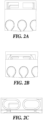
- FIG. 2A shows an exemplary multi-analyte electrode system configuration for a diagnostic test element.
- the sample chamber of the test element has an electrode system of electrically conductive material that includes a pair of SSEs positioned along a respective side edge of the non-conductive substrate, a CE/WE pair for measuring a first analyte positioned adjacent one of the SSEs and WE for measuring a second analyte positioned adjacent the other SSE, where the WE for measuring the second analyte has a greater working area than the WE for the first analyte.
- FIG. 2B shows another exemplary multi-analyte electrode system configuration for a diagnostic test element.
- the sample chamber of the test element has an electrode system of electrically conductive material that includes a pair of SSEs positioned along a respective side edge of the non-conductive substrate, a CE/WE pair for measuring a first analyte and a WE for measuring the second analyte.
- the CE in FIG. 2B extends across the sample chamber in front of both WEs. Additionally, the WEs have equivalent working areas.
- FIG. 2C shows yet another exemplary multi-analyte electrode system configuration for a diagnostic test element.
- FIG. 2C does not include the SSEs and includes a WE for the second analyte having a working area greater than the WE for the first analyte.
- the detection reagents described above can be formulated as a viscous solution that includes thickeners and thixotropic agents to enhance its physical properties.
- the thickeners are selected to provide a thick, liquid matrix having the remaining components homogeneously dispersed therein.
- the thickening and thixotropic agents also inhibit the liquid or semi-paste material from running or spreading over the surface of the substrate after each has been deposited and before they dries. After the detection reagents are deposited, they quickly dry to a readily hydratable reagent matrix.
- dry detection reagents can be provided by dissolving these components first in a solvent or solvent mixture and subsequently removing the solvent or mixture of solvents by a suitable treatment as described in further detail below.
- dry means that the reagent composition is essentially free of a solvent or a mixture of solvents.
- essentially free means that at least about 85%, at least about 90%, at least about 91%, at least about 92%, at least about 93%, at least about 94%, at least about 95%, at least about 96%, at least about 97% or even at least 98% of the solvent or solvent mixture that was originally present in a solution of the reagent composition is removed from the composition.
- the solvent or solvent mixture is present in the dry reagent composition in an amount of up to about 15%, up to about 10%, up to about 9%, up to about 8%, up to about 7%, up to about 6%, up to about 5%, up to about 4%, up to about 3% or up to about 2%.
- the aforementioned percentage values and the other percentage values referred to herein refer to percent by weight (w/w).
- the detection reagents can be applied via ink jetting over their respective electrode(s). See, e.g., US Patent No. 9,157,109 .
- the detection reagents can be applied via drop on demand printing over their respective electrode(s).
- the detection reagents can be applied via a PicoJet ® Dispensing System (Nordson EFD) to deposit the detection reagent(s) in discrete areas of the sample chamber.
- PicoJet ® Dispensing System Nedson EFD
- Other contact or non-contact dispensing systems also can be used, which are described in the paragraphs below.
- the detection reagents can be applied via vacuum-assist slot die coating over their respective electrode(s).
- Methods of controlling detection reagent thickness and uniformity by vacuum-assist slot die coating are described in, for example, Int'l Patent Application Publication No. WO 2012/139767 and US Patent No. 7,749,437 .
- the diagnostic test elements can include one or more reflection layers of one or more pigments that have reflective properties such as, for example, white pigments such as titanium dioxide particles.
- the at least one reflection layer can be on a surface of the substrate that faces away from the detection reagents, which can be in the form of test fields, thus serving as a sample application side. In this manner, the detection of the at least one analyte can take place through the substrate from a side opposite to the sample application side.
- the substrate can be completely or partially optically transparent for at least one excitation light irradiated into the detection reagents and/or transparent for at least one detection light reflected and/or emitted by the detection reagents, where a transparency is understood as a transparency of at least about 70%.
- the liquid sample can be introduced laterally into the detection reagents (i.e., parallel to the layer structure).
- a concern in multi-analyte diagnostic test elements is controlling for potential cross-talk in signals that can occur between or among the various detection reagents.
- Several methods of attenuating or avoiding cross-talk are known in the art and can be used in connection with the multi-analyte test elements disclosed herein. For example, one can control diffusion of components from one detection reagent matrix to the other by (1) using detection reagent formulations that swell but are not completely soluble (e.g.
- the matrix materials described above (2) by spacing the detection reagents apart from one another; (3) by using physical barriers between the detection reagents (i.e., leaving residual conductive material or other materials; laser marking on the substrate); and/or (4) by using a short time frame to complete the measurement so that reagent diffusion is limited.
- Test systems can include an analyte measurement device and at least one multi-analyte diagnostic test elements as described above.
- FIG. 3 shows an exemplary analyte measurement system including an analyte measuring device such as a test meter 38 operatively coupled with an electrochemical diagnostic test element 10.
- the test element is a multi-analyte diagnostic test element as described in detail above.
- the meter 38 and the diagnostic test element 10 are operable to determine concentration of a plurality of analytes in a body fluid sample provided to the test element 10.
- the sample may be a body fluid sample such as, for example, whole blood, plasma, serum, urine, or saliva.
- the sample may be another type of fluid sample to be tested for the presence or concentration of one or more electrochemically reactive analyte(s) such as an aqueous environmental sample.
- the diagnostic test element 10 is a single use test strip removably inserted into a connection terminal (or test element port) 40 of meter 38.
- the test element 10 is configured as a dual analyte - glucose and ketone - test element and includes features and functionalities for electrochemically measuring glucose and ketones.
- the test element 10 is configured to electrochemically measure other analytes such as, for example, amino acids, antibodies, bacteria, carbohydrates, drugs, lipids, markers, nucleic acids, peptides, proteins, toxins, viruses, and other analytes.
- the meter 38 generally includes an entry (or input) means 44, a controller, a memory associated with the controller/microcontroller, and a programmable processor associated with the controller and connected with the memory.
- the meter includes an output such as an electronic display 42 that is connected to the processor and is used to display various types of information to the user including analyte concentration(s) or other test results.
- the meter 38 further includes associated test signal generating and measuring circuitry (not shown) that are operable to generate a test signal, to apply the signal to the test element 10, and to measure one or more responses of the test element 10 to the test signal.
- the processor also is connected with a test element port and is operable to process and record data in memory relating to detecting the presence and/or concentration of the analytes obtained through use of a multi-analyte test element as described herein.
- Test element port includes connectors configured to engage with contact pads of the electrical system.
- the meter includes user entry means connected with the processor, which is accessible by a user to provide input to processor, where the processor is further programmable to receive input commands from user entry means and provide an output that responds to the input commands.
- the processor also is connected with a communication module or link to facilitate wireless transmissions with the meter 38.
- the communication link may be used to exchange messages, warnings, or other information between the meter 38 and another device or party, such as a caseworker, caregiver, parent, guardian or healthcare provider, including nurses, pharmacists, primary or secondary care physicians and emergency medical professionals, just to provide a few possibilities.
- the communication link also can be utilized for downloading programming updates for meter 38.
- the communication link may be configured for sending and receiving information through mobile phone standard technology, including third-generation (3G) and fourth-generation (4G) technologies, or through BLUETOOTH ® , ZIGBEE ® , Wibree, ultra-wide band (UWB), wireless local area network (WLAN), General Packet Radio Service (GPRS), Worldwide Interoperability for Microwave Access (WiMAX or WiMAN), Wireless Medical Telemetry (WMTS), Wireless Universal Serial Bus (WUSB), Global System for Mobile communications (GSM), Short Message Service (SMS) or WLAN 802.11x standards.
- 3G third-generation
- 4G fourth-generation
- Wibree ultra-wide band
- WLAN wireless local area network
- GPRS General Packet Radio Service
- WiMAX or WiMAN Worldwide Interoperability for Microwave Access
- WMTS Wireless Medical Telemetry
- WUSB Wireless Universal Serial Bus
- GSM Global System for Mobile communications
- SMS Short Message Service
- WLAN 802.11x standards.
- the controller therefore can include one or more components configured as a single unit or of multi-component form and can be programmable, a state logic machine or other type of dedicated hardware, or a hybrid combination of programmable and dedicated hardware.
- One or more components of the controller may be of the electronic variety defining digital circuitry, analog circuitry, or both.
- the controller may include one or more mechanical or optical control elements.
- the controller includes an integrated processor operatively coupled to one or more solid-state memory devices defining, at least in part, memory.
- the memory contains operating logic to be executed by processor that is a microprocessor and is arranged for reading and writing of data in the memory in accordance with one or more routines of a program executed by the microprocessor.
- the memory can include one or more types of solid-state electronic memory and additionally or alternatively may include the magnetic or optical variety.
- the memory can include solid-state electronic random access memory (RAM), sequentially accessible memory (SAM) (such as the first-in, first-out (FIFO) variety or the last-in, first-out (LIFO) variety), programmable read only memory (PROM), electrically programmable read only memory (EPROM), or electrically erasable programmable read only memory (EEPROM); or a combination of any of these types.
- the memory may be volatile, nonvolatile or a hybrid combination of volatile and nonvolatile varieties. Some or all of the memory can be of a portable type, such as a disk, tape, memory stick, cartridge, code chip or the like. Memory can be at least partially integrated with the processor and/or may be in the form of one or more components or units.
- the meter 38 may utilize a removable memory key, which is pluggable into a socket or other receiving means and which communicates with the memory or controller to provide information relating to calibration codes, measurement methods, measurement techniques, and information management.
- a removable memory key which is pluggable into a socket or other receiving means and which communicates with the memory or controller to provide information relating to calibration codes, measurement methods, measurement techniques, and information management. Examples of such removable memory keys are disclosed in, for example, US Patent Nos. 5,366,609 and 5,053,199 .
- the controller also can include signal conditioners, filters, limiters, analog-to-digital (A/D) converters, digital-to-analog (D/A) converters, communication ports, or other types of operators as would occur to one of skill in the art.
- A/D analog-to-digital
- D/A digital-to-analog
- entry means 44 it may be defined by a plurality of push-button input devices, although the entry means 44 may include one or more other types of input devices like a keyboard, mouse or other pointing device, touch screen, touch pad, roller ball, or a voice recognition input subsystem.
- the display 42 may include one or more output means like an operator display that can be of a cathode ray tube (CRT) type, liquid crystal display (LCD) type, plasma type, organic light emitting diode (OLED) type, a printer, or the like.
- output means like an operator display that can be of a cathode ray tube (CRT) type, liquid crystal display (LCD) type, plasma type, organic light emitting diode (OLED) type, a printer, or the like.
- Other input and display means can be included such as loudspeakers, voice generators, voice and speech recognition systems, haptic displays, electronic wired or wireless communication subsystems, and the like.
- the test element port 40 includes connectors configured to engage with contact pads of the electrode system of the test elements described herein.
- the connection between meter 38 and the diagnostic test element 10 is used to apply a test signal having a potential or a series of potentials across the electrodes of the electrode system and to subsequently receive electrochemical signals that are produced by the detection reagents in the presence of the analytes of interest and can be correlated to the concentration of the analytes.
- the processor is configured to evaluate the electrochemical signals to assess the presence and/or concentration of the analytes, where the results of the same may be stored in the memory.
- the meter 38 can be configured as a blood glucose measurement meter and includes features and functionalities of the ACCU-CHEK ® AVIVA ® meter as described in the booklet "Accu-Chek ® Aviva Blood Glucose Meter Owner's Booklet” (2007), portions of which are disclosed in US Patent No. 6,645,368 .
- meter 38 can be configured to electrochemically measure one or more other analytes such as, for example, amino acids, antibodies, bacteria, carbohydrates, drugs, lipids, markers, nucleic acids, proteins, peptides, toxins, viruses, and other analytes. Additional details regarding exemplary meters configured for use with electrochemical measurement methods are disclosed in, for example, US Patent Nos.
- test systems include one more multi-analyte diagnostic test elements as described in detail above.
- lancing devices for obtaining a body fluid sample.
- lancing devices are described in, for example, Int'l Patent Application Publication Nos. WO 2012/089523 and WO 2012/089524 .
- the lancing device can be integrated into the meter. See , e.g. , id.
- the measuring methods disclosed herein largely utilize amperometry; however, it is contemplated that the methods can be used with other electrochemical measuring techniques (e.g., coulometry, potentiometry or voltammetry). Moreover, the measuring methods can be implemented using advanced microprocessor-based algorithms and processes that result in dramatically improved system performance. These measuring methods also offer flexibility and number of ways to create algorithms that can achieve improved performance such as 10/10 performance.
- 10/10 performance means, for example, that a measured blood glucose concentration is within about ⁇ 10% of the actual blood glucose concentration for glucose concentrations >100 mg/dL, and within ⁇ 10 mg/dL of the actual blood glucose concentration for glucose concentrations ⁇ 100 mg/dL.
- the measuring methods can include the steps described herein, and these steps may be, but not necessarily, carried out in the sequence as described. Other sequences, however, also are conceivable. Furthermore, individual or multiple steps may be carried out either in parallel and/or overlapping in time and/or individually or in multiply repeated steps. Moreover, the methods may include additional, unspecified steps.
- the measuring methods begin by obtaining a body fluid sample having or suspected of having one or more analytes of interest therein.
- body fluids include, but are not limited to, blood, interstitial fluid, saliva, tears and urine.
- blood means whole blood and its cell-free components, namely plasma and serum.
- the body sample fluid may be fresh capillary blood obtained by lancing a fingertip or approved alternate sites (e.g., forearm, palm, ear lobe, upper arm, calf and thigh).
- the bodily fluid sample containing the analyte(s) of interest may be acquired and delivered to the test elements in any fashion.
- the measuring methods principally relate to in vitro methods.
- a blood sample may be obtained in conventional fashion by incising the skin, such as with a lancet, needle or scalpel, and then contacting the test element with blood sample that appears at the skin surface.
- the test elements can be used in connection with control fluids that are used in conventional fashion to verify the integrity of the test system.
- the diagnostic test elements are operable for assessing the targeted analytes while only using a very small volume of a body fluid sample. In this manner, only a slight skin incision is necessary to produce the volume of body fluid required for the test, and the pain and other concerns with such method can be minimized or eliminated.
- the methods include applying an electrical test sequence to the electrode system of the test element.
- a test sequence can be supplied by the meter from its connection terminals to one or more contact pads of the electrode system.
- electrical test sequences include one or more AC blocks (optional) and/or one or more DC blocks as are known in the art. See , e.g. , Int'l Patent Application Publication Nos. WO 2014/140718 ; WO 2014/140164 ; WO 2014/140170 ; WO 2014/140172 ; WO 2014/140173 ; and WO 2014/140177 .
- FIGS. 4A-F show exemplary test sequences that may be used in connection with SMBG and other test systems. As shown in FIGS. 4A-B , the test sequence can include one or more blocks of AC and or DC potentials, which are described in greater detail below.
- the AC block can include a plurality of AC segments such as, for example, from about 2 segments to about 10 segments, from about 3 segments to about 9 segments, from about 4 segments to about 8 segments, from about 5 segments to about 7 segments, or about 6 segments.
- the AC block can include about 2 segments, about 3 segments, about 4 segments, about 5 segments, about 6 segments, about 7 segments, about 8 segments, about 9 segments, or about 10 segments.
- the AC block can have more than 10 segments, that is, about 15 segments, about 20 segments, or about 25 segments.
- the AC block can include 1 segment, where the segment has multiple low-frequency AC signals applied simultaneously.
- the frequency of each signal in each segment of the AC block can be from about 1 kHz to about 20 kHz, from about 2 kHz to about 19 kHz, from about 3 kHz to about 18 kHz, from about 4 kHz to about 17 kHz, from about 5 kHz to about 16 kHz, from about 6 kHz to about 15 kHz, from about 7 kHz to about 14 kHz, from about 8 kHz to about 13 kHz, from about 9 kHz to about 12 kHz or from about 10 kHz to about 11 kHz.
- the frequency of each segment in the AC block can be about 1 kHz, about 2 kHz, about 3 kHz, about 4 kHz, about 5 kHz, about 6 kHz, about 7 kHz, about 8 kHz, about 9 kHz, about 10 kHz, about 11 kHz, about 12 kHz, about 13 kHz, about 14 kHz, about 15 kHz, about 16 kHz, about 17 kHz, about 18 kHz, about 19 kHz, or about 20 kHz.
- the frequency of each signal in each segment of the AC block can be more than 20 kHz, that is, about 30 kHz, about 40 kHz, or about 50 kHz.
- one or more of the segments can have the same frequency, whereas in other instances each segment has a distinct frequency from the other segments.
- Four frequencies generally is adequate. The exact frequencies employed can be readily generated by simple integer division of a measurement system clock's maximum frequency.
- a maximum frequency limit for a signal in a segment of the AC block can be up to about 100 kHz for an inexpensive, battery-powered handheld instrument such as the meter. Beyond that, the increasing demands on analog bandwidth, sampling rate, storage and processing speed quickly add up, while the imaginary portion of a typical biosensor response becomes increasingly smaller with frequency. Lower frequencies have longer periods and take longer times to sample with comparable accuracy.
- the AC block typically includes at least two different low-amplitude signals.
- the AC block can include two (2) segments at two (2) frequencies such as, for example, about 10 kHz or about 20 kHz followed by about 1 kHz or about 2 kHz.
- the AC block includes a plurality of low-amplitude signals.
- the AC block can have five (5) segments at four (4) frequencies such as, for example, about 10 kHz, about 20 kHz, about 10 kHz, about 2 kHz and about 1 kHz.
- the AC block can have four (4) segments at four (4) frequencies such as, for example, about 20 kHz, about 10 kHz, about 2 kHz and about 1 kHz.
- the AC block can have four (4) frequencies applied simultaneously at about 10 kHz, about 20 kHz, about 10 kHz, about 2 kHz and about 1 kHz.
- the AC block can have a multi-frequency excitation waveform that simultaneously applies the desired low-amplitude AC signals.
- the AC frequencies may be applied sequentially, or combined and applied simultaneously and analyzed via Fourier Transform.
- the block of low-amplitude AC signals can be applied for about 500 msec to about 1.5 sec, about 600 msec to about 1.25 sec, about 700 msec to about 1000 msec, or about 800 msec to about 900 msec.
- the block of low-amplitude AC signals can be applied for about 500 msec, about 600 msec, about 700 msec, about 800 msec, about 900 msec, about 1000 msec, about 1.25 sec or about 1.5 sec.
- the block of low-amplitude AC signals can be applied for about 100 msec to about 300 msec.
- AC current response information can be obtained at any time during a test sequence. Impedance results at lower frequencies may be influenced by analyte concentration if obtained after an electrochemical cell is DC polarized. In some instances, a series of AC current response measurements can be obtained early in the test sequence. Measurements taken shortly after a fluidic sample is applied to a test element will be influenced by diffusion, temperature and reagent solubility. In other instances, the AC response current measurements can be obtained at a sufficient time after an adequate sample has been applied to allow the response to stabilize, and avoid the transient response in the first second. Likewise, response current measurements can be made at one or more frequencies. Due to their capacitive nature, multiple AC measurements separated by a frequency octave or decade may offer different sensitivities or easier manipulation.
- the response information to such an AC block can be used to assess diffusion, temperature and reagent solubility prior to initiating the analyte measurements. Consequently, the response information to the AC block can be used to correct for confounding variables such as Hct and/or temperature or to determine the condition of the test element and its suitability for providing an accurate result.
- the DC block can include a plurality of pulses such as, for example, from about 2 pulses to about 10 pulses, from about 3 pulses to about 9 pulses, from about 4 pulses to about 8 pulses, from about 5 pulses to about 7 pulses, or about 6 pulses.
- the DC block can include about 2 pulses, about 3 pulses, about 4 pulses, about 5 pulses, about 6 pulses, about 7 pulses, about 8 pulses, about 9 pulses, or about 10 pulses.
- the DC block can have more than 10 pulses, that is, about 15 pulses, about 20 pulses, or about 25 pulses.
- pulse means at least one excitation and one recovery period.
- the DC block typically includes a constantly applied potential difference that alternates between about 0 mV and about +450 mV potential difference, or other slowly time-varying potential difference that can be analyzed by traditional DC electrochemical methods.
- a constantly applied potential difference that alternates between about 0 mV and about +450 mV potential difference, or other slowly time-varying potential difference that can be analyzed by traditional DC electrochemical methods.
- excitation pulse potential can be greater-than, less-than or equal to about +450 mV.
- excitation potentials include, but are not limited to, 50 mV, 75 mV, 100 mV, 125 mV, 150 mV, 175 mV, 200 mV, 225 mV, 250 mV, 275 mV, 300 mV, 325 mV, 350 mV, 375 mV, 400 mV, 425 mV, 450 mV, 475 mV, 500 mV, 525 mV, 550 mV, 575 mV, 600 mV, 625 mV, 650 mV, 675 mV, 700 mV, 725 mV.
- each DC pulse can be applied for about 50 msec to about 500 msec, about 60 msec to about 450 msec, about 70 msec to about 400 msec, about 80 msec to about 350 msec, about 90 msec to about 300 msec, about 100 msec to about 250 msec, about 150 msec to about 200 msec, or about 175 msec.
- each pulse can be applied for about 50 msec, about 60 msec, about 70 msec, about 80 msec, about 90 msec, about 100 msec, about 125 msec, about 150 msec, about 175 msec, about 200 msec, about 225 msec, about 250 msec, about 275 msec, about 300 msec, about 325 msec, about 350 msec, about 375 msec, about 400 msec, about 425 msec, about 450 msec, about 475 msec or about 500 msec.
- each DC pulse at +450 mV can be applied for about 250 msec
- each DC pulse at 0 mV can be applied for about 500 msec.
- each pulse can be applied for less than about 50 msec or more than about 500 msec.
- each DC pulse is selected to provide about 50% or greater reduction in peak current relative to the peak current provided by a nearly ideal potential transition.
- each pulse can have the same ramp rate.
- some pulses can have the same ramp rate and other pulses can have a different ramp rate.
- each pulse has its own ramp rate.
- effective ramp rates can be from about 5 mV/msec to about 75 mV/msec or from about 10 mV/msec to about 50 mV/msec, 15 mV/msec to about 25 mV/msec, or about 20 mV/msec.
- the ramp rate can be about 5 mV/msec, about 10 mV/msec, about 15 mV/msec, about 20 mV/msec, about 25 mV/msec, about 30 mV/msec, about 35 mV/msec, about 40 mV/msec, about 45 mV/msec, about 50 mV/msec, about 55 mV/msec, about 60 mV/msec, about 65 mV/msec, about 70 mV/msec, or about 75 mV/msec.
- the ramp rate can be from about 40 mV/msec to about 50 mV/msec.
- the applied DC potential can be fixed at about 0 mV between pulses to provide a recovery pulse, thus making it a generally continuous excitation waveform.
- recovery pulse means a zero-potential pulse (e.g., about -10 mV to about +10 mV) applied for an adequately long recovery period in which the electrochemical reaction with the analyte of interested (e.g., glucose) is turned “off,” thereby allowing the system to return to a fixed starting point before subsequent interrogation with another positive DC pulse.
- An exemplary DC block therefore can alternate (i.e., pulse) between about 0 mV and about +450 mV (in biamperometric mode).
- the response information to such a DC block can be used to assess a first analyte concentration or presence, such as a glucose concentration or presence. Additionally, information such as a recovery current response, shape and/or magnitude from the DC block potentials can be used to correct for not only Hct and/or temperature but also wetting of the reagent and sample diffusion, as well as variations in detection reagent thickness.
- the multi-analyte test sequence can include a waveform having plurality of intervals such as, for example, from about 2 intervals to about 10 intervals, from about 3 intervals to about 9 intervals, from about 4 intervals to about 8 intervals, from about 5 intervals to about 7 intervals, or about 6 intervals.
- the waveform can include about 1 interval, about 2 intervals, about 3 intervals, about 4 intervals, about 5 intervals, about 6 intervals, about 7 intervals, about 8 intervals, about 9 intervals, or about 10 intervals.
- the waveform can have more than 10 intervals, that is, about 15 intervals, about 20 intervals, or about 25 intervals. The number of waveform intervals, however, typically is limited by the available time for the test sequence.
- the waveform intervals can be at a potential that alternates or cycles between a positive potential and a negative potential (or vice versa).
- the potential can alternate from about -450 mV to about +450 mV, from about -425 mV to about +425 mV, from about -400 mV to about +400 mV, from about -375 mV to about +375 mV, from about -350 mV to about +350 mV, from about -325 mV to about +325 mV, from about -300 mV to about +300 mV, from about -275 mV to about +275 mV, from about - 250 mV to about +250 mV, from about -225 mV to about +225 mV, from about -200 mV to about +200 mV, from about -175 mV to about +175 mV, from about -150 mV to about +150 mV, from about -125
- each waveform interval can be applied for about 100 msec to about 5 sec, from about 200 msec to about 4 sec, from about 300 msec to about 3 sec, from about 400 msec to about 2 sec, from about 500 msec to about 1 sec, from about 600 msec to about 900 msec, or from about 700 msec to about 800 msec.
- each waveform interval can be applied for about 100 msec, about 150 msec, about 200 msec, about 250 msec, about 300 msec, about 350 msec, about 400 msec, about 450 msec, about 500 msec, about 550 msec, about 600 msec, about 650 msec, about 700 msec, about 750 msec, about 800 msec, about 850 msec, about 900 msec, about 950 msec, about 1 sec, about 1.5 sec, about 2 sec, about 2.5 sec, about 3 sec, about 3.5 sec, about 4 sec, about 4.5 sec, or about 5 sec.
- each waveform interval at about -450 mV can be applied for about 100 msec to about 200 msec, and each waveform interval at about +450 mV can be applied for about 100 msec to about 200 msec.
- each waveform interval can be applied for less than about 100 msec or more than about 5 sec.
- the waveform intervals can have the same ramp rates. In other instances, some waveform intervals can have the same ramp rate and other waveform intervals can have a different ramp rate. In still other instances, each waveform interval has its own ramp rate.
- the ramp rate can be from about 0.5 mV/msec to ⁇ 45 mV/msec.
- the ramp rate of each interval can be from about 1 mV/msec to about 40 mV/msec, from about 2 mV/msec to about 30 mV/msec, from about 3 mV/msec to about 20 mV/msec, from about 4 mV/msec to about 19 mV/msec, from about 5 mV/msec to about 18 mV/msec, from about 6 mV/msec to about 17 mV/msec, from about 7 mV/msec to about 16 mV/msec, from about 8 mV/msec to about 15 mV/msec, from about 9 mV/msec to about 14 mV/msec, or from about 10 mV/msec to about 13 mV/msec, or about 11 mV/msec to about 12 mV/msec.
- the ramp rate of each intervals can be about 0.5 mV/msec, 1 mV/msec, about 2 mV/msec, about 3 mV/msec, about 4 mV/msec, about 5 mV/msec, about 6 mV/msec, about 7 mV/msec, about 8 mV/msec, about 9 mV/msec, about 10 mV/msec, about 11 mV/msec, about 12 mV/msec, about 13 mV/msec, about 14 mV/msec, about 15 mV/msec, about 16 mV/msec, about 17 mV/msec, about 18 mV/msec, about 19 mV/msec, about 20 mV/msec, about 25 mV/msec, about 30 mV/msec, about 35 mV/msec, about 40 mV/msec, or about 45 mV/msec.
- the ramp rate is between
- the waveform can be a triangular waveform, trapezoidal waveform, sinusoidal waveform or combinations thereof.
- Such a DC block can be used to assess a second analyte's concentration or presence, such as a ketone concentration or presence. Additionally, information such as a recovery current response, shape and/or magnitude from the DC block potentials can be used to assess detection reagent health and/or presence of certain interferents such as antioxidants (e.g., ascorbate, citric acid, deferoxamine (DFO), glutathione, N-acetylcysteine (NAC), pyrrolidine dithiocarbamate (PDTC), trylizad-mesylate (TLM) and uric acid).
- antioxidants e.g., ascorbate, citric acid, deferoxamine (DFO), glutathione, N-acetylcysteine (NAC), pyrrolidine dithiocarbamate (PDTC), trylizad-mesylate (TLM) and uric acid.
- a waveform for the multi-analyte test sequence can include a waveform having plurality of intervals such as, for example, from about 2 intervals to about 10 intervals, from about 3 intervals to about 9 intervals, from about 4 intervals to about 8 intervals, from about 5 intervals to about 7 intervals, or about 6 intervals.
- the waveform can include about 1 interval, about 2 intervals, about 3 intervals, about 4 intervals, about 5 intervals, about 6 intervals, about 7 intervals, about 8 intervals, about 9 intervals, or about 10 intervals.
- the waveform can have more than 10 intervals, that is, about 15 intervals, about 20 intervals, or about 25 intervals. The number of waveform intervals, however, typically is limited by the available time for the test sequence.
- the waveform intervals can be at a potential that alternates or cycles between a positive potential and a negative potential (or vice versa).
- the potential can alternate from about 0 mV to about +250 mV, from about 0 mV to about +225 mV, from about 0 mV to about +200 mV, from about 0 mV to about +175 mV, from about 0 mV to about +150 mV, from about 0 mV to about +125 mV, from about -0 mV to about +100 mV.
- the potential can be maintained at about 250 mV, at about 225 mV, at about 200 mV, at about 175 mV, at about 150 mv, at about 125 mV, or at about 100 mV.
- one or more of the successive cycles can have the same potential, whereas in other instances the successive cycles have a distinct potential from the other segments.
- each waveform interval can be applied for about 100 msec to about 5 sec, from about 200 msec to about 4 sec, from about 300 msec to about 3 sec, from about 400 msec to about 2 sec, from about 500 msec to about 1 sec, from about 600 msec to about 900 msec, or from about 700 msec to about 800 msec.
- each waveform interval can be applied for about 100 msec, about 150 msec, about 200 msec, about 250 msec, about 300 msec, about 350 msec, about 400 msec, about 450 msec, about 500 msec, about 550 msec, about 600 msec, about 650 msec, about 700 msec, about 750 msec, about 800 msec, about 850 msec, about 900 msec, about 950 msec, about 1 sec, about 1.5 sec, about 2 sec, about 2.5 sec, about 3 sec, about 3.5 sec, about 4 sec, about 4.5 sec, or about 5 sec.
- each waveform interval at about -450 mV can be applied for about 100 msec to about 200 msec, and each waveform interval at about +450 mV can be applied for about 100 msec to about 200 msec.
- each waveform interval can be applied for less than about 100 msec or more than about 5 sec.
- the waveform intervals can have the same ramp rates. In other instances, some waveform intervals can have the same ramp rate and other waveform intervals can have a different ramp rate. In still other instances, each waveform interval has its own ramp rate.
- the ramp rate can be from about 0.5 mV/msec to ⁇ 45 mV/msec.
- the ramp rate of each interval can be from about 1 mV/msec to about 40 mV/msec, from about 2 mV/msec to about 30 mV/msec, from about 3 mV/msec to about 20 mV/msec, from about 4 mV/msec to about 19 mV/msec, from about 5 mV/msec to about 18 mV/msec, from about 6 mV/msec to about 17 mV/msec, from about 7 mV/msec to about 16 mV/msec, from about 8 mV/msec to about 15 mV/msec, from about 9 mV/msec to about 14 mV/msec, or from about 10 mV/msec to about 13 mV/msec, or about 11 mV/msec to about 12 mV/msec.
- the ramp rate of each intervals can be about 0.5 mV/msec, 1 mV/msec, about 2 mV/msec, about 3 mV/msec, about 4 mV/msec, about 5 mV/msec, about 6 mV/msec, about 7 mV/msec, about 8 mV/msec, about 9 mV/msec, about 10 mV/msec, about 11 mV/msec, about 12 mV/msec, about 13 mV/msec, about 14 mV/msec, about 15 mV/msec, about 16 mV/msec, about 17 mV/msec, about 18 mV/msec, about 19 mV/msec, about 20 mV/msec, about 25 mV/msec, about 30 mV/msec, about 35 mV/msec, about 40 mV/msec, or about 45 mV/msec.
- the ramp rate is between
- the waveform can be a triangular waveform, trapezoidal waveform, sinusoidal waveform or combinations thereof.
- the response information to such a DC block can be used to assess a second analyte's concentration or presence, such as a ketone concentration or presence.
- FIG. 4A An exemplary multi-analyte test sequence is shown in FIG. 4A (left panel), which includes (1) a first fixed DC potential difference between a first electrode pair dedicated to measuring a first analyte, followed by (2) a second fixed DC potential difference between a second electrode pair dedicated to measuring a second analyte.
- a first fixed DC potential difference between a first electrode pair dedicated to measuring a first analyte followed by (2) a second fixed DC potential difference between a second electrode pair dedicated to measuring a second analyte.
- the sequence order can be determined by the analyte that benefits from a longer reaction time.
- the first analyte is measured kinetically, while the second analyte's WE remains open circuited.
- FIG. 4A shows an exemplary response to the test sequence shown in FIG. 4A (left panel).
- FIG. 4B An alternative exemplary multi-analyte test sequence is shown in FIG. 4B (left panel), which includes (1) a delay after a sample is introduced to the test element to allow the reactions to proceed, during which an open circuit or near 0 V potential difference is maintained between both electrode pairs, (2) a first fixed DC potential difference sufficient to generate a faradaic current between a first electrode pair, dedicated to measuring a first analyte, followed by (3) a second fixed DC potential difference sufficient to generate a faradaic current between a second electrode pair dedicated to measuring a second analyte.
- FIG. 4B (right panel) shows an exemplary response to the test sequence shown in FIG. 4B (left panel).
- FIG. 4C An alternative exemplary multi-analyte test sequence is shown in FIG. 4C (left panel), which includes (1) a delay after a sample is introduced to the test element to allow the reactions to proceed, during which an open circuit or near 0 V potential difference is maintained between both electrode pairs, (2) a first fixed DC potential difference sufficient to generate a faradaic current between a first electrode pair, dedicated to measuring a first analyte, followed by (3) a near 0 V DC potential difference between the first electrode pair to allow the current to return to 0, then (4) a second fixed DC potential difference sufficient to generate a faradaic current between a second electrode pair dedicated to measuring a second analyte.
- FIG. 4C (right panel) shows an exemplary response to the test sequence shown in FIG. 4C (left panel).
- FIG. 4D An alternative exemplary multi-analyte test sequence is shown in FIG. 4D (left panel), which includes (1) a delay after a sample is introduced to the test element to allow the reactions to proceed, during which an open circuit or near 0 V potential difference is maintained between both electrode pairs, (2) a first DC block of short-duration (e.g., about 50-500 msec) about +450 mV pulses separated by similarly short-duration (e.g., about 50-500 msec) recovery intervals during which about 0 mV potential difference is applied, followed by (3) a second DC block applying a fixed potential difference of about +175 mV following an open circuit between a second electrode pair dedicated to measuring a second analyte.
- FIG. 4D (right panel) shows an exemplary response to the test sequence shown in FIG. 4D (left panel).
- test sequence includes (1) a delay after a sample is introduced to the test element to allow the reactions to proceed, during which an open circuit or near 0 V potential difference is maintained between both electrode pairs, (2) an AC block of a plurality of low-amplitude AC signals, (3) a first DC block of short-duration ( e . g ., about 50-500 msec) pulses ramped to or from about 0 V to about +450 mV over an interval of 10 msec, separated by similarly short-duration ( e .
- short-duration e . g ., about 50-500 msec
- FIG. 4E shows an exemplary response to the test sequence shown in FIG. 4E (left panel).
- the AC component can be a series of small amplitude excitations at multiple discrete frequencies.
- the first (pulsed) DC component can be a series of slew rate-controlled potential differences applied across a primary electrode pair between 0 V DC and an amplitude ( i . e ., +450 mV is this example) sufficient to produce a faradaic current response proportional to the primary analyte's concentration.
- the potential's amplitude is dependent on the primary analyte's mediator.
- the 130 msec positive pulses are interspersed with intervals of 0 V applied potential difference of sufficient duration to allow the electrochemical cell to return to close to its initial state (I ⁇ 0).
- the second DC component emulates a cyclic voltammetry technique.
- the potential difference applied to primary electrode pair is swept between +450 mV and -450 mV at a rate of 3.5 V/sec.
- the second DC component therefor can be used to detect electro-active interferents.
- This is followed by a third DC component for measuring a secondary analyte concentration.
- the third DC component applies one or more slew rate-controlled potential difference(s) across a secondary electrode pair at an amplitude ( i . e ., +175 mV is this example) sufficient to produce a faradaic current response proportional to the secondary analyte's concentration, and dependent on the secondary analyte's mediator.
- the secondary analyte's current is measured at a time after applying the secondary potential, typically about 500 msec.
- test sequence includes not only the AC and DC components as discussed above but also a burn-off interval.
- the test sequence includes (1) a burn-off interval during which a first positive potential difference is briefly applied between one or both electrode pairs to reduce the amount of reduced mediator present in the reagent(s) prior to a significant contribution from the analyte reaction of interest, (2) an AC block of a plurality of low-amplitude AC signals; (3) a first DC component of short-duration ( e .
- FIG. 4F shows an exemplary response to the test sequence shown in FIG. 4F (left panel).
- one of the test signals described herein can be applied to one or more of the WEs to provide a potential difference between the WE and CE.
- a test potential other than virtual ground or reference potential can be provided as a CE to provide a potential difference between the WE and CE. It shall be appreciated that the foregoing and a variety of other additional and alternate test cell, electrode, and/or circuitry configurations operable to apply a test signal to an electrode system in contact with a combined sample and detection reagent and measure a response thereto may be utilized.
- AC and/or DC current response information is collected from the applied test sequence and includes current responses to the AC and DC blocks. Important information includes, but is not limited to, duration, shape and/or magnitude of the current response to an excitation pulse and/or a recovery pulse in the test sequence.
- the current response information can be collected at an A/D sampling rate for DC and AC measurements to simplify the system design, including a single shared signal path for AC and DC measurements.
- Common digital audio sampling rates range include, but are not limited to, from about 44.1 kHz to about 192 kHz. A/D converters in this range are readily available from variety of commercial semiconductor suppliers.
- Current response information to the AC block can be used to determine impedance, admittance and phase values or other complex parameters as described in further detail below.
- current information to the DC blocks can be used to determine analyte concentrations or other complex parameters as described in further detail below (e . g ., Hct-, temperature-, and/or interferent-based compensation and/or corrections, as well as compensations and/or corrections for reagent wetting, reagent film thickness, and reaction kinetics).
- the AC and/or DC response current information can be obtained ( i . e ., measured or recorded) at about 2,000/sec to about 200,000/sec, at about 3,000/sec to about 190,000/sec, at about 4,000/sec to about 180,000/sec, at about 5,000/sec to about 170,000, at about 6,000/sec to about 160,000/sec, at about 7,000/sec to about 150,000/sec, at about 8,000/sec to about 140,000/sec, at about 9,000/sec to about 130,000/sec, at about 10,000/sec to about 120,000/sec, at about 15,000/sec to about 110,000/sec, at about 20,000/sec to about 100,000/sec, at about 30,000/sec to about 90,000/sec, at about 40,000/sec to about 80,000/sec, at about 50,000/sec to about 70,000/sec, or at about 60,000/sec.
- the AC and/or DC response current information can be obtained at about 100/sec to about 200/sec, at about 200/sec to about 300/sec, at about 300/sec to about 400/sec, at about 400/sec to about 500/sec, at about 500/sec to about 600/sec, at about 600/sec to about 700/sec, at about 700/sec to about 800/sec, at about 800/sec to about 900/sec, at about 1,000/sec to about 1,500/sec, at about 1,500/sec to about 2,000/sec, at about 2,000/sec to about 2,500/sec, at about 2,500/sec to about 3,000/sec, at about 3,000/sec to about 3,500/sec, at about 3,500/sec to about 4,000/sec, at about 4,000/sec to about 4,500/sec, at about 4,500/sec to about 5,000/sec, at about 5,000/sec to about 5,500/sec, at about 5,500/sec to about 6,000/sec, at about 6,000/sec to about 6,500/sec, at about 6,500 to about 7,000
- the AC and/or DC response current information can be obtained up to about 100/sec, about 200/sec, about 300/sec, about 400/sec, about 500/sec, 600/sec, about 700/sec, about 800/sec, about 900/sec, about 1,000/sec, about 1,250/sec, about 1,500/sec, about 1,750/sec, about 2,000/sec, about 2,225/sec, about 2,500/sec, about 2,750/sec, about 3,000/sec, about 3,250/sec, about 3,500/sec, about 3,750/sec, about 4,000/sec, about 4,250/sec, about 4,500/sec, about 4,750/sec, about 5,000/sec, about 5,250/sec, about 5,500/sec, about 5,750/sec, about 6,000/sec, about 6,250/sec, about 6,500, about 7,000/sec, about 7,250/sec, about 7,500/sec, about 7,750/sec, about 8,000/sec, about 8,250/sec, about 8,500/sec, about 8,750, about 9,000/sec, about 9,250/sec,
- the analyte concentrations can be determined by algorithms and/or correlations to the amount of redox equivalents (e . g ., electrons) liberated or consumed in the detection reagents and measured via the electrode system, where such algorithms and/or correlations are known in the art.
- redox equivalents e . g ., electrons
- the methods can include displaying on the meter one or more analyte concentrations or trends to a user.
- a variety of graphical and/or numeric means are known in the art for displaying the data and other related information to the user. See , e.g. , US Patent Application Publication No. 2009/0210249 and US Patent No. 9,218,453 .
- the methods can include additional steps.
- the methods can include determining both analytes during each test but only providing to the user the glucose concentration unless a predetermined threshold or condition for one analyte (e . g ., glucose), the other analyte ( e . g ., ketone), or both analytes is met.
- a predetermined threshold or condition for one analyte e . g ., glucose
- the other analyte e . g ., ketone
- both analytes is met.
- hydroxybutyrate concentrations below 0.6 mM in blood are considered normal, while hydroxybutyrate concentrations that are between 0.6 mM and 1.5 mM indicate that a problem may develop and that are greater than 1.5 mM indicate a risk for developing DKA.
- Hydroxybutyrate concentrations above 3 mM in blood are indicative or DKA and require emergency medical treatment.
- the glucose concentration is displayed to the user and the ketone concentration is displayed only of the predetermined threshold(s) or condition(s) is/are met, and where the predetermined threshold(s) or condition(s) can be a glucose concentration of about 240 mg/dL or a ketone concentration from about 0.6 mM to about 3.0 mM or even from about 0.6 mM to about 1.5 mM. See , e.g. , Int'l Patent Application No. 2014/068024 .
- the methods also can include providing the indication in response to determining the first analyte concentration is above a predetermined value includes at least one of displaying the first analyte concentration, providing a warning, providing a list of actions to take in response to the first analyte concentration being above the predetermined value, and transmitting a message to at least one of a user of the test element, healthcare provider, caregiver and parent or guardian.
- providing the indication in response to determining the first analyte concentration is above the predetermined level can include transmitting a message to a mobile device or computer. In some instances, providing the indication in response to determining the first analyte concentration is above the predetermined level further includes displaying a message related to the first analyte concentration on a test meter. In other instances, providing the indication in response to determining the first analyte concentration is above the predetermined level includes displaying a message related to the first analyte concentration. In still other instances, providing the indication in response to determining the first analyte concentration is above the predetermined level includes changing a color or a shading of at least a portion of a display screen or textual display.
- providing the indication in response to determining the first analyte concentration is above the predetermined level includes displaying an information icon on a display screen.
- providing the indication in response to determining the first analyte concentration is above the predetermined level includes displaying an information icon on a display screen with an audio tone or vibration to encourage the patient to take notice.
- the method further includes providing a message in response to a selection of the information icon.
- the message includes at least one of a description of the first analyte concentration, a list of actions to take in response to the first analyte concentration being above the predetermined level, and contact information of a healthcare provider.
- a ketone watch may be set by the meter whenever a measured glucose value greater than or equal to a predetermined value, such as 240 mg/dL, is recorded.
- the ketone watch may be set by the meter whenever a measured ketone value is greater than or equal to a predetermined value, such as 0.6 mM to 3.0 mM.
- the ketone watch would recommend testing glucose and ketone every 4-6 hours as long as the predetermined value remains.
- the meter may automatically display measured glucose and ketone levels regardless of their relationship with any pre-specified values.
- a ketone watch may also start a new trending set of data to determine if ketones are beginning to rise even if still below the threshold of a high ketone level.
- a ketone watch may also be started if the user has indicated they have an illness such as a cold or the flu.
- Example 1 Ketone and Glucose Detection Reagents for Dual Analyte Analysis.
- Ketone and glucose detection reagents were prepared as described below. Table 3 shows the basic components for the ketone detection reagent. Table 3: Ketone Detection Reagent. Reagent Component Wet (%) Dry (%) Wet (mM) MOPS 1.51 14.49 72.22 Keltrol 0.08 0.78 Natrosol 250 HBR 0.56 5.34 Kollidon VA 64 1.63 15.64 Tergitol 15-S-19 0.03 0.28 Propiofan 70D 1.18 11.29 PG355 0.33 3.14 10.12 cNAD 2.00 19.20 30.37 HBDH 2.56 24.54 KOH 0.55 5.29 % solids 10.43 100.00
- Table 4 shows the basic components for the glucose detection reagent.
- Table 4 Glucose Detection Reagent. Reagent Component Wet (%) Dry (%) Wet (mM) PIPES Acid Xanthan 2.19 22.58 72.5 Gum/Keltrol F 0.09 0.96 Natrosol 250 HBR 0.51 5.28 Geropon T77 0.03 0.29 Kollidon VA 64 1.73 17.81 NA1144 sodium succinate 0.64 6.64 23.3 hexahydrate 0.23 2.33 14.0 KOH 30%(w/v) 0.91 9.34 FAD-GDH 2.07 21.34 Propiofan 70D 1.30 13.43 %Solid Content 9.71 100
- 3-HB was prepared in 150 mM phosphate buffer, pH 7.
- test sequence was applied to different levels of 3-HB in buffer (i.e., 0, 0.5, 1.0, 1.5, 2.0, 3.0, 4.0 and 8.0 mM).
- a test sequence as disclosed in Int'l Patent Application Publication No. WO 2014/140178 was used, which was then followed by a single, long pulse of 175 mV (vs. glucose counter electrode). Current was read at 0.5 seconds after applying the 175 mV potential difference between the ketone working electrode and glucose counter electrode for ketone measurements.
- the ketone reagent had a high mediator content (10 mM) when compared to other studies herein.
- the polymer content in the dry film was higher than in other studies.
- FIG. 5 shows a linear response during the dose response study, where increasing currents were measured as the 3-HB concentration increased.
- Example 2 Aqueous Cross-Talk Study.
- Ketone and glucose detection reagents were prepared as above in Example 1. The detection reagents were incorporated into test elements and then used in cross-talk experiments. The glucose detection reagent was applied to the glucose working and counter electrodes, and the ketone detection reagent was applied to the ketone working electrode.
- the aqueous matrix for glucose and 3-HB was 150 mM phosphate buffer, pH 7.
- test elements were dosed with aqueous samples that contained both 3-HB and glucose with varying concentrations (0, 1.0, 3.0 and 8.0 mM for 3-HB; and 0 or 300 mg/dL for glucose).
- Current was read at about 130 msec ( see , e.g. , point "DC1" in FIG. 4E , right panel) after initiating the first ramped pulse from about 0 mV to about +450 mV between the glucose working electrode and the glucose counter electrode for glucose measurements and at about 0.5 seconds after applying the 175 mV potential difference between the ketone working electrode and glucose counter electrode for ketone measurements.
- FIG. 6A shows the glucose current in the presence of 3-HB, with no impact on the glucose current from the presence of different levels of 3-HB (0 mM, 1 mM, 3 mM, and 8 mM). Two glucose levels were tested, each with different levels of 3-HB.
- FIG. 6B shows the 3-HB current in the presence of glucose, with no impact on the 3-HB current from the presence of different levels of glucose (0 mg/dL and 300 mg/dL).
- 3-HB 3-HB current in the presence of glucose
- Reagent chemistries were prepared as described above in Example 1. Here, however, a ketone detection reagent was prepared with NAD instead of cNAD for the coenzyme/cofactor. Tables 5 and 6 show the basic components for the alternate ketone detection reagents. In the dose response studies, the glucose reagent the same as in the Examples above. Table 5: Alternate Ketone Detection Reagent (with NAD).
- test sequence was the same as in the Examples above and was applied to different levels of 3-HB in buffer ( i . e ., 0, 0.5, 1.0, 1.5, 2.0, 3.0, and 4.0 mM) and to different levels of glucose in buffer ( i . e ., 0, 57, 123, 520, and 1000 mg/dL).
- current was read at about 130 msec ( see , e.g. , point "DC1 ") after initiating the first ramped pulse from about 0 mV to about +450 mV between the glucose working electrode and the glucose counter electrode for glucose measurements and at about 0.5 seconds after applying the 175 mV potential difference between the ketone working electrode and glucose counter electrode for ketone measurements.
- the ketone reagent has low mediator content (7.5 mM) when compared to the studies above. Likewise, the polymer content in the dry film is lower than the studies above.
- FIG. 7A shows that NAD (diamonds) is slightly more effective as the cofactor than cNAD (squares); however, the response with cNAD is still acceptable, especially since it possesses an enhanced stability over the native cofactor NAD.
- FIG. 7B shows that there is little difference on the glucose measurement when NAD or cNAD are used in the ketone detection reagent. Thus, FIG. 7B shows that the glucose response is unperturbed by the detection reagent deposition method ( e . g ., PicoJet ® ).
- Reagent chemistries were prepared as described above in Example 1. Here, however, the ketone detection reagent was prepared with cPES instead of PG355. Table 7 shows the basic components for the alternate ketone detection reagent. In the dose response studies, the glucose reagent the same as in the Examples above. Table 7: Alternate Ketone Detection Reagent (with cPES).
- test sequence was the same as in the Examples above and was applied to different levels of 3-HB in buffer ( i . e ., 0, 0.5, 1.0, 1.5, 2.0, 3.0, and 4.0 mM). As above, current was read at 0.5 seconds after applying the 175 mV potential difference between the ketone working electrode and glucose counter electrode for ketone measurements.
- the ketone reagent has low mediator content (7.5 mM) when compared to the studies above. Likewise, the polymer content in the dry film is lower than the studies above.
- FIG. 8 shows that cPES is an effective mediator with comparable results to using PG355.
- Reagent chemistries were prepared as described above in Example 2. Here, however, the ketone detection reagent was prepared with wild-type HBDH, an AFDH3 HBDH, and an AFDH4 HBDH mutant (see, EP Patent Application No. 16165421.5 for additional details on the mutants). Table 8 shows the basic components for the alternate ketone detection reagents. In the dose response studies, the glucose detection reagent was the same as in the Examples 1 and 2 above. Table 8: Alternate Ketone Detection Reagent (with wild-type HBDH).
- test sequence was the same as in the Examples above and was applied to samples having different levels of 3-HB in buffer ( i . e ., 0.5, 1.5, and 3.0 mM) and to different levels of glucose in buffer ( i . e ., 40, 150, and 400 mm/dL). Additionally, the samples were prepared as glycolyzed venous blood having a hematocrit of about 41%. As above in Examples 2-3, current was read at about 130 msec ( see , e.g.
- point "DC1 ” after initiating the first ramped pulse from about 0 mV to about +450 mV between the glucose working electrode and the glucose counter electrode for glucose measurements and at about 0.5 seconds after applying the 175 mV potential difference between the ketone working electrode and glucose counter electrode for ketone measurements.
- Example 6 Alternative Ketone and Glucose Detection Reagents for Dual Analyte Analysis.
- Reagent chemistries were prepared as described above in Example 2. Here, however, the glucose detection reagent was prepared with FAD-GDH and NA1144 and the ketone detection reagent was prepared with HBDH and diaphorase/NA1144. The NA1144 concentration for the glucose detection reagent was 25 mM and was 7.5 mM for the ketone detection reagent.
- Ketone and glucose detection reagents were deposited using PicoJet ® discrete dispensing.
- test sequence was the same as in the Examples above and was applied to samples having different levels of 3-HB in buffer (i.e. , 0 mM, 1 mM, 3 mM, and 8 mM) and having a single glucose level ( i.e. , 300 mm/dL).
- Example 7 Slot-Die Coating Dual Glucose Detection Reagents onto Test Elements.
- Ketone and glucose detection reagents were deposited using dual reagent slot-die coating instead of PicoJet ® discrete dispensing.
- test elements were dosed with samples having different levels of 3-HB in buffer (i.e., 0.5, 1.5, and 3.0 mM) and to different levels of glucose in buffer (i . e ., 1, 150, and 300 mm/dL).
- current was read at about 130 msec ( see , e.g. , point "DC1") after initiating the first ramped pulse from about 0 mV to about +450 mV between the glucose working electrode and the glucose counter electrode for glucose measurements and at about 0.5 seconds after applying the 175 mV potential difference between the ketone working electrode and glucose counter electrode for ketone measurements.
- Example 8 Inkjet Printing Dual Detection Reagents with Polymer Overcoat onto Test Elements.
- Reagent chemistries were prepared as described above in Example 1. Here, two glucose detection reagents were prepared, where one glucose detection reagent included FAD-GDH and the other glucose detection reagent included a mutant PQQ-GDH with low maltose sensitivity (available from Roche Diagnostics, Inc.; Indianapolis, IN USA).
- the inkjet formulations for each glucose detection reagent were the same with the exception of the enzyme and coenzyme. Table 9: Inkjet Formations.
- the test sequence is the same as described above in Example 1. Minimal crosstalk between the electrodes was observed for major sugar interferents for each electrode. The current responses were normalized to the glucose response for each electrode, since the WE areas were different for each reagent. No dose response data was collected; instead, the experiment was to apply 450 mV across each WE and CE and run a "kinetic" experiment, where the current was monitored from the time the sample was applied.
- FIG. 12A shows response of 350 mg/dL glucose, 350 mg/dL maltose, or 350 mg/dL xylose on the electrode having the mutant PQQ-GDH with low maltose sensitivity. No significant xylose response was seen on the electrode with mutant PQQ-GDH. If there was cross-talk caused by the FAD-GDH reagent, one would have expected to see significant xylose response.
- FIG. 12B shows response of 350 mg/dL glucose, 350 mg/dL maltose, and 350 mg/dL xylose on the FAD-GDH electrode. Minimal maltose response was observed on the FAD-GDH electrode. Some signal due to xylose was observed, which was expected due to the xylose interference with FAD-GDH.
Landscapes
- Chemical & Material Sciences (AREA)
- Life Sciences & Earth Sciences (AREA)
- Health & Medical Sciences (AREA)
- Organic Chemistry (AREA)
- Zoology (AREA)
- Engineering & Computer Science (AREA)
- Proteomics, Peptides & Aminoacids (AREA)
- Wood Science & Technology (AREA)
- Molecular Biology (AREA)
- Physics & Mathematics (AREA)
- Biochemistry (AREA)
- General Health & Medical Sciences (AREA)
- Immunology (AREA)
- Analytical Chemistry (AREA)
- Biophysics (AREA)
- General Engineering & Computer Science (AREA)
- Bioinformatics & Cheminformatics (AREA)
- Microbiology (AREA)
- Biotechnology (AREA)
- Genetics & Genomics (AREA)
- Electrochemistry (AREA)
- Chemical Kinetics & Catalysis (AREA)
- General Physics & Mathematics (AREA)
- Pathology (AREA)
- Hematology (AREA)
- Emergency Medicine (AREA)
- Spectroscopy & Molecular Physics (AREA)
- Measuring Or Testing Involving Enzymes Or Micro-Organisms (AREA)
- Investigating Or Analysing Biological Materials (AREA)
- Apparatus Associated With Microorganisms And Enzymes (AREA)
Applications Claiming Priority (3)
| Application Number | Priority Date | Filing Date | Title |
|---|---|---|---|
| US201662404258P | 2016-10-05 | 2016-10-05 | |
| PCT/US2017/047048 WO2018067235A1 (fr) | 2016-10-05 | 2017-08-16 | Réactifs de détection et agencements d'électrodes pour éléments de test de diagnostic multi-analytes, ainsi que leurs procédés d'utilisation |
| EP17858856.2A EP3523639B1 (fr) | 2016-10-05 | 2017-08-16 | Réactifs de détection et agencements d'électrodes pour éléments de test de diagnostic multi-analytes, ainsi que leurs procédés d'utilisation |
Related Parent Applications (2)
| Application Number | Title | Priority Date | Filing Date |
|---|---|---|---|
| EP17858856.2A Division-Into EP3523639B1 (fr) | 2016-10-05 | 2017-08-16 | Réactifs de détection et agencements d'électrodes pour éléments de test de diagnostic multi-analytes, ainsi que leurs procédés d'utilisation |
| EP17858856.2A Division EP3523639B1 (fr) | 2016-10-05 | 2017-08-16 | Réactifs de détection et agencements d'électrodes pour éléments de test de diagnostic multi-analytes, ainsi que leurs procédés d'utilisation |
Publications (2)
| Publication Number | Publication Date |
|---|---|
| EP4481375A2 true EP4481375A2 (fr) | 2024-12-25 |
| EP4481375A3 EP4481375A3 (fr) | 2025-04-02 |
Family
ID=61831464
Family Applications (2)
| Application Number | Title | Priority Date | Filing Date |
|---|---|---|---|
| EP17858856.2A Active EP3523639B1 (fr) | 2016-10-05 | 2017-08-16 | Réactifs de détection et agencements d'électrodes pour éléments de test de diagnostic multi-analytes, ainsi que leurs procédés d'utilisation |
| EP24211207.6A Pending EP4481375A3 (fr) | 2016-10-05 | 2017-08-16 | Réactifs de détection et agencements d'électrodes pour éléments de test de diagnostic multi-analytes, ainsi que leurs procédés d'utilisation |
Family Applications Before (1)
| Application Number | Title | Priority Date | Filing Date |
|---|---|---|---|
| EP17858856.2A Active EP3523639B1 (fr) | 2016-10-05 | 2017-08-16 | Réactifs de détection et agencements d'électrodes pour éléments de test de diagnostic multi-analytes, ainsi que leurs procédés d'utilisation |
Country Status (10)
| Country | Link |
|---|---|
| US (3) | US11230727B2 (fr) |
| EP (2) | EP3523639B1 (fr) |
| JP (2) | JP2019529935A (fr) |
| KR (1) | KR102372113B1 (fr) |
| CN (2) | CN121955122A (fr) |
| CA (2) | CA3250966A1 (fr) |
| ES (1) | ES3009739T3 (fr) |
| PL (1) | PL3523639T3 (fr) |
| TW (1) | TWI661048B (fr) |
| WO (1) | WO2018067235A1 (fr) |
Families Citing this family (17)
| Publication number | Priority date | Publication date | Assignee | Title |
|---|---|---|---|---|
| EP4325222A3 (fr) | 2016-03-04 | 2024-05-01 | Abbott Diabetes Care Inc. | Enzymes sensibles dépendant de nad(p), électrodes et capteurs, et procédés de fabrication et d'utilisation de ceux-ci |
| JP2019529935A (ja) | 2016-10-05 | 2019-10-17 | エフ ホフマン−ラ ロッシュ アクチェン ゲゼルシャフト | 多検体診断用試験エレメントのための検出試薬および電極配置、ならびにそれらを使用する方法 |
| US10258295B2 (en) * | 2017-05-09 | 2019-04-16 | LifePod Solutions, Inc. | Voice controlled assistance for monitoring adverse events of a user and/or coordinating emergency actions such as caregiver communication |
| US11250942B1 (en) * | 2017-12-27 | 2022-02-15 | Invoy Holdings Inc. | Health monitoring and coaching system |
| US20210231598A1 (en) * | 2018-05-18 | 2021-07-29 | Nanobio Systems Inc. | Detection of 1, 5-anhydroglucitol (1, 5-ag) in saliva |
| AU2020214230B2 (en) | 2019-01-28 | 2023-03-02 | Abbott Diabetes Care Inc. | Analyte sensors employing multiple enzymes and methods associated therewith |
| CN113518584B (zh) | 2019-01-28 | 2024-11-08 | 美国雅培糖尿病护理公司 | 检测肌酐的分析物传感器和感测方法 |
| EP4574038A3 (fr) | 2019-01-28 | 2025-08-27 | Abbott Diabetes Care, Inc. | Capteurs d'analyte et procédés de détection comprenant une détection double de glucose et de cétones |
| CN114554955B (zh) * | 2019-08-30 | 2024-12-03 | 美国雅培糖尿病护理公司 | 用于检测醇的分析物传感器和感测方法 |
| CN214749932U (zh) | 2020-01-14 | 2021-11-16 | 利多(香港)有限公司 | 一种电化学测试条 |
| WO2022182344A1 (fr) * | 2021-02-25 | 2022-09-01 | Nova Biomedical Corporation | Biocapteur électrochimique jetable basé sur la déshydrogénase et la diaphorase dépendantes de nad(p) |
| US11404062B1 (en) | 2021-07-26 | 2022-08-02 | LifePod Solutions, Inc. | Systems and methods for managing voice environments and voice routines |
| US11410655B1 (en) | 2021-07-26 | 2022-08-09 | LifePod Solutions, Inc. | Systems and methods for managing voice environments and voice routines |
| JP7781686B2 (ja) * | 2022-03-17 | 2025-12-08 | アークレイ株式会社 | バイオセンサを用いた酸化還元酵素の電気化学的測定方法及びそれに用いるバイオセンサ |
| EP4779299A1 (fr) * | 2023-09-14 | 2026-07-22 | Leadway (HK) Limited | Procédé de mesure destiné à un biocapteur et système d'analyse |
| TWI835702B (zh) * | 2023-09-15 | 2024-03-11 | 立寶光電股份有限公司 | 設置於體外試劑檢測儀的檢測結構 |
| GB2703866A (en) * | 2024-10-15 | 2026-08-12 | Early Health Ltd | A sample testing device |
Citations (172)
| Publication number | Priority date | Publication date | Assignee | Title |
|---|---|---|---|---|
| US4008448A (en) | 1975-10-03 | 1977-02-15 | Polaroid Corporation | Solenoid with selectively arrestible plunger movement |
| US4225410A (en) | 1978-12-04 | 1980-09-30 | Technicon Instruments Corporation | Integrated array of electrochemical sensors |
| US4233029A (en) | 1978-10-25 | 1980-11-11 | Eastman Kodak Company | Liquid transport device and method |
| US4323536A (en) | 1980-02-06 | 1982-04-06 | Eastman Kodak Company | Multi-analyte test device |
| US4720372A (en) | 1983-06-16 | 1988-01-19 | Boehringer Mannheim Gmbh | Device for the evaluation of a flat test carrier for the analytical determination of components of body fluids |
| EP0302287A2 (fr) | 1987-08-04 | 1989-02-08 | Roche Diagnostics GmbH | Diagnostique pour la détermination d'analyte dans le sang et procédé pour sa préparation |
| US4891319A (en) | 1985-07-09 | 1990-01-02 | Quadrant Bioresources Limited | Protection of proteins and the like |
| EP0354441A2 (fr) | 1988-08-09 | 1990-02-14 | Roche Diagnostics GmbH | Procédé de détermination colorimétrique d'analyse utilisant l'oxidation enzymatique |
| US4919770A (en) | 1982-07-30 | 1990-04-24 | Siemens Aktiengesellschaft | Method for determining the concentration of electro-chemically convertible substances |
| US4963814A (en) | 1989-12-15 | 1990-10-16 | Boehringer Mannheim Corporation | Regulated bifurcated power supply |
| US4999632A (en) | 1989-12-15 | 1991-03-12 | Boehringer Mannheim Corporation | Analog to digital conversion with noise reduction |
| US4999582A (en) | 1989-12-15 | 1991-03-12 | Boehringer Mannheim Corp. | Biosensor electrode excitation circuit |
| EP0431456A1 (fr) | 1989-12-02 | 1991-06-12 | Roche Diagnostics GmbH | Utilisation d'un sel soluble lourd d'un hétéropolyacide pour la détérmination d'un composé, essai correspondant et moyen pour cela |
| US5053199A (en) | 1989-02-21 | 1991-10-01 | Boehringer Mannheim Corporation | Electronically readable information carrier |
| US5108564A (en) | 1988-03-15 | 1992-04-28 | Tall Oak Ventures | Method and apparatus for amperometric diagnostic analysis |
| US5120420A (en) | 1988-03-31 | 1992-06-09 | Matsushita Electric Industrial Co., Ltd. | Biosensor and a process for preparation thereof |
| US5122244A (en) | 1990-02-03 | 1992-06-16 | Boehringer Mannheim Gmbh | Method and sensor electrode system for the electrochemical determination of an analyte or an oxidoreductase as well as the use of suitable compounds therefor |
| US5128015A (en) | 1988-03-15 | 1992-07-07 | Tall Oak Ventures | Method and apparatus for amperometric diagnostic analysis |
| EP0547710A2 (fr) | 1991-12-19 | 1993-06-23 | Johnson & Johnson Clinical Diagnostics, Inc. | Empilements de lamelles sans magasin |
| US5243516A (en) | 1989-12-15 | 1993-09-07 | Boehringer Mannheim Corporation | Biosensing instrument and method |
| US5271895A (en) | 1991-02-27 | 1993-12-21 | Boehringer Mannheim Corporation | Test strip |
| US5282950A (en) | 1991-07-15 | 1994-02-01 | Boehringer Mannheim Gmbh | Electrochemical analysis system |
| US5286362A (en) | 1990-02-03 | 1994-02-15 | Boehringer Mannheim Gmbh | Method and sensor electrode system for the electrochemical determination of an analyte or an oxidoreductase as well as the use of suitable compounds therefor |
| US5288636A (en) | 1989-12-15 | 1994-02-22 | Boehringer Mannheim Corporation | Enzyme electrode system |
| US5352351A (en) | 1993-06-08 | 1994-10-04 | Boehringer Mannheim Corporation | Biosensing meter with fail/safe procedures to prevent erroneous indications |
| EP0620283A1 (fr) | 1993-04-08 | 1994-10-19 | Roche Diagnostics GmbH | Méthode pour la détermination colorimétrique d'un analyte utilisant une déhydrogénase PQQ-dépendante |
| US5366609A (en) | 1993-06-08 | 1994-11-22 | Boehringer Mannheim Corporation | Biosensing meter with pluggable memory key |
| US5371687A (en) | 1992-11-20 | 1994-12-06 | Boehringer Mannheim Corporation | Glucose test data acquisition and management system |
| US5379214A (en) | 1991-02-27 | 1995-01-03 | Boehringer Mannheim Corporation | Method for reading the concentration of a medically significant component of a biological fluid from a test strip |
| US5385846A (en) | 1993-06-03 | 1995-01-31 | Boehringer Mannheim Corporation | Biosensor and method for hematocrit determination |
| US5405511A (en) | 1993-06-08 | 1995-04-11 | Boehringer Mannheim Corporation | Biosensing meter with ambient temperature estimation method and system |
| US5413690A (en) | 1993-07-23 | 1995-05-09 | Boehringer Mannheim Corporation | Potentiometric biosensor and the method of its use |
| EP0654079A1 (fr) | 1992-07-02 | 1995-05-24 | Boehringer Mannheim Corporation | Reactif stabilise au moyen de sels metalliques divalents |
| US5437999A (en) | 1994-02-22 | 1995-08-01 | Boehringer Mannheim Corporation | Electrochemical sensor |
| US5438271A (en) | 1993-06-08 | 1995-08-01 | Boehringer Mannheim Corporation | Biosensing meter which detects proper electrode engagement and distinguishes sample and check strips |
| US5508171A (en) | 1989-12-15 | 1996-04-16 | Boehringer Mannheim Corporation | Assay method with enzyme electrode system |
| US5526111A (en) | 1993-08-31 | 1996-06-11 | Boehringer Mannheim Corporation | Method and apparatus for calculating a coagulation characteristic of a sample of blood a blood fraction or a control |
| US5627075A (en) | 1993-06-21 | 1997-05-06 | Boehringer Mannheim Corporation | Stable diagnostic reagent |
| US5628890A (en) | 1995-09-27 | 1997-05-13 | Medisense, Inc. | Electrochemical sensor |
| US5682884A (en) | 1983-05-05 | 1997-11-04 | Medisense, Inc. | Strip electrode with screen printing |
| US5694932A (en) | 1993-03-01 | 1997-12-09 | Disetronic Licensing Ag | Sensor array |
| US5727548A (en) | 1983-05-05 | 1998-03-17 | Medisense, Inc. | Strip electrode with screen printing |
| EP0831327A1 (fr) | 1996-09-24 | 1998-03-25 | Roche Diagnostics GmbH | Composés redox-actifs et leur utilisation |
| US5762770A (en) | 1994-02-21 | 1998-06-09 | Boehringer Mannheim Corporation | Electrochemical biosensor test strip |
| WO1998033936A1 (fr) | 1997-02-04 | 1998-08-06 | Specialty Assays, Inc. | Utilisation des analogues des nadph et nadh pour mesurer les activites enzymatiques et les metabolites |
| WO1998035225A1 (fr) | 1997-02-06 | 1998-08-13 | E. Heller & Company | DETECTEUR D'UN FAIBLE VOLUME D'ANALYTE $i(IN VITRO) |
| US5858691A (en) | 1995-06-13 | 1999-01-12 | Boehringer Mannheim Gmbh | Method and agent for the simultaneous colorimetric and electrochemical measurement of an analyte |
| US5948695A (en) | 1997-06-17 | 1999-09-07 | Mercury Diagnostics, Inc. | Device for determination of an analyte in a body fluid |
| US5975153A (en) | 1998-02-13 | 1999-11-02 | Roche Diagnostics Corporation | Capillary fill test device with improved fluid delivery |
| US5997817A (en) | 1997-12-05 | 1999-12-07 | Roche Diagnostics Corporation | Electrochemical biosensor test strip |
| US6001239A (en) | 1998-09-30 | 1999-12-14 | Mercury Diagnostics, Inc. | Membrane based electrochemical test device and related methods |
| US6004441A (en) | 1996-01-10 | 1999-12-21 | Matsushita Electric Industrial Co., Ltd. | Biosensor |
| US6025203A (en) | 1996-07-23 | 2000-02-15 | Roche Diagnostics Gmbh | Diagnostic test carrier and methods in which it is used to determine an analyte |
| US6054039A (en) | 1997-08-18 | 2000-04-25 | Shieh; Paul | Determination of glycoprotein and glycosylated hemoglobin in blood |
| US6134504A (en) | 1997-10-31 | 2000-10-17 | Mercury Diagnostics, Incorporated | Analyte concentration information collection and communication system |
| US6144922A (en) | 1997-10-31 | 2000-11-07 | Mercury Diagnostics, Incorporated | Analyte concentration information collection and communication system |
| US6162639A (en) | 1997-12-19 | 2000-12-19 | Amira Medical | Embossed test strip system |
| US6207000B1 (en) | 1998-04-08 | 2001-03-27 | Roche Diagnostics Gmbh | Process for the production of analytical devices |
| WO2001049247A2 (fr) | 1999-12-30 | 2001-07-12 | Specialty Assays, Inc. | Utilisation d'analogues de nicotinamide adenine dinucleotide (nad) et analogues de nicotinamide adenine dinucleotide phosphate (nadp) pour la mesure des activites enzymatiques, de metabolites et de substrats |
| US6319719B1 (en) | 1999-10-28 | 2001-11-20 | Roche Diagnostics Corporation | Capillary hematocrit separation structure and method |
| US6406672B1 (en) | 2000-01-28 | 2002-06-18 | Roche Diagnostics | Plasma retention structure providing internal flow |
| US6413395B1 (en) | 1999-12-16 | 2002-07-02 | Roche Diagnostics Corporation | Biosensor apparatus |
| US6413213B1 (en) | 2000-04-18 | 2002-07-02 | Roche Diagnostics Corporation | Subscription based monitoring system and method |
| US6425863B1 (en) | 1998-03-31 | 2002-07-30 | Roche Diagnostics Gmbh | Method for monitoring insulin medication |
| US6428664B1 (en) | 2000-06-19 | 2002-08-06 | Roche Diagnostics Corporation | Biosensor |
| US6447657B1 (en) | 2000-12-04 | 2002-09-10 | Roche Diagnostics Corporation | Biosensor |
| US6451264B1 (en) | 2000-01-28 | 2002-09-17 | Roche Diagnostics Corporation | Fluid flow control in curved capillary channels |
| US6488828B1 (en) | 2000-07-20 | 2002-12-03 | Roche Diagnostics Corporation | Recloseable biosensor |
| US6506575B1 (en) | 1999-09-24 | 2003-01-14 | Roche Diagnostics Gmbh | Analytical element and method for the determination of an analyte in a liquid |
| US20030031592A1 (en) | 1998-10-23 | 2003-02-13 | Wolfgang-Reinhold Knappe | Spreading layers, wetting agents for their production and their use in test strips |
| US6540890B1 (en) | 2000-11-01 | 2003-04-01 | Roche Diagnostics Corporation | Biosensor |
| US6562210B1 (en) | 1999-12-30 | 2003-05-13 | Roche Diagnostics Corporation | Cell for electrochemical anaylsis of a sample |
| US6592815B1 (en) | 1997-12-04 | 2003-07-15 | Roche Diagnostics Gmbh | Analytical test element with a narrowed capillary channel |
| US20030146113A1 (en) | 2000-02-21 | 2003-08-07 | Volker Unkrig | Electrochemical sensor for determining blood clotting, corresponding system for measuring blood clotting and method for determining blood clotting |
| US6627057B1 (en) | 1999-12-23 | 2003-09-30 | Roche Diagnostic Corporation | Microsphere containing sensor |
| US6635167B1 (en) | 1997-12-04 | 2003-10-21 | Roche Diagnostics Corporation | Apparatus and method for determining the concentration of a component of a sample |
| US6638772B1 (en) | 1996-06-17 | 2003-10-28 | Amire Medical | Electrochemical test device |
| US6645368B1 (en) | 1997-12-22 | 2003-11-11 | Roche Diagnostics Corporation | Meter and method of using the meter for determining the concentration of a component of a fluid |
| US6662439B1 (en) | 1999-10-04 | 2003-12-16 | Roche Diagnostics Corporation | Laser defined features for patterned laminates and electrodes |
| US6755949B1 (en) | 2001-10-09 | 2004-06-29 | Roche Diagnostics Corporation | Biosensor |
| US6767440B1 (en) | 2001-04-24 | 2004-07-27 | Roche Diagnostics Corporation | Biosensor |
| US6780296B1 (en) | 1999-12-23 | 2004-08-24 | Roche Diagnostics Corporation | Thermally conductive sensor |
| US6787109B2 (en) | 2000-07-01 | 2004-09-07 | Roche Diagnostics Corporation | Test element analysis system |
| EP1457572A1 (fr) | 2001-12-28 | 2004-09-15 | ARKRAY, Inc. | Procede de colorimetrie et reactif utilise dans ce procede |
| US6814844B2 (en) | 2001-08-29 | 2004-11-09 | Roche Diagnostics Corporation | Biosensor with code pattern |
| US6814843B1 (en) | 2000-11-01 | 2004-11-09 | Roche Diagnostics Corporation | Biosensor |
| US6858433B1 (en) | 2000-04-03 | 2005-02-22 | Roche Diagnostics Operations, Inc. | Biosensor electromagnetic noise cancellation |
| US6866758B2 (en) | 2002-03-21 | 2005-03-15 | Roche Diagnostics Corporation | Biosensor |
| WO2005045016A2 (fr) | 2003-08-11 | 2005-05-19 | Codexis, Inc. | Polypeptides de glucose deshydrogenase et polynucleotides apparentes |
| US6927749B1 (en) | 1998-09-08 | 2005-08-09 | Roche Diagnostics Operations, Inc. | LCD display with failure control |
| US6945955B1 (en) | 1998-05-20 | 2005-09-20 | Disetronic Licensing Ag | Sensor system including a port body |
| EP1593434A2 (fr) | 2004-05-07 | 2005-11-09 | F. Hoffmann-La Roche Ag | Procédé et dispositif de fabrication d'une bandelette d'analyse d'échantillons liquides |
| US20060003397A1 (en) | 2004-02-18 | 2006-01-05 | Wolfgang-Reinhold Knappe | Test element |
| US6984307B2 (en) | 2001-10-05 | 2006-01-10 | Stephen Eliot Zweig | Dual glucose-hydroxybutyrate analytical sensors |
| US7008799B1 (en) | 1997-12-04 | 2006-03-07 | Roche Diagnostics Gmbh | Analytical test element with a capillary channel |
| US7018843B2 (en) | 2001-11-07 | 2006-03-28 | Roche Diagnostics Operations, Inc. | Instrument |
| US7025836B1 (en) | 1997-12-04 | 2006-04-11 | Roche Diagnostics Gmbh | Modification of surfaces in order to increase the surface tension |
| US7045054B1 (en) | 1999-09-20 | 2006-05-16 | Roche Diagnostics Corporation | Small volume biosensor for continuous analyte monitoring |
| US7067320B2 (en) | 2000-12-29 | 2006-06-27 | Roche Diagnostics Operations, Inc. | Sensor for luminescense-optical determination of an analyte |
| US7073246B2 (en) | 1999-10-04 | 2006-07-11 | Roche Diagnostics Operations, Inc. | Method of making a biosensor |
| US7132270B2 (en) | 2000-10-27 | 2006-11-07 | Roche Diagnostics Gmbh | Forms of soluble pyrroloquinoline quinone-dependent glucose dehydrogenase |
| WO2007012494A1 (fr) | 2005-07-28 | 2007-02-01 | F.Hoffmann-La Roche Ag | Derives de nad/nadh |
| US7208119B1 (en) | 2000-03-01 | 2007-04-24 | Roche Diagnostics Operations, Inc. | Hospital meter system |
| EP1780288A1 (fr) | 2005-10-25 | 2007-05-02 | F.Hoffmann-La Roche Ag | Spectroscopie de fluorescence dans des milieux absorbants |
| US7238534B1 (en) | 1997-12-04 | 2007-07-03 | Roche Diagnostics Gmbh | Capillary active test element having an intermediate layer situated between the support and the covering |
| US7276147B2 (en) | 2001-11-16 | 2007-10-02 | Roche Diagnostics Operations, Inc. | Method for determining the concentration of an analyte in a liquid sample using small volume samples and fast test times |
| US7276146B2 (en) | 2001-11-16 | 2007-10-02 | Roche Diagnostics Operations, Inc. | Electrodes, methods, apparatuses comprising micro-electrode arrays |
| US7291107B2 (en) | 2004-08-26 | 2007-11-06 | Roche Diagnostics Operations, Inc. | Insulin bolus recommendation system |
| US7335286B2 (en) | 2001-04-18 | 2008-02-26 | Disetronic Licensing Ag | Immersion sensor for measuring the concentration of an analyte with the help of an oxidase |
| US7338639B2 (en) | 1997-12-22 | 2008-03-04 | Roche Diagnostics Operations, Inc. | System and method for analyte measurement |
| US7347973B2 (en) | 1996-10-30 | 2008-03-25 | Roche Diagnostics Operations, Inc. | Synchronized analyte testing system |
| US7390667B2 (en) | 1997-12-22 | 2008-06-24 | Roche Diagnostics Operations, Inc. | System and method for analyte measurement using AC phase angle measurements |
| US7407811B2 (en) | 1997-12-22 | 2008-08-05 | Roche Diagnostics Operations, Inc. | System and method for analyte measurement using AC excitation |
| US7417811B2 (en) | 2006-11-17 | 2008-08-26 | Hon Hai Precision Indsutry Co., Ltd. | Lens module |
| US7429865B2 (en) | 2005-10-05 | 2008-09-30 | Roche Diagnostics Operations, Inc. | Method and system for error checking an electrochemical sensor |
| US7452457B2 (en) | 2003-06-20 | 2008-11-18 | Roche Diagnostics Operations, Inc. | System and method for analyte measurement using dose sufficiency electrodes |
| US7473398B2 (en) | 2001-05-25 | 2009-01-06 | Roche Diagnostics Operations, Inc. | Biosensor |
| WO2009015870A1 (fr) | 2007-08-01 | 2009-02-05 | Roche Diagnostics Gmbh | Procédé et dispositif pour déterminer la concentration d'un analyte par mesure de la fluorescence |
| US7488601B2 (en) | 2003-06-20 | 2009-02-10 | Roche Diagnostic Operations, Inc. | System and method for determining an abused sensor during analyte measurement |
| US7545148B2 (en) | 2004-08-17 | 2009-06-09 | Oxford Biosensors Limited | Electrochemical sensor |
| US7553615B2 (en) | 2005-07-28 | 2009-06-30 | Roche Diagnostics Operations, Inc. | Compounds, methods, complexes, apparatuses and uses relating to stabile forms of NAD/NADH |
| US7556723B2 (en) | 2004-06-18 | 2009-07-07 | Roche Diagnostics Operations, Inc. | Electrode design for biosensor |
| US7569126B2 (en) | 2004-06-18 | 2009-08-04 | Roche Diagnostics Operations, Inc. | System and method for quality assurance of a biosensor test strip |
| US20090210249A1 (en) | 2008-02-16 | 2009-08-20 | Juergen Rasch-Menges | Medical device |
| WO2009103540A1 (fr) | 2008-02-19 | 2009-08-27 | F. Hoffmann - La Roche Ag | Stabilisation de déshydrogénases avec des coenzymes stables |
| US20090246808A1 (en) | 2008-03-27 | 2009-10-01 | Wilsey Christopher D | Biosensor with improved analyte specificity |
| US7597793B2 (en) | 2003-06-20 | 2009-10-06 | Roche Operations Ltd. | System and method for analyte measurement employing maximum dosing time delay |
| US7601299B2 (en) | 2004-06-18 | 2009-10-13 | Roche Diagnostics Operations, Inc. | System and method for coding information on a biosensor test strip |
| US7638095B2 (en) | 2006-02-10 | 2009-12-29 | Roche Diagnostics Operations, Inc. | Personal portable blood glucose meter with replaceable cartridge of test strips |
| US7638033B2 (en) | 2003-04-08 | 2009-12-29 | Roche Diagnostics Operations, Inc. | Biosensor system |
| US7727467B2 (en) | 2003-06-20 | 2010-06-01 | Roche Diagnostics Operations, Inc. | Reagent stripe for test strip |
| US7732179B2 (en) | 2006-04-13 | 2010-06-08 | Roche Diagnostics Operations, Inc. | Mutants of pyrroloquinoline quinone dependent soluble glucose dehydrogenase |
| US7751864B2 (en) | 2007-03-01 | 2010-07-06 | Roche Diagnostics Operations, Inc. | System and method for operating an electrochemical analyte sensor |
| WO2010094427A2 (fr) | 2009-02-19 | 2010-08-26 | Roche Diagnostics Gmbh | Stockage peu encombrant de moyens d'analyse |
| WO2010094426A1 (fr) | 2009-02-19 | 2010-08-26 | Roche Diagnostics Gmbh | Procédé de fabrication d'un chargeur pour analyses |
| WO2010094632A1 (fr) | 2009-02-19 | 2010-08-26 | F. Hoffmann-La Roche Ag | Cinétique réactionnelle rapide d'enzymes présentant une activité inférieure dans des couches chimiques sèches |
| US7820451B2 (en) | 2003-10-07 | 2010-10-26 | Roche Diagnostics Operations, Inc. | Analytical test element |
| US7867369B2 (en) | 2003-06-20 | 2011-01-11 | Roche Diagnostics Operations, Inc. | Biosensor with multiple electrical functionalities |
| WO2011012270A1 (fr) | 2009-07-27 | 2011-02-03 | Roche Diagnostics Gmbh | Synthèse enzymatique de carba-nad |
| WO2011012269A2 (fr) | 2009-07-27 | 2011-02-03 | Roche Diagnostics Gmbh | Procédé et substances pour préparer des composés de pyridinium à substitution n |
| WO2011012271A2 (fr) | 2009-07-27 | 2011-02-03 | Roche Diagnostics Gmbh | Procédé et substances pour préparer des composés de pyridinium à substitution n |
| WO2011020856A1 (fr) | 2009-08-20 | 2011-02-24 | F. Hoffmann-La Roche Ag | Stabilisation d'enzymes par des coenzymes stables |
| WO2012010308A1 (fr) | 2010-07-23 | 2012-01-26 | Roche Diagnostics Gmbh | Compositions contenant un tampon zwitterionique et leurs utilisations dans des dispositifs et des procédés d'électroanalyse |
| US20120053429A1 (en) | 1998-04-06 | 2012-03-01 | Pierre Trepagnier | Non-Invasive Tissue Glucose-Level Monitoring |
| US8148164B2 (en) | 2003-06-20 | 2012-04-03 | Roche Diagnostics Operations, Inc. | System and method for determining the concentration of an analyte in a sample fluid |
| US8180423B2 (en) | 2003-09-30 | 2012-05-15 | Roche Diagnostics Operations, Inc. | Sensor with increased biocompatibility |
| WO2012089523A1 (fr) | 2010-12-30 | 2012-07-05 | Roche Diagnostics Gmbh | Dispositifs manuels pour diagnostic médical avec régulation de la vitesse d'incision |
| WO2012089524A1 (fr) | 2010-12-30 | 2012-07-05 | Roche Diagnostics Gmbh | Dispositifs manuels pour un diagnostic médical avec transfert d'échantillons |
| WO2012139767A1 (fr) | 2011-04-15 | 2012-10-18 | Roche Diagnostics Gmbh | Techniques d'enduction par filière en forme de fente sous vide |
| WO2013017218A1 (fr) | 2011-07-29 | 2013-02-07 | Roche Diagnostics Gmbh | Biocapteurs codés et procédés de fabrication et d'utilisation associés |
| US8431408B2 (en) | 2010-10-15 | 2013-04-30 | Roche Diagnostics Operations, Inc. | Handheld diabetes managing device with light pipe for enhanced illumination |
| WO2013131885A1 (fr) | 2012-03-06 | 2013-09-12 | Roche Diagnostics Gmbh | Soluté compatible ectoïne ainsi que des dérivés de celui-ci pour la stabilisation d'enzymes |
| WO2014037372A1 (fr) | 2012-09-06 | 2014-03-13 | Roche Diagnostics Gmbh | Compositions et procédés de stabilité améliorée de matrice |
| WO2014068022A1 (fr) | 2012-11-02 | 2014-05-08 | Roche Diagnostics Gmbh | Matériaux réactifs et éléments de test associés |
| WO2014068024A1 (fr) | 2012-11-02 | 2014-05-08 | Roche Diagnostics Gmbh | Systèmes et procédés pour l'analyse d'analytes multiples |
| US20140212903A1 (en) | 2011-09-28 | 2014-07-31 | Roche Diagnostics Operations, Inc. | Azo mediators and methods of use thereof |
| WO2014140173A1 (fr) | 2013-03-15 | 2014-09-18 | Roche Diagnostics Gmbh | Procédés basés sur descripteurs pour la mesure électrochimique d'un analyte ainsi que dispositifs, appareils et systèmes les incorporant |
| WO2014140164A1 (fr) | 2013-03-15 | 2014-09-18 | Roche Diagnostics Gmbh | Procédés d'utilisation d'informations issues d'impulsions de récupération lors de mesures d'analytes électrochimiques, et dispositifs, appareils et systèmes les incorporant |
| WO2014140170A1 (fr) | 2013-03-15 | 2014-09-18 | Roche Diagnostics Gmbh | Procédés de mise à l'échelle de données utilisées pour construire des algorithmes pour des capteurs biologiques, ainsi que dispositifs, appareils et systèmes incorporant lesdits procédés |
| WO2014140718A2 (fr) | 2013-03-11 | 2014-09-18 | Lincoln Global, Inc. | Guidage automatique dans un joint de soudure |
| WO2014140177A2 (fr) | 2013-03-15 | 2014-09-18 | Roche Diagnostics Gmbh | Procédés de détection de niveaux élevés d'antioxydant pendant les mesures électrochimiques et de garantie anti-erreur d'une concentration d'une substance à analyser ainsi que des dispositifs, des appareils et des systèmes les intégrant |
| WO2014140178A1 (fr) | 2013-03-15 | 2014-09-18 | Roche Diagnostics Gmbh | Procédés de mesure électrochimique d'analyte au moyen d'une séquence de test comportant un bloc à courant continu pulsé de même que dispositifs, appareils et systèmes les incorporant |
| WO2014140172A1 (fr) | 2013-03-15 | 2014-09-18 | Roche Diagnostics Gmbh | Procédés de sûreté intégrée de mesures électrochimiques d'un analyte ainsi que dispositifs, appareils et systèmes les comprenant |
| US20140322737A1 (en) | 2009-02-19 | 2014-10-30 | Carina Horn | Fast reaction kinetics of enzymes having low activity in dry chemistry layers |
| US8992750B1 (en) | 2012-07-02 | 2015-03-31 | Roche Diagnostics Operations, Inc. | Biosensor and methods for manufacturing |
| WO2015057933A1 (fr) | 2013-10-16 | 2015-04-23 | Asset Intertech, Inc. | Procédé de présentation de données de trace d'efficacité améliorée en utilisant des commandes de sortie formatées hébergées |
| US9017544B2 (en) | 2002-10-04 | 2015-04-28 | Roche Diagnostics Operations, Inc. | Determining blood glucose in a small volume sample receiving cavity and in a short time period |
| US9157109B2 (en) | 2009-05-29 | 2015-10-13 | Mcmaster University | Biosensors utilizing ink jet-printed biomolecule compatible sol gel inks and uses thereof |
| WO2015158645A1 (fr) | 2014-04-14 | 2015-10-22 | Roche Diagnostics Gmbh | Médiateurs phénazinium |
| WO2015187580A1 (fr) | 2014-06-05 | 2015-12-10 | Roche Diabetes Care, Inc. | Agencement d'électrodes pour intégrité d'élément d'essai |
| US20150362455A1 (en) | 2011-07-29 | 2015-12-17 | Steven Moore | Encoded biosensors and methods of manufacture and use thereof |
| US9218453B2 (en) | 2009-06-29 | 2015-12-22 | Roche Diabetes Care, Inc. | Blood glucose management and interface systems and methods |
Family Cites Families (29)
| Publication number | Priority date | Publication date | Assignee | Title |
|---|---|---|---|---|
| USRE36268E (en) | 1988-03-15 | 1999-08-17 | Boehringer Mannheim Corporation | Method and apparatus for amperometric diagnostic analysis |
| US5393615A (en) | 1994-02-03 | 1995-02-28 | Miles Inc. | Mediators suitable for the electrochemical regeneration of NADH, NADPH or analogs thereof |
| US5798031A (en) * | 1997-05-12 | 1998-08-25 | Bayer Corporation | Electrochemical biosensor |
| US6505059B1 (en) | 1998-04-06 | 2003-01-07 | The General Hospital Corporation | Non-invasive tissue glucose level monitoring |
| US6338790B1 (en) * | 1998-10-08 | 2002-01-15 | Therasense, Inc. | Small volume in vitro analyte sensor with diffusible or non-leachable redox mediator |
| US8226814B2 (en) * | 2001-05-11 | 2012-07-24 | Abbott Diabetes Care Inc. | Transition metal complexes with pyridyl-imidazole ligands |
| US6863800B2 (en) * | 2002-02-01 | 2005-03-08 | Abbott Laboratories | Electrochemical biosensor strip for analysis of liquid samples |
| US6743635B2 (en) * | 2002-04-25 | 2004-06-01 | Home Diagnostics, Inc. | System and methods for blood glucose sensing |
| US20040040868A1 (en) * | 2002-06-19 | 2004-03-04 | Denuzzio John D. | Microfabricated sensor arrays for multi-component analysis in minute volumes |
| US8071030B2 (en) * | 2003-06-20 | 2011-12-06 | Roche Diagnostics Operations, Inc. | Test strip with flared sample receiving chamber |
| ATE369562T1 (de) * | 2004-09-09 | 2007-08-15 | Analyticon Biotechnologies Ag | Lateralflussmessvorrichtung und messverfahren für analyten |
| CN103048442B (zh) * | 2005-09-30 | 2015-04-08 | 拜尔健康护理有限责任公司 | 门控伏特安培法 |
| US7951271B2 (en) | 2006-06-12 | 2011-05-31 | David Brent Thompson | System for recovering oil from used automobile tires |
| BRPI0717430A2 (pt) * | 2006-09-22 | 2013-11-12 | Bayer Healthcare Llc | Sistema de biossensor tendo estabilidade e desempenho de hematócritos maiores |
| US7312042B1 (en) | 2006-10-24 | 2007-12-25 | Abbott Diabetes Care, Inc. | Embossed cell analyte sensor and methods of manufacture |
| MX2010003205A (es) * | 2007-09-24 | 2010-04-09 | Bayer Healthcare Llc | Sensores de prueba multi-region y multi-potenciales, metodos y sistemas. |
| KR100980115B1 (ko) | 2008-01-07 | 2010-09-07 | 서울대학교산학협력단 | 발광 다이오드 코팅 방법 |
| US7678250B2 (en) | 2008-01-22 | 2010-03-16 | Home Diagnostics, Inc. | Reagent compositions for use in electrochemical detection |
| US20110048972A1 (en) * | 2009-08-31 | 2011-03-03 | Lifescan Scotland Limited | Multi-analyte test strip with shared counter/reference electrode and inline electrode configuration |
| US8357276B2 (en) * | 2009-08-31 | 2013-01-22 | Abbott Diabetes Care Inc. | Small volume test strips with large sample fill ports, supported test strips, and methods of making and using same |
| MX2012014620A (es) * | 2010-06-30 | 2013-02-07 | Hoffmann La Roche | Metodos para fabricar una tira reactiva de biosensor dual. |
| EP2770064A1 (fr) * | 2013-02-22 | 2014-08-27 | F. Hoffmann-La Roche AG | Fabrication très efficace de bandes de test de glycémie |
| TWI588286B (zh) | 2013-11-26 | 2017-06-21 | 烏翠泰克股份有限公司 | 經改良的電漿強化原子層沉積方法、周期及裝置 |
| JP6639479B2 (ja) * | 2014-08-25 | 2020-02-05 | エフ.ホフマン−ラ ロシュ アーゲーF. Hoffmann−La Roche Aktiengesellschaft | 干渉補償型の2電極テストストリップ |
| JP6526193B2 (ja) * | 2014-11-03 | 2019-06-05 | エフ ホフマン−ラ ロッシュ アクチェン ゲゼルシャフト | 電気化学的テストエレメントのための電極配置およびその使用方法 |
| GB201507508D0 (en) * | 2015-04-30 | 2015-06-17 | Inside Biometrics Ltd | Electrochemical Test Device |
| GB201507510D0 (en) * | 2015-04-30 | 2015-06-17 | Inside Biometrics Ltd | Electrochemical Test Device |
| CN108882893A (zh) | 2016-03-29 | 2018-11-23 | 豪夫迈·罗氏有限公司 | 操作用于接收分析物数据的接收器的方法,接收器和计算机程序产品 |
| JP2019529935A (ja) | 2016-10-05 | 2019-10-17 | エフ ホフマン−ラ ロッシュ アクチェン ゲゼルシャフト | 多検体診断用試験エレメントのための検出試薬および電極配置、ならびにそれらを使用する方法 |
-
2017
- 2017-08-16 JP JP2019518202A patent/JP2019529935A/ja active Pending
- 2017-08-16 CN CN202511963171.9A patent/CN121955122A/zh active Pending
- 2017-08-16 ES ES17858856T patent/ES3009739T3/es active Active
- 2017-08-16 KR KR1020197010480A patent/KR102372113B1/ko active Active
- 2017-08-16 CA CA3250966A patent/CA3250966A1/en active Pending
- 2017-08-16 PL PL17858856.2T patent/PL3523639T3/pl unknown
- 2017-08-16 WO PCT/US2017/047048 patent/WO2018067235A1/fr not_active Ceased
- 2017-08-16 EP EP17858856.2A patent/EP3523639B1/fr active Active
- 2017-08-16 CA CA3035874A patent/CA3035874C/fr active Active
- 2017-08-16 EP EP24211207.6A patent/EP4481375A3/fr active Pending
- 2017-08-16 CN CN201780060276.0A patent/CN109804240A/zh active Pending
- 2017-10-02 TW TW106134001A patent/TWI661048B/zh active
-
2019
- 2019-04-04 US US16/375,209 patent/US11230727B2/en active Active
-
2020
- 2020-09-28 JP JP2020162605A patent/JP7141433B2/ja active Active
-
2021
- 2021-12-10 US US17/643,766 patent/US12024735B2/en active Active
-
2024
- 2024-06-07 US US18/737,348 patent/US12649943B2/en active Active
Patent Citations (207)
| Publication number | Priority date | Publication date | Assignee | Title |
|---|---|---|---|---|
| US4008448A (en) | 1975-10-03 | 1977-02-15 | Polaroid Corporation | Solenoid with selectively arrestible plunger movement |
| US4233029A (en) | 1978-10-25 | 1980-11-11 | Eastman Kodak Company | Liquid transport device and method |
| US4225410A (en) | 1978-12-04 | 1980-09-30 | Technicon Instruments Corporation | Integrated array of electrochemical sensors |
| US4323536A (en) | 1980-02-06 | 1982-04-06 | Eastman Kodak Company | Multi-analyte test device |
| US4919770A (en) | 1982-07-30 | 1990-04-24 | Siemens Aktiengesellschaft | Method for determining the concentration of electro-chemically convertible substances |
| US5727548A (en) | 1983-05-05 | 1998-03-17 | Medisense, Inc. | Strip electrode with screen printing |
| US5682884A (en) | 1983-05-05 | 1997-11-04 | Medisense, Inc. | Strip electrode with screen printing |
| US4720372A (en) | 1983-06-16 | 1988-01-19 | Boehringer Mannheim Gmbh | Device for the evaluation of a flat test carrier for the analytical determination of components of body fluids |
| US4891319A (en) | 1985-07-09 | 1990-01-02 | Quadrant Bioresources Limited | Protection of proteins and the like |
| EP0302287A2 (fr) | 1987-08-04 | 1989-02-08 | Roche Diagnostics GmbH | Diagnostique pour la détermination d'analyte dans le sang et procédé pour sa préparation |
| US5108564A (en) | 1988-03-15 | 1992-04-28 | Tall Oak Ventures | Method and apparatus for amperometric diagnostic analysis |
| US5128015A (en) | 1988-03-15 | 1992-07-07 | Tall Oak Ventures | Method and apparatus for amperometric diagnostic analysis |
| US5120420B1 (en) | 1988-03-31 | 1999-11-09 | Matsushita Electric Industrial Co Ltd | Biosensor and a process for preparation thereof |
| US5120420A (en) | 1988-03-31 | 1992-06-09 | Matsushita Electric Industrial Co., Ltd. | Biosensor and a process for preparation thereof |
| US5206147A (en) | 1988-08-09 | 1993-04-27 | Boehringer Mannheim Gmbh | Colorimetric assay by enzymatic oxidation in the presence of an aromatic nitroso or oxime compound |
| EP0354441A2 (fr) | 1988-08-09 | 1990-02-14 | Roche Diagnostics GmbH | Procédé de détermination colorimétrique d'analyse utilisant l'oxidation enzymatique |
| US5053199A (en) | 1989-02-21 | 1991-10-01 | Boehringer Mannheim Corporation | Electronically readable information carrier |
| EP0431456A1 (fr) | 1989-12-02 | 1991-06-12 | Roche Diagnostics GmbH | Utilisation d'un sel soluble lourd d'un hétéropolyacide pour la détérmination d'un composé, essai correspondant et moyen pour cela |
| US4999582A (en) | 1989-12-15 | 1991-03-12 | Boehringer Mannheim Corp. | Biosensor electrode excitation circuit |
| US4963814A (en) | 1989-12-15 | 1990-10-16 | Boehringer Mannheim Corporation | Regulated bifurcated power supply |
| US5243516A (en) | 1989-12-15 | 1993-09-07 | Boehringer Mannheim Corporation | Biosensing instrument and method |
| US4999632A (en) | 1989-12-15 | 1991-03-12 | Boehringer Mannheim Corporation | Analog to digital conversion with noise reduction |
| US5508171A (en) | 1989-12-15 | 1996-04-16 | Boehringer Mannheim Corporation | Assay method with enzyme electrode system |
| US5288636A (en) | 1989-12-15 | 1994-02-22 | Boehringer Mannheim Corporation | Enzyme electrode system |
| US5286362A (en) | 1990-02-03 | 1994-02-15 | Boehringer Mannheim Gmbh | Method and sensor electrode system for the electrochemical determination of an analyte or an oxidoreductase as well as the use of suitable compounds therefor |
| US5122244A (en) | 1990-02-03 | 1992-06-16 | Boehringer Mannheim Gmbh | Method and sensor electrode system for the electrochemical determination of an analyte or an oxidoreductase as well as the use of suitable compounds therefor |
| US5271895A (en) | 1991-02-27 | 1993-12-21 | Boehringer Mannheim Corporation | Test strip |
| US5379214A (en) | 1991-02-27 | 1995-01-03 | Boehringer Mannheim Corporation | Method for reading the concentration of a medically significant component of a biological fluid from a test strip |
| US5282950A (en) | 1991-07-15 | 1994-02-01 | Boehringer Mannheim Gmbh | Electrochemical analysis system |
| EP0547710A2 (fr) | 1991-12-19 | 1993-06-23 | Johnson & Johnson Clinical Diagnostics, Inc. | Empilements de lamelles sans magasin |
| EP0654079A1 (fr) | 1992-07-02 | 1995-05-24 | Boehringer Mannheim Corporation | Reactif stabilise au moyen de sels metalliques divalents |
| US5371687A (en) | 1992-11-20 | 1994-12-06 | Boehringer Mannheim Corporation | Glucose test data acquisition and management system |
| US5594906A (en) | 1992-11-20 | 1997-01-14 | Boehringer Mannheim Corporation | Zero power receive detector for serial data interface |
| US5694932A (en) | 1993-03-01 | 1997-12-09 | Disetronic Licensing Ag | Sensor array |
| EP0620283A1 (fr) | 1993-04-08 | 1994-10-19 | Roche Diagnostics GmbH | Méthode pour la détermination colorimétrique d'un analyte utilisant une déhydrogénase PQQ-dépendante |
| US5385846A (en) | 1993-06-03 | 1995-01-31 | Boehringer Mannheim Corporation | Biosensor and method for hematocrit determination |
| US5352351A (en) | 1993-06-08 | 1994-10-04 | Boehringer Mannheim Corporation | Biosensing meter with fail/safe procedures to prevent erroneous indications |
| US5438271A (en) | 1993-06-08 | 1995-08-01 | Boehringer Mannheim Corporation | Biosensing meter which detects proper electrode engagement and distinguishes sample and check strips |
| US5366609A (en) | 1993-06-08 | 1994-11-22 | Boehringer Mannheim Corporation | Biosensing meter with pluggable memory key |
| US5405511A (en) | 1993-06-08 | 1995-04-11 | Boehringer Mannheim Corporation | Biosensing meter with ambient temperature estimation method and system |
| US5627075A (en) | 1993-06-21 | 1997-05-06 | Boehringer Mannheim Corporation | Stable diagnostic reagent |
| US5413690A (en) | 1993-07-23 | 1995-05-09 | Boehringer Mannheim Corporation | Potentiometric biosensor and the method of its use |
| US5526111A (en) | 1993-08-31 | 1996-06-11 | Boehringer Mannheim Corporation | Method and apparatus for calculating a coagulation characteristic of a sample of blood a blood fraction or a control |
| US5762770A (en) | 1994-02-21 | 1998-06-09 | Boehringer Mannheim Corporation | Electrochemical biosensor test strip |
| US5437999A (en) | 1994-02-22 | 1995-08-01 | Boehringer Mannheim Corporation | Electrochemical sensor |
| US5858691A (en) | 1995-06-13 | 1999-01-12 | Boehringer Mannheim Gmbh | Method and agent for the simultaneous colorimetric and electrochemical measurement of an analyte |
| US5628890A (en) | 1995-09-27 | 1997-05-13 | Medisense, Inc. | Electrochemical sensor |
| US6004441A (en) | 1996-01-10 | 1999-12-21 | Matsushita Electric Industrial Co., Ltd. | Biosensor |
| US7018848B2 (en) | 1996-06-17 | 2006-03-28 | Roche Diagnostic Operations, Inc. | Electrochemical test device and related methods |
| US6638772B1 (en) | 1996-06-17 | 2003-10-28 | Amire Medical | Electrochemical test device |
| US7115362B2 (en) | 1996-06-17 | 2006-10-03 | Roche Diagnostics Operations, Inc. | Electrochemical test device and related methods |
| US6025203A (en) | 1996-07-23 | 2000-02-15 | Roche Diagnostics Gmbh | Diagnostic test carrier and methods in which it is used to determine an analyte |
| EP0831327A1 (fr) | 1996-09-24 | 1998-03-25 | Roche Diagnostics GmbH | Composés redox-actifs et leur utilisation |
| US7347973B2 (en) | 1996-10-30 | 2008-03-25 | Roche Diagnostics Operations, Inc. | Synchronized analyte testing system |
| US5801006A (en) | 1997-02-04 | 1998-09-01 | Specialty Assays, Inc. | Use of NADPH and NADH analogs in the measurement of enzyme activities and metabolites |
| WO1998033936A1 (fr) | 1997-02-04 | 1998-08-06 | Specialty Assays, Inc. | Utilisation des analogues des nadph et nadh pour mesurer les activites enzymatiques et les metabolites |
| WO1998035225A1 (fr) | 1997-02-06 | 1998-08-13 | E. Heller & Company | DETECTEUR D'UN FAIBLE VOLUME D'ANALYTE $i(IN VITRO) |
| US6271045B1 (en) | 1997-06-17 | 2001-08-07 | Amira Medical | Device for determination of an analyte in a body fluid |
| US6780651B2 (en) | 1997-06-17 | 2004-08-24 | Roche Diagnostics Operations, Inc. | Device for determination of an analyte in a body fluid |
| US5948695A (en) | 1997-06-17 | 1999-09-07 | Mercury Diagnostics, Inc. | Device for determination of an analyte in a body fluid |
| US6054039A (en) | 1997-08-18 | 2000-04-25 | Shieh; Paul | Determination of glycoprotein and glycosylated hemoglobin in blood |
| US6582573B2 (en) | 1997-09-30 | 2003-06-24 | Amira Medical | Membrane based electrochemical test device |
| US6134504A (en) | 1997-10-31 | 2000-10-17 | Mercury Diagnostics, Incorporated | Analyte concentration information collection and communication system |
| US6144922A (en) | 1997-10-31 | 2000-11-07 | Mercury Diagnostics, Incorporated | Analyte concentration information collection and communication system |
| US6635167B1 (en) | 1997-12-04 | 2003-10-21 | Roche Diagnostics Corporation | Apparatus and method for determining the concentration of a component of a sample |
| US7008799B1 (en) | 1997-12-04 | 2006-03-07 | Roche Diagnostics Gmbh | Analytical test element with a capillary channel |
| US7025836B1 (en) | 1997-12-04 | 2006-04-11 | Roche Diagnostics Gmbh | Modification of surfaces in order to increase the surface tension |
| US6592815B1 (en) | 1997-12-04 | 2003-07-15 | Roche Diagnostics Gmbh | Analytical test element with a narrowed capillary channel |
| US7238534B1 (en) | 1997-12-04 | 2007-07-03 | Roche Diagnostics Gmbh | Capillary active test element having an intermediate layer situated between the support and the covering |
| US6254736B1 (en) | 1997-12-05 | 2001-07-03 | Roche Diagnostics Corporation | Method of selectively increasing the hydrophilicity of a web |
| US6270637B1 (en) | 1997-12-05 | 2001-08-07 | Roche Diagnostics Corporation | Electrochemical biosensor test strip |
| US5997817A (en) | 1997-12-05 | 1999-12-07 | Roche Diagnostics Corporation | Electrochemical biosensor test strip |
| US6162639A (en) | 1997-12-19 | 2000-12-19 | Amira Medical | Embossed test strip system |
| US6455324B1 (en) | 1997-12-19 | 2002-09-24 | Amira Medical | Embossed test strip system |
| US7390667B2 (en) | 1997-12-22 | 2008-06-24 | Roche Diagnostics Operations, Inc. | System and method for analyte measurement using AC phase angle measurements |
| US7338639B2 (en) | 1997-12-22 | 2008-03-04 | Roche Diagnostics Operations, Inc. | System and method for analyte measurement |
| US7494816B2 (en) | 1997-12-22 | 2009-02-24 | Roche Diagnostic Operations, Inc. | System and method for determining a temperature during analyte measurement |
| US7981363B2 (en) | 1997-12-22 | 2011-07-19 | Roche Diagnostics Operations, Inc. | System and method for analyte measurement |
| US7407811B2 (en) | 1997-12-22 | 2008-08-05 | Roche Diagnostics Operations, Inc. | System and method for analyte measurement using AC excitation |
| US6645368B1 (en) | 1997-12-22 | 2003-11-11 | Roche Diagnostics Corporation | Meter and method of using the meter for determining the concentration of a component of a fluid |
| US5975153A (en) | 1998-02-13 | 1999-11-02 | Roche Diagnostics Corporation | Capillary fill test device with improved fluid delivery |
| US6425863B1 (en) | 1998-03-31 | 2002-07-30 | Roche Diagnostics Gmbh | Method for monitoring insulin medication |
| US20120053429A1 (en) | 1998-04-06 | 2012-03-01 | Pierre Trepagnier | Non-Invasive Tissue Glucose-Level Monitoring |
| US6207000B1 (en) | 1998-04-08 | 2001-03-27 | Roche Diagnostics Gmbh | Process for the production of analytical devices |
| US6945955B1 (en) | 1998-05-20 | 2005-09-20 | Disetronic Licensing Ag | Sensor system including a port body |
| US6927749B1 (en) | 1998-09-08 | 2005-08-09 | Roche Diagnostics Operations, Inc. | LCD display with failure control |
| US6001239A (en) | 1998-09-30 | 1999-12-14 | Mercury Diagnostics, Inc. | Membrane based electrochemical test device and related methods |
| US6245215B1 (en) | 1998-09-30 | 2001-06-12 | Amira Medical | Membrane based electrochemical test device and related methods |
| US20030031592A1 (en) | 1998-10-23 | 2003-02-13 | Wolfgang-Reinhold Knappe | Spreading layers, wetting agents for their production and their use in test strips |
| US7045054B1 (en) | 1999-09-20 | 2006-05-16 | Roche Diagnostics Corporation | Small volume biosensor for continuous analyte monitoring |
| US7731835B2 (en) | 1999-09-20 | 2010-06-08 | Roche Diagnostics Operations, Inc. | Electrochemical sensor and method for continuous analyte monitoring |
| US6506575B1 (en) | 1999-09-24 | 2003-01-14 | Roche Diagnostics Gmbh | Analytical element and method for the determination of an analyte in a liquid |
| US7386937B2 (en) | 1999-10-04 | 2008-06-17 | Roche Diagnostics Operations, Inc. | Method of making a biosensor |
| US6662439B1 (en) | 1999-10-04 | 2003-12-16 | Roche Diagnostics Corporation | Laser defined features for patterned laminates and electrodes |
| US7073246B2 (en) | 1999-10-04 | 2006-07-11 | Roche Diagnostics Operations, Inc. | Method of making a biosensor |
| US6319719B1 (en) | 1999-10-28 | 2001-11-20 | Roche Diagnostics Corporation | Capillary hematocrit separation structure and method |
| US6413395B1 (en) | 1999-12-16 | 2002-07-02 | Roche Diagnostics Corporation | Biosensor apparatus |
| US6780296B1 (en) | 1999-12-23 | 2004-08-24 | Roche Diagnostics Corporation | Thermally conductive sensor |
| US7510643B2 (en) | 1999-12-23 | 2009-03-31 | Roche Diagnostics Operations, Inc. | Sensor system |
| US6627057B1 (en) | 1999-12-23 | 2003-09-30 | Roche Diagnostic Corporation | Microsphere containing sensor |
| WO2001049247A2 (fr) | 1999-12-30 | 2001-07-12 | Specialty Assays, Inc. | Utilisation d'analogues de nicotinamide adenine dinucleotide (nad) et analogues de nicotinamide adenine dinucleotide phosphate (nadp) pour la mesure des activites enzymatiques, de metabolites et de substrats |
| US6562210B1 (en) | 1999-12-30 | 2003-05-13 | Roche Diagnostics Corporation | Cell for electrochemical anaylsis of a sample |
| US6406672B1 (en) | 2000-01-28 | 2002-06-18 | Roche Diagnostics | Plasma retention structure providing internal flow |
| US6451264B1 (en) | 2000-01-28 | 2002-09-17 | Roche Diagnostics Corporation | Fluid flow control in curved capillary channels |
| US20030146113A1 (en) | 2000-02-21 | 2003-08-07 | Volker Unkrig | Electrochemical sensor for determining blood clotting, corresponding system for measuring blood clotting and method for determining blood clotting |
| US7208119B1 (en) | 2000-03-01 | 2007-04-24 | Roche Diagnostics Operations, Inc. | Hospital meter system |
| US6858433B1 (en) | 2000-04-03 | 2005-02-22 | Roche Diagnostics Operations, Inc. | Biosensor electromagnetic noise cancellation |
| US6413213B1 (en) | 2000-04-18 | 2002-07-02 | Roche Diagnostics Corporation | Subscription based monitoring system and method |
| US6428664B1 (en) | 2000-06-19 | 2002-08-06 | Roche Diagnostics Corporation | Biosensor |
| US6787109B2 (en) | 2000-07-01 | 2004-09-07 | Roche Diagnostics Corporation | Test element analysis system |
| US6488828B1 (en) | 2000-07-20 | 2002-12-03 | Roche Diagnostics Corporation | Recloseable biosensor |
| US7063774B2 (en) | 2000-07-20 | 2006-06-20 | Roche Diagnostics Operations, Inc. | Recloseable biosensor |
| US7132270B2 (en) | 2000-10-27 | 2006-11-07 | Roche Diagnostics Gmbh | Forms of soluble pyrroloquinoline quinone-dependent glucose dehydrogenase |
| US7547535B2 (en) | 2000-10-27 | 2009-06-16 | Roche Diagnostics Operations, Inc. | Forms of soluble pyrroloquinoline quinone-dependent glucose dehydrogenase |
| US6540890B1 (en) | 2000-11-01 | 2003-04-01 | Roche Diagnostics Corporation | Biosensor |
| US6814843B1 (en) | 2000-11-01 | 2004-11-09 | Roche Diagnostics Corporation | Biosensor |
| US6447657B1 (en) | 2000-12-04 | 2002-09-10 | Roche Diagnostics Corporation | Biosensor |
| US7067320B2 (en) | 2000-12-29 | 2006-06-27 | Roche Diagnostics Operations, Inc. | Sensor for luminescense-optical determination of an analyte |
| US7335286B2 (en) | 2001-04-18 | 2008-02-26 | Disetronic Licensing Ag | Immersion sensor for measuring the concentration of an analyte with the help of an oxidase |
| US7479211B2 (en) | 2001-04-24 | 2009-01-20 | Roche Diagnostics Operations, Inc. | Biosensor |
| US6767440B1 (en) | 2001-04-24 | 2004-07-27 | Roche Diagnostics Corporation | Biosensor |
| US7473398B2 (en) | 2001-05-25 | 2009-01-06 | Roche Diagnostics Operations, Inc. | Biosensor |
| US7476827B1 (en) | 2001-08-29 | 2009-01-13 | Roche Diagnostics Operations, Inc. | Method of making a biosensor |
| US7780827B1 (en) | 2001-08-29 | 2010-08-24 | Roche Diagnostics Operations, Inc. | Biosensor |
| US6814844B2 (en) | 2001-08-29 | 2004-11-09 | Roche Diagnostics Corporation | Biosensor with code pattern |
| US6984307B2 (en) | 2001-10-05 | 2006-01-10 | Stephen Eliot Zweig | Dual glucose-hydroxybutyrate analytical sensors |
| US6755949B1 (en) | 2001-10-09 | 2004-06-29 | Roche Diagnostics Corporation | Biosensor |
| US7018843B2 (en) | 2001-11-07 | 2006-03-28 | Roche Diagnostics Operations, Inc. | Instrument |
| US7276146B2 (en) | 2001-11-16 | 2007-10-02 | Roche Diagnostics Operations, Inc. | Electrodes, methods, apparatuses comprising micro-electrode arrays |
| US7276147B2 (en) | 2001-11-16 | 2007-10-02 | Roche Diagnostics Operations, Inc. | Method for determining the concentration of an analyte in a liquid sample using small volume samples and fast test times |
| US8329026B2 (en) | 2001-11-16 | 2012-12-11 | Roche Diagnostics Operations, Inc. | Determination of blood glucose in a small volume and in a short test time using short read potentials |
| US8298401B2 (en) | 2001-11-16 | 2012-10-30 | Roche Diagnostics Operations, Inc. | Determination of blood glucose in a small volume and in a short test time |
| EP1457572A1 (fr) | 2001-12-28 | 2004-09-15 | ARKRAY, Inc. | Procede de colorimetrie et reactif utilise dans ce procede |
| US6866758B2 (en) | 2002-03-21 | 2005-03-15 | Roche Diagnostics Corporation | Biosensor |
| US9017544B2 (en) | 2002-10-04 | 2015-04-28 | Roche Diagnostics Operations, Inc. | Determining blood glucose in a small volume sample receiving cavity and in a short time period |
| US7638033B2 (en) | 2003-04-08 | 2009-12-29 | Roche Diagnostics Operations, Inc. | Biosensor system |
| US7749437B2 (en) | 2003-06-20 | 2010-07-06 | Roche Diagnostics Operations, Inc. | Method and reagent for producing narrow, homogenous reagent stripes |
| US7452457B2 (en) | 2003-06-20 | 2008-11-18 | Roche Diagnostics Operations, Inc. | System and method for analyte measurement using dose sufficiency electrodes |
| US7977112B2 (en) | 2003-06-20 | 2011-07-12 | Roche Diagnostics Operations, Inc. | System and method for determining an abused sensor during analyte measurement |
| US7867369B2 (en) | 2003-06-20 | 2011-01-11 | Roche Diagnostics Operations, Inc. | Biosensor with multiple electrical functionalities |
| US8148164B2 (en) | 2003-06-20 | 2012-04-03 | Roche Diagnostics Operations, Inc. | System and method for determining the concentration of an analyte in a sample fluid |
| US8298828B2 (en) | 2003-06-20 | 2012-10-30 | Roche Diagnostics Operations, Inc. | System and method for determining the concentration of an analyte in a sample fluid |
| US7488601B2 (en) | 2003-06-20 | 2009-02-10 | Roche Diagnostic Operations, Inc. | System and method for determining an abused sensor during analyte measurement |
| US8420404B2 (en) | 2003-06-20 | 2013-04-16 | Roche Diagnostics Operations, Inc. | System and method for determining the concentration of an analyte in a sample fluid |
| US8377707B2 (en) | 2003-06-20 | 2013-02-19 | Roche Diagnostics Operations, Inc. | System and method for determining an abused sensor during analyte measurement |
| US7727467B2 (en) | 2003-06-20 | 2010-06-01 | Roche Diagnostics Operations, Inc. | Reagent stripe for test strip |
| US7597793B2 (en) | 2003-06-20 | 2009-10-06 | Roche Operations Ltd. | System and method for analyte measurement employing maximum dosing time delay |
| US7892849B2 (en) | 2003-06-20 | 2011-02-22 | Roche Diagnostics Operations, Inc. | Reagent stripe for test strip |
| WO2005045016A2 (fr) | 2003-08-11 | 2005-05-19 | Codexis, Inc. | Polypeptides de glucose deshydrogenase et polynucleotides apparentes |
| US8180423B2 (en) | 2003-09-30 | 2012-05-15 | Roche Diagnostics Operations, Inc. | Sensor with increased biocompatibility |
| US7820451B2 (en) | 2003-10-07 | 2010-10-26 | Roche Diagnostics Operations, Inc. | Analytical test element |
| US20060003397A1 (en) | 2004-02-18 | 2006-01-05 | Wolfgang-Reinhold Knappe | Test element |
| EP1593434A2 (fr) | 2004-05-07 | 2005-11-09 | F. Hoffmann-La Roche Ag | Procédé et dispositif de fabrication d'une bandelette d'analyse d'échantillons liquides |
| US7569126B2 (en) | 2004-06-18 | 2009-08-04 | Roche Diagnostics Operations, Inc. | System and method for quality assurance of a biosensor test strip |
| US7556723B2 (en) | 2004-06-18 | 2009-07-07 | Roche Diagnostics Operations, Inc. | Electrode design for biosensor |
| US7601299B2 (en) | 2004-06-18 | 2009-10-13 | Roche Diagnostics Operations, Inc. | System and method for coding information on a biosensor test strip |
| US7545148B2 (en) | 2004-08-17 | 2009-06-09 | Oxford Biosensors Limited | Electrochemical sensor |
| US7291107B2 (en) | 2004-08-26 | 2007-11-06 | Roche Diagnostics Operations, Inc. | Insulin bolus recommendation system |
| US7553615B2 (en) | 2005-07-28 | 2009-06-30 | Roche Diagnostics Operations, Inc. | Compounds, methods, complexes, apparatuses and uses relating to stabile forms of NAD/NADH |
| WO2007012494A1 (fr) | 2005-07-28 | 2007-02-01 | F.Hoffmann-La Roche Ag | Derives de nad/nadh |
| US7429865B2 (en) | 2005-10-05 | 2008-09-30 | Roche Diagnostics Operations, Inc. | Method and system for error checking an electrochemical sensor |
| EP1780288A1 (fr) | 2005-10-25 | 2007-05-02 | F.Hoffmann-La Roche Ag | Spectroscopie de fluorescence dans des milieux absorbants |
| US7638095B2 (en) | 2006-02-10 | 2009-12-29 | Roche Diagnostics Operations, Inc. | Personal portable blood glucose meter with replaceable cartridge of test strips |
| US7732179B2 (en) | 2006-04-13 | 2010-06-08 | Roche Diagnostics Operations, Inc. | Mutants of pyrroloquinoline quinone dependent soluble glucose dehydrogenase |
| US7417811B2 (en) | 2006-11-17 | 2008-08-26 | Hon Hai Precision Indsutry Co., Ltd. | Lens module |
| US7751864B2 (en) | 2007-03-01 | 2010-07-06 | Roche Diagnostics Operations, Inc. | System and method for operating an electrochemical analyte sensor |
| WO2009015870A1 (fr) | 2007-08-01 | 2009-02-05 | Roche Diagnostics Gmbh | Procédé et dispositif pour déterminer la concentration d'un analyte par mesure de la fluorescence |
| US20090210249A1 (en) | 2008-02-16 | 2009-08-20 | Juergen Rasch-Menges | Medical device |
| WO2009103540A1 (fr) | 2008-02-19 | 2009-08-27 | F. Hoffmann - La Roche Ag | Stabilisation de déshydrogénases avec des coenzymes stables |
| US8008037B2 (en) | 2008-03-27 | 2011-08-30 | Roche Diagnostics Operations, Inc. | Matrix composition with alkylphenazine quaternary salt and a nitrosoaniline |
| US20090246808A1 (en) | 2008-03-27 | 2009-10-01 | Wilsey Christopher D | Biosensor with improved analyte specificity |
| US20140322737A1 (en) | 2009-02-19 | 2014-10-30 | Carina Horn | Fast reaction kinetics of enzymes having low activity in dry chemistry layers |
| WO2010094632A1 (fr) | 2009-02-19 | 2010-08-26 | F. Hoffmann-La Roche Ag | Cinétique réactionnelle rapide d'enzymes présentant une activité inférieure dans des couches chimiques sèches |
| WO2010094426A1 (fr) | 2009-02-19 | 2010-08-26 | Roche Diagnostics Gmbh | Procédé de fabrication d'un chargeur pour analyses |
| WO2010094427A2 (fr) | 2009-02-19 | 2010-08-26 | Roche Diagnostics Gmbh | Stockage peu encombrant de moyens d'analyse |
| US9157109B2 (en) | 2009-05-29 | 2015-10-13 | Mcmaster University | Biosensors utilizing ink jet-printed biomolecule compatible sol gel inks and uses thereof |
| US9218453B2 (en) | 2009-06-29 | 2015-12-22 | Roche Diabetes Care, Inc. | Blood glucose management and interface systems and methods |
| WO2011012270A1 (fr) | 2009-07-27 | 2011-02-03 | Roche Diagnostics Gmbh | Synthèse enzymatique de carba-nad |
| WO2011012269A2 (fr) | 2009-07-27 | 2011-02-03 | Roche Diagnostics Gmbh | Procédé et substances pour préparer des composés de pyridinium à substitution n |
| WO2011012271A2 (fr) | 2009-07-27 | 2011-02-03 | Roche Diagnostics Gmbh | Procédé et substances pour préparer des composés de pyridinium à substitution n |
| WO2011020856A1 (fr) | 2009-08-20 | 2011-02-24 | F. Hoffmann-La Roche Ag | Stabilisation d'enzymes par des coenzymes stables |
| WO2012010308A1 (fr) | 2010-07-23 | 2012-01-26 | Roche Diagnostics Gmbh | Compositions contenant un tampon zwitterionique et leurs utilisations dans des dispositifs et des procédés d'électroanalyse |
| US8431408B2 (en) | 2010-10-15 | 2013-04-30 | Roche Diagnostics Operations, Inc. | Handheld diabetes managing device with light pipe for enhanced illumination |
| WO2012089524A1 (fr) | 2010-12-30 | 2012-07-05 | Roche Diagnostics Gmbh | Dispositifs manuels pour un diagnostic médical avec transfert d'échantillons |
| WO2012089523A1 (fr) | 2010-12-30 | 2012-07-05 | Roche Diagnostics Gmbh | Dispositifs manuels pour diagnostic médical avec régulation de la vitesse d'incision |
| WO2012139767A1 (fr) | 2011-04-15 | 2012-10-18 | Roche Diagnostics Gmbh | Techniques d'enduction par filière en forme de fente sous vide |
| WO2013017218A1 (fr) | 2011-07-29 | 2013-02-07 | Roche Diagnostics Gmbh | Biocapteurs codés et procédés de fabrication et d'utilisation associés |
| US20150362455A1 (en) | 2011-07-29 | 2015-12-17 | Steven Moore | Encoded biosensors and methods of manufacture and use thereof |
| US20140212903A1 (en) | 2011-09-28 | 2014-07-31 | Roche Diagnostics Operations, Inc. | Azo mediators and methods of use thereof |
| US20140363835A1 (en) | 2012-03-06 | 2014-12-11 | Roche Diagnostics Operations, Inc. | Compatible solute ectoine as well as derivatives thereof for enzyme stabilization |
| WO2013131885A1 (fr) | 2012-03-06 | 2013-09-12 | Roche Diagnostics Gmbh | Soluté compatible ectoïne ainsi que des dérivés de celui-ci pour la stabilisation d'enzymes |
| US8992750B1 (en) | 2012-07-02 | 2015-03-31 | Roche Diagnostics Operations, Inc. | Biosensor and methods for manufacturing |
| WO2014037372A1 (fr) | 2012-09-06 | 2014-03-13 | Roche Diagnostics Gmbh | Compositions et procédés de stabilité améliorée de matrice |
| US8921061B2 (en) | 2012-11-02 | 2014-12-30 | Roche Diagnostics Operations, Inc. | Reagent materials and associated test elements |
| WO2014068024A1 (fr) | 2012-11-02 | 2014-05-08 | Roche Diagnostics Gmbh | Systèmes et procédés pour l'analyse d'analytes multiples |
| WO2014068022A1 (fr) | 2012-11-02 | 2014-05-08 | Roche Diagnostics Gmbh | Matériaux réactifs et éléments de test associés |
| US8920628B2 (en) | 2012-11-02 | 2014-12-30 | Roche Diagnostics Operations, Inc. | Systems and methods for multiple analyte analysis |
| WO2014140718A2 (fr) | 2013-03-11 | 2014-09-18 | Lincoln Global, Inc. | Guidage automatique dans un joint de soudure |
| WO2014140177A2 (fr) | 2013-03-15 | 2014-09-18 | Roche Diagnostics Gmbh | Procédés de détection de niveaux élevés d'antioxydant pendant les mesures électrochimiques et de garantie anti-erreur d'une concentration d'une substance à analyser ainsi que des dispositifs, des appareils et des systèmes les intégrant |
| WO2014140178A1 (fr) | 2013-03-15 | 2014-09-18 | Roche Diagnostics Gmbh | Procédés de mesure électrochimique d'analyte au moyen d'une séquence de test comportant un bloc à courant continu pulsé de même que dispositifs, appareils et systèmes les incorporant |
| WO2014140172A1 (fr) | 2013-03-15 | 2014-09-18 | Roche Diagnostics Gmbh | Procédés de sûreté intégrée de mesures électrochimiques d'un analyte ainsi que dispositifs, appareils et systèmes les comprenant |
| WO2014140170A1 (fr) | 2013-03-15 | 2014-09-18 | Roche Diagnostics Gmbh | Procédés de mise à l'échelle de données utilisées pour construire des algorithmes pour des capteurs biologiques, ainsi que dispositifs, appareils et systèmes incorporant lesdits procédés |
| WO2014140164A1 (fr) | 2013-03-15 | 2014-09-18 | Roche Diagnostics Gmbh | Procédés d'utilisation d'informations issues d'impulsions de récupération lors de mesures d'analytes électrochimiques, et dispositifs, appareils et systèmes les incorporant |
| WO2014140173A1 (fr) | 2013-03-15 | 2014-09-18 | Roche Diagnostics Gmbh | Procédés basés sur descripteurs pour la mesure électrochimique d'un analyte ainsi que dispositifs, appareils et systèmes les incorporant |
| WO2015057933A1 (fr) | 2013-10-16 | 2015-04-23 | Asset Intertech, Inc. | Procédé de présentation de données de trace d'efficacité améliorée en utilisant des commandes de sortie formatées hébergées |
| WO2015158645A1 (fr) | 2014-04-14 | 2015-10-22 | Roche Diagnostics Gmbh | Médiateurs phénazinium |
| WO2015187580A1 (fr) | 2014-06-05 | 2015-12-10 | Roche Diabetes Care, Inc. | Agencement d'électrodes pour intégrité d'élément d'essai |
Non-Patent Citations (16)
| Title |
|---|
| BAIK ET AL., APPL. ENVIRON. MICROBIOL., vol. 71, 2005, pages 3285 - 3293 |
| BALDWIN, ANAL. CHEM., vol. 55, 1983, pages 1588 - 1591 |
| DEGRANDMILLER, J. AM. CHEM. SOC., vol. 102, 1980, pages 5728 - 5732 |
| GORTON, CHEM. SOC., FARADAY TRANS., vol. 1, no. 82, 1986, pages 1245 - 1258 |
| GORTONDOMINGUEZ, REV. MOL. BIOTECHNOL., vol. 82, 2002, pages 371 - 392 |
| HABERMÜLLER ET AL., FRESENIUS J. ANAL. CHEM., vol. 366, 2000, pages 560 - 568 |
| HELLER ET AL., CHEM. REV., vol. 108, 2008, pages 2482 - 2505 |
| HONES ET AL., DIABETES TECHNOL. THER., vol. 10, 2008, pages 10 - 26 |
| HUANG ET AL., CLIN. CHIM. ACTA., vol. 433, 2014, pages 28 - 33 |
| HUTCHINSON ET AL., CHEM. COMMUN., vol. 24, 1996, pages 2765 - 2766 |
| KITANIMILLER, J. AM. CHEM. SOC., vol. 103, 1981, pages 3595 - 3597 |
| PICKUP ET AL., BIOSENS. BIOELECTRON., vol. 20, 2005, pages 2555 - 2565 |
| SLAMASIMMONS, BIOCHEM., vol. 27, 1988, pages 183 - 193 |
| SLAMASIMMONS, BIOCHEM., vol. 28, 1989, pages 7688 - 7694 |
| TAKAMINAMI, MATER. INTEGR., vol. 21, 2008, pages 317 - 323 |
| VASQUEZ-FIGUEROA ET AL., CHEMBIOCHEM, vol. 8, 2007, pages 2295 - 2301 |
Also Published As
| Publication number | Publication date |
|---|---|
| KR102372113B1 (ko) | 2022-03-07 |
| JP2019529935A (ja) | 2019-10-17 |
| EP3523639C0 (fr) | 2024-12-18 |
| EP3523639B1 (fr) | 2024-12-18 |
| US20240327892A1 (en) | 2024-10-03 |
| EP3523639A1 (fr) | 2019-08-14 |
| CN121955122A (zh) | 2026-05-01 |
| CA3035874C (fr) | 2025-09-09 |
| TWI661048B (zh) | 2019-06-01 |
| KR20190052073A (ko) | 2019-05-15 |
| CN109804240A (zh) | 2019-05-24 |
| ES3009739T3 (en) | 2025-03-31 |
| PL3523639T3 (pl) | 2025-03-17 |
| CA3035874A1 (fr) | 2018-04-12 |
| US12024735B2 (en) | 2024-07-02 |
| EP4481375A3 (fr) | 2025-04-02 |
| US12649943B2 (en) | 2026-06-09 |
| EP3523639A4 (fr) | 2020-06-03 |
| JP7141433B2 (ja) | 2022-09-22 |
| US11230727B2 (en) | 2022-01-25 |
| CA3250966A1 (en) | 2025-06-05 |
| TW201829778A (zh) | 2018-08-16 |
| US20190233870A1 (en) | 2019-08-01 |
| WO2018067235A1 (fr) | 2018-04-12 |
| US20220098636A1 (en) | 2022-03-31 |
| JP2021004892A (ja) | 2021-01-14 |
Similar Documents
| Publication | Publication Date | Title |
|---|---|---|
| US12024735B2 (en) | Detection reagents and electrode arrangements for multi-analyte diagnostic test elements, as well as methods of using the same | |
| US10466196B2 (en) | Systems and methods for multiple analyte analysis | |
| AU2013340841B2 (en) | Reagent materials and associated test elements | |
| HK40009082A (en) | Detection reagents and electrode arrangements for multi-analyte diagnostic test elements, as well as methods of using the same | |
| HK40000484A (en) | Reagent materials and associated test elements | |
| HK40000347A (en) | Reagent materials and associated test elements | |
| HK40000351A (en) | Reagent materials and associated test elements | |
| HK40000482A (en) | Reagent materials and associated test elements | |
| HK1239810A1 (en) | Systems and methods for multiple analyte analysis |
Legal Events
| Date | Code | Title | Description |
|---|---|---|---|
| PUAI | Public reference made under article 153(3) epc to a published international application that has entered the european phase |
Free format text: ORIGINAL CODE: 0009012 |
|
| STAA | Information on the status of an ep patent application or granted ep patent |
Free format text: STATUS: THE APPLICATION HAS BEEN PUBLISHED |
|
| AC | Divisional application: reference to earlier application |
Ref document number: 3523639 Country of ref document: EP Kind code of ref document: P |
|
| AK | Designated contracting states |
Kind code of ref document: A2 Designated state(s): AL AT BE BG CH CY CZ DE DK EE ES FI FR GB GR HR HU IE IS IT LI LT LU LV MC MK MT NL NO PL PT RO RS SE SI SK SM TR |
|
| REG | Reference to a national code |
Ref country code: DE Ref legal event code: R079 Free format text: PREVIOUS MAIN CLASS: G01N0027416000 Ipc: G01N0027260000 |
|
| PUAL | Search report despatched |
Free format text: ORIGINAL CODE: 0009013 |
|
| AK | Designated contracting states |
Kind code of ref document: A3 Designated state(s): AL AT BE BG CH CY CZ DE DK EE ES FI FR GB GR HR HU IE IS IT LI LT LU LV MC MK MT NL NO PL PT RO RS SE SI SK SM TR |
|
| RIC1 | Information provided on ipc code assigned before grant |
Ipc: G01N 27/416 20060101ALI20250226BHEP Ipc: G01N 27/327 20060101ALI20250226BHEP Ipc: G01N 27/26 20060101AFI20250226BHEP |
|
| STAA | Information on the status of an ep patent application or granted ep patent |
Free format text: STATUS: REQUEST FOR EXAMINATION WAS MADE |
|
| 17P | Request for examination filed |
Effective date: 20250922 |
|
| RAP3 | Party data changed (applicant data changed or rights of an application transferred) |
Owner name: F. HOFFMANN-LA ROCHE AG Owner name: ROCHE DIABETES CARE GMBH |