EP4483859A1 - Sucette à poignée annulaire - Google Patents
Sucette à poignée annulaire Download PDFInfo
- Publication number
- EP4483859A1 EP4483859A1 EP24184097.4A EP24184097A EP4483859A1 EP 4483859 A1 EP4483859 A1 EP 4483859A1 EP 24184097 A EP24184097 A EP 24184097A EP 4483859 A1 EP4483859 A1 EP 4483859A1
- Authority
- EP
- European Patent Office
- Prior art keywords
- shield
- respect
- teat
- handle
- pacifier
- Prior art date
- Legal status (The legal status is an assumption and is not a legal conclusion. Google has not performed a legal analysis and makes no representation as to the accuracy of the status listed.)
- Pending
Links
Images





Classifications
-
- A—HUMAN NECESSITIES
- A61—MEDICAL OR VETERINARY SCIENCE; HYGIENE
- A61J—CONTAINERS SPECIALLY ADAPTED FOR MEDICAL OR PHARMACEUTICAL PURPOSES; DEVICES OR METHODS SPECIALLY ADAPTED FOR BRINGING PHARMACEUTICAL PRODUCTS INTO PARTICULAR PHYSICAL OR ADMINISTERING FORMS; DEVICES FOR ADMINISTERING FOOD OR MEDICINES ORALLY; BABY COMFORTERS; DEVICES FOR RECEIVING SPITTLE
- A61J17/00—Baby-comforters; Teething rings
- A61J17/001—Baby-comforters
-
- A—HUMAN NECESSITIES
- A61—MEDICAL OR VETERINARY SCIENCE; HYGIENE
- A61J—CONTAINERS SPECIALLY ADAPTED FOR MEDICAL OR PHARMACEUTICAL PURPOSES; DEVICES OR METHODS SPECIALLY ADAPTED FOR BRINGING PHARMACEUTICAL PRODUCTS INTO PARTICULAR PHYSICAL OR ADMINISTERING FORMS; DEVICES FOR ADMINISTERING FOOD OR MEDICINES ORALLY; BABY COMFORTERS; DEVICES FOR RECEIVING SPITTLE
- A61J17/00—Baby-comforters; Teething rings
- A61J17/10—Details; Accessories therefor
Definitions
- the present invention relates to a pacifier with annular handle.
- a generic pacifier (also termed “soother” or “dummy”) for newborns and toddlers (henceforth also generally defined as “infants”) comprises a body made of rubber-like material, such as natural rubber or silicone, known as teat, which has an elongated shape suitable to be sucked by the infant in order to stimulate the natural sucking reflex, with a soothing and sleep-inducing effect.
- teat a body made of rubber-like material, such as natural rubber or silicone, known as teat, which has an elongated shape suitable to be sucked by the infant in order to stimulate the natural sucking reflex, with a soothing and sleep-inducing effect.
- the teat is connected to a handle through an interposed shield which prevents swallowing by the infant and consequent risk of suffocation.
- a pacifier can be of the composite type, i.e., provided with a teat made of a rubber-like material and with a shield with a handle made of rigid material, typically plastic, or of the monolithic type, i.e., constituted by a single molded body made of a rubber-like material.
- pacifier use reduces the risk of sudden death syndrome and increases physiological and nutritional stability in premature infants.
- the teat has an elongated anatomical profile designed to facilitate breathing, as well as to promote proper mouth development, correct tongue positioning, correct jaw movement and other similar purposes, including preventing the development of malocclusions.
- non-orthodontic pacifiers i.e., fitted with a teat having a non-anatomical shape, for example cylindrical or cherry-shaped
- pacifiers can be a risk factor for early weaning, for otitis media, as well as for the development of malocclusion and, in particular, of anterior open bite, both symmetrical and asymmetrical types, and of posterior crossbite, with a risk factor that is sometimes even greater than the one found in the case of finger or thumb sucking.
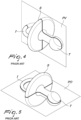
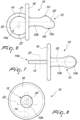
- Figures 1, 2, 3 , 4, and 5 show a pacifier C of the orthodontic type according to the prior art, by means of a lateral elevation view, a plan view, a front elevation view, and a first and second perspective view, respectively.
- the teat T generally has a profile which is symmetrical with respect to a vertical plane PV ( Figure 4 ) and extends longitudinally with respect to the elongated profile of the teat T, to separate ideally the right side of the oral cavity from the left side, and asymmetrical with respect to a horizontal plane PO ( Figure 5 ) that is ideally interposed between the tongue and the palate.
- PV vertical plane
- PO horizontal plane
- the teat T has a cylindrical portion Ta that connects to the shield S and extends along a longitudinal axis x, and a contoured terminal portion Tb that is symmetrical with respect to the vertical plane PV and asymmetrical with respect to the horizontal plane PO.
- the handle I consists of an annular body that extends at right angles to the vertical plane PV about a second axis Y which lies on the vertical plane, and connects to the shield S along the line of intersection of the horizontal plane PO with the shield S.
- the annular handle I is rigidly connected to the shield S, with the second axis Y extending vertically, but in other known solutions the annular handle I can be hinged to the shield S about a horizontal axis.
- annular handles have no influence with respect to the above-cited beneficial orthodontic functions of the pacifier but on the contrary, by virtue of their weight and shape, may constitute a disturbance factor.
- the aim of the present invention is to provide a pacifier which is equipped with an annular handle that is easier and more comfortable to handle for the caregiver and/or infant who wishes to hold the pacifier independently, and which also has a beneficial effect in relation to the orthodontic functions of the pacifier.
- a further object of the invention is to provide a pacifier which, while complying with all safety criteria regarding the risks of swallowing and consequent suffocation, promotes a more natural and more ergonomic sucking motion such as to produce at least some of the beneficial effects normally attributed to breastfeeding.
- a pacifier 10 comprises a teat 12 made of a rubber-like material, such as natural rubber or silicone, connected to a handle 14 with the interposition of a shield 16 adapted to prevent swallowing by the infant.
- the shield 16 and the handle 14 are made of rigid plastic material.
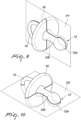
- the teat 12 has an elongated anatomical profile adapted to sucking, which is symmetrical with respect to a vertical plane P1 ( Figure 9 ) which extends longitudinally with respect to the elongated profile of the teat 12, ideally separating the right side of the oral cavity from the left side, and asymmetrical with respect to a horizontal plane P2 ( Figure 10 ) ideally interposed between the tongue and the palate.
- a vertical plane P1 Figure 9
- P2 Figure 10
- the teat 12 has a contoured terminal portion 12a that has an anatomical profile which is symmetrical with respect to the vertical plane P1 and asymmetrical with respect to the horizontal plane P2 and extends along a longitudinal axis 20 that is substantially equidistant, in a vertical direction, from the two opposite extreme points H1, H2 of the terminal portion 12a ( Figure 6 ).
- the terminal portion 12a connects to the shield 16 by means of a connecting portion 12b.
- the connecting portion 12b has a cylindrical profile whose axis coincides with the longitudinal axis 20.
- the handle 14 comprises an annular body which, in a configuration for use, extends parallel to the longitudinal axis 20.
- configuration for use means the configuration in which the handle 14 is adapted to be gripped while the pacifier is in use.
- the handle 14 is rigidly connected to the shield 16 (for example, the annular handle 14 can be welded, glued, or molded monolithically together with the shield 16), so that it is always in the above-mentioned configuration for use.
- the handle 14 connects to shield 16 along the line of intersection of the vertical plane P1 with the shield 16.
- the handle 14 extends in a planar manner along the horizontal axis 22.
- the handle 14 has a toroidal profile, and the horizontal axis 22 therefore coincides with the axis of revolution of said toroidal profile.
- the diameter of revolution of the toroidal profile may be approximately 30 mm while the diameter of the generating circumference may be approximately 5 mm, the passageway 14a therefore having a circular profile with a diameter of 25 mm, such as to allow the passage of an adult's index or middle finger.
- the shield 16 has a circular profile and the teat 12 connects to the center of the shield 16.
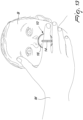
- the vertical arrangement of the annular handle 14, as opposed to the horizontal arrangement of conventional pacifiers such as the one shown in Figures 1-5 allows a caregiver sitting next to the infant B, or located behind the infant B while holding him in his arms, to comfortably insert a finger of his own hand M into the annular handle 14, the index finger in Figure 13 , so as to help the infant B hold the pacifier 10 in his mouth in the correct way.
- the vertical arrangement of the handle also facilitates the infant's possible independent use of the pacifier; the infant can insert one or more fingers of his own hand laterally into the handle while holding the pacifier in his mouth.
- the vertically downward offset position of the handle 14 with respect to the longitudinal axis 20, associated with the slight axial pressure that is normally exerted by the caregiver to hold the pacifier in the infant's mouth, generates a moment about a horizontal axis that stimulates the infant to make a beneficial anteroposterior mandibular movement during sucking in the effort to hold the pacifier 10 in his mouth.
- Figures 11 and 12 show an alternative embodiment of the invention, in which the parts that correspond to the previous embodiment are designated by the same reference numerals increased by 100 and the planes are identified by the same reference with the addition of a prime.
- Figures 11 and 12 differs from the previous embodiment only in that the annular handle 114 is hinged to the shield 116 about a vertical axis 124 which lies on the vertical plane P1', so that it can be folded into a more compact configuration which is substantially parallel to the shield 116 when not in use (i.e., when it is not in the configuration for use).
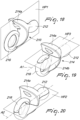
- FIGS 14-20 show a pacifier 210 according to a further embodiment of the invention.
- the pacifier 210 according to this embodiment is of the monolithic type and can advantageously be molded monolithically as a single piece of a rubber-like material, such as natural rubber or silicone, in a per se known manner.
- the pacifier 210 comprises:
- the shield 214 extends along a shield axis A1 that extends longitudinally, is contained in the vertical plane HP1, and is substantially equidistant from the two vertically opposite extreme points of the cross-section of the shield E1', E2' with respect to the vertical plane HP1 ( Figure 17 ).
- the shield 214 is longitudinally delimited between a front surface 214a, to which the outer surface of teat 212 joins, and a rear surface 214b, which joins the front surface 214a along a perimeter edge 214c ( Figure 17 ).
- the perimeter edge 214c is advantageously rounded.
- the front surface 214a and the rear surface 214b are also symmetrical with respect to the vertical plane HP1 ( Figure 18 ).
- the front surface 214a of the shield 214 has a convex profile and the rear surface 214b has a concave profile.
- This shape of the shield in contrast to conventional shapes which are generally flat (as in the previous embodiments) or slightly concave on the side of the teat to adhere to the infant's cheeks and lips, has the advantage of facilitating the natural sucking motion that would be performed by the infant during breastfeeding.
- the front surface 214a and the rear surface 214b are continuous, i.e., they are not crossed by through holes and, even more advantageously, are substantially smooth.
- the shield 214 has a thickness that gradually decreases toward the perimeter edge 214c.
- the convex profile of the front surface 214a is advantageously delimited between two first generatrices having an inclination ⁇ , measured with reference to the line extending between its opposite ends, comprised between 10° and 50°, more advantageously, approximately 30°, with respect to the shield axis A1.
- the concave profile of the rear surface 214b is advantageously delimited between two second generatrices having an inclination ⁇ , measured with reference to the straight line extending between its opposite ends, comprised between 50° and 80°, more advantageously, approximately 65°, with respect to the shield axis A1.
- the two first generatrices that delimit the convex profile of the front surface 214a with respect to the vertical plane HP1 advantageously have at least one slightly curved portion, with their respective concavities facing each other.
- said first generatrices have a radius of curvature that progressively decreases toward the perimeter edge 214c.
- the two second generatrices that delimit the concave profile of the rear surface 214b with respect to the vertical plane HP1 also advantageously have at least one slightly curved portion with their respective concavities facing each other.
- the second generatrices have a radius of curvature that gradually increases toward the perimeter edge 214c, until they become substantially straight in an outermost portion.
- the contoured outer surface of the teat 212 has a narrowing of its cross-section 217 that is delimited between an upper recess G1 of the section of the teat 212 with respect to the vertical plane HP1, which defines the central profile of an upper seat adapted to be engaged by a user's upper lip, and a lower recess G2 of the cross-section of the teat 212 with respect to the vertical plane HP1, which is longitudinally offset with respect to the upper recess G1 in the direction of the shield 214 and defines the central profile of a lower seat adapted to be engaged by the lower lip of the user; the narrowing in cross-section 217 extends with continuity on the contoured outer surface of the teat 212 between the upper recess G1 and the lower recess G2.
- the expression "with continuity” referring to the extension of a surface means that said surface has a continuous profile that has no edges or steps.
- the expression "with continuity” referring to two interconnected surfaces means that said two surfaces connect smoothly, that is, without forming edges or steps: in other words, said two surfaces are tangent to each other along their joining line.
- the pacifier 210 is preferably sized so that its center of gravity is offset on the side of the handle 216 relative to the lower recess G2.
- the teat 212 has a contoured terminal portion 212a extending in a direction substantially parallel to the shield axis A1, and a connecting portion 218 which connects the terminal portion 212a to the shield 214.
- the terminal portion 212a of the teat 212 has an anatomical profile which is symmetrical with respect to the vertical plane HP1 and asymmetrical with respect to the first horizontal plane HP2, and extends along a longitudinal axis A2 that is contained in the vertical plane HP1 and in the first horizontal plane HP2 and, considering the cross-section with respect to the vertical plane HP1, is substantially equidistant, in a vertical direction, from the two opposite extreme points of the terminal portion E1", E2".
- the profile of the terminal portion 212b of the teat 212 will not be further elaborated since it is beyond the aim and objects of the present invention, and can be provided on the basis of known anatomical criteria in orthodontic pacifiers according to known knowledge in the field.
- the upper recess G1 is formed in the terminal portion 212b
- the lower recess G2 is formed in the connecting portion 218, and the longitudinal axis A2 is advantageously spaced downward with respect to the shield axis A1.
- the shield axis A1 does not intersect the terminal portion 212b of the teat 212 at any point.
- the connecting portion 218 advantageously has an intermediate sector 218a extending along an oblique axis A3 which intersects the shield axis A1.
- FIG 17 the different portions and different sectors of the pacifier 210 are shown separated by dashed lines.
- the verticality and obliqueness of said lines is defined in relation to the direction of the longitudinal axes A1 and A2, which are considered horizontal.
- the intermediate sector 18a of the connecting portion 218 connects to the terminal portion 212b of the teat 212 by means of a first end sector 218b (comprised between the second oblique line L2 and a first vertical line L3 in Figure 17 ), whose outer surface extends with continuity with the outer surface of the terminal portion 212b of the teat 212; similarly, the intermediate sector 218a of the connecting portion 218 connects to the shield 214 by means of a second end sector 218c (comprised between the first oblique line L1 and a second vertical line L4 in Figure 17 ), whose outer surface extends with continuity with the front surface 214a of the shield 214.
- the oblique axis A3 is inclined with respect to the shield axis A1 by an angle ⁇ that is preferably comprised between 20° and 60°, more preferably approximately 40°.
- the front surface 214a and the rear surface 214b of the shield 214 are substantially symmetrical with respect to the second horizontal plane HP3.
- the shield 214 has a maximum height, measured on the cross-section with respect to the vertical plane HP1, that is greater than the maximum width measured on the cross-section with respect to the second horizontal plane HP3.
- the handle 216 comprises an annular body which forms internally a passage 216a configured to allow the insertion of at least one little finger of an infant's hand and, in a configuration for use, extends parallel to the longitudinal axis A2 and extends along a horizontal axis A4 which is perpendicular to the vertical plane HP1.
- the handle 216 has a toroidal profile, preferably with a circular cross-section, extending along the horizontal axis A4 ( Figure 16 ).
- the point that is equidistant from the upper end X1 and from the lower end X2 of the passage way 216a which in the example described here, where the handle 14 has a toroidal profile, is contained in the horizontal axis A4, is offset vertically downward with respect to the longitudinal axis A2 ( Figure 17 ).
- the horizontal axis A4 is also offset downward with respect to the shield axis A1.
- the handle 216 intersects both the front surface 214a and the rear surface 214b of the shield 214 below the shield axis A1.
- At least the terminal portion 212b of the teat 212 is hollow with thin walls and communicates with the atmosphere through a venting channel 220 which, in this embodiment, leads into an opening 222 on the rear surface 214b of the shield 214 above the shield axis A1.
- the first end sector 218b and part of the intermediate sector 218a are also hollow with thin walls, and the venting channel 220 extends through the shield 214, the second end sector 218c and part of the intermediate sector 218a.
- the profile of the shield 214 has the effect of stimulating a natural and ergonomic sucking motion similar to the one performed during breastfeeding. This effect is further enhanced if the shield 214 is provided with a thickness that progressively decreases outward, as in the example described and illustrated here.
- the vertical arrangement of the handle 216 allows a caregiver who is positioned beside the infant or child, or who is holding him on his arms, to comfortably insert a finger in the handle and assist the infant in properly holding the pacifier 210 in his mouth, possibly pressing lightly in the direction of the longitudinal axis A2.
- the slight downward offset of the handle with respect to the longitudinal axis A2 associated with the slight axial pressure that is normally exerted by the caregiver to hold the pacifier in the infant's mouth, gives the pacifier 210 a proper balance in use that can stimulate the correct anteroposterior movement of the infant's jaw.
- the above highlighted shape aspects of the pacifier have the effect of inducing the user to correctly reproduce many of the movements that are naturally performed during breastfeeding, and in particular the antero-posterior displacements of the mandible, which are known to stimulate its sagittal extension.
- Figures 21 and 22 show a further alternative embodiment of the invention, which differs from the previous one only in that the pacifier 310, instead of having the terminal portion 312b of the teat 312 teat that is hollow with thin walls and communicates with the atmosphere through a venting channel, is solid.
- the teat is made of a different material than the shield and annular handle.
- the invention would be equally applicable to a pacifier made entirely of a rubber-like material such as silicone or natural rubber.
- the front surface and/or the rear surface of the shield may have straight generatrices instead of curved or partially curved ones as in the embodiment described and illustrated by way of example herein.
- the shape of the teat may be widely varied from those described and illustrated here, as long as it has a profile that is symmetrical with respect to the vertical plane and asymmetrical with respect to the horizontal plane.
- the term "annular" referred to the handle generally identifies a profile that internally forms a passageway, regardless of the specific geometric characteristics of the handle.
- the passageway could have an elliptical profile rather than a circular one, and/or could be configured and/or sized to accommodate two or more fingers of a hand of an adult or an infant, as long as, regardless of the shape, the passageway has a minimum diameter such as to allow the insertion of at least one little finger of an infant's hand, typically, a minimum diameter of at least 7 mm.
- the minimum diameter of the passageway should allow the insertion of at least one little finger of an adult, typically, a minimum diameter of at least 12 mm.
- the handle could also have a non-circular cross-section, for example elliptical, rectangular, square, and so on.
- silicone and natural rubber have been referenced as preferred materials in the present description since, to date, these are conventionally used materials for the manufacture of pacifiers, of course any other rubber-like material of natural or synthetic origin that has suitable characteristics in terms of both ergonomics and safety may be used.
- the term "monolithic" should not be understood in a restrictive sense.
- the pacifier according to the invention can be provided in a single rubber-like material, the possibility of making, for example, the teat and shield of two distinct rubber-like materials non-detachably interconnected (for example welded or glued) is not ruled out.
Landscapes
- Health & Medical Sciences (AREA)
- Pediatric Medicine (AREA)
- Life Sciences & Earth Sciences (AREA)
- Animal Behavior & Ethology (AREA)
- General Health & Medical Sciences (AREA)
- Public Health (AREA)
- Veterinary Medicine (AREA)
- Medical Preparation Storing Or Oral Administration Devices (AREA)
Applications Claiming Priority (2)
| Application Number | Priority Date | Filing Date | Title |
|---|---|---|---|
| IT202300013248 | 2023-06-27 | ||
| IT202300013245 | 2023-06-27 |
Publications (1)
| Publication Number | Publication Date |
|---|---|
| EP4483859A1 true EP4483859A1 (fr) | 2025-01-01 |
Family
ID=91617295
Family Applications (1)
| Application Number | Title | Priority Date | Filing Date |
|---|---|---|---|
| EP24184097.4A Pending EP4483859A1 (fr) | 2023-06-27 | 2024-06-24 | Sucette à poignée annulaire |
Country Status (1)
| Country | Link |
|---|---|
| EP (1) | EP4483859A1 (fr) |
Citations (4)
| Publication number | Priority date | Publication date | Assignee | Title |
|---|---|---|---|---|
| DE7028703U (de) * | 1970-07-30 | 1971-10-21 | Plaat Fa Carl | Beruhigungssauger. |
| US5013320A (en) * | 1990-01-29 | 1991-05-07 | Roni Orpaz | Pacifier with lip clip |
| EP1275366A2 (fr) * | 2001-06-27 | 2003-01-15 | SSL Healthcare Italia S.p.A. | Tétine ou sucette |
| US6773451B1 (en) * | 1999-04-14 | 2004-08-10 | Louis-Marie Dussere | Ergonomic teat |
-
2024
- 2024-06-24 EP EP24184097.4A patent/EP4483859A1/fr active Pending
Patent Citations (4)
| Publication number | Priority date | Publication date | Assignee | Title |
|---|---|---|---|---|
| DE7028703U (de) * | 1970-07-30 | 1971-10-21 | Plaat Fa Carl | Beruhigungssauger. |
| US5013320A (en) * | 1990-01-29 | 1991-05-07 | Roni Orpaz | Pacifier with lip clip |
| US6773451B1 (en) * | 1999-04-14 | 2004-08-10 | Louis-Marie Dussere | Ergonomic teat |
| EP1275366A2 (fr) * | 2001-06-27 | 2003-01-15 | SSL Healthcare Italia S.p.A. | Tétine ou sucette |
Similar Documents
| Publication | Publication Date | Title |
|---|---|---|
| JP4350524B2 (ja) | おしゃぶり | |
| US7294141B2 (en) | Pacifier, a system and a method for maintaining proper dentitions | |
| US7861721B2 (en) | Appliance, system and method for preventing snoring | |
| US7975701B2 (en) | Appliance, system and method for correction habits of an oral cavity | |
| US3082770A (en) | Bottle nursing nipple | |
| US8833575B2 (en) | Artificial suckling system | |
| US20130263864A1 (en) | Teat device for preventing snoring and other habits | |
| AU2007277019A1 (en) | Orthodontic pacifier/nipple appliance | |
| TW201701841A (zh) | 口部裝置及其使用方法 | |
| JPH07500517A (ja) | 口部用品 | |
| WO2012036873A1 (fr) | Protection pour dispositifs buccaux pour enfants | |
| CN213406360U (zh) | 壳状牙齿矫治器、牙齿矫治套组和矫治系统 | |
| CN103533913B (zh) | 口腔装置 | |
| US20260108430A1 (en) | Infant pacifier | |
| US2227389A (en) | Nipple for nursing bottles | |
| CN221904123U (zh) | 具有卡扣固位结构的牙科正畸矫治器 | |
| WO2009156802A1 (fr) | Dispositif flexible destiné à prévenir le ronflement | |
| HK1079083B (en) | Pacifier | |
| MYOLOGY | POSITION STATEMENT OF THE INTERNATIONAL ASSOCIATION OF | |
| ZA200409102B (en) | A pacifier, a system and a method for maintaining proper dentitions |
Legal Events
| Date | Code | Title | Description |
|---|---|---|---|
| PUAI | Public reference made under article 153(3) epc to a published international application that has entered the european phase |
Free format text: ORIGINAL CODE: 0009012 |
|
| STAA | Information on the status of an ep patent application or granted ep patent |
Free format text: STATUS: THE APPLICATION HAS BEEN PUBLISHED |
|
| AK | Designated contracting states |
Kind code of ref document: A1 Designated state(s): AL AT BE BG CH CY CZ DE DK EE ES FI FR GB GR HR HU IE IS IT LI LT LU LV MC ME MK MT NL NO PL PT RO RS SE SI SK SM TR |
|
| STAA | Information on the status of an ep patent application or granted ep patent |
Free format text: STATUS: REQUEST FOR EXAMINATION WAS MADE |
|
| 17P | Request for examination filed |
Effective date: 20250609 |