EP4484983A1 - Verfahren zur überwachung des gesundheitszustands einer batterie - Google Patents
Verfahren zur überwachung des gesundheitszustands einer batterie Download PDFInfo
- Publication number
- EP4484983A1 EP4484983A1 EP24184113.9A EP24184113A EP4484983A1 EP 4484983 A1 EP4484983 A1 EP 4484983A1 EP 24184113 A EP24184113 A EP 24184113A EP 4484983 A1 EP4484983 A1 EP 4484983A1
- Authority
- EP
- European Patent Office
- Prior art keywords
- battery
- soh
- health
- state
- model
- Prior art date
- Legal status (The legal status is an assumption and is not a legal conclusion. Google has not performed a legal analysis and makes no representation as to the accuracy of the status listed.)
- Pending
Links
Images




Classifications
-
- G—PHYSICS
- G01—MEASURING; TESTING
- G01R—MEASURING ELECTRIC VARIABLES; MEASURING MAGNETIC VARIABLES
- G01R31/00—Arrangements for testing electric properties; Arrangements for locating electric faults; Arrangements for electrical testing characterised by what is being tested not provided for elsewhere
- G01R31/36—Arrangements for testing, measuring or monitoring the electrical condition of accumulators or electric batteries, e.g. capacity or state of charge [SoC]
- G01R31/367—Software therefor, e.g. for battery testing using modelling or look-up tables
-
- G—PHYSICS
- G01—MEASURING; TESTING
- G01R—MEASURING ELECTRIC VARIABLES; MEASURING MAGNETIC VARIABLES
- G01R31/00—Arrangements for testing electric properties; Arrangements for locating electric faults; Arrangements for electrical testing characterised by what is being tested not provided for elsewhere
- G01R31/36—Arrangements for testing, measuring or monitoring the electrical condition of accumulators or electric batteries, e.g. capacity or state of charge [SoC]
- G01R31/389—Measuring internal impedance, internal conductance or related variables
-
- G—PHYSICS
- G01—MEASURING; TESTING
- G01R—MEASURING ELECTRIC VARIABLES; MEASURING MAGNETIC VARIABLES
- G01R31/00—Arrangements for testing electric properties; Arrangements for locating electric faults; Arrangements for electrical testing characterised by what is being tested not provided for elsewhere
- G01R31/36—Arrangements for testing, measuring or monitoring the electrical condition of accumulators or electric batteries, e.g. capacity or state of charge [SoC]
- G01R31/392—Determining battery ageing or deterioration, e.g. state of health
Definitions
- the technical field of the invention is that of monitoring and managing electric batteries, in particular batteries installed in a vehicle, in particular in an aircraft.
- the present invention relates to a method for monitoring the health status of a battery.
- climate change is a major concern for many legislative and regulatory bodies around the world. Indeed, various restrictions on carbon emissions have been, are being or will be adopted by various States. In particular, an ambitious standard applies both to new types of aircraft but also to those currently in circulation requiring the implementation of technological solutions in order to make them compliant with the regulations in force. Civil aviation has been mobilizing for several years now to make a contribution to the fight against climate change.
- the Applicant takes into consideration the factors impacting all phases of design and development, to obtain less energy-intensive, more environmentally friendly aeronautical components and products whose integration and use in civil aviation have moderate environmental impacts with the aim of improving the energy efficiency of aircraft.
- the Applicant is constantly working to reduce its climate impact by using methods and operating virtuous development and manufacturing processes that minimize greenhouse gas emissions to the minimum possible in order to reduce the environmental footprint of its activity.
- the state of health of a battery also commonly called SOH for "State of Health” in English, can be defined according to the loss of capacity or the gain in resistance of a battery throughout its life.
- SOH curing c initiale ⁇ 100 %
- the use of the battery can be modified.
- batteries are usually used up to a threshold state of health between 70% and 80%. This first use corresponds to what is called the “first life” of a battery. Below this threshold state of health, the loss of capacity tends to accelerate, but the battery can continue to be used in so-called “second life” applications, such as “smart grid” energy networks.
- a second known method disclosed in Shen, P., Ouyang, M., Lu, L., Li, J., & Feng, X. (2016).
- IEEE Transactions on Vehicular Technology, 67(1), 92-103 proposes to estimate the state of health of a battery based on a recursive least squares method with forgetting factor. This method is very complete because it also allows to estimate the state of charge and the operating state of the battery. However, this method is complex to implement.
- a third known method disclosed in Zhou, Y., Huang, M., & Pecht, M. (2018, August 27).
- This method is easy to implement, but the validity of the relationship between the state of health of a battery and the voltage integral has only been demonstrated for the type of battery presented in the paper. Thus, this method cannot, at present, be used for batteries with different chemistries than the one presented in the paper.
- this method requires taking into account a very wide range of battery states of charge, which is not systematically done depending on the application.
- the invention provides a solution to the problems mentioned above, by making it possible to determine a state of health SOH of a battery from the surface resistance R surf of the battery, the intensity I of current applied to the battery and the temperature T of the battery. Indeed, the inventors have, surprisingly, discovered that it was possible to determine the surface resistance R surf of the battery as the parameters.
- the invention comprises the generation of a model of an electric circuit configured to evaluate a state of health SOH of a battery, said model being based on a model of a component of an electric circuit configured to evaluate a surface resistance of a battery. Then, by providing the model of the component of the electric circuit configured to evaluate a state of health SOH of a battery, the intensity I of current applied to the battery and the temperature T of the battery, it is possible to obtain the state of health SOH of a battery.
- monitoring the state of health of the battery can be carried out easily and directly in an embedded system.
- the method according to the invention can be applied to any operational condition in terms of current and temperature and does not require scanning a wide range of state of charge.
- the method according to the invention does not require the use of a continuous "observer" component. It can be applied discontinuously, for example at times when updating the state of health of the battery is necessary.
- the method according to the invention can be implemented during the charging of the battery. Indeed, the charging of the battery is an opportune moment to implement the method according to the invention, because it is possible, during battery charging, to apply a constant current pulse from which it is possible to obtain the surface resistance.
- a fourth aspect of the invention relates to an aircraft comprising an electric battery and a battery management system according to the invention.
- a fifth aspect of the invention relates to a computer program comprising instructions which, when the program is executed by a computer, cause the latter to implement a method according to the invention.
- a sixth aspect of the invention relates to a computer-readable data carrier, on which the computer program according to the invention is recorded.
- FIG. 1 is a block diagram illustrating the steps of an example of the method 100 for monitoring a SOH state of health of a battery.
- the mandatory steps of the example of the method 100 are indicated by a solid rectangle and the optional steps are indicated by a dotted rectangle.
- steps are performed by at least one computer or processor or other similar system.
- steps are performed by the computer, possibly fully automatically, or semi-automatically.
- the triggering of at least some of the steps of the method may be performed by user-computer interaction.
- the level of user-computer interaction required may depend on the level of automation intended and balanced against the need to implement the user's wishes. In examples, this level may be user-defined and/or predefined.
- a typical example of a computer implementation of a method is to execute the method with a system adapted for this purpose.
- the system may include a processor coupled to a memory and a graphical user interface (GUI), a computer program comprising instructions for implementing the method being stored in the memory.
- GUI graphical user interface
- the memory may also store a database.
- Memory is any hardware adapted for such storage, possibly comprising several distinct physical parts.
- a first step 110 of the method 100 consists in obtaining a first model of a component of an electrical circuit of the battery.
- This first model makes it possible to calculate a surface resistance R surf of the battery from an intensity I of current applied to the battery and a temperature T of the battery.
- the intensity I of current applied to the battery is expressed in Amperes.
- the temperature T of the battery is expressed in Kelvin.
- This first model further comprises four parameters.
- the first parameter of the first model of the component of the electrical circuit of the battery is the resistance of an interphase of the solid electrolyte at a predetermined temperature denoted R SEI (T pre ).
- the interphase of the solid electrolyte commonly called “Solid Electrolyte Interphase” in English, is a passivation layer present between the negative electrode and the electrolyte of the battery.
- the resistance of the interphase of the solid electrolyte R SEI is expressed in ohms.
- the predetermined temperature is between 0°C and 30°C. In the remainder of the application, for the sake of simplification, we will use 25°C as the predetermined temperature. It is possible to note that the first model of the component of the electrical circuit is all the more precise as the temperature T of the battery is close to said predetermined temperature.
- the second parameter of the first model of the battery electrical circuit component is the activation energy related to the interphase of the solid electrolyte denoted E a,SEI .
- the activation energy related to the interphase of the solid electrolyte E a,SEI is expressed in electronvolts.
- the third parameter of the first model of the battery electrical circuit component is the exchange current at the predetermined temperature noted I 0 (T pre ). This parameter is expressed in amperes. This parameter is used to measure the level of oxidation and reduction reactions taking place in the battery for the predetermined temperature. Thus, a high exchange current reflects a level of oxidation and reduction reactions in the battery which is also high, therefore an efficient charge transfer.
- the predetermined temperature of the third parameter is the same as for the first parameter.
- the fourth parameter of the first model of the battery electrical circuit component is the activation energy linked to the exchange current E a,I0 which is expressed in electronvolts.
- a second step 120 of the method 100 consists in determining, for the four parameters of the first model, a function characterizing the evolution of said each parameter as a function of an evolution of the state of health of the SOH battery.
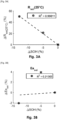
- Figures 3A to 3D show an example of evolution for each parameter of the first electric model depending on the SOH state of health of the battery.
- the Figure 3A shows an example of the relationship between the resistance of the solid electrolyte interphase of a battery at a temperature of 25°C R SEI (25° C ) and the state of health of the SOH battery.
- the Figure 3B shows an example of the relationship between activation energy related to the interphase of the solid electrolyte of an E a,SEI battery and the state of health of the SOH battery.
- each of the parameters can be modeled as a function of the battery health status with a function.
- a linear form function can be used.
- R 2 the square of the linear correlation coefficient denoted.
- the square of the linear correlation coefficient R 2 for the Figure 3A is 0.99811.
- these parameters vary differently depending on the SOH state of health of the battery: quadratically for example.
- the determination 120, for each parameter of the first model, of a function characterizing the evolution of said each parameter as a function of an evolution of the state of health of the SOH battery comprises two tests.
- the first test is an electrochemical impedance spectroscopy test.
- the electrochemical impedance spectroscopy test consists of applying a sinusoidal current wave with a zero mean value to the battery and measuring a voltage variation of the battery. From this test, it is possible to identify a series resistance Rs, which is independent of the current, as well as the surface resistance Rsurf of the battery for a quasi-zero current, i.e. the sinusoidal current average is zero or nearly zero.
- the series resistance Rs represents all purely resistive contributions, such as the electrolyte, current collectors and contact resistances of the battery.
- An example of a result of an electrochemical impedance spectroscopy test is shown in figure 4 .
- FIG 4 has as its abscissa axis the real component of the impedance expressed in milliohms, and as its ordinate axis the imaginary component, in negative, of the impedance expressed in milliohms.
- the second test is a current pulse test consisting of applying current pulses to the battery during charging and discharging. This test allows extracting information on the impedance of the battery by analyzing its voltage response. From this test, we identify a cell voltage at equilibrium U oc , the surface resistance R surf of the battery for currents other than zero, a time constant linked to surface phenomena denoted ⁇ surf and an impedance denoted Z diff .
- the cell voltage at equilibrium U oc is a voltage source representing the open-circuit voltage, commonly denoted OCV for the English "Open-Circuit Voltage".
- the surface resistance R surf is linked to the voltage drop between the surface of the active material and the electrolyte, due to the charge transfer and the interphase of the electrolyte.
- the time constant related to surface phenomena ⁇ surf is equal to the product between the surface resistance R surf and the surface capacitance, also called double layer capacitance C surf .
- This time constant is related to surface phenomena that are associated with charge transfer, double layers and the interphase of the electrolyte.
- This time constant related to surface phenomena ⁇ surf represents a fast dynamic, generally less than 1 second.
- the impedance Z diff is an impedance related to the diffusion phenomena of lithium ions in the electrolyte and lithium atoms in the two electrodes. This impedance has a slow dynamic, generally of the order of several minutes.
- FIG 5 An example of a result of a current pulse test is illustrated in figure 5 . There figure 5 has the time expressed in seconds as its abscissa axis.
- the abscissa axis For easier reading, part of the abscissa axis is hidden; thus, some durations are indicated in seconds (noted s) and others in minutes (noted min).
- the ordinate axis on the left corresponds to the current level of the battery, expressed in C-rate, i.e. a charge and/or discharge current in amperes (A) divided by the capacity in ampere-hours (Ah).
- the ordinate axis on the right corresponds to the battery voltage expressed in volts.
- a third step 130 of the method 100 consists in generating a second model of the component of the electrical circuit of the battery.
- This second model is configured to evaluate the state of health of the SOH battery from the surface resistance R surf of the battery, the intensity I of current applied to the battery and the temperature T of the battery.
- each function characterizing the evolution of each of the four parameters of the first model as a function of an evolution of the state of health of the SOH battery is integrated into the second model.
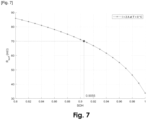
- the generation 130 of the second model of the component of the electrical circuit of the battery further comprises a determination of an equation between the surface resistance R surf and the state of health SOH.
- the first option consists in solving this equation for a set of SOH values, thus making it possible to evaluate the state of health SOH from a surface resistance R surf .
- the figure 8 shows an example of the evolution of the surface resistance R surf as a function of the state of health SOH of a battery for a battery temperature T of 0°C and for current intensities I between 0 and 20 amperes in discharge.
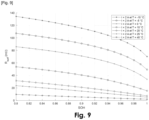
- the figure 9 shows an example of the evolution of the surface resistance R surf as a function of the state of health SOH of a battery for a current intensity of 2 amperes in discharge for temperatures between -10 and 40°C.
- the second option is to generate a table of parameters allowing the state of health SOH to be directly evaluated from the current intensity I applied to the battery, the temperature T of the battery and the surface resistance R surf of the battery.
- this simplified equation can be solved for a certain number of states of health SOH, thus creating a table of states of health SOH as a function of the surface resistance Rsurf, to then interpolate the already known value of surface resistance Rsurf and obtain the desired state of health SOH.
- the choice of implementing the first or the second option may depend on the computing capacity of the system and its storage capacity. Thus, for a system mainly limited in system computing capacity, the second option is the most suitable, whereas for a system mainly limited in storage capacity, the first option is to be preferred.
- a fourth step 140 of the method 100 consists in measuring the intensity I of current applied to the battery, the temperature T of the battery and obtaining the surface resistance R surf of the battery. To obtain the surface resistance Rsurf of the battery, it is possible to use a technique known from the state of the art that can be implemented via embedded algorithms. This step 140 can be carried out during use of the battery, in particular during charging of the battery.
- a fifth step 150 of the method 100 consists in determining the state of health of the SOH battery by providing the second model of the component of the electrical circuit of the battery with the intensity I of current applied to the battery, the temperature T of the battery and the surface resistance R surf of the battery measured or obtained in step 140.
- a sixth optional step 160 of the method 100 consists in modifying the conditions of use of the battery according to the state of health SOH determined in step 150.
- the modification of the conditions of use of the battery may consist in replacing the battery with a new battery.
- the battery whose determined state of health SOH is lower than a predetermined state of health SOH value may for example be used in so-called second-life applications.
- the modification of the battery usage conditions may include interrupting use of the battery upon reaching a maximum temperature, the maximum temperature being determined from the determined state of health SOH.
- modifying the battery usage conditions may include charging the battery at a current intensity less than or equal to a maximum current intensity, the maximum current intensity being determined from the determined state of health SOH.
- FIG. 2 is a block diagram illustrating the steps of an example of the method 200.
- the mandatory steps of the example of the method 200 are indicated by a solid rectangle and the optional steps are indicated by a dotted rectangle.
- a first step 210 and a second step 220 of the method 200 are preferably identical respectively to steps 110 and 120 of the method 100.
- a third step 230 of the method 200 consists in generating a second model of the component of the electrical circuit of the battery configured to evaluate the surface resistance Rsurf of the battery from the intensity I of current applied to the battery, the temperature T of the battery and the state of health of the battery SOH.
- the generation of the second model comprises, for each parameter of the first model, the integration of the function characterizing the evolution of said each parameter as a function of an evolution of the state of health of the battery SOH.
- the second electrical model of the method 200 can be based on the preceding equation (3).
- a fourth step 240 of the method 200 consists in measuring the intensity I of current applied to the battery, the temperature T of the battery and obtaining the state of health SOH of the battery. To obtain the state of health SOH of the battery, it is possible to use a technique known from the state of the art.
- a fifth step 250 of the method 200 consists in determining the surface resistance R surf of the battery by providing the second model with the intensity I of current applied to the battery, the temperature T of the battery and the state of health of the battery SOH obtained in step 240.
- the method 200 can be used to directly calculate the surface resistance R surf of the battery from a known state of health.
- the method can be implemented by computer or by a processor, for example included in a battery management system.
- the method 200 is particularly interesting because, among all the parameters of the electrical model of the battery, the surface resistance R surf of the battery is the one that changes the most with the aging of the battery and which must be updated as a priority. Moreover, the update alone of said surface resistance can be sufficient for a first estimation of the new impedance of the battery.
- a sixth optional step 260 of the method 200 consists in modifying the conditions of use of the battery as a function of the surface resistance R surf of the battery determined in step 250, for example in a manner similar to step 160 previously described in relation to the method illustrated in the figure 1 .
Landscapes
- Physics & Mathematics (AREA)
- General Physics & Mathematics (AREA)
- Secondary Cells (AREA)
Applications Claiming Priority (1)
| Application Number | Priority Date | Filing Date | Title |
|---|---|---|---|
| FR2306721A FR3150602A1 (fr) | 2023-06-27 | 2023-06-27 | Procédé de surveillance d’un état de santé d’une batterie |
Publications (1)
| Publication Number | Publication Date |
|---|---|
| EP4484983A1 true EP4484983A1 (de) | 2025-01-01 |
Family
ID=88207538
Family Applications (1)
| Application Number | Title | Priority Date | Filing Date |
|---|---|---|---|
| EP24184113.9A Pending EP4484983A1 (de) | 2023-06-27 | 2024-06-24 | Verfahren zur überwachung des gesundheitszustands einer batterie |
Country Status (2)
| Country | Link |
|---|---|
| EP (1) | EP4484983A1 (de) |
| FR (1) | FR3150602A1 (de) |
Citations (3)
| Publication number | Priority date | Publication date | Assignee | Title |
|---|---|---|---|---|
| CN107367698A (zh) | 2017-08-25 | 2017-11-21 | 北京交通大学 | 电动汽车锂电池组的健康状态预测方法 |
| US20190041464A1 (en) | 2017-08-02 | 2019-02-07 | Total Solar International | Method and apparatus for identifying a battery model |
| CN115032540A (zh) | 2022-04-02 | 2022-09-09 | 中国人民解放军国防科技大学 | 锂离子电池健康状态估计方法、装置、设备及介质 |
-
2023
- 2023-06-27 FR FR2306721A patent/FR3150602A1/fr active Pending
-
2024
- 2024-06-24 EP EP24184113.9A patent/EP4484983A1/de active Pending
Patent Citations (3)
| Publication number | Priority date | Publication date | Assignee | Title |
|---|---|---|---|---|
| US20190041464A1 (en) | 2017-08-02 | 2019-02-07 | Total Solar International | Method and apparatus for identifying a battery model |
| CN107367698A (zh) | 2017-08-25 | 2017-11-21 | 北京交通大学 | 电动汽车锂电池组的健康状态预测方法 |
| CN115032540A (zh) | 2022-04-02 | 2022-09-09 | 中国人民解放军国防科技大学 | 锂离子电池健康状态估计方法、装置、设备及介质 |
Non-Patent Citations (5)
| Title |
|---|
| DAMAY N.MBEYA K. M.FRIEDRICH G.FORGEZ C.: "Separation of the charge transfers and solid electrolyte interphase contributions to a battery voltage by modeling their non-linearities regarding current and temperature", JOURNAL OF POWER SOURCES, vol. 516, 2021, pages 230617, XP086857927, DOI: 10.1016/j.jpowsour.2021.230617 |
| FABIAN SINGLE ET AL.: "arxiv.org", 2 August 2019, CORNELL UNIVERSITY LIBRARY, article "Theory of impedance spectroscopy for lithium batteries", pages: 201 |
| FABIAN SINGLE ET AL: "Theory of Impedance Spectroscopy for Lithium Batteries", ARXIV.ORG, CORNELL UNIVERSITY LIBRARY, 201 OLIN LIBRARY CORNELL UNIVERSITY ITHACA, NY 14853, 2 August 2019 (2019-08-02), XP081454494 * |
| SHEN, P.OUYANG, M.LU, L.LI, J.FENG, X.: "The co-estimation of State of Charge, State of Health, and State of Function for lithium-ion batteries in electric vehicles", IEEE TRANSACTIONS ON VEHICULAR TECHNOLOGY, vol. 67, no. 1, 2018, pages 92 - 103 |
| ZHOU, Y.HUANG, M.PECHT, M.: "An Online State of Health Estimation Method for Lithium-ion Batteries Based on Integrated Voltage", IEEE INTERNATIONAL CONFERENCE ON PROGNOSTICS AND HEALTH MANAGEMENT, 27 August 2018 (2018-08-27) |
Also Published As
| Publication number | Publication date |
|---|---|
| FR3150602A1 (fr) | 2025-01-03 |
Similar Documents
| Publication | Publication Date | Title |
|---|---|---|
| EP2434304B1 (de) | Verfahren und System zur in situ Batteriediagnose mittels elektrochemischer Impedanzspektroskopie | |
| EP3443370B1 (de) | Verfahren zur bestimmung des parameterwerts bezüglich des zustands eines akkumulators einer batterie, batterie und elektronisches batterieverwaltungssystem | |
| EP2410346B1 (de) | Verfahren zur Bestimmung eines Parameter mindestens eines Akkus einer Batterie | |
| Alamin et al. | A machine learning-based digital twin for electric vehicle battery modeling | |
| EP2293090A2 (de) | Verbessertes Verfahren zur Schätzung nicht messbarer Charakteristiken eines elektrochemischen Systems | |
| EP2362234A1 (de) | Nicht intrusives Verfahren zur Bestimmung der elektrischen Impedanz einer Batterie | |
| FR2980850A1 (fr) | Procede et systeme de diagnotic de l'etat interne d'une batterie par emission acoustique. | |
| EP2293091A2 (de) | Verfahren zur Simulation des thermischen Verhaltens eines elektrochemischen Systems | |
| FR3086802A1 (fr) | Procede et dispositif de mesure en temps reel et in situ des donnees thermodynamiques d'une batterie (enthalpie et entropie) | |
| EP4094084B1 (de) | Verfahren zur schnellen offline-diagnose von akkumulatoren und zugehörige vorrichtungen | |
| WO2014177799A1 (fr) | Procede et systeme de charge d'une batterie de vehicule automobile en fonction de la temperature | |
| WO2010049148A1 (fr) | Procede de determination de l'etat de charge d'une batterie en phase de charge ou de decharge | |
| EP3974853B1 (de) | Vorhersage des zukünftigen state of health von zellen einer elektrischen batterie | |
| EP2775313A1 (de) | Verfahren zur Bestimmung der Restkapazität einer Batterie | |
| EP4253973A1 (de) | Verfahren zum sortieren einer batterieanordnung auf basis eines automatischen klassifizierungsmodells | |
| FR3130039A1 (fr) | Estimation d’informations relatives à une batterie cellulaire | |
| EP4174504B1 (de) | Verfahren zur kalibrierung eines modells zur alterungsschätzung von elektrochemischen akkumulatoren | |
| EP4484983A1 (de) | Verfahren zur überwachung des gesundheitszustands einer batterie | |
| EP3678255B1 (de) | Verfahren zur kalibrierung einer familie von lithium-ionen-batterieelementen, entsprechende lademethode, entsprechendes computerprogrammprodukt und entsprechende ladevorrichtung | |
| EP4526975B1 (de) | Schätzung eines energiezustands einer batterie | |
| EP4386403B1 (de) | Verfahren und vorrichtung zur bestimmung eines die zukünftigen nutzung einer batterie repräsentativen belastungsprofils für eine bestimmte anwendung | |
| FR3134480A1 (fr) | Systeme de recharge pour vehicule automobile sans placage de lithium, procede et vehicule sur la base d’un tel systeme | |
| WO2025233586A1 (fr) | Procede de surveillance d'un etat de sante d'une cellule electrique de batterie | |
| WO2021014072A1 (fr) | Estimation du soc d'un elément electrochimique | |
| EP4647787A1 (de) | Verfahren zur überwachung eines gesundheitszustands einer batterie |
Legal Events
| Date | Code | Title | Description |
|---|---|---|---|
| PUAI | Public reference made under article 153(3) epc to a published international application that has entered the european phase |
Free format text: ORIGINAL CODE: 0009012 |
|
| STAA | Information on the status of an ep patent application or granted ep patent |
Free format text: STATUS: THE APPLICATION HAS BEEN PUBLISHED |
|
| AK | Designated contracting states |
Kind code of ref document: A1 Designated state(s): AL AT BE BG CH CY CZ DE DK EE ES FI FR GB GR HR HU IE IS IT LI LT LU LV MC ME MK MT NL NO PL PT RO RS SE SI SK SM TR |
|
| STAA | Information on the status of an ep patent application or granted ep patent |
Free format text: STATUS: REQUEST FOR EXAMINATION WAS MADE |
|
| 17P | Request for examination filed |
Effective date: 20250630 |