EP4485306A1 - Système et procédé de détermination d'un élément de protection - Google Patents
Système et procédé de détermination d'un élément de protection Download PDFInfo
- Publication number
- EP4485306A1 EP4485306A1 EP23182064.8A EP23182064A EP4485306A1 EP 4485306 A1 EP4485306 A1 EP 4485306A1 EP 23182064 A EP23182064 A EP 23182064A EP 4485306 A1 EP4485306 A1 EP 4485306A1
- Authority
- EP
- European Patent Office
- Prior art keywords
- protective element
- comparison
- data sets
- comparison data
- data set
- Prior art date
- Legal status (The legal status is an assumption and is not a legal conclusion. Google has not performed a legal analysis and makes no representation as to the accuracy of the status listed.)
- Withdrawn
Links
Images


Classifications
-
- G—PHYSICS
- G06—COMPUTING OR CALCULATING; COUNTING
- G06Q—INFORMATION AND COMMUNICATION TECHNOLOGY [ICT] SPECIALLY ADAPTED FOR ADMINISTRATIVE, COMMERCIAL, FINANCIAL, MANAGERIAL OR SUPERVISORY PURPOSES; SYSTEMS OR METHODS SPECIALLY ADAPTED FOR ADMINISTRATIVE, COMMERCIAL, FINANCIAL, MANAGERIAL OR SUPERVISORY PURPOSES, NOT OTHERWISE PROVIDED FOR
- G06Q10/00—Administration; Management
- G06Q10/08—Logistics, e.g. warehousing, loading or distribution; Inventory or stock management
-
- G—PHYSICS
- G06—COMPUTING OR CALCULATING; COUNTING
- G06Q—INFORMATION AND COMMUNICATION TECHNOLOGY [ICT] SPECIALLY ADAPTED FOR ADMINISTRATIVE, COMMERCIAL, FINANCIAL, MANAGERIAL OR SUPERVISORY PURPOSES; SYSTEMS OR METHODS SPECIALLY ADAPTED FOR ADMINISTRATIVE, COMMERCIAL, FINANCIAL, MANAGERIAL OR SUPERVISORY PURPOSES, NOT OTHERWISE PROVIDED FOR
- G06Q10/00—Administration; Management
- G06Q10/10—Office automation; Time management
-
- G—PHYSICS
- G06—COMPUTING OR CALCULATING; COUNTING
- G06Q—INFORMATION AND COMMUNICATION TECHNOLOGY [ICT] SPECIALLY ADAPTED FOR ADMINISTRATIVE, COMMERCIAL, FINANCIAL, MANAGERIAL OR SUPERVISORY PURPOSES; SYSTEMS OR METHODS SPECIALLY ADAPTED FOR ADMINISTRATIVE, COMMERCIAL, FINANCIAL, MANAGERIAL OR SUPERVISORY PURPOSES, NOT OTHERWISE PROVIDED FOR
- G06Q50/00—Information and communication technology [ICT] specially adapted for implementation of business processes of specific business sectors, e.g. utilities or tourism
- G06Q50/08—Construction
Definitions
- the invention relates to a system for determining a protective element of a protective element type for use in an application situation relating to a building component.
- the object of the present invention is therefore to offer a system and a method that enable reliable protection of building components. Systems and methods that also enable particularly cost-effective protection of building components are particularly preferred.
- a system for determining a protective element of a protective element type for use in an application situation relating to a building component comprising an input device, an output device and a database, wherein the database comprises a plurality of comparison data sets, each of which comprises data relating to a comparison application situation, wherein the system is set up to Input device to receive an input data set which comprises data on the application situation and, depending on the input data set, to output at least one of the comparison data sets, a part of at least one of the comparison data sets, a reference to at least one of the comparison data sets and/or at least one designation of a protective element of the protective element type via the output device.
- the input data set includes data from the application situation.
- the system can thus make it possible to assign and/or output one or more comparison data sets based on the input data set. Even if no identical comparison data set and thus no protection element directly certified for the application situation is available for the application situation represented by the input data set, a protection element suitable for this application situation or its identifier can be determined based on the one comparison data set or the several comparison data sets.
- the system can also be set up to immediately output a designation for one or more suitable protective elements.
- the structural part can comprise part or the entire structure of a building or civil engineering structure, a steel structure such as an oil drilling platform, or the like.
- the structural part can be or comprise, for example, a wall, a ceiling and/or a floor of the structure.
- the comparison data sets may also include one or more results of the system from previous determinations of comparison data sets and/or appropriate protection elements for previous application situations.
- the comparison data sets may be selected to meet certain minimum quality requirements. For example, they may be limited to results from previous individual analyses by certain experts who, for example, meet certain educational requirements and/or have certain minimum experience.
- the comparison data sets can preferably relate to application situations for which protective elements of the desired protective element type are available and/or certified. If such a comparison data set can thus be assigned to the input data set, a suitable protective element can be derived directly from the comparison data set.
- the database can comprise at least one identifier of an assigned protective element of the protective element type for at least one, preferably for all, of the comparison data sets.
- the system can be set up to assign one or more comparable comparison data sets to the input data set and/or to output them on the output device.
- the comparison data sets and/or identifiers of protection elements associated with them can then be output on the output device.
- the system can also be set up not to assign a result or to output an error signal indicating that no comparable comparison data set is available and/or to output it on the output device.
- image data for example in the form of CAD drawings, photographs, sketches or the like, can be available and/or created.
- image data can depict application situations in great detail and precisely.
- geometric relationships can be described simply and precisely using image data. It is therefore advantageous if the input data set and/or at least one of the comparison data sets includes image data.
- the system can then preferably be set up to process image data of the input data set and/or one or more comparison data sets.
- the system can have an image processing unit and/or an image and language processing unit, for example in the form of a vision language model.
- the input data set and/or at least one of the comparison data sets comprises nominally scaled data.
- the system can be set up to process such nominally scaled data of the input data set and/or at least one of the comparison data sets.
- Nominally scaled data also offers the advantage that they allow the input data set and/or the comparison data sets to be categorized directly. The input data set can thus be compared very easily and quickly, at least with regard to properties with nominally scaled data, with one or more of the comparison data sets.
- the input data set and/or at least one of the comparison data sets comprises text data. Accordingly, the system can be set up to process such free text data.
- the system can have a module for processing natural language, hereinafter referred to as NLP module, natural language processing module.
- the system can be set up to determine a subset of the comparison data sets depending on the input data set.
- it can comprise a classifier. It can be set up to output more than one comparison data set and/or more than one identifier. This makes it possible to output several comparison data sets and/or several equivalent identifiers that are equivalent with regard to the application situation.
- the system can have at least one mapping matrix for the 1:n assignment of property values of an application situation.
- the mapping matrix can therefore be designed in such a way that one or more property values are assigned to a property value.
- the material of a substrate can only be of limited relevance for the selection of a suitable protective element.
- a fire protection sealant that is certified for use on concrete is also suitable for use on plasterboard, but not for use on wood.
- the mapping matrix could then show an assignment of the material property value "plasterboard” to "plasterboard” and “concrete", i.e. a 1:2 assignment. It could also only show an assignment of the material property value "wood” to "wood”, i.e. a 1:1 assignment, etc.
- the system can also have several mapping matrices, especially for more than one property of the application situations. By sequentially filtering based on the various mapping matrices, a particularly extensive pre-selection can be carried out.
- mapping matrices can be obtained with the help of expert assessments.
- the system can have a machine learner.
- the system can have a machine learner and/or be a machine learner.
- the machine learner can, for example, have a neural network, a support vector machine, a deep learning unit, or the like.
- the machine learner can be trained using manually prepared expert assessments of application situations and suitable protective elements, for example the protective elements certified for the respective application situations. It is conceivable that the system, in particular the machine learner, is set up to receive feedback and, particularly preferably, to update the machine learner with the help of the feedback, in particular to retrain it.
- the system can thus be configured to filter one or more of the comparison data sets based on their similarity to the input data set.
- the system can be set up not to output a comparison data set, not to output a reference to at least one of the comparison data sets and not to output an identifier.
- an error signal can be output.
- the error signal can correspond to the fact that no sufficiently similar comparison data set could be found.
- the type of protective element can include fire protection elements, insulation elements, i.e. elements for protection against energy loss and/or energy input, in particular against heat and/or cold loss, noise protection elements and/or moisture protection elements.
- the system is also particularly advantageous when the type of protective element concerns fire protection elements, since missing or incorrect fire protection measures can have particularly devastating effects in the event of a fire.
- the scope of the invention also includes a method for determining a protective element of a protective element type for use in an application situation relating to a building part, wherein, using a system of the type described above and/or below, an input data set comprising data on an application situation is compared with a plurality of comparison data sets, each of which comprises comparison application situations and at least one associated protective element of the protective element type, and wherein, as a result of the comparison, at least one of the comparison data sets, a part of at least one of the comparison data sets, a reference to at least one of the comparison data sets and/or an identifier of a protective element of the protective element type is determined.
- the method thus also enables particularly cost-effective and secure protection of building parts, in particular entire buildings.
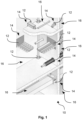
- Fig. 1 shows a building part 10 in a schematic, perspective, partially sectioned view, in particular a section of a building, with a large number of protective elements 12 in different application situations 14.
- the protective elements 12 are designed as fire protection elements. In particular, they are designed to prevent the spread of fire from one room 16 to another room 16 or vice versa, or at least to make it more difficult depending on the protection class.
- the application situations 14 can, for example, differ with regard to the type of substrate material, in the case of wall openings with regard to the dimensions and/or the shapes of the wall openings, the elements leading through the wall openings, for example supply lines or power lines, with regard to the required flexibility, i.e. whether or to what extent Changes to the protective element 12 are necessary or possible, with regard to required fire protection classes to be achieved and/or the like.
- the protective elements 12 for such application situations 14 must be selected in accordance with the respective certifications of the protective elements 12 and installed correctly. In cases where an application situation 14 does not correspond to any of the application situations for which protective elements 12 are available, in particular certified, an application situation that is as comparable as possible and for which a protective element 12 is available should be determined as far as possible.
- Fig. 2a, 2b and 2c show schematic representations of application situations 14.
- these representations include image data 20, nominally scaled data 22 and structured, semi-structured and/or unstructured text data 24.
- the text data 24 can also be at least nominally scaled.
- the image data represent, among other things, geometric features of the application situations 14.
- the nominally scaled data 22 relate, for example, to the designations of materials or protection classes to be achieved. In addition to truly nominally scaled data, they can also include higher scaled data, in particular ordinally scaled data.
- the text data 24 include additional information on the application situations 14, for example with regard to the layer structure of the floor, a ceiling or a wall shown in the image data 20. It can also contain further dimensions, references to norms and standards to be observed, or the like.
- Fig. 2a shows an example of an application situation 14 from a list of standard application situations.
- Fig. 2b shows an example of an application situation 14 for which a protective element 12 in the form of a fire protection element is certified.
- the example shown is a fire-retardant sealing paste filled in a tube for sealing gaps between a wall or a floor and a pipe to be led through the wall or floor.
- application situations 14 of comparison data sets 26 are also referred to as comparison application situations 27 .
- Fig. 2c shows an example of a possible result data set 28, which can be obtained, for example, by the system to be described below.
- the result data set 28 also includes an application situation 14 and an associated protection element 12, which is determined as described in more detail below.
- the comparison data set 26 and the result data set 28 largely correspond, for example the respective image data 20 match, but there are differences with regard to the text data 24.
- Fig. 3 shows a method 100 for determining a protective element 12 (see Fig. 1 ) of a type of protective element, in the present example in particular a fire protection element, for use in an application situation 14 (see e.g. Fig. 2a ), which is a structural part 10 (see Fig.
- an input data record 36 which comprises data on the application situation 14 is compared with a plurality of comparison data records 26 stored in a database 25 , each of which comprises data on comparison application situations 27 and each at least one associated protective element 12 of the protective element type, and wherein as a result of the comparison at least one of the comparison data records 26, at least a part of one of the comparison data records 26, a reference to at least one of the comparison data records 26 and/or an identifier of a protective element 12 of the protective element type is determined.
- the system 30 is constructed in several parts. Accordingly, in the embodiment according to Fig. 3 It is intended to carry out the method 100 in several stages.
- the input data set 36 is entered into an input device 37 of the system 30.
- the input device 37 can, for example, be a It may include a data interface with which, for example, data can be retrieved online or entered online, for example on a web-based form. It may also have a human-machine interface, for example in the form of a keyboard, a mouse and/or a touchscreen or the like.
- the first system part 32 pre-filters one or more of the comparison data sets 26 based on the input data set 36. In Fig. 3 In the example shown, this results in three different comparison data sets 26.
- the second system part 33 makes a final selection within the pre-filtered comparison data sets 26 and delivers a result data set 38, which thus corresponds to one of the pre-filtered comparison data sets 26 in this embodiment.
- the third system part 34 forms a quality assurance level.
- the third system part 34 carries out a final plausibility check of the result data set 38 using criteria that are as independent as possible of the filter or selection processes of the system parts 32, 33.
- the third system part 34 can be set up to check whether the absolute exclusion criteria specified in the input data set 36 are actually met by the result data set 38.
- the wall thickness of the breakthrough wall can be specified.
- the fire protection protection element corresponding to the result data set 38 should then also be actually certified for this wall thickness.
- a fire protection sealing paste for filling a gap it can also be checked, for example, whether the fire protection sealing paste is actually certified for the dimensions of a gap to be sealed specified in the input data set 36.
- an identifier 42 of the protective element 12 corresponding to the result data set 38 is output on an output device 40, for example.
- the output device 40 can comprise an image output unit, for example a monitor, a display unit of a computer, for example a tablet or a smartphone, or the like.
- the output device 40 can alternatively or additionally also comprise a data interface for transmitting the result data set 38 or a part thereof to another computer.
- the other computer can be and/or comprise, for example, a planning system for building planning.
- the other computer can also be and/or comprise a construction execution system and/or be part of such a system. construction execution system.
- the construction execution system can, for example, be set up to order a sufficient quantity of protective elements 12 of the type corresponding to the identifier 42, to deliver them to a construction site at which the building part 10 is being erected and/or to use them there, in particular to install them, in an automated manner, for example with the aid of a suitable construction robot.
- the system 30 is also designed in one part. Alternatively, it can also be designed in two parts or more than three parts. Accordingly, the method 100 can alternatively be designed in one step, two steps or more than three steps. It is also conceivable that the system 30 is designed as a recommendation system and/or the method 100 is designed as a recommendation process. For example, for legal reasons, it may be necessary that a final selection of a protective element cannot be made purely by machine. Then, for example, it can be provided that the results of the system 30 only form a suggestion that is finally checked by a human expert, particularly in the field of the type of protective element in question. For example, the third system part 34 can be replaced by the human expert for this purpose.
- Fig. 4 shows details of an embodiment of the system parts 32, 33 and the corresponding steps of the method 100 (see Fig. 3 ).
- the first system part 32 has a plurality of mapping matrices 44 for a 1:n assignment of property values of different properties.
- mapping matrix 44 for property values concerning fire protection elements for penetrations is given in Fig. 5 shown.
- One of the property values A, B, C, D, E, F, G, H, I, J, K, L or M of the input data set 36 listed line by line (see Fig. 4 ), depending on the marked fields, one or more of the property values A, B, C, D, E, F, G, H, I, J, K, L, M listed in columns are taken from comparison data sets 26 (see Fig. 4 ).
- the property values A, B, C, D, E, F, G, H, I, J, K, L, M can correspond to "concrete", "plasterboard”, "wood”, “chipboard”, “metal-clad concrete” etc.
- the property values I and M are also assigned to the property value C. This results in a 1:3 assignment.
- mapping matrix 44 An alternative embodiment of a mapping matrix 44 is shown in Fig. 6
- This mapping matrix 44 largely corresponds to the mapping matrix 44 described above.
- a special feature of this mapping matrix 44 is, however, that it also contains graded assignment levels, in Fig. 6 represented by different filling levels of the individual fields.
- the assignment levels can, for example, correspond to similarity levels. They can also correspond to proportions in which the various property values, in this case material types, should be taken into account as a substitute.
- the first system part 32 is set up to assign further alternative values to the relevant property values for each property that can be isolated from the input data set 36. From the comparison data sets 26, the first system part 32 then filters those comparison data sets 26 that, for each of the isolable properties, each have either a property value that matches the respective associated property value of the input data set 36 or one of the alternative values.
- the first system part 32 can be set up to carry out a hierarchical cluster analysis among the comparison data sets 26 found, for example based on a Gower distance metric.
- the first system part 32 can also be set up to select certain clusters and elements thereof.
- the first system part can be set up to select the three clusters and their central elements whose central elements are closest to the input data set 36 in terms of the Gower distance metric.
- three comparison data sets 26 can result as an intermediate result and serve as input data for the second system part 33.
- the second system part 33 has an image processing unit 46.
- the image processing unit 46 has a machine learner 48 in the form of a multi-stage neural network.
- the machine learner 48 is trained to process the image data 20 (see Fig. 2a, 2b and 2c ). For example, it can be set up to distinguish straight lines versus curves, to recognize and/or classify angles, and/or to perform other functions for the application situations 14 ( Fig. 1 ) to identify typical elements, such as pipes, supports, building parts or the like.
- the second system part 33 is set up to classify the image data 20 of the input data set 36 and the image data 20 of the comparison data sets 26 identified as an intermediate result with the aid of the image processing unit 46.
- Fig. 7 represents another example of the first and second system parts 32, 33 and the corresponding sub-steps of the method 100 (see Fig. 3 ).
- the second system part 33 can be connected to the Fig. 4 described second system part 33.
- image data 20 (see Fig. 2a to 2c ) of the input data set 36 and of comparison data sets 26 are evaluated by the second system part 33.
- the data extracted from the image data 20 form further, at least nominally scaled, properties of the input data set 36 or the comparison data sets 26.
- the first system part 32 of this embodiment has a further machine learner 48, which also comprises a multi-layer neural network, for example.
- the machine learner 48 is trained, for example by means of backpropagation and, for example, using expert assessments, to assign a most similar one of the comparison data sets 26 or the most similar one of the comparison application situations 27 to an input data set 36 and to output the corresponding comparison data set 26 and/or its identifier.
- the input data set 36 is thus first analyzed with regard to its image data 20.
- the additional, at least nominally scaled properties obtained in this way are fed to the first system part 32 with the remaining, at least nominally scaled properties of the input data set 36.
- This, in particular its machine learner 48 determines the most similar of the comparison data sets 26 or the associated comparison application situations 27 as the result data set 38 and outputs this on the output device 40.
Landscapes
- Business, Economics & Management (AREA)
- Engineering & Computer Science (AREA)
- Strategic Management (AREA)
- Economics (AREA)
- Human Resources & Organizations (AREA)
- General Business, Economics & Management (AREA)
- Entrepreneurship & Innovation (AREA)
- Marketing (AREA)
- Tourism & Hospitality (AREA)
- Physics & Mathematics (AREA)
- Theoretical Computer Science (AREA)
- General Physics & Mathematics (AREA)
- Operations Research (AREA)
- Quality & Reliability (AREA)
- Health & Medical Sciences (AREA)
- General Health & Medical Sciences (AREA)
- Data Mining & Analysis (AREA)
- Primary Health Care (AREA)
- Development Economics (AREA)
- Management, Administration, Business Operations System, And Electronic Commerce (AREA)
Priority Applications (3)
| Application Number | Priority Date | Filing Date | Title |
|---|---|---|---|
| EP23182064.8A EP4485306A1 (fr) | 2023-06-28 | 2023-06-28 | Système et procédé de détermination d'un élément de protection |
| EP24732693.7A EP4736094A1 (fr) | 2023-06-28 | 2024-06-13 | Système et procédé de détermination d'un élément de protection |
| PCT/EP2024/066334 WO2025002823A1 (fr) | 2023-06-28 | 2024-06-13 | Système et procédé de détermination d'un élément de protection |
Applications Claiming Priority (1)
| Application Number | Priority Date | Filing Date | Title |
|---|---|---|---|
| EP23182064.8A EP4485306A1 (fr) | 2023-06-28 | 2023-06-28 | Système et procédé de détermination d'un élément de protection |
Publications (1)
| Publication Number | Publication Date |
|---|---|
| EP4485306A1 true EP4485306A1 (fr) | 2025-01-01 |
Family
ID=87280703
Family Applications (2)
| Application Number | Title | Priority Date | Filing Date |
|---|---|---|---|
| EP23182064.8A Withdrawn EP4485306A1 (fr) | 2023-06-28 | 2023-06-28 | Système et procédé de détermination d'un élément de protection |
| EP24732693.7A Pending EP4736094A1 (fr) | 2023-06-28 | 2024-06-13 | Système et procédé de détermination d'un élément de protection |
Family Applications After (1)
| Application Number | Title | Priority Date | Filing Date |
|---|---|---|---|
| EP24732693.7A Pending EP4736094A1 (fr) | 2023-06-28 | 2024-06-13 | Système et procédé de détermination d'un élément de protection |
Country Status (2)
| Country | Link |
|---|---|
| EP (2) | EP4485306A1 (fr) |
| WO (1) | WO2025002823A1 (fr) |
Citations (1)
| Publication number | Priority date | Publication date | Assignee | Title |
|---|---|---|---|---|
| US20200279364A1 (en) * | 2019-02-28 | 2020-09-03 | Skidmore Owings & Merrill Llp | Machine learning tool for structures |
-
2023
- 2023-06-28 EP EP23182064.8A patent/EP4485306A1/fr not_active Withdrawn
-
2024
- 2024-06-13 EP EP24732693.7A patent/EP4736094A1/fr active Pending
- 2024-06-13 WO PCT/EP2024/066334 patent/WO2025002823A1/fr not_active Ceased
Patent Citations (1)
| Publication number | Priority date | Publication date | Assignee | Title |
|---|---|---|---|---|
| US20200279364A1 (en) * | 2019-02-28 | 2020-09-03 | Skidmore Owings & Merrill Llp | Machine learning tool for structures |
Also Published As
| Publication number | Publication date |
|---|---|
| WO2025002823A1 (fr) | 2025-01-02 |
| EP4736094A1 (fr) | 2026-05-06 |
Similar Documents
| Publication | Publication Date | Title |
|---|---|---|
| DE69505218T2 (de) | Verfahren zur Fehleridentifizierung in einem komplexen System | |
| EP2186003B1 (fr) | Procédé et dispositif de détermination d'une probabilité d'admission | |
| CH701481B1 (de) | Prozessmanagement. | |
| EP4485306A1 (fr) | Système et procédé de détermination d'un élément de protection | |
| EP3731043A1 (fr) | Procédé d'évaluation de la sécurité, programme informatique, support d'enregistrement lisible par machine et dispositif d'évaluation de la sécurité | |
| EP1092210B1 (fr) | Dispositif et procede pour la realisation d'un modele d'installation virtuel | |
| DE19703964C1 (de) | Verfahren zur Transformation einer zur Nachbildung eines technischen Prozesses dienenden Fuzzy-Logik in ein neuronales Netz | |
| DE19914819B4 (de) | Verfahren zur Unterstützung von Entwicklungprozessen | |
| EP3401849A1 (fr) | Détermination de la maturité de produit d'un système technique | |
| EP4307121A1 (fr) | Procédé mis en uvre par ordinateur pour configurer un système de test virtuel et procédé d'entraînement | |
| EP2191338B1 (fr) | Système d'établissement d'un programme de simulation | |
| DE102023211799A1 (de) | System und Verfahren mit einem Large Language Model | |
| EP3779619B1 (fr) | Procédé et dispositif pour la détermination de risques émergents d'un système technique | |
| DE102011082838A1 (de) | Identifikation wiederverwendbarer mechatronischer Komponenten in der Fabrikautomation | |
| WO2022084732A1 (fr) | Procédé de commande d'un processus à l'aide d'un produit de programme | |
| Fahlbruch et al. | Sicherheit | |
| DE102015214673A1 (de) | Produktionssystem und entsprechendes Verfahren | |
| WO2014005938A2 (fr) | Détermination de l'aptitude d'une ressource | |
| DE202009018710U1 (de) | Vorrichtung und Computerprogrammprodukt zur Projektierung eines Branderkennungssystems mit Absaugvorrichtung | |
| WO2026000006A1 (fr) | Procédé d'analyse fonctionnelle d'un système source | |
| EP4627501A1 (fr) | Procédé de sélection d'un produit de construction approprié et ordinateur | |
| DE10046116B4 (de) | Verfahren und Vorrichtung zum rechnergestützten Ermitteln mindestens eines gespeicherten Produkts und/oder mindestens eines gespeicherten Lösungsprinzips und Computerprogramm-Element | |
| DE102023206769A1 (de) | Verknüpfung von schnittstellen und/oder datenpunkten von applikationsprogrammen | |
| DE102018001413A1 (de) | Verfahren zur Steuerung einer Alarmanzeigeeinheit | |
| DE102024116725A1 (de) | Verfahren zur computergestützten Auswahl von Fertigungskomponenten |
Legal Events
| Date | Code | Title | Description |
|---|---|---|---|
| PUAI | Public reference made under article 153(3) epc to a published international application that has entered the european phase |
Free format text: ORIGINAL CODE: 0009012 |
|
| STAA | Information on the status of an ep patent application or granted ep patent |
Free format text: STATUS: THE APPLICATION HAS BEEN PUBLISHED |
|
| AK | Designated contracting states |
Kind code of ref document: A1 Designated state(s): AL AT BE BG CH CY CZ DE DK EE ES FI FR GB GR HR HU IE IS IT LI LT LU LV MC ME MK MT NL NO PL PT RO RS SE SI SK SM TR |
|
| STAA | Information on the status of an ep patent application or granted ep patent |
Free format text: STATUS: THE APPLICATION IS DEEMED TO BE WITHDRAWN |
|
| 18D | Application deemed to be withdrawn |
Effective date: 20250702 |