EP4487697A1 - Procédé de fabrication de gel fluide - Google Patents
Procédé de fabrication de gel fluide Download PDFInfo
- Publication number
- EP4487697A1 EP4487697A1 EP23763570.1A EP23763570A EP4487697A1 EP 4487697 A1 EP4487697 A1 EP 4487697A1 EP 23763570 A EP23763570 A EP 23763570A EP 4487697 A1 EP4487697 A1 EP 4487697A1
- Authority
- EP
- European Patent Office
- Prior art keywords
- fluid gel
- protein
- transglutaminase
- semi
- mayonnaise
- Prior art date
- Legal status (The legal status is an assumption and is not a legal conclusion. Google has not performed a legal analysis and makes no representation as to the accuracy of the status listed.)
- Pending
Links
Images




Classifications
-
- C—CHEMISTRY; METALLURGY
- C12—BIOCHEMISTRY; BEER; SPIRITS; WINE; VINEGAR; MICROBIOLOGY; ENZYMOLOGY; MUTATION OR GENETIC ENGINEERING
- C12Y—ENZYMES
- C12Y203/00—Acyltransferases (2.3)
- C12Y203/02—Aminoacyltransferases (2.3.2)
- C12Y203/02013—Protein-glutamine gamma-glutamyltransferase (2.3.2.13), i.e. transglutaminase or factor XIII
-
- A—HUMAN NECESSITIES
- A23—FOODS OR FOODSTUFFS; TREATMENT THEREOF, NOT COVERED BY OTHER CLASSES
- A23J—PROTEIN COMPOSITIONS FOR FOODSTUFFS; WORKING-UP PROTEINS FOR FOODSTUFFS; PHOSPHATIDE COMPOSITIONS FOR FOODSTUFFS
- A23J3/00—Working-up of proteins for foodstuffs
- A23J3/30—Working-up of proteins for foodstuffs by hydrolysis
- A23J3/32—Working-up of proteins for foodstuffs by hydrolysis using chemical agents
- A23J3/34—Working-up of proteins for foodstuffs by hydrolysis using chemical agents using enzymes
- A23J3/346—Working-up of proteins for foodstuffs by hydrolysis using chemical agents using enzymes of vegetable proteins
-
- A—HUMAN NECESSITIES
- A23—FOODS OR FOODSTUFFS; TREATMENT THEREOF, NOT COVERED BY OTHER CLASSES
- A23C—DAIRY PRODUCTS, e.g. MILK, BUTTER OR CHEESE; MILK OR CHEESE SUBSTITUTES; PREPARATION THEREOF
- A23C11/00—Milk substitutes, e.g. coffee whitener compositions
- A23C11/02—Milk substitutes, e.g. coffee whitener compositions containing at least one non-milk component as source of fats or proteins
- A23C11/06—Milk substitutes, e.g. coffee whitener compositions containing at least one non-milk component as source of fats or proteins containing non-milk proteins
-
- A—HUMAN NECESSITIES
- A23—FOODS OR FOODSTUFFS; TREATMENT THEREOF, NOT COVERED BY OTHER CLASSES
- A23C—DAIRY PRODUCTS, e.g. MILK, BUTTER OR CHEESE; MILK OR CHEESE SUBSTITUTES; PREPARATION THEREOF
- A23C13/00—Cream; Cream preparations; Making thereof
- A23C13/12—Cream preparations
-
- A—HUMAN NECESSITIES
- A23—FOODS OR FOODSTUFFS; TREATMENT THEREOF, NOT COVERED BY OTHER CLASSES
- A23C—DAIRY PRODUCTS, e.g. MILK, BUTTER OR CHEESE; MILK OR CHEESE SUBSTITUTES; PREPARATION THEREOF
- A23C13/00—Cream; Cream preparations; Making thereof
- A23C13/12—Cream preparations
- A23C13/16—Cream preparations containing, or treated with, microorganisms, enzymes, or antibiotics; Sour cream
-
- A—HUMAN NECESSITIES
- A23—FOODS OR FOODSTUFFS; TREATMENT THEREOF, NOT COVERED BY OTHER CLASSES
- A23C—DAIRY PRODUCTS, e.g. MILK, BUTTER OR CHEESE; MILK OR CHEESE SUBSTITUTES; PREPARATION THEREOF
- A23C9/00—Milk preparations; Milk powder or milk powder preparations
- A23C9/12—Fermented milk preparations; Treatment using microorganisms or enzymes
- A23C9/127—Fermented milk preparations; Treatment using microorganisms or enzymes using microorganisms of the genus lactobacteriaceae and other microorganisms or enzymes, e.g. kefir, koumiss
-
- A—HUMAN NECESSITIES
- A23—FOODS OR FOODSTUFFS; TREATMENT THEREOF, NOT COVERED BY OTHER CLASSES
- A23C—DAIRY PRODUCTS, e.g. MILK, BUTTER OR CHEESE; MILK OR CHEESE SUBSTITUTES; PREPARATION THEREOF
- A23C9/00—Milk preparations; Milk powder or milk powder preparations
- A23C9/12—Fermented milk preparations; Treatment using microorganisms or enzymes
- A23C9/13—Fermented milk preparations; Treatment using microorganisms or enzymes using additives
- A23C9/1315—Non-milk proteins or fats; Seeds, pulses, cereals or soja; Fatty acids, phospholipids, mono- or diglycerides or derivatives therefrom; Egg products
-
- A—HUMAN NECESSITIES
- A23—FOODS OR FOODSTUFFS; TREATMENT THEREOF, NOT COVERED BY OTHER CLASSES
- A23G—COCOA; COCOA PRODUCTS, e.g. CHOCOLATE; SUBSTITUTES FOR COCOA OR COCOA PRODUCTS; CONFECTIONERY; CHEWING GUM; ICE-CREAM; PREPARATION THEREOF
- A23G9/00—Frozen sweets, e.g. ice confectionery, ice-cream; Mixtures therefor
- A23G9/32—Frozen sweets, e.g. ice confectionery, ice-cream; Mixtures therefor characterised by the composition containing organic or inorganic compounds
- A23G9/38—Frozen sweets, e.g. ice confectionery, ice-cream; Mixtures therefor characterised by the composition containing organic or inorganic compounds containing peptides or proteins
-
- A—HUMAN NECESSITIES
- A23—FOODS OR FOODSTUFFS; TREATMENT THEREOF, NOT COVERED BY OTHER CLASSES
- A23J—PROTEIN COMPOSITIONS FOR FOODSTUFFS; WORKING-UP PROTEINS FOR FOODSTUFFS; PHOSPHATIDE COMPOSITIONS FOR FOODSTUFFS
- A23J3/00—Working-up of proteins for foodstuffs
- A23J3/04—Animal proteins
- A23J3/08—Dairy proteins
- A23J3/10—Casein
-
- A—HUMAN NECESSITIES
- A23—FOODS OR FOODSTUFFS; TREATMENT THEREOF, NOT COVERED BY OTHER CLASSES
- A23J—PROTEIN COMPOSITIONS FOR FOODSTUFFS; WORKING-UP PROTEINS FOR FOODSTUFFS; PHOSPHATIDE COMPOSITIONS FOR FOODSTUFFS
- A23J3/00—Working-up of proteins for foodstuffs
- A23J3/14—Vegetable proteins
- A23J3/16—Vegetable proteins from soybean
-
- A—HUMAN NECESSITIES
- A23—FOODS OR FOODSTUFFS; TREATMENT THEREOF, NOT COVERED BY OTHER CLASSES
- A23J—PROTEIN COMPOSITIONS FOR FOODSTUFFS; WORKING-UP PROTEINS FOR FOODSTUFFS; PHOSPHATIDE COMPOSITIONS FOR FOODSTUFFS
- A23J3/00—Working-up of proteins for foodstuffs
- A23J3/30—Working-up of proteins for foodstuffs by hydrolysis
- A23J3/32—Working-up of proteins for foodstuffs by hydrolysis using chemical agents
- A23J3/34—Working-up of proteins for foodstuffs by hydrolysis using chemical agents using enzymes
- A23J3/341—Working-up of proteins for foodstuffs by hydrolysis using chemical agents using enzymes of animal proteins
- A23J3/343—Working-up of proteins for foodstuffs by hydrolysis using chemical agents using enzymes of animal proteins of dairy proteins
- A23J3/344—Working-up of proteins for foodstuffs by hydrolysis using chemical agents using enzymes of animal proteins of dairy proteins of casein
-
- A—HUMAN NECESSITIES
- A23—FOODS OR FOODSTUFFS; TREATMENT THEREOF, NOT COVERED BY OTHER CLASSES
- A23L—FOODS, FOODSTUFFS OR NON-ALCOHOLIC BEVERAGES, NOT OTHERWISE PROVIDED FOR; PREPARATION OR TREATMENT THEREOF
- A23L27/00—Spices; Flavouring agents or condiments; Artificial sweetening agents; Table salts; Dietetic salt substitutes; Preparation or treatment thereof
- A23L27/60—Salad dressings; Mayonnaise; Ketchup
-
- A—HUMAN NECESSITIES
- A23—FOODS OR FOODSTUFFS; TREATMENT THEREOF, NOT COVERED BY OTHER CLASSES
- A23L—FOODS, FOODSTUFFS OR NON-ALCOHOLIC BEVERAGES, NOT OTHERWISE PROVIDED FOR; PREPARATION OR TREATMENT THEREOF
- A23L29/00—Foods or foodstuffs containing additives; Preparation or treatment thereof
- A23L29/06—Enzymes
-
- A—HUMAN NECESSITIES
- A23—FOODS OR FOODSTUFFS; TREATMENT THEREOF, NOT COVERED BY OTHER CLASSES
- A23L—FOODS, FOODSTUFFS OR NON-ALCOHOLIC BEVERAGES, NOT OTHERWISE PROVIDED FOR; PREPARATION OR TREATMENT THEREOF
- A23L29/00—Foods or foodstuffs containing additives; Preparation or treatment thereof
- A23L29/10—Foods or foodstuffs containing additives; Preparation or treatment thereof containing emulsifiers
-
- A—HUMAN NECESSITIES
- A23—FOODS OR FOODSTUFFS; TREATMENT THEREOF, NOT COVERED BY OTHER CLASSES
- A23L—FOODS, FOODSTUFFS OR NON-ALCOHOLIC BEVERAGES, NOT OTHERWISE PROVIDED FOR; PREPARATION OR TREATMENT THEREOF
- A23L29/00—Foods or foodstuffs containing additives; Preparation or treatment thereof
- A23L29/20—Foods or foodstuffs containing additives; Preparation or treatment thereof containing gelling or thickening agents
- A23L29/275—Foods or foodstuffs containing additives; Preparation or treatment thereof containing gelling or thickening agents of animal origin, e.g. chitin
- A23L29/281—Proteins, e.g. gelatin or collagen
-
- C—CHEMISTRY; METALLURGY
- C12—BIOCHEMISTRY; BEER; SPIRITS; WINE; VINEGAR; MICROBIOLOGY; ENZYMOLOGY; MUTATION OR GENETIC ENGINEERING
- C12N—MICROORGANISMS OR ENZYMES; COMPOSITIONS THEREOF; PROPAGATING, PRESERVING, OR MAINTAINING MICROORGANISMS; MUTATION OR GENETIC ENGINEERING; CULTURE MEDIA
- C12N9/00—Enzymes; Proenzymes; Compositions thereof; Processes for preparing, activating, inhibiting, separating or purifying enzymes
- C12N9/10—Transferases (2.)
- C12N9/1022—Transferases (2.) transferring aldehyde or ketonic groups (2.2)
-
- C—CHEMISTRY; METALLURGY
- C12—BIOCHEMISTRY; BEER; SPIRITS; WINE; VINEGAR; MICROBIOLOGY; ENZYMOLOGY; MUTATION OR GENETIC ENGINEERING
- C12N—MICROORGANISMS OR ENZYMES; COMPOSITIONS THEREOF; PROPAGATING, PRESERVING, OR MAINTAINING MICROORGANISMS; MUTATION OR GENETIC ENGINEERING; CULTURE MEDIA
- C12N9/00—Enzymes; Proenzymes; Compositions thereof; Processes for preparing, activating, inhibiting, separating or purifying enzymes
- C12N9/10—Transferases (2.)
- C12N9/1025—Acyltransferases (2.3)
- C12N9/104—Aminoacyltransferases (2.3.2)
- C12N9/1044—Protein-glutamine gamma-glutamyltransferase (2.3.2.13), i.e. transglutaminase or factor XIII
-
- A—HUMAN NECESSITIES
- A23—FOODS OR FOODSTUFFS; TREATMENT THEREOF, NOT COVERED BY OTHER CLASSES
- A23V—INDEXING SCHEME RELATING TO FOODS, FOODSTUFFS OR NON-ALCOHOLIC BEVERAGES AND LACTIC OR PROPIONIC ACID BACTERIA USED IN FOODSTUFFS OR FOOD PREPARATION
- A23V2002/00—Food compositions, function of food ingredients or processes for food or foodstuffs
-
- A—HUMAN NECESSITIES
- A23—FOODS OR FOODSTUFFS; TREATMENT THEREOF, NOT COVERED BY OTHER CLASSES
- A23V—INDEXING SCHEME RELATING TO FOODS, FOODSTUFFS OR NON-ALCOHOLIC BEVERAGES AND LACTIC OR PROPIONIC ACID BACTERIA USED IN FOODSTUFFS OR FOOD PREPARATION
- A23V2200/00—Function of food ingredients
- A23V2200/20—Ingredients acting on or related to the structure
- A23V2200/22—Coating agent
Definitions
- the present invention relates to a fluid gel which can impart stickiness-free viscosity and a rich taste, good melt in mouth, foaming property, and the like to semi-solid foods, and which itself is superior in emulsifying property, and a production method thereof, emulsifiers and semi-solid foods containing the fluid gel, and the like.
- a creamer containing sugar, fat, and a protein having a spherical protein denaturation degree within a specific range, and having a viscosity within a specific range is known as a creamer that can achieve long-term stability, high whitening ability, and a pleasant mouthfeel (Patent Literature 1).
- an edible composition containing water, a fat phase, microgel particles, a stabilizing emulsifier, and an unstabilizing emulsifier, which has an elastic modulus within a specific range, has properties similar to those of mayonnaise or a spread, and can be spooned or spread is known (Patent Literature 2).
- transglutaminase is an enzyme that catalyzes the cross-linking of proteins and is widely used as an adhesive enzyme for food materials.
- protein gelation by transglutaminase is known (Patent Literature 4, Patent Literature 5).
- the present invention aims to provide a fluid gel which can impart stickiness-free viscosity and a rich taste, good melt in mouth, foaming property, and the like to semi-solid foods, and which itself is superior in emulsifying property, and a production method thereof, emulsifiers and semi-solid foods containing the fluid gel, and the like.
- the present inventors have conducted intensive studies of the above-mentioned problem and found that a fluid gel can be obtained by stirring a solution containing a protein and transglutaminase, and that addition of this fluid gel to low-fat mayonnaise, whipped cream using vegetable fat, and the like can provide properties closer to those of full-fat mayonnaise and whipped cream produced by stirring high-fat raw milk, respectively; specifically, viscosity and texture that are free of stickiness, good foaming property, and good melt in mouth, and have completed the present invention by conducting further studies based on such finding.
- the present invention provides the following.
- the present invention can provide a fluid gel which can impart good properties such as stickiness-free viscosity and rich taste, good melt in mouth, foaming property, and the like to semi-solid foods, and which itself is superior in emulsifying property.
- the present invention provides a method for producing a fluid gel, including stirring a solution containing a protein and transglutaminase (hereinafter to be referred to as "the production method of the present invention").
- the "fluid gel” is also called “liquid gel”, “fluid-state gel”, “fluid gel” and the like, and refers to an aggregate in which microgels are dispersed. Fluid gels have fluidity as a whole while gelling in the microgel parts, and behave differently from general gels which gelatinize as a whole, lose fluidity, and behave like a solid.
- the microgel is a microgel whose dispersoid is a protein treated with transglutaminase.
- the particle size of the microgel is not particularly limited.
- the proportion of gel particles that pass through a 10,000 ⁇ m sieve is preferably not less than 50 wt%, more preferably not less than 70 wt%, further preferably not less than 90 wt%, of the total amount of the fluid gel.
- the particle size of the fluid gel obtained by the production method of the present invention is preferably 0.1 ⁇ m to 1,000 ⁇ m as the median diameter (D50 particle size; hereinafter also referred to as "D50 particle size”), more preferably 0.1 ⁇ m to 500 ⁇ m, further preferably 0.1 ⁇ m to 200 ⁇ m.
- the median diameter can be measured, for example, using a laser diffraction ⁇ scattering particle size distribution measuring device LA-960 (Horiba, Ltd.).
- the dispersion medium constituting the fluid gel water suitable for use in food production, such as purified water, distilled water, deionized water, tap water, and the like is preferred. Also, buffer solutions such as acetate buffer, phosphate buffer, and aqueous solutions suitable for use in food production, such as an aqueous sodium carbonate solution, can be used.
- the content of these dispersion media in the fluid gel is preferably 0.1 wt% to 30 wt%, more preferably 0.5 wt% to 20 wt%, and further preferably 1 wt% to 15 wt%.
- Proteins include plant proteins, animal proteins, and mixtures of these, and the like.
- Plant proteins are proteins derived from plants or compositions containing them, and also include those in which the protein content has been increased by processing plants.
- Specific examples of the plant protein include soy protein, wheat protein, green pea protein, mung bean protein, broad bean protein, green soy protein, rape seed protein, chia seed protein, corn protein, rice protein, buckwheat protein, sweet potato protein, asparagus protein, broccoli protein, avocado protein, oat protein, almond protein and the like, and soy protein is preferred.
- the plant protein is not particularly limited as long as it contains a protein derived from a plant.
- the soy protein is not particularly limited as long as it contains a protein derived from soybeans, and refers to proteins that can be obtained by processing soybeans, such as concentrated soy protein, isolated soy protein, fibrous soy protein, extracted soy protein, and the like. Specific examples include, but are not limited to, "New FUJIPRO SEH" (Fuji Oil Co., Ltd.).
- Operations such as plant processing, plant protein separation, and the like can be performed by a conventional method, for example, operations such as soybean processing, soy protein separation, and the like, and can be performed according to the methods described in Journal of the Japan Oil Chemists' Society, Vol. 19, No. 8, p. 826 (1970 ), Journal of the Japan Oil Chemists' Society, Vol. 28, No. 10, p. 781 (1979 ), and the like, or methods similar thereto.
- plant protein one type of plant protein may be used, or two or more types of plant proteins may be used.
- Animal protein is a protein derived from an animal or a composition containing the same, and specific examples include milk protein (whey protein, casein protein, etc.), egg white protein, meat protein, fish protein, etc., of which milk protein or egg white protein is preferred, and casein protein is particularly preferred.
- the animal protein is not particularly limited as long as it contains a protein derived from an animal.
- casein protein is not particularly limited as long as it contains a protein fraction obtained by removing whey and milk fat from raw milk, and refers to proteins such as micellar casein and sodium caseinate.
- the animal protein may be prepared by oneself or may be a commercially available product such as "Sodium Caseinate 180" (Fonterra Japan K.K.) and the like.
- animal protein one type of animal protein may be used, or two or more types of animal proteins may be used.
- Transglutaminase is an enzyme that has the activity of catalyzing an acyl transfer reaction in which a glutamine residue in a protein or peptide is used as a donor and a lysine residue is used as a receptor, and transglutaminase of various origins is known, such as those derived from mammals, those derived from fish, and those derived from microorganisms.
- the origin of the transglutaminase used in the present invention is not particularly limited as long as it has the aforementioned activity, and transglutaminase of any origin may be used, and recombinant enzymes may also be used.
- the transglutaminase used in the present invention may be a commercially available product, and specific examples include, but are not limited to, microorganism-derived transglutaminase commercially available under the trade names "Activa (registered trademark) TG-AK” (Ajinomoto Co., Inc.), “Activa (registered trademark) TG-S” (Ajinomoto Co., Inc.), “Activa TG (registered trademark)” (Ajinomoto Co., Inc.), and the like.
- the amount of transglutaminase used in the production method of the present invention is not particularly limited, and may vary depending on the production conditions. It is preferably an amount that is 0.001 U (unit) to 1,000 U, more preferably an amount that is 0.01 U to 500 U, and further preferably an amount that is 0.1 U to 100 U, per 1 g of protein.
- the activity unit of transglutaminase is measured and defined as follows. That is, transglutaminase is allowed to act in a reaction system in which benzyloxycarbonyl-L-glutamylglycine and hydroxylamine are used as substrates in Tris buffer at 37°C and pH 6.0, and the hydroxamic acid produced is allowed to form an iron complex in the presence of trichloroacetic acid. The absorbance at 525 nm is then measured, and the amount of hydroxamic acid is calculated using a calibration curve, and the amount of enzyme required to produce 1 ⁇ mol of hydroxamic acid per minute is defined as 1 unit (1 U) (see JP S64-27471 A ).
- water suitable for use in food production such as purified water, distilled water, deionized water, tap water, and the like is preferably used.
- Buffer solutions such as acetate buffer and phosphate buffer, and aqueous solutions suitable for use in food production, such as an aqueous sodium carbonate solution, can also be used.
- the concentration of the protein in the solution is preferably 0.1 wt% to 40 wt%, more preferably 0.5 wt% to 30 wt%, and further preferably 1 wt% to 20 wt%.
- the temperature at which the solution containing the mixture of protein and transglutaminase is stirred is preferably a temperature at which the protein does not denature, and depends on other conditions, but is preferably 0°C to 60°C, more preferably 10°C to 60°C, further preferably 20°C to 50°C.
- the stirring speed when the solution is stirred depends on other conditions. For example, 100 rpm to 30,000 rpm is preferred, 150 rpm to 20,000 rpm is more preferred, and 200 rpm to 15,000 rpm is further preferred. In one embodiment, 1,000 rpm to 30,000 rpm is more preferred and 2,000 rpm to 20,000 rpm is further preferred.
- a stirring speed of 100 rpm or more is preferred because it is less likely to cause the entire solution to gelatinize as it is.
- the stirring time when the solution is stirred depends on other conditions, it is preferably 1 minute to 12 hours, more preferably 5 minutes to 6 hours, and further preferably 10 minutes to 3 hours.
- the production method of the present invention can be performed by stirring the solution containing the protein while adding transglutaminase.
- components other than the protein and transglutaminase may be added as long as they do not impair the effects of the present invention.
- other components include other enzymes such as glucose oxidase and the like, alkaline agents (pH adjusters) such as sodium carbonate, potassium carbonate, calcined calcium, and the like, redox agents such as sodium ascorbate, glutathione, cysteine, and the like, and the like.
- enzymes such as glucose oxidase and the like
- alkaline agents (pH adjusters) such as sodium carbonate, potassium carbonate, calcined calcium, and the like
- redox agents such as sodium ascorbate, glutathione, cysteine, and the like, and the like.
- one type of component may be used, or two or more types of components may be used in combination.
- the timing of adding the above-mentioned other components to the solution containing the protein and transglutaminase is not particularly limited.
- the amount of other components to be used is not particularly limited, but is preferably an amount that is not more than 10 wt%, more preferably an amount that is not more than 5 wt%, and further preferably an amount that is not more than 1 wt%, in the solution containing the protein and transglutaminase.
- the present invention also provides a fluid gel containing a protein treated with transglutaminase, and having a median diameter of 0.1 ⁇ m to 1000 ⁇ m.
- Transglutaminase, protein, fluid gel, and median diameter are as explained above in the production method of the present invention.
- the method of making transglutaminase act on protein is not particularly limited.
- An example is a method of stirring a solution containing a mixture of protein and transglutaminase as explained above in the production method of the present invention.
- the present invention also provides a fluid gel containing a protein treated with transglutaminase and satisfying one or more of the following properties at 25°C (hereinafter referred to as the "fluid gel of the present invention"):
- the present invention provides a fluid gel containing a protein treated with transglutaminase, which satisfies two or more of the above-mentioned properties (1) to (3) at 25°C.
- the present invention provides a fluid gel containing a protein treated with transglutaminase, which satisfies all of the above-mentioned properties (1) to (3) at 25°C.
- Transglutaminase, protein, and fluid gel are as explained above in the production method of the present invention.
- the method of making transglutaminase act on protein is not particularly limited.
- An example is a method of stirring a solution containing a mixture of protein and transglutaminase as explained above in the production method of the present invention.
- the complex modulus refers to the complex expression of the elastic modulus with respect to oscillatory stress and strain in linear viscoelasticity ( Chemical Dictionary, 2nd Edition, Morikita Publishing (2009 )).
- the complex modulus can be measured, for example, using a rheometer such as the Stress Controlled Rheometer MCR501 (Anton Paar Japan Co., Ltd.).
- the complex modulus at an angular frequency of 1 rad/sec is preferably 5 Pa to 5,000 Pa, more preferably 10 Pa to 2,000 Pa.
- the coordination number is information relating to the spatial distribution of virtual flow unit lattices in the system ( RHEOLOGY TORONKAI KOEN YOSHISHU (Proceedings of the Rheology Symposium), vol.: 66th, p. 322-323 (October 17, 2018 )), and the gel strength indicates the strength of the mechanical interaction between the above-mentioned flow unit lattices ( RHEOLOGY TORONKAI KOEN YOSHISHU (Proceedings of the Rheology Symposium), vol.: 66th, p. 322-323 (October 17, 2018 )).
- Both the coordination number and gel strength can be derived from the angular frequency dependence data of the above-mentioned complex modulus using a weak-gel model ( J Biorheol, 32 (1), 9-14 (2018 ), Rheologica Acta, 40, 120-127 (2001 ), etc.).
- the angular frequency dependency data in the angular frequency range of 0.1 to 100 rad/sec is plotted on a graph with the complex modulus (Pa) on the vertical axis and the angular frequency (rad/sec) on the horizontal axis, and an approximate line is drawn on the graph by the least squares method, and when the vertical intercept of the approximate line at an angular frequency of 1 rad/sec is b and the slope of the approximate line is a, the gel strength A f (Pas 1/z ) in the angular frequency range of 0.1 to 100 rad/sec is expressed as 10 b , and the coordination number z is expressed as 1/a.
- the complex modulus, coordination number, gel strength, and angular frequency have the following relationship in the weak-gel model ( Rheologica Acta, 40, 120-127 (2001 )).
- G ⁇ A f ⁇ 1 z .
- G* represents the complex modulus (Pa)
- a f represents the gel strength (Pas 1/z )
- ⁇ represents the angular frequency (rad/sec)
- z represents the coordination number
- the coordination number in the angular frequency range of 0.1 to 100 rad/sec is preferably 0.1 to 15, more preferably 0.1 to 10.
- the gel strength in the angular frequency range of 0.1 to 100 rad/sec is preferably 0.1 Pas 1/z to 80Pas 1/z , more preferably 0.1Pas 1/z to 60Pas 1/z .
- the shear stress can also be measured using a rheometer such as the Stress Controlled Rheometer MCR501 (Anton Paar Japan Co., Ltd.), and the viscosity coefficient can be analyzed using the shear stress and the shear rate set during measurement with the rheometer, along with the H-B (Herschel-Bulkley) index and yield stress, using the analysis software Universal Software US200 (Paar Physica) according to the following Herschel-Bulkley equation (Kolloid-Z, 39, 291 (1926)), an empirical equation that describes non-Newtonian flow.
- a rheometer such as the Stress Controlled Rheometer MCR501 (Anton Paar Japan Co., Ltd.)
- H-B Herschel-Bulkley index and yield stress
- ⁇ k ⁇ ⁇ n + ⁇ y (In the formula, ⁇ represents shear stress (Pa), k represents viscosity coefficient (Pas n ), ⁇ represents shear rate (1/sec), n represents H-B index (no unit), and ⁇ y represents yield stress (Pa)).
- the shear stress at a shear rate of 10/sec is preferably 2 Pa to 200 Pa, more preferably 5 Pa to 100 Pa.
- the viscosity coefficient at a shear rate range of 1 to 100/sec is preferably 0.1 Pas n to 80 Pas n , more preferably 0.1 Pas n to 60 Pas n .
- the average particle size of the fluid gel of the present invention is preferably 0.1 ⁇ m to 1,000 ⁇ m, more preferably 0.1 ⁇ m to 500 ⁇ m, and further preferably 0.1 ⁇ m to 200 ⁇ m.
- the average particle size can be measured, for example, using a laser diffraction-scattering particle size distribution measuring device LA-960 (Horiba, Ltd.).
- the fluid gel of the present invention can be produced, for example, by the above-mentioned production method of the present invention.
- the present invention provides a fluid gel that can be obtained by stirring a solution containing a protein and transglutaminase.
- the present invention also provides a fluid gel that contains a protein treated with transglutaminase, the fluid gel having an average particle size of 0.1 ⁇ m to 1,000 um.
- This fluid gel can also be produced, for example, by the above-mentioned production method of the present invention.
- the present invention also provides an emulsifier containing the fluid gel of the present invention (hereinafter referred to as the "emulsifier of the present invention").
- the emulsifier of the present invention may be the fluid gel of the present invention used alone, or may contain other components as long as the effect of the present invention is not impaired.
- examples of other components include other emulsifiers such as sucrose fatty acid ester, glycerol fatty acid ester, sorbitan fatty acid ester, sodium caseinate, lecithin, saponin, and the like, thickeners such as xanthan gum, gellan gum, gum arabic, carrageenan and the like, proteins such as egg white and the like, carbohydrates such as glucose, lactose, and the like, fats and oils such as soybean oil and the like, sweeteners such as aspartame, acesulfame potassium, and the like, flavoring materials such as sodium chloride, sodium L-glutamate, and the like, colorants such as annatto dye, turmeric dye, gardenia dye, and the like, flavors such as ethyl acetoacetate, orange, lavender and the like, preservatives
- the content of the fluid gel of the present invention in the emulsifier of the present invention is not particularly limited. It is preferably 0.01% to 100 wt%, more preferably 1 wt% to 100 wt%, 10 wt% to 100 wt%, 30 wt% to 100 wt%, or 50 wt% to 100 wt%, further preferably 70 wt% to 100 wt%, or 80 wt% to 100 wt%, particularly preferably 90 wt% to 100 wt%.
- the content of the above-mentioned other components in the emulsifier of the present invention is not particularly limited. It is preferably 0.0001 wt% to 30 wt%, more preferably 0.001 wt% to 20 wt%, further preferably 0.01 wt% to 10 wt%, in total.
- the emulsifier of the present invention may be produced by using the fluid gel of the present invention as it is, or, for example, by adding the above-mentioned other components to the fluid gel of the present invention and mixing them by a general method.
- the emulsifier of the present invention can be added, for example, to emulsified foods, cosmetics, and the like.
- the emulsified foods to which the emulsifier of the present invention is added are preferably oil-in-water emulsified foods.
- examples of the oil-in-water emulsified food include yoghurt, mayonnaise, whipped cream, ice cream, custard cream, cafe au lait, coffee cream, coffee drinks, and the like.
- the content of the emulsifier in the emulsified food is not particularly limited, but is preferably 0.01 wt% to 30 wt%, more preferably 0.05 wt% to 20 wt%, and further preferably 0.1 wt% to 10 wt%.
- the timing of adding the emulsifier of the present invention to an emulsified food is not particularly limited. For example, it may be mixed together with the other ingredients of the emulsified food, or it may be added after mixing the other ingredients.
- the emulsifier of the present invention may also be added to an emulsified food in combination with other emulsifiers such as sucrose fatty acid ester, glycerol fatty acid ester, sorbitan fatty acid ester, sodium caseinate, lecithin, saponin, and the like.
- Examples of the cosmetics to which the emulsifier of the present invention is added include basic cosmetics such as emulsion, cream, lotion, facial cleanser, and the like, hair cosmetics such as shampoo, rinse, treatment and the like, makeup cosmetics such as liquid foundation and the like, and the like.
- the content of the emulsifier in the cosmetics is not particularly limited, but is preferably 0.01 wt% to 80 wt%, more preferably 0.05 wt% to 60 wt%, further preferably 0.1 wt% to 40 wt%.
- the timing of the addition of the emulsifier of the present invention to a cosmetic is not particularly limited.
- the emulsifier may be mixed together with the other ingredients of the cosmetic, or may be added after mixing the other ingredients.
- the emulsifier of the present invention may also be added to a cosmetic in combination with other emulsifiers such as sodium caseinate, saponin, and the like.
- the present invention also provides a semi-solid food containing the fluid gel of the present invention (hereinafter to be referred to as "the semi-solid food of the present invention").
- Semi-solid foods include yoghurt, mayonnaise, whipped cream, cafe au lait, dressings, sauces, and the like, and yoghurt, mayonnaise, whipped cream, and cafe au lait are preferred.
- semi-solid foods include alternative semi-solid foods; for example, mayonnaise includes conventional mayonnaise, as well as alternative mayonnaise such as low-fat mayonnaise and mayonnaise using plant protein instead of animal protein; whipped cream includes whipped cream using milk fat (raw milk) (hereinafter referred to as "milk fat"), which is animal fat with high fat content, as well as alternative whipped cream such as whipped cream using milk fat with low fat content and whipped cream using vegetable fat (hereinafter referred to as "vegetable fat").
- Low-fat mayonnaise mayonnaise using plant protein instead of animal protein, and the like have a thin viscosity, and therefore, a thickener such as xanthan gum is generally added. This results in a sticky texture, and whipped cream using milk fat with low fat content and whipped cream using vegetable fat have low foaming property.
- alternative semi-solid foods such as alternative mayonnaise and whipped cream in place of low-fat mayonnaise, which is prone to problems in terms of property, mayonnaise using plant protein instead of animal protein, whipped cream using milk fat with low fat content, whipped cream using vegetable fat, and the like are more preferred as semi-solid foods.
- the semi-solid food of the present invention can be produced, for example, by adding the fluid gel of the present invention to the raw materials of the food during the production process of the semi-solid food and mixing them by a general method.
- the raw materials of the food refer to food materials for producing the food, and are not particularly limited as long as the food can be produced, and anything that is generally used as a raw material for the food can be used.
- the raw materials of the food also include intermediate products of the food at any stage during the production process of the food.
- the present invention also provides a method for producing a semi-solid food and a method for improving the property of a semi-solid food, which is characterized by mixing the fluid gel of the present invention with the raw materials of the semi-solid food.
- the semi-solid food and the raw materials of the food are each the same as those described above for the semi-solid food of the present invention.
- the method for producing a semi-solid food and the method for improving the property of the present invention can be performed, for example, by adding the fluid gel of the present invention to the raw materials of the semi-solid food during the production process of the semi-solid food and mixing them by a general method.
- the semi-solid food is mayonnaise
- the property of the mayonnaise is improved (stickiness-free viscosity and a rich taste, good melt in mouth and the like are obtained)
- the property of the whipped cream is improved (foaming property is improved)
- the semi-solid food is cafe au lait
- the property of the cafe au lait is improved (rich taste similar to that of oil and fat, and the mid- to late-stage thickness are imparted).
- Soy protein is added to a mixture of 185.9 mL of distilled water and 2.1 mL of 10 mM Na 2 CO 3 aqueous solution (pH 10.5), stirred and dissolved in a homomixer at 40°C and 15,000 rpm for 1 hr, and the mixture is defoamed in a centrifuge at 2,000 rpm for 5 min to obtain a soy protein solution.
- Transglutaminase is added to the resulting solution, and the mixture is stirred in a homomixer at 40°C and 5,000 rpm for 30 min.
- the resulting solution is heated in a microwave oven (900W, 30 sec), and then heated in an oil bath at 75°C or higher for 5 min to inactivate the transglutaminase.
- the solution is then defoamed in a centrifuge at 2,000 rpm for 10 min to obtain a fluid gel.
- Soy protein is added to 188.0 mL of distilled water, and 4.0 mL of ethanol is added to preliminarily disperse the soy protein. It is then stirred and dissolved in a homomixer at 60°C and 15,000 rpm for 1 hr, and defoamed in a centrifuge at 2,000 rpm for 5 min to obtain a soy protein solution.
- Transglutaminase is added to the resulting solution, and the mixture is stirred in a homomixer at 40°C and 5,000 rpm for 30 min.
- the resulting solution is heated in a microwave oven (900W, 30 sec), and then heated in an oil bath at 75°C or higher for 5 min to inactivate the transglutaminase.
- the solution is then defoamed in a centrifuge at 2,000 rpm for 10 min to obtain a fluid gel.
- soy protein solutions were obtained from soy protein "New FUJIPRO SEH” (Fuji Oil Co., Ltd.), distilled water, and 10 mM Na 2 CO 3 aqueous solution (pH 10.5).
- Transglutaminase "Activa (registered trademark) TG” was added to each of the obtained solutions so that the concentration thereof was 12.2 U/g, and each was stirred in a homomixer for 30 min at 40°C and 300 rpm instead of 5,000 rpm.
- the obtained solutions were heated in a microwave oven (900 W, 30 sec), and then heated in an oil bath at 75°C or higher for 5 min to inactivate the transglutaminase.
- the solutions were then defoamed in a centrifuge at 2,000 rpm for 10 min.
- the same procedure was performed without adding transglutaminase.
- soy protein solution was obtained from soy protein "New FUJIPRO SEH” (Fuji Oil Co., Ltd.), distilled water, and 10 mM Na 2 CO 3 aqueous solution (pH 10.5).
- Transglutaminase "Activa (registered trademark) TG” was added to the obtained solution so that the concentration thereof was 1.22 U/g, 3.66 U/g or 6.10 U/g, and each was stirred in a homomixer for 30 min at 40°C and 5,000 rpm.
- the obtained solutions were heated in a microwave oven (900 W, 30 sec), and then heated in an oil bath at 75°C or higher for 5 min to inactivate the transglutaminase.
- the solutions were then defoamed in a centrifuge at 2,000 rpm for 10 min.
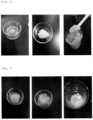
- Fig. 1 Photographs of the resulting mixtures are shown in Fig. 1 , respectively.
- Fig. 1 Photographs of the resulting mixtures are shown in Fig. 1 , respectively.
- Fig. 1 when transglutaminase was added to 1.22 U/g and 3.66 U/g, a transparent fluid gel was obtained.
- transglutaminase was added to 6.10 U/g, the viscosity rose sharply and the entire mixture gelled.
- soy protein solution was obtained from soy protein "New FUJIPRO SEH” (Fuji Oil Co., Ltd.) and distilled water.
- Transglutaminase "Activa (registered trademark) TG” was added to the obtained solution so that the concentration thereof was 1.22 U/g, 3.66 U/g or 6.10 U/g, and each was stirred in a homomixer for 30 min at 40°C and 5,000 rpm.
- the obtained solutions were heated in a microwave oven (900 W, 30 sec), and then heated in an oil bath at 75°C or higher for 5 min to inactivate the transglutaminase.
- the solutions were then defoamed in a centrifuge at 2,000 rpm for 10 min.
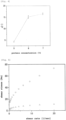
- the coordination number (z) in the angular frequency range of 0.1 to 100 rad/sec was derived by plotting the angular frequency dependency data of the above-mentioned complex modulus (G*) (Pa) in the angular frequency range of 0.1 to 100 rad/sec on a graph with the complex modulus (Pa) on the vertical axis and the angular frequency (rad/sec) on the horizontal axis, drawing an approximation line by the least squares method, and calculating 1/a from the slope a of the approximation line.
- the viscosity coefficient was derived from the shear stress measured in Experimental Example 2 for each fluid gel obtained when transglutaminase "Activa (registered trademark) TG" was added to 1.22 U/g and 3.66 U/g in Example 2 (alkaline conditions) and Example 3 (neutral conditions).
- the viscosity coefficient was calculated by analyzing the shear stress obtained in Experimental Example 2 and the shear rate (1/sec) set during measurement with the above-mentioned rheometer using the following Herschel-Bulkley equation using analysis software Universal Software US200 (Paar Physica).
- ⁇ shear stress (Pa)
- k viscosity coefficient (Pas n )
- ⁇ shear rate (1/sec)
- n H-B index (no unit)
- ⁇ y represents yield stress (Pa)).
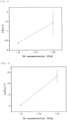
- the gel strength A f (Pas 1/z ) at an angular frequency of 1 rad/sec was derived by plotting the angular frequency dependency data of the above-mentioned complex modulus (G*) (Pa) in the angular frequency range of 0.1 to 100 rad/sec on a graph with the complex modulus (Pa) on the vertical axis and the angular frequency (rad/sec) on the horizontal axis, drawing an approximation line by the least squares method, and calculating 10 b from the vertical intercept b of the approximation line at an angular frequency of 1 rad/sec.
- Fig. 9 The results thereof are shown in Fig. 9 . As shown in Fig. 9 , it can be seen that the gel strength increases as the transglutaminase concentration increases.
- Mayonnaise was prepared with the composition shown in Table 1.
- the soybean 6% fluid gel used was a fluid gel obtained from a 6 wt% soy protein solution prepared in the same manner as in Example 1.
- Half mayonnaise corresponds to low-fat mayonnaise.
- Dynamic viscoelasticity was measured for each mayonnaise obtained in Example 4, under the following conditions and using an ARES G-2 (manufactured by TA Instruments) as the measuring device. Specifically, about 2 ml of each sample was dropped directly under the jig, and after it reached the gap, the protruding sample was wiped off, and the measurement was performed.
- G' storage modulus (index of elastic property)
- G" loss modulus (index of viscous property)
- Tan ⁇ loss tangent (G'/G")
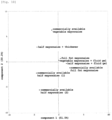
- Fig. 10 The results thereof are shown in Fig. 10 .
- the commercially available full-fat mayonnaise, the full-fat mayonnaise obtained in Example 4 the half mayonnaise + fluid gel, and the vegetable mayonnaise + fluid gel were arranged close to each other in the right direction from the point of origin.
- the commercially available half mayonnaise which is a low-fat mayonnaise, was arranged leftward from the point of origin, and the half mayonnaise containing the thickener xanthan gum obtained in Example 4 was also arranged leftward from the point of origin.
- the commercially available vegetable mayonnaise was arranged upward from the point of origin.
- a mug was filled with (1) milk fat with a low fat content (fat content 35%), (2) vegetable fat (fat content 41%), or (3) vegetable fat (fat content 41%) (about 100 ml), and the mug was immersed in a bowl of ice water.
- 7.5 g of sugar and, in the case of (3), 2% (2 g) of fluid gel obtained from a 5 wt% soy protein solution prepared in the same manner as in Example 1 were added.
- the mixture was whipped using a Bamix until the corners stood up, and then leveled with and placed in a plastic cup to prepare whipped cream, which was then weighed.
- Dynamic viscoelasticity was measured for each whipped cream obtained in Example 5, under the following conditions and using an ARES G-2 (manufactured by TA Instruments) as the measuring device. Specifically, about 2 ml of each sample was dropped directly under the jig, and after it reached the gap, the protruding sample was wiped off, the measurement was performed, and G' (storage modulus (index of elastic property)) was calculated.
- Fig. 12 The results thereof are shown in Fig. 12 .
- the storage modulus when the distortion increased was higher in (2) the whipped cream prepared from vegetable fat, compared to (1) the whipped cream prepared from milk fat with a low fat content, but in (3) the whipped cream prepared from a mixture in which a fluid gel obtained from a 5 wt% soy protein solution was added to vegetable fat, the storage modulus decreased to the same level as (1) the whipped cream prepared from milk fat with a low fat content.
- the addition of the fluid gel of the present invention improves the melt in mouth of the obtained whipped cream.
- FIG. 13 A photograph of the appearance after 1 hr is shown in Fig. 13 .
- sample No. 4 which was simply a mixture of soy protein and transglutaminase
- Mayonnaise was prepared with the composition shown in Table 4. [Table 4] proportion (%) sample name No. 1 No. 2 No. 3 egg-yolk 13.2 13.2 13.2 vinegar 1.4 1.4 1.4 salt 1.4 1.4 1.4 MSG 0.01 0.01 0.01 water 11 - - canola oil 73 73 73 soybean 6% fluid gel 300 rpm - 11 - soybean 6% fluid gel 5,000 rpm - - 11 total 100.0 100.0 100.0 100.0 100.0 100.0 100.0 100.0 100.0
- the fluid gel used was "soybean 6% fluid gel 300 rpm", which was obtained by adding transglutaminase "Activa (registered trademark) TG” to the soy protein solution to a concentration of 3.66 U/g and stirring at 300 rpm instead of 5,000 rpm in Example 2, or "soybean 6% fluid gel 5,000 rpm", which was obtained by adding transglutaminase "Activa (registered trademark) TG” to the soy protein solution to a concentration of 3.66 U/g in Example 2.
- Example 6 Each mayonnaise prepared in Example 6 was frozen at -20°C overnight and then left at room temperature for 1 hr, and the emulsified state was observed.
- Fig. 14 The results thereof are shown in Fig. 14 .
- layer separation was observed in mayonnaise without fluid gel and mayonnaise containing fluid gel stirred at 300 rpm, whereas it was confirmed that mayonnaise containing fluid gel stirred at 5,000 rpm maintained a good emulsified state even after thawing.
- ICP refers to instant creaming powder that is added to luxury beverages such as coffee drinks as a substitute for cream
- Marim registered trademark
- Marim registered trademark
- Marim registered trademark
- the premix was prepared from instant coffee powder, sodium bicarbonate, and granulated sugar according to the method described in JP-A-2005-144600 .
- the fluid gel used was the one obtained in Example 2 by adding transglutaminase "Activa (registered trademark) TG" to the soy protein solution to 3.66 U/g.
- the mid- to late-stage thickness of each cafe au lait prepared in Example 7 was evaluated by four panelists skilled in evaluation through discussion, using the mid- to late-stage thickness of cafe au lait measured using ICP as the standard and according to the following evaluation scale.
- the "mid- to late-stage thickness” refers mainly to the thickness derived from fats and oils and milk, and indicates a sensation of intensification of the flavor without changing the balance.
- Milk protein "Sodium Casainate 180" (Fonterra Japan Co., Ltd.) was added to water at 60°C so that the protein concentration was 8 wt%, and mixed using a homogenizer at 10,000 rpm for 1 min, and then at 5,000 rpm for 59 min to obtain 500 mL of a protein solution. After the temperature of the obtained solution was lowered to 40°C, transglutaminase "Activa (registered trademark) TG” was added to 300 mL of the solution so that the concentration thereof was 3.66 U/g, and the mixture was stirred in a homomixer at 40°C and 1,0000 rpm for 30 min.
- Activa registered trademark
- the obtained solution was heated in an oil bath at 75°C or higher for 5 min or more to inactivate the transglutaminase.
- the mixture was then defoamed in a centrifuge at 2,000 rpm for 10 min to obtain a fluid gel.
- Example 14 g of the fluid gel prepared in Example 8, 126 g of water, and 60 g of canola oil were mixed for 5 min at 5,000 rpm using a homogenizer.
- the same procedure was performed using a protein solution obtained according to the method described in Example 8 instead of the fluid gel prepared in Example 8.
- Fig. 15 The results thereof are shown in Fig. 15 .
- Fig. 15 when the protein solution obtained according to the method described in Example 8 was used, layers were separated immediately after mixing, but when the fluid gel prepared in Example 8 was used, no layer separation was observed until after freezing and thawing.
- the particle size was measured using a laser diffraction-scattering particle size distribution measuring device LA-960 (HORIBA, Ltd.) for a fluid gel prepared using a 6 wt% soy protein solution instead of the 5 wt% soy protein solution in Example 2, and a fluid gel prepared using a 6 wt% soy protein solution instead of the 5 wt% soy protein solution and stirring at 300 rpm instead of 5,000 rpm in Example 2.
- LA-960 laser diffraction-scattering particle size distribution measuring device LA-960 (HORIBA, Ltd.) for a fluid gel prepared using a 6 wt% soy protein solution instead of the 5 wt% soy protein solution in Example 2, and a fluid gel prepared using a 6 wt% soy protein solution instead of the 5 wt% soy protein solution and stirring at 300 rpm instead of 5,000 rpm in Example 2.
- the D50 particle size was approximately 200 ⁇ m when stirred at 5,000 rpm, and the D50 particle size was about 1,000 ⁇ m when stirred at 300 rpm.
- the present invention provides a fluid gel which can impart good properties such as stickiness-free viscosity and a rich taste, good melt in mouth, foaming property, and the like to semi-solid foods, and which itself is superior in emulsifying property, and a production method thereof, emulsifiers and semi-solid foods containing the fluid gel, and the like.
- a fluid gel can be obtained without heating at a high temperature.
- low-calorie mayonnaise or whipped cream that has property closer to full-fat mayonnaise or whipped cream that uses high-fat milk fat can be obtained, even when low-fat raw materials are used. Therefore, the present invention is useful in the food industry.
Landscapes
- Life Sciences & Earth Sciences (AREA)
- Chemical & Material Sciences (AREA)
- Engineering & Computer Science (AREA)
- Health & Medical Sciences (AREA)
- Food Science & Technology (AREA)
- Polymers & Plastics (AREA)
- Nutrition Science (AREA)
- Zoology (AREA)
- Biochemistry (AREA)
- Organic Chemistry (AREA)
- Bioinformatics & Cheminformatics (AREA)
- Genetics & Genomics (AREA)
- Wood Science & Technology (AREA)
- Microbiology (AREA)
- General Health & Medical Sciences (AREA)
- General Engineering & Computer Science (AREA)
- General Chemical & Material Sciences (AREA)
- Chemical Kinetics & Catalysis (AREA)
- Biomedical Technology (AREA)
- Biotechnology (AREA)
- Molecular Biology (AREA)
- Medicinal Chemistry (AREA)
- Proteomics, Peptides & Aminoacids (AREA)
- Inorganic Chemistry (AREA)
- Biophysics (AREA)
- Dispersion Chemistry (AREA)
- Jellies, Jams, And Syrups (AREA)
Applications Claiming Priority (2)
| Application Number | Priority Date | Filing Date | Title |
|---|---|---|---|
| JP2022032720 | 2022-03-03 | ||
| PCT/JP2023/008032 WO2023167313A1 (fr) | 2022-03-03 | 2023-03-03 | Procédé de fabrication de gel fluide |
Publications (1)
| Publication Number | Publication Date |
|---|---|
| EP4487697A1 true EP4487697A1 (fr) | 2025-01-08 |
Family
ID=87883749
Family Applications (1)
| Application Number | Title | Priority Date | Filing Date |
|---|---|---|---|
| EP23763570.1A Pending EP4487697A1 (fr) | 2022-03-03 | 2023-03-03 | Procédé de fabrication de gel fluide |
Country Status (4)
| Country | Link |
|---|---|
| US (1) | US20240415148A1 (fr) |
| EP (1) | EP4487697A1 (fr) |
| JP (1) | JPWO2023167313A1 (fr) |
| WO (1) | WO2023167313A1 (fr) |
Family Cites Families (7)
| Publication number | Priority date | Publication date | Assignee | Title |
|---|---|---|---|---|
| JPH0665280B2 (ja) | 1987-03-04 | 1994-08-24 | 味の素株式会社 | タンパクゲル化剤及びそれを用いるタンパクのゲル化方法 |
| JPH08131119A (ja) * | 1994-11-11 | 1996-05-28 | Ajinomoto Co Inc | 水中油型エマルジョン組成物 |
| JP4310579B2 (ja) | 2003-11-14 | 2009-08-12 | ユアサテクノ株式会社 | 機上計測装置 |
| SG11201808571XA (en) * | 2016-04-01 | 2018-10-30 | Oatly Ab | Enhanced viscosity oat base and fermented oat base product |
| CN109511745A (zh) * | 2018-10-19 | 2019-03-26 | 中国农业科学院农产品加工研究所 | 一种荷载反式白藜芦醇/苷的人造奶油替代物及其制备方法 |
| JP7505320B2 (ja) | 2020-08-13 | 2024-06-25 | 富士通株式会社 | 2波長光検出器、及びこれを用いたイメージセンサ |
| CN112890165A (zh) * | 2021-02-05 | 2021-06-04 | 中国农业科学院农产品加工研究所 | 一种基于植物蛋白Pickering乳液的素食沙拉酱及制备方法 |
-
2023
- 2023-03-03 EP EP23763570.1A patent/EP4487697A1/fr active Pending
- 2023-03-03 JP JP2024504439A patent/JPWO2023167313A1/ja active Pending
- 2023-03-03 WO PCT/JP2023/008032 patent/WO2023167313A1/fr not_active Ceased
-
2024
- 2024-08-30 US US18/821,019 patent/US20240415148A1/en active Pending
Also Published As
| Publication number | Publication date |
|---|---|
| WO2023167313A1 (fr) | 2023-09-07 |
| US20240415148A1 (en) | 2024-12-19 |
| JPWO2023167313A1 (fr) | 2023-09-07 |
Similar Documents
| Publication | Publication Date | Title |
|---|---|---|
| AU674220B2 (en) | Oil-coated microparticulated gellan gum | |
| US9005690B2 (en) | Aerated products with reduced creaming | |
| JP5719346B2 (ja) | コーヒーホワイトナー、その製造方法及び飲料の製造方法 | |
| JP2006500061A (ja) | タンパク質−多糖複合体を有する2相以上の製品の界面安定化 | |
| CN1288993C (zh) | 具有淀粉水解物的冷冻甜食组合物 | |
| JP2023056016A (ja) | 熱抑制されたワキシーキャッサバスターチ | |
| JP5015364B1 (ja) | 気泡入り加工食品及びその製造方法、並びに気泡入り加工食品を用いた食品。 | |
| MX2012004209A (es) | Emulsiones para batir bajas en grasa con fibras dieteticas. | |
| Yuliarti et al. | Evaluation of the physicochemical and sensorial properties of coconut milk-soy protein-based ice cream | |
| EP1968398B1 (fr) | Puree de fruits ou de legumes microfoisonnee et son procede de preparation | |
| US20240415148A1 (en) | Method for manufacturing fluid gel | |
| CN103491799A (zh) | 充气食品 | |
| RU2227505C2 (ru) | Способ производства десерта | |
| JP2012095598A (ja) | 気泡入り加工食品 | |
| WO2009109407A2 (fr) | Utilisation d'alternane comme agent texturant dans des produits alimentaires et cosmétiques | |
| TW202517166A (zh) | 泡沫乳油的製造方法及泡沫乳油 | |
| JPS60203139A (ja) | 食品用w/o/w型複合エマルジヨンの製造法 | |
| JP3401577B2 (ja) | アイスクリーム類の製造法 | |
| JP6154691B2 (ja) | スポンジケーキ用懸濁液 | |
| JP2017077216A (ja) | レトルト処理食品用水中油型乳化物 | |
| JP2003225055A (ja) | 水中油型チョコレート類 | |
| EP4565069B1 (fr) | Formulation | |
| JP2002017257A (ja) | 起泡性クリーム用油脂組成物 | |
| HK40131720A (zh) | 搅打奶油的制造方法和搅打奶油 | |
| JP2002355014A (ja) | 飲料組成物 |
Legal Events
| Date | Code | Title | Description |
|---|---|---|---|
| STAA | Information on the status of an ep patent application or granted ep patent |
Free format text: STATUS: THE INTERNATIONAL PUBLICATION HAS BEEN MADE |
|
| PUAI | Public reference made under article 153(3) epc to a published international application that has entered the european phase |
Free format text: ORIGINAL CODE: 0009012 |
|
| STAA | Information on the status of an ep patent application or granted ep patent |
Free format text: STATUS: REQUEST FOR EXAMINATION WAS MADE |
|
| 17P | Request for examination filed |
Effective date: 20240925 |
|
| AK | Designated contracting states |
Kind code of ref document: A1 Designated state(s): AL AT BE BG CH CY CZ DE DK EE ES FI FR GB GR HR HU IE IS IT LI LT LU LV MC ME MK MT NL NO PL PT RO RS SE SI SK SM TR |
|
| DAV | Request for validation of the european patent (deleted) | ||
| DAX | Request for extension of the european patent (deleted) |