EP4488314A1 - Composition de résine d'étanchéité et dispositif à semi-conducteur - Google Patents
Composition de résine d'étanchéité et dispositif à semi-conducteur Download PDFInfo
- Publication number
- EP4488314A1 EP4488314A1 EP23759976.6A EP23759976A EP4488314A1 EP 4488314 A1 EP4488314 A1 EP 4488314A1 EP 23759976 A EP23759976 A EP 23759976A EP 4488314 A1 EP4488314 A1 EP 4488314A1
- Authority
- EP
- European Patent Office
- Prior art keywords
- resin composition
- sealing resin
- curing agent
- biomass
- composition according
- Prior art date
- Legal status (The legal status is an assumption and is not a legal conclusion. Google has not performed a legal analysis and makes no representation as to the accuracy of the status listed.)
- Pending
Links
Images
Classifications
-
- C—CHEMISTRY; METALLURGY
- C08—ORGANIC MACROMOLECULAR COMPOUNDS; THEIR PREPARATION OR CHEMICAL WORKING-UP; COMPOSITIONS BASED THEREON
- C08L—COMPOSITIONS OF MACROMOLECULAR COMPOUNDS
- C08L63/00—Compositions of epoxy resins; Compositions of derivatives of epoxy resins
-
- H—ELECTRICITY
- H10—SEMICONDUCTOR DEVICES; ELECTRIC SOLID-STATE DEVICES NOT OTHERWISE PROVIDED FOR
- H10W—GENERIC PACKAGES, INTERCONNECTIONS, CONNECTORS OR OTHER CONSTRUCTIONAL DETAILS OF DEVICES COVERED BY CLASS H10
- H10W74/00—Encapsulations, e.g. protective coatings
- H10W74/40—Encapsulations, e.g. protective coatings characterised by their materials
- H10W74/47—Encapsulations, e.g. protective coatings characterised by their materials comprising organic materials, e.g. plastics or resins
-
- C—CHEMISTRY; METALLURGY
- C08—ORGANIC MACROMOLECULAR COMPOUNDS; THEIR PREPARATION OR CHEMICAL WORKING-UP; COMPOSITIONS BASED THEREON
- C08G—MACROMOLECULAR COMPOUNDS OBTAINED OTHERWISE THAN BY REACTIONS ONLY INVOLVING UNSATURATED CARBON-TO-CARBON BONDS
- C08G59/00—Polycondensates containing more than one epoxy group per molecule; Macromolecules obtained by polymerising compounds containing more than one epoxy group per molecule using curing agents or catalysts which react with the epoxy groups
- C08G59/18—Macromolecules obtained by polymerising compounds containing more than one epoxy group per molecule using curing agents or catalysts which react with the epoxy groups ; e.g. general methods of curing
- C08G59/40—Macromolecules obtained by polymerising compounds containing more than one epoxy group per molecule using curing agents or catalysts which react with the epoxy groups ; e.g. general methods of curing characterised by the curing agents used
- C08G59/62—Alcohols or phenols
- C08G59/621—Phenols
-
- C—CHEMISTRY; METALLURGY
- C08—ORGANIC MACROMOLECULAR COMPOUNDS; THEIR PREPARATION OR CHEMICAL WORKING-UP; COMPOSITIONS BASED THEREON
- C08G—MACROMOLECULAR COMPOUNDS OBTAINED OTHERWISE THAN BY REACTIONS ONLY INVOLVING UNSATURATED CARBON-TO-CARBON BONDS
- C08G59/00—Polycondensates containing more than one epoxy group per molecule; Macromolecules obtained by polymerising compounds containing more than one epoxy group per molecule using curing agents or catalysts which react with the epoxy groups
- C08G59/18—Macromolecules obtained by polymerising compounds containing more than one epoxy group per molecule using curing agents or catalysts which react with the epoxy groups ; e.g. general methods of curing
- C08G59/68—Macromolecules obtained by polymerising compounds containing more than one epoxy group per molecule using curing agents or catalysts which react with the epoxy groups ; e.g. general methods of curing characterised by the catalysts used
- C08G59/688—Macromolecules obtained by polymerising compounds containing more than one epoxy group per molecule using curing agents or catalysts which react with the epoxy groups ; e.g. general methods of curing characterised by the catalysts used containing phosphorus
-
- C—CHEMISTRY; METALLURGY
- C08—ORGANIC MACROMOLECULAR COMPOUNDS; THEIR PREPARATION OR CHEMICAL WORKING-UP; COMPOSITIONS BASED THEREON
- C08K—Use of inorganic or non-macromolecular organic substances as compounding ingredients
- C08K3/00—Use of inorganic substances as compounding ingredients
- C08K3/01—Use of inorganic substances as compounding ingredients characterized by their specific function
- C08K3/013—Fillers, pigments or reinforcing additives
-
- C—CHEMISTRY; METALLURGY
- C08—ORGANIC MACROMOLECULAR COMPOUNDS; THEIR PREPARATION OR CHEMICAL WORKING-UP; COMPOSITIONS BASED THEREON
- C08K—Use of inorganic or non-macromolecular organic substances as compounding ingredients
- C08K3/00—Use of inorganic substances as compounding ingredients
- C08K3/34—Silicon-containing compounds
- C08K3/36—Silica
-
- C—CHEMISTRY; METALLURGY
- C09—DYES; PAINTS; POLISHES; NATURAL RESINS; ADHESIVES; COMPOSITIONS NOT OTHERWISE PROVIDED FOR; APPLICATIONS OF MATERIALS NOT OTHERWISE PROVIDED FOR
- C09D—COATING COMPOSITIONS, e.g. PAINTS, VARNISHES OR LACQUERS; FILLING PASTES; CHEMICAL PAINT OR INK REMOVERS; INKS; CORRECTING FLUIDS; WOODSTAINS; PASTES OR SOLIDS FOR COLOURING OR PRINTING; USE OF MATERIALS THEREFOR
- C09D163/00—Coating compositions based on epoxy resins; Coating compositions based on derivatives of epoxy resins
-
- H—ELECTRICITY
- H10—SEMICONDUCTOR DEVICES; ELECTRIC SOLID-STATE DEVICES NOT OTHERWISE PROVIDED FOR
- H10W—GENERIC PACKAGES, INTERCONNECTIONS, CONNECTORS OR OTHER CONSTRUCTIONAL DETAILS OF DEVICES COVERED BY CLASS H10
- H10W74/00—Encapsulations, e.g. protective coatings
- H10W74/40—Encapsulations, e.g. protective coatings characterised by their materials
- H10W74/47—Encapsulations, e.g. protective coatings characterised by their materials comprising organic materials, e.g. plastics or resins
- H10W74/473—Encapsulations, e.g. protective coatings characterised by their materials comprising organic materials, e.g. plastics or resins containing a filler
Definitions
- the present invention relates to a sealing resin composition and a semiconductor device.
- thermosetting resin composition As a material for sealing a semiconductor package or the like, a thermosetting resin composition (sealing resin composition) has been known.
- Patent Document 1 discloses a sealing resin used for collectively sealing, in an electronic device used for an automobile, such as an engine control unit or an automatic transmission controller unit, an electronic component provided in the electronic device, a substrate on which the electronic component is mounted, and a terminal connected to the substrate.
- Patent Document 1 International Publication No. WO2017/056728
- the present inventors have found that, by using a phenolic curing agent obtained from a plant-derived raw material with a predetermined blending, it is possible to improve these physical properties while increasing the degree of biomass, and have completed the present invention.
- sealing resin composition according to the aspect of the present invention, by using a plant-derived raw material, it is possible to provide a sealing material which is friendly to the global environment, and has excellent practicality such as fluidity, curability, and electrical reliability.
- the sealing resin composition according to the present embodiment contains an epoxy resin (A) and a curing agent (B) including a phenolic curing agent (B1) obtained from a plant-derived raw material.
- the plant-derived phenolic curing agent (B1) and a plant-derived epoxy resin (A2) described later, which is included in the epoxy resin (A), can be obtained from plant-derived phenols.
- examples of a derivative include a salt, a hydrate, and a solvate.
- a heterocyclic compound may include a compound derived from non-biomass and other components as an impurity, in addition to the main component.
- Examples of a method for producing the plant-derived phenols include a method of obtaining the plant-derived phenols, for example, through a step 1 of obtaining a raw material containing hydroxybenzoic acids from mixed sugars contained in a plant, and then a step 2 of decarboxylating the hydroxybenzoic acids by a biological reaction or a chemical reaction.
- Examples of a method of the step 1 include a method described in Biotechnology and Bioengineering, Vol. 76, p. 376, 2001 and a method described in International Publication No. WO2015/156271 .
- Examples of a method of the step 2 include International Publication No. WO2012/063860 as a biological reaction and a decarboxylation reaction with an acidic compound as a chemical reaction.
- the epoxy resin (A) is a compound having two or more epoxy groups in one molecule, and may be a monomer, an oligomer, or a polymer.
- the epoxy resin (A) is one or two or more selected from the group consisting of crystalline epoxy resins such as a biphenyl-type epoxy resin, a bisphenol-type epoxy resin, and a stilbene-type epoxy resin; a novolac-type epoxy resins such as a phenol novolac-type epoxy resin and a cresol novolac-type epoxy resin; polyfunctional epoxy resins such as a trisphenylmethane-type epoxy resin and an alkyl-modified triphenol methane-type epoxy resin; phenol aralkyl-type epoxy resins such as a phenylene skeleton-containing phenol aralkyl-type epoxy resin and a biphenylene skeleton-containing phenol aralkyl-type epoxy resin; naphthol-type epoxy resins such as a dihydroxynaphthalene-type epoxy resin and an epoxy resin obtained by glycidyl etherification of a dimer of dihydroxynaphthalene; triazine nuclei-
- the epoxy resin (A) is preferably one or two or more selected from the group consisting of a trisphenylmethane-type epoxy resin, a biphenyl aralkyl-type polyfunctional epoxy resin, an ortho-cresol-type bifunctional epoxy resin, a biphenyl-type bifunctional epoxy resin, and a bisphenol-type bifunctional epoxy resin.
- the epoxy resin (A) is preferably one or two or more selected from the group consisting of a tris(hydroxyphenyl)methane-type epoxy resin, a biphenylene skeleton-containing phenol aralkyl-type epoxy resin, an ortho-cresol novolac-type epoxy resin, and a 3,3',5,5'-tetramethylbiphenylglycidyl ether-type epoxy resin.
- the epoxy resin (A) can include an epoxy resin (A1) obtained from a petroleum-derived raw material.
- Examples of the epoxy resin (A1) include the above-described epoxy resins.
- an epoxy resin (A2) obtained by epoxidizing a phenol derived from a plant-derived raw material.
- the plant-derived epoxy resin (A2) is obtained, for example, by a step of reacting a compound having a plant-derived phenol hydroxyl group, such as the above-described plant-derived phenols and the plant-derived phenolic curing agent (B1), with epichlorohydrin or the like to substitute the phenol hydroxyl group with a phenol glycidyl ether group.
- the content of the epoxy resin (A) in the sealing resin composition is preferably 2% by mass or more, more preferably 3% by mass or more, and still more preferably 4% by mass or more with respect to the entire sealing resin composition.
- the content of the epoxy resin (A) in the sealing resin composition is preferably 40% by mass or less, more preferably 30% by mass or less, still more preferably 20% by mass or less, and even more preferably 10% by mass or less with respect to the entire sealing resin composition.
- a ratio (A1:A2) of the epoxy resin (A1) and the epoxy resin (A2) can be preferably 10:90 to 90:10 and more preferably 20:80 to 80:20.
- the curing agent (B) includes a phenolic curing agent (B1) obtained from a plant-derived raw material.
- the plant-derived phenolic curing agent (B1) is obtained, for example, by a step of reacting the above-described plant-derived phenols with aldehydes derived from plant or petroleum in the presence of an acidic catalyst.
- Examples of the plant-derived phenolic curing agent (B1) include a phenol novolac resin, a cresol novolac resin, an aromatic hydrocarbon formaldehyde resin-modified phenol resin, a dicyclopentadiene-phenol addition-type resin, a phenol aralkyl resin, a biphenyl skeleton-containing phenol aralkyl resin, a naphthol aralkyl resin, a trimethylolmethane resin, a tetraphenylethane resin, a naphthol novolac resin, a naphthol-phenol copolycondensed novolac resin, a naphthol-cresol copolycondensed novolac resin, a biphenyl-modified phenol resin (polyhydric phenol compound in which phenol nuclei are linked by a bismethylene group), a biphenyl-modified naphthol resin (polyhydric naphthol compound in which phenol nuclei are
- biomass-modified phenol resin a known biomass-modified phenol resin can be used as long as the effects of the present invention are exhibited, and biomass-modified phenol resin which is modified with unsaturated carbon chain-containing phenols derived from a plant raw material is preferable.
- the above-described biomass-modified phenol resin can be obtained, for example, by a step of reacting a biomass derivative, phenols, and aldehydes.
- the biomass derivative can be obtained, for example, by an addition reaction step of adding phenols to a double bond of an unsaturated carbon chain of unsaturated carbon chain-containing phenols derived from a plant raw material.
- the above-described plant raw material is not particularly limited as long as it is unsaturated carbon chain-containing phenols, and examples thereof include plant-derived unsaturated carboxylic acids such as cinnamic acid, cinnamaldehyde, caffeic acid, ferulic acid, coumaric acid, and derivatives thereof; and plant-derived phenolic hydroxyl group and unsaturated alkyl group-containing phenols such as cashew nut shell liquid (cashew oil), for example, cardanol, cardol, methylcardol, anacardic acid, and the like, a urushiol extract, for example, urushiol, laccol, and thitsiol, and purified products thereof. These may be used alone or in combination of two or more thereof.
- plant-derived unsaturated carboxylic acids such as cinnamic acid, cinnamaldehyde, caffeic acid, ferulic acid, coumaric acid, and derivatives
- a biomass modification rate in the biomass-modified phenol resin can be increased, and heat resistance of the cured product can be improved.
- the phenolic hydroxyl group and unsaturated alkyl group-containing phenols it is possible to realize a biomass-modified phenol resin having a high biomass introduction rate and excellent reactivity.
- the biomass-modified phenol resin has no easily decomposable functional group such as an ester group, unlike other animal and vegetable oils and fats, a molded object composed of a cured product of the biomass-modified phenol resin can be excellent in heat resistance.
- a plant raw material containing cashew oil can be used.
- the above-described cashew oil is an oily liquid contained in a shell of cashew nut, and includes anacardic acid, cardol, 2-methylcardol, cardanol, and the like.
- the above-described cashew oil can include one or more selected from the group consisting of cardanol, cardol, and 2-methylcardol.
- a purified product of the cashew oil, such as cardanol may be used. These may be used alone or in combination of two or more thereof.
- the above-described biomass-modified phenol resin can include a cashew-modified phenol resin.
- phenolic hydroxyl group and unsaturated alkyl group-containing phenols include, for example, a phenol compound represented by General Formula (1). These may be used alone or in combination of two or more thereof.
- R represents a linear unsaturated hydrocarbon group having 10 or more carbon atoms.
- a hydrogen atom bonded to a benzene ring having a phenolic hydroxyl group may be substituted with a substituent.
- R may be at any of an ortho-position, a meta-position, or a para-position, and may be one or more, two or more, or three or more.
- R in Formula (1) represents a linear unsaturated hydrocarbon group having 10 or more carbon atoms; and a linear unsaturated hydrocarbon group having 10 to 20 carbon atoms is preferable, a linear unsaturated hydrocarbon group having 12 to 20 carbon atoms is more preferable, and a linear unsaturated hydrocarbon group having 12 to 18 carbon atoms is still more preferable.
- the number of carbon atoms in the linear unsaturated hydrocarbon group is equal to or less than the upper limit value of the above-described range, the phenol compound is easily diluted with an organic solvent.
- the linear unsaturated hydrocarbon group has one or more double bonds, and it may be two double bonds or three double bonds.
- the substituent which substitutes the hydrogen atom bonded to the benzene ring having the phenolic hydroxyl group is not particularly limited, and examples thereof include an acetyl group, a methyl group, and a hydroxyl group.
- phenol compound represented by Formula (1) examples include 3-dodecenylphenol, 3-tridecenylphenol, 3-pentadecenylphenol, 5-tridecenylresorcinol, 5-pentadecenylresorcinol, cardanol which is a phenol having a linear unsaturated hydrocarbon group having 15 carbon atoms at the meta-position, cardol which is a phenol having a linear unsaturated hydrocarbon group having 15 carbon atoms and a hydroxyl group at the meta-position, and 2-methylcardol which is a phenol having a linear unsaturated hydrocarbon group having 15 carbon atoms and a hydroxyl group at the meta-position and a methyl group at the ortho-position.
- cardanol is preferably used.
- the cardanol is a component contained in the shell of cashew nut, and is a compound having a structure represented by Formula (2), which consists of a phenol moiety and a linear hydrocarbon moiety having 15 carbon atoms.
- the cardanol has four types of unsaturated bond numbers in the linear hydrocarbon moiety R, and is usually a mixture of these four components. That is, it is a mixture of 3-pentadecylphenol, 3-pentadecylphenol monoene, 3-pentadecylphenol diene, and 3-pentadecylphenol triene, which are represented by Formula (2).
- a cashew oil containing the cardanol as a main component which is obtained by extracting and purifying from a cashew nut shell liquid, can be used.
- the phenols can be subjected to an addition reaction with a double bond of the unsaturated carbon chain of the unsaturated carbon chain-containing phenols derived from a plant raw material, to obtain a biomass derivative.
- double bonds of unsaturated carbon chains remaining in the unsaturated carbon chain-containing phenols can be reduced.
- the acidic catalyst is not particularly limited, and examples thereof include organic carboxylic acids such as formic acid and acetic acid; organic sulfonic acids such as benzenesulfonic acid, para-toluenesulfonic acid, and methanesulfonic acid; alkyl sulfates such as dimethyl sulfate and diethyl sulfate; Lewis acid salts such as aluminum chloride, aluminum bromide, iron(II) chloride, zinc chloride, boron trifluoride, tin(II) chloride, antimony chloride, gallium chloride, and gallium bromide; and inorganic acids such as sulfuric acid.
- organic carboxylic acids such as formic acid and acetic acid
- organic sulfonic acids such as benzenesulfonic acid, para-toluenesulfonic acid, and methanesulfonic acid
- alkyl sulfates such as dimethyl sulfate and dieth
- a reaction temperature in the above-described addition reaction step can be appropriately selected depending on the plant raw material, but for example, may be 100°C to 200°C, preferably 120°C to 180°C.
- a reaction time in the above-described addition reaction step is not particularly limited, and may be appropriately determined according to reaction conditions, and may be, for example, 1 hour to 8 hours.
- the acidic catalyst may be removed by neutralization as necessary, or the acidic catalyst may remain as it is in the biomass derivative.
- the excess unreacted phenols may be removed later, or the unreacted phenols may remain in the biomass derivative.
- the phenols used in the above-described addition reaction step may have, for example, mononuclear, dinuclear or trinuclear phenol rings, and the number of phenolic hydroxyl groups may be 1 or 2 or more.
- phenols include, which is not limited to these, phenol; cresols such as ortho-cresol, meta-cresol, and para-cresol; xylenols such as 2,3-xylenol, 2,4-xylenol, 2,5-xylenol, 2,6-xylenol, and 3,5-xylenol; alkylphenols such as 2,3,5-trimethylphenol, 2-ethylphenol, 4-ethylphenol, 2-isopropylphenol, 4-isopropylphenol, n-butylphenol, isobutylphenol, tert-butylphenol, hexylphenol, octylphenol, nonylphenol, phenylphenol, benzylphenol, cumylphenol, and allylphenol; naphthols such as 1-naphthol and 2-naphthol; halogenated phenols such as fluorophenol, chlorophenol;
- the phenols can include one or more selected from the group consisting of phenol, cresol, xylenol, and alkylphenol, and from the viewpoint of cost, phenol can be used.
- the step of obtaining the biomass-modified phenol resin includes a step of reacting the obtained biomass derivative, phenols, and aldehydes, and as a result, a reaction solution containing a biomass-modified phenol resin obtained by reacting the biomass derivative, the phenols, and the aldehydes can be obtained.
- the step of obtaining the reaction solution can be carried out under acidic conditions.
- an acidic catalyst such as a known organic acid and inorganic acid can be used.
- the step of obtaining the reaction solution can be carried out under alkaline conditions.
- an alkaline catalyst can be used.
- a method of producing a novolac-type phenol resin will be described. In this case, from the viewpoint of strength, a novolac-type biomass-modified phenol resin can be used.
- the novolac-type biomass-modified phenol resin obtained using the cardanol has a structural unit represented by Formula (3).
- Q includes a structure in which the above-described phenols are added to the double bond of the unsaturated carbon chain of R in Formula (2) described above.
- the aldehydes used in the above-described step of obtaining the biomass-modified phenol resin are not particularly limited, and examples thereof include formaldehydes such as formalin and para-formaldehyde; trioxane, acetaldehyde, propionaldehyde, polyoxymethylene, chloral, hexamethylenetetramine, furfural, glyoxal, n-butylaldehyde, caproaldehyde, allylaldehyde, benzaldehyde, crotonaldehyde, acrolein, tetraoxymethylene, phenylacetaldehyde, o-tolualdehyde, and salicylaldehyde.
- formaldehydes such as formalin and para-formaldehyde
- trioxane acetaldehyde
- propionaldehyde polyoxymethylene
- chloral hexamethylenetetramine
- aldehydes may be used alone or in combination of two or more thereof.
- the aldehydes can include formaldehyde or acetaldehyde, and from the viewpoint of productivity and cost, formalin or para-formaldehyde can be used.
- the phenols described in the addition reaction step above can be used. These may be used alone or in combination of two or more thereof.
- the phenols used in each step may be the same or different from each other.
- the acidic catalyst used in the synthesis of the novolac-type biomass-modified phenol resin is not particularly limited, and examples thereof include acids such as formic acid, hydrochloric acid, sulfuric acid, diethyl sulfate, and para-toluenesulfonic acid, and metal salts such as zinc acetate, which can be used alone or in combination of two or more thereof.
- An amount of the acidic catalyst used is not particularly limited, but can be set to 0.1% by mass or more and 10% by mass or less with respect to the entire biomass-modified phenol resin.
- reaction solvent in the present embodiment, water may be used, or an organic solvent may be used.
- a non-aqueous system such as a non-polar solvent can be used as the organic solvent.
- the organic solvent include alcohols, ketones, and aromatics.
- the alcohols include methanol, ethanol, propyl alcohol, ethylene glycol, diethylene glycol, triethylene glycol, and glycerin
- examples of the ketones include acetone and methyl ethyl ketone
- aromatics include toluene and xylene. These may be used alone or in combination of two or more thereof.
- a reaction temperature may be, for example, 40°C to 120°C, preferably 60°C to 110°C.
- a reaction time is not particularly limited, and may be appropriately determined according to the type of the starting material, the molar ratio of the formulation, the amount and type of the catalyst used, and the reaction conditions.
- a neutralization step of neutralizing the reaction solution may be performed.
- a step of, after the above-described reaction, removing unreacted monomers (for example, unreacted phenols) by a monomer-removing step may be added.
- a dehydrating step may be performed.
- the dehydrating step may be carried out at the same time as the monomer-removing step.
- reduced pressure dehydration may be used, or normal pressure dehydration may be used.
- a degree of vacuum during the reduced pressure dehydration may be, for example, 110 torr or less, preferably 80 torr or less.
- a dehydration time can be shortened, and a stable biomass-modified phenol resin with little variation in resin characteristics can be obtained.
- a moisture content in the biomass-modified phenol resin can be set to 5% by weight or less by the dehydrating step. Sufficiently removing the moisture can be performed by these methods, but in order to further remove the moisture, a step of using a known moisture removing device such as a vacuum dryer and a thin film evaporator may be combined.
- the biomass-modified phenol resin can be recovered and used as the plant-derived phenolic curing agent (B1).
- the plant-derived phenolic curing agent (B1) contains more impurities such as ionic impurities, as compared with a petroleum-derived phenolic curing agent. It is considered that, in a case where the degree of biomass is increased due to one factor, physical properties such as fluidity, curability, and electrical reliability are deteriorated. In the present embodiment, by using the phenolic curing agent obtained from a plant-derived raw material with a predetermined blending, the degree of biomass can be increased while improving these physical properties.
- the curing agent (B) may include a phenolic curing agent (B2) obtained from a petroleum-derived raw material, together with the plant-derived phenolic curing agent (B1).
- phenol curing agent (B2) examples include a novolac resin obtained by condensing or co-condensing phenols such as a phenol novolac resin, a cresol novolac resin, phenol, cresol, resorcinol, catechol, bisphenol A, bisphenol F, phenylphenol, aminophenol, ⁇ -naphthol, ⁇ -naphthol, and dihydroxynaphthalene with formaldehyde or ketones in the presence of an acidic catalyst; phenol aralkyl resins such as a phenol aralkyl resin having a biphenylene skeleton and a phenol aralkyl resin having a phenylene skeleton, which are synthesized from the phenols and dimethoxyparaxylene or bis(methoxymethyl)biphenyl; and a phenol resin having a trisphenylmethane skeleton. These may be used alone or in combination of two or more thereof.
- the curing agent (B) includes the plant-derived phenolic curing agent (B1) and the petroleum-derived phenolic curing agent (B2)
- the curing agent can be used such that a degree of biomass of a cured body of the sealing resin composition according to the present embodiment is in a predetermined range (5% or more and 95% or less), and for example, the phenolic curing agent (B2) can be contained in an amount of preferably 0.5% by mass or more and 50% by mass or less, and more preferably 1% by mass or more and 20% by mass or less with respect to the total amount (100% by mass) of the curing agent (B).
- a blending amount of the curing agent (B) and the epoxy resin (A) is preferably a proportion in which the epoxy group in the epoxy resin is 0.8 to 1.2 equivalents with respect to 1 equivalent of the total amount of active groups in the curing agent (B).
- the active group in the curing agent (B) refers to an arylcarbonyloxy group and a phenolic hydroxyl group, which are included in the resin structure.
- the curing agent (B) is used in an amount of preferably 0.2% by mass or more and 15% by mass or less, more preferably 0.5% by mass or more and 10% by mass or less, and still more preferably 1.0% by mass or more and 7% by mass or less with respect to the entire sealing resin composition.
- the obtained cured product can have more excellent dielectric characteristics, and a low dielectric loss tangent can be further excellent.
- the sealing resin composition according to the present embodiment can contain a curing accelerator (C).
- the curing accelerator (C) for example, one or two or more selected from phosphorus atom-containing compounds such as organic phosphine, tetra-substituted phosphonium compound, phosphobetaine compound, adduct of phosphine compound and quinone compound, and adduct of phosphonium compound and silane compound; nitrogen atom-containing compounds such as amidines such as 1,8-diazabicyclo[5.4.0]undecene-7, benzyldimethylamine, and 2-methylimidazole, tertiary amines, and quaternary salts of the amidines or amines; and polyhydroxynaphthalene compounds such as 2,3-dihydroxynaphthalene can be included.
- phosphorus atom-containing compounds such as organic phosphine, tetra-substituted phosphonium compound, phosphobetaine compound, adduct of phosphine compound and quinone compound, and adduct of
- a phosphorus atom-containing compound it is more preferable to include a phosphorus atom-containing compound.
- a compound having latent property such as tetra-substituted phosphonium compound, phosphobetaine compound, adduct of phosphine compound and quinone compound, and adduct of phosphonium compound and silane compound.
- the content of the curing accelerator (C) in the sealing resin composition is preferably 0.01% by mass or more, more preferably 0.05% by mass or more, and still more preferably 0.1% by mass or more with respect to the entire sealing resin composition.
- the content of the curing accelerator (C) in the sealing resin composition is preferably 2.0% by mass or less, more preferably 1.0% by mass or less, and still more preferably 0.5% by mass or less with respect to the entire sealing resin composition.
- the sealing resin composition according to the present embodiment can contain an inorganic filler (D).
- the inorganic filler (D) those generally used for resin compositions for sealing a semiconductor, and the like can be used.
- the inorganic filler (D) may be a material which has been subjected to a surface treatment.
- the inorganic filler (D) include silica such as fused silica, crystalline silica, and amorphous silicon dioxide; alumina; talc; titanium oxide; silicon nitride; and aluminum nitride. These inorganic fillers may be used alone or in combination of two or more.
- the inorganic filler (D) preferably includes silica.
- Examples of a shape of silica include spherical silica and crushed silica.
- an average diameter (D 50 ) of the inorganic filler (D) is preferably 5 ⁇ m or more and more preferably 10 ⁇ m or more, and is preferably 80 ⁇ m or less, more preferably 50 ⁇ m or less, and still more preferably 40 ⁇ m or less.
- a particle diameter distribution of the inorganic filler (D) can be obtained by measuring the particle diameter distribution of particles on a volume basis using a commercially available laser diffraction type particle diameter distribution measuring device (for example, SALD-7000 manufactured by Shimadzu Corporation).
- a maximum particle diameter of the inorganic filler (D) is preferably 10 ⁇ m or more and more preferably 20 ⁇ m or more, and is preferably 100 ⁇ m or less and more preferably 80 ⁇ m or less.
- a specific surface area of the inorganic filler (D) is preferably 1 m 2 /g or more and more preferably 3 m 2 /g or more, and is preferably 20 m 2 /g or less and more preferably 10 m 2 /g or less.
- the content of the inorganic filler (D) in the sealing resin composition is preferably 50% by mass or more, more preferably 60% by mass or more, and still more preferably 65% by mass or more with respect to the entire sealing resin composition.
- the content of the inorganic filler (D) in the sealing resin composition may be, for example, 97% by mass or less, preferably 95% by mass or less and more preferably 90% by mass or less with respect to the entire sealing resin composition.
- the sealing resin composition according to the present embodiment may include components other than the above-described components, and for example, various additives such as a silane coupling agent, a fluidity imparting agent, a mold release agent, an ion scavenger, a low stress component, a flame retardant, a coloring agent, and an antioxidant can be appropriately blended.
- various additives such as a silane coupling agent, a fluidity imparting agent, a mold release agent, an ion scavenger, a low stress component, a flame retardant, a coloring agent, and an antioxidant can be appropriately blended.
- the sealing resin composition according to the present embodiment is solid at normal temperature (25°C), a form thereof can be selected according to a molding method of the sealing resin composition, and the like, and examples thereof include particles such as tablet, powder, and granule; and sheets.
- the sealing resin composition can be obtained by a method in which each of the above-described components is mixed by a known unit, further melt-kneaded by a kneading machine such as a roll, a kneader, and an extruder, cooled, and pulverized.
- a kneading machine such as a roll, a kneader, and an extruder
- the sealing resin composition in a form of particles or sheets may be obtained by molding.
- a particle-form sealing resin composition may be obtained by tablet-molding into a tablet.
- a sheet-form sealing resin composition may be obtained by a vacuum extruder.
- dispersity, fluidity, and the like of the obtained sealing resin composition may be adjusted as appropriate.
- the sealing resin composition according to the present embodiment has excellent fluidity, and a spiral flow length measured under the following conditions is 100 cm or more and 250 cm or less, preferably 100 cm or more and 220 cm or less, more preferably 120 cm or more and 200 cm or less, and still more preferably 155 cm or more and 180 cm or less.
- the sealing resin composition has excellent moldability.
- a flow length measured by injecting the sealing resin composition into a spiral flow measurement mold according to EMMI-1-66 under conditions of a mold temperature of 175°C, an injection pressure of 6.9 MPa, and a curing time of 120 seconds is defined as the spiral flow length.
- the sealing resin composition according to the present embodiment has excellent curability, and a gel time at 175°C is 10 seconds or more and 60 seconds or less, preferably 20 seconds or more and 50 seconds or less and more preferably 32 seconds or more and 45 seconds or less.
- the sealing resin composition has excellent fillability, and generation of an unfilled portion can be suppressed.
- the gel time can be measured by melting the resin composition on a hot plate heated to 175°C, and then measuring a time (gel time) until the resin composition becomes tack-free while kneading with a spatula.
- a bending strength of a cured product thereof at a room temperature of 25°C can be set to 80 MPa or more, preferably 100 MPa or more and more preferably 110 MPa or more.
- the upper limit value thereof is not particularly limited, but is 300 MPa or less.
- a bending elastic modulus of a cured product thereof at a room temperature of 25°C can be set to 10,000 MPa or more, preferably 12,000 MPa or more and more preferably 13,000 MPa or more.
- the upper limit value thereof is not particularly limited, but is 30,000 MPa or less.
- the sealing resin composition according to the present embodiment since the bending strength or the bending elastic modulus of the above-described cured product obtained from the composition is within the above-described range, it is possible to provide a cured product having excellent mechanical strength.
- the above-described characteristics can be controlled, for example, by appropriately selecting the type and blending amount of each component contained in the sealing resin composition, a method of preparing the sealing resin composition, and the like.
- a degree of biomass of the cured body can be 5% or more and 95% or less.
- the sealing resin composition according to the present embodiment can be used as a sealing material for various electronic components, and can be used as a sealing material for, for example, a circuit board on which an electronic component is mounted, a rotor core in which a magnet is fixed (see International Publication No. WO2012/029278 and the like), a stator core in which a coil or the like is insulated (see Japanese Laid-open Patent Publication NO. 2020-094092A and the like), an electronic control unit for a vehicle (see International Publication No. WO2016/139985 and the like), a semiconductor device, or the like.
- the rotor core will be described.
- a permanent magnet is inserted into a hole portion provided in the rotor core, and the resin composition is filled between the hole portion and the permanent magnet, thereby fixing the permanent magnet to the rotor core.
- a tablet obtained by the method according to the embodiment of the present invention can be used. By using the tablet according to the embodiment of the present invention as a sealing material, it is possible to enlarge the rotor core and to perform multiple simultaneous productions.
- the stator core will be described.
- the stator core has a plurality of teeth, and a coil is wound around the plurality of teeth. At this time, it is necessary to insulate the coil from the stator core, and insulation can be achieved by interposing the sealing resin composition therebetween.
- the resin composition according to the embodiment of the present invention can be applied.
- the tablet according to the embodiment of the present invention as a sealing material, it is possible to enlarge the stator core and to perform multiple simultaneous productions.
- the electronic control unit for a vehicle will be described.
- As electronic control unit for a vehicle a product obtained by sealing a substrate on which an electronic component or the like is mounted, with the resin composition is investigated.
- the resin composition according to the embodiment of the present invention can be applied.
- the tablet according to the embodiment of the present invention as a sealing material, it is possible to enlarge the electronic control unit for a vehicle and to perform multiple simultaneous productions.
- a semiconductor element is sealed by a cured product of the above-described resin composition for sealing according to the present embodiment.
- the semiconductor element include integrated circuits, large-scale integrated circuits, transistors, thyristors, diodes, and solid-state image sensors.
- the semiconductor element is preferably a so-called element which does not allow light to enter or exit, excluding optical semiconductor elements such as a light receiving element and a light emitting element (light emitting diode or the like).
- a base material of the semiconductor device is, for example, a wiring substrate such as an interposer, or a lead frame.
- the semiconductor element is electrically connected to the base material by wire bonding, flip chip connection, or the like.
- Examples of a semiconductor device obtained by sealing a semiconductor element by sealing molding using the sealing resin composition include mold array package (MAP), quad flat package (QFP), small outline package (SOP), chip size package (CSP), quad flat non-leaded package (QFN), small outline non-leaded package (SON), ball grid array (BGA), lead frame BGA (LF-BGA), flip chip BGA (FCBGA), molded array process BGA (MAPBGA), embedded wafer-level BGA (eWLB), Fan-In type eWLB, and Fan-out type eWLB.
- MAP mold array package
- QFP quad flat package
- SOP small outline package
- CSP chip size package
- QFN quad flat non-leaded package
- SON small outline non-leaded package
- BGA ball grid array
- LF-BGA lead frame BGA
- FCBGA flip chip BGA
- MAPBGA molded array process BGA
- eWLB embedded wafer-level BGA
- Fan-In type eWLB Fan-out type
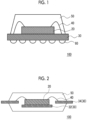
- Figs. 1 and 2 are cross-sectional views showing configurations of the semiconductor device.
- the configuration of the semiconductor device is not limited to those shown in Figs. 1 and 2 .
- a semiconductor device 100 shown in Fig. 1 includes a semiconductor element 20 mounted on a substrate 30, and a sealing material 50 of sealing the semiconductor element 20.
- the sealing material 50 is composed of a cured product obtained by curing the above-described sealing resin composition according to the present embodiment.
- Fig. 1 shows a case where the substrate 30 is a circuit board.
- a plurality of solder balls 60 are formed on a surface of the substrate 30 on a side opposite to a surface on which the semiconductor element 20 is mounted.
- the semiconductor element 20 is mounted on the substrate 30 and is electrically connected to the substrate 30 through a wire 40.
- the semiconductor element 20 may be flip-chip mounted on the substrate 30.
- the wire 40 is not limited, and examples thereof include Ag wire, Ni wire, Cu wire, Au wire, and Al wire.
- the wire 40 is preferably composed of Ag, Ni, Cu, or an alloy including one or more of these.
- the sealing material 50 seals the semiconductor element 20 to cover a surface of the semiconductor element 20 on a side opposite to a surface facing the substrate 30.
- the sealing material 50 is formed to cover the above-described surface and a side surface of the semiconductor element 20.
- the sealing material 50 is composed of a cured product of the above-described sealing resin composition. Therefore, in the semiconductor device 100, adhesiveness between the sealing material 50 and the wire 40 is excellent, and thus the semiconductor device 100 has excellent reliability.
- the sealing material 50 can be formed by sealing and molding the sealing resin composition with a known method such as a transfer molding method and a compression molding method.
- Fig. 2 is a cross-sectional view showing a configuration of a semiconductor device 100 according to the present embodiment, and shows an example different from that of Fig. 1 .
- the semiconductor device 100 shown in Fig. 2 uses a lead frame as the substrate 30.
- the semiconductor element 20 is mounted on a die pad 32 of the substrate 30, and is electrically connected to an outer lead 34 through a wire 40.
- the sealing material 50 is composed of a cured product of the sealing resin composition according to the present embodiment.
- a softening point of the obtained resin was 83°C, a content of free phenol was 0.1%, and a biomass content excluding the unreacted phenols was 31%.
- a proportion of a peak derived from alkyl chain unsaturated bond hydrogen, obtained from NMR, was 0.1% or less with respect to the total integrated value of peaks derived from hydrogens bonded to carbon atoms.
- Each component shown in Table 1 was mixed at a described ratio of amounts to obtain a mixture.
- the mixing was carried out at normal temperature using a Henschel mixer.
- the mixture was roll-kneaded at 70°C to 100°C to obtain a kneaded product.
- the kneaded product thus obtained was cooled and then pulverized to obtain a sealing resin composition.
- the biomass-modified phenol resin obtained in Synthesis Example 1 was subjected to measurement of peak values of C13 and C14 by C-NMR (JNM-ECA400 manufactured by JEOL Ltd.), and a biomass ratio of the phenol resin was calculated from the ratio thereof. From the values, a degree of biomass in the sealing resin and a biomass proportion in the organic components excluding the inorganic substance were calculated from the blending amount.
- the sealing resin composition was injected into a mold for measuring spiral flow according to EMMI-1-66 under conditions of a mold temperature of 175°C, an injection pressure of 6.9 MPa, and a curing time of 120 seconds, thereby measuring a flow length. As the numerical value is larger, the fluidity is better.
- Each sealing resin composition of Examples and Comparative Examples was melted on a hot plate heated to 175°C, and a time (unit: seconds) until curing while kneading with a spatula was measured.
- the sealing resin composition was injection-molded into a mold using a low-pressure transfer molding machine ("KTS-30" manufactured by KOHTAKI Corporation) under the conditions of a mold temperature of 175°C, an injection pressure of 10.0 MPa, and a curing time of 120 seconds. As a result, a molded article having a width of 10 mm, a thickness of 4 mm, and a length of 80 mm was obtained. Next, the obtained molded article was post-cured under conditions of 175°C for 4 hours. In this manner, a test piece for evaluating a mechanical strength was produced. The bending strength (N/mm 2 ) and the bending elastic modulus (N/mm 2 ) of the test piece at normal temperature (25°C) were measured in accordance with JIS K 6911.
- the electrical reliability was evaluated by moisture resistance reliability (HAST) and high temperature storage characteristics (HTSL).
- HAST moisture resistance reliability
- HTSL high temperature storage characteristics
- Moisture resistance reliability using a low-pressure transfer molding machine (manufactured by DAIICHISEIKO Co.,Ltd., GP-ELF), the epoxy resin composition was injected under the conditions of a mold temperature of 175°C, an injection pressure of 7.4 MPa, and a curing time of 105 seconds to seal-mold a lead frame and the like, on which a semiconductor element (silicon chip) was mounted, thereby producing a semiconductor device having a 16-pin SOP (standard product TEG9 for HAST was used as a semiconductor element, and the semiconductor element and the inner lead part of the lead frame were bonded to each other with a 25 pm-diameter gold wire); the obtained semiconductor device was subjected to a highly accelerated temperature and humidity stress test (HAST) in accordance with IEC 68-2-66; the test conditions were set to 130°C, 85 %RH, an applied voltage of 20 V, and a treatment for 240 hours; the presence or absence of an open failure of the circuit
- High temperature storage characteristics using a low-pressure transfer molding machine (manufactured by DAIICHISEIKO Co.,Ltd., GP-ELF), the resin composition for sealing a semiconductor was injected under the conditions of a mold temperature of 180°C, an injection pressure of 6.9 ⁇ 0.17 MPa, and 90 seconds to seal-mold a lead frame and the like, on which a semiconductor element (silicon chip) was mounted, thereby producing a semiconductor device having a 16-pin dual inline package (DIP; 42 alloy lead frame, size: 7 mm ⁇ 11.5 mm ⁇ thickness 1.8 mm, size of the semiconductor element: 5 ⁇ 9 mm ⁇ thickness 0.35 mm; in the semiconductor element, an oxide layer with a thickness of 5 ⁇ m was formed and an aluminum wiring pattern with a line-and-space of 10 ⁇ m was formed thereon, the aluminum wiring pad portion and the lead frame pad portion on the element are bonded with a 25 ⁇ m-diameter gold wire); initial resistance values of
- Example 1 Inorganic filler 1 75.0 75.0 Inorganic filler 2 5.0 5.0 Epoxy resin 1 12.0 12.0 Epoxy resin 2 Epoxy resin 3 Epoxy resin 4 Phenolic curing agent 1 (derived from petroleum) Part by mass 6.4 3.4 Phenolic curing agent 2 (derived from plant) 3.0 Curing accelerator 0.2 0.2 Silane coupling agent 0.3 0.3 Coloring agent 0.3 0.3 Mold release agent 0.2 0.2 Ion scavenger 0.3 0.3 Low stress agent 0.3 0.3 Total Part by mass 100 100 Degree of biomass Biomass ratio of phenolic curing agent % 0 0.9 Biomass proportion in organic components % 0 4.6 Fluidity SF cm 150 160 Curability GT sec 30 33 Mechanical properties Bending strength (room temperature) MPa 130 125 Bending elastic modulus (room temperature) MPa 15000 14500 Electrical reliability HAST (130°C/85 %RH/20 V/240 h) Judge ⁇ ⁇ HTSL (175°C/1000 h) Judge ⁇ ⁇ Table
- the sealing resin composition of Examples according to the present invention contained the phenolic curing agent obtained from a plant-derived raw material, the sealing resin composition had excellent fluidity, and the cured product having excellent curability and electrical reliability was obtained.
- the curability and the mechanical properties were equivalent to those of a sealing resin composition containing only a phenolic curing agent derived from a petroleum in the related art.
Landscapes
- Chemical & Material Sciences (AREA)
- Organic Chemistry (AREA)
- Health & Medical Sciences (AREA)
- Chemical Kinetics & Catalysis (AREA)
- Medicinal Chemistry (AREA)
- Polymers & Plastics (AREA)
- Life Sciences & Earth Sciences (AREA)
- Engineering & Computer Science (AREA)
- Materials Engineering (AREA)
- Wood Science & Technology (AREA)
- Structures Or Materials For Encapsulating Or Coating Semiconductor Devices Or Solid State Devices (AREA)
- Epoxy Resins (AREA)
- Compositions Of Macromolecular Compounds (AREA)
Applications Claiming Priority (2)
| Application Number | Priority Date | Filing Date | Title |
|---|---|---|---|
| JP2022029262 | 2022-02-28 | ||
| PCT/JP2023/006237 WO2023162975A1 (fr) | 2022-02-28 | 2023-02-21 | Composition de résine d'étanchéité et dispositif à semi-conducteur |
Publications (2)
| Publication Number | Publication Date |
|---|---|
| EP4488314A1 true EP4488314A1 (fr) | 2025-01-08 |
| EP4488314A4 EP4488314A4 (fr) | 2026-03-04 |
Family
ID=87765911
Family Applications (1)
| Application Number | Title | Priority Date | Filing Date |
|---|---|---|---|
| EP23759976.6A Pending EP4488314A4 (fr) | 2022-02-28 | 2023-02-21 | Composition de résine d'étanchéité et dispositif à semi-conducteur |
Country Status (6)
| Country | Link |
|---|---|
| EP (1) | EP4488314A4 (fr) |
| JP (2) | JP7477055B2 (fr) |
| KR (1) | KR20240154052A (fr) |
| CN (1) | CN118742588A (fr) |
| TW (1) | TW202344551A (fr) |
| WO (1) | WO2023162975A1 (fr) |
Families Citing this family (2)
| Publication number | Priority date | Publication date | Assignee | Title |
|---|---|---|---|---|
| JP7835721B2 (ja) * | 2023-12-06 | 2026-03-25 | 日本化薬株式会社 | 硬化性樹脂組成物およびその硬化物 |
| WO2026023033A1 (fr) * | 2024-07-25 | 2026-01-29 | 株式会社レゾナック | Composition durcissable et dispositif à composants électroniques |
Family Cites Families (16)
| Publication number | Priority date | Publication date | Assignee | Title |
|---|---|---|---|---|
| JP2007002070A (ja) * | 2005-06-22 | 2007-01-11 | Bridgestone Corp | ゴム組成物およびそれを用いた空気入りタイヤ |
| JP2009046576A (ja) * | 2007-08-20 | 2009-03-05 | Sumitomo Rubber Ind Ltd | ブレーカーエッジカバリング用ゴム組成物およびそれを用いたブレーカーエッジカバリングを有するタイヤ |
| JP5437929B2 (ja) * | 2010-06-24 | 2014-03-12 | パナソニック株式会社 | エポキシ樹脂組成物とそれを用いた成形品 |
| KR101508080B1 (ko) | 2010-09-02 | 2015-04-07 | 스미또모 베이크라이트 가부시키가이샤 | 로터에 사용하는 고정용 수지 조성물 |
| KR101905605B1 (ko) | 2010-11-10 | 2018-10-08 | 그린 케미칼즈 가부시키가이샤 | 코리네형 세균 형질 전환체 및 그것을 사용하는 페놀의 제조 방법 |
| JP6091295B2 (ja) * | 2013-04-03 | 2017-03-08 | 日本化薬株式会社 | エポキシ樹脂組成物及びその硬化物 |
| EP3130664B1 (fr) | 2014-04-08 | 2025-05-21 | Green Chemicals Co., Ltd. | Transformant de bactérie corynéforme et procédé de production d'acide 4-hydroxybenzoïque ou d'un de ses sels |
| JP2014141688A (ja) * | 2014-05-15 | 2014-08-07 | Nippon Kayaku Co Ltd | フェノール樹脂、エポキシ樹脂、エポキシ樹脂組成物、およびその硬化物 |
| US10079188B2 (en) | 2015-03-05 | 2018-09-18 | Sumitomo Bakelite Co., Ltd. | Resin composition for encapsulating, manufacturing method of on-vehicle electronic control unit, and on-vehicle electronic control unit |
| JP6561129B2 (ja) | 2015-09-29 | 2019-08-14 | 日立オートモティブシステムズ株式会社 | 電子制御装置またはその製造方法 |
| JP6660070B2 (ja) * | 2016-06-06 | 2020-03-04 | 日本化薬株式会社 | エポキシ樹脂、エポキシ樹脂組成物及びその硬化物 |
| JP2019077769A (ja) * | 2017-10-24 | 2019-05-23 | 株式会社デンソー | エポキシ樹脂組成物、樹脂硬化物、電子デバイス及びエポキシ樹脂組成物の製造方法 |
| JP2019147921A (ja) * | 2018-02-28 | 2019-09-05 | 住友ベークライト株式会社 | バイオマス変性フェノール樹脂組成物および構造体 |
| JP7302166B2 (ja) | 2018-12-10 | 2023-07-04 | 住友ベークライト株式会社 | ステータコア絶縁用樹脂組成物 |
| JP2022029262A (ja) | 2020-08-04 | 2022-02-17 | コニカミノルタ株式会社 | 画像処理装置、画像処理方法、画像処理プログラム、および学習装置 |
| CN113402848B (zh) * | 2021-06-30 | 2022-05-17 | 四川大学 | 用于强韧化环氧树脂的生物基纳米组装固化剂及制备方法 |
-
2023
- 2023-02-21 EP EP23759976.6A patent/EP4488314A4/fr active Pending
- 2023-02-21 KR KR1020247031984A patent/KR20240154052A/ko active Pending
- 2023-02-21 JP JP2023551185A patent/JP7477055B2/ja active Active
- 2023-02-21 CN CN202380022705.0A patent/CN118742588A/zh active Pending
- 2023-02-21 WO PCT/JP2023/006237 patent/WO2023162975A1/fr not_active Ceased
- 2023-02-23 TW TW112106643A patent/TW202344551A/zh unknown
-
2024
- 2024-04-02 JP JP2024059374A patent/JP2024094333A/ja active Pending
Also Published As
| Publication number | Publication date |
|---|---|
| JP2024094333A (ja) | 2024-07-09 |
| JP7477055B2 (ja) | 2024-05-01 |
| TW202344551A (zh) | 2023-11-16 |
| WO2023162975A1 (fr) | 2023-08-31 |
| KR20240154052A (ko) | 2024-10-24 |
| JPWO2023162975A1 (fr) | 2023-08-31 |
| CN118742588A (zh) | 2024-10-01 |
| EP4488314A4 (fr) | 2026-03-04 |
Similar Documents
| Publication | Publication Date | Title |
|---|---|---|
| JP7651926B2 (ja) | 成形用樹脂組成物及び電子部品装置 | |
| EP4488314A1 (fr) | Composition de résine d'étanchéité et dispositif à semi-conducteur | |
| US20130289187A1 (en) | Resin composition for encapsulation and electronic component device | |
| US20150152258A1 (en) | Resin composition for encapsulation and electronic device using the same | |
| JP7827100B2 (ja) | 封止用樹脂組成物、電子部品装置及び電子部品装置の製造方法 | |
| WO2020066856A1 (fr) | Composition de résine de scellement, dispositif à composants électroniques et procédé de fabrication de dispositif à composants électroniques | |
| JP2024144537A (ja) | 成形用樹脂組成物及び電子部品装置 | |
| JP2023100761A (ja) | 封止用樹脂組成物、電子部品装置及び電子部品装置の製造方法 | |
| JP2021116331A (ja) | 封止用樹脂組成物、電子部品装置、及び電子部品装置の製造方法 | |
| KR102939079B1 (ko) | 밀봉용 수지 조성물, 전자 부품 장치 및 전자 부품 장치의 제조 방법 | |
| JP7501818B2 (ja) | 成形用樹脂組成物及び電子部品装置 | |
| JP2022093030A (ja) | 樹脂組成物及び高周波デバイス | |
| CN112805315A (zh) | 硬化性树脂组合物及电子零件装置 | |
| TW202016169A (zh) | 硬化性樹脂組成物用添加劑、硬化性樹脂組成物及電子零件裝置 | |
| JP2020152825A (ja) | 封止用樹脂組成物、電子部品装置及び電子部品装置の製造方法 | |
| JP2020122071A (ja) | 封止用樹脂組成物、電子部品装置及び電子部品装置の製造方法 | |
| JP7396290B2 (ja) | 封止用樹脂組成物、電子部品装置及び電子部品装置の製造方法 | |
| JP2009242719A (ja) | フェノールノボラック樹脂、エポキシ樹脂組成物及びその硬化物、並びに半導体装置 | |
| JP2001316453A (ja) | エポキシ樹脂組成物及び半導体装置 | |
| JP2021116329A (ja) | 封止用樹脂組成物、電子部品装置、及び電子部品装置の製造方法 | |
| JP2021113253A (ja) | 封止用樹脂組成物、電子部品装置、及び電子部品装置の製造方法 | |
| CN113260651A (zh) | 密封用树脂组合物、电子零件装置及电子零件装置的制造方法 | |
| JP2025179368A (ja) | 熱硬化性樹脂組成物、成形材料および封止材 | |
| JP2024006465A (ja) | 樹脂組成物及び半導体装置 | |
| WO2025249327A1 (fr) | Composition durcissable liquide et dispositif de composant électronique |
Legal Events
| Date | Code | Title | Description |
|---|---|---|---|
| STAA | Information on the status of an ep patent application or granted ep patent |
Free format text: STATUS: THE INTERNATIONAL PUBLICATION HAS BEEN MADE |
|
| PUAI | Public reference made under article 153(3) epc to a published international application that has entered the european phase |
Free format text: ORIGINAL CODE: 0009012 |
|
| STAA | Information on the status of an ep patent application or granted ep patent |
Free format text: STATUS: REQUEST FOR EXAMINATION WAS MADE |
|
| 17P | Request for examination filed |
Effective date: 20240905 |
|
| AK | Designated contracting states |
Kind code of ref document: A1 Designated state(s): AL AT BE BG CH CY CZ DE DK EE ES FI FR GB GR HR HU IE IS IT LI LT LU LV MC ME MK MT NL NO PL PT RO RS SE SI SK SM TR |
|
| DAV | Request for validation of the european patent (deleted) | ||
| DAX | Request for extension of the european patent (deleted) | ||
| A4 | Supplementary search report drawn up and despatched |
Effective date: 20260130 |
|
| RIC1 | Information provided on ipc code assigned before grant |
Ipc: C08G 59/62 20060101AFI20260126BHEP Ipc: C08K 3/36 20060101ALI20260126BHEP Ipc: C08L 63/00 20060101ALI20260126BHEP Ipc: H10W 74/47 20260101ALI20260126BHEP Ipc: C08G 59/68 20060101ALI20260126BHEP Ipc: C09D 163/00 20060101ALI20260126BHEP |