EP4491195A2 - Bispezifische tetravalente antikörper und verfahren zur pakiing und verwendung davon - Google Patents
Bispezifische tetravalente antikörper und verfahren zur pakiing und verwendung davon Download PDFInfo
- Publication number
- EP4491195A2 EP4491195A2 EP24200270.7A EP24200270A EP4491195A2 EP 4491195 A2 EP4491195 A2 EP 4491195A2 EP 24200270 A EP24200270 A EP 24200270A EP 4491195 A2 EP4491195 A2 EP 4491195A2
- Authority
- EP
- European Patent Office
- Prior art keywords
- seq
- amino acid
- acid sequence
- antibody
- egfr
- Prior art date
- Legal status (The legal status is an assumption and is not a legal conclusion. Google has not performed a legal analysis and makes no representation as to the accuracy of the status listed.)
- Pending
Links
Images















Classifications
-
- C—CHEMISTRY; METALLURGY
- C07—ORGANIC CHEMISTRY
- C07K—PEPTIDES
- C07K16/00—Immunoglobulins [IG], e.g. monoclonal or polyclonal antibodies
- C07K16/18—Immunoglobulins [IG], e.g. monoclonal or polyclonal antibodies against material from animals or humans
- C07K16/28—Immunoglobulins [IG], e.g. monoclonal or polyclonal antibodies against material from animals or humans against receptors, cell surface antigens or cell surface determinants
- C07K16/30—Immunoglobulins [IG], e.g. monoclonal or polyclonal antibodies against material from animals or humans against receptors, cell surface antigens or cell surface determinants from tumour cells
- C07K16/3015—Breast
-
- A—HUMAN NECESSITIES
- A61—MEDICAL OR VETERINARY SCIENCE; HYGIENE
- A61K—PREPARATIONS FOR MEDICAL, DENTAL OR TOILETRY PURPOSES
- A61K39/00—Medicinal preparations containing antigens or antibodies
- A61K39/395—Antibodies; Immunoglobulins; Immune serum, e.g. antilymphocytic serum
- A61K39/39533—Antibodies; Immunoglobulins; Immune serum, e.g. antilymphocytic serum against materials from animals
- A61K39/3955—Antibodies; Immunoglobulins; Immune serum, e.g. antilymphocytic serum against materials from animals against proteinaceous materials, e.g. enzymes, hormones, lymphokines
-
- A—HUMAN NECESSITIES
- A61—MEDICAL OR VETERINARY SCIENCE; HYGIENE
- A61K—PREPARATIONS FOR MEDICAL, DENTAL OR TOILETRY PURPOSES
- A61K39/00—Medicinal preparations containing antigens or antibodies
- A61K39/395—Antibodies; Immunoglobulins; Immune serum, e.g. antilymphocytic serum
- A61K39/39533—Antibodies; Immunoglobulins; Immune serum, e.g. antilymphocytic serum against materials from animals
- A61K39/39558—Antibodies; Immunoglobulins; Immune serum, e.g. antilymphocytic serum against materials from animals against tumor tissues, cells, antigens
-
- A—HUMAN NECESSITIES
- A61—MEDICAL OR VETERINARY SCIENCE; HYGIENE
- A61K—PREPARATIONS FOR MEDICAL, DENTAL OR TOILETRY PURPOSES
- A61K45/00—Medicinal preparations containing active ingredients not provided for in groups A61K31/00 - A61K41/00
- A61K45/06—Mixtures of active ingredients without chemical characterisation, e.g. antiphlogistics and cardiaca
-
- A—HUMAN NECESSITIES
- A61—MEDICAL OR VETERINARY SCIENCE; HYGIENE
- A61K—PREPARATIONS FOR MEDICAL, DENTAL OR TOILETRY PURPOSES
- A61K47/00—Medicinal preparations characterised by the non-active ingredients used, e.g. carriers or inert additives; Targeting or modifying agents chemically bound to the active ingredient
- A61K47/50—Medicinal preparations characterised by the non-active ingredients used, e.g. carriers or inert additives; Targeting or modifying agents chemically bound to the active ingredient the non-active ingredient being chemically bound to the active ingredient, e.g. polymer-drug conjugates
- A61K47/51—Medicinal preparations characterised by the non-active ingredients used, e.g. carriers or inert additives; Targeting or modifying agents chemically bound to the active ingredient the non-active ingredient being chemically bound to the active ingredient, e.g. polymer-drug conjugates the non-active ingredient being a modifying agent
- A61K47/68—Medicinal preparations characterised by the non-active ingredients used, e.g. carriers or inert additives; Targeting or modifying agents chemically bound to the active ingredient the non-active ingredient being chemically bound to the active ingredient, e.g. polymer-drug conjugates the non-active ingredient being a modifying agent the modifying agent being an antibody, an immunoglobulin or a fragment thereof, e.g. an Fc-fragment
- A61K47/6835—Medicinal preparations characterised by the non-active ingredients used, e.g. carriers or inert additives; Targeting or modifying agents chemically bound to the active ingredient the non-active ingredient being chemically bound to the active ingredient, e.g. polymer-drug conjugates the non-active ingredient being a modifying agent the modifying agent being an antibody, an immunoglobulin or a fragment thereof, e.g. an Fc-fragment the modifying agent being an antibody or an immunoglobulin bearing at least one antigen-binding site
- A61K47/6849—Medicinal preparations characterised by the non-active ingredients used, e.g. carriers or inert additives; Targeting or modifying agents chemically bound to the active ingredient the non-active ingredient being chemically bound to the active ingredient, e.g. polymer-drug conjugates the non-active ingredient being a modifying agent the modifying agent being an antibody, an immunoglobulin or a fragment thereof, e.g. an Fc-fragment the modifying agent being an antibody or an immunoglobulin bearing at least one antigen-binding site the antibody targeting a receptor, a cell surface antigen or a cell surface determinant
-
- A—HUMAN NECESSITIES
- A61—MEDICAL OR VETERINARY SCIENCE; HYGIENE
- A61K—PREPARATIONS FOR MEDICAL, DENTAL OR TOILETRY PURPOSES
- A61K47/00—Medicinal preparations characterised by the non-active ingredients used, e.g. carriers or inert additives; Targeting or modifying agents chemically bound to the active ingredient
- A61K47/50—Medicinal preparations characterised by the non-active ingredients used, e.g. carriers or inert additives; Targeting or modifying agents chemically bound to the active ingredient the non-active ingredient being chemically bound to the active ingredient, e.g. polymer-drug conjugates
- A61K47/51—Medicinal preparations characterised by the non-active ingredients used, e.g. carriers or inert additives; Targeting or modifying agents chemically bound to the active ingredient the non-active ingredient being chemically bound to the active ingredient, e.g. polymer-drug conjugates the non-active ingredient being a modifying agent
- A61K47/68—Medicinal preparations characterised by the non-active ingredients used, e.g. carriers or inert additives; Targeting or modifying agents chemically bound to the active ingredient the non-active ingredient being chemically bound to the active ingredient, e.g. polymer-drug conjugates the non-active ingredient being a modifying agent the modifying agent being an antibody, an immunoglobulin or a fragment thereof, e.g. an Fc-fragment
- A61K47/6835—Medicinal preparations characterised by the non-active ingredients used, e.g. carriers or inert additives; Targeting or modifying agents chemically bound to the active ingredient the non-active ingredient being chemically bound to the active ingredient, e.g. polymer-drug conjugates the non-active ingredient being a modifying agent the modifying agent being an antibody, an immunoglobulin or a fragment thereof, e.g. an Fc-fragment the modifying agent being an antibody or an immunoglobulin bearing at least one antigen-binding site
- A61K47/6851—Medicinal preparations characterised by the non-active ingredients used, e.g. carriers or inert additives; Targeting or modifying agents chemically bound to the active ingredient the non-active ingredient being chemically bound to the active ingredient, e.g. polymer-drug conjugates the non-active ingredient being a modifying agent the modifying agent being an antibody, an immunoglobulin or a fragment thereof, e.g. an Fc-fragment the modifying agent being an antibody or an immunoglobulin bearing at least one antigen-binding site the antibody targeting a determinant of a tumour cell
-
- A—HUMAN NECESSITIES
- A61—MEDICAL OR VETERINARY SCIENCE; HYGIENE
- A61K—PREPARATIONS FOR MEDICAL, DENTAL OR TOILETRY PURPOSES
- A61K47/00—Medicinal preparations characterised by the non-active ingredients used, e.g. carriers or inert additives; Targeting or modifying agents chemically bound to the active ingredient
- A61K47/50—Medicinal preparations characterised by the non-active ingredients used, e.g. carriers or inert additives; Targeting or modifying agents chemically bound to the active ingredient the non-active ingredient being chemically bound to the active ingredient, e.g. polymer-drug conjugates
- A61K47/51—Medicinal preparations characterised by the non-active ingredients used, e.g. carriers or inert additives; Targeting or modifying agents chemically bound to the active ingredient the non-active ingredient being chemically bound to the active ingredient, e.g. polymer-drug conjugates the non-active ingredient being a modifying agent
- A61K47/68—Medicinal preparations characterised by the non-active ingredients used, e.g. carriers or inert additives; Targeting or modifying agents chemically bound to the active ingredient the non-active ingredient being chemically bound to the active ingredient, e.g. polymer-drug conjugates the non-active ingredient being a modifying agent the modifying agent being an antibody, an immunoglobulin or a fragment thereof, e.g. an Fc-fragment
- A61K47/6835—Medicinal preparations characterised by the non-active ingredients used, e.g. carriers or inert additives; Targeting or modifying agents chemically bound to the active ingredient the non-active ingredient being chemically bound to the active ingredient, e.g. polymer-drug conjugates the non-active ingredient being a modifying agent the modifying agent being an antibody, an immunoglobulin or a fragment thereof, e.g. an Fc-fragment the modifying agent being an antibody or an immunoglobulin bearing at least one antigen-binding site
- A61K47/6875—Medicinal preparations characterised by the non-active ingredients used, e.g. carriers or inert additives; Targeting or modifying agents chemically bound to the active ingredient the non-active ingredient being chemically bound to the active ingredient, e.g. polymer-drug conjugates the non-active ingredient being a modifying agent the modifying agent being an antibody, an immunoglobulin or a fragment thereof, e.g. an Fc-fragment the modifying agent being an antibody or an immunoglobulin bearing at least one antigen-binding site the antibody being a hybrid immunoglobulin
- A61K47/6879—Medicinal preparations characterised by the non-active ingredients used, e.g. carriers or inert additives; Targeting or modifying agents chemically bound to the active ingredient the non-active ingredient being chemically bound to the active ingredient, e.g. polymer-drug conjugates the non-active ingredient being a modifying agent the modifying agent being an antibody, an immunoglobulin or a fragment thereof, e.g. an Fc-fragment the modifying agent being an antibody or an immunoglobulin bearing at least one antigen-binding site the antibody being a hybrid immunoglobulin the immunoglobulin having two or more different antigen-binding sites, e.g. bispecific or multispecific immunoglobulin
-
- A—HUMAN NECESSITIES
- A61—MEDICAL OR VETERINARY SCIENCE; HYGIENE
- A61P—SPECIFIC THERAPEUTIC ACTIVITY OF CHEMICAL COMPOUNDS OR MEDICINAL PREPARATIONS
- A61P35/00—Antineoplastic agents
-
- A—HUMAN NECESSITIES
- A61—MEDICAL OR VETERINARY SCIENCE; HYGIENE
- A61P—SPECIFIC THERAPEUTIC ACTIVITY OF CHEMICAL COMPOUNDS OR MEDICINAL PREPARATIONS
- A61P43/00—Drugs for specific purposes, not provided for in groups A61P1/00-A61P41/00
-
- C—CHEMISTRY; METALLURGY
- C07—ORGANIC CHEMISTRY
- C07K—PEPTIDES
- C07K16/00—Immunoglobulins [IG], e.g. monoclonal or polyclonal antibodies
- C07K16/18—Immunoglobulins [IG], e.g. monoclonal or polyclonal antibodies against material from animals or humans
- C07K16/28—Immunoglobulins [IG], e.g. monoclonal or polyclonal antibodies against material from animals or humans against receptors, cell surface antigens or cell surface determinants
- C07K16/2863—Immunoglobulins [IG], e.g. monoclonal or polyclonal antibodies against material from animals or humans against receptors, cell surface antigens or cell surface determinants against receptors for growth factors, growth regulators
-
- C—CHEMISTRY; METALLURGY
- C07—ORGANIC CHEMISTRY
- C07K—PEPTIDES
- C07K16/00—Immunoglobulins [IG], e.g. monoclonal or polyclonal antibodies
- C07K16/18—Immunoglobulins [IG], e.g. monoclonal or polyclonal antibodies against material from animals or humans
- C07K16/32—Immunoglobulins [IG], e.g. monoclonal or polyclonal antibodies against material from animals or humans against translation products of oncogenes
-
- C—CHEMISTRY; METALLURGY
- C07—ORGANIC CHEMISTRY
- C07K—PEPTIDES
- C07K16/00—Immunoglobulins [IG], e.g. monoclonal or polyclonal antibodies
- C07K16/46—Hybrid immunoglobulins
- C07K16/468—Immunoglobulins having two or more different antigen binding sites, e.g. multifunctional antibodies
-
- A—HUMAN NECESSITIES
- A61—MEDICAL OR VETERINARY SCIENCE; HYGIENE
- A61K—PREPARATIONS FOR MEDICAL, DENTAL OR TOILETRY PURPOSES
- A61K39/00—Medicinal preparations containing antigens or antibodies
- A61K2039/505—Medicinal preparations containing antigens or antibodies comprising antibodies
-
- A—HUMAN NECESSITIES
- A61—MEDICAL OR VETERINARY SCIENCE; HYGIENE
- A61K—PREPARATIONS FOR MEDICAL, DENTAL OR TOILETRY PURPOSES
- A61K39/00—Medicinal preparations containing antigens or antibodies
- A61K2039/51—Medicinal preparations containing antigens or antibodies comprising whole cells, viruses or DNA/RNA
- A61K2039/515—Animal cells
- A61K2039/5152—Tumor cells
-
- C—CHEMISTRY; METALLURGY
- C07—ORGANIC CHEMISTRY
- C07K—PEPTIDES
- C07K2317/00—Immunoglobulins specific features
- C07K2317/20—Immunoglobulins specific features characterized by taxonomic origin
- C07K2317/21—Immunoglobulins specific features characterized by taxonomic origin from primates, e.g. man
-
- C—CHEMISTRY; METALLURGY
- C07—ORGANIC CHEMISTRY
- C07K—PEPTIDES
- C07K2317/00—Immunoglobulins specific features
- C07K2317/20—Immunoglobulins specific features characterized by taxonomic origin
- C07K2317/24—Immunoglobulins specific features characterized by taxonomic origin containing regions, domains or residues from different species, e.g. chimeric, humanized or veneered
-
- C—CHEMISTRY; METALLURGY
- C07—ORGANIC CHEMISTRY
- C07K—PEPTIDES
- C07K2317/00—Immunoglobulins specific features
- C07K2317/30—Immunoglobulins specific features characterized by aspects of specificity or valency
- C07K2317/31—Immunoglobulins specific features characterized by aspects of specificity or valency multispecific
-
- C—CHEMISTRY; METALLURGY
- C07—ORGANIC CHEMISTRY
- C07K—PEPTIDES
- C07K2317/00—Immunoglobulins specific features
- C07K2317/30—Immunoglobulins specific features characterized by aspects of specificity or valency
- C07K2317/35—Valency
-
- C—CHEMISTRY; METALLURGY
- C07—ORGANIC CHEMISTRY
- C07K—PEPTIDES
- C07K2317/00—Immunoglobulins specific features
- C07K2317/60—Immunoglobulins specific features characterized by non-natural combinations of immunoglobulin fragments
- C07K2317/62—Immunoglobulins specific features characterized by non-natural combinations of immunoglobulin fragments comprising only variable region components
- C07K2317/622—Single chain antibody (scFv)
-
- C—CHEMISTRY; METALLURGY
- C07—ORGANIC CHEMISTRY
- C07K—PEPTIDES
- C07K2317/00—Immunoglobulins specific features
- C07K2317/60—Immunoglobulins specific features characterized by non-natural combinations of immunoglobulin fragments
- C07K2317/64—Immunoglobulins specific features characterized by non-natural combinations of immunoglobulin fragments comprising a combination of variable region and constant region components
-
- C—CHEMISTRY; METALLURGY
- C07—ORGANIC CHEMISTRY
- C07K—PEPTIDES
- C07K2317/00—Immunoglobulins specific features
- C07K2317/70—Immunoglobulins specific features characterized by effect upon binding to a cell or to an antigen
- C07K2317/73—Inducing cell death, e.g. apoptosis, necrosis or inhibition of cell proliferation
-
- C—CHEMISTRY; METALLURGY
- C07—ORGANIC CHEMISTRY
- C07K—PEPTIDES
- C07K2317/00—Immunoglobulins specific features
- C07K2317/70—Immunoglobulins specific features characterized by effect upon binding to a cell or to an antigen
- C07K2317/73—Inducing cell death, e.g. apoptosis, necrosis or inhibition of cell proliferation
- C07K2317/732—Antibody-dependent cellular cytotoxicity [ADCC]
-
- C—CHEMISTRY; METALLURGY
- C07—ORGANIC CHEMISTRY
- C07K—PEPTIDES
- C07K2317/00—Immunoglobulins specific features
- C07K2317/70—Immunoglobulins specific features characterized by effect upon binding to a cell or to an antigen
- C07K2317/76—Antagonist effect on antigen, e.g. neutralization or inhibition of binding
-
- C—CHEMISTRY; METALLURGY
- C07—ORGANIC CHEMISTRY
- C07K—PEPTIDES
- C07K2317/00—Immunoglobulins specific features
- C07K2317/90—Immunoglobulins specific features characterized by (pharmaco)kinetic aspects or by stability of the immunoglobulin
- C07K2317/92—Affinity (KD), association rate (Ka), dissociation rate (Kd) or EC50 value
-
- C—CHEMISTRY; METALLURGY
- C07—ORGANIC CHEMISTRY
- C07K—PEPTIDES
- C07K2317/00—Immunoglobulins specific features
- C07K2317/90—Immunoglobulins specific features characterized by (pharmaco)kinetic aspects or by stability of the immunoglobulin
- C07K2317/94—Stability, e.g. half-life, pH, temperature or enzyme-resistance
Definitions
- the present disclosure generally relates to the technical field of antibody therapeutic agents, and more particularly relates to bispecific tetravalent antibodies against two different members of EGFR family.
- Overexpression and/or deregulation of members of the ErbB/HER receptor family such as EGFR, HER2, HER3, HER4 have been shown to play an important role in tumorigenesis in cancers. Mutation and amplification of EGFR or HER2 produce aberrant growth signal which activates downstream signaling pathway contributing to tumorigenesis. Therapeutic antibodies and small-molecule inhibitors directed against EGFR and HER2 have been approved for use in the treatment of cancer ( Arteaga et al., Nature Reviews Clinical Oncology 9 16-32, January 2012 ).
- Monoclonal antibodies against members of EGFR family such as EGFR and HER2 have demonstrated good clinical responses in colon cancer ( Price et al., The Lancet Oncology 15(6), Pages 569-579, May 2014 ), squamous cell carcinoma of head and neck ( Cohen, Cancer Treatment Reviews 40 (2014) 567-577 ), breast and gastric cancers ( Arteaga et al., Nature Reviews Clinical Oncology 9 16-32, January 2012 ).
- Several therapeutic anti-EGFR antibodies, including cetuximab, panitumumab and nimotuzumab are approved therapeutics for several cancers including metastatic colorectal cancer, head and neck squamous cell carcinoma and glioma ( Price and Cohen, Curr Treat Options Oncol.
- the disclosure provides bispecific tetravalent antibodies.
- the bispecific tetravalent antibodies may include an immunoglobulin G (IgG) moiety with two heavy chains and two light chains, and two scFv moieties being covalently connected to either C or N terminals of the heavy or light chains.
- the IgG moiety may have a binding specificity to a first member of EGFR family.
- the scFv moiety may have a binding specificity to a second member of the EGFR family.
- the IgG moiety and two scFv moieties are covalently connected to be functional as a bispecific tetravalent antibody.
- the present disclosure provides bispecific tetravalent antibodies with superior therapeutic properties or efficacies over the currently known anti-EGFR antibodies.
- the antibodies target two members of EGFR family including, without limitation, EFFR and HER3.
- the bispecific tetravalent antibodies may inhibit both EGFR and HER3 mediated signaling simultaneously therefore overcome resistance in EGFR inhibitor or monoclonal antibody treatment.
- Antibody fragments comprise a portion of an intact antibody, preferably the antigen-binding or variable region of the intact antibody.
- antibody fragments include Fv, Fab, Fab', F(ab')2, Fab'-SH; diabodies; linear antibodies (see U.S. Pat. No. 5,641,870 , Example 2; Zapata et al., Protein Eng. 8(10): 1057-1062 (1995 )); single-chain antibody molecules (e.g. scFv). While in the present description, and throughout the specification, reference is made to antibodies and various properties of antibodies, the same disclosure also applies to functional antibody fragments, e.g. dual action Fab fragments.
- the bispecific tetravalent antibodies may include an immunoglobulin G (IgG) moiety with two heavy chains and two light chains, and two scFv moieties being covalently connected to either C or N terminals of the heavy or light chains.
- the IgG moiety may have a binding specificity to a first member of EGFR family.
- the scFv moiety may have a binding specificity to a second member of the EGFR family.
- the IgG moiety may provide stability to the scFv moiety.
- the bispecific tetravalent antibody may block signalling for both AKT and MAPK/ERK pathways and may mediate antibody dependent cell-mediated cytotoxicity (ADCC) towards cells expressing either one or both antigens.
- ADCC antibody dependent cell-mediated cytotoxicity
- the bispecific tetravalent antibody is capable of binding both antigens simultaneously. In some embodiments, the bispecific tetravalent antibody provides stronger tumour inhibition in proliferation assays in vitro and in vivo than the mono-specific antibody parental control or combination of the mono-specific antibody parental controls.
- the disclosure provides a bispecific tetravalent antibody having two IgG1 heavy chains, two kappa light chains, and two single chain Fv (scFv) domains.
- the two IgG1 heavy chains and kappa light chains form an IgG moiety with a binding specificity to a first member of the EGFR family.
- the two scFv domains have a binding specificity to a second member of the EGFR family, and each scFv domain is connected to the C-terminus of either of the IgG1 heavy chains by a connector with an amino acid sequence (gly-gly-gly-gly-ser) n , also known as (G 4 S) n , to provide a IgG1-connector connection, n is an integral of at least 1. For example, n may be 2, 3, 4, 5, 6, 7, 8, 9, 10, or 17.
- Each scFv domain has a structure order of N terminus-variable heavy-linker-variable light-C terminus.
- the linker may have an amino acid sequence of (gly-gly-gly-gly-ser) m , also known as (G 4 S) m .
- m may be an integral of at least 2 or at least 3.
- m may be 3, 4, 5, 6, 11, or12.
- at least one or both of the IgG1 heavy chains are humanized or human.
- at least one or both of the kappa light chains are humanized or human.
- the EGFR family members may include EGFR, HER2, HER3, a fragment or a derivative thereof.
- the first member of the EGFR family may be EGFR, HER2, a fragment or a derivative thereof.
- the second member of the EGFR family may be HER3, a fragment or a derivative thereof.
- the IgG moiety may have a binding specificity for HER3.
- the scFv domains may have a binding specificity for EGFR.
- the IgG moiety may have a binding specificity for HER3, and the scFv domains may have a binding specificity for EGFR.
- the IgG moiety may have a binding specificity for EGFR. In one embodiment, the scFv domains may have a binding specificity for HER3. In one embodiment, the IgG moiety may a binding specificity for EGFR, and the scFv domains may have a binding specificity for HER3.
- the C terminus of one or both of the IgG1 heavy chains misses an amino acid residue.
- the lysine reside may be deleted from the C terminus of the IgG1 chain before the connector is fused onto the C-terminus. The deletion of the lysine residue makes the IgG1-connector connection resistant to protease activity.
- one or both of the IgG1 heavy chains contain two mutations in the CH3 domain.
- the two mutations may be reversion to the common residues in human CH3 domain.
- the IgG1 heavy chains may an amino acid sequences of or with at least 95%, 98% or 99% similarity to SEQ ID NO 7, 15, 23, 31, 39, 47, and 127.
- the IgG1 heavy chain, connector, and scFv domain may have an amino acid sequence of or with at least 95%, 98% or 99% similarity to SEQ ID NO 56, 66, 76, 86, 98, 108, 118, and 136.
- the kappa light chains may have an amino acid sequence of or with at least 95%, 98% or 99% similarity to SEQ ID NO 3, 11, 19, 27, 35, 43, 51, 61, 71, 81, 92, 103, 113, 123, and 131.
- the variable light chain may an amino acid sequence of or with at least 95%, 98% or 99% similarity to SEQ ID NO 4, 12, 20, 28, 36, 44, 52, 62, 72, 82, 93, 104, 114, 124, and 132.
- variable heavy chain may have an amino acid sequence of or with at least 95%, 98% or 99% similarity to SEQ ID NO 8, 16, 24, 32, 40, 48, 57, 67, 77, 87, 99, 109, 119, 128, and 137.
- the IgG moiety has a binding specificity for HER3, and the scFv domains have a binding specificity for EGFR.
- the IgG1 heavy chain, connector, and scFv domain have an amino acid sequence of SEQ ID NO 56, and the kappa light chain has an amino acid sequence of SEQ ID NO 51.
- the IgG1 heavy chain, connector, and scFv domain have an amino acid sequence of SEQ ID NO 76, and the kappa light chain has an amino acid sequence of SEQ ID NO 71.
- the IgG1 heavy chain, connector, and scFv domain have an amino acid sequence of SEQ ID NO 108, and the kappa light chain has an amino acid sequence of SEQ ID NO 103.
- the IgG moiety has a binding specificity for EGFR, and the scFv domains have a binding specificity for HER3.
- the IgG1 heavy chain, connector, and scFv domain have an amino acid sequence of SEQ ID NO 66, and the kappa light chain has an amino acid sequence of SEQ ID NO 61.
- the IgG1 heavy chain, connector, and scFv domain have an amino acid sequence of SEQ ID NO 86, and the kappa light chain has an amino acid sequence of SEQ ID NO 81.
- the IgG1 heavy chain, connector, and scFv domain have an amino acid sequence of SEQ ID NO 98, and the kappa light chain has an amino acid sequence of SEQ ID NO 92. In one embodiment, the IgG1 heavy chain, connector, and scFv domain have an amino acid sequence of SEQ ID NO 118, and the kappa light chain has an amino acid sequence of SEQ ID NO 113. In one embodiment, the IgG1 heavy chain, connector, and scFv domain have an amino acid sequence of SEQ ID NO 136, and the kappa light chain has an amino acid sequence of SEQ ID NO 131.
- an antibody of the invention has a dissociation constant (Kd) of ⁇ 80 nM, ⁇ 50 nM, ⁇ 30 nM, ⁇ 20nM, ⁇ 10 nM, or ⁇ 0.1 nM for its target EGRF or HER3.
- Kd dissociation constant
- the antibody may bind to both targets simultaneously.
- the antibody binds to EGRF and HER3 with a Kd less than 50nM.
- the antibody binds to EGRF and/or HER3 with a Kd less than 40, 30, 25, 20, 19, 18 or 10nM.
- the antibody binds to EGRF with a Kd less than 30nM and binds to HER3 with a Kd less than 30nM. In one embodiment, the antibody binds to EGRF with a Kd less than 50nM and binds to HER3 with a Kd less than 50nM simultaneously.
- the disclosure provides isolated nucleic acids encoding the bispecific tetravalent antibodies or its sub-component disclosed herein.
- the sub-component may be the IgG1 heavy chain, the kappa light chain, the variable light chain, or the variable heavy chain.
- the disclosure provides expression vectors having the isolated nucleic acids encoding the bispecific tetravalent antibody or its sub-component disclosed herein.
- the vectors may be expressible in a host cell.
- the host cell may be prokaryotic or eukaryotic.
- the disclosure provides host cells having the isolated nucleic acids encoding the bispecific tetravalent antibodies disclosed herein or the expression vectors including such nucleic acid sequences.
- the disclosure provides methods for producing bispecific tetravalent antibodies.
- the method may include culturing the above-described host cells so that the antibody is produced.
- the disclosure provides immunoconjugates including the bispecific tetravalent antibodies described herein and a cytotoxic agent.
- the disclosure provides pharmaceutical compositions.
- the pharmaceutical composition may include the bispecific tetravalent antibodies or the immunoconjugates described herein and a pharmaceutically acceptable carrier.
- the composition may further include radioisotope, radionuclide, a toxin, a therapeutic agent, a chemotherapeutic agent or a combination thereof.
- the disclosure provides methods of treating a subject with a cancer.
- the method includes the step of administering to the subject an effective amount of a bispecific tetravalent antibody described herein.
- the cancer may include cells expressing at least two members of EGFR family including, for example, EGFR, HER2, HER3, a fragment or a derivative thereof.
- the cancer may be breast cancer, colorectal cancer, pancreatic cancer, head and neck cancer, melanoma, ovarian cancer, prostate cancer, and non-small lung cell cancer, glioma, esophageal cancer, nasopharyngeal cancer, anal cancer, rectal cancer, gastric cancer, bladder cancer, cervical cancer and brain cancer.
- the method may further include co-administering an effective amount of a therapeutic agent.
- the therapeutic agent may be, for example, an antibody, a chemotherapy agent, a cytotoxic agent, an enzyme, or a combination thereof.
- the therapeutic agent may be an anti-estrogen agent, a receptor tyrosine inhibitor, or a combination thereof.
- the therapeutic agent may be biologics.
- the therapeutic agent may be a checkpoint inhibitor.
- the therapeutic agent may include PD1, PDL1, CTLA4, 4-1BB, OX40, GITR, TIM3, LAG3, TIGIT, CD40, CD27, HVEM, BTLA, VISTA, B7H4, a derivative, a conjugate, or a fragment thereof.
- the therapeutic agent may be capecitabine, cisplatin, trastuzumab, fulvestrant, tamoxifen, letrozole, exemestane, anastrozole, aminoglutethimide, testolactone, vorozole, formestane, fadrozole, letrozole, erlotinib, lafatinib, dasatinib, gefitinib, imatinib, pazopinib, lapatinib, sunitinib, nilotinib, sorafenib, nab-palitaxel, or a derivative thereof.
- the subject in need of such treatment is a human.
- the disclosure provides methods for treating a subject by administering to the subject an effective amount of the bispecific tetravalent antibody to inhibit a biological activity of a HER receptor.
- the disclosure provides solutions having an effective concentration of the bispecific tetravalent antibody.
- the solution is blood plasma in a subject.
- FIG. 1 A diagram of the general structure of IgG is shown in FIG. 1 .
- FIG. 2 A diagram of the representative structure of the bispecific tetravalent antibodies according to some embodiments is shown in FIG. 2 .
- the bispecific tetravalent antibody includes two human IgG1 heavy chains, two human kappa light chains, and two single chain Fv (scFv) domains.
- the two human IgG1 heavy chains and human kappa light chains form an IgG moiety with a binding specificity to one member of the EGFR family, and each of the two scFv domains is connected to the C-terminal residue of either of the human IgG1 heavy chains by a connector with an amino acid sequence of gly-gly-gly-gly-ser-gly-gly-gly-gly-ser ((G 4 S) 2 ).
- Each scFv domain is in the order: N terminus-variable heavy-linker-variable light-C terminus.
- the linker is comprised of amino acid sequence of gly-gly-gly-gly-ser-gly-gly-gly-gly-ser-gly-gly-gly-gly-ser, also known as (G 4 S) 3 .
- the CH1, CH2, CH3, CL, Connector and Linker amino acid sequences are identical.
- Each bispecific tetravalent antibody has a bivalent anti-HER3 binding specificity on one end of the antibody and a bivalent anti-EGFR binding specificity on the other end.
- One pair of anti-HER3 variable heavy chain and variable light chain is designated as 1C1, and four pairs of anti-EGFR variable heavy chains and variable light chains are designated as 1C3, 1C5, 1C5.2, 1C6 and 1C6.4, respectively.
- the bispecific tetravalent antibodies are designated as 1X1, 1X2, 1X3, 1X4, 1X4.2, 1X5, 1X5.2, 1X6, and 1X6.4
- a control molecule 1C4 (also designated as SI-1C4) was used in some of the studies.
- 1C4 is a bispecific antibody against EGFR and HER3 built on the two-in-one platform described by Schaefer et. al., 2011 ( Schaefer et al., Cancer Cell. 2011 Oct 18; 20(4):472-86 ).
- IC4 has a similar structure to a monoclonal antibody. The molecule can bind to either EGFR or HER3 on each Fab arm, but cannot engage both targets simultaneously on each Fab arm.
- Variable light chain, variable heavy chain and single chain Fv (scFv) DNA fragments were generated by gene synthesis through an outside vendor.
- Human Gamma-1 heavy chain and human kappa light chain DNA fragments were generated by gene synthesis through an outside vendor.
- the fragments were assembled together by DNA ligation using restriction sites and cloned into a vector that is designed for transient expression in mammalian cells.
- the vector contains a strong CMV-derived promoter, and other upstream and downstream elements required for transient expression.
- the resulting IgG expression plasmids were verified as containing the expected DNA sequences by DNA sequencing.
- Transient expression of the antibody constructs was achieved using transfection of suspension-adapted HEK293F cells with linear PEI as described elsewhere (see CSH Protocols; 2008; doi:10.1101/pdb.prot4977 ).
- Antibodies were purified from the resulting transfection supernatants using protein affinity chromatography and size exclusion chromatography if needed. Protein quality is analysed by Superdex 200 column. Protein used for all the assays have a purity of greater than 90%.
- the bispecific antibody may be used for the treatment of cancer types with EGFR and HER3 co-expressions, including without limitation colon cancer, head and neck squamous cell carcinoma, lung cancer, glioma, pancreatic cancer, nasopharyngeal cancer and other cancer types.
- the bispecific antibody is of tetravalent dual specificity.
- the example antibody may include an IgG and two scFv, which provides two different binding specificities compared to mono-specific antibody IgG.
- the IgG component provides stability and improved serum half-life over other bispecific antibodies that used only scFv such as BiTE technology ( Lutterbuese et al., Proceedings of the National Academy of Sciences of the United States of America 107.28 (2010): 12605-12610. PMC. Web. 2 Dec. 2014 ) and others (for example, US7332585B2 ). It is also capable of mediating ADCC while those without Fc component cannot (for example, US7332585B2 ).
- the tetravalent dual specificity nature provides the bispecific antibody a simultaneous binding capability over some other bispecific antibodies, which may only bind one antigen at a time ( Schanzer et al, Antimicrob. Agents Chemother. 2011, 55(5):2369 ; EP272942A1 ).
- SI-1C1 SEQUENCES SEQ ID NO 1 SEQ ID NO 2 SEQ ID NO 3 SEQ ID NO 4 SEQ ID NO 5 SEQ ID NO 6 SEQ ID NO 7 SEQ ID NO 8 SI-1C3 SEQUENCES SEQ ID NO 9 SEQ ID NO 10 SEQ ID NO 11 SEQ ID NO 12 SEQ ID NO 13 SEQ ID NO 14 SEQ ID NO 15 SEQ ID NO 16 SI-1C4 SEQUENCES SEQ ID NO 17 SEQ ID NO 18 SEQ ID NO 19 SEQ ID NO 20 SEQ ID NO 21 SEQ ID NO 22 SEQ ID NO 23 SEQ ID NO 24 SI-1C5 SEQUENCES SEQ ID NO 25 SEQ ID NO 26 SEQ ID NO 27 SEQ ID NO 28 SEQ ID NO 29 SEQ ID NO 30 SEQ ID NO 31 SEQ ID NO 32 SI-1C5.2 SEQUENCES SEQ ID NO 1 SEQ ID NO 2 SEQ ID NO 3 SEQ ID NO 4 SEQ ID NO 5 SEQ ID NO 6 SEQ ID NO 7 SEQ ID NO 8 SI-1C3 SEQUENCES SEQ ID NO 9
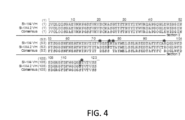
- SI-1X4.2 is a modification of SI-1X4 molecule and contained 5 amino acid changes as follows: V71A, T75S, N76S, A93T and S107T using the Kabat numbering system. Some of these changes especially positions 75, 76 and 93 potentially made interaction with antigen even though these are not in the CDR loops and are essential for binding and activity.
- FIG. 4 shows the 5 amino acid differences between SI-1X4.2 and SI-1X4.
- Monomeric EGFR extracellular domain binding was measured in a biolayer interferometry (BLI) binding assay on a BLItz instrument (ForteBio, Inc.). 25 ⁇ g/mL of SI-1C3, SI-1C4, SI-1C6, SI-1X1, SI-1X2, SI-1X5, and SI-1X6 were diluted in PBS and captured on anti-huIgG Fc BLItz biosensor tips for 120 seconds. Tips were washed for 30 seconds in PBS and moved to an EGFR (ProSpec Bio, PKA-344) sample for binding at 588nM. Binding of EGFR ECD to the tips was recorded as biolayer interferometry signals ( ⁇ nm) over an association time of 120 seconds.
- FIGS 5 and 6 report data starting at the association step of EGFR to the antibody-loaded biosensor. Each Figure shows comparison to SI-1C4 as a benchmark antibody.
- SI-1C3 and SI-1X2 share their EGFR binding domain displayed as a Fab, their binding profiles are similar and stronger than the scFv form displayed on SI-1X1 ( FIG. 6 ). Each has a very slow off-rate to EGFR compared to SI-1C4 and is not affected by their on-rate. SI-1X1 may show weaker on-rate binding to EGFR, but stays bound very strongly. The same trend is observed in FIG. 5 , where the Fab versions of the EGFR binding domains displayed on SI-1C6 and SI-1X6 bind at a faster rate than their representative scFv displayed on SI-1X5.
- SI-1X3 and SI-1X4 do not exhibit monomeric EGFR binding in this assay (data not shown) and dimeric EGFR binding is investigated in an ELISA below.
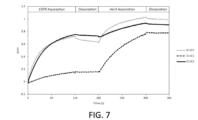
- Bispecific binding to EGFR and Her3 extracellular domains was measured in a biolayer interferometry (BLI) binding assay on a BLItz instrument (ForteBio, Inc.). 200nM of SI-1C1, SI-1C3, SI-1C4, SI-1C6, SI-1X1, SI-1X2, SI-1X3, SI-1X4, SI-1X5, and SI-1X6 were diluted in 1X Kinetics Buffer (ForteBio, Inc.) and captured on anti-huIgG Fc BLItz biosensor tips for 120 seconds. Tips were washed in KB for 30 seconds and moved to an EGFR sample (ProSpec Bio, PKA-344) for binding at 200nM.
- FIGS 8-10 7-9 report data starting at the association step of EGFR to the antibody-loaded biosensor. Antibodies are able to exhibit simultaneous bispecific binding of EGFR and Her3 while being bound by the Fc to the sensor. As observed in FIG. 7 and FIG.
- the display of the EGFR binding domain as Fab (SI-1X2, SI-1X6) has stronger on-rate binding than their scFv forms (SI-1X1, SI-1X5, respectively).
- both EGFR and Her3 exhibit the same Fab>>scFv on-rate trend.
- SI-1X3 and SI-1X4 do not exhibit binding to monomeric EGFR, however each has the ability to bind Her3, as expected since each molecule uses the same ⁇ Her3 binding domain as SI-1X1, SI-1X2, SI-1X5, and SI-1X6.
- SI-1X3 and SI-1X4 are investigated for dimeric EGFR binding in an ELISA below.
- SI-1X3 and SI-1X4 were unable to bind a monomeric form of EGFR in a BLI assay ( FIG. 9 ). It has been suggested that in order for the ⁇ EGFR binding domain used in SI-1C5, SI-1X3, and SI-1X4 to bind to EGFR in vitro, bivalent binding is required ( Perez et al, Chin Clin Oncol 2014;3(1):5 ). To observe this, we utilized ELISA for antibody binding relative to other EGFR binding antibodies using a dimeric form of EGFR.
- ELISA was performed using dimeric EGFR ECD reagent, SI-2C1, fused to rabbit Fc created in house.
- EGFR was coated onto Maxisorp immunoplates (Nunc) at 3 ⁇ g/mL in PBS at 4°C overnight. Plates were blocked in PBS with 3% BSA and 0.05% Tween20 for 2 hours at room temperature.
- Antibodies were captured at starting at 10ug/mL except for SI-1C5, SI-1X3, and SI-1X4 which started at 50 ⁇ g/mL for (reported in nM), all with 3X dilutions in PBST (1% BSA) for 1 hour at room temperature.
- Goat ⁇ human IgG-HRP antibody Jackson ImmunoResearch, 109-035-098 was used for detection of the Fc portion of the antibodies at 1:2000 dilution in PBST (1% BSA) and developed in TMB (Thermo Scientific) for 5 minutes with 2M H 2 S0 4 as a stop solution. 3 washes with PBST (1% BSA) were performed between each step. All data points were performed in triplicate and collected at 450 nm ( FIG. 10 ). SI-1C5, SI-1X3, and SI-1X4 all bound to the dimeric EGFR ECD in this ELISA format at high concentrations as compared to the other molecules.
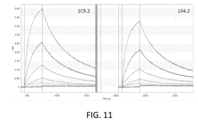
- association with EGFR protein was performed for 300 seconds with each sensor in a single concentration of EGFR protein (300, 100, 33.33, 11.11, 3.705, 1.235, 0.4116 and 0 nM). Dissociation was then performed in 10X Kinetics Buffer for 900 seconds. A typical association and dissociation trace for 1C5.2 and 1X4.2 is shown in FIG. 11 .
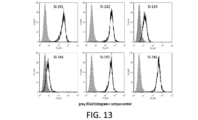
- the bispecific antibodies SI-1X1, SI-1X2, SI-1X3, SI-1X4, SI-1X5, and SI-1X6, as well as an isotype control were tested for binding to the tumor cell lines, A431 (epidermoid carcinoma, ATCC CRL-1555) and BxPC3 (pancreatic adenocarcinoma, ATCC CRL-1687) by flow cytometry.
- Cells were grown in RPMI-1640 medium containing 10% fetal bovine serum and were harvested for analysis while in exponential growth phase.
- the bispecific antibody, SI-1X4.2, monospecific antibodies, SI-1C5.2 and SI-1C1, as well as an isotype control were tested for binding to the tumor cell lines, A431 (epidermoid carcinoma, ATCC CRL-1555) ( FIG. 14 ) and FaDu (hypopharyngeal squamous cell carcinoma, ATCC HTB-43) ( FIG. 15 ) by flow cytometry.
- Cells were grown in RPMI-1640 medium containing 10% fetal bovine serum and were harvested for analysis while in exponential growth phase.
- SI-1C1 binds weakly to the two cell lines probably due to low level of expression of Her3 on the surface of the cells.
- 1C5.2 and 1X4.2 contained five amino acid changes as compared to 1C5 and 1X4 as described in example 1. These changes accounted for improved binding to target cells when compared to the parental molecule, 1X4.
- A431 cells ATCC CRL-1555, Manassas, Va.
- BxPC3 ATCC CRL-1687, Manassas, Va.
- test antibodies were added at various concentrations, ranging from 0.0015nM to 100nM.
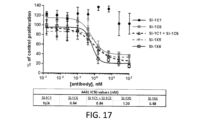
- SI-1X2 demonstrated more efficacious antiproliferative effect than the control antibodies SI-1C1 (anti-Her3), SI-1C3 (anti-EGFR), or SI-1C1 and SI-1C3 applied together.
- SI-1X1 exhibited antiproliferative effects, although not to the degree seen with SI-1C3 and the combination of SI-1C1 and SI-1C3.
- Inhibition plots as well as IC50 values are shown in FIG. 17 .
- SI-1X5 and SI-1X6 Similar results were observed for SI-1X5 and SI-1X6, where SI-1X6 is more potent than SI-1X5 and the control antibody SI-1C1 (anti-Her3), however it displayed similar antiproliferative potential as the control antibody SI-1C6 (anti-EGFR) and the combination of SI-1C1 and SI-1C6. This may be seen along with IC50 values in FIG. 17 .
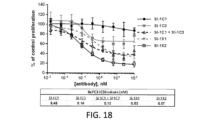
- SI-1X2 demonstrated more efficacious antiproliferative effect than the control antibodies SI-1C1 (anti-Her3), SI-1C3 (anti-EGFR), or SI-1C1 and SI-1C3 applied together.
- SI-1X1 was more efficacious than SI-1C1, but weaker than SI-1C3 and the combination of SI-1C1 and SI-1C3. Inhibition curves and IC50 values are displayed in FIG. 19 .
- BxPC3 proliferation was more strongly inhibited by both SI-1X5 and SI-1X6 than with the control antibodies SI-1C1 (anti-Her3), SI-1C6 (anti-EGFR), or SI-1C1 and SI-1C6 in combination.
- This data along with IC50 values is shown in FIG. 19 .
- FaDu nasopharyngeal squamous cell carcinoma line, ATCC HTB-43
- A431 epidermoid carcinoma, ATCC CRL-1555
- alamar blue reagent (Thermo Scientific) was added and cells were incubated at 37°C for 2 hours. Alamar blue is readily taken up by actively proliferating cells, reduced, and then secreted into the culture medium. The reduced form of alamar blue is strongly fluorescent. Following incubation, fluorescence was measured using a Molecular Devices (Sunnyvale, CA) FilterMax F5 multi-mode plate reader using an excitation wavelength of 535nm and an emission wavelength of 595nm. Fluorescence values for control cells (treated with medium only) were also obtained in this manner at the time of antibody addition in order to establish baseline metabolic activity.
- SI-1C5.2 and SI-1X4.2 were shown in FIG. 20 and FIG. 21 respectively.
- SI-1X4.2 demonstrated improved efficacious anti-proliferative effect than the control antibodies, SI-1C5.2 (anti-EGFR Mab), SI-1C1 (anti-Her3 Mab) or SI-1C1 and SI-1C7 applied together.
- Tubes were centrifuged at 1300RPM for 10 minutes and the supernatant was carefully aspirated. Cells were resuspended in 40ml PBS and centrifuged again. The process was repeated for a total of 2 washes. Following the final wash, cells were resuspended in 30ml RPMI-1630 + 10% FBS and incubated overnight at 37°C, 5% CO 2 .
- Target cells tested were the head and neck squamous cell carcinoma line, FaDu (ATCC HTB-43, Manassus, VA) and the non-small cell lung adenocarcinoma cell line, NCI-H1975 (ATCC CRL-5908, Manassus, VA).
- Target cells were labeled with calcein as follows. Cells were grown as monolayers and were detached by incubation with accutase. Cells were washed twice in RPMI with no serum. 1ml of cells at 4 ⁇ 10 6 cells/ml was mixed with 1ml RPMI (no serum) + 20 ⁇ M calcein AM (Sigma cat# C1359; St. Louis, MO).
- Probenecid (Sigma cat# P8761; St. Louis, MO) is an anionic transporter inhibitor and is known to reduce spontaneous release of intracellular calcein. Cells were resuspended in 20ml assay medium and allowed to recover for 2 hours at 37°C, 5% CO 2 . Cells were then washed once with assay medium and diluted to 200,000 cells/ml. Aliquots of 50 ⁇ l (10,000 cells) calcein-labeled cells were aliquoted to 96-well round-bottom plates.
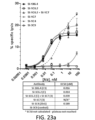
- PBMCs 50 ⁇ l of antibody (at 3X final concentration) was added to cells and allowed to bind for 40 minutes on ice. PBMCs from the previous day were centrifuged at 300g for 5 minutes, resuspended in 20ml fresh assay medium, counted, and diluted to 6 ⁇ 10 6 cells/ml. 50 ⁇ l PBMC (300,000) were added to each well and plates incubated at 37°C, 5% CO 2 for 4 hours. Each antibody was titrated in triplicate via 10-fold serial dilutions, starting at 50nM and going down to 0.00005nM. Control wells were also set up containing labeled target cells in the absence of antibody and effector cells in order to measure maximal and spontaneous calcein release.
- % specific lysis [(test sample value - spontaneous release)/(maximal release - spontaneous release)]*100
- SI-1X6.4 mediated cellular cytotoxicity, but was not particularly more effective than the control antibodies, SI-1C6.2, SI-1C7, or the combination of SI-1C6.2 + SI-1C7.
- SI-1X6.4 did mediate cytotoxicity with a lower EC50 than our benchmark antibody, SI-1C4.
- SI-1X4.2 mediated cellular cytotoxicity at about the same degree as the control antibodies. However, it was not as effective as mediating cellular cytotoxicity as the benchmark, SI-1C4. This is likely due to the lower affinity of SI-1X4.2.
- Protein Thermal Shift Study was performed for protein thermal stability analysis. Protein melt reactions were set up using Protein Thermal Shift Buffer TM and the Protein Thermal Shift Dye TM (Applied Biosystems). In brief, the 20ul reaction mixture contains 5ug protein, 5ul Protein Thermal Shift Buffer TM and 2.5 ⁇ 8X diluted Protein Thermal Shift TM Dye. For the negative control, PBS was used instead. The reaction mixture was added into MicroAmp Optical Reaction Plate and sealed with MicroAmp Optical Adhesive Film. Each sample consisted of 4 repeats. The protein melt reactions were run on Applied Biosystem Real-Time PCR System from 25 - 90 °C in 1% increment and then analyzed by Protein Thermal Shift Software TM . FIG.
- Tm 24 shows the thermal curve of SI-1X2, SI-1X4.2, SI-1X6.4, SI-1C3, SI-1C3, SI-1C6.2, SI-1C5.2 and SI-1C7.
- TABLE 5 shows Tm for these molecules. Tm is defined as the temperature needed to unfold 50% of the protein.
- the bispecific molecules, 1X2, 1X4.2 and 1X6 all have Tm around 66 °C which are comparable to all the MAbs (1C3, 1C6.2, 1C5.2) and the Fc-scFv (1C7) molecules.
- TABLE 5 Protein Name Tm (°C) SI-1X2 66.52 SI-1C3 70.06 SI-1X4.2 66.94 SI-1C5.2 70.26 SI-1X6.4 66.50 SI-1C6.2 70.12 SI-1C7 66.40
- Serum stability of the molecules SI-1C5.2, SI-1C6.2, SI-1X4.2, and SI-1X6.4 was determined by comparative binding to monomeric EGFR ECD by ELISA after incubation at 100 ⁇ g/mL in 95% human serum (Atlanta Biologics, S40110) at 37°C for Days 0, 3, and 7 time points with an extra time point of 55°C on Day 7 to provide a known condition where degradation occurs.
- ELISA plates were coated with monomeric EGFR ECD (SI-2R4) at 3 ⁇ g/mL in PBS at 4°C overnight. Coated ELISA plates were blocked with 3% BSA PBST for 2 hours at 25°C and then washed 3 times with PBST.
- SI-1C6.2 and SI-1X6.4 were diluted 1:10 with 1% BSA PBST and diluted 4x across the plate.
- SI-1C5.2 and SI-1X4.2 were diluted 1:2 with 1% BSA PBST and diluted 4x across the plate and incubated at 25°C for 1 hour.
- 3 more washes with PBST were performed before antigen capture with 1 ⁇ g/mL Her3 ECD Rabbit IgG1 (SI-1R1) for 1 hour at 25°C in 1% BSA PBST.
- 3 more washes with PBST were performed before goat anti-rabbit IgG-HRP (Bio-Rad 172-1019) secondary antibody was applied at 1:5000 dilution in 1% BSA PBST at 25°C for 1 hour.
- Results of the ELISA are reported by EC50 on FIG. 25 and indicate a favorable profile of minor degradation when held at 37°C. When placed in 55°C, the EC50 shifts roughly a log as the molecules are subjected to degradation conditions. EC50 values for SI-1C5.2 shift from 589.7 pM on Day 0 to 755.2 pM on Day 7 at 37°C ( ⁇ 165.5 pM) with a shift to 6.522 nM on Day 7 at 55°C ( ⁇ 5932.3 pM).
- Antibody concentrations were determined using three ELISA assays.
- assay 1 EGFR ECD coated ELISA
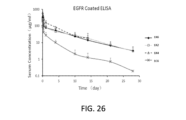
- recombinant EGFR-rabbit Fc was coated to the plate, wells were washed with PBST (phosphate buffered saline with 0.05% Tween) and blocked with 1% BSA in PBST. Serum or serum diluted standards were then added, followed by PBST washing, addition of HRP labeled rabbit-anti-human IgG (BOSTER), and additional PBST washing. TMB was then added and the plates were incubated 2.5 minutes in the dark. Color reaction was stopped by adding 2M sulfuric acid. Plate was read at 450nm wavelength.
- FIGS 26-28 show serum concentration data for four antibodies with three different assays respectively. Fitted PK parameters from in vivo PK studies are provided in TABLE 6. PK data include half-life, which represents the beta phase that characterizes elimination of antibody from serum and Cmax, which represents the maximal observed serum concentration, AUC, which represents the area under the concentration time curve.
- the example tested the activity of SI-1X2, SI-1X4.2 and SI-1X6 of concomitant blockade of EGFR, HER3 in preclinical models of Fadu ( head and neck squamous cell carcinoma xenograft model ) and compared their potency with cetuximab and cetuximab in combination with an anti-HER3 antibody.
- mice All mouse studies were conducted through Institutional Animal care and used committee-approved animal protocols in accordance with institutional guidelines.
- Six-week-old female Balb/c Nude mice were purchased from Beijing Vital River Laboratories and housed in air-filtered laminar flow cabinets with a 12 - hour light cycle and food and water ad libitum.
- the size of the animal groups was calculated to measure means difference between placebo and treatment groups of 25% with a power of 80% and a P value of 0.01.
- Host mice carrying xenografts were randomly and equally assigned to either control or treatment groups. Animal experiments were conducted in a controlled and non-blinded manner.
- mice were injected subcutaneously with 2 ⁇ 106 Fadu suspended 150 ⁇ l of culture medium per mouse.
- mice were randomized into 9 groups, with 6 mice per group.
- Vehicle Control 1C6 ( 25mg/kg), 1C4 ( 25mg/kg), 1C6 + 1C1 ( 25mg/kg+50mg/kg), SI-1X2 ( 25mg/kg), SI-1X6 ( 10mg/kg), SI-1X6 ( 25mg/kg), and SI-1X4.2 ( 10mg/kg) , SI-1X4 (25mg/kg) . All test articles were administered once weekly via intravenous injection. Tumors were measured by digital caliper over the entire treatment period every 3 days and the volume was determined using the following formula: 1/2 ⁇ lenth ⁇ width2. The body weight of mice were recorded before the first dose and followed by every week during the treatment period and recovery period.
- the term "effective amount" refers to an amount of a drug effective to achieve a desired effect, e.g., to ameliorate disease in a subject.
- the effective amount of the drug may inhibit (for example, slow to some extent, inhibit or stop) one or more of the following example characteristics including, without limitation, cancer cell growth, cancer cell proliferation, cancer cell motility, cancer cell infiltration into peripheral organs, tumor metastasis, and tumor growth.
- the effective amount of the drug may alternatively do one or more of the following when administered to a subject: slow or stop tumor growth, reduce tumor size (for example, volume or mass), relieve to some extent one or more of the symptoms associated with the cancer, extend progression free survival, result in an objective response (including, for example, a partial response or a complete response), and increase overall survival time.
- the drug may prevent growth and/or kill existing cancer cells, it is cytostatic and/or cytotoxic.
- the antibodies disclosed herein may be mixed or combined with pharmaceutically acceptable carriers known in the art dependent upon the chosen route of administration.
- pharmaceutically acceptable carriers known in the art dependent upon the chosen route of administration.
- a suitable pharmaceutical composition for injection may include pharmaceutically suitable carriers or excipients such as, without limitation, a buffer, a surfactant, or a stabilizer agent.
- a buffer may include, without limitation, acetate, phosphate or citrate buffer.
- surfactants may include, without limitation, polysorbate.
- Example stabilizer may include, without limitation, human albumin.
- a suitable solution for injection may contain, without limitation, from about 1 to about 20, from about 1 to about 10 mg antibodies per ml.
- the example dose may be, without limitation, from about 0.1 to about 20, from about 1 to about 5 mg/Kg body weight.
- the example administration frequency could be, without limitation, once per day or three times per week.
Landscapes
- Health & Medical Sciences (AREA)
- Chemical & Material Sciences (AREA)
- Life Sciences & Earth Sciences (AREA)
- Immunology (AREA)
- Medicinal Chemistry (AREA)
- General Health & Medical Sciences (AREA)
- Organic Chemistry (AREA)
- Pharmacology & Pharmacy (AREA)
- Animal Behavior & Ethology (AREA)
- Public Health (AREA)
- Veterinary Medicine (AREA)
- Engineering & Computer Science (AREA)
- Bioinformatics & Cheminformatics (AREA)
- Epidemiology (AREA)
- Genetics & Genomics (AREA)
- Biochemistry (AREA)
- Molecular Biology (AREA)
- Proteomics, Peptides & Aminoacids (AREA)
- Biophysics (AREA)
- Cell Biology (AREA)
- Oncology (AREA)
- Chemical Kinetics & Catalysis (AREA)
- Nuclear Medicine, Radiotherapy & Molecular Imaging (AREA)
- General Chemical & Material Sciences (AREA)
- Mycology (AREA)
- Microbiology (AREA)
- Biomedical Technology (AREA)
- Endocrinology (AREA)
- Peptides Or Proteins (AREA)
- Medicines Containing Antibodies Or Antigens For Use As Internal Diagnostic Agents (AREA)
- Micro-Organisms Or Cultivation Processes Thereof (AREA)
- Preparation Of Compounds By Using Micro-Organisms (AREA)
- Medicines That Contain Protein Lipid Enzymes And Other Medicines (AREA)
Applications Claiming Priority (3)
| Application Number | Priority Date | Filing Date | Title |
|---|---|---|---|
| US201462095348P | 2014-12-22 | 2014-12-22 | |
| PCT/US2015/066951 WO2016106157A1 (en) | 2014-12-22 | 2015-12-19 | Bispecific tetravalent antibodies and methods of makiing and using thereof |
| EP15874216.3A EP3237005B1 (de) | 2014-12-22 | 2015-12-19 | Tetravalente bispezifische antikörper und verfahren zur herstellung und verwendung davon |
Related Parent Applications (1)
| Application Number | Title | Priority Date | Filing Date |
|---|---|---|---|
| EP15874216.3A Division EP3237005B1 (de) | 2014-12-22 | 2015-12-19 | Tetravalente bispezifische antikörper und verfahren zur herstellung und verwendung davon |
Publications (2)
| Publication Number | Publication Date |
|---|---|
| EP4491195A2 true EP4491195A2 (de) | 2025-01-15 |
| EP4491195A3 EP4491195A3 (de) | 2025-04-02 |
Family
ID=56151464
Family Applications (3)
| Application Number | Title | Priority Date | Filing Date |
|---|---|---|---|
| EP24200270.7A Pending EP4491195A3 (de) | 2014-12-22 | 2015-12-19 | Bispezifische tetravalente antikörper und verfahren zur pakiing und verwendung davon |
| EP15874216.3A Active EP3237005B1 (de) | 2014-12-22 | 2015-12-19 | Tetravalente bispezifische antikörper und verfahren zur herstellung und verwendung davon |
| EP15874217.1A Active EP3237006B1 (de) | 2014-12-22 | 2015-12-19 | Bispezifische tetravalente antikörper und verfahren zur herstellung und verwendung davon |
Family Applications After (2)
| Application Number | Title | Priority Date | Filing Date |
|---|---|---|---|
| EP15874216.3A Active EP3237005B1 (de) | 2014-12-22 | 2015-12-19 | Tetravalente bispezifische antikörper und verfahren zur herstellung und verwendung davon |
| EP15874217.1A Active EP3237006B1 (de) | 2014-12-22 | 2015-12-19 | Bispezifische tetravalente antikörper und verfahren zur herstellung und verwendung davon |
Country Status (22)
| Country | Link |
|---|---|
| US (2) | US10717783B2 (de) |
| EP (3) | EP4491195A3 (de) |
| JP (2) | JP6947639B2 (de) |
| KR (4) | KR102590385B1 (de) |
| CN (11) | CN113105553B (de) |
| AU (1) | AU2015369831B2 (de) |
| CA (2) | CA3138083A1 (de) |
| DK (1) | DK3237005T3 (de) |
| ES (2) | ES2995733T3 (de) |
| FI (1) | FI3237005T3 (de) |
| HR (1) | HRP20241502T1 (de) |
| HU (1) | HUE069256T2 (de) |
| IL (3) | IL305193A (de) |
| LT (1) | LT3237005T (de) |
| NZ (1) | NZ732628A (de) |
| PL (1) | PL3237005T3 (de) |
| PT (1) | PT3237005T (de) |
| RS (1) | RS66070B1 (de) |
| SG (1) | SG11201704741PA (de) |
| SI (1) | SI3237005T1 (de) |
| SM (1) | SMT202400477T1 (de) |
| WO (2) | WO2016106158A1 (de) |
Families Citing this family (37)
| Publication number | Priority date | Publication date | Assignee | Title |
|---|---|---|---|---|
| SG11201704741PA (en) * | 2014-12-22 | 2017-07-28 | Systimmune Inc | Bispecific tetravalent antibodies and methods of makiing and using thereof |
| US12428483B2 (en) | 2014-12-22 | 2025-09-30 | Systimmune, Inc. | Bispecific tetravalent antibodies and methods of making and using thereof |
| WO2016115274A1 (en) * | 2015-01-14 | 2016-07-21 | Compass Therapeutics Llc | Multispecific immunomodulatory antigen-binding constructs |
| CN106632681B (zh) * | 2016-10-11 | 2017-11-14 | 北京东方百泰生物科技有限公司 | 抗egfr和抗cd3双特异抗体及其应用 |
| CN108948195B (zh) * | 2017-05-23 | 2022-05-31 | 胡毅 | 一种抗egfr/pd-l1双靶向抗体、其制备方法及用途 |
| WO2019005636A2 (en) * | 2017-06-25 | 2019-01-03 | Systimmune, Inc. | ANTI-ROR1 ANTIBODIES AND METHODS OF PREPARATION AND USE |
| KR102785809B1 (ko) * | 2017-11-02 | 2025-03-26 | 시스트이뮨, 인코포레이티드 | 이중특이성 항체 및 이의 제조 및 사용 방법 |
| KR20200109313A (ko) * | 2018-01-15 | 2020-09-22 | 난징 레전드 바이오테크 씨오., 엘티디. | Tigit에 대한 항체 및 이의 변이체 |
| CN108220244A (zh) * | 2018-01-18 | 2018-06-29 | 东北农业大学 | 一种含重组人表皮生长因子受体抗体基因的cho细胞株、筛选方法及其生产工艺 |
| CN107974461A (zh) * | 2018-01-18 | 2018-05-01 | 东北农业大学 | 一种高效表达anti-hEGFR基因的真核表达载体构建方法 |
| BR112020020828A2 (pt) * | 2018-04-13 | 2021-01-19 | Affimed Gmbh | Proteínas de ligação, composições farmacêuticas, método para o tratamento ou melhoria de uma doença, para tratar e/ou prevenir uma doença, para tratar um paciente e para tratar câncer e anticorpos |
| WO2019222428A1 (en) * | 2018-05-16 | 2019-11-21 | Arbele Limited | Composition of bispecific antibodies and method of use thereof |
| EP3833690B1 (de) | 2018-08-08 | 2024-03-27 | ImmuneOnco Biopharmaceuticals (Shanghai) Inc. | Gegen cd47 und her2 gerichtetes, rekombinantes bifunktionales protein |
| CN110850068B (zh) * | 2018-08-21 | 2023-08-15 | 上海恒润达生生物科技股份有限公司 | 一种嵌合抗原受体亲和力检测方法 |
| AU2019345151B2 (en) * | 2018-09-19 | 2025-04-17 | Alpine Immune Sciences, Inc. | Methods and uses of variant CD80 fusion proteins and related constructs |
| CN119798453A (zh) * | 2018-11-13 | 2025-04-11 | Jn生物科学有限责任公司 | 激活免疫细胞的双特异性抗体 |
| WO2020160310A1 (en) * | 2019-01-30 | 2020-08-06 | The Wistar Institute Of Anatomy And Biology | Dna-encoded bispecific t-cell engagers targeting cancer antigens and methods of use in cancer theraputics |
| US12168690B2 (en) * | 2019-07-26 | 2024-12-17 | Abl Bio Inc. | Anti-EGFR/anti-4-1BB bispecific antibody |
| AU2020327000A1 (en) * | 2019-08-08 | 2022-03-31 | Regeneron Pharmaceuticals, Inc. | Novel antigen binding molecule formats |
| CN114502203B (zh) * | 2019-11-06 | 2024-07-19 | 成都百利多特生物药业有限责任公司 | 制导和导航控制蛋白及其制备和使用方法 |
| CN115361972A (zh) * | 2020-02-19 | 2022-11-18 | 戴纳立制药公司 | 工程化抗her2双特异性蛋白 |
| TWI874613B (zh) * | 2020-03-17 | 2025-03-01 | 美商西雅圖免疫公司 | 微型導引和導航控制(miniGNC)類抗體蛋白及其製造和使用方法 |
| CN111548424A (zh) * | 2020-06-05 | 2020-08-18 | 上海科弈药业科技有限公司 | 一种靶向egfr与cd47的多功能融合蛋白及其应用 |
| WO2022061256A2 (en) * | 2020-09-21 | 2022-03-24 | Systimmune, Inc. | Egfr binding complex and method of making and using thereof |
| CN117940459A (zh) * | 2021-08-25 | 2024-04-26 | 西雅图免疫公司 | 靶向egfr和her3的双特异性四价抗体 |
| EP4405396A2 (de) * | 2021-09-20 | 2024-07-31 | Voyager Therapeutics, Inc. | Zusammensetzungen und verfahren zur behandlung von her2-positivem krebs |
| AU2022357570A1 (en) * | 2021-10-03 | 2024-04-11 | Systimmune, Inc. | Methods of treating cancer and the pharmaceutical compositions thereof |
| EP4434548A1 (de) | 2021-11-15 | 2024-09-25 | Systimmune, Inc. | Bispezifisches antikörper-camptothecin-wirkstoffkonjugat und pharmazeutische verwendung davon |
| WO2023241480A1 (zh) * | 2022-06-13 | 2023-12-21 | 三优生物医药(上海)有限公司 | 抗pd-l1、vegf和egfr三特异性抗体及其应用 |
| WO2024050439A2 (en) * | 2022-08-31 | 2024-03-07 | Systimmune, Inc. | Biepitopic tetravalent antibody targeting egfr |
| CN116063564A (zh) * | 2022-10-08 | 2023-05-05 | 盛禾(中国)生物制药有限公司 | 一种纯化融合蛋白的方法 |
| WO2024168588A1 (en) * | 2023-02-15 | 2024-08-22 | Zhejiang Shimai Pharmaceutical Co., Ltd. | Egfr and lag3 dual targeted bispecific antibody and uses thereof |
| CN121443647A (zh) * | 2023-07-07 | 2026-01-30 | 四川科伦博泰生物医药股份有限公司 | EGFR/c-MET双特异性结合蛋白及其用途 |
| KR20260049221A (ko) * | 2023-07-29 | 2026-04-13 | 상하이 카이진 바이오테크놀로지, 리미티드 | 변형된 e형 다중특이성 항체 |
| WO2025117871A1 (en) * | 2023-11-29 | 2025-06-05 | Systimmune, Inc. | Bispecific tetravalent antibody targeting her2 and her3 |
| WO2025140662A1 (en) * | 2023-12-29 | 2025-07-03 | Biocytogen Pharmaceuticals (Beijing) Co., Ltd. | Anti-egfr/her3 antibodies and uses thereof |
| WO2025190404A1 (zh) * | 2024-03-14 | 2025-09-18 | 珠海普米斯生物科技有限公司 | 双特异性抗体、抗体药物偶联物及其应用 |
Citations (3)
| Publication number | Priority date | Publication date | Assignee | Title |
|---|---|---|---|---|
| EP0272942B1 (de) | 1986-12-23 | 1992-09-30 | Brookes and Gatehouse Limited | Geschwindigkeitsmessvorrichtung |
| US5641870A (en) | 1995-04-20 | 1997-06-24 | Genentech, Inc. | Low pH hydrophobic interaction chromatography for antibody purification |
| US7332585B2 (en) | 2002-04-05 | 2008-02-19 | The Regents Of The California University | Bispecific single chain Fv antibody molecules and methods of use thereof |
Family Cites Families (27)
| Publication number | Priority date | Publication date | Assignee | Title |
|---|---|---|---|---|
| AU2003210802B2 (en) * | 2002-02-05 | 2009-09-10 | Genentech Inc. | Protein purification |
| CN101061140B (zh) * | 2004-09-17 | 2015-07-01 | 多曼蒂斯有限公司 | 单价结合cd40l的组合物和应用方法 |
| BRPI0713421A2 (pt) * | 2006-06-14 | 2012-03-13 | Imclone Systems Incorporated | Formulação liofolizada, formulação aquosa adequada para a liofilização, e, métodos para estabilizar am anticorpo e para tratar um mamífero |
| AU2007353412A1 (en) * | 2006-11-21 | 2008-11-20 | Fox Chase Cancer Center | Anti-EGFR family antibodies, bispecific anti-EGFR family antibodies and methods of use thereof |
| CN104447995A (zh) * | 2009-03-20 | 2015-03-25 | 霍夫曼-拉罗奇有限公司 | 双特异性抗-her抗体 |
| WO2010111625A1 (en) | 2009-03-27 | 2010-09-30 | Zymogenetics, Inc. | Compositions and methods for using multispecific-binding proteins comprising an antibody-receptor combination |
| PE20120591A1 (es) | 2009-04-02 | 2012-05-23 | Roche Glycart Ag | Anticuerpos multiespecificos que comprenden anticuerpos de longitud completa y fragmentos fab de cadena sencilla |
| MX2011010166A (es) * | 2009-04-07 | 2011-10-11 | Roche Glycart Ag | Anticuerpos biespecificos anti-erbb-3/anti-c-met. |
| KR20120060877A (ko) * | 2009-09-01 | 2012-06-12 | 아보트 러보러터리즈 | 이원 가변 도메인 면역글로불린 및 이의 용도 |
| EP2496598B1 (de) * | 2009-11-04 | 2017-08-02 | Affibody AB | Her3-bindende polypeptide |
| JP2014504850A (ja) * | 2010-09-30 | 2014-02-27 | メルク・シャープ・エンド・ドーム・コーポレイション | 抗her3抗体の製造、特徴づけ及びその用途 |
| CA2817448C (en) | 2010-12-23 | 2019-01-22 | F. Hoffmann-La Roche Ag | Binding agent |
| TWI588156B (zh) | 2011-03-28 | 2017-06-21 | 賽諾菲公司 | 具有交叉結合區定向之雙重可變區類抗體結合蛋白 |
| US20140170148A1 (en) * | 2011-04-20 | 2014-06-19 | Genmab A/S | Bispecific antibodies against her2 |
| JP6177231B2 (ja) * | 2011-04-20 | 2017-08-09 | ゲンマブ エー/エス | Her2に対する二重特異性抗体 |
| SMT201800269T1 (it) * | 2011-04-25 | 2018-07-17 | Daiichi Sankyo Co Ltd | Anticorpo anti-b7-h3 |
| CN102250246A (zh) * | 2011-06-10 | 2011-11-23 | 常州亚当生物技术有限公司 | 抗VEGF/PDGFRβ双特异性抗体及其应用 |
| CN102250247B (zh) * | 2011-06-15 | 2013-06-19 | 常州亚当生物技术有限公司 | 一种抗vegf/ang2双特异性抗体及其应用 |
| LT2794658T (lt) * | 2011-12-19 | 2017-05-10 | Synimmune Gmbh | Bispecifinė antikūno molekulė |
| WO2013096346A1 (en) | 2011-12-22 | 2013-06-27 | Development Center For Biotechnology | Bispecific t-cell activator antibody |
| RU2014136886A (ru) * | 2012-03-27 | 2016-05-20 | Дженентек, Инк. | Диагностика и виды лечения, связанные с ингибиторами her3 |
| CN104768571B (zh) * | 2012-07-13 | 2018-11-09 | 酵活有限公司 | 多价异多聚体支架设计和构建体 |
| CN113201073A (zh) * | 2012-11-21 | 2021-08-03 | 詹森生物科技公司 | 双特异性EGFR/c-Met抗体 |
| CN104688740A (zh) * | 2012-12-21 | 2015-06-10 | 百奥泰生物科技(广州)有限公司 | 类美登素衍生物及其制备方法和用途 |
| AU2014227638A1 (en) | 2013-03-15 | 2015-09-17 | Merck Patent Gmbh | Tetravalent bispecific antibodies |
| CN104211814A (zh) * | 2013-05-29 | 2014-12-17 | 三星电子株式会社 | 用于消耗靶膜蛋白的组合物 |
| SG11201704741PA (en) | 2014-12-22 | 2017-07-28 | Systimmune Inc | Bispecific tetravalent antibodies and methods of makiing and using thereof |
-
2015
- 2015-12-19 SG SG11201704741PA patent/SG11201704741PA/en unknown
- 2015-12-19 ES ES15874216T patent/ES2995733T3/es active Active
- 2015-12-19 EP EP24200270.7A patent/EP4491195A3/de active Pending
- 2015-12-19 LT LTEPPCT/US2015/066951T patent/LT3237005T/lt unknown
- 2015-12-19 CN CN202110471392.XA patent/CN113105553B/zh active Active
- 2015-12-19 CN CN202110471245.2A patent/CN113512123B/zh active Active
- 2015-12-19 NZ NZ732628A patent/NZ732628A/en unknown
- 2015-12-19 CN CN202110471052.7A patent/CN113512121B/zh active Active
- 2015-12-19 WO PCT/US2015/066952 patent/WO2016106158A1/en not_active Ceased
- 2015-12-19 CA CA3138083A patent/CA3138083A1/en active Pending
- 2015-12-19 IL IL305193A patent/IL305193A/en unknown
- 2015-12-19 JP JP2017551580A patent/JP6947639B2/ja active Active
- 2015-12-19 US US15/538,189 patent/US10717783B2/en active Active
- 2015-12-19 AU AU2015369831A patent/AU2015369831B2/en active Active
- 2015-12-19 KR KR1020237021346A patent/KR102590385B1/ko active Active
- 2015-12-19 CN CN202311507433.1A patent/CN117467017A/zh active Pending
- 2015-12-19 HU HUE15874216A patent/HUE069256T2/hu unknown
- 2015-12-19 DK DK15874216.3T patent/DK3237005T3/da active
- 2015-12-19 KR KR1020177020104A patent/KR102548827B1/ko active Active
- 2015-12-19 CN CN202110470743.5A patent/CN113105551B/zh active Active
- 2015-12-19 PT PT158742163T patent/PT3237005T/pt unknown
- 2015-12-19 CN CN202110471476.3A patent/CN113150165B/zh active Active
- 2015-12-19 CN CN202110470781.0A patent/CN113105552B/zh active Active
- 2015-12-19 ES ES15874217T patent/ES2962675T3/es active Active
- 2015-12-19 CN CN201580036408.7A patent/CN106659779B/zh active Active
- 2015-12-19 CN CN201580073430.9A patent/CN107206074B/zh active Active
- 2015-12-19 WO PCT/US2015/066951 patent/WO2016106157A1/en not_active Ceased
- 2015-12-19 CN CN202110470818.XA patent/CN113512120B/zh active Active
- 2015-12-19 IL IL286835A patent/IL286835B2/en unknown
- 2015-12-19 SI SI201532042T patent/SI3237005T1/sl unknown
- 2015-12-19 KR KR1020257020085A patent/KR20250094744A/ko active Pending
- 2015-12-19 CA CA2969867A patent/CA2969867C/en active Active
- 2015-12-19 US US15/119,694 patent/US10919977B2/en active Active
- 2015-12-19 EP EP15874216.3A patent/EP3237005B1/de active Active
- 2015-12-19 CN CN202110471082.8A patent/CN113512122B/zh active Active
- 2015-12-19 KR KR1020237034930A patent/KR102823201B1/ko active Active
- 2015-12-19 HR HRP20241502TT patent/HRP20241502T1/hr unknown
- 2015-12-19 RS RS20241150A patent/RS66070B1/sr unknown
- 2015-12-19 EP EP15874217.1A patent/EP3237006B1/de active Active
- 2015-12-19 FI FIEP15874216.3T patent/FI3237005T3/fi active
- 2015-12-19 PL PL15874216.3T patent/PL3237005T3/pl unknown
- 2015-12-19 SM SM20240477T patent/SMT202400477T1/it unknown
-
2017
- 2017-06-11 IL IL252811A patent/IL252811B/en unknown
-
2021
- 2021-04-15 JP JP2021068859A patent/JP7335290B2/ja active Active
Patent Citations (3)
| Publication number | Priority date | Publication date | Assignee | Title |
|---|---|---|---|---|
| EP0272942B1 (de) | 1986-12-23 | 1992-09-30 | Brookes and Gatehouse Limited | Geschwindigkeitsmessvorrichtung |
| US5641870A (en) | 1995-04-20 | 1997-06-24 | Genentech, Inc. | Low pH hydrophobic interaction chromatography for antibody purification |
| US7332585B2 (en) | 2002-04-05 | 2008-02-19 | The Regents Of The California University | Bispecific single chain Fv antibody molecules and methods of use thereof |
Non-Patent Citations (11)
| Title |
|---|
| ARTEAGA ET AL., NATURE REVIEWS CLINICAL ONCOLOGY, vol. 9, pages 16 - 32 |
| BODE ET AL., EXPERT OPIN BIOL THER, vol. 12, no. 12, December 2012 (2012-12-01), pages 1649 - 59 |
| COHEN, CANCER TREATMENT REVIEWS, vol. 40, 2014, pages 567 - 577 |
| JACKMAN ET AL., J CLIN ONCOL, vol. 28, 2010, pages 357 - 60 |
| LUTTERBUESE ET AL., PROCEEDINGS OF THE NATIONAL ACADEMY OF SCIENCES OF THE UNITED STATES OF AMERICA, vol. 107, no. 28, 2010, pages 12605 - 12610 |
| PEREZ ET AL., CHIN CLIN ONCOL, vol. 3, no. 1, 2014, pages 5 |
| PRICE ET AL., THE LANCET ONCOLOGY, vol. 15, no. 6, May 2014 (2014-05-01), pages 569 - 579 |
| PRICECOHEN, URR TREAT OPTIONS ONCOL., vol. 13, no. 1, March 2012 (2012-03-01), pages 35 - 46 |
| SCHAEFER ET AL., CANCER CELL, vol. 20, no. 4, 18 October 2011 (2011-10-18), pages 472 - 86 |
| SCHANZER ET AL., ANTIMICROB. AGENTS CHEMOTHER, vol. 55, no. 5, 2011, pages 2369 |
| ZAPATA ET AL., PROTEIN ENG., vol. 8, no. 10, 1995, pages 1057 - 1062 |
Also Published As
Similar Documents
| Publication | Publication Date | Title |
|---|---|---|
| JP7335290B2 (ja) | 二重特異性四価抗体並びにその製作及び使用方法 | |
| CN108112254B (zh) | 抗-pdl1抗体、可活化的抗-pdl1抗体、及其使用方法 | |
| CN108368170B (zh) | 抗pd-1抗体、可活化抗pd-1抗体及其使用方法 | |
| IL302278A (en) | Combination treatment | |
| US12428483B2 (en) | Bispecific tetravalent antibodies and methods of making and using thereof | |
| HK40120554A (en) | Bispecific tetravalent antibodies and methods of makiing and using thereof | |
| HK1233941B (zh) | 双特异性四价抗体及其制造和使用方法 | |
| HK1233941A1 (en) | Bispecific tetravalent antibodies and methods of making and using thereof | |
| EA039736B1 (ru) | Анти-pdl1-антитела, активируемые анти-pdl1-антитела и способы их применения |
Legal Events
| Date | Code | Title | Description |
|---|---|---|---|
| PUAI | Public reference made under article 153(3) epc to a published international application that has entered the european phase |
Free format text: ORIGINAL CODE: 0009012 |
|
| STAA | Information on the status of an ep patent application or granted ep patent |
Free format text: STATUS: THE APPLICATION HAS BEEN PUBLISHED |
|
| AC | Divisional application: reference to earlier application |
Ref document number: 3237005 Country of ref document: EP Kind code of ref document: P |
|
| AK | Designated contracting states |
Kind code of ref document: A2 Designated state(s): AL AT BE BG CH CY CZ DE DK EE ES FI FR GB GR HR HU IE IS IT LI LT LU LV MC MK MT NL NO PL PT RO RS SE SI SK SM TR |
|
| REG | Reference to a national code |
Ref country code: DE Ref legal event code: R079 Free format text: PREVIOUS MAIN CLASS: A61K0039395000 Ipc: C07K0016280000 |
|
| PUAL | Search report despatched |
Free format text: ORIGINAL CODE: 0009013 |
|
| AK | Designated contracting states |
Kind code of ref document: A3 Designated state(s): AL AT BE BG CH CY CZ DE DK EE ES FI FR GB GR HR HU IE IS IT LI LT LU LV MC MK MT NL NO PL PT RO RS SE SI SK SM TR |
|
| RIC1 | Information provided on ipc code assigned before grant |
Ipc: A61P 43/00 20060101ALI20250221BHEP Ipc: C07K 16/30 20060101ALI20250221BHEP Ipc: C07K 16/32 20060101ALI20250221BHEP Ipc: A61K 39/00 20060101ALI20250221BHEP Ipc: A61P 35/00 20060101ALI20250221BHEP Ipc: C07K 16/28 20060101AFI20250221BHEP |
|
| REG | Reference to a national code |
Ref country code: HK Ref legal event code: DE Ref document number: 40120554 Country of ref document: HK |
|
| STAA | Information on the status of an ep patent application or granted ep patent |
Free format text: STATUS: REQUEST FOR EXAMINATION WAS MADE |
|
| 17P | Request for examination filed |
Effective date: 20251002 |