EP4492622A1 - Verfahren zur diagnose einer motorischen antriebseinrichtung für eine verdunkelungsvorrichtung einer schliess-, verdunkelungs- oder sonnenschutzanlage - Google Patents
Verfahren zur diagnose einer motorischen antriebseinrichtung für eine verdunkelungsvorrichtung einer schliess-, verdunkelungs- oder sonnenschutzanlage Download PDFInfo
- Publication number
- EP4492622A1 EP4492622A1 EP24188150.7A EP24188150A EP4492622A1 EP 4492622 A1 EP4492622 A1 EP 4492622A1 EP 24188150 A EP24188150 A EP 24188150A EP 4492622 A1 EP4492622 A1 EP 4492622A1
- Authority
- EP
- European Patent Office
- Prior art keywords
- electrical energy
- drive device
- motorized drive
- photovoltaic panel
- during
- Prior art date
- Legal status (The legal status is an assumption and is not a legal conclusion. Google has not performed a legal analysis and makes no representation as to the accuracy of the status listed.)
- Pending
Links
Images



Classifications
-
- H—ELECTRICITY
- H02—GENERATION; CONVERSION OR DISTRIBUTION OF ELECTRIC POWER
- H02J—ELECTRIC POWER NETWORKS; CIRCUIT ARRANGEMENTS OR SYSTEMS FOR SUPPLYING OR DISTRIBUTING ELECTRIC POWER; SYSTEMS FOR STORING ELECTRIC ENERGY
- H02J7/00—Circuit arrangements for charging or discharging batteries or for supplying loads from batteries
- H02J7/80—Circuit arrangements for charging or discharging batteries or for supplying loads from batteries including monitoring or indicating arrangements
-
- E—FIXED CONSTRUCTIONS
- E06—DOORS, WINDOWS, SHUTTERS, OR ROLLER BLINDS IN GENERAL; LADDERS
- E06B—FIXED OR MOVABLE CLOSURES FOR OPENINGS IN BUILDINGS, VEHICLES, FENCES OR LIKE ENCLOSURES IN GENERAL, e.g. DOORS, WINDOWS, BLINDS, GATES
- E06B9/00—Screening or protective devices for wall or similar openings, with or without operating or securing mechanisms; Closures of similar construction
- E06B9/56—Operating, guiding or securing devices or arrangements for roll-type closures; Spring drums; Tape drums; Counterweighting arrangements therefor
- E06B9/68—Operating devices or mechanisms, e.g. with electric drive
- E06B9/72—Operating devices or mechanisms, e.g. with electric drive comprising an electric motor positioned inside the roller
-
- H—ELECTRICITY
- H02—GENERATION; CONVERSION OR DISTRIBUTION OF ELECTRIC POWER
- H02J—ELECTRIC POWER NETWORKS; CIRCUIT ARRANGEMENTS OR SYSTEMS FOR SUPPLYING OR DISTRIBUTING ELECTRIC POWER; SYSTEMS FOR STORING ELECTRIC ENERGY
- H02J7/00—Circuit arrangements for charging or discharging batteries or for supplying loads from batteries
- H02J7/34—Parallel operation in networks using both storage and other DC sources, e.g. providing buffering
- H02J7/35—Parallel operation in networks using both storage and other DC sources, e.g. providing buffering with light sensitive cells
Definitions
- the present invention relates to a method for diagnosing a motorized drive device for a concealment device of a closing, concealment or solar protection installation, as well as a motorized drive device suitable for implementing this diagnostic method.
- the present invention relates to the field of occultation devices comprising a motorized drive device setting a screen in motion, between at least a first position and at least a second position.
- a motorized drive device comprises an electromechanical actuator of a movable closing, concealing or sun protection element, such as a shutter, a door, a grille, a blind or any other equivalent material, hereinafter called a screen.
- a movable closing, concealing or sun protection element such as a shutter, a door, a grille, a blind or any other equivalent material, hereinafter called a screen.
- a motorized drive device comprising an electromechanical actuator and an electrical energy supply device including a battery and a photovoltaic panel.
- the photovoltaic panel is used to recharge the battery so that the latter is always sufficiently charged to power the electromagnetic actuator.
- the present invention aims to remedy the aforementioned drawbacks and to propose a diagnostic method improving the situation.
- the invention proposes a diagnostic method which makes it possible to determine the state of the photovoltaic panel.
- the method may comprise a first step of comparing the electrical energy produced by the photovoltaic panel during the target period, in particular a first step of comparing the electrical energy produced by the photovoltaic panel during the target period to a theoretical consumption of the motorized drive device, in particular a first step of comparing the electrical energy produced by the photovoltaic panel during the target period to a theoretical consumption of the motorized drive device during the target period.
- the method may comprise, depending on the result of the first comparison step, a communication, in particular a display, of electrical energy production information.
- the method may comprise a second step of comparing the electrical energy produced by the photovoltaic panel during the target period to the electrical energy consumed by the motorized drive device during the target period.
- the method may comprise, depending on the result of the second comparison step, a communication, in particular a display, of an energy balance indicator and/or a recommendation of action to improve the balance indicator.
- the method may comprise a step of combined analysis of at least two results of the second comparison step for different target periods of short, intermediate and/or long duration.
- the motorized drive device for a concealment device of a closing, concealment or solar protection installation comprises means for implementing the method defined above.
- the computer program product comprises program code instructions recorded on a computer-readable medium for implementing the steps of the method defined above when said program operates on a computer.
- the computer program product downloadable from a communications network and/or recorded on a data medium readable by a computer and/or executable by a computer, is characterized in that it comprises instructions which, when the program is executed by the computer, lead the latter to implement the method defined above.
- the data recording medium readable by a computer, on which is recorded a computer program comprising program code instructions for implementing the method defined above.
- the computer-readable recording medium comprises instructions which, when executed by a computer, cause the latter to implement the method defined above.
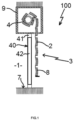
- installation 100 includes window 40.
- the window 40 comprises at least one fixed frame 41 and at least one pane 42.
- the pane 42 is arranged inside the fixed frame 41, in particular in an assembled configuration of the window 40.
- the window 42 can either be mounted in the fixed frame 41, in the case where it is fixed relative to the fixed frame 41, or mounted in a frame of the opening, in the case where it is movable relative to the fixed frame 41, in particular according to a rotational movement, in particular in the case of a tilting or hinged window, or according to a translational movement, in particular in the case of a sliding window in a horizontal or vertical direction, or according to two rotational movements, in particular in the case of a tilt-and-turn window.
- the occultation device 3 may be a roller shutter, a canvas blind or one with adjustable slats, a rolling gate, a grille, a door or even a hinged shutter.
- the present invention applies to all types of occultation device.
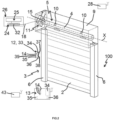
- the installation 100 comprises the occultation device 3.
- the occulting device 3 comprises a motorized drive device 5.
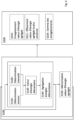
- the motorized drive device 5 comprises at least one electromechanical actuator 11 illustrated in figure 3 .
- the screen 2 of the occultation device 3 is wound on the winding tube 4 or unwound around it, the winding tube 4 being driven by the motorized drive device 5, in particular by the electromechanical actuator 11.
- the screen 2 is movable between a rolled-up position, in particular high, and an unrolled position, in particular low, and vice versa.
- the screen 2 of the occultation device 3 is a closing, occultation and/or sun protection screen, winding and unwinding around the winding tube 4, the inner diameter of which is greater than the outer diameter of the electromechanical actuator 11, so that the electromechanical actuator 11 can be inserted into the winding tube 4, when assembling the occultation device 3.
- the electromechanical actuator 11 in particular of the tubular type, makes it possible to rotate the winding tube 4 around an axis of rotation X, so as to move, in particular unroll or wind, the screen 2 of the occultation device 3.
- the electromechanical actuator 11 is inserted into the winding tube 4.
- the rolled-up high position corresponds to the support of a final end blade 8, for example L-shaped, of the apron 2 of the roller shutter 3 against an edge of a casing 9 of the roller shutter 3 or to the stopping of the final end blade 8 in a programmed high end-of-travel position.
- the unrolled low position corresponds to the support of the final end blade 8 of the apron 2 of the roller shutter 3 against a threshold 7 of the opening 1 or to the stopping of the final end blade 8 in a programmed low end-of-travel position.
- the screen 2 is configured to be moved, by means of the motorized drive device 5, in particular the electromechanical actuator 11, between an open position, corresponding to the rolled-up position and which can also be called the first end-of-travel position or the high end-of-travel position FdCH, and a closed position, corresponding to the unrolled position and which can also be called the second end-of-travel position or the low end-of-travel position FdCB.
- the electromechanical actuator 11 is configured to drive, in other words to move, the screen 2, between the first end-of-travel position FdCH and the second end-of-travel position FdCB, and vice versa, opposite the window 40, in particular the glass 42.
- screen 2 is arranged outside the building.
- screen 2 is arranged inside the building.
- the first blade of the roller shutter 3, opposite the final end blade 8, is connected to the winding tube 4 by means of at least one articulation 10, in particular a band-shaped attachment piece.
- the winding tube 4 is arranged inside the casing 9 of the roller shutter 3.
- the apron 2 of the roller shutter 3 winds and unwinds around the winding tube 4 and is housed at least partly inside the casing 9.
- the trunk 9 is arranged above the opening 1, or in the upper part of the opening 1.
- the motorized drive device 5 is controlled by a control unit.
- the control unit may be, for example, a local control unit 12 or a central control unit 13.
- the local control unit 12 can be connected, by wired or wireless connection, with the central control unit 13.
- the central control unit 13 can control the local control unit 12, as well as other similar local control units distributed throughout the building.
- the motorized drive device 5 is preferably configured to execute the commands for unrolling or rolling up the screen 2 of the occultation device 3, which can be issued, in particular, by the local control unit 12 or the central control unit 13.
- the installation 100 comprises either the local control unit 12, or the central control unit 13, or the local control unit 12 and the central control unit 13.
- the motorized drive device 5 including the electromechanical actuator 11, belonging at the installation 100 of figures 1 And 2 .
- the electromechanical actuator 11 comprises at least one electric motor 16.
- the electric motor 16 comprises a rotor and a stator, not shown and positioned coaxially around the axis of rotation X of the winding tube 4 in the mounted configuration of the motorized drive device 5.
- the electric motor 16 may be of the brushless type with electronic commutation, also called “BLDC” (acronym for the English term BrushLess Direct Current) or “synchronous with permanent magnets”, or of the direct current type.
- BLDC brushless type with electronic commutation
- synchronous with permanent magnets or of the direct current type.
- Means for controlling the electromechanical actuator 11, allowing the movement of the screen 2 of the occultation device 3, comprise at least one electronic control unit 15.
- This electronic control unit 15 is capable of operating the electric motor 16 of the electromechanical actuator 11 and, in particular, allowing the supply of electrical energy to the electric motor 16.
- the electronic control unit 15 controls, in particular, the electric motor 16, so as to open or close the screen 2, as described previously.
- the control means of the electromechanical actuator 11 comprise hardware and/or software means.
- the hardware means may comprise at least one microcontroller 31.
- the motorized drive device 5 further comprises the electronic control unit 15.
- the electronic control unit 15 further comprises a first communication module 27, in particular for receiving control orders, the control orders being emitted by an order transmitter, such as the local control unit 12 or the central control unit 13, these orders being intended to control the motorized drive device 5.
- a first communication module 27 in particular for receiving control orders, the control orders being emitted by an order transmitter, such as the local control unit 12 or the central control unit 13, these orders being intended to control the motorized drive device 5.
- the first communication module 27 of the electronic control unit 15 is of the wireless type.
- the first communication module 27 is configured to receive radio control orders.
- the first communication module 27 can also allow the reception of control orders transmitted by wired means.
- the electronic control unit 15, the local control unit 12 and/or the central control unit 13 can be in communication with a weather station, not shown, arranged inside the building or remote to the outside of the building, including, in particular, one or more sensors that can be configured to determine, for example, a temperature, a brightness, or even a wind speed, in the case where the weather station is remote to the outside of the building.
- a weather station not shown, arranged inside the building or remote to the outside of the building, including, in particular, one or more sensors that can be configured to determine, for example, a temperature, a brightness, or even a wind speed, in the case where the weather station is remote to the outside of the building.
- the electronic control unit 15, the local control unit 12 and/or the central control unit 13 can also be in communication with a server 28, as illustrated in FIG. figure 2 , so as to control the electromechanical actuator 11 according to data made available remotely via a communication network, in particular an internet network which can be connected to the server 28.
- a communication network in particular an internet network which can be connected to the server 28.
- the electronic control unit 15 can be controlled from the local control unit 12 and/or central control unit 13.
- the local control unit 12 and/or central control unit 13 is provided with a control keyboard.
- the control keyboard of the local control unit 12 or central control unit 13 comprises one or more selection elements 14 and, optionally, one or more display elements 34.
- the selection elements may comprise push buttons and/or sensitive keys.
- the display elements may comprise light-emitting diodes and/or a display, for example LCD (acronym for the English term “Liquid Crystal Display”) or TFT (acronym for the English term “Thin Film Transistor”).
- LCD liquid Crystal Display
- TFT thin Film Transistor
- the selection and display elements may also be implemented using a touch screen.
- the local control unit 12 and/or central control unit 13 comprises at least one second communication module 36.
- the second communication module 36 of the local control unit 12 or central control unit 13 is configured to transmit, in other words emit, control orders, in particular by wireless means, for example radioelectric, or by wired means.
- the second communication module 36 of the local control unit 12 or central control unit 13 can also be configured to receive, i.e. receives, order orders, in particular through the same means.
- the second communication module 36 of the local control unit 12 or central control unit 13 is configured to communicate, in other words communicates, with the first communication module 27 of the electronic control unit 15.
- the second communication module 36 of the local control unit 12 or central control unit 13 exchanges control orders with the first communication module 27 of the electronic control unit 15, either in a one-way or two-way manner.
- the local control unit 12 is a control point, which may be fixed or mobile.
- a fixed control point may be a control box intended to be fixed on a facade of a wall of the building or on a face of the fixed frame 41 of the window 40 or of a door.
- a mobile control point may be a remote control, a smartphone or a tablet.
- the local control unit 12 and/or central control unit 13 further comprises a controller 35.
- the motorized drive device 5, in particular the electronic control unit 15, is preferably configured to execute movement control orders, in particular closing and opening, of the screen 2 of the occultation device 3. These control orders can be issued, in particular, by the local control unit 12 or by the central control unit 13.
- the motorized drive device 5 can be controlled by the user, for example by receiving a control command corresponding to pressing the or one of the selection elements 14 of the local 12 or central 13 control unit.
- the motorized drive device 5 can also be controlled automatically, for example by receiving a control command corresponding to at least one signal from at least one sensor 43 and/or a signal from a clock, not shown, of the electronic control unit 15, in particular of the microcontroller 31.
- the sensor 43 and/or the clock can be integrated, as a variant, not shown, in the local control unit 12 or in the central control unit 13.
- the electromechanical actuator 11 further comprises a casing 17, in particular tubular.
- the electric motor 16 is mounted inside the casing 17, in particular in an assembled configuration of the electromechanical actuator 11.
- the housing 17 is hollow.
- the housing 17 comprises a first end 17a and a second end 17b.
- the second end 17b is opposite the first end 17a.
- the electromechanical actuator 11 further comprises a crown 30.
- the crown 30 is arranged, in other words is configured to be arranged, in the vicinity of the first end 17a of the casing 17, in particular in the assembled configuration of the electromechanical actuator 11.
- the casing 17 of the electromechanical actuator 11 is cylindrical in shape, in particular of revolution around the axis of rotation X, and is open at each of its ends 17a, 17b.
- the casing 17 is a tube having a circular section.
- the casing 17 is made of a metallic material.
- the material of the housing of the electromechanical actuator is not limiting and may be different. It may be, in particular, a plastic material.
- the electromechanical actuator 11 further comprises an output shaft 20.
- the electromechanical actuator 11 further comprises a reducer 19.
- the reducer 19 comprises at least one reduction stage.
- the reduction stage may be an epicyclic type gear train.
- the type and number of reduction stages of the reducer are not limiting.
- the electromechanical actuator 11 further comprises a brake 29.
- the brake 29 may be a spring brake, a cam brake, a magnetic brake or an electromagnetic brake.
- the brake 29 is configured to be arranged, in other words is arranged, between the electric motor 16 and the reducer 19, that is to say at the output of the electric motor 16.
- the reducer 19 and, optionally, the brake 29 are mounted inside the casing 17 of the electromechanical actuator 11, in particular in the assembled configuration of the electromechanical actuator 11.
- the electromechanical actuator 11 and, more particularly, the electronic control unit 15 further comprises an obstacle detection and end-of-travel device, not shown, during the rolling up of the screen 2 and during the unrolling of this screen 2, which may be mechanical or electronic.
- the obstacle detection and end-of-travel device is implemented by means of the microcontroller 31 of the electronic control unit 15 and, in particular, by means of an algorithm implemented by this microcontroller 31.
- the winding tube 4 is rotated about the axis of rotation X and the casing 17 of the electromechanical actuator 11 while being supported by means of two pivot connections.
- the first pivot connection is made at a first end of the winding tube 4 by means of the crown 30.
- the crown 30 thus makes it possible to produce a bearing.
- the second pivot connection is made at a second end of the winding tube 4, opposite the first end.
- the crown 30 forms, in other words is configured to form or constitute, a bearing for guiding the winding tube 4 in rotation, around the casing 17 of the electromechanical actuator 11, in particular in an assembled configuration of the motorized drive device 5 and, consequently, of the occultation device 3.
- the electromechanical actuator 11 further comprises a torque support 21, which may also be called an “actuator head” or “fixed point”.
- the torque support 21 is arranged at the first end 17a of the casing 17 of the electromechanical actuator 11, in particular in the assembled configuration of the electromechanical actuator 11.
- the torque support 21 makes it possible to take up the forces exerted by the electromechanical actuator 11, in particular the torque exerted by the electromechanical actuator 11, relative to the structure of the building.
- the torque support 21 advantageously makes it possible to take up, in addition, forces exerted by the winding tube 4, in particular the weight of the winding tube 4, of the electromechanical actuator 11 and of the screen 2, and to ensure the take-up of these forces by the structure of the building.
- the torque support 21 of the electromechanical actuator 11 makes it possible to fix the electromechanical actuator 11 on a frame 23, in particular to a cheek of the trunk 9.
- the torque support 21 projects at the level of the first end 17a of the casing 17 of the electromechanical actuator 11.
- the torque support 21 closes, in other words is configured to close, the first end 17a of the casing 17, in particular in the assembled configuration of the electromechanical actuator 11.
- the torque support 21 of the electromechanical actuator 11 can make it possible to support at least part of the electronic control unit 15.
- the torque support 21 is fixed to the casing 17 by means of one or more fixing elements, not shown, in particular in the assembled configuration of the electromechanical actuator 11.
- the fixing element(s) may be, in particular, bosses, fixing screws, elastic snap-fastening fixing elements, grooves fitted into notches or a combination of these different fixing elements.
- the crown 30 is arranged or inserted, in other words is configured to be arranged or inserted, around the torque support 21, in particular in the assembled configuration of the actuator. electromechanical 11. In this case, the crown 30 is mounted freely in rotation around the torque support 21.
- the crown 30 is arranged or inserted, in other words is configured to be arranged or inserted, on the one hand, around the torque support 21 and, on the other hand, around a part of the casing 17, in particular in the assembled configuration of the electromechanical actuator 11.
- the crown 30 can be mounted free to rotate, on the one hand, around the torque support 21 and, on the other hand, around the casing 17.
- the electronic control unit 15 can be supplied with electrical energy by means of an electrical power supply cable 18.
- the electronic control unit 15 is thus arranged, in other words is integrated, inside the casing 17 of the electromechanical actuator 11.
- the electronic control unit 15 is arranged outside the casing 17 of the electromechanical actuator 11 and, in particular, mounted on the housing 9 or in the torque support 21.
- the torque support 21 can comprise at least one button, not shown.
- buttons can be used to adjust the electromechanical actuator 11 through one or more configuration modes, to pair one or more control units 12, 13 with the electromechanical actuator 11, to reset one or more parameters, which may be, for example, an end-of-travel position, to reset the paired control unit(s) 12, 13 or to control the movement of the screen 2.
- the torque support 21 can comprise at least one display device, not shown, so as to allow a visual indication of an operating parameter of the motorized drive device 5.
- the display device comprises at least one lighting source, not shown, in particular a light-emitting diode.
- This or these lighting sources are mounted on an electronic card of the electronic control unit 15 and, optionally, a transparent or translucent cover and/or a light guide, to allow the passage of the light emitted by the or each of the lighting sources.
- the output shaft 20 of the electromechanical actuator 11 is arranged inside the winding tube 4 and at least partly outside the casing 17 of the electromechanical actuator 11.
- the output shaft 20 of the electromechanical actuator 11 is configured to drive a connecting element 22 in rotation.
- This connecting element 22 is connected to the winding tube 4, in particular in the assembled configuration of the occulting device 3.
- the connecting element is produced in the form of a wheel.
- the electric motor 16 and the reduction gear 19 rotate the output shaft 20.
- the output shaft 20 of the electromechanical actuator 11 rotates the winding tube 4 via the connecting element 22.
- the winding tube 4 rotates the screen 2 of the occultation device 3, so as to open or close the opening 1.
- the occultation device 3 and, more particularly, the motorized drive device 5 further comprises an electrical energy supply device 26, visible in the figure 2 .
- the electromechanical actuator 11 is electrically connected to the electrical energy supply device 26.
- the electrical energy supply device 26 comprises at least one battery 24, of the rechargeable type, and at least one photovoltaic panel 25.
- the electrical energy supply device 26 is configured to supply, in other words supplies, electrical energy to the electromechanical actuator 11 and, more particularly, to the electronic control unit 15 and the electric motor 16.
- the electrical energy supply device 26 makes it possible to supply electrical energy to the electromechanical actuator 11, without itself being electrically connected to a mains electrical supply network.
- the electromechanical actuator 11 is electrically connected to the electrical energy supply device 26 and, more particularly, to the battery 24, in particular by means of the electrical power supply cable 18.
- the battery 24 is configured to supply power, in other words supplies electrical energy to the electromechanical actuator 11, in particular the electronic control unit 15 and the electric motor 16. Furthermore, the battery 24 is configured to be supplied, in other words is supplied, with electrical energy by the photovoltaic panel 25.
- the recharging of the battery 24 is implemented by solar energy, by means of the photovoltaic panel 25.
- the battery 24 can be arranged at the level of the trunk 9 of the concealment device 3.
- the battery 24 is arranged outside the trunk 9.
- the battery 24 may be arranged inside the trunk 9, inside the winding tube 4 while being outside the casing 17, or inside the casing 17, in particular in the assembled configuration of the electromechanical actuator 11.
- the electromechanical actuator 11 comprises the battery 24.
- the operating parameter that this display device allows to be viewed is advantageously a state of charge of the battery 24.
- the electromechanical actuator 11 comprises the electrical power supply cable 18 allowing its supply of electrical energy, in particular the electrical power supply of the electronic control unit 15 and the electrical power supply of the electric motor 16, in particular from the battery 24.
- the battery 24 is electrically connected directly to the electronic control unit 15, by the electrical power supply cable 18.
- the battery 24 comprises a plurality of energy storage elements 32, in particular electrically connected in series.
- the energy storage elements 32 of the battery 24 may be, in particular, rechargeable accumulators or even rechargeable batteries.
- the photovoltaic panel 25 comprises at least one photovoltaic cell, not shown, and, more particularly, a plurality of photovoltaic cells.
- the motorized drive device 5, in particular the photovoltaic panel 25 and the electronic control unit 15, comprises charging elements configured to charge the battery 24, from the solar energy recovered by the photovoltaic panel 25.
- the current flows between the components 15, 24 and 25 through a wired connection, not shown, which may be separate from the electrical energy supply cable 18.
- the charging elements configured to charge the battery 24, from solar energy, make it possible to convert the solar energy recovered by the photovoltaic panel 25 into electrical energy.
- the motorized drive device 5, in particular the electromechanical actuator 11, is supplied with electrical energy by means of the battery 24 or from a mains power supply network, in particular by the commercial AC network, in particular depending on a state of charge of the battery 24.
- the electronic control unit 15 comprises a single electronic card. Furthermore, the electronic card is configured to control the electric motor 16, to allow the recharging of the battery 24 and, optionally, to access parameterization and/or configuration functions of the electromechanical actuator 11, by means of selection and, optionally, display elements, not shown. As mentioned above, the charging elements of the battery 24 can be arranged at the level of the electronic card.
- the electronic control unit 15 comprises a first electronic card and a second electronic card.
- the first electronic card is configured to control, in other words to monitor, the electric motor 16.
- the second electronic card is configured to allow the battery 24 to be recharged and, optionally, to access parameterization and/or configuration functions of the electromechanical actuator 11, by means of selection and, optionally, display elements, not shown.
- the battery charging elements 24 may be arranged at the level of the second electronic card.
- the electronic control unit 15 comprises a first electronic card and a second electronic card
- the first electronic card of the electronic control unit 15 can be arranged inside the casing 17 of the electromechanical actuator 11.
- the second electronic card can be arranged inside the torque support 21 of the electromechanical actuator 11.
- the torque support 21 may comprise a cover, not shown.
- the second electronic card may be arranged inside a housing formed between a portion of the torque support 21 and the cover.
- the installation 100 further comprises at least one mobile terminal 33.
- the mobile terminal 33 can be the local control unit 12 and include all or part of the elements constituting the latter.
- the mobile terminal 33 is a smart phone, also called a “Smartphone” in English.
- the mobile terminal 33 may be a touch pad or a configuration tool.
- the mobile terminal 33 can thus be any mobile device configured to implement a method for verifying the compatibility of the motorized drive device 5 of the concealment device 3 for the installation 100, as described below.
- the mobile terminal 33 comprises at least the controller 35 and a photographic device 37, in particular digital.
- the photographic device 37 of the mobile terminal 33 is a camera, in particular a digital one.
- the photographic device 37 of the mobile terminal 33 comprises an image sensor, not shown.
- the image sensor of the camera 37 of the mobile terminal 33 is a CCD sensor (acronym for the English term “Charged Couple Device”). Furthermore, the image sensor of the camera 37 of the mobile terminal 33 is configured to transform light signals into electrical signals.
- the mobile terminal 33 further comprises an orientation detection device 38.
- the orientation detection device 38 of the mobile terminal 33 comprises a gyroscope.
- the orientation detection device 38 of the mobile terminal 33 comprises a magnetometer, which can be combined with an accelerometer and/or with a gyroscope.
- the mobile terminal 33 further comprises a positioning device 39, for example a satellite positioning device.
- a positioning device 39 for example a satellite positioning device.
- the mobile terminal 33 comprises the second communication module 36, as previously described with reference to the local control unit 12, as well as the selection 14 and display 34 elements.
- the installation 100 further comprises a sunshine sensor 43, in particular a single sunshine sensor 43 for a facade of the building or for the building.
- the electronic control unit 15 is configured to control, in other words command, the electromechanical actuator 11 or, optionally, a plurality of electromechanical actuators 11, as a function of at least one value of at least one sunshine condition originating from the sunshine sensor 43.
- the electronic control unit 15 is configured to control, in other words command, the electromechanical actuator 11, as a function of at least one value of at least one sunshine condition coming from the server 28.
- the mobile terminal 33 or the installation 100 comprise all the hardware and/or software elements necessary for implementing the compatibility verification method which is the subject of the invention, as described below.
- the elements may include software modules.
- the diagnostic method is advantageously implemented by an application, in particular an application of the mobile terminal 33.
- These values can be determined in the electrical energy supply device 26, in particular by storage and processing in a logic processing unit of the electrical energy supply device 26.
- the duration of the elementary time interval can be of the order of a second or a few seconds (typically 10 s to 60 s) or of the order of a minute or a few minutes (typically 1 min to 10 min).
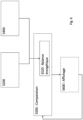
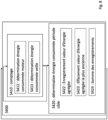
- Step S140 consists in aggregating the values determined during step S130 over elementary periods, an elementary period being the sum of the elementary time intervals, and in calculating a sum of these determined values which is an energy value, called the aggregated energy value.
- the elementary period is in particular equal to 24 hours.
- step S150 the aggregated energy value determined at the end of the elementary period is recorded in a first memory.
- the first memory therefore contains a history of the aggregated energy values determined at the end of the different elementary periods, the first memory therefore contains historical data, i.e. a history of values.
- the first memory contains the aggregated values which are the most recent available.
- the energy threshold value associated with the target period is a theoretical value corresponding to a theoretical consumption of the motorized drive device 5 during the target period.
- Steps S100, S200 can be implemented in a loop on each corresponding interval or period.
- the method then loops on a new step S500, which is implemented with the updated values from steps S100, S200 and S300.
- the process concludes that the photovoltaic panel is damaged and issues information indicating this state of the photovoltaic panel. The user or installer can then replace the photovoltaic panel.
- the energy threshold value associated with the target period is an effective value corresponding to the effective consumption of the motorized drive device 5 during the target period.
- These values can be determined in the electrical energy supply device 26, in particular by processing in a logic processing unit of the electrical energy supply device 26.
- the method may include a communication action to indicate that energy production is insufficient and/or display recommendations such as cleaning the photovoltaic panel and/or moving the photovoltaic panel.
- the method may include a communication action to indicate that energy production is sufficient.
- Steps S100, S200, S400 can be implemented in a loop on each corresponding interval or period.
- the method then loops to a new step S500, which is implemented with the updated values from steps S100, S200 and S400.
- the communication may comprise, alternatively or in addition to the qualitative information, quantitative information such as the value of electrical energy produced by the photovoltaic panel 25 during the target period and/or a recommendation for action to improve the balance indicator and/or a recommendation for action to increase the electrical energy produced by the photovoltaic panel 25 during the target period.
- step S600 is implemented at the request of the user or installer. Without a request from the user or installer, the method can loop to a new step S500, step S600 then being optional.
- Data stored over a short period of time corresponds to a short history
- data stored over an intermediate period of time corresponds to an intermediate history
- data stored over a long period of time corresponds to a long history.
- the joint uses of a long history and an intermediate history or a short history and an intermediate history or a short history and a long history or all three short, intermediate and long histories are implemented.
- the 80-day production indicator is bad, there is potentially a problem with the panel (positioning, cleanliness) or too intensive use, overall. There is a high probability that the problem will persist even during a period when the weather would be more favorable.
- an energy balance indicator produced by comparing the energy produced and the energy consumed can be calculated and used as seen previously. In the same way as seen previously for the energy production values, the calculation and use can be done over two target periods (e.g. 25 days and 80 days as seen previously).
Landscapes
- Engineering & Computer Science (AREA)
- Power Engineering (AREA)
- Structural Engineering (AREA)
- Architecture (AREA)
- Civil Engineering (AREA)
- Operating, Guiding And Securing Of Roll- Type Closing Members (AREA)
- Photovoltaic Devices (AREA)
Applications Claiming Priority (1)
| Application Number | Priority Date | Filing Date | Title |
|---|---|---|---|
| FR2307490A FR3151054B1 (fr) | 2023-07-12 | 2023-07-12 | Procédé de diagnostic d’un dispositif d’entraînement motorisé pour un dispositif d’occultation d’une installation de fermeture, d’occultation ou de protection solaire. |
Publications (1)
| Publication Number | Publication Date |
|---|---|
| EP4492622A1 true EP4492622A1 (de) | 2025-01-15 |
Family
ID=88290601
Family Applications (1)
| Application Number | Title | Priority Date | Filing Date |
|---|---|---|---|
| EP24188150.7A Pending EP4492622A1 (de) | 2023-07-12 | 2024-07-11 | Verfahren zur diagnose einer motorischen antriebseinrichtung für eine verdunkelungsvorrichtung einer schliess-, verdunkelungs- oder sonnenschutzanlage |
Country Status (2)
| Country | Link |
|---|---|
| EP (1) | EP4492622A1 (de) |
| FR (1) | FR3151054B1 (de) |
Citations (4)
| Publication number | Priority date | Publication date | Assignee | Title |
|---|---|---|---|---|
| US20070267150A1 (en) * | 2005-04-26 | 2007-11-22 | Franz Schaumberger | Multiple-Pane Window with an Electrical Built-in Element |
| FR2959884A1 (fr) * | 2010-05-06 | 2011-11-11 | Bubendorff | Procede de controle de l'alimentation en energie electrique d'une batterie d'un dispositif d'occultation par un panneau photovoltaique et dispositif d'occultation comportant un systeme pour un tel controle |
| US20220070019A1 (en) * | 2020-09-01 | 2022-03-03 | Mechoshade Systems, Llc | Window shade system power management |
| FR3124213A1 (fr) * | 2021-06-16 | 2022-12-23 | Somfy Activites Sa | Dispositif d’occultation |
-
2023
- 2023-07-12 FR FR2307490A patent/FR3151054B1/fr active Active
-
2024
- 2024-07-11 EP EP24188150.7A patent/EP4492622A1/de active Pending
Patent Citations (4)
| Publication number | Priority date | Publication date | Assignee | Title |
|---|---|---|---|---|
| US20070267150A1 (en) * | 2005-04-26 | 2007-11-22 | Franz Schaumberger | Multiple-Pane Window with an Electrical Built-in Element |
| FR2959884A1 (fr) * | 2010-05-06 | 2011-11-11 | Bubendorff | Procede de controle de l'alimentation en energie electrique d'une batterie d'un dispositif d'occultation par un panneau photovoltaique et dispositif d'occultation comportant un systeme pour un tel controle |
| US20220070019A1 (en) * | 2020-09-01 | 2022-03-03 | Mechoshade Systems, Llc | Window shade system power management |
| FR3124213A1 (fr) * | 2021-06-16 | 2022-12-23 | Somfy Activites Sa | Dispositif d’occultation |
Also Published As
| Publication number | Publication date |
|---|---|
| FR3151054B1 (fr) | 2025-11-07 |
| FR3151054A1 (fr) | 2025-01-17 |
Similar Documents
| Publication | Publication Date | Title |
|---|---|---|
| EP3904630B1 (de) | Verfahren zur betriebssteuerung einer verdunkelungs- oder sonnenschutzanlage und entsprechende anlage | |
| EP4232680B1 (de) | Verfahren zur steuerung des betriebs einer beschattungsvorrichtung und zugehörige beschattungsvorrichtung | |
| EP3942690B1 (de) | Verfahren zur bestimmung einer solarmaske für eine anlage und verfahren zur überprüfung der kompatibilität einer motorisierten antriebsvorrichtung | |
| WO2025103699A1 (fr) | Procédé de commande d'un dispositif d'occultation et dispositif d'occultation associé | |
| EP3504393A1 (de) | Motorisierte antriebsvorrichtung für eine schliess- oder sonnenschutzeinheit und entsprechende einheit | |
| FR3088362A1 (fr) | Procede de commande en fonctionnement d'une installation domotique de fermeture, d'occultation ou de protection solaire et installation domotique associee | |
| EP4263997A1 (de) | Verfahren zum betreiben eines autonomen elektrischen gerätes | |
| EP4202175A1 (de) | Verfahren zur betriebssteuerung einer motorischen antriebsvorrichtung, motorisierte antriebsvorrichtung und verdunkelungsvorrichtung dafür | |
| EP4272036B1 (de) | Verfahren zur steuerung des betriebs einer motorisierten antriebsvorrichtung und motorisierte antriebsvorrichtung zur durchführung solch eines verfahrens | |
| EP4492622A1 (de) | Verfahren zur diagnose einer motorischen antriebseinrichtung für eine verdunkelungsvorrichtung einer schliess-, verdunkelungs- oder sonnenschutzanlage | |
| WO2023208949A1 (fr) | Procédé de vérification de compatibilité d'un dispositif d'entraînement motorisé d'un dispositif d'occultation pour une installation de fermeture, d'occultation ou de protection solaire | |
| FR3142214A1 (fr) | Procédé de fonctionnement d’une installation d’occultation ou de protection solaire et installation associée | |
| WO2022148734A1 (fr) | Dispositif d'entraînement motorisé pour un dispositif d'occultation, dispositif d'occultation et procédé de commande en fonctionnement associés | |
| EP4442955B1 (de) | Verfahren zur kompatibilitätsprüfung einer motorischen antriebsvorrichtung einer verdunkelungsvorrichtung für eine schliess-, verdunkelungs- oder sonnenschutzanlage | |
| FR3128731A1 (fr) | Dispositif d’entraînement motorisé, dispositif d’occultation et procédé de commande associés | |
| FR3142215A1 (fr) | Procédé de fonctionnement d’une installation d’occultation ou de protection solaire et installation associée | |
| EP4600457A1 (de) | Verfahren zum konfigurieren einer motorischen antriebseinrichtung für eine verdunkelungsvorrichtung einer schliess-, verdunkelungs- oder sonnenschutzanlage | |
| FR3088952A1 (fr) | Procédé de commande en fonctionnement d’une installation domotique de fermeture, d’occultation ou de protection solaire et installation domotique associée | |
| FR3159408A1 (fr) | Procédé de détermination d’un état de fonctionnement d’un dispositif d’entraînement motorisé d’un dispositif d’occultation pour une installation d’occultation | |
| EP4530432A1 (de) | Verfahren zur betriebssteuerung einer motorischen antriebsvorrichtung, motorisierte antriebsvorrichtung und verdunkelungsvorrichtung dafür | |
| EP4175119B1 (de) | Motorisierte antriebsvorrichtung, verdunkelungsvorrichtung und steuerungsverfahren dafür | |
| FR3159409A1 (fr) | Procédé de détermination d’un état de fonctionnement d’un dispositif d’entraînement motorisé d’un dispositif d’occultation pour une installation d’occultation | |
| WO2022148799A1 (fr) | Procédé de détermination d'un azimut d'une fenêtre et procédé de commande en fonctionnement d'un dispositif d'entraînement motorisé | |
| FR3129969A1 (fr) | Procédé de détermination d’un paramètre d’une installation de fermeture, d’occultation ou de protection solaire | |
| EP4575173A1 (de) | Algorithmus zur erkennung einer überhitzung aus einer aussentemperaturmessung |
Legal Events
| Date | Code | Title | Description |
|---|---|---|---|
| PUAI | Public reference made under article 153(3) epc to a published international application that has entered the european phase |
Free format text: ORIGINAL CODE: 0009012 |
|
| STAA | Information on the status of an ep patent application or granted ep patent |
Free format text: STATUS: THE APPLICATION HAS BEEN PUBLISHED |
|
| AK | Designated contracting states |
Kind code of ref document: A1 Designated state(s): AL AT BE BG CH CY CZ DE DK EE ES FI FR GB GR HR HU IE IS IT LI LT LU LV MC ME MK MT NL NO PL PT RO RS SE SI SK SM TR |
|
| STAA | Information on the status of an ep patent application or granted ep patent |
Free format text: STATUS: REQUEST FOR EXAMINATION WAS MADE |
|
| 17P | Request for examination filed |
Effective date: 20250715 |