EP4492784A2 - Système pour interrompre sélectivement une prédiction dans un decodage vidéo - Google Patents
Système pour interrompre sélectivement une prédiction dans un decodage vidéo Download PDFInfo
- Publication number
- EP4492784A2 EP4492784A2 EP24216018.2A EP24216018A EP4492784A2 EP 4492784 A2 EP4492784 A2 EP 4492784A2 EP 24216018 A EP24216018 A EP 24216018A EP 4492784 A2 EP4492784 A2 EP 4492784A2
- Authority
- EP
- European Patent Office
- Prior art keywords
- indication
- slice
- tile
- prediction
- video picture
- Prior art date
- Legal status (The legal status is an assumption and is not a legal conclusion. Google has not performed a legal analysis and makes no representation as to the accuracy of the status listed.)
- Pending
Links
Images




Classifications
-
- H—ELECTRICITY
- H04—ELECTRIC COMMUNICATION TECHNIQUE
- H04N—PICTORIAL COMMUNICATION, e.g. TELEVISION
- H04N19/00—Methods or arrangements for coding, decoding, compressing or decompressing digital video signals
- H04N19/10—Methods or arrangements for coding, decoding, compressing or decompressing digital video signals using adaptive coding
- H04N19/134—Methods or arrangements for coding, decoding, compressing or decompressing digital video signals using adaptive coding characterised by the element, parameter or criterion affecting or controlling the adaptive coding
- H04N19/136—Incoming video signal characteristics or properties
- H04N19/137—Motion inside a coding unit, e.g. average field, frame or block difference
- H04N19/139—Analysis of motion vectors, e.g. their magnitude, direction, variance or reliability
-
- C—CHEMISTRY; METALLURGY
- C12—BIOCHEMISTRY; BEER; SPIRITS; WINE; VINEGAR; MICROBIOLOGY; ENZYMOLOGY; MUTATION OR GENETIC ENGINEERING
- C12N—MICROORGANISMS OR ENZYMES; COMPOSITIONS THEREOF; PROPAGATING, PRESERVING, OR MAINTAINING MICROORGANISMS; MUTATION OR GENETIC ENGINEERING; CULTURE MEDIA
- C12N9/00—Enzymes; Proenzymes; Compositions thereof; Processes for preparing, activating, inhibiting, separating or purifying enzymes
- C12N9/0004—Oxidoreductases (1.)
- C12N9/0071—Oxidoreductases (1.) acting on paired donors with incorporation of molecular oxygen (1.14)
-
- C—CHEMISTRY; METALLURGY
- C12—BIOCHEMISTRY; BEER; SPIRITS; WINE; VINEGAR; MICROBIOLOGY; ENZYMOLOGY; MUTATION OR GENETIC ENGINEERING
- C12P—FERMENTATION OR ENZYME-USING PROCESSES TO SYNTHESISE A DESIRED CHEMICAL COMPOUND OR COMPOSITION OR TO SEPARATE OPTICAL ISOMERS FROM A RACEMIC MIXTURE
- C12P17/00—Preparation of heterocyclic carbon compounds with only O, N, S, Se or Te as ring hetero atoms
- C12P17/14—Nitrogen or oxygen as hetero atom and at least one other diverse hetero ring atom in the same ring
-
- C—CHEMISTRY; METALLURGY
- C12—BIOCHEMISTRY; BEER; SPIRITS; WINE; VINEGAR; MICROBIOLOGY; ENZYMOLOGY; MUTATION OR GENETIC ENGINEERING
- C12P—FERMENTATION OR ENZYME-USING PROCESSES TO SYNTHESISE A DESIRED CHEMICAL COMPOUND OR COMPOSITION OR TO SEPARATE OPTICAL ISOMERS FROM A RACEMIC MIXTURE
- C12P7/00—Preparation of oxygen-containing organic compounds
- C12P7/02—Preparation of oxygen-containing organic compounds containing a hydroxy group
- C12P7/04—Preparation of oxygen-containing organic compounds containing a hydroxy group acyclic
- C12P7/06—Ethanol, i.e. non-beverage
- C12P7/14—Multiple stages of fermentation; Multiple types of microorganisms or re-use of microorganisms
-
- C—CHEMISTRY; METALLURGY
- C12—BIOCHEMISTRY; BEER; SPIRITS; WINE; VINEGAR; MICROBIOLOGY; ENZYMOLOGY; MUTATION OR GENETIC ENGINEERING
- C12Y—ENZYMES
- C12Y114/00—Oxidoreductases acting on paired donors, with incorporation or reduction of molecular oxygen (1.14)
-
- H—ELECTRICITY
- H04—ELECTRIC COMMUNICATION TECHNIQUE
- H04N—PICTORIAL COMMUNICATION, e.g. TELEVISION
- H04N19/00—Methods or arrangements for coding, decoding, compressing or decompressing digital video signals
- H04N19/10—Methods or arrangements for coding, decoding, compressing or decompressing digital video signals using adaptive coding
- H04N19/102—Methods or arrangements for coding, decoding, compressing or decompressing digital video signals using adaptive coding characterised by the element, parameter or selection affected or controlled by the adaptive coding
- H04N19/103—Selection of coding mode or of prediction mode
-
- H—ELECTRICITY
- H04—ELECTRIC COMMUNICATION TECHNIQUE
- H04N—PICTORIAL COMMUNICATION, e.g. TELEVISION
- H04N19/00—Methods or arrangements for coding, decoding, compressing or decompressing digital video signals
- H04N19/10—Methods or arrangements for coding, decoding, compressing or decompressing digital video signals using adaptive coding
- H04N19/102—Methods or arrangements for coding, decoding, compressing or decompressing digital video signals using adaptive coding characterised by the element, parameter or selection affected or controlled by the adaptive coding
- H04N19/103—Selection of coding mode or of prediction mode
- H04N19/105—Selection of the reference unit for prediction within a chosen coding or prediction mode, e.g. adaptive choice of position and number of pixels used for prediction
-
- H—ELECTRICITY
- H04—ELECTRIC COMMUNICATION TECHNIQUE
- H04N—PICTORIAL COMMUNICATION, e.g. TELEVISION
- H04N19/00—Methods or arrangements for coding, decoding, compressing or decompressing digital video signals
- H04N19/10—Methods or arrangements for coding, decoding, compressing or decompressing digital video signals using adaptive coding
- H04N19/102—Methods or arrangements for coding, decoding, compressing or decompressing digital video signals using adaptive coding characterised by the element, parameter or selection affected or controlled by the adaptive coding
- H04N19/117—Filters, e.g. for pre-processing or post-processing
-
- H—ELECTRICITY
- H04—ELECTRIC COMMUNICATION TECHNIQUE
- H04N—PICTORIAL COMMUNICATION, e.g. TELEVISION
- H04N19/00—Methods or arrangements for coding, decoding, compressing or decompressing digital video signals
- H04N19/10—Methods or arrangements for coding, decoding, compressing or decompressing digital video signals using adaptive coding
- H04N19/134—Methods or arrangements for coding, decoding, compressing or decompressing digital video signals using adaptive coding characterised by the element, parameter or criterion affecting or controlling the adaptive coding
- H04N19/136—Incoming video signal characteristics or properties
- H04N19/137—Motion inside a coding unit, e.g. average field, frame or block difference
-
- H—ELECTRICITY
- H04—ELECTRIC COMMUNICATION TECHNIQUE
- H04N—PICTORIAL COMMUNICATION, e.g. TELEVISION
- H04N19/00—Methods or arrangements for coding, decoding, compressing or decompressing digital video signals
- H04N19/10—Methods or arrangements for coding, decoding, compressing or decompressing digital video signals using adaptive coding
- H04N19/134—Methods or arrangements for coding, decoding, compressing or decompressing digital video signals using adaptive coding characterised by the element, parameter or criterion affecting or controlling the adaptive coding
- H04N19/157—Assigned coding mode, i.e. the coding mode being predefined or preselected to be further used for selection of another element or parameter
- H04N19/159—Prediction type, e.g. intra-frame, inter-frame or bidirectional frame prediction
-
- H—ELECTRICITY
- H04—ELECTRIC COMMUNICATION TECHNIQUE
- H04N—PICTORIAL COMMUNICATION, e.g. TELEVISION
- H04N19/00—Methods or arrangements for coding, decoding, compressing or decompressing digital video signals
- H04N19/10—Methods or arrangements for coding, decoding, compressing or decompressing digital video signals using adaptive coding
- H04N19/169—Methods or arrangements for coding, decoding, compressing or decompressing digital video signals using adaptive coding characterised by the coding unit, i.e. the structural portion or semantic portion of the video signal being the object or the subject of the adaptive coding
- H04N19/17—Methods or arrangements for coding, decoding, compressing or decompressing digital video signals using adaptive coding characterised by the coding unit, i.e. the structural portion or semantic portion of the video signal being the object or the subject of the adaptive coding the unit being an image region, e.g. an object
- H04N19/172—Methods or arrangements for coding, decoding, compressing or decompressing digital video signals using adaptive coding characterised by the coding unit, i.e. the structural portion or semantic portion of the video signal being the object or the subject of the adaptive coding the unit being an image region, e.g. an object the region being a picture, frame or field
-
- H—ELECTRICITY
- H04—ELECTRIC COMMUNICATION TECHNIQUE
- H04N—PICTORIAL COMMUNICATION, e.g. TELEVISION
- H04N19/00—Methods or arrangements for coding, decoding, compressing or decompressing digital video signals
- H04N19/10—Methods or arrangements for coding, decoding, compressing or decompressing digital video signals using adaptive coding
- H04N19/169—Methods or arrangements for coding, decoding, compressing or decompressing digital video signals using adaptive coding characterised by the coding unit, i.e. the structural portion or semantic portion of the video signal being the object or the subject of the adaptive coding
- H04N19/17—Methods or arrangements for coding, decoding, compressing or decompressing digital video signals using adaptive coding characterised by the coding unit, i.e. the structural portion or semantic portion of the video signal being the object or the subject of the adaptive coding the unit being an image region, e.g. an object
- H04N19/174—Methods or arrangements for coding, decoding, compressing or decompressing digital video signals using adaptive coding characterised by the coding unit, i.e. the structural portion or semantic portion of the video signal being the object or the subject of the adaptive coding the unit being an image region, e.g. an object the region being a slice, e.g. a line of blocks or a group of blocks
-
- H—ELECTRICITY
- H04—ELECTRIC COMMUNICATION TECHNIQUE
- H04N—PICTORIAL COMMUNICATION, e.g. TELEVISION
- H04N19/00—Methods or arrangements for coding, decoding, compressing or decompressing digital video signals
- H04N19/10—Methods or arrangements for coding, decoding, compressing or decompressing digital video signals using adaptive coding
- H04N19/189—Methods or arrangements for coding, decoding, compressing or decompressing digital video signals using adaptive coding characterised by the adaptation method, adaptation tool or adaptation type used for the adaptive coding
- H04N19/196—Methods or arrangements for coding, decoding, compressing or decompressing digital video signals using adaptive coding characterised by the adaptation method, adaptation tool or adaptation type used for the adaptive coding being specially adapted for the computation of encoding parameters, e.g. by averaging previously computed encoding parameters
-
- H—ELECTRICITY
- H04—ELECTRIC COMMUNICATION TECHNIQUE
- H04N—PICTORIAL COMMUNICATION, e.g. TELEVISION
- H04N19/00—Methods or arrangements for coding, decoding, compressing or decompressing digital video signals
- H04N19/42—Methods or arrangements for coding, decoding, compressing or decompressing digital video signals characterised by implementation details or hardware specially adapted for video compression or decompression, e.g. dedicated software implementation
- H04N19/436—Methods or arrangements for coding, decoding, compressing or decompressing digital video signals characterised by implementation details or hardware specially adapted for video compression or decompression, e.g. dedicated software implementation using parallelised computational arrangements
-
- H—ELECTRICITY
- H04—ELECTRIC COMMUNICATION TECHNIQUE
- H04N—PICTORIAL COMMUNICATION, e.g. TELEVISION
- H04N19/00—Methods or arrangements for coding, decoding, compressing or decompressing digital video signals
- H04N19/44—Decoders specially adapted therefor, e.g. video decoders which are asymmetric with respect to the encoder
-
- H—ELECTRICITY
- H04—ELECTRIC COMMUNICATION TECHNIQUE
- H04N—PICTORIAL COMMUNICATION, e.g. TELEVISION
- H04N19/00—Methods or arrangements for coding, decoding, compressing or decompressing digital video signals
- H04N19/46—Embedding additional information in the video signal during the compression process
-
- H—ELECTRICITY
- H04—ELECTRIC COMMUNICATION TECHNIQUE
- H04N—PICTORIAL COMMUNICATION, e.g. TELEVISION
- H04N19/00—Methods or arrangements for coding, decoding, compressing or decompressing digital video signals
- H04N19/50—Methods or arrangements for coding, decoding, compressing or decompressing digital video signals using predictive coding
-
- H—ELECTRICITY
- H04—ELECTRIC COMMUNICATION TECHNIQUE
- H04N—PICTORIAL COMMUNICATION, e.g. TELEVISION
- H04N19/00—Methods or arrangements for coding, decoding, compressing or decompressing digital video signals
- H04N19/60—Methods or arrangements for coding, decoding, compressing or decompressing digital video signals using transform coding
- H04N19/61—Methods or arrangements for coding, decoding, compressing or decompressing digital video signals using transform coding in combination with predictive coding
-
- H—ELECTRICITY
- H04—ELECTRIC COMMUNICATION TECHNIQUE
- H04N—PICTORIAL COMMUNICATION, e.g. TELEVISION
- H04N19/00—Methods or arrangements for coding, decoding, compressing or decompressing digital video signals
- H04N19/70—Methods or arrangements for coding, decoding, compressing or decompressing digital video signals characterised by syntax aspects related to video coding, e.g. related to compression standards
-
- H—ELECTRICITY
- H04—ELECTRIC COMMUNICATION TECHNIQUE
- H04N—PICTORIAL COMMUNICATION, e.g. TELEVISION
- H04N19/00—Methods or arrangements for coding, decoding, compressing or decompressing digital video signals
- H04N19/80—Details of filtering operations specially adapted for video compression, e.g. for pixel interpolation
-
- H—ELECTRICITY
- H04—ELECTRIC COMMUNICATION TECHNIQUE
- H04N—PICTORIAL COMMUNICATION, e.g. TELEVISION
- H04N19/00—Methods or arrangements for coding, decoding, compressing or decompressing digital video signals
- H04N19/80—Details of filtering operations specially adapted for video compression, e.g. for pixel interpolation
- H04N19/82—Details of filtering operations specially adapted for video compression, e.g. for pixel interpolation involving filtering within a prediction loop
-
- H—ELECTRICITY
- H04—ELECTRIC COMMUNICATION TECHNIQUE
- H04N—PICTORIAL COMMUNICATION, e.g. TELEVISION
- H04N19/00—Methods or arrangements for coding, decoding, compressing or decompressing digital video signals
- H04N19/90—Methods or arrangements for coding, decoding, compressing or decompressing digital video signals using coding techniques not provided for in groups H04N19/10-H04N19/85, e.g. fractals
- H04N19/91—Entropy coding, e.g. variable length coding [VLC] or arithmetic coding
Definitions
- Embodiments of the invention relate to video compression, and more specifically, to the selective use of prediction and in-loop filtering mechanisms at picture segment boundaries of video pictures.
- Digital video capabilities can be incorporated into a wide range of devices, including digital televisions, digital direct broadcast systems, wireless broadcast systems, personal digital assistants (PDAs), laptop or desktop computers, video cameras, digital recording devices, video gaming devices, video game consoles, cellular or satellite radio telephones, and the like.
- Digital video devices may implement video compression techniques, such as those described in standards like MPEG-2, MPEG-4, both available from the International Organization for Standardization ("ISO") 1, ch.
- ISO International Organization for Standardization
- a video encoder can receive uncoded video information for processing in any suitable format, which may be a digital format conforming to ITU-R BT 601 (available from the International Telecommunications Union, Place des Nations, 1211 Geneva 20, Switzerland, www.itu.int, and which is incorporated herein by reference in its entirety) or in some other digital format.
- the uncoded video may be organized both spatially into pixel values arranged in one or more two-dimensional matrices as well as temporally into a series of uncoded pictures, with each uncoded picture comprising one or more of the above-mentioned two-dimensional matrices of pixel values. Further, each pixel may comprise a number of separate components used to represent color in digital format.
- One common format for uncoded video that is input to a video encoder has, for each group of four pixels, four luminance samples which contain information regarding the brightness/lightness or darkness of the pixels, and two chrominance samples which contain color information (e.g., YCrCb 4:2:0).
- Video encoders One function of video encoders is to translate (more generally “transform") uncoded pictures into a bitstream, packet stream, NAL unit stream, or other suitable transmission format (all referred to as “bitstream” henceforth), with goals such as reducing the amount of redundancy encoded into the bitstream to thereby increase transmission rates, increasing the resilience of the bitstream to suppress bit errors or packet erasures that may occur during transmission (collectively known as “error resilience”), or other application-specific goals.
- Embodiments of the present invention provide for at least one of the removal or reduction of redundancy, the increase in error resilience, and implementability of video encoders and/or associated decoders in parallel processing architectures.
- Video decoders One function of video decoders is to receive as its input a coded video in the form of a bitstream that may have been produced by a video encoder conforming to the same video compression standard. The video encoder then translates (more generally "transforms") the received coded bitstream into uncoded video information that may be displayed, stored, or otherwise handled.
- Both video encoders and video decoders may be implemented using hardware and/or software configurations, including combinations of both hardware and software. Implementations of either or both may include the use of programmable hardware components such as general purpose central processing units (CPUs), such as found in personal computers (PCs), embedded processors, graphic card processors, digital signal processors (DSPs), field programmable gate arrays (FPGAs), or others.
- CPUs general purpose central processing units
- CPUs central processing units
- PCs personal computers
- embedded processors such as found in personal computers (PCs), embedded processors, graphic card processors, digital signal processors (DSPs), field programmable gate arrays (FPGAs), or others.
- CPUs central processing units
- DSPs digital signal processors
- FPGAs field programmable gate arrays
- Computer readable media choices include compact disc read-only memory (CD-ROM), digital videodisc read-only memory (DVD-ROM), memory stick, embedded ROM, or others.
- Video compression and decompression refer to certain operations performed in a video encoder and/or decoder.
- a video decoder may perform all, or a subset of, the inverse operations of the encoding operations.
- techniques of video encoding described herein are intended also to encompass the inverse of the described video encoding techniques (namely associated video decoding techniques).
- the uncompressed, digital representation of video can be viewed as a sample stream, wherein the samples can be processed by the video display in scan order.
- One type of boundary often occurring in this sample stream is the boundary between pictures in the sample stream.
- Many video compression standards recognize this boundary and often divide the coded bitstream at these boundaries, for example, through the insertion of a picture header or other metadata at the beginning of each uncoded picture.
- Other boundaries that may occur in the sample stream include slice and tile boundaries, which may occur within an uncoded picture, as described below.
- Prediction in video coding can occur at many levels.
- entropy coding level One level is referred to henceforth as the “entropy coding level” and the prediction at that level is referred to as “encoding prediction”.
- encoding prediction the decoding of an entropy coded symbol may require the successful decoding of previous entropy coded symbols.
- All or nearly all current video compression standards break the encoding prediction at both the picture and the slice level. That is, at the detection of a picture or slice header in the bitstream (or equivalent), the entropy coding related states used in the entropy coding are reset to an initialization state.
- One example for entropy coded prediction is the reset of CABAC states in ITU-T Rec. H.264.
- motion compensation can use (possibly motion compensated) pixel values from one or more reference pictures for prediction.
- This type of prediction is broken through the macroblock type (or equivalent).
- intra macroblocks do not generally use prediction from reference pictures, whereas inter macroblocks may.
- Intra and Inter slices are simply accumulations of macroblocks belonging to those different macroblock types.
- prediction levels that include prediction based on pixel values that have already been reconstructed during the reconstruction process of the picture being encoded.
- intra prediction mechanisms such as the ones described in Annex I of ITU-T Rec. H.263. (Similar mechanisms are available in other video coding standards as well.)
- the first such use case involves parallel processing.
- standard definition video e.g., 720 ⁇ 480 or 720x576 pixels
- More recently HD (up to 1920x1080 pixels) formats as well as 4k (4096 ⁇ 2048 pixels), 8k (8192x4096 pixels), and still larger formats are emerging and finding use in a variety of application spaces.
- HD up to 1920x1080 pixels
- 4k 4096 ⁇ 2048 pixels
- 8k 8192x4096 pixels
- Parallel encoding and decoding may occur, for example, at the instruction level (e.g., using SIMD), in a pipeline where several video coding units may be processed at different stages simultaneously, or on a large structure basis where collections of video coding sub units are processed by separate computing engines as separate entities (e.g., a multi-core general purpose processor).
- the last form of parallel processing can require picture segmentation.
- the second such use case involves picture segmentation so as to create a bitstream suitable for efficient transport over packet networks.
- Codecs whose coded video is transported over IP and other packet networks can be subject to a maximum transmission unit ("MTU") size constraint. It is sometimes advantageous for the coded slice size to be such that the resulting packet containing the coded slice is as close to the MTU size as possible without exceeding that size, so as to keep the payload/packetization overhead ratio high, while avoiding fragmentation (and the resulting higher loss probability) by the network.
- MTU maximum transmission unit
- the MTU size differs widely from network to network.
- the MTU size of many Internet connections may be set by the smallest MTU size of network infrastructure commonly used on the Internet, which often corresponds to limitations in Ethernet and may be roughly 1500 bytes.
- the number of bits in a coded picture depends on many factors such as the source picture's dimensions, the desired quality, the complexity of the content in terms of suitability for prediction, and other factors.
- the size of an average coded picture easily exceeds the MTU size.
- a video conferencing encoder can require about 2 MBit/s to encode a 720p60 video sequence. This results in an average coded picture size of roughly 33333 bits or 4167 bytes, which is considerably more than the 1500 bytes of the Internet's MTU size.
- the average picture size increases to values significantly above the Internet's MTU size.
- a 4096 ⁇ 2048 (4k) video at 60 fps (4kp60) may require over 300,000 bits, or 25 MTU-sized packets for each coded video picture.
- a picture segment (or, at least, one form of a picture segment) is known as a "slice".
- any kind of (e.g., video coding based) picture fragmentation that breaks at least one form of in-picture prediction, in-loop filtering, or other coding mechanism may be referred to generally as a "slice”.
- structures such as the Group Of Blocks ("GOB") in ITU.T Rec. H.261 or ITU Rec. H.263 (available from the ITU; see above for H.264), slices in H.264 or the MPEG family of standards, may each constitute a "slice" as this term is used herein throughout.
- GOB Group Of Blocks
- fragmentation units of RFC3984 or data partitions of H.264 may not constitute a "slice", as this term is used herein throughout, because they subdivide the bitstream of a coded picture and do not break in-picture prediction, in-loop filtering or another coding mechanism.
- FIG. 1 shown is an example 100 of picture segmentation using slices.
- a picture 101 is broken into two scan order slices 102, 103.
- the slice boundary is shown as a boldface line 104.
- the first macroblock 105 of the second slice 103 has address 11.
- the corresponding bitstream 106 for transmitting the picture 101 can contain one or more parameter sets 107 that do not contain information about the slice boundaries, followed by the slice headers 108, 110 and slice data 109,111 of the two slices 102, 103.
- the slice header 110 of the second slice 103 is shown enlarged.
- the dimensions of the uncoded slice 103 for example, are determined by a decoder by a combination of at least two factors.
- the slice header 110 contains the address of the first macroblock 105 of slice 103.
- the end of the slice is determined, for example, by the detection of a new slice header in the bitstream or, in the depicted example, by the end of the coded picture in the bitstream 112, i.e., after macroblock 24. All macroblocks between the first macroblock and the end of the slice make up the slice. It is noted that scan order modifications, such as Flexible Macroblock Ordering of H.264, can change the number of macroblocks in the slice by creating gaps.
- slices are at least to a certain extent independently decodeable (as discussed below in more detail), by breaking certain types of prediction at the boundaries between slices.
- the loss of one slice therefore does not necessarily render the other slices of a coded picture unusable or un-decodeable.
- the loss of a fragment in contrast, may well render many other fragments unusable because fragmentation, as this term is used herein throughout, does not break any form(s) of prediction.
- WD4 (B. Bross et. al., "WD4: Working Draft 4 of High-Efficiency Video Coding", available from http://wftp3.itu.int/av-arch/jctvc-site/2011_07_F_Torino/ ) is a draft specification relating to a digital video coding standard in development, which may be referred to as High Efficiency Video Coding (HEVC) or H.265.
- HEVC High Efficiency Video Coding
- WD4 also includes a picture segmentation mechanism known as "Tiles”.
- a source picture can be divided into rectangular units called tiles, such that each pixel of the source picture is part of a tile (other constraints may also apply).
- a tile is, therefore, a rectangular part of a picture.
- Tile boundaries are determined by coordinates available in high-level syntax structures, which are known in WD4 as parameter sets. Tiles are described in more detail below.
- each of the in-picture prediction mechanisms or coding mechanisms described above may be broken by the decoding of a picture header (or equivalent, such as the decoding of a slice with a frame number different from the previous slice). Whether those prediction mechanisms are broken across slice or tile boundaries depends on the video compression standard, and the type of slice in use.
- slices may be independently decodeable with respect to motion vector prediction, intra prediction, CA-VLC and CABAC states, and other aspects of the H.264 standard. Only inter picture prediction (including import of pixel data outside of the slice boundaries through motion compensation) is allowed. While this decoding independence increases error resilience, disallowing the aforementioned prediction across slice boundaries reduces coding efficiency.
- a video encoder has more flexibility in selecting which prediction mechanisms are broken through the use of slices or GOBs with non-empty GOB headers. For example, there is a bit included in the picture header, selectable when Annex R is in use, which signals to the decoder that no prediction or filtering at all occurs across slice/GOB (with non-empty headers) boundaries. Certain prediction mechanisms, such as motion vector prediction are broken across GOBs with non-empty headers and across slice boundaries, regardless of the state of Annex R. Others are controlled by Annex R.
- motion vectors may point outside the spatial area co-located with the current slice/GOB with non-empty header in the reference picture(s), thereby potentially "importing" sample values that are used for motion compensation into the current slice from an area that is not inside of the geometric area of the slice/GOB in the reference picture.
- loop filtering may incorporate sample values outside of the slice/GOB.
- picture segmentation allows breaking a picture into spatial areas smaller than a whole picture. While the most common applications for picture segmentation, as described, appear to be MTU size matching and parallelization, picture segmentation can also be used for many other purposes, including those that adapt the segment size and shape to the content.
- Region of interest coding is one of several examples. In such cases, it is possible that certain parts of a picture can be more efficiently coded than others (in the sense that spending a lower number of bits for encoding yield comparable visual experience) when different coding tools, including different prediction mechanisms, are applied. For example, some content may benefit from deblocking filtering and may not respond well to intra prediction, whereas other content in the same picture may better be coded without deblocking filtering, but could benefit from intra prediction. A third content may best be coded with both deblocking filtering and intra prediction enabled. All this content can be located in the same picture when the picture is tiled, which occurs, for example, in interview situations, or in video conferencing.
- One shortcoming of the existing mechanisms for prediction breaking at segment boundaries is that the enablement and/or disablement of the prediction breaking is generally hard-coded into the existing video coding standards, thereby making it difficult or impossible to selectively break prediction mechanisms at segment boundaries based, for example, on the characteristics of the content to be encoded.
- Embodiments of the present invention provide method(s) and system(s) for encoding and/or decoding video pictures in which a plurality of prediction and in-loop filtering tools for a picture segment may be selectively enabled or disabled.
- an encoder may indicate for one or more prediction tools whether that tool may take information from outside the picture segment currently being processed as reference information for processing within that picture segment.
- the encoder may provide such indication for a single prediction tool (for example, entropy prediction, intra prediction, motion compensated prediction, motion vector prediction, henceforth referred to as prediction tools) and/or a single filtering tool (for example, adaptive interpolation filtering, adaptive loop filtering, deblocking, filtering, sample adaptive offset, henceforth referred to as loop filter tools), as well as others.
- the encoder may provide such indication for a plurality of pre-defined tools or a predefined groups of tools that may include any of the above-noted prediction and loop filter tools, as well as others. Doing so may be useful in support of parallelization of encoders and decoders as well as for certain application scenarios such as soft continuous presence (stitching together coded pictures in the compressed domain).
- the encoder may indicate to the prediction tool, loop filter tool, or plurality of pre-defined groups of tools, whether that tool may take information across horizontal, vertical, or both horizontal and vertical tile boundaries to be used as reference information.
- the encoder may set values for "coding interrupt indication" flags used for prediction and in-loop filtering tools such as: intra prediction referencing sample values outside the slice/tile boundary; vectors referencing sample values outside the slice/tile boundary (i.e., through motion compensation); use of CABAC states outside the slice/tile boundary; use of CA-VLC states outside the slice/tile boundary; use of PIPE or similar V2V entropy coding states outside the slice/tile boundary (HEVC-only); and, use of states and sample values outside the slice/tile boundary of in-loop filters such as adaptive interpolation filters, adaptive loop filters, deblocking loop filters, or sample adaptive offset.
- in-loop filters such as adaptive interpolation filters, adaptive loop filters, deblocking loop filters, or sample adaptive offset.
- the use or other enablement of coding tools may not be indicated in the form of flags, but through manipulation of other data structures, such as "coding interrupt indication” integers that may, in some cases, combine a plurality of the aforementioned flags, or preferred permutations of those flags, into a single symbol.
- the maximum length of a motion vector pointing outside of a slice boundary may be coded in an appropriate entropy coding representation of an integer, thereby indicating not only the non-use of motion compensation up to the distance allowed by the level in use, but also the maximum that is allowed, which can, for example, aid resource allocation in a decoder implementation.
- At least one of the aforementioned coding interrupt indication flags or other data coding interrupt indication structures may be stored in the slice header, picture header, parameter set, or equivalent.
- a decoder may react to the presence of the flags or other data structures by breaking the indicated prediction tools across slice/tile boundaries as opposed to other potentially suitable boundaries.
- a method for decoding a coded video picture comprising a plurality of segments.
- the method may include, in respect of at least one segment of the coded video picture not having an associated segment header, obtaining from the coded video picture at least one indication of at least one prediction or in-loop filtering operation to be applied to the coded video picture, and controlling the at least one prediction or in-loop filtering operation in response to the at least one indication.
- the coded video picture may contain at least two segments without an associated segment header.
- a method for encoding a video picture comprising a plurality of segments.
- the method may include, in respect of at least one segment of the video picture not having an associated segment header, obtaining at least one indication of at least one prediction or in-loop filtering operation to be applied to the at least one segment not having an associated segment header, and controlling the at least one prediction or in-loop filtering operation during encoding of the video picture in response to the at least one indication.
- the video picture may contain at least two segments without an associated segment header.
- a non-transitory computer readable media having computer executable instructions stored thereon for programming one or more processors to perform a method of decoding a coded video picture comprising a plurality of segments.
- the method may include, in respect of at least one segment of the coded video picture not having an associated segment header, obtaining from the coded video picture at least one indication of at least one prediction or in-loop filtering operation to be applied to the coded video picture, and controlling the at least one prediction or in-loop filtering operation in response to the at least one indication.
- the coded video picture may include at least two segments without an associated segment header.
- a non-transitory computer readable media having computer executable instructions stored thereon for programming one or more processors to perform a method of encoding a video picture comprising a plurality of segments.
- the method may include, in respect of at least one segment of the video picture not having an associated segment header, obtaining at least one indication of at least one prediction or in-loop filtering operation to be applied to the at least one segment not having an associated segment header, and controlling the at least one prediction or in-loop filtering operation during encoding of the video picture in response to the at least one indication.
- the video picture contains at least two segments without an associated segment header.
- a data processing system that includes at least one of a processor and accelerator hardware configured to execute a method of decoding a coded video picture comprising a plurality of segments.
- the method may include, in respect of at least one segment of the coded video picture not having an associated segment header, obtaining from the coded video picture at least one indication of at least one prediction or in-loop filtering operation to be applied to the coded video picture, and controlling the at least one prediction or in-loop filtering operation in response to the at least one indication.
- the coded video picture contains at least two segments without an associated segment header.
- a data processing system that includes at least one of a processor and accelerator hardware configured to execute a method of encoding video picture comprising a plurality of segments.
- the method may include, in respect of at least one segment of the video picture not having an associated segment header, obtaining at least one indication of at least one prediction or in-loop filtering operation to be applied to the at least one segment not having an associated segment header, and controlling the at least one prediction or in-loop filtering operation during encoding of the video picture in response to the at least one indication.
- the video picture contains at least two segments without an associated segment header.
- the at least one prediction or in-loop filtering operation may include at least one of entropy prediction, intra prediction, motion vector prediction, motion compensated prediction, adaptive loop filtering, adaptive interpolation filtering, deblocking filtering, or sample adaptive offset.
- the at least one of a plurality indications may be derived from at least one combination indications.
- the at least one indication may be coded as a vector indicative of the maximum length of a motion vector.
- the at least one indication may be coded in a parameter set.
- an apparatus such as a data processing system, a method for adapting this apparatus, as well as articles of manufacture such as a non-transitory computer readable medium or product having program instructions recorded and/or stored thereon for performing any of the methods described herein.
- data processing system is used herein to refer to any machine for processing data, including the computer systems, wireless devices, and network arrangements described herein.
- Embodiments of the present invention may be implemented in any computer programming language provided that the operating system of the data processing system provides the facilities that may support the requirements of these embodiments.
- Embodiments of the present invention may also be implemented in hardware or in a combination of hardware and software.
- At least some embodiments of the present invention relate to selectively breaking prediction mechanisms and/or selectively disabling in-loop filtering mechanisms in conjunction with picture segmentation in video compression.
- segment or “picture segment” are used hereinafter in reference to any one or more macroblocks or equivalent (for example, treeblocks in WD4) that are smaller than the whole picture, and at whose boundaries at least one form of prediction is broken and/or at least one form of in-loop filtering is disabled.
- H.264-like Slices as well as WD4-like tiles, as described below (with tile_boundary_independence_idc equal to 1) are non-limiting examples of segments.
- FIG. 2 shows an example 200, where a picture 201 is divided into two tiles 202, 203 by a vertical dividing tile boundary 204, depicted as a bold, solid line.
- Tiles can co-exist with slices within the picture 201.
- the picture 201 is divided into two slices by the slice boundary 205 at the same time as being divided into the tiles 202, 203 by the tile boundary 204.
- Tiles (with tile_boundary_independence_idc equal to 1), as described in WD4, may in one or more respects generalize another type of picture segment, referred to as columns, which is described further in co-pending United States patent application serial no. 13/336,675, filed December 23, 2011 , entitled “METHOD AND SYSTEM FOR PICTURE SEGMENTATION USING COLUMNS", the entire contents of which are incorporated herein by reference.
- the bitstream 206 corresponding to transmission of the picture 201 can contain, for example, parameter sets 207 or other high-layer syntax elements that include tile boundary information 208 for identifying the tile boundary 204.
- the parts of the bitstream other than the parameter sets 207 do not include any information about tiles boundaries.
- a decoder can identify the tile to which a coded macroblock (also known as Largest Coding Unit (LCU) or (in WD4) treeblock) belongs by associating its internal state information of the macroblock currently being processed and the information of the tiles dimensions known from the parameter sets 207.
- LCU Largest Coding Unit
- tile boundaries according to WD4 interrupt all in-picture prediction mechanisms, but allow for reference of samples in reference pictures that are not co-located with samples associated with the tile for which motion compensation is being performed.
- tile boundaries do not interrupt in-loop filtering, including the deblocking filter, sample adaptive offset filter, and adaptive loop filter.
- an encoder or decoder may also be convenient or desirable for an encoder or decoder to break a different set of prediction mechanisms using tiles.
- an encoder or decoder may also be convenient or desirable for an encoder or decoder to break a different set of prediction mechanisms using tiles.
- the encoder or decoder may be able to handle full resolution video encoding except for the entropy coding of symbols.
- Such an encoder or decoder might, for example, involve dedicated signal processing hardware for sample based processing, but may use a general purpose multicore CPU for entropy coding and/or decoding, where a single core would not be able to handle the load (in HEVC, especially CABAC entropy coding is known to be computationally demanding). Accordingly, in order to support this use case, entropy coding may need to be broken at tile boundaries, while other in picture or inter picture prediction mechanisms may be capable of crossing slice and/or tile boundaries.
- references to pixel values may not be possible, while reference to control information (such as the information necessary for motion vector prediction) may be available on the communication channel between the processors.
- Intra prediction may not be possible, but motion vector prediction could be used.
- WD4 includes other loop filters such as the adaptive loop filter (concerned with filtering all samples), a deblocking filter (concerned with filtering block boundaries) and a filtering mechanism known as sample-adaptive offset. These filters may all share properties similar to AIF.
- the adaptive loop filter as specified in WD4, it can be advantageous to (possibly independently) disable access to information used to derive the filter taps across tile boundaries, as well as disable filtering across tile boundaries itself.
- segments may be defined by picture (or higher) level syntax structures, such as, for example, parameter sets when using WD4 tiles, by segment header information (such as, for example, H.263 Annex K rectangular slices), by a combination of placement of a segment header in the bitstream and encoder/decoder state (such as, for example, H.264 slices when Flexible Macroblock Ordering (FMO) is not in use), or a combination of two or more of the aforementioned mechanisms (i.e., FMO defines slice groups, and the picture segment is defined within the slice group through a combination of slice header placements in the bitstream (identifying the first macroblock of the slice by its address) and implicit ascendance of macroblock addresses within the slice group until the end of the slice is detected through bitstream parsing or other means).
- segment header information such as, for example, H.263 Annex K rectangular slices
- FMO Flexible Macroblock Ordering
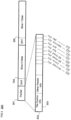
- a coded bitstream 301 comprising a parameter set 302 and two coded slices 304, 305.
- the coded slices 304, 305 may belong to one or two coded pictures.
- a picture boundary can be identified by a slice header with an LCU address of Q.
- the parameter set 302 may include tile control information 303 (such as tile boundaries), and the information in the parameter set 302 is, in this example, assumed to pertain to both coded slices (i.e. the parameter set reference in the slice header contains the same index).
- a parameter set pertains to tens, hundreds, or more slices.
- the parameter set 302 may contain a plurality of prediction tool indication flags (PTIs).
- PTIs prediction tool indication flags
- flags may be defined, for example, for entropy coding prediction 306, intra prediction 307, motion vector prediction 308, motion compensated prediction 309, adaptive loop filtering 310, adaptive interpolation filtering 311, deblocking filtering 312, sample adaptive offset 313, and possibly other prediction and in-loop filtering tools defined in the video coding mechanism.
- Including PTIs for individual prediction and in-loop filtering mechanisms, that pertain to all slices and pictures that reference the parameter set, may help to tailor the bitstream to the encoding and/or decoding environment, such as the hardware architecture of the encoder or decoder. Since the flags may be part of a parameter set, which may apply to many slices or pictures, the overhead of the PTIs in the parameter set may be negligible compared to the benefits they provide.
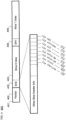
- a coded bitstream 401 comprising a parameter set 402, and a coded picture containing two slices 403, 404. Each slice starts with a slice header 405, 406. Slice header 405 is enlarged to show parts of its information.
- a PTI pertaining to the same prediction or in-loop filtering mechanism is present in both parameter set 502 and in a slice header 506, and in the situation where the corresponding tile and slice boundaries are aligned, at least two decoder reactions may be possible. Such choices may be made statically specified in the standard, through a profile/level selection, or dynamically based on control information in a parameter set or other high layer syntax elements.
- a future digital TV standard may conceivably require that a certain tile layout and certain PTI settings controlling prediction and in-loop filtering across tile boundaries be used for certain (high) resolutions, so to enable cost efficient multiprocessor/multicore implementations. It is possible that only a subset of all PTIs need to be fixed at sequence level.
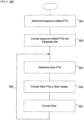
- the encoder may encode ( 602 ) the sequence-related PTIs into an appropriate high level syntax structure, such as a sequence or picture parameter set, sequence, GOP, or picture header.
- the encoder may also have the option (through the syntax structure of the video coding standard) to leave PTI(s) undefined during this encoding.
- the sequence-related PTIs may stay constant at least for one full video picture (unless overwritten by slice header based PTIs, as described later), but, in many cases, may stay constant for at least one "sequence" (for example, all pictures between two IDR pictures and the leading IDR picture in the video stream), and perhaps during an entire video encoding session.
- sequence-related PTIs may at least partly driven by hardware constraints, which are unlikely to change during a session. Henceforth assumed for convenience is this latter case.
- the encoder continues by encoding slices. In order to do so, the encoder can determine ( 603 ) slice-level PTIs, which may interact with sequence-related PTIs, as already described. The slice-level PTIs can be encoded ( 604 ) as part of the encoding of the slice header.
- the encoding continues ( 606 ) with the next slice.
- Described now is the operation of a decoder that, according to embodiments, may be suitable for use with any of the configurations of PTI information previously described.
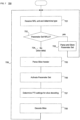
- FIG. 7 is a flowchart 700 of a decoder that may be used in an embodiment of the invention.
- the decoder may receive ( 701 ) a NAL unit from the bitstream and determine its type. If the NAL unit type is indicative of a parameter set ( 702 ), the decoder may perform parameter set parsing and storage ( 703 ) in accordance with the video coding standard employed. (Other high level syntax structures, such as sequence, GOP, or picture headers may also be used for this purpose.).
- the decoder may parse the slice header ( 705 ) and then respond in accordance with the information, such as PTI information, coded therein.
- the slice header may contain a parameter set reference, and this parameter set may be "activated" ( 706 ) as described in the video coding standard-that is, the values of the parameter set with the reference indicated become valid.
- PTIs may be part of the parameter set, through the activation ( 706 ), their values may become valid as well.
- the slice header may further include its own PTIs, as already described, which may be different from the PTIs included in the parameter set. Options for how to arbitrate between PTI information coded into the slice header and PTI information coded into the parameter set have already been described. For example, by correlating the slice header based PTIs (if present) with the parameter set header PTIs (if present), and taking into account any restrictions that may be present in other parts of the video coding standards (such as restrictions and/or default settings of PTIs by profiles and levels), the decoder may determine ( 707 ) the final PTI settings to be used in decoding the subject slice. It is noted that PTIs may be different for different borders of the slice, depending on the PTI settings of the parameter set and the PTI settings of the slice header, including the particular case of when a slice boundary is aligned with a tile boundary.
- the decoder may decode ( 708 ) the slice using prediction and/or in-loop filtering techniques across slice or tile boundaries as indicated by the information coded into the PTIs.
- the process continues ( 709 ) with the next NAL unit.
- NAL units other than slice or parameter set NAL units are not shown in FIG. 7 .
- FIG. 8 is a block diagram illustrating a data processing system (e.g., a personal computer ("PC")) 800 based implementation in accordance with an embodiment of the invention.
- a data processing system e.g., a personal computer ("PC")
- PC personal computer
- FIG. 8 is a block diagram illustrating a data processing system (e.g., a personal computer ("PC")) 800 based implementation in accordance with an embodiment of the invention.
- PC personal computer
- the encoder and/or the decoder for a PC or similar device 800 may be provided in the form of a computer-readable media 801 (e.g., CD-ROM, semiconductor-ROM, memory stick) containing instructions configured to enable a processor 802, alone or in combination with accelerator hardware (e.g., graphics processor) 803, in conjunction with memory 804 coupled to the processor 802 and/or the accelerator hardware 803 to perform the encoding or decoding.
- a computer-readable media 801 e.g., CD-ROM, semiconductor-ROM, memory stick
- accelerator hardware e.g., graphics processor
- the processor 802, memory 804, and accelerator hardware 803 may be coupled to a bus 805 that can be used to deliver the bitstream and the uncompressed video to/from the aforementioned devices.
- peripherals for the input/output of the bitstream or the uncompressed video may be coupled to the bus 805.
- a camera 806 may be attached through a suitable interface, such as a frame grabber 807 or a USB link 808, to the bus 805 for real-time input of uncompressed video.
- a similar interface can be used for uncompressed video storage devices such as VTRs.
- Uncompressed video may be output through a display device such as a computer monitor or a TV screen 809.
- a DVD RW drive or equivalent (e.g., CD ROM, CD-RW Blue Ray, memory stick) 810 may be used to input and/or output the bitstream.
- a network interface 811 can be used to convey the bitstream and/or uncompressed video, depending on the capacity of the access link to the network 812, and the network 812 itself.
- the above described method(s) may be implemented by a respective software module. According to other embodiments, the above described method(s) may be implemented by a respective hardware module. According to still other embodiments, the above described method(s) may be implemented by a combination of software and/or hardware modules.
- the apparatus discussed above with reference to a data processing system 800 may, according to the described embodiments, be programmed so as to enable the practice of the described method(s).
- an article of manufacture for use with a data processing system 800 such as a pre-recorded storage device or other similar computer readable medium or product including program instructions recorded thereon, may direct the data processing system 800 so as to facilitate the practice of the described method(s). It is understood that such apparatus and articles of manufacture, in addition to the described methods, all fall within the scope of the described embodiments.
- sequences of instructions which when executed cause the method described herein to be performed by the data processing system 800 can be contained in a data carrier product according to one embodiment of the invention.
- This data carrier product can be loaded into and run by the data processing system 800.
- sequences of instructions which when executed cause the method described herein to be performed by the data processing system 800 can be contained in a computer program or software product according to one embodiment of the invention.
- This computer program or software product can be loaded into and run by the data processing system 800.
- sequences of instructions which when executed cause the method described herein to be performed by the data processing system 800 can be contained in an integrated circuit product (e.g., a hardware module or modules) which may include a coprocessor or memory according to one embodiment of the invention.
- This integrated circuit product can be installed in the data processing system 800.
- the above embodiments may contribute to an improved system and method for selectively breaking prediction and/or in-loop filtering in video coding and may provide one or more advantages.
- PTIs for individual prediction and/or in-loop filtering mechanisms, that pertain to all slices and pictures that reference the parameter set may help to tailor the bitstream to the encoding and/or decoding environment, such as the hardware architecture of the encoder or decoder.
- PTIs for individual prediction and/or in-loop filtering mechanisms that pertain to a given slice can help to adapt the bitstream to the content, thereby improving coding efficiency.
Landscapes
- Engineering & Computer Science (AREA)
- Multimedia (AREA)
- Signal Processing (AREA)
- Chemical & Material Sciences (AREA)
- Organic Chemistry (AREA)
- Life Sciences & Earth Sciences (AREA)
- Zoology (AREA)
- Wood Science & Technology (AREA)
- Health & Medical Sciences (AREA)
- Bioinformatics & Cheminformatics (AREA)
- Genetics & Genomics (AREA)
- Theoretical Computer Science (AREA)
- Computing Systems (AREA)
- General Health & Medical Sciences (AREA)
- Biochemistry (AREA)
- General Engineering & Computer Science (AREA)
- Biotechnology (AREA)
- Microbiology (AREA)
- General Chemical & Material Sciences (AREA)
- Chemical Kinetics & Catalysis (AREA)
- Medicinal Chemistry (AREA)
- Molecular Biology (AREA)
- Biomedical Technology (AREA)
- Compression Or Coding Systems Of Tv Signals (AREA)
- Color Television Systems (AREA)
- Image Analysis (AREA)
- Image Processing (AREA)
Applications Claiming Priority (6)
| Application Number | Priority Date | Filing Date | Title |
|---|---|---|---|
| US201061427569P | 2010-12-28 | 2010-12-28 | |
| US13/336,475 US9060174B2 (en) | 2010-12-28 | 2011-12-23 | Method and system for selectively breaking prediction in video coding |
| PCT/CA2011/001412 WO2012088595A1 (fr) | 2010-12-28 | 2011-12-28 | Procédé et système pour interrompre sélectivement une prédiction dans un codage vidéo |
| EP11852303.4A EP2659679B1 (fr) | 2010-12-28 | 2011-12-28 | Procédé pour interrompre sélectivement une prédiction dans un codage vidéo |
| EP22159870.9A EP4047932B1 (fr) | 2010-12-28 | 2011-12-28 | Système pour interrompre sélectivement une prédiction dans un decodage vidéo |
| EP18197423.9A EP3445051B1 (fr) | 2010-12-28 | 2011-12-28 | Procédé et système pour interrompre sélectivement une prédiction dans un codage vidéo |
Related Parent Applications (4)
| Application Number | Title | Priority Date | Filing Date |
|---|---|---|---|
| EP18197423.9A Division EP3445051B1 (fr) | 2010-12-28 | 2011-12-28 | Procédé et système pour interrompre sélectivement une prédiction dans un codage vidéo |
| EP11852303.4A Division EP2659679B1 (fr) | 2010-12-28 | 2011-12-28 | Procédé pour interrompre sélectivement une prédiction dans un codage vidéo |
| EP22159870.9A Division EP4047932B1 (fr) | 2010-12-28 | 2011-12-28 | Système pour interrompre sélectivement une prédiction dans un decodage vidéo |
| EP22159870.9A Division-Into EP4047932B1 (fr) | 2010-12-28 | 2011-12-28 | Système pour interrompre sélectivement une prédiction dans un decodage vidéo |
Publications (2)
| Publication Number | Publication Date |
|---|---|
| EP4492784A2 true EP4492784A2 (fr) | 2025-01-15 |
| EP4492784A3 EP4492784A3 (fr) | 2025-04-02 |
Family
ID=46316772
Family Applications (7)
| Application Number | Title | Priority Date | Filing Date |
|---|---|---|---|
| EP24216018.2A Pending EP4492784A3 (fr) | 2010-12-28 | 2011-12-28 | Système pour interrompre sélectivement une prédiction dans un decodage vidéo |
| EP22154252.5A Pending EP4027642A1 (fr) | 2010-12-28 | 2011-12-28 | Procédé pour segmenter une image au moyen de colonnes |
| EP18197423.9A Active EP3445051B1 (fr) | 2010-12-28 | 2011-12-28 | Procédé et système pour interrompre sélectivement une prédiction dans un codage vidéo |
| EP20166614.6A Pending EP3697087A1 (fr) | 2010-12-28 | 2011-12-28 | Procédé pour segmenter une image au moyen de colonnes |
| EP22159870.9A Active EP4047932B1 (fr) | 2010-12-28 | 2011-12-28 | Système pour interrompre sélectivement une prédiction dans un decodage vidéo |
| EP11852303.4A Active EP2659679B1 (fr) | 2010-12-28 | 2011-12-28 | Procédé pour interrompre sélectivement une prédiction dans un codage vidéo |
| EP11853888.3A Revoked EP2659675B1 (fr) | 2010-12-28 | 2011-12-28 | Procédé pour segmenter une image au moyen de colonnes |
Family Applications After (6)
| Application Number | Title | Priority Date | Filing Date |
|---|---|---|---|
| EP22154252.5A Pending EP4027642A1 (fr) | 2010-12-28 | 2011-12-28 | Procédé pour segmenter une image au moyen de colonnes |
| EP18197423.9A Active EP3445051B1 (fr) | 2010-12-28 | 2011-12-28 | Procédé et système pour interrompre sélectivement une prédiction dans un codage vidéo |
| EP20166614.6A Pending EP3697087A1 (fr) | 2010-12-28 | 2011-12-28 | Procédé pour segmenter une image au moyen de colonnes |
| EP22159870.9A Active EP4047932B1 (fr) | 2010-12-28 | 2011-12-28 | Système pour interrompre sélectivement une prédiction dans un decodage vidéo |
| EP11852303.4A Active EP2659679B1 (fr) | 2010-12-28 | 2011-12-28 | Procédé pour interrompre sélectivement une prédiction dans un codage vidéo |
| EP11853888.3A Revoked EP2659675B1 (fr) | 2010-12-28 | 2011-12-28 | Procédé pour segmenter une image au moyen de colonnes |
Country Status (15)
| Country | Link |
|---|---|
| US (17) | US9060174B2 (fr) |
| EP (7) | EP4492784A3 (fr) |
| CN (17) | CN106454339B (fr) |
| CY (2) | CY1121428T1 (fr) |
| DK (3) | DK2659679T3 (fr) |
| ES (4) | ES2811234T3 (fr) |
| HR (4) | HRP20181962T1 (fr) |
| HU (3) | HUE051603T2 (fr) |
| LT (3) | LT2659679T (fr) |
| PL (4) | PL4047932T3 (fr) |
| PT (3) | PT2659679T (fr) |
| RS (4) | RS63227B1 (fr) |
| SI (3) | SI2659675T1 (fr) |
| SM (4) | SMT202500226T1 (fr) |
| WO (2) | WO2012088595A1 (fr) |
Families Citing this family (105)
| Publication number | Priority date | Publication date | Assignee | Title |
|---|---|---|---|---|
| US9060174B2 (en) | 2010-12-28 | 2015-06-16 | Fish Dive, Inc. | Method and system for selectively breaking prediction in video coding |
| US9215473B2 (en) | 2011-01-26 | 2015-12-15 | Qualcomm Incorporated | Sub-slices in video coding |
| FR2972588A1 (fr) | 2011-03-07 | 2012-09-14 | France Telecom | Procede de codage et decodage d'images, dispositif de codage et decodage et programmes d'ordinateur correspondants |
| US20120230399A1 (en) * | 2011-03-10 | 2012-09-13 | Christopher Andrew Segall | Video decoder parallelization including a bitstream signal |
| US20120230398A1 (en) * | 2011-03-10 | 2012-09-13 | Christopher Andrew Segall | Video decoder parallelization including slices |
| CN103370936A (zh) * | 2011-04-21 | 2013-10-23 | 联发科技股份有限公司 | 用于改进环内滤波的方法与装置 |
| KR20140005296A (ko) * | 2011-06-10 | 2014-01-14 | 미디어텍 인크. | 스케일러블 비디오 코딩의 방법 및 장치 |
| FR2977111A1 (fr) | 2011-06-24 | 2012-12-28 | France Telecom | Procede de codage et decodage d'images, dispositif de codage et decodage et programmes d'ordinateur correspondants |
| US8767824B2 (en) | 2011-07-11 | 2014-07-01 | Sharp Kabushiki Kaisha | Video decoder parallelization for tiles |
| US9398307B2 (en) * | 2011-07-11 | 2016-07-19 | Sharp Kabushiki Kaisha | Video decoder for tiles |
| CN103718553B (zh) | 2011-08-11 | 2017-03-01 | 太阳专利托管公司 | 图像编码方法、图像解码方法、图像编码装置、图像解码装置及图像编码解码装置 |
| CN103650501B (zh) * | 2011-08-25 | 2017-10-27 | 太阳专利托管公司 | 使用瓦片编码方案对视频进行编码、提取和解码的方法和装置 |
| WO2013046504A1 (fr) * | 2011-09-29 | 2013-04-04 | パナソニック株式会社 | Dispositif de décodage arithmétique, dispositif de décodage d'image et procédé de décodage arithmétique |
| US9584819B2 (en) * | 2011-10-24 | 2017-02-28 | Qualcomm Incorporated | Grouping of tiles for video coding |
| US20130107973A1 (en) * | 2011-10-28 | 2013-05-02 | Qualcomm Incorporated | Loop filtering control over tile boundaries |
| US9124895B2 (en) | 2011-11-04 | 2015-09-01 | Qualcomm Incorporated | Video coding with network abstraction layer units that include multiple encoded picture partitions |
| US9077998B2 (en) | 2011-11-04 | 2015-07-07 | Qualcomm Incorporated | Padding of segments in coded slice NAL units |
| CN108600753B (zh) * | 2011-12-29 | 2020-10-27 | Lg 电子株式会社 | 视频编码和解码方法和使用该方法的装置 |
| US9154787B2 (en) | 2012-01-19 | 2015-10-06 | Qualcomm Incorporated | Sub-block level parallel video coding |
| SG10201608508QA (en) * | 2012-01-20 | 2016-12-29 | Samsung Electronics Co Ltd | Video Encoding Method And Apparatus And Video Decoding Method And Apparatus Using Unified Syntax For Parallel Processing |
| CN107257490B (zh) | 2012-01-27 | 2019-12-17 | 太阳专利托管公司 | 图像编码方法及图像编码装置 |
| US10244246B2 (en) * | 2012-02-02 | 2019-03-26 | Texas Instruments Incorporated | Sub-pictures for pixel rate balancing on multi-core platforms |
| EP4274227A3 (fr) * | 2012-02-04 | 2023-11-29 | LG Electronics Inc. | Procédé de codage vidéo, procédé de décodage vidéo, et dispositif s'y rapportant |
| JP5979406B2 (ja) * | 2012-02-22 | 2016-08-24 | ソニー株式会社 | 画像処理装置、画像処理方法、および画像処理システム |
| WO2013140722A1 (fr) * | 2012-03-21 | 2013-09-26 | パナソニック株式会社 | Procédé et dispositif de codage d'image, procédé et dispositif de décodage d'image, et dispositif de codage/décodage d'image |
| WO2013173721A1 (fr) | 2012-05-18 | 2013-11-21 | Home Box Office, Inc. | Remise de contenu audiovisuel |
| ES2936333T3 (es) | 2012-05-25 | 2023-03-16 | Sun Patent Trust | Procedimiento de codificación de imágenes de vídeo, procedimiento de decodificación de imágenes de vídeo, dispositivo de codificación de imágenes de vídeo, dispositivo de decodificación de imágenes de vídeo y dispositivo de codificación-decodificación de imágenes de vídeo |
| KR102060617B1 (ko) | 2012-06-04 | 2019-12-30 | 선 페이턴트 트러스트 | 동화상 부호화 방법, 동화상 부호화 장치, 동화상 복호 방법, 및, 동화상 복호 장치 |
| US20150312569A1 (en) * | 2012-06-06 | 2015-10-29 | Sony Corporation | Image processing apparatus, image processing method, and program |
| US9386307B2 (en) | 2012-06-14 | 2016-07-05 | Qualcomm Incorporated | Grouping of bypass-coded bins for SAO syntax elements |
| ES2961943T3 (es) | 2012-06-26 | 2024-03-14 | Lg Electronics Inc | Método de decodificación de vídeo, método de codificación de vídeo y medio de almacenamiento que almacena información de video codificada |
| JP6080405B2 (ja) * | 2012-06-29 | 2017-02-15 | キヤノン株式会社 | 画像符号化装置、画像符号化方法及びプログラム、画像復号装置、画像復号方法及びプログラム |
| WO2014047134A1 (fr) * | 2012-09-18 | 2014-03-27 | Vid Scale, Inc. | Vidéocodage d'une région présentant un intérêt à l'aide de pavés et de groupes de pavés |
| SG11201501400QA (en) | 2012-09-26 | 2015-04-29 | Panasonic Ip Corp America | Image decoding method, image coding method, image decoding apparatus, image coding apparatus, and image coding and decoding apparatus |
| US9992490B2 (en) | 2012-09-26 | 2018-06-05 | Sony Corporation | Video parameter set (VPS) syntax re-ordering for easy access of extension parameters |
| US20140092961A1 (en) * | 2012-09-28 | 2014-04-03 | Sharp Laboratories Of America, Inc. | Signaling decoder picture buffer information |
| US20140092985A1 (en) | 2012-09-28 | 2014-04-03 | Sharp Laboratories Of America, Inc. | Content initialization for enhancement layer coding |
| US10419778B2 (en) | 2013-01-04 | 2019-09-17 | Sony Corporation | JCTVC-L0227: VPS_extension with updates of profile-tier-level syntax structure |
| US10219006B2 (en) * | 2013-01-04 | 2019-02-26 | Sony Corporation | JCTVC-L0226: VPS and VPS_extension updates |
| US20140254659A1 (en) | 2013-03-11 | 2014-09-11 | Mediatek Inc. | Video coding method using at least evaluated visual quality and related video coding apparatus |
| KR20200045012A (ko) | 2013-07-15 | 2020-04-29 | 소니 주식회사 | 상호작용성을 위한 모션-구속된 타일 세트들 sei 메시지의 확장들 |
| US20150049105A1 (en) * | 2013-08-13 | 2015-02-19 | Mediatek Inc. | Data processing apparatus for transmitting/receiving indication information of pixel data grouping setting via display interface and related data processing method |
| US10313682B2 (en) * | 2013-08-26 | 2019-06-04 | Qualcomm Incorporated | Determining regions when performing intra block copying |
| US20160234523A1 (en) * | 2013-09-06 | 2016-08-11 | Mitsubishi Electric Corporation | Video encoding device, video transcoding device, video encoding method, video transcoding method, and video stream transmission system |
| US9270999B2 (en) * | 2013-09-25 | 2016-02-23 | Apple Inc. | Delayed chroma processing in block processing pipelines |
| US10091519B2 (en) * | 2013-10-14 | 2018-10-02 | Electronics And Telecommunications Research Institute | Multilayer-based image encoding/decoding method and apparatus |
| WO2015127581A1 (fr) * | 2014-02-25 | 2015-09-03 | Mediatek Singapore Pte. Ltd. | Procédés pour couper les filtres de prédiction intra |
| JP6129759B2 (ja) * | 2014-02-03 | 2017-05-17 | 満男 江口 | Simd型超並列演算処理装置向け超解像処理方法、装置、プログラム及び記憶媒体 |
| GB2524249B (en) * | 2014-03-17 | 2021-01-20 | Sony Interactive Entertainment Inc | Image Processing |
| US9800898B2 (en) * | 2014-10-06 | 2017-10-24 | Microsoft Technology Licensing, Llc | Syntax structures indicating completion of coded regions |
| US11146788B2 (en) | 2015-06-12 | 2021-10-12 | Qualcomm Incorporated | Grouping palette bypass bins for video coding |
| US9794574B2 (en) * | 2016-01-11 | 2017-10-17 | Google Inc. | Adaptive tile data size coding for video and image compression |
| EP3429204B1 (fr) * | 2016-03-07 | 2020-04-15 | Sony Corporation | Dispositif et procédé d'encodage |
| US10805635B1 (en) * | 2016-03-22 | 2020-10-13 | NGCodec Inc. | Apparatus and method for coding tree unit bit size limit management |
| US10694202B2 (en) * | 2016-12-01 | 2020-06-23 | Qualcomm Incorporated | Indication of bilateral filter usage in video coding |
| JP6565885B2 (ja) * | 2016-12-06 | 2019-08-28 | 株式会社Jvcケンウッド | 画像符号化装置、画像符号化方法及び画像符号化プログラム、並びに画像復号化装置、画像復号化方法及び画像復号化プログラム |
| JP2018107500A (ja) * | 2016-12-22 | 2018-07-05 | キヤノン株式会社 | 符号化装置、符号化方法及びプログラム、復号装置、復号方法及びプログラム |
| WO2018196682A1 (fr) * | 2017-04-27 | 2018-11-01 | Mediatek Inc. | Procédé et appareil de mappage d'une image de réalité virtuelle sur un format de projection de sphère segmentée |
| CN109426629B (zh) * | 2017-08-30 | 2025-10-31 | 英特尔公司 | 用于通过预测位流来预配置加速器的技术 |
| US10552988B2 (en) * | 2017-12-22 | 2020-02-04 | Intel Corporation | Ordering segments of an image for encoding and transmission to a display device |
| CN112136327B (zh) * | 2018-05-30 | 2024-06-18 | 华为技术有限公司 | 用于边界分割的方法和装置 |
| JP7116199B2 (ja) | 2018-06-26 | 2022-08-09 | ホアウェイ・テクノロジーズ・カンパニー・リミテッド | 点群符号化用の高レベルな構文設計 |
| US10841602B2 (en) | 2018-07-16 | 2020-11-17 | Tencent America LLC | Hierarchical tiles |
| US10375416B1 (en) * | 2018-09-05 | 2019-08-06 | Tencent America LLC | Segment types in video coding |
| JP7479062B2 (ja) * | 2018-10-01 | 2024-05-08 | オーピー ソリューションズ, エルエルシー | 指数関数的分割の方法およびシステム |
| CN113273198B (zh) | 2018-11-06 | 2024-10-18 | 交互数字Vc控股公司 | 用于视频编码和解码的多个编解码单元之间的参数分组 |
| MX2021005355A (es) * | 2018-11-07 | 2021-06-30 | Huawei Tech Co Ltd | Un codificador de video, un decodificador de video y metodos correspondientes. |
| KR102154407B1 (ko) * | 2018-11-15 | 2020-09-09 | 한국전자기술연구원 | 타일 기반 스트리밍을 위한 모션 제한 av1 영상 부호화 방법 및 장치 |
| JP7182006B2 (ja) | 2018-12-20 | 2022-12-01 | テレフオンアクチーボラゲット エルエム エリクソン(パブル) | ピクチャにおける均一なセグメントスプリットを使用したビデオコーディングのための方法および装置 |
| EP3868103A4 (fr) * | 2018-12-28 | 2022-03-23 | Huawei Technologies Co., Ltd. | Dispositifs et procédés permettant de coder une image par partitionnement de celle-ci en tranches comprenant des pavés |
| JP7285857B2 (ja) * | 2019-01-16 | 2023-06-02 | テレフオンアクチーボラゲット エルエム エリクソン(パブル) | リマインダをもつ均一なタイルスプリットを含むビデオコーディング |
| EP3935835A4 (fr) * | 2019-03-08 | 2022-12-14 | Telefonaktiebolaget Lm Ericsson (Publ) | Procédés de fourniture de codage/décodage de partitions dépendantes/indépendantes et dispositifs associés |
| SG11202109270RA (en) * | 2019-03-11 | 2021-09-29 | Tencent America LLC | Tile and sub-picture partitioning |
| US11910024B2 (en) * | 2019-03-11 | 2024-02-20 | Qualcomm Incorporated | Boundary handling for adaptive loop filtering |
| KR102825177B1 (ko) * | 2019-03-11 | 2025-06-26 | 후아웨이 테크놀러지 컴퍼니 리미티드 | 인코더, 디코더, 및 대응하는 방법들 |
| EP3734972A1 (fr) * | 2019-05-03 | 2020-11-04 | InterDigital VC Holdings, Inc. | Syntaxe de haut niveau pour un ensemble outil de codage vidéo simplifié pour petits blocs |
| CN113853786A (zh) * | 2019-05-03 | 2021-12-28 | 华为技术有限公司 | 用于分块、砖块和条带的波前并行处理 |
| US12282567B2 (en) | 2019-06-29 | 2025-04-22 | Intel Corporation | Cryptographic computing using encrypted base addresses and used in multi-tenant environments |
| US11580234B2 (en) * | 2019-06-29 | 2023-02-14 | Intel Corporation | Implicit integrity for cryptographic computing |
| US11403234B2 (en) | 2019-06-29 | 2022-08-02 | Intel Corporation | Cryptographic computing using encrypted base addresses and used in multi-tenant environments |
| US11575504B2 (en) | 2019-06-29 | 2023-02-07 | Intel Corporation | Cryptographic computing engine for memory load and store units of a microarchitecture pipeline |
| US11197030B2 (en) | 2019-08-08 | 2021-12-07 | Panasonic Intellectual Property Corporation Of America | System and method for video coding |
| WO2021025168A1 (fr) | 2019-08-08 | 2021-02-11 | Panasonic Intellectual Property Corporation Of America | Système et procédé de codage vidéo |
| WO2021025167A1 (fr) * | 2019-08-08 | 2021-02-11 | Panasonic Intellectual Property Corporation Of America | Système et procédé de codage vidéo |
| CN120017829A (zh) * | 2019-08-08 | 2025-05-16 | 松下电器(美国)知识产权公司 | 用于视频编码的系统和方法 |
| CN120302049A (zh) | 2019-08-08 | 2025-07-11 | 松下电器(美国)知识产权公司 | 用于视频编码的系统和方法 |
| CN120416511A (zh) * | 2019-08-22 | 2025-08-01 | 夏普株式会社 | 用于在视频编码中发送信号通知图片信息的系统和方法 |
| WO2021045130A1 (fr) | 2019-09-03 | 2021-03-11 | Panasonic Intellectual Property Corporation Of America | Système et procédé de codage vidéo |
| WO2021049593A1 (fr) | 2019-09-11 | 2021-03-18 | Panasonic Intellectual Property Corporation Of America | Système et procédé de codage vidéo |
| US12143601B2 (en) * | 2019-12-05 | 2024-11-12 | Hfi Innovation Inc. | Specifying layout in video pictures |
| KR102842990B1 (ko) * | 2020-01-09 | 2025-08-05 | 텔레폰악티에볼라겟엘엠에릭슨(펍) | 화상 헤더 존재 |
| CN115244933B (zh) | 2020-02-29 | 2025-06-24 | 抖音视界有限公司 | 不同编解码工具的约束 |
| CN120111220A (zh) | 2020-04-05 | 2025-06-06 | 字节跳动有限公司 | 视频编解码中滤波的高级控制 |
| EP4118836A4 (fr) | 2020-04-13 | 2023-11-22 | Beijing Bytedance Network Technology Co., Ltd. | Informations de contraintes générales dans le codage vidéo |
| JP7540871B2 (ja) | 2020-05-22 | 2024-08-27 | 北京字節跳動網絡技術有限公司 | 一般制約フラグのシグナリング |
| CN116250239B (zh) * | 2020-07-27 | 2025-12-05 | 字节跳动有限公司 | 去方块滤波改进 |
| US11669625B2 (en) | 2020-12-26 | 2023-06-06 | Intel Corporation | Data type based cryptographic computing |
| US11580035B2 (en) | 2020-12-26 | 2023-02-14 | Intel Corporation | Fine-grained stack protection using cryptographic computing |
| US12167008B2 (en) | 2021-04-20 | 2024-12-10 | Samsung Electronics Co., Ltd. | Operation of video decoding engine for EVC |
| KR20230022061A (ko) | 2021-08-06 | 2023-02-14 | 삼성전자주식회사 | 디코딩 장치 및 그의 동작 방법 |
| WO2023025178A1 (fr) * | 2021-08-24 | 2023-03-02 | Beijing Bytedance Network Technology Co., Ltd. | Procédé, appareil et support de traitement vidéo |
| US12306998B2 (en) | 2022-06-30 | 2025-05-20 | Intel Corporation | Stateless and low-overhead domain isolation using cryptographic computing |
| US12321467B2 (en) | 2022-06-30 | 2025-06-03 | Intel Corporation | Cryptographic computing isolation for multi-tenancy and secure software components |
| US12063367B2 (en) | 2022-07-27 | 2024-08-13 | Qualcomm Incorporated | Tracking sample completion in video coding |
| CN119672589B (zh) * | 2024-10-24 | 2025-10-17 | 杭州电子科技大学 | 一种基于卡方过滤的双分支网络视频分割方法 |
Family Cites Families (77)
| Publication number | Priority date | Publication date | Assignee | Title |
|---|---|---|---|---|
| US4949388A (en) | 1987-02-19 | 1990-08-14 | Gtx Corporation | Method and apparatus for recognition of graphic symbols |
| KR960013055A (ko) * | 1994-09-27 | 1996-04-20 | 김광호 | 조건부 퀴드트리 분할방식의 화상압축방법 및 장치 |
| US5638128A (en) | 1994-11-08 | 1997-06-10 | General Instrument Corporation Of Delaware | Pixel interpolation filters for video decompression processor |
| JPH10143131A (ja) | 1996-11-06 | 1998-05-29 | Toshiba Corp | 復号画像表示装置とその表示メモリ制御方法 |
| US6263023B1 (en) | 1998-10-15 | 2001-07-17 | International Business Machines Corporation | High definition television decoder |
| KR100611999B1 (ko) | 1999-08-27 | 2006-08-11 | 삼성전자주식회사 | 그리디 알고리듬을 이용한 객체 기반 콰드 트리 메쉬 움직임 보상방법 |
| US20020114388A1 (en) * | 2000-04-14 | 2002-08-22 | Mamoru Ueda | Decoder and decoding method, recorded medium, and program |
| CA2314333A1 (fr) | 2000-07-21 | 2002-01-21 | University Of British Columbia | Modelisation informatisee de la neige tombee au sol |
| EP1336303A2 (fr) | 2000-11-23 | 2003-08-20 | Koninklijke Philips Electronics N.V. | Procede de codage video et codeur correspondant |
| EP2320661B8 (fr) | 2001-11-29 | 2015-09-02 | Godo Kaisha IP Bridge 1 | Procédé de retrait de distorsion de codage |
| FI114679B (fi) | 2002-04-29 | 2004-11-30 | Nokia Corp | Satunnaisaloituspisteet videokoodauksessa |
| JP4035717B2 (ja) | 2002-08-23 | 2008-01-23 | 富士ゼロックス株式会社 | 画像処理装置及び画像処理方法 |
| CN1482808A (zh) | 2002-09-13 | 2004-03-17 | 中国科学院计算技术研究所 | Mpeg-4视频并行编码中的形状自适应的启发式数据划分方法 |
| US7227901B2 (en) | 2002-11-21 | 2007-06-05 | Ub Video Inc. | Low-complexity deblocking filter |
| KR100543700B1 (ko) * | 2003-01-30 | 2006-01-20 | 삼성전자주식회사 | 영상의 중복 부호화 및 복호화 방법 및 장치 |
| US20050008240A1 (en) | 2003-05-02 | 2005-01-13 | Ashish Banerji | Stitching of video for continuous presence multipoint video conferencing |
| JP2005033336A (ja) | 2003-07-08 | 2005-02-03 | Ntt Docomo Inc | 動画像符号化装置、動画像符号化方法及び動画像符号化プログラム |
| US7289562B2 (en) * | 2003-08-01 | 2007-10-30 | Polycom, Inc. | Adaptive filter to improve H-264 video quality |
| US7724827B2 (en) | 2003-09-07 | 2010-05-25 | Microsoft Corporation | Multi-layer run level encoding and decoding |
| EP1656793B1 (fr) * | 2003-09-07 | 2019-11-27 | Microsoft Technology Licensing, LLC | Couche de tranche dans une video codec |
| JP2005124091A (ja) * | 2003-10-20 | 2005-05-12 | Sony Corp | 復号装置及び復号方法 |
| US7852916B2 (en) | 2004-06-27 | 2010-12-14 | Apple Inc. | Efficient use of storage in encoding and decoding video data streams |
| CN2726480Y (zh) | 2004-08-12 | 2005-09-21 | 巫嘉雄 | 多功能温煮膳食器 |
| US9560367B2 (en) | 2004-09-03 | 2017-01-31 | Nokia Technologies Oy | Parameter set and picture header in video coding |
| FR2875974A1 (fr) * | 2004-09-28 | 2006-03-31 | Thomson Licensing Sa | Procede et dispositif de codage d'une sequence d'images sources |
| US20060146734A1 (en) * | 2005-01-04 | 2006-07-06 | Nokia Corporation | Method and system for low-delay video mixing |
| JP5227187B2 (ja) | 2006-01-09 | 2013-07-03 | トムソン ライセンシング | マルチビュービデオ符号化のための低解像度アップデートモードを提供する方法及び装置 |
| CN100458932C (zh) * | 2006-05-10 | 2009-02-04 | 建兴电子科技股份有限公司 | 学习式写入策略调整方法及其装置 |
| US7949054B2 (en) | 2006-06-01 | 2011-05-24 | Microsoft Corporation | Flexible data organization for images |
| KR101213161B1 (ko) | 2006-06-14 | 2012-12-17 | 삼성전자주식회사 | 압축영역에서의 비디오 워터마킹 장치 및 그 방법 |
| US8000388B2 (en) * | 2006-07-17 | 2011-08-16 | Sony Corporation | Parallel processing apparatus for video compression |
| CN101115195B (zh) * | 2006-07-24 | 2010-08-18 | 同济大学 | 视频码流的宏块级耦合的解码和环路滤波方法和装置 |
| GB0615068D0 (en) * | 2006-07-28 | 2006-09-06 | Ttp Communications Ltd | Digital radio systems |
| US7991236B2 (en) * | 2006-10-16 | 2011-08-02 | Nokia Corporation | Discardable lower layer adaptations in scalable video coding |
| CN105376573A (zh) | 2006-11-08 | 2016-03-02 | 汤姆逊许可证公司 | 用于环内去伪影滤波的方法和设备 |
| JP2009538084A (ja) | 2006-11-17 | 2009-10-29 | エルジー エレクトロニクス インコーポレイティド | ビデオ信号のデコーディング/エンコーディング方法及び装置 |
| US8428125B2 (en) | 2006-12-22 | 2013-04-23 | Qualcomm Incorporated | Techniques for content adaptive video frame slicing and non-uniform access unit coding |
| WO2008084996A1 (fr) | 2007-01-11 | 2008-07-17 | Samsung Electronics Co, . Ltd. | Procédé et appareil pour dégroupage-filtrage de données vidéo |
| CN101004641A (zh) * | 2007-01-23 | 2007-07-25 | 张克坚 | 计算机拼音汉字的输入方法 |
| WO2008129500A2 (fr) | 2007-04-24 | 2008-10-30 | Nokia Corporation | Système et procédé d'accès rapide par des images redondantes intracodées |
| KR101482642B1 (ko) * | 2007-05-16 | 2015-01-15 | 톰슨 라이센싱 | 다중-뷰 비디오 코딩(mvc) 정보의 디코딩에 슬라이스 그룹들을 이용하기 위한 방법 및 장치 |
| CN101779464B (zh) * | 2007-06-08 | 2014-02-12 | 汤姆森特许公司 | 多格点基于稀疏性滤波基础上环内去伪像滤波方法和装置 |
| KR101345295B1 (ko) | 2007-06-11 | 2013-12-27 | 삼성전자주식회사 | 인트라 픽처만을 이용한 동영상 시퀀스의 부호화시의비트율 제어 방법 및 장치 |
| KR101367659B1 (ko) * | 2007-07-12 | 2014-02-25 | 삼성전자주식회사 | 읽기 에러를 줄일 수 있는 멀티 레벨 상 변화 메모리 장치및 그것의 읽기 방법 |
| GB2451434B (en) | 2007-07-27 | 2012-09-19 | Hewlett Packard Development Co | A method of generating a sequence of display frames for display on a display device |
| JP2009049460A (ja) * | 2007-08-13 | 2009-03-05 | Sony Corp | 画像処理装置およびその方法、並びにプログラム |
| CN101389021B (zh) * | 2007-09-14 | 2010-12-22 | 华为技术有限公司 | 视频编解码方法及装置 |
| US8619880B2 (en) * | 2007-10-10 | 2013-12-31 | Qualcomm Incorporated | Universal blockiness correction |
| DE102007049351A1 (de) | 2007-10-15 | 2009-04-16 | Siemens Ag | Verfahren und Vorrichtung zum Erstellen eines kodierten Ausgangsvideostroms aus mindestens zwei kodierten Eingangsvideoströmen, sowie Verwendung der Vorrichtung und kodierter Eingangsvideostrom |
| JP4834772B2 (ja) | 2007-11-28 | 2011-12-14 | パナソニック株式会社 | 画像符号化方法および画像符号化装置 |
| US8542748B2 (en) | 2008-03-28 | 2013-09-24 | Sharp Laboratories Of America, Inc. | Methods and systems for parallel video encoding and decoding |
| CN101252694B (zh) * | 2008-03-31 | 2011-08-17 | 清华大学 | 基于块的视频解码的帧存储压缩和地址映射系统 |
| DK2835976T3 (en) | 2008-04-16 | 2016-12-05 | Ge Video Compression Llc | Bit depth scalability |
| US20090304086A1 (en) | 2008-06-06 | 2009-12-10 | Apple Inc. | Method and system for video coder and decoder joint optimization |
| US20090316793A1 (en) | 2008-06-20 | 2009-12-24 | Yang Zhijie Michael | Method and system for adaptive deblocking for avs1-p2 |
| US8908763B2 (en) * | 2008-06-25 | 2014-12-09 | Qualcomm Incorporated | Fragmented reference in temporal compression for video coding |
| US8619856B2 (en) | 2008-10-03 | 2013-12-31 | Qualcomm Incorporated | Video coding with large macroblocks |
| US20100128797A1 (en) * | 2008-11-24 | 2010-05-27 | Nvidia Corporation | Encoding Of An Image Frame As Independent Regions |
| US9467699B2 (en) | 2008-12-03 | 2016-10-11 | Hfi Innovation Inc. | Method for performing parallel coding with ordered entropy slices, and associated apparatus |
| JP5340091B2 (ja) * | 2008-12-19 | 2013-11-13 | キヤノン株式会社 | 画像符号化装置及びその制御方法 |
| JP5586101B2 (ja) | 2009-03-23 | 2014-09-10 | 株式会社Nttドコモ | 画像予測符号化装置、画像予測符号化方法、画像予測符号化プログラム、画像予測復号装置、画像予測復号方法、及び画像予測復号プログラム |
| JP5343703B2 (ja) | 2009-05-22 | 2013-11-13 | ソニー株式会社 | 復号処理装置、復号処理方法、およびプログラム |
| CN104869417A (zh) * | 2009-07-01 | 2015-08-26 | 汤姆森特许公司 | 用于视频编码器和解码器的方法和装置 |
| JP5344238B2 (ja) * | 2009-07-31 | 2013-11-20 | ソニー株式会社 | 画像符号化装置および方法、記録媒体、並びにプログラム |
| KR101456498B1 (ko) * | 2009-08-14 | 2014-10-31 | 삼성전자주식회사 | 계층적 부호화 단위의 스캔 순서를 고려한 비디오 부호화 방법 및 장치, 비디오 복호화 방법 및 장치 |
| US20110116545A1 (en) | 2009-11-17 | 2011-05-19 | Jinwen Zan | Methods and devices for in-loop video deblocking |
| CN101740082A (zh) | 2009-11-30 | 2010-06-16 | 孟智平 | 一种基于浏览器的视频剪辑方法及系统 |
| JP5260757B2 (ja) | 2010-01-19 | 2013-08-14 | ルネサスエレクトロニクス株式会社 | 動画像符号化方法、動画像復号化方法、動画像符号化装置および動画像復号化装置 |
| CN101924938B (zh) * | 2010-08-11 | 2012-09-05 | 上海交通大学 | 视频解码宏块预测与边界滤波中相邻块信息的处理方法 |
| WO2012042884A1 (fr) * | 2010-09-29 | 2012-04-05 | パナソニック株式会社 | Procédé de décodage d'image, procédé de codage d'image, dispositif de décodage d'image, dispositif de codage d'image, programme et circuit intégré |
| US8861617B2 (en) | 2010-10-05 | 2014-10-14 | Mediatek Inc | Method and apparatus of region-based adaptive loop filtering |
| US20120106622A1 (en) * | 2010-11-03 | 2012-05-03 | Mediatek Inc. | Method and Apparatus of Slice Grouping for High Efficiency Video Coding |
| US20120134425A1 (en) | 2010-11-29 | 2012-05-31 | Faouzi Kossentini | Method and System for Adaptive Interpolation in Digital Video Coding |
| US9060174B2 (en) | 2010-12-28 | 2015-06-16 | Fish Dive, Inc. | Method and system for selectively breaking prediction in video coding |
| US9300976B2 (en) | 2011-01-14 | 2016-03-29 | Cisco Technology, Inc. | Video encoder/decoder, method and computer program product that process tiles of video data |
| CN103891292B (zh) * | 2011-10-24 | 2018-02-02 | 寰发股份有限公司 | 视频数据环路滤波处理方法及其装置 |
| US9967563B2 (en) * | 2012-02-03 | 2018-05-08 | Hfi Innovation Inc. | Method and apparatus for loop filtering cross tile or slice boundaries |
-
2011
- 2011-12-23 US US13/336,475 patent/US9060174B2/en active Active
- 2011-12-23 US US13/336,675 patent/US10244239B2/en active Active
- 2011-12-28 SI SI201131908T patent/SI2659675T1/sl unknown
- 2011-12-28 CN CN201611033820.6A patent/CN106454339B/zh active Active
- 2011-12-28 CN CN201611033822.5A patent/CN106412577B/zh active Active
- 2011-12-28 CN CN201611024993.1A patent/CN107071408B/zh active Active
- 2011-12-28 CN CN201180062299.8A patent/CN103314581B/zh active Active
- 2011-12-28 ES ES11853888T patent/ES2811234T3/es active Active
- 2011-12-28 HR HRP20181962TT patent/HRP20181962T1/hr unknown
- 2011-12-28 HR HRP20250752TT patent/HRP20250752T1/hr unknown
- 2011-12-28 CN CN201611024980.4A patent/CN107071407B/zh active Active
- 2011-12-28 CN CN201611033415.4A patent/CN107105230B/zh active Active
- 2011-12-28 SM SM20250226T patent/SMT202500226T1/it unknown
- 2011-12-28 PL PL22159870.9T patent/PL4047932T3/pl unknown
- 2011-12-28 WO PCT/CA2011/001412 patent/WO2012088595A1/fr not_active Ceased
- 2011-12-28 PT PT11852303T patent/PT2659679T/pt unknown
- 2011-12-28 SI SI201131620T patent/SI2659679T1/sl unknown
- 2011-12-28 CN CN201611136169.5A patent/CN106791831B/zh active Active
- 2011-12-28 WO PCT/CA2011/001411 patent/WO2012088594A1/fr not_active Ceased
- 2011-12-28 HU HUE11853888A patent/HUE051603T2/hu unknown
- 2011-12-28 SM SM20200431T patent/SMT202000431T1/it unknown
- 2011-12-28 RS RS20220446A patent/RS63227B1/sr unknown
- 2011-12-28 SI SI201132055T patent/SI3445051T1/sl unknown
- 2011-12-28 CN CN201611136137.5A patent/CN106454340B/zh active Active
- 2011-12-28 LT LTEP11852303.4T patent/LT2659679T/lt unknown
- 2011-12-28 PL PL11852303T patent/PL2659679T3/pl unknown
- 2011-12-28 CN CN201611033819.3A patent/CN106488228B/zh active Active
- 2011-12-28 CN CN201611128574.2A patent/CN106791830B/zh active Active
- 2011-12-28 ES ES18197423T patent/ES2914608T3/es active Active
- 2011-12-28 CN CN201611136138.XA patent/CN106658001B/zh active Active
- 2011-12-28 DK DK11852303.4T patent/DK2659679T3/da active
- 2011-12-28 PL PL18197423.9T patent/PL3445051T3/pl unknown
- 2011-12-28 CN CN201611024992.7A patent/CN106851268B/zh active Active
- 2011-12-28 SM SM20180634T patent/SMT201800634T1/it unknown
- 2011-12-28 EP EP24216018.2A patent/EP4492784A3/fr active Pending
- 2011-12-28 ES ES11852303T patent/ES2698438T3/es active Active
- 2011-12-28 CN CN201611136140.7A patent/CN106412578B/zh active Active
- 2011-12-28 SM SM20220200T patent/SMT202200200T1/it unknown
- 2011-12-28 CN CN201611129107.1A patent/CN106534848B/zh active Active
- 2011-12-28 LT LTEP11853888.3T patent/LT2659675T/lt unknown
- 2011-12-28 RS RS20200969A patent/RS60712B1/sr unknown
- 2011-12-28 PT PT118538883T patent/PT2659675T/pt unknown
- 2011-12-28 EP EP22154252.5A patent/EP4027642A1/fr active Pending
- 2011-12-28 HR HRP20201314TT patent/HRP20201314T1/hr unknown
- 2011-12-28 CN CN201611128575.7A patent/CN106658000B/zh active Active
- 2011-12-28 CN CN201611129106.7A patent/CN106534847B/zh active Active
- 2011-12-28 CN CN201180062300.7A patent/CN103314592B/zh active Active
- 2011-12-28 EP EP18197423.9A patent/EP3445051B1/fr active Active
- 2011-12-28 ES ES22159870T patent/ES3033855T3/es active Active
- 2011-12-28 RS RS20181421A patent/RS57975B1/sr unknown
- 2011-12-28 EP EP20166614.6A patent/EP3697087A1/fr active Pending
- 2011-12-28 LT LTEP18197423.9T patent/LT3445051T/lt unknown
- 2011-12-28 RS RS20250618A patent/RS67041B1/sr unknown
- 2011-12-28 DK DK11853888.3T patent/DK2659675T3/da active
- 2011-12-28 HU HUE22159870A patent/HUE072071T2/hu unknown
- 2011-12-28 EP EP22159870.9A patent/EP4047932B1/fr active Active
- 2011-12-28 PT PT181974239T patent/PT3445051T/pt unknown
- 2011-12-28 DK DK18197423.9T patent/DK3445051T3/da active
- 2011-12-28 EP EP11852303.4A patent/EP2659679B1/fr active Active
- 2011-12-28 PL PL11853888T patent/PL2659675T3/pl unknown
- 2011-12-28 EP EP11853888.3A patent/EP2659675B1/fr not_active Revoked
- 2011-12-28 HR HRP20220632TT patent/HRP20220632T1/hr unknown
- 2011-12-28 HU HUE18197423A patent/HUE058729T2/hu unknown
-
2014
- 2014-12-05 US US14/561,480 patent/US10225558B2/en active Active
-
2015
- 2015-04-29 US US14/699,246 patent/US9313505B2/en active Active
- 2015-04-29 US US14/699,214 patent/US9369722B2/en active Active
-
2016
- 2016-01-28 US US15/008,573 patent/US9794573B2/en active Active
- 2016-06-24 US US15/192,079 patent/US10104377B2/en active Active
-
2018
- 2018-08-23 US US16/110,325 patent/US11178400B2/en active Active
- 2018-11-29 CY CY20181101272T patent/CY1121428T1/el unknown
-
2019
- 2019-03-01 US US16/290,764 patent/US10986344B2/en active Active
-
2020
- 2020-08-13 CY CY20201100729T patent/CY1123166T1/el unknown
-
2021
- 2021-02-12 US US17/174,728 patent/US11356670B2/en active Active
- 2021-11-15 US US17/526,472 patent/US11871000B2/en active Active
-
2022
- 2022-06-06 US US17/833,115 patent/US11582459B2/en active Active
-
2023
- 2023-01-13 US US18/097,019 patent/US11949878B2/en active Active
- 2023-12-05 US US18/529,337 patent/US12368862B2/en active Active
-
2024
- 2024-03-13 US US18/604,341 patent/US12382059B2/en active Active
-
2025
- 2025-06-20 US US19/244,688 patent/US20250317572A1/en active Pending
- 2025-07-08 US US19/263,388 patent/US20250337914A1/en active Pending
Also Published As
Similar Documents
| Publication | Publication Date | Title |
|---|---|---|
| US12368862B2 (en) | Method and system for selectively breaking prediction in video coding | |
| HK1237569A1 (en) | Method and system for selectively breaking prediction in video coding | |
| HK1235589A1 (en) | Method and device for encoding or decoding, and storage medium | |
| HK1234564A1 (en) | Method and system for selectively breaking prediction in video coding | |
| HK1235947A1 (en) | Method and device for encoding or decoding, and storage medium | |
| HK1237571A1 (en) | Method and system for selectively breaking prediction in video coding | |
| HK1234566A1 (en) | Method and system for selectively breaking prediction in video coding | |
| HK1234565A1 (en) | Method and system for selectively breaking prediction in video coding | |
| HK1234559A1 (en) | Method and system for selectively breaking prediction in video coding | |
| HK1234565B (zh) | 用於选择性地破坏视频编码中的预测的方法和系统 | |
| HK1234564B (zh) | 用於选择性地破坏视频编码中的预测的方法和系统 | |
| HK1237569B (zh) | 用於选择性地破坏视频编码中的预测的方法和系统 | |
| HK1234559B (zh) | 用於选择性地破坏视频编码中的预测的方法和系统 | |
| HK1234566B (zh) | 用於选择性地破坏视频编码中的预测的方法和系统 | |
| HK1237571B (zh) | 用於选择性地破坏视频编码中的预测的方法和系统 | |
| HK1235947B (zh) | 编码方法、解码方法、编码或解码设备、存储介质 | |
| HK1235589B (zh) | 编码方法、解码方法、编码或解码设备、存储介质 |
Legal Events
| Date | Code | Title | Description |
|---|---|---|---|
| PUAI | Public reference made under article 153(3) epc to a published international application that has entered the european phase |
Free format text: ORIGINAL CODE: 0009012 |
|
| STAA | Information on the status of an ep patent application or granted ep patent |
Free format text: STATUS: REQUEST FOR EXAMINATION WAS MADE |
|
| 17P | Request for examination filed |
Effective date: 20241128 |
|
| AC | Divisional application: reference to earlier application |
Ref document number: 2659679 Country of ref document: EP Kind code of ref document: P Ref document number: 3445051 Country of ref document: EP Kind code of ref document: P Ref document number: 4047932 Country of ref document: EP Kind code of ref document: P |
|
| AK | Designated contracting states |
Kind code of ref document: A2 Designated state(s): AL AT BE BG CH CY CZ DE DK EE ES FI FR GB GR HR HU IE IS IT LI LT LU LV MC MK MT NL NO PL PT RO RS SE SI SK SM TR |
|
| REG | Reference to a national code |
Ref country code: DE Ref legal event code: R079 Free format text: PREVIOUS MAIN CLASS: H04N0019174000 Ipc: H04N0019700000 |
|
| PUAL | Search report despatched |
Free format text: ORIGINAL CODE: 0009013 |
|
| P01 | Opt-out of the competence of the unified patent court (upc) registered |
Free format text: CASE NUMBER: APP_8076/2025 Effective date: 20250218 |
|
| AK | Designated contracting states |
Kind code of ref document: A3 Designated state(s): AL AT BE BG CH CY CZ DE DK EE ES FI FR GB GR HR HU IE IS IT LI LT LU LV MC MK MT NL NO PL PT RO RS SE SI SK SM TR |
|
| RIC1 | Information provided on ipc code assigned before grant |
Ipc: H04N 19/174 20140101ALI20250224BHEP Ipc: H04N 19/436 20140101ALI20250224BHEP Ipc: H04N 19/82 20140101ALI20250224BHEP Ipc: H04N 19/117 20140101ALI20250224BHEP Ipc: H04N 19/61 20140101ALI20250224BHEP Ipc: H04N 19/46 20140101ALI20250224BHEP Ipc: H04N 19/105 20140101ALI20250224BHEP Ipc: H04N 19/70 20140101AFI20250224BHEP |
|
| STAA | Information on the status of an ep patent application or granted ep patent |
Free format text: STATUS: EXAMINATION IS IN PROGRESS |
|
| 17Q | First examination report despatched |
Effective date: 20251119 |