EP4494842A1 - Installation de traitement de récipients et procédé de fabrication et de traitement d'une préforme - Google Patents
Installation de traitement de récipients et procédé de fabrication et de traitement d'une préforme Download PDFInfo
- Publication number
- EP4494842A1 EP4494842A1 EP24188868.4A EP24188868A EP4494842A1 EP 4494842 A1 EP4494842 A1 EP 4494842A1 EP 24188868 A EP24188868 A EP 24188868A EP 4494842 A1 EP4494842 A1 EP 4494842A1
- Authority
- EP
- European Patent Office
- Prior art keywords
- machine
- container treatment
- preform
- production
- production machine
- Prior art date
- Legal status (The legal status is an assumption and is not a legal conclusion. Google has not performed a legal analysis and makes no representation as to the accuracy of the status listed.)
- Pending
Links
Images
Classifications
-
- B—PERFORMING OPERATIONS; TRANSPORTING
- B29—WORKING OF PLASTICS; WORKING OF SUBSTANCES IN A PLASTIC STATE IN GENERAL
- B29C—SHAPING OR JOINING OF PLASTICS; SHAPING OF MATERIAL IN A PLASTIC STATE, NOT OTHERWISE PROVIDED FOR; AFTER-TREATMENT OF THE SHAPED PRODUCTS, e.g. REPAIRING
- B29C45/00—Injection moulding, i.e. forcing the required volume of moulding material through a nozzle into a closed mould; Apparatus therefor
- B29C45/17—Component parts, details or accessories; Auxiliary operations
- B29C45/84—Safety devices
-
- B—PERFORMING OPERATIONS; TRANSPORTING
- B29—WORKING OF PLASTICS; WORKING OF SUBSTANCES IN A PLASTIC STATE IN GENERAL
- B29C—SHAPING OR JOINING OF PLASTICS; SHAPING OF MATERIAL IN A PLASTIC STATE, NOT OTHERWISE PROVIDED FOR; AFTER-TREATMENT OF THE SHAPED PRODUCTS, e.g. REPAIRING
- B29C49/00—Blow-moulding, i.e. blowing a preform or parison to a desired shape within a mould; Apparatus therefor
- B29C49/42—Component parts, details or accessories; Auxiliary operations
- B29C49/78—Measuring, controlling or regulating
-
- B—PERFORMING OPERATIONS; TRANSPORTING
- B29—WORKING OF PLASTICS; WORKING OF SUBSTANCES IN A PLASTIC STATE IN GENERAL
- B29D—PRODUCING PARTICULAR ARTICLES FROM PLASTICS OR FROM SUBSTANCES IN A PLASTIC STATE
- B29D22/00—Producing hollow articles
- B29D22/003—Containers for packaging, storing or transporting, e.g. bottles, jars, cans, barrels, tanks
-
- B—PERFORMING OPERATIONS; TRANSPORTING
- B29—WORKING OF PLASTICS; WORKING OF SUBSTANCES IN A PLASTIC STATE IN GENERAL
- B29C—SHAPING OR JOINING OF PLASTICS; SHAPING OF MATERIAL IN A PLASTIC STATE, NOT OTHERWISE PROVIDED FOR; AFTER-TREATMENT OF THE SHAPED PRODUCTS, e.g. REPAIRING
- B29C45/00—Injection moulding, i.e. forcing the required volume of moulding material through a nozzle into a closed mould; Apparatus therefor
- B29C45/17—Component parts, details or accessories; Auxiliary operations
- B29C45/76—Measuring, controlling or regulating
- B29C45/7646—Measuring, controlling or regulating viscosity
-
- B—PERFORMING OPERATIONS; TRANSPORTING
- B29—WORKING OF PLASTICS; WORKING OF SUBSTANCES IN A PLASTIC STATE IN GENERAL
- B29C—SHAPING OR JOINING OF PLASTICS; SHAPING OF MATERIAL IN A PLASTIC STATE, NOT OTHERWISE PROVIDED FOR; AFTER-TREATMENT OF THE SHAPED PRODUCTS, e.g. REPAIRING
- B29C45/00—Injection moulding, i.e. forcing the required volume of moulding material through a nozzle into a closed mould; Apparatus therefor
- B29C45/17—Component parts, details or accessories; Auxiliary operations
- B29C45/76—Measuring, controlling or regulating
- B29C45/78—Measuring, controlling or regulating of temperature
-
- B—PERFORMING OPERATIONS; TRANSPORTING
- B29—WORKING OF PLASTICS; WORKING OF SUBSTANCES IN A PLASTIC STATE IN GENERAL
- B29C—SHAPING OR JOINING OF PLASTICS; SHAPING OF MATERIAL IN A PLASTIC STATE, NOT OTHERWISE PROVIDED FOR; AFTER-TREATMENT OF THE SHAPED PRODUCTS, e.g. REPAIRING
- B29C49/00—Blow-moulding, i.e. blowing a preform or parison to a desired shape within a mould; Apparatus therefor
- B29C49/02—Combined blow-moulding and manufacture of the preform or the parison
- B29C2049/023—Combined blow-moulding and manufacture of the preform or the parison using inherent heat of the preform, i.e. 1 step blow moulding
-
- B—PERFORMING OPERATIONS; TRANSPORTING
- B29—WORKING OF PLASTICS; WORKING OF SUBSTANCES IN A PLASTIC STATE IN GENERAL
- B29C—SHAPING OR JOINING OF PLASTICS; SHAPING OF MATERIAL IN A PLASTIC STATE, NOT OTHERWISE PROVIDED FOR; AFTER-TREATMENT OF THE SHAPED PRODUCTS, e.g. REPAIRING
- B29C49/00—Blow-moulding, i.e. blowing a preform or parison to a desired shape within a mould; Apparatus therefor
- B29C49/42—Component parts, details or accessories; Auxiliary operations
- B29C49/78—Measuring, controlling or regulating
- B29C2049/7874—Preform or article shape, weight, defect or presence
-
- B—PERFORMING OPERATIONS; TRANSPORTING
- B29—WORKING OF PLASTICS; WORKING OF SUBSTANCES IN A PLASTIC STATE IN GENERAL
- B29C—SHAPING OR JOINING OF PLASTICS; SHAPING OF MATERIAL IN A PLASTIC STATE, NOT OTHERWISE PROVIDED FOR; AFTER-TREATMENT OF THE SHAPED PRODUCTS, e.g. REPAIRING
- B29C49/00—Blow-moulding, i.e. blowing a preform or parison to a desired shape within a mould; Apparatus therefor
- B29C49/42—Component parts, details or accessories; Auxiliary operations
- B29C49/78—Measuring, controlling or regulating
- B29C2049/788—Controller type or interface
- B29C2049/78805—Computer or PLC control
-
- B—PERFORMING OPERATIONS; TRANSPORTING
- B29—WORKING OF PLASTICS; WORKING OF SUBSTANCES IN A PLASTIC STATE IN GENERAL
- B29C—SHAPING OR JOINING OF PLASTICS; SHAPING OF MATERIAL IN A PLASTIC STATE, NOT OTHERWISE PROVIDED FOR; AFTER-TREATMENT OF THE SHAPED PRODUCTS, e.g. REPAIRING
- B29C2945/00—Indexing scheme relating to injection moulding, i.e. forcing the required volume of moulding material through a nozzle into a closed mould
- B29C2945/76—Measuring, controlling or regulating
- B29C2945/76003—Measured parameter
- B29C2945/7604—Temperature
-
- B—PERFORMING OPERATIONS; TRANSPORTING
- B29—WORKING OF PLASTICS; WORKING OF SUBSTANCES IN A PLASTIC STATE IN GENERAL
- B29C—SHAPING OR JOINING OF PLASTICS; SHAPING OF MATERIAL IN A PLASTIC STATE, NOT OTHERWISE PROVIDED FOR; AFTER-TREATMENT OF THE SHAPED PRODUCTS, e.g. REPAIRING
- B29C2945/00—Indexing scheme relating to injection moulding, i.e. forcing the required volume of moulding material through a nozzle into a closed mould
- B29C2945/76—Measuring, controlling or regulating
- B29C2945/76003—Measured parameter
- B29C2945/7605—Viscosity
-
- B—PERFORMING OPERATIONS; TRANSPORTING
- B29—WORKING OF PLASTICS; WORKING OF SUBSTANCES IN A PLASTIC STATE IN GENERAL
- B29C—SHAPING OR JOINING OF PLASTICS; SHAPING OF MATERIAL IN A PLASTIC STATE, NOT OTHERWISE PROVIDED FOR; AFTER-TREATMENT OF THE SHAPED PRODUCTS, e.g. REPAIRING
- B29C2945/00—Indexing scheme relating to injection moulding, i.e. forcing the required volume of moulding material through a nozzle into a closed mould
- B29C2945/76—Measuring, controlling or regulating
- B29C2945/76003—Measured parameter
- B29C2945/76163—Errors, malfunctioning
-
- B—PERFORMING OPERATIONS; TRANSPORTING
- B29—WORKING OF PLASTICS; WORKING OF SUBSTANCES IN A PLASTIC STATE IN GENERAL
- B29C—SHAPING OR JOINING OF PLASTICS; SHAPING OF MATERIAL IN A PLASTIC STATE, NOT OTHERWISE PROVIDED FOR; AFTER-TREATMENT OF THE SHAPED PRODUCTS, e.g. REPAIRING
- B29C2945/00—Indexing scheme relating to injection moulding, i.e. forcing the required volume of moulding material through a nozzle into a closed mould
- B29C2945/76—Measuring, controlling or regulating
- B29C2945/76494—Controlled parameter
- B29C2945/76531—Temperature
-
- B—PERFORMING OPERATIONS; TRANSPORTING
- B29—WORKING OF PLASTICS; WORKING OF SUBSTANCES IN A PLASTIC STATE IN GENERAL
- B29C—SHAPING OR JOINING OF PLASTICS; SHAPING OF MATERIAL IN A PLASTIC STATE, NOT OTHERWISE PROVIDED FOR; AFTER-TREATMENT OF THE SHAPED PRODUCTS, e.g. REPAIRING
- B29C2945/00—Indexing scheme relating to injection moulding, i.e. forcing the required volume of moulding material through a nozzle into a closed mould
- B29C2945/76—Measuring, controlling or regulating
- B29C2945/76494—Controlled parameter
- B29C2945/76551—Time
-
- B—PERFORMING OPERATIONS; TRANSPORTING
- B29—WORKING OF PLASTICS; WORKING OF SUBSTANCES IN A PLASTIC STATE IN GENERAL
- B29C—SHAPING OR JOINING OF PLASTICS; SHAPING OF MATERIAL IN A PLASTIC STATE, NOT OTHERWISE PROVIDED FOR; AFTER-TREATMENT OF THE SHAPED PRODUCTS, e.g. REPAIRING
- B29C2945/00—Indexing scheme relating to injection moulding, i.e. forcing the required volume of moulding material through a nozzle into a closed mould
- B29C2945/76—Measuring, controlling or regulating
- B29C2945/76494—Controlled parameter
- B29C2945/76625—Humidity, moisture
-
- B—PERFORMING OPERATIONS; TRANSPORTING
- B29—WORKING OF PLASTICS; WORKING OF SUBSTANCES IN A PLASTIC STATE IN GENERAL
- B29C—SHAPING OR JOINING OF PLASTICS; SHAPING OF MATERIAL IN A PLASTIC STATE, NOT OTHERWISE PROVIDED FOR; AFTER-TREATMENT OF THE SHAPED PRODUCTS, e.g. REPAIRING
- B29C2945/00—Indexing scheme relating to injection moulding, i.e. forcing the required volume of moulding material through a nozzle into a closed mould
- B29C2945/76—Measuring, controlling or regulating
- B29C2945/76655—Location of control
- B29C2945/76769—Moulded articles
-
- B—PERFORMING OPERATIONS; TRANSPORTING
- B29—WORKING OF PLASTICS; WORKING OF SUBSTANCES IN A PLASTIC STATE IN GENERAL
- B29C—SHAPING OR JOINING OF PLASTICS; SHAPING OF MATERIAL IN A PLASTIC STATE, NOT OTHERWISE PROVIDED FOR; AFTER-TREATMENT OF THE SHAPED PRODUCTS, e.g. REPAIRING
- B29C2949/00—Indexing scheme relating to blow-moulding
- B29C2949/07—Preforms or parisons characterised by their configuration
- B29C2949/0715—Preforms or parisons characterised by their configuration the preform having one end closed
-
- B—PERFORMING OPERATIONS; TRANSPORTING
- B29—WORKING OF PLASTICS; WORKING OF SUBSTANCES IN A PLASTIC STATE IN GENERAL
- B29C—SHAPING OR JOINING OF PLASTICS; SHAPING OF MATERIAL IN A PLASTIC STATE, NOT OTHERWISE PROVIDED FOR; AFTER-TREATMENT OF THE SHAPED PRODUCTS, e.g. REPAIRING
- B29C49/00—Blow-moulding, i.e. blowing a preform or parison to a desired shape within a mould; Apparatus therefor
- B29C49/02—Combined blow-moulding and manufacture of the preform or the parison
- B29C49/06—Injection blow-moulding
-
- B—PERFORMING OPERATIONS; TRANSPORTING
- B29—WORKING OF PLASTICS; WORKING OF SUBSTANCES IN A PLASTIC STATE IN GENERAL
- B29C—SHAPING OR JOINING OF PLASTICS; SHAPING OF MATERIAL IN A PLASTIC STATE, NOT OTHERWISE PROVIDED FOR; AFTER-TREATMENT OF THE SHAPED PRODUCTS, e.g. REPAIRING
- B29C49/00—Blow-moulding, i.e. blowing a preform or parison to a desired shape within a mould; Apparatus therefor
- B29C49/42—Component parts, details or accessories; Auxiliary operations
- B29C49/42378—Handling malfunction
- B29C49/4238—Ejecting defective preforms or products
-
- B—PERFORMING OPERATIONS; TRANSPORTING
- B29—WORKING OF PLASTICS; WORKING OF SUBSTANCES IN A PLASTIC STATE IN GENERAL
- B29K—INDEXING SCHEME ASSOCIATED WITH SUBCLASSES B29B, B29C OR B29D, RELATING TO MOULDING MATERIALS OR TO MATERIALS FOR MOULDS, REINFORCEMENTS, FILLERS OR PREFORMED PARTS, e.g. INSERTS
- B29K2023/00—Use of polyalkenes or derivatives thereof as moulding material
- B29K2023/04—Polymers of ethylene
- B29K2023/06—PE, i.e. polyethylene
-
- B—PERFORMING OPERATIONS; TRANSPORTING
- B29—WORKING OF PLASTICS; WORKING OF SUBSTANCES IN A PLASTIC STATE IN GENERAL
- B29K—INDEXING SCHEME ASSOCIATED WITH SUBCLASSES B29B, B29C OR B29D, RELATING TO MOULDING MATERIALS OR TO MATERIALS FOR MOULDS, REINFORCEMENTS, FILLERS OR PREFORMED PARTS, e.g. INSERTS
- B29K2023/00—Use of polyalkenes or derivatives thereof as moulding material
- B29K2023/10—Polymers of propylene
- B29K2023/12—PP, i.e. polypropylene
-
- B—PERFORMING OPERATIONS; TRANSPORTING
- B29—WORKING OF PLASTICS; WORKING OF SUBSTANCES IN A PLASTIC STATE IN GENERAL
- B29K—INDEXING SCHEME ASSOCIATED WITH SUBCLASSES B29B, B29C OR B29D, RELATING TO MOULDING MATERIALS OR TO MATERIALS FOR MOULDS, REINFORCEMENTS, FILLERS OR PREFORMED PARTS, e.g. INSERTS
- B29K2067/00—Use of polyesters or derivatives thereof, as moulding material
- B29K2067/003—PET, i.e. poylethylene terephthalate
-
- B—PERFORMING OPERATIONS; TRANSPORTING
- B29—WORKING OF PLASTICS; WORKING OF SUBSTANCES IN A PLASTIC STATE IN GENERAL
- B29L—INDEXING SCHEME ASSOCIATED WITH SUBCLASS B29C, RELATING TO PARTICULAR ARTICLES
- B29L2031/00—Other particular articles
- B29L2031/712—Containers; Packaging elements or accessories, Packages
-
- B—PERFORMING OPERATIONS; TRANSPORTING
- B29—WORKING OF PLASTICS; WORKING OF SUBSTANCES IN A PLASTIC STATE IN GENERAL
- B29L—INDEXING SCHEME ASSOCIATED WITH SUBCLASS B29C, RELATING TO PARTICULAR ARTICLES
- B29L2031/00—Other particular articles
- B29L2031/712—Containers; Packaging elements or accessories, Packages
- B29L2031/7158—Bottles
Definitions
- the present invention relates to a container treatment plant for producing and treating a preform according to independent claim 1 and a corresponding method according to independent claim 9.
- Container treatment systems are well known in the art. To produce containers, container treatment systems typically include a blow molding machine, which can be used to form preforms into containers. Injection molding processes have become established for producing the preforms.
- State-of-the-art container processing machines therefore typically include a storage unit in which the preforms that have already been manufactured are stored as bulk material and can be made available to the blow molding machine as required.
- the preforms stored in the storage unit are first fed to a sorting device in which they are separated so that they can then be fed to the blow molding machine in an orderly manner.
- the preforms can then be shaped into containers by the blow molding machine.
- further treatment steps can be carried out on the containers in the container processing system, such as coating, labeling, printing, filling and/or closing the containers.
- the task to be solved is to make the operation of a container treatment plant more efficient and at the same time to increase the quality of the containers produced.
- the container treatment system comprises a production machine, in particular an injection molding machine, for producing a preform, at least one container treatment machine arranged downstream of the production machine in a transport direction of the preform and a control unit, wherein the production machine and the at least one container treatment machine are interlocked with one another and the control unit is designed to synchronize a first operation of the production machine and a second operation of the at least one container treatment machine with one another.
- the manufacturing machine can in particular be an injection molding machine. Alternatively, it can also be a device for producing preforms using a compression molding process or a device for producing preforms using an injection compression molding process. However, it can also be any other device that is suitable for producing a preform.
- the container treatment machine can be any type of container treatment machine that is suitable for producing a container from a preform and/or for treating a container produced from the preform.
- the container treatment machine can be a blow molding machine, which can be designed as a stretch blow molding machine or an extrusion blow molding machine, and/or a heating device, which can be designed as an infrared heating device or a microwave heating device, for example.
- a thermal buffer section can optionally be provided between the production machine and the heating device.
- the container treatment machine can also be a container treatment machine designed for pretreating a container, for example by means of a Flame pyrolysis, plasma or corona process, a labeling machine, a direct printing device, a filler and/or a sealer.
- several container treatment machines can be arranged in series downstream of the production machine in the transport direction of the preform. Any possible combination of the above-mentioned and any other container treatment machine can be provided.
- the container treatment machine can be used to produce and treat a wide variety of containers from the preforms, with the containers preferably being bottles used in the beverage industry.
- any other type of container can also be produced from the preforms, such as cans, glasses, cups or tubes, such as those used in the beverage, pharmaceutical, health or food industries, or any other container that can be suitable for holding any liquid or pasty medium.
- the interlocking of the production machine and the at least one container treatment machine means that the production machine and the at least one container treatment machine form a unit.
- the preforms can thus be produced in the same system in which they are also further processed into containers.
- the production machine and the container treatment machine are connected to one another by means of a transport device, such as a conveyor belt or a rotating star, so that the preforms produced by means of the production machine can be transported directly and in an orderly manner to the at least one container treatment machine.
- the transport device can be designed to be sterile so that contamination of the containers during transport from the production machine to the at least one container treatment machine can be avoided.
- the first operation can in particular be a number of preforms that can be produced per time interval, for example per hour, by means of the production machine or a number of preforms that can be delivered per time interval, for example per hour, to the container treatment machine arranged downstream in the transport direction.
- the number of preforms that can be produced by the production machine per time interval and the number of preforms that can be delivered per time interval can be different, for example, if the production machine carries out an optional inspection of the preforms and is designed to remove faulty preforms, so that only fault-free preforms are delivered to the at least one container treatment machine.
- the first operation can also be, for example, a distance at which the preforms are output by the production machine.
- the first operation can be controlled, for example, by means of a first operating parameter of the production machine, such as a cycle or injection duration.
- the first operation can also be an operation of the production machine that is not directly related to the preforms produced by the production machine per time interval.
- the first operating parameter can also be an operating parameter that can parameterize any component of the production machine and does not directly influence the preform throughput through the production machine.
- the first operating parameter in this case can be a tool temperature of a production tool of the production machine.
- the first operating parameter can also indicate a wear state of the production machine and/or a component of the production machine.
- the first operating parameter can also be a material-specific parameter of a material processed by the production machine, such as a granulate or a melt, or of a preform produced by the production machine.
- the material-specific parameter can be, for example, a preform temperature, an infrared characteristic value of the preform, an intrinsic viscosity value of the preform, a color of the preform or any other material property of the preform produced by the production machine.
- the material-specific parameters can be measured, for example, by at least one sensor device, which can be assigned to the production machine or can be included in the production machine.
- the first operation can be described, for example, by at least one first operating parameter. It can be provided that the first operation can comprise a plurality of first operating parameters of the production machine, some of which can be related to the number of preforms produced by the production machine per time interval and some of which can also not be related to the number of preforms produced per time interval.
- the second operation may in particular be a throughput of preforms or containers per time interval that can be achieved by means of the container treatment machine, for example per hour, or a number of containers that can be processed or discharged by the container treatment machine per time interval.
- the second operation can be controlled, for example, by means of a second operating parameter of the container treatment machine.
- the second operation can also be an operation of the at least one container treatment machine which is not directly related to the throughput of preforms or containers that can be achieved by the at least one container treatment machine.
- the second operation can also be a parameterization of a treatment step carried out on the preforms or containers by the at least one container treatment machine, which leads to a change in a material property of the preform or the container, but does not necessarily have to influence the container throughput that can be achieved by the container treatment machine.
- the container treatment machine is a blow molding machine
- the second operating parameter can be, for example, a heating profile of the blow molding machine.
- the second operation can also be described by at least one second operating parameter. It can be provided, for example, that the second operation can comprise a plurality of second operating parameters of the at least one container treatment machine, some of which can be related to the number of preforms treated by the container treatment machine per time interval and some of which can also not be related to the number of preforms treated per time interval.
- Synchronizing the first and second operation can generally be understood to mean that the first operation and the second operation are coordinated with one another.
- a first operating parameter of the production machine and a second operating parameter of the at least one container treatment machine can be coordinated with one another. This can be understood, for example, to mean that the first operating parameter is controlled based on the second operating parameter or the second operating parameter is controlled based on the first second operating parameter.
- synchronizing the first and second operations can be understood to mean that the first operation of the manufacturing machine and the second operation of the container treatment machine are coordinated with one another, so that the preforms produced by the manufacturing machine do not have to be temporarily stored, for example, and can be further processed directly by means of the at least one container treatment machine arranged downstream in the transport direction, in particular the throughput (also output) of the production machine and the container treatment machine are the same.
- Synchronization of the first and second operation can be carried out, for example, when the production machine and/or the at least one container treatment machine is started by the control unit.
- synchronization of the first and second operation can also take place during operation, for example at set time intervals.
- synchronization can also be understood, for example, to mean that the second operation, such as a heating profile of a blow molding machine, is also controlled based on a material-specific parameter, such as a preform temperature or an infrared characteristic value, of a preform produced by the production machine.
- a material-specific parameter such as a preform temperature or an infrared characteristic value
- the container treatment plant according to the invention thus allows preforms to be produced in one and the same plant and further processed into containers, whereby the synchronization of the first and second operations enables the container treatment plant to operate as efficiently as possible and improves the quality of the preforms produced.
- This can in particular prevent damage to the preforms caused by storage and/or transport, which can typically occur with externally produced preforms or when the preforms are temporarily stored, and saves storage and transport costs.
- contamination of the preforms due to transport or storage can be prevented. Consequently, by blocking the production machine and at least one container treatment machine and synchronizing the first and second operations, the quality of the containers produced from the preforms can be increased and the production or treatment process can be made more efficient.
- the first operation may comprise an output capacity of the production machine, a first operating parameter of the production machine, which can influence a property of a preform produced by the production machine and/or a property of a preform produced by the production machine
- the second operation may comprise a throughput capacity of the at least one container treatment machine and/or a second operating parameter of the at least one container treatment machine, which influence a property of a preform produced by the at least one container treatment machine. treated preform and/or container.
- the output or throughput is to be understood as the number of preforms/containers which can be output or processed per time interval, for example per hour, by the production machine or the at least one container treatment machine.
- the property of the preform produced by the production machine can be understood as, for example, a material-specific parameter of the preform, such as a preform temperature, an infrared characteristic value of a preform, an intrinsic viscosity of a preform, a color of a preform or any other material property of the preform.
- a material-specific parameter of the preform such as a preform temperature, an infrared characteristic value of a preform, an intrinsic viscosity of a preform, a color of a preform or any other material property of the preform.
- the output and throughput are easy to determine and flexibly controllable and can thus be easily synchronized by the control device.
- control unit can be designed to regulate the second operation of the at least one container treatment machine based on the first operation of the production machine. This can be provided in particular if the second operation of the at least one container treatment machine is easier to control or regulate compared to the first operation of the production machine or if the production machine is to serve as a master machine of the container treatment system.
- the control unit can be designed to determine the first operation based on a cycle time, a number of cavities of a production tool of the production machine, a preform temperature, an infrared characteristic of a preform, an intrinsic viscosity of a preform and/or a color of a preform.
- the cycle time is understood to mean the time required to produce a preform with the production machine.
- a cavity is in turn understood to mean a hollow space of a production tool of the production machine into which the liquid material, for example liquid plastic, is injected to produce the preform, the shape of the hollow space determining the shape of the finished preform.
- the cycle time and the number of cavities are directly related to the output of the production machine and thus represent suitable variables for determining the output.
- the manufacturing machine may comprise an inspection machine for detecting and sorting out faulty preforms and the control unit may be designed to adjust the first or second operation based on a number of preforms sorted out.
- the synchronous operation between the production machine and the container treatment machine can be ensured even if the first operation, or the output (as the number of preforms that are transferred to the subsequent container treatment machine per unit of time), of the production machine changes over time due to the sorting out of defective preforms, although the number of containers produced with the production machine per unit of time remains constant.
- control unit can be designed to regulate the first operation of the production machine based on the second operation of the at least one container treatment machine. This can be provided if the first operation of the production machine can be controlled more easily than the second operation of the at least one container treatment machine or if the at least one container treatment machine is to serve as the master machine of the container treatment machine.
- the at least one container treatment machine can comprise a transport component and the control unit can be designed to determine the second operation based on a receiving capacity of the transport component and/or a container throughput that can be achieved by the transport component.
- the receiving capacity of the transport component and/or the container throughput of the transport component are directly related to the second operation, or the throughput, of the at least one container treatment machine and are therefore suitable variables for determining the second operation.
- control of the first operation of the production machine can comprise the control of at least one of a cycle time, a lock-to-lock time, an injection duration, a drying parameter, a production tool temperature, a number of post-cooling units assigned to the production machine and/or a post-cooling duration.
- the injection duration describes the period of time for which a material, for example liquid plastic, is introduced into a cavity of the production tool and the production tool temperature describes a temperature of the production tool before the material is introduced into the cavity of the production tool.
- the post-cooling units can be designed as fans, for example, and can be provided to cool the preform to a specific target temperature, while the post-cooling duration describes the period of time for which the preform is cooled by the post-cooling units.
- Lock-to-lock time is to be understood as the time that the production tool takes to Opening and closing are required. During this time, no preforms can be produced in the production machine, so that the lock to lock time can be equated with a dead time.
- Drying parameters can be understood as an operating parameter of the production machine, which influences the drying process of the produced preform. Since the variables just described are directly related to the first operation of the production machine, they are suitable for regulating the first operation of the production machine.
- the invention provides a method for controlling an operation of a container treatment plant, wherein the container treatment plant comprises a production machine for producing a preform, in particular an injection molding machine, at least one container treatment machine arranged downstream of the production machine in a transport direction of the preform, and a control unit, wherein the production machine and the at least one container treatment machine are interlocked with one another and wherein a first operation of the production machine and a second operation of the at least one container treatment machine are synchronized with one another by means of the control unit.
- the container treatment plant comprises a production machine for producing a preform, in particular an injection molding machine, at least one container treatment machine arranged downstream of the production machine in a transport direction of the preform, and a control unit, wherein the production machine and the at least one container treatment machine are interlocked with one another and wherein a first operation of the production machine and a second operation of the at least one container treatment machine are synchronized with one another by means of the control unit.
- the method according to the invention thus allows the preforms to be produced in the same system and further processed into containers.
- the synchronous operation of the production machine also means that intermediate storage of the preforms before they are fed to the at least one container treatment machine can be avoided.
- storage and transport costs as well as damage that can be caused either during storage, transport or intermediate storage in the container treatment system can thus be prevented and the quality of the containers produced from the preforms can be increased.
- the method according to the invention can save energy because the residual heat of the preforms after the production process can be used for the subsequent treatment steps, such as for a blow molding process.
- the first operation may include an output capacity of the production machine, a first operating parameter of the production machine, which may influence a property of a preform produced by the production machine and/or a property of a preform produced by the production machine
- the second operation may include a throughput capacity of the at least one container treatment machine and/or a second operating parameter of the at least one container treatment machine, which can influence a property of a preform and/or container treated by the at least one container treatment machine. Since the output, the throughput, the first and second operating parameters, as well as the specified material-specific parameters can be determined and regulated relatively easily, these variables are particularly suitable for achieving coordination of the first and second operation of the production machine and the at least one container treatment machine.
- the second operation of the at least one container treatment machine is controlled based on the first operation of the production machine. This can be provided in particular if the first operation of the production machine is more difficult or less flexible to adjust than the second operation or if the production machine is to serve as the lead machine of the container treatment plant.
- the first operation is determined based on a cycle time, a number of cavities of a production tool of the production machine, a preform temperature, an infrared characteristic of a preform, an intrinsic viscosity of a preform and/or a color of a preform. Since the first two variables are directly related to the output of the production machine, the output can be determined in a simple and precise manner using these parameters.
- the material-specific parameters can in turn influence the treatment steps carried out on the preforms and/or containers using the at least one container treatment machine and are thus suitable for coordinating the first and second operations.
- the manufacturing machine comprises an inspection machine for detecting and sorting out faulty preforms, and the first or second operation is adjusted based on a number of preforms sorted out. This also makes it possible to ensure a synchronized first and second operation when sorting out faulty preforms and an associated time-varying first operation, or a time-varying first output.
- the first operation of the production machine is controlled based on the second operation of the at least one container treatment machine. This can be particularly advantageous if the second operation of the container treatment machine is difficult to control or if the at least one container treatment machine is to serve as a master machine. In this case, too, synchronous operation between the production machine and the at least one container treatment machine can be ensured.
- the at least one container treatment machine comprises a transport component and the second operation is determined based on a receiving capacity of the transport component and/or a container throughput of the transport component and/or the first operation is controlled based on a cycle time, a lock to lock time, an injection duration, a drying parameter, a production tool temperature, a number of post-cooling units assigned to the production machine and/or a post-cooling duration. Since the variables just mentioned are directly related to the first or second operation, a simple and precise determination or a simple and precise control of the first or second operation can be achieved by determining or controlling these variables.
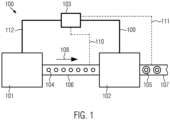
- Figure 1 shows a container treatment plant 100 according to an embodiment, which according to the invention comprises a production machine 101 and at least one container treatment machine 102 arranged downstream of the production machine 101 in a transport direction 108 of the preforms, wherein the production machine 101 and the container treatment machine 102 are interlocked with one another and thus form a unit.
- the container treatment plant 100 also comprises a control unit 103, which is designed to synchronize a first operation of the production machine 101 and a second operation of the at least one container treatment machine 102.
- the production machine 101 can be designed to produce preforms 104.
- the production machine 101 can be set up to process plastics of any kind. Preferably, however, these are plastics that are suitable for producing a preform 104.
- the production machine can be designed to process polyethylene terephthalate (PET) or to produce preforms 104 from PET.
- PET polyethylene terephthalate
- the production machine 101 can also be used, for example, to process polyethylene (PE) or polypropylene (PP) and to produce preforms 104 can be made of PE or PP.
- PE polyethylene
- PP polypropylene
- these examples are not to be understood as limiting, so that any other suitable plastic can be processed into a preform 104 by the manufacturing machine 101.
- the production machine can in particular be an injection molding machine. Alternatively, it can also be a device for producing preforms using a compression molding process or a device for producing preforms using an injection compression molding process. However, it can also be any other device that is suitable for producing a preform.
- the production machine 101 can comprise a production tool.
- the production tool can in turn comprise a cavity or a hollow space, wherein the cavity or the hollow space can represent a negative impression of the preform 104 that is to be produced using the production machine 101.
- the production tool can, for example, also comprise a plurality of cavities, for example two, five or ten cavities. Thus, several preforms 104 can be produced simultaneously with the production tool in one process step, whereby the output of the production machine 101 can be increased.
- the manufacturing machine 101 may also include a plurality of post-cooling units to cool the preforms 104 produced by the manufacturing tool to a specific temperature.
- the manufacturing machine 101 can comprise a magazine for a plurality of different manufacturing tools, wherein the different manufacturing tools comprise differently shaped cavities or hollow spaces, so that preforms 104 of different types can be produced with the manufacturing machine 101 as required.
- the preforms may be provided in an orderly manner by the manufacturing machine.
- the at least one container treatment machine 102 is designed as a blow molding machine 102.
- the blow molding machine can be, for example, a stretch blow molding machine or an extrusion blow molding machine.
- the sub-steps of the forming process can be carried out independently of the geometric location of the preforms.
- the blow molding machine 102 can be designed to form the preform 104 provided by the production machine 101 into a container 105 of any type.
- the container 105 is a container used in the beverage industry bottle used.
- this type of design of the container 105 produced by the blow molding machine is not to be understood as limiting.
- the blow molding machine 102 can also be designed, for example, to form the preform 104 into a can, a glass, a cup or a tube, for example, as are used in the beverage, pharmaceutical, health or food industries, or into any other container which can be suitable for holding any liquid or pasty medium.
- the above-discussed embodiment of the at least one container treatment machine 102 as a blow molding machine 102 is to be understood as an example.
- the at least one container treatment machine 102 can also be designed as any other type of container treatment machine that is designed to produce a container from a preform and/or to treat a container.
- the container treatment machine can also be a machine for pretreating containers, for example with a flame pyrolysis, a plasma or a corona process, a filler, a labeling device, a direct printing device and/or a sealer.
- the above-discussed possible embodiments of the at least one container treatment machine are to be understood as examples and not restrictive.
- more than one container treatment machine 102 is arranged downstream of the production machine 101 in the transport direction 108 of the preforms 104.
- a blow molding machine can be arranged downstream of the production machine 101 in the transport direction 108, a filler downstream of the blow molding machine in the transport direction 108, a closer downstream of the filler in the transport direction 108 and a labeling machine downstream of the closer.
- any other combination or any other number of container treatment machines arranged downstream of the production machine is also conceivable.
- the manufacturing machine 101 and the at least one container treatment machine 102, or the Figure 1 discussed blow molding machine 102 are interlocked with one another.
- interlocking is to be understood in particular as meaning that the production machine 101 and the at least one container treatment machine 102 form a unit and are connected to one another in such a way that the preforms 104 produced by means of the production machine 101 can be transferred to the at least one container treatment machine 102 for further processing.
- the preforms 104 produced in the production machine 101 are transferred to the blow molding machine 102, where they are formed into containers 105.
- a first transport device 106 can be provided between the production machine 101 and the blow molding machine for transferring the preforms to the blow molding machine 102.
- a second transport device 107 can be provided downstream of the blow molding machine 102, by means of which the containers 105 formed by the blow molding machine 102 are transported away from the blow molding machine 102 or to a further container treatment machine arranged downstream of the blow molding machine in the transport direction 108, which in the Figure 1 however, is not shown.
- a further container treatment machine is provided for pretreatment, filling, labeling, printing and/or closing the containers 105.
- the optional transport devices 106 and 107 are designed as linear transport devices. This type of design is to be understood as exemplary and not restrictive.
- the optional first 106 and the optional second transport device 107 are designed as a rotating star.
- the at least one container treatment machine 102 which is designed here as a blow molding machine 102
- the blow molding machine 102 when designed as a rotary machine, this can comprise a plurality of blow molds for receiving preforms, wherein the blow molds can be arranged along the circumference of the rotary machine.
- each of the blow molds can be assigned a blow unit, by means of which a preform can be formed into a container 105 in a blow mold by applying compressed air.
- the control unit 103 is designed according to the invention to control the first operation of the production machine 101 and the second operation of the at least one container treatment machine 102, or the operation associated with the Figure 1 discussed blow molding machine 102.
- the first operation can in particular be a number of preforms 104 that can be produced per time interval, for example per hour, by means of the production machine 101 or a number of preforms 104 that can be output per time interval, for example per hour, to the container treatment machine 102 arranged downstream in the transport direction 108.
- the number of preforms 104 that can be produced by the production machine 101 per time interval and the number of preforms 104 that can be output per time interval by the production machine 101 can be different, for example, if the production machine 101 carries out an optional inspection of the preforms and is designed to remove faulty preforms so that only fault-free preforms are output to the at least one container treatment machine 102 or the blow molding machine 102.
- the first operation can also be, for example, a distance between two preforms with which the preforms are output by the production machine 101.
- the first operation can be controlled, for example, by means of a first operating parameter, such as a cycle or injection duration or a post-cooling time.
- the first operation can also be an operation of the production machine 101 that is not directly related to the preforms produced by the production machine 101 per time interval.
- the first operating parameter can also be an operating parameter that can parameterize any component of the production machine and does not necessarily have to influence the preform throughput through the production machine.
- the first operating parameter can be, for example, a tool temperature of a production tool of the production machine.
- the first operating parameter can also indicate a wear state of the production machine and/or a component of the production machine.
- the first operating parameter can also be a material-specific parameter of a material processed by the production machine 101, such as a granulate or a melt, or of a preform produced by the production machine 101.
- the material-specific parameter can be, for example, a preform temperature, an infrared characteristic value of the preform, an intrinsic viscosity value of the preform, a color of the preform or any other material property of the preform produced by the production machine.
- the material-specific parameters can, for example, be measured by at least one optional sensor device.
- the optional sensor device can, for example, be from the Manufacturing machine can be designed as a separate device or be included in the manufacturing machine 101.
- the first operation can, for example, be described by at least one first operating parameter.
- the first operation can comprise a plurality of first operating parameters of the production machine, some of which can be related to the number of preforms produced by the production machine per time interval and some of which can also be unrelated to the number of preforms produced per time interval.
- the second operation can in particular be a throughput of preforms or containers per time interval that can be achieved by means of the container treatment machine 102, for example per hour, or a number of containers that can be processed per time interval by the container treatment machine 102.
- the second operation can be controlled, for example, by means of a second operating parameter of the container treatment machine.
- the second operating parameter can be, for example, a preheating period of the preform 104 before carrying out the blow molding process or a blowing time.
- the second operation can also be an operation of the at least one container treatment machine which is not directly related to the throughput of preforms or containers that can be achieved by the container treatment machine.
- the second operation can also be a parameterization of a treatment step carried out by the container treatment machine on the preforms or containers, which leads to a change in a material property of the preform or the container, but does not necessarily have to influence the container throughput that can be achieved by the at least one container treatment machine.
- the container treatment machine is a blow molding machine
- the second operating parameter can be, for example, a heating profile of the blow molding machine.
- the second operation can also be described by at least one second operating parameter.
- the second operation can comprise a plurality of second operating parameters of the container treatment machine, some of which may be related to the number of preforms and/or containers treated by the container treatment machine per time interval and may in part also not be related to the number of preforms and/or containers treated per time interval.
- the first operation can include an output of the production machine 101, a first operating parameter of the production machine, which can influence a property of a preform produced by the production machine 101 and/or a property of a preform produced by the production machine 101
- the second operation can include a throughput of the at least one container treatment machine 102 and/or a second operating parameter of the at least one container treatment machine, which can influence a property of a preform and/or container treated by the at least one container treatment machine.
- the output of the production machine 101 and the throughput of the at least one container treatment machine 102 can be easily determined and flexibly controlled and are therefore particularly suitable for synchronizing the first and second operations of the production machine 101 and the at least one container treatment machine 102.
- Synchronizing the first and second operations can generally be understood to mean that the first operation and the second operation are coordinated with one another.
- a first operating parameter of the production machine and a second operating parameter of the at least one container treatment machine can be coordinated with one another. This can be understood, for example, to mean that the first operating parameter is controlled based on the second operating parameter or the second operating parameter is controlled based on the first second operating parameter.
- synchronizing the first and second operations can mean, for example, that the first operation of the production machine 101 and the second operation of the container treatment machine 102 are coordinated with one another, so that the preforms produced by the production machine 101 can be transferred in an orderly manner to the container treatment machine arranged downstream in the transport direction 108 of the preforms and can be processed directly there without the preforms produced by the production machine having to be temporarily stored in an intermediate buffer unit. Since the preforms are typically stored as bulk goods in an intermediate buffer unit and must be separated again before being fed to the at least one container treatment machine 102, the synchronization of the first and second operations not only allows the container treatment system 100 to be operated more efficiently, but also reduces potential damage. of the preforms 104 can be avoided by the intermediate storage. Optionally, such an intermediate buffer device can still be provided.
- the second operation such as a heating profile of a blow molding machine
- a material-specific parameter such as a preform temperature or an infrared characteristic value, of a preform produced by the production machine.
- a first operation of the production machine which can influence a property of a preform produced by the production machine 101, such as a tool cooling of a tool of the production machine 101, is controlled based on a second operation of the at least one container treatment machine 102.
- the second operation can be, for example, a heating profile of the Fig. 1 blow molding machine shown or any other second operating parameter.
- the control unit 103 can be designed as a computer or computing system and can be configured to determine and regulate the first operation of the production machine 101 and the second operation of the at least one container treatment machine 102.
- the control unit 103 can be connected to the production machine 101 via a first cable connection 112, for example, and to the at least one container treatment machine 102, or the blow molding machine 102, via a second cable connection 109, wherein the control unit 103 can send data to the production machine 101 and the at least one container treatment machine 102 and can also receive data from the machines.
- the control unit 103 communicates wirelessly, for example via a WLAN connection, with the production machine 101 and the at least one container treatment machine 102.
- the control unit 103 can also comprise a storage unit.
- a database can be stored on the storage unit, which can comprise a plurality of first operating parameters for controlling the first operation of the production machine 101 and a plurality of second operating parameters for controlling the second operation of the at least one container treatment machine 102.
- at least one first operating parameter value can be assigned to a specific first operation of the production machine 101 in the database and at least one second operating parameter value can be assigned to a specific second operation of the at least one container treatment machine 102.
- control unit 103 can, based on the data stored in the database, determine the at least one first operating parameter value which is necessary to achieve a specific first operation of the production machine and, based thereon, set the at least one operating parameter of the production machine 101 in order to achieve a specific first operation of the production machine 101.
- the control unit 103 can then, for example based on a first or second operation, regulate the other operation such that the first and second operations are synchronized.
- the control unit 103 can, for example, regulate the at least one operating parameter of the other operation and thus achieve synchronous operation.
- the regulation can, for example, comprise setting the first or second operating parameter based on the first or second operating parameter value obtained from the database.
- control unit 103 is connected to the Internet and can access an external server, wherein the server comprises a database on which the information just described is stored.
- control unit 103 can be connected to the first 106 and/or the second transport device 107 via cable or wireless connections 110, 111 and is designed to control the first 106 and/or the second transport device 107.
- the control unit 103 can be designed to control a transport speed of the first and/or the second transport device.
- the control unit 103 is designed to control a rotational speed of the first and/or second transport device.
- the control unit additionally controls the first and/or the second transport device in order to synchronize the first and second operations, which can include, for example, controlling the transport speed and/or the rotational speed of the first and/or second transport device.
- control unit 103 is designed to regulate the second operation of the at least one container treatment machine 102 based on the first operation of the production machine 101.
- the control unit 103 first determines the first operation based on a first operating parameter of the production machine 101. If the first operating parameter is a material-specific parameter of the material for producing the preform or a material-specific parameter of the produced preforms, it can be determined by the optional sensor device described above.
- the control unit 103 can determine the first operation, for example, based on a number of cavities of the production tool of the production machine or a cycle time of the production process. To do this, the control unit 103 can, for example, access the database stored in the storage unit, where a specific value of the cycle time and/or a specific number of cavities of the production tool is assigned to a specific first operation.
- the first operation determined in this way can, for example, be an output of the production machine, which can, for example, assume a value of 1,000 preforms per hour, 5,000 preforms per hour or 20,000 preforms per hour.
- control unit 103 can then determine a target value for a second operation based on the data stored in the database of the storage unit and regulate the second operation of the blow molding machine, or generally of the at least one container treatment machine 102, accordingly, so that the first and second operations are synchronized.
- the same procedure can be followed for any other first operating parameter.
- the control of the second operation can, for example, comprise the control of at least one second operating parameter of the blow molding machine 102, or of the at least one container treatment machine 102.
- the at least one second operating parameter can be set to the target value determined by means of the database.
- the control is carried out by means of a control loop.
- the production machine 101 comprises an inspection machine by means of which faulty preforms can be detected and sorted out.
- the inspection machine can comprise a first detection device, which can be designed as at least one camera, for example.
- the detection device scratched, deformed or otherwise damaged preforms can be detected and sorted out directly in the production machine 101. This can ensure that only faultless preforms 104 are fed to the at least one container treatment machine 102 arranged downstream in the transport direction, or to the blow molding machine, and thus the quality of the containers treated by the at least one container treatment machine 102, or of the containers produced by the blow molding machine 102, can be increased.
- the output of the production machine 101 which corresponds to the number of defect-free preforms output in a certain time interval, can be lower than the number of preforms produced by the production machine 101 at a certain operating parameter, which can be determined, for example, as described above, based on the at least one operating parameter and/or a property of the production machine, such as the number of cavities of the production tool, it can be provided in this embodiment that the number of defective or rejected preforms is taken into account when determining the first operation.
- the production machine can produce a number of N preforms per unit of time.
- the production machine can sort out a number of M defective preforms per unit of time (depending, for example, on an inspection result, as described above), so that the production machine can effectively output a number of N - M preforms per unit of time.
- N and M represent natural numbers.
- the control unit can then be designed to start the first operation of the production machine based on the number N - M of preforms output per unit of time. 101. Based on the first operation thus determined, the control unit 103 can then regulate the second operation of the at least one container treatment machine 102 so that the first and second operations are synchronized with one another.
- the production machine 101 is designed to produce a number (N) of 2000 preforms per hour and that an average number (M) of 30 defective preforms are sorted out per unit of time.
- the production machine thus effectively outputs 1970 preforms per hour. Based on this number, i.e. the 1970 preforms that are actually output from the production machine 101 to the downstream container treatment machine 102, the operation of the downstream container treatment machine 102 is then controlled.
- This embodiment is not to be understood as limiting, in particular with regard to the specified number of preforms produced and/or sorted out, so that any other number of preforms per unit of time or any other number of sorted out preforms and any other ratio of sorted out to produced preforms can also be used here.
- N and M can also take on any other desired value.
- a second detection device is arranged at an outlet of the production machine 101, through which the defect-free preforms are provided to the at least one container treatment machine 102 arranged downstream in the transport direction, which can also be designed as at least one camera, and is designed to determine the number of preforms actually output in a certain time interval.
- the second detection device determines the distance between two preforms 104 output by the production machine 101 and the first operation of the production machine 101 is determined based on the distance between two output preforms 104.
- the second operation can then be controlled so that the first operation of the production machine 101 and the second operation of the blow molding machine 102, or of the at least one container treatment machine, are also synchronized in this case.
- the first operation of the production machine 101 is controlled based on the second operation of the at least one container treatment machine 102.
- the at least one container treatment machine 102 is provided as the lead machine of the container treatment system 100.
- this can also be provided, for example, if a maximum throughput that can be achieved by the at least one container treatment machine 102, i.e. how many preforms per time interval, for example per hour, can be processed by the container treatment machine 102, is smaller than a maximum number of preforms that can be output by the production machine 101 arranged upstream in the transport direction in an identical time interval.
- the at least one container treatment machine 102 comprises a transport component and the control unit is designed to determine the second operation based on a receiving capacity of the transport component and/or a container throughput achievable by the transport component.
- the transport component can be designed, for example, as a linear transport component, such as a conveyor belt.
- the transport component can be designed as a rotating star or as a sawtooth star.
- the holding capacity can be given, for example, by the width of the linear transport component, in the case of a rotating star by the number of gripping arms of the rotating star and in the case of a sawtooth star by the number of pockets of the sawtooth star.
- the container throughput of the linear transport component can also depend on a transport speed at which the linear transport component is operated. In the case of the rotating star or the sawtooth star, the container throughput can in turn depend on a rotation speed of the rotating star or the sawtooth star.
- the control unit 103 can then be designed to regulate the first operation of the production machine 101 such that the first and second operations are synchronized. As already described above in connection with the regulation of the second operation based on the first operation, the control unit 103 can access the database stored in the storage unit for this purpose. Based on this, the control unit 103 can then, for example, regulate at least one first operating parameter of the production machine 101 in order to synchronize the first and second operations.
- the control can in particular include the control unit setting the at least one first operating parameter to a target value determined from the database.
- the control can also be carried out by means of a control loop, for example.
- control of the first operation can, for example, comprise the control of at least one of a cycle time, a lock-to-lock time, an injection duration, a drying parameter, a production tool temperature, a number of post-cooling units assigned to the production machine and/or a post-cooling duration.
- the injection duration means the period of time for which a material, for example liquid plastic, is introduced into a cavity of the production tool.
- the drying parameter can be understood to mean an operating parameter of the production machine which influences the drying process of the produced preform.
- the production tool temperature is to be understood to mean a temperature of the production tool before the material is introduced into the cavity of the production tool.
- the post-cooling units can, for example, be designed as fans and be provided to cool the preform to a specific target temperature after it has been removed from the production tool.
- the post-cooling duration describes the period of time for which the preform is cooled by the post-cooling units.
- Lock to lock time is the time that the production tool needs to open and close. During this time, no preforms can be produced in the production machine, so the lock to lock time can be equated with dead time. Since these variables are directly related to the first operation and can be controlled easily and precisely, they are particularly suitable for controlling the first operation.
- the control unit in the event of a malfunction of a component of the container treatment plant, such as a container treatment machine or a transport device, is designed to identify the malfunction and to adjust a speed of the components of the container treatment system that are arranged upstream of the component that has a malfunction.
- the output of the components in particular can be adjusted and controlled continued operation of the container treatment system can be enabled.
- the malfunction can be, for example, a bottle bursting in the filler or a liquid foaming over in the filler. However, it can also be any other malfunction in any other component of the container treatment system.
- the operating parameters of the respective components of the container treatment system can then be individually adjusted.
- the operating parameter can be a heating output, a pre-blowing time, an injection parameter, a buffer output, a stretching speed, etc.
- the first operation of the production machine can also be a material-specific parameter of a preform produced by the production machine.
- the second operation is controlled based on the material-specific parameter of the preform.
- the material-specific parameters can be taken into account in the subsequent treatment and the quality of the preforms treated by the at least one container treatment machine can be improved in this way.
- the material-specific parameter is, for example, a preform temperature or an infrared characteristic value of the preform and the at least one container treatment machine 102, as in connection with the Fig. 1 If, as described, it is a blow molding machine, it can be provided that a heating profile or any other machine parameter of the blow molding machine is controlled based on the preform temperature or the infrared characteristic value. Control can also be based on any other material-specific parameter of the preform.
- a first operation of the production machine 101 is controlled based on a second operation of the at least one container treatment machine, such as the blow molding machine.
- the second operation can, for example, be a speed control of the at least one container treatment machine 102 or any other second operating parameter of the at least one container treatment machine.
- any second operation of a container treatment machine 102 arranged downstream of the production machine is synchronized with the first operation of the production machine.
- This can, for example, also include coordination of a granulate drying in the production machine with the second operation of the at least one container treatment machine arranged downstream, up to the synchronization of a second operation of a labeling machine or packaging machine with the first operation of the production machine.
- the adjusted operating parameters are determined by a neural network.
- the neural network can be a trained neural network.
- the neural network can, for example, access a data set that can be stored locally in the control unit or on an external server, for example a cloud.
- the adjusted operating parameters can also be determined using a deterministic algorithm (e.g. a program with fixed variables and functions).
- the deterministic algorithm can be stored locally on the control unit or externally on a server, for example a cloud.
Landscapes
- Engineering & Computer Science (AREA)
- Mechanical Engineering (AREA)
- Manufacturing & Machinery (AREA)
- Blow-Moulding Or Thermoforming Of Plastics Or The Like (AREA)
Applications Claiming Priority (1)
| Application Number | Priority Date | Filing Date | Title |
|---|---|---|---|
| DE102023119036.9A DE102023119036A1 (de) | 2023-07-19 | 2023-07-19 | Behälterbehandlungsanlage und Verfahren zum Herstellen und Behandeln eines Vorformlings |
Publications (1)
| Publication Number | Publication Date |
|---|---|
| EP4494842A1 true EP4494842A1 (fr) | 2025-01-22 |
Family
ID=91954080
Family Applications (1)
| Application Number | Title | Priority Date | Filing Date |
|---|---|---|---|
| EP24188868.4A Pending EP4494842A1 (fr) | 2023-07-19 | 2024-07-16 | Installation de traitement de récipients et procédé de fabrication et de traitement d'une préforme |
Country Status (4)
| Country | Link |
|---|---|
| US (1) | US20250026060A1 (fr) |
| EP (1) | EP4494842A1 (fr) |
| CN (1) | CN119329099A (fr) |
| DE (1) | DE102023119036A1 (fr) |
Citations (5)
| Publication number | Priority date | Publication date | Assignee | Title |
|---|---|---|---|---|
| US20100187730A1 (en) * | 2006-08-11 | 2010-07-29 | Krones Ag | Injection blow molding machine and process for the stretch blow molding of plastic containers |
| DE102010029644A1 (de) * | 2010-06-02 | 2011-12-08 | Krones Ag | Vorrichtung und Verfahren zum Herstellen von Kunststoffbehältern |
| US20130115325A1 (en) * | 2010-06-25 | 2013-05-09 | Zoppas Matteo | Plant for production of plastic containers |
| US20150273754A1 (en) * | 2008-04-30 | 2015-10-01 | Krones Ag | Facility and method for producing containers |
| US20210170665A1 (en) * | 2017-11-09 | 2021-06-10 | Krones Ag | Method and apparatus for processing plastic containers with speed-controllable blow moulding machine |
Family Cites Families (6)
| Publication number | Priority date | Publication date | Assignee | Title |
|---|---|---|---|---|
| US7517480B2 (en) | 2003-08-18 | 2009-04-14 | Kortec, Inc. | Automatic process control for a multilayer injection molding apparatus |
| US7052644B2 (en) * | 2003-11-17 | 2006-05-30 | Graham Packaging Pet Technologies, Inc. | Continuous production of molded plastic containers |
| DE102011053180A1 (de) * | 2011-09-01 | 2013-03-07 | Krones Aktiengesellschaft | Anlage und Verfahren zum Herstellen von Kunststoffbehältnissen |
| GB2528934B (en) * | 2014-08-05 | 2017-08-02 | Colton William | Preform Optical Inspection |
| JP6678733B2 (ja) * | 2016-03-30 | 2020-04-08 | 日精エー・エス・ビー機械株式会社 | ブロー成形装置 |
| DE102020122471A1 (de) * | 2020-08-27 | 2022-03-03 | Krones Aktiengesellschaft | Verfahren und Vorrichtung zum Herstellen von Kunststoffvorformlingen und Kunststoffbehältnissen mit thermischen Vorformlingspeicher |
-
2023
- 2023-07-19 DE DE102023119036.9A patent/DE102023119036A1/de active Pending
-
2024
- 2024-07-16 EP EP24188868.4A patent/EP4494842A1/fr active Pending
- 2024-07-18 US US18/777,238 patent/US20250026060A1/en active Pending
- 2024-07-18 CN CN202410963310.7A patent/CN119329099A/zh active Pending
Patent Citations (5)
| Publication number | Priority date | Publication date | Assignee | Title |
|---|---|---|---|---|
| US20100187730A1 (en) * | 2006-08-11 | 2010-07-29 | Krones Ag | Injection blow molding machine and process for the stretch blow molding of plastic containers |
| US20150273754A1 (en) * | 2008-04-30 | 2015-10-01 | Krones Ag | Facility and method for producing containers |
| DE102010029644A1 (de) * | 2010-06-02 | 2011-12-08 | Krones Ag | Vorrichtung und Verfahren zum Herstellen von Kunststoffbehältern |
| US20130115325A1 (en) * | 2010-06-25 | 2013-05-09 | Zoppas Matteo | Plant for production of plastic containers |
| US20210170665A1 (en) * | 2017-11-09 | 2021-06-10 | Krones Ag | Method and apparatus for processing plastic containers with speed-controllable blow moulding machine |
Also Published As
| Publication number | Publication date |
|---|---|
| CN119329099A (zh) | 2025-01-21 |
| US20250026060A1 (en) | 2025-01-23 |
| DE102023119036A1 (de) | 2025-01-23 |
Similar Documents
| Publication | Publication Date | Title |
|---|---|---|
| EP2368691B2 (fr) | Procédé de fabrication de récipients en matière synthétique et dispositif pour realiser le procéde | |
| EP2346775B1 (fr) | Dispositif et procédé de fabrication de contenants en matière plastique | |
| EP4219120B1 (fr) | Dispositif et procédé de chauffage d'ébauches en plastique au moyen d'une détection de température à résolution spatiale | |
| EP3964349B1 (fr) | Dispositif et procédé de chauffage de préformes en matière plastique à détection de température à résolution espace | |
| DE10116665B4 (de) | Verfahren zur Steuerung eines Blasvorgangs bei der Herstellung von Behältern aus einem thermoplastischen Material | |
| DE69804456T2 (de) | Einstufiges verfahren mit hoher produktivität und vorrichtung zum herstellen von behältern aus kunststoff | |
| DE102021108790A1 (de) | Verfahren zum Auswerten defekter Behältnisse und Defektauswerteeinrichtung für eine Behältnisbehandlungsanlage | |
| EP3347778B1 (fr) | Dispositif et procédé de traitement de récipients avec des dispositifs de traitement interrogateurs | |
| DE102012101915A9 (de) | Heizvorrichtung und Verfahren zum Temperieren von Vorformlingen | |
| EP4585399A1 (fr) | Dispositif et procédé de fabrication de récipients en plastique avec inspection de préformes en plastique | |
| DE102023119036A1 (de) | Behälterbehandlungsanlage und Verfahren zum Herstellen und Behandeln eines Vorformlings | |
| EP4494840A1 (fr) | Installation de traitement de récipients pour réguler la température d'une préforme | |
| WO2018054790A1 (fr) | Procédé et dispositif de fabrication de récipients | |
| DE10165127B3 (de) | Verfahren zur Steuerung eines Blasvorgangs bei der Herstellung von Behältern aus einem thermoplastischen Material | |
| EP3838550B1 (fr) | Machine de moulage par injection pour une fabrication continue | |
| EP4494839A1 (fr) | Installation de traitement de récipients pour la fabrication et le traitement de préformes | |
| EP4585395A1 (fr) | Dispositif et procédé de fabrication d'ébauches en plastique avec mesure de température des préformes en plastique fabriquées | |
| EP4674595A1 (fr) | Dispositif et procédé de séparation par lots de préformes en plastique transportées | |
| EP4585394A1 (fr) | Dispositif et procédé de fabrication d'ébauches en plastique au moyen d'un dispositif d'analyse spectrale | |
| EP4566795A1 (fr) | Procédé et dispositif de fabrication de récipients en matière plastique | |
| DE202025105304U1 (de) | Maschine zum Herstellen von Behältern | |
| EP4585398A1 (fr) | Dispositif et procédé de fabrication d'une préforme en plastique avec contrôle des unités de fabrication en fonction des résultats d'inspection | |
| EP3250501A1 (fr) | Dispositif de remplissage et de fermeture de récipients | |
| WO2025157599A1 (fr) | Appareil de traitement, de remplissage et/ou d'étiquetage de corps creux, contrôleur associé et procédé l'utilisant |
Legal Events
| Date | Code | Title | Description |
|---|---|---|---|
| PUAI | Public reference made under article 153(3) epc to a published international application that has entered the european phase |
Free format text: ORIGINAL CODE: 0009012 |
|
| STAA | Information on the status of an ep patent application or granted ep patent |
Free format text: STATUS: THE APPLICATION HAS BEEN PUBLISHED |
|
| AK | Designated contracting states |
Kind code of ref document: A1 Designated state(s): AL AT BE BG CH CY CZ DE DK EE ES FI FR GB GR HR HU IE IS IT LI LT LU LV MC ME MK MT NL NO PL PT RO RS SE SI SK SM TR |
|
| STAA | Information on the status of an ep patent application or granted ep patent |
Free format text: STATUS: REQUEST FOR EXAMINATION WAS MADE |
|
| 17P | Request for examination filed |
Effective date: 20250722 |