EP4495029A1 - Getränkekapsel - Google Patents
Getränkekapsel Download PDFInfo
- Publication number
- EP4495029A1 EP4495029A1 EP23186712.8A EP23186712A EP4495029A1 EP 4495029 A1 EP4495029 A1 EP 4495029A1 EP 23186712 A EP23186712 A EP 23186712A EP 4495029 A1 EP4495029 A1 EP 4495029A1
- Authority
- EP
- European Patent Office
- Prior art keywords
- beverage
- punctured
- support plate
- beverage capsule
- capsule according
- Prior art date
- Legal status (The legal status is an assumption and is not a legal conclusion. Google has not performed a legal analysis and makes no representation as to the accuracy of the status listed.)
- Pending
Links
Images

Classifications
-
- B—PERFORMING OPERATIONS; TRANSPORTING
- B65—CONVEYING; PACKING; STORING; HANDLING THIN OR FILAMENTARY MATERIAL
- B65D—CONTAINERS FOR STORAGE OR TRANSPORT OF ARTICLES OR MATERIALS, e.g. BAGS, BARRELS, BOTTLES, BOXES, CANS, CARTONS, CRATES, DRUMS, JARS, TANKS, HOPPERS, FORWARDING CONTAINERS; ACCESSORIES, CLOSURES, OR FITTINGS THEREFOR; PACKAGING ELEMENTS; PACKAGES
- B65D85/00—Containers, packaging elements or packages, specially adapted for particular articles or materials
- B65D85/70—Containers, packaging elements or packages, specially adapted for particular articles or materials for materials not otherwise provided for
- B65D85/804—Disposable containers or packages with contents which are mixed, infused or dissolved in situ, i.e. without having been previously removed from the package
- B65D85/8043—Packages adapted to allow liquid to pass through the contents
- B65D85/8049—Details of the inlet
-
- B—PERFORMING OPERATIONS; TRANSPORTING
- B65—CONVEYING; PACKING; STORING; HANDLING THIN OR FILAMENTARY MATERIAL
- B65D—CONTAINERS FOR STORAGE OR TRANSPORT OF ARTICLES OR MATERIALS, e.g. BAGS, BARRELS, BOTTLES, BOXES, CANS, CARTONS, CRATES, DRUMS, JARS, TANKS, HOPPERS, FORWARDING CONTAINERS; ACCESSORIES, CLOSURES, OR FITTINGS THEREFOR; PACKAGING ELEMENTS; PACKAGES
- B65D17/00—Rigid or semi-rigid containers specially constructed to be opened by cutting or piercing, or by tearing of frangible members or portions
- B65D17/02—Rigid or semi-rigid containers specially constructed to be opened by cutting or piercing, or by tearing of frangible members or portions of curved cross-section, e.g. cans of circular or elliptical cross-section
-
- B—PERFORMING OPERATIONS; TRANSPORTING
- B65—CONVEYING; PACKING; STORING; HANDLING THIN OR FILAMENTARY MATERIAL
- B65D—CONTAINERS FOR STORAGE OR TRANSPORT OF ARTICLES OR MATERIALS, e.g. BAGS, BARRELS, BOTTLES, BOXES, CANS, CARTONS, CRATES, DRUMS, JARS, TANKS, HOPPERS, FORWARDING CONTAINERS; ACCESSORIES, CLOSURES, OR FITTINGS THEREFOR; PACKAGING ELEMENTS; PACKAGES
- B65D85/00—Containers, packaging elements or packages, specially adapted for particular articles or materials
- B65D85/70—Containers, packaging elements or packages, specially adapted for particular articles or materials for materials not otherwise provided for
- B65D85/804—Disposable containers or packages with contents which are mixed, infused or dissolved in situ, i.e. without having been previously removed from the package
- B65D85/8043—Packages adapted to allow liquid to pass through the contents
- B65D85/8061—Filters
-
- B—PERFORMING OPERATIONS; TRANSPORTING
- B65—CONVEYING; PACKING; STORING; HANDLING THIN OR FILAMENTARY MATERIAL
- B65D—CONTAINERS FOR STORAGE OR TRANSPORT OF ARTICLES OR MATERIALS, e.g. BAGS, BARRELS, BOTTLES, BOXES, CANS, CARTONS, CRATES, DRUMS, JARS, TANKS, HOPPERS, FORWARDING CONTAINERS; ACCESSORIES, CLOSURES, OR FITTINGS THEREFOR; PACKAGING ELEMENTS; PACKAGES
- B65D85/00—Containers, packaging elements or packages, specially adapted for particular articles or materials
- B65D85/70—Containers, packaging elements or packages, specially adapted for particular articles or materials for materials not otherwise provided for
- B65D85/804—Disposable containers or packages with contents which are mixed, infused or dissolved in situ, i.e. without having been previously removed from the package
- B65D85/8043—Packages adapted to allow liquid to pass through the contents
- B65D85/8067—Packages for several ingredients
Definitions
- the present invention relates to a beverage capsule for use in a beverage preparation system to prepare a beverage by passing a fluid through the beverage capsule.
- the present invention further relates to a use of the beverage capsule in a beverage preparation system to prepare a beverage.
- a known beverage capsule comprises: a cup-shaped body comprising a base and a sidewall contiguous with the base, wherein the base is configured to be pierced by a draining member of the beverage preparation machine to allow draining a beverage from the beverage capsule; a lid which is typically sealed to the cup-shaped body, the lid and cup-shaped body enclosing an interior volume, wherein the lid is configured to be pierced by an injection member of the beverage preparation machine to inject a fluid into the beverage capsule; and a punctured support plate positioned inside the cup-shaped body and dividing the interior volume into a first compartment delimited in part by the lid and configured for holding one or more beverage ingredients and a second compartment delimited in part by the base, wherein the punctured support plate is located at a distance from said base which is equal or larger than a piercing height of the draining member of the beverage preparation machine and wherein said beverage is able to pass through the punctured support plate.
- Such a beverage capsule is known from WO 2013/39585 A1 where a filter paper is attached to the plastic punctured support plate.
- the paper filter in the capsule disclosed in WO 2013/39585 A1 is configured to filter the beverage made by passing the water through the beverage ingredients contained in the capsule.
- the filter paper retains at least most of the beverage ingredients inside the capsule which, if these were to come out together with the beverage, would reduce the quality of the latter.
- the role of the punctured support plate is avoiding that the filter paper gets damaged by the ingredients and/or the piercing member of the beverage preparation machine.
- beverage ingredients are known. These may be divided roughly into two classes, namely extraction or infusion ingredients and dissolving ingredients.
- the beverage capsule according to the present invention may be applied in both cases, i.e. either in the case in which the capsule is of the type which contains beverage ingredients intended to allow the beverage to be made by extraction or infusion (such as roasted ground coffee or tea leaves as with the capsule disclosed in WO 2013/39585 A1 ) and in the case in which the capsule is of the type which contains beverage ingredients intended to allow the beverage to be made following complete or partial dissolving of the beverage ingredients when the water passes through it (for example milk, chocolate, powdered tea, instant drink, etc.).
- the known beverage capsules are used in a beverage preparation system where fluid (usually water) is supplied directly into the capsule. More specifically, the capsule is inserted in an openable and closable chamber, defined inside the beverage preparation system. When the capsule is inside the closed chamber, an injection member of the beverage preparation machine pierces the lid and water (usually hot and pressurised as required) is injected into the capsule, in order to obtain the beverage following the interaction of the water with the beverage ingredients (e.g. extraction, infusion, or partial or whole dissolution). Finally, the beverage is released from the capsule by a draining member which pierces the base allowing the beverage to flow along an outflow path of the beverage preparation system.
- fluid usually water
- Keurig K-Cup TM capsules have: a body that is formed from a multilayered material that includes a polyethylene or polypropylene outer layer, an ethylene vinyl alcohol copolymer (EVOH) barrier layer and a polyethylene sealing layer; a filter that is formed primarily out of paper; and a cover that is formed from a multilayered material that includes an aluminium foil outer layer, an EVOH barrier layer and a polyethylene sealing layer.
- the filter is usually attached to and irremovable from the capsule body.
- WO 2019/204916 A1 proposes forming the entire capsule (i.e. body, filter and cover) from a single polymeric material thus allowing recycling in a single material stream.
- US 2017/283163 A1 proposes an aluminium capsule with a base having an elevated part to support the paper filter to avoid the use of a plastic punctured support plate.
- metal aids in preserving the beverage ingredients which are present within the interior volume. More specifically, a known downside of polymeric materials (as in the capsule disclosed in WO 2019/204916 A1 ) is a low preservation of food ingredients inside the capsule, this is particularly caused by an insufficient oxygen tightness. The use of metal overcomes this issue.
- the punctured support plate can perform the role of a conventional filter paper. As such, there is no longer any need to include a filter paper inside the capsule. This improves the recyclability of the capsule since there is no longer any need to separate the filter paper from the remainder of the capsule as with the capsuled disclosed in US 2017/283163 A1 .
- the beverage capsule further comprises the one or more beverage ingredients, which ingredients are either extraction/infusion based ingredients (e.g. roasted ground coffee, tea leaves, etc.) or dissolution based (e.g. powder materials such as milk powder, chocolate powder, powdered tea, powdered soup, instant drink, etc.).
- the beverage ingredients have a particle size distribution determined using optical microscopy according to ISO 13320:2020, wherein at least 90 volume%, and in particular at least 95 volume%, of the one or more beverage ingredients have a particle size of at least 30 ⁇ m , in particular at least 40 ⁇ m and more particularly at least 50 ⁇ m.
- the beverage capsule according to the present invention is thus usable for preparing a variety of beverages.
- the punctured support plate comprises openings having a size so as to prevent at least 90 volume%, in particular at least 95 volume%, and specifically at least 99 volume%, of the one or more beverage ingredients from passing therethrough. This avoids that too much of the ingredients would pass into the beverage which could otherwise negatively affect beverage quality.
- the punctured support plate comprises openings having a smallest dimension which is at most 500 ⁇ m, in particular at most 300 ⁇ m, more in particular at most 200 ⁇ m, and most in particular at most 100 ⁇ m.
- the smallest dimension is comprised between 50 ⁇ m and 100 ⁇ m, such as 55 ⁇ m , 60 ⁇ m, 65 ⁇ m, 70 ⁇ m, 75 ⁇ m, 80 ⁇ m, 85 ⁇ m, 90 ⁇ m or 95 ⁇ m.
- the smallest dimension may be the diameter in case the openings are substantially circular or the width in case the openings are formed as oblong slits. Such a smallest dimension has been found to retain conventional roasted ground coffee ingredients to a sufficient extent so as to avoid these from lowering the beverage quality.
- the punctured support plate comprises openings which are substantially uniformly distributed across the plate.
- alternative distributions with a concentration in the center or on the outer part are also possible.
- the distribution is mainly determined to achieve a desired contact time between the water and the beverage ingredients, which desired contact time is dependent on the type of beverage to prepare.
- the cup-shaped body the lid and the punctured support plate are all made of a metal, preferably a food-grade metal, such as aluminium or an aluminium alloy. Ideally, all parts are made of the same metal to optimize recyclability of the capsule.
- the cup-shaped body and the lid are both made of a metal-based laminate material comprising at least one layer of metal, the metal layer preferably comprising a food-grade metal, such as an aluminium or an aluminium alloy, wherein the punctured support plate is made of a metal, preferably a food-grade metal, such as aluminium or an aluminium alloy.
- the metal used for the punctured support plate is the same as that used in the metal layer of the metal-based laminate. The use of the same metal in all parts optimizes recyclability of the capsule.
- the aluminium or aluminium alloy is preferably annealed aluminium or aluminium alloy and particularly being a soft annealed aluminium or aluminium alloy.
- the aluminium alloy may, for example, be of grade 3005, 3104, 3105, 3175, 8011 or 8079. The skilled person is familiar with these materials and their various advantages, in particular in the context of food-grade materials.
- the metal-based laminate may comprises one or more lacquer layers (i.e. a lacquer-metal laminate).
- a lacquer-metal laminate i.e. a heat seal lacquer, in particular a vinyl heat seal lacquer, or an epoxy stove lacquer, in particular a colored or transparent epoxy stove lacquer.
- lacquer layers i.e. a lacquer-metal laminate.
- a heat seal lacquer in particular a vinyl heat seal lacquer
- an epoxy stove lacquer in particular a colored or transparent epoxy stove lacquer.
- lacquers can influence the visual look of the cup-shaped body exterior and may also be beneficial for, in a later stage of production, applying a lid to the cup-shaped body to seal the capsule.
- the presence of one or two lacquer layers has no negative impact on the capsule recyclability as the capsule is mainly formed from a metal material.
- the metal-based laminate may comprise one or more polymer layers (i.e. a polymer-metal laminate).
- the one or more polymer layers may comprise a single layer of a single polymer material or multiple layers of different polymer materials. Where multiple layers of different polymer materials are used, each layer may be applied separately when forming the sheet of material that is usually the basis for forming the cup-shaped body. However, it is preferred that the multiple layers of different polymer materials are first made up into a multilayer laminated polymer film which can then be laminated onto the metal layer (e.g. the aluminium or aluminium alloy layer) by a suitable process, for example adhesive lamination.
- the metal layer e.g. the aluminium or aluminium alloy layer
- the polymer materials of the one or more polymer layers may comprise materials selected from the group consisting of homopolymers, copolymers and mixtures thereof.
- a homopolymer refers to a polymer produced by the polymerization of a single monomer.
- a copolymer refers to a polymer produced by the polymerization of two or more monomers.
- Suitable homopolymers include polyvinyl chloride (PVC), polypropylene (PP), low density polyethylene (LDPE), medium density polyethylene (MDPE), high density polyethylene (HDPE), polytetrafluoroethylene (PTFE), polyethylene terephthalate (PET), polychloroprene, polyisobutylene, and polyamides.
- Suitable copolymers include fluorinated ethylene propylene (FEP), ethylene propylene diene monomer (EPDM), polyamides, thermoplastic copolyesters (TPC) and olefin block copolymers (OBC). These copolymers are preferably alternating copolymers or block copolymers.
- An alternating copolymer refers to a copolymer with regular alternating monomer units.
- a block copolymer refers to a copolymer comprising two or more homopolymer subunits linked by covalent bonds.
- the cup-shaped body is integrally formed (e.g. by drawing or deep drawing operations) from a sheet of material.
- the sheet may have a thickness between 50 and 500 microns.
- the thickness preferably being at least 60 microns, more preferably at least 70 microns and most preferably at least 80 microns.
- the thickness preferably being at most 400 microns, more preferably at most 300 microns, even more preferably at most 200 microns, still more preferably at most 150 microns, and most preferably at most 120 microns.
- the sheet advantageously has a thickness of about 80 to 100 microns.
- the sidewall comprises a stepped region, the punctured support plate engaging the stepped region.
- the sidewall comprises a first region and a second region having a different inclination with respect to a central axis of the beverage capsule, the punctured support plate engaging the sidewall where the first region and a second region are contiguous.
- Both embodiments rely on a change in shape of the sidewall to create an abutment surface for the punctured support plate. This allows the punctured support plate to, during assembly of the capsule, rest against the abutment surface by the influence of gravity.
- the lid Once the capsule is filled, i.e. after the beverage ingredients are placed in the capsule, the lid is sealed to the cup-shaped body. In this way, the lid traps the beverage ingredients which therefore maintain the placement of the punctured support plate, e.g. by pushing lightly against this.
- the punctured support plate may be welded to the abutment surface (i.e. the stepped region or the region where the sidewall inclination changes). It should be appreciated that the punctured support plate may generally be welded to the sidewall without requiring an abutment surface.
- Another way to achieve a more secure placement of the punctured support plate is to provide one or more inwardly extending protrusions facing the abutment surface (i.e. the stepped region or the region where the sidewall inclination changes). For example, during assembly of the capsule, once the punctured support plate has been placed, the sidewall of the capsule is indented in the region above the punctured support plate. In this way, the punctured support plate is trapped between the abutment surface and the protrusions.
- said distance between the punctured support plate and the base is at least 5 mm and preferably at least 8 mm or more. Such a distance has been found to be sufficiently far away to allow the draining member of the beverage preparation machine to sufficiently pierce the base to allow a satisfactory draining of the beverage from the capsule without contacting and/or damaging the punctured support plate.
- the beverage capsule does not contain a filter paper.
- the beverage capsule comprises an annular rim contiguous with the sidewall, the lid being sealed to the annular rim.
- the provision of an annular rim provides a surface on which the lid can be easily sealed.
- the capsule is a single-use, disposable element.
- the object according to the present invention is also achieved with a use of a beverage capsule as described above in a beverage preparation machine to prepare a beverage by passing a fluid through the beverage capsule.
- FIG 1 shows an exploded view of a beverage capsule 10 according to the present invention.
- the capsule 10 comprises a cup-shaped body 12 having a base 14, a sidewall 16 which is contiguous with the base 14 and an annular rim 18 which is contiguous with the sidewall 16.
- the capsule 10 further comprises a punctured support plate 20 and a lid 22 sealed to the sidewall 16, in particular to the annular rim 18.
- Beverage ingredients 24 are also schematically shown in figure 1 .
- the cup-shaped body 12 generally has a height H comprised between 25 and 65 mm.
- the height H is preferably at least 35 mm, more preferably at least 40 mm, and most preferably at least 43 mm.
- the height H is preferably at most 55 mm, more preferably at most 50 mm, and most preferably at most 47 mm. In the illustrated embodiment, the height H is about 45 mm.
- the cup-shaped body 12 generally has an outer diameter D comprised between 30 and 70 mm.
- the outer diameter D is preferably at least 40 mm, more preferably at least 45 mm, and most preferably at least 49 mm.
- the outer diameter D is preferably at most 60 mm, more preferably at most 55 mm, and most preferably at most 53 mm. In the illustrated embodiment, the outer diameter D is about 51 mm.
- the sidewall 16 has an inner diameter D i measured at the end 16a contiguous with the base 14 comprised between 15 and 55 mm.
- the inner diameter D i is preferably at least 25 mm, more preferably at least 30 mm, and most preferably at least 33 mm.
- the inner diameter D i is preferably at most 45 mm, more preferably at most 40 mm, and most preferably at most 37 mm.
- the outer diameter D i is about 35 mm.
- the sidewall 16 has an outer diameter D o measured at the end 16b contiguous with the annular rim 18 comprised between 25 and 65 mm.
- the outer diameter D o is preferably at least 35 mm, more preferably at least 40 mm, and most preferably at least 43 mm.
- the outer diameter D o is preferably at most 55 mm, more preferably at most 50 mm, and most preferably at most 47 mm. In the illustrated embodiment, the outer diameter D o is about 45 mm.
- the dimensions H, D, D i and D o are mainly determined in function of the beverage preparation machine, in particular of the closed chamber inside the beverage preparation machine.
- the sidewall 16 is provided with a stepped region 16c, i.e. a region in which the diameter of the sidewall rapidly increases.
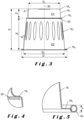
- the punctured support plate 20 engages this stepped region 16c as best shown in figure 4 and may be sealed thereto.
- the stepped region 14c divides the sidewall 14 into a first section 16 1 extending between the base 14 and the stepped region 16c and a second section 16 2 extending between the stepped region 16c and the annular rim 18.
- the stepped region can be replaced by a change in inclination angles of the sidewall sections, e.g. the first sidewall section having an inclination angle of 30° or more (e.g. 45°) with the second sidewall section having an inclination angle of 20° or less (e.g. 8°).
- both a stepped region and/or inclination change may be absent in which case the punctured support plate 20 is welded to the sidewall 16 at the desired location.
- the first sidewall section 16 1 has a height H 1 comprised between 3 and 20 mm.
- the height H 1 is preferably at least 5 mm, more preferably at least 8 mm, and most preferably at least 9 mm.
- the height H 1 is preferably at most 15 mm, more preferably at most 12 mm, and most preferably at most 11 mm. In the illustrated embodiment, the height H 1 is about 10 mm.
- the second sidewall section 16 2 has a height H 2 comprised between 20 and 50 mm.
- the height H 2 is preferably at least 25 mm, more preferably at least 30 mm, and most preferably at least 33 mm.
- the height H 2 is preferably at most 45 mm, more preferably at most 40 mm, and most preferably at most 37 mm. In the illustrated embodiment, the height H 2 is about 35 mm.
- the first sidewall section 16 1 has an inclination angle ⁇ 1 with respect to the central axis 30 of the capsule 10 comprised between 0° and 10°.
- the inclination angle ⁇ 1 is preferably at least 1° and more preferably at least 2°.
- the inclination angle ⁇ 1 is preferably at most 8°, more preferably at most 6°, and most preferably at most 4° mm. In the illustrated embodiment, the inclination angle ⁇ 1 is about 3°.
- the second sidewall section 16 2 has an inclination angle ⁇ 2 with respect to the central axis 30 of the capsule 10 comprised between 0° and 20°.
- the inclination angle ⁇ 2 is preferably at least 2°, more preferably at least 4°, and most preferably at least 5°.
- the inclination angle ⁇ 2 is preferably at most 15°, more preferably at most 10°, and most preferably at most 8° mm. In the illustrated embodiment, the inclination angle ⁇ 2 is about 6°.
- the inclination angles ⁇ 1 and ⁇ 2 are determined in order to maximize the volume inside the cup-shaped body whilst allowing the cup-shaped bodies to be stackable before assembly.
- the punctured support plate 20 divides the internal capsule volume into a first compartment C1 and a second compartment C2.
- the first compartment C1 is normally empty and the second compartment C2 is filled with beverage ingredients 24.
- the first compartment C1 is delimited by the base 14, the first sidewall section 16 1 and the punctured support plate 20.
- the second compartment C2 is delimited by the lid 22, the second sidewall section 16 2 and the punctured support plate 20.
- the beverage ingredients 24 are either extraction/infusion based ingredients (e.g. roasted ground coffee, tea leaves, etc.) or dissolution based (e.g. powder materials such as milk powder, chocolate powder, powdered tea, powdered soup, instant drink, etc.).
- the beverage ingredients have a particle size distribution determined using optical microscopy according to ISO 13320:2020, wherein at least 90 volume%, and in particular at least 95 volume%, of the one or more beverage ingredients have a particle size of at least 30 ⁇ m , in particular at least 40 ⁇ m and more particularly at least 50 ⁇ m.
- the second compartment C2 has a volume comprised between 30 and 70 mml.
- the second compartment volume is preferably at least 35 ml, more preferably at least 40 ml, and most preferably at least 45 ml.
- the second compartment volume is preferably at most 60 ml, more preferably at most 55 ml, and most preferably at most 52 ml. In the illustrated embodiment, the second compartment volume is about 48 or 49 ml.
- the annular rim 18 has a flat section 18 2 and a rolled-over rim potion 18 1 .
- the lid 22 is normally sealed to the flat section 18 2 .
- the use of a rolled-over rim portion 18 1 is a well-known technique for forming the free end of the annular rim when using a metal or metal-based laminate material to form the cup-shaped body 12.
- the rolled-over rim 18 1 has a height h comprised between 0,8 and 2,0 mm.
- the height h is preferably at least 1,0 mm, more preferably at least 1,2 mm, and most preferably at least 1,25 mm.
- the height h is preferably at most 1,6 mm, more preferably at most 1,4 mm, and most preferably at most 1,35 mm. In the illustrated embodiment, the height h is about 1,25 mm.
- the rolled-over rim portion e.g. an elliptic shape which increases the surface area of the flat section 18 2 useable for sealing the lid 22.
- the orientation of the roll-over rim portion may also be clockwise instead of counter-clockwise in the illustrated embodiment.
- Figure 2 further illustrates that the base 14 is provided with a ridged contour 14c which divides the base 14 into an inner region 14 i and an outer region 14 o .
- the outer region 14 o is punctured by a piercing member of the beverage preparation machine to drain a beverage from the capsule 10.
- the lid 22 is normally pierced by a piercing member of the beverage preparation machine to inject a fluid (typically water) into the capsule to create a beverage through interaction with the beverage ingredients.
- a fluid typically water
- the punctured support plate 20 is provided with openings (schematically illustrated in figure 1 ) to allow the prepared beverage to pass therethrough.
- the openings in the punctured support plate 20 have a size so as to prevent at least 90 volume%, in particular at least 95 volume%, and specifically at least 99 volume%, of the beverage ingredients 24 from passing therethrough.
- the openings in the punctured support plate 20 have a smallest dimension which is at most 500 ⁇ m, in particular at most 300 ⁇ m, more in particular at most 200 ⁇ m, and most in particular at most 100 ⁇ m.
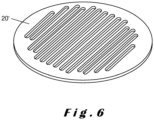
- the smallest dimension may be the diameter in case the openings are substantially circular (as in the illustrated embodiment) or the width in case the openings are formed as oblong slits as in the embodiment of the punctured support plated 20' illustrated in figure 6 .
- the openings are substantially uniformly distributed across the punctured support plate 20 and are substantially the same. However, this is not necessary. The distribution of the openings may vary as described above. Moreover, the openings may have varying shapes and/or size.
- the cup-shaped body 12 is usually obtained by deforming a flat sheet of material into the cup-shape. This may be done by deep drawing in a one-stage or multiple-stage process. Due to the presence of the stepped region 16c, the cup-shaped body 12 is usually manufactured in a multiple-stage process using differently sized punches sequentially. However, a multiple-element punch may also be used to manufacture the cup 12 in a single step.
- the cup 12, the punctured support plate 20 and the lid 22 all comprise metal and ideally a same metal for improving recyclability.
- the cup 12 and the lid 22 are both made either solely from a metal or a metal-based laminate having a metal layer with a lacquer layer on one or both sides. Possible and preferred metals have been described above and will not be repeated.
- the punctured support plate 20 in the illustrated embodiment is made solely from a metal and ideally the same metal as used for the cup 12 and the lid 22.
- the cup 12 and the lid 22 are both made from a same metal-based polymer laminate.
- the punctured support plate 20 is preferably made solely from a metal and ideally the same metal as used for the metal layer in the cup 12 and the lid 22. Possible and preferred metals and polymers have been described above and will not be repeated.
- the cup 12 is made from a metal or a metal-based laminate having a metal layer with a lacquer layer on one or both sides; the lid 22 is made from a metal-based polymer laminate and the punctured support plate 20 is preferably made solely from a metal.
- the metal is the same for each component. Possible and preferred metals and polymers have been described above and will not be repeated.
Landscapes
- Engineering & Computer Science (AREA)
- Mechanical Engineering (AREA)
- Apparatus For Making Beverages (AREA)
- Packages (AREA)
Priority Applications (3)
| Application Number | Priority Date | Filing Date | Title |
|---|---|---|---|
| EP23186712.8A EP4495029A1 (de) | 2023-07-20 | 2023-07-20 | Getränkekapsel |
| US18/658,268 US20250026561A1 (en) | 2023-07-20 | 2024-05-08 | Beverage capsule |
| CA3248875A CA3248875A1 (en) | 2023-07-20 | 2024-07-17 | DRINK CAPSULE |
Applications Claiming Priority (1)
| Application Number | Priority Date | Filing Date | Title |
|---|---|---|---|
| EP23186712.8A EP4495029A1 (de) | 2023-07-20 | 2023-07-20 | Getränkekapsel |
Publications (1)
| Publication Number | Publication Date |
|---|---|
| EP4495029A1 true EP4495029A1 (de) | 2025-01-22 |
Family
ID=87426858
Family Applications (1)
| Application Number | Title | Priority Date | Filing Date |
|---|---|---|---|
| EP23186712.8A Pending EP4495029A1 (de) | 2023-07-20 | 2023-07-20 | Getränkekapsel |
Country Status (3)
| Country | Link |
|---|---|
| US (1) | US20250026561A1 (de) |
| EP (1) | EP4495029A1 (de) |
| CA (1) | CA3248875A1 (de) |
Citations (13)
| Publication number | Priority date | Publication date | Assignee | Title |
|---|---|---|---|---|
| US5008013A (en) * | 1987-10-01 | 1991-04-16 | Nestec S.A. | Filter for use in a cartridge for the preparation of a beverage |
| US20120201933A1 (en) * | 2011-02-03 | 2012-08-09 | 2266170 Ontario Inc. | Beverage Capsule |
| WO2013039585A1 (en) | 2011-09-13 | 2013-03-21 | Conair Corporation | Brewed beverage appliance and method |
| US20140017359A1 (en) * | 2011-03-14 | 2014-01-16 | K-Fee System Gmbh | Beverage substance, portion capsule and method for producing a beverage |
| WO2014158656A1 (en) * | 2013-03-14 | 2014-10-02 | Starbucks Corporation D/B/A Starbucks Coffee Company | Stretchable beverage cartridges and methods |
| WO2017163210A1 (en) | 2016-03-23 | 2017-09-28 | Macchiavelli S.R.L. | Capsule for infusion products, in particular coffee |
| US20170283163A1 (en) | 2016-04-02 | 2017-10-05 | Rebecca J. Gatewood | Beverage pod |
| WO2019106485A1 (en) | 2017-11-29 | 2019-06-06 | Goglio S.P.A. | A capsule for soluble or extractable products |
| WO2019204916A1 (en) | 2018-04-23 | 2019-10-31 | 2266170 Ontario Inc. | Capsules and other containers with optimized recycling attributes and methods for making same |
| WO2020120432A1 (en) | 2018-12-12 | 2020-06-18 | Société des Produits Nestlé S.A. | Capsule for food or beverage preparation having a displaceable membrane for engagement with opening means |
| US20210354908A1 (en) * | 2020-04-13 | 2021-11-18 | Sung Oh | Energy director releasably sealing single-serve beverage pod |
| WO2022112318A1 (en) * | 2020-11-27 | 2022-06-02 | Société des Produits Nestlé S.A. | Capsule and system for preparing a beverage |
| IT202100011192A1 (it) * | 2021-05-03 | 2022-11-03 | Sandro Mizzon | Capsula con filtro interno per la preparazione di bevande |
Family Cites Families (13)
| Publication number | Priority date | Publication date | Assignee | Title |
|---|---|---|---|---|
| EP2165937A1 (de) * | 2008-09-23 | 2010-03-24 | Nestec S.A. | Zweifarbiger Aluminiumbehälter und Verfahren zur Herstellung dieses Behälters |
| FR2963332B1 (fr) * | 2010-07-28 | 2012-08-31 | Andre Luciani | Dosette de cafe a enveloppe flexible microporeuse ou microperforee |
| US20120171333A1 (en) * | 2011-01-04 | 2012-07-05 | Multisorb Technologies, Inc. | Oxygen and carbon dioxide absorption in a single use container with an absorbent support below the filter |
| WO2013043048A1 (en) * | 2011-09-20 | 2013-03-28 | Koninklijke Douwe Egberts B.V. | Beverage filter systems and methods |
| DE202012013330U1 (de) * | 2011-12-21 | 2016-05-20 | Delica Ag | Kapsel und System für die Zubereitung eines Getränks |
| GB2509046B (en) * | 2012-10-19 | 2016-01-13 | Kraft Foods R & D Inc | Improvement in or relating to capsules |
| JP6297598B2 (ja) * | 2013-02-04 | 2018-03-20 | カフィタリー システム エス.ピー.エー.CAFFITALY SYSTEM S.p.A. | 飲料作製用カプセル |
| US20160016727A1 (en) * | 2013-12-23 | 2016-01-21 | Telesonic Packaging Corp. | Cartridge for beverage dispenser |
| CN106659324A (zh) * | 2014-07-21 | 2017-05-10 | 雅培制药有限公司 | 含有具有体积流动性性质的营养粉末的营养粉末荚式容器 |
| IT201600109774A1 (it) * | 2016-10-31 | 2018-05-01 | Gruppo Gimoka S R L | Capsula per la preparazione di bevande |
| US10716427B2 (en) * | 2017-02-14 | 2020-07-21 | Portage Plastics Corporation | Single-serving beverage cartridge container |
| NL2019260B1 (en) * | 2017-07-17 | 2019-01-30 | Douwe Egberts Bv | A pad containing roasted and ground coffee for preparing at least a coffee part of a beverage in a beverage preparing device |
| US20210362941A1 (en) * | 2020-05-22 | 2021-11-25 | Nexe Innovations Inc. | Beverage pod |
-
2023
- 2023-07-20 EP EP23186712.8A patent/EP4495029A1/de active Pending
-
2024
- 2024-05-08 US US18/658,268 patent/US20250026561A1/en active Pending
- 2024-07-17 CA CA3248875A patent/CA3248875A1/en active Pending
Patent Citations (13)
| Publication number | Priority date | Publication date | Assignee | Title |
|---|---|---|---|---|
| US5008013A (en) * | 1987-10-01 | 1991-04-16 | Nestec S.A. | Filter for use in a cartridge for the preparation of a beverage |
| US20120201933A1 (en) * | 2011-02-03 | 2012-08-09 | 2266170 Ontario Inc. | Beverage Capsule |
| US20140017359A1 (en) * | 2011-03-14 | 2014-01-16 | K-Fee System Gmbh | Beverage substance, portion capsule and method for producing a beverage |
| WO2013039585A1 (en) | 2011-09-13 | 2013-03-21 | Conair Corporation | Brewed beverage appliance and method |
| WO2014158656A1 (en) * | 2013-03-14 | 2014-10-02 | Starbucks Corporation D/B/A Starbucks Coffee Company | Stretchable beverage cartridges and methods |
| WO2017163210A1 (en) | 2016-03-23 | 2017-09-28 | Macchiavelli S.R.L. | Capsule for infusion products, in particular coffee |
| US20170283163A1 (en) | 2016-04-02 | 2017-10-05 | Rebecca J. Gatewood | Beverage pod |
| WO2019106485A1 (en) | 2017-11-29 | 2019-06-06 | Goglio S.P.A. | A capsule for soluble or extractable products |
| WO2019204916A1 (en) | 2018-04-23 | 2019-10-31 | 2266170 Ontario Inc. | Capsules and other containers with optimized recycling attributes and methods for making same |
| WO2020120432A1 (en) | 2018-12-12 | 2020-06-18 | Société des Produits Nestlé S.A. | Capsule for food or beverage preparation having a displaceable membrane for engagement with opening means |
| US20210354908A1 (en) * | 2020-04-13 | 2021-11-18 | Sung Oh | Energy director releasably sealing single-serve beverage pod |
| WO2022112318A1 (en) * | 2020-11-27 | 2022-06-02 | Société des Produits Nestlé S.A. | Capsule and system for preparing a beverage |
| IT202100011192A1 (it) * | 2021-05-03 | 2022-11-03 | Sandro Mizzon | Capsula con filtro interno per la preparazione di bevande |
Also Published As
| Publication number | Publication date |
|---|---|
| US20250026561A1 (en) | 2025-01-23 |
| CA3248875A1 (en) | 2025-06-05 |
Similar Documents
| Publication | Publication Date | Title |
|---|---|---|
| EP3439988B1 (de) | Geschlossene kapsel mit öffnungsvorrichtung und integrierter sperrschicht | |
| JP6749326B2 (ja) | 飲料用カプセルのためのカップ型本体を形成する方法 | |
| EP2210827B1 (de) | Kapsel mit abnehmbaren Einspritzmitteln | |
| AU2011361036B2 (en) | Capsule, device and method for preparing a beverage by extraction | |
| RU2658271C1 (ru) | Капсула для приготовления напитков | |
| HU225842B1 (en) | Capsule, method for preparing various beverage in the same machine and method for improving hygiene and reducing cross-contamination in the preparation of a baverage from a capsule | |
| KR20150100726A (ko) | 일인분 캡슐 및 일인분 캡슐에 의한 음료 생산 방법 | |
| US20140178538A1 (en) | Beverage filter cartridge | |
| WO2013157924A1 (en) | Capsule and device for preparing beverages and method for manufacturing a capsule | |
| CA2829071A1 (en) | Capsule, device and method for preparing a beverage by extraction | |
| CN105188488A (zh) | 用于形成饮料的饮料生产系统、料盒和方法 | |
| EP2675730A1 (de) | Behälter zur herstellung eines getränks mit einer verbesserten durchstechbaren folie und verfahren zur herstellung eines getränks | |
| KR20210132643A (ko) | 에어 퍼지 홈 | |
| KR20210101211A (ko) | 개방 수단과의 맞물림을 위한 변위가능 멤브레인을 갖는 식품 또는 음료 제조용 캡슐 | |
| KR20200038474A (ko) | 음료를 제조하기 위한 캡슐 및 시스템 | |
| WO2016075321A1 (en) | A method of forming a beverage capsule, a beverage capsule, a beverage preparation system and a set of tools | |
| EP4553001A1 (de) | Getränkekapsel | |
| US20250026561A1 (en) | Beverage capsule | |
| EP4552763A1 (de) | Verfahren zur herstellung einer punktierten filterplatte zur verwendung in einer getränkekapsel | |
| EP3490908B1 (de) | Kapsel und getränkeherstellungssystem | |
| WO2024023661A1 (en) | A multilayer film with different adhesion zones for sealing a capsule for making beverages | |
| BR122023002140B1 (pt) | Sistema para preparo de uma quantidade de bebida adequada ao consumo | |
| JP2001301845A (ja) | 食品包装袋 | |
| KR20190033474A (ko) | 음료 제조용 캡슐 | |
| HK1141773B (en) | Capsule with delaminatable injection means |
Legal Events
| Date | Code | Title | Description |
|---|---|---|---|
| PUAI | Public reference made under article 153(3) epc to a published international application that has entered the european phase |
Free format text: ORIGINAL CODE: 0009012 |
|
| STAA | Information on the status of an ep patent application or granted ep patent |
Free format text: STATUS: THE APPLICATION HAS BEEN PUBLISHED |
|
| AK | Designated contracting states |
Kind code of ref document: A1 Designated state(s): AL AT BE BG CH CY CZ DE DK EE ES FI FR GB GR HR HU IE IS IT LI LT LU LV MC ME MK MT NL NO PL PT RO RS SE SI SK SM TR |
|
| STAA | Information on the status of an ep patent application or granted ep patent |
Free format text: STATUS: REQUEST FOR EXAMINATION WAS MADE |
|
| TPAC | Observations filed by third parties |
Free format text: ORIGINAL CODE: EPIDOSNTIPA |
|
| 17P | Request for examination filed |
Effective date: 20250716 |
|
| STAA | Information on the status of an ep patent application or granted ep patent |
Free format text: STATUS: EXAMINATION IS IN PROGRESS |
|
| 17Q | First examination report despatched |
Effective date: 20250915 |