EP4496018A1 - Procédé et agencement pour revêtir une feuille métallique dans le cadre d'un processus de fabrication de batterie - Google Patents
Procédé et agencement pour revêtir une feuille métallique dans le cadre d'un processus de fabrication de batterie Download PDFInfo
- Publication number
- EP4496018A1 EP4496018A1 EP23186906.6A EP23186906A EP4496018A1 EP 4496018 A1 EP4496018 A1 EP 4496018A1 EP 23186906 A EP23186906 A EP 23186906A EP 4496018 A1 EP4496018 A1 EP 4496018A1
- Authority
- EP
- European Patent Office
- Prior art keywords
- drying
- paste
- metal foil
- coating
- drying process
- Prior art date
- Legal status (The legal status is an assumption and is not a legal conclusion. Google has not performed a legal analysis and makes no representation as to the accuracy of the status listed.)
- Withdrawn
Links
Images


Classifications
-
- H—ELECTRICITY
- H01—ELECTRIC ELEMENTS
- H01M—PROCESSES OR MEANS, e.g. BATTERIES, FOR THE DIRECT CONVERSION OF CHEMICAL ENERGY INTO ELECTRICAL ENERGY
- H01M4/00—Electrodes
- H01M4/02—Electrodes composed of, or comprising, active material
- H01M4/04—Processes of manufacture in general
- H01M4/0402—Methods of deposition of the material
- H01M4/0404—Methods of deposition of the material by coating on electrode collectors
-
- H—ELECTRICITY
- H01—ELECTRIC ELEMENTS
- H01M—PROCESSES OR MEANS, e.g. BATTERIES, FOR THE DIRECT CONVERSION OF CHEMICAL ENERGY INTO ELECTRICAL ENERGY
- H01M4/00—Electrodes
- H01M4/02—Electrodes composed of, or comprising, active material
- H01M4/04—Processes of manufacture in general
- H01M4/0471—Processes of manufacture in general involving thermal treatment, e.g. firing, sintering, backing particulate active material, thermal decomposition, pyrolysis
-
- H—ELECTRICITY
- H01—ELECTRIC ELEMENTS
- H01M—PROCESSES OR MEANS, e.g. BATTERIES, FOR THE DIRECT CONVERSION OF CHEMICAL ENERGY INTO ELECTRICAL ENERGY
- H01M4/00—Electrodes
- H01M4/02—Electrodes composed of, or comprising, active material
- H01M4/13—Electrodes for accumulators with non-aqueous electrolyte, e.g. for lithium-accumulators; Processes of manufacture thereof
- H01M4/139—Processes of manufacture
-
- H—ELECTRICITY
- H01—ELECTRIC ELEMENTS
- H01M—PROCESSES OR MEANS, e.g. BATTERIES, FOR THE DIRECT CONVERSION OF CHEMICAL ENERGY INTO ELECTRICAL ENERGY
- H01M4/00—Electrodes
- H01M4/02—Electrodes composed of, or comprising, active material
- H01M4/64—Carriers or collectors
- H01M4/66—Selection of materials
- H01M4/661—Metal or alloys, e.g. alloy coatings
-
- H—ELECTRICITY
- H01—ELECTRIC ELEMENTS
- H01M—PROCESSES OR MEANS, e.g. BATTERIES, FOR THE DIRECT CONVERSION OF CHEMICAL ENERGY INTO ELECTRICAL ENERGY
- H01M10/00—Secondary cells; Manufacture thereof
- H01M10/05—Accumulators with non-aqueous electrolyte
- H01M10/052—Li-accumulators
- H01M10/0525—Rocking-chair batteries, i.e. batteries with lithium insertion or intercalation in both electrodes; Lithium-ion batteries
Definitions
- the invention relates to a method for coating a metal foil in the context of a battery production process according to the preamble of claim 1 and to an arrangement for coating a metal foil in the context of a battery production process according to the preamble of claim 11.
- This coating is usually done by applying a wet paste to a metal foil, for example mixtures of graphite, binders and solvents and possibly other components.
- the paste must be dried in an immediately following process step so that it acquires its mechanical and electrochemical properties.
- the initially wet paste goes through various phases, which are well documented in the specialist literature and are defined by different properties.
- the disadvantage is that the first coating is dried twice and then wound up again when it is completely dry.
- the double drying process costs energy and can potentially damage the material if it is too dry. Dry, brittle material in particular can be damaged during the winding process.
- the object underlying the invention is to provide a technical solution for the production of battery cells which overcomes the disadvantages of the prior art, in particular enables energy-saving production.
- a first drying process is carried out in such a way that the drying of the first paste of the coated metal foil is stopped shortly before complete drying is achieved
- a second drying process is carried out in such a way that the first Paste is heated in such a way that the first paste and the second paste are completely dried.
- the method according to the invention is characterized, among other things, by the advantage that overdrying of the first coating can be avoided. Furthermore, this also saves energy, since according to the invention complete drying of the first paste is avoided during the first drying process and thus less energy tends to be introduced or introduced into the paste than is the case according to the prior art. Nevertheless, the invention ensures that the layers are dry after completion of the first and second drying processes.
- the drying directed at the second paste can also dry the first paste indirectly, for example through heat conduction. In any case, this indirect drying saves energy again and overdrying of the first paste during the second drying process is avoided.
- the coated metal foil with both the first and both coatings retains a flexibility that avoids damage to the metal foil, especially when rolling it onto and/or unrolling it onto a roll.
- the arrangement according to the invention for carrying out the coating of a metal foil in the context of a battery production process is characterized by means for carrying out the method and/or one of its further developments.
- the arrangement according to the invention enables the implementation of the method according to the invention and/or its further developments and thus mutatis mutandis also the realization of the advantages of the method and/or its further developments.
- the energy-saving and overdrying-preventing effect of the directed drying is best achieved when the method according to the invention is further developed in such a way that the directed heating is carried out in such a way that a first energy input is locally and/or directionally limited to the first paste.
- the local and directional limitation also allows the invention to be used in an industrial environment in which a long-running metal foil strip is usually processed by subjecting sections of the strip to individual manufacturing processes.
- the method according to the invention can also be developed in such a way that the first energy input is carried out by a first directed irradiation device, in particular by means of an infrared emitter, laser emitter and comparable emitter.
- a first directed irradiation device in particular by means of an infrared emitter, laser emitter and comparable emitter.
- the method according to the invention can be further developed in such a way that at least in a timely manner, in particular at the same time as the first energy input, a second energy input is carried out by a second irradiation device directed at the first paste, in particular by means of an infrared emitter, laser emitter and comparable emitter, in particular limited locally and/or directionally.
- a second energy input is carried out by a second irradiation device directed at the first paste, in particular by means of an infrared emitter, laser emitter and comparable emitter, in particular limited locally and/or directionally.
- the first paste can be additionally heated and dried while avoiding overdrying. This can also be used if residual moisture occurs spontaneously, i.e. not fundamentally, and this is detected.
- the method according to the invention is preferably further developed in such a way that the first drying process is aborted when a predeterminable moisture level is reached.
- This ensures consistent, in particular optimized, results in production.
- this can be a moisture level that has been determined to be particularly suitable using optimization methods such as "trial and error", simulation and/or using a digital twin.
- the predeterminable moisture level is determined from one or more states according to different drying phases, in particular the state of a partially filled capillary network and/or remaining liquid clusters, for example according to the Jana Kumberg et al. (2019). Drying of Lithium-Ion Battery Anodes for Use in High Energy Cells - Influence of Electrode Thickness on Drying Time, Adhesion and Crack Formation. Energy Technology. 7.10.1002/ente.201900722 known drying phases C and D are chosen as the default, which are already particularly advantageous, since these states and their properties have been very well researched and are therefore very well suited for implementing the invention. In particular, states C or D allow good results in connection with with the procedure according to the invention and/or its further development.
- the method according to the invention can be further developed in such a way that the duration of the first drying process and/or second drying process is determined by a control device. This achieves a consistently accurate implementation, particularly in an industrial environment.
- the method can also be developed in such a way that the duration of the first drying process and/or the second drying process is determined on the basis of at least one signal from a sensor for determining a current moisture level of the first paste and/or the second paste.
- This can ensure quality control, but above all it can provide feedback which, particularly in conjunction with the control system, can ensure that the drying processes can be carried out precisely with regard to a desired moisture level.
- spontaneously occurring deviations can be recorded, such as, as mentioned above, a spontaneously occurring insufficient drying of the first paste during the second drying process, for example due to insufficient heat conduction.
- the development of the method according to the invention is suitable for compensating for the latter spontaneous presence of residual moisture, in which the second drying process is carried out by means of at least one second radiant heater directed at the first paste.
- first and/or second irradiation device is designed as a directed, for example infrared emitter, laser emitter and/or comparable radiant heater.
- a first module in particular designed as a processor, is designed and connected to at least parts of the devices carrying out the first sub-process and second sub-process in such a way that it controls at least the first drying process and/or second drying process.
- a first sensor for determining the degree of moisture and/or a second sensor for determining the degree of moisture is designed and connected to the first module in such a way that the first module controls the energy input, in particular via the duration and/or the level of heating energy, of the first drying process and/or second drying process on the basis of signals from the first sensor and/or second sensor.
- the described components of the embodiments each represent individual features of the invention that are to be considered independently of one another, which also further develop the invention independently of one another and are thus to be regarded as part of the invention individually or in a combination other than that shown.
- Figure 1 is a according Jana Kumberg et al. (2019). Drying of Lithium-Ion Battery Anodes for Use in High Energy Cells - Influence of Electrode Thickness on Drying Time, Adhesion and Crack Formation. Energy Technology. 7.10.1002/ente.201900722 A process of experimental drying during the coating of a film known from the state of the art is presented, the content of which, relating to these drying phases and going beyond the content given here and necessary for understanding the process, is hereby incorporated by reference.
- a periodically moving heating plate and a slot nozzle dryer were used for the drying step, and isothermal drying conditions were set.
- the isothermal drying temperature was calculated to correspond to a certain drying rate at a certain air flow rate and dew point of the drying air and thus corresponded to the stationary temperature of an industrial dryer under the same drying conditions, so that the drying process shown can be used as a basis for explaining the state of the art in the production of battery cells and the inventive redesign of the process is suitable, even if the drying steps shown are not implemented individually during the drying process in industrial production, but result from the physics of the drying process when the wet film is exposed to a constant heating power.
- This heating according to the state of the art is carried out with the help of a single oven in which several heat zones of the oven are distributed over the length of typically 80 m.
- drying phases A...E can be assumed to be present during the coating of metal foils during the production of battery cells.
- the metal foils are coated on both sides with active material.
- this is usually done in a two-step process where one side is first coated and dried, then wound up, and later the one-sided coated film is recoated from the other side.
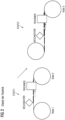
- FIG. 2 The first stage STAGE1 is now shown schematically on the left-hand side. It can be seen how a first roll ROLL1, onto which an uncoated metal foil is wound, is unwound and the foil is first coated by a schematically indicated coater COATER and dried by a schematically indicated dryer DRYER before it is rolled up again onto a second roll ROLL2.
- Drying therefore takes place sequentially, whereby overdrying of the side coated first is accepted.
- the embodiments of the method according to the invention or the means for carrying out the method relating to the embodiments of the device according to the invention are based on the features and inventive ideas described below:
- the drying process which today usually takes place in a convection oven DRYER with homogeneous heat distribution on all sides, is improved according to the invention at least in parts of the process in that it is realized and carried out by directed and/or finely controllable heating elements, such as infrared radiators or laser radiators.
- drying heating systems modified according to the invention apply the heat energy mainly to the side and only to the place where drying actually needs to be done. Heat losses due to heat conduction in the material and the heated ambient air play a minor role when using the invention.
- the method according to the invention makes targeted use of the knowledge of the 5 drying phases A...E known according to the state of the art and uses, for example, suitable sensors to determine the current drying state as a means of using this systematically and systematically.
- a far-reaching optimized drying process according to the invention can be achieved, which also allows for more gentle drying of the material while significantly reducing energy consumption.
- the first coated side of the metal foil is pre-dried using any heating method after it has been unwound, for example, from the first roll ROLL1, and coated by the coater COATER.
- the invention relates to the sub-processes within the framework of coating and drying and improves these alone, but ultimately has a beneficial effect on the battery production process as a whole, in particular because the energy requirement and the properties of the coated film and thus the scrap rate are improved.
- the metal foil is generally coated with one or, for example, several thin wet pastes of an active material to counteract the binder migration described above.
- the active material varies depending on the type of battery. In lithium-ion batteries, for example, the coating consists of a mixture of lithium compounds.
- a convection oven or directed radiator or other, in particular already conventional, heating elements DRYER can be used.
- This pre-drying is carried out until a condition corresponding to drying phase C or D is reached. Which this is may be predetermined depending on the type of battery produced and/or other parameters related to the battery and/or the manufacturing method.
- a second step S2 the above-mentioned sensor is used to check whether the predetermined drying phase has already been reached. If this is not yet the case, further heated, while in case it has been reached, the method changes to a third step S3.
- the material has been sufficiently dried within the meaning of the invention.
- Within the meaning of the invention means that it is pre-dried to such an extent that it already has good adhesion and stability properties but is not yet dry enough to be operated electrically.
- step S4 which is carried out analogously to the second stage STAGE 2 of the coating process, in which the coating of the second side takes place, the drying of the second side is carried out according to the invention using a directed, locally limited process, i.e. by means of an oven with directed energy input.
- the embodiment of the invention ensures that the side coated first is either not heated at all or is only slightly heated by heat conduction.
- This indirect heating can also be used advantageously to remove any remaining moisture (the first side was only dried up to phase C or D).
- the residual moisture of the first layer can be removed by a second, directed energy input, for example an infrared radiator implemented as another oven, at the same time or with a minimal time delay to the Drying of the second coating in the fourth step S4 also finally dry the first coating.
- a second, directed energy input for example an infrared radiator implemented as another oven
- another and/or the same sensor can be used to determine the degree of dryness.
- the process can be optimized through suitable optimization, for example through simulation and/or using a digital twin, so that when drying is completed in the fourth step S4, the first layer is automatically completely dried.
- the first step S1 can be optimized in such a way that a sensor is not necessary, but rather, for example by controlling the process after an optimal drying time has elapsed, it can be assumed that the desired, specified drying phase (C or D) has been reached.
- the film can be rolled up, for example onto the third roll ROLL3, in a fifth step S5 and the coating process reaches its final state in a second state Z2, from which it can be brought into the first state Z1 to produce a new film.
Landscapes
- Chemical & Material Sciences (AREA)
- Engineering & Computer Science (AREA)
- Chemical Kinetics & Catalysis (AREA)
- Electrochemistry (AREA)
- General Chemical & Material Sciences (AREA)
- Manufacturing & Machinery (AREA)
- Materials Engineering (AREA)
- Battery Electrode And Active Subsutance (AREA)
Priority Applications (1)
| Application Number | Priority Date | Filing Date | Title |
|---|---|---|---|
| EP23186906.6A EP4496018A1 (fr) | 2023-07-21 | 2023-07-21 | Procédé et agencement pour revêtir une feuille métallique dans le cadre d'un processus de fabrication de batterie |
Applications Claiming Priority (1)
| Application Number | Priority Date | Filing Date | Title |
|---|---|---|---|
| EP23186906.6A EP4496018A1 (fr) | 2023-07-21 | 2023-07-21 | Procédé et agencement pour revêtir une feuille métallique dans le cadre d'un processus de fabrication de batterie |
Publications (1)
| Publication Number | Publication Date |
|---|---|
| EP4496018A1 true EP4496018A1 (fr) | 2025-01-22 |
Family
ID=87429568
Family Applications (1)
| Application Number | Title | Priority Date | Filing Date |
|---|---|---|---|
| EP23186906.6A Withdrawn EP4496018A1 (fr) | 2023-07-21 | 2023-07-21 | Procédé et agencement pour revêtir une feuille métallique dans le cadre d'un processus de fabrication de batterie |
Country Status (1)
| Country | Link |
|---|---|
| EP (1) | EP4496018A1 (fr) |
Citations (3)
| Publication number | Priority date | Publication date | Assignee | Title |
|---|---|---|---|---|
| US20190081317A1 (en) * | 2017-09-11 | 2019-03-14 | Andreas Keil | Web coating and calendering system and method |
| KR20210147522A (ko) * | 2020-05-29 | 2021-12-07 | 주식회사 나래나노텍 | 배터리 전극 제조방법 |
| US20220238873A1 (en) * | 2021-01-27 | 2022-07-28 | Prime Planet Energy & Solutions, Inc. | Electrode material comprising moisture powder, electrode, method for producing same, and secondary battery provided with said electrode |
-
2023
- 2023-07-21 EP EP23186906.6A patent/EP4496018A1/fr not_active Withdrawn
Patent Citations (3)
| Publication number | Priority date | Publication date | Assignee | Title |
|---|---|---|---|---|
| US20190081317A1 (en) * | 2017-09-11 | 2019-03-14 | Andreas Keil | Web coating and calendering system and method |
| KR20210147522A (ko) * | 2020-05-29 | 2021-12-07 | 주식회사 나래나노텍 | 배터리 전극 제조방법 |
| US20220238873A1 (en) * | 2021-01-27 | 2022-07-28 | Prime Planet Energy & Solutions, Inc. | Electrode material comprising moisture powder, electrode, method for producing same, and secondary battery provided with said electrode |
Non-Patent Citations (2)
| Title |
|---|
| JANA KUMBERG ET AL.: "Drying of Lithium-Ion Battery Anodes for Use in High Energy Cells - Influence of Electrode Thickness on Drying Time, Adhesion and Crack Formation", ENERGY TECHNOLOGY, 2019 |
| JANA KUMBERG ET AL.: "Drying of Lithium-Ion Battery Anodes for Use in High Energy Cells - Influence of Electrode Thickness on Drying Time, Adhesion and Crack Formation", ENERGY TECHNOLOGY, 2019, XP002810779 * |
Similar Documents
| Publication | Publication Date | Title |
|---|---|---|
| EP0154772A1 (fr) | Plaque bipolaire pour appareil comprenant un empilement de cellules électrochimiques à électrolyte solide, et son procédé de fabrication | |
| DE102016105963A1 (de) | Brennstoffzellenseparator und Herstellungsverfahren für einen Brennstoffzellenseparator | |
| DE102015114454A1 (de) | Elektrodenkonstruktion mit optimalem ionomergehalt für eine polymerelektrolytmembran-brennstoffzelle | |
| DE2023489A1 (fr) | ||
| DE102012224228A1 (de) | Verfahren und Vorrichtung zur Nassbeschichtung eines Substrats | |
| DE102021214965B4 (de) | Stromableiter für eine Kathode einer Lithium-Ionen-Batteriezelle sowie Verfahren zur Herstellung eines solchen Stromableiters | |
| EP4305684A1 (fr) | Procédé et appareil de production d'une électrode | |
| EP4496018A1 (fr) | Procédé et agencement pour revêtir une feuille métallique dans le cadre d'un processus de fabrication de batterie | |
| EP4480015A1 (fr) | Procédé et appareil de fabrication d'électrodes en forme de bande | |
| DE102012224295A1 (de) | Kalandriereinrichtung und Verfahren zu deren Betrieb | |
| WO2020173940A1 (fr) | Feuille d'aluminium pour électrodes de batterie et procédé de fabrication | |
| DE3324968C2 (fr) | ||
| DE102011115233B4 (de) | Verfahren zur Herstellung einer abgestuften Elektrode sowie solch eine abgestufte Elektrode | |
| WO2023217318A1 (fr) | Procédé de revêtement d'une bande de film électroconductrice avec un promoteur d'adhérence électroconducteur | |
| EP4435880A1 (fr) | Ensemble de processus et procédé de fabrication d'une électrode | |
| EP3930037B1 (fr) | Dispositif de stockage d énergie et procédé de fabrication d'un dispositif de stockage d énergie | |
| EP4411848A1 (fr) | Calandre et procédé d'assemblage pour la fabrication d'une électrode en forme de feuille | |
| DE102006046373A1 (de) | Verfahren zur Herstellung einer Elektrodenschicht für eine Brennstoffzelle | |
| DE102006035468A1 (de) | Modifizierte Elektroden für elektrische Energiespeicher | |
| DE102024123566A1 (de) | Verfahren zur Trocknung einer beschichteten Zellelektrode, Verfahren zur Herstellung einer beschichteten Zellelektrode und Trocknungsvorrichtung | |
| WO2020249750A1 (fr) | Électrode pour une batterie lithium ainsi que procédé pour la fabrication de celle-ci | |
| EP4498440A1 (fr) | Procédé de fabrication d'un objet revêtu, objet revêtu, dispositif de séchage pour mettre en oeuvre le procédé et produit programme informatique comprenant un jumeau numérique pour la simulation du procédé ou du dispositif de séchage | |
| EP4476777A1 (fr) | Batterie tout solide et procédé de fabrication d'une telle batterie tout solide | |
| WO2023174657A1 (fr) | Procédé de fabrication d'une électrode pour une cellule électrochimique, électrode composite et cellule électrochimique | |
| DE102015006078A1 (de) | Katalysatorbeschichtete Membran für eine Brennstoffzelle, Verfahren zu deren Herstellung und Vorrichtung zur Durchführung des Verfahrens |
Legal Events
| Date | Code | Title | Description |
|---|---|---|---|
| PUAI | Public reference made under article 153(3) epc to a published international application that has entered the european phase |
Free format text: ORIGINAL CODE: 0009012 |
|
| STAA | Information on the status of an ep patent application or granted ep patent |
Free format text: STATUS: THE APPLICATION HAS BEEN PUBLISHED |
|
| AK | Designated contracting states |
Kind code of ref document: A1 Designated state(s): AL AT BE BG CH CY CZ DE DK EE ES FI FR GB GR HR HU IE IS IT LI LT LU LV MC ME MK MT NL NO PL PT RO RS SE SI SK SM TR |
|
| STAA | Information on the status of an ep patent application or granted ep patent |
Free format text: STATUS: THE APPLICATION IS DEEMED TO BE WITHDRAWN |
|
| 18D | Application deemed to be withdrawn |
Effective date: 20250723 |