EP4497576A1 - Dispositif et procédé de préparation de la zone de soudure du tuyau de remplissage d'un sac - Google Patents
Dispositif et procédé de préparation de la zone de soudure du tuyau de remplissage d'un sac Download PDFInfo
- Publication number
- EP4497576A1 EP4497576A1 EP23187209.4A EP23187209A EP4497576A1 EP 4497576 A1 EP4497576 A1 EP 4497576A1 EP 23187209 A EP23187209 A EP 23187209A EP 4497576 A1 EP4497576 A1 EP 4497576A1
- Authority
- EP
- European Patent Office
- Prior art keywords
- filling hose
- bag
- suction pipe
- liquid
- filling
- Prior art date
- Legal status (The legal status is an assumption and is not a legal conclusion. Google has not performed a legal analysis and makes no representation as to the accuracy of the status listed.)
- Pending
Links
Images


Classifications
-
- B—PERFORMING OPERATIONS; TRANSPORTING
- B29—WORKING OF PLASTICS; WORKING OF SUBSTANCES IN A PLASTIC STATE IN GENERAL
- B29C—SHAPING OR JOINING OF PLASTICS; SHAPING OF MATERIAL IN A PLASTIC STATE, NOT OTHERWISE PROVIDED FOR; AFTER-TREATMENT OF THE SHAPED PRODUCTS, e.g. REPAIRING
- B29C65/00—Joining or sealing of preformed parts, e.g. welding of plastics materials; Apparatus therefor
- B29C65/78—Means for handling the parts to be joined, e.g. for making containers or hollow articles, e.g. means for handling sheets, plates, web-like materials, tubular articles, hollow articles or elements to be joined therewith; Means for discharging the joined articles from the joining apparatus
- B29C65/7841—Holding or clamping means for handling purposes
- B29C65/7847—Holding or clamping means for handling purposes using vacuum to hold at least one of the parts to be joined
-
- B—PERFORMING OPERATIONS; TRANSPORTING
- B65—CONVEYING; PACKING; STORING; HANDLING THIN OR FILAMENTARY MATERIAL
- B65B—MACHINES, APPARATUS OR DEVICES FOR, OR METHODS OF, PACKAGING ARTICLES OR MATERIALS; UNPACKING
- B65B55/00—Preserving, protecting or purifying packages or package contents in association with packaging
- B65B55/24—Cleaning of, or removing dust from, containers, wrappers, or packaging ; Preventing of fouling
-
- B—PERFORMING OPERATIONS; TRANSPORTING
- B29—WORKING OF PLASTICS; WORKING OF SUBSTANCES IN A PLASTIC STATE IN GENERAL
- B29C—SHAPING OR JOINING OF PLASTICS; SHAPING OF MATERIAL IN A PLASTIC STATE, NOT OTHERWISE PROVIDED FOR; AFTER-TREATMENT OF THE SHAPED PRODUCTS, e.g. REPAIRING
- B29C65/00—Joining or sealing of preformed parts, e.g. welding of plastics materials; Apparatus therefor
- B29C65/02—Joining or sealing of preformed parts, e.g. welding of plastics materials; Apparatus therefor by heating, with or without pressure
-
- B—PERFORMING OPERATIONS; TRANSPORTING
- B08—CLEANING
- B08B—CLEANING IN GENERAL; PREVENTION OF FOULING IN GENERAL
- B08B5/00—Cleaning by methods involving the use of air flow or gas flow
- B08B5/04—Cleaning by suction, with or without auxiliary action
-
- B—PERFORMING OPERATIONS; TRANSPORTING
- B08—CLEANING
- B08B—CLEANING IN GENERAL; PREVENTION OF FOULING IN GENERAL
- B08B9/00—Cleaning hollow articles by methods or apparatus specially adapted thereto
- B08B9/02—Cleaning pipes or tubes or systems of pipes or tubes
- B08B9/027—Cleaning the internal surfaces; Removal of blockages
- B08B9/032—Cleaning the internal surfaces; Removal of blockages by the mechanical action of a moving fluid, e.g. by flushing
- B08B9/035—Cleaning the internal surfaces; Removal of blockages by the mechanical action of a moving fluid, e.g. by flushing by suction
-
- B—PERFORMING OPERATIONS; TRANSPORTING
- B29—WORKING OF PLASTICS; WORKING OF SUBSTANCES IN A PLASTIC STATE IN GENERAL
- B29C—SHAPING OR JOINING OF PLASTICS; SHAPING OF MATERIAL IN A PLASTIC STATE, NOT OTHERWISE PROVIDED FOR; AFTER-TREATMENT OF THE SHAPED PRODUCTS, e.g. REPAIRING
- B29C66/00—General aspects of processes or apparatus for joining preformed parts
- B29C66/01—General aspects dealing with the joint area or with the area to be joined
- B29C66/02—Preparation of the material, in the area to be joined, prior to joining or welding
- B29C66/022—Mechanical pre-treatments, e.g. reshaping
- B29C66/0222—Mechanical pre-treatments, e.g. reshaping without removal of material, e.g. cleaning by air blowing or using brushes
-
- B—PERFORMING OPERATIONS; TRANSPORTING
- B29—WORKING OF PLASTICS; WORKING OF SUBSTANCES IN A PLASTIC STATE IN GENERAL
- B29C—SHAPING OR JOINING OF PLASTICS; SHAPING OF MATERIAL IN A PLASTIC STATE, NOT OTHERWISE PROVIDED FOR; AFTER-TREATMENT OF THE SHAPED PRODUCTS, e.g. REPAIRING
- B29C66/00—General aspects of processes or apparatus for joining preformed parts
- B29C66/01—General aspects dealing with the joint area or with the area to be joined
- B29C66/05—Particular design of joint configurations
- B29C66/10—Particular design of joint configurations particular design of the joint cross-sections
- B29C66/11—Joint cross-sections comprising a single joint-segment, i.e. one of the parts to be joined comprising a single joint-segment in the joint cross-section
- B29C66/112—Single lapped joints
- B29C66/1122—Single lap to lap joints, i.e. overlap joints
-
- B—PERFORMING OPERATIONS; TRANSPORTING
- B29—WORKING OF PLASTICS; WORKING OF SUBSTANCES IN A PLASTIC STATE IN GENERAL
- B29C—SHAPING OR JOINING OF PLASTICS; SHAPING OF MATERIAL IN A PLASTIC STATE, NOT OTHERWISE PROVIDED FOR; AFTER-TREATMENT OF THE SHAPED PRODUCTS, e.g. REPAIRING
- B29C66/00—General aspects of processes or apparatus for joining preformed parts
- B29C66/40—General aspects of joining substantially flat articles, e.g. plates, sheets or web-like materials; Making flat seams in tubular or hollow articles; Joining single elements to substantially flat surfaces
- B29C66/41—Joining substantially flat articles ; Making flat seams in tubular or hollow articles
- B29C66/43—Joining a relatively small portion of the surface of said articles
- B29C66/431—Joining the articles to themselves
- B29C66/4312—Joining the articles to themselves for making flat seams in tubular or hollow articles, e.g. transversal seams
- B29C66/43121—Closing the ends of tubular or hollow single articles, e.g. closing the ends of bags
-
- B—PERFORMING OPERATIONS; TRANSPORTING
- B29—WORKING OF PLASTICS; WORKING OF SUBSTANCES IN A PLASTIC STATE IN GENERAL
- B29C—SHAPING OR JOINING OF PLASTICS; SHAPING OF MATERIAL IN A PLASTIC STATE, NOT OTHERWISE PROVIDED FOR; AFTER-TREATMENT OF THE SHAPED PRODUCTS, e.g. REPAIRING
- B29C66/00—General aspects of processes or apparatus for joining preformed parts
- B29C66/70—General aspects of processes or apparatus for joining preformed parts characterised by the composition, physical properties or the structure of the material of the parts to be joined; Joining with non-plastics material
- B29C66/73—General aspects of processes or apparatus for joining preformed parts characterised by the composition, physical properties or the structure of the material of the parts to be joined; Joining with non-plastics material characterised by the intensive physical properties of the material of the parts to be joined, by the optical properties of the material of the parts to be joined, by the extensive physical properties of the parts to be joined, by the state of the material of the parts to be joined or by the material of the parts to be joined being a thermoplastic or a thermoset
- B29C66/737—General aspects of processes or apparatus for joining preformed parts characterised by the composition, physical properties or the structure of the material of the parts to be joined; Joining with non-plastics material characterised by the intensive physical properties of the material of the parts to be joined, by the optical properties of the material of the parts to be joined, by the extensive physical properties of the parts to be joined, by the state of the material of the parts to be joined or by the material of the parts to be joined being a thermoplastic or a thermoset characterised by the state of the material of the parts to be joined
- B29C66/7373—Joining soiled or oxidised materials
-
- B—PERFORMING OPERATIONS; TRANSPORTING
- B29—WORKING OF PLASTICS; WORKING OF SUBSTANCES IN A PLASTIC STATE IN GENERAL
- B29C—SHAPING OR JOINING OF PLASTICS; SHAPING OF MATERIAL IN A PLASTIC STATE, NOT OTHERWISE PROVIDED FOR; AFTER-TREATMENT OF THE SHAPED PRODUCTS, e.g. REPAIRING
- B29C66/00—General aspects of processes or apparatus for joining preformed parts
- B29C66/80—General aspects of machine operations or constructions and parts thereof
- B29C66/84—Specific machine types or machines suitable for specific applications
- B29C66/849—Packaging machines
-
- B—PERFORMING OPERATIONS; TRANSPORTING
- B29—WORKING OF PLASTICS; WORKING OF SUBSTANCES IN A PLASTIC STATE IN GENERAL
- B29C—SHAPING OR JOINING OF PLASTICS; SHAPING OF MATERIAL IN A PLASTIC STATE, NOT OTHERWISE PROVIDED FOR; AFTER-TREATMENT OF THE SHAPED PRODUCTS, e.g. REPAIRING
- B29C66/00—General aspects of processes or apparatus for joining preformed parts
- B29C66/80—General aspects of machine operations or constructions and parts thereof
- B29C66/84—Specific machine types or machines suitable for specific applications
- B29C66/851—Bag or container making machines
- B29C66/8511—Bag making machines
-
- B—PERFORMING OPERATIONS; TRANSPORTING
- B65—CONVEYING; PACKING; STORING; HANDLING THIN OR FILAMENTARY MATERIAL
- B65B—MACHINES, APPARATUS OR DEVICES FOR, OR METHODS OF, PACKAGING ARTICLES OR MATERIALS; UNPACKING
- B65B3/00—Packaging plastic material, semiliquids, liquids or mixed solids and liquids, in individual containers or receptacles, e.g. bags, sacks, boxes, cartons, cans, or jars
- B65B3/003—Filling medical containers such as ampoules, vials, syringes or the like
- B65B3/006—Related operations, e.g. scoring ampoules
-
- B—PERFORMING OPERATIONS; TRANSPORTING
- B65—CONVEYING; PACKING; STORING; HANDLING THIN OR FILAMENTARY MATERIAL
- B65B—MACHINES, APPARATUS OR DEVICES FOR, OR METHODS OF, PACKAGING ARTICLES OR MATERIALS; UNPACKING
- B65B43/00—Forming, feeding, opening or setting-up containers or receptacles in association with packaging
- B65B43/42—Feeding or positioning bags, boxes, or cartons in the distended, opened, or set-up state; Feeding preformed rigid containers, e.g. tins, capsules, glass tubes, glasses, to the packaging position; Locating containers or receptacles at the filling position; Supporting containers or receptacles during the filling operation
- B65B43/46—Feeding or positioning bags, boxes, or cartons in the distended, opened, or set-up state; Feeding preformed rigid containers, e.g. tins, capsules, glass tubes, glasses, to the packaging position; Locating containers or receptacles at the filling position; Supporting containers or receptacles during the filling operation using grippers
- B65B43/465—Feeding or positioning bags, boxes, or cartons in the distended, opened, or set-up state; Feeding preformed rigid containers, e.g. tins, capsules, glass tubes, glasses, to the packaging position; Locating containers or receptacles at the filling position; Supporting containers or receptacles during the filling operation using grippers for bags
-
- B—PERFORMING OPERATIONS; TRANSPORTING
- B65—CONVEYING; PACKING; STORING; HANDLING THIN OR FILAMENTARY MATERIAL
- B65B—MACHINES, APPARATUS OR DEVICES FOR, OR METHODS OF, PACKAGING ARTICLES OR MATERIALS; UNPACKING
- B65B51/00—Devices for, or methods of, sealing or securing package folds or closures; Devices for gathering or twisting wrappers, or necks of bags
- B65B51/10—Applying or generating heat or pressure or combinations thereof
-
- B—PERFORMING OPERATIONS; TRANSPORTING
- B65—CONVEYING; PACKING; STORING; HANDLING THIN OR FILAMENTARY MATERIAL
- B65B—MACHINES, APPARATUS OR DEVICES FOR, OR METHODS OF, PACKAGING ARTICLES OR MATERIALS; UNPACKING
- B65B51/00—Devices for, or methods of, sealing or securing package folds or closures; Devices for gathering or twisting wrappers, or necks of bags
- B65B51/10—Applying or generating heat or pressure or combinations thereof
- B65B51/14—Applying or generating heat or pressure or combinations thereof by reciprocating or oscillating members
-
- B—PERFORMING OPERATIONS; TRANSPORTING
- B65—CONVEYING; PACKING; STORING; HANDLING THIN OR FILAMENTARY MATERIAL
- B65B—MACHINES, APPARATUS OR DEVICES FOR, OR METHODS OF, PACKAGING ARTICLES OR MATERIALS; UNPACKING
- B65B51/00—Devices for, or methods of, sealing or securing package folds or closures; Devices for gathering or twisting wrappers, or necks of bags
- B65B51/10—Applying or generating heat or pressure or combinations thereof
- B65B51/14—Applying or generating heat or pressure or combinations thereof by reciprocating or oscillating members
- B65B51/146—Closing bags
-
- B—PERFORMING OPERATIONS; TRANSPORTING
- B65—CONVEYING; PACKING; STORING; HANDLING THIN OR FILAMENTARY MATERIAL
- B65B—MACHINES, APPARATUS OR DEVICES FOR, OR METHODS OF, PACKAGING ARTICLES OR MATERIALS; UNPACKING
- B65B67/00—Apparatus or devices facilitating manual packaging operations; Sack holders
- B65B67/12—Sack holders, i.e. stands or frames with means for supporting sacks in the open condition to facilitate filling with articles or materials
-
- B—PERFORMING OPERATIONS; TRANSPORTING
- B29—WORKING OF PLASTICS; WORKING OF SUBSTANCES IN A PLASTIC STATE IN GENERAL
- B29C—SHAPING OR JOINING OF PLASTICS; SHAPING OF MATERIAL IN A PLASTIC STATE, NOT OTHERWISE PROVIDED FOR; AFTER-TREATMENT OF THE SHAPED PRODUCTS, e.g. REPAIRING
- B29C65/00—Joining or sealing of preformed parts, e.g. welding of plastics materials; Apparatus therefor
- B29C65/02—Joining or sealing of preformed parts, e.g. welding of plastics materials; Apparatus therefor by heating, with or without pressure
- B29C65/04—Dielectric heating, e.g. high-frequency welding, i.e. radio frequency welding of plastic materials having dielectric properties, e.g. PVC
-
- B—PERFORMING OPERATIONS; TRANSPORTING
- B29—WORKING OF PLASTICS; WORKING OF SUBSTANCES IN A PLASTIC STATE IN GENERAL
- B29C—SHAPING OR JOINING OF PLASTICS; SHAPING OF MATERIAL IN A PLASTIC STATE, NOT OTHERWISE PROVIDED FOR; AFTER-TREATMENT OF THE SHAPED PRODUCTS, e.g. REPAIRING
- B29C65/00—Joining or sealing of preformed parts, e.g. welding of plastics materials; Apparatus therefor
- B29C65/02—Joining or sealing of preformed parts, e.g. welding of plastics materials; Apparatus therefor by heating, with or without pressure
- B29C65/08—Joining or sealing of preformed parts, e.g. welding of plastics materials; Apparatus therefor by heating, with or without pressure using ultrasonic vibrations
-
- B—PERFORMING OPERATIONS; TRANSPORTING
- B29—WORKING OF PLASTICS; WORKING OF SUBSTANCES IN A PLASTIC STATE IN GENERAL
- B29C—SHAPING OR JOINING OF PLASTICS; SHAPING OF MATERIAL IN A PLASTIC STATE, NOT OTHERWISE PROVIDED FOR; AFTER-TREATMENT OF THE SHAPED PRODUCTS, e.g. REPAIRING
- B29C66/00—General aspects of processes or apparatus for joining preformed parts
- B29C66/80—General aspects of machine operations or constructions and parts thereof
- B29C66/81—General aspects of the pressing elements, i.e. the elements applying pressure on the parts to be joined in the area to be joined, e.g. the welding jaws or clamps
- B29C66/814—General aspects of the pressing elements, i.e. the elements applying pressure on the parts to be joined in the area to be joined, e.g. the welding jaws or clamps characterised by the design of the pressing elements, e.g. of the welding jaws or clamps
- B29C66/8141—General aspects of the pressing elements, i.e. the elements applying pressure on the parts to be joined in the area to be joined, e.g. the welding jaws or clamps characterised by the design of the pressing elements, e.g. of the welding jaws or clamps characterised by the surface geometry of the part of the pressing elements, e.g. welding jaws or clamps, coming into contact with the parts to be joined
- B29C66/81433—General aspects of the pressing elements, i.e. the elements applying pressure on the parts to be joined in the area to be joined, e.g. the welding jaws or clamps characterised by the design of the pressing elements, e.g. of the welding jaws or clamps characterised by the surface geometry of the part of the pressing elements, e.g. welding jaws or clamps, coming into contact with the parts to be joined being toothed, i.e. comprising several teeth or pins, or being patterned
-
- B—PERFORMING OPERATIONS; TRANSPORTING
- B29—WORKING OF PLASTICS; WORKING OF SUBSTANCES IN A PLASTIC STATE IN GENERAL
- B29C—SHAPING OR JOINING OF PLASTICS; SHAPING OF MATERIAL IN A PLASTIC STATE, NOT OTHERWISE PROVIDED FOR; AFTER-TREATMENT OF THE SHAPED PRODUCTS, e.g. REPAIRING
- B29C66/00—General aspects of processes or apparatus for joining preformed parts
- B29C66/80—General aspects of machine operations or constructions and parts thereof
- B29C66/83—General aspects of machine operations or constructions and parts thereof characterised by the movement of the joining or pressing tools
- B29C66/832—Reciprocating joining or pressing tools
- B29C66/8322—Joining or pressing tools reciprocating along one axis
- B29C66/83221—Joining or pressing tools reciprocating along one axis cooperating reciprocating tools, each tool reciprocating along one axis
-
- B—PERFORMING OPERATIONS; TRANSPORTING
- B29—WORKING OF PLASTICS; WORKING OF SUBSTANCES IN A PLASTIC STATE IN GENERAL
- B29L—INDEXING SCHEME ASSOCIATED WITH SUBCLASS B29C, RELATING TO PARTICULAR ARTICLES
- B29L2023/00—Tubular articles
-
- B—PERFORMING OPERATIONS; TRANSPORTING
- B29—WORKING OF PLASTICS; WORKING OF SUBSTANCES IN A PLASTIC STATE IN GENERAL
- B29L—INDEXING SCHEME ASSOCIATED WITH SUBCLASS B29C, RELATING TO PARTICULAR ARTICLES
- B29L2031/00—Other particular articles
- B29L2031/712—Containers; Packaging elements or accessories, Packages
- B29L2031/7148—Blood bags, medical bags
Definitions
- the invention relates to a device and a method for preparing the weld seam area of the filling tube of a bag, in particular an infusion bag.
- the infusion bags can be bags with just one chamber, but also multi-chamber bags. Multi-chamber bags can also contain a powder and a liquid chamber, for example.
- Infusion bags must generally be filled under special conditions (called “low bio burden” or even aseptic conditions), as the contents of the infusion bags are administered to a patient and must therefore not be contaminated.
- low bio burden or even aseptic conditions
- oxygen-sensitive ingredients particularly cancer drugs or infusions for parenteral nutrition
- it may be necessary to fill the infusion bags under inert gas as the liquid to be filled must not come into contact with atmospheric oxygen.
- Nitrogen is usually used as the inert gas.
- sterilization after filling is possible. In this case, an aseptic production process is not required. If subsequent sterilization is not possible, however, an aseptic production process must be carried out.
- the bags usually have a filling hose through which the bags can be filled.
- a dosing needle is inserted into the filling hose.
- the dosing needle can have at least one contour feature on its outer contour, through which the elastic filling hose is expanded from the inside.
- the filling hose then seals itself through its own tension. against the dispensing needle.
- Such a seal between the filling hose and the dispensing needle is necessary so that no liquid can get between the dispensing needle and the filling hose during dispensing. Counterforces can occur when the bag is being filled.
- the filling hose must therefore be stretched so much at the contour features that the forces of the material tension are greater than the forces of the liquid.
- the filling hose is usually stretched relatively strongly in length.
- the filling hose then contracts again suddenly. This can lead to product splashing into the environment; contamination of the inside of the filling hose is also possible.
- the often used active pushing of the filling hose off the dispensing needle can also lead to similar effects due to the tensions and thus also to contamination.
- a short post-gassing can be carried out first. This is generally possible when using a dosing valve with connections for both the liquid and an inert gas. If, however, active post-gassing is not to be used during dosing, another method must be used to ensure that the dosing hose is ventilated. This can be particularly difficult when filling using "single-use" components.
- Liquid residues in the end area of the filling hose can make it difficult to close the bag afterwards.
- voltage flashovers can occur, which can also occur inside the filling hose. If welding is carried out beyond the end of the hose, the risk of such voltage flashovers is significantly increased. Voltage flashovers can also occur if liquid residues are pushed outwards by the contact pressure of the welding jaws. In some cases, the bag may also leak, which would lead to the product in question being excluded. This can be a problem, especially with liquids that contain protein. Liquids that contain protein can make secure welding more difficult, as the proteins form a barrier layer.
- the weld seam is placed in the area of the wet filling hose depending on the hose material, the liquid and the welding process selected (usually ultrasonic welding or high frequency welding). In some cases, the weld seam is even penetrated by the liquid if the liquid reaches the filling hose. Whether such a weld seam is successful depends, among other things, on the hose material, the type of liquid, the welding process selected and the available welding time.
- the invention is based on the object of specifying a device and a method for preparing the weld seam area of the filling hose of a bag, which make it possible to weld the filling hose as safely and simply as possible.
- the device according to the invention for preparing the weld seam area of the filling hose of a bag is given by the features of the main claim 1.
- the method according to the invention for preparing the weld seam area of the filling hose of a bag is given by the features of the independent claim 6.
- the device according to the invention for preparing the weld seam area of the filling hose of a bag has a holding device for the bag.
- a suction pipe is provided that can be inserted into the filling hose of the bag.
- a clamping device is provided by which the filling hose or the bag can be clamped off. The device according to the invention can reduce the moisture within the filling hose in the weld seam area so that the weld seam can be set precisely and there is no risk of leaks.
- the clamping device can be provided between the free end of the suction pipe and the bag. This allows the filling hose to be clamped off by the clamping device.
- the clamping device can also be provided in the upper area of the bag. This allows the bag to be clamped off above the liquid already present in the bag.
- the filling hose or the bag is clamped off.
- a suction pipe is inserted into the filling hose.
- the liquid remaining in the filling hose is sucked out through this suction pipe.
- the filling hose or bag can be disconnected in a first step.
- the liquid remaining in the filling hose can be sucked out while the suction tube is being inserted.
- the suction tube can remain inside the filling hose for a certain time while the suction continues.
- the filling hose is usually filled from above, so that the filling hose is positioned at the upper edge of the bag. Therefore, the suction pipe is also usually filled into the filling hose from above. Accordingly, the clamping device is positioned a little below the free end of the suction pipe.
- a circumferential gap can be provided between the outer wall of the suction pipe and the inner wall of the filling hose. In this way, the The area of the filling hose where the suction pipe is located can be treated optimally. In addition, drops from the edge of the filling hose can also be removed.
- the device according to the invention can preferably have a sealing device which is arranged between the clamping device and the free end of the filling hose.
- a sealing device can in particular have two sealing jaws between which the sealing seam can be formed.
- the filling hose can be welded immediately after removing the suction pipe.
- the filling hose can still be clamped off so that renewed contamination of the inner walls of the filling hose can be ruled out.
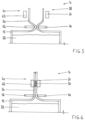
- the device 10 according to the invention is shown in the Fig 1 to 6 shown schematically.
- the device 10 has a holding device (not shown here) by means of which a bag 12, which can in particular be an infusion bag 12, can be held.
- the bag 12 is held essentially hanging by the holding device, so that the bag 12 is aligned approximately vertically.
- the bag 12 has a filling hose 20 that is arranged on the upper edge of the bag 12.
- the filling hose 20 can be one piece with the bag 12 or attached to the bag 12.
- the bag 12 has already been filled with at least one liquid 22 at a previous processing station.
- drops 26 of the liquid 22 remained in two places on the inside 24 of the filling hose 20 in the present example.
- These remaining liquid drops 26 are located in the weld seam area 28 of the filling hose 20.
- the drops 26 can make it difficult to produce a sealing seam 34 and can impair the quality of the sealing seam 34. Therefore, such drops 26 should be removed before producing the weld seam 34.
- the drops 32 on the edge 30 of the filling hose 20 can lead to contamination of the outside of the bag 12 or the filling hose 20 so that these drops 32 should also be removed if possible.
- the device 10 according to the invention therefore has a clamping device 40 in the area of the filling hose 20.
- the clamping device 40 has two clamping jaws 42, 44.
- the filling hose 20 can be tightly clamped off by the clamping jaws 42, 44.
- no further liquid 22 can get from the bag 12 into the filling hose 20; at the same time, no more air or liquid can flow from the filling hose 20 into the bag 12.
- the clamping device 40 is arranged relatively close to the upper edge of the bag 12. Depending on the length of the filling hose 20, the clamping device 40 can also be further away from the upper edge of the bag 12.
- the device 10 has a suction pipe 50, which is initially located outside the filling hose 20 (see Fig. 1 ). After filling the bag 12 with the liquid 22, in the present example, the filling hose 20 is first clamped off by the clamping device 40 (see Fig. 2 ). The suction pipe 50 is then inserted at least a little way into the filling hose 20 (see Fig. 3 ). Air is sucked out through the suction pipe 50. This can be done, for example, by a vacuum generator that is connected to the suction pipe 50.
- the suction pipe 50 is designed in such a way that a circumferential gap 52 is formed between the outside of the suction pipe 50 and the inside 24 of the filling hose 20.
- suction begins as soon as the suction pipe 50 is inserted into the filling hose 20. This also allows liquid droplets 32 present on the circumferential edge 30 to be removed. After the complete After inserting the suction pipe 50 into the filling hose 20, the suction can be continued for a certain time until no more liquid residues remain on the inside 24 of the filling hose 20 (see Fig. 4 ). The duration of the suction can be varied depending on the liquid 22 and the material of the filling hose 20.
- the suction pipe 50 can then be removed from the filling hose 20 (see Fig. 5 ).
- the clamping of the filling hose 20 by the clamping device 40 should initially be maintained so that the filling hose 20 cannot become contaminated again.
- the filling hose 20 can then be closed by means of a sealing seam 34.
- the device 10 has a sealing device 60 for this purpose.
- the sealing device 60 has two sealing jaws 62, 64 in the present example.
- the sealing device 60 is arranged between the clamping device 40 and the peripheral edge 30 of the filling hose 20.
- the sealing seam 34 can thus be produced immediately after the suction pipe 50 has been removed (see Fig. 6 ).
- the inner side 24 of the filling hose 20 is thereby largely freed of liquid residues, so that a sealing seam 34 of high quality can be produced.
- the sealing seam 34 can also be produced in a downstream processing station.
- the sealing seam 34 can - as shown in the drawings - only be placed in the middle area of the filling hose 20. Alternatively, the sealing seam 34 also extends to the bottom and/or top edge of the filling hose 20.
Landscapes
- Engineering & Computer Science (AREA)
- Mechanical Engineering (AREA)
- Basic Packing Technique (AREA)
- Supplying Of Containers To The Packaging Station (AREA)
Priority Applications (4)
| Application Number | Priority Date | Filing Date | Title |
|---|---|---|---|
| EP23187209.4A EP4497576A1 (fr) | 2023-07-24 | 2023-07-24 | Dispositif et procédé de préparation de la zone de soudure du tuyau de remplissage d'un sac |
| US18/779,150 US20250033296A1 (en) | 2023-07-24 | 2024-07-22 | Device and method for preparing the weld region of the filling tube of a bag |
| CA3249574A CA3249574A1 (fr) | 2023-07-24 | 2024-07-23 | Dispositif et procédé de préparation de la zone de soudure du tube de remplissage d'un sac |
| CN202410993220.2A CN119348939A (zh) | 2023-07-24 | 2024-07-24 | 用于制备包袋的填充软管的焊缝区域的设备和方法 |
Applications Claiming Priority (1)
| Application Number | Priority Date | Filing Date | Title |
|---|---|---|---|
| EP23187209.4A EP4497576A1 (fr) | 2023-07-24 | 2023-07-24 | Dispositif et procédé de préparation de la zone de soudure du tuyau de remplissage d'un sac |
Publications (1)
| Publication Number | Publication Date |
|---|---|
| EP4497576A1 true EP4497576A1 (fr) | 2025-01-29 |
Family
ID=87474357
Family Applications (1)
| Application Number | Title | Priority Date | Filing Date |
|---|---|---|---|
| EP23187209.4A Pending EP4497576A1 (fr) | 2023-07-24 | 2023-07-24 | Dispositif et procédé de préparation de la zone de soudure du tuyau de remplissage d'un sac |
Country Status (4)
| Country | Link |
|---|---|
| US (1) | US20250033296A1 (fr) |
| EP (1) | EP4497576A1 (fr) |
| CN (1) | CN119348939A (fr) |
| CA (1) | CA3249574A1 (fr) |
Citations (1)
| Publication number | Priority date | Publication date | Assignee | Title |
|---|---|---|---|---|
| US3823438A (en) * | 1972-02-03 | 1974-07-16 | Whitehall Machinery Ltd | Apparatus for handling sacks |
Family Cites Families (1)
| Publication number | Priority date | Publication date | Assignee | Title |
|---|---|---|---|---|
| DE102018103863A1 (de) * | 2018-02-21 | 2019-08-22 | Fresenius Medical Care Deutschland Gmbh | Vorrichtung und Verfahren zum Befüllen von Lösungsbeuteln für die Dialyse |
-
2023
- 2023-07-24 EP EP23187209.4A patent/EP4497576A1/fr active Pending
-
2024
- 2024-07-22 US US18/779,150 patent/US20250033296A1/en active Pending
- 2024-07-23 CA CA3249574A patent/CA3249574A1/fr active Pending
- 2024-07-24 CN CN202410993220.2A patent/CN119348939A/zh active Pending
Patent Citations (1)
| Publication number | Priority date | Publication date | Assignee | Title |
|---|---|---|---|---|
| US3823438A (en) * | 1972-02-03 | 1974-07-16 | Whitehall Machinery Ltd | Apparatus for handling sacks |
Also Published As
| Publication number | Publication date |
|---|---|
| CA3249574A1 (fr) | 2025-06-17 |
| US20250033296A1 (en) | 2025-01-30 |
| CN119348939A (zh) | 2025-01-24 |
Similar Documents
| Publication | Publication Date | Title |
|---|---|---|
| DE2546687C2 (fr) | ||
| DE69614133T2 (de) | Verfahren und vorrichtung zum mischen von bestandteilen für knochenzement in einem mischbehälter | |
| DE69635595T2 (de) | Vorrichtung zur Dampfsterilisation von Erzeugnissen mit Lumen | |
| DE69517627T2 (de) | Verfahren und Vorrichtung zum Füllen eines geschlossenen Behälters unter aseptischen Bedingungen | |
| DE69019620T2 (de) | Apparat und methode zur aseptischen entnahme von flüssigkeitsproben aus einer sterilen flüssigkeitsquelle. | |
| EP2981364B1 (fr) | Dispositif de transport de poudre et son procede de fonctionnement | |
| EP3010645B1 (fr) | Dispositif pour transporter de la poudre de revetement | |
| EP3496766B1 (fr) | Procédé et récipient de transport et de transfert de produit coulant stérile dans un isolateur | |
| DE69605992T2 (de) | Vorrichtung und Verfahren zum Evakuieren von Beuteln | |
| DE102007041666B4 (de) | Vorrichtung und Verfahren zum Mischen von Knochenzement | |
| EP1212993A3 (fr) | Dispositif de mélange et dispositif de transfer d'une matière à écoulement libre | |
| EP2303701A1 (fr) | Procédé pour remplir des systèmes à chambre double dans des systèmes supports préstérilisables et système support préstérilisable | |
| DE2329348C3 (fr) | ||
| EP3512621A1 (fr) | Dispositif et procédé pour mélanger le contenu d'un réservoir | |
| EP4282518B1 (fr) | Dispositif et procédé de préparation de la pâte de ciment osseux | |
| EP3049332B1 (fr) | Installation de remplissage aseptique d'un récipient | |
| EP3006061B1 (fr) | Procédé de commande de la pression d'irrigation | |
| EP4497576A1 (fr) | Dispositif et procédé de préparation de la zone de soudure du tuyau de remplissage d'un sac | |
| EP3428610A2 (fr) | Dispositif d'échantillonnage | |
| EP3714926A1 (fr) | Instrument, tête d'instrument, système d'application et procédé | |
| EP0355456B1 (fr) | Dispositif pour le traitement du sang avec un gaz | |
| EP2125523B1 (fr) | Dispositif et procédé de transvasement sans contamination de poudres et de solides et nouvelle utilisation d'une feuille tubulaire pouvant être soudée et détachable | |
| DE912329C (de) | Homogenisiervorrichtung fuer Fluessigkeiten | |
| EP4339111A1 (fr) | Dispositif et procédé de remplissage de sacs | |
| DE10346842B4 (de) | Vorrichtung zum Füllen und Verschließen von rohrförmigen Behältern, insbesondere in der pharmazeutischen Industrie |
Legal Events
| Date | Code | Title | Description |
|---|---|---|---|
| PUAI | Public reference made under article 153(3) epc to a published international application that has entered the european phase |
Free format text: ORIGINAL CODE: 0009012 |
|
| STAA | Information on the status of an ep patent application or granted ep patent |
Free format text: STATUS: THE APPLICATION HAS BEEN PUBLISHED |
|
| AK | Designated contracting states |
Kind code of ref document: A1 Designated state(s): AL AT BE BG CH CY CZ DE DK EE ES FI FR GB GR HR HU IE IS IT LI LT LU LV MC ME MK MT NL NO PL PT RO RS SE SI SK SM TR |
|
| STAA | Information on the status of an ep patent application or granted ep patent |
Free format text: STATUS: REQUEST FOR EXAMINATION WAS MADE |
|
| 17P | Request for examination filed |
Effective date: 20250530 |