EP4498444A1 - Elektrode für eine wiederaufladbare lithiumbatterie und wiederaufladbare lithiumbatterie damit - Google Patents
Elektrode für eine wiederaufladbare lithiumbatterie und wiederaufladbare lithiumbatterie damit Download PDFInfo
- Publication number
- EP4498444A1 EP4498444A1 EP24187594.7A EP24187594A EP4498444A1 EP 4498444 A1 EP4498444 A1 EP 4498444A1 EP 24187594 A EP24187594 A EP 24187594A EP 4498444 A1 EP4498444 A1 EP 4498444A1
- Authority
- EP
- European Patent Office
- Prior art keywords
- electrode
- binder
- coating layer
- lithium battery
- combination
- Prior art date
- Legal status (The legal status is an assumption and is not a legal conclusion. Google has not performed a legal analysis and makes no representation as to the accuracy of the status listed.)
- Pending
Links
Images


Classifications
-
- H—ELECTRICITY
- H01—ELECTRIC ELEMENTS
- H01M—PROCESSES OR MEANS, e.g. BATTERIES, FOR THE DIRECT CONVERSION OF CHEMICAL ENERGY INTO ELECTRICAL ENERGY
- H01M4/00—Electrodes
- H01M4/02—Electrodes composed of, or comprising, active material
- H01M4/62—Selection of inactive substances as ingredients for active masses, e.g. binders, fillers
- H01M4/621—Binders
- H01M4/622—Binders being polymers
-
- H—ELECTRICITY
- H01—ELECTRIC ELEMENTS
- H01M—PROCESSES OR MEANS, e.g. BATTERIES, FOR THE DIRECT CONVERSION OF CHEMICAL ENERGY INTO ELECTRICAL ENERGY
- H01M4/00—Electrodes
- H01M4/02—Electrodes composed of, or comprising, active material
- H01M4/13—Electrodes for accumulators with non-aqueous electrolyte, e.g. for lithium-accumulators; Processes of manufacture thereof
-
- H—ELECTRICITY
- H01—ELECTRIC ELEMENTS
- H01M—PROCESSES OR MEANS, e.g. BATTERIES, FOR THE DIRECT CONVERSION OF CHEMICAL ENERGY INTO ELECTRICAL ENERGY
- H01M10/00—Secondary cells; Manufacture thereof
- H01M10/05—Accumulators with non-aqueous electrolyte
- H01M10/052—Li-accumulators
-
- H—ELECTRICITY
- H01—ELECTRIC ELEMENTS
- H01M—PROCESSES OR MEANS, e.g. BATTERIES, FOR THE DIRECT CONVERSION OF CHEMICAL ENERGY INTO ELECTRICAL ENERGY
- H01M4/00—Electrodes
- H01M4/02—Electrodes composed of, or comprising, active material
- H01M4/13—Electrodes for accumulators with non-aqueous electrolyte, e.g. for lithium-accumulators; Processes of manufacture thereof
- H01M4/131—Electrodes based on mixed oxides or hydroxides, or on mixtures of oxides or hydroxides, e.g. LiCoOx
-
- H—ELECTRICITY
- H01—ELECTRIC ELEMENTS
- H01M—PROCESSES OR MEANS, e.g. BATTERIES, FOR THE DIRECT CONVERSION OF CHEMICAL ENERGY INTO ELECTRICAL ENERGY
- H01M4/00—Electrodes
- H01M4/02—Electrodes composed of, or comprising, active material
- H01M4/36—Selection of substances as active materials, active masses, active liquids
- H01M4/48—Selection of substances as active materials, active masses, active liquids of inorganic oxides or hydroxides
- H01M4/52—Selection of substances as active materials, active masses, active liquids of inorganic oxides or hydroxides of nickel, cobalt or iron
- H01M4/525—Selection of substances as active materials, active masses, active liquids of inorganic oxides or hydroxides of nickel, cobalt or iron of mixed oxides or hydroxides containing iron, cobalt or nickel for inserting or intercalating light metals, e.g. LiNiO2, LiCoO2 or LiCoOxFy
-
- H—ELECTRICITY
- H01—ELECTRIC ELEMENTS
- H01M—PROCESSES OR MEANS, e.g. BATTERIES, FOR THE DIRECT CONVERSION OF CHEMICAL ENERGY INTO ELECTRICAL ENERGY
- H01M4/00—Electrodes
- H01M4/02—Electrodes composed of, or comprising, active material
- H01M4/36—Selection of substances as active materials, active masses, active liquids
- H01M4/58—Selection of substances as active materials, active masses, active liquids of inorganic compounds other than oxides or hydroxides, e.g. sulfides, selenides, tellurides, halogenides or LiCoFy; of polyanionic structures, e.g. phosphates, silicates or borates
- H01M4/5825—Oxygenated metallic salts or polyanionic structures, e.g. borates, phosphates, silicates, olivines
-
- H—ELECTRICITY
- H01—ELECTRIC ELEMENTS
- H01M—PROCESSES OR MEANS, e.g. BATTERIES, FOR THE DIRECT CONVERSION OF CHEMICAL ENERGY INTO ELECTRICAL ENERGY
- H01M4/00—Electrodes
- H01M4/02—Electrodes composed of, or comprising, active material
- H01M4/62—Selection of inactive substances as ingredients for active masses, e.g. binders, fillers
-
- H—ELECTRICITY
- H01—ELECTRIC ELEMENTS
- H01M—PROCESSES OR MEANS, e.g. BATTERIES, FOR THE DIRECT CONVERSION OF CHEMICAL ENERGY INTO ELECTRICAL ENERGY
- H01M4/00—Electrodes
- H01M4/02—Electrodes composed of, or comprising, active material
- H01M4/62—Selection of inactive substances as ingredients for active masses, e.g. binders, fillers
- H01M4/624—Electric conductive fillers
- H01M4/625—Carbon or graphite
-
- H—ELECTRICITY
- H01—ELECTRIC ELEMENTS
- H01M—PROCESSES OR MEANS, e.g. BATTERIES, FOR THE DIRECT CONVERSION OF CHEMICAL ENERGY INTO ELECTRICAL ENERGY
- H01M4/00—Electrodes
- H01M4/02—Electrodes composed of, or comprising, active material
- H01M4/64—Carriers or collectors
- H01M4/66—Selection of materials
- H01M4/661—Metal or alloys, e.g. alloy coatings
-
- H—ELECTRICITY
- H01—ELECTRIC ELEMENTS
- H01M—PROCESSES OR MEANS, e.g. BATTERIES, FOR THE DIRECT CONVERSION OF CHEMICAL ENERGY INTO ELECTRICAL ENERGY
- H01M4/00—Electrodes
- H01M4/02—Electrodes composed of, or comprising, active material
- H01M4/64—Carriers or collectors
- H01M4/66—Selection of materials
- H01M4/665—Composites
- H01M4/667—Composites in the form of layers, e.g. coatings
-
- H—ELECTRICITY
- H01—ELECTRIC ELEMENTS
- H01M—PROCESSES OR MEANS, e.g. BATTERIES, FOR THE DIRECT CONVERSION OF CHEMICAL ENERGY INTO ELECTRICAL ENERGY
- H01M4/00—Electrodes
- H01M4/02—Electrodes composed of, or comprising, active material
- H01M4/64—Carriers or collectors
- H01M4/66—Selection of materials
- H01M4/668—Composites of electroconductive material and synthetic resins
-
- H—ELECTRICITY
- H01—ELECTRIC ELEMENTS
- H01M—PROCESSES OR MEANS, e.g. BATTERIES, FOR THE DIRECT CONVERSION OF CHEMICAL ENERGY INTO ELECTRICAL ENERGY
- H01M10/00—Secondary cells; Manufacture thereof
- H01M10/05—Accumulators with non-aqueous electrolyte
- H01M10/052—Li-accumulators
- H01M10/0525—Rocking-chair batteries, i.e. batteries with lithium insertion or intercalation in both electrodes; Lithium-ion batteries
-
- H—ELECTRICITY
- H01—ELECTRIC ELEMENTS
- H01M—PROCESSES OR MEANS, e.g. BATTERIES, FOR THE DIRECT CONVERSION OF CHEMICAL ENERGY INTO ELECTRICAL ENERGY
- H01M4/00—Electrodes
- H01M4/02—Electrodes composed of, or comprising, active material
- H01M2004/021—Physical characteristics, e.g. porosity, surface area
-
- H—ELECTRICITY
- H01—ELECTRIC ELEMENTS
- H01M—PROCESSES OR MEANS, e.g. BATTERIES, FOR THE DIRECT CONVERSION OF CHEMICAL ENERGY INTO ELECTRICAL ENERGY
- H01M4/00—Electrodes
- H01M4/02—Electrodes composed of, or comprising, active material
- H01M2004/026—Electrodes composed of, or comprising, active material characterised by the polarity
- H01M2004/028—Positive electrodes
-
- Y—GENERAL TAGGING OF NEW TECHNOLOGICAL DEVELOPMENTS; GENERAL TAGGING OF CROSS-SECTIONAL TECHNOLOGIES SPANNING OVER SEVERAL SECTIONS OF THE IPC; TECHNICAL SUBJECTS COVERED BY FORMER USPC CROSS-REFERENCE ART COLLECTIONS [XRACs] AND DIGESTS
- Y02—TECHNOLOGIES OR APPLICATIONS FOR MITIGATION OR ADAPTATION AGAINST CLIMATE CHANGE
- Y02E—REDUCTION OF GREENHOUSE GAS [GHG] EMISSIONS, RELATED TO ENERGY GENERATION, TRANSMISSION OR DISTRIBUTION
- Y02E60/00—Enabling technologies; Technologies with a potential or indirect contribution to GHG emissions mitigation
- Y02E60/10—Energy storage using batteries
Definitions
- An electrode for a rechargeable lithium battery and a rechargeable lithium battery including the same are disclosed.
- a rechargeable lithium battery includes a positive electrode and a negative electrode including an active material capable of intercalating and deintercalating lithium ions, and an electrolyte, and electrical energy is produced through oxidation and reduction reactions if lithium ions are intercalated/deintercalated from the positive electrode and negative electrode.
- a conductive coating layer (e.g., an electrically conductive coating layer) may be provided between the current collector and the active material layer.
- the conductive coating layer may be formed by coating a conductive slurry (e.g., an electrically conductive slurry) including a conductive material (e.g., an electrically conductive material) and a binder on a current collector and the binder may be CMC, PVdF, etc.
- a conductive slurry e.g., an electrically conductive slurry
- a conductive material e.g., an electrically conductive material
- a binder may be CMC, PVdF, etc.
- binders such as CMC and PVdF have low adhesive strength, and thus in order to exhibit sufficient adhesive strength, an amount of binder used may be increased, and an amount of conductive material used accordingly decreases.
- the adhesive strength and conductivity of the conductive coating layer are in a trade-off relationship.
- Some embodiments of the present disclosure provide an electrode for a rechargeable lithium battery that has excellent adhesive strength and conductivity (e.g., electrical conductivity).
- Some embodiments provide a rechargeable lithium battery including the electrode.
- an electrode for a rechargeable lithium battery including a current collector; a conductive coating layer (e.g., an electrically conductive coating layer) on the current collector; and an active material layer on the conductive coating layer, wherein the conductive coating layer includes a conductive material (e.g., an electrically conductive material); a binder; and a compound including a catechol functional group, a quinone functional group, or a combination thereof.
- a conductive coating layer e.g., an electrically conductive coating layer
- the conductive coating layer includes a conductive material (e.g., an electrically conductive material); a binder; and a compound including a catechol functional group, a quinone functional group, or a combination thereof.
- Some embodiments provide a rechargeable lithium battery including the electrode.
- the electrode according to some embodiments can exhibit excellent adhesive strength and conductivity (e.g., electrical conductivity). Accordingly, the rechargeable lithium battery including the electrode according to some embodiments can exhibit excellent cycle-life characteristics by minimizing or reducing an increase in resistance (e.g., electrical resistance) and a decrease in energy density during operation.
- adhesive strength and conductivity e.g., electrical conductivity
- “combination thereof” may mean a mixture of constituents, a stack, a composite, a copolymer, an alloy, a blend, and/or a reaction product.
- a particle diameter may be an average particle diameter.
- the particle diameter means an average particle diameter (D50), which is a diameter of particles with a cumulative volume of 50 volume% in the particle size distribution.
- the average particle diameter (D50) may be measured by any suitable method generally used in the art, for example, by a particle size analyzer, by a transmission electron microscopic image, and/or a scanning electron microscopic image.
- a dynamic light-scattering measurement device is used to perform a data analysis, and the number of particles is counted for each particle size range. From this, the average particle diameter (D50) value may be easily obtained through a calculation.
- a laser diffraction method may also be used.
- the particles to be measured are dispersed in a dispersion medium and then introduced into a commercially available laser diffraction particle size measuring device (e.g., MT 3000 available from Microtrac, Ltd.) using ultrasonic waves at about 28 kHz, and after irradiation with an output of 60 W, the average particle size (D50) based on 50% of the particle size distribution in the measuring device can be calculated.
- a commercially available laser diffraction particle size measuring device e.g., MT 3000 available from Microtrac, Ltd.
- thickness may be measured through a picture or image taken with an optical microscope or, for example, a scanning electron microscope.
- an electrode for a rechargeable lithium battery including a current collector; a conductive coating layer (e.g., an electrically conductive layer) on the current collector; and an active material layer on the conductive coating layer, wherein the conductive coating layer includes a conductive material (e.g., an electrically conductive material), a binder, and a compound including a catechol functional group.
- a conductive coating layer e.g., an electrically conductive layer
- the conductive coating layer includes a conductive material (e.g., an electrically conductive material), a binder, and a compound including a catechol functional group.
- the electrode according to some embodiments can exhibit excellent adhesive strength and conductivity (e.g., electrical conductivity). Accordingly, the rechargeable lithium battery including the electrode according to some embodiments can exhibit excellent cycle-life characteristics by minimizing or reducing an increase in resistance (e.g., electrical resistance) and a decrease in energy density during operation.
- adhesive strength and conductivity e.g., electrical conductivity
- the conductive coating layer may be between the current collector and the active material layer to increase the conductivity (e.g., the electrical conductivity) of the electrode.
- the conductive coating layer includes a compound including a catechol functional group, a quinone functional group, or a combination thereof.
- the compound including the catechol functional group, quinone functional group, or a combination thereof is a material that exhibits suitable or sufficient adhesive strength even in a small amount. Accordingly, the electrode of some embodiments can exhibit sufficient adhesive strength even if the amount of binder used is reduced, and the conductivity can be improved by increasing the amount of the conductive material used.
- the compound including the catechol functional group, quinone functional group, or combination thereof is a monomolecular compound, and has a weight average molecular weight as measured by gas chromatography mass spectrometry (GC-MS), liquid chromatography mass spectrometry (LC-MS) and/or matrix-assisted laser desorption/ionization time of flight mass spectrometry (MALDI-TOF) method of about 100 g/mol to about 1,000 g/mol, about 1,000 g/mol to about 3,000 g/mol, about 1,200 g/mol to about 2,500 g/mol, or about 1,500 g/mol to about 2,000 g/mol.
- GC-MS gas chromatography mass spectrometry
- LC-MS liquid chromatography mass spectrometry
- MALDI-TOF matrix-assisted laser desorption/ionization time of flight mass spectrometry
- the compound including the catechol functional group may include tannic acid, humic acid, pyrogallolic acid, catecholamine, dopamine hydrochloride, 3,4-dihydroxybenzaldehyde, caffeic acid, or a combination thereof.
- the compound including the catechol functional group may have a feature of being able to induce strong bonding with the polymer compound (e.g., the binder) through multiple hydrogen bonds and/or chemical crosslinking.
- the compound including the catechol functional group can be oxidized by oxygen and converted to a quinone functional group.
- the compound including the quinone functional group may include humic acid.
- the quinone functional group can form a strong covalent bond with the amino group or hydroxy group contained in the binder, and even if the amount of binder used in the conductive coating layer is reduced, suitable or sufficient adhesive strength can be secured and resistance (e.g., electrical resistance of the electrode) can be reduced.
- the compound including the catechol functional group, quinone functional group, or combination thereof may be included in an amount of about 0.1 wt% to about 15 wt%, about 1 wt% to about 10 wt%, or about 5 wt% to about 7 wt%, based on a total amount of the conductive coating layer. In this way, the compound including the catechol functional group, quinone functional group, or combination thereof can exhibit suitable or sufficient adhesive strength even in a small amount.
- the conductive coating layer includes a binder.
- the binder may play a role in adhering the materials in the conductive coating layer to each other and adhering the conductive coating layer to the active material layer.
- the binder may be a non-water-soluble binder, a water-soluble binder, or a combination thereof.
- the water-insoluble binder may include polyvinyl chloride, carboxylated polyvinyl chloride, polyvinyl fluoride, an ethylene oxide-containing polymer, an ethylene propylene copolymer, polystyrene, polyvinylpyrrolidone, polyurethane, polytetrafluoro ethylene, polyvinylidene fluoride, polyethylene, polypropylene, polyamideimide, polyimide, or a combination thereof.
- the polymer resin binder may be selected from polyethyleneoxide, polyvinylpyrrolidone, polyepichlorohydrin, polyphosphazene, polyacrylonitrile, ethylenepropylenedienecopolymer, polyvinylpyridine, chlorosulfonatedpolyethylene, latex, a polyester resin, an acrylic resin, a phenolic resin, an epoxy resin, polyvinyl alcohol, and a combination thereof.
- a cellulose-based compound capable of imparting viscosity may be further included.
- the cellulose-based compound one or more of carboxymethyl cellulose, hydroxypropylmethyl cellulose, methyl cellulose, or alkali metal salts thereof may be mixed together and used.
- the alkali metal may be Na, K, and/or Li.
- the positive electrode active material layer includes a positive electrode active material.
- the positive electrode active material may be a compound (lithiated intercalation compound) capable of intercalating and deintercalating lithium.
- a compound (lithiated intercalation compound) capable of intercalating and deintercalating lithium.
- one or more types (or kinds) of composite oxides of lithium and a metal selected from cobalt, manganese, nickel, and a combination thereof can be used.
- Li a A 1-b X b O 2-c D c (0.90 ⁇ a ⁇ 1.8, 0 ⁇ b ⁇ 0.5, 0 ⁇ c ⁇ 0.05); Li a Mn 2-b X b O 4-c D c (0.90 ⁇ a ⁇ 1.8, 0 ⁇ b ⁇ 0.5, 0 ⁇ c ⁇ 0.05); Li a Ni 1-b-c Co b X c O 2- ⁇ D ⁇ (0.90 ⁇ a ⁇ 1.8, 0 ⁇ b ⁇ 0.5, 0 ⁇ c ⁇ 0.5, 0 ⁇ 2); Li a Ni 1-b-c Mn b X c O 2- ⁇ D ⁇ (0.90 ⁇ a ⁇ 1.8, 0 ⁇ b ⁇ 0.5, 0 ⁇ c ⁇ 0.5, 0 ⁇ 2); Li a Ni b Co c L 1 d G e O 2 (0.90 ⁇ a ⁇ 1.8, 0 ⁇ b ⁇ 0.9, 0 ⁇ c ⁇ 0.5, 0 ⁇ d ⁇ 0.5, 0 ⁇ e ⁇ 0.1); Li a NiG b
- A is Ni, Co, Mn, or a combination thereof
- X is Al, Ni, Co, Mn, Cr, Fe, Mg, Sr, V, a rare earth element, or a combination thereof
- D is O, F, S, P, or a combination thereof
- G is Al, Cr, Mn, Fe, Mg, La, Ce, Sr, V, or a combination thereof
- L 1 is Mn, Al, or a combination thereof.
- the positive electrode active material may have a nickel content of greater than or equal to about 80 mol%, greater than or equal to about 85 mol%, greater than or equal to about 90 mol%, greater than or equal to about 91 mol%, or greater than or equal to about 94 mol% based on 100 mol% of metals excluding lithium in the lithium transition metal composite oxide, and may be a high nickel-based positive electrode active material having a nickel content of less than or equal to about 99 mol% based on 100 mol% of metals excluding lithium in the lithium transition metal composite oxide.
- the high-nickel-based positive electrode active materials can achieve high capacity and can be applied to high-capacity, high-density rechargeable lithium batteries.
- the positive electrode active material may be, for example, lithium composite oxide represented by Chemical Formula 1.
- Chemical Formula 1 Li a CoO 2-c D c
- D is selected from O, F, S, P, and a combination thereof; 0.90 ⁇ a ⁇ 1.8, and 0 ⁇ c ⁇ 0.05.
- the positive electrode for a rechargeable lithium battery may include a current collector and a positive electrode active material layer on the current collector.
- the positive electrode active material layer may include a positive electrode active material and may further include a binder and/or a conductive material (e.g., an electrically conductive material).
- the positive electrode may further include an additive that can function as a sacrificial positive electrode.
- the binder serves to attach the positive electrode active material particles well to each other and also to attach the positive electrode active material well to the current collector.
- the binder may include polyvinyl alcohol, carboxymethyl cellulose, hydroxypropyl cellulose, diacetyl cellulose, polyvinylchloride, carboxylated polyvinylchloride, polyvinylfluoride, a polymer including ethylene oxide, polyvinylpyrrolidone, polyurethane, polytetrafluoroethylene, polyvinylidene fluoride, polyethylene, polypropylene, a styrene-butadiene rubber, a (meth)acrylated styrene-butadiene rubber, an epoxy resin, a (meth)acrylic resin, a polyester resin, nylon, and the like, as non-limiting examples.
- the conductive material may be used to impart conductivity (e.g., electrical conductivity) to the electrode. Any material that does not cause chemical change (e.g., does not cause an undesirable chemical change in the rechargeable lithium battery) and conducts electrons can be used in the battery.
- conductivity e.g., electrical conductivity
- the conductive material may include a carbon-based material such as natural graphite, artificial graphite, carbon black, acetylene black, ketjen black, a carbon fiber, a carbon nanofiber, and carbon nanotube; a metal-based material containing copper, nickel, aluminum, silver, etc., in a form of a metal powder and/or a metal fiber; a conductive polymer (e.g., an electrically conductive polymer) such as a polyphenylene derivative; or a mixture thereof.
- a carbon-based material such as natural graphite, artificial graphite, carbon black, acetylene black, ketjen black, a carbon fiber, a carbon nanofiber, and carbon nanotube
- a metal-based material containing copper, nickel, aluminum, silver, etc., in a form of a metal powder and/or a metal fiber a conductive polymer (e.g., an electrically conductive polymer) such as a polyphenylene derivative; or a mixture thereof.
- Al may be used as the current collector, but is not limited thereto.
- a rechargeable lithium battery including a positive electrode, a negative electrode, a separator between the positive electrode and the positive electrode, and an electrolyte.
- the rechargeable lithium battery may be one in which the electrode according to the aforementioned embodiment is applied only to the positive electrode, only to the negative electrode, or may be applied to both the positive electrode and the negative electrode.
- the electrode of the aforementioned embodiment can exhibit suitable or sufficient adhesive strength even if the amount of binder used is reduced, and the conductivity can be improved by increasing the amount of the conductive material used.
- the rechargeable lithium battery of some embodiments has the electrode of the aforementioned embodiments, an increase in resistance (e.g., electrical resistance) and a decrease in energy density during battery operation is minimized or reduced, and thus can exhibit excellent cycle-life characteristics.
- an increase in resistance e.g., electrical resistance
- a decrease in energy density during battery operation is minimized or reduced, and thus can exhibit excellent cycle-life characteristics.
- the negative electrode active material may be a material that reversibly intercalates/deintercalates lithium ions, a lithium metal, a lithium metal alloy, a material capable of doping and dedoping lithium, and/or a transition metal oxide.
- the material that reversibly intercalates/deintercalates lithium ions may include a carbon-based negative electrode active material, for example, crystalline carbon, amorphous carbon, or a combination thereof.
- the crystalline carbon may be graphite such as irregular-shaped, sheet-shaped, flake-shaped, sphere-shaped, and/or fiber-shaped natural graphite and/or artificial graphite.
- the amorphous carbon may be a soft carbon, a hard carbon, a mesophase pitch carbonization product, calcined coke, and/or the like.
- the lithium metal alloy may include lithium and a metal selected from Na, K, Rb, Cs, Fr, Be, Mg, Ca, Sr, Si, Sb, Pb, In, Zn, Ba, Ra, Ge, Al, and Sn.
- the material capable of doping/dedoping lithium may be a Si-based negative electrode active material and/or a Sn-based negative electrode active material.
- the Si-based negative electrode active material may include silicon, a silicon-carbon composite, SiO x (0 ⁇ x ⁇ 2), a Si-Q alloy (where Q is selected from an alkali metal, an alkaline-earth metal, a Group 13 element, a Group 14 element (excluding Si), a Group 15 element, a Group 16 element, a transition metal, a rare earth element, and a combination thereof), or a combination thereof.
- the Sn-based negative electrode active material may include Sn, SnO 2 , a Sn-based alloy, or a combination thereof.
- the silicon-carbon composite may be a composite of silicon and amorphous carbon.
- the silicon-carbon composite may be in a form of silicon particles and amorphous carbon coated on the surface of the silicon particles.
- the silicon-carbon composite may include a secondary particle (core) in which primary silicon particles are assembled, and an amorphous carbon coating layer (shell) on the surface of the secondary particle.
- the amorphous carbon may also be between the primary silicon particles, and, for example, the primary silicon particles may be coated with the amorphous carbon.
- the secondary particle may exist dispersed in an amorphous carbon matrix.
- the silicon-carbon composite may further include crystalline carbon.
- the silicon-carbon composite may include a core including crystalline carbon and silicon particles and an amorphous carbon coating layer on a surface of the core.
- the Si-based negative electrode active material and/or the Sn-based negative electrode active material may be used in combination with a carbon-based negative electrode active material.
- a negative electrode for a rechargeable lithium battery includes a current collector and a negative electrode active material layer on the current collector.
- the negative electrode active material layer includes a negative electrode active material and may further include a binder and/or a conductive material (e.g., an electrically conductive material).
- the negative electrode active material layer may include about 90 wt% to about 99 wt% of the negative electrode active material, about 0.5 wt% to about 5 wt% of the binder, and about 0 wt% to about 5 wt% of the conductive material.
- the binder may serve to attach the negative electrode active material particles well to each other and also to attach the negative electrode active material well to the current collector.
- the binder may include a non-aqueous binder, an aqueous binder, a dry binder, or a combination thereof.
- the non-aqueous binder may include polyvinyl chloride, carboxylated polyvinyl chloride, polyvinyl fluoride, an ethylene propylene copolymer, polystyrene, polyurethane, polytetrafluoroethylene, polyvinylidene fluoride, polyethylene, polypropylene, polyamideimide, polyimide, or a combination thereof.
- the aqueous binder may be selected from a styrene-butadiene rubber, a (meth)acrylated styrene-butadiene rubber, a (meth)acrylonitrile-butadiene rubber, (meth)acrylic rubber, a butyl rubber, a fluoro rubber, polyethylene oxide, polyvinylpyrrolidone, polyepichlorohydrin, polyphosphazene, poly(meth)acrylonitrile, an ethylene propylene diene copolymer, polyvinylpyridine, chlorosulfonated polyethylene, latex, a polyester resin, a (meth)acrylic resin, a phenol resin, an epoxy resin, polyvinyl alcohol, and a combination thereof.
- an aqueous binder may further include a cellulose-based compound capable of imparting or increasing viscosity.
- the cellulose-based compound may include one or more of carboxylmethyl cellulose, hydroxypropylmethyl cellulose, methyl cellulose, and/or alkali metal salts thereof.
- the alkali metal may be Na, K, and/or Li.
- the dry binder may be a polymer material capable of being fiberized, and may be, for example, polytetrafluoroethylene, polyvinylidene fluoride, polyvinylidene fluoride-hexafluoropropylene copolymer, polyethylene oxide, or a combination thereof.
- the conductive material is included to provide electrode conductivity (e.g., electrical conductivity), and any suitable electrically conductive material may be used as the conductive material unless it causes a chemical change (e.g., an undesirable chemical change in the battery).
- the conductive material may be a carbon-based material such as natural graphite, artificial graphite, carbon black, acetylene black, ketjen black, a carbon fiber, a carbon nanofiber, a carbon nanotube, and the like; a metal-based material such as copper, nickel, aluminum silver, and the like in a form of a metal powder and/or a metal fiber; a conductive polymer (e.g., an electrically conductive polymer) such as a polyphenylene derivative; or a mixture thereof.
- a carbon-based material such as natural graphite, artificial graphite, carbon black, acetylene black, ketjen black, a carbon fiber, a carbon nanofiber, a carbon nanotube, and the like
- the negative electrode current collector may include one selected from a copper foil, a nickel foil, a stainless steel foil, a titanium foil, a nickel foam, a copper foam, a polymer substrate coated with a conductive metal (e.g., an electrically conductive metal), and a combination thereof, but is not limited thereto.
- a conductive metal e.g., an electrically conductive metal
- the electrolyte for a rechargeable lithium battery contains a non-aqueous organic solvent and a lithium salt.
- the non-aqueous organic solvent serves as a medium for transmitting ions taking part in the electrochemical reaction of a battery.
- the non-aqueous organic solvent may be a carbonate-based, ester-based, ether-based, ketone-based, alcohol-based solvent, aprotic solvent, or a combination thereof.
- the carbonate-based solvent may include dimethyl carbonate (DMC), diethyl carbonate (DEC), dipropyl carbonate (DPC), methylpropyl carbonate (MPC), ethylpropyl carbonate (EPC), methylethyl carbonate (MEC), ethylene carbonate (EC), propylene carbonate (PC), butylene carbonate (BC), and/or the like.
- the ester-based solvent may include methyl acetate, ethyl acetate, n-propyl acetate, dimethylacetate, methylpropionate, ethylpropionate, decanolide, mevalonolactone, valerolactone(valerolactone), caprolactone, and/or the like.
- the ether-based solvent may include dibutyl ether, tetraglyme, diglyme, dimethoxyethane, 2-methyltetrahydrofuran, 2,5-dimethyltetrahydrofuran, tetrahydrofuran, and/or the like.
- the ketone-based solvent may include cyclohexanone.
- the alcohol-based solvent may include ethyl alcohol, isopropyl alcohol, and/or the like
- the aprotic solvent may include nitriles such as R-CN (wherein R is a C2 to C20 linear, branched, or cyclic hydrocarbon group, a double bond, an aromatic ring, or an ether group), amides such as dimethylformamide, dioxolanes such as 1,3-dioxolane and/or 1,4-dioxolane, sulfolanes, and/or the like.
- R-CN wherein R is a C2 to C20 linear, branched, or cyclic hydrocarbon group, a double bond, an aromatic ring, or an ether group
- amides such as dimethylformamide
- dioxolanes such as 1,3-dioxolane and/or 1,4-dioxolane
- sulfolanes and/or the like.
- the non-aqueous organic solvent may be used alone or as a mixture of two or more.
- cyclic carbonate and chain carbonate can be mixed together and used, and cyclic carbonate and chain carbonate can be mixed together at a volume ratio of about 1:1 to about 1:9.
- the lithium salt dissolved in the organic solvent supplies lithium ions in a battery, enables a basic operation of a rechargeable lithium battery, and improves transportation of the lithium ions between positive and negative electrodes.
- a lithium salt may include one or more than one selected from LiPF 6 , LiBF 4 , LiSbF 6 , LiAsF 6 , LiClO 4 , LiAlO 2 , LiAlCl 4 , LiPO 2 F 2 , LiCl, Lil, LiN(SO 3 C 2 F 5 ) 2 , Li(FSO 2 ) 2 N (lithium bis(fluorosulfonyl)imide, LiFSI), LiC 4 F 9 SO 3 , LiN(C x F 2x+1 SO 2 )(C y F 2y+1 SO 2 ) (x and y are integers from 1 to 20), lithium trifluoromethane sulfonate, lithium tetrafluoroethanesulfonate, lithium difluorobis(o
- a separator may be present between the positive electrode and the negative electrode.
- the separator may include polyethylene, polypropylene, polyvinylidene fluoride, or a multilayer film of two or more layers thereof, and a mixed multilayer film such as a polyethylene/polypropylene two-layer separator, polyethylene/polypropylene/polyethylene three-layer separator, polypropylene/polyethylene/polypropylene three-layer separator, and/or the like.
- the separator may include a porous substrate and a coating layer including an organic material, an inorganic material, or a combination thereof on one or both surfaces (e.g., two opposing surfaces) of the porous substrate.
- the porous substrate may be a polymer film formed of any one selected from polyolefin polymers such as polyethylene and polypropylene, polyester such as polyethylene terephthalate and polybutylene terephthalate, polyacetal, polyamide, polyimide, polycarbonate, polyether ketone, polyarylether ketone, polyether ketone, polyetherimide, polyamideimide, polybenzimidazole, polyethersulfone, polyphenylene oxide, a cyclic olefin copolymer, polyphenylene sulfide, polyethylene naphthalate, a glass fiber, TEFLON, and polytetrafluoroethylene, and/or a copolymer or mixture of two or more thereof.
- polyolefin polymers such as polyethylene and polypropylene
- polyester such as polyethylene terephthalate and polybutylene terephthalate
- polyacetal polyamide, polyimide, polycarbonate, polyether ketone, polyary
- the organic material may include a polyvinylidene fluoride-based polymer and/or a (meth)acrylic polymer.
- the inorganic material may include inorganic particles selected from Al 2 O 3 , SiO 2 , TiO 2 , SnO 2 , CeO 2 , MgO, NiO, CaO, GaO, ZnO, ZrO 2 , Y 2 O 3 , SrTiOs, BaTiOs, Mg(OH) 2 , boehmite, and a combination thereof, but is not limited thereto.
- the organic material and the inorganic material may be mixed together in one coating layer, or a coating layer including an organic material and a coating layer including an inorganic material may be stacked.
- a conductive slurry was prepared in the same manner as in Preparation Example 1-1 except that 3,4-dihydroxy benzoaldehyde was used instead of the tannic acid.
- a conductive slurry was prepared in the same manner as in Preparation Example 1-1 except that dopamine hydrochloride was used instead of the tannic acid.
- a conductive slurry was prepared in the same manner as in Preparation Example 1-1 except that the content of the tannic acid was increased to 7 wt%, while the content of the conductive material was reduced to 32 wt%.
- a conductive slurry was prepared in the same manner as in Preparation Example 1-2 except that the content of the 3,4-dihydroxy benzoaldehyde was increased to 7 wt%, while the content of the conductive material was reduced to 32 wt%.
- a conductive slurry was prepared in the same manner as in Preparation Example 1-3 except that the content of the dopamine hydrochloride was increased to 7 wt%, while the content of the conductive material was reduced to 32 wt%.
- a conductive slurry was prepared by mixing together 35 wt% of carbon black particles having a D50 particle diameter of 30 nm as a conductive material, 10 wt% of carboxylmethyl cellulose as a first binder, 5 wt% of chitosan as a second binder, and 50 wt% of a styrene-butadiene rubber as a third binder in an aqueous solvent.
- a conductive slurry was prepared by mixing together 30 wt% of carbon black particles having a D50 particle diameter of 30 nm as a conductive material, 10 wt% of carboxylmethyl cellulose as a first binder, 5 wt% of chitosan as a second binder, and 55 wt% of a styrene-butadiene rubber as a third binder in an aqueous solvent.
- LiCoO 2 having a D50 particle diameter of 17 ⁇ m as a positive electrode active material was used.
- a positive electrode active material slurry was prepared by mixing 95 together wt% of LiCoO 2 as the positive electrode active material, 3 wt% of polyvinylidene fluoride as a binder, and 2 wt% of ketjen black as a conductive material in an N-methylpyrrolidone solvent.
- the conductive slurry of Preparation Example 1-1 was coated on one surface of an aluminum current collector and dried to form a 1 ⁇ m-thick conductive coating layer.
- the positive electrode active material slurry of Preparation Example 2 was coated and dried to form a 100 ⁇ m-thick positive electrode active material layer.
- the positive electrode, a separator with a polyethylene/polypropylene multilayer structure, and the negative electrode were sequentially stacked to form a pouch-type cell, and an electrolyte prepared by adding 1.0 M of LiPF 6 lithium salt to a solvent of ethylene carbonate and diethyl carbonate mixed together in a volume ratio of 50:50 was injected thereinto to manufacture a rechargeable lithium battery cell.
- a positive electrode and a rechargeable lithium battery cell including the same were manufactured in the same manner as in Example 1 except that the conductive slurry of Preparation Example 1-2 was used.
- a positive electrode and a rechargeable lithium battery cell including the same were manufactured in the same manner as in Example 1 except that the conductive slurry of Preparation Example 1-3 was used.
- a positive electrode and a rechargeable lithium battery cell including the same were manufactured in the same manner as in Example 1 except that the conductive slurry of Preparation Example 1-4 was used.
- a positive electrode and a rechargeable lithium battery cell including the same were manufactured in the same manner as in Example 1 except that the conductive slurry of Preparation Example 1-5 was used.
- a positive electrode and a rechargeable lithium battery cell including the same were manufactured in the same manner as in Example 1 except that the conductive slurry of Preparation Example 1-6 was used.
- a positive electrode and a rechargeable lithium battery cell including the same were manufactured in the same manner as in Example 1 except that the conductive slurry of Comparative Preparation Example 1-1 was used.
- a positive electrode and a rechargeable lithium battery cell including the same were manufactured in the same manner as in Example 1 except that the conductive slurry of Comparative Preparation Example 1-2 was used.
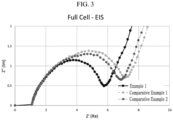
- Each of the rechargeable lithium battery cells according to Example 1 and Comparative Examples 1 and 2 was constant current-charged at a rate of 0.5 C to a voltage of 4.25 V and subsequently, cut off at a rate of 0.02 C, while maintaining 4.25 V in a constant voltage mode at room temperature (25 °C). Subsequently, the cells were discharged to a voltage of 2.8 V at a rate of 0.5 C, and this charge and discharge cycle was 100 times repeated. Capacity of the cells according to the number of cycles was measured and shown in FIG. 2 , and electrochemical impedance spectroscopy (EIS) results measured at room temperature after the charge were shown in FIG. 3 .
- EIS electrochemical impedance spectroscopy
- the rechargeable lithium battery cell of Example 1 exhibited excellent cycle-life characteristics by minimizing or reducing the increase in resistance (e.g., electrical resistance) and the decrease in energy density during the operation.
- increase in resistance e.g., electrical resistance
- the rechargeable lithium battery cells of Example 1 to 6 included a compound including a catechol functional group, a quinone functional group, or a combination thereof, and thus, a material capable of exhibiting sufficient adhesive strength even in a small amount was introduced into the rechargeable lithium battery cells, and were determined to achieve sufficient adhesive strength even though the amount of the binder was reduced, and were determined to also improve conductivity by increasing the amount of the conductive material.
Landscapes
- Chemical & Material Sciences (AREA)
- Chemical Kinetics & Catalysis (AREA)
- Electrochemistry (AREA)
- General Chemical & Material Sciences (AREA)
- Engineering & Computer Science (AREA)
- Materials Engineering (AREA)
- Composite Materials (AREA)
- Manufacturing & Machinery (AREA)
- Inorganic Chemistry (AREA)
- Crystallography & Structural Chemistry (AREA)
- Battery Electrode And Active Subsutance (AREA)
Applications Claiming Priority (1)
| Application Number | Priority Date | Filing Date | Title |
|---|---|---|---|
| KR1020230099116A KR20250017985A (ko) | 2023-07-28 | 2023-07-28 | 리튬 이차 전지용 전극 및 이를 포함하는 리튬 이차 전지 |
Publications (1)
| Publication Number | Publication Date |
|---|---|
| EP4498444A1 true EP4498444A1 (de) | 2025-01-29 |
Family
ID=91898794
Family Applications (1)
| Application Number | Title | Priority Date | Filing Date |
|---|---|---|---|
| EP24187594.7A Pending EP4498444A1 (de) | 2023-07-28 | 2024-07-10 | Elektrode für eine wiederaufladbare lithiumbatterie und wiederaufladbare lithiumbatterie damit |
Country Status (3)
| Country | Link |
|---|---|
| US (1) | US20250038209A1 (de) |
| EP (1) | EP4498444A1 (de) |
| KR (1) | KR20250017985A (de) |
Citations (3)
| Publication number | Priority date | Publication date | Assignee | Title |
|---|---|---|---|---|
| US20150287995A1 (en) * | 2014-04-04 | 2015-10-08 | E I Du Pont De Nemours And Company | Electrode with decreased contact resistance |
| US20200255419A1 (en) * | 2016-08-22 | 2020-08-13 | Global Graphene Group, Inc. | Humic acid-bonded metal foil film current collector and battery and supercapacitor containing same |
| KR20230064478A (ko) * | 2021-11-03 | 2023-05-10 | 주식회사 엘지화학 | 부착 증진층이 코팅된 양극 집전체 및 그 제조방법, 이를 포함하는 리튬 이차 전지용 양극 및 리튬 이차 전지 |
-
2023
- 2023-07-28 KR KR1020230099116A patent/KR20250017985A/ko active Pending
-
2024
- 2024-04-05 US US18/628,125 patent/US20250038209A1/en active Pending
- 2024-07-10 EP EP24187594.7A patent/EP4498444A1/de active Pending
Patent Citations (3)
| Publication number | Priority date | Publication date | Assignee | Title |
|---|---|---|---|---|
| US20150287995A1 (en) * | 2014-04-04 | 2015-10-08 | E I Du Pont De Nemours And Company | Electrode with decreased contact resistance |
| US20200255419A1 (en) * | 2016-08-22 | 2020-08-13 | Global Graphene Group, Inc. | Humic acid-bonded metal foil film current collector and battery and supercapacitor containing same |
| KR20230064478A (ko) * | 2021-11-03 | 2023-05-10 | 주식회사 엘지화학 | 부착 증진층이 코팅된 양극 집전체 및 그 제조방법, 이를 포함하는 리튬 이차 전지용 양극 및 리튬 이차 전지 |
Also Published As
| Publication number | Publication date |
|---|---|
| US20250038209A1 (en) | 2025-01-30 |
| KR20250017985A (ko) | 2025-02-04 |
Similar Documents
| Publication | Publication Date | Title |
|---|---|---|
| EP4589673A1 (de) | Positive elektroden und wiederaufladbare lithiumbatterien damit | |
| EP4629347A1 (de) | Positive elektrode mit niedrigem widerstand und wiederaufladbare lithiumbatterie damit | |
| EP4498444A1 (de) | Elektrode für eine wiederaufladbare lithiumbatterie und wiederaufladbare lithiumbatterie damit | |
| EP4496032A1 (de) | Elektrode für eine wiederaufladbare lithiumbatterie, elektrodenanordnung und wiederaufladbare lithiumbatterie damit | |
| EP4560727A1 (de) | Negative elektrode für eine wiederaufladbare lithiumbatterie und wiederaufladbare lithiumbatterie damit | |
| US20250070130A1 (en) | Negative electrode active material and rechargeable lithium battery including same | |
| EP4657548A1 (de) | Negativelektrodenaktivmaterial, negativelektrode mit dem negativelektrodenaktivmaterial, wiederaufladbare lithiumbatterie mit der negativelektrode und verfahren zur herstellung des negativelektrodenaktivmaterials | |
| US20260066295A1 (en) | Negative electrode active material for rechargeable lithium battery and rechargeable lithium battery including the same | |
| EP4597638A1 (de) | Negative elektrode für eine wiederaufladbare lithiumbatterie und wiederaufladbare lithiumbatterie damit | |
| EP4597598A1 (de) | Negativelektrode für eine wiederaufladbare lithiumbatterie und wiederaufladbare lithiumbatterie damit | |
| EP4553982A1 (de) | Bindemittel, separator und wiederaufladbare lithiumbatterie mit dem separator | |
| EP4539140A1 (de) | Negatives aktivmaterial für eine wiederaufladbare lithiumbatterie, negative elektrode damit und wiederaufladbare lithiumbatterie damit | |
| EP4632842A1 (de) | Negativelektrode und wiederaufladbare lithiumbatterie damit | |
| US20250158021A1 (en) | Negative electrode active material and rechargeable lithium battery including same | |
| EP4645457A2 (de) | Positivelektrode und wiederaufladbare lithiumbatterie mit der positivelektrode | |
| US20260045547A1 (en) | Electrolyte for rechargeable lithium battery and rechargeable lithium battery including the same | |
| EP4571875A1 (de) | Negative elektrode für eine wiederaufladbare lithiumbatterie und wiederaufladbare lithiumbatterie damit | |
| EP4481859A2 (de) | Positivelektrode für eine wiederaufladbare lithiumbatterie und wiederaufladbare lithiumbatterie damit | |
| US20250343235A1 (en) | Negative electrodes for rechargeable lithium batteries, and rechargeable lithium batteries including same | |
| EP4657591A1 (de) | Elektrolytlösung für eine wiederaufladbare lithiumbatterie | |
| EP4704202A1 (de) | Elektrode für eine wiederaufladbare lithiumbatterie und wiederaufladbare lithiumbatterie damit | |
| US20250118750A1 (en) | Negative electrode for rechargeable lithium battery and rechargeable lithium battery including the same | |
| US20250070176A1 (en) | Negative electrode and rechargeable lithium battery including the same | |
| EP4645435A1 (de) | Positivelektrodenaktivmaterial für eine wiederaufladbare lithiumbatterie, positivelektrode damit und wiederaufladbare lithiumbatterie damit | |
| EP4654279A1 (de) | Positivelektroden-aktivmaterialien, herstellungsverfahren für positivelektroden-aktivmaterialien, positivelektroden und wiederaufladbare lithiumbatterien |
Legal Events
| Date | Code | Title | Description |
|---|---|---|---|
| PUAI | Public reference made under article 153(3) epc to a published international application that has entered the european phase |
Free format text: ORIGINAL CODE: 0009012 |
|
| STAA | Information on the status of an ep patent application or granted ep patent |
Free format text: STATUS: REQUEST FOR EXAMINATION WAS MADE |
|
| 17P | Request for examination filed |
Effective date: 20240710 |
|
| AK | Designated contracting states |
Kind code of ref document: A1 Designated state(s): AL AT BE BG CH CY CZ DE DK EE ES FI FR GB GR HR HU IE IS IT LI LT LU LV MC ME MK MT NL NO PL PT RO RS SE SI SK SM TR |