EP4553982A1 - Bindemittel, separator und wiederaufladbare lithiumbatterie mit dem separator - Google Patents
Bindemittel, separator und wiederaufladbare lithiumbatterie mit dem separator Download PDFInfo
- Publication number
- EP4553982A1 EP4553982A1 EP24194834.8A EP24194834A EP4553982A1 EP 4553982 A1 EP4553982 A1 EP 4553982A1 EP 24194834 A EP24194834 A EP 24194834A EP 4553982 A1 EP4553982 A1 EP 4553982A1
- Authority
- EP
- European Patent Office
- Prior art keywords
- group
- binder
- structural unit
- mol
- separator
- Prior art date
- Legal status (The legal status is an assumption and is not a legal conclusion. Google has not performed a legal analysis and makes no representation as to the accuracy of the status listed.)
- Pending
Links
Images

Classifications
-
- H—ELECTRICITY
- H01—ELECTRIC ELEMENTS
- H01M—PROCESSES OR MEANS, e.g. BATTERIES, FOR THE DIRECT CONVERSION OF CHEMICAL ENERGY INTO ELECTRICAL ENERGY
- H01M50/00—Constructional details or processes of manufacture of the non-active parts of electrochemical cells other than fuel cells, e.g. hybrid cells
- H01M50/40—Separators; Membranes; Diaphragms; Spacing elements inside cells
- H01M50/409—Separators, membranes or diaphragms characterised by the material
- H01M50/411—Organic material
- H01M50/414—Synthetic resins, e.g. thermoplastics or thermosetting resins
- H01M50/42—Acrylic resins
-
- H—ELECTRICITY
- H01—ELECTRIC ELEMENTS
- H01M—PROCESSES OR MEANS, e.g. BATTERIES, FOR THE DIRECT CONVERSION OF CHEMICAL ENERGY INTO ELECTRICAL ENERGY
- H01M4/00—Electrodes
- H01M4/02—Electrodes composed of, or comprising, active material
- H01M4/62—Selection of inactive substances as ingredients for active masses, e.g. binders, fillers
- H01M4/621—Binders
- H01M4/622—Binders being polymers
-
- C—CHEMISTRY; METALLURGY
- C08—ORGANIC MACROMOLECULAR COMPOUNDS; THEIR PREPARATION OR CHEMICAL WORKING-UP; COMPOSITIONS BASED THEREON
- C08F—MACROMOLECULAR COMPOUNDS OBTAINED BY REACTIONS ONLY INVOLVING CARBON-TO-CARBON UNSATURATED BONDS
- C08F220/00—Copolymers of compounds having one or more unsaturated aliphatic radicals, each having only one carbon-to-carbon double bond, and only one being terminated by only one carboxyl radical or a salt, anhydride ester, amide, imide or nitrile thereof
- C08F220/02—Monocarboxylic acids having less than ten carbon atoms; Derivatives thereof
- C08F220/04—Acids; Metal salts or ammonium salts thereof
- C08F220/06—Acrylic acid; Methacrylic acid; Metal salts or ammonium salts thereof
-
- C—CHEMISTRY; METALLURGY
- C08—ORGANIC MACROMOLECULAR COMPOUNDS; THEIR PREPARATION OR CHEMICAL WORKING-UP; COMPOSITIONS BASED THEREON
- C08F—MACROMOLECULAR COMPOUNDS OBTAINED BY REACTIONS ONLY INVOLVING CARBON-TO-CARBON UNSATURATED BONDS
- C08F220/00—Copolymers of compounds having one or more unsaturated aliphatic radicals, each having only one carbon-to-carbon double bond, and only one being terminated by only one carboxyl radical or a salt, anhydride ester, amide, imide or nitrile thereof
- C08F220/02—Monocarboxylic acids having less than ten carbon atoms; Derivatives thereof
- C08F220/52—Amides or imides
- C08F220/54—Amides, e.g. N,N-dimethylacrylamide or N-isopropylacrylamide
- C08F220/58—Amides, e.g. N,N-dimethylacrylamide or N-isopropylacrylamide containing oxygen in addition to the carbonamido oxygen, e.g. N-methylolacrylamide, N-(meth)acryloylmorpholine
- C08F220/585—Amides, e.g. N,N-dimethylacrylamide or N-isopropylacrylamide containing oxygen in addition to the carbonamido oxygen, e.g. N-methylolacrylamide, N-(meth)acryloylmorpholine and containing other heteroatoms, e.g. 2-acrylamido-2-methylpropane sulfonic acid [AMPS]
-
- H—ELECTRICITY
- H01—ELECTRIC ELEMENTS
- H01M—PROCESSES OR MEANS, e.g. BATTERIES, FOR THE DIRECT CONVERSION OF CHEMICAL ENERGY INTO ELECTRICAL ENERGY
- H01M10/00—Secondary cells; Manufacture thereof
- H01M10/05—Accumulators with non-aqueous electrolyte
- H01M10/052—Li-accumulators
- H01M10/0525—Rocking-chair batteries, i.e. batteries with lithium insertion or intercalation in both electrodes; Lithium-ion batteries
-
- H—ELECTRICITY
- H01—ELECTRIC ELEMENTS
- H01M—PROCESSES OR MEANS, e.g. BATTERIES, FOR THE DIRECT CONVERSION OF CHEMICAL ENERGY INTO ELECTRICAL ENERGY
- H01M50/00—Constructional details or processes of manufacture of the non-active parts of electrochemical cells other than fuel cells, e.g. hybrid cells
- H01M50/40—Separators; Membranes; Diaphragms; Spacing elements inside cells
- H01M50/409—Separators, membranes or diaphragms characterised by the material
- H01M50/443—Particulate material
-
- H—ELECTRICITY
- H01—ELECTRIC ELEMENTS
- H01M—PROCESSES OR MEANS, e.g. BATTERIES, FOR THE DIRECT CONVERSION OF CHEMICAL ENERGY INTO ELECTRICAL ENERGY
- H01M50/00—Constructional details or processes of manufacture of the non-active parts of electrochemical cells other than fuel cells, e.g. hybrid cells
- H01M50/40—Separators; Membranes; Diaphragms; Spacing elements inside cells
- H01M50/409—Separators, membranes or diaphragms characterised by the material
- H01M50/446—Composite material consisting of a mixture of organic and inorganic materials
-
- H—ELECTRICITY
- H01—ELECTRIC ELEMENTS
- H01M—PROCESSES OR MEANS, e.g. BATTERIES, FOR THE DIRECT CONVERSION OF CHEMICAL ENERGY INTO ELECTRICAL ENERGY
- H01M50/00—Constructional details or processes of manufacture of the non-active parts of electrochemical cells other than fuel cells, e.g. hybrid cells
- H01M50/40—Separators; Membranes; Diaphragms; Spacing elements inside cells
- H01M50/409—Separators, membranes or diaphragms characterised by the material
- H01M50/449—Separators, membranes or diaphragms characterised by the material having a layered structure
- H01M50/451—Separators, membranes or diaphragms characterised by the material having a layered structure comprising layers of only organic material and layers containing inorganic material
-
- H—ELECTRICITY
- H01—ELECTRIC ELEMENTS
- H01M—PROCESSES OR MEANS, e.g. BATTERIES, FOR THE DIRECT CONVERSION OF CHEMICAL ENERGY INTO ELECTRICAL ENERGY
- H01M50/00—Constructional details or processes of manufacture of the non-active parts of electrochemical cells other than fuel cells, e.g. hybrid cells
- H01M50/40—Separators; Membranes; Diaphragms; Spacing elements inside cells
- H01M50/489—Separators, membranes, diaphragms or spacing elements inside the cells, characterised by their physical properties, e.g. swelling degree, hydrophilicity or shut down properties
-
- H—ELECTRICITY
- H01—ELECTRIC ELEMENTS
- H01M—PROCESSES OR MEANS, e.g. BATTERIES, FOR THE DIRECT CONVERSION OF CHEMICAL ENERGY INTO ELECTRICAL ENERGY
- H01M2220/00—Batteries for particular applications
- H01M2220/10—Batteries in stationary systems, e.g. emergency power source in plant
-
- Y—GENERAL TAGGING OF NEW TECHNOLOGICAL DEVELOPMENTS; GENERAL TAGGING OF CROSS-SECTIONAL TECHNOLOGIES SPANNING OVER SEVERAL SECTIONS OF THE IPC; TECHNICAL SUBJECTS COVERED BY FORMER USPC CROSS-REFERENCE ART COLLECTIONS [XRACs] AND DIGESTS
- Y02—TECHNOLOGIES OR APPLICATIONS FOR MITIGATION OR ADAPTATION AGAINST CLIMATE CHANGE
- Y02E—REDUCTION OF GREENHOUSE GAS [GHG] EMISSIONS, RELATED TO ENERGY GENERATION, TRANSMISSION OR DISTRIBUTION
- Y02E60/00—Enabling technologies; Technologies with a potential or indirect contribution to GHG emissions mitigation
- Y02E60/10—Energy storage using batteries
Definitions
- Binders, separators including the binders, and rechargeable lithium batteries including the separators are disclosed.
- a rechargeable lithium battery typically includes a positive electrode and a negative electrode including an active material capable of intercalating and deintercalating lithium ions, and an electrolyte solution. Electrical energy is typically produced through oxidation and reduction reactions when lithium ions are intercalated/deintercalated from the positive electrode and negative electrode.
- the separator is an intermediate membrane that substantially isolates the positive and negative electrodes in a rechargeable lithium battery and substantially continuously maintains ionic conductivity, enabling charging and discharging of the rechargeable lithium battery.
- a separator When a rechargeable lithium battery is exposed to a high-temperature environment due to abnormal behavior, a separator may be mechanically shrunk or damaged due to melting characteristics at a low temperature.
- the positive and negative electrodes contact each other and may cause an explosion of the battery.
- a method of increasing heat resistance of the separator by coating the separator with a mixture of inorganic particles having a large thermal resistance and an organic binder having adherence is typically known.
- such method may not sufficiently secure the desired adhesive strength, and lowering the resistance is challenging.
- Some example embodiments include a binder for a rechargeable lithium battery having high heat resistance and low electrical resistance.
- Some example embodiments include a separator for a rechargeable lithium battery including the binder.
- Some example embodiments include a rechargeable lithium battery including the separator.
- Some example embodiments include a binder for a rechargeable lithium battery including at least one of a first structural unit derived from (meth)acrylic acid, (meth)acrylate, or a salt thereof; a second structural unit derived from hydroxyalkyl (meth)acrylate; and a third structural unit derived from (meth)acrylamidosulfonic acid or a salt thereof.
- Some example embodiments include a separator for a rechargeable lithium battery including a porous substrate, and a coating layer on at least one surface of the porous substrate and including a binder and inorganic particles, wherein the binder includes at least one of a first structural unit derived from a (meth)acrylic acid, (meth)acrylate, or a salt thereof; a second structural unit derived from hydroxyalkyl (meth)acrylate; and a third structural unit derived from (meth)acrylamidosulfonic acid or a salt thereof.
- Some example embodiments include a rechargeable lithium battery including a positive electrode, a negative electrode, and a separator between the positive electrode and the negative electrode.
- the binder for a rechargeable lithium battery according to some example embodiments exhibits high heat resistance and low electrical resistance. Accordingly, by applying the binder for a rechargeable lithium battery according to some example embodiments to the coating layer of the separator, a rechargeable lithium battery with desired, advantageous or improved cycle-life characteristics at room temperature and/or high temperature can be implemented.
- FIGS. 1 to 4 are exploded perspective views of rechargeable lithium batteries according to some example embodiments.
- a particle size is an average particle size.
- This average particle size means an average particle size (D50), which is a diameter of particles with a cumulative volume of 50 volume% in the particle size distribution.
- the average particle size (D50) can be measured by methods well known to those skilled in the art, for example, by measuring with a particle size analyzer, a transmission electron microscope or scanning electron microscope, or a scanning electron microscope. Alternatively, a dynamic light-scattering measurement device is used to perform a data analysis, and the number of particles is counted for each particle size range. From this, the average particle size (D50) value may be easily obtained through a calculation. A laser diffraction method may also be used.
- the particles to be measured are dispersed in a dispersion medium and then introduced into a commercially available laser diffraction particle size measuring device (e.g., MT 3000 available from Microtrac, Ltd.) using ultrasonic waves at about 28 kHz, and after irradiation with an output of 60 W, the average particle size (D50) based on 50% of the particle size distribution in the measuring device can be calculated.
- a commercially available laser diffraction particle size measuring device e.g., MT 3000 available from Microtrac, Ltd.
- alkyl group refers to a C1 to C20 alkyl group
- alkenyl group refers to a C2 to C20 alkenyl group
- cycloalkenyl group refers to a C3 to C20 cycloalkenyl group
- heterocycloalkenyl group refers to a C3 to C20 heterocycloalkenyl group
- aryl group refers to a C6 to C20 aryl group
- arylalkyl group refers to a C7 to C20 arylalkyl group
- alkylene group refers to a C1 to C20 alkylene group
- arylene group refers to a C6 to C20 arylene group
- alkylarylene group refers to a C7 to C20 alkylarylene group
- heteroarylene group refers to a C3 to C20 heteroarylene group
- alk alkyl group
- alkenyl group refers to a C2 to C20 alkeny
- substituted refers to replacement of at least one hydrogen atom by a substituent selected from the group consisting of a halogen atom (F, Cl, Br, or I), a hydroxy group, a C1 to C20 alkoxy group, a nitro group, a cyano group, an amino group, an imino group, an azido group, an amidino group, a hydrazino group, a hydrazono group, a carbonyl group, a carbamyl group, a thiol group, an ester group, an ether group, a carboxyl group or a salt thereof, a sulfonic acid group or a salt thereof, a phosphoric acid or a salt thereof, a C1 to C20 alkyl group, a C2 to C20 alkenyl group, a C2 to C20 alkynyl group, a C6 to C20 aryl group,
- hetero means that at least one hetero atom of N, O, S, and P is included in the chemical formula.
- (meth)acrylate refers to both “acrylate” and “methacrylate”
- (meth)acrylic acid refers to both “acrylic acid” and “methacrylic acid”
- (meth)acrylamidosulfonic acid refers to both “acrylamidosulfonic acid” and “methacrylamidosulfonic acid.”
- a weight average molecular weight is a value measured using gel permeation chromatography (GPC).
- Some example embodiments provide a binder for a rechargeable lithium battery including a first structural unit derived from (meth)acrylic acid, (meth)acrylate, or a salt thereof; a second structural unit derived from hydroxyalkyl (meth)acrylate; and a third structural unit derived from (meth)acrylamidosulfonic acid or a salt thereof.
- the binder for a rechargeable lithium battery according to some example embodiments exhibits high heat resistance and low electrical resistance. Accordingly, by applying the binder for a rechargeable lithium battery according to some example embodiments to the coating layer of the separator, a rechargeable lithium battery with desired, advantageous or improved cycle-life characteristics at room temperature and/or high temperature can be implemented.
- a description of the binder for a rechargeable lithium battery according to some example embodiments is as follows.
- the first structural unit may be included in an amount of 20 mol% to 75 mol%, or 25 mol% to 70 mol%, or 30 mol% to 65 mol% (i.e., for example, 20 % to 75 % of the structural unit of the copolymer may be first structural units).
- the first structural unit is represented by any one of Chemical Formulas 1 to 3:
- R 1 to R 3 each independently represents hydrogen or a C1 to C10 alkyl group, for example a C1 to C3 alkyl group, such as a methyl group.
- the second structural unit may be included in an amount of 1 mol% to 20 mol%, 2 mol% to 5 mol%, or 5 mol% to 15 mol%.
- the second structural unit may be derived from a hydroxyalkyl (meth)acrylate, and is configured to fix the inorganic particles on the porous substrate, while providing adhesion so that the coating layer sufficiently adheres to the porous substrate and electrode. Additionally, the second structural unit may contribute to improving the dispersibility of the coating slurry by including a hydroxy functional group (-OH) in the structural unit.
- the second structural unit is represented by Chemical Formula 4:
- R 4 and R 5 each independently represents hydrogen or a C1 to C10 alkyl group, for example a C1 to C3 alkyl group, such as a methyl group. According to one embodiment, R 4 may be hydrogen or a methyl group and R 5 may be a methyl group.
- index a may be 1 and L 1 may be a C1 to C10 alkylene group, for example a C1 to C3 alkylene group, such as an ethylene group.
- the third structural unit may be included in an amount of 20% to 75 mol%, 25% to 70 mol%, or 30% to 65 mol%.
- the total amount of the first structural unit, the second structural unit, and the third structural unit add up to 100 mol%.
- the third structural unit includes a bulky functional group, for example, derived from (meth)acrylamidosulfonic acid or a salt thereof, thereby increasing the glass transition temperature thereof and thus enhancing the heat resistance of the separator. Additionally, when the third structural unit includes a functional group derived from a salt of (meth)acrylamidosulfonic acid, the metal (M) can move through the third structural unit due to the sulfonic acid functional group substituted with the metal (M), which can have the effect of lowering the resistance.
- a bulky functional group for example, derived from (meth)acrylamidosulfonic acid or a salt thereof
- the third structural unit is represented by any one of Chemical Formulas 5 to 7:
- R 6 to R 8 each independently represents hydrogen or a C1 to C10 alkyl group, for example a C1 to C3 alkyl group, such as a methyl group. According to one embodiment, R 6 to R 8 may be hydrogen or a methyl group.
- indices b to d may be 1 and L 1 to L 3 may be a C1 to C10 alkylene group, for example a C1 to C3 alkylene group, such as an ethylene group.
- L 1 to L 3 may be *-C(CH 3 ) 2 -CH 2 -*.
- R 1 to R 8 are each independently be hydrogen or a C1 to C10 alkyl group.
- R 1 to R 4 and R 6 to R 8 may each be hydrogen or a methyl group; and R 5 may be a methyl group.
- L 1 to L 4 are each independently be a substituted or unsubstituted C1 to C10 alkylene group, a substituted or unsubstituted C3 to C20 cycloalkylene group, a substituted or unsubstituted C6 to C20 arylene group, or a substituted or unsubstituted C3 to C20 heterocyclic group.
- L 1 may be a methylene group or an ethylene group; and L 2 to L 4 may each independently be *-C(CH 3 ) 2 -CH 2 -*.
- a, b, c, and d are each independently be one of the integers in a range of 0 to 2.
- a, b, c, and d may all be equal to 1.
- M is an alkali metal, and the alkali metal may be at least one of lithium, sodium, potassium, rubidium, or cesium.
- M may be lithium or sodium.
- the first structural unit is derived from acrylic acid
- the second structural unit is derived from hydroxyethylmethacrylate
- the third structural unit is derived from 2-acrylamido-2-methylpropanesulfonic acid.
- R 9 to R 12 are independently be hydrogen or a C1 to C10 alkyl group.
- R 9 , R 10 , and R 12 may each be hydrogen or a methyl group; and R 11 may be a methyl group.
- L 5 and L 6 are each independently be a substituted or unsubstituted C1 to C10 alkylene group, a substituted or unsubstituted C3 to C20 cycloalkylene group, a substituted or unsubstituted C6 to C20 arylene group, or a substituted or unsubstituted C3 to C20 heterocyclic group.
- L 5 may be a methylene group or an ethylene group; and L 6 may be *-C(CH 3 ) 2 -CH 2 -*.
- M is an alkali metal, and the alkali metal may be at least one of lithium, sodium, potassium, rubidium, or cesium.
- M may be lithium or sodium.
- the binder may have a weight average molecular weight measured using gel permeation chromatography (GPC) of 100,000 g/mol to 1,000,000 g/mol, 200,000 g/mol to 950,000 g/mol, or 300,000 g/mol to 900,000 g/mol.
- GPC gel permeation chromatography
- a separator including the binder for a rechargeable lithium battery according to some example embodiments can exhibit desired, advantageous or improved adhesion and low electrical resistance.
- a separator for a rechargeable lithium battery includes a porous substrate; and a coating layer disposed on at least one surface of the porous substrate and including the afore-mentioned binder and inorganic particles.
- the binder for a rechargeable lithium battery according to the aforementioned example embodiments exhibits high heat resistance and low electrical resistance. Accordingly, by applying the binder for a rechargeable lithium battery according to the aforementioned embodiments to the coating layer of the separator, a rechargeable lithium battery with desired, advantageous or improved cycle-life characteristics at room temperature and/or high temperature can be implemented.
- the inorganic particles can hinder or prevent the separator from rapidly shrinking or deforming due to temperature increase.
- the inorganic particles may be ceramic materials capable of improving heat resistance, for example, the inorganic particles may be at least one of Al 2 O 3 , SiO 2 , TiO 2 , SnO 2 , CeO 2 , MgO, NiO, CaO, GaO, ZnO, ZrO 2 , Y 2 O 3 , SrTiO 3 , BaTiO 3 , Mg(OH) 2 , boehmite, and a combination thereof, but is not limited thereto.
- the inorganic particles may be at least one of spherical, plate-shaped, cubic, or irregular shaped.
- An average particle size of the inorganic particles may be 0.2 ⁇ m to 1 ⁇ m, 0.25 ⁇ m to 0.7 ⁇ m, or 0.25 ⁇ m to 0.5 ⁇ m.
- the average particle size of the inorganic particles is the particle size (D 50 ) at 50% by volume in the cumulative size-distribution curve.
- the average particle diameter (D50) of the inorganic particles may be measured by laser diffraction (LD). The method may be performed according to ISO 13320:2020.
- a weight ratio of binder: inorganic particles in the coating layer may be in a range of 1:5 to 1:40, desirably in a range of 1:10 to 1:35, and more desirably in a range of 1:15 to 1:30.
- the separator can exhibit desired, advantageous or improved heat resistance and low electrical resistance.
- the coating layer may have a thickness of 0.2 ⁇ m to 5 ⁇ m, for example, 0.5 ⁇ m to 3 ⁇ m.
- the coating layer may be disposed on one or both surfaces of the porous substrate. In the latter case, it may be advantageous to achieve high heat resistance and low electrical resistance of the separator.
- the porous substrate may have a plurality of pores and may generally be or include a substrate used in an electrochemical device.
- Non-limiting examples of the porous substrate may be or include a polymer film formed of a copolymer or a mixture of two or more of polyolefin such as polyethylene and polypropylene, polyester such as polyethylene terephthalate and polybutylene terephthalate, polyacetal, polyamide, polyimides, polycarbonate, polyether ether ketone, polyaryl ether ketone, polyetherimide, polyamideimide, polybenzimidazole, polypolyethersulfone, polyphenylene oxide, a cyclic olefin copolymer, polyphenylene sulfide, polyethylene naphthalate, a glass fiber, Teflon, and polytetrafluoroethylene.
- the porous substrate may be or include a polyolefin-based substrate including polyolefin, and the polyolefin-based substrate may have a desired, advantageous or improved shutdown function, which can contribute to improving the safety of the battery.
- the polyolefin-based substrate may be one of, for example, a polyethylene single film, a polypropylene single film, a polyethylene/polypropylene double film, a polypropylene/polyethylene/polypropylene triple film, and a polyethylene/polypropylene/polyethylene triple film.
- the polyolefin-based resin may include a non-olefin resin in addition to an olefin resin, or may include a copolymer of olefin and non-olefin monomer.
- the porous substrate may have a thickness of in a range of 1 ⁇ m to 40 ⁇ m, for example 1 ⁇ m to 30 ⁇ m, 1 ⁇ m to 20 ⁇ m, 2 ⁇ m to 15 ⁇ m, or 5 ⁇ m to 10 ⁇ m.
- the separator of some example embodiments may be manufactured by various known methods.
- a separator for a rechargeable lithium battery can be formed by coating a composition for forming a coating layer to one or both surfaces of a porous substrate and then drying it.
- Some example embodiments include a rechargeable lithium battery including a positive electrode, a negative electrode, and a separator between the positive electrode and the negative electrode.
- the positive electrode active material may be or include a compound (lithiated intercalation compound) capable of intercalating and deintercalating lithium.
- a compound lithiumated intercalation compound capable of intercalating and deintercalating lithium.
- one or more types of composite oxides of lithium and a metal that is one of cobalt, manganese, nickel, and a combination thereof may be used.
- the composite oxide may be a lithium transition metal composite oxide, and examples may include, e,g., at least one of lithium nickel-based oxide, lithium cobalt-based oxide, lithium manganese-based oxide, a lithium iron phosphate-based compound, cobalt-free lithium nickel-manganese-based oxide, and a combination thereof.
- Li a A 1-b X b O 2-c D c (0.90 ⁇ a ⁇ 1.8, 0 ⁇ b ⁇ 0.5, 0 ⁇ c ⁇ 0.05); Li a Mn 2-b X b O 4-c D c (0.90 ⁇ a ⁇ 1.8, 0 ⁇ b ⁇ 0.5, 0 ⁇ c ⁇ 0.05); Li a Ni 1-b-c Co b X c O 2- ⁇ D ⁇ (0.90 ⁇ a ⁇ 1.8, 0 ⁇ b ⁇ 0.5, 0 ⁇ c ⁇ 0.5, 0 ⁇ 2); Li a Ni 1-b-c Mn b X c O 2- ⁇ D ⁇ (0.90 ⁇ a ⁇ 1.8, 0 ⁇ b ⁇ 0.5, 0 ⁇ c ⁇ 0.5, 0 ⁇ 2); Li a Ni b Co c L 1 d G e O 2 (0.90 ⁇ a ⁇ 1.8, 0 ⁇ b ⁇ 0.9, 0 ⁇ c ⁇ 0.5, 0 ⁇ d ⁇ 0.5, 0 ⁇ e ⁇ 0.1); Li a NiG b
- A is Ni, Co, Mn, or a combination thereof
- X is Al, Ni, Co, Mn, Cr, Fe, Mg, Sr, V, a rare earth element, or a combination thereof
- D is O, F, S, P, or a combination thereof
- G is Al, Cr, Mn, Fe, Mg, La, Ce, Sr, V, or a combination thereof
- L 1 is Mn, Al, or a combination thereof.
- the positive electrode active material may be or include, for example, lithium nickel-based oxide represented by Chemical Formula 11, lithium cobalt-based oxide represented by Chemical Formula 12, lithium iron phosphate-based compound represented by Chemical Formula 13, and cobalt-free lithium nickel-manganese-based oxide represented by Chemical Formula 14, or a combination thereof.
- M 1 and M 2 are each independently one or more of Al, B, Ba, Ca, Ce, Co, Cr, Cu, Fe, Mg, Mn, Mo, Nb, Si, Sn, Sr, Ti, V, W, and Zr, and X is one or more of F, P, and S.
- M 3 is one or more of Al, B, Ba, Ca, Ce, Cr, Cu, Fe, Mg, Mn, Mo, Ni, Se, Si, Sn, Sr, Ti, V, W, Y, Zn, and Zr
- X is one or more of F, P, and S.
- M 4 is one or more of Al, B, Ba, Ca, Ce, Co, Cr, Cu, Mg, Mn, Mo, Ni, Se, Si, Sn, Sr, Ti, V, W, Y, Zn, and Zr
- X is one or more of F, P, and S.
- M 5 is one or more of Al, B, Ba, Ca, Ce, Cr, Fe, Mg, Mo, Nb, Si, Sn, Sr, Ti, V, W, and Zr
- X is one or more of F, P, and S.
- the positive electrode active material may be or include a high nickel-based positive electrode active material having a nickel content of greater than or equal to 80 mol%, greater than or equal to 85 mol%, greater than or equal to 90 mol%, greater than or equal to 91 mol%, or greater than or equal to 94 mol% and less than or equal to 99 mol% based on 100 mol% of metals excluding lithium in the lithium transition metal composite oxide.
- the high nickel-based positive electrode active materials can achieve high capacity and can be applied to high-capacity, high-density rechargeable lithium batteries.
- the positive electrode for a rechargeable lithium battery may include a current collector and a positive electrode active material layer on the current collector.
- the positive electrode active material layer may include a positive electrode active material and may further include a binder and/or a conductive material.
- the positive electrode may further include an additive configured to operate as a sacrificial positive electrode.
- a content of the positive electrode active material may be 90 wt% to 99.5 wt%, and a content of the binder and the conductive material may be 0.5 wt% to 5 wt%, respectively based on 100 wt% of the positive electrode active material layer.
- the binder is configured to sufficiently attach the positive electrode active material particles to each other and also to sufficiently attach the positive electrode active material to the current collector.
- the binder may include at least one of polyvinyl alcohol, carboxymethyl cellulose, hydroxypropyl cellulose, diacetyl cellulose, polyvinylchloride, carboxylated polyvinylchloride, polyvinylfluoride, a polymer including ethylene oxide, polyvinylpyrrolidone, polyurethane, polytetrafluoroethylene, polyvinylidene fluoride, polyethylene, polypropylene, a styrene-butadiene rubber, a (meth)acrylated styrene-butadiene rubber, an epoxy resin, a (meth)acrylic resin, a polyester resin, nylon, and the like, but are not limited thereto.
- the conductive material may be used to impart conductivity (e.g., electrical conductivity) to the electrode. Any material that does not cause chemical change (e.g., does not cause an undesirable chemical change in the rechargeable lithium battery) and that conducts electrons can be used in the battery.
- conductivity e.g., electrical conductivity
- the conductive material may include a carbon-based material such as, e.g., natural graphite, artificial graphite, carbon black, acetylene black, ketjen black, a carbon fiber, a carbon nanofiber, and carbon nanotube; a metal-based material including, e.g., copper, nickel, aluminum, silver, etc., in a form of a metal powder or a metal fiber; a conductive polymer such as, e.g., a polyphenylene derivative; or a mixture thereof.
- a carbon-based material such as, e.g., natural graphite, artificial graphite, carbon black, acetylene black, ketjen black, a carbon fiber, a carbon nanofiber, and carbon nanotube
- a metal-based material including, e.g., copper, nickel, aluminum, silver, etc., in a form of a metal powder or a metal fiber
- a conductive polymer such as, e.g., a polyphenylene
- the current collector may be or include Al, but is not limited thereto.
- the negative electrode active material may be or include at least one of a material that reversibly intercalates/deintercalates lithium ions, a lithium metal, a lithium metal alloy, a material capable of doping and dedoping lithium, or a transition metal oxide.
- the material that reversibly intercalates/deintercalates lithium ions may include a carbon-based negative electrode active material, for example, crystalline carbon, amorphous carbon or a combination thereof.
- the crystalline carbon may be or include graphite such as irregular, sheet-shaped, flake-shaped, sphere-shaped, or fiber-shaped natural graphite or artificial graphite.
- the amorphous carbon may be or include a soft carbon, a hard carbon, a mesophase pitch carbonization product, calcined coke, and the like.
- the lithium metal alloy may include lithium and a metal such as, e.g., at least one of Na, K, Rb, Cs, Fr, Be, Mg, Ca, Sr, Si, Sb, Pb, In, Zn, Ba, Ra, Ge, Al, and Sn.
- a metal such as, e.g., at least one of Na, K, Rb, Cs, Fr, Be, Mg, Ca, Sr, Si, Sb, Pb, In, Zn, Ba, Ra, Ge, Al, and Sn.
- the material capable of doping/dedoping lithium may be or include a Si-based negative electrode active material or a Sn-based negative electrode active material.
- the Si-based negative electrode active material may include silicon, a silicon-carbon composite, SiO x (0 ⁇ x ⁇ 2), a Si-Q alloy (wherein Q is one of an alkali metal, an alkaline-earth metal, a Group 13 element, a Group 14 element (excluding Si), a Group 15 element, a Group 16 element, a transition metal, a rare earth element, and a combination thereof).
- the Sn-based negative electrode active material may include, e.g., Sn, SnO 2 , a Sn-based alloy, or a combination thereof.
- the silicon-carbon composite may be or include a composite of silicon and amorphous carbon.
- the silicon-carbon composite may be in a form of silicon particles and amorphous carbon coated on the surface of the silicon particles.
- the silicon-carbon composite may include a secondary particle (core) in which primary silicon particles are assembled, and an amorphous carbon coating layer (shell) on the surface of the secondary particle.
- the amorphous carbon may also be between the primary silicon particles, and, for example, the primary silicon particles may be coated with the amorphous carbon.
- the secondary particle may exist dispersed in an amorphous carbon matrix.
- the silicon-carbon composite may further include crystalline carbon.
- the silicon-carbon composite may include a core including crystalline carbon and silicon particles and an amorphous carbon coating layer on a surface of the core.
- the Si-based negative electrode active material or the Sn-based negative electrode active material may be used in combination with a carbon-based negative electrode active material.
- a negative electrode for a rechargeable lithium battery includes a current collector and a negative electrode active material layer on the current collector.
- the negative electrode active material layer includes a negative electrode active material and may further include a binder and/or a conductive material.
- the negative electrode active material layer may include 90 wt% to 99 wt% of the negative electrode active material, 0.5 wt% to 5 wt% of the binder, and 0.5 wt% to 5 wt% of the conductive material.
- the binder may be configured to sufficiently attach the negative electrode active material particles to each other and also to sufficiently attach the negative electrode active material to the current collector.
- the binder may include at least one of a non-aqueous binder, an aqueous binder, a dry binder, or a combination thereof.
- the non-aqueous binder may include at least one of polyvinyl chloride, carboxylated polyvinyl chloride, polyvinyl fluoride, an ethylene propylene copolymer, polystyrene, polyurethane, polytetrafluoroethylene, polyvinylidene fluoride, polyethylene, polypropylene, polyamideimide, polyimide, or a combination thereof.
- the aqueous binder may be or include at least one of a styrene-butadiene rubber, a (meth)acrylated styrene-butadiene rubber, a (meth)acrylonitrile-butadiene rubber, a (meth)acrylic rubber, a butyl rubber, a fluoro rubber, polyethylene oxide, polyvinylpyrrolidone, polyepichlorohydrin, polyphosphazene, poly(meth)acrylonitrile, an ethylene propylene diene copolymer, polyvinylpyridine, chlorosulfonated polyethylene, latex, a polyester resin, a (meth)acrylic resin, a phenol resin, an epoxy resin, polyvinyl alcohol, and a combination thereof.
- the aqueous binder may further include a cellulose-based compound capable of imparting viscosity.
- the cellulose-based compound includes one or more of carboxylmethyl cellulose, hydroxypropylmethyl cellulose, methyl cellulose, or alkali metal salts thereof.
- the alkali metal may be or include Na, K, or Li.
- the dry binder may be or include a polymer material configured to be fiberized, and may be or include, for example, polytetrafluoroethylene, polyvinylidene fluoride, polyvinylidene fluoride-hexafluoropropylene copolymer, polyethylene oxide, or a combination thereof.
- the conductive material is included to provide electrode conductivity, and any electrically conductive material may be used as a conductive material unless the electrically conductive material causes a chemical change.
- the conductive material may be, e.g., at least one of a carbon-based material such as natural graphite, artificial graphite, carbon black, acetylene black, ketjen black, a carbon fiber, a carbon nanofiber, a carbon nanotube, and the like; a metal-based material such as copper, nickel, aluminum silver, and the like in a form of a metal powder or a metal fiber; a conductive polymer such as a polyphenylene derivative; or a mixture thereof.
- a carbon-based material such as natural graphite, artificial graphite, carbon black, acetylene black, ketjen black, a carbon fiber, a carbon nanofiber, a carbon nanotube, and the like
- a metal-based material such as copper, nickel, aluminum silver, and the like in a form of a
- the negative electrode current collector may include at least one of a copper foil, a nickel foil, a stainless steel foil, a titanium foil, a nickel foam, a copper foam, a polymer substrate coated with a conductive metal, and a combination thereof, but is not limited thereto.
- the electrolyte solution for a rechargeable lithium battery includes a non-aqueous organic solvent and a lithium salt.
- the non-aqueous organic solvent is configured as a medium for transmitting ions taking part in the electrochemical reaction of a battery.
- the non-aqueous organic solvent may be or include at least one of a carbonate-based, ester-based, ether-based, ketone-based, alcohol-based solvent, aprotic solvent, or a combination thereof.
- the carbonate-based solvent may include at least one of dimethyl carbonate (DMC), diethyl carbonate (DEC), dipropyl carbonate (DPC), methylpropyl carbonate (MPC), ethylpropyl carbonate (EPC), methylethyl carbonate (MEC), ethylene carbonate (EC), propylene carbonate (PC), butylene carbonate (BC), and the like.
- the ester-based solvent may include at least one of methyl acetate, ethyl acetate, n-propyl acetate, dimethylacetate, methylpropionate, ethylpropionate, decanolide, mevalonolactone, valerolactone, caprolactone, and the like.
- the ether-based solvent may include dibutyl ether, tetraglyme, diglyme, dimethoxyethane, 2-methyltetrahydrofuran, 2,5-dimethyltetrahydrofuran, tetrahydrofuran, and the like.
- the ketone-based solvent may include, e.g., cyclohexanone.
- the alcohol-based solvent may include at least one of ethyl alcohol, isopropyl alcohol, and the like, and the aprotic solvent may include nitriles such as R-CN (wherein R is a C2 to C20 linear, branched, or cyclic hydrocarbon group, a double bond, an aromatic ring, or an ether group), amides such as dimethylformamide, dioxolanes such as 1,3-dioxolane or 1,4-dioxolane, sulfolanes, and the like.
- R-CN wherein R is a C2 to C20 linear, branched, or cyclic hydrocarbon group, a double bond, an aromatic ring, or an ether group
- amides such as dimethylformamide
- dioxolanes such as 1,3-dioxolane or 1,4-dioxolane
- sulfolanes and the like.
- the non-aqueous organic solvent may be used alone or in combination of two or more.
- cyclic carbonate and chain carbonate can be mixed and used, and cyclic carbonate and chain carbonate can be mixed at a volume ratio of about 1:1 to about 1:9.
- the lithium salt dissolved in the organic solvent supplies lithium ions in a battery, enables a basic operation of a rechargeable lithium battery, and improves transportation of the lithium ions between positive and negative electrodes.
- a lithium salt may include one or more of LiPF 6 , LiBF 4 , LiSbF 6 , LiAsF 6 , LiClO 4 , LiAlO 2 , LiAlCl 4 , LiPO 2 F 2 , LiCl, Lil, LiN(SO 3 C 2 F 5 ) 2 , Li(FSO 2 ) 2 N (lithium bis(fluorosulfonyl)imide, LiFSI), LiC 4 F 9 SO 3 , LiN(C x F 2x+1 SO 2 )(C y F 2y+1 SO 2 ) (x and y are integers from 1 to 20), lithium trifluoromethane sulfonate, lithium tetrafluoroethanesulfonate, lithium difluorobis(oxala
- the rechargeable lithium battery may be classified into, e.g., cylindrical, prismatic, pouch, or coin-type batteries, and the like depending on their shape.
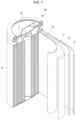
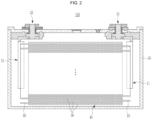
- FIGS. 1 to 4 are schematic views illustrating a rechargeable lithium battery according to an example embodiment.
- FIG. 1 shows a cylindrical battery
- FIG. 2 shows a prismatic battery
- FIGS. 3 and 4 show pouch-type batteries.
- the rechargeable lithium battery 100 includes an electrode assembly 40 including a separator 30 between a positive electrode 10 and a negative electrode 20, and a case 50 in which the electrode assembly 40 is included.
- the positive electrode 10, the negative electrode 20, and the separator 30 may be impregnated with an electrolyte solution (not shown).
- the rechargeable lithium battery 100 may include a sealing member 60 sealing the case 50 as shown in FIG. 1 .
- the rechargeable lithium battery 100 may include a positive lead tab 11, a positive terminal 12, a negative lead tab 21, and a negative terminal 22.
- the rechargeable lithium battery 100 includes a positive electrode tab 71 and a negative electrode tab 72 serving as an electrical path for inducing the current formed in the electrode assembly 40 to the outside.
- the rechargeable lithium battery 100 includes an electrode tab 70, which includes the positive electrode tab 71 and a negative electrode tab 72 illustrated in FIG. 3 and serving as an electrical path for inducing the current formed in the electrode assembly 40 to the outside.
- the rechargeable lithium battery according to some example embodiments may be used in, or applied to, e.g., automobiles, mobile phones, and/or various types of electrical devices, but the present invention is not limited thereto.
- the reaction solution was reacted by heating, while a reaction temperature thereof was controlled to be stable between about 65 °C to about 70 °C for 12 hours.
- NV non-volatile component
- a first structural unit derived from acrylic acid, a second structural unit derived from hydroxyethylmethacrylate, and a third structural unit derived from 2-acrylamido-2-methylpropanesulfonic acid had a molar ratio of 30:10:60.
- An acrylic copolymer was prepared in the same manner as in Synthesis Example 1 except that acrylic acid (28.8 g, 0.4 mol), hydroxyethylmethacrylate (13 g, 0.1 mol), and 2-acrylamido-2-methylpropanesulfonic acid (103.6 g, 0.5 mol) were used.
- the reaction solution had a non-volatile component of 9.7% (theoretical value: 10%).
- a first structural unit derived from acrylic acid, a second structural unit derived from hydroxyethyl methacrylate, and a third structural unit derived from 2-acrylamido-2-methylpropanesulfonic acid had a molar ratio of 40:10:50.
- An acrylic copolymer was prepared in the same manner as in Synthesis Example 1 except that acrylic acid (43.2 g, 0.6 mol), hydroxyethylmethacrylate (13 g, 0.1 mol), and 2-acrylamido-2-methylpropanesulfonic acid (62.2 g, 0.3 mol) were used.
- the reaction solution had a non-volatile component of 9.7% (theoretical value: 10%).
- a first structural unit derived from acrylic acid, a second structural unit derived from hydroxyethyl methacrylate, and a third structural unit derived from 2-acrylamido-2-methylpropanesulfonic acid had a molar ratio of 60:10:30.
- An acrylic copolymer was prepared in the same manner as in Synthesis Example 1 except that acrylic acid (28.8 g, 0.4 mol), hydroxyethylmethacrylate (6.5 g, 0.05 mol), and 2-acrylamido-2-methylpropanesulfonic acid (114 g, 0.55 mol) were used.
- the reaction solution had a non-volatile component of 9.8% (theoretical value: 10%).
- a first structural unit derived from acrylic acid, a second structural unit derived from hydroxyethyl methacrylate, and a third structural unit derived from 2-acrylamido-2-methylpropanesulfonic acid had a molar ratio of 40:5:55.
- An acrylic copolymer was prepared in the same manner as in Synthesis Example 1 with a difference that acrylic acid (28.8 g, 0.4 mol), hydroxyethylmethacrylate (19.5 g, 0.15 mol), and 2-acrylamido-2-methylpropanesulfonic acid (93.3 g, 0.45 mol) were used.
- the reaction solution had a non-volatile component of 9.8% (theoretical value: 10%).
- a first structural unit derived from acrylic acid, a second structural unit derived from hydroxyethyl methacrylate, and a third structural unit derived from 2-acrylamido-2-methylpropanesulfonic acid had a molar ratio of 40:15:45.
- the reaction solution had a non-volatile component of 9.7% (theoretical value: 10%).
- a first structural unit derived from acrylic acid and a third structural unit derived from 2-acrylamido-2-methylpropanesulfonic acid had a molar ratio of 35:65.
- Distilled water (968 g), a 20% aqueous lithium hydroxide solution (102 g), acrylic acid (54 g, 0.62 mol), ammonium persulfate (0.65 g, 2.85 mmol), and 2-methylpropanesulfonic acid (6 g, 0.02 mol) were added to a 3 L 4-necked separable flask equipped with a stirrer, a thermometer, and a cooling tube, and after three times repeatedly reducing an internal pressure of the flask to 10 mmHg with a diaphragm pump and returning the flask to a normal pressure with nitrogen, acrylonitrile (60 g, 0.94 mol) was added thereto.
- acrylonitrile 60 g, 0.94 mol
- reaction solution was reacted by heating, while a reaction temperature thereof was controlled to be stable between 65 °C to 70 °C for 18 hours, and ammonium persulfate (0.22 g, 0.95 mmol) was secondarily added thereto and then, heated to 80 °C and reacted again for 4 hours.
- NV non-volatile component
- a structural unit derived from acrylic acid, a structural unit derived from acrylonitrile, and a structural unit derived from 2-acrylamido-2-methylpropanesulfonic acid had a molar ratio of 45:50:5.
- the reaction solution was reacted by heating, while a reaction temperature thereof was controlled to be stable between 65 °C to 70 °C for 12 hours. After cooling the reaction solution to room temperature, the reaction was treated with a 25% ammonia solution to adjust pH to 7 to 8.
- reaction solution was taken by about 10 mL to measure a non-volatile component, which was 9.5% (theoretical value: 10%).
- a structural unit derived from acrylic acid, a structural unit derived from acrylamide, and a structural unit derived from 2-acrylamido-2-methylpropanesulfonic acid had a molar ratio of 0:95:5. In fact, it can be said to be poly(acrylamide-co-2-acrylamido-2-methylpropanesulfonic acid) lithium salt.
- the prepared composition for a coating layer was die-coated to be 1 ⁇ m thick on the single surface pf a 5.5 ⁇ m-thick polyethylene porous substrate (air permeability: 110 sec/100 cc, puncture strength: 360 kgf, CZMZ Co.) and then, dried at 70 °C for 10 minutes to manufacture a separator.
- Positive electrode active material slurry was prepared by mixing LiNi 0.75 Mn 0.23 Al 0.02 O 2 as a positive electrode active material, polyvinylidene fluoride as a binder, and acetylene black as a conductive material in a weight ratio of 96:3:1 and dispersing the mixture in N-methyl pyrrolidone.
- the positive electrode active material slurry was coated on a 15 ⁇ m-thick Al foil, dried at 100 °C, and pressed to manufacture a positive electrode.
- Negative electrode active material slurry was prepared by mixing artificial graphite and an Si-C composite in a weight ratio of 93:7 to prepare a negative electrode active material, mixing the negative electrode active material, a styrene-butadiene rubber binder, and carboxy methyl cellulose in a ratio of 98:1:1, and dispersing the mixture in distilled water.
- the Si-C composite had a core containing artificial graphite and silicon particles and coal-based pitch coated on the core.
- the negative electrode active material slurry was coated on a 10 ⁇ m-thick Cu foil, dried at 100 °C, and pressed to manufacture a negative electrode.
- the positive and negative electrodes were assembled with the separator to manufacture an electrode assembly, and an electrolyte solution was injected thereinto to manufacture a rechargeable lithium battery cell.
- the electrolyte solution was prepared by mixing ethylene carbonate (EC) and ethylmethyl carbonate (EMC) in a volume ratio of 3:7 and dissolving 1 M LiPF 6 in the mixed non-aqueous organic solvent.
- a separator for a rechargeable lithium battery and a rechargeable lithium battery cell were manufactured in the same manner as in Example 1 with a difference that the binder of Synthesis Example 2 was used instead of the binder of Synthesis Example 1.
- a separator for a rechargeable lithium battery and a rechargeable lithium battery cell were manufactured in the same manner as in Example 1 with a difference that the binder of Synthesis Example 3 was used instead of the binder of Synthesis Example 1.
- a separator for a rechargeable lithium battery and a rechargeable lithium battery cell were manufactured in the same manner as in Example 1 with a difference that the binder of Synthesis Example 4 was used instead of the binder of Synthesis Example 1.
- a separator for a rechargeable lithium battery and a rechargeable lithium battery cell were manufactured in the same manner as in Example 1 with a difference that the binder of Synthesis Example 5 was used instead of the binder of Synthesis Example 1.
- a separator for a rechargeable lithium battery and a rechargeable lithium battery cell were manufactured in the same manner as in Example 1 with a difference that the binder of Comparative Synthesis Example 1 was used instead of the binder of Synthesis Example 1.
- a separator for a rechargeable lithium battery and a rechargeable lithium battery cell were manufactured in the same manner as in Example 1 with a difference that the binder of Comparative Synthesis Example 2 was used instead of the binder of Synthesis Example 1.
- a separator for a rechargeable lithium battery and a rechargeable lithium battery cell were manufactured in the same manner as in Example 1 with a difference that the binder of Comparative Synthesis Example 3 was used instead of the binder of Synthesis Example 1.
- Each of the separators was cut into a size of 10 cm x 10 cm to prepare a sample, and the sample was impregnated in the electrolyte solution of Example 1 to measure resistance at 25 °C in an alternating current method.
- time (seconds) that it took for 100 cc of air to pass through the sample was measured by a densometer according to an ASTM D 726-94 test method.
- the separator After contacting the coating layer of the separator with the negative electrode active material layer of Example 1, the separator was bonded to the negative electrode in a chamber at 60 °C by using a laminator. Accordingly, the bonded laminate of the separator and the negative electrode was cut into a predetermined size (a width: 25 mm, a length: 50 mm) to prepare a sample, a force required for peeling in a direction of 180 ° was measured by using a tension meter (TA-XT, Stable Micro Systems).
- TA-XT Stable Micro Systems
- each of the separators of Examples 1 to 5 exhibited enhanced adhesive strength, compared with the separator of Comparative Example 1.
- separators of Examples 1 to 5 compared with the separators of Comparative Examples 2 and 3, exhibited reduced resistance when impregnated with an electrolyte solution.
- Capacity retention rate (discharge capacity after 200 cycles/discharge capacity after 1 cycle) * 100(%)
- DC internal resistance change rate ⁇ (DC-IR after 200 cycles)-(DC-IR after 1 cycle)/(DC-IR after 1 cycle) ⁇ * 100(%) [Table 3] Capacity retention rate @25 °C, 200 cyc. (%) Initial resistance @25 °C ( ⁇ ) DC-IR after 200cy @25 °C ( ⁇ ) DC-IR change rate after 200cyc.
- Example 1 88 2.30 4.60 200
- Example 2 85 2.59 5.30 205
- Example 3 83 2.88 6.04 210
- Example 4 89 2.42 4.85 201
- Example 5 84 2.70 5.59 207
- Comparative Example 1 87 2.30 7.15 311
- Comparative Example 2 78 4.03 8.65 215 Comparative Example 3 79 4.03 8.65 215
- the rechargeable lithium battery cells of Examples 1 to 5 compared with rechargeable lithium battery cell of Comparative Example 1, exhibited a reduced DC-IR change rate at room temperature.
- the rechargeable lithium battery cells of Examples 1 to 5 compared with the rechargeable lithium battery cell of Comparative Example 1, exhibited a reduced direct current internal resistance (DC-IR) change rate at a high temperature.
- the separators of the examples included a binder including specific structure units and had high heat resistance and low electrical resistance.
- a binder including specific structure units and had high heat resistance and low electrical resistance.
Landscapes
- Chemical & Material Sciences (AREA)
- Chemical Kinetics & Catalysis (AREA)
- General Chemical & Material Sciences (AREA)
- Electrochemistry (AREA)
- Engineering & Computer Science (AREA)
- Inorganic Chemistry (AREA)
- Health & Medical Sciences (AREA)
- Medicinal Chemistry (AREA)
- Polymers & Plastics (AREA)
- Organic Chemistry (AREA)
- Materials Engineering (AREA)
- Manufacturing & Machinery (AREA)
- Composite Materials (AREA)
- Battery Electrode And Active Subsutance (AREA)
- Secondary Cells (AREA)
- Cell Separators (AREA)
Applications Claiming Priority (1)
| Application Number | Priority Date | Filing Date | Title |
|---|---|---|---|
| KR1020230154658A KR102737795B1 (ko) | 2023-11-09 | 2023-11-09 | 바인더, 이를 포함하는 분리막 및 리튬 이차 전지 |
Publications (1)
| Publication Number | Publication Date |
|---|---|
| EP4553982A1 true EP4553982A1 (de) | 2025-05-14 |
Family
ID=92458295
Family Applications (1)
| Application Number | Title | Priority Date | Filing Date |
|---|---|---|---|
| EP24194834.8A Pending EP4553982A1 (de) | 2023-11-09 | 2024-08-16 | Bindemittel, separator und wiederaufladbare lithiumbatterie mit dem separator |
Country Status (6)
| Country | Link |
|---|---|
| US (1) | US20250158065A1 (de) |
| EP (1) | EP4553982A1 (de) |
| JP (1) | JP2025079300A (de) |
| KR (1) | KR102737795B1 (de) |
| CN (1) | CN119955441A (de) |
| TW (1) | TWI890547B (de) |
Citations (4)
| Publication number | Priority date | Publication date | Assignee | Title |
|---|---|---|---|---|
| US20140186680A1 (en) * | 2012-10-05 | 2014-07-03 | Lg Chem, Ltd. | Separator and electrochemical device comprising the same |
| US20170338461A1 (en) * | 2016-05-17 | 2017-11-23 | Samsung Sdi Co., Ltd. | Separator for rechargeable battery and rechargeable lithium battery including the same |
| WO2022240227A1 (ko) * | 2021-05-14 | 2022-11-17 | 삼성에스디아이주식회사 | 세퍼레이터, 이를 채용한 리튬이차전지, 및 이의 제조방법 |
| WO2023189442A1 (ja) * | 2022-03-31 | 2023-10-05 | 日本ゼオン株式会社 | 非水系二次電池機能層用スラリー組成物、非水系二次電池用セパレータ及び非水系二次電池 |
Family Cites Families (5)
| Publication number | Priority date | Publication date | Assignee | Title |
|---|---|---|---|---|
| CN108780891B (zh) * | 2016-03-03 | 2023-10-20 | 日本瑞翁株式会社 | 非水系二次电池电极用粘结剂组合物、导电材料糊组合物、浆料组合物、电极和二次电池 |
| CN110402510B (zh) * | 2017-03-24 | 2022-07-08 | 日本瑞翁株式会社 | 非水系二次电池用粘结剂组合物和非水系二次电池用浆料组合物 |
| AU2018297173B2 (en) * | 2017-07-07 | 2021-03-11 | Ppg Industries Ohio, Inc. | Electrode binder slurry composition for lithium ion electrical storage devices |
| CN112662348B (zh) * | 2020-01-21 | 2023-08-29 | 四川茵地乐科技有限公司 | 电池用粘合剂、锂离子电池负极片以及锂离子电池 |
| KR102538285B1 (ko) * | 2022-10-06 | 2023-06-01 | 주식회사 한솔케미칼 | 공중합체 조성물을 포함하는 바인더, 상기 바인더를 포함하는 이차전지용 음극 및 상기 음극을 포함하는 이차전지 |
-
2023
- 2023-11-09 KR KR1020230154658A patent/KR102737795B1/ko active Active
-
2024
- 2024-07-10 JP JP2024110779A patent/JP2025079300A/ja active Pending
- 2024-07-25 US US18/783,686 patent/US20250158065A1/en active Pending
- 2024-08-09 TW TW113130045A patent/TWI890547B/zh active
- 2024-08-13 CN CN202411105200.3A patent/CN119955441A/zh active Pending
- 2024-08-16 EP EP24194834.8A patent/EP4553982A1/de active Pending
Patent Citations (6)
| Publication number | Priority date | Publication date | Assignee | Title |
|---|---|---|---|---|
| US20140186680A1 (en) * | 2012-10-05 | 2014-07-03 | Lg Chem, Ltd. | Separator and electrochemical device comprising the same |
| US20170338461A1 (en) * | 2016-05-17 | 2017-11-23 | Samsung Sdi Co., Ltd. | Separator for rechargeable battery and rechargeable lithium battery including the same |
| WO2022240227A1 (ko) * | 2021-05-14 | 2022-11-17 | 삼성에스디아이주식회사 | 세퍼레이터, 이를 채용한 리튬이차전지, 및 이의 제조방법 |
| US20240145866A1 (en) * | 2021-05-14 | 2024-05-02 | Samsung Sdi Co., Ltd. | Separator, lithium secondary battery employing same, and method for manufacturing same |
| WO2023189442A1 (ja) * | 2022-03-31 | 2023-10-05 | 日本ゼオン株式会社 | 非水系二次電池機能層用スラリー組成物、非水系二次電池用セパレータ及び非水系二次電池 |
| EP4503300A1 (de) * | 2022-03-31 | 2025-02-05 | Zeon Corporation | Aufschlämmungszusammensetzung für wasserfreie sekundärbatteriefunktionsschichten, separator für wasserfreie sekundärbatterien und wasserfreie sekundärbatterie |
Also Published As
| Publication number | Publication date |
|---|---|
| TW202519624A (zh) | 2025-05-16 |
| JP2025079300A (ja) | 2025-05-21 |
| US20250158065A1 (en) | 2025-05-15 |
| TWI890547B (zh) | 2025-07-11 |
| CN119955441A (zh) | 2025-05-09 |
| KR102737795B1 (ko) | 2024-12-02 |
Similar Documents
| Publication | Publication Date | Title |
|---|---|---|
| US20250316841A1 (en) | Separator for rechargeable lithium battery and rechargeable lithium battery including the same | |
| EP4553982A1 (de) | Bindemittel, separator und wiederaufladbare lithiumbatterie mit dem separator | |
| US20250167392A1 (en) | Separator for rechargeable lithium battery and rechargeable lithium battery including the same | |
| EP4700848A1 (de) | Negative elektrode und wiederaufladbare lithiumbatterie damit | |
| EP4700868A2 (de) | Bindemittel für eine wiederaufladbare lithiumbatterie, elektrode damit und wiederaufladbare lithiumbatterie damit | |
| EP4496032A1 (de) | Elektrode für eine wiederaufladbare lithiumbatterie, elektrodenanordnung und wiederaufladbare lithiumbatterie damit | |
| US20260045547A1 (en) | Electrolyte for rechargeable lithium battery and rechargeable lithium battery including the same | |
| EP4604196A1 (de) | Wiederaufladbare lithiumbatterie | |
| US20250149734A1 (en) | Rechargeable lithium battery | |
| US20250167313A1 (en) | Separator for rechargeable lithium battery and rechargeable lithium battery including the same | |
| EP4641705A1 (de) | Positive elektroden für wiederaufladbare lithiumbatterien und wiederaufladbare lithiumbatterien damit | |
| EP4700960A1 (de) | Bindemittel für eine wiederaufladbare lithiumbatterie, elektrode damit und wiederaufladbare lithiumbatterie damit | |
| EP4648158A1 (de) | Separator für eine wiederaufladbare lithiumbatterie und wiederaufladbare lithiumbatterie damit | |
| EP4557424A1 (de) | Elektrolytlösung für eine wiederaufladbare lithiumbatterie und wiederaufladbare lithiumbatterie damit | |
| EP4651292A2 (de) | Separator für eine wiederaufladbare lithiumbatterie und wiederaufladbare lithiumbatterie damit | |
| EP4597638A1 (de) | Negative elektrode für eine wiederaufladbare lithiumbatterie und wiederaufladbare lithiumbatterie damit | |
| US20250167397A1 (en) | Separator for rechargeable lithium battery and rechargeable lithium battery including the same | |
| EP4557425A1 (de) | Elektrolytlösung für eine wiederaufladbare lithiumbatterie und wiederaufladbare lithiumbatterie damit | |
| EP4641704A1 (de) | Positive elektroden für wiederaufladbare lithiumbatterien und wiederaufladbare lithiumbatterien damit | |
| EP4704184A1 (de) | Verfahren zum laden einer wiederaufladbaren lithiumbatterie | |
| EP4481859A2 (de) | Positivelektrode für eine wiederaufladbare lithiumbatterie und wiederaufladbare lithiumbatterie damit | |
| EP4700869A1 (de) | Bindemittel für eine wiederaufladbare lithiumbatterie, elektrode damit und wiederaufladbare lithiumbatterie damit | |
| US20250337108A1 (en) | Separator for rechargeable lithium battery and rechargeable lithium battery including the same | |
| US20250158127A1 (en) | Electrolyte solution for rechargeable lithium battery and rechargeable lithium battery including the same | |
| EP4498444A1 (de) | Elektrode für eine wiederaufladbare lithiumbatterie und wiederaufladbare lithiumbatterie damit |
Legal Events
| Date | Code | Title | Description |
|---|---|---|---|
| PUAI | Public reference made under article 153(3) epc to a published international application that has entered the european phase |
Free format text: ORIGINAL CODE: 0009012 |
|
| STAA | Information on the status of an ep patent application or granted ep patent |
Free format text: STATUS: REQUEST FOR EXAMINATION WAS MADE |
|
| 17P | Request for examination filed |
Effective date: 20240816 |
|
| AK | Designated contracting states |
Kind code of ref document: A1 Designated state(s): AL AT BE BG CH CY CZ DE DK EE ES FI FR GB GR HR HU IE IS IT LI LT LU LV MC ME MK MT NL NO PL PT RO RS SE SI SK SM TR |