EP4501637A1 - Feuille coextrudée - Google Patents
Feuille coextrudée Download PDFInfo
- Publication number
- EP4501637A1 EP4501637A1 EP22935618.3A EP22935618A EP4501637A1 EP 4501637 A1 EP4501637 A1 EP 4501637A1 EP 22935618 A EP22935618 A EP 22935618A EP 4501637 A1 EP4501637 A1 EP 4501637A1
- Authority
- EP
- European Patent Office
- Prior art keywords
- extruded sheet
- thickness
- core layer
- skin layer
- resin
- Prior art date
- Legal status (The legal status is an assumption and is not a legal conclusion. Google has not performed a legal analysis and makes no representation as to the accuracy of the status listed.)
- Pending
Links
Images



Classifications
-
- B—PERFORMING OPERATIONS; TRANSPORTING
- B29—WORKING OF PLASTICS; WORKING OF SUBSTANCES IN A PLASTIC STATE IN GENERAL
- B29C—SHAPING OR JOINING OF PLASTICS; SHAPING OF MATERIAL IN A PLASTIC STATE, NOT OTHERWISE PROVIDED FOR; AFTER-TREATMENT OF THE SHAPED PRODUCTS, e.g. REPAIRING
- B29C44/00—Shaping by internal pressure generated in the material, e.g. swelling or foaming ; Producing porous or cellular expanded plastics articles
- B29C44/20—Shaping by internal pressure generated in the material, e.g. swelling or foaming ; Producing porous or cellular expanded plastics articles for articles of indefinite length
- B29C44/22—Shaping by internal pressure generated in the material, e.g. swelling or foaming ; Producing porous or cellular expanded plastics articles for articles of indefinite length consisting of at least two parts of chemically or physically different materials, e.g. having different densities
- B29C44/24—Making multilayered articles
-
- B—PERFORMING OPERATIONS; TRANSPORTING
- B29—WORKING OF PLASTICS; WORKING OF SUBSTANCES IN A PLASTIC STATE IN GENERAL
- B29C—SHAPING OR JOINING OF PLASTICS; SHAPING OF MATERIAL IN A PLASTIC STATE, NOT OTHERWISE PROVIDED FOR; AFTER-TREATMENT OF THE SHAPED PRODUCTS, e.g. REPAIRING
- B29C44/00—Shaping by internal pressure generated in the material, e.g. swelling or foaming ; Producing porous or cellular expanded plastics articles
- B29C44/34—Auxiliary operations
- B29C44/36—Feeding the material to be shaped
- B29C44/46—Feeding the material to be shaped into an open space or onto moving surfaces, i.e. to make articles of indefinite length
- B29C44/50—Feeding the material to be shaped into an open space or onto moving surfaces, i.e. to make articles of indefinite length using pressure difference, e.g. by extrusion or by spraying
-
- B—PERFORMING OPERATIONS; TRANSPORTING
- B29—WORKING OF PLASTICS; WORKING OF SUBSTANCES IN A PLASTIC STATE IN GENERAL
- B29C—SHAPING OR JOINING OF PLASTICS; SHAPING OF MATERIAL IN A PLASTIC STATE, NOT OTHERWISE PROVIDED FOR; AFTER-TREATMENT OF THE SHAPED PRODUCTS, e.g. REPAIRING
- B29C48/00—Extrusion moulding, i.e. expressing the moulding material through a die or nozzle which imparts the desired form; Apparatus therefor
- B29C48/03—Extrusion moulding, i.e. expressing the moulding material through a die or nozzle which imparts the desired form; Apparatus therefor characterised by the shape of the extruded material at extrusion
- B29C48/07—Flat, e.g. panels
- B29C48/08—Flat, e.g. panels flexible, e.g. films
-
- B—PERFORMING OPERATIONS; TRANSPORTING
- B29—WORKING OF PLASTICS; WORKING OF SUBSTANCES IN A PLASTIC STATE IN GENERAL
- B29C—SHAPING OR JOINING OF PLASTICS; SHAPING OF MATERIAL IN A PLASTIC STATE, NOT OTHERWISE PROVIDED FOR; AFTER-TREATMENT OF THE SHAPED PRODUCTS, e.g. REPAIRING
- B29C48/00—Extrusion moulding, i.e. expressing the moulding material through a die or nozzle which imparts the desired form; Apparatus therefor
- B29C48/16—Articles comprising two or more components, e.g. co-extruded layers
- B29C48/18—Articles comprising two or more components, e.g. co-extruded layers the components being layers
- B29C48/21—Articles comprising two or more components, e.g. co-extruded layers the components being layers the layers being joined at their surfaces
-
- B—PERFORMING OPERATIONS; TRANSPORTING
- B32—LAYERED PRODUCTS
- B32B—LAYERED PRODUCTS, i.e. PRODUCTS BUILT-UP OF STRATA OF FLAT OR NON-FLAT, e.g. CELLULAR OR HONEYCOMB, FORM
- B32B27/00—Layered products comprising a layer of synthetic resin
-
- B—PERFORMING OPERATIONS; TRANSPORTING
- B32—LAYERED PRODUCTS
- B32B—LAYERED PRODUCTS, i.e. PRODUCTS BUILT-UP OF STRATA OF FLAT OR NON-FLAT, e.g. CELLULAR OR HONEYCOMB, FORM
- B32B27/00—Layered products comprising a layer of synthetic resin
- B32B27/06—Layered products comprising a layer of synthetic resin as the main or only constituent of a layer, which is next to another layer of the same or of a different material
- B32B27/065—Layered products comprising a layer of synthetic resin as the main or only constituent of a layer, which is next to another layer of the same or of a different material of foam
-
- B—PERFORMING OPERATIONS; TRANSPORTING
- B32—LAYERED PRODUCTS
- B32B—LAYERED PRODUCTS, i.e. PRODUCTS BUILT-UP OF STRATA OF FLAT OR NON-FLAT, e.g. CELLULAR OR HONEYCOMB, FORM
- B32B27/00—Layered products comprising a layer of synthetic resin
- B32B27/06—Layered products comprising a layer of synthetic resin as the main or only constituent of a layer, which is next to another layer of the same or of a different material
- B32B27/08—Layered products comprising a layer of synthetic resin as the main or only constituent of a layer, which is next to another layer of the same or of a different material of synthetic resin
-
- B—PERFORMING OPERATIONS; TRANSPORTING
- B32—LAYERED PRODUCTS
- B32B—LAYERED PRODUCTS, i.e. PRODUCTS BUILT-UP OF STRATA OF FLAT OR NON-FLAT, e.g. CELLULAR OR HONEYCOMB, FORM
- B32B27/00—Layered products comprising a layer of synthetic resin
- B32B27/28—Layered products comprising a layer of synthetic resin comprising synthetic resins not wholly covered by any one of the sub-groups B32B27/30 - B32B27/42
- B32B27/283—Layered products comprising a layer of synthetic resin comprising synthetic resins not wholly covered by any one of the sub-groups B32B27/30 - B32B27/42 comprising polysiloxanes
-
- B—PERFORMING OPERATIONS; TRANSPORTING
- B32—LAYERED PRODUCTS
- B32B—LAYERED PRODUCTS, i.e. PRODUCTS BUILT-UP OF STRATA OF FLAT OR NON-FLAT, e.g. CELLULAR OR HONEYCOMB, FORM
- B32B27/00—Layered products comprising a layer of synthetic resin
- B32B27/36—Layered products comprising a layer of synthetic resin comprising polyesters
-
- B—PERFORMING OPERATIONS; TRANSPORTING
- B32—LAYERED PRODUCTS
- B32B—LAYERED PRODUCTS, i.e. PRODUCTS BUILT-UP OF STRATA OF FLAT OR NON-FLAT, e.g. CELLULAR OR HONEYCOMB, FORM
- B32B27/00—Layered products comprising a layer of synthetic resin
- B32B27/36—Layered products comprising a layer of synthetic resin comprising polyesters
- B32B27/365—Layered products comprising a layer of synthetic resin comprising polyesters comprising polycarbonates
-
- B—PERFORMING OPERATIONS; TRANSPORTING
- B32—LAYERED PRODUCTS
- B32B—LAYERED PRODUCTS, i.e. PRODUCTS BUILT-UP OF STRATA OF FLAT OR NON-FLAT, e.g. CELLULAR OR HONEYCOMB, FORM
- B32B5/00—Layered products characterised by the non- homogeneity or physical structure, i.e. comprising a fibrous, filamentary, particulate or foam layer; Layered products characterised by having a layer differing constitutionally or physically in different parts
- B32B5/18—Layered products characterised by the non- homogeneity or physical structure, i.e. comprising a fibrous, filamentary, particulate or foam layer; Layered products characterised by having a layer differing constitutionally or physically in different parts characterised by features of a layer of foamed material
-
- B—PERFORMING OPERATIONS; TRANSPORTING
- B32—LAYERED PRODUCTS
- B32B—LAYERED PRODUCTS, i.e. PRODUCTS BUILT-UP OF STRATA OF FLAT OR NON-FLAT, e.g. CELLULAR OR HONEYCOMB, FORM
- B32B5/00—Layered products characterised by the non- homogeneity or physical structure, i.e. comprising a fibrous, filamentary, particulate or foam layer; Layered products characterised by having a layer differing constitutionally or physically in different parts
- B32B5/22—Layered products characterised by the non- homogeneity or physical structure, i.e. comprising a fibrous, filamentary, particulate or foam layer; Layered products characterised by having a layer differing constitutionally or physically in different parts characterised by the presence of two or more layers which are next to each other and are fibrous, filamentary, formed of particles or foamed
-
- B—PERFORMING OPERATIONS; TRANSPORTING
- B32—LAYERED PRODUCTS
- B32B—LAYERED PRODUCTS, i.e. PRODUCTS BUILT-UP OF STRATA OF FLAT OR NON-FLAT, e.g. CELLULAR OR HONEYCOMB, FORM
- B32B7/00—Layered products characterised by the relation between layers; Layered products characterised by the relative orientation of features between layers, or by the relative values of a measurable parameter between layers, i.e. products comprising layers having different physical, chemical or physicochemical properties; Layered products characterised by the interconnection of layers
- B32B7/02—Physical, chemical or physicochemical properties
-
- B—PERFORMING OPERATIONS; TRANSPORTING
- B32—LAYERED PRODUCTS
- B32B—LAYERED PRODUCTS, i.e. PRODUCTS BUILT-UP OF STRATA OF FLAT OR NON-FLAT, e.g. CELLULAR OR HONEYCOMB, FORM
- B32B2250/00—Layers arrangement
- B32B2250/03—3 layers
-
- B—PERFORMING OPERATIONS; TRANSPORTING
- B32—LAYERED PRODUCTS
- B32B—LAYERED PRODUCTS, i.e. PRODUCTS BUILT-UP OF STRATA OF FLAT OR NON-FLAT, e.g. CELLULAR OR HONEYCOMB, FORM
- B32B2250/00—Layers arrangement
- B32B2250/40—Symmetrical or sandwich layers, e.g. ABA, ABCBA, ABCCBA
-
- B—PERFORMING OPERATIONS; TRANSPORTING
- B32—LAYERED PRODUCTS
- B32B—LAYERED PRODUCTS, i.e. PRODUCTS BUILT-UP OF STRATA OF FLAT OR NON-FLAT, e.g. CELLULAR OR HONEYCOMB, FORM
- B32B2266/00—Composition of foam
- B32B2266/02—Organic
- B32B2266/0214—Materials belonging to B32B27/00
- B32B2266/025—Polyolefin
-
- B—PERFORMING OPERATIONS; TRANSPORTING
- B32—LAYERED PRODUCTS
- B32B—LAYERED PRODUCTS, i.e. PRODUCTS BUILT-UP OF STRATA OF FLAT OR NON-FLAT, e.g. CELLULAR OR HONEYCOMB, FORM
- B32B2266/00—Composition of foam
- B32B2266/02—Organic
- B32B2266/0214—Materials belonging to B32B27/00
- B32B2266/0264—Polyester
-
- B—PERFORMING OPERATIONS; TRANSPORTING
- B32—LAYERED PRODUCTS
- B32B—LAYERED PRODUCTS, i.e. PRODUCTS BUILT-UP OF STRATA OF FLAT OR NON-FLAT, e.g. CELLULAR OR HONEYCOMB, FORM
- B32B2307/00—Properties of the layers or laminate
- B32B2307/30—Properties of the layers or laminate having particular thermal properties
-
- B—PERFORMING OPERATIONS; TRANSPORTING
- B32—LAYERED PRODUCTS
- B32B—LAYERED PRODUCTS, i.e. PRODUCTS BUILT-UP OF STRATA OF FLAT OR NON-FLAT, e.g. CELLULAR OR HONEYCOMB, FORM
- B32B2307/00—Properties of the layers or laminate
- B32B2307/30—Properties of the layers or laminate having particular thermal properties
- B32B2307/308—Heat stability
-
- B—PERFORMING OPERATIONS; TRANSPORTING
- B32—LAYERED PRODUCTS
- B32B—LAYERED PRODUCTS, i.e. PRODUCTS BUILT-UP OF STRATA OF FLAT OR NON-FLAT, e.g. CELLULAR OR HONEYCOMB, FORM
- B32B2307/00—Properties of the layers or laminate
- B32B2307/50—Properties of the layers or laminate having particular mechanical properties
- B32B2307/546—Flexural strength; Flexion stiffness
-
- B—PERFORMING OPERATIONS; TRANSPORTING
- B32—LAYERED PRODUCTS
- B32B—LAYERED PRODUCTS, i.e. PRODUCTS BUILT-UP OF STRATA OF FLAT OR NON-FLAT, e.g. CELLULAR OR HONEYCOMB, FORM
- B32B2307/00—Properties of the layers or laminate
- B32B2307/70—Other properties
- B32B2307/718—Weight, e.g. weight per square meter
-
- B—PERFORMING OPERATIONS; TRANSPORTING
- B32—LAYERED PRODUCTS
- B32B—LAYERED PRODUCTS, i.e. PRODUCTS BUILT-UP OF STRATA OF FLAT OR NON-FLAT, e.g. CELLULAR OR HONEYCOMB, FORM
- B32B2307/00—Properties of the layers or laminate
- B32B2307/70—Other properties
- B32B2307/72—Density
-
- B—PERFORMING OPERATIONS; TRANSPORTING
- B32—LAYERED PRODUCTS
- B32B—LAYERED PRODUCTS, i.e. PRODUCTS BUILT-UP OF STRATA OF FLAT OR NON-FLAT, e.g. CELLULAR OR HONEYCOMB, FORM
- B32B2307/00—Properties of the layers or laminate
- B32B2307/70—Other properties
- B32B2307/732—Dimensional properties
-
- B—PERFORMING OPERATIONS; TRANSPORTING
- B32—LAYERED PRODUCTS
- B32B—LAYERED PRODUCTS, i.e. PRODUCTS BUILT-UP OF STRATA OF FLAT OR NON-FLAT, e.g. CELLULAR OR HONEYCOMB, FORM
- B32B2307/00—Properties of the layers or laminate
- B32B2307/70—Other properties
- B32B2307/732—Dimensional properties
- B32B2307/737—Dimensions, e.g. volume or area
- B32B2307/7375—Linear, e.g. length, distance or width
- B32B2307/7376—Thickness
-
- B—PERFORMING OPERATIONS; TRANSPORTING
- B32—LAYERED PRODUCTS
- B32B—LAYERED PRODUCTS, i.e. PRODUCTS BUILT-UP OF STRATA OF FLAT OR NON-FLAT, e.g. CELLULAR OR HONEYCOMB, FORM
- B32B2451/00—Decorative or ornamental articles
-
- B—PERFORMING OPERATIONS; TRANSPORTING
- B32—LAYERED PRODUCTS
- B32B—LAYERED PRODUCTS, i.e. PRODUCTS BUILT-UP OF STRATA OF FLAT OR NON-FLAT, e.g. CELLULAR OR HONEYCOMB, FORM
- B32B2605/00—Vehicles
- B32B2605/003—Interior finishings
Definitions
- the present disclosure relates to a co-extruded sheet containing an engineering plastic, particularly a polycarbonate resin.
- Methods of molding a foam resin include physical foam molding and chemical foam molding.
- Chemical foam molding uses a blowing agent that is a chemical blowing agent. Chemical blowing agents have a high environmental burden and thus are not preferable from the viewpoint of protecting the earth's environment.
- Physical foam molding uses a blowing agent that is a physical blowing agent, such as nitrogen or carbon dioxide. Physical blowing agents have a low environmental burden and thus are preferable from the viewpoint of protecting the earth's environment.
- One physical foam-molding method that foams engineering plastics and/or super engineering plastics with high heat resistance involves shearing and kneading molten engineering and/or super engineering plastic resins together with a supercritical fluid at high pressure and dissolving them all.
- Patent Document 1 discloses a method of manufacturing a foam molding using a physical blowing agent such as nitrogen or carbon dioxide at relatively low pressure, instead of a high-pressure supercritical fluid. This method enables formation of fine foam cells in a resin molding with a relatively simple process using a physical blowing agent at low pressure without using special high-pressure equipment. Patent Document 1 further discloses a method of forming a foam molding by injection molding and extrusion molding.
- a physical blowing agent such as nitrogen or carbon dioxide
- Injection molding enables production of a foam molding with a complex shape.
- the surface layer of the molten resin flows around within the mold while being cooled and solidified.
- a relatively thin non-foamed skin layer is formed as the surface layer of the foam molding.
- extrusion molding with less mold-size and load restrictions than injection molding, is suitable for consecutively manufacturing foam moldings of a single shape and a single thickness.
- a sheet-shaped foam molding obtained by extrusion molding may be vacuum formed, for example, to shape it into a shape that is complex to some degree or into a relatively large size, for example.
- Patent Document 1 does not consider a foam molding of a polycarbonate resin composed of an amorphous resin that is vacuum formable, nor does it consider ensuring the surface smoothness of the foam molding when heated to a temperature exceeding the glass-transition temperature of the polycarbonate resin.
- crystalline resins are unlikely to experience significant deformation or dimensional change when heated at a temperature higher than the glass-transition temperature but lower than the melting point.
- amorphous resins are susceptible to thermal deformation when heated to a temperature higher than the glass-transition temperature (the glass-transition temperature of polycarbonate resin is about 145 °C).
- Patent Document 2 discloses a method of manufacturing a thermoplastic-resin foam sheet. This method of manufacturing a thermoplastic-resin foam sheet allows a skin layer to be formed readily on the surface of the thermoplastic-resin foam sheet by extrusion molding.
- JP 2000-52370 A discloses a method of manufacturing a multi-layer laminated molding. This multi-layer laminated molding is formed by co-extrusion molding, including a core layer and skin layers made of a foam resin.
- Patent Documents 2 and 3 use commodity plastics with relatively low heat resistance and mechanical strength, such as polypropylene or polystyrene, as the main resin material, and do not use an engineering plastic with good heat resistance and mechanical strength, particularly a polycarbonate resin. Further, the objectives of the manufacturing methods of Patent Documents 2 and 3 are to enable easy or stable manufacturing of a foam molding, and not to improve heat resistance and mechanical strength. Further, they cannot enable a weight reduction if the thickness of the skin layer is too large, i.e., the thickness of the core layer is too small.
- Patent Document 4 discloses an extruded laminated foam sheet of a polycarbonate-based resin having a plurality of extruded foam sheets of the polycarbonate-based resin bonded together.
- the extruded laminated foam sheet of a polycarbonate-based resin of Patent Document 4 is produced by cutting and laminating extruded foam sheets of the polycarbonate-based resin to produce a polycarbonate-based resin foam sheet with a relatively large thickness; the skin layer at the surface is not regulated.
- a foam molding made of a foam resin is that reducing its density to improve light-weight properties decreases its mechanical strength.
- a foam molding made of a polycarbonate resin required to have mechanical strength is disadvantageous relative to a resin molding made of an amorphous resin, due to the significantly lower mechanical strength of the former.
- Patent Document 5 JP H08-174780 A (Patent Document 5; "H08” stands for Heisei 8, i.e., the year 1996) discloses an extruded laminated polycarbonate-resin foam sheet with high expansion ratio produced by co-extrusion molding. This extruded laminated polycarbonate-resin foam sheet has good heating workability, particularly deep-drawing workability, and also has good appearance design quality and mechanical strength. Patent Document 5 discloses heating-induced dimensional changes occurring when the extruded laminated polycarbonate-resin foam sheet is heated in an atmosphere at a relatively low temperature of 170 °C.
- co-extrusion molding is an integrated molding method in which a core layer and skin layers are brought together inside a die during co-extrusion molding.
- bubbles in the core layer may expand during pressure release through the die outlet, causing problems in bubble-size uniformity.
- the pressure and concentration of the physical blowing agent are increased, the density of expanding bubbles increases, resulting in a non-uniform bubble size in the core layer of the co-extruded sheet, and swollen portions are produced in the co-extruded sheet after heating to 200 °C or higher.
- a laminated polycarbonate-resin foam sheet with high expansion ratio as shown in Patent Document 5 while providing good light-weight properties, has a lower mechanical strength than a laminated polycarbonate-resin foam sheet with low expansion ratio.
- the present inventors conducted extensive research and discovered that the density of a co-extruded sheet and the thickness of its skin layers can be adjusted to provide a co-extruded sheet, including a core layer made of a foam resin intended to reduce weight, that provides improved mechanical strength and experiences reduced deterioration of appearance design quality during vacuum forming.
- Patent Document 5 does not propose improving the mechanical strength of a laminated polycarbonate-resin foam sheet from the viewpoint of density or skin-layer thickness nor reducing deterioration of appearance design quality during vacuum forming.
- An object of the present disclosure is to provide a co-extruded sheet containing a polycarbonate resin that reduces swelling of the surface occurring during thermal shaping such as vacuum forming and/or cracking of the co-extruded sheet and that also provides improved mechanical strength.
- a co-extruded sheet according to the present disclosure may contain a polycarbonate resin. It may include: a core layer formed from a foam resin; a first skin layer formed from a non-foaming resin and laminated to one major surface of the core layer; and a second skin layer laminated to another major surface of the core layer.
- the co-extruded sheet may have a density of 0.4 to 0.9 g/cm 3 , have a thickness of 1 to 5 mm and satisfy the following expression, (1): 0.10 ⁇ t 1 + t2 / T ⁇ 0 .5
- t1 indicates a thickness of the first skin layer
- t2 indicates a thickness of the second skin layer
- T indicates a thickness of the co-extruded sheet.
- the co-extruded sheet When heated for 30 minutes in a heated atmosphere at 250 °C, the co-extruded sheet may include a swollen portion produced on a surface of the co-extruded sheet due to the heating.
- a thickness t3 of the co-extruded sheet inclusive of the swollen portion may be not larger than 1.5 times an average thickness t4 of the co-extruded sheet before the heating.
- the co-extruded sheet after the heating may have less than one swollen portion per 100 cm 2 of the surface.
- a co-extruded sheet may contain a polycarbonate resin. It may include: a core layer formed from a foam resin; a first skin layer formed from a non-foaming resin and laminated to one major surface of the core layer; and a second skin layer laminated to another major surface of the core layer.
- the co-extruded sheet may have a density of 0.4 to 0.9 g/cm 3 , have a thickness of 1 to 5 mm and satisfy the following expression, (1): 0.10 ⁇ t 1 + t2 / T ⁇ 0 .5
- t1 indicates a thickness of the first skin layer
- t2 indicates a thickness of the second skin layer
- T indicates a thickness of the co-extruded sheet.
- an average thickness t5 of the co-extruded sheet after the heating may be not larger than 1.5 times an average thickness t4 of the co-extruded sheet before the heating.
- a co-extruded sheet may contain a polycarbonate resin. It may include: a core layer formed from a foam resin; a first skin layer formed from a non-foaming resin and laminated to one major surface of the core layer; and a second skin layer laminated to another major surface of the core layer.
- the co-extruded sheet may have a density of 0.4 to 0.9 g/cm 3 , have a thickness of 1 to 5 mm and satisfy the following expression, (1): 0.10 ⁇ t 1 + t2 / T ⁇ 0 .5
- t1 indicates a thickness of the first skin layer
- t2 indicates a thickness of the second skin layer
- T indicates a thickness of the co-extruded sheet.
- the core layer may have an expansion ratio of 1.6 to 3.3.
- the co-extruded sheet according to the present disclosure reduces swelling of the surface occurring during thermal shaping such as vacuum forming and/or cracking of the co-extruded sheet, and also provides good light-weight properties and mechanical strength.
- a co-extruded sheet according to the present disclosure may contain a polycarbonate resin. It may include: a core layer formed from a foam resin; a first skin layer formed from a non-foaming resin and laminated to one major surface of the core layer; and a second skin layer laminated to another major surface of the core layer.
- the co-extruded sheet may have a density of 0.4 to 0.9 g/cm 3 .
- the co-extruded sheet may have a thickness of 1 to 5 mm and satisfy the following expression, (1): 0.10 ⁇ t 1 + t2 / T ⁇ 0 .5
- t1 indicates a thickness of the first skin layer
- t2 indicates a thickness of the second skin layer
- T indicates a thickness of the co-extruded sheet.
- the co-extruded sheet When heated for 30 minutes in a heated atmosphere at 250 °C, the co-extruded sheet may include a swollen portion produced on a surface of the co-extruded sheet due to the heating.
- a thickness t3 of the co-extruded sheet inclusive of the swollen portion may be not larger than 1.5 times an average thickness t4 of the co-extruded sheet before the heating.
- the co-extruded sheet after the heating may have less than one swollen portion per 100 cm 2 of the surface.
- the density of the co-extruded sheet and the thickness of the skin layers relative to the thickness of the co-extruded sheet are regulated in this manner, swelling and/or cracking occurring at the surface during thermal shaping such as vacuum forming will be prevented and, at the same time, good light-weight properties and mechanical strength will be provided. Further, deterioration of the appearance design quality of the co-extruded sheet during thermal shaping such as vacuum forming will be reduced.
- a co-extruded sheet may contain a polycarbonate resin. It may include: a core layer formed from a foam resin; a first skin layer formed from a non-foaming resin and laminated to one major surface of the core layer; and a second skin layer laminated to another major surface of the core layer.
- the co-extruded sheet may have a density of 0.4 to 0.9 g/cm 3 , have a thickness of 1 to 5 mm and satisfy the following expression, (1): 0.10 ⁇ t 1 + t2 / T ⁇ 0 .5
- t1 indicates a thickness of the first skin layer
- t2 indicates a thickness of the second skin layer
- T indicates a thickness of the co-extruded sheet.
- an average thickness t5 of the co-extruded sheet after the heating may be not larger than 1.5 times an average thickness t4 of the co-extruded sheet before the heating.
- the density of the co-extruded sheet and the thickness of the skin layers relative to the thickness of the co-extruded sheet are regulated in this manner, swelling and/or cracking occurring at the surface during thermal shaping such as vacuum forming will be prevented and, at the same time, good light-weight properties and mechanical strength will be provided. Further, deterioration of the appearance design quality of the co-extruded sheet during thermal shaping such as vacuum forming will be reduced.
- a co-extruded sheet may contain a polycarbonate resin. It may include: a core layer formed from a foam resin; a first skin layer formed from a non-foaming resin and laminated to one major surface of the core layer; and a second skin layer laminated to another major surface of the core layer.
- the co-extruded sheet may have a density of 0.4 to 0.9 g/cm 3 , have a thickness of 1 to 5 mm and satisfy the following expression, (1): 0.10 ⁇ t 1 + t2 / T ⁇ 0 .5
- t1 indicates a thickness of the first skin layer
- t2 indicates a thickness of the second skin layer
- T indicates a thickness of the co-extruded sheet.
- the core layer may have an expansion ratio of 1.6 to 3.3. This will reduce deterioration of the appearance design quality of the co-extruded sheet during thermal shaping such as vacuum forming and, at the same time, provide even better light-weight properties and mechanical strength.
- the polycarbonate resin contained in the first and second skin layers may have a melt volume-flow rate 1.0 to 5 times a melt volume-flow rate of the polycarbonate resin contained in the core layer. This will prevent the bubble size in the core layer from becoming non-uniform.
- the polycarbonate resin contained in the first and second skin layers may have a melt volume-flow rate 1.5 to 3 times a melt volume-flow rate of the polycarbonate resin contained in the core layer. This will improve vacuum formability.
- the co-extruded sheet may have a density not higher than 0.82 g/cm 3 . This will provide even better light-weight properties and mechanical strength.
- the co-extruded sheet When the co-extruded sheet is heated for 30 minutes in an atmosphere at 200 °C, the co-extruded sheet may have a dimensional change ratio of -5 to 0 % as measured along one of a direction of extrusion and a width direction perpendicular to the direction of extrusion in planner view. This will ensure the dimensional stability of the co-extruded sheet during thermal shaping such as vacuum forming.
- the co-extruded sheet may have a specific flexural modulus not lower than 1.5 GPa ⁇ cm 3 /g. This will reduce the weight of the co-extruded sheet and, at the same time, improve its mechanical strength.
- the co-extruded sheet may have a specific flexural modulus not lower than 2 GPa ⁇ cm 3 /g. This will further improve the light-weight properties and mechanical strength of the co-extruded sheet.
- the co-extruded sheet may further include a decorative film.
- the decorative film may be laminated to an outer surface of at least one of the first and second skin layers. This will provide a design depending on the application of the molded product resulting from vacuum forming of the co-extruded sheet.
- FIGS. 1 to 5 show embodiments of the co-extruded sheet, denoted by numeral 1, of the present disclosure.
- the same and corresponding elements in the drawings are labeled with the same reference characters, and their description will not be repeated.
- the drawings to which reference will be made below show elements in a simplified or schematic manner, and/or do not show some elements.
- the co-extruded sheet 1 is made of a polycarbonate resin.
- the co-extruded sheet 1 according to the present embodiments has a sheet shape.
- the co-extruded sheet 1 is produced by co-extrusion molding of a molten polycarbonate resin.
- the resin used in the present disclosure may be any other engineering plastic that contains a polycarbonate resin.
- An engineering plastic is a thermoplastic resin with an under-load deflection temperature not lower than 100 °C.
- the engineering plastic may be, for example, a polycarbonate resin (PC) or, instead, a modified polyphenylene ether (m-PPE) or syndiotactic polystyrene (SPS), for example.
- PC polycarbonate resin
- m-PPE modified polyphenylene ether
- SPS syndiotactic polystyrene
- the resin used in the co-extruded sheet 1 of the present disclosure may contain at least one selected from the group consisting of these engineering plastics.
- the resin material of the co-extruded sheet 1 is only required to be an extrusion-moldable engineering plastic.
- An ultraviolet absorbing agent and/or an anti-aging agent, for example, may be added to the resin material of the co-extruded sheet 1.
- the co-extruded sheet 1 has a density of 0.4 to 0.9 g/cm 3 . If the density of the co-extruded sheet 1 is 0.4 to 0.9 g/cm 3 , both weight reduction and improvement of strength will be achieved. More preferably, the density of the co-extruded sheet 1 may be 0.4 to 0.82 g/cm 3 . This will provide even better light-weight properties and mechanical strength.
- the co-extruded sheet 1 includes a core layer 2, a skin layer 3 laminated to one major surface of the core layer 2, and a skin layer 4 laminated to the other major surface of the core layer 2.
- the co-extruded sheet 1 has a thickness T of 1 to 5 mm.
- the core layer 2 is formed from a foam resin.
- the core layer 2 may be formed by foam molding of a molten polycarbonate resin. This means that the core layer 2 has a large number of air bubbles. Each of these bubbles has a generally elliptic shape extended in the direction of extrusion in a cross-sectional view of the layer taken along a plane in the direction of extrusion during extrusion molding and in the thickness direction. Bubbles contained in the core layer 2 that are located at and near the middle of the core layer 2 as determined along the thickness direction has larger bubble diameters than bubbles 21 located near the ends of the core layer 2 as determined along the thickness direction. The bubble diameter of bubbles 21 gradually decreases as it goes from the middle of the core layer 2 as determined along the thickness direction toward the ends thereof as determined along the thickness direction.
- the skin layer 3 is formed from a non-foaming resin. This means that the skin layer 3 is not foam molded.
- the skin layer 3 is extruded by co-extrusion molding through the die outlet in a non-foamed state and laminated integrally to the core layer 2.
- the skin layer 3 has a thickness t1.
- the skin layer 3 may use a thermoplastic resin that can bond well to the core layer 2. More specifically, it is particularly preferable that the resin material of the skin layer 3 is the same resin material that forms the core layer 2. Further, to strengthen the skin layer 3, the skin layer 3 may be formed from a reinforced resin containing an inorganic filler. This construction of the skin layer 3 will achieve both weight reduction and improvement of strength while efficiently improving strength.
- the inorganic filler may be, for example, glass fiber, carbon fiber, aramid fiber, talc or mica.
- the skin layer 4 has a thickness t2.
- the skin layer 4 is the same as the skin layer 3 except that it is laminated to the other major surface of the core layer 2. As such, no specific description of the skin layer 4 will be given.
- the thickness t1 of the skin layer 3 and the thickness t2 of the skin layer 4 are measured in the following manner:
- the co-extruded sheet 1 is cut along the width direction, down in the thickness direction, and the resulting cut surface is observed with a microscope.
- the microscope used is a Type No. VHX-6000 from Keyence Corporation. A magnification of the microscope that allows determination of the bubble diameter at the interface between the skin layer 3 and core layer 2 of the co-extruded sheet 1 is sufficient.
- the cut surface of the co-extruded sheet 1 is equally divided into 16 sub-sections that are arranged in the width direction; from among the large number of bubbles present in the cut surface of the co-extruded sheet 1, 15 bubbles are selected that are located on the imaginary borderlines of the sub-sections and close to the surfaces of the co-extruded sheet 1; among these bubbles, the one closest to a surface of the co-extruded sheet 1 is identified. Another imaginary line is drawn that runs through the uppermost point of this closest bubble and perpendicular to the thickness direction. The portion located inward of the imaginary line as determined along the thickness direction is treated as a core layer 2, and the portion located outward along the thickness direction is treated as a skin layer 3.
- each of the thickness t1 of the skin layer 3 and the thickness t2 of the skin layer 4 is preferably not smaller than 0.050 mm.
- the ratio of the total thickness of the skin layers to the thickness T of the co-extruded sheet 1 is to be 0.10 to 0.5, where the total thickness is the sum of the thickness t1 of the skin layer 3 and the thickness t2 of the skin layer 4. That is, the co-extruded sheet 1 is to satisfy the following expression, (1): 0.10 ⁇ t 1 + t2 / T ⁇ 0 .5
- the ratio of the total thickness of the skin layers (t1+t2) to the thickness T of the co-extruded sheet 1 is lower than 0.10, the reinforcing effect, in terms of mechanical strength, of the non-foaming resin of the skin layers is insufficiently produced, decreasing a mechanical strength such as specific flexural modulus.
- the ratio of the total thickness of the skin layers (t1+t2) to the thickness T of the co-extruded sheet 1 is higher than 0.5, this means increased density of the co-extruded sheet 1.
- the co-extruded sheet 1 loses light-weight properties that would otherwise be provided by foaming.
- the ratio of the total thickness of the skin layers (t1+t2) to the thickness T of the co-extruded sheet 1 is preferably in the range of 0.15 to 0.45, and more preferably in the range of 0.2 to 0.4. As the ratio of the total thickness of the skin layers (t1+t2) to the thickness T of the co-extruded sheet 1 is in such a range, the specific flexural modulus of the sheet is improved while the reduced density reduces its weight.
- the ratio of the total thickness of the skin layers (t1+t2) to the thickness T of the co-extruded sheet 1 is in the range of 0.2 to 0.4, a certain thickness of the core layer 2 is provided in which irregular-sized bubbles have been uniformed, while secondary workability in vacuum forming, for example, is improved.
- Regulating the density of the co-extruded sheet 1 and the thickness of the skin layers 3 and 4 (t1+t2) relative to the thickness T of the co-extruded sheet 1 in this manner will reduce swelling and/or cracking occurring at the surface during thermal shaping such as vacuum forming and, at the same time, provide good light-weight properties and mechanical strength.
- the melt volume-flow rate (hereinafter referred to as "MVR")of the polycarbonate resin contained in the skin layer 3 is equal to the MVR of the polycarbonate resin contained in the core layer 2 or higher than the MVR of the polycarbonate resin contained in the core layer 2.
- the MVR of the polycarbonate resin contained in the skin layer 3 is to be 1.0 to 5 times, preferably 1.5 to 3 times the MVR of the polycarbonate resin contained in the core layer 2.
- the temperature of the resin forming the skin layer 3 can be lowered as much as possible directly after discharge through the die outlet during extrusion molding. This reduces the viscosity of the skin layer 3 directly after discharge through the die outlet, thereby preventing swelling or rupturing of the surface of the skin layer 3, which would be caused by the non-uniform size of the bubbles contained in the core layer 2.
- the ratio of the MVR of the resin contained in the skin layer 3 were lower than 1.0, this would make it difficult to lower the resin temperature, making it difficult to prevent swelling or rupturing of the surface of the skin layer 3.
- the ratio of the MVR of the resin contained in the skin layer 3 is not lower than 1.5, it will be yet easier to prevent the size of the bubbles in the core layer 2 from becoming non-uniform during extrusion molding and, at the same time, reduce the pre-heating time for vacuum forming and thus improve productivity.
- the ratio of the MVR of the resin contained in the skin layer 3 is higher than 5, it is necessary to excessively lower the MVR of the resin forming the core layer 2 in order to cause the resin forming the skin layer 3 to properly flow within the die during extrusion molding.
- the MVR of the polycarbonate resin contained in the skin layer 3 is to be 1.0 to 5 times, preferably 1.5 to 3 times the MVR of the polycarbonate resin contained in the core layer 2. The same applies to the skin layer 4 / core layer 2.
- the MVR of the resins contained in the skin layer 3 and core layer 2 is measured by plastic flow characteristic testing with a capillary rheometer and a slit-die rheometer (in accordance with JIS K7199 and ISO 11443). In the present disclosure, measurement is done where the length of the capillary die is 5 mm, the inner diameter is 1 mm and the measurement temperature is 300 °C.
- the core layer 2 of the present disclosure is preferably foam molded using a physical blowing agent with relatively low pressure, such as nitrogen or carbon dioxide, where nitrogen is more preferable.
- a physical blowing agent with relatively low pressure, such as nitrogen or carbon dioxide, where nitrogen is more preferable.
- the pressure of the physical blowing agent will be set to 1 to 6 MPa, which is relatively low, thereby forming a large number of fine bubbles. This will further prevent swelling, for example, during heating at a high temperature in vacuum forming.
- the average bubble diameter of bubbles is to be not smaller than 0.1 mm, and not larger than 1.0 mm, and preferably not larger than 0.3 mm.
- the expansion ratio of the core layer 2 is to be not lower than 1.6, and not higher than 3.3.
- the expansion ratio of the core layer 2 is to be not higher than 3.1. This will provide even better light-weight properties and mechanical strength.
- the co-extruded sheet 1 is shaped into various shapes through vacuum forming.
- the co-extruded sheet 1 is heated to about 200 °C, which initiates drawdown, and then deposited on the die, for example, and experiences vacuum suction so as to be shaped.
- the amount of deformation of the co-extruded sheet 1 in response to the heating temperature during vacuum forming i.e., dimensional change ratio during heating
- the co-extruded sheet 1 may have a dimensional change ratio of -5 % to 0 % in the direction of extrusion.
- the co-extruded sheet 1 may have a dimensional change ratio of -5 to 0 % in the width direction.
- the co-extruded sheet 1 has a dimensional change ratio of -5 to 0 % in one of the direction of extrusion and the width direction.
- the co-extruded sheet 1 has a dimensional change ratio of -5 to 0 % in both the direction of extrusion and the width direction.
- the width direction is the direction perpendicular to the above-mentioned direction of extrusion in planner view.
- the co-extruded sheet 1 has good dimensional stability during heating.
- the co-extruded sheet 1 has a specific flexural modulus not lower than 1.5 GPa ⁇ cm 3 /g.
- a specific flexural modulus is the flexural modulus of the co-extruded sheet 1 divided by the density of the co-extruded sheet 1. As such, the higher the specific flexural modulus, the better light-weight properties and mechanical strength.
- the flexural modulus is measured by three-point bending testing (in accordance with ISO 178 or JIS K 7171). The flexural modulus is measured in the atmosphere. The testing rate is 10 mm/min.
- the co-extruded sheet 1 is thermally shaped into a desired shape mainly through vacuum forming, for example.
- swelling i.e., a swollen portion
- the average thickness t5 of the co-extruded sheet 1 after heating is not larger than 1.5 times the average thickness t4 of the co-extruded sheet before heating.
- the broken line denoted by S in FIG. 3 indicates the surface of the co-extruded sheet 1 before heating. That is, the co-extruded sheet 1 is prevented from developing a swollen portion due to heating, thereby reducing a change in thickness as determined by comparing the sheet before heating and the sheet after heating. As such, the co-extruded sheet 1 provides improved appearance design quality upon thermal shaping such as vacuum forming.
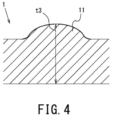
- the thickness t3 of the co-extruded sheet inclusive of the above-discussed swollen portion 11 is not larger than 1.5 times the average thickness t4 of the co-extruded sheet before heating shown in FIG. 3 .
- the co-extruded sheet 1 after heating has less than one swollen portion 11 per 100 cm 2 of its surface. That is, in the co-extruded sheet 1, the height of the swollen portion 11 produced on the surface due to the heating is reduced, and the number of swollen portions 11 produced is also reduced.
- the co-extruded sheet 1 provides improved appearance design quality upon thermal shaping such as vacuum forming.
- a product thermally shaped from the co-extruded sheet is used in applications that particularly require appearance design quality, such as signboards, containers like suitcases, or interior/exterior automotive materials. In such applications, defects such as swellings on thermally shaped products are not desirable. In view of this, swelling during heating of the co-extruded sheet 1 is to be prevented as much as possible, and specifically there is to be less than one swollen portion 11.
- the co-extruded sheet 1 may contain a large number of scale-like filler particles.
- the scale-like filler may be, for example, an inorganic filler, such as talc, calcium carbonate, mica, clay, boron nitride, wollastonite, potassium titanate, or glass flakes.
- the scale-like filler may be surface treated with a silane-based coupling agent, a titanate-based coupling agent, a phosphate ester-based coupling agent, or fatty acid-based coupling agent, for example.
- the scale-like filler particles have an aspect ratio not lower than 5. The aspect ratio is calculated by dividing the average diameter of the scale-like filler particles by their average thickness (average particle diameter / average thickness).
- the aspect ratio of the scale-like filler particles is preferably not lower than 10, and more preferably not lower than 30.
- the aspect ratio of the scale-like filler particles is preferably not lower than 10, and more preferably not lower than 30.
- the aspect ratio is too high, the flow rate of the mixed molten resin inside the die cannot easily be controlled during the manufacturing process described further below, which may deteriorate surface smoothness.
- an increase in the viscosity of the mixed molten resin during extrusion molding will be too large, which will generate heat inside the extrusion-molding equipment, as will be discussed further below, potentially causing thermal degradation of the thermoplastic resin.
- the aspect ratio of the scale-like filler particles is to be lower than 50.
- the specific surface area of the scale-like filler is preferably 5 to 20 m 2 /g. If the specific surface area of the scale-like filler is too small, surface smoothness is less likely to be achieved by sliding of the scale-like filler at the surface; if the specific surface area is too large, the resistance of the scale-like filler in the molten resin will be large and, as a result, it will be difficult to properly orient the scale-like filler particles.
- the core layer 2 may contain, in a region near the boundary with the skin layer 3, scale-like filler particles oriented generally parallel to the boundary surface between the core layer 2 and skin layer 3.
- the near-boundary region is a defined, as determined along the thickness direction of the core layer 2, by the boundary surface between the core layer 2 and sky layer 3 and a position a thickness of 5 % of the core-layer thickness away from the boundary surface.
- the bubbles contained in the core layer 2 have a shape extended along the direction of extrusion during extrusion molding.
- the scale-like filler particles are also oriented generally parallel to the bubble walls of the bubbles extended along the direction of extension, thereby improving the strength of the bubble walls. This will prevent rupturing along the direction of extrusion of the co-extruded sheet 1.
- Scale-like filler particles being generally parallel means that, in a cross section obtained by cutting the co-extruded sheet 1 in the thickness direction along the direction of extrusion during extrusion molding, the scale-like filler particles have an inclination not less than 0 ° and less than 5 ° relative to the boundary surface between the core layer 2 and skin layer 3. In other words, it means that the surfaces (i.e., major surfaces) of the scale-like filler particles face the boundary surface of the core layer 2 and skin layer 3 so as to be generally parallel to the surface. The same applies to the orientation of scale-like filler particles located in the core layer 2 and near the boundary between the core layer 2 and skin layer 4.
- the orientation of a large number of scale-like filler particles contained in the region near the boundary between the core layer 2 and skin layer 3 were calculated in the following manner: First, in a cross section in a plane in the thickness direction and along the direction of extrusion during extrusion molding, 50 electron micrographs of 150 by 150 ⁇ m were taken, all with an equal distance from the front end to the rear end along the direction of extrusion in the near-boundary region and in the middle of the near-boundary region along the thickness direction. From among all the scale-like filler particles contained in these 50 electron micrographs, the ones oriented generally parallel to the boundary surface between the core layer 2 and skin layer 3 were identified. Then, the proportion of the scale-like filler particles oriented generally parallel in the large number of scale-like filler particles contained in the near-boundary region was calculated.
- the core layer 2 may contain, in a middle region of the core layer 2 along the thickness direction, scale-like filler particles oriented with an angle of 5 ° to 90 ° relative to the surfaces of the co-extruded sheet 1.
- the middle region is a region with a thickness of 25 % beginning at the middle along the thickness direction toward the boundary surface between the core layer 2 and skin layer 3, where the thickness of the core layer 2 is 100 %.
- Preferably not less than 40 % of the large number of scale-like filler particles contained in the middle region are oriented with an angle of 5 ° to 90 ° relative to the surface S of the co-extruded sheet 1. This will improve the formability of the co-extruded sheet 1.
- the scale-like filler particles are oriented with an angle of 5 ° to 90 ° relative to the surface. This will further improve the formability of the co-extruded sheet 1.
- the bubbles contained in the middle region of the core layer 2 are likely to become larger than those in the near-boundary region discussed above during extrusion molding. This is because the middle region is not as easily cooled after extrusion as the near-boundary region. If the bubbles are too large, this may cause damage to the co-extruded sheet 1. If the scale-like filler particles in the middle region are inclined and randomly disposed between the bubbles, as discussed above, this will reduce growth of bubbles in all directions.
- the orientation of the large number of scale-like filler particles contained in the middle region of the core layer 2 can be calculated in the following manner: First, similarly to the near-boundary region, 50 electron micrographs are taken, all with an equal distance and in the middle of the core layer 2 along the thickness direction. From among all the scale-like filler particles contained in these 50 electron micrographs, the ones oriented with an angle of 5 ° to 90 ° relative to the surface of the co-extruded sheet 1 are identified. Then, the proportion of the scale-like filler particles oriented with an angle of 5 ° to 90 ° relative to the surface of the co-extruded sheet 1 in the large number of scale-like filler particles contained in the middle region is calculated.
- a method of manufacturing the co-extruded sheet 1 will be described below (not shown).
- resin pellets constituting a resin material are loaded into the screw cylinder of a main extruder.
- the resin material is a polycarbonate resin.
- the resin pellets are heated within the screw cylinder to produce a molten resin.
- a blowing agent is injected into the molten resin from a blowing-agent injection bottle attached to the screw cylinder of the main extruder.
- the blowing agent is melted into the molten resin by the screw cylinder and kneaded to be uniformly dispersed. This results in a mixed molten resin.
- the mixed molten resin is discharged through the die outlet to form a core layer 2.
- resin pellets constituting a resin material are loaded into each of the screw cylinders of two auxiliary extruders, heated and melted to produce two molten resins.
- One of the two molten resins is discharged through the associated die outlet to form a skin layer 3, while the other is discharged through the associated die outlet to form a skin layer 4.
- the mixed molten resin and the two molten resins from their respective extruders are brought together inside a die and discharged through the die outlet, where the skin layer 3 is laminated to one of the major surfaces of the core layer 2 and the skin layer 4 is laminated to the other major surface of the core layer 2.
- the mixed molten resin is foamed during extension through the die outlet into the atmosphere. This results in a co-extruded sheet 1.
- the foaming method is physical foaming using an inert gas, such as nitrogen or carbon dioxide, as a blowing agent.
- an inert gas such as nitrogen or carbon dioxide
- the co-extruded sheet 1 that has been extruded in this manner is transported by a haul-off machine to a cutter.
- the cutter cuts the co-extruded sheet 1 into a desired shape.
- the co-extruded sheet 1 produced in this manner which is then shaped into a desired shape by vacuum forming, for example, may be used in the following applications: For example, a wide product and part required to have relatively high strength, such as a signboard or a mobility material like an exterior automotive material; a product and part required to have heat resistance, such as a battery or a tray for heat-generating members used in a manufacturing process that includes a heating step; or a product and part required to be light-weight. Since the co-extruded sheet 1 contains a polycarbonate resin and has been foam molded through co-extrusion molding, it is a suitable material for forming such a product or part as listed above.
- the co-extruded sheet 1 may have decorative films 5, as shown in FIG. 5 .
- a decorative film 5 is laminated to the outer surface of at least one of the skin layers 3 and 4.
- the outer surface of the skin layer 3 is the surface of the skin layer 3 opposite the face facing the core layer 2.
- a desired kind of the decorative film 5 may be selected from a plurality of kinds of the decorative film 5 with various designs provided thereon to provide a design quality suitable for the application of the molded product obtained by vacuum forming of the co-extruded sheet 1.
- the decorative film 5 used may be, for example, a colored film, a film with any pattern printed or otherwise provided on the surface, a film with a pattern such as emboss texture, wood texture, stone texture or carbon texture, or a film with a metallic surface luster added by vapor deposition.
- the material of the decorative film 5 may be, for example, PC, PMMA, a PC/PMMA alloy, ABS, AES, PVC, or copolymerized PET.
- the co-extruded sheet 1 may be composed of three layers, i.e., a core layer 2 and skin layers 3 and 4, or may be composed of constructed by laminating a decorative film 5 to at least one of the skin layers 3 and 4.
- a product and a part, for example, fabricated from the co-extruded sheet 1 help reduce the amount of resin used.
- the co-extruded sheet 1 according to the present embodiments will contribute to improving the efficiency with which natural resources are used, to alleviating transportation-related issues, to reducing the amount of energy used, and to reducing CO 2 emissions.
- Offering the co-extruded sheet 1 to society will contribute to achieving some of the 17 Sustainable Development Goals (SDGs) set by the United Nations: Goal 7 (affordable and clean energy); Goal 9 (industry, innovation and infrastructure); and Goal 11 (sustainable cities and communities).
- SDGs Sustainable Development Goals
- test specimens for Inventive Examples 1 to 10 and Comparative Examples 1 to 6 were fabricated, and tests were conducted to evaluate specific flexural modulus, whether a specimen was broken in harpy impact testing, and swelling on a test specimen when heated at 250 °C for 30 minutes.
- the resin material used for these test specimens is a polycarbonate resin. It should be noted that the present disclosure is not limited to these examples.
- the test specimen for Inventive Example 1 was fabricated by co-extrusion molding in the following manner: First, a polycarbonate resin was loaded into the screw cylinder of a main extruder, and was sheared and kneaded while being heated at 270°C. Thereafter, a blowing agent constituted by N 2 was injected at a pressure of 4 MPa. The polycarbonate resin and blowing agent were heated at 215 °C to melt, and a core layer was produced with a die-outlet temperature of 215 °C.
- a polycarbonate resin was loaded into each of the screw cylinders of auxiliary extruders, and was sheared and kneaded while being heated at 255 °C, and two skin layers were produced with a die-outlet temperature of 215 °C. These core and skin layers were brought together inside a die and laminated, and discharged through the die outlet. This resulted in a test specimen for Inventive Example 1 with skin layers made of a non-foaming resin laminated to both major surfaces of the core layer made of a foam resin.
- the co-extrusion molding of the test specimen for Inventive Example 1 occurred with such a die outlet gap that the resulting thickness T of the test specimen for Inventive Example 1 was at the relevant value shown in Table 1 and with a haul-off speed of 0.7 m/min.
- test specimens for Inventive Examples 2 to 10 were fabricated by the same method as the test specimen for Inventive Example 1 except that the die outlet gap, the discharge flow rates of the main and auxiliary extruders and the haul-off speed were such that the thickness T of each specimen was at the relevant value shown in Table 1. This means that the test specimens for Inventive Examples 1 to 10 had different thicknesses.
- the test specimen for Comparative Example 1 was fabricated by co-extrusion molding in the following manner: First, a polycarbonate resin was loaded into the screw cylinder of a main extruder, and was sheared and kneaded while being heated at 270 °C. Thereafter, such an amount of a blowing agent constituted by isopentane gas was injected that its resulting content was 0.53 mol/kg resin. The polycarbonate and blowing agent were heated at 215 °C to melt, and a core layer was produced with a die-outlet temperature of 215 °C.
- a polycarbonate resin was loaded into the screw cylinders of two auxiliary extruders, and was sheared and kneaded while being heated at 255 °C, and two skin layers were produced with a die-outlet temperature of 215 °C. These core and skin layers were brought together inside a die and laminated, and discharged through the die outlet. This resulted in a test specimen for Comparative Example 1 with skin layers made of a non-foaming resin laminated to both major surfaces of a core layer made of a foam resin.
- the co-extrusion molding of the test specimen for Comparative Example 1 occurred with such a die outlet gap that the resulting thickness T of the test specimen for Comparative Example 1 was at the relevant value shown in Table 1 and with a haul-off speed of 6.5 m/min.
- the test specimen for Comparative Example 2 was fabricated by extrusion laminating in the following manner: First, a polycarbonate resin was loaded into the screw cylinder of a main extruder, and was sheared and kneaded while being heated at 270 °C. Thereafter, such an amount of a blowing agent constituted by isopentane gas was injected that its content was 0.53 mol relative to 1 kg of the loaded polycarbonate resin. The polycarbonate resin and blowing agent were heated at 200 °C to melt, and a core layer was produced with a die-outlet temperature of 200 °C.
- the core layer was extrusion molded with such a die outlet gap that the resulting thickness T of the test specimen for Comparative Example 2 was at the relevant value shown in Table 1 and with a haul-off speed of 6.5 m/min.
- each of two skin layers made of a polycarbonate resin that had been fabricated in advance was bonded to the respective one of the major surfaces of the core layer for lamination.
- the test specimen for Comparative Example 3 was fabricated by laminating a core layer and skin layers together through thermocompression bonding. First, a core layer was produced in the same manner as for the test specimen for Comparative Example 2. Next, the core layer was cooled and solidified, and each of two skin layers made of a polycarbonate resin that had been fabricated in advance was laminated to the respective one of the major surfaces of the core layer through hot pressing.
- the test specimen for Comparative Example 4 was fabricated by injection molding.
- a polycarbonate resin was loaded into the screw cylinder of the injection molder, and was sheared and kneaded while being heated at 270 °C. Thereafter, a blowing agent constituted by nitrogen was injected at a pressure of 8 Mpa, and the polycarbonate resin with the blowing agent injected therein was allowed to fill the die. Then, the core-back method was used to release pressure in the die to produce the test specimen.
- the die was designed such that the resulting test specimen had a thickness of 3 mm.
- the densities of the test specimens shown in Table 1 were calculated in the following manner: A sheet-shaped test specimen with a dimension of 400 mm in the direction of extrusion was cut out. A cut surface of the test specimen along the width direction was equally divided into 11 sub-sections arranged in the width direction, and the thicknesses at 10 points with an equal distance, other than the ends, were measured and the arithmetic mean of these thicknesses was determined, which was treated as the average thickness of the test specimen. The lengths of the sides of the test specimen in the width direction and in the direction of extrusion were measured using a measuring tape, and the volume of the test specimen was calculated from the lengths of the sides and the average thickness. In addition, the weight of the test specimen was measured using an electronic balance, and the weight of the test specimen was divided by the volume to determine the density of the test specimen.
- the dimensional change ratios shown in Table 1 were calculated in the following manner: First, a sheet-shaped test specimen was cut into a sample with a size of 120 mm by 120 mm. Here, a sample was taken from each of the middle and both ends of the entire width of the test specimen. The middle refers to the position at a distance of 1/2 of the entire width of the test specimen, and both ends refer to the positions 50 mm distant from the extreme ends of the entire width of the test specimen. Each sample was marked to indicate the direction of extrusion and the width direction, and the middle of each sample was marked to enable measurement of its gauge lengths in the direction of extrusion and in the width direction.
- the gauge lengths in the direction of extrusion and the width direction were measured using a scale ruler or a carpenter's square capable of measuring 0.5 mm at the minimum. Thereafter, a metallic container with a polytetrafluoroethylene (PTFE) sheet laid on its inner bottom surface was placed in a drier, and the temperature of the drier was adjusted such that the temperature of the metallic container was 200 ⁇ 2 °C. The sample was placed in the metallic container and heated for 30 minutes. After completion of the heating process, the sample was taken out of the metallic container and was left to cool to room temperature, and the gauge lengths in the direction of extrusion and the width direction were measured. Then, the dimensional change ratio was calculated by the expression given above.
- PTFE polytetrafluoroethylene
- the absolute value of the dimensional change ratio in the direction of extrusion was higher than the dimensional change ratio in the width direction; in view of this, Table 1 shows the dimensional change ratios in the direction of extrusion.
- the dimensional change ratio in the width direction was lower than the dimensional change ratio in the direction of extrusion.
- the dimension in the width direction was more stable during the heating than that in the direction of extrusion.
- the thicknesses T and specific flexural modulus of the test specimens shown in Table 1 were measured in accordance with the above-described measurement method. Further, an MVR ratio shown in Table 1 is the ratio of the MVR of the polycarbonate resin contained in the skin layers to that of the polycarbonate resin contained in the core layer, and was measured by the above-described measurement method.
- a specimen with a specific flexural modulus higher than 2.0 GPa ⁇ cm 3 /g was graded as "A”, a specimen with a constant higher than 1.5 GPa ⁇ cm 3 /g and not higher than 2.0 GPa ⁇ cm 3 /g as "B”, and a specimen with a constant not higher than 1.5 GPa ⁇ cm 3 /g as "C”.
- Sheet swelling / swollen portion indicates a surface swelling of a sheet-shaped test specimen after heating.
- a surface swelling refers to such a swollen portion as defined above.
- Each test specimen was evaluated for the present/absence of a sheet swelling after heating at a temperature of 250 °C for 30 minutes. Specifically, the method was as follows: The average thickness of a test specimen before heating was calculated. A cut surface of the test specimen was observed using a micrometer, and the cut surface of the test specimen was equally divided into 11 sub-sections arranged in the width direction, and the thicknesses at 10 points with an equal distance other than the ends were measured and the arithmetic mean of these thicknesses was treated as the average thickness.
- the average thickness of the test specimen after heating was calculated in the same manner as the test specimen before heating. Further, the test specimen after heating was visually observed to determine whether there was a swollen portion as compared with the surface of the test specimen before heating. If a swollen portion was observed visually, a portion of the cut surface including the swollen portion was observed using a microscope to measure the thickness of the test specimen inclusive of the swollen portion, t3 (see FIG. 4 ).
- a test specimen after heating having an average thickness t5 larger than 1.5 times the average thickness t4 of the test specimen before heating and a thickness t3 inclusive of the swollen portion larger than 1.5 times the average thickness t4 of the test specimen before heating was determined to have a surface swelling, and a specimen with one or more swollen portions was graded as "C” and a specimen with less than one swollen portion as “B”; otherwise, a specimen was graded as "A”.
- “Sheet swelling” in Table 1 a test specimen after heating having an average thickness t5 not larger than 1.5 times the average thickness t4 of the test specimen before heating was graded as "A”, and a specimen with an average thickness t5 larger than 1.5 times as "B".
- a test specimen having a thickness t3 inclusive of a swollen portion larger than 1.5 times the average thickness t4 of the test specimen before heating was determined to have a surface swelling; a specimen with one or more swollen portions was graded as "B", and a specimen with less than one swollen portion as "A”.
- the method of heating a test specimen was as follows: First, a test specimen was cut into a sample with a size of 100 mm by 100 mm. Here, a sample was taken from each of the middle and both ends of the entire width of the test specimen.
- the middle refers to the position at a distance of 1/2 of the entire width of the sheet, and both ends refer to positions 50 mm distant from the extreme ends of the entire width of the sheet.
- a metallic container with a polytetrafluoroethylene (PTFE) sheet laid on its inner bottom surface was placed in an electric furnace, and the temperature of the electric furnace was adjusted such that the temperature of the metallic container was 250 ⁇ 2 °C.
- the cut sample was placed in the metallic container and heated for 30 minutes. After completion of the heating process, the sample was taken from the metallic container. The sample was left to cool to room temperature before the surface condition of the sample was visually observed.
- PTFE polytetrafluoroethylene
- the ones of Inventive Examples 1 to 10 that had a thickness ratio ⁇ (t1+t2)/T ⁇ of 0.10 to 0.5 are graded as "B” or better for evaluation of all of "Specific flexural modulus", "Sheet swelling / swollen portion” and “Broken or not", and graded as "A” for "Swollen portion”.
- the ones with a thickness ratio of 0.20 to 0.40 and a specimen density of 0.4 to 0.9 g/cm 3 are graded as "A” for evaluation of "Specific flexural modulus” and "Broken or not”.
- test specimens were heated at a temperature of 250 °C in the above-described tests, it can be assumed that, if a test specimen is heated at a temperature of 200 °C, the evaluation result for "Sheet swelling / swollen portion" will be the same.
- the ones of Inventive Examples 1 to 7 having an MVR ratio of 1 to 5 are graded as "B” or better for evaluation of all of "Specific flexural modulus", “Sheet swelling / swollen portion” and “Broken or not”.
- the ones with an MVR ratio of 1.5 to 3 are graded as "A” for evaluation of both "Sheet swelling / swollen portion” and "Broken or not”.
- the thickness ratio is preferably not lower than 0.20 and not higher than 0.40
- the density of the test specimen i.e., sheet
- the MVR ratio is preferably not lower than 1.7 and not higher than 2.7.
- the test specimen for Inventive Example 8 which had an expansion ratio of 1.57, had a lower specific flexural modulus than the other inventive examples.
- Comparative Example 5 which was produced through co-extrusion as was the case with the inventive examples, had an expansion ratio of 3.42, and had a specific flexural modulus of 1.38, which is significantly lower.
- the test specimen for Comparative Example 6 had an expansion ratio of 1.63 and a specific flexural modulus of 2.00, which is a relatively good result; however, it had a density of 0.96, which means inferior light-weight properties.
- the expansion ratio of the co-extruded sheet is to be 1.6 to 3.3. It is to be noted that, for the test specimen for Inventive Example 2, the specific flexural modulus was 1.75 GPa ⁇ cm 3 /g while the expansion ratio was 3.16, showing a tendency of slight decrease. This suggests that the expansion ratio of the co-extruded sheet is more preferably 1.6 to 3.1.
- the density of a co-extruded sheet is to be 0.4 to 0.9 g/cm 3
- a density not higher than 0.82 g/cm 3 i.e., 0.4 to 0.82 g/cm 3
- Comparative Examples 1 to 3 were low-density laminated polycarbonate resin sheet with a blowing agent constituted by isopentane gas.
- the density of each of the test specimens for Comparative Examples 1 to 3 was 0.1 to 0.11, i.e., lower than 0.4. Further, for each of the test specimens for Comparative Examples 1 to 3, the ratio of the thickness of the skin layers (t1+t2) to the thickness T of the test specimen was lower than 0.10. As a result, bubbles had a generally flat shape extended significantly along the direction of extrusion.
- test specimens for Comparative Examples 1 to 3 had higher expansion ratios due to the use of organic, volatile isopentane gas for a blowing agent.
- the surface of each of the test specimens after extrusion foam-molding had conspicuous irregularities due to ruptured bubbles.
- the test specimens were significantly extended along the direction of extrusion.
- bubbles had a generally flat shape extended significantly along the direction of extrusion. For these reasons, heating the test specimens in an atmosphere at the glass-transition temperature of the polycarbonate resin or higher was more likely to cause bubbles inside the test specimen to contract.
- Comparative Examples 1 to 3 are thought to have had increased dimensional change ratios due to significant contraction along the direction of extrusion. It can be assumed that such significantly extended, generally flat bubbles further decreased the density of the test specimens and thus decreased the flexural modulus of the test specimens, and made it more likely that the test specimen broke. Generally, a foam molding composed of a polycarbonate resin is considered to have good light-weight properties and mechanical strength. However, in the above-described tests, the test specimens for Comparative Examples 1 to 3 failed to provide good flexural modulus and impact properties.
- test specimens for Inventive Examples 1 to 7, for which care was taken to provide a certain thickness of the skin layers (t1+t2) relative to the thickness T of the test specimen and the specimen density was 0.4 to 0.9 g/cm 3 provided good light-weight properties and mechanical strength and also improved appearance design quality when heated under vacuum-forming conditions.
- Comparative Example 4 was a sheet-shaped test specimen fabricated through injection molding. For a test specimen fabricated through injection molding, the cooling-rate distribution inside the die causes formation of a skin layer as a surface layer of the test specimen. Comparative Example 4 is graded as "C" for evaluation of "Sheet swelling / swollen portion", and "B” for evaluation of "Sheet swelling” and "Swollen portion". It is assumed that, since the resin forming the skin layers of a test specimen fabricated through injection molding contained a blowing agent, the blowing agent expanded during heating and caused formation of a large number of relatively large swollen portions on the surfaces of the test specimen. Thus, a co-extruded sheet is distinguished from a molding from injection molding.
- Comparative Example 5 is graded as “C” for evaluation of "Specific flexural modulus” and “Sheet swelling / swollen portion”, and “B” for evaluation of "Sheet swelling”, “Swollen portion” and “Broken or not”.
- Comparative Example 6 had relatively good mechanical strength and appearance design quality when heated under vacuum-forming conditions. However, Comparative Example 6 had a density higher than 0.9 g/cm 3 , failing to reduce weight.
Landscapes
- Engineering & Computer Science (AREA)
- Mechanical Engineering (AREA)
- Extrusion Moulding Of Plastics Or The Like (AREA)
- Laminated Bodies (AREA)
Applications Claiming Priority (2)
| Application Number | Priority Date | Filing Date | Title |
|---|---|---|---|
| JP2022059973 | 2022-03-31 | ||
| PCT/JP2022/039304 WO2023188487A1 (fr) | 2022-03-31 | 2022-10-21 | Feuille coextrudée |
Publications (2)
| Publication Number | Publication Date |
|---|---|
| EP4501637A1 true EP4501637A1 (fr) | 2025-02-05 |
| EP4501637A4 EP4501637A4 (fr) | 2025-07-23 |
Family
ID=88200610
Family Applications (2)
| Application Number | Title | Priority Date | Filing Date |
|---|---|---|---|
| EP22935618.3A Pending EP4501637A4 (fr) | 2022-03-31 | 2022-10-21 | Feuille coextrudée |
| EP23780643.5A Pending EP4501615A4 (fr) | 2022-03-31 | 2023-03-29 | Feuille co-extrudée |
Family Applications After (1)
| Application Number | Title | Priority Date | Filing Date |
|---|---|---|---|
| EP23780643.5A Pending EP4501615A4 (fr) | 2022-03-31 | 2023-03-29 | Feuille co-extrudée |
Country Status (6)
| Country | Link |
|---|---|
| US (2) | US20250010589A1 (fr) |
| EP (2) | EP4501637A4 (fr) |
| JP (2) | JPWO2023188487A1 (fr) |
| KR (1) | KR20240012495A (fr) |
| CN (2) | CN117545632A (fr) |
| WO (2) | WO2023188487A1 (fr) |
Families Citing this family (1)
| Publication number | Priority date | Publication date | Assignee | Title |
|---|---|---|---|---|
| JP7756823B1 (ja) * | 2025-03-10 | 2025-10-20 | 学 加藤 | 発泡樹脂複合体 |
Family Cites Families (26)
| Publication number | Priority date | Publication date | Assignee | Title |
|---|---|---|---|---|
| JPS568655B2 (fr) | 1975-03-14 | 1981-02-25 | ||
| JPS6139038U (ja) | 1984-08-13 | 1986-03-12 | 一郎 服部 | 鉄分溶出具 |
| JP3142964B2 (ja) * | 1992-09-03 | 2001-03-07 | 旭化成株式会社 | 多層ポリカーボネート樹脂発泡体およびその製造方法 |
| JP3273485B2 (ja) * | 1994-09-01 | 2002-04-08 | 株式会社ジエイエスピー | 自動車内装材成形用基材 |
| JP3791699B2 (ja) | 1994-10-27 | 2006-06-28 | 株式会社ジェイエスピー | ポリカーボネート樹脂押出発泡積層シート |
| JP3007943B2 (ja) * | 1994-12-28 | 2000-02-14 | 株式会社ジェイエスピー | ポリカーボネート樹脂押出発泡シート |
| JP3568655B2 (ja) | 1995-10-09 | 2004-09-22 | 株式会社ジェイエスピー | ポリカーボネート系樹脂押出発泡積層シート |
| JP3654697B2 (ja) | 1996-02-15 | 2005-06-02 | 三井化学株式会社 | スキン層を有する熱可塑性樹脂発泡シートの製造方法 |
| JPH10193519A (ja) * | 1997-01-10 | 1998-07-28 | Kanegafuchi Chem Ind Co Ltd | 自動車内装材用発泡積層シートおよび自動車内装材用成形体 |
| JP3862191B2 (ja) * | 1998-01-19 | 2006-12-27 | 株式会社ジェイエスピー | ポリカーボネート樹脂押出発泡体/フィルム積層物 |
| JP3828279B2 (ja) * | 1998-04-23 | 2006-10-04 | 株式会社ジェイエスピー | 表面平滑なポリカーボネート系樹脂発泡板及びその製造方法並びに箱 |
| JP3997332B2 (ja) * | 1998-05-12 | 2007-10-24 | 株式会社ジェイエスピー | 積層ポリカーボネート系樹脂発泡板及び箱 |
| JP2000052370A (ja) | 1998-08-10 | 2000-02-22 | Monteru J P O Kk | 多層発泡成形体の製造方法 |
| JP4446412B2 (ja) * | 1999-10-06 | 2010-04-07 | 株式会社ジェイエスピー | ポリカーボネート樹脂発泡体/ポリカーボネート樹脂多層体 |
| JP2001239539A (ja) * | 2000-03-01 | 2001-09-04 | Sekisui Chem Co Ltd | 液晶ポリマー強化発泡体の製造方法 |
| JP4458905B2 (ja) * | 2004-04-05 | 2010-04-28 | 株式会社エフピコ | 発泡ポリエチレン系樹脂包装用容器及びその製造方法 |
| JP2010269501A (ja) * | 2009-05-20 | 2010-12-02 | Japan Polypropylene Corp | ポリオレフィン系樹脂多層発泡シートの押出成形方法 |
| JP5517842B2 (ja) * | 2010-08-31 | 2014-06-11 | 株式会社ジェイエスピー | ポリカーボネート樹脂押出発泡体の製造方法及びポリカーボネート樹脂押出発泡体 |
| CN103182818B (zh) * | 2011-12-29 | 2016-01-06 | 上海杰事杰新材料(集团)股份有限公司 | 一种聚碳酸酯挤出发泡复合板材及其制备方法 |
| EP2884313A4 (fr) * | 2012-08-09 | 2016-01-20 | Furukawa Electric Co Ltd | Feuille réfléchissante en micro-mousse de résine thermoplastique, plaque de réflexion optique, panneau de rétroéclairage et procédé permettant de produire une feuille réfléchissante en mousse |
| JP5932568B2 (ja) * | 2012-08-17 | 2016-06-08 | 株式会社ジェイエスピー | ポリスチレン系樹脂積層発泡シート |
| TWI515108B (zh) * | 2013-02-21 | 2016-01-01 | 薩比克全球科技公司 | 聚合型板、彼之製造和使用方法、及含該聚合型板的物件 |
| JP6266571B2 (ja) * | 2014-08-29 | 2018-01-24 | 積水化成品工業株式会社 | 樹脂発泡シート、及び、樹脂発泡成形品 |
| JP6139038B1 (ja) | 2015-07-08 | 2017-05-31 | 日立マクセル株式会社 | 発泡成形体の製造方法 |
| WO2021095727A1 (fr) * | 2019-11-11 | 2021-05-20 | マクセルホールディングス株式会社 | Procédé de production d'un panneau de mousse de résine |
| JP7100216B1 (ja) * | 2022-03-31 | 2022-07-12 | マクセル株式会社 | 共押出シート |
-
2022
- 2022-10-21 EP EP22935618.3A patent/EP4501637A4/fr active Pending
- 2022-10-21 WO PCT/JP2022/039304 patent/WO2023188487A1/fr not_active Ceased
- 2022-10-21 KR KR1020237044107A patent/KR20240012495A/ko active Pending
- 2022-10-21 JP JP2024511182A patent/JPWO2023188487A1/ja active Pending
- 2022-10-21 US US18/574,928 patent/US20250010589A1/en active Pending
- 2022-10-21 CN CN202280044664.0A patent/CN117545632A/zh active Pending
-
2023
- 2023-03-29 WO PCT/JP2023/012722 patent/WO2023190634A1/fr not_active Ceased
- 2023-03-29 JP JP2024512641A patent/JPWO2023190634A1/ja active Pending
- 2023-03-29 US US18/574,947 patent/US20250018692A1/en active Pending
- 2023-03-29 EP EP23780643.5A patent/EP4501615A4/fr active Pending
- 2023-03-29 CN CN202380012456.7A patent/CN117561163A/zh active Pending
Also Published As
| Publication number | Publication date |
|---|---|
| WO2023190634A1 (fr) | 2023-10-05 |
| CN117561163A (zh) | 2024-02-13 |
| JPWO2023188487A1 (fr) | 2023-10-05 |
| JPWO2023190634A1 (fr) | 2023-10-05 |
| KR20240012497A (ko) | 2024-01-29 |
| EP4501615A1 (fr) | 2025-02-05 |
| KR20240012495A (ko) | 2024-01-29 |
| EP4501637A4 (fr) | 2025-07-23 |
| EP4501615A4 (fr) | 2025-07-30 |
| US20250018692A1 (en) | 2025-01-16 |
| CN117545632A (zh) | 2024-02-09 |
| US20250010589A1 (en) | 2025-01-09 |
| WO2023188487A1 (fr) | 2023-10-05 |
Similar Documents
| Publication | Publication Date | Title |
|---|---|---|
| JP5717198B2 (ja) | ポリプロピレン系樹脂発泡粒子及びポリプロピレン系樹脂発泡粒子成形体 | |
| EP2246175B1 (fr) | Article moulé par soufflage en résine de mousse à base de polyéthylène | |
| CN102821930A (zh) | 聚丙烯系树脂发泡吹塑成形体的制造方法 | |
| EP4163079B1 (fr) | Feuille de résine et moulage de résine | |
| EP4501637A1 (fr) | Feuille coextrudée | |
| Souza et al. | Thermoformable high oxygen barrier multilayer EVOH/LDPE film/foam | |
| CN118660797B (zh) | 热塑性树脂发泡颗粒成形体的制造方法 | |
| TWI816730B (zh) | 聚乙烯系樹脂擠製發泡片材 | |
| EP4501580A1 (fr) | Feuille co-extrudée et article en résine moulée | |
| JP7100216B1 (ja) | 共押出シート | |
| EP4556227A1 (fr) | Feuille coextrudée | |
| JP4906363B2 (ja) | ポリプロピレン系樹脂発泡体の製造方法 | |
| CN118647497B (zh) | 热塑性树脂发泡颗粒成形体的制造方法 | |
| JP7553403B2 (ja) | 多層発泡粒子 | |
| WO2023190679A1 (fr) | Feuille expansée par extrusion et procédé d'inspection et dispositif d'inspection pour la feuille expansée par extrusion | |
| JP2023152908A (ja) | ケース | |
| KR102941565B1 (ko) | 공압출 시트 | |
| EP4610302A1 (fr) | Corps moulé de particules de mousse de résine de polyéthylène et son procédé de production | |
| JP7482278B1 (ja) | 樹脂成形体 | |
| JP2014198436A (ja) | 積層発泡シート、及び、食品用容器 |
Legal Events
| Date | Code | Title | Description |
|---|---|---|---|
| STAA | Information on the status of an ep patent application or granted ep patent |
Free format text: STATUS: THE INTERNATIONAL PUBLICATION HAS BEEN MADE |
|
| PUAI | Public reference made under article 153(3) epc to a published international application that has entered the european phase |
Free format text: ORIGINAL CODE: 0009012 |
|
| STAA | Information on the status of an ep patent application or granted ep patent |
Free format text: STATUS: REQUEST FOR EXAMINATION WAS MADE |
|
| 17P | Request for examination filed |
Effective date: 20231227 |
|
| AK | Designated contracting states |
Kind code of ref document: A1 Designated state(s): AL AT BE BG CH CY CZ DE DK EE ES FI FR GB GR HR HU IE IS IT LI LT LU LV MC ME MK MT NL NO PL PT RO RS SE SI SK SM TR |
|
| DAV | Request for validation of the european patent (deleted) | ||
| DAX | Request for extension of the european patent (deleted) | ||
| A4 | Supplementary search report drawn up and despatched |
Effective date: 20250624 |
|
| RIC1 | Information provided on ipc code assigned before grant |
Ipc: B32B 27/36 20060101AFI20250617BHEP Ipc: B29C 44/24 20060101ALI20250617BHEP Ipc: B29C 44/50 20060101ALI20250617BHEP Ipc: B32B 5/18 20060101ALI20250617BHEP Ipc: B29K 69/00 20060101ALI20250617BHEP Ipc: B32B 5/22 20060101ALI20250617BHEP |