EP4501815A1 - Installation de transport de conteneurs - Google Patents
Installation de transport de conteneurs Download PDFInfo
- Publication number
- EP4501815A1 EP4501815A1 EP24191521.4A EP24191521A EP4501815A1 EP 4501815 A1 EP4501815 A1 EP 4501815A1 EP 24191521 A EP24191521 A EP 24191521A EP 4501815 A1 EP4501815 A1 EP 4501815A1
- Authority
- EP
- European Patent Office
- Prior art keywords
- container
- stacking
- containers
- transfer
- transport vehicle
- Prior art date
- Legal status (The legal status is an assumption and is not a legal conclusion. Google has not performed a legal analysis and makes no representation as to the accuracy of the status listed.)
- Granted
Links
Images



Classifications
-
- B—PERFORMING OPERATIONS; TRANSPORTING
- B65—CONVEYING; PACKING; STORING; HANDLING THIN OR FILAMENTARY MATERIAL
- B65G—TRANSPORT OR STORAGE DEVICES, e.g. CONVEYORS FOR LOADING OR TIPPING, SHOP CONVEYOR SYSTEMS OR PNEUMATIC TUBE CONVEYORS
- B65G1/00—Storing articles, individually or in orderly arrangement, in warehouses or magazines
- B65G1/02—Storage devices
- B65G1/04—Storage devices mechanical
- B65G1/137—Storage devices mechanical with arrangements or automatic control means for selecting which articles are to be removed
- B65G1/1373—Storage devices mechanical with arrangements or automatic control means for selecting which articles are to be removed for fulfilling orders in warehouses
- B65G1/1378—Storage devices mechanical with arrangements or automatic control means for selecting which articles are to be removed for fulfilling orders in warehouses the orders being assembled on fixed commissioning areas remote from the storage areas
-
- B—PERFORMING OPERATIONS; TRANSPORTING
- B65—CONVEYING; PACKING; STORING; HANDLING THIN OR FILAMENTARY MATERIAL
- B65G—TRANSPORT OR STORAGE DEVICES, e.g. CONVEYORS FOR LOADING OR TIPPING, SHOP CONVEYOR SYSTEMS OR PNEUMATIC TUBE CONVEYORS
- B65G1/00—Storing articles, individually or in orderly arrangement, in warehouses or magazines
- B65G1/02—Storage devices
- B65G1/04—Storage devices mechanical
- B65G1/06—Storage devices mechanical with means for presenting articles for removal at predetermined position or level
- B65G1/065—Storage devices mechanical with means for presenting articles for removal at predetermined position or level with self propelled cars
-
- B—PERFORMING OPERATIONS; TRANSPORTING
- B65—CONVEYING; PACKING; STORING; HANDLING THIN OR FILAMENTARY MATERIAL
- B65G—TRANSPORT OR STORAGE DEVICES, e.g. CONVEYORS FOR LOADING OR TIPPING, SHOP CONVEYOR SYSTEMS OR PNEUMATIC TUBE CONVEYORS
- B65G1/00—Storing articles, individually or in orderly arrangement, in warehouses or magazines
- B65G1/02—Storage devices
- B65G1/04—Storage devices mechanical
- B65G1/0492—Storage devices mechanical with cars adapted to travel in storage aisles
-
- B—PERFORMING OPERATIONS; TRANSPORTING
- B65—CONVEYING; PACKING; STORING; HANDLING THIN OR FILAMENTARY MATERIAL
- B65G—TRANSPORT OR STORAGE DEVICES, e.g. CONVEYORS FOR LOADING OR TIPPING, SHOP CONVEYOR SYSTEMS OR PNEUMATIC TUBE CONVEYORS
- B65G1/00—Storing articles, individually or in orderly arrangement, in warehouses or magazines
- B65G1/02—Storage devices
- B65G1/04—Storage devices mechanical
- B65G1/0407—Storage devices mechanical using stacker cranes
- B65G1/0421—Storage devices mechanical using stacker cranes with control for stacker crane operations
-
- B—PERFORMING OPERATIONS; TRANSPORTING
- B65—CONVEYING; PACKING; STORING; HANDLING THIN OR FILAMENTARY MATERIAL
- B65G—TRANSPORT OR STORAGE DEVICES, e.g. CONVEYORS FOR LOADING OR TIPPING, SHOP CONVEYOR SYSTEMS OR PNEUMATIC TUBE CONVEYORS
- B65G1/00—Storing articles, individually or in orderly arrangement, in warehouses or magazines
- B65G1/02—Storage devices
- B65G1/04—Storage devices mechanical
- B65G1/0485—Check-in, check-out devices
-
- B—PERFORMING OPERATIONS; TRANSPORTING
- B65—CONVEYING; PACKING; STORING; HANDLING THIN OR FILAMENTARY MATERIAL
- B65G—TRANSPORT OR STORAGE DEVICES, e.g. CONVEYORS FOR LOADING OR TIPPING, SHOP CONVEYOR SYSTEMS OR PNEUMATIC TUBE CONVEYORS
- B65G1/00—Storing articles, individually or in orderly arrangement, in warehouses or magazines
- B65G1/02—Storage devices
- B65G1/04—Storage devices mechanical
- B65G1/137—Storage devices mechanical with arrangements or automatic control means for selecting which articles are to be removed
-
- B—PERFORMING OPERATIONS; TRANSPORTING
- B65—CONVEYING; PACKING; STORING; HANDLING THIN OR FILAMENTARY MATERIAL
- B65G—TRANSPORT OR STORAGE DEVICES, e.g. CONVEYORS FOR LOADING OR TIPPING, SHOP CONVEYOR SYSTEMS OR PNEUMATIC TUBE CONVEYORS
- B65G2201/00—Indexing codes relating to handling devices, e.g. conveyors, characterised by the type of product or load being conveyed or handled
- B65G2201/02—Articles
- B65G2201/0235—Containers
Definitions
- the present invention relates to a container transport facility including a transport vehicle that transports a container that is configured to be step-stacked in an up-down direction, a storage shelf that stores the container, and a work area in which target work, which is at least one of taking-out work of an article from the container and inputting work of the article into the container, is performed.
- JP 2001 - 297 140 A discloses that an article having a high storage and retrieval frequency among articles to be handled by a facility is provided such that the article is stored at a position from which the article is more easily retrieved than an article having a low storage and retrieval frequency. As a result, it is expected that transport efficiency in the facility is able to be improved. However, JP 2001 - 297 140 A does not disclose a specific configuration for improving the transport efficiency.
- a container transport facility including a transport vehicle configured to transport at least one container that is configured to be step-stacked in an up-down direction; a storage shelf configured to store the container; and a work area in which target work, which is at least one of taking-out work of an article from the container and inputting work of the article into the container, is performed, in which the at least one container includes a plurality of containers, the storage shelf is configured to include a plurality of steps of a shelf portion that supports each container in the up-down direction, and store the plurality of containers in a state of being separated from each other, the transport vehicle includes a traveling body configured to travel, a support portion configured to be mounted on the traveling body and support the plurality of containers as a step-stacking container group which is a container group in a step-stacked state, a first transfer device configured to be mounted on the traveling body and transfer the containers between the storage shelf and the step-stacking container group supported by the support portion, and a second transfer device configured to be mounted on the traveling body and transfer the step
- the step-stacking container group is able to be held in the holding area. Therefore, for example, by holding a specific container in the holding area, such as a container for which transportation to the work area is scheduled or a container with a high frequency of transportation to the work area, work of the transport vehicle for returning the container to the storage shelf or taking out the container from the storage shelf is suppressed to be small, and it is easy to improve the transport efficiency of the container by the transport vehicle.
- the plurality of containers in a step-stacked state is able to be transferred at once between the transport vehicle and the holding area. Further, the delivery of the step-stacking container group is performed even in the delivery portion of the work area.
- the plurality of containers are held in a step-stacked state in the holding area, so that it is easy to suppress a floor area occupied by the holding area to be small.
- the storage shelf is configured to store the plurality of containers in a state of being separated from each other by the plurality of steps of the shelf portion. Therefore, in the storage shelf, a large number of containers is able to be appropriately stored in a state in which the individual containers are easily transferred to the transport vehicle.
- a path of the transport vehicle extending along the storage shelf is defined as a shelf region inner path, and the holding portion of the holding area is disposed at a position along a connection path connecting the shelf region inner path and the delivery portion.
- the transport efficiency of the container by the transport vehicle is able to be easily increased.
- the container transport facility further includes a control system that controls the transport vehicle, in which the holding area is disposed in a region between the storage shelf and the work area, the control system is configured to manage the plurality of containers by dividing the plurality of containers into a general container and a high-frequency container having a higher frequency of being transported to the work area than the general container based on a type of the article accommodated in each of the containers, and the transport vehicle transports the step-stacking container group including the high-frequency container at least in part to the holding area based on an instruction from the control system.
- the container having a high frequency of being transported to the work area is able to be held by the holding portion of the holding area disposed in the region between the storage shelf and the work area. Therefore, it is easy to suppress the traveling distance of the transport vehicle to be short in a case in which the transport vehicle transports the high-frequency container. Therefore, it is easy to suppress the traveling distance of the transport vehicle to be short as a whole, and as a result, it is easy to increase the transport efficiency of the container by the transport vehicle.
- control system periodically reviews the division between the general container and the high-frequency container, and the transport vehicle transports the container changed from the high-frequency container to the general container from the holding area to the storage shelf ortransports the container changed from the general container to the high-frequency container from the storage shelf to the holding area based on an instruction from the control system.
- a state in which the container having a high frequency of being transported to the work area is held by the holding portion of the holding area is able to be maintained for a long period of time.
- control system defines the container in which a frequency of being transported to the work area in the high-frequency container is equal to or greater than a predetermined threshold value as an ultrahigh-frequency container, and the transport vehicle creates the step-stacking container group configured of only the ultrahigh-frequency containers and transports the step-stacking container group to the holding area based on an instruction from the control system.
- the ultrahigh-frequency container having an extremely high frequency of being transported to work area is able to be held in the holding area by being grouped into one step-stacking container group. Therefore, it is easy to suppress the traveling distance of the transport vehicle to be short, and as a result, it is easy to increase the transport efficiency of the container by the transport vehicle.
- the container transport facility further includes a control system that controls the transport vehicle, in which the transport vehicle travels a path which returns to the delivery portion from the delivery portion of the work area via both the storage shelf and the holding area based on an instruction from the control system.
- both the container stored in the storage shelf and the container held in the holding area are able to be transported to the work area, and the container for which target work in the work area is completed is able to be returned to either the storage shelf or the holding area.
- the number of the containers which is an upper limit that is able to be supported in the support portion by the transport vehicle on the support portion, is defined as a support upper limit number, and in a case in which the transport vehicle receives the container in both the storage shelf and the holding area, the number of the containers received from the storage shelf and supported by the support portion is set to be equal to or less than a difference between the support upper limit number and the number of the containers included in the step-stacking container group received from the holding portion of the holding area.
- the step-stacking container group held by the holding portion of the holding area is able to be received and supported by the support portion without being separated. Therefore, it is possible to reduce the necessity of providing a device or the like for separating the step-stacking container groups in both the holding area and the transport vehicle.
- the transport vehicle further includes a lifting device that is mounted on the traveling body and is able to lift a part or all of the containers of the step-stacking container group supported by the support portion, in the step-stacking container group supported by the support portion, at least one container that is not lifted by the lifting device is defined as a residual container group, and the second transfer device is configured to transfer the step-stacking container group supported by the support portion to the holding portion, to transfer the residual container group to the holding portion, and to transfer the step-stacking container group held by the holding portion to the support portion.
- a lifting device that is mounted on the traveling body and is able to lift a part or all of the containers of the step-stacking container group supported by the support portion, in the step-stacking container group supported by the support portion, at least one container that is not lifted by the lifting device is defined as a residual container group
- the second transfer device is configured to transfer the step-stacking container group supported by the support portion to the holding portion, to transfer
- the transfer of the step-stacking container group between the holding portion of the holding area and the support portion of the transport vehicle is able to be appropriately performed.
- the technique according to the present disclosure is able to be applied to a container transport facility including a transport vehicle that transports a container that is configured to be step-stacked in an up-down direction, a storage shelf that stores the container, and a work area in which target work, which is at least one of taking-out work of an article from the container and inputting work of the article into the container, is performed.
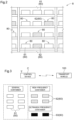
- a container transport facility F includes a transport vehicle 100 that transports a container 60 (see Fig. 2 ), a storage shelf 8 that stores the container 60, and a work area 9A in which target work, which is at least one of taking-out work of an article (not illustrated) from the container 60 and inputting work of the article into the container 60, is performed.
- the container transport facility F includes a storage area 8A.
- the container transport facility F further includes a control device C that controls the transport vehicle 100.
- the control device C corresponds to a "control system”. However, the control device C may constitute at least a part of the control system.
- the control device C is configured to perform communication with a transport vehicle control unit (not illustrated) mounted on each of a plurality of transport vehicles 100 (see also Fig. 3 ).
- the container 60 is configured to accommodate an article.
- the container 60 has a shape in which an upper side is open.
- the article is put into an inside of the container 60 via an upper opening portion of the container 60 or taken out from the inside of the container 60.
- the article includes, for example, various products such as food products and daily necessities, or components and workpieces used in a production line of a factory and the like.
- One container 60 is configured to accommodate the same type of article.
- the container 60 is configured to be step-stackable in an up-down direction in a state in which the article is accommodated therein (see Figs. 4 and 9 ).
- a plurality of containers 60 are step-stacked in the up-down direction to form a step-stacking container group 6G.
- a bottom portion of the container 60 is fitted from above to the opening portion of the other container 60, so that the two containers 60 are step-stacked in the up-down direction.
- the work area 9A is provided with a delivery portion 90 through which the step-stacking container group 6G is delivered between the delivery portion 90 and a support portion 2 (see Fig. 4 ) of the transport vehicle 100.
- the delivery portion 90 carries in and carries out the container 60.
- the transport vehicle 100 transports the container 60 carried in to the delivery portion 90 to the storage shelf 8, or transports the container 60 stored in the storage shelf 8 to the delivery portion 90 for carrying out.
- a separation device 91 that separates respective containers 60 constituting the step-stacking container group 6G is provided in the work area 9A.
- the step-stacking container group 6G handed over to the delivery portion 90 is separated into a plurality of containers 60 by the separation device 91.
- the separation device 91 is not an essential configuration. The separation of respective containers 60 from the step-stacking container group 6G may be performed by hand.
- the plurality of storage shelves 8 are disposed in parallel to each other with a predetermined interval therebetween. At least a front surface of each of the plurality of storage shelves 8 is open, and the container 60 is taken in and out on the front surface.
- a pair of storage shelves 8 are disposed in a state in which rear surfaces thereof face each other and are close to each other. A plurality of sets of the pair of storage shelves 8 of which the rear surfaces face each other are disposed in the storage area 8A.
- a part of a travel path of the transport vehicle 100 is set to extend along each of the plurality of storage shelves 8.
- the path of the transport vehicle 100 extending along the storage shelf 8 is defined as a shelf region inner path R8.
- the transport vehicle 100 is able to travel in the shelf region inner path R8, so that it is possible to perform the movement in the storage area 8A and the transfer of the container 60 to the storage shelf 8.
- the shelf region inner path R8 is provided along the front surface (surface on which the container 60 is taken in and out) of each of the plurality of storage shelves 8. In the pair of storage shelves 8 disposed to face each other on the front surfaces, one shelf region inner path R8 is shared.
- the storage shelf 8 is configured to include a plurality of steps of a shelf portion 80 that supports each container 60 in the up-down direction, and store the plurality of containers 60 in a state of being separated from each other.
- a plurality of shelf portions 80 are provided in each step.
- One container 60 is able to be stored in each of the plurality of shelf portions 80.
- the control device C is configured to be communicable with the transport vehicle 100.
- the control device C is configured to allow the transport vehicle 100 to perform a transport instruction that designates the container 60 of a transport target, and a transport source and a transport destination of the container 60.
- the control device C includes, for example, a processor such as a microcomputer, peripheral circuits such as a memory, and the like. Then, each function is realized by the cooperation of the hardware and a program executed on a processor such as a computer.
- the control device C is configured to manage the plurality of containers 60 handled by the container transport facility F by dividing the plurality of containers 60 into a general container 61 and a high-frequency container 62. This division is performed based on the demand for each container 60, in other words, a height of the necessity of performing target work (taking-out work of the article or inputting work of the article) in the work area 9A.
- the container 60 that accommodates the article of which taking-out work is frequently performed is able to be divided into the high-frequency container 62.
- the necessary for performing the above-described inputting work increases, even the empty container 60 that does not accommodate the article is able to be divided into the high-frequency container 62.
- control device C is configured to manage the plurality of containers 60 by dividing the plurality of containers 60 into the general container 61 and the high-frequency container 62 having a higher frequency of being transported to the work area 9A than the general container 61 based on the type of the article accommodated in each of the containers 60.
- the above-described frequency of being transported is able to be expressed as a planned number of times of transport.
- the container 60 that accommodates the article for which the demand in the work area 9A is relatively low is divided into the general container 61
- the container 60 that accommodates the article for which the demand in the work area 9A is relatively high is divided into the high-frequency container 62.
- the demand for the article is quantified and a reference value is set, and the control device C may determine the container 60 that accommodates the article, which is below the reference value, as the general container 61, and may determine the container 60 that accommodates the article, which is above the reference value, as the high-frequency container 62.
- control device C is configured to periodically review the division between the general container 61 and the high-frequency container 62.
- the container 60 determined as the general container 61 is able to be changed to the high-frequency container 62.
- the container 60 determined as the high-frequency container 62 is able to be changed to the general container 61.
- the period for reviewing the division may be appropriately determined according to the use, the capacity, the scale, and the like of the container transport facility F.
- control device C is configured to define the container 60 in which the frequency of being transported to the work area 9A in the high-frequency container 62 is equal to or greater than a predetermined threshold value as an ultrahigh-frequency container 63.
- control device C is configured to determine that the container 60 of which the planned number of times of transport is equal to or greater than the threshold value is the ultrahigh-frequency container 63.
- a direction in which a traveling body 10 travels is referred to as a "vehicle body front-rear direction L"
- a direction orthogonal to the vehicle body front-rear direction L in the up-down direction view is referred to as a "vehicle body width direction W'.
- the transport vehicle 100 is configured to transport the containers 60 configured to be step-stackable in the up-down direction.
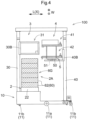
- the transport vehicle 100 includes the traveling body 10 that travels, the support portion 2 that is mounted on the traveling body 10 and supports the plurality of containers 60 as the step-stacking container group 6G which is a container group in a step-stacked state, a first transfer device 4 that is mounted on the traveling body 10 and transfers the containers 60 between the storage shelf 8 and the step-stacking container group 6G supported by the support portion 2, and a second transfer device 22 that is mounted on the traveling body 10 and transfers the step-stacking container group 6G.
- the transport vehicle 100 further includes a lifting device 3 that is mounted on the traveling body 10 and is able to lift a part or all of the containers 60 of the step-stacking container group 6G supported by the support portion 2.
- the traveling body 10 is configured to travel on a floor surface.
- the traveling body 10 includes a plurality of traveling wheels 11.
- the plurality of traveling wheels 11 include a pair of drive wheels 11a that are disposed to be spaced apart from each other in the vehicle body width direction W, and a plurality of driven wheels 11b.
- Each of the pair of drive wheels 11a is independently driven by a wheel drive source (not illustrated), such as a motor.
- a wheel drive source such as a motor.
- the traveling body 10 is able to turn in place about an upper and lower axial center by rotationally driving each of the pair of drive wheels 11a in opposite directions with respect to each other.
- Each of the plurality of driven wheels 11b is supported by the traveling body 10 so as to be rotatable about an axial center along the up-down direction. That is, the direction along the rotation axis of each of the driven wheels 11b may be changed in a horizontal plane.
- each of the driven wheels 11b is configured as a caster.
- the support portion 2 is configured to support the plurality of containers 60 as the step-stacking container group 6G in the step-stacked state.
- the support portion 2 is also able to support a single container 60.
- a step-stacking region 2A in which the step-stacking container group 6G is disposed is defined above the support portion 2.
- the step-stacking region 2A is a three-dimensional imaginary region that extends upward from the support portion 2.
- the second transfer device 22 is configured to transfer the step-stacking container group 6G supported by the support portion 2 along the vehicle body width direction W.
- the second transfer device 22 is configured by using a conveyor.
- a well-known conveyor such as a roller conveyor, a chain conveyor, or a belt conveyor may be used.
- the second transfer device 22 and the support portion 2 are integrally configured.
- the lifting device 3 includes a lifting mast 30 that is erected upward from the traveling body 10, a lifting and lowering body 30B that is connected to the lifting mast 30, a frame member 31 that is connected to the lifting and lowering body 30B, and a lifting and lowering body drive unit (not illustrated) that lifts and lowers the lifting and lowering body 30B, and the frame member 31 along the lifting mast 30.
- the lifting and lowering body drive unit is configured as, for example, a motor for rotationally driving a rotation body around which an endless body such as a belt is wound.
- the lifting device 3 includes a first lifting holding portion 311 that lifts the container 60 at any height in the step-stacking container group 6G step-stacked in the step-stacking region 2Ato the container 60 adjacent to a container 60 below the container 60, and a second lifting holding portion 312 that lifts the container 60 below the container 60 lifted by the first lifting holding portion 311 to the container 60 adjacent to a container 60 below the container 60.
- the first lifting holding portion 311 and the second lifting holding portion 312 are supported by the frame member 31.
- the first lifting holding portion 311 and the second lifting holding portion 312 are disposed to be spaced apart from each other in the up-down direction. As a result, it is possible to form a space between the container 60 lifted by the first lifting holding portion 311 and the container 60 lifted by the second lifting holding portion 312 in the up-down direction. In addition, it is possible to form a space in the up-down direction below the container 60 lifted by the second lifting holding portion 312.
- the first transfer device 4 includes a transfer mast 40 that is fixed to the traveling body 10 and is disposed along the up-down direction, a transfer lifting and lowering body 40B that lifts and lowers along the transfer mast 40, and a transfer lifting and lowering body drive unit (not illustrated) that lifts and lowers the transfer lifting and lowering body 40B along the transfer mast 40.
- the transfer lifting and lowering body drive unit is configured, for example, as a motor for rotationally driving a rotation body around which an endless body such as a belt is wound.
- the first transfer device 4 includes an upper transfer portion 41, a lower transfer portion 42 disposed below the upper transfer portion 41, and a turning device 5.
- the upper transfer portion 41, the lower transfer portion 42, and the turning device 5 are connected to the transfer lifting and lowering body 40B.
- the upper transfer portion 41 and the lower transfer portion 42 are configured to integrally lift and lower by the lifting and lowering of the transfer lifting and lowering body 40B, integrally turn about the upper and lower axial center by the turning device 5, and individually transfer the container 60.
- the first transfer device 4 is configured to transfer the container 60 along the horizontal direction by the upper transfer portion 41 and the lower transfer portion 42.
- a direction in which the container 60 is transferred by the first transfer device 4 is defined as a "transfer direction X", in the example illustrated in Fig. 4
- the transfer direction X is equal to the vehicle body front-rear direction L.
- the first transfer device 4 is configured to change an attitude between a first attitude P1 in which the transfer direction X directs to the step-stacking region 2A and a second attitude P2 in which the transfer direction X directs to the storage shelf 8 by turning the upper transfer portion 41 and the lower transfer portion 42 around the up-down axial center by the turning device 5.
- the transfer direction X is able to be changed in the horizontal plane by the turning device 5.
- the first transfer device 4 changes the attitude according to a position of a transfer target location. Specifically, the first transfer device 4 takes the first attitude P1 in a case in which the transfer target location is the step-stacking region 2A, and takes the second attitude P2 in a case in which the transfer target location is the storage shelf 8 (shelf portion 80).
- the turning device 5 includes a turning table 50 that supports the upper transfer portion 41 and the lower transfer portion 42, a turning shaft 51 that supports the turning table 50 to be turnable with respect to the transfer lifting and lowering body 40B, and a turning drive unit (not illustrated) that drives the turning shaft 51.
- the transfer operation includes a handover operation of handing over the container 60 and a receiving operation of receiving the container 60.
- first side X1 in the transfer direction one side in the transfer direction X
- second side X2 in the transfer direction one side in the transfer direction X
- first side X1 in the transfer direction one side in the transfer direction X
- second side X2 in the transfer direction one side in the transfer direction X
- the upper transfer portion 41 includes an upper pressing portion 41a that presses the container 60 toward the first side X1 in the transfer direction in a case of performing the handover operation of the container 60, and an upper locking portion 41b that is locked to the container 60 and pulls the container 60 toward the second side X2 in the transfer direction in a case of performing the receiving operation of the container 60.
- the upper transfer portion 41 is configured in a so-called push-pull type.
- the upper transfer portion 41 is not limited to such a configuration, and may be configured in a fork type.
- the lower transfer portion 42 includes a lower pressing portion 42a that presses the container 60 toward the first side X1 in the transfer direction in a case of performing the handover operation of the container 60, and a lower locking portion 42b that is locked to the container 60 and pulls the container 60 toward the second side X2 in the transfer direction in a case of performing the receiving operation of the container 60.
- the lower transfer portion 42 is configured in a so-called push-pull type.
- the lower transfer portion 42 is not limited to such a configuration, and may be configured in a fork type.
- each of the upper locking portion 41b and the lower locking portion 42b is configured to be driven by a drive unit (not illustrated) to change the attitude between a locking attitude in which each thereof is locked to the container 60 and a non-locking attitude in which each thereof is not locked to the container 60.
- Figs. 6 to 8 illustrate a transfer operation of the container 60 to the step-stacking region 2A.
- the lifting device 3 is able to form spaces between the plurality of containers 60 step-stacked in the step-stacking region 2A in the up-down direction.
- the first transfer device 4 transfers the container 60 to the step-stacking region 2A by using these spaces.
- the first transfer device 4 is configured to perform the handover operation and the receiving operation of the container 60 with respect to the step-stacking region 2A.
- the first transfer device 4 is able to perform a parallel operation of handing over and receiving the container 60 in parallel with respect to the step-stacking region 2A.
- Figs. 6 to 8 illustrate an example in which the containers 60 of five steps are step-stacked in the step-stacking region 2A as the step-stacking container group 6G.
- respective containers 60 step-stacked in a row from the bottom to the top are marked with the number of "1 to 5".
- a character " ⁇ " is added to the container 60, which is the handover target, held by the upper transfer portion 41.
- the container 60 (container " ⁇ ") of the handover target is handed over to the fourth-step container 60 (container "4") by using a space formed between the fifth-step container 60 (container "5") and the fourth-step container 60 (container "4") in the up-down direction by the lifting device 3.
- the third-step container 60 (container "3") is received by using a space formed below the fourth-step container 60 (container "4") by the lifting device 3.
- the first transfer device 4 moves the lower locking portion 42b in the locking attitude to the second side X2 in the transfer direction in a state in which the lower locking portion 42b is locked to the container 60 (container "3").
- the first transfer device 4 moves the upper pressing portion 41a to the first side X1 in the transfer direction in a state in which the container 60 (container " ⁇ ") held by the upper transfer portion 41 is pressed by the upper pressing portion 41a, in parallel with this.
- the lower locking portion 42b pulls the container 60 (container "3") of the receiving target to the second side X2 in the transfer direction, and the upper pressing portion 41a presses the container 60 (container " ⁇ ") of the handover target to the first side X1 in the transfer direction.
- the lower transfer portion 42 receives the container 60 (container "3") as the receiving target, which is pulled in by the lower locking portion 42b, and the upper transfer portion 41 disposes the container 60 (container " ⁇ ") as the handover target, which is pressed by the upper pressing portion 41a, above the container 60 (container "4") lifted by the second lifting holding portion 312 and fits it into the container 60 (container "4").
- the step-stacking container group 6G in the step-stacking region 2A is in a state as illustrated in Fig. 8 . That is, the container 60 (container "3") which is a part of the plurality of containers 60 disposed in the step-stacking region 2A is exchanged with the new container 60 (container " ⁇ ").
- a holding area 7A is provided at a location different from the work area 9A and the storage shelf 8.
- the holding area 7A is an area where the plurality of containers 60 are able to be held as the step-stacking container group 6G, unlike the storage shelf 8 for storing the plurality of containers 60 in a state of being separated from each other.
- the holding area 7A includes a holding portion 70 that holds the step-stacking container group 6G.
- the step-stacking container group 6G is able to be held.
- the holding portion 70 is configured to be able to hold a plurality of step-stacking container groups 6G (see also Fig. 9 ).
- the holding area 7A includes a plurality of such holding portions 70.
- the holding portion 70 is configured to enable the transfer of the step-stacking container group 6G between the holding portion 70 and the support portion 2 by the second transfer device 22 of the transport vehicle 100.
- the holding portion 70 includes one or a plurality of third transfer devices 73.
- the holding portion 70 includes three third transfer devices 73.
- the third transfer device 73 is configured by using a conveyor. As such a conveyor, a well-known conveyor such as a roller conveyor, a chain conveyor, or a belt conveyor may be used.
- the third transfer device 73 of the holding portion 70 and the second transfer device 22 of the transport vehicle 100 are configured to deliver the step-stacking container group 6G to each other. That is, in the present embodiment, the second transfer device 22 of the transport vehicle 100 is configured to be able to transfer the entire step-stacking container group 6G supported by the support portion 2 to the holding portion 70 and to transfer the entire step-stacking container group 6G held by the holding portion 70 to the support portion 2.
- the step-stacking container group 6G which is the transfer target, is transferred along the vehicle body width direction W.
- the transport vehicle 100 and the holding portion 70 are configured to be communicable with each other, and are configured to cooperate with each other to transfer the step-stacking container group 6G.
- the transport vehicle 100 transmits a transfer signal for transferring the step-stacking container group 6G to the holding portion 70 in a state of being stopped at a position adjacent to the holding portion 70 in the vehicle body width direction W, and operates the second transfer device 22.
- the holding portion 70 that receives the transfer signal operates the third transfer device 73.
- the third transfer device 73 of the holding portion 70 and the second transfer device 22 of the transport vehicle 100 deliver the step-stacking container groups 6G to each other.
- the holding area 7A is disposed in a region between the storage shelf 8 and the work area 9A.
- the holding area 7A is disposed in a region between the storage shelf 8 and the work area 9A in a direction in which the storage shelf 8 extends, that is, in a direction in which the shelf region inner path R8 extends.
- the holding portion 70 of the holding area 7A is disposed at a position along a connection path R7 connecting the shelf region inner path R8 and the delivery portion 90 of the work area 9A.
- the shelf region inner path R8 and the connection path R7 have a linear shape.
- a plurality of shelf region inner paths R8 are provided in accordance with the number of the storage shelves 8, and the same number of connection paths R7 as the plurality of shelf region inner paths R8 are provided.
- Each of the plurality of holding portions 70 provided in the holding area 7A is disposed at a position along any of the plurality of connection paths R7.
- the transport vehicle 100 transports the step-stacking container group 6G including the high-frequency container 62 (see Fig. 9 ) at least in part to the holding area 7A based on an instruction from the control device C.
- the high-frequency container 62 is able to be disposed in the holding area 7A located at a location different from the storage shelf 8, and the general container 61 and the high-frequency container 62 is able to be easily physically divided.
- the holding area 7A is disposed in a region between the storage shelf 8 and the work area 9A.
- the high-frequency container 62 is able to be disposed at a position close to the work area 9A. It is preferable that all the step-stacking container groups 6G in the holding area 7A are configured by the high-frequency containers 62.
- unnecessary empty container 60 is able to also be accumulated in the holding area 7A as the high-frequency container 62. In this case, a plurality of unnecessary empty containers 60 are easily moved to the outside of the holding area 7A in a lump.
- the transport vehicle 100 travels a path which returns to the delivery portion 90 from the delivery portion 90 of the work area 9A via both the storage shelf 8 and the holding area 7A based on an instruction from the control device C.
- the order in which the storage shelf 8 and the holding area 7A are passed through may be any.
- both the container 60 stored in the storage shelf 8 and the container 60 held in the holding area 7A are able to be transported to the work area 9A, and the container 60 for which target work in the work area 9A is completed is able to be returned to either the storage shelf 8 or the holding area 7A.
- the control device C is configured to periodically review the division between the general container 61 and the high-frequency container 62.
- the high-frequency container 62 may be changed to the general container 61
- the general container 61 may be changed to the high-frequency container 62.
- the transport vehicle 100 transports the container 60 changed from the high-frequency container 62 to the general container 61 from the holding area 7A to the storage shelf 8 or transports the container 60 changed from the general container 61 to the high-frequency container 62 from the storage shelf 8 to the holding area 7A based on an instruction from the control device C.
- the transportation of the container 60 after such a change may be performed during the operation of the facility or may be performed during the non-operation of the facility, such as at night.
- a part of the plurality of transport vehicles 100 may be used as a transport dedicated to the container 60 after the change.
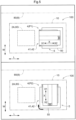
- the second transfer device 22 of the transport vehicle 100 is configured to be able to transfer the step-stacking container group 6G supported by the support portion 2 to the holding portion 70 of the holding area 7A.
- the transport vehicle 100 is configured to be able to transfer a part of the plurality of containers 60 constituting the step-stacking container group 6G supported by the support portion 2 to the holding portion 70 of the holding area 7A.
- the transport vehicle 100 is configured to be able to transfer a part of the step-stacking container group 6G to the holding portion 70 of the holding area 7A by separating the part by using the lifting device 3 (see Fig. 6 and the like).
- the lifting device 3 and elements that are not necessary for the description are omitted.
- the second transfer device 22 of the transport vehicle 100 is configured to transfer the residual container group 6Ga to the holding portion 70.
- the transport vehicle 100 separates the plurality or single general container 61 and the plurality or single high-frequency container 62 from the plurality of containers 60 constituting the step-stacking container group 6G by the lifting device 3.
- the transport vehicle 100 hands over the plurality of or single high-frequency container 62 (residual container group 6Ga) to the holding portion 70 by the second transfer device 22.
- the transport vehicle 100 is able to hand over only the high-frequency container 62 to the holding portion 70 even in a case in which the step-stacking container group 6G includes the general container 61 and the high-frequency container 62.
- the transport vehicle 100 is not limited to the high-frequency container 62, and a part of the plurality of containers 60 constituting the step-stacking container group 6G is able to be selected to hand over the selected part of the containers 60 (plurality or single container 60) to the holding portion 70.
- the transport vehicle 100 is configured to create the step-stacking container group 6G configured of only the high-frequency containers 62 based on an instruction from the control device C and transport the step-stacking container group 6G to the holding area 7A.
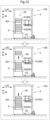
- the transport vehicle 100 lifts any part of the containers 60 of the step-stacking container group 6G supported by the support portion 2 by the lifting device 3 (not illustrated in Fig. 12 ), and removes the container 60 adjacent to the lower side of the lifted container 60 from the step-stacking container group 6G by the first transfer device 4 to create a new step-stacking container group 6G using a plurality of containers 60 other than the removed container 60.
- the transport vehicle 100 places the high-frequency containers 62 of the second step or higher from above, which are lifted by the lifting device 3, on the plurality of high-frequency containers 62 supported by the support portion 2.
- the step-stacking container group 6G configured of only the high-frequency containers 62 is newly created.
- the transport vehicle 100 may be configured to create the step-stacking container group 6G configured of only the ultrahigh-frequency containers 63 and transport the step-stacking container group 6G to the holding area 7A based on an instruction from the control device C.
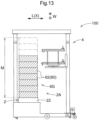
- the number of the containers 60 which is the upper limit thereof that is able to be supported by the transport vehicle 100 on the support portion 2, is defined as a support upper limit number M.
- the number of the containers 60 received from the storage shelf 8 and supported by the support portion 2 is set to be equal to or less than a difference between the support upper limit number M and the number of the containers 60 included in the step-stacking container group 6G received from the holding portion 70 of the holding area 7A.
- the support upper limit number M is "10"
- the number of the containers 60 included in the step-stacking container group 6G received by the transport vehicle 100 from the holding portion 70 of the holding area 7A is "7". Therefore, the number of the containers 60 that are able to be received by the transport vehicle 100 from the storage shelf 8 and supported by the support portion 2 is "3" or less.
- the step-stacking container group 6G held by the holding portion 70 of the holding area 7A is able to be received and supported by the support portion 2 without being separated.
Landscapes
- Engineering & Computer Science (AREA)
- Mechanical Engineering (AREA)
- Warehouses Or Storage Devices (AREA)
Applications Claiming Priority (1)
| Application Number | Priority Date | Filing Date | Title |
|---|---|---|---|
| JP2023126917A JP2025022391A (ja) | 2023-08-03 | 2023-08-03 | 容器搬送設備 |
Publications (3)
| Publication Number | Publication Date |
|---|---|
| EP4501815A1 true EP4501815A1 (fr) | 2025-02-05 |
| EP4501815B1 EP4501815B1 (fr) | 2025-07-30 |
| EP4501815C0 EP4501815C0 (fr) | 2025-07-30 |
Family
ID=92108521
Family Applications (1)
| Application Number | Title | Priority Date | Filing Date |
|---|---|---|---|
| EP24191521.4A Active EP4501815B1 (fr) | 2023-08-03 | 2024-07-29 | Installation de transport de conteneurs |
Country Status (4)
| Country | Link |
|---|---|
| US (1) | US20250042658A1 (fr) |
| EP (1) | EP4501815B1 (fr) |
| JP (1) | JP2025022391A (fr) |
| CN (1) | CN119429452A (fr) |
Cited By (1)
| Publication number | Priority date | Publication date | Assignee | Title |
|---|---|---|---|---|
| US20240375873A1 (en) * | 2021-09-13 | 2024-11-14 | Daifuku Co., Ltd. | Article Storage Facility, Article Storage Method and Article Storage Program |
Families Citing this family (1)
| Publication number | Priority date | Publication date | Assignee | Title |
|---|---|---|---|---|
| US20230406639A1 (en) * | 2022-04-29 | 2023-12-21 | Kenton Brett | System and method for local tube transport |
Citations (6)
| Publication number | Priority date | Publication date | Assignee | Title |
|---|---|---|---|---|
| JPS5992805A (ja) * | 1982-11-17 | 1984-05-29 | Daifuku Co Ltd | 水平循環式保管棚への自動移載設備 |
| JP2001297140A (ja) | 2000-04-12 | 2001-10-26 | Murata Mach Ltd | 物流システムネットワーク |
| TW201139252A (en) * | 2010-02-24 | 2011-11-16 | Muratec Automation Co Ltd | Transporting vehicle system |
| JP6592711B1 (ja) * | 2019-02-25 | 2019-10-23 | 株式会社Mujin | 保管システム |
| US20220363475A1 (en) * | 2021-05-13 | 2022-11-17 | Daifuku Co., Ltd. | Transport Vehicle |
| TWI810317B (zh) * | 2018-07-13 | 2023-08-01 | 日商大福股份有限公司 | 物品分類設備 |
Family Cites Families (1)
| Publication number | Priority date | Publication date | Assignee | Title |
|---|---|---|---|---|
| JP6827905B2 (ja) * | 2017-10-26 | 2021-02-10 | 株式会社日立物流 | 棚管理システム及び棚管理方法 |
-
2023
- 2023-08-03 JP JP2023126917A patent/JP2025022391A/ja active Pending
-
2024
- 2024-07-29 EP EP24191521.4A patent/EP4501815B1/fr active Active
- 2024-08-01 US US18/792,015 patent/US20250042658A1/en active Pending
- 2024-08-02 CN CN202411056000.3A patent/CN119429452A/zh active Pending
Patent Citations (6)
| Publication number | Priority date | Publication date | Assignee | Title |
|---|---|---|---|---|
| JPS5992805A (ja) * | 1982-11-17 | 1984-05-29 | Daifuku Co Ltd | 水平循環式保管棚への自動移載設備 |
| JP2001297140A (ja) | 2000-04-12 | 2001-10-26 | Murata Mach Ltd | 物流システムネットワーク |
| TW201139252A (en) * | 2010-02-24 | 2011-11-16 | Muratec Automation Co Ltd | Transporting vehicle system |
| TWI810317B (zh) * | 2018-07-13 | 2023-08-01 | 日商大福股份有限公司 | 物品分類設備 |
| JP6592711B1 (ja) * | 2019-02-25 | 2019-10-23 | 株式会社Mujin | 保管システム |
| US20220363475A1 (en) * | 2021-05-13 | 2022-11-17 | Daifuku Co., Ltd. | Transport Vehicle |
Cited By (1)
| Publication number | Priority date | Publication date | Assignee | Title |
|---|---|---|---|---|
| US20240375873A1 (en) * | 2021-09-13 | 2024-11-14 | Daifuku Co., Ltd. | Article Storage Facility, Article Storage Method and Article Storage Program |
Also Published As
| Publication number | Publication date |
|---|---|
| EP4501815B1 (fr) | 2025-07-30 |
| EP4501815C0 (fr) | 2025-07-30 |
| CN119429452A (zh) | 2025-02-14 |
| JP2025022391A (ja) | 2025-02-14 |
| US20250042658A1 (en) | 2025-02-06 |
Similar Documents
| Publication | Publication Date | Title |
|---|---|---|
| EP4501815B1 (fr) | Installation de transport de conteneurs | |
| US8707658B2 (en) | Rack-integrated packing station | |
| US12454409B2 (en) | High-density automated storage and retrieval system | |
| US9981808B2 (en) | Pickface builder for storage and retrieval systems | |
| CN210162597U (zh) | 一种无人化仓储系统 | |
| EP4245693B1 (fr) | Installation de stockage d'articles | |
| CN112707075B (zh) | 堆垛存放组件 | |
| WO2010084542A1 (fr) | Entrepôt automatisé | |
| CN117682249B (zh) | 物料拣选系统、仓储系统及物料拣选方法 | |
| CN116723990A (zh) | 远程操作拾取车辆 | |
| JP7425408B2 (ja) | 物品収容設備 | |
| JP2020075791A (ja) | 箱体積付システム | |
| EP4501814A1 (fr) | Installation de transport de conteneurs | |
| JP7586325B2 (ja) | ピッキングシステム | |
| CN116685540A (zh) | 物品容纳设备 | |
| JP7524918B2 (ja) | 搬送設備 | |
| JP7800519B2 (ja) | 物品仕分け設備 | |
| CN218369817U (zh) | 仓储系统 | |
| JP7700918B1 (ja) | 物品搬送設備 | |
| EP4588847A1 (fr) | Véhicule pour un système de stockage et de récupération automatisé, système de stockage et de récupération automatisé et méthode associée. | |
| US20250187826A1 (en) | A remotely operated vehicle, an automated storage and retrieval system and a method of operating a remotely operated vehicle for handling a goods holder of an automated storage and retrieval system |
Legal Events
| Date | Code | Title | Description |
|---|---|---|---|
| PUAI | Public reference made under article 153(3) epc to a published international application that has entered the european phase |
Free format text: ORIGINAL CODE: 0009012 |
|
| STAA | Information on the status of an ep patent application or granted ep patent |
Free format text: STATUS: THE APPLICATION HAS BEEN PUBLISHED |
|
| STAA | Information on the status of an ep patent application or granted ep patent |
Free format text: STATUS: REQUEST FOR EXAMINATION WAS MADE |
|
| AK | Designated contracting states |
Kind code of ref document: A1 Designated state(s): AL AT BE BG CH CY CZ DE DK EE ES FI FR GB GR HR HU IE IS IT LI LT LU LV MC ME MK MT NL NO PL PT RO RS SE SI SK SM TR |
|
| 17P | Request for examination filed |
Effective date: 20250130 |
|
| GRAP | Despatch of communication of intention to grant a patent |
Free format text: ORIGINAL CODE: EPIDOSNIGR1 |
|
| STAA | Information on the status of an ep patent application or granted ep patent |
Free format text: STATUS: GRANT OF PATENT IS INTENDED |
|
| INTG | Intention to grant announced |
Effective date: 20250310 |
|
| GRAS | Grant fee paid |
Free format text: ORIGINAL CODE: EPIDOSNIGR3 |
|
| GRAA | (expected) grant |
Free format text: ORIGINAL CODE: 0009210 |
|
| STAA | Information on the status of an ep patent application or granted ep patent |
Free format text: STATUS: THE PATENT HAS BEEN GRANTED |
|
| AK | Designated contracting states |
Kind code of ref document: B1 Designated state(s): AL AT BE BG CH CY CZ DE DK EE ES FI FR GB GR HR HU IE IS IT LI LT LU LV MC ME MK MT NL NO PL PT RO RS SE SI SK SM TR |
|
| REG | Reference to a national code |
Ref country code: GB Ref legal event code: FG4D |
|
| REG | Reference to a national code |
Ref country code: CH Ref legal event code: EP |
|
| REG | Reference to a national code |
Ref country code: DE Ref legal event code: R096 Ref document number: 602024000362 Country of ref document: DE |
|
| REG | Reference to a national code |
Ref country code: IE Ref legal event code: FG4D |
|
| U01 | Request for unitary effect filed |
Effective date: 20250813 |
|
| U07 | Unitary effect registered |
Designated state(s): AT BE BG DE DK EE FI FR IT LT LU LV MT NL PT RO SE SI Effective date: 20250821 |
|
| PG25 | Lapsed in a contracting state [announced via postgrant information from national office to epo] |
Ref country code: IS Free format text: LAPSE BECAUSE OF FAILURE TO SUBMIT A TRANSLATION OF THE DESCRIPTION OR TO PAY THE FEE WITHIN THE PRESCRIBED TIME-LIMIT Effective date: 20251130 |
|
| PG25 | Lapsed in a contracting state [announced via postgrant information from national office to epo] |
Ref country code: NO Free format text: LAPSE BECAUSE OF FAILURE TO SUBMIT A TRANSLATION OF THE DESCRIPTION OR TO PAY THE FEE WITHIN THE PRESCRIBED TIME-LIMIT Effective date: 20251030 |
|
| PG25 | Lapsed in a contracting state [announced via postgrant information from national office to epo] |
Ref country code: HR Free format text: LAPSE BECAUSE OF FAILURE TO SUBMIT A TRANSLATION OF THE DESCRIPTION OR TO PAY THE FEE WITHIN THE PRESCRIBED TIME-LIMIT Effective date: 20250730 |
|
| PG25 | Lapsed in a contracting state [announced via postgrant information from national office to epo] |
Ref country code: GR Free format text: LAPSE BECAUSE OF FAILURE TO SUBMIT A TRANSLATION OF THE DESCRIPTION OR TO PAY THE FEE WITHIN THE PRESCRIBED TIME-LIMIT Effective date: 20251031 |
|
| PG25 | Lapsed in a contracting state [announced via postgrant information from national office to epo] |
Ref country code: PL Free format text: LAPSE BECAUSE OF FAILURE TO SUBMIT A TRANSLATION OF THE DESCRIPTION OR TO PAY THE FEE WITHIN THE PRESCRIBED TIME-LIMIT Effective date: 20250730 |
|
| PG25 | Lapsed in a contracting state [announced via postgrant information from national office to epo] |
Ref country code: RS Free format text: LAPSE BECAUSE OF FAILURE TO SUBMIT A TRANSLATION OF THE DESCRIPTION OR TO PAY THE FEE WITHIN THE PRESCRIBED TIME-LIMIT Effective date: 20251030 |
|
| PG25 | Lapsed in a contracting state [announced via postgrant information from national office to epo] |
Ref country code: ES Free format text: LAPSE BECAUSE OF FAILURE TO SUBMIT A TRANSLATION OF THE DESCRIPTION OR TO PAY THE FEE WITHIN THE PRESCRIBED TIME-LIMIT Effective date: 20250730 |
|
| PG25 | Lapsed in a contracting state [announced via postgrant information from national office to epo] |
Ref country code: SM Free format text: LAPSE BECAUSE OF FAILURE TO SUBMIT A TRANSLATION OF THE DESCRIPTION OR TO PAY THE FEE WITHIN THE PRESCRIBED TIME-LIMIT Effective date: 20250730 |
|
| PG25 | Lapsed in a contracting state [announced via postgrant information from national office to epo] |
Ref country code: CZ Free format text: LAPSE BECAUSE OF FAILURE TO SUBMIT A TRANSLATION OF THE DESCRIPTION OR TO PAY THE FEE WITHIN THE PRESCRIBED TIME-LIMIT Effective date: 20250730 |
|
| PG25 | Lapsed in a contracting state [announced via postgrant information from national office to epo] |
Ref country code: SK Free format text: LAPSE BECAUSE OF FAILURE TO SUBMIT A TRANSLATION OF THE DESCRIPTION OR TO PAY THE FEE WITHIN THE PRESCRIBED TIME-LIMIT Effective date: 20250730 |