EP4502341A1 - Joint annulaire à pièces multiples pour un moteur d'une turbine ã gaz - Google Patents
Joint annulaire à pièces multiples pour un moteur d'une turbine ã gaz Download PDFInfo
- Publication number
- EP4502341A1 EP4502341A1 EP24192724.3A EP24192724A EP4502341A1 EP 4502341 A1 EP4502341 A1 EP 4502341A1 EP 24192724 A EP24192724 A EP 24192724A EP 4502341 A1 EP4502341 A1 EP 4502341A1
- Authority
- EP
- European Patent Office
- Prior art keywords
- seal
- guide surface
- rotor
- annular channel
- recited
- Prior art date
- Legal status (The legal status is an assumption and is not a legal conclusion. Google has not performed a legal analysis and makes no representation as to the accuracy of the status listed.)
- Pending
Links
Images



Classifications
-
- F—MECHANICAL ENGINEERING; LIGHTING; HEATING; WEAPONS; BLASTING
- F01—MACHINES OR ENGINES IN GENERAL; ENGINE PLANTS IN GENERAL; STEAM ENGINES
- F01D—NON-POSITIVE DISPLACEMENT MACHINES OR ENGINES, e.g. STEAM TURBINES
- F01D11/00—Preventing or minimising internal leakage of working-fluid, e.g. between stages
- F01D11/003—Preventing or minimising internal leakage of working-fluid, e.g. between stages by packing rings; Mechanical seals
-
- F—MECHANICAL ENGINEERING; LIGHTING; HEATING; WEAPONS; BLASTING
- F01—MACHINES OR ENGINES IN GENERAL; ENGINE PLANTS IN GENERAL; STEAM ENGINES
- F01D—NON-POSITIVE DISPLACEMENT MACHINES OR ENGINES, e.g. STEAM TURBINES
- F01D11/00—Preventing or minimising internal leakage of working-fluid, e.g. between stages
- F01D11/005—Sealing means between non relatively rotating elements
- F01D11/006—Sealing the gap between rotor blades or blades and rotor
-
- F—MECHANICAL ENGINEERING; LIGHTING; HEATING; WEAPONS; BLASTING
- F01—MACHINES OR ENGINES IN GENERAL; ENGINE PLANTS IN GENERAL; STEAM ENGINES
- F01D—NON-POSITIVE DISPLACEMENT MACHINES OR ENGINES, e.g. STEAM TURBINES
- F01D11/00—Preventing or minimising internal leakage of working-fluid, e.g. between stages
- F01D11/005—Sealing means between non relatively rotating elements
-
- F—MECHANICAL ENGINEERING; LIGHTING; HEATING; WEAPONS; BLASTING
- F02—COMBUSTION ENGINES; HOT-GAS OR COMBUSTION-PRODUCT ENGINE PLANTS
- F02C—GAS-TURBINE PLANTS; AIR INTAKES FOR JET-PROPULSION PLANTS; CONTROLLING FUEL SUPPLY IN AIR-BREATHING JET-PROPULSION PLANTS
- F02C7/00—Features, components parts, details or accessories, not provided for in, or of interest apart form groups F02C1/00 - F02C6/00; Air intakes for jet-propulsion plants
- F02C7/28—Arrangement of seals
-
- F—MECHANICAL ENGINEERING; LIGHTING; HEATING; WEAPONS; BLASTING
- F16—ENGINEERING ELEMENTS AND UNITS; GENERAL MEASURES FOR PRODUCING AND MAINTAINING EFFECTIVE FUNCTIONING OF MACHINES OR INSTALLATIONS; THERMAL INSULATION IN GENERAL
- F16J—PISTONS; CYLINDERS; SEALINGS
- F16J15/00—Sealings
- F16J15/16—Sealings between relatively-moving surfaces
- F16J15/164—Sealings between relatively-moving surfaces the sealing action depending on movements; pressure difference, temperature or presence of leaking fluid
-
- F—MECHANICAL ENGINEERING; LIGHTING; HEATING; WEAPONS; BLASTING
- F16—ENGINEERING ELEMENTS AND UNITS; GENERAL MEASURES FOR PRODUCING AND MAINTAINING EFFECTIVE FUNCTIONING OF MACHINES OR INSTALLATIONS; THERMAL INSULATION IN GENERAL
- F16J—PISTONS; CYLINDERS; SEALINGS
- F16J15/00—Sealings
- F16J15/16—Sealings between relatively-moving surfaces
- F16J15/32—Sealings between relatively-moving surfaces with elastic sealings, e.g. O-rings
- F16J15/3268—Mounting of sealing rings
- F16J15/3272—Mounting of sealing rings the rings having a break or opening, e.g. to enable mounting on a shaft otherwise than from a shaft end
-
- F—MECHANICAL ENGINEERING; LIGHTING; HEATING; WEAPONS; BLASTING
- F05—INDEXING SCHEMES RELATING TO ENGINES OR PUMPS IN VARIOUS SUBCLASSES OF CLASSES F01-F04
- F05D—INDEXING SCHEME FOR ASPECTS RELATING TO NON-POSITIVE-DISPLACEMENT MACHINES OR ENGINES, GAS-TURBINES OR JET-PROPULSION PLANTS
- F05D2240/00—Components
- F05D2240/55—Seals
-
- F—MECHANICAL ENGINEERING; LIGHTING; HEATING; WEAPONS; BLASTING
- F05—INDEXING SCHEMES RELATING TO ENGINES OR PUMPS IN VARIOUS SUBCLASSES OF CLASSES F01-F04
- F05D—INDEXING SCHEME FOR ASPECTS RELATING TO NON-POSITIVE-DISPLACEMENT MACHINES OR ENGINES, GAS-TURBINES OR JET-PROPULSION PLANTS
- F05D2240/00—Components
- F05D2240/55—Seals
- F05D2240/58—Piston ring seals
-
- F—MECHANICAL ENGINEERING; LIGHTING; HEATING; WEAPONS; BLASTING
- F05—INDEXING SCHEMES RELATING TO ENGINES OR PUMPS IN VARIOUS SUBCLASSES OF CLASSES F01-F04
- F05D—INDEXING SCHEME FOR ASPECTS RELATING TO NON-POSITIVE-DISPLACEMENT MACHINES OR ENGINES, GAS-TURBINES OR JET-PROPULSION PLANTS
- F05D2240/00—Components
- F05D2240/60—Shafts
-
- F—MECHANICAL ENGINEERING; LIGHTING; HEATING; WEAPONS; BLASTING
- F05—INDEXING SCHEMES RELATING TO ENGINES OR PUMPS IN VARIOUS SUBCLASSES OF CLASSES F01-F04
- F05D—INDEXING SCHEME FOR ASPECTS RELATING TO NON-POSITIVE-DISPLACEMENT MACHINES OR ENGINES, GAS-TURBINES OR JET-PROPULSION PLANTS
- F05D2260/00—Function
- F05D2260/30—Retaining components in desired mutual position
- F05D2260/36—Retaining components in desired mutual position by a form fit connection, e.g. by interlocking
Definitions
- a gas turbine engine typically includes a fan section, a compressor section, a combustor section and a turbine section.
- the compressor section includes a plurality of stages with blades progressively increasing inlet air pressure. Between some of the stages of the compressor section are seals disposed between a commonly rotating shaft and an inner bore of a compressor rotor. The seals separate stages of different pressures. Leakage past the seals can impact compressor and engine efficiencies.
- Turbine engine manufacturers continue to seek further improvements to engine performance including improvements to thermal, transfer and propulsive efficiencies.
- a rotor assembly for a gas turbine engine includes, among other possible things, a rotor that includes a hub that has a bore and carries one or more rotatable blades, a shaft that is rotatable about an engine axis and extends through the bore, the shaft is co-rotatable with the rotor, an annular seal assembly that is carried within an annular channel within the shaft that provides a seal between the shaft and the bore, the annular seal assembly includes a first member that is configured to seal against a radial surface of the bore and a second member that is configured to seal against an axial surface of the annular channel.
- the annular channel includes at least one guide surface and the second member includes a guided surface.
- An interface between the guide surface and the guided surface are configured to generate the seal against the axial surface.
- the interface between the guide surface and the guided surface is configured to generate a biasing force against the first member in response to rotation of the shaft and rotor.
- the guide surface and the guided surface are both angled relative to a plane that is perpendicular to the engine axis.
- the annular channel includes a first guide surface and a second guide surface and the annular seal assembly includes a third member that is disposed on an axially opposite side of the first member.
- the second member abuts the first guide surface and the third member includes a guided surface that is configured to abut the second guide surface.
- each of the first member includes a first radial height and the second member includes a second radial height that is less than the first radial height.
- the first member includes a rectilinear shape in cross-section.
- the second member includes a wedge shape in cross-section.
- the rotor is part of a compressor section of the gas turbine engine.
- each of the first member and the second member includes a circumferential gap between spaced apart ends.
- a gas turbine engine includes, among other possible things, a fan that includes a plurality of fan blades that are rotatable about an axis, a compressor section, a combustor that is in fluid communication with the compressor section, a turbine section that is in fluid communication with the combustor, a rotor within at least one of the turbine section and the compressor section, the rotor includes a hub that has a bore and carries one or more rotatable blades, a shaft that rotatably extends through the bore and co-rotatable with the rotor, and an annular seal assembly that is carried within an annular channel within the shaft that provides a seal between the shaft and the bore.
- the annular seal assembly includes a first member that is configured to seal against a radial surface of the bore and a second member that is configured to seal against an axial surface of the annular channel.
- the annular channel includes at least one guide surface and the second member includes a guided surface.
- An interface between the guide surface and the guided surface are configured to generate the seal against the axial surface.
- the interface between the guide surface and the guided surface is configured to generate a biasing force against the first member in response to rotation of the shaft and rotor.
- the guide surface and the guided surface are both angled relative to a plane perpendicular to the engine axis.
- the annular channel includes a first guide surface and a second guide surface and the annular seal assembly includes a third member that is disposed on an axially opposite side of the first member.
- the second member abuts the first guide surface and the third member includes a guided surface that is configured to abut the second guide surface.
- the first member includes a first radial height and the second member includes a second radial height that is less than the first radial height.
- the first member includes a rectilinear shape in cross-section.
- the second member includes a wedge shape in cross-section.
- the rotor is disposed on the compressor section.
- a method of creating a seal between co-rotating components of a gas turbine engine includes, among other possible things, assembling a first seal member within an annular channel of a first component, assembling a second seal member within the annular channel such that the second seal abuts an axial face of the first seal member and a guide surface of the annular channel, configuring the first seal to expand radially outward into sealing contact with a surface of second component that is radially spaced apart from the first component in response to rotation, and configuring the second seal member to abut the guide surface of the annular channel and an axial surface of the first seal to generate an axial seal with the guide surface in response to rotation.
- Figure 1 schematically illustrates a gas turbine engine 20.
- the example turbine engine 20 includes a multi-part seal assembly 74 disposed within a compressor section 24 to reduce leakage between compressor stages.
- the gas turbine engine 20 is disclosed herein as a two-spool turbofan that generally incorporates a fan section 22, a compressor section 24, a combustor section 26 and a turbine section 28.
- the fan section 22 drives air along a bypass flow path B in a bypass duct defined within a nacelle 18, and also drives air along a core flow path C for compression and communication into the combustor section 26 then expansion through the turbine section 28.
- a two-spool turbofan gas turbine engine in the disclosed non-limiting embodiment, it should be understood that the concepts described herein are not limited to use with two-spool turbofans as the teachings may be applied to other types of turbine engines including three-spool architectures.
- the exemplary engine 20 generally includes a low speed spool 30 and a high speed spool 32 mounted for rotation about an engine central longitudinal axis A relative to an engine static structure 36 via several bearing systems 38. It should be understood that the various bearing systems 38 may alternatively or additionally be provided at different locations and the location of bearing systems 38 may be varied as appropriate to the application.
- the low speed spool 30 generally includes an inner shaft 40 that interconnects, a first (or low) pressure compressor 44 and a first (or low) pressure turbine 46.
- the inner shaft 40 is connected to a fan section 22 through a speed change mechanism, which in exemplary gas turbine engine 20 is illustrated as a geared architecture 48 to drive fan blades 42 at a lower speed than the low speed spool 30.
- the high speed spool 32 includes an outer shaft 50 that interconnects a second (or high) pressure compressor 52 and a second (or high) pressure turbine 54.
- a combustor 56 is arranged in exemplary gas turbine 20 between the high pressure compressor 52 and the high pressure turbine 54.
- a mid-turbine frame 58 of the engine static structure 36 may be arranged generally between the high pressure turbine 54 and the low pressure turbine 46.
- the mid-turbine frame 58 further supports bearing systems 38 in the turbine section 28.
- the inner shaft 40 and the outer shaft 50 are concentric and rotate via bearing systems 38 about the engine central longitudinal axis A which is collinear with their longitudinal axes.
- the core airflow is compressed by the low pressure compressor 44 then the high pressure compressor 52, mixed and burned with fuel in the combustor 56, then expanded over the high pressure turbine 54 and low pressure turbine 46.
- the mid-turbine frame 58 includes airfoils 60 which are in the core airflow path C.
- the turbines 46, 54 rotationally drive the respective low speed spool 30 and high speed spool 32 in response to the expansion.
- gear system 48 may be located aft of the low pressure compressor 44 and the fan blades 42 may be positioned forward or aft of the location of the geared architecture 48 or even aft of turbine section 28.
- a portion of the HPC 52 is schematically shown and includes a plurality of rotors 62 for separate compressor stages.
- Each of the rotors 62 includes a plurality of blades 64 and a hub 66 that defines an inner bore 68.
- a multi-part seal assembly 74 provides a seal the inner bore 68 and a shaft 70.
- the example seal assembly 74 seals against leakage between compressor stages.
- the hub 66 and shaft 70 rotate together such that no relative rotation is present.
- a compressor section is disclosed and described by way of example, the example multi-part seal assembly 74 may be utilized in other sections of the gas turbine engine that have co-rotating hubs and shafts, such as for example, the turbine section.
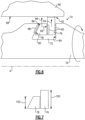
- the shaft 70 includes an annular channel 72 that receives the seal assembly 74.
- the seal assembly 74 includes a first seal member 76 and a second seal member 78 that are both disposed within the annular channel 72.
- the first seal member 76 is generally rectangular in cross-section and the second seal member 78 is generally trapezoidal in cross-section.
- each of the seal members 76, 78 include a split 80, 83.
- Each of the splits 80, 83 enable expansion to assist assembly into the annular channel 72.
- the splits 80, 83 are purposely misaligned circumferentially so as to not form a leakage path.
- the example annular channel 72 includes a guide surface 82 and the second seal member 78 includes a guided surface 86.
- the example guide surface 82 is disposed at an angle 118 relative to a plane 116 perpendicular to the engine axis A.
- the angled guide surface 86 and the guided surface 86 of the second seal member 78 are substantially the same.
- a second side 84 of the annular channel 72 is perpendicular to the engine axis A to provide an axial facing surface.
- the seal assembly 74 provides for sealing a radial gap 120 between the inner bore 68 and the shaft 70. Leakage flows, indicated by arrow 122 may through the radial gap 120 are sealed by the first seal member 76. Leakage flows indicated by arrows 124 around the seals 76, 78 are substantially prevented by interaction between the second seal member 78, the guide surface 82, the first seal member 76 and the axial surface 84.
- the seal assembly 74 is shown during operation where both the shaft 70 and the hub 66 are rotating. Rotation generates circumferential forces that drive both the first seal member and the second seal member 78 radially outward.
- the first seal member 76 is driven radially outward as indicated by arrow 94 into sealing contact with the inner bore 68.
- a seal 92 is therefore formed that prevents the leakage flow 122 shown in Figure 5 .
- Rotation drives the guided surface 86 of the second seal member 78 along the guide surface 82 of the annular channel 72.
- the angled configuration of the guide surface 82 generates an axially directed force indicated by arrow 96 that moves the second seal member 78 in an axial direction in response to radial movement indicated by arrow 98.
- the axial movement forces the first seal member 76 against the axial surface 84 to create axial seals 90.
- the interface between the guide surface 82 and the guided surface 86 creates a seal 88.
- the seals 88 and 90 prevents or substantially reduces the leakage flows indicated by arrows 124 in Figure 5 .
- the example seal assembly 74 utilizes the centrifugal forces generated by rotation to seal both the radial gap 120 and the axial leakage path around the seals 76, 78.
- the example seal members 76, 78 provide different sealing functions and therefore are shaped and sized appropriately.
- the first seal member 76 includes a height 100 that provides for the formation of the radial seal against the inner bore 68 and against the axial surface 84 of the annular channel 72.
- the first seal member 76 is shown as substantially rectangular in cross-section.
- the second seal member 78 provides for sealing against axial face but not against the radial surface of the inner bore 68. Accordingly, in the disclosed example embodiment, the second seal member 78 includes a height 102 that is less than the height 100 of the first seal member 78. The reduced height of the second seal member 78 prevents constraint of axial movement by radial contact with the inner bore 68. As appreciated, the extend of axial movement of the second seal member 78 provides for the additional sealing with surfaces of the annular channel 72 to prevent leakage flows around the seal assembly 74.
- the axial movement of the second seal member 78 is defined by the angle 118 and is a function of the radial movement generated by the centrifugal forces during operation. Accordingly, the height 102 of the second seal member 78 is provided to prevent radial contact that could constrain the desired axial movement and biasing forces.
- first seal member 76 is shown as rectangular in cross-section, other rectilinear shapes that provide for creation of the desired radial seal could be utilized and are within the scope of this disclosure.
- second seal member 78 is shown as trapezoidal or wedge shaped in cross-section, other shapes with surfaces that generate axial movement in response to radially outward movement could also be utilized and are within the contemplation of this disclosure.
- Each of the first sealing member 76 and the second sealing member 78 may be irregularly shaped to enable tailoring to application specific conditions. The size of each of the sealing members 76, 78 will vary depending on application specific requirements and sealing requirements.
- FIG. 8 another example multi-part ring seal assembly 114 is shown and includes a third sealing member 108 with an angled guided surface 112.
- the guided surface 112 guides along a second guide surface 110 defined by the annular channel 106 in the shaft 104.
- the annular channel 106 includes both sides that are angled.
- the first sealing member 76 is disposed between the second sealing member 78 and the third sealing member 108.
- Centrifugal forces generate radial movement of all of the sealing members 76, 78 and 108.
- the second sealing member 78 and the third sealing member 108 both guide along corresponding guide surfaces 110 and sandwich the first sealing ember 76 therebetween.
- the first sealing ember 76 moves radially outward and forms a seal against the inner bore 68.
- the second and third sealing members 78, 108 moves both radially outward and axially inward toward the first sealing member 76.
- the first and second sealing members 78, 108 create a seal on each side of the first sealing member 76 and against the corresponding guide surface 110 of the annular channel 106.
- the disclosed multi-part seal assemblies seal against radial and axial surfaces to reduce leakage between inner bore surfaces and a co-rotating shaft.
Landscapes
- Engineering & Computer Science (AREA)
- General Engineering & Computer Science (AREA)
- Mechanical Engineering (AREA)
- Chemical & Material Sciences (AREA)
- Combustion & Propulsion (AREA)
- Sealing Using Fluids, Sealing Without Contact, And Removal Of Oil (AREA)
- Turbine Rotor Nozzle Sealing (AREA)
Applications Claiming Priority (1)
| Application Number | Priority Date | Filing Date | Title |
|---|---|---|---|
| US18/365,445 US12221891B1 (en) | 2023-08-04 | 2023-08-04 | Multi-piece ring seal |
Publications (1)
| Publication Number | Publication Date |
|---|---|
| EP4502341A1 true EP4502341A1 (fr) | 2025-02-05 |
Family
ID=92212955
Family Applications (1)
| Application Number | Title | Priority Date | Filing Date |
|---|---|---|---|
| EP24192724.3A Pending EP4502341A1 (fr) | 2023-08-04 | 2024-08-02 | Joint annulaire à pièces multiples pour un moteur d'une turbine ã gaz |
Country Status (2)
| Country | Link |
|---|---|
| US (1) | US12221891B1 (fr) |
| EP (1) | EP4502341A1 (fr) |
Citations (3)
| Publication number | Priority date | Publication date | Assignee | Title |
|---|---|---|---|---|
| US20050242519A1 (en) * | 2004-04-29 | 2005-11-03 | Koleilat Bashir M | Wedge seal |
| US20130051993A1 (en) * | 2011-08-24 | 2013-02-28 | Scot A. Webb | Rotating turbomachine seal |
| US20220259975A1 (en) * | 2021-02-17 | 2022-08-18 | Pratt & Whitney Canada Corp. | Split ring seal for gas turbine engine rotor |
Family Cites Families (4)
| Publication number | Priority date | Publication date | Assignee | Title |
|---|---|---|---|---|
| US1360967A (en) | 1919-08-25 | 1920-11-30 | Pressure Proof Piston Ring Com | Piston-packing |
| US3522950A (en) | 1967-11-13 | 1970-08-04 | Duriron Co | Piston and ptfe ring assembly for internal combustion engines |
| FR2603947B1 (fr) * | 1986-09-17 | 1990-11-30 | Snecma | Dispositif de maintien d'un joint d'etancheite sur un bout d'arbre et turbomachine le comportant |
| US5562294A (en) * | 1994-01-28 | 1996-10-08 | Bw/Ip International, Inc. | Backup seal for axial face seal |
-
2023
- 2023-08-04 US US18/365,445 patent/US12221891B1/en active Active
-
2024
- 2024-08-02 EP EP24192724.3A patent/EP4502341A1/fr active Pending
Patent Citations (3)
| Publication number | Priority date | Publication date | Assignee | Title |
|---|---|---|---|---|
| US20050242519A1 (en) * | 2004-04-29 | 2005-11-03 | Koleilat Bashir M | Wedge seal |
| US20130051993A1 (en) * | 2011-08-24 | 2013-02-28 | Scot A. Webb | Rotating turbomachine seal |
| US20220259975A1 (en) * | 2021-02-17 | 2022-08-18 | Pratt & Whitney Canada Corp. | Split ring seal for gas turbine engine rotor |
Also Published As
| Publication number | Publication date |
|---|---|
| US20250043690A1 (en) | 2025-02-06 |
| US12221891B1 (en) | 2025-02-11 |
Similar Documents
| Publication | Publication Date | Title |
|---|---|---|
| EP3719265B1 (fr) | Joint de segment de piston rotatif en carbone | |
| EP3734018B1 (fr) | Joint d'étanchéité pour un composant d'un moteur à turbine à gaz et procédé associé | |
| EP3653915B1 (fr) | Aide au démontage de joints | |
| US9546560B2 (en) | Compact double grounded mechanical carbon seal | |
| EP3093445B1 (fr) | Aube statorique d'une turbine á gaz et procédé de fabrication associé | |
| EP3043028B1 (fr) | Réduction de fuite de mini stator aveugle | |
| EP3524780B1 (fr) | Agencement d'étanchéité hydrostatique pour moteur à turbine à gaz et moteur à turbine à gaz associé | |
| EP3453838B1 (fr) | Joint à face sèche avec un nez de carbone conique | |
| US10954953B2 (en) | Rotor hub seal | |
| EP3181945B1 (fr) | Caractéristiques d'installation de joint amortisseur | |
| EP3428408B1 (fr) | Elément d'insertion à l'extrémité d'une aube variable dans un moteur à turbine à gaz | |
| EP3865668B1 (fr) | Ensemble d'étanchéité entre une chambre de combustion et une aube et procédé de fabrication | |
| EP3708773B1 (fr) | Moteur à turbine à gaz avec joint d'étanchéité pour un empilement de rotors et procédé associé pour rendre étanche un arbre par rapport à un disque de rotor | |
| EP3450692B1 (fr) | Ensemble de joint d'etanceite pour l'interface entre la chambre de combustion et l'aube de stator | |
| EP3428389B1 (fr) | Joint lamelle interarbre | |
| EP3282101B1 (fr) | Cale pour moteur de turbine à gaz | |
| EP3719359B1 (fr) | Système de joint annulaire dynamique pilote étendu pour la prévention des dommages aux installations | |
| EP4502341A1 (fr) | Joint annulaire à pièces multiples pour un moteur d'une turbine ã gaz | |
| US12180840B1 (en) | Seal assembly for a turbine engine | |
| EP2905427B1 (fr) | Agencement d'étanchéité de moteur à turbine à gaz | |
| EP3112602B1 (fr) | Système de rodage d'espacement et contrôle de fuite | |
| EP3663538B1 (fr) | Ensemble de protection contre la survitesse d'un rotor | |
| US10746041B2 (en) | Shroud and shroud assembly process for variable vane assemblies | |
| EP3851642B1 (fr) | Ensemble d'étanchéité entre une chambre de combustion et une aube et procédé de fabrication | |
| US20200032669A1 (en) | Shrouded blade assemblies |
Legal Events
| Date | Code | Title | Description |
|---|---|---|---|
| PUAI | Public reference made under article 153(3) epc to a published international application that has entered the european phase |
Free format text: ORIGINAL CODE: 0009012 |
|
| STAA | Information on the status of an ep patent application or granted ep patent |
Free format text: STATUS: THE APPLICATION HAS BEEN PUBLISHED |
|
| AK | Designated contracting states |
Kind code of ref document: A1 Designated state(s): AL AT BE BG CH CY CZ DE DK EE ES FI FR GB GR HR HU IE IS IT LI LT LU LV MC ME MK MT NL NO PL PT RO RS SE SI SK SM TR |
|
| STAA | Information on the status of an ep patent application or granted ep patent |
Free format text: STATUS: REQUEST FOR EXAMINATION WAS MADE |
|
| 17P | Request for examination filed |
Effective date: 20250805 |