EP4503087A1 - Emitter und vorrichtung damit - Google Patents
Emitter und vorrichtung damit Download PDFInfo
- Publication number
- EP4503087A1 EP4503087A1 EP23779858.2A EP23779858A EP4503087A1 EP 4503087 A1 EP4503087 A1 EP 4503087A1 EP 23779858 A EP23779858 A EP 23779858A EP 4503087 A1 EP4503087 A1 EP 4503087A1
- Authority
- EP
- European Patent Office
- Prior art keywords
- electron source
- insulator
- conductive terminals
- shielding member
- pair
- Prior art date
- Legal status (The legal status is an assumption and is not a legal conclusion. Google has not performed a legal analysis and makes no representation as to the accuracy of the status listed.)
- Pending
Links
Images







Classifications
-
- H—ELECTRICITY
- H01—ELECTRIC ELEMENTS
- H01J—ELECTRIC DISCHARGE TUBES OR DISCHARGE LAMPS
- H01J37/00—Discharge tubes with provision for introducing objects or material to be exposed to the discharge, e.g. for the purpose of examination or processing thereof
- H01J37/02—Details
- H01J37/04—Arrangements of electrodes and associated parts for generating or controlling the discharge, e.g. electron-optical arrangement or ion-optical arrangement
- H01J37/06—Electron sources; Electron guns
-
- H—ELECTRICITY
- H01—ELECTRIC ELEMENTS
- H01J—ELECTRIC DISCHARGE TUBES OR DISCHARGE LAMPS
- H01J1/00—Details of electrodes, of magnetic control means, of screens, or of the mounting or spacing thereof, common to two or more basic types of discharge tubes or lamps
- H01J1/88—Mounting, supporting, spacing, or insulating of electrodes or of electrode assemblies
- H01J1/90—Insulation between electrodes or supports within the vacuum space
-
- H—ELECTRICITY
- H01—ELECTRIC ELEMENTS
- H01J—ELECTRIC DISCHARGE TUBES OR DISCHARGE LAMPS
- H01J1/00—Details of electrodes, of magnetic control means, of screens, or of the mounting or spacing thereof, common to two or more basic types of discharge tubes or lamps
- H01J1/02—Main electrodes
- H01J1/13—Solid thermionic cathodes
- H01J1/14—Solid thermionic cathodes characterised by the material
- H01J1/148—Solid thermionic cathodes characterised by the material with compounds having metallic conductive properties, e.g. lanthanum boride, as an emissive material
-
- H—ELECTRICITY
- H01—ELECTRIC ELEMENTS
- H01J—ELECTRIC DISCHARGE TUBES OR DISCHARGE LAMPS
- H01J1/00—Details of electrodes, of magnetic control means, of screens, or of the mounting or spacing thereof, common to two or more basic types of discharge tubes or lamps
- H01J1/02—Main electrodes
- H01J1/13—Solid thermionic cathodes
- H01J1/15—Cathodes heated directly by an electric current
-
- H—ELECTRICITY
- H01—ELECTRIC ELEMENTS
- H01J—ELECTRIC DISCHARGE TUBES OR DISCHARGE LAMPS
- H01J1/00—Details of electrodes, of magnetic control means, of screens, or of the mounting or spacing thereof, common to two or more basic types of discharge tubes or lamps
- H01J1/02—Main electrodes
- H01J1/13—Solid thermionic cathodes
- H01J1/20—Cathodes heated indirectly by an electric current; Cathodes heated by electron or ion bombardment
- H01J1/22—Heaters
-
- H—ELECTRICITY
- H01—ELECTRIC ELEMENTS
- H01J—ELECTRIC DISCHARGE TUBES OR DISCHARGE LAMPS
- H01J3/00—Details of electron-optical or ion-optical arrangements common to two or more basic types of discharge tubes or lamps
- H01J3/02—Electron guns
- H01J3/024—Electron guns using thermionic emission of cathode heated by electron or ion bombardment or by irradiation by other energetic beams, e.g. by laser
-
- H—ELECTRICITY
- H01—ELECTRIC ELEMENTS
- H01J—ELECTRIC DISCHARGE TUBES OR DISCHARGE LAMPS
- H01J3/00—Details of electron-optical or ion-optical arrangements common to two or more basic types of discharge tubes or lamps
- H01J3/02—Electron guns
- H01J3/027—Construction of the gun or parts thereof
-
- H—ELECTRICITY
- H01—ELECTRIC ELEMENTS
- H01J—ELECTRIC DISCHARGE TUBES OR DISCHARGE LAMPS
- H01J37/00—Discharge tubes with provision for introducing objects or material to be exposed to the discharge, e.g. for the purpose of examination or processing thereof
- H01J37/02—Details
- H01J37/04—Arrangements of electrodes and associated parts for generating or controlling the discharge, e.g. electron-optical arrangement or ion-optical arrangement
- H01J37/06—Electron sources; Electron guns
- H01J37/065—Construction of guns or parts thereof
-
- H—ELECTRICITY
- H05—ELECTRIC TECHNIQUES NOT OTHERWISE PROVIDED FOR
- H05B—ELECTRIC HEATING; ELECTRIC LIGHT SOURCES NOT OTHERWISE PROVIDED FOR; CIRCUIT ARRANGEMENTS FOR ELECTRIC LIGHT SOURCES, IN GENERAL
- H05B3/00—Ohmic-resistance heating
- H05B3/02—Details
- H05B3/06—Heater elements structurally combined with coupling elements or holders
-
- H—ELECTRICITY
- H05—ELECTRIC TECHNIQUES NOT OTHERWISE PROVIDED FOR
- H05B—ELECTRIC HEATING; ELECTRIC LIGHT SOURCES NOT OTHERWISE PROVIDED FOR; CIRCUIT ARRANGEMENTS FOR ELECTRIC LIGHT SOURCES, IN GENERAL
- H05B3/00—Ohmic-resistance heating
- H05B3/10—Heating elements characterised by the composition or nature of the materials or by the arrangement of the conductor
- H05B3/12—Heating elements characterised by the composition or nature of the materials or by the arrangement of the conductor characterised by the composition or nature of the conductive material
- H05B3/14—Heating elements characterised by the composition or nature of the materials or by the arrangement of the conductor characterised by the composition or nature of the conductive material the material being non-metallic
- H05B3/145—Carbon only, e.g. carbon black, graphite
-
- H—ELECTRICITY
- H01—ELECTRIC ELEMENTS
- H01J—ELECTRIC DISCHARGE TUBES OR DISCHARGE LAMPS
- H01J2201/00—Electrodes common to discharge tubes
- H01J2201/19—Thermionic cathodes
- H01J2201/196—Emission assisted by other physical processes, e.g. field- or photo emission
-
- H—ELECTRICITY
- H01—ELECTRIC ELEMENTS
- H01J—ELECTRIC DISCHARGE TUBES OR DISCHARGE LAMPS
- H01J2201/00—Electrodes common to discharge tubes
- H01J2201/28—Heaters for thermionic cathodes
- H01J2201/2892—Coatings
- H01J2201/2896—Insulating layers
-
- H—ELECTRICITY
- H01—ELECTRIC ELEMENTS
- H01J—ELECTRIC DISCHARGE TUBES OR DISCHARGE LAMPS
- H01J2237/00—Discharge tubes exposing object to beam, e.g. for analysis treatment, etching, imaging
- H01J2237/02—Details
- H01J2237/022—Avoiding or removing foreign or contaminating particles, debris or deposits on sample or tube
Definitions
- the disclosure relates to an emitter that emits electrons and a device comprising the same.
- Patent Literature 1 discloses a thermionic cathode device including an emitter tip, a heat-generating holder for holding the emitter tip, and a conductive member for supporting the heat-generating holder and supplying a current thereto.
- the heat-generating holder is made of a pyrolytic graphite material.
- the heater and the electron source may be heated to 1600 to 1900K by energizing the heater.
- the materials that make up the heater and/or electron source may evaporate, thereby producing evaporated matter.
- this evaporated matter cools and solidifies, for example, on the surface of an insulator, the insulating properties of the insulator surface deteriorate, causing unintended current flow. This current causes a problem in that the reliability of the emission current is impaired.
- the disclosure provides an emitter capable of maintaining the reliability of an emission current for a sufficiently long period of time and a device including the same.
- An aspect of the disclosure relates to an emitter.
- This emitter includes: an insulator; a pair of conductive terminals attached to the insulator and spaced apart from each other; a heater disposed between tips of the pair of conductive terminals and generating heat when energized; an electron source heated by the heater and made of a first material emitting electrons; a Wehnelt electrode having an inner surface forming an internal space along with a surface of the insulator, and applying a bias voltage across the Wehnelt electrode and the electron source; and a shielding member covering a part of the surface of the insulator in the internal space.
- the shielding member preferably serves to suppress a conductive layer from being formed continuously between the conductive terminal and the Wehnelt electrode due to solidification of evaporated matter on the surface of the insulator.
- the evaporated matter is generated in the internal space by heat from the heater. Since a relatively large voltage (for example, 15 to 1000 V) is applied across the conductive terminal and the Wehnelt electrode, it is preferable that a high level of insulation between the conductive terminal and the Wehnelt electrode is maintained. On the other hand, since the voltage applied across the pair of conductive terminals is, for example, about 1 to 10 V, the insulation required between the pair of conductive terminals is not as high compared to the insulation required between the conductive terminals and the Wehnelt electrode.
- the shielding member is preferably spaced apart from the inner surface of the Wehnelt electrode.
- the shielding member is preferably disposed to cover at least a region along the inner surface of the Wehnelt electrode, of the surface of the insulator.
- the shielding member is preferably spaced apart from the pair of conductive terminals.
- the shielding member may be disposed to cover at least two regions respectively along the pair of conductive terminals, of the surface of the insulator.
- the emitter may further include an intermediate member made of a second material having a lower thermal conductivity than the first material, and the tips of the pair of conductive terminals may hold the electron source via the intermediate member.
- an intermediate member made of a second material having a lower thermal conductivity than the first material, and the tips of the pair of conductive terminals may hold the electron source via the intermediate member.
- An aspect of the disclosure relates to a device comprising the emitter.
- the devices comprising the emitters include electron microscopes, semiconductor manufacturing devices, inspection devices, and processing devices.
- an emitter capable of maintaining the reliability of an emission current for a sufficiently long period of time and a device including the same.
- FIG. 1 is a vertical cross-sectional view schematically showing an emitter according to this embodiment.
- An emitter 10 shown in this drawing includes an electron source 1, intermediate members 2a and 2b, a pair of heaters 5a and 5b, a pair of conductive terminals 6a and 6b, an insulator 7, a shielding member 8, and a Wehnelt electrode 9.
- the heaters 5a and 5b generate heat due to energization thereto, the electron source 1 is heated and electrons emitted from the electron source 1 are emitted from an opening 9a of the Wehnelt electrode 9.
- the tip of the electron source 1 is located at a position that does not protrude from the opening 9a.
- the Wehnelt electrode 9 is an electrode disposed between the electron source 1 (cathode) and the anode (not shown), is configured to apply a negative bias voltage to the electron source 1, and serves to control the amount of emitted electrons. With this configuration, it is possible to suppress excess electrons from the side surface of the electron source 1 and to use only the electrons from the tip of the electron source 1.
- the Wehnelt electrode 9 includes a cylindrical portion 9b and a closing portion 9c which closes one end of the cylindrical portion 9b and has an opening 9a formed at the center of the closing portion 9c.
- An inner surface 9d of the Wehnelt electrode 9 forms an internal space S along with a surface 7a of the insulator 7.
- a voltage of, for example, about 1 to 10 V is applied between the pair of conductive terminals 6a and 6b, and a current of about 0.5 to 3 A flows.
- devices including the emitter 10 include electron microscopes, semiconductor manufacturing devices, inspection devices, and processing devices.
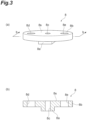
- FIG. 2 is a plan view schematically showing a state in which the Wehnelt electrode 9 is removed from the emitter 10 shown in FIG. 1 .
- the dashed circle in FIG. 2 indicates the position of the inner surface 9d of the Wehnelt electrode 9.
- the shielding member 8 is disposed on the surface 7a of the insulator 7.
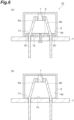
- the shielding member 8 serves to suppress a conductive layer Lc (a conductive deposition layer) from being formed continuously between the conductive terminals 6a and 6b and the Wehnelt electrode 9 due to the solidification of evaporated matter on the surface 7a of the insulator 7, which is generated in the internal space S by heat from the heaters 5a and 5b (see (a) in FIG. 6 ).
- the shielding member 8 is composed of a raised portion 8a which comes into contact with the surface 7a of the insulator 7 and a protruding portion 8b which has a surface 8s exposed to the internal space S.
- the raised portion 8a has a rectangular cross section. The length of one side is, for example, about 4 to 10 mm.
- the thickness of the raised portion 8a is, for example, 0.5 to 2 mm.
- the protruding portion 8b is provided to protrude laterally beyond the raised portion 8a, and is circular in cross section. The diameter is, for example, about 8 to 20 mm.
- the shielding member 8 is made of an insulating material (for example, ceramics). From the viewpoint of workability, the material of the shielding member 8 is preferably a machinable ceramic.
- the raised portion 8a and the protruding portion 8b may be formed integrally, or may be separable from each other.
- the shielding member 8 includes a hole 8c for fixing the shielding member 8 to the insulator 7 with a bolt 14 and holes 8d and 8e into which the conductive terminals 6a and 6b are inserted.
- the bolt hole 8c is provided to penetrate the center of the shielding member 8, and the holes 8d and 8e are provided at positions that sandwich the hole 8c.
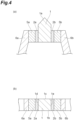
- FIG. 4 is a vertical cross-sectional view schematically showing a configuration of the electron source 1 and the like accommodated in the internal space S
- FIG. 4 is a horizontal cross-sectional view shown in (a) in FIG. 4
- the electron source 1 is disposed between the tips of the conductive terminals 6a and 6b.
- the conductive terminals 6a and 6b are used to hold the electron source 1 and to energize the heaters 5a and 5b.
- the electron source 1 is sandwiched by the intermediate members 2a and 2b.
- the heaters 5a and 5b are disposed on the outside of the intermediate members 2a and 2b.
- the tip of the conductive terminal 6a is in contact with the heater 5a
- the tip of the conductive terminal 6b is in contact with the heater 5b.
- the electron source 1 is made of a first material (electron emitting material) having electron emitting properties.
- the tip 1a of the electron source 1 is formed in a cone shape, and electrons are emitted from the tip.
- the side surfaces 1b and 1c of the electron source 1 are exposed to the internal space S.
- the shape of the electron source 1 other than the tip 1a is a square prism.
- the length of the electron source 1 is, for example, 0.1 to 2 mm, and may be 0.2 to 1.5 mm or 0.2 to 1 mm.
- the length of 0.1 mm or more tends to improve handling, and the length of 2 mm or less tends to improve uniform heating.
- the cross-sectional shape of the square prism of the electron source 1 is approximately square.
- the length of the side is, for example, 0.02 to 1 mm, and may be 0.05 to 0.5 mm or 0.05 to 0.15 mm.
- electron emitting materials include rare earth borides such as lanthanum boride (LaB 6 ) and cerium boride (CeB 6 ); high melting point metals such as tungsten, tantalum, and hafnium as well as their oxides, carbides, and nitrides; and precious metal-rare earth alloys such as iridium cerium.
- rare earth borides such as lanthanum boride (LaB 6 ) and cerium boride (CeB 6 )
- high melting point metals such as tungsten, tantalum, and hafnium as well as their oxides, carbides, and nitrides
- precious metal-rare earth alloys such as iridium cerium.
- the electron emitting material constituting the electron source 1 is preferably a rare earth boride.
- the electron source 1 is made of a rare earth boride, it is preferable that the electron source 1 is a single crystal processed so that the ⁇ 100> orientation, which is easy to emit electrons, coincides with the electron emission direction.
- the electron source 1 can be formed into a desired shape by electric discharge machining and the like.
- the side surface of the electron source 1 is preferably a (100) crystal plane since it is thought that the evaporation rate becomes slower on this side surface.
- the material constituting the electron source 1 has a higher thermal conductivity than the material constituting the intermediate members 2a and 2b.
- the thermal conductivity of the material constituting the electron source 1 is preferably 5 W/m ⁇ K or more, and more preferably 10 W/m ⁇ K or more. Since the thermal conductivity of this material is 5 W/m ⁇ K or more, the entire electron source 1 tends to be heated sufficiently uniformly by the heat from the heaters 5a and 5b. Furthermore, the upper limit of the thermal conductivity of this material is, for example, 200 W/m ⁇ K.
- the thermal conductivities of a plurality of materials are shown below.
- the thermal conductivity value T E of the electron source 1 is sufficiently larger than the thermal conductivity value T I of the intermediate members 2a and 2b.
- the ratio (T E /T I ) of the thermal conductivity value T E of the electron source 1 to the thermal conductivity value T I of the intermediate members 2a and 2b is, for example, 7 to 13, and may be 8 to 12 or 10 to 11. By setting this ratio within this range, the temperature of the heaters 5a and 5b can be appropriately increased when energized.
- the temperature of the heaters 5a and 5b during energization can be set to be, for example, about 150 to 250°C higher than the temperature of the electron source 1. Accordingly, it is possible to suppress the material constituting the electron source 1 from being deposited in the vicinity of the heaters 5a and 5b.
- the intermediate members 2a and 2b are disposed to contact and cover a pair of surfaces 1d and 1e of the electron source 1 (see (b) in FIG. 4 ). It is preferable that the length of the shortest path of the intermediate member from the heater to the electron source is 100 ⁇ m or more. That is, in this embodiment, the thickness of the intermediate member 2a (the distance between the electron source 1 and the heater 5a) is preferably 100 ⁇ m or more, and may be 100 to 1000 ⁇ m or 300 to 800 ⁇ m.
- the intermediate members 2a and 2b are made of a material (second material) having a lower thermal conductivity than the material constituting the electron source 1.
- the thermal conductivity of the material constituting the intermediate members 2a and 2b is, for example, 100 W/m ⁇ K or less, preferably 1 to 100 W/m ⁇ K, and more preferably 1 to 60 W/m ⁇ K.
- the lower limit of this value may be 2 W/m ⁇ K or may be 3 W/m ⁇ K.
- the upper limit of this value may be 45 W/m ⁇ K, or may be 40 W/m ⁇ K.
- the material constituting the intermediate members 2a and 2b preferably includes a high melting point metal or a carbide thereof, and preferably includes at least one of metallic tantalum, metallic titanium, metallic zirconium, metallic tungsten, metallic molybdenum, metallic rhenium, tantalum carbide, titanium carbide, and zirconium carbide. Further, the material may also include at least one of boron carbide and graphite (carbon material), and may also include at least one of niobium, hafnium, and vanadium. As this material, glassy carbon (for example, Glassy Carbon (product name, manufactured by Rayho Manufacturing Co., Ltd.)) may be used. Boron nitride may be used as this material. The thermal conductivities of a plurality of materials are shown below.
- the material constituting the intermediate members 2a and 2b is electrically conductive. From the viewpoint of suppressing the intermediate members 2a and 2b from excessively heating due to energization, it is preferable that the material constituting the intermediate members 2a and 2b has a lower electrical resistivity than the material constituting the heaters 5a and 5b.
- the electrical resistivity of the material constituting the intermediate members 2a and 2b is preferably 300 ⁇ m or less, and more preferably 100 ⁇ m or less. Since the electrical resistivity of this material is 300 ⁇ m or less, it is possible to suppress the intermediate members 2a and 2b from generating excessive heat when energized. Furthermore, the lower limit of the electrical resistivity of this material is, for example, 0.1 ⁇ m, and may be 0.3 ⁇ m or 1.0 ⁇ m.
- the electrical resistivities of a plurality of materials are shown below.
- the heaters 5a and 5b are made of a material having high electrical resistivity and generate heat when energized.
- the electrical resistivity of the material constituting the heaters 5a and 5b is preferably 500 to 1000 ⁇ m, and more preferably 600 to 900 ⁇ m. When the electrical resistivity of this material is 500 ⁇ m or more, the electron source 1 tends to be able to be heated sufficiently by energization, whereas when the electrical resistivity of this material is 1000 ⁇ m or less, the electron source 1 tends to be able to be sufficiently energized.
- Examples of materials constituting the heaters 5a and 5b include pyrolytic graphite and hot-pressed carbon. Furthermore, the electrical resistivity (typical value) of pyrolytic graphite is 800 ⁇ m.
- the electrical resistivity value R H of the heaters 5a and 5b is sufficiently larger than the electrical resistivity value R I of the intermediate members 2a and 2b.
- the ratio (R H /R I ) of the electrical resistivity value R H of the heaters 5a and 5b to the electrical resistivity value R I of the intermediate members 2a and 2b is, for example, 12 to 20, and may be 13 to 19 or 14 to 18.
- this ratio is 12 or more, the temperature of the heaters 5a and 5b can be sufficiently high when energized, and there is a tendency that deposition of the material constituting the electron source 1 in the vicinity of the heaters 5a and 5b can be suppressed.
- this ratio is 20 or less, the loss of power required to heat the heaters 5a and 5b tends to be reduced.
- the emitter 10 can be manufactured through the following steps. First, the conductive terminals 6a and 6b are fixed to holes 7b and 7c of the insulator 7 by, for example, brazing ((a) in FIG. 5 ). Subsequently, the shielding member 8 is fixed to the insulator 7 with the bolt 14 while the conductive terminals 6a and 6b pass through holes 8d and 8e of the insulator 7 ((b) in FIG. 5 ). Then, the conductive terminals 6a and 6b are bent so that the tips of the conductive terminals 6a and 6b move close to each other ((c) in FIG. 5 ).
- the electron source 1, the intermediate members 2a and 2b, and the heaters 5a and 5b are disposed between the tips of the conductive terminals 6a and 6b.
- the Wehnelt electrode 9 is attached, and the emitter 10 shown in FIG. 1 is obtained.
- the shielding member 8 is disposed to cover a part of the surface 7a of the insulator 7 (particularly, an annular region R1 that follows the inner surface 9d of the Wehnelt electrode 9), it is possible to sufficiently suppress the conductive layer Lc from being continuously formed between the conductive terminals 6a and 6b and the Wehnelt electrode 9 even when the emitter 10 is used for a long period of time. Therefore, it is possible to maintain a high level of insulation between the conductive terminals 6a and 6b and the Wehnelt electrode 9.
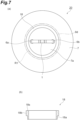
- An emitter 20 shown in (a) in FIG. 7 includes an annular shielding member 18.
- the shielding member 18 selectively covers the annular region R1 that follows the inner surface 9d of the Wehnelt electrode 9 in the surface 7a of the insulator 7.
- the shielding member 18 is composed of a raised portion 18a which comes into contact with the surface 7a of the insulator 7 and a protruding portion 18b which has a surface 18s exposed to the internal space S.
- the thickness of the raised portion 18a is, for example, 0.5 to 2 mm.
- the protruding portion 18b is provided to protrude further to the side than the raised portion 18a.
- a groove (not shown) may be provided in the insulator 7, the shielding member 18 may be fitted to this groove, and the shielding member 18 may be fixed to the insulator 7 by brazing.
- An emitter 30 shown in (a) in FIG. 8 includes a pair of shielding members 28 and 29.
- the pair of shielding members 28 and 29 are both annular and selectively cover two annular regions Ra and Rb that respectively follow the outer surfaces of the conductive terminals 6a and 6b in the surface 7a of the insulator 7.
- the shielding member 28 is composed of a raised portion 28a which comes into contact with the surface 7a of the insulator 7 and a protruding portion 28b which has a surface 28s exposed to the internal space S.
- the thickness of the raised portion 28a is, for example, 0.5 to 2 mm.
- the protruding portion 28b is provided to protrude further to the side than the raised portion 28a.
- the configuration of the shielding member 29 may be the same as the shielding member 28.
- a plurality of holes may be provided in the insulator 7, the shielding members 28 and 29 may be respectively fitted into these holes, and the shielding members 28 and 29 may be fitted and fixed to the conductive terminals 6a and 6b.
- FIG. 9 are diagrams showing a first modified example.
- the electron source 1 according to this modified example four side surfaces of the columnar portion are covered with the intermediate member 2. Since four side surfaces of the columnar portion of the electron source 1 are covered with the intermediate member 2, this has the effect of suppressing the diffusion of the evaporated matter from the electron source and of making the electron source 1 uniformly heated.
- the material of the intermediate member 2 may be the same as that of the intermediate members 2a and 2b according to the above-described embodiment.
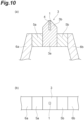
- FIG. 10 are diagrams showing a second modified example.
- An intermediate member 3 according to this modified example is composed of a columnar portion 3a and a conical portion 3b.
- An opening 4 is provided at the tip of the conical portion 3b, and the electron source 1 is inserted into the opening 4.
- the shape of the electron source 1 is a square prism.
- the length of the electron source 1 is, for example, 0.1 to 1 mm, and may be 0.2 to 0.6 mm or 0.3 mm. The length of 0.1 mm or more tends to improve handling, and the length of 1 mm or less tends to reduce the risk of cracks.
- the cross-sectional shape of the electron source 1 is approximately square.
- the length of the side is, for example, 20 to 300 ⁇ m, and may be 50 to 150 ⁇ m or 100 ⁇ m.
- the shape of the columnar portion 3a of the intermediate member 3 is a square prism.
- the cross-sectional shape of the columnar portion 3a is approximately square.
- the length of the side is, for example, 0.5 to 2 mm, and may be 0.6 to 1 mm or 0.7 to 0.9 mm. Since the surfaces of the electron source 1 other than the electron emission surface are covered with the intermediate member 3, emission of electrons from the surfaces other than the electron emission surface is suppressed.
- the material of the intermediate member 3 may be the same as that of the intermediate members 2a and 2b according to the above-described embodiment.
- the tip of the electron source 1 may protrude from the opening 9a as shown in FIG. 11 .
- the amount of electrons emitted from the electron source 1 can be increased by applying a positive bias voltage to the electron source 1.
- the electron source 1 since the electron source 1 is embedded in the intermediate member 3, it is possible to suppress the emission of excess electrons from the side surface of the electron source 1.
- the voltage applied across the pair of conductive terminals 6a and 6b is, for example, about 1 to 10 V, whereas the voltage applied across the conductive terminals 6a and 6b and the Wehnelt electrode 9 is, for example, 15 to 1000 V.
- FIG. 12 are diagrams showing a third modified example.
- the intermediate members 2a and 2b are not disposed, and the electron source 1 are directly sandwiched by the heaters 5a and 5b.
- the disclosure includes the following invention.
- Electron source 2, 2a, 2b, 3: Intermediate member, 5a, 5b: Heater, 6a, 6b: Conductive terminal, 7: Insulator, 8, 18, 28, 29: Shielding member, 9: Wehnelt electrode, 10, 20, 30: Emitter, R1, Ra, Rb: Region
Landscapes
- Chemical & Material Sciences (AREA)
- Analytical Chemistry (AREA)
- Physics & Mathematics (AREA)
- Optics & Photonics (AREA)
- Electron Sources, Ion Sources (AREA)
Applications Claiming Priority (2)
| Application Number | Priority Date | Filing Date | Title |
|---|---|---|---|
| JP2022053162 | 2022-03-29 | ||
| PCT/JP2023/010963 WO2023189842A1 (ja) | 2022-03-29 | 2023-03-20 | エミッター及びこれを備える装置 |
Publications (2)
| Publication Number | Publication Date |
|---|---|
| EP4503087A1 true EP4503087A1 (de) | 2025-02-05 |
| EP4503087A4 EP4503087A4 (de) | 2025-06-25 |
Family
ID=88201219
Family Applications (1)
| Application Number | Title | Priority Date | Filing Date |
|---|---|---|---|
| EP23779858.2A Pending EP4503087A4 (de) | 2022-03-29 | 2023-03-20 | Emitter und vorrichtung damit |
Country Status (6)
| Country | Link |
|---|---|
| US (1) | US12586747B2 (de) |
| EP (1) | EP4503087A4 (de) |
| JP (1) | JP7674594B2 (de) |
| KR (1) | KR20240152930A (de) |
| CN (1) | CN118922907A (de) |
| WO (1) | WO2023189842A1 (de) |
Family Cites Families (6)
| Publication number | Priority date | Publication date | Assignee | Title |
|---|---|---|---|---|
| JPS4725911U (de) | 1971-04-20 | 1972-11-24 | ||
| JPH09260237A (ja) * | 1996-03-19 | 1997-10-03 | Fujitsu Ltd | 電子銃、電子ビーム装置及び電子ビーム照射方法 |
| US5854490A (en) | 1995-10-03 | 1998-12-29 | Fujitsu Limited | Charged-particle-beam exposure device and charged-particle-beam exposure method |
| JP2003168382A (ja) * | 2001-11-29 | 2003-06-13 | Ebara Corp | 電子銃及び該電子銃を備えた電子線装置 |
| JP4951477B2 (ja) | 2006-12-04 | 2012-06-13 | 電気化学工業株式会社 | 電子放出源 |
| WO2022039042A1 (ja) * | 2020-08-17 | 2022-02-24 | デンカ株式会社 | エミッター及びこれを備える装置 |
-
2023
- 2023-03-20 US US18/851,047 patent/US12586747B2/en active Active
- 2023-03-20 EP EP23779858.2A patent/EP4503087A4/de active Pending
- 2023-03-20 WO PCT/JP2023/010963 patent/WO2023189842A1/ja not_active Ceased
- 2023-03-20 CN CN202380029983.9A patent/CN118922907A/zh active Pending
- 2023-03-20 KR KR1020247032265A patent/KR20240152930A/ko not_active Withdrawn
- 2023-03-20 JP JP2024511898A patent/JP7674594B2/ja active Active
Also Published As
| Publication number | Publication date |
|---|---|
| EP4503087A4 (de) | 2025-06-25 |
| JPWO2023189842A1 (de) | 2023-10-05 |
| US12586747B2 (en) | 2026-03-24 |
| KR20240152930A (ko) | 2024-10-22 |
| CN118922907A (zh) | 2024-11-08 |
| WO2023189842A1 (ja) | 2023-10-05 |
| US20250218717A1 (en) | 2025-07-03 |
| JP7674594B2 (ja) | 2025-05-09 |
Similar Documents
| Publication | Publication Date | Title |
|---|---|---|
| US5170422A (en) | Electron emitter for an x-ray tube | |
| EP0632479A1 (de) | Heizeinrichtung aus anisotropischem pyrolytischem Graphit | |
| EP0380205B1 (de) | Schnellheizkathode für Hochleistungsvakuumröhren | |
| JP2025072670A (ja) | エミッター及びこれを備える装置 | |
| EP4503087A1 (de) | Emitter und vorrichtung damit | |
| US11915921B2 (en) | Electron source, method for manufacturing same, emitter, and device including same | |
| US20220208506A1 (en) | Electron beam emitting assembly | |
| JP5047062B2 (ja) | 熱電子放射陰極 | |
| TWI887399B (zh) | 電子源及其製造方法,以及發射器及具備該發射器之裝置 | |
| JP2024062621A (ja) | 電子源及びその製造方法 | |
| TW202601707A (zh) | 發射器 | |
| TW202244972A (zh) | 發射器及具備該發射器之裝置 | |
| JPH06231708A (ja) | 長尺電子ビーム発生装置 | |
| JP2009117134A (ja) | 電子線源の製造方法 |
Legal Events
| Date | Code | Title | Description |
|---|---|---|---|
| STAA | Information on the status of an ep patent application or granted ep patent |
Free format text: STATUS: THE INTERNATIONAL PUBLICATION HAS BEEN MADE |
|
| PUAI | Public reference made under article 153(3) epc to a published international application that has entered the european phase |
Free format text: ORIGINAL CODE: 0009012 |
|
| STAA | Information on the status of an ep patent application or granted ep patent |
Free format text: STATUS: REQUEST FOR EXAMINATION WAS MADE |
|
| 17P | Request for examination filed |
Effective date: 20241028 |
|
| AK | Designated contracting states |
Kind code of ref document: A1 Designated state(s): AL AT BE BG CH CY CZ DE DK EE ES FI FR GB GR HR HU IE IS IT LI LT LU LV MC ME MK MT NL NO PL PT RO RS SE SI SK SM TR |
|
| REG | Reference to a national code |
Ref country code: DE Ref legal event code: R079 Free format text: PREVIOUS MAIN CLASS: H01J0037060000 Ipc: H01J0001148000 |
|
| A4 | Supplementary search report drawn up and despatched |
Effective date: 20250527 |
|
| RIC1 | Information provided on ipc code assigned before grant |
Ipc: H01J 37/065 20060101ALI20250521BHEP Ipc: H01J 37/06 20060101ALI20250521BHEP Ipc: H01J 3/02 20060101ALI20250521BHEP Ipc: H01J 1/90 20060101ALI20250521BHEP Ipc: H01J 1/22 20060101ALI20250521BHEP Ipc: H01J 1/15 20060101ALI20250521BHEP Ipc: H01J 1/148 20060101AFI20250521BHEP |
|
| DAV | Request for validation of the european patent (deleted) | ||
| DAX | Request for extension of the european patent (deleted) |