EP4506471A1 - Feuille d'acier électromagnétique à grains orientés et son procédé de production - Google Patents
Feuille d'acier électromagnétique à grains orientés et son procédé de production Download PDFInfo
- Publication number
- EP4506471A1 EP4506471A1 EP23784756.1A EP23784756A EP4506471A1 EP 4506471 A1 EP4506471 A1 EP 4506471A1 EP 23784756 A EP23784756 A EP 23784756A EP 4506471 A1 EP4506471 A1 EP 4506471A1
- Authority
- EP
- European Patent Office
- Prior art keywords
- steel sheet
- grooves
- base material
- grain
- oriented electrical
- Prior art date
- Legal status (The legal status is an assumption and is not a legal conclusion. Google has not performed a legal analysis and makes no representation as to the accuracy of the status listed.)
- Pending
Links
Images

Classifications
-
- H—ELECTRICITY
- H01—ELECTRIC ELEMENTS
- H01F—MAGNETS; INDUCTANCES; TRANSFORMERS; SELECTION OF MATERIALS FOR THEIR MAGNETIC PROPERTIES
- H01F1/00—Magnets or magnetic bodies characterised by the magnetic materials therefor; Selection of materials for their magnetic properties
- H01F1/01—Magnets or magnetic bodies characterised by the magnetic materials therefor; Selection of materials for their magnetic properties of inorganic materials
- H01F1/03—Magnets or magnetic bodies characterised by the magnetic materials therefor; Selection of materials for their magnetic properties of inorganic materials characterised by their coercivity
- H01F1/12—Magnets or magnetic bodies characterised by the magnetic materials therefor; Selection of materials for their magnetic properties of inorganic materials characterised by their coercivity of soft-magnetic materials
- H01F1/14—Magnets or magnetic bodies characterised by the magnetic materials therefor; Selection of materials for their magnetic properties of inorganic materials characterised by their coercivity of soft-magnetic materials metals or alloys
- H01F1/16—Magnets or magnetic bodies characterised by the magnetic materials therefor; Selection of materials for their magnetic properties of inorganic materials characterised by their coercivity of soft-magnetic materials metals or alloys in the form of sheets
-
- C—CHEMISTRY; METALLURGY
- C22—METALLURGY; FERROUS OR NON-FERROUS ALLOYS; TREATMENT OF ALLOYS OR NON-FERROUS METALS
- C22C—ALLOYS
- C22C38/00—Ferrous alloys, e.g. steel alloys
- C22C38/02—Ferrous alloys, e.g. steel alloys containing silicon
-
- B—PERFORMING OPERATIONS; TRANSPORTING
- B23—MACHINE TOOLS; METAL-WORKING NOT OTHERWISE PROVIDED FOR
- B23K—SOLDERING OR UNSOLDERING; WELDING; CLADDING OR PLATING BY SOLDERING OR WELDING; CUTTING BY APPLYING HEAT LOCALLY, e.g. FLAME CUTTING; WORKING BY LASER BEAM
- B23K26/00—Working by laser beam, e.g. welding, cutting or boring
- B23K26/02—Positioning or observing the workpiece, e.g. with respect to the point of impact; Aligning, aiming or focusing the laser beam
- B23K26/06—Shaping the laser beam, e.g. by masks or multi-focusing
- B23K26/073—Shaping the laser spot
-
- B—PERFORMING OPERATIONS; TRANSPORTING
- B23—MACHINE TOOLS; METAL-WORKING NOT OTHERWISE PROVIDED FOR
- B23K—SOLDERING OR UNSOLDERING; WELDING; CLADDING OR PLATING BY SOLDERING OR WELDING; CUTTING BY APPLYING HEAT LOCALLY, e.g. FLAME CUTTING; WORKING BY LASER BEAM
- B23K26/00—Working by laser beam, e.g. welding, cutting or boring
- B23K26/36—Removing material
- B23K26/362—Laser etching
- B23K26/364—Laser etching for making a groove or trench, e.g. for scribing a break initiation groove
-
- C—CHEMISTRY; METALLURGY
- C21—METALLURGY OF IRON
- C21D—MODIFYING THE PHYSICAL STRUCTURE OF FERROUS METALS; GENERAL DEVICES FOR HEAT TREATMENT OF FERROUS OR NON-FERROUS METALS OR ALLOYS; MAKING METAL MALLEABLE, e.g. BY DECARBURISATION OR TEMPERING
- C21D10/00—Modifying the physical properties by methods other than heat treatment or deformation
- C21D10/005—Modifying the physical properties by methods other than heat treatment or deformation by laser shock processing
-
- C—CHEMISTRY; METALLURGY
- C21—METALLURGY OF IRON
- C21D—MODIFYING THE PHYSICAL STRUCTURE OF FERROUS METALS; GENERAL DEVICES FOR HEAT TREATMENT OF FERROUS OR NON-FERROUS METALS OR ALLOYS; MAKING METAL MALLEABLE, e.g. BY DECARBURISATION OR TEMPERING
- C21D6/00—Heat treatment of ferrous alloys
- C21D6/008—Heat treatment of ferrous alloys containing Si
-
- C—CHEMISTRY; METALLURGY
- C21—METALLURGY OF IRON
- C21D—MODIFYING THE PHYSICAL STRUCTURE OF FERROUS METALS; GENERAL DEVICES FOR HEAT TREATMENT OF FERROUS OR NON-FERROUS METALS OR ALLOYS; MAKING METAL MALLEABLE, e.g. BY DECARBURISATION OR TEMPERING
- C21D8/00—Modifying the physical properties of ferrous metals or ferrous alloys by deformation combined with, or followed by, heat treatment
- C21D8/12—Modifying the physical properties of ferrous metals or ferrous alloys by deformation combined with, or followed by, heat treatment during manufacturing of articles with special electromagnetic properties
-
- C—CHEMISTRY; METALLURGY
- C21—METALLURGY OF IRON
- C21D—MODIFYING THE PHYSICAL STRUCTURE OF FERROUS METALS; GENERAL DEVICES FOR HEAT TREATMENT OF FERROUS OR NON-FERROUS METALS OR ALLOYS; MAKING METAL MALLEABLE, e.g. BY DECARBURISATION OR TEMPERING
- C21D8/00—Modifying the physical properties of ferrous metals or ferrous alloys by deformation combined with, or followed by, heat treatment
- C21D8/12—Modifying the physical properties of ferrous metals or ferrous alloys by deformation combined with, or followed by, heat treatment during manufacturing of articles with special electromagnetic properties
- C21D8/1216—Modifying the physical properties of ferrous metals or ferrous alloys by deformation combined with, or followed by, heat treatment during manufacturing of articles with special electromagnetic properties characterised by the working steps
- C21D8/1222—Hot rolling
-
- C—CHEMISTRY; METALLURGY
- C21—METALLURGY OF IRON
- C21D—MODIFYING THE PHYSICAL STRUCTURE OF FERROUS METALS; GENERAL DEVICES FOR HEAT TREATMENT OF FERROUS OR NON-FERROUS METALS OR ALLOYS; MAKING METAL MALLEABLE, e.g. BY DECARBURISATION OR TEMPERING
- C21D8/00—Modifying the physical properties of ferrous metals or ferrous alloys by deformation combined with, or followed by, heat treatment
- C21D8/12—Modifying the physical properties of ferrous metals or ferrous alloys by deformation combined with, or followed by, heat treatment during manufacturing of articles with special electromagnetic properties
- C21D8/1216—Modifying the physical properties of ferrous metals or ferrous alloys by deformation combined with, or followed by, heat treatment during manufacturing of articles with special electromagnetic properties characterised by the working steps
- C21D8/1233—Cold rolling
-
- C—CHEMISTRY; METALLURGY
- C21—METALLURGY OF IRON
- C21D—MODIFYING THE PHYSICAL STRUCTURE OF FERROUS METALS; GENERAL DEVICES FOR HEAT TREATMENT OF FERROUS OR NON-FERROUS METALS OR ALLOYS; MAKING METAL MALLEABLE, e.g. BY DECARBURISATION OR TEMPERING
- C21D8/00—Modifying the physical properties of ferrous metals or ferrous alloys by deformation combined with, or followed by, heat treatment
- C21D8/12—Modifying the physical properties of ferrous metals or ferrous alloys by deformation combined with, or followed by, heat treatment during manufacturing of articles with special electromagnetic properties
- C21D8/1244—Modifying the physical properties of ferrous metals or ferrous alloys by deformation combined with, or followed by, heat treatment during manufacturing of articles with special electromagnetic properties characterised by the heat treatment
- C21D8/1261—Modifying the physical properties of ferrous metals or ferrous alloys by deformation combined with, or followed by, heat treatment during manufacturing of articles with special electromagnetic properties characterised by the heat treatment following hot rolling
-
- C—CHEMISTRY; METALLURGY
- C21—METALLURGY OF IRON
- C21D—MODIFYING THE PHYSICAL STRUCTURE OF FERROUS METALS; GENERAL DEVICES FOR HEAT TREATMENT OF FERROUS OR NON-FERROUS METALS OR ALLOYS; MAKING METAL MALLEABLE, e.g. BY DECARBURISATION OR TEMPERING
- C21D8/00—Modifying the physical properties of ferrous metals or ferrous alloys by deformation combined with, or followed by, heat treatment
- C21D8/12—Modifying the physical properties of ferrous metals or ferrous alloys by deformation combined with, or followed by, heat treatment during manufacturing of articles with special electromagnetic properties
- C21D8/1277—Modifying the physical properties of ferrous metals or ferrous alloys by deformation combined with, or followed by, heat treatment during manufacturing of articles with special electromagnetic properties involving a particular surface treatment
-
- C—CHEMISTRY; METALLURGY
- C21—METALLURGY OF IRON
- C21D—MODIFYING THE PHYSICAL STRUCTURE OF FERROUS METALS; GENERAL DEVICES FOR HEAT TREATMENT OF FERROUS OR NON-FERROUS METALS OR ALLOYS; MAKING METAL MALLEABLE, e.g. BY DECARBURISATION OR TEMPERING
- C21D8/00—Modifying the physical properties of ferrous metals or ferrous alloys by deformation combined with, or followed by, heat treatment
- C21D8/12—Modifying the physical properties of ferrous metals or ferrous alloys by deformation combined with, or followed by, heat treatment during manufacturing of articles with special electromagnetic properties
- C21D8/1277—Modifying the physical properties of ferrous metals or ferrous alloys by deformation combined with, or followed by, heat treatment during manufacturing of articles with special electromagnetic properties involving a particular surface treatment
- C21D8/1283—Application of a separating or insulating coating
-
- C—CHEMISTRY; METALLURGY
- C21—METALLURGY OF IRON
- C21D—MODIFYING THE PHYSICAL STRUCTURE OF FERROUS METALS; GENERAL DEVICES FOR HEAT TREATMENT OF FERROUS OR NON-FERROUS METALS OR ALLOYS; MAKING METAL MALLEABLE, e.g. BY DECARBURISATION OR TEMPERING
- C21D8/00—Modifying the physical properties of ferrous metals or ferrous alloys by deformation combined with, or followed by, heat treatment
- C21D8/12—Modifying the physical properties of ferrous metals or ferrous alloys by deformation combined with, or followed by, heat treatment during manufacturing of articles with special electromagnetic properties
- C21D8/1277—Modifying the physical properties of ferrous metals or ferrous alloys by deformation combined with, or followed by, heat treatment during manufacturing of articles with special electromagnetic properties involving a particular surface treatment
- C21D8/1288—Application of a tension-inducing coating
-
- C—CHEMISTRY; METALLURGY
- C21—METALLURGY OF IRON
- C21D—MODIFYING THE PHYSICAL STRUCTURE OF FERROUS METALS; GENERAL DEVICES FOR HEAT TREATMENT OF FERROUS OR NON-FERROUS METALS OR ALLOYS; MAKING METAL MALLEABLE, e.g. BY DECARBURISATION OR TEMPERING
- C21D8/00—Modifying the physical properties of ferrous metals or ferrous alloys by deformation combined with, or followed by, heat treatment
- C21D8/12—Modifying the physical properties of ferrous metals or ferrous alloys by deformation combined with, or followed by, heat treatment during manufacturing of articles with special electromagnetic properties
- C21D8/1294—Modifying the physical properties of ferrous metals or ferrous alloys by deformation combined with, or followed by, heat treatment during manufacturing of articles with special electromagnetic properties involving a localised treatment
-
- C—CHEMISTRY; METALLURGY
- C21—METALLURGY OF IRON
- C21D—MODIFYING THE PHYSICAL STRUCTURE OF FERROUS METALS; GENERAL DEVICES FOR HEAT TREATMENT OF FERROUS OR NON-FERROUS METALS OR ALLOYS; MAKING METAL MALLEABLE, e.g. BY DECARBURISATION OR TEMPERING
- C21D9/00—Heat treatment, e.g. annealing, hardening, quenching or tempering, adapted for particular articles; Furnaces therefor
- C21D9/46—Heat treatment, e.g. annealing, hardening, quenching or tempering, adapted for particular articles; Furnaces therefor for sheet metals
-
- C—CHEMISTRY; METALLURGY
- C22—METALLURGY; FERROUS OR NON-FERROUS ALLOYS; TREATMENT OF ALLOYS OR NON-FERROUS METALS
- C22C—ALLOYS
- C22C38/00—Ferrous alloys, e.g. steel alloys
- C22C38/001—Ferrous alloys, e.g. steel alloys containing N
-
- C—CHEMISTRY; METALLURGY
- C22—METALLURGY; FERROUS OR NON-FERROUS ALLOYS; TREATMENT OF ALLOYS OR NON-FERROUS METALS
- C22C—ALLOYS
- C22C38/00—Ferrous alloys, e.g. steel alloys
- C22C38/04—Ferrous alloys, e.g. steel alloys containing manganese
-
- C—CHEMISTRY; METALLURGY
- C22—METALLURGY; FERROUS OR NON-FERROUS ALLOYS; TREATMENT OF ALLOYS OR NON-FERROUS METALS
- C22C—ALLOYS
- C22C38/00—Ferrous alloys, e.g. steel alloys
- C22C38/06—Ferrous alloys, e.g. steel alloys containing aluminium
-
- H—ELECTRICITY
- H01—ELECTRIC ELEMENTS
- H01F—MAGNETS; INDUCTANCES; TRANSFORMERS; SELECTION OF MATERIALS FOR THEIR MAGNETIC PROPERTIES
- H01F1/00—Magnets or magnetic bodies characterised by the magnetic materials therefor; Selection of materials for their magnetic properties
- H01F1/01—Magnets or magnetic bodies characterised by the magnetic materials therefor; Selection of materials for their magnetic properties of inorganic materials
- H01F1/03—Magnets or magnetic bodies characterised by the magnetic materials therefor; Selection of materials for their magnetic properties of inorganic materials characterised by their coercivity
- H01F1/12—Magnets or magnetic bodies characterised by the magnetic materials therefor; Selection of materials for their magnetic properties of inorganic materials characterised by their coercivity of soft-magnetic materials
- H01F1/14—Magnets or magnetic bodies characterised by the magnetic materials therefor; Selection of materials for their magnetic properties of inorganic materials characterised by their coercivity of soft-magnetic materials metals or alloys
- H01F1/147—Alloys characterised by their composition
-
- H—ELECTRICITY
- H01—ELECTRIC ELEMENTS
- H01F—MAGNETS; INDUCTANCES; TRANSFORMERS; SELECTION OF MATERIALS FOR THEIR MAGNETIC PROPERTIES
- H01F1/00—Magnets or magnetic bodies characterised by the magnetic materials therefor; Selection of materials for their magnetic properties
- H01F1/01—Magnets or magnetic bodies characterised by the magnetic materials therefor; Selection of materials for their magnetic properties of inorganic materials
- H01F1/03—Magnets or magnetic bodies characterised by the magnetic materials therefor; Selection of materials for their magnetic properties of inorganic materials characterised by their coercivity
- H01F1/12—Magnets or magnetic bodies characterised by the magnetic materials therefor; Selection of materials for their magnetic properties of inorganic materials characterised by their coercivity of soft-magnetic materials
- H01F1/14—Magnets or magnetic bodies characterised by the magnetic materials therefor; Selection of materials for their magnetic properties of inorganic materials characterised by their coercivity of soft-magnetic materials metals or alloys
- H01F1/16—Magnets or magnetic bodies characterised by the magnetic materials therefor; Selection of materials for their magnetic properties of inorganic materials characterised by their coercivity of soft-magnetic materials metals or alloys in the form of sheets
- H01F1/18—Magnets or magnetic bodies characterised by the magnetic materials therefor; Selection of materials for their magnetic properties of inorganic materials characterised by their coercivity of soft-magnetic materials metals or alloys in the form of sheets with insulating coating
-
- H—ELECTRICITY
- H01—ELECTRIC ELEMENTS
- H01F—MAGNETS; INDUCTANCES; TRANSFORMERS; SELECTION OF MATERIALS FOR THEIR MAGNETIC PROPERTIES
- H01F41/00—Apparatus or processes specially adapted for manufacturing or assembling magnets, inductances or transformers; Apparatus or processes specially adapted for manufacturing materials characterised by their magnetic properties
- H01F41/02—Apparatus or processes specially adapted for manufacturing or assembling magnets, inductances or transformers; Apparatus or processes specially adapted for manufacturing materials characterised by their magnetic properties for manufacturing cores, coils, or magnets
- H01F41/0206—Manufacturing of magnetic cores by mechanical means
- H01F41/0233—Manufacturing of magnetic circuits made from sheets
-
- B—PERFORMING OPERATIONS; TRANSPORTING
- B23—MACHINE TOOLS; METAL-WORKING NOT OTHERWISE PROVIDED FOR
- B23K—SOLDERING OR UNSOLDERING; WELDING; CLADDING OR PLATING BY SOLDERING OR WELDING; CUTTING BY APPLYING HEAT LOCALLY, e.g. FLAME CUTTING; WORKING BY LASER BEAM
- B23K2101/00—Articles made by soldering, welding or cutting
- B23K2101/34—Coated articles ; Surface treated articles
-
- C—CHEMISTRY; METALLURGY
- C21—METALLURGY OF IRON
- C21D—MODIFYING THE PHYSICAL STRUCTURE OF FERROUS METALS; GENERAL DEVICES FOR HEAT TREATMENT OF FERROUS OR NON-FERROUS METALS OR ALLOYS; MAKING METAL MALLEABLE, e.g. BY DECARBURISATION OR TEMPERING
- C21D2201/00—Treatment for obtaining particular effects
- C21D2201/05—Grain orientation
-
- Y—GENERAL TAGGING OF NEW TECHNOLOGICAL DEVELOPMENTS; GENERAL TAGGING OF CROSS-SECTIONAL TECHNOLOGIES SPANNING OVER SEVERAL SECTIONS OF THE IPC; TECHNICAL SUBJECTS COVERED BY FORMER USPC CROSS-REFERENCE ART COLLECTIONS [XRACs] AND DIGESTS
- Y02—TECHNOLOGIES OR APPLICATIONS FOR MITIGATION OR ADAPTATION AGAINST CLIMATE CHANGE
- Y02P—CLIMATE CHANGE MITIGATION TECHNOLOGIES IN THE PRODUCTION OR PROCESSING OF GOODS
- Y02P10/00—Technologies related to metal processing
- Y02P10/20—Recycling
Definitions
- the present invention relates to grain-oriented electrical steel sheet.
- Grain-oriented electrical steel sheet is steel sheet controlled in crystal orientation by a combination of cold rolling treatment and annealing treatment so that the easy magnetization axes of the crystal grains and the rolling direction match.
- insulating coating acts to impart not only an electrical insulation property, but also tension, rust proofness, etc. to the base material steel sheet.
- the method of magnetic domain control which forms distortion areas or grooves formed in a direction intersecting the rolling direction at a predetermined pitch along the rolling direction so as to reduce the width of 180° magnetic domains (refining of 180°magnetic domains) is known.
- the method of magnetic domain control is classified as methods which impart strain to the base material steel sheet of the grain-oriented electrical steel sheet and methods which form grooves in the surface of the base material steel sheet with coatings which apply tension to the base material steel sheet.
- Grain-oriented electrical steel sheet controlled in magnetic domains by grooves can be used to produce an iron core (winding core) of a transformer. Even if performing stress relief annealing, the grooves do not disappear, so it is possible to maintain the effect of magnetic domain refining. For this reason, for winding cores, the method of magnetic domain control by formation of grooves is employed as a method for reducing the eddy current loss.
- FIG. 1 is a view schematically showing an electrical steel sheet formed with grooves.
- FIG. 1 shows the state where the surface of a base material steel sheet 1 is formed with a plurality of grooves 2 at a pitch in the rolling direction of the base material steel sheet 1.
- ⁇ shows an angle formed by the direction perpendicular to the rolling direction and the sheet thickness direction of the base material steel sheet (sheet width direction) and the longitudinal direction of the grooves 2.
- W shows a width of the grooves 2
- D shows a depth of the grooves 2
- P shows a pitch of the grooves 2 adjoining each other in the rolling direction.
- PTL 1 discloses an electrolytic etching method for forming grooves in a steel sheet surface of grain-oriented electrical steel sheet by electrolytic etching.
- PTL 2 discloses a gear press method for mechanically pressing a gear against the steel sheet surface of grain-oriented electrical steel sheet to thereby form grooves at the steel sheet surface.
- the method using electrolytic etching requires a process of masking, etching, and mask removal. There is the problem that the process becomes more complicated compared with the mechanical method.
- the method using gear pressing results in wear of the tooth profile in a short time since electrical steel sheet is high in hardness. Furthermore, from the viewpoint of high speed processing, it is difficult to realize a line speed of 100 mpm or more demanded from a general ferrous metal production process.
- PTL 3 discloses a lasering method of using a laser to melt and evaporate parts struck by the laser at the steel sheet surface of grain-oriented electrical steel sheet.
- the lasering method is free of the problems of wear of the tooth profile and complication of the process and enables high speed processing.
- PTL 4 proposes forming grooves in cold rolled steel sheet by the lasering method but if lasering cold rolled steel sheet, in the final product, a glass coating comprised of forsterite is formed at the bottom of the grooves.
- the glass coating is comprised of nonmagnetic oxides, so the magnetic flux density of the steel sheet falls and the resultant deterioration of the core loss becomes a problem.
- the present invention was developed considering the above situation and has as its object the provision of grain-oriented electrical steel sheet better improved in core loss in control of magnetic domains for forming laser grooves in cold rolled steel sheet (grooves formed by laser).
- the inventors engaged in intensive studies for solving the above problem. In repeatedly studying the lasering conditions at the time of forming laser grooves, they discovered that the core loss is improved if fine grains are present at the inside of the glass coating formed at the groove surfaces.
- the present invention was made based on this discovery. Its gist is as follows:
- the inventors engaged in repeated studies for realizing the effect of magnetic domain refining to the maximum extent whereupon they discovered that by forming fine grains in the glass coating at the surfaces of the recessed parts of the grooves, the effect of magnetic domain refining can be enjoyed to the maximum extent.
- the constitution of the grain-oriented electrical steel sheet according to an embodiment of the present invention (below, referred to as the "present electrical steel sheet") will be explained.
- the present electrical steel sheet is provided with a base material steel sheet having a plurality of grooves arranged in parallel at its surface and a glass coating formed at the surface of the base material steel sheet (see FIG. 1 to FIG. 4 ).
- the surface of the glass coating may also be formed with a tension coating (insulating coating).
- a plurality of grooves are formed substantially in parallel so as to adjoin each other in the rolling direction of the base material steel sheet.
- the direction of the grooves (angle ⁇ ) and width W, depth D, and pitch P of the grooves are determined considering the core loss in the same way as ordinary grain-oriented electrical steel sheet.
- angle ⁇ formed by the direction perpendicular to the rolling direction and the sheet thickness direction of the base material steel sheet (sheet width direction) and the longitudinal direction of the grooves is too large, there is no effect of magnetic domain control and the effect of improvement of the core loss can no longer be obtained, so it is made 40° or less.
- the angle ⁇ is preferably smaller and may be 35° or less, 30° or less, 25° or less, 20° or less, 15° or less, 10° or less, 8° or less, 6° or less, or 5° or less.
- the lower limit of the angle ⁇ is 0°, that is, the longitudinal direction of the grooves, is when parallel to the sheet width direction. Note that, the direction of the angle ⁇ is not an issue.
- the surface of the base material steel sheet has a plurality of grooves arranged generally parallel, but the angle ⁇ of each groove need only be in such a range.
- the "groove width W" indicates the width of the grooves at the surface of the base material steel sheet in the cross-section of the grooves (groove cross-section) at the plane vertical to the longitudinal direction of the grooves. Even if the groove width W is less than 20 ⁇ m or too narrow, the grooves do not become starting points of formation of magnetic poles, there is no effect of control of the magnetic domains, and a good core loss cannot be obtained. On the other hand, if the width becomes more than 300 ⁇ m or too wide, the grooves do not become starting points of formation of magnetic poles, there is no effect of control of the magnetic domains, and a good core loss cannot be obtained. For this reason, the groove width W should be made 20 ⁇ m or more and 300 ⁇ m or less.
- the lower limit of the groove width W may preferably be made 25 ⁇ m, 30 ⁇ m, or 35 ⁇ m.
- the upper limit of the groove width W may preferably be made 250 ⁇ m, 200 ⁇ m, 150 ⁇ m, 100 ⁇ m, or 80 ⁇ m.
- the groove depth D may be made 10 ⁇ m or more and 40 ⁇ m or less.
- the lower limit of the groove depth D may preferably be 11 ⁇ m, 12 ⁇ m, 13 ⁇ m, 14 ⁇ m, or 15 ⁇ m.
- the upper limit of the groove depth D may preferably be 38 ⁇ m, 36 ⁇ m, 34 ⁇ m, 32 ⁇ m, 30 ⁇ m, 28 ⁇ m, or 26 ⁇ m.
- the "groove pitch P" is the pitch of the center lines in the longitudinal direction of the adjoining grooves in the grooves arranged substantially in parallel at the base material steel sheet surface and indicates a distance of the base material steel sheet in the rolling direction.
- the "center lines of grooves” are lines parallel to the longitudinal direction of the grooves passing through the center points of the grooves at the base material steel sheet surface in the groove cross-section.
- the groove pitch P may be 1 mm or more and 30 mm or less.
- the groove pitch P need not be equal pitches, but the groove pitch P with the adjoining groove may be within this range.
- the lower limit of the groove pitch P is preferably 1.2 mm, 1.4 mm, 1.5 mm, 1.6 mm, 1.8 mm, or 2.0 mm.
- the upper limit of the groove pitch P is preferably 25 mm, 20 mm, 15 mm, 10 mm, 7 mm, or 5 mm.
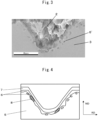
- FIG. 2 to FIG. 4 are cross-sectional views of the groove parts of the present electrical steel sheet. More specifically, they are views showing regions including the grooves at the cross-sections perpendicular to the longitudinal direction of the grooves.
- control is performed so that fine grains are present inside the glass coating at the surfaces of the recessed parts of the grooves formed at the base material steel sheet surface. Specifically, as shown in FIG. 2 , control is performed so that there are fine grains with a long axis of 1 ⁇ m or more and less than 20 ⁇ m inside the glass coating at the surfaces of the recessed parts of the grooves. Further, control is performed so that the crystal orientation of the fine grains differs by 5° or more from the crystal orientation of the base material, that is, the Goss orientation.
- a cross-section of the groove perpendicular to the longitudinal direction of the groove can be polished to a mirror surface and electrolytically polished to acquire an inverse pole figure (IPF) map (crystal orientation map) by an SEM-EBSD (electron backscattered diffraction pattern) to enable confirmation of the fine grains 4 in the glass coating 6.
- IPF inverse pole figure
- SEM-EBSD electron backscattered diffraction pattern
- FIG. 3 shows an SEM image of the same field as FIG. 2 .
- FIG. 4 schematically shows this groove cross-section. Note that, in FIG. 2 and FIG. 3 , the island shaped black parts 6' in the base material 3 are parts of the glass coating. The glass coating itself is present as if rooted in the base material. The span of the interface between the line connecting the bottom surfaces of the glass coating (including parts appearing to be island shaped) and the grooves may be considered to be the glass coating without problem. As explained above, using the IPF map of the EBSD, it is possible to identify fine grains in the glass coating and further possible to confirm the crystal orientation of the fine grains and the Goss orientation of the base material.
- the reason why the fine grains at the inside of the glass coating at the surfaces of the recessed parts of the grooves reduce the core loss is believed to be as follows:
- the magnetic domain refining at the grain-oriented electrical steel sheet is realized by the magnetic poles formed at the steel sheet surface causing the magnetostatic energy to rise and 180° domain walls newly forming to eliminate the same and thereby the magnetic domain width becoming narrower. If the magnetic domain width becomes narrower, the distance of movement of the domain walls when the steel sheet is magnetized becomes shorter and the energy loss at the time of movement of the domain walls is reduced, that is, the core loss is reduced. For this reason, magnetic domain refining requires formation of magnetic poles. It is necessary to create interfaces with a substance with a different magnetic permeability from steel sheet. It is believed that the fine grains at the inside of the glass coating at the surfaces of the recessed parts of the grooves act as starting points for formation of magnetic poles and promote magnetic domain refining to thereby reduce the core loss.
- the long axes of the fine grains at the inside of the glass coating at the surfaces of the recessed parts of the grooves become longer, there is a possibility of the magnetic properties ending up remarkably deteriorating, so the long axes of the fine grains should be 20 ⁇ m or less.
- the upper limit of the long axes of the fine grains may be 19 ⁇ m, 18 ⁇ m, 17 ⁇ m, 16 ⁇ m, 15 ⁇ m, 14 ⁇ m, 13 ⁇ m, 12 ⁇ m, 11 ⁇ m, 10 ⁇ m, or 9 ⁇ m.
- the lower limit of the long axes of the fine grains is not particularly prescribed, but from the spatial resolution of an SEM-EBSD may be made 1 ⁇ m or more.
- the number of fine grains in the glass coating at the surfaces of the recessed parts of the grooves is obtained by selecting at least one of any groove from the surface of the electrical steel sheet, selecting 10 locations at any groove cross-section in the selected groove, examining the selected 10 locations of the groove cross-section by SEM-EBSD as explained above, and obtaining the average of the numbers of fine grains at the groove cross-sections at the 10 locations. That number should be 1.0 or more.
- the difference in orientation of the fine grains in the glass coating at the surfaces of the recessed parts of the grooves from the crystal orientation of the adjoining base material should be 5° or more. If the difference in orientation is less than 5°, the difference in orientation from the base material Goss orientation becomes too small and there is a possibility that the fine grains will not become starting points for formation of magnetic poles. Further, it is sufficient that they become starting points for formation of magnetic poles, so the upper limit of the difference in the crystal orientation of the fine grains and base material is not prescribed.
- a known method is used to produce cold rolled steel sheet for the present electrical steel sheet.
- the composition of the steel sheet and the method of production of the cold rolled steel sheet are not particularly limited.
- a known method for example, the composition of the steel sheet and the method of production described in PTL 5, can be employed.
- the groove forming step forming grooves by lasering is preferably performed after the cold rolling and before the decarburization annealing step.
- the controllability of the shape of the grooves formed by the lasering is improved since the grooves are not cold rolled, but are decarburization annealed and finish annealed.
- the groove forming step will be explained.
- the steel sheet surface is formed with a plurality of grooves in a direction perpendicular to the rolling direction so that the groove width W, groove depth D, and predetermined pitch (groove pitch P) become the prescribed ranges.
- the type of the laser source, laser output, laser scan speed, and speed of movement of the steel sheet at the time of lasering are not particularly limited. Suitable conditions may be selected so that the groove width W, groove depth D, and predetermined pitch (groove pitch P) become the prescribed ranges.
- the laser source for example, a fiber laser, YAG laser, semiconductor laser, CO 2 laser, or other high output laser generally used for industry can be used. If the grooves can be stably formed, a pulse laser or a continuous wave laser may also be used.
- the output should be made 200W or more.
- it may be 1000W or more, more preferably 1500W or more.
- the output should be made 3000W or less.
- it should be 2800W or less, more preferably 2500W or less.
- the laser scan speed is a slow one of less than 5 m/s, it is necessary to slow the running speed of the steel sheet, so the speed is made 5 m/s or more. Preferably it is 20 m/s or more, more preferably 40 m/s or more. Further, if the laser scan speed is faster than 100 m/s, high output becomes correspondingly necessary and the capital costs increase, so the speed should be made 100 m/s or less. Preferably, it may be 80 m/s or less, more preferably 60 m/s or less.
- the shape of the focused spot of the laser may be circular or oval somewhat broader in the sheet width direction at the base material steel sheet surface.
- the focused spot diameter: dL of the laser in the rolling direction and the focused spot diameter: dC of the laser in the sheet width direction should satisfy the relation (1).
- the focused spot diameter: dL of the laser in the rolling direction may be made 5 to 100 ⁇ m
- the focused spot diameter: dC of the laser in the sheet width direction may be made 5 to 100 ⁇ m
- the laser output may be made 200 to 3000W
- the laser scan speed V may be made 5 to 100 m/s.
- dL/dC is larger than 1.000, the laser spot becomes an oval shape long in the rolling direction. Control of the groove shape by the laser becomes difficult. If dL/dC is smaller than 0.010, the laser spot becomes an oval shape superlong in the sheet width direction. In this case as well, control of the shape of the laser grooves becomes difficult.
- the inventors engaged in repeated experiments and discovered that dL/dC affects the thickness of the melt layer at the surfaces of the recessed parts of the grooves. More specifically, if, like in the present invention, the spot shape is a suitable oval shape in the steel sheet width, it was confirmed that the melt layer of the surfaces of the recessed parts of the grooves became suitably thicker. If the laser spot is made an oval shape suitably long in the sheet width direction, it is believed that when lasering continuously at a 40° or less angle with respect to the sheet width direction, the heat due to the lasering becomes easily transferred in the direction of groove formation and the controllability of the columnar crystals formed at the surfaces of the recessed parts of the grooves is improved.
- the thickness of the melt layer greatly affects the formation of fine grains, so preferably the thickness is not formed too great. Furthermore, if the thickness of the melt layer becomes too great, in the decarburization annealing (primary annealing), not only does recrystallization occur from the base material, but also recrystallization occurs from inside the melt layer, so crystal grains are formed in an orientation different from the grains recrystallized from the base material. If there are many recrystallized crystals present in the melt layer, in the finish annealing (secondary annealing), the priority growth of the Goss orientation, the so-called "secondary recrystallization", is detrimentally affected and this leads to deterioration of the characteristics of the electrical steel sheet. For this reason, control is necessary so that the melt layer does not become too thick, that is, so that dL/dC does not become too small.
- the relation of formula (1) is preferably satisfied.
- the lower limit of dL/dC is made 0.01, but may preferably be 0.015, 0.020, 0.025, 0.030, 0.035, 0.040, 0.045, or 0.050.
- the upper limit of dL/dC is 1 (circular spot), but the shape of the laser spot should if possible to be an oval shape suitably long in the sheet width direction. Preferably, it is 0.980, 0.960, 0.940, 0.920, 0.900, 0.880, 0.860, 0.840, 0.820, 0.800, 0.750, 0.700, 0.650, 0.600, 0.550, or 0.500.
- the groove forming step it is possible to form grooves in the lasered parts on the steel sheet and possible to control the thickness of the melt layer of the surfaces of the recessed parts of the grooves and then possible to make the fine grains form nuclei by the following recrystallization annealing treatment and possible to ensure the presence of fine grains at the inside of the glass coating in the surface of the recessed parts of the grooves explained above.
- the mechanism of formation of fine grains at the inside of the glass coating in the surface of the recessed parts of the grooves is believed to be as follows. Due to the lasering, the lasered parts of the cold rolled steel sheet (base material steel sheet) melt and form grooves. At the surface parts of the grooves, the crystals grow while oriented in the process of solidification after melting, so columnar crystals are formed from the cold rolled steel sheet (base material) side. The columnar crystals present at the groove surfaces of the cold rolled steel sheet are consumed in large part by the crystal grains recrystallized from the internal structure of the cold rolled steel sheet in the next step of decarburization annealing. On the other hand, an internal oxide layer is formed from the cold rolled steel sheet surface toward the inside layer.
- the columnar crystals are covered by the oxides which act as barriers, so the oxides function as pins so the crystals become hard to be consumed by the crystal grains recrystallized from inside the steel sheet. As a result, some of the columnar crystals are present inside the internal oxide layer and remain as fine grains without being consumed. In the following secondary recrystallization as well, the internal oxide layer forms a glass coating. The fine grains in the glass coating remain as far as in the final product without being consumed by the Goss orientation growing with priority in the secondary recrystallization.
- melt layer thickness As explained above, even if considered from the above mechanism of formation of fine grains, it is clear that if the melt layer is thick, the remaining fine grains also become larger in size. Furthermore, if the melt layer becomes too thick, as explained above, many recrystallized grains are formed from inside the melt layer as well and detrimentally affect the secondary recrystallization, specifically, obstruct the priority growth of the Goss orientation, so it is important to control the melt layer thickness.
- the melt layer does not become too thick and the columnar crystals become fine. If fine crystal grains, the distance of formation of oxides from the surface to the inside layer becomes short, recrystallized grains grow from inside the steel sheet, and pinning oxides are formed and easily remain before the columnar crystals of the surface layer are consumed. The fine grains remaining here are not consumed even in the secondary recrystallization of the 1200°C high temperature annealing. This is believed to be because the internal oxide layer transforms to the glass coating in the high temperature annealing, so the oxides continue to have a pinning action and are not consumed.
- the size of the focused spot is not particularly limited, but from the viewpoint of making the remaining recrystallized grains fine, the size of the focused spot is also preferably small.
- the size of the focused spot may be selected from its relation to other properties of the electrical steel sheet. Practically, the upper limit of dC may be made 300 ⁇ m, preferably 250 ⁇ m, 200 ⁇ m, 150 ⁇ m, or 100 ⁇ m.
- assist gas may be blown to the portion of the steel sheet where the lasering is performed.
- the assist gas acts to remove the constituents from the steel sheet melted or evaporated by lasering. By blowing the assist gas, the laser stably reaches the steel sheet, so grooves are stably formed.
- the flow rate of the assist gas is preferably, for example, made 10 to 1000 liters per minute. Further, the assist gas is preferably air or an inert gas.
- an annealing separator mainly comprised of MgO is coated and is heated and held, then cooled to form a glass coating.
- the decarburization atmosphere is preferably made a hydrogen-inert gas atmosphere with an oxygen potential (PH 2 O/PH 2 ) of 0.15 to 0.80 in range. In particular, good properties are obtained in the range of 0.30 to 0.60.
- the dwell time at 200 to 700°C may preferably be made 50 seconds or less. If the dwell time is 50 seconds or less, in the following soaking process of the decarburization annealing, internal oxidation is promoted, so this is preferable.
- the oxygen potential (PH 2 O/PH 2 ) at the temperature raising process of the decarburization annealing is also preferably 0.80 or less, more preferably 0.60 or less. If 0.80 or less, in the following soaking process of the decarburization annealing, internal oxidation becomes easily promoted, so this is preferable.
- the nitriding can also be performed employing known methods.
- the amount of nitriding can, for example, be made 50 to 400 ppm in range, but if 180 to 250 ppm in range, good properties are obtained.
- the glass coating is formed by the step of winding the steel sheet coated with the annealing separator in a coil and holding it at 1150 to 1250°C for 10 to 30 hours (finish annealing), then cooling it.
- the composition of the annealing separator a known one may be employed.
- it may be made one comprised of MgO: 100 parts by mass and TiO 2 : 5 parts by mass to which, as an additive, for example, FeCl 2 is added to 200 ppm converted as chlorine.
- the moisture release rate from the annealing separator at the finish annealing (room temperature to 700°C) may preferably be 0.5% or more and 6.0% or less. If the moisture release rate is 0.5% or more and 6.0% or less, in the process of temperature rise in the finish annealing, agglomeration of the internal oxide layer to the steel sheet surface side is suppressed and formation of fine grains in the glass coating is promoted.
- tension coating it is possible to impart tension to the steel sheet even by only the glass coating, but to enhance the effect of control of magnetic domains, it is also possible to form a tension coating (insulating coating) on the glass coating.
- a tension coating for example, it is possible to use one mainly comprised of aluminum phosphate. The thickness may be made about 1 ⁇ m.
- a slab comprised of Si: 3.3 mass%, Mn: 0.10 mass%, S: 0.006 mass%, C: 0.060 mass%, acid soluble Al: 0.027 mass%, and N: 0.008 mass% was hot rolled, annealed as a hot rolled sheet, and cold rolled in that order by known methods to obtain steel sheet with a final sheet thickness of 0.22 mm.
- the laser output was adjusted from 1800 to 2000W and the laser scan speed was adjusted from 40 to 60 m/s to laser the surface of the steel sheet to form the laser grooves shown in Table 1.
- the focused spot diameter dL of the laser in the rolling direction was adjusted to 3 to 1000 ⁇ m
- the focused spot diameter dC of the laser in the sheet width direction was adjusted to 3 to 800 ⁇ m in range
- the aspect ratio (dL/dC) of the focused spot was adjusted as shown in Table 1.
- the groove angle ⁇ was made a direction slanted by 0 to 80° with respect to the sheet width direction of the steel sheet in the rolling direction, the groove depth D was made 5 to 50 ⁇ m, the groove pitch P was made 0.4 to 50 mm, and the groove width W was made 10 to 350 ⁇ m.
- air is sprayed as assist gas in 100 liters/min.
- the cold rolled steel sheet formed with the grooves was decarburized and further was nitrided.
- the decarburization conditions were raising the temperature to 850°C, then holding for 60 seconds and cooling.
- the decarburization atmosphere was a hydrogen-nitrogen atmosphere.
- PH 2 O/PH 2 was made 0.33. Further, the amount of nitriding was made 200 ppm.
- an annealing separator mainly comprised of MgO was coated to 4 g/m 2 per surface.
- the composition of the annealing separator was MgO: 100 parts by mass and TiO 2 : 5 parts by mass.
- FeCl 2 was added to 200 ppm converted as chlorine.
- the steel sheet coated with the annealing separator was taken up in a coil, held at 1200°C for 20 hours, then cooled to form a glass coating on the surface. Further, a tension coating mainly comprised of aluminum phosphate was formed to a thickness of 1 ⁇ m to obtain grain-oriented electrical steel sheet. The tension at this time was 12 MPa, including the glass coating, with respect to the rolling direction.
- the core loss W17/50 after imparting the tension insulating coating was measured.
- the results are shown in Table 1. It was confirmed that at Nos. B1 to B20 and Nos. b1 to b11, b15, b16, b18, and b19, the magnetic flux densities were all the same extent, while at Nos. B1 to B20, the core losses were good ones of less than 0.750W/kg. At Nos. b12, b13, b14, and b17, secondary recrystallization did not occur, the number of fine grains could not be counted, and the core loss and the magnetic flux density remarkably deteriorated.
- Example 2 Using the slab described in Example 1, laser grooves shown in Table 2 were formed under the lasering conditions shown in Table 2. Except for the lasering conditions and state of formation of the laser grooves shown in Table 2, a method of production similar to that described in Example 1 was used to produce grain-oriented electrical steel sheet. In each of Nos. C1 to C10 where the crystal orientation of the fine grains at the inside of the glass coating at the surfaces of the recessed parts of the grooves was off from the crystal orientation of the base material by 5° or more, it was confirmed that the core loss was a further improved 0.730W/kg or less.
- the present invention can be utilized for example for transformer use winding cores and other industrial equipment utilizing grain-oriented electrical steel sheet.
Landscapes
- Engineering & Computer Science (AREA)
- Chemical & Material Sciences (AREA)
- Physics & Mathematics (AREA)
- Mechanical Engineering (AREA)
- Organic Chemistry (AREA)
- Materials Engineering (AREA)
- Metallurgy (AREA)
- Thermal Sciences (AREA)
- Crystallography & Structural Chemistry (AREA)
- Optics & Photonics (AREA)
- Manufacturing & Machinery (AREA)
- Electromagnetism (AREA)
- Power Engineering (AREA)
- Plasma & Fusion (AREA)
- Dispersion Chemistry (AREA)
- Manufacturing Of Steel Electrode Plates (AREA)
- Soft Magnetic Materials (AREA)
Applications Claiming Priority (2)
| Application Number | Priority Date | Filing Date | Title |
|---|---|---|---|
| JP2022062619 | 2022-04-04 | ||
| PCT/JP2023/013949 WO2023195470A1 (fr) | 2022-04-04 | 2023-04-04 | Feuille d'acier électromagnétique à grains orientés et son procédé de production |
Publications (2)
| Publication Number | Publication Date |
|---|---|
| EP4506471A1 true EP4506471A1 (fr) | 2025-02-12 |
| EP4506471A4 EP4506471A4 (fr) | 2025-08-13 |
Family
ID=88243065
Family Applications (1)
| Application Number | Title | Priority Date | Filing Date |
|---|---|---|---|
| EP23784756.1A Pending EP4506471A4 (fr) | 2022-04-04 | 2023-04-04 | Feuille d'acier électromagnétique à grains orientés et son procédé de production |
Country Status (6)
| Country | Link |
|---|---|
| US (1) | US20250154631A1 (fr) |
| EP (1) | EP4506471A4 (fr) |
| JP (1) | JP7667522B2 (fr) |
| KR (1) | KR102873351B1 (fr) |
| CN (1) | CN118922574A (fr) |
| WO (1) | WO2023195470A1 (fr) |
Families Citing this family (1)
| Publication number | Priority date | Publication date | Assignee | Title |
|---|---|---|---|---|
| JP7836392B2 (ja) * | 2022-10-04 | 2026-03-26 | 日本製鉄株式会社 | 方向性電磁鋼板およびその製造方法 |
Family Cites Families (11)
| Publication number | Priority date | Publication date | Assignee | Title |
|---|---|---|---|---|
| JPS61117284A (ja) | 1984-11-10 | 1986-06-04 | Nippon Steel Corp | 低鉄損一方向性電磁鋼板の製造方法 |
| JPS61117218A (ja) | 1984-11-10 | 1986-06-04 | Nippon Steel Corp | 低鉄損一方向性電磁鋼板の製造方法 |
| JPS6254873A (ja) | 1985-09-03 | 1987-03-10 | Sanyo Electric Co Ltd | 固定ヘツド型デイジタル磁気再生装置 |
| JPS6253579A (ja) | 1985-09-03 | 1987-03-09 | Seiko Epson Corp | 携帯用受信機器 |
| JPH05258935A (ja) * | 1992-03-09 | 1993-10-08 | Nippon Steel Corp | 低鉄損一方向性電磁鋼板およびその製造法 |
| JP4189143B2 (ja) | 2001-10-22 | 2008-12-03 | 新日本製鐵株式会社 | 低鉄損一方向性電磁鋼板の製造方法 |
| WO2011007771A1 (fr) | 2009-07-13 | 2011-01-20 | 新日本製鐵株式会社 | Procédé de fabrication d'une plaque d'acier électromagnétique à grains orientés |
| WO2012032792A1 (fr) | 2010-09-10 | 2012-03-15 | Jfeスチール株式会社 | Tôle d'acier magnétique à grain orienté et procédé de production de ladite tôle |
| KR20150062034A (ko) * | 2013-11-28 | 2015-06-05 | 주식회사 포스코 | 방향성 전기강판 및 그 제조방법 |
| KR101693516B1 (ko) * | 2014-12-24 | 2017-01-06 | 주식회사 포스코 | 방향성 전기강판 및 그 제조방법 |
| PL3751013T3 (pl) * | 2018-02-09 | 2023-06-19 | Nippon Steel Corporation | Elektrotechniczna blacha stalowa o ziarnach zorientowanych i sposób jej wytwarzania |
-
2023
- 2023-04-04 JP JP2024514283A patent/JP7667522B2/ja active Active
- 2023-04-04 KR KR1020247032433A patent/KR102873351B1/ko active Active
- 2023-04-04 US US18/838,639 patent/US20250154631A1/en active Pending
- 2023-04-04 WO PCT/JP2023/013949 patent/WO2023195470A1/fr not_active Ceased
- 2023-04-04 EP EP23784756.1A patent/EP4506471A4/fr active Pending
- 2023-04-04 CN CN202380029358.4A patent/CN118922574A/zh active Pending
Also Published As
| Publication number | Publication date |
|---|---|
| JPWO2023195470A1 (fr) | 2023-10-12 |
| JP7667522B2 (ja) | 2025-04-23 |
| WO2023195470A1 (fr) | 2023-10-12 |
| KR20240158292A (ko) | 2024-11-04 |
| EP4506471A4 (fr) | 2025-08-13 |
| KR102873351B1 (ko) | 2025-10-20 |
| CN118922574A (zh) | 2024-11-08 |
| US20250154631A1 (en) | 2025-05-15 |
| WO2023195470A9 (fr) | 2024-07-11 |
Similar Documents
| Publication | Publication Date | Title |
|---|---|---|
| EP4474494A1 (fr) | Feuille d'acier électromagnétique à grains orientés et son procédé de production | |
| JP7352109B2 (ja) | 方向性電磁鋼板 | |
| JP7511484B2 (ja) | 方向性電磁鋼板およびその製造方法 | |
| RU2765033C1 (ru) | Электротехнический стальной лист с ориентированной зеренной структурой | |
| EP4506471A1 (fr) | Feuille d'acier électromagnétique à grains orientés et son procédé de production | |
| EP4600384A1 (fr) | Feuille d'acier électromagnétique à grains orientés et son procédé de fabrication | |
| RU2852694C2 (ru) | Лист анизотропной электротехнической стали и способ его производства | |
| JP2000026942A (ja) | 磁気特性に優れる方向性電磁鋼板及びその製造方法 | |
| RU2850429C2 (ru) | Лист анизотропной электротехнической стали и способ его производства | |
| EP4600385A1 (fr) | Tôle d'acier électromagnétique à grains orientés et son procédé de fabrication | |
| RU2851318C2 (ru) | Анизотропный лист электротехнической стали и способ его производства | |
| RU2859849C2 (ru) | Анизотропный лист электротехнической стали и способ его производства | |
| RU2858634C2 (ru) | Ленточный сердечник | |
| TWI887859B (zh) | 捲鐵心 | |
| JP7473864B1 (ja) | 巻鉄心 | |
| EP4613895A1 (fr) | Tôle d'acier électromagnétique à grains orientés | |
| JP7727244B2 (ja) | 方向性電磁鋼板及びその製造方法 | |
| JPH02118023A (ja) | 電気用途鋼の磁区を細分化する方法 | |
| KR20250087697A (ko) | 철손 특성이 우수한 방향성 전자 강판 | |
| JPH0565543A (ja) | 歪取り焼鈍を施しても磁気特性の劣化がなくかつ幅方向に均一の特性を有する低鉄損一方向性珪素鋼板の製造方法 | |
| KR100538595B1 (ko) | 자기특성이우수한방향성전자강판및그의제조방법 | |
| JP2024094075A (ja) | 方向性電磁鋼板およびその製造方法 |
Legal Events
| Date | Code | Title | Description |
|---|---|---|---|
| STAA | Information on the status of an ep patent application or granted ep patent |
Free format text: STATUS: THE INTERNATIONAL PUBLICATION HAS BEEN MADE |
|
| PUAI | Public reference made under article 153(3) epc to a published international application that has entered the european phase |
Free format text: ORIGINAL CODE: 0009012 |
|
| STAA | Information on the status of an ep patent application or granted ep patent |
Free format text: STATUS: REQUEST FOR EXAMINATION WAS MADE |
|
| 17P | Request for examination filed |
Effective date: 20240902 |
|
| AK | Designated contracting states |
Kind code of ref document: A1 Designated state(s): AL AT BE BG CH CY CZ DE DK EE ES FI FR GB GR HR HU IE IS IT LI LT LU LV MC ME MK MT NL NO PL PT RO RS SE SI SK SM TR |
|
| DAV | Request for validation of the european patent (deleted) | ||
| DAX | Request for extension of the european patent (deleted) | ||
| A4 | Supplementary search report drawn up and despatched |
Effective date: 20250714 |
|
| RIC1 | Information provided on ipc code assigned before grant |
Ipc: H01F 1/147 20060101ALI20250708BHEP Ipc: C21D 8/12 20060101AFI20250708BHEP Ipc: C22C 38/00 20060101ALI20250708BHEP Ipc: C22C 38/06 20060101ALI20250708BHEP Ipc: B23K 26/073 20060101ALI20250708BHEP Ipc: B23K 26/364 20140101ALI20250708BHEP |