EP4506732A1 - Traitement de mesure gnss pour identifier des modes - Google Patents
Traitement de mesure gnss pour identifier des modes Download PDFInfo
- Publication number
- EP4506732A1 EP4506732A1 EP23190360.0A EP23190360A EP4506732A1 EP 4506732 A1 EP4506732 A1 EP 4506732A1 EP 23190360 A EP23190360 A EP 23190360A EP 4506732 A1 EP4506732 A1 EP 4506732A1
- Authority
- EP
- European Patent Office
- Prior art keywords
- probability density
- modes
- posterior probability
- measurements
- gnss
- Prior art date
- Legal status (The legal status is an assumption and is not a legal conclusion. Google has not performed a legal analysis and makes no representation as to the accuracy of the status listed.)
- Pending
Links
Images


Classifications
-
- G—PHYSICS
- G01—MEASURING; TESTING
- G01S—RADIO DIRECTION-FINDING; RADIO NAVIGATION; DETERMINING DISTANCE OR VELOCITY BY USE OF RADIO WAVES; LOCATING OR PRESENCE-DETECTING BY USE OF THE REFLECTION OR RERADIATION OF RADIO WAVES; ANALOGOUS ARRANGEMENTS USING OTHER WAVES
- G01S19/00—Satellite radio beacon positioning systems; Determining position, velocity or attitude using signals transmitted by such systems
- G01S19/38—Determining a navigation solution using signals transmitted by a satellite radio beacon positioning system
- G01S19/39—Determining a navigation solution using signals transmitted by a satellite radio beacon positioning system the satellite radio beacon positioning system transmitting time-stamped messages, e.g. GPS [Global Positioning System], GLONASS [Global Orbiting Navigation Satellite System] or GALILEO
- G01S19/396—Determining accuracy or reliability of position or pseudorange measurements
-
- G—PHYSICS
- G01—MEASURING; TESTING
- G01S—RADIO DIRECTION-FINDING; RADIO NAVIGATION; DETERMINING DISTANCE OR VELOCITY BY USE OF RADIO WAVES; LOCATING OR PRESENCE-DETECTING BY USE OF THE REFLECTION OR RERADIATION OF RADIO WAVES; ANALOGOUS ARRANGEMENTS USING OTHER WAVES
- G01S19/00—Satellite radio beacon positioning systems; Determining position, velocity or attitude using signals transmitted by such systems
- G01S19/01—Satellite radio beacon positioning systems transmitting time-stamped messages, e.g. GPS [Global Positioning System], GLONASS [Global Orbiting Navigation Satellite System] or GALILEO
- G01S19/13—Receivers
- G01S19/35—Constructional details or hardware or software details of the signal processing chain
- G01S19/37—Hardware or software details of the signal processing chain
-
- G—PHYSICS
- G01—MEASURING; TESTING
- G01S—RADIO DIRECTION-FINDING; RADIO NAVIGATION; DETERMINING DISTANCE OR VELOCITY BY USE OF RADIO WAVES; LOCATING OR PRESENCE-DETECTING BY USE OF THE REFLECTION OR RERADIATION OF RADIO WAVES; ANALOGOUS ARRANGEMENTS USING OTHER WAVES
- G01S19/00—Satellite radio beacon positioning systems; Determining position, velocity or attitude using signals transmitted by such systems
- G01S19/01—Satellite radio beacon positioning systems transmitting time-stamped messages, e.g. GPS [Global Positioning System], GLONASS [Global Orbiting Navigation Satellite System] or GALILEO
- G01S19/13—Receivers
- G01S19/24—Acquisition or tracking or demodulation of signals transmitted by the system
- G01S19/29—Acquisition or tracking or demodulation of signals transmitted by the system carrier including Doppler, related
-
- G—PHYSICS
- G01—MEASURING; TESTING
- G01S—RADIO DIRECTION-FINDING; RADIO NAVIGATION; DETERMINING DISTANCE OR VELOCITY BY USE OF RADIO WAVES; LOCATING OR PRESENCE-DETECTING BY USE OF THE REFLECTION OR RERADIATION OF RADIO WAVES; ANALOGOUS ARRANGEMENTS USING OTHER WAVES
- G01S19/00—Satellite radio beacon positioning systems; Determining position, velocity or attitude using signals transmitted by such systems
- G01S19/38—Determining a navigation solution using signals transmitted by a satellite radio beacon positioning system
- G01S19/39—Determining a navigation solution using signals transmitted by a satellite radio beacon positioning system the satellite radio beacon positioning system transmitting time-stamped messages, e.g. GPS [Global Positioning System], GLONASS [Global Orbiting Navigation Satellite System] or GALILEO
- G01S19/42—Determining position
- G01S19/43—Determining position using carrier phase measurements, e.g. kinematic positioning; using long or short baseline interferometry
- G01S19/44—Carrier phase ambiguity resolution; Floating ambiguity; LAMBDA [Least-squares AMBiguity Decorrelation Adjustment] method
-
- G—PHYSICS
- G06—COMPUTING OR CALCULATING; COUNTING
- G06N—COMPUTING ARRANGEMENTS BASED ON SPECIFIC COMPUTATIONAL MODELS
- G06N5/00—Computing arrangements using knowledge-based models
- G06N5/04—Inference or reasoning models
- G06N5/041—Abduction
-
- G—PHYSICS
- G01—MEASURING; TESTING
- G01S—RADIO DIRECTION-FINDING; RADIO NAVIGATION; DETERMINING DISTANCE OR VELOCITY BY USE OF RADIO WAVES; LOCATING OR PRESENCE-DETECTING BY USE OF THE REFLECTION OR RERADIATION OF RADIO WAVES; ANALOGOUS ARRANGEMENTS USING OTHER WAVES
- G01S19/00—Satellite radio beacon positioning systems; Determining position, velocity or attitude using signals transmitted by such systems
- G01S19/01—Satellite radio beacon positioning systems transmitting time-stamped messages, e.g. GPS [Global Positioning System], GLONASS [Global Orbiting Navigation Satellite System] or GALILEO
- G01S19/13—Receivers
- G01S19/20—Integrity monitoring, fault detection or fault isolation of space segment
Definitions
- the present invention relates to Global Navigation Satellite Systems (GNSS).
- GNSS Global Navigation Satellite Systems
- the present invention relates to a method and apparatus for processing GNSS measurements.
- GNSS Global Positioning System
- Galileo Galileo
- GLONASS BeiDou Navigation Satellite System
- BDS BeiDou Navigation Satellite System
- Each GNSS comprises a constellation of satellites, also known in the art as “space vehicles” (SVs), which orbit the earth.
- SVs space vehicles
- each SV transmits a number of satellite signals.
- state information such as a navigation solution.
- the GNSS receiver can generate a number of ranging and/or Doppler measurements using the signals, to derive information about the distance between the receiver and respective satellites (and/or the rate of change of these distances). When a sufficient number of measurements can be made, the receiver's position and/or velocity can then be calculated.
- Sources of error include, for example, multipath interference. This may be a particular problem for navigation systems of road vehicles. In the signal environments commonly encountered by road vehicles, multipath interference can be caused by reflection or occlusion of satellite signals by other vehicles, or by buildings or vegetation.
- Jamming signals are transmitted with the deliberate aim to prevent a GNSS receiver from receiving satellite signals successfully. Spoofing involves transmitting a signal that emulates a real satellite signal, with the intention that a GNSS receiver will mistakenly acquire and track the spoofed signal. This can be used by an attacker to deliberately introduce false information into the multilateration calculation, leading to a false position or velocity estimate.
- an “alert limit” or “alarm limit” is sometimes used. This may be defined as the maximum allowable error (for example, error in position) that can be permitted without triggering a hazardous situation.
- Integrity risk is also used. This may be defined as the probability that the actual position error exceeds the alert limit without any alert flags at a given moment in time.
- the integrity risk thus describes the level of trust or confidence in the accuracy of the GNSS position estimate.
- the uncertainty associated with a position estimate may be quantified in terms of a "protection level". This is defined as a statistical error bound, computed such that the probability of the position error exceeding the bound is less than or equal to a target integrity risk.
- the protection level may be provided in terms of a radius, in which case the protection level defines a circle in which there is a (quantifiably) high probability of the vehicle being located.
- a protection level can be used in conjunction with an alert limit, to alert a user of a navigation application, or to trigger other mitigating actions in an automated system. Whenever the protection level exceeds the alert limit, the system alerts the user or takes the necessary mitigating actions, as appropriate.
- EP 3 859 397 A1 discloses a method for determining a protection level of a position estimate using a single epoch of GNSS measurements.
- the method includes: specifying a prior probability density P(x) of a state x; specifying a system model h(x) that relates the state x to observables z of the measurements; quantifying quality indicators q associated with the measurements; specifying a non-Gaussian residual error probability density model f(r
- EP 3 859 397 A1 proposes the particular example of Student's T-distribution, as the non-Gaussian residual error probability density model.
- a key aspect in achieving these goals is to model the probability density function of errors as accurately as possible in the set of GNSS measurements that are used to infer the state information. Errors in the modelling of the probability density function are likely to give rise to errors in the resulting inferred state information. Errors in bounds on states may manifest themselves either in unduly high confidence or in unduly low confidence in the state information. Both types of error may be problematic in their own ways. For example, if too low an estimate is provided for the protection level, there is an increased risk that the true error exceeds an alarm limit without the system realising it. Conversely, if too high an estimate is provided for the protection level, the system may give too many false alarms.
- the posterior probability density is multimodal. Each mode of the distribution corresponds to one possible combination of integer values for resolving (or "fixing") the ambiguities.
- the present inventors have recognised that it can be advantageous to identify the modes explicitly.
- the information about the modes can be exploited to improve the efficiency of the integration (which may involve numerical integration), for example by implementing more targeted random sampling of the probability density.
- This approach can yield particular benefits in the context of non-Gaussian distributions (which allow more accurate modelling of measurement errors).
- Existing algorithms for dealing with integer ambiguities in carrier phase measurements tend to assume a Gaussian distribution of errors. Such algorithms allow computational efficiency at the expense of less accurate modelling of the error distribution.
- a method and apparatus are disclosed for processing GNSS measurements.
- the GNSS measurements include carrier phase measurements.
- a state vector is defined, comprising state variables.
- a posterior probability density for the state vector is obtained, which is based on non-Gaussian residual error models for the GNSS measurements.
- a search of the posterior probability density is performed, to identify a set of modes of the probability density. State information is inferred based on the posterior probability density, using the identified set of modes.
- the search comprises transforming the posterior probability density into a mixture model comprising a plurality of mixture components, wherein each mixture component is a multivariate distribution.
- a method of processing a plurality of GNSS measurements comprising:
- the inventors have recognised that the modes can be identified efficiently by transforming the posterior probability density into a mixture model and identifying the set of modes using the mixture model, instead of searching the original form of the posterior probability density directly.
- the transforming may comprise approximating the posterior probability density by one or more different functions.
- approximating the posterior probability density in this way has been found to be advantageous, because it can allow the modes to be found more easily, without affecting the overall quality of the inference. This is because the state information can still be inferred based on the posterior probability density in its original form (that is, rather than the approximated form). In other words, the approximated form is only used to help find the modes.
- the modes are then used with the original form of the posterior probability density for inference (including, for example, any numerical integration).
- the mixture model may comprise a sum of the mixture components.
- the step of identifying the set of modes using the mixture model may comprise identifying one mode per mixture component, for each of a plurality of the mixture components.
- the multivariate distribution forming each mixture component may comprise a product univariate distributions.
- Each mixture component may comprise (or consist of) a linear distribution.
- it may comprise (or consist of) a product of linear distributions.
- linear distribution is used to denote a distribution that is not a wrapped distribution.
- each mixture component comprises a product of Student-T distributions (e.g., one Student-T distribution per carrier phase measurement).
- the set of modes comprises at least two modes, optionally at least 10, 100, or 1000 modes.
- the posterior probability density may be obtained in an original form that comprises a cyclic distribution for the residual error in each carrier phase measurements.
- Transforming the posterior probability density optionally comprises: defining a wrapped distribution for each carrier phase measurement; and transforming the wrapped distributions into the mixture model, wherein each mode is associated with a set of integers, a, each integer being associated with a respective one of the carrier phase measurements, wherein each integer indexes a number of cycles in the respective wrapped distribution.
- the posterior probability density may be obtained in a form that already includes these wrapped distributions.
- wrapped distributions are defined which approximate the obtained posterior probability density.
- the state information may comprise evaluating an integral.
- the transforming may further comprise changing an integration domain of the integral.
- the integration domain may be changed so that the integration is over the set of real numbers (instead of over one cycle, for the carrier phase states).
- Identifying the set of modes optionally comprises: defining a float cost function based on the mixture model, by relaxing the constraint that each value, a, indexing the number of cycles in the respective carrier phase measurement, is an integer; performing a first local search of the float cost function to find a float-valued state vector associated with a local minimum value of the cost function; approximating the float cost function in the region of the local minimum value by a multivariate Gaussian distribution; and identifying the set of modes based on the approximating multivariate Gaussian distribution.
- the first local search may comprise solving a non-linear optimization problem.
- the first local search may involve using a Gauss-Newton based algorithm (for example, the Levenburg-Marquardt algorithm, or a hybrid between Newton's method and Steepest Descent, as described in Section 2.2 (equation 2.11) of " METHODS FOR NON-LINEAR LEAST SQUARES PROBLEMS" by K. Madsen, H.B. Nielsen, O. Tingleff, 2004 ).
- the first local search may be initialized by taking a Gaussian approximation to each univariate distribution and finding the peak of each said Gaussian approximation. The peak of each Gaussian approximation may be found analytically.
- the first local search may be designed to find the global minimum of the cost function. However, it might not be guaranteed to always find the global minimum. It may sometimes find another local minimum near to the global minimum.
- each mode may be associated with a set of integers, a, each integer being associated with a respective one of the carrier phase measurements.
- Each integer may index a number of cycles in the respective wrapped distribution.
- the integers, a may be replaced by real numbers a*.
- the approximating multivariate Gaussian distribution may be expressed in the form of a negative log likelihood, wherein the multivariate Gaussian distribution is modelled as a quadratic function.
- Identifying the set of modes based on the approximating multivariate Gaussian distribution may comprise characterising the approximating multivariate Gaussian distribution in the region of the local minimum value by a matrix, being one of: a covariance matrix; and a Hessian matrix.
- Identifying the set of modes based on the approximating multivariate Gaussian distribution optionally further comprises, based on the state vector associated with the local minimum and the matrix, defining a weighted squared norm based on the matrix; and identifying candidate sets of integers, a, that are less than a threshold distance from the local minimum according to the weighted squared norm.
- the step of identifying the candidate sets of integers, a may use any suitable algorithm. This includes but is not limited to the least squares ambiguity decorrelation adjustment (LAMBDA) algorithm.
- LAMBDA least squares ambiguity decorrelation adjustment
- Identifying the candidate sets of integers may comprise: identifying a maximum likelihood candidate set of integers; evaluating a first weighted squared norm associated with the maximum likelihood candidate set of integers; and identifying other candidate sets of integers having a weighted squared norm within a predetermined search threshold of the first weighted squared norm.
- Identifying the maximum likelihood candidate set may comprise running the LAMBDA algorithm for a first time. Identifying the other candidate sets may comprise running the LAMBDA algorithm for a second time.
- the method may further comprise, for each identified candidate set of integers: defining a further cost function based on the float cost function, wherein, in the further cost function, each value, a, indexing the number of cycles in the respective carrier phase measurement is constrained to the respective integer of the candidate set of integers; and performing a second local search of the further cost function to find a state vector associated with a local minimum value of the cost function associated with the candidate set of integers.
- Each second local search may comprise solving a non-linear optimization problem.
- the second local search may involve using a Gauss-Newton based algorithm (for example, the Levenburg-Marquardt algorithm, or a hybrid between Newton's method and Steepest Descent, as mentioned above).
- the second local search may be designed to find a local minimum of the cost function. This local minimum may be used to characterise the respective mode.
- the local minimum of the cost function may correspond to a local maximum of the posterior probability density.
- the second local search may also produce a matrix characterising the curvature of the posterior probability density in the region of the local minimum.
- the matrix may be one of: a covariance matrix; and a Hessian matrix.
- the obtained posterior probability density may be defined, prior to transforming it into the mixture model, as a product of: a plurality of first residual error models describing a probability distribution of errors in respective pseudorange measurements; a plurality of second residual error models describing a probability distribution of errors in respective first carrier phase measurements; and a plurality of third residual error models describing a probability distribution of errors in respective second carrier phase measurements, wherein the first carrier phase measurements comprise one carrier phase measurement for each GNSS frequency band for each visible GNSS constellation, the second carrier phase measurements comprise the remaining carrier phase measurements, the second residual error models do not include a phase bias term, and the third residual error models include a phase bias term.
- one carrier phase measurement for each band from each GNSS constellation is assigned to the first plurality, and the other carrier phase measurements for that band from that GNSS constellation are assigned to the second plurality.
- the state vector may include a phase bias per GNSS band per GNSS constellation.
- the inferring may comprise numerically integrating the posterior probability density including the at least one non-Gaussian model, wherein the integrating is based on the identified set of modes.
- the numerically integrating optionally comprises importance sampling based on the identified set of modes.
- the inferred state information may comprise at least one of: a position estimate; and an error bound for the position estimate.
- Also provided is a computer program comprising computer program code configured to cause one or more processors to perform all the steps of a method as summarised above when said computer program is run on said one or more processors.
- GNSS receiver comprising:
- the GNSS receiver may further comprise an RF front-end.
- the RF front-end may be configured to receive GNSS signals via an antenna.
- the signal processing unit may be configured to make GNSS measurements (carrier range measurements and optionally pseudorange measurements) on the GNSS signals received by the RF front-end.
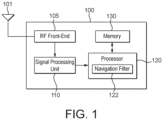
- Fig. 1 is a schematic block diagram of a device according to an example.
- the device comprises a GNSS antenna 101 and a GNSS receiver 100.
- the GNSS antenna 101 is configured to receive GNSS signals. It may be configured to receive GNSS signals from a single GNSS constellation (for example, GPS), or it may be configured to receive GNSS signals from multiple constellations (for example, GPS, Galileo, GLONASS, and/or BeiDou).
- the GNSS receiver 100 comprises an RF front-end 105, a signal processing unit 110, a processor 120, and a memory 130.
- the RF front-end 105 is configured to receive GNSS signals via the GNSS antenna 101, and to output them to the signal processing unit 110.
- the RF front-end 105 is configured to down-convert and digitise the satellite signals received via the antenna 101.
- the RF front-end essentially conditions the signals for subsequent signal processing. Other typical tasks performed by the front-end include filtering and amplification.
- the satellite signals received at the RF front-end 105 via the antenna 101 include at least one ranging signal, such as a GPS L1 C/A signal, for each of a plurality of satellites.
- the signal processing unit 110 is configured to track the received GNSS signals - for example, in frequency, delay (code-phase) and carrier phase - and to produce GNSS measurements from the received GNSS signals.
- the processor 120 is configured to process the GNSS measurements obtained from the signal processing unit 110.
- the processor implements a navigation filter 122 as described for the calculation of the single-epoch position bound in EP 3 859 397 A1 .
- the navigation filter 122 estimates the current value of a state vector of state variables, optionally with their associated uncertainties.
- the state variables estimated by the navigation filter 122 generally include position and time variables, and optionally velocity and other variables.
- the memory 130 is in communication with the processor 120.
- the memory 130 is configured to store software/firmware to be executed by the processor 120.
- the software/firmware is configured to control the processor 120 to carry out a processing method according to an example.
- the memory may also be configured to store data that is used as input to the processor 120 and/or to store data that is output by the processor 120.
- Fig. 2 illustrates a method performed by the processor 120 according to an example.
- the processor 120 obtains a plurality of GNSS measurements from the signal processing unit 110.
- the GNSS measurements are all obtained from the same epoch - that is, they are all made by the signal processing unit 110 at substantially the same time.
- the GNSS measurements include at least carrier phase measurements. In the present example, they also include pseudorange measurements. Each measurement (be it a pseudorange measurement or a carrier phase measurement) relates to a particular GNSS signal transmitted by a particular satellite.
- the plurality of GNSS measurements include pseudorange and carrier phase measurements for L1 and L2 signals of several GPS satellites. Typically, in order to calculate a position and time solution from the GNSS measurements alone, measurements of four signals from four respective satellites are obtained. In general, the measurements may relate to different satellites of the same constellation or, satellites of different constellations.
- the goal of the method of Fig. 2 is to infer state information from the GNSS measurements.
- the state information may comprise the values of state variables, or bounds for those state variables, or both.
- the state information of primary interest is the position of the GNSS receiver and a bound on the position of the GNSS receiver. This position bound is the protection level.
- the processor 120 defines a state vector comprising state variables.
- the state variables include (among others) position variables.
- the state vector also includes state variables corresponding to integer ambiguities associated with respective carrier phase measurements.
- the processor 120 obtains a posterior probability density for the state vector.
- the posterior probability density is based on one or more residual error models describing a probability distribution of errors in each of the GNSS measurements.
- the residual error models include at least one non-Gaussian model.
- the error in each GNSS measurement is modelled separately, as a univariate probability distribution.
- this is not essential.
- some or all of the GNSS measurements may be modelled together in a joint, multivariate probability distribution.
- residual error models tend to assume that errors have a Gaussian distribution. This assumption is often invalid or unreliable, in practice; however, it is chosen because it can allow considerable simplification of the calculations necessary to infer state information.
- some (if not all) of the residual errors are modelled by non-Gaussian distributions. By relaxing the Gaussian assumption, residual error models can be designed that better approximate the true distributions of the errors.
- the residual error models are defined in advance and are stored in the memory 130.
- r is the residual
- ⁇ is a degrees of freedom parameter
- ⁇ is a scaling parameter which defines the width of the core distribution
- ⁇ is the gamma function.
- the residual error model for each carrier phase measurement comprises a probability distribution that is cyclic.
- step 240 the processor 120 searches for the significant modes of the posterior probability density. Then, in step 250, the processor 120 infers state information (in particular, the position and protection level) based on the posterior probability density, using information about the location of the significant modes as determined in step 240.
- state information in particular, the position and protection level
- the inference in step 250 involves numerically integrating the posterior probability density (see step 252).
- the pre-processing to locate the modes of the posterior probability can help to increase the accuracy and computational efficiency of the integration. It can avoid the need, for example, to rely on numerical integration techniques to find and integrate over the relevant modes (which might incur a heavy computational cost, when using stochastic numerical integration methods, and which might miss modes depending on the random samples chosen).
- a variety of integration methods can benefit from knowing the locations of the modes. Suitable methods include: importance sampling, based on the identified set of modes; or an MCMC method, based on the identified set of modes.
- Other relevant integration methods may include the one described in Pompe et al.
- the posterior probability density is approximation of the posterior probability density with a mathematical model which can be integrated analytically, wherein the approximation is based on the identified set of modes.
- the posterior could be approximated by a Gaussian Mixture Model (GMM) with one or more mixture components centred on each of the modes.
- GMM Gaussian Mixture Model
- the search in step 240 involves two stages.
- the first stage transforms the posterior probability density into a mixture model (see step 242).
- This mixture model is made up of a plurality of mixture components, each of which is a multivariate distribution.
- the second stage identifies the set of modes using the mixture model (see step 244).
- step 310 the processor 120 defines a wrapped distribution for each of the carrier phase measurements.
- these wrapped distributions involve an approximation of the cyclic distribution for each carrier phase measurement in the original posterior probability density.
- the original posterior was already based on wrapped distributions for the carrier phase. In such cases, no approximation is necessary - the wrapped distributions in the original posterior can be used to generate the mixture model directly.
- step 320 the domain of the numerical integration is transformed.
- the integration domain for each carrier phase bias state is over a single cycle.
- all of the variables to be integrated can have the same domain - that is, the integration is over the set of real numbers for all variables.
- step 330 the numerical integration over the posterior probability density is recast as an integration over a mixture model.
- the posterior is defined as a product of sums.
- This definition is reformulated as a sum of products.
- Each such product is formed from "linear” (i.e., non-wrapped) distributions.
- each of these "product" distributions is a product of univariate Student-T distributions.
- step 242 The transformation to a mixture model, in step 242, is followed by the step 244 of identifying the set of modes using the mixture model. This will now be described in more detail, with reference to Fig. 4 .
- the processor 120 defines a cost function that will be used to search for the maximum likelihood solution for the state vector.
- the set of modes can then be located in the vicinity of this maximum likelihood solution.
- the cost function is defined, and the maximum likelihood solution found, by relaxing the constraint that the number of cycles in each carrier phase measurement is an integer.
- the cost function is therefore denote the "float cost function". It is defined as a negative log likelihood, based on the form of a single one of the mixture components.
- the processor carries out a local search of the float cost function to find a float-valued state vector associated with a minimum value of the cost function.
- the search aims to find the global minimum, but it is not mathematically guaranteed to find it in every instance. This will depend on the shape of the cost function in each given case. In some cases, the search may (inadvertently) find another local minimum which is not the global minimum.
- the local search involves solving a nonlinear optimisation problem. In the present example, the local search is based on a hybrid between Newton's method and Steepest Descent, as described in Section 2.2 (equation 2.11) of " METHODS FOR NON-LINEAR LEAST SQUARES PROBLEMS" by K. Madsen, H.B. Nielsen, O. Tingleff, 2004 .
- the local search may be initialised in various ways.
- the mixture component underlying the cost function is a product of univariate distributions. To initialise the search, each of these univariate distributions is approximated by a univariate Gaussian.
- the cost function then takes the form of a multivariate quadratic, and the minimum cost solution can be found analytically, to provide a starting coordinates for the search.
- step 430 the processor 120 approximates the float cost function in the vicinity of the found minimum by a multivariate Gaussian distribution. Since the cost function is expressed as a negative log likelihood, this approximation takes the form of a quadratic function.
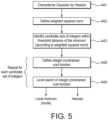
- step 440 the processor 120 identifies the set of modes based on this approximating multivariate Gaussian distribution. This step will now be described in more detail, with reference to Fig. 5 .
- step 441 the processor 120 characterises the approximating Gaussian distribution by its Hessian matrix, which conveniently emerges as a by-product of the local search algorithm. (The covariance matrix could be used, equivalently, since it is the inverse of the Hessian.)
- step 442 the processor 120 defines a weighted squared norm based on the Hessian/covariance matrix.
- step 443 the processor 120 identifies candidate sets of integers that are less than a threshold distance (according to the weighted squared norm) from the local minimum found in step 420. These candidate sets of integers, a, are possible solutions for "fixing" the ambiguities in the carrier phase states to integer values. Each set of integers is associated with a respective mode of the posterior probability density.
- the processor 120 determines the integers does not yet define the location of the mode in state space.
- the processor 120 defines an integer-constrained cost function, in step 448. This corresponds to the float cost function defined earlier in step 410, but with the integer constraint re-applied.
- the processor 120 carries out a local search of the cost function defined in step 448, in order to find the coordinates of the local minimum - in other words, the state vector that characterises the position of the corresponding local peak in the posterior probability density. This is defines the location of the mode in state space.
- the local search 449 is again performed using the hybrid between Newton's method and steepest descent.
- This optimization algorithm again produces as an output a Hessian (or covariance) matrix characterising the curvature of the cost function in the neighbourhood of the local minimum (mode). This is useful as it characterizes the sharpness of the peak in the posterior probability density associated with this particular mode.
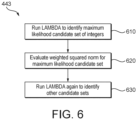
- Steps 448 and 449 are repeated for each candidate set of integers found in step 443. The details of that step will now be described with reference to Fig. 6 .
- the search for candidate sets of integers is based on the LAMBDA algorithm ( Teunissen P, (1995) The least-squares ambiguity decorrelation adjustment: a method for fast GPS integer ambiguity estimation, J Geod 70(1-2):65-82 ).
- the LAMBDA algorithm enforces the integer constraint. It is run once (in step 610) to identify the maximum likelihood candidate set of integers. In step 620, the weighted squared norm (as defined previously in step 442) is evaluated for this maximum likelihood set of integers. A second instance of the LAMBDA algorithm is then run in step 630.
- the algorithm is configured not to search for the single best set of integers, but instead to find all sets of integers whose weighted squared norm differs from that of the best set by less than a search threshold.
- This search threshold is set empirically to ensure liberal detection - that is, to discover all significant modes and to err slightly on the side of finding some additional, less significant modes.
- phase observations There are n linear observations.
- the phase observations are contaminated with an unknown phase bias ⁇ j ; there are m distinct phase biases, and n j phase observations affected by each bias.
- a model h relates states ⁇ and z to the observations, where ⁇ is the state of interest, and z is contains p linear (i.e. non-phase) nuisance states.
- Linear observations are affected by measurement noise ⁇ i , which has a probability density function f i ( x ) with x ⁇ R .
- Phase observations are affected by measurement noise ⁇ jk , which has a probability density function f ⁇ jk ( x ) with x e [0,1].
- the terms h jk ( ⁇ , z ), ⁇ j , and ⁇ jk all represent phases in the range [0, 1], and addition of these terms is taken to be modulo 1.
- the posterior probability distribution on the states can be inferred up to a constant of proportionality S : prob ⁇ , z , ⁇
- y , I ⁇ S prob y
- the linear nuisance states z and the phase nuisance states ⁇ can be marginalised out: prob ⁇
- y , I ⁇ z ⁇ R p ⁇ ⁇ ⁇ 0,1 m prob ⁇ , z , ⁇
- the constant of proportionality S can be inferred from the fact that the integral of prob( ⁇
- y , I ) with respect to ⁇ must equal 1. Then, the objective is to evaluate a credible interval ( L, U ) such that the risk the true value falls outside this interval is ⁇ , and the left and right tails share this risk equally: ⁇ 2 ⁇ ⁇ ⁇ L prob ⁇
- y , I d ⁇ ⁇ U ⁇ prob ⁇
- Equation (1) The major challenge in evaluating the position bound ( L, U ) is that the posterior probability distribution defined in Equation (1) is difficult to numerically integrate. This difficulty comes from several factors:
- the present approach is based on a systematic search to locate important modes, followed by importance sampling to evaluate the integral. Knowledge of the modes can be used to help the importance sampling algorithm move between modes efficiently and effectively.
- Equation (1) The posterior probability distribution presented in Equation (1) is highly multimodal, and it is not obvious where modes lie in the high dimensional state space. Our strategy is to transform this single complicated distribution into a mixture of simpler distributions. Each component in this mixture will generate a mode (or possibly more than one mode) in the posterior, and the task of locating modes in the posterior turns into the easier task of locating the maxima of each mixture component.
- the first stage defines wrapped distributions which can be used in place of the existing phase error distributions; this approximation enables everything that follows.
- the second stage changes the integration domain from R p ⁇ 0,1 m to R p + m ; this is helpful because this is the domain of our mixture components.
- the final stage (see step 320 in Fig. 3 )
- the functions f jk ( x ) are Student-T distributions, as described previously above. This approximation does not need to be particularly accurate, because it will only be used to locate and characterise modes; the actual evaluation of the integral via importance sampling will use the original version.
- a ( ⁇ , z ) and B ( ⁇ , z , ⁇ ) thus:
- Equation (2) becomes prob ⁇
- Each phase bias ⁇ j must have at least one associated observation (i.e., n j ⁇ 1 for all j).
- n j ⁇ 1 for all j.
- Equation (5) is a mixture which contains an infinite number of components, so it is not immediately obvious the transformation is helpful. However, most of the mass of the distribution will typically be contained in a small number of components, and the next task is therefore to identify these significant components.
- Equation (6) Whilst this is a well specified problem, it is computationally expensive to evaluate. Instead, we approximate Equation (6) with a multivariate normal distribution, and use this to identify an approximate feasible set ⁇ ' .
- Equation (7) the gradient term is omitted in Equation (7) because ⁇ * is a local minimum, and hence the gradient of c ( ⁇ ) is zero.
- the cost function is approximated in the vicinity of the minimum ⁇ * by a multivariate Gaussian (step 430). This Gaussian distribution is characterized by the Hessian matrix H (see step 441).
- the weighted squared norm here is the one described above in connection with step 442. In terms of numerical evaluation, this is a problem which is already well explored in the context of integer ambiguity resolution, and efficient algorithms are available (e.g., the LAMBDA algorithm as proposed above in connection with steps 610 and 630 of Fig. 6 ).
- a reasonable search threshold ⁇ 2 can be conveniently selected by identifying the maximum likelihood component (see step 610), evaluating its weighted squared norm (see step 620), and then setting ⁇ 2 at a fixed depth below this.
- this information is then used to support the inference - either supporting numerical integration, or supporting integration by other means.
- nonlinear optimizers other than the hybrid between Newton's method and steepest descent
- suitable alternative nonlinear optimization algorithms include, but are not limited to, the Levenburg-Marquardt algorithm.
- the state vector included position variables, and the state information to be inferred concerned the position estimate and/or position bounds, this is not limiting.
- the state vector might not include position variables and/or the state information to be inferred might concern other state variables.
- the position of the GNSS receiver might be known (or indeed fixed - as may be the case for a terrestrial reference station).
- the ultimate goal of processing the GNSS measurements may be to infer information about other state variables, such as errors in the orbits of the satellites, or errors in the satellite clocks.
- the integer ambiguities in the carrier phase measurements may still give rise to modes in the posterior probability density for the state variable(s) of interest. Therefore, it would be desirable to identify such modes explicitly, for the same reasons that it is desirable when attempting to infer state information relating to position.
- the LAMBDA algorithm was used to find candidate sets of integer ambiguities - that is, to fix the integer ambiguities in the respective carrier phases. This is one convenient, efficient, effective, and widely used algorithm; however, it is not essential to use it.
- Fig. 1 various components illustrated in Fig. 1 may be implemented in hardware, or software, or a mixture of both. Furthermore, some components may be grouped together in a given implementation or may be implemented separately. In the present implementation, block 105 is implemented entirely in hardware, block 110 is implemented partially in hardware, and the remaining components (downstream in the signal processing chain) are implemented in software. In some examples, the navigation filter 122 may be implemented in a separate software module, running on a separate processor from the processor 120. Other implementations are possible, which divide and distribute the various functions differently between hardware and software, or between different hardware components, software modules and/or processors running the software.
- any reference signs placed between parentheses shall not be construed as limiting the claim.
- the word “comprising” does not exclude the presence of elements or steps other than those listed in a claim. However, where the word “comprising” is used, this also discloses as a special case the possibility that the elements or steps listed are exhaustive - that is, the apparatus or method may consist solely of those elements or steps.
- the word “a” or “an” preceding an element does not exclude the presence of a plurality of such elements.
- the embodiments may be implemented by means of hardware comprising several distinct elements. In a device claim enumerating several means, several of these means may be embodied by one and the same item of hardware.
- the various embodiments may be implemented in hardware or special purpose circuits, software, logic or any combination thereof.
- some aspects may be implemented in hardware, while other aspects may be implemented in firmware or software, which may be executed by a controller, microprocessor or other computing device, although these are not limiting examples.
- firmware or software which may be executed by a controller, microprocessor or other computing device, although these are not limiting examples.
- various aspects described herein may be illustrated and described as block diagrams, flow charts, or using some other pictorial representation, it is well understood that these blocks, apparatus, systems, techniques or methods described herein may be implemented in, as non-limiting examples, hardware, software, firmware, special purpose circuits or logic, general purpose hardware or controller or other computing devices, or some combination thereof.
- any blocks of the logic flow as in the Figures may represent program steps, or interconnected logic circuits, blocks and functions, or a combination of program steps and logic circuits, blocks and functions.
- the software may be stored on such physical media as memory chips, or memory blocks implemented within the processor, magnetic media such as hard disk or floppy disks, and optical media such as for example DVD and the data variants thereof, or CD.
- the memory may be of any type suitable to the local technical environment and may be implemented using any suitable data storage technology, such as semiconductor-based memory devices, magnetic memory devices and systems, optical memory devices and systems, fixed memory and removable memory.
- the data processors may be of any type suitable to the local technical environment, and may include one or more of general purpose computers, special purpose computers, microprocessors, digital signal processors (DSPs), application specific integrated circuits (ASIC), gate level circuits and processors based on multi-core processor architecture, as non-limiting examples.
- Embodiments as discussed herein may be practiced in various components such as integrated circuit modules.
- the design of integrated circuits is generally a highly automated process. Complex and powerful software tools are available for converting a logic level design into a semiconductor circuit design ready to be etched and formed on a semiconductor substrate.
Landscapes
- Engineering & Computer Science (AREA)
- Remote Sensing (AREA)
- Radar, Positioning & Navigation (AREA)
- General Physics & Mathematics (AREA)
- Physics & Mathematics (AREA)
- Computer Networks & Wireless Communication (AREA)
- Theoretical Computer Science (AREA)
- Signal Processing (AREA)
- Software Systems (AREA)
- Mathematical Physics (AREA)
- Evolutionary Computation (AREA)
- Data Mining & Analysis (AREA)
- Computational Linguistics (AREA)
- Artificial Intelligence (AREA)
- General Engineering & Computer Science (AREA)
- Computing Systems (AREA)
- Complex Calculations (AREA)
- Position Fixing By Use Of Radio Waves (AREA)
Priority Applications (3)
| Application Number | Priority Date | Filing Date | Title |
|---|---|---|---|
| EP23190360.0A EP4506732A1 (fr) | 2023-08-08 | 2023-08-08 | Traitement de mesure gnss pour identifier des modes |
| US18/796,388 US20250052912A1 (en) | 2023-08-08 | 2024-08-07 | Gnss measurement processing to identify modes |
| CN202411076613.3A CN119471740A (zh) | 2023-08-08 | 2024-08-07 | Gnss测量结果处理以识别模态 |
Applications Claiming Priority (1)
| Application Number | Priority Date | Filing Date | Title |
|---|---|---|---|
| EP23190360.0A EP4506732A1 (fr) | 2023-08-08 | 2023-08-08 | Traitement de mesure gnss pour identifier des modes |
Publications (1)
| Publication Number | Publication Date |
|---|---|
| EP4506732A1 true EP4506732A1 (fr) | 2025-02-12 |
Family
ID=87567718
Family Applications (1)
| Application Number | Title | Priority Date | Filing Date |
|---|---|---|---|
| EP23190360.0A Pending EP4506732A1 (fr) | 2023-08-08 | 2023-08-08 | Traitement de mesure gnss pour identifier des modes |
Country Status (3)
| Country | Link |
|---|---|
| US (1) | US20250052912A1 (fr) |
| EP (1) | EP4506732A1 (fr) |
| CN (1) | CN119471740A (fr) |
Families Citing this family (1)
| Publication number | Priority date | Publication date | Assignee | Title |
|---|---|---|---|---|
| CN120195699B (zh) * | 2025-04-02 | 2026-02-03 | 武汉大学 | 一种基于ppp-rtk的桥梁多模态频率识别方法与系统 |
Citations (1)
| Publication number | Priority date | Publication date | Assignee | Title |
|---|---|---|---|---|
| EP3859397A1 (fr) | 2020-01-31 | 2021-08-04 | u-blox AG | Procédé et appareil de position délimitée d'époque unique |
-
2023
- 2023-08-08 EP EP23190360.0A patent/EP4506732A1/fr active Pending
-
2024
- 2024-08-07 US US18/796,388 patent/US20250052912A1/en active Pending
- 2024-08-07 CN CN202411076613.3A patent/CN119471740A/zh active Pending
Patent Citations (1)
| Publication number | Priority date | Publication date | Assignee | Title |
|---|---|---|---|---|
| EP3859397A1 (fr) | 2020-01-31 | 2021-08-04 | u-blox AG | Procédé et appareil de position délimitée d'époque unique |
Non-Patent Citations (3)
| Title |
|---|
| EMILIA POMPECHRIS HOLMESKRZYSZTOF TATUSZYRÍSKI, A FRAMEWORK FOR ADAPTIVE MCMC TARGETING MULTIMODAL DISTRIBUTIONS, January 2019 (2019-01-01), Retrieved from the Internet <URL:https://arxiv.org/pdf/1812.02609v2)> |
| RUNNALLS ANDREW R ET AL: "Terrain-referenced navigation using the IGMAP data fusion algorithm", PROCEEDINGS OF THE 61ST ANNUAL MEETING OF THE INSTITUTE OF NAVIGATION, 27 June 2005 (2005-06-27), XP093117438 * |
| YUN ET AL: "Carrier Phase-based RAIM using a Gaussian Sum Filter", GNSS 2009 - PROCEEDINGS OF THE 22ND INTERNATIONAL TECHNICAL MEETING OF THE SATELLITE DIVISION OF THE INSTITUTE OF NAVIGATION (ION GNSS 2009), THE INSTITUTE OF NAVIGATION, 8551 RIXLEW LANE SUITE 360 MANASSAS, VA 20109, USA, 25 September 2009 (2009-09-25), pages 1666 - 1674, XP056010612 * |
Also Published As
| Publication number | Publication date |
|---|---|
| CN119471740A (zh) | 2025-02-18 |
| US20250052912A1 (en) | 2025-02-13 |
Similar Documents
| Publication | Publication Date | Title |
|---|---|---|
| US8032301B2 (en) | Computing long term orbit and clock models with variable time-horizons | |
| JP5421903B2 (ja) | 部分探索搬送波位相整数アンビギュイティ決定 | |
| US20160231428A1 (en) | Psuedo maximum likelihood tracking for global navigation satellite systems | |
| US6337657B1 (en) | Methods and apparatuses for reducing errors in the measurement of the coordinates and time offset in satellite positioning system receivers | |
| US8325086B2 (en) | Methods and systems to diminish false-alarm rates in multi-hypothesis signal detection through combinatoric navigation | |
| CN102221699A (zh) | 卫星定位系统的异常值检测装置、检测方法及检测程序 | |
| US20240012163A1 (en) | Gnss measurement processing to identify modes | |
| US20230113888A1 (en) | Methods and systems for estimating an expected accuracy using navigation satellite system observations | |
| US20240012161A1 (en) | Gnss measurement processing and residual error model estimation | |
| US20250052912A1 (en) | Gnss measurement processing to identify modes | |
| CN120153289A (zh) | 用于对卫星定位解完整性定界的系统和方法 | |
| Angrisano et al. | A resampling strategy based on bootstrap to reduce the effect of large blunders in GPS absolute positioning | |
| US12523783B2 (en) | GNSS measurement processing with carrier phase residual error model | |
| EP4119988B1 (fr) | Positionnement gnss avec fixation d'ambiguïtés de plage de porteuse | |
| EP4517386A2 (fr) | Intégration pour traitement de mesure gnss | |
| Yoo et al. | A coarse-time positioning method for improved availability | |
| Zou et al. | Robust estimation‐based multipath detection for vector tracking loop | |
| EP2020607A2 (fr) | Détermination des paramètres spatio-temporels et cinétiques d'un récepteur de signal et son horloge par la fusion d'informations | |
| KR102279946B1 (ko) | Dgnss 유효성 검사에 기반하여 gnss 수신 환경을 판단하는 장치 및 그 방법 | |
| Souza et al. | GPS satellite kinematic relative positioning: analyzing and improving the functional mathematical model using wavelets | |
| EP4538748A1 (fr) | Réglage de seuils de détection de signal | |
| Liu et al. | A LSTM‐RNN‐Assisted Vector Tracking Loop for Signal Outage Bridging | |
| Zheng et al. | Enhanced GNSS-SAR range-doppler algorithm for the target detection of weak reflected signals: an experimental study | |
| Zhou | Parameter optimization and configuration of the CUBE algorithm for shallow water survey | |
| JP2019020338A (ja) | 状態推定装置及びプログラム |
Legal Events
| Date | Code | Title | Description |
|---|---|---|---|
| PUAI | Public reference made under article 153(3) epc to a published international application that has entered the european phase |
Free format text: ORIGINAL CODE: 0009012 |
|
| STAA | Information on the status of an ep patent application or granted ep patent |
Free format text: STATUS: THE APPLICATION HAS BEEN PUBLISHED |
|
| AK | Designated contracting states |
Kind code of ref document: A1 Designated state(s): AL AT BE BG CH CY CZ DE DK EE ES FI FR GB GR HR HU IE IS IT LI LT LU LV MC ME MK MT NL NO PL PT RO RS SE SI SK SM TR |
|
| P01 | Opt-out of the competence of the unified patent court (upc) registered |
Free format text: CASE NUMBER: APP_12883/2025 Effective date: 20250314 |
|
| STAA | Information on the status of an ep patent application or granted ep patent |
Free format text: STATUS: REQUEST FOR EXAMINATION WAS MADE |
|
| 17P | Request for examination filed |
Effective date: 20250805 |