EP4509670A1 - Système de paroi comprenant une paroi préfabriquée et procédé de fabrication d'un système de paroi - Google Patents
Système de paroi comprenant une paroi préfabriquée et procédé de fabrication d'un système de paroi Download PDFInfo
- Publication number
- EP4509670A1 EP4509670A1 EP24194356.2A EP24194356A EP4509670A1 EP 4509670 A1 EP4509670 A1 EP 4509670A1 EP 24194356 A EP24194356 A EP 24194356A EP 4509670 A1 EP4509670 A1 EP 4509670A1
- Authority
- EP
- European Patent Office
- Prior art keywords
- mounting element
- prefabricated wall
- wall
- fastening
- longitudinal axis
- Prior art date
- Legal status (The legal status is an assumption and is not a legal conclusion. Google has not performed a legal analysis and makes no representation as to the accuracy of the status listed.)
- Granted
Links
Images


Classifications
-
- E—FIXED CONSTRUCTIONS
- E04—BUILDING
- E04B—GENERAL BUILDING CONSTRUCTIONS; WALLS, e.g. PARTITIONS; ROOFS; FLOORS; CEILINGS; INSULATION OR OTHER PROTECTION OF BUILDINGS
- E04B1/00—Constructions in general; Structures which are not restricted either to walls, e.g. partitions, or floors or ceilings or roofs
- E04B1/02—Structures consisting primarily of load-supporting, block-shaped, or slab-shaped elements
- E04B1/10—Structures consisting primarily of load-supporting, block-shaped, or slab-shaped elements the elements consisting of wood
-
- F—MECHANICAL ENGINEERING; LIGHTING; HEATING; WEAPONS; BLASTING
- F16—ENGINEERING ELEMENTS AND UNITS; GENERAL MEASURES FOR PRODUCING AND MAINTAINING EFFECTIVE FUNCTIONING OF MACHINES OR INSTALLATIONS; THERMAL INSULATION IN GENERAL
- F16B—DEVICES FOR FASTENING OR SECURING CONSTRUCTIONAL ELEMENTS OR MACHINE PARTS TOGETHER, e.g. NAILS, BOLTS, CIRCLIPS, CLAMPS, CLIPS OR WEDGES; JOINTS OR JOINTING
- F16B5/00—Joining sheets or plates, e.g. panels, to one another or to strips or bars parallel to them
- F16B5/02—Joining sheets or plates, e.g. panels, to one another or to strips or bars parallel to them by means of fastening members using screw-thread
-
- E—FIXED CONSTRUCTIONS
- E04—BUILDING
- E04B—GENERAL BUILDING CONSTRUCTIONS; WALLS, e.g. PARTITIONS; ROOFS; FLOORS; CEILINGS; INSULATION OR OTHER PROTECTION OF BUILDINGS
- E04B1/00—Constructions in general; Structures which are not restricted either to walls, e.g. partitions, or floors or ceilings or roofs
- E04B1/38—Connections for building structures in general
- E04B1/61—Connections for building structures in general of slab-shaped building elements with each other
- E04B2001/6195—Connections for building structures in general of slab-shaped building elements with each other the slabs being connected at an angle, e.g. forming a corner
Definitions
- the present invention relates to a wall system comprising a prefabricated wall.
- the present invention further relates to a method for constructing a wall system.
- Wall systems comprising prefabricated walls are increasingly being used in the construction of houses and wooden structures.
- a prefabricated wall is a wall that is prefabricated in a factory and transported to the construction site as a complete building element. Such prefabricated walls are part of a prefabricated building in which various building elements are pre-produced industrially and then assembled on site to form a building.
- the prefabricated wall can comprise different materials and designs, depending on the specific requirements of the construction project.
- timber frame construction When wood is used, such constructions of houses and prefabricated walls are also referred to as timber frame construction, or also as timber post construction or timber panel construction.
- timber frame construction is the quick construction time.
- Timber frames also referred to below as prefabricated walls, can be prefabricated in a factory and then assembled very quickly on site, which can significantly shorten the construction time of houses.
- Timber frame construction is also light and flexible, which allows a variety of design options and designs, so that it is also relatively easy to build individually designed houses. Since a house built using timber frame construction is also sustainable, energy efficient and cost-effective, the demand for wooden houses built in this way is increasing.
- a horizontal beam also known as an assembly threshold
- shims are used, for example, which are positioned with the help of a spirit level so that the assembly threshold runs horizontally.
- the prefabricated wall is then placed on the assembly threshold and attached to the assembly threshold and/or the floor slab.
- Such known connecting elements and connecting systems for fastening wooden structures such as prefabricated walls or timber frame construction elements therefore have the disadvantage that time-consuming preparatory work is required, that this preparatory work has to be carried out on site, and that the preparatory work is particularly demanding when a large number of prefabricated walls have to be arranged and fastened on a floor slab, in particular a very uneven floor slab.
- the document EP2738401B1 discloses a quick assembly element that allows prefabricated walls to be quickly attached to an installation location. These quick assembly elements are usually embedded in the prefabricated wall at the factory. At the installation site, threaded rods, for example in the form of anchor bolts, are inserted into the subsurface before the prefabricated wall is installed. The prefabricated walls are then lowered at the installation site so that the threaded rods engage in the quick assembly elements and are held in place by them.
- such quick assembly elements have the disadvantage that the quick assembly element and threaded rod can only be connected once, which means that this connection can then no longer be released or can only be released with great effort. Subsequent corrections and adjustments to prefabricated walls attached in this way are therefore no longer possible or can only be made with considerable effort.
- a nut screwed onto a thread is used to adjust the height. It is extremely cumbersome and therefore time-consuming to turn this nut. In addition, the load-bearing capacity of these quick-assembly elements is limited, so that the use of additional quick-assembly elements is necessary to support heavier prefabricated walls.
- the present invention is based on the object of at least reducing these and other disadvantages of the prior art and in particular of specifying a wall system comprising prefabricated walls and a method for creating a wall system comprising prefabricated walls, which allows a simpler and more efficient creation of wall systems comprising prefabricated walls.
- a wall system comprising a prefabricated wall and several fastening devices, wherein the prefabricated wall is connected to an installation location by means of several fastening devices, wherein the prefabricated wall is provided with a recess for each of the fastening devices, wherein each of the fastening devices comprises a mounting element, a fastening element and a locking element, wherein the mounting element has a longitudinal axis and in the direction of the longitudinal axis has a first section and then a second section, wherein the mounting element has an inner bore with an internal thread that runs concentrically to the longitudinal axis, preferably designed as a blind hole, along the first section, and wherein the mounting element has a transverse bore that runs perpendicular to the longitudinal axis in the region of the second section, wherein the fastening element preferably protrudes beyond the installation location, wherein the fastening element comprises an external thread that is screwed into the inner bore, wherein the mounting element is arranged in the associated recess and the
- the object is further achieved in particular with a method for creating a wall system in which a prefabricated wall having a recess is created by attaching a plurality of fastening elements comprising external threads to predetermined Installation locations are anchored in such a way that the external threads, preferably running in a vertical direction, protrude beyond the installation locations, by screwing a mounting element onto the respective external thread by rotating it about its longitudinal axis and, by rotating it, also adjusting each mounting element to a predetermined height, by lowering the prefabricated wall until the mounting elements come to lie at least partially in the corresponding recess, and by inserting a locking element through the transverse bore of the mounting element and at least partially through the prefabricated wall, so that the prefabricated wall is firmly connected to the installation location via the fastening device.
- the prefabricated wall preferably has a prepared hole for receiving the locking element, wherein this hole is arranged in such a way that the inserted locking element runs both through this hole and through the cross hole of the mounting element.
- the diameter of the locking element and the hole are preferably designed to be mutually adapted in such a way that a positive connection is created between the locking element and the prefabricated wall, and preferably also between the locking element and the mounting element.
- the hole for receiving the locking element could also be created on site, preferably after the prefabricated wall has been lowered onto the mounting element.
- the wall system according to the invention has the advantage that all the necessary work steps for the construction of the wall system, including prefabricated walls, for example timber frame walls, or the construction of the prefabricated building at the installation site, are carried out efficiently, cost-effectively and reliably, whereby Corrections can be made.
- prefabricated walls for example timber frame walls
- prefabricated building at the installation site are carried out efficiently, cost-effectively and reliably, whereby Corrections can be made.
- precise positioning and leveling of the prefabricated walls as well as correct anchoring of the same is of central importance.
- fastening elements comprising an external thread are anchored in a substrate in such a way that the external thread protrudes above the substrate.
- the fastening elements with an external thread are designed as a threaded fastening element, comprising at least one threaded rod.
- the threaded fastening element can, for example, be designed as a pure threaded rod, or also as a screw, as a threaded anchor or as a threaded dowel.
- the threaded fastening element could, for example, also be designed as a combination of flange and threaded rod, in that the threaded rod is firmly connected to the flange and the flange can be firmly attached to the substrate with the aid of anchoring means such as screws.
- Such a fastening element with an external thread is anchored firmly and immovably in the substrate, so that the external thread is fixed in the substrate in a rotationally fixed manner, i.e. no longer rotatable, after the fastening element has been anchored.
- the fastening element can be firmly attached to the installation location, for example concrete or wood, using various anchoring techniques, such as epoxy resin, injection mortar, special mortar, dowels, direct pouring or mechanical anchoring systems, so that the fastening element is anchored in the installation location in a rotationally fixed and immovable manner.
- the fastening element is preferably designed as just a threaded rod, particularly preferably with a continuous external thread.
- the external thread protruding above the substrate, or the threaded rod of the fastening element protruding above the substrate, preferably runs vertically Direction.
- the external threads of all anchored fastening elements run in a vertical direction.
- Such fastening elements are very easy to position and fasten to the substrate.
- Mounting elements are then screwed onto the protruding external threads.
- the mounting elements advantageously comprise an at least partially cylindrical outer contour, preferably with a diameter such that the mounting element fits well in the hand and can therefore be turned very comfortably with the fingers or by hand.
- the absolute height of each mounting element, or the distance between the surface of the installation location and the mounting element, can be individually adjusted by rotating the mounting element accordingly about its longitudinal axis, with the mounting elements preferably serving as a support for the prefabricated wall, so that the height adjustment of the individual mounting elements ultimately adjusts the height or leveling of the entire prefabricated wall.
- the prefabricated wall can be lowered, with the prefabricated wall having recesses on its lower edge to at least partially accommodate the mounting elements.
- the prefabricated wall is preferably lowered until it rests on the assembly elements and is supported by them. After this step, it can be checked again whether all assembly elements are in the desired position. Otherwise, the prefabricated wall could be raised again and the height of the assembly element corrected by turning it accordingly.
- the prefabricated wall rests satisfactorily on the assembly elements, their mutual connection is secured by inserting locking elements, preferably in the form of dowel rods.
- the prefabricated wall is secured in particular against lifting, in particular vertical displacement upwards, and, by absorbing compressive forces, preferably also against vertical displacement downwards.
- the height of the prefabricated wall can be corrected again even in this state by removing the locking elements again, raising the prefabricated wall again, and correcting its height by turning the corresponding assembly elements. The prefabricated wall is then lowered again and the locking element is reinserted.
- the wall system according to the invention therefore has the advantage that a correction or subsequent adjustment of the height setting is easily possible.
- the wall system according to the invention also has the advantage that a previously mounted assembly threshold on which the prefabricated wall could subsequently be built can be dispensed with, since the wall system according to the invention allows height adjustment and any corrections to the height setting or the inclination relative to the horizontal in a simple manner.
- the omission of an assembly threshold reduces construction costs and also allows better anchoring of the prefabricated walls.
- the cross hole of the assembly element, the diameter of the locking element and the hole in the prefabricated wall for receiving the locking element or the diameter of the locking channel are designed to be mutually adapted in such a way that the prefabricated wall is connected to the locking element via the locking channel in a form-fitting manner, or essentially without play, or preferably at least without play in the vertical direction.
- the mounting element is preferably designed to transmit larger forces acting between the prefabricated wall and the fastening element. Forces, wherein the mounting element has a first longitudinal section which can be screwed onto the external thread, wherein the first longitudinal section has a wall thickness dimensioned accordingly for the transmission of the forces, and wherein the mounting element has a second longitudinal section which has a transverse bore for receiving the locking element, and which is also dimensioned or designed accordingly for the transmission of the acting forces.
- the mounting element has a protruding support part at one end, at the end opposite the cross hole, which is preferably designed like a flange, with the prefabricated wall preferably resting on this support part at least during assembly.
- This design of the mounting element also has the advantage that the assembled prefabricated wall can also have very low heights or a very small distance from the subsurface.
- the mounting element is preferably made in one piece and preferably consists of metal or a fiber-reinforced plastic.
- the mounting element has a coupling point or a tool engagement point to which a measuring device, e.g. a prism, can be attached in order to measure the height of the mounting element using a tachymeter, for example, in order to then set the desired height of the mounting element.
- a measuring device e.g. a prism
- the height can be set manually or automatically using a corresponding drive of the mounting element.
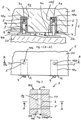
- FIGS 1 to 3 show an embodiment of a wall system 1 according to the invention comprising a prefabricated wall 10 and a plurality of fastening devices 2, wherein each of the Fastening devices 2 comprise a mounting element 3, a fastening element 4 and a locking element 5.
- Figure 1 shows a longitudinal section through the wall system 1 along the section line AA according to Figure 3 , whereby the fastening element 4 is not shown as cut.
- the prefabricated wall 10 is supported and held by two fastening devices 2.
- additional fastening devices 2 could also be arranged to support the prefabricated wall 10.
- several prefabricated walls 10 could also be arranged and supported by fastening devices 2.
- Each of the fastening elements 4 shown is firmly, preferably torsionally, connected to the installation location 20, for example a concrete slab, via a first fastening section 4b.
- the connection between the fastening element 4 or the first fastening section 4b and the installation location 20 is not shown in detail and could, for example, be made by means of a screw connection or by means of an adhesive connection.
- the fastening element 4 comprises a second fastening section 4c having an external thread 4a.
- the second fastening section 4c runs vertically upwards.
- the mounting element 3 comprises an inner bore 3d with an inner thread 3e adapted to the external thread 4a, so that the mounting element 3 can be screwed onto the external thread 4a by rotating it about its longitudinal axis and can thus be fastened to the fastening element 4.
- the distance between the first fastening section 4b and the mounting element 3 is also changed, or the penetration depth of the second fastening section 4c into the inner bore 3d is changed, so that by rotating the mounting element 3 about its longitudinal axis, the distance of the mounting element 3 with respect to the first fastening section 4b or the distance between the mounting element 3 and the surface of the installation location 20.
- the surface of the installation location 20 may be uneven, wherein the mounting elements 3 are preferably as in Figure 1 shown in such a way that both mounting elements 3 have the same absolute height in the horizontal direction, and thereby form, for example, a preferably horizontally running stop for a lower edge 10e of the prefabricated wall 10, so that the lower edge 10e of the prefabricated wall 10 runs horizontally.
- Such an adjustment of the height of the individual mounting elements 3 is also referred to as so-called leveling, because this adjusts the height as well as the course of the prefabricated wall 10 with respect to the horizontal.
- the fastening elements 4 are connected to the installation location in preparatory process steps, and in a subsequent step the assembly elements 3 are screwed onto the respective fastening elements 4 and adjusted to a predetermined height by turning accordingly.
- the prefabricated wall 10 has prepared recesses 10a for receiving one mounting element 3 each, wherein the mounting location of the fastening devices 2 and the positioning of the recess 10a in the wall 10 are arranged so as to be mutually adapted that the prefabricated wall 10 can be lowered after the height of the individual mounting elements 3 has been adjusted, and one mounting element 3 comes to lie in each associated recess 10a, so that the prefabricated wall 10 is supported by the mounting elements 3 after lowering.
- holes 20a for the fastening elements 4 are created based on a predetermined or calculated drilling plan at the installation location 20, whereby these Holes for the fastening elements 4 are positioned and drilled manually or preferably automatically at the installation location 20, and wherein the height H of the individual mounting elements 3 is preferably adjusted based on a height plan, either manually or preferably automatically via a drive device acting on the mounting element 3, which rotates the mounting element 3 accordingly.
- each mounting element 3 comprises a flange-shaped protruding support part 3i with a support surface 3k, whereby these support parts 3i can support the prefabricated wall 10 via its lower edge 10e resting on the support part 3i.
- the prefabricated wall 10 is only supported by the support parts 3i after it has been lowered.
- the recess 10a can also be designed in such a way that it forms a second support surface 10f at the base, so that after the prefabricated wall 10 has been lowered, the upper end faces 3a of the mounting elements 3 rest on the second support surface 10f and thereby support the prefabricated wall 10.
- the prefabricated wall 10 is therefore preferably supported either mostly or completely via the support parts 3i, mostly or completely via the upper end face 3a or via a combination of support parts 3i and upper end faces 3a.
- a locking element 5 running through the assembly element 3 and the prefabricated wall 10 is then introduced in order to secure the prefabricated wall 10 in particular against lifting off the assembly element 3, or to connect the prefabricated wall 10 to the installation location 20 using the fastening device 2.
- the locking element 5 can also, if advantageous, be arranged and connected to the prefabricated wall 10 in such a way that this the prefabricated wall 10 is at least partially or even completely supported, and thus absorbs the downward pressure forces exerted by the prefabricated wall 10. If the prefabricated wall 10 is completely supported by the locking elements 5, this means that the prefabricated wall 10 no longer rests in a load-bearing manner on the upper end face 3a or no longer on the support surface 3k.
- Figure 2 shows a side view of the wall system 1 according to Figure 1 , whereby the fastening elements 4 are only partially shown.
- Figure 2 shows in dashed lines the recesses 10a prefabricated in the prefabricated wall 10 in which the mounting element 3 is arranged, whereby only the support part 3i of the mounting element 3 is shown.
- the prefabricated wall 10 comprises an associated locking channel 10b for each recess 10a, through which the locking element 5 runs or can be inserted.
- the locking element 5 is preferably rod-shaped, for example designed as a rod dowel.
- the mounting element 3 has a transverse bore 3g provided for receiving the locking element 5.
- Figure 3 shows a section through the wall system along the section line BB according to Figure 2 , whereby the mounting element 3 and the locking element 5 are not shown in section.
- the prefabricated wall 10 is clearly connected to the mounting element 3 by means of the rod-shaped locking element 5, which runs through the locking channel 10b and the transverse bore 3g of the mounting element 3.
- the locking channels 10b are already created during the manufacture of the prefabricated wall 10.
- the locking channels 10b are preferably arranged in such a way that when the prefabricated wall 10 is lowered onto the mounting elements 3 and rests on them, the transverse bore 3g of the respective mounting element 3 is aligned with the associated locking channel 10b, so that the locking element 5 can be easily inserted into the prefabricated wall 10 and the transverse bore 3g, and the locking element 5 after its insertion in Figure 3 shown position, and the prefabricated wall is thus securely connected to the installation location 20 via the fastening device 2.
- the locking channel 10b could also be created after the prefabricated wall 10 has been placed on the mounting element 3.
- the position of the cross hole 3g can be determined as shown in Figure 2 As can be seen, starting from the support part 3i, it can be easily determined and, for example, marked on the outer surface of the prefabricated wall 10, and then the locking channel 10b can be drilled into the prefabricated wall 10.
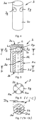
- the Figures 4 to 7 show various views of a further embodiment of a mounting element 3.
- the mounting element 3 is cylindrical, has a longitudinal axis L, and also has an upper end face 3a, a lower end face 3b, a side surface 3c and a transverse bore 3g.
- a prefabricated wall 10 rests only on the upper end faces 3a of the mounting elements 3 after it has been lowered.
- the mounting element 3 has a first section L1 in the direction of the longitudinal axis L and then a second section L2.
- the mounting element 3 has an inner bore 3d, which runs concentrically to the longitudinal axis L and is designed as a blind hole and has an internal thread 3e, along the first section L1, the first section L1 having an outer wall 3h along the blind hole.
- the mounting element 3 has a transverse bore 3g running perpendicular to the longitudinal axis L in the region of the second section L2.
- Figure 6 shows a cross section through Figure 5 along the section line CC.
- the mounting element 3 has two transverse bores 3g that run perpendicular to one another or are offset by 90 degrees in the circumferential direction.
- the mounting element 3 could also have just a single transverse bore 3g, or for example also have further, e.g.
- FIG. 7 shows along the section line DD according to Figure 5 a cross-section through the first section L1 of the mounting element 3, with inner bore 3d and side wall 3h.
- the fastening device 2 and in particular the assembly element 3 are therefore preferably designed in such a way that such forces can be transferred without damaging the assembly element 3.
- the first section L1 essentially serves to transfer forces between the assembly element 3 and the second fastening section 4c designed as a threaded rod.
- the second section L2 serves, among other things, to transfer forces between the locking element 5 held in the transverse bore 3g and the assembly element 3.
- the locking element 5 in all embodiments, preferably designed as a rod dowel, has a length in Range of 4 to 10 times the outer diameter D2 of the mounting element 3.
- This locking element 5, which may be relatively long, can exert considerable forces, in particular a considerable torque, on the mounting element 3.
- a mechanically robust mounting element 3 can be, for example, as shown in the Figures 3 to 7 shown, in that the mounting element 3 is made from a cylindrical solid body, in which the inner bore 3d designed as a blind bore and the one or two transverse bores 3g are let.
- the outer diameter D2 of the mounting element 3 is at least twice as large as the inner diameter D1 of the inner bore 3d, in order to thereby achieve a sufficient thickness of the side wall 3h in order to reliably transmit forces from the mounting element 3 to the second fastening section 4c of the fastening element 4.
- the inner diameter D1 is in a range between 6 and 12 mm, preferably between 8 and 10 mm.
- the inner bore 3d does not open into the transverse bore 3g but is as in Figure 5 shown as a blind hole, which is why the second section L2 is not weakened by the inner bore 3d.
- the mounting element 3 has a continuous transverse bore 3g, whereby at least the bottom side 3o of the transverse bore 3g directed downwards runs along its entire length as a continuous line or surface, i.e. is designed without interruption.
- the bottom side 3o thus runs continuously in a straight line from the inlet opening of the transverse bore 3g to its outlet opening of the transverse bore 3g, as in Figure 5
- This embodiment has the advantage that a locking element 5 running through the transverse bore 3g can preferably rest along the entire length of the underside 3o on the mounting element 3.
- This embodiment has the advantage that the locking element 5 can bear a large load without the locking element and/or the mounting element 3, particularly in the area of the transverse bore 3g, is deformed or damaged.
- the upper side 3p of the transverse bore 3g which is directed upwards, is also designed as a continuous line or surface along its entire length, i.e. without interruption.
- the upper side 3p thus runs continuously in a straight line from the inlet opening of the transverse bore 3g to the outlet opening of the transverse bore 3g, as in Figure 5
- This embodiment has the advantage that a locking element 5 running through the transverse bore 3g can preferably rest against the mounting element 3 along the entire length of the upper side 3p when an upwardly directed force acts on the prefabricated wall 10.
- This embodiment has the advantage that the locking element 5 can transmit large forces to the mounting element 3 without the locking element and/or the mounting element 3 being deformed or damaged, particularly in the area of the transverse bore 3g.
- the distance between the end of the blind hole and the transverse bore 3g is at least a quarter of the inner diameter D1.
- the diameter of the transverse bore 3g is preferably selected such that the sum of all connection points 3m forms at least a quarter of the total area defined by the outer diameter D2. This ensures that the expected forces introduced by the locking element 5 via the transverse bore 3g cause no or only minor damage to the first section L1.
- the inner bore 3d could also extend into the transverse bore 3g, so that the inner bore is not designed as a blind hole and the inner bore 3d is thus connected to the transverse bore 3g.
- this embodiment has the disadvantage that the underside 3o the transverse bore 3g has an opening or an interruption caused by the inner bore 3d, which weakens the load-bearing capacity of the underside 3o or the overall stability of the second partial section L2.
- this fastening section 4c could at least partially protrude into the interior of the transverse bore 3g, thereby hindering the introduction of the locking element 5 into the transverse bore 3g.
- the mounting element 3 in order to insert the locking element 5 into the prefabricated wall 10 lowered onto the mounting elements 3, the mounting element 3 must be arranged in such a way that the openings of the transverse bore 3g are aligned with the respective wall outer surface 10d, so that in combination with the existing or still to be formed locking channel 10b a continuous opening for inserting the locking element 5 is created.
- the embodiment of the mounting element shown with two transverse bores 3g arranged offset by 90 degrees in the circumferential direction has the advantage that only a quarter turn of the mounting element 3 is required in order to realign the transverse bore 3g in such a way that the transverse bore 3g is aligned with the respective outer wall surface 10d when the prefabricated wall 10 is lowered. Due to the threads 3e, 4a, the height of the mounting element 3 is changed with respect to the fastening element 4 when the mounting element 3 is turned, whereby the existing thread pitch of the threads 3e, 4a ultimately determines the change in height when turning.
- the thread pitch is preferably selected such that a rotation of 360° results in a change in height in the range of 0.5 mm to 2 mm, preferably 0.8 mm.
- the Figures 4 to 7 The embodiment of a mounting element 3 shown has the advantage that the height or the mutual position of the mounting element with respect to the fastening element 4 is very precise and can be adjusted in small steps, ie the smallest step is a rotation of the mounting element 3 by 90°, which preferably corresponds to a height change of 0.2 mm. The height or the distance of the mounting element 3 from the surface of the installation location 20 can thus be adjusted very precisely.
- the mounting element 3 could also have only a single transverse bore 3g, so that for the smallest step of the height adjustment a rotation of the mounting element 3 by 180° would be necessary.
- Figure 8 shows in a perspective view the preferred, also in Figure 1 Mounting element 3 shown.
- the mounting element 3 has Figure 8
- a flange-like protruding support part 3i forms a support surface 3k.
- the support part 3i forms one end of the mounting element 3 in the direction of the longitudinal axis L.
- the support part 3i is preferably circular in the circumferential direction and concentric to the longitudinal axis L, but could also be arranged eccentrically to the longitudinal axis L and/or could have any shape in the circumferential direction, for example rectangular or square, in order to form a larger or better adapted support surface 3k for the prefabricated wall 10.
- the support part 3i can be designed as a separate part which is firmly connected to the rest of the mounting element 3.
- the mounting element 3 comprising the support part 3i is particularly advantageously designed in one piece or in one piece, for example by manufacturing it from a single base body.
- the Figures 8 and 9 The embodiment of the mounting element 3 shown has the advantage that the The forces of the prefabricated wall 10 acting on the support surface 10c can be easily transferred to the second fastening section 4c via the threads 3e and 4a.
- Figures 8 and 9 The embodiment of the mounting element 3 shown has the further advantage that the minimum height H, i.e.
- the minimum distance of the lower edge 10e of the prefabricated wall 10 with respect to the surface of the installation location 20 can be set very small and essentially corresponds to the vertical thickness of the support part 3i. With the help of the mounting element 3, the height H can therefore be set or varied within a relatively large range.
- FIG 9 shows the mounting element 3 according to Figure 8 connected to a fastening element 4 which is anchored in a bore 20a in the installation location 20.
- the fastening element 4 has a first fastening section 4b (not shown in detail) and a second fastening section 4c.
- the fastening element 4 is designed, for example, as an anchor screw, a bolt anchor or a concrete screw, each comprising an external thread 4a.
- the fastening element is fastened to the fastening section 4b, e.g. to the anchor of the anchor screw, in the bore 20a, preferably fastened non-rotatably, the fastening element 4, and in particular the second fastening section 4c, preferably running in a vertical direction as shown.
- the fastening element 4 is preferably designed as a threaded rod having an external thread 4a in the second fastening section 4c.
- the entire fastening element 4 is particularly advantageously designed, for example, as an anchor screw, bolt anchor or concrete screw.
- the mounting element 3 is screwed onto the external thread 4a by rotating it about its longitudinal axis L in the direction of rotation U with its internal thread 3e, wherein the penetration depth of the fastening element 4 into the mounting element 3 can be adjusted by rotating the mounting element 3 accordingly in the direction of rotation U.
- the mounting element 3 is arranged such that the support surface 3k has a predetermined distance H with respect to the surface of the installation location 20.
- the Figure 9 The lower edge 10e of the prefabricated wall 10, indicated by dashed lines, rests on the support surface 3k via a bearing surface 10c, so that the prefabricated wall 10 connected to the mounting element 3 ultimately has a distance H with respect to the surface of the installation location 20.
- Figure 10 shows a further embodiment of a mounting element 3 with an upper end face 3a, a lower end face 3b, an inner bore 3d or bore opening 3f, a side surface 3c and a transverse bore 3g.
- the mounting element 3 shown has a single transverse bore 3g, but could advantageously, as already described, also have several transverse bores 3g arranged offset in the circumferential direction.
- the section between the transverse bore 3g and the upper end face 3a is longer and advantageously has a tool engagement 3l to which a correspondingly adapted tool can be applied, for example in order to rotate the mounting element 3 safely and reproducibly in the circumferential direction U.
- the tool engagement 3l is connected to a leveling device which adjusts the mounting element 3 to a predetermined height H by rotating it in the circumferential direction U.
- Figure 11 shows a further embodiment of a mounting element 3, the side surface 3c of which is designed to be frustoconical. Otherwise, the mounting element 3 is designed similarly to Figure 10 , namely comprising an upper end face 3a, a lower end face 3b, an inner bore 3d, a transverse bore 3g and a support part 3i.
- the support surface 3k and/or the upper end face 3a and/or the side surface 3c can serve as a surface for supporting or carrying the prefabricated wall 10.
- Figure 12 shows a top view, partially in section, of another embodiment of a mounting element 3.
- the mounting element 3 is cut along the first section L1 and has a square shape with corresponding mutually perpendicular side surfaces 3c and an inner bore 3d running perpendicular to the viewing plane.
- the support part 3i is rectangular and can also have protruding elements 3n, which are designed as guide elements or as teeth, for example, in order to engage with a lower edge 10e of a prefabricated wall 10.
- the outer contour of the mounting element 3, apart from the support part 3i that may be present, can generally be designed in a variety of shapes, for example polygonal, for example triangular, quadrangular, hexagonal or octagonal, with the side lengths preferably being the same length.
- the outer contour could also be designed to be rounded, for example elliptical, or a hybrid of square and round.
- the outer contour of the support part 3i can be designed in a variety of shapes to form a support surface 3k, for example polygonal, for example triangular, quadrangular, hexagonal or octagonal, with the side lengths preferably being the same length.
- the outer contour could also be designed to be rounded, or a hybrid of square and round.
Landscapes
- Engineering & Computer Science (AREA)
- General Engineering & Computer Science (AREA)
- Architecture (AREA)
- Mechanical Engineering (AREA)
- Life Sciences & Earth Sciences (AREA)
- Wood Science & Technology (AREA)
- Physics & Mathematics (AREA)
- Electromagnetism (AREA)
- Civil Engineering (AREA)
- Structural Engineering (AREA)
- Finishing Walls (AREA)
- Conveying And Assembling Of Building Elements In Situ (AREA)
Applications Claiming Priority (1)
| Application Number | Priority Date | Filing Date | Title |
|---|---|---|---|
| EP23191445.8A EP4509669A1 (fr) | 2023-08-15 | 2023-08-15 | Système de paroi comprenant une paroi préfabriquée et procédé de fabrication d'un système de paroi |
Publications (3)
| Publication Number | Publication Date |
|---|---|
| EP4509670A1 true EP4509670A1 (fr) | 2025-02-19 |
| EP4509670B1 EP4509670B1 (fr) | 2025-06-25 |
| EP4509670C0 EP4509670C0 (fr) | 2025-06-25 |
Family
ID=87575889
Family Applications (2)
| Application Number | Title | Priority Date | Filing Date |
|---|---|---|---|
| EP23191445.8A Withdrawn EP4509669A1 (fr) | 2023-08-15 | 2023-08-15 | Système de paroi comprenant une paroi préfabriquée et procédé de fabrication d'un système de paroi |
| EP24194356.2A Active EP4509670B1 (fr) | 2023-08-15 | 2024-08-13 | Système de paroi comprenant une paroi préfabriquée et procédé de fabrication d'un système de paroi |
Family Applications Before (1)
| Application Number | Title | Priority Date | Filing Date |
|---|---|---|---|
| EP23191445.8A Withdrawn EP4509669A1 (fr) | 2023-08-15 | 2023-08-15 | Système de paroi comprenant une paroi préfabriquée et procédé de fabrication d'un système de paroi |
Country Status (1)
| Country | Link |
|---|---|
| EP (2) | EP4509669A1 (fr) |
Cited By (1)
| Publication number | Priority date | Publication date | Assignee | Title |
|---|---|---|---|---|
| CN120119716A (zh) * | 2025-05-13 | 2025-06-10 | 浙江中南建设集团有限公司 | 一种基于bim技术的装配式建筑及施工方法 |
Citations (4)
| Publication number | Priority date | Publication date | Assignee | Title |
|---|---|---|---|---|
| DE1818597U (de) * | 1960-06-02 | 1960-09-22 | Alfred Dr Neff | Schraubverbindung. |
| DE20220778U1 (de) * | 2002-11-06 | 2004-04-01 | Wortmann, Bernhard, Dipl.-Ing. | Vorrichtung zur Schnellfestsetzung einer Zugstange oder von Elementen an einer Zugstange |
| US7594367B2 (en) * | 2003-02-26 | 2009-09-29 | Pointblank Design Inc. | Connection structure for a log wall |
| EP2738401B1 (fr) | 2012-11-29 | 2016-08-10 | Hubert Fritz | Élément de montage rapide |
-
2023
- 2023-08-15 EP EP23191445.8A patent/EP4509669A1/fr not_active Withdrawn
-
2024
- 2024-08-13 EP EP24194356.2A patent/EP4509670B1/fr active Active
Patent Citations (4)
| Publication number | Priority date | Publication date | Assignee | Title |
|---|---|---|---|---|
| DE1818597U (de) * | 1960-06-02 | 1960-09-22 | Alfred Dr Neff | Schraubverbindung. |
| DE20220778U1 (de) * | 2002-11-06 | 2004-04-01 | Wortmann, Bernhard, Dipl.-Ing. | Vorrichtung zur Schnellfestsetzung einer Zugstange oder von Elementen an einer Zugstange |
| US7594367B2 (en) * | 2003-02-26 | 2009-09-29 | Pointblank Design Inc. | Connection structure for a log wall |
| EP2738401B1 (fr) | 2012-11-29 | 2016-08-10 | Hubert Fritz | Élément de montage rapide |
Cited By (1)
| Publication number | Priority date | Publication date | Assignee | Title |
|---|---|---|---|---|
| CN120119716A (zh) * | 2025-05-13 | 2025-06-10 | 浙江中南建设集团有限公司 | 一种基于bim技术的装配式建筑及施工方法 |
Also Published As
| Publication number | Publication date |
|---|---|
| EP4509670B1 (fr) | 2025-06-25 |
| EP4509669A1 (fr) | 2025-02-19 |
| EP4509670C0 (fr) | 2025-06-25 |
Similar Documents
| Publication | Publication Date | Title |
|---|---|---|
| EP2171179B1 (fr) | Fondation forée | |
| DE69803766T2 (de) | Bausystem mit individuellen bauelementen | |
| EP3559484B1 (fr) | Système d'assemblage ou de blindage de composants | |
| EP1574624B1 (fr) | Dispositif d'ancrage dans le sol pour supporter du bois équarri | |
| DE69928053T2 (de) | Methode zum Stellen von Transportbeton und Schalungseinheit, die in dieser Methode benutzt wird | |
| EP2875193A1 (fr) | Montage d'un coffrage de mur et système d'ancrage à élément de dimension modulaire | |
| WO2011123873A2 (fr) | Élément de connexion pour des éléments préfabriqués | |
| EP4509670B1 (fr) | Système de paroi comprenant une paroi préfabriquée et procédé de fabrication d'un système de paroi | |
| EP2481858A1 (fr) | Procédé de fixation d'un élément d'ancrage sur une partie de construction et application du procédé | |
| DE102012211638A1 (de) | Verankerungssystem | |
| DE10007450A1 (de) | Montageträgersystem sowie Verfahren zur Befestigung eines Fertigbauteils an einem Gebäudeteil unter Verwendung des Montageträgersystems | |
| DE19537000C1 (de) | Verfahren zur einstellbaren Befestigung von Latten, Profilschienen, Platten oder dergleichen an einem festen Untergrund und Befestigungselement zur Durchführung des Verfahrens | |
| AT525254B1 (de) | Verankerung eines Bauwerkteils an einem ortsfesten Untergrund | |
| EP0918910A1 (fr) | Element de type plaque portante en bois pour constructions de planchers ou de ponts et utilisation d'une vis pour assembler des planches pour former un element de type plaque | |
| DE1683121B2 (de) | Spindeltreppe | |
| DE4227975C2 (de) | Verfahren zur Verankerung zweier zueinander paralleler Platten | |
| EP4301991B1 (fr) | Procédé et système de nivellement d'un élément de fixation à ancrer dans un sous sol | |
| EP4431256B1 (fr) | Cheville et élément préfabriqué en béton doté d'une telle cheville | |
| DE10258435B4 (de) | Verankerungselement | |
| DE3200262A1 (de) | Verankerungseinrichtung fuer ein traggeruest einer aussenwand oder einer tragenden zwischenwand eines aus vorgefertigten teilen bestehenden montierbaren gebaeudes | |
| EP0686736B1 (fr) | Procédé et dispositif pour le fixage des soutiens aux faces latérales des plaques en béton ou disques en béton | |
| DE10161426A1 (de) | Verankerung für verspannte Konstruktionen | |
| EP1631727A1 (fr) | Systeme d'elements de construction assembles | |
| EP4541979A1 (fr) | Système de montage d'un balcon sur un bâtiment, et méthode de montage | |
| DE2309723C3 (de) | Verfahren und Vorrichtung zur Justierung von Fertigteilwänden und -stützen von Gebäuden |
Legal Events
| Date | Code | Title | Description |
|---|---|---|---|
| PUAI | Public reference made under article 153(3) epc to a published international application that has entered the european phase |
Free format text: ORIGINAL CODE: 0009012 |
|
| STAA | Information on the status of an ep patent application or granted ep patent |
Free format text: STATUS: THE APPLICATION HAS BEEN PUBLISHED |
|
| AK | Designated contracting states |
Kind code of ref document: A1 Designated state(s): AL AT BE BG CH CY CZ DE DK EE ES FI FR GB GR HR HU IE IS IT LI LT LU LV MC ME MK MT NL NO PL PT RO RS SE SI SK SM TR |
|
| STAA | Information on the status of an ep patent application or granted ep patent |
Free format text: STATUS: REQUEST FOR EXAMINATION WAS MADE |
|
| GRAP | Despatch of communication of intention to grant a patent |
Free format text: ORIGINAL CODE: EPIDOSNIGR1 |
|
| STAA | Information on the status of an ep patent application or granted ep patent |
Free format text: STATUS: GRANT OF PATENT IS INTENDED |
|
| 17P | Request for examination filed |
Effective date: 20250305 |
|
| GRAS | Grant fee paid |
Free format text: ORIGINAL CODE: EPIDOSNIGR3 |
|
| INTG | Intention to grant announced |
Effective date: 20250408 |
|
| GRAA | (expected) grant |
Free format text: ORIGINAL CODE: 0009210 |
|
| STAA | Information on the status of an ep patent application or granted ep patent |
Free format text: STATUS: THE PATENT HAS BEEN GRANTED |
|
| AK | Designated contracting states |
Kind code of ref document: B1 Designated state(s): AL AT BE BG CH CY CZ DE DK EE ES FI FR GB GR HR HU IE IS IT LI LT LU LV MC ME MK MT NL NO PL PT RO RS SE SI SK SM TR |
|
| REG | Reference to a national code |
Ref country code: GB Ref legal event code: FG4D Free format text: NOT ENGLISH |
|
| REG | Reference to a national code |
Ref country code: CH Ref legal event code: EP |
|
| REG | Reference to a national code |
Ref country code: CH Ref legal event code: EP |
|
| REG | Reference to a national code |
Ref country code: IE Ref legal event code: FG4D Free format text: LANGUAGE OF EP DOCUMENT: GERMAN |
|
| REG | Reference to a national code |
Ref country code: DE Ref legal event code: R096 Ref document number: 502024000084 Country of ref document: DE |
|
| U01 | Request for unitary effect filed |
Effective date: 20250710 |
|
| U07 | Unitary effect registered |
Designated state(s): AT BE BG DE DK EE FI FR IT LT LU LV MT NL PT RO SE SI Effective date: 20250725 |
|
| U20 | Renewal fee for the european patent with unitary effect paid |
Year of fee payment: 2 Effective date: 20250828 |
|
| PG25 | Lapsed in a contracting state [announced via postgrant information from national office to epo] |
Ref country code: NO Free format text: LAPSE BECAUSE OF FAILURE TO SUBMIT A TRANSLATION OF THE DESCRIPTION OR TO PAY THE FEE WITHIN THE PRESCRIBED TIME-LIMIT Effective date: 20250925 Ref country code: GR Free format text: LAPSE BECAUSE OF FAILURE TO SUBMIT A TRANSLATION OF THE DESCRIPTION OR TO PAY THE FEE WITHIN THE PRESCRIBED TIME-LIMIT Effective date: 20250926 |
|
| PG25 | Lapsed in a contracting state [announced via postgrant information from national office to epo] |
Ref country code: HR Free format text: LAPSE BECAUSE OF FAILURE TO SUBMIT A TRANSLATION OF THE DESCRIPTION OR TO PAY THE FEE WITHIN THE PRESCRIBED TIME-LIMIT Effective date: 20250625 |
|
| PG25 | Lapsed in a contracting state [announced via postgrant information from national office to epo] |
Ref country code: RS Free format text: LAPSE BECAUSE OF FAILURE TO SUBMIT A TRANSLATION OF THE DESCRIPTION OR TO PAY THE FEE WITHIN THE PRESCRIBED TIME-LIMIT Effective date: 20250925 |
|
| PG25 | Lapsed in a contracting state [announced via postgrant information from national office to epo] |
Ref country code: IS Free format text: LAPSE BECAUSE OF FAILURE TO SUBMIT A TRANSLATION OF THE DESCRIPTION OR TO PAY THE FEE WITHIN THE PRESCRIBED TIME-LIMIT Effective date: 20251025 |
|
| PG25 | Lapsed in a contracting state [announced via postgrant information from national office to epo] |
Ref country code: SM Free format text: LAPSE BECAUSE OF FAILURE TO SUBMIT A TRANSLATION OF THE DESCRIPTION OR TO PAY THE FEE WITHIN THE PRESCRIBED TIME-LIMIT Effective date: 20250625 |
|
| PG25 | Lapsed in a contracting state [announced via postgrant information from national office to epo] |
Ref country code: CZ Free format text: LAPSE BECAUSE OF FAILURE TO SUBMIT A TRANSLATION OF THE DESCRIPTION OR TO PAY THE FEE WITHIN THE PRESCRIBED TIME-LIMIT Effective date: 20250625 |
|
| PG25 | Lapsed in a contracting state [announced via postgrant information from national office to epo] |
Ref country code: PL Free format text: LAPSE BECAUSE OF FAILURE TO SUBMIT A TRANSLATION OF THE DESCRIPTION OR TO PAY THE FEE WITHIN THE PRESCRIBED TIME-LIMIT Effective date: 20250625 |
|
| PG25 | Lapsed in a contracting state [announced via postgrant information from national office to epo] |
Ref country code: SK Free format text: LAPSE BECAUSE OF FAILURE TO SUBMIT A TRANSLATION OF THE DESCRIPTION OR TO PAY THE FEE WITHIN THE PRESCRIBED TIME-LIMIT Effective date: 20250625 |
|
| PG25 | Lapsed in a contracting state [announced via postgrant information from national office to epo] |
Ref country code: ES Free format text: LAPSE BECAUSE OF FAILURE TO SUBMIT A TRANSLATION OF THE DESCRIPTION OR TO PAY THE FEE WITHIN THE PRESCRIBED TIME-LIMIT Effective date: 20250625 |
|
| PG25 | Lapsed in a contracting state [announced via postgrant information from national office to epo] |
Ref country code: MC Free format text: LAPSE BECAUSE OF FAILURE TO SUBMIT A TRANSLATION OF THE DESCRIPTION OR TO PAY THE FEE WITHIN THE PRESCRIBED TIME-LIMIT Effective date: 20250625 |
|
| PLBE | No opposition filed within time limit |
Free format text: ORIGINAL CODE: 0009261 |
|
| STAA | Information on the status of an ep patent application or granted ep patent |
Free format text: STATUS: NO OPPOSITION FILED WITHIN TIME LIMIT |