EP4509984A1 - Procédé et appareil de traitement de tâches - Google Patents
Procédé et appareil de traitement de tâches Download PDFInfo
- Publication number
- EP4509984A1 EP4509984A1 EP23787375.7A EP23787375A EP4509984A1 EP 4509984 A1 EP4509984 A1 EP 4509984A1 EP 23787375 A EP23787375 A EP 23787375A EP 4509984 A1 EP4509984 A1 EP 4509984A1
- Authority
- EP
- European Patent Office
- Prior art keywords
- code
- temporary
- task
- storage position
- cargo
- Prior art date
- Legal status (The legal status is an assumption and is not a legal conclusion. Google has not performed a legal analysis and makes no representation as to the accuracy of the status listed.)
- Pending
Links
Images

Classifications
-
- G—PHYSICS
- G06—COMPUTING OR CALCULATING; COUNTING
- G06F—ELECTRIC DIGITAL DATA PROCESSING
- G06F9/00—Arrangements for program control, e.g. control units
- G06F9/06—Arrangements for program control, e.g. control units using stored programs, i.e. using an internal store of processing equipment to receive or retain programs
- G06F9/44—Arrangements for executing specific programs
- G06F9/451—Execution arrangements for user interfaces
-
- G—PHYSICS
- G06—COMPUTING OR CALCULATING; COUNTING
- G06Q—INFORMATION AND COMMUNICATION TECHNOLOGY [ICT] SPECIALLY ADAPTED FOR ADMINISTRATIVE, COMMERCIAL, FINANCIAL, MANAGERIAL OR SUPERVISORY PURPOSES; SYSTEMS OR METHODS SPECIALLY ADAPTED FOR ADMINISTRATIVE, COMMERCIAL, FINANCIAL, MANAGERIAL OR SUPERVISORY PURPOSES, NOT OTHERWISE PROVIDED FOR
- G06Q10/00—Administration; Management
- G06Q10/06—Resources, workflows, human or project management; Enterprise or organisation planning; Enterprise or organisation modelling
- G06Q10/063—Operations research, analysis or management
- G06Q10/0631—Resource planning, allocation, distributing or scheduling for enterprises or organisations
- G06Q10/06316—Sequencing of tasks or work
-
- G—PHYSICS
- G06—COMPUTING OR CALCULATING; COUNTING
- G06Q—INFORMATION AND COMMUNICATION TECHNOLOGY [ICT] SPECIALLY ADAPTED FOR ADMINISTRATIVE, COMMERCIAL, FINANCIAL, MANAGERIAL OR SUPERVISORY PURPOSES; SYSTEMS OR METHODS SPECIALLY ADAPTED FOR ADMINISTRATIVE, COMMERCIAL, FINANCIAL, MANAGERIAL OR SUPERVISORY PURPOSES, NOT OTHERWISE PROVIDED FOR
- G06Q10/00—Administration; Management
- G06Q10/06—Resources, workflows, human or project management; Enterprise or organisation planning; Enterprise or organisation modelling
- G06Q10/063—Operations research, analysis or management
- G06Q10/0631—Resource planning, allocation, distributing or scheduling for enterprises or organisations
- G06Q10/06315—Needs-based resource requirements planning or analysis
-
- G—PHYSICS
- G06—COMPUTING OR CALCULATING; COUNTING
- G06F—ELECTRIC DIGITAL DATA PROCESSING
- G06F9/00—Arrangements for program control, e.g. control units
- G06F9/06—Arrangements for program control, e.g. control units using stored programs, i.e. using an internal store of processing equipment to receive or retain programs
- G06F9/46—Multiprogramming arrangements
- G06F9/54—Interprogram communication
- G06F9/546—Message passing systems or structures, e.g. queues
-
- G—PHYSICS
- G06—COMPUTING OR CALCULATING; COUNTING
- G06Q—INFORMATION AND COMMUNICATION TECHNOLOGY [ICT] SPECIALLY ADAPTED FOR ADMINISTRATIVE, COMMERCIAL, FINANCIAL, MANAGERIAL OR SUPERVISORY PURPOSES; SYSTEMS OR METHODS SPECIALLY ADAPTED FOR ADMINISTRATIVE, COMMERCIAL, FINANCIAL, MANAGERIAL OR SUPERVISORY PURPOSES, NOT OTHERWISE PROVIDED FOR
- G06Q10/00—Administration; Management
- G06Q10/08—Logistics, e.g. warehousing, loading or distribution; Inventory or stock management
-
- G—PHYSICS
- G06—COMPUTING OR CALCULATING; COUNTING
- G06Q—INFORMATION AND COMMUNICATION TECHNOLOGY [ICT] SPECIALLY ADAPTED FOR ADMINISTRATIVE, COMMERCIAL, FINANCIAL, MANAGERIAL OR SUPERVISORY PURPOSES; SYSTEMS OR METHODS SPECIALLY ADAPTED FOR ADMINISTRATIVE, COMMERCIAL, FINANCIAL, MANAGERIAL OR SUPERVISORY PURPOSES, NOT OTHERWISE PROVIDED FOR
- G06Q10/00—Administration; Management
- G06Q10/08—Logistics, e.g. warehousing, loading or distribution; Inventory or stock management
- G06Q10/083—Shipping
-
- G—PHYSICS
- G06—COMPUTING OR CALCULATING; COUNTING
- G06Q—INFORMATION AND COMMUNICATION TECHNOLOGY [ICT] SPECIALLY ADAPTED FOR ADMINISTRATIVE, COMMERCIAL, FINANCIAL, MANAGERIAL OR SUPERVISORY PURPOSES; SYSTEMS OR METHODS SPECIALLY ADAPTED FOR ADMINISTRATIVE, COMMERCIAL, FINANCIAL, MANAGERIAL OR SUPERVISORY PURPOSES, NOT OTHERWISE PROVIDED FOR
- G06Q10/00—Administration; Management
- G06Q10/08—Logistics, e.g. warehousing, loading or distribution; Inventory or stock management
- G06Q10/087—Inventory or stock management, e.g. order filling, procurement or balancing against orders
-
- G—PHYSICS
- G06—COMPUTING OR CALCULATING; COUNTING
- G06F—ELECTRIC DIGITAL DATA PROCESSING
- G06F2209/00—Indexing scheme relating to G06F9/00
- G06F2209/54—Indexing scheme relating to G06F9/54
- G06F2209/545—Gui
-
- G—PHYSICS
- G06—COMPUTING OR CALCULATING; COUNTING
- G06F—ELECTRIC DIGITAL DATA PROCESSING
- G06F2209/00—Indexing scheme relating to G06F9/00
- G06F2209/54—Indexing scheme relating to G06F9/54
- G06F2209/548—Queue
Definitions
- the present disclosure relates to the field of computer technology, in particular to a task processing method and apparatus.
- CTU also known as multi-layer box handling AGV (AGV is a transport device equipped with an electromagnetic or optical automatic navigation device, which can travel along a specified navigation path and has safety protection and various transfer functions), can carry multiple boxes at a time and place the boxes at different heights.
- AGV is a transport device equipped with an electromagnetic or optical automatic navigation device, which can travel along a specified navigation path and has safety protection and various transfer functions
- One is a workstation based on a conveyor line device (the workstation is an operating area in the warehouse, which usually has an operating point consisting of shelves and computers), that is, the CTU takes containers and puts them on a conveyor line, which then transfers them to a certain operating point for operations (shelving, picking, stocktaking, etc.), and after the operations are completed, they are conveyed to a CTU cargo taking position via the conveyor line; the other is a workstation where the CTU takes boxes and places them on ordinary multi-layer shelves, and on-site personnel perform operations based on the boxes already placed on the shelves.
- the workstation is an operating area in the warehouse, which usually has an operating point consisting of shelves and computers
- the CTU takes containers and puts them on a conveyor line, which then transfers them to a certain operating point for operations (shelving, picking, stocktaking, etc.), and after the operations are completed, they are conveyed to a CTU cargo taking position via the conveyor line
- the other is a workstation where the CTU takes boxes
- the existing CTU operating modes have a single line for the conveyor line device, lack a necessary visual interface operation and have a phenomenon of box queuing, so they have a high operating cost and a low operating efficiency.
- embodiments of the present disclosure provide a task processing method and apparatus, which can solve the problems of a low operating efficiency and a high cost of the existing CTU operating modes.
- a task processing method comprising: receiving a task request, and acquiring idle temporary-storage position information of a workstation shelf, so as to obtain a first code and a second code of the temporary-storage position that have a mapping relationship; updating corresponding temporary-storage position display information in a preset visual operation interface according to the first code, and generating a cargo placement task and sending the same to a transport device according to the second code and the task request; in response to a container corresponding to the cargo placement task being transported to the temporary-storage position, updating the temporary-storage position display information in the visual operation interface according to the first code corresponding to the second code in the cargo placement task; and determining a cargo pickup quantity corresponding to the container according to the task request, executing a cargo pickup program, and updating the temporary-storage position display information in the visual operation interface according to the first code after cargo pickup is completed.
- identifying a task type according to the task request so as to acquire corresponding attribute information based on the task type; and generating a cargo placement task according to the attribute information and the second code.
- the present disclosure also provides a task processing apparatus, comprising: an acquisition module for receiving a task request, and acquiring idle temporary-storage position information of a workstation shelf, so as to obtain a first code and a second code of the temporary-storage position that have a mapping relationship; and a processing module for updating corresponding temporary-storage position display information in a preset visual operation interface according to the first code, and generating a cargo placement task and sending the same to a transport device according to the second code and the task request; in response to a container corresponding to the cargo placement task being transported to the temporary-storage position, updating the temporary-storage position display information in the visual operation interface according to the first code corresponding to the second code in the cargo placement task; and determining a cargo pickup quantity corresponding to the container according to the task request, executing a cargo pickup program, and updating the temporary-storage position display information in the visual operation interface according to the first code after cargo pickup is completed.
- the present disclosure uses multi-layer shelves formed by front and rear coding to perform visual operations on multi-layer temporary-storage containers, thereby solving the problem of finding containers during the operations and realizing on-site operations without the need to determine container numbers, and utilizes simple position coding operations to support visual operations on container positions so as to improve the efficiency of the on-site operations.
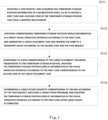
- Fig. 1 is a schematic diagram of a main flow of a task processing method according to a first embodiment of the present disclosure.
- the task processing method comprises: Step S101: receiving a task request, and acquiring idle temporary-storage position information of a workstation shelf, so as to obtain a first code and a second code of the temporary-storage position that have a mapping relationship.
- the workstation shelf is arranged in multiple layers and has front and rear sides, and the front and rear sides of each temporary-storage position on the workstation shelf are configured with corresponding first and second codes, respectively.
- the side of the workstation shelf facing the warehouse is defined as the rear side, and the rear side of each temporary-storage position is configured with a second code for identification by a CTU device;
- the side of the workstation shelf facing the operation direction is defined as the front side, and the front side of each temporary-storage position is configured with a first code for use in on-site operations.
- the first code and the second code of each temporary-storage position are unique, and a mapping relationship is configured between the second code defining the rear side and the first code defining the front side, i.e., establishing a relationship R, e.g., R1 (#1, B001), R2 (#2, B006).
- R1 #1, B001
- R2 #2, B006
- the workstation shelf each layer of which can be divided into multiple columns, which is specifically determined by the length of the shelf and the width of the container, is physically divided into several equal-sized temporary-storage positions according to the layers and columns.
- the main body of the shelf consists of 3 layers, and each layer is divided into 3 columns, i.e., a total of 9 temporary-storage positions.
- current configuration information of the workstation shelf can be acquired (for example, acquiring whether a status indicator in the configuration information is idle) to judge whether there is a temporary-storage position with an idle status. If it is determined that there is a temporary-storage position with an idle status, judge whether a preset waiting queue includes the task request (that is, if there is an idle temporary-storage position, first process the task request in the waiting queue), and if it is determined that a preset waiting queue includes the task request, pull the task request in the waiting queue and put a currently received task request into the waiting queue; if it is determined that a preset waiting queue does not include the task request, execute the currently received task request. If it is determined that there is not a temporary-storage position with an idle status, put the currently received task request into the preset waiting queue, that is, if there is no idle temporary-storage position at present, you may queue in the waiting queue.
- Step S102 updating corresponding temporary-storage position display information in a preset visual operation interface according to the first code, and generating a cargo placement task and sending the same to a transport device according to the second code and the task request.
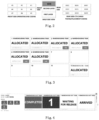
- the present disclosure is creatively provided with a visual operation interface: As shown in Figs. 3 (the task type is a warehousing task) and 4 (the task type is a warehouse-out task), the visual operation interface is divided into multiple equal positions according to the temporary-storage positions of the actual workstation shelves. For example, there are 3 layers in total and 4 columns in each layer, and the number corresponds to the first code of the temporary-storage position. For each corresponding temporary-storage position, the visual operation interface area is divided into an upper, middle and lower three-layer structure.
- the leftmost portion of the upper layer is the first code
- the middle portion of the upper layer is the task description or other prompts
- the middle layer is specifically a prompt of the container's handling status, which can provide a double-click event.
- the lower layer is an operation area including an input box and operation buttons; the input box can be used to bind empty boxes and input data required by other businesses such as text, while the operation buttons can provide operations for the current temporary-storage position, e.g., calling an empty box operation in the warehouse.
- the visual operation interface can be connected to the temporary-storage position, monitor the container for operations, display multiple containers at the same time, and operate multiple boxes, so as to greatly improve the operating efficiency.
- the present disclosure can identify a task type according to the task request, so as to acquire corresponding attribute information based on the task type. Then, a cargo placement task can be generated according to the attribute information and the second code.
- the task type can be identified as a warehousing task or a warehouse-out task according to the task request.
- Target attributes are configured correspondingly based on different task types (i.e., a warehousing task or a warehouse-out task), respectively, and corresponding attribute information is acquired according to the target attributes.
- the attribute information can be used to generate a cargo placement task.
- the warehouse-out task needs to acquire warehouse container addresses according to the target attributes.
- the present disclosure can be adapted to CTU operations in any scene.
- Step S103 in response to a container corresponding to the cargo placement task being transported to the temporary-storage position, updating the temporary-storage position display information in the visual operation interface according to the first code corresponding to the second code in the cargo placement task.
- Step S104 determining a cargo pickup quantity corresponding to the container according to the task request, executing a cargo pickup program, and updating the temporary-storage position display information in the visual operation interface according to the first code after cargo pickup is completed.
- the picked items or the containers in the temporary-storage position may also be taken away according to the actual task processing requirements.
- the specific implementation process includes: in response to the execution of the cargo pickup program being completed, generating a cargo taking task and sending the same to the transport device according to the second code. Finally, in response to the cargo taking task of the transport device being completed, the temporary-storage position display information in the visual operation interface is updated according to the first code corresponding to the second code in the cargo taking task.
- the text information can be identified and a corresponding execution program can be determined to process the temporary-storage position having the first code.
- the present disclosure can input operation instructions through the visual operation interface, automatically identify the operation content, and call the corresponding execution program to process the temporary-storage position, e.g., reviewing the items in the temporary-storage position container.
- the present disclosure may also directly perform targeted operations through the visual operation interface, for example, directly clicking on a regional call control with a first code number of 2 corresponding to the visual operation interface.
- the specific implementation process includes: in response to selecting an operation control corresponding to the first code in the visual operation interface, identifying a type of the operation control, and acquiring a corresponding operation program. Then, whether there are multiple operation programs is judged, wherein if it is determined that there are multiple operation programs is judged, process the temporary-storage position having the first code in response to the selected operation program; if it is determined that there are not multiple operation programs is judged, execute the operation program to process the temporary-storage position having the first code.
- a SMS sending operation program and an email sending operation program are acquired; in response to selecting the SMS sending operation program, an empty container calling SMS is generated for the temporary-storage position with a first code number of 2 and sent to the transport device.
- Fig. 5 is a schematic diagram of a main flow of a task processing method according to a second embodiment of the present disclosure. As shown in Fig. 5 , the task processing method comprises:
- an idle temporary-storage position with a first code number of 2 is allocated and occupied in the preset visual operation interface
- the task type is displayed as a warehouse-out task at No. 2 and is bolded in black
- "Allocated” is displayed in the middle view (the background color is white).
- Step S506 identifying a task type according to the task request, so as to acquire corresponding attribute information based on the task type, and generating a cargo placement task and sending the same to a transport device according to the attribute information and the second code.
- Step S507 in response to a container corresponding to the cargo placement task being transported to the temporary-storage position, updating the temporary-storage position display information in the visual operation interface according to the first code corresponding to the second code in the cargo placement task.
- the display information is updated to "Arrived" in the middle view with a first code number of 2 of the preset visual operation interface (the background color is white), and the currently arrived container information is prompted in the view below (gray is uneditable).
- Step S508 determining a cargo pickup quantity corresponding to the container according to the task request, and executing a cargo pickup program.
- the cargo pickup quantity that the current containers need to operate is highlighted on the preset visual operation interface according to the task request, with the font being white and the background being red.
- Step S509 in response to the execution of the cargo pickup program being completed, updating the temporary-storage position display information in the visual operation interface according to the first code, and generating a cargo taking task and sending the same to the transport device according to the second code.
- the display information is updated to "Cargo Pickup Completed" in the middle view with a first code number of 2 of the preset visual operation interface (the background color is white).
- Step S510 in response to the cargo taking task of the transport device being completed, updating the temporary-storage position display information in the visual operation interface according to the first code corresponding to the second code in the cargo taking task.
- the display information is updated to "Task Completed" in the middle view with a first code number of 2 of the visual operation interface, with the font being white and the background being green.
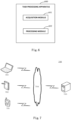
- Fig. 6 is a schematic diagram of main modules of a task processing apparatus according to an embodiment of the present disclosure.
- the task processing apparatus 600 comprises an acquisition module 601 and a processing module 602.
- the acquisition module 601 receives a task request, and acquires idle temporary-storage position information of a workstation shelf, so as to obtain a first code and a second code of the temporary-storage position that have a mapping relationship.
- the processing module 602 updates corresponding temporary-storage position display information in a preset visual operation interface according to the first code, and generates a cargo placement task and sends the same to a transport device according to the second code and the task request; in response to a container corresponding to the cargo placement task being transported to the temporary-storage position, updates the temporary-storage position display information in the visual operation interface according to the first code corresponding to the second code in the cargo placement task; and determines a cargo pickup quantity corresponding to the container according to the task request, executes a cargo pickup program, and updates the temporary-storage position display information in the visual operation interface according to the first code after cargo pickup is completed.
- processing module 602 is also used for:
- the acquisition module 601 after the acquisition module 601 receives the task request, there are comprised: acquiring current configuration information of the workstation shelf, and judging whether there is a temporary-storage position with an idle status; if it is determined that there is a temporary-storage position with an idle status, judging whether a preset waiting queue includes the task request, and if it is determined that a preset waiting queue includes the task request, pulling the task request in the waiting queue and putting a currently received task request into the waiting queue; if if it is determined that a preset waiting queue does not include the task request, executing the currently received task request; and if it is determined that there is not a temporary-storage position with an idle status there is a temporary-storage position with an idle status, putting the currently received task request into the preset waiting queue.
- the acquisition module 601 after the acquisition module 601 receives the task request, there is further comprised: identifying a task type according to the task request, so as to acquire corresponding attribute information based on the task type.
- the processing module 602 is also used for: generating a cargo placement task according to the attribute information and the second code.
- the processing module 602 is further used for: monitoring that text information exists in an input box corresponding to the first code in the visual operation interface; and identifying the text information, and determining a corresponding execution program, so as to process the temporary-storage position having the first code.
- processing module 602 is further used for:
- the workstation shelf is provided with front and rear sides, and the front and rear sides of each temporary-storage position on the workstation shelf are configured with corresponding first and second codes, respectively.
- Fig. 7 shows an exemplary system architecture 700 in which the task processing method or the task processing apparatus according to the embodiments of the present disclosure can be applied.
- the system architecture 700 may include terminal devices 701, 702, 703, a network 704, and a server 705.
- the network 704 is used to provide a communication link medium between the terminal devices 701, 702, 703 and the server 705.
- the network 704 may include various connection types, such as wired and wireless communication links, fiber optic cables, etc.
- the user can use the terminal devices 701, 702, 703 to interact with the server 705 via the network 704 to receive or send messages, etc.
- Various communication client applications may be installed on the terminal devices 701, 702, 703.
- the terminal devices 701, 702, 703 may be various electronic devices that have a task processing screen and support web browsing, including but not limited to smart phones, tablet computers, laptop computers, desktop computers, and so on.
- the server 705 may be a server that provides various services, for example, a back-end management server that provides support for users using the terminal devices 701, 702, 703 (which is only an example).
- the back-end management server can subject the received data such as a product information query request to processing such as analysis, and feed the processing results (such as target push information and product information, which are only examples) back to the terminal devices.
- the task processing method as provided by the embodiment of the present disclosure is generally executed by the server 705, and, accordingly, the calculating device is generally provided in the server 705.
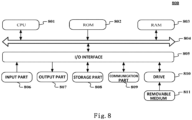
- FIG. 8 it shows a structural schematic diagram of a computer system 800 suitable for implementing a terminal device according to an embodiment of the present disclosure.
- the terminal device shown in Fig. 8 which is only an example, should not bring any limitation to the function and use scope of the embodiment of the present disclosure.
- the computer system 800 includes a central processing unit (CPU) 801, which can perform various appropriate actions and processes according to a program stored in a read-only memory (ROM) 802 or a program loaded from a storage part 808 into a random access memory (RAM) 803.
- ROM read-only memory
- RAM random access memory
- Various programs and data required for the operation of the computer system 800 are also stored in the RAM 803.
- the CPU 801, the ROM 802, and the RAM 803 are connected to each other through a bus 804.
- An input/output (I/O) interface 805 is also connected to the bus 804.
- the following components are connected to the I/O interface 805: an input part 806 including a keyboard, a mouse and the like; an output part 807 including a cathode ray tube (CRT), a liquid crystal task processor (LCD), a speaker and the like; a storage part 808 including a hard disk and the like; and a communication part 809 including a network interface card such as a LAN card, a modem and the like.
- the communication part 809 performs communication processing via a network such as the Internet.
- a drive 810 is also connected to the I/O interface 805 as required.
- a removable medium 811 such as a magnetic disk, an optical disk, a magneto-optical disk, a semiconductor memory or the like, is installed on the drive 810 as required, so that the computer program read from it is installed into the storage part 808 as required.
- the process described above with reference to the flowchart may be implemented as a computer software program.
- the embodiment of the present invention includes a computer program product, which includes a computer program carried on a computer-readable medium, and the computer program contains a program code for executing the method shown in the flowchart.
- the computer program may be downloaded and installed from the network through the communication part 809, and/or installed from the removable medium 811.
- the central processing unit (CPU) 801 the above-mentioned functions defined in the system of the present disclosure are executed.
- the computer-readable medium shown in the present invention may be a computer-readable signal medium or a computer-readable storage medium, or any combination of the above two.
- the computer-readable storage medium may be, for example, but not limited to, an electrical, magnetic, optical, electromagnetic, infrared or semiconductor system, device or device, or a combination of any of the above.
- the computer-readable storage medium may include, but are not limited to: an electrical connection with one or more wires, a portable computer disk, a hard disk, a random access memory (RAM), a read-only memory (ROM), an erasable programmable read-only memory (EPROM or flash memory), an optical fiber, a portable compact disk read-only memory (CD-ROM), an optical storage device, a magnetic storage device, or any suitable combination of the above.
- the computer-readable storage medium may be any tangible medium that contains or stores a program, and the program may be used by or in combination with an instruction execution system, apparatus or device.
- the computer-readable signal medium may include a data signal propagated in baseband or as a part of a carrier wave, in which a computer-readable program code is carried.
- the propagated data signal can take many forms, including but not limited to an electromagnetic signal, an optical signal, or any suitable combination of the above.
- the computer-readable signal medium may also be any computer-readable medium other than the computer-readable storage medium, and the computer-readable medium can send, propagate, or transmit a program used by or in combination with an instruction execution system, apparatus or device.
- the program code contained on the computer-readable medium can be transmitted by any suitable medium, including but not limited to: wireless, wire, optical cable, RF and the like, or any suitable combination of the above.
- each block in the flowcharts or block diagrams can represent a module, a program segment or a part of a code, which contains one or more executable instructions for realizing the specified logic function.
- the functions marked in the blocks may also occur in a different order from that marked in the drawings. For example, two blocks shown in succession can actually be executed substantially in parallel, and they can sometimes be executed in a reverse order, depending on the functions involved.
- each block in the block diagrams or flowcharts, and the combination of blocks in the block diagrams or flowcharts can be implemented by a dedicated hardware-based system that performs the specified functions or operations, or can be implemented by a combination of dedicated hardware and computer instructions.
- the modules involved in the embodiments described in the present disclosure can be implemented by software or hardware.
- the described modules can also be provided in a processor, which, for example, can be described as: a processor including an acquiring module and a processing module.
- a processor including an acquiring module and a processing module.
- the names of these modules do not constitute limitations to the modules themselves under certain circumstances.
- the present disclosure also provides a computer-readable medium, which may be included in the device described in the above embodiment or may exist alone without being assembled into the device.
- the above computer-readable medium carries one or more programs that, when executed by a device, cause the device to include: receiving a task request, and acquiring idle temporary-storage position information of a workstation shelf, so as to obtain a first code and a second code of the temporary-storage position that have a mapping relationship; updating corresponding temporary-storage position display information in a preset visual operation interface according to the first code, and generating a cargo placement task and sending the same to a transport device according to the second code and the task request; in response to a container corresponding to the cargo placement task being transported to the temporary-storage position, updating the temporary-storage position display information in the visual operation interface according to the first code corresponding to the second code in the cargo placement task; and determining a cargo pickup quantity corresponding to the container according to the task request, executing a cargo pickup program, and updating the temporary-storage
- the technical solutions according to the embodiments of the present disclosure can solve the problems of a low operating efficiency and a high cost of the existing CTU operating modes.
Landscapes
- Business, Economics & Management (AREA)
- Engineering & Computer Science (AREA)
- Human Resources & Organizations (AREA)
- Economics (AREA)
- Theoretical Computer Science (AREA)
- Strategic Management (AREA)
- Entrepreneurship & Innovation (AREA)
- General Physics & Mathematics (AREA)
- Physics & Mathematics (AREA)
- Tourism & Hospitality (AREA)
- Quality & Reliability (AREA)
- Operations Research (AREA)
- General Business, Economics & Management (AREA)
- Marketing (AREA)
- Development Economics (AREA)
- Software Systems (AREA)
- Educational Administration (AREA)
- Game Theory and Decision Science (AREA)
- General Engineering & Computer Science (AREA)
- Accounting & Taxation (AREA)
- Finance (AREA)
- Human Computer Interaction (AREA)
Applications Claiming Priority (2)
| Application Number | Priority Date | Filing Date | Title |
|---|---|---|---|
| CN202210380201.3A CN115390958A (zh) | 2022-04-12 | 2022-04-12 | 一种任务处理方法和装置 |
| PCT/CN2023/074252 WO2023197727A1 (fr) | 2022-04-12 | 2023-02-02 | Procédé et appareil de traitement de tâches |
Publications (2)
| Publication Number | Publication Date |
|---|---|
| EP4509984A1 true EP4509984A1 (fr) | 2025-02-19 |
| EP4509984A4 EP4509984A4 (fr) | 2026-04-22 |
Family
ID=84115763
Family Applications (1)
| Application Number | Title | Priority Date | Filing Date |
|---|---|---|---|
| EP23787375.7A Pending EP4509984A4 (fr) | 2022-04-12 | 2023-02-02 | Procédé et appareil de traitement de tâches |
Country Status (5)
| Country | Link |
|---|---|
| US (1) | US20250209397A1 (fr) |
| EP (1) | EP4509984A4 (fr) |
| JP (1) | JP7782065B2 (fr) |
| CN (1) | CN115390958A (fr) |
| WO (1) | WO2023197727A1 (fr) |
Families Citing this family (1)
| Publication number | Priority date | Publication date | Assignee | Title |
|---|---|---|---|---|
| CN115390958A (zh) * | 2022-04-12 | 2022-11-25 | 北京京东乾石科技有限公司 | 一种任务处理方法和装置 |
Family Cites Families (19)
| Publication number | Priority date | Publication date | Assignee | Title |
|---|---|---|---|---|
| JPS62235102A (ja) * | 1986-04-02 | 1987-10-15 | Nec Corp | 自動倉庫棚番管理方式 |
| JPH09136706A (ja) * | 1995-11-14 | 1997-05-27 | Nippon Filing Co Ltd | 物品棚のピッキング表示装置 |
| JPH09202413A (ja) * | 1996-01-26 | 1997-08-05 | Ishida Co Ltd | ピッキングシステム |
| JP2005067876A (ja) * | 2003-08-27 | 2005-03-17 | Hitachi Ltd | 情報処理装置、ピッキング物品管理方法、プログラム、および記録媒体 |
| JP2005320116A (ja) | 2004-05-10 | 2005-11-17 | Toyota Industries Corp | ロケーション指示装置、ロケーション管理システム、及びロケーション指示方法 |
| JP4624316B2 (ja) | 2006-07-07 | 2011-02-02 | 本田技研工業株式会社 | ラックセンタへの部品搬入装置及び部品搬入方法 |
| US8073562B2 (en) | 2007-01-26 | 2011-12-06 | Innovative Picking Technologies, Inc. | Picking system with pick verification |
| US9779373B1 (en) * | 2013-11-27 | 2017-10-03 | Amazon Technologies, Inc. | Item flow visualization for outbound fulfillment |
| JP6183279B2 (ja) | 2014-04-04 | 2017-08-23 | 株式会社ダイフク | ピッキング設備における物品供給方法、支持体分割方法、及び、ピッキング作業実行方法 |
| JP6261691B2 (ja) | 2016-09-13 | 2018-01-17 | オークラ輸送機株式会社 | ピッキングシステム |
| CN107944781A (zh) * | 2016-10-12 | 2018-04-20 | 菜鸟智能物流控股有限公司 | 提供存放对象提示信息的方法及装置 |
| CN108629539A (zh) * | 2018-05-10 | 2018-10-09 | 珠海横琴盛达兆业科技投资有限公司 | 一种基于亮灯模式实现仓库集中拣货的方法 |
| CN110533353B (zh) | 2018-05-25 | 2023-05-30 | 北京京东乾石科技有限公司 | 用于搬运货架的方法和装置 |
| CN112633785B (zh) * | 2019-09-24 | 2024-07-16 | 北京京东振世信息技术有限公司 | 一种仓储可视化的方法和装置 |
| CN111762483A (zh) * | 2019-10-22 | 2020-10-13 | 北京沃东天骏信息技术有限公司 | 一种拣货容器合流方法和装置 |
| JP2022527879A (ja) * | 2020-04-26 | 2022-06-07 | 杭州壹悟科技有限公司 | 倉庫作業システム及び方法 |
| CN113443316B (zh) * | 2020-06-17 | 2023-04-07 | 深圳市海柔创新科技有限公司 | 仓储系统、集货方法、装置、料箱移动装置及控制终端 |
| CN113844812B (zh) * | 2021-09-23 | 2023-05-12 | 北京京东振世信息技术有限公司 | 入库盘点运输系统、物品入库方法、装置、设备和介质 |
| CN115390958A (zh) * | 2022-04-12 | 2022-11-25 | 北京京东乾石科技有限公司 | 一种任务处理方法和装置 |
-
2022
- 2022-04-12 CN CN202210380201.3A patent/CN115390958A/zh active Pending
-
2023
- 2023-02-02 WO PCT/CN2023/074252 patent/WO2023197727A1/fr not_active Ceased
- 2023-02-02 EP EP23787375.7A patent/EP4509984A4/fr active Pending
- 2023-02-02 US US18/849,740 patent/US20250209397A1/en active Pending
- 2023-02-02 JP JP2024556564A patent/JP7782065B2/ja active Active
Also Published As
| Publication number | Publication date |
|---|---|
| US20250209397A1 (en) | 2025-06-26 |
| CN115390958A (zh) | 2022-11-25 |
| JP2025513948A (ja) | 2025-05-01 |
| JP7782065B2 (ja) | 2025-12-08 |
| WO2023197727A1 (fr) | 2023-10-19 |
| EP4509984A4 (fr) | 2026-04-22 |
Similar Documents
| Publication | Publication Date | Title |
|---|---|---|
| WO2021068645A1 (fr) | Procédé et appareil de détermination d'emplacement de stockage en entrepôt, dispositif électronique et support de stockage | |
| EP4390803A1 (fr) | Procédé et appareil d'inventaire de fournitures, et dispositif et support de stockage | |
| CN111784222B (zh) | 用于处理订单的方法和装置 | |
| CN111589730A (zh) | 一种拣货方法、装置、设备和存储介质 | |
| CN111861298A (zh) | 一种订单取消的方法和装置 | |
| CN116562770A (zh) | 信息序列存储方法、装置、电子设备和计算机可读介质 | |
| CN111415110A (zh) | 一种盘点货架的方法和装置 | |
| EP4509984A1 (fr) | Procédé et appareil de traitement de tâches | |
| CN114148659A (zh) | 容器上架方法、装置、系统、电子设备和计算机可读介质 | |
| CN111695843A (zh) | 订单数据处理方法、装置、电子设备及计算机可读介质 | |
| CN111824667B (zh) | 存储货物的方法和装置 | |
| CN112101690B (zh) | 一种物品拣选方法和装置 | |
| CN111768138A (zh) | 一种拣货方法、装置、设备及介质 | |
| CN115608623A (zh) | 用于确定拣选信息的方法和装置 | |
| CN110378636B (zh) | 一种交叉拣选方法和装置 | |
| CN112278692B (zh) | 基于立体仓库的仓储处理方法及装置、设备和介质 | |
| CN112474368A (zh) | 货物拣选方法、装置、设备和计算机可读介质 | |
| CN117993826A (zh) | 用于控制车辆的方法和装置 | |
| CN112785213A (zh) | 一种仓库拣货单的组建方法和装置 | |
| CN116578087A (zh) | 一种料箱的管理方法、装置、电子设备和存储介质 | |
| WO2023173684A1 (fr) | Procédé et dispositif de distribution | |
| CN112441364B (zh) | 一种自动化仓库的容器入库或回库方法和装置 | |
| CN112150082A (zh) | 一种货品调度方法、货品调度设备及货品调度系统 | |
| EP4682795A1 (fr) | Procédé de distribution d'article et appareil | |
| CN113819989B (zh) | 物品封装方法、装置、电子设备和计算机可读介质 |
Legal Events
| Date | Code | Title | Description |
|---|---|---|---|
| STAA | Information on the status of an ep patent application or granted ep patent |
Free format text: STATUS: THE INTERNATIONAL PUBLICATION HAS BEEN MADE |
|
| PUAI | Public reference made under article 153(3) epc to a published international application that has entered the european phase |
Free format text: ORIGINAL CODE: 0009012 |
|
| STAA | Information on the status of an ep patent application or granted ep patent |
Free format text: STATUS: REQUEST FOR EXAMINATION WAS MADE |
|
| 17P | Request for examination filed |
Effective date: 20241104 |
|
| AK | Designated contracting states |
Kind code of ref document: A1 Designated state(s): AL AT BE BG CH CY CZ DE DK EE ES FI FR GB GR HR HU IE IS IT LI LT LU LV MC ME MK MT NL NO PL PT RO RS SE SI SK SM TR |
|
| DAV | Request for validation of the european patent (deleted) | ||
| DAX | Request for extension of the european patent (deleted) | ||
| REG | Reference to a national code |
Ref country code: DE Ref legal event code: R079 Free format text: PREVIOUS MAIN CLASS: G06F0009451000 Ipc: G06Q0010063100 |
|
| A4 | Supplementary search report drawn up and despatched |
Effective date: 20260319 |
|
| RIC1 | Information provided on ipc code assigned before grant |
Ipc: G06Q 10/0631 20230101AFI20260313BHEP Ipc: G06Q 10/087 20230101ALI20260313BHEP |