EP4512652A1 - Dispositif de traitement de données pour un système de stationnement comprenant au moins une station de charge - Google Patents
Dispositif de traitement de données pour un système de stationnement comprenant au moins une station de charge Download PDFInfo
- Publication number
- EP4512652A1 EP4512652A1 EP24193051.0A EP24193051A EP4512652A1 EP 4512652 A1 EP4512652 A1 EP 4512652A1 EP 24193051 A EP24193051 A EP 24193051A EP 4512652 A1 EP4512652 A1 EP 4512652A1
- Authority
- EP
- European Patent Office
- Prior art keywords
- vehicle
- charging
- charging station
- module
- identifier
- Prior art date
- Legal status (The legal status is an assumption and is not a legal conclusion. Google has not performed a legal analysis and makes no representation as to the accuracy of the status listed.)
- Pending
Links
Images

Classifications
-
- B—PERFORMING OPERATIONS; TRANSPORTING
- B60—VEHICLES IN GENERAL
- B60L—PROPULSION OF ELECTRICALLY-PROPELLED VEHICLES; SUPPLYING ELECTRIC POWER FOR AUXILIARY EQUIPMENT OF ELECTRICALLY-PROPELLED VEHICLES; ELECTRODYNAMIC BRAKE SYSTEMS FOR VEHICLES IN GENERAL; MAGNETIC SUSPENSION OR LEVITATION FOR VEHICLES; MONITORING OPERATING VARIABLES OF ELECTRICALLY-PROPELLED VEHICLES; ELECTRIC SAFETY DEVICES FOR ELECTRICALLY-PROPELLED VEHICLES
- B60L53/00—Methods of charging batteries, specially adapted for electric vehicles; Charging stations or on-board charging equipment therefor; Exchange of energy storage elements in electric vehicles
- B60L53/60—Monitoring or controlling charging stations
- B60L53/65—Monitoring or controlling charging stations involving identification of vehicles or their battery types
-
- B—PERFORMING OPERATIONS; TRANSPORTING
- B60—VEHICLES IN GENERAL
- B60L—PROPULSION OF ELECTRICALLY-PROPELLED VEHICLES; SUPPLYING ELECTRIC POWER FOR AUXILIARY EQUIPMENT OF ELECTRICALLY-PROPELLED VEHICLES; ELECTRODYNAMIC BRAKE SYSTEMS FOR VEHICLES IN GENERAL; MAGNETIC SUSPENSION OR LEVITATION FOR VEHICLES; MONITORING OPERATING VARIABLES OF ELECTRICALLY-PROPELLED VEHICLES; ELECTRIC SAFETY DEVICES FOR ELECTRICALLY-PROPELLED VEHICLES
- B60L53/00—Methods of charging batteries, specially adapted for electric vehicles; Charging stations or on-board charging equipment therefor; Exchange of energy storage elements in electric vehicles
- B60L53/30—Constructional details of charging stations
- B60L53/305—Communication interfaces
-
- B—PERFORMING OPERATIONS; TRANSPORTING
- B60—VEHICLES IN GENERAL
- B60L—PROPULSION OF ELECTRICALLY-PROPELLED VEHICLES; SUPPLYING ELECTRIC POWER FOR AUXILIARY EQUIPMENT OF ELECTRICALLY-PROPELLED VEHICLES; ELECTRODYNAMIC BRAKE SYSTEMS FOR VEHICLES IN GENERAL; MAGNETIC SUSPENSION OR LEVITATION FOR VEHICLES; MONITORING OPERATING VARIABLES OF ELECTRICALLY-PROPELLED VEHICLES; ELECTRIC SAFETY DEVICES FOR ELECTRICALLY-PROPELLED VEHICLES
- B60L53/00—Methods of charging batteries, specially adapted for electric vehicles; Charging stations or on-board charging equipment therefor; Exchange of energy storage elements in electric vehicles
- B60L53/60—Monitoring or controlling charging stations
- B60L53/66—Data transfer between charging stations and vehicles
-
- B—PERFORMING OPERATIONS; TRANSPORTING
- B60—VEHICLES IN GENERAL
- B60L—PROPULSION OF ELECTRICALLY-PROPELLED VEHICLES; SUPPLYING ELECTRIC POWER FOR AUXILIARY EQUIPMENT OF ELECTRICALLY-PROPELLED VEHICLES; ELECTRODYNAMIC BRAKE SYSTEMS FOR VEHICLES IN GENERAL; MAGNETIC SUSPENSION OR LEVITATION FOR VEHICLES; MONITORING OPERATING VARIABLES OF ELECTRICALLY-PROPELLED VEHICLES; ELECTRIC SAFETY DEVICES FOR ELECTRICALLY-PROPELLED VEHICLES
- B60L53/00—Methods of charging batteries, specially adapted for electric vehicles; Charging stations or on-board charging equipment therefor; Exchange of energy storage elements in electric vehicles
- B60L53/60—Monitoring or controlling charging stations
- B60L53/67—Controlling two or more charging stations
-
- Y—GENERAL TAGGING OF NEW TECHNOLOGICAL DEVELOPMENTS; GENERAL TAGGING OF CROSS-SECTIONAL TECHNOLOGIES SPANNING OVER SEVERAL SECTIONS OF THE IPC; TECHNICAL SUBJECTS COVERED BY FORMER USPC CROSS-REFERENCE ART COLLECTIONS [XRACs] AND DIGESTS
- Y02—TECHNOLOGIES OR APPLICATIONS FOR MITIGATION OR ADAPTATION AGAINST CLIMATE CHANGE
- Y02T—CLIMATE CHANGE MITIGATION TECHNOLOGIES RELATED TO TRANSPORTATION
- Y02T10/00—Road transport of goods or passengers
- Y02T10/60—Other road transportation technologies with climate change mitigation effect
- Y02T10/7072—Electromobility specific charging systems or methods for batteries, ultracapacitors, supercapacitors or double-layer capacitors
-
- Y—GENERAL TAGGING OF NEW TECHNOLOGICAL DEVELOPMENTS; GENERAL TAGGING OF CROSS-SECTIONAL TECHNOLOGIES SPANNING OVER SEVERAL SECTIONS OF THE IPC; TECHNICAL SUBJECTS COVERED BY FORMER USPC CROSS-REFERENCE ART COLLECTIONS [XRACs] AND DIGESTS
- Y02—TECHNOLOGIES OR APPLICATIONS FOR MITIGATION OR ADAPTATION AGAINST CLIMATE CHANGE
- Y02T—CLIMATE CHANGE MITIGATION TECHNOLOGIES RELATED TO TRANSPORTATION
- Y02T90/00—Enabling technologies or technologies with a potential or indirect contribution to GHG emissions mitigation
- Y02T90/10—Technologies relating to charging of electric vehicles
- Y02T90/12—Electric charging stations
Definitions
- the invention relates to a data processing device for a parking system with at least one charging station, comprising a first receiving module, set up to receive a first license plate data set, containing at least one vehicle license plate of a vehicle driven through a passage, recorded by at least one camera of the parking system, and comprising a second receiving module, set up to receive a charging request data set, containing at least one vehicle charging identifier recorded by a charging station via a charging cable connected to the vehicle.
- the invention also relates to a method, a computer program and a parking system.
- a parking system for or with parking facilities usually has one or more access devices at a corresponding number of passages to and/or from a parking facility.
- a barrier with a pivoting barrier boom can be provided as an access device.
- an access device in particular, the passage of a vehicle through a passageway on which the access device is arranged is monitored or controlled from a first area to a further area.
- At least one access device can be provided to control the passage of a vehicle from a non-controlled area, for example a (public) road, into a controlled area, for example the parking area or the parking device.
- driving into the parking device can be controlled by an access device at an entrance to the parking system.
- at least one access device can be provided in a parking system to control a vehicle driving through from the controlled area into the non-controlled area.
- driving out of the parking device at an exit can be controlled by an access device.
- a parking ticket such as a short-term parking ticket
- the short-term parking ticket in particular a paper ticket
- the short-term parking ticket is then paid for by a user at a machine after the end of a parking time or parking duration and is checked at the exit by a validator device on the access device. If the check is positive, driving through the passage (in this case the exit) is authorized by an authorization module.
- the validator device determines that the ticket has not yet been paid for, for example, or that the payment was made too long ago, the access device remains closed and the passage is blocked. In other words, driving through the passage is blocked by an authorization module.
- a constant concern with parking systems is to improve user comfort.
- manual user actions are seen as user-unfriendly.
- Parking systems are already known from the state of the art in which the required user actions can be reduced.
- parking systems are known in which at least one camera is arranged at a passage, in particular at each passage, and is set up to record the license plate of a vehicle driving through or travelling through the corresponding passage. This includes in particular recording the license plate before driving through the passage.
- the parking system can comprise a data processing device with a receiving module, set up to receive a license plate data set containing at least the vehicle license plate recorded by the at least one camera of the parking system and in particular a time indication of the recording of the vehicle license plate.
- a first license plate data set can be received in the form of an entry data set, which can contain as a time indication an entry time of the vehicle detected by the camera.
- the parking service can then be paid for at a machine, for example by entering the vehicle license plate.
- the associated entry data set can then be determined.
- a billing module determines the amount to be paid for the parking service or the parking process, in particular based on the parking duration determined from the entry time and the current time and a predetermined tariff date.
- parking systems increasingly include charging stations, each set up to charge vehicles or electrical energy storage devices (in particular a drive battery) of (electric) vehicles.
- a plurality of parking spaces in a parking facility can be equipped with at least one charging station.
- a vehicle When such a vehicle has driven into the parking facility and is parked in a parking space at a charging station, it can be connected to the charging station via a charging cable in order to draw electrical energy.
- a disadvantage of the known parking systems is that user comfort is reduced.
- a key reason is that a large number of manual user actions are required.
- ISO 15118 is a standard that contains specifications for bidirectional communication, in particular via a charging cable, between an electric vehicle 448 and a charging station 450.
- OCPP Open Charge-Point Protocol
- OCPI Open Charge-Point Interface
- service providers e.g. roaming platform provider 484, e-mobility service provider 486 (EMP), etc.
- a connection to the user 488 of the vehicle 448 can be established via an API.
- a vehicle with an electric storage device generally includes a charging control unit, in particular in the form of a so-called Electric Vehicle Communication Controller (EVCC).
- the EVCC functions in particular as a gateway for the mutual exchange of charging data or charging information through communication between a charging station or a charging column and the central control unit of the electric vehicle, the vehicle ECU ("electronic control unit").
- each EVCC can have a unique identifier in the form of a MAC address (EVCC ID), which is transmitted via the charging cable when information is exchanged between the vehicle and the charging station. This EVCC ID is not visible and/or determinable for the user of the vehicle.
- the EVCC ID is in particular part of the ISO 15118 and OCPP protocols, but not of the OCPI protocol.
- each vehicle can have a vehicle charging identifier that can be transmitted via the charging cable.
- the EVCC ID can be used, for example, as a vehicle charging identifier.
- the vehicle load identifier can also be another identifier that is as unique as possible.
- the object is achieved according to a first aspect of the invention by a data processing device according to claim 1 for a parking system with at least one charging station.
- the data processing device comprises a first receiving module.
- the first receiving module is set up to receive a first license plate data set.
- the first license plate data set contains at least one vehicle license plate of a vehicle driven through a passage, recorded by at least one camera of the parking system.
- the data processing device comprises a second receiving module.
- the second receiving module is set up to receive a charging request data set.
- the charging request data set contains at least one vehicle charging identifier recorded by a charging station via a charging cable connected to the vehicle.
- the data processing device comprises at least one database. A plurality of vehicle charging data sets are stored in the database.
- the respective vehicle charging data set contains at least one vehicle charging identifier and a vehicle license plate of a respective vehicle.
- the data processing device comprises an assignment module.
- the assignment module is configured to assign the received vehicle charging identifier to the received first license plate data set based on the vehicle charging data sets stored in the database.
- the data processing device comprises an enabling module.
- the enabling module is configured to automatically enable a charging process for charging the vehicle connected to the charging station via the charging cable only when the received vehicle charging identifier is assigned to the first license plate data set.
- a joint billing of the parking process and the charging process of a vehicle is made possible, in particular in an automatic manner.
- the data processing device can be formed from one or more computers and comprise at least one processor.
- the at least one processor can be set up to execute software modules (e.g. reception module, allocation module, release module, billing module, etc.).
- the data processing device can be formed by at least one local computer arranged on the parking device of the parking system and/or at least one background system arranged remotely from the parking device.
- the background system can preferably be formed from one or more (distributed) computers (e.g. server(s)) and/or a cloud system.
- the data processing device is used in a parking system and can in particular form and/or comprise the parking system control.
- the parking system can comprise a parking device for parking vehicles or cars, such as a parking lot, a parking garage or the like.
- a parking device can comprise a plurality of parking spaces.
- the parking system preferably has at least one access arrangement(s).
- An access arrangement comprises one or more access devices and at least one camera.
- a barrier with at least one barrier boom pivotably mounted on a column or a base of the access device can be provided as an access device.
- a roller shutter, swing gate, sectional door, retractable bollard and the like can also be used alternatively or additionally as an access device or blocking means in an access arrangement.
- the access device can also manage without a material blocking means and, for example, control driving through a passage using a light signal.
- a digital trigger can be used, which can, for example, represent a function of the parking system's camera.
- An access device can in particular be arranged at a passage of a parking device or the parking system, such as an entrance and/or exit of the parking device.
- an access section In front of an access device (seen in the direction of travel), an access section is provided in a first area, which a vehicle that is going to drive through the access device must first pass through.
- the access device is used to control or manage a passage through this passage through the access device from the first area into a further area.
- driving into the parking device can be controlled by an access device at an entrance.
- driving out of the parking device can be controlled by an access device at an exit. It goes without saying that a parking device can certainly have several entrances and/or exits.
- an access arrangement can have at least one camera.
- the at least one camera of the parking system is positioned at the at least one passage in such a way that a license plate of (every) vehicle that will and/or has passed through the passage passes through the detection range of the camera so that the license plate is recorded.
- the camera records images or provides image data that can be evaluated by an image evaluation module (for example implemented in the data processing device) of the parking system in order to determine the license plate.
- an image evaluation module for example implemented in the data processing device
- automatic vehicle license plate determination can be carried out using OCR.
- the recorded vehicle registration number in particular each recorded vehicle registration number, can be provided to a first receiving module of the data processing device.
- a first registration number data set is provided.
- the first The license plate data record contains at least the vehicle license plate and preferably at least one time.
- the time (in particular a time stamp) can indicate the time at which the vehicle license plate was recorded, i.e. in particular the time at which the vehicle passed through.
- the first license plate data record is in particular an entry data record, containing the vehicle license plate of a vehicle entering the parking facility through the passage and in particular the time at which the vehicle entered as a time.
- a first receiving module of the data processing device is configured to receive first license plate data sets, in particular for further processing of these license plate data sets.
- the parking system comprises at least one charging station, in particular a plurality of charging stations.
- the at least one charging station can be arranged at a parking space of the parking device.
- the at least one charging station is at least designed to deliver electrical energy, preferably for the bidirectional exchange of electrical energy.
- a charging station or a charging column can have at least one charging point, for example two charging points.
- a charging point can in particular comprise a delivery device.
- a delivery device in the form of a charging plug (including charging cable) is in particular designed to deliver energy in the form of electrical energy. In particular, a flow of current from a charging point via the delivery device to a vehicle can be enabled.
- a charging process includes at least the delivery of electrical energy.
- energy flows from the delivery point to a user's vehicle.
- a user can couple or connect the charging station to the vehicle using a charging cable.
- the amount of energy transferred during the delivery process can be recorded or counted in a known manner (by a corresponding sensor or energy meter in the charging station). From this amount of energy, the amount to be paid for carrying out the delivery process or for receiving the counted amount of energy can be calculated in a known manner.
- the charging station receives a vehicle charging identifier from the vehicle to be charged (immediately after the charging cable is connected).
- a vehicle charging identifier is in particular a unique identifier of the vehicle. In other words, a vehicle can be uniquely identified using the vehicle charging identifier.
- a characteristic of a vehicle charging identifier according to the invention is that it is only transmitted via a charging cable and is not visible and/or ascertainable for a user during normal use of the vehicle. As soon as the charging cable is plugged in or connected, encrypted communication in accordance with the ISO 15118 standard can start between the vehicle and the connected charging station and the vehicle charging identifier can be transmitted.
- the charging station in particular provides a charging request data record containing at least the vehicle charging identifier to the data processing device (for example via a wireless and/or wired communication network).
- a charging request data record can preferably contain further data, such as a charging station identifier of the charging station to which the vehicle is connected, a recording time date, etc.
- the data processing device comprises a database in which a plurality of vehicle charging data sets are stored.
- Each vehicle charging data set contains at least one vehicle registration number of a vehicle and a vehicle charging identifier of this vehicle.
- the data processing device further comprises an assignment module.
- the assignment module assigns this vehicle charging identifier to a previously received vehicle license plate from a plurality of previously received vehicle license plates, based on the vehicle charging data records stored in the database.
- the allocation module can compare the received vehicle load identifier with the vehicle load identifiers of the vehicle load data sets stored in the database. In particular, if it is determined that the received vehicle load identifier is identical to a stored vehicle load identifier, the vehicle registration number assigned to the stored and identical vehicle load identifier can be determined. Then, in a further comparison step, the allocation module can determine whether the specific vehicle license plate is identical to a previously received vehicle license plate. If this is the case, the assignment module assigns the received vehicle load identifier to the received first license plate data set or the corresponding vehicle license plate. It is understood that the comparison steps can also be carried out simultaneously or in reverse order.
- assigning the received vehicle load identifier to the received first license plate data set based on the vehicle load data sets stored in the database includes in particular determining that a vehicle load data set is stored which contains both the received vehicle load identifier and the received vehicle license plate.
- a release module is also provided for automatically releasing a charging process for charging the vehicle connected to the charging station via the charging cable.
- Automatic release only occurs (however) if the received vehicle charging identifier has previously been assigned to the first license plate data set or the corresponding vehicle license plate.
- Automatic release of the charging process in the present case means in particular that electrical energy can be and in particular is transmitted (immediately) to the vehicle or the traction battery, preferably without further checking, authorization, etc.
- the charging process is started immediately, in particular, according to the invention. Manual interactions by the user, such as using a charging card or inputs at the charging station, can be omitted.
- the vehicle identification number is in particular a unique number with which a vehicle can be identified.
- at least one payment date can be present in the vehicle charging data record.
- the payment date can be used to (automatically) bill the charging process and/or the parking process in particular. User convenience can be improved even further.
- a contact date is used in particular to provide the user with information about a charging process and/or parking process that has been carried out, such as an invoice for the charging process and/or parking process that has been carried out.
- At least one authentication date can be present, which can optionally be queried before the charging process is released, for example by sending a corresponding release request, for example based on the contact date.
- a corresponding release request can be displayed on a (mobile) end device of the user, for example.
- a release response can be sent automatically or prompted by a user action by the end device to the data processing device. containing at least the requested authentication data. If the data processing device determines that the received authentication data is identical to the stored authentication data, the charging process can be released. Otherwise, the charging process can be blocked and, for example, a corresponding message can be sent to the terminal.
- the authentication data can alternatively or additionally be requested via an interface of the charging station at which the vehicle to be charged and thus the corresponding user is located.
- a user name and/or a user address can be stored in addition to the at least one (electronic) contact date.
- a loyalty date can also be stored.
- the vehicle charging ID in particular the EVCC ID
- the number of loyalty points can be automatically increased.
- these can be used as a stamp card, Paybay action, etc.
- the database of the data processing device can be linked to the database of the loyalty system or form a common database.
- a registration of the vehicle or the user can be carried out in order to generate a vehicle charging data set which contains at least the vehicle registration number of the vehicle and the vehicle charging identifier.
- a corresponding registration can advantageously be carried out during an initial charging process.
- the vehicle charging identifier is set up and stored in a data memory of the vehicle, in particular of the charging control unit, in such a way that it cannot be determined by the user (without special technical means).
- An initial charging process here means in particular a charging process of a vehicle at a charging station of the parking system for which no vehicle charging data set has yet been stored in the database.
- a third receiving module which is connected via a (wireless and/or wired) Communication network connected to an interface of the parking system, receive at least the vehicle registration number of the vehicle.
- At least one further charging vehicle data of the above-described vehicle charging data can be received by the third receiving module via the at least one interface of the parking system.
- Non-exhaustive mobile devices include smartphones, tablet computers, mobile game consoles, laptops, netbooks, data glasses, smart watches and similar wearables.
- a mobile device can be a dedicated A parking ticketing device designed exclusively for a parking application or an operating terminal (e.g. a touch display or a similar interface of the charging station) designed exclusively for the use of at least one charging station.
- an operating terminal e.g. a touch display or a similar interface of the charging station
- the charging station identifier of the charging station at which the initial charging process is to be carried out can be and/or was taken into account during the assignment.
- the vehicle charging identifier can be transmitted to the data processing device together with the charging station identifier.
- the charging station identifier can be transmitted through the interface (automatically or after input by the user) together with the vehicle registration number. Linking the vehicle charging identifier and the vehicle registration number or generating a corresponding vehicle charging data record can be done based on the respective charging station identifiers received.
- a time window can be predefined in which both the vehicle registration number and the vehicle charging identifier must be received. Otherwise, linking can be omitted.
- a generation module that can be executed by a processor of the data processing device is in particular set up to generate a vehicle charging data record based on the vehicle registration number and the vehicle charging identifier (and possibly at least one other charging vehicle data item provided).
- the generated vehicle charging data record can be stored in the database by a storage module.
- Vehicle charging data records can be generated and stored in a simple and at the same time secure manner.
- an auxiliary medium can be used for generating and storing a vehicle charging data set.
- the vehicle charging identifier received in the context of an initial charging process can be linked to an auxiliary medium.
- an auxiliary medium in the form of a A one-time (temporarily valid) code and in particular a website address can be shown on the receipt or invoice (or the like) of a charging process.
- a user can cause at least the vehicle registration number and the code mentioned to be transmitted to the data processing device, in particular using a terminal device and the website address.
- the code can be stored in the data processing device (temporarily) together with the linked vehicle charging identifier.
- a search can be carried out for a stored code that is identical to the received code. If a stored identical code is identified, a vehicle charging data record can be generated and stored from the vehicle charging identifier linked to this code and the received vehicle registration number, as described. When a receipt is digitally retrieved via a landing page, further data can also be requested here.
- the parking duration can be determined in particular from an entry time and an exit time.
- the amount to be paid for the parking process can be determined in particular depending on at least one parking tariff and the determined parking duration.
- the amount to be paid for the charging process can be determined in particular depending on at least one charging tariff and the energy information provided and in particular previously measured.
- the billing module can combine the amounts mentioned (e.g. according to a specified combination rule) and in particular bill them together.
- the first receiving module can be set up to receive a second license plate data set, containing at least the vehicle license plate recorded by at least one camera of the parking system of a vehicle driven through a passage of the parking system after a completed charging process.
- the first license plate data set can be a previously described entry data set and the second license plate data set can be a previously described exit data set.
- an entry data set can be assigned to an exit data set based on the identical vehicle license plate contained in each case.
- the parking duration information can be determined based on the entry data set and the exit data set.
- the second receiving module can be configured to receive the energy information provided by the charging station during the completed charging process.
- a charging station can have an energy meter set up to measure the amount of energy exchanged.
- the second receiving module can receive the measured amount of energy, in particular together with the vehicle charging identifier, as energy information from the charging station.
- the billing module can then be set up to jointly bill the parking charging process.
- the data processing device can comprise a fourth receiving module.
- the fourth receiving module can be set up to receive a charging station reservation request, containing at least a vehicle registration number of the vehicle to be charged and a reservation time indication.
- the reservation time indication means in particular a period of time in the future during which the vehicle with the vehicle registration number of the charging station reservation request is to be charged.
- the charging station reservation module can be set up to reserve a charging station (in particular a plurality of charging stations) of the parking system, such that depending on the reservation time, a charging process at the Charging station is only released when the specific vehicle charging identifier is received.
- the data processing device can comprise a charging reservation database in which charging reservation data records can be stored.
- a charging reservation data record can contain, in particular, the vehicle registration number of the vehicle to be charged, the specific vehicle charging identifier and the reservation time.
- a charging reservation data record can contain a charging station identifier of a defined reserved charging station and/or a charging technology date.
- reserving a charging station can comprise reserving a defined charging station from a plurality of charging stations.
- the charging reservation data record can contain the charging station identifier of this defined charging station. Charging at this defined charging station is only possible during the reservation time with the vehicle whose vehicle charging identifier is contained in this charging reservation data record.
- any charging station from the plurality of charging stations can be reserved in such a way that it is ensured that the vehicle whose vehicle charging identifier is contained in this charging reservation data set can be charged at any free charging station during the reservation time specification.
- the charging station reservation module can control the charging stations depending on the current occupancy and the stored charging reservation data sets or the corresponding reservation time specifications in such a way that the number of free charging stations during a defined (future) period is greater than or equal to the number of charging reservation data sets (of vehicles not yet connected to a charging station of the parking system) with reservation time specifications that lie within this defined period.
- this reservation variant also referred to as a dynamic reservation variant
- a capacity can be kept free, which can depend on the stored charging reservation data sets.
- the assignment between charging station and vehicle can only when the vehicle is connected to a free or available charging station.
- the charging station reservation module ensures that a corresponding number of any charging stations (if necessary, the charging technology can be taken into account based on the stored charging technology data) and undefined charging stations are available for the stored charging reservation data sets. This means that a user can drive to any free charging station.
- the charging station reservation module can be set up to check whether at least one charging station of the parking system is free or has not yet been reserved for the requested reservation time, based on the stored
- Charging reservation data sets If no free charging station can be identified for the requested reservation time, a corresponding message can be sent to the sender in response (for example with an alternative reservation suggestion). If a free charging station for the requested reservation time can be identified by the charging station reservation module, the charging station reservation module can generate a (new) charging reservation data set containing the vehicle registration number of the vehicle to be charged, the specific vehicle charging identifier and the reservation time.
- the charging reservation data set can contain the charging station identifier of the reserved charging station and/or a charging technology date.
- the charging technology date specifies in particular which charging technology is required to charge the vehicle named in the charging reservation data set.
- a confirmation can be sent to the sender in response to the reservation request.
- a charging station preferably every charging station, can comprise at least one controllable (optical) display (for example at least one light module, a display, a loudspeaker and/or the like).
- a charging station controller of the parking system can control the at least one display based on the stored charging reservation data sets. In particular, this can be used to indicate to users whether a charging station is reserved (for example by a signal light of a certain color (e.g. red)) or not (for example by a signal light of a certain color (e.g. green)).
- the release module before the charging process is released at a (reserved) charging station, the release module first checks whether the charging station to which the vehicle is connected via a charging cable has a charging reservation data record, in particular by determining by the release module whether the received vehicle charging identifier is identical to a vehicle charging identifier stored in a charging reservation data record. If the release module determines that there is no charging reservation data record with the received vehicle charging identifier for this charging station, the release module blocks the charging process. In other words, the connected vehicle is not charged. Optionally, a corresponding notice can be displayed and/or sent.
- the release module automatically release the charging process. In particular, this can reduce the risk that a reserved charging station is blocked by a vehicle that is not authorized to charge at this charging station.
- the charging station reservation module is set up to reserve any charging station of the parking system from a plurality of charging stations of the parking system, such that, depending on the reservation time specification, at least one charging station of the plurality of charging stations of the parking system is only released for a charging process when the specific vehicle charging identifier is received.
- the release module can first check whether the number of free Charging stations during a defined (future) period is greater than or equal to the number of charging reservation data sets (of vehicles not yet connected to a charging station of the parking system) with reservation time information that is within this defined period.
- a charging process can be carried out at this charging station in the manner described above.
- it can be checked whether the vehicle charging identifier is identical to a vehicle charging identifier contained in a charging reservation data set. If this is the case, in particular the number of
- Charging reservation data records of vehicles not yet connected to a charging station of the parking system can be reduced by one. If this is not the case, the number of free charging stations during a defined (future) period can be reduced by one. In particular, if the number of free charging stations during a defined (future) period is equal to the number of charging reservation data records of vehicles not yet connected to a charging station of the parking system with reservation time information, the release module can first check before releasing the charging process whether a charging reservation data record exists that contains a vehicle charging identifier that is identical to the received vehicle charging identifier. If the release module determines that no corresponding charging reservation data record exists, the release module blocks the charging process. In other words, the connected vehicle is not charged.
- a corresponding notice can be displayed and/or sent. Only if it is determined that a charging reservation data record exists that contains a vehicle charging identifier that is identical to the received vehicle charging identifier (and in particular corresponding to the stored reservation time information), does the release module automatically release the charging process. In particular, this can reduce the risk of a reserved charging station being blocked by a vehicle that is not authorized to charge at this charging station.
- first receiving module, the second receiving module, the third receiving module and/or the fourth receiving module can be formed by one (or two or three) common receiving device(s) or by separate modules.
- the data processing device can further comprise a memory module.
- the memory module can be set up to store a charging reservation data record containing at least the vehicle registration number of the vehicle to be charged, preferably the specific vehicle charging identifier and in particular a reservation time indication.
- a charging station identifier can optionally be included.
- a previously described charging reservation data record can be generated and stored, in particular in the database mentioned.
- the data processing device can preferably comprise a routing module.
- the routing module can be set up to control at least one vehicle guidance module (of the parking system) when the vehicle registration number contained in the charging reservation data set is received by the first receiving module, such that the vehicle driven through the passage is guided to the reserved charging station or a free charging station or an area with at least one free charging station, possibly based on the charging station identifier contained in the charging reservation data set.
- the at least one vehicle guidance module can, for example, be at least one (optical) display of the parking system, set up to display routing information (for example arrow symbols and/or text) that guide the user of the vehicle to the reserved charging station.
- the routing module can be configured to control a vehicle guidance module when a vehicle registration number is received by the first receiving module and a vehicle charging data set is present for the received vehicle registration number, such that the vehicle driven through the passage is guided to a free charging station or an area with several free charging stations.
- the vehicle can be marked as stolen in the database mentioned, for example after a corresponding notification from the user of the stolen vehicle. If the vehicle is connected to a charging station of the parking system and the vehicle charging ID is transmitted, it can be provided in particular that information about the location of the vehicle is sent to a contact date of the user (e.g. email, SMS, etc.).
- a contact date of the user e.g. email, SMS, etc.
- a charging station of the parking system can be set up for the bidirectional exchange of electrical energy or power.
- the usual procedure described above can be used to determine whether information on bidirectional charging is stored. This can be stored in the vehicle charging data record, for example.
- the conditions under which bidirectional charging can take place e.g. minimum remuneration for feeding back into the grid, specific period of time, minimum permitted charge level of the traction battery, etc. can be stored.
- a further aspect of the invention is a computer program comprising instructions which, when the computer program is executed by at least one processor of a (previously described) data processing device, cause the latter to execute and/or control the previously described method.
- the computer program in particular the instructions or
- Program instructions may be stored in a computer program product, in particular a program memory.
- a program memory is a non-volatile memory such as a flash memory, a magnetic memory, an EEPROM memory (electrically erasable programmable read-only memory) and/or an optical memory.
- a data processing device can have a main memory, for example a volatile or non-volatile memory, in particular a random access memory (RAM), such as a static random access memory (SRAM), a dynamic random access memory (DRAM), a ferroelectric random access memory (FeRAM) and/or a magnetic random access memory (MRAM).
- RAM random access memory
- SRAM static random access memory
- DRAM dynamic random access memory
- FeRAM ferroelectric random access memory
- MRAM magnetic random access memory
- the at least one processor of the data processing device can, for example, store intermediate results or the like in the main memory.
- the parking system comprises at least one camera arranged at a passage (of the parking system).
- the at least one camera is set up to capture a license plate of a vehicle driving through the passage.
- the parking system comprises at least one charging station.
- the at least one charging station is set up to receive a vehicle charging identifier via a charging cable connected to the vehicle and the charging station.
- the parking system comprises a data processing device as described above.
- the modules described above are preferably at least partially software elements (eg executable code) and can be executed by a processor of the data processing device. It should also be noted that terms such as “first”, “second” etc. do not indicate a sequence, but serve in particular to distinguish between two elements (eg receiving module, area etc.).
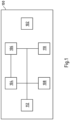
- the Figure 1 shows a schematic view of an embodiment of a data processing device 100 for a parking system according to the invention.
- the data processing device 100 is in particular a component of the parking system and serves to operate or control the parking system.
- the data processing device 100 may comprise at least one processor 102 configured to execute software modules 104, 106, 108, 110 of the data processing device 100. It is understood that the data processing device 100 may comprise further hardware elements, such as storage means, etc.
- a first receiving module 104 of the data processing device is configured to receive a first license plate data set containing at least one license plate of a vehicle driven through a passageway, recorded by at least one camera of the parking system. It is understood that the license plate of the vehicle can be recorded by the at least one camera before, during and/or after driving through the passageway. In particular, each license plate of each vehicle driving through the passageway is recorded by the at least one camera and provided to the first receiving module 104.
- a second receiving module 106 is provided in the data processing device 100, configured to receive a charging request data set containing at least one vehicle charging identifier detected by a charging station of the parking system via a charging cable connected to the vehicle.
- the data processing device 100 comprises at least one database 112 in which a plurality of vehicle charging data sets are stored.
- Each vehicle charging data set contains at least one vehicle charging identifier and a vehicle registration number of a respective (registered) vehicle.
- at least one further charging vehicle data item can be contained in a respective vehicle charging data set.
- the at least one received vehicle charging identifier and the at least one vehicle license plate can be provided to an assignment module 108 of the data processing device 100.
- the assignment module 108 is in particular configured to access the database 112.
- the assignment module 108 is configured to assign the received vehicle charging identifier to the received first license plate data set based on the vehicle charging data sets stored in the database 112.
- the assignment module 108 can be configured to check whether a vehicle charging data set is stored in the database 112 that contains both the received vehicle charging identifier and the at least one vehicle license plate. By determining that a vehicle charging data set is stored in the database 112 that contains the received vehicle license plate and the received vehicle charging identifier, the received vehicle charging identifier is assigned to the received first license plate data set.
- the data processing device 100 comprises an enabling module 110.
- the enabling module 110 is set up to automatically enable a charging process for charging the vehicle connected to the charging station via the charging cable only if the received vehicle charging identifier could be assigned to the first license plate data set.
- the assignment module 108 can control the enabling module 110 accordingly after an assignment as described above and/or the enabling module 110 can be integrated in the assignment module 108. If no assignment can be made, i.e. no If a corresponding vehicle charging data record cannot be identified, the charging process can be blocked (at least initially). In particular, it may then be necessary for the user to initiate the charging process at the charging station in the conventional way, for example using a charging card as described above.
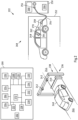
- the parking system 222 comprises at least one data processing device 200, at least one charging station 250 (preferably a plurality of charging stations 250) and at least one camera 242 (preferably a plurality of cameras 242).
- the at least one camera 242 is arranged at the at least one passage 236 (of the parking system 222).
- a plurality of passages 236 can be provided.
- at least one entrance and at least one exit can be provided in the parking system 222.
- An access device 238 can be arranged at a passage 236.
- the access device 238 is in particular set up to control or monitor a passage through this passage 236.
- the access device 238 can control a passage through the passage 236 by a vehicle 248 from a first area 246, in particular an access section (which is arranged in front of the access device 238 in the direction of travel of the vehicle 248) into a further area 244.
- the access device 238 is arranged, for example, at a parking garage entrance, the first area 246 represents in particular the non-controlled area and the further area 244 represents the controlled area, in particular the parking area or the parking device 252. If the access device 238 is arranged, for example, at a parking garage exit, the situation is reversed.
- a controllable actuator e.g. an electric motor
- the actuator can in particular be set up to move a barrier boom 240 (or a similar blocking element) between a blocking position and an open position, depending on a control signal or release signal.
- a release in this case in particular an opening of the access device 238, may depend on whether a user is authorized to drive through the passage 236 (or not).
- the at least one camera 242 (in particular together with an image evaluation module of the camera 242 and/or the data processing device 200) is configured to detect the vehicle registration number of the vehicle 248. As in the Figure 2 As shown, the camera 242 can be arranged such that the vehicle registration number of (each) vehicle 248 located in the access section is recorded. A corresponding arrangement of the at least one camera 242 enables an optional check of an authorization to drive through the passage 236 based on the recorded vehicle registration number.
- the recorded vehicle license plate when entering the parking system 222, can be compared with a predefined blocking list that contains blocked vehicle license plates. Driving through the access device 238 can only be released if the recorded vehicle registration number is not on the block list.
- the recorded vehicle registration number When exiting, for example, it can be checked whether at least one specified exit criterion is met for the recorded vehicle registration number. For example, it can be checked whether a parking and/or charging process has been paid for in full and/or whether a payment date is stored in the vehicle charging data record of the recorded vehicle registration number that allows automatic billing of the parking and/or charging process (particularly after the parking and/or charging process).
- the parking system 222 can comprise at least one wireless and/or wired communication network (not shown). It is understood that two or more communication networks, each with a different transmission technology, can be provided.
- the charging station 250 can comprise at least one charging point 256 (preferably at least two charging points 256). To transmit electrical energy, a charging cable 254 can be connected between the charging point 256 and a charging connection 258 of the vehicle 248. Furthermore, the charging station 250 is set up to communicate with the vehicle 248, in particular with a charging control unit 270 of the vehicle 248.
- the charging control unit 270 is in particular an Electric Vehicle Communication Controller (EVCC).
- EVCC Electric Vehicle Communication Controller
- EVCC ID Electric Vehicle Communication Controller
- the parking system 222 in the present case comprises at least one (controllable) vehicle control module 264, in particular in the form of a parking application installed on a mobile terminal 262 of a user of the vehicle (not shown) (in particular executable by a processor of the mobile terminal 262).
- vehicle control module 264 in particular in the form of a parking application installed on a mobile terminal 262 of a user of the vehicle (not shown) (in particular executable by a processor of the mobile terminal 262).
- optical displays can be arranged in the parking system (e.g. on walls, pillars, in the form of a free-standing display, etc.).
- the data processing device 200 can optionally comprise at least one further module 220 to 234 that can be executed by the processor, in addition to a processor 202, a first receiving module 204, a second receiving module 206, an allocation module 208, a release module 210 and a database 212.
- the data processing device 200 can comprise a billing module 234, which is in particular set up to bill the parking charging process of the vehicle 248, at least based on an energy indication given during a completed charging process and a parking duration indication.
- the energy indication can in particular be made available to the billing module 234 via the communication network mentioned by the energy meter 266 of the charging station 250.
- the parking duration indication can be determined automatically, for example, from the entry time of the vehicle 248 and the exit time of the vehicle. It goes without saying that the time of payment at a machine or the like can also be used to determine the parking duration indication. In the manner described, the total amount to be paid for the parking and charging process can then be determined using tariff data. determined and, for example, billed based on the saved payment date (automatically).
- the charging station reservation request can be rejected, for example by sending a corresponding response to the received charging station reservation request.
- the charging station reservation module 220 determines that at least one charging station 250 is available, an available charging station 250 can be reserved by generating a charging reservation data record by the charging station reservation module 220.
- the generated charging reservation data record contains the received vehicle license plate, the vehicle charging identifier determined based on the received vehicle license plate and the received reservation time information.
- the charging reservation data record can contain the charging station identifier 250 of the reserved charging station and/or a charging technology date.
- the generated charging reservation data record can be stored in the charging reservation database 228, in particular by the storage module 232.
- the release module 210 determines that a charging reservation data set is available for the charging station 250, it can be checked whether the received vehicle charging identifier is identical to the vehicle charging identifier stored in this charging reservation data set. Only if the release module 210 determines an identity between the received vehicle charging identifier and the vehicle charging identifier stored in the aforementioned charging reservation data set, a The charging process can be released in the manner described above. Otherwise, the charging process will be blocked, in particular by the release module 210, and, for example, corresponding information will be displayed on the at least one (optical) display of the charging station 250.
- the data processing device 200 can comprise a routing module 272.
- the first receiving module 204 can make each received vehicle license plate available to the routing module 272.
- the routing module 272 can in particular be configured to control at least one vehicle guidance module 264 when the first receiving module 204 receives the vehicle license plate contained in the charging reservation data set, such that the vehicle 248 driven through the passage 236 is guided to the reserved charging station 250 and/or a free charging station 250 or an area with at least one free charging station, based on the charging station identifier contained in the charging reservation data set.
- the routing module 272 can check for each received vehicle license plate whether a charging reservation data record is present in the charging reservation database 228 and/or whether a vehicle charging data record is present in the database. If no reservation data record and no vehicle charging data record are present, an action by the routing module 272 can be omitted. If the routing module 272 determines a charging reservation data record and/or a vehicle charging data record that contains a vehicle license plate that is identical to the received vehicle license plate, the at least one vehicle control module 264 can be controlled by the routing module 272.
- routing information can be stored for the reserved charging station 250 or a free charging station 250 or an area with several free charging stations.
- this information can be transmitted to the user's mobile terminal 262 (in particular based on a stored contact date) in the form of a routing data set by the routing module 272.
- the routing data set can contain the routing information and instructions which, when they are executed by a processor of the mobile terminal 262 under the control of the parking application 264, cause the processor to output the routing information via a visual display and/or an acoustic interface of the mobile terminal 262.
- the parking application 264 can display navigation information based on the current vehicle position (e.g. determined by the mobile terminal 262 by e.g. GPS, Bluetooth, WLAN and/or the like) and the routing information in order to guide the vehicle 248 or the user (from the current vehicle position) to the reserved charging station 250.
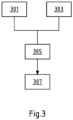
- a first license plate data set is received, containing at least one vehicle license plate of a vehicle driven through a passage, as described, captured by at least one camera of the parking system.
- a charging request data set is received, containing at least one vehicle charging identifier detected by a charging station via a charging cable connected to the vehicle, as described.
- a plurality of vehicle loading data sets are stored in a database of the data processing device.
- Each vehicle loading data set contains at least a vehicle loading identifier and a vehicle registration number of a respective vehicle, as described.
- step 305 the received vehicle load identifier is assigned to the received first license plate data set based on the stored vehicle load data sets, as described.
- step 307 an automatic release of a charging process for charging the vehicle connected to the charging station via the charging cable only takes place if the received vehicle charging identifier is assigned to the first license plate data set, as described. If an assignment cannot take place because there is no vehicle charging data set in the database that contains the received vehicle charging identifier and the received vehicle license plate, an automatic release of the charging process can be blocked. In particular, a conventional release of the charging process can then take place, for example using a user's charging card.
Landscapes
- Engineering & Computer Science (AREA)
- Power Engineering (AREA)
- Transportation (AREA)
- Mechanical Engineering (AREA)
- Devices For Checking Fares Or Tickets At Control Points (AREA)
Applications Claiming Priority (1)
| Application Number | Priority Date | Filing Date | Title |
|---|---|---|---|
| DE102023122831.5A DE102023122831A1 (de) | 2023-08-25 | 2023-08-25 | Datenverarbeitungsvorrichtung für ein Parksystem mit mindestens einer Ladestation |
Publications (1)
| Publication Number | Publication Date |
|---|---|
| EP4512652A1 true EP4512652A1 (fr) | 2025-02-26 |
Family
ID=92258724
Family Applications (1)
| Application Number | Title | Priority Date | Filing Date |
|---|---|---|---|
| EP24193051.0A Pending EP4512652A1 (fr) | 2023-08-25 | 2024-08-06 | Dispositif de traitement de données pour un système de stationnement comprenant au moins une station de charge |
Country Status (2)
| Country | Link |
|---|---|
| EP (1) | EP4512652A1 (fr) |
| DE (1) | DE102023122831A1 (fr) |
Citations (4)
| Publication number | Priority date | Publication date | Assignee | Title |
|---|---|---|---|---|
| EP3403868A1 (fr) * | 2017-05-15 | 2018-11-21 | Siemens Aktiengesellschaft | Procédé et dispositif d'identification de véhicule assistée par ordinateur |
| DE102017216417A1 (de) * | 2017-09-15 | 2019-03-21 | Siemens Aktiengesellschaft | Ladestation sowie Verfahren zum Ermöglichen einer Zugangskontrolle zu einer solchen Ladestation |
| EP3656603A1 (fr) * | 2018-11-23 | 2020-05-27 | Henrik Thiele | Station de charge et système avec capteur de présence de véhicule et fonction d'authentification |
| DE102019130029A1 (de) * | 2019-11-07 | 2021-05-12 | Scheidt & Bachmann Gmbh | Verfahren zum Betrieb einer gebührenpflichtigen Parkeinrichtung |
Family Cites Families (3)
| Publication number | Priority date | Publication date | Assignee | Title |
|---|---|---|---|---|
| EP2500888B1 (fr) * | 2011-03-17 | 2013-06-05 | Kapsch TrafficCom AG | Parc de stationnement avec système de réservation |
| CN104766406A (zh) * | 2015-03-30 | 2015-07-08 | 戴国峰 | 一种智能化的电动车充电电站 |
| DE102021103047A1 (de) * | 2021-02-10 | 2022-08-11 | Audi Aktiengesellschaft | Verfahren zum Belegen eines Parkhauses mit Fahrzeugen |
-
2023
- 2023-08-25 DE DE102023122831.5A patent/DE102023122831A1/de active Pending
-
2024
- 2024-08-06 EP EP24193051.0A patent/EP4512652A1/fr active Pending
Patent Citations (4)
| Publication number | Priority date | Publication date | Assignee | Title |
|---|---|---|---|---|
| EP3403868A1 (fr) * | 2017-05-15 | 2018-11-21 | Siemens Aktiengesellschaft | Procédé et dispositif d'identification de véhicule assistée par ordinateur |
| DE102017216417A1 (de) * | 2017-09-15 | 2019-03-21 | Siemens Aktiengesellschaft | Ladestation sowie Verfahren zum Ermöglichen einer Zugangskontrolle zu einer solchen Ladestation |
| EP3656603A1 (fr) * | 2018-11-23 | 2020-05-27 | Henrik Thiele | Station de charge et système avec capteur de présence de véhicule et fonction d'authentification |
| DE102019130029A1 (de) * | 2019-11-07 | 2021-05-12 | Scheidt & Bachmann Gmbh | Verfahren zum Betrieb einer gebührenpflichtigen Parkeinrichtung |
Also Published As
| Publication number | Publication date |
|---|---|
| DE102023122831A1 (de) | 2025-02-27 |
Similar Documents
| Publication | Publication Date | Title |
|---|---|---|
| CN108010331A (zh) | 智慧停车云平台管理系统 | |
| EP2930696A1 (fr) | Procédé d'enregistrement et de paiement de stationnements | |
| EP2833329B1 (fr) | Procédé et système destinés à améliorer un processus de stationnement payant de véhicule dans une installation de parking, programme informatique et produit-programme informatique | |
| EP3051502A1 (fr) | Systeme de controle d'entree de stationnement et procede de controle de l'entree dans un stationnement | |
| EP2410494A1 (fr) | Procédé destiné au fonctionnement d'une station service électrique | |
| EP1398719A1 (fr) | Système informatique de réservation de véhicule et procédé pour un système informatique de réservation de véhicule | |
| EP3033736A1 (fr) | Système et procédé de gestion d'une opération de stationnement d'un véhicule dans une zone de stationnement payant et de gestion d'une opération de paiement des frais de stationnement | |
| EP3955219A2 (fr) | Procédé de fonctionnement d'un dispositif de stationnement | |
| EP2892029A1 (fr) | Paiement de droits de stationnement par Internet | |
| EP3819875B1 (fr) | Procédé de fonctionnement d'un système de stationnement payant | |
| DE102014002632A1 (de) | Verfahren und System zur Bewirtschaftung kostenpflichtiger Verkehrsräume | |
| EP3355249B1 (fr) | Procédé d'attribution d'un véhicule à un lieu de stationnement, installation de traitement de données et véhicule | |
| EP4512652A1 (fr) | Dispositif de traitement de données pour un système de stationnement comprenant au moins une station de charge | |
| EP4072180A1 (fr) | Procédé d'autorisation d'un processus de charge à un point de charge | |
| EP4595027A1 (fr) | Procédé d'interaction avec un système de péage, et véhicule | |
| DE102017210724B4 (de) | Verfahren und System zum Betreiben eines Ladeabgriffs zum Laden eines batteriebetriebenen Gegenstands | |
| DE102019202504A1 (de) | Automatisierte Überprüfung eines elektrischen Ladevorgangs | |
| EP3040947B1 (fr) | Procédé destiné a éviter les mauvais usages d'autorisations d'accès d'un système de contrôle d'accès basé sur un identifiant | |
| EP3252697B1 (fr) | Dispositif de validation pour un systeme de ticket | |
| EP4002306A1 (fr) | Système de transport en boucle ouverte doté d'un système d'arrière-plan | |
| WO2020160924A1 (fr) | Autorisation d'utilisation de distributeurs automatiques | |
| DE102024130923A1 (de) | Verwaltungssystem für parkplätze und verfahren | |
| DE102024125578A1 (de) | Verfahren zur Nutzung eines gebührenpflichtigen Parkplatzes durch ein Fahrzeug | |
| EP4578721A1 (fr) | Procédé mis en oeuvre par ordinateur et système de déconnexion d'une colonne de charge | |
| DE202017105446U1 (de) | Ein gemeinsam genutztes Steuersystem |
Legal Events
| Date | Code | Title | Description |
|---|---|---|---|
| PUAI | Public reference made under article 153(3) epc to a published international application that has entered the european phase |
Free format text: ORIGINAL CODE: 0009012 |
|
| STAA | Information on the status of an ep patent application or granted ep patent |
Free format text: STATUS: THE APPLICATION HAS BEEN PUBLISHED |
|
| AK | Designated contracting states |
Kind code of ref document: A1 Designated state(s): AL AT BE BG CH CY CZ DE DK EE ES FI FR GB GR HR HU IE IS IT LI LT LU LV MC ME MK MT NL NO PL PT RO RS SE SI SK SM TR |
|
| STAA | Information on the status of an ep patent application or granted ep patent |
Free format text: STATUS: REQUEST FOR EXAMINATION WAS MADE |
|
| 17P | Request for examination filed |
Effective date: 20250805 |