EP4512792A1 - Verfahren zur kontinuierlichen rückgewinnung von styrolmonomer aus polystyrolabfall - Google Patents
Verfahren zur kontinuierlichen rückgewinnung von styrolmonomer aus polystyrolabfall Download PDFInfo
- Publication number
- EP4512792A1 EP4512792A1 EP23792129.1A EP23792129A EP4512792A1 EP 4512792 A1 EP4512792 A1 EP 4512792A1 EP 23792129 A EP23792129 A EP 23792129A EP 4512792 A1 EP4512792 A1 EP 4512792A1
- Authority
- EP
- European Patent Office
- Prior art keywords
- depolymerization
- styrene monomer
- residue
- yield
- reactor
- Prior art date
- Legal status (The legal status is an assumption and is not a legal conclusion. Google has not performed a legal analysis and makes no representation as to the accuracy of the status listed.)
- Pending
Links
Images


Classifications
-
- C—CHEMISTRY; METALLURGY
- C08—ORGANIC MACROMOLECULAR COMPOUNDS; THEIR PREPARATION OR CHEMICAL WORKING-UP; COMPOSITIONS BASED THEREON
- C08J—WORKING-UP; GENERAL PROCESSES OF COMPOUNDING; AFTER-TREATMENT NOT COVERED BY SUBCLASSES C08B, C08C, C08F, C08G or C08H
- C08J11/00—Recovery or working-up of waste materials
- C08J11/04—Recovery or working-up of waste materials of polymers
- C08J11/10—Recovery or working-up of waste materials of polymers by chemically breaking down the molecular chains of polymers or breaking of crosslinks, e.g. devulcanisation
- C08J11/16—Recovery or working-up of waste materials of polymers by chemically breaking down the molecular chains of polymers or breaking of crosslinks, e.g. devulcanisation by treatment with inorganic material
-
- B—PERFORMING OPERATIONS; TRANSPORTING
- B01—PHYSICAL OR CHEMICAL PROCESSES OR APPARATUS IN GENERAL
- B01J—CHEMICAL OR PHYSICAL PROCESSES, e.g. CATALYSIS OR COLLOID CHEMISTRY; THEIR RELEVANT APPARATUS
- B01J27/00—Catalysts comprising the elements or compounds of halogens, sulfur, selenium, tellurium, phosphorus or nitrogen; Catalysts comprising carbon compounds
- B01J27/20—Carbon compounds
- B01J27/232—Carbonates
-
- C—CHEMISTRY; METALLURGY
- C07—ORGANIC CHEMISTRY
- C07C—ACYCLIC OR CARBOCYCLIC COMPOUNDS
- C07C4/00—Preparation of hydrocarbons from hydrocarbons containing a larger number of carbon atoms
- C07C4/22—Preparation of hydrocarbons from hydrocarbons containing a larger number of carbon atoms by depolymerisation to the original monomer, e.g. dicyclopentadiene to cyclopentadiene
-
- C—CHEMISTRY; METALLURGY
- C08—ORGANIC MACROMOLECULAR COMPOUNDS; THEIR PREPARATION OR CHEMICAL WORKING-UP; COMPOSITIONS BASED THEREON
- C08J—WORKING-UP; GENERAL PROCESSES OF COMPOUNDING; AFTER-TREATMENT NOT COVERED BY SUBCLASSES C08B, C08C, C08F, C08G or C08H
- C08J2325/00—Characterised by the use of homopolymers or copolymers of compounds having one or more unsaturated aliphatic radicals, each having only one carbon-to-carbon double bond, and at least one being terminated by an aromatic carbocyclic ring; Derivatives of such polymers
- C08J2325/02—Homopolymers or copolymers of hydrocarbons
- C08J2325/04—Homopolymers or copolymers of styrene
-
- C—CHEMISTRY; METALLURGY
- C08—ORGANIC MACROMOLECULAR COMPOUNDS; THEIR PREPARATION OR CHEMICAL WORKING-UP; COMPOSITIONS BASED THEREON
- C08J—WORKING-UP; GENERAL PROCESSES OF COMPOUNDING; AFTER-TREATMENT NOT COVERED BY SUBCLASSES C08B, C08C, C08F, C08G or C08H
- C08J2325/00—Characterised by the use of homopolymers or copolymers of compounds having one or more unsaturated aliphatic radicals, each having only one carbon-to-carbon double bond, and at least one being terminated by an aromatic carbocyclic ring; Derivatives of such polymers
- C08J2325/02—Homopolymers or copolymers of hydrocarbons
- C08J2325/04—Homopolymers or copolymers of styrene
- C08J2325/06—Polystyrene
-
- Y—GENERAL TAGGING OF NEW TECHNOLOGICAL DEVELOPMENTS; GENERAL TAGGING OF CROSS-SECTIONAL TECHNOLOGIES SPANNING OVER SEVERAL SECTIONS OF THE IPC; TECHNICAL SUBJECTS COVERED BY FORMER USPC CROSS-REFERENCE ART COLLECTIONS [XRACs] AND DIGESTS
- Y02—TECHNOLOGIES OR APPLICATIONS FOR MITIGATION OR ADAPTATION AGAINST CLIMATE CHANGE
- Y02W—CLIMATE CHANGE MITIGATION TECHNOLOGIES RELATED TO WASTEWATER TREATMENT OR WASTE MANAGEMENT
- Y02W30/00—Technologies for solid waste management
- Y02W30/50—Reuse, recycling or recovery technologies
- Y02W30/62—Plastics recycling; Rubber recycling
Definitions
- the present disclosure relates to a method of continuously recovering a styrene monomer from waste polystyrene. More specifically, the present disclosure relates to a method of continuously recovering a styrene monomer having high yield and high purity from waste polystyrene by mixing waste polystyrene with a potassium carbonate (K 2 CO 3 ) catalyst and then continuously depolymerizing the mixture.
- K 2 CO 3 potassium carbonate
- a method of recycling waste plastics is divided into a material recycling method (a method of recycling waste plastics in their original form or after processing), a thermal recycling method (such as incineration), and a chemical recycling method (a method of recovering chemicals such as resin raw materials).
- the material recycling method is mainly used in recycled resin manufacturing, lightweight concrete manufacturing, and adhesive manufacturing.
- this material recycling method is a physical recycling method in which a significantly low added value is created.
- recycling is impossible, which means generating a significant amount of waste polystyrene.
- a significant amount of contaminated waste polystyrene, discharged from agricultural and fisheries markets or discharged as construction waste, is less clean than other waste polystyrene, making it difficult to use the contaminated waste polystyrene by the material recycling method.
- contaminated waste polystyrene has about 50 times more volume than that of other waste polystyrene, making the material recycling with the contaminated waste polystyrene difficult.
- the contaminated waste polystyrene has been disposed of through landfill burial or incineration.
- the incineration method causes environmental problems by generating dioxins.
- Non-patent document 0001 a technique for recovering a styrene monomer using highly acidic metal oxides such as Co 3 O 4 , Fe 2 O 3 , Cr 2 O 3 , and CuO as a catalyst
- Patent Documents 0001 and 0002 a technique for recovering a styrene monomer using a sulfate catalyst
- Patent Documents 0003 and 0003 a dual catalyst technique for recovering a styrene monomer by bringing a metal oxide supported on silica as a main catalyst and a basic catalyst supported on alumina as a co-catalyst.
- a continuous depolymerization process is more advantageous than a batch process.
- little research has been conducted on the continuous depolymerization process.
- the activity of the depolymerization catalysts decreased as the reaction time elapsed. This illustrated that the depolymerization reaction of polystyrene was suppressed, oil production was lowered, and the yield of styrene, which is a monomer, was lowered.
- Non-Patent Document 1 Ind. Eng. Res., Vol. 34, No. 12, 1995, 4519
- an objective of the present disclosure is to provide a method of continuously recovering a styrene monomer by suppressing the production of ethylbenzene, alpha-methylstyrene, benzene, and toluene generated in side reactions in the conventional continuous recovery process of waste polystyrene while increasing the yield of the styrene monomer.
- a method of continuously recovering a styrene monomer from waste polystyrene by continuous depolymerization of the waste polystyrene including obtaining a styrene monomer-containing product by continuously introducing waste polystyrene and a potassium carbonate (K 2 CO 3 ) catalyst into a depolymerization reactor and depolymerizing the mixture, in which the yield of the styrene monomer (SM) by the depolymerization is 70% or more and satisfies one or more of Formula 1 or 2 below.
- K 2 CO 3 potassium carbonate
- the potassium carbonate (K 2 CO 3 ) catalyst may be introduced in an amount of 0.1 to 10 parts by weight based on 100 parts by weight of waste polystyrene.
- the method of continuously recovering a styrene monomer from the waste polystyrene may include: (a) obtaining a styrene monomer-containing depolymerization product by continuously introducing waste polystyrene and a potassium carbonate (K 2 CO 3 ) catalyst into a depolymerization reactor made of one or two or more stages and depolymerizing the mixture; (b) discharging a gaseous depolymerization product out of the depolymerization products to a depolymerization gas discharge unit using a sweeping gas, and discharging a depolymerization residue other than the gaseous depolymerization product to a residue treatment unit; and (c) obtaining a styrene monomer by collecting the discharged gaseous depolymerization product.
- K 2 CO 3 potassium carbonate
- the step (b) may involve supplying the sweeping gas in a counter-current to the discharge flow of the depolymerization residue to separate the styrene monomer from the depolymerization residue being discharged to a residue treatment unit and discharge the styrene monomer to the depolymerization gas discharge unit.
- each of the depolymerization gas discharge units, between each stage may be connected in communication with adjacent units, allowing the gaseous depolymerization product among the depolymerization products generated in each stage of the depolymerization reactor to be discharged outside the depolymerization reactor and allowing the depolymerization residue other than the gaseous depolymerization product to be moved to the rear stage.
- the sweeping gas may be further supplied in a counter-current to the flow of the depolymerization residue moving from stage to stage, thereby the styrene monomer remaining in the depolymerization residue moving between each of the stages is discharged from each of the depolymerization gas discharge units.
- the step (c) may further involve reducing the content of dimers+ in the gaseous depolymerization product discharged from the depolymerization gas discharge unit.
- reducing the content of dimers+ may be performed in a separation column unit installed in the depolymerization gas discharge unit.
- the sweeping gas may be heated and supplied.
- the residence time of waste polystyrene in the depolymerization reactor may be in a range of 15 minutes to 2 hours.
- the recovering of the potassium carbonate (K 2 CO 3 ) catalyst present in the remaining residue may be further included by bringing the remaining residue into contact with water after the styrene monomer has been discharged from the residue treatment unit.
- a method of continuously recovering a styrene monomer from waste polystyrene according to the present disclosure induces the depolymerization of waste polystyrene under specific catalysts and conditions, thereby the production of ethylbenzene as a by-product in the styrene monomer recovery process is suppressed, and finally the styrene monomer having high yield and high purity can be recovered.
- a component When a component is referred to as being “connected” or “coupled” to another component, it may be directly connected or coupled to that other component. However, it should be understood that other components may exist in the middle. On the other hand, when it is mentioned that a component is “directly connected” or “directly coupled” to another component, it should be understood that there are no other components in between.
- the present disclosure provides a method of continuously recovering a styrene monomer from waste polystyrene by continuous depolymerization of waste polystyrene, the method including obtaining a styrene monomer-containing depolymerization product by continuously introducing waste polystyrene and a potassium carbonate (K 2 CO 3 ) catalyst into a depolymerization reactor and depolymerizing the mixture, in which the yield of styrene monomer (SM) by the depolymerization is 70% or more and satisfies one or more of Formula 1 or 2 below.
- K 2 CO 3 potassium carbonate
- the method of continuously recovering a styrene monomer may recover a styrene monomer having high yield and high purity by suppressing the production of ethylbenzene as a by-product in the styrene monomer recovery process, in which the suppression is achieved by mixing waste polystyrene with potassium carbonate (K 2 CO 3 ) and continuously depolymerizing the mixture under specific conditions.
- K 2 CO 3 potassium carbonate
- FIG. 1 is a process diagram of continuously recovering a styrene monomer from polystyrene using a continuous recovery device 100 for styrene monomer according to one embodiment of the present disclosure.
- FIG. 2 is a process diagram of continuously recovering a styrene monomer from polystyrene using a continuous recovery device 100 for styrene monomer according to another embodiment of the present disclosure.
- the method of continuously recovering a styrene monomer from the waste polystyrene may include: (a) obtaining a styrene monomer-containing depolymerization product by continuously introducing waste polystyrene and a potassium carbonate (K 2 CO 3 ) catalyst into a depolymerization reactor made of one or more stages and depolymerizing the mixture; (b) discharging a gaseous depolymerization product out of the depolymerization products to a depolymerization gas discharge unit using a sweeping gas, and discharging a depolymerization residue other than the gaseous depolymerization product to a residue treatment unit; and (c) obtaining a styrene monomer by collecting the discharged gaseous depolymerization product.
- K 2 CO 3 potassium carbonate
- the method of continuously recovering a styrene monomer from waste polystyrene includes obtaining a styrene monomer-containing depolymerization product by continuously introducing waste polystyrene and a potassium carbonate (K 2 CO 3 ) catalyst to a depolymerization reactor made of one or more stages and depolymerizing the mixture [Step (a)].
- An input device unit 100 may be an input device unit generally applied to a depolymerization reactor.
- the input device unit may be configured to include a stirring screw (not shown) in a hopper unit 111 equipped with an opening and closing device 112. Accordingly, waste polystyrene P and a catalyst S may be supplied without air (especially oxygen) when they are continuously introduced, as well as it is possible to prevent a gaseous styrene monomer-containing product generated in post-processes from leaking to the outside.
- the waste polystyrene P supplied to the input device unit includes all after-use polystyrene discarded in various industrial fields.
- the waste polystyrene may be applied regardless of its shape and purpose.
- the waste polystyrene Before being introduced into the depolymerization reactor, the waste polystyrene may undergo pretreatment steps such as washing or shredding. At this point, the size of the to-be-shredded waste polystyrene may be adjusted during shredding depending on the size of a depolymerization reactor.
- a potassium carbonate (K 2 CO 3 ) catalyst C which is introduced into a depolymerization reactor with the waste polystyrene, is a catalyst for the depolymerization reaction of waste polystyrene.
- the potassium carbonate catalyst has excellent catalytic stability at high temperatures compared to other alkali or alkaline earth carbonate catalysts.
- the potassium carbonate catalyst facilitates recovery from depolymerization residues.
- the potassium carbonate catalyst is used as a catalyst for a continuous depolymerization reaction, the yield of styrene is greatly increased, and the generation of side reaction products is greatly reduced compared to a batch reaction.
- the potassium carbonate catalyst may be efficiently applied to the continuous depolymerization reaction of waste polystyrene.
- the potassium carbonate (K 2 CO 3 ) catalyst may be introduced in an amount of 0.1 to 10 parts by weight, preferably 0.5 to 5 parts by weight, based on 100 parts by weight of waste polystyrene.
- the potassium carbonate (K 2 CO 3 ) catalyst is present in less than 0.1 parts by weight based on 100 parts by weight of waste polystyrene, reactivity may be greatly reduced, and the amount of ethylbenzene may be greatly increased.
- the amount of the potassium carbonate (K 2 CO 3 ) catalyst exceeds 10 parts by weight based on 100 parts by weight of waste polystyrene, costs may increase without any difference in responsiveness.
- the waste polystyrene continuously introduced into a depolymerization reactor 120 through the input device unit 110 undergoes depolymerization in the presence of the potassium carbonate (K 2 CO 3 ) catalyst to obtain a styrene monomer-containing product.
- K 2 CO 3 potassium carbonate
- the depolymerization reactor 120 may be used without limitation as long as the depolymerization reactor is capable of depolymerizing waste polystyrene continuously introduced.
- the depolymerization reactor may be an Auger reactor which is connected in communication with the input device unit, the Auger reactor being equipped with one or more transfer screws therein continuously transferring the waste polystyrene, which is introduced from the input device unit, from the input side to the discharge side and being made of one or two or more stages.
- the depolymerization reactor is made of a depolymerization reactor main body unit 121 in the form of an enclosure with a space formed inside; one or more heat source units 124 provided around the depolymerization reactor main body unit; and a depolymerization gas discharge unit 123 connected to the discharge side of the depolymerization reactor main body unit to discharge depolymerization products generated in the depolymerization reactor.
- the depolymerization reactor may include a transfer screw 122 provided inside the depolymerization reactor main body unit to continuously transfer the introduced waste polystyrene and catalyst to generate a gaseous depolymerization product through heating obtained from the heat source unit.
- the heat source unit 124 may be any general heat source capable of being applied to a depolymerization reactor without limitation, and examples thereof may include burners, heaters, and heating wires.
- the depolymerization reactor according to the present disclosure may be a depolymerization reactor with one main body unit as described above. However, the length of the main body unit of the depolymerization reactor may be increased as needed. In this case, considering the problem of excessive pressure caused by gas generated as waste polystyrene is heated, or the load applied to the conveying screw due to the length of the conveying screw that conveys waste polystyrene, it is preferable to have a multi-stage structure with multiple units. Accordingly, the depolymerization reactor body can be composed of two or more units, and the number of stages can be adjusted according to the depolymerization conditions.
- a depolymerization reactor the main body unit made of multiple stages may include a first depolymerization reactor main body unit 121a being involved in a depolymerization reaction to produce first depolymerization products with waste polystyrene and a catalyst introduced through and supplied from an input device unit 110, which is connected in communication with one end of the first depolymerization reactor main body unit; a first depolymerization gas discharge unit 123a being involved in the discharge of a first gaseous depolymerization product to the outside and the discharge of a first depolymerization residue other than the first gaseous depolymerization product to the rear stage, both of which are included in the first depolymerization products generated in the first depolymerization reactor main body unit, the discharge side of which is connected in communication with the first depolymerization gas discharge unit; a second depolymerization reactor main body unit 121b being involved in a depolymerization reaction to produce second depol
- the waste polystyrene introduced from the input device unit is transferred in a zig-zag flow and is depolymerized by heating in the heat source unit to produce the depolymerization products.
- the generated depolymerization products are separated into a gaseous depolymerization product (dotted arrow) and a depolymerization residue other than the gaseous depolymerization product (solid arrow) depending on the boiling point.
- the separated gaseous depolymerization product (dotted arrow) is discharged to the outside or to a separation column unit 140, which will be described later.
- the depolymerization residue (solid arrow) is discharged to a residue treatment unit.
- the depolymerization reaction temperature, residence time, and rotation of the transfer screw may be controlled in the depolymerization reactor to adjust the yield of the styrene monomer produced.
- the depolymerization reaction temperature, residence time, and stirring speed of the transfer screw in each depolymerization reactor main body may also independently be controlled to adjust the yield of styrene monomer.
- the depolymerization reaction temperature in the depolymerization reactor may be in a range of 420°C to 550°C, preferably 450°C to 500°C, more preferably 450°C to 475°C.
- the depolymerization reaction temperature is less than 420°C, the amount of residual oil and high-boiling dimers and trimers produced increases due to a decrease in reactivity, and the amount of styrene monomer produced may be significantly reduced.
- the amount of benzene and toluene may greatly increase due to the cracking reaction, which may significantly reduce the amount of styrene monomer produced, and dimers and trimers which have a high boiling point may be mixed into the products.
- the residence time of polystyrene in the depolymerization reactor may be in a range of 15 minutes to 2 hours, preferably in a range of 20 minutes to 1 hour.
- the residence time is less than 15 minutes or more than 2 hours, the yield of the styrene monomer may be lowered, and the amount of the styrene monomer produced per hour may be significantly lowered.
- the products obtained from the depolymerization reaction include a styrene monomer (SM), which is the final target component, as well as ethylbenzene (EB), toluene, cumene, alpha methylstyrene, substances with a high boiling point such as dimers+, and depolymerization residues.
- SM styrene monomer
- EB ethylbenzene
- dimers+ refer to compounds containing two or more benzene rings.
- the dimers+ may include 1,3-diphenylpropane, 4-diphenyl-1-butane, 1-phenylnaphthalene, 2-benzylnaphthalene, m-terphenyl, 1,3,5-triphenylcyclohexane, and 1,3,5-triphenylbenzene.
- a potassium carbonate catalyst is used for depolymerization under specific conditions, thereby it is possible to continuously obtain 70% or more yield of styrene monomer, the final target component, as well as ethylbenzene (EB), toluene, cumene, and alpha methylstyrene may each be recovered at a yield of 3.5% or less.
- EB ethylbenzene
- the yield of styrene monomer may be 70% or more and satisfy one or more of Formula 1 or 2 below.
- the yield of the styrene monomer may satisfy one or more of Formulas 1 to 3, and even more preferably may satisfy two or more of Formulas 1 to 3.
- Formula 1 styrene yield / dimer + yield ⁇ 15
- a later process described later to recover the styrene monomer, the final target component may easily be performed by suppressing the production of ethylbenzene, alpha-methylstyrene, and toluene, and especially ethylbenzene, which are generated in side reactions in the conventional styrene monomer recovery process.
- the later process it is possible to further improve the yield and purity of the final styrene monomer.
- a gaseous depolymerization product (dotted arrow) is discharged to the depolymerization gas discharge unit using a sweeping gas, and a depolymerization residue is discharged to the residue treatment unit [step (b)].
- the sweeping gas may be supplied from the input side to the discharge side of the depolymerization reactor. Any method of supplying the sweeping gas may be applied without limitation as long as the sweeping gas may be supplied to the depolymerization reactor by the method.
- the sweeping gas may be supplied to the input device unit when waste polystyrene is introduced into the input device unit of the depolymerization reactor.
- the sweeping gas may be used without limitation as long as the sweeping gas is a non-reactive gas such as nitrogen, argon, and helium, and the sweeping gas may be supplied after being heated.
- the temperature of the sweeping gas supplied may be in a range of 20°C to 500°C.
- the temperature may be preferably raised to 200°C to 400°C in terms of depolymerization reaction efficiency.
- the depolymerization residue remaining after having been depolymerized in the depolymerization reactor is continuously introduced into the residue treatment unit 130 and then heated, thereby the styrene monomer remaining in the depolymerization residue may be recovered, and the remaining residue may be discharged to the outside or moved back to the polystyrene inlet 110.
- the remaining catalyst may be recovered using water from the remaining residue discharged to the outside.
- One end of the residue treatment unit 130 is connected in communication with the depolymerization gas discharge unit 123 of the depolymerization reactor.
- the liquid depolymerization residue remaining after having been depolymerized in the depolymerization reactor is supplied to the residue treatment unit.
- the supplied depolymerization residue is heated to recover the gaseous styrene monomer remaining in the depolymerization residue and discharge the gaseous styrene monomer to the outside or the separation column unit 140 through the depolymerization gas discharge unit.
- the temperature of the residue treatment unit may be in a range of 100°C to 300°C in terms of improving the yield and selectivity of styrene monomer.
- a sweeping gas is sprayed into the discharge flow of the depolymerization residue in a counter-current to the discharge flow of the depolymerization residue discharged from the depolymerization gas discharge unit of the depolymerization reactor to increase the recovery and selectivity of styrene monomer.
- the styrene monomer remaining in the depolymerization residue is separated from the depolymerization residue and is moved back to the depolymerization gas discharge unit.
- the spraying of the sweeping gas onto the depolymerization residue is performed by using a sweeping gas spray device 131 in a counter-current to the flow of the depolymerization residue being supplied to the residue treatment unit, thereby helping separate the styrene monomer from the depolymerization residue and move the styrene monomer to the depolymerization gas discharge unit. Accordingly, polymerization caused by the stagnation of styrene monomer at a rear stage of the depolymerization reactor is prevented. As a result, the recovery rate of styrene monomer may be increased.
- the sweeping gas spray device may be used without limitation as long as the sweeping gas spray device is a spray device capable of spraying gas.
- the sweeping gas may be a non-reactive gas such as nitrogen, argon, and helium, or a light hydrocarbon such as methane and ethane, and may be supplied by heating.
- the sweeping gas sprayed in a counter-current to the residue flow may be supplied at a rate in a range of 0.01 cm/min to 20 cm/min, preferably in a range of 0.5 cm/min to 10 cm/min.
- the supply rate of the sweeping gas is less than 0.01 cm/min, the flow in a counter-current is lowered, so the styrene monomer produced may stagnate, and polymerization may occur.
- the separation ability of styrene monomer from the depolymerization residue may also be lowered, which may reduce the yield of styrene monomer.
- the depolymerization reactor may be a multi-stage depolymerization reactor made of two or more stages.
- a plurality of depolymerization gas discharge units 123a and 123b are provided connected to one side of one of the depolymerization reactor main body units.
- a residue treatment unit 130 is connected only to the third depolymerization gas discharge unit 123c connected in communication with the final third depolymerization reactor main body unit.
- the method of continuously recovering a styrene monomer from waste polystyrene may include recovering a potassium carbonate (K 2 CO 3 ) catalyst from the remaining residue by bringing the remaining residue into contact with water after the styrene monomer has been recovered.
- K 2 CO 3 potassium carbonate
- the potassium carbonate (K 2 CO 3 ) catalyst used in the depolymerization reaction is continuously discharged from the residue treatment unit 130 with the remaining residue.
- the potassium carbonate catalyst included in the discharged remaining residue is water-soluble, unlike the components of the remaining residue.
- the potassium carbonate catalyst-including remaining residue into contact with water, only the potassium carbonate catalyst may be dissolved to be separated and recovered from the remaining residue, and the separated and recovered potassium carbonate catalyst may be recycled for the depolymerization reaction through water removal.
- step (c) the styrene monomer-containing gaseous depolymerization product that is moved or discharged from the depolymerization gas discharge unit is collected to obtain a styrene monomer [step (c)].
- the present disclosure may further include reducing the content of dimers+ in the gaseous depolymerization product discharged from the depolymerization gas discharge unit.
- the reducing of the content of dimers+ may be performed using a separation column unit 140 connected in communication with one side of the depolymerization gas discharge unit.
- the separation column unit 140 is connected by having its one side in communication with the depolymerization gas discharge unit 123 of the depolymerization reactor.
- the gaseous depolymerization product obtained in the depolymerization reactor 120 and the styrene monomer recovered in the residue treatment unit 130 may be supplied to the separation column unit and liquefied. This may lead to removing dimers+ with a low boiling point from the gaseous depolymerization product, which is supplied from the depolymerization gas discharge unit, thereby the styrene monomer may be obtained.
- a separation column unit 140 when a separation column unit 140 is connected to a multi-stage depolymerization reactor, a plurality of the separation column unit may be connected to one side of each of the depolymerization gas discharge units in the depolymerization reactor.
- each of the separation column units 140 is connected to each of the depolymerization gas discharge units in the multi-stage depolymerization reactor, thereby a gaseous depolymerization product discharged from each of the depolymerization gas discharge units may be supplied to each of the separation column unit.
- the depolymerization gas discharge unit at the last stage is connected to the residue treatment unit, so with the styrene monomer recovered from the residue treatment unit, the gaseous depolymerization product discharged from the depolymerization gas discharge unit may be liquefied.
- the separation column unit 140 may be a separation column unit filled with a filler material or a separation column unit not filled with a filler material.
- the gaseous styrene monomer recovered from the residue treatment unit and the gaseous depolymerization product obtained from the depolymerization reactor may be supplied to undergo a phase transition to a liquid state as they pass through the separation column unit, thereby substances with a high boiling point, such as dimers+, may be further removed.
- the filler material borosilicate, porcelain, and stainless steel may be used.
- the purity of styrene monomer may be further improved whereas the yield of styrene monomer decreases. Based on this, the yield and purity of styrene monomer may be appropriately adjusted.
- cooling is an indirect cooling method of cooling a collected product by compressing and evaporating a refrigerant on the basis of the evaporation heat of the refrigerant.
- any cooling methods applied in the industry, such as direct cooling may be used without limitation.
- a sweeping gas spray nozzle was installed in the residue treatment unit, and nitrogen gas (200°C), which was a sweeping gas, was sprayed at a supply rate of 0.5 cm/min in the counter-current to the inflow of the depolymerization residue.
- the depolymerization product was liquefied without installing a separation column unit. Then, the liquefied product was subjected to measurement using a GC/FID (Younglin Instruments) equipped with a capillary column (HP-5, 30 m ⁇ 0.32 mm ⁇ 1.0 ⁇ m, Crosslinked 5 % PH ME Siloxane). The results are shown in Tables 1 and 2 and FIG. 3 .
- ⁇ 1 , ⁇ 2 , and ⁇ 3 in Table 1 below were calculated using Formulas 1 to 3 below.
- SM was a styrene monomer
- EB was ethylbenzene
- ⁇ -MS was alpha-methylstyrene.
- a sweeping gas spray nozzle was installed in the residue treatment unit, and nitrogen gas (200°C), which was a sweeping gas, was sprayed at a supply rate of 0.5 cm/min in the counter-current to the inflow of the depolymerization residue.
- the depolymerization product was liquefied without installing a separation column unit. Then, the liquefied product was subjected to measurement using a GC/FID (Younglin Instruments) equipped with a capillary column (HP-5, 30 m ⁇ 0.32 mm ⁇ 1.0 ⁇ m, Crosslinked 5 % PH ME Siloxane). The results are shown in Table 3 and FIG. 4 below. ⁇ 1 , ⁇ 2 , and ⁇ 3 in Table 3 below were calculated using Formulas 1 to 3 above.
- a sweeping gas spray nozzle was installed in the residue treatment unit, and nitrogen gas (200°C), which was a sweeping gas, was sprayed at a supply rate of 0.5 cm/min in the counter-current to the inflow of the depolymerization residue.
- the depolymerization product was liquefied without installing a separation column unit. Then, the liquefied product was subjected to measurement using a GC/FID (Younglin Instruments) equipped with a capillary column (HP-5, 30 m ⁇ 0.32 mm ⁇ 1.0 ⁇ m, Crosslinked 5 % PH ME Siloxane). The results are shown in Table 4 and FIG. 5 below. ⁇ 1 , ⁇ 2 , and ⁇ 3 in Table 4 below were calculated using Formulas 1 to 3 above.
- the depolymerization product was liquefied using a separation column unit filled with a filler material (borosilicate, Raschig ring, 6 mm ⁇ 6 mm) at a filling rate of 75%. Then, the liquefied product was subjected to measurement using a GC/FID (Younglin Instruments) equipped with a capillary column (HP-5, 30 m ⁇ 0.32 mm ⁇ 1.0 ⁇ m, Crosslinked 5 % PH ME Siloxane). The results are shown in Table 7 below.
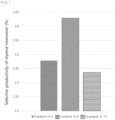
- the depolymerization product was liquefied using a separation column unit filled with a filler material (borosilicate, Raschig ring, 6 mm ⁇ 6 mm) and a separation column unit without a filler material. Then, the liquefied product was subjected to measurement using a GC/FID (Younglin Instruments) equipped with a capillary column (HP-5, 30 m ⁇ 0.32 mm ⁇ 1.0 ⁇ m, Crosslinked 5 % PH ME Siloxane). The results are shown in Tables 8 and 9 and FIGs. 6 and 7 . At this point, the ⁇ selectivity and selective productivity of styrene monomer were calculated using Formulas 4 and 5 below.
- the productivity of styrene monomer refers to the amount of styrene monomer produced in the reactor per unit time.
- [Table 8] Division Presence of Seperation column unit Supply rate of sweepin g gas (cm/min ) Fillin g rate of filler (%) Division Yield (%) or selectivity (%) Liqui d oil Dimers + Toluen e EB styren e a-MS Experimental Example 6-1 nonexistence 0 - Yield 70.9 4.5 1.5 1.1 60.6 3.2 Selectivity - 6.3 2.1 1.6 85.5 4.5 Experiment al Example 6-2 nonexisten ce 0.5 - Yield 87.1 4.1 2.6 0. 5 77.8 2.
- selectivity and yield were inversely proportional to each other, so selectivity and yield were required to be appropriately adjusted considering the situation.
Landscapes
- Chemical & Material Sciences (AREA)
- Organic Chemistry (AREA)
- Chemical Kinetics & Catalysis (AREA)
- Engineering & Computer Science (AREA)
- Sustainable Development (AREA)
- Oil, Petroleum & Natural Gas (AREA)
- Life Sciences & Earth Sciences (AREA)
- General Chemical & Material Sciences (AREA)
- Health & Medical Sciences (AREA)
- Medicinal Chemistry (AREA)
- Polymers & Plastics (AREA)
- Materials Engineering (AREA)
- Separation, Recovery Or Treatment Of Waste Materials Containing Plastics (AREA)
- Organic Low-Molecular-Weight Compounds And Preparation Thereof (AREA)
- Low-Molecular Organic Synthesis Reactions Using Catalysts (AREA)
- Production Of Liquid Hydrocarbon Mixture For Refining Petroleum (AREA)
Applications Claiming Priority (2)
| Application Number | Priority Date | Filing Date | Title |
|---|---|---|---|
| KR1020220047724A KR102551161B1 (ko) | 2022-04-18 | 2022-04-18 | 폐 폴리스티렌으로부터 스티렌 모노머의 연속 회수 방법 |
| PCT/KR2023/005183 WO2023204553A1 (ko) | 2022-04-18 | 2023-04-17 | 폐 폴리스티렌으로부터 스티렌 모노머의 연속 회수 방법 |
Publications (1)
| Publication Number | Publication Date |
|---|---|
| EP4512792A1 true EP4512792A1 (de) | 2025-02-26 |
Family
ID=87156683
Family Applications (1)
| Application Number | Title | Priority Date | Filing Date |
|---|---|---|---|
| EP23792129.1A Pending EP4512792A1 (de) | 2022-04-18 | 2023-04-17 | Verfahren zur kontinuierlichen rückgewinnung von styrolmonomer aus polystyrolabfall |
Country Status (6)
| Country | Link |
|---|---|
| US (1) | US20250263533A1 (de) |
| EP (1) | EP4512792A1 (de) |
| JP (1) | JP2025512552A (de) |
| KR (1) | KR102551161B1 (de) |
| CN (1) | CN119053575A (de) |
| WO (1) | WO2023204553A1 (de) |
Family Cites Families (11)
| Publication number | Priority date | Publication date | Assignee | Title |
|---|---|---|---|---|
| US5264640A (en) * | 1992-04-06 | 1993-11-23 | S-P Reclamation, Inc. | Depolymerization method for resource recovery from polymeric wastes |
| JPH08283745A (ja) * | 1995-04-14 | 1996-10-29 | Kanegafuchi Chem Ind Co Ltd | スチレン系樹脂の熱分解方法 |
| JP2001316303A (ja) | 2000-03-01 | 2001-11-13 | San Kaihatsu Kk | 触媒法によるポリスチレン樹脂からのスチレンモノマー回収方法 |
| KR200187093Y1 (ko) | 2000-01-14 | 2000-06-15 | 이금자 | 압력계 케이스 |
| JP2001294708A (ja) | 2000-04-11 | 2001-10-23 | Sanesu:Kk | ポリスチレン樹脂からのスチレンモノマーの回収方法およびそれに用いられる装置 |
| KR100468047B1 (ko) | 2002-04-12 | 2005-01-24 | 한국화학연구원 | 폐폴리스티렌으로부터 스티렌모노머의 회수방법 |
| JP2014070132A (ja) * | 2012-09-28 | 2014-04-21 | Teijin Ltd | ポリエステル原料の製造方法 |
| KR101838815B1 (ko) * | 2016-11-07 | 2018-03-14 | 서강대학교산학협력단 | 미반응 모노머 회수 장치 및 회수 방법 |
| KR20210113263A (ko) * | 2019-01-07 | 2021-09-15 | 이네오스 스티롤루션 그룹 게엠베하 | 스티렌계 모노머-함유 폴리머의 해중합 및 스티렌계 모노머의 회수를 위한 공정 |
| EP4031610B1 (de) * | 2019-09-18 | 2024-11-06 | INEOS Styrolution Group GmbH | Verfahren zur depolymerisation von polystyrol |
| EP4306504B1 (de) * | 2021-04-16 | 2026-04-08 | Korea Research Institute of Chemical Technology | Verfahren zur rückgewinnung von styrolmonomeren aus polystyrolabfällen |
-
2022
- 2022-04-18 KR KR1020220047724A patent/KR102551161B1/ko active Active
-
2023
- 2023-04-17 CN CN202380034629.5A patent/CN119053575A/zh active Pending
- 2023-04-17 EP EP23792129.1A patent/EP4512792A1/de active Pending
- 2023-04-17 JP JP2024560924A patent/JP2025512552A/ja active Pending
- 2023-04-17 WO PCT/KR2023/005183 patent/WO2023204553A1/ko not_active Ceased
- 2023-04-17 US US18/858,214 patent/US20250263533A1/en active Pending
Also Published As
| Publication number | Publication date |
|---|---|
| WO2023204553A1 (ko) | 2023-10-26 |
| CN119053575A (zh) | 2024-11-29 |
| JP2025512552A (ja) | 2025-04-17 |
| US20250263533A1 (en) | 2025-08-21 |
| KR102551161B1 (ko) | 2023-07-04 |
Similar Documents
| Publication | Publication Date | Title |
|---|---|---|
| Kaminsky et al. | New pathways in plastics recycling | |
| US6160031A (en) | Process for decomposing a polymer to its monomer or monomers | |
| US20100234648A1 (en) | Process for producing tertiary olefin and aliphatic alcohol | |
| JP7581538B2 (ja) | 廃ポリスチレンからスチレンモノマーを回収する方法 | |
| EP3841083A1 (de) | Verfahren zur katalytischen herstellung von raffinierten enalprodukten aus einem aldehydspeisestrom unter verwendung einer einzigen geschlossenen einheit | |
| KR101149320B1 (ko) | 스티렌모노머 회수장치 및 회수방법 | |
| EP4512792A1 (de) | Verfahren zur kontinuierlichen rückgewinnung von styrolmonomer aus polystyrolabfall | |
| GB2228493A (en) | A method for recovering styrene monomer from discarded polystyrene scrap through pyrolytic reduction | |
| KR100468047B1 (ko) | 폐폴리스티렌으로부터 스티렌모노머의 회수방법 | |
| CN114835564A (zh) | 缩合法生产光引发剂uv-1173的方法 | |
| KR20220076183A (ko) | 촉매 및 이를 이용한 폴리스티렌으로부터 스티렌 모노머 제조 방법 | |
| Bhaskar et al. | Pyrolysis study of a PVDC and HIPS-Br containing mixed waste plastic stream: Effect of the poly (ethylene terephthalate) | |
| JP2004238393A (ja) | グリセリン、硝酸および苛性アルカリからグリシジルニトレートを製造するための連続法および装置系、並びにグリシジルニトレートのポリ・グリシジルニトレートへの転化 | |
| JPS5835135A (ja) | フロログルシンの製造法 | |
| KR102525838B1 (ko) | 폐 폴리스티렌으로부터 스티렌 모노머를 회수하는 방법 | |
| JP2009298877A (ja) | プラスチックの処理方法 | |
| CN111362786B (zh) | 一种丙烯酸甲酯重组分回收利用的方法 | |
| JP3866876B2 (ja) | テレフタル酸ジメチルの回収方法 | |
| CN105523883B (zh) | 一种光催化甲苯转化为氯代甲苯的方法 | |
| KR20150088484A (ko) | 공정 폐수를 재활용하는 1,3-부타디엔 제조시스템 및 방법 | |
| JP2003268098A (ja) | ポリエステル樹脂廃棄物の再利用方法および装置 | |
| JP2007291039A (ja) | ベンゼン類の製造方法およびプラスチックの処理方法 | |
| KR20260009488A (ko) | 폐폴리스티렌의 해중합 방법 | |
| KR20050019432A (ko) | 폴리스틸렌 열분해 연속반응기 및 이를 이용한 스틸렌모노머 회수방법 | |
| JP2007291289A (ja) | プラスチックの処理方法およびその処理装置ならびにベンゼン類の製造方法およびその製造装置 |
Legal Events
| Date | Code | Title | Description |
|---|---|---|---|
| STAA | Information on the status of an ep patent application or granted ep patent |
Free format text: STATUS: THE INTERNATIONAL PUBLICATION HAS BEEN MADE |
|
| PUAI | Public reference made under article 153(3) epc to a published international application that has entered the european phase |
Free format text: ORIGINAL CODE: 0009012 |
|
| STAA | Information on the status of an ep patent application or granted ep patent |
Free format text: STATUS: REQUEST FOR EXAMINATION WAS MADE |
|
| 17P | Request for examination filed |
Effective date: 20241105 |
|
| AK | Designated contracting states |
Kind code of ref document: A1 Designated state(s): AL AT BE BG CH CY CZ DE DK EE ES FI FR GB GR HR HU IE IS IT LI LT LU LV MC ME MK MT NL NO PL PT RO RS SE SI SK SM TR |
|
| DAV | Request for validation of the european patent (deleted) | ||
| DAX | Request for extension of the european patent (deleted) |