EP4516535A1 - Pneu ayant une bande de caoutchouc électroconductrice - Google Patents
Pneu ayant une bande de caoutchouc électroconductrice Download PDFInfo
- Publication number
- EP4516535A1 EP4516535A1 EP24195520.2A EP24195520A EP4516535A1 EP 4516535 A1 EP4516535 A1 EP 4516535A1 EP 24195520 A EP24195520 A EP 24195520A EP 4516535 A1 EP4516535 A1 EP 4516535A1
- Authority
- EP
- European Patent Office
- Prior art keywords
- tread
- tire
- rubber
- strip
- phr
- Prior art date
- Legal status (The legal status is an assumption and is not a legal conclusion. Google has not performed a legal analysis and makes no representation as to the accuracy of the status listed.)
- Pending
Links
Images


Classifications
-
- B—PERFORMING OPERATIONS; TRANSPORTING
- B60—VEHICLES IN GENERAL
- B60C—VEHICLE TYRES; TYRE INFLATION; TYRE CHANGING; CONNECTING VALVES TO INFLATABLE ELASTIC BODIES IN GENERAL; DEVICES OR ARRANGEMENTS RELATED TO TYRES
- B60C19/00—Tyre parts or constructions not otherwise provided for
- B60C19/08—Electric-charge-dissipating arrangements
- B60C19/086—Electric-charge-dissipating arrangements using conductive sidewalls
-
- B—PERFORMING OPERATIONS; TRANSPORTING
- B60—VEHICLES IN GENERAL
- B60C—VEHICLE TYRES; TYRE INFLATION; TYRE CHANGING; CONNECTING VALVES TO INFLATABLE ELASTIC BODIES IN GENERAL; DEVICES OR ARRANGEMENTS RELATED TO TYRES
- B60C1/00—Tyres characterised by the chemical composition or the physical arrangement or mixture of the composition
- B60C1/0025—Compositions of the sidewalls
-
- B—PERFORMING OPERATIONS; TRANSPORTING
- B60—VEHICLES IN GENERAL
- B60C—VEHICLE TYRES; TYRE INFLATION; TYRE CHANGING; CONNECTING VALVES TO INFLATABLE ELASTIC BODIES IN GENERAL; DEVICES OR ARRANGEMENTS RELATED TO TYRES
- B60C19/00—Tyre parts or constructions not otherwise provided for
- B60C19/08—Electric-charge-dissipating arrangements
-
- B—PERFORMING OPERATIONS; TRANSPORTING
- B60—VEHICLES IN GENERAL
- B60C—VEHICLE TYRES; TYRE INFLATION; TYRE CHANGING; CONNECTING VALVES TO INFLATABLE ELASTIC BODIES IN GENERAL; DEVICES OR ARRANGEMENTS RELATED TO TYRES
- B60C19/00—Tyre parts or constructions not otherwise provided for
- B60C19/08—Electric-charge-dissipating arrangements
- B60C19/082—Electric-charge-dissipating arrangements comprising a conductive tread insert
-
- C—CHEMISTRY; METALLURGY
- C08—ORGANIC MACROMOLECULAR COMPOUNDS; THEIR PREPARATION OR CHEMICAL WORKING-UP; COMPOSITIONS BASED THEREON
- C08K—Use of inorganic or non-macromolecular organic substances as compounding ingredients
- C08K3/00—Use of inorganic substances as compounding ingredients
- C08K3/02—Elements
- C08K3/04—Carbon
-
- C—CHEMISTRY; METALLURGY
- C08—ORGANIC MACROMOLECULAR COMPOUNDS; THEIR PREPARATION OR CHEMICAL WORKING-UP; COMPOSITIONS BASED THEREON
- C08L—COMPOSITIONS OF MACROMOLECULAR COMPOUNDS
- C08L25/00—Compositions of, homopolymers or copolymers of compounds having one or more unsaturated aliphatic radicals, each having only one carbon-to-carbon double bond, and at least one being terminated by an aromatic carbocyclic ring; Compositions of derivatives of such polymers
- C08L25/02—Homopolymers or copolymers of hydrocarbons
- C08L25/04—Homopolymers or copolymers of styrene
- C08L25/08—Copolymers of styrene
- C08L25/10—Copolymers of styrene with conjugated dienes
-
- B—PERFORMING OPERATIONS; TRANSPORTING
- B60—VEHICLES IN GENERAL
- B60C—VEHICLE TYRES; TYRE INFLATION; TYRE CHANGING; CONNECTING VALVES TO INFLATABLE ELASTIC BODIES IN GENERAL; DEVICES OR ARRANGEMENTS RELATED TO TYRES
- B60C1/00—Tyres characterised by the chemical composition or the physical arrangement or mixture of the composition
- B60C1/0016—Compositions of the tread
-
- B—PERFORMING OPERATIONS; TRANSPORTING
- B60—VEHICLES IN GENERAL
- B60C—VEHICLE TYRES; TYRE INFLATION; TYRE CHANGING; CONNECTING VALVES TO INFLATABLE ELASTIC BODIES IN GENERAL; DEVICES OR ARRANGEMENTS RELATED TO TYRES
- B60C11/00—Tyre tread bands; Tread patterns; Anti-skid inserts
- B60C11/0041—Tyre tread bands; Tread patterns; Anti-skid inserts comprising different tread rubber layers
- B60C11/005—Tyre tread bands; Tread patterns; Anti-skid inserts comprising different tread rubber layers with cap and base layers
-
- B—PERFORMING OPERATIONS; TRANSPORTING
- B60—VEHICLES IN GENERAL
- B60C—VEHICLE TYRES; TYRE INFLATION; TYRE CHANGING; CONNECTING VALVES TO INFLATABLE ELASTIC BODIES IN GENERAL; DEVICES OR ARRANGEMENTS RELATED TO TYRES
- B60C11/00—Tyre tread bands; Tread patterns; Anti-skid inserts
- B60C11/0041—Tyre tread bands; Tread patterns; Anti-skid inserts comprising different tread rubber layers
- B60C11/005—Tyre tread bands; Tread patterns; Anti-skid inserts comprising different tread rubber layers with cap and base layers
- B60C11/0058—Tyre tread bands; Tread patterns; Anti-skid inserts comprising different tread rubber layers with cap and base layers with different cap rubber layers in the axial direction
-
- B—PERFORMING OPERATIONS; TRANSPORTING
- B60—VEHICLES IN GENERAL
- B60C—VEHICLE TYRES; TYRE INFLATION; TYRE CHANGING; CONNECTING VALVES TO INFLATABLE ELASTIC BODIES IN GENERAL; DEVICES OR ARRANGEMENTS RELATED TO TYRES
- B60C11/00—Tyre tread bands; Tread patterns; Anti-skid inserts
- B60C11/0041—Tyre tread bands; Tread patterns; Anti-skid inserts comprising different tread rubber layers
- B60C11/005—Tyre tread bands; Tread patterns; Anti-skid inserts comprising different tread rubber layers with cap and base layers
- B60C11/0058—Tyre tread bands; Tread patterns; Anti-skid inserts comprising different tread rubber layers with cap and base layers with different cap rubber layers in the axial direction
- B60C11/0066—Tyre tread bands; Tread patterns; Anti-skid inserts comprising different tread rubber layers with cap and base layers with different cap rubber layers in the axial direction having an asymmetric arrangement
-
- B—PERFORMING OPERATIONS; TRANSPORTING
- B60—VEHICLES IN GENERAL
- B60C—VEHICLE TYRES; TYRE INFLATION; TYRE CHANGING; CONNECTING VALVES TO INFLATABLE ELASTIC BODIES IN GENERAL; DEVICES OR ARRANGEMENTS RELATED TO TYRES
- B60C11/00—Tyre tread bands; Tread patterns; Anti-skid inserts
- B60C11/0041—Tyre tread bands; Tread patterns; Anti-skid inserts comprising different tread rubber layers
- B60C11/005—Tyre tread bands; Tread patterns; Anti-skid inserts comprising different tread rubber layers with cap and base layers
- B60C11/0075—Tyre tread bands; Tread patterns; Anti-skid inserts comprising different tread rubber layers with cap and base layers with different base rubber layers in the axial direction
Definitions
- the present invention is directed to a tire comprising a rubber strip having an electrical volume resistivity lower than 10 8 Ohm ⁇ cm, particularly for conducting electrical charges from the tire's bead portion to the tread of the tire. Moreover, the present invention is directed to methods of building such a tire.
- Tires need a certain electrical conductivity to allow conduction of electrostatic charges from the vehicle to the environment. In particular, this helps to prevent electrostatic shocks, e.g., when touching the car.
- This electrical conductivity is typically achieved by sufficient amounts of carbon black in rubber compositions in multiple tire components so as to provide a conductive pathway between rim and road surface.
- carbon black is detrimental to reduced rolling resistance. It would be desirable to provide tires with reduced rolling resistance while ensuring sufficient electrical conductivity of the tire.
- U.S. Patent Application Publication 2005/0103412 A1 discloses a tire with a rubber sidewall containing an internal electrically conductive rubber strip. This strip extends from an electrically conductive tread base layer in an area axially outside and radially below a belt portion of the tire into a bead area of the tire.
- An aim of this design is to conduct electrical charges from the electrically conductive tread base layer through the rubber strip arranged next to a carcass ply into an area neighboring the bead, which is also in contact with an electrically conductive chafer. While this design may provide an electrical path for some tire types it is not suitable for other tire types. Moreover, it is desirable to provide further advanced conductive passages through a tire.
- the invention relates to a tire in accordance with claim 1.
- a first preferred aspect of the present invention is directed to a tire comprising a tread, a pair of bead portions, a pair of sidewalls, wherein each of the sidewalls extends from the tread to a respective bead portion, at least one carcass ply, and one or more belt plies arranged radially between the tread and the at least one carcass ply in a crown area of the tire.
- the tread comprises a tread strip having an electrical volume resistivity lower than 10 8 Ohm ⁇ cm and extending from a radially outer surface of the tread to a radially inner position of the tread, wherein said radially inner position is radially above the belt plies.
- the tire comprises at least one rubber strip having an electrical volume resistivity lower than 10 8 Ohm ⁇ cm and extending from a radially inner position of the tread strip along a radially inner side of the tread towards one of the sidewalls and along one of the sidewalls towards the respective bead portion.
- a second preferred aspect of the present invention is directed to a tire comprising a tread, a pair of bead portions, a pair of sidewalls, wherein each of the sidewalls extends from the tread to a respective bead portion, at least one carcass ply, and one or more belt plies arranged radially between the tread and the at least one carcass ply in a crown area of the tire.
- the tread comprises a tread base layer having an electrical volume resistivity lower than 10 8 Ohm cm.
- the tire comprises at least one rubber strip having an electrical volume resistivity lower than 10 8 Ohm ⁇ cm and extending from a radially inner side of the tread base layer and along an axially outer surface of the sidewall towards the respective bead portion.
- the rubber strip has a maximum width, measured in the circumferential direction, which is less than 100 mm.
- the tread base layer further comprises an integrally formed tread strip having an electrical volume resistivity lower than 10 8 Ohm ⁇ cm and extending from a radially outer surface of the tread transversely to the axial direction through the tread.
- the tread further comprises at least one tread cap layer, wherein the at least one tread cap layer and the sidewalls comprise one or more of: a) one or more rubber compositions having an electrical volume resistivity which is higher than 10 9 Ohm ⁇ cm; b) one or more rubber compositions comprising less than 45 phr carbon black; and c) one or more rubber compositions comprising carbon black having an iodine absorption of less than 90 g/kg.
- the present invention is directed to a tire comprising a tread, a pair of bead portions, a pair of sidewalls, wherein each of the sidewalls extends from the tread to a respective (one of the) bead portion(s), at least one carcass ply, and one or more belt plies arranged radially between the tread and the at least one carcass ply in a crown area of the tire.
- the tread comprises a tread strip having an electrical volume resistivity lower than 10 8 Ohm ⁇ cm and extending from a radially outer surface of the tread (which contacts the road when driving) to a radially inner position of the tread (preferably through the tread, e.g., transversely through the tread), wherein said radially inner position is radially above the belt plies.
- the tire comprises at least one rubber strip having an electrical volume resistivity lower than 10 8 Ohm ⁇ cm and extending from a radially inner (or innermost) position of the tread strip along a radially inner side (or bottom) of the tread, preferably towards one of the sidewalls, and along one of the sidewalls (e.g., in a radially inner direction) towards the respective bead portion.
- the present invention provides an efficient electrically conductive pathway between the surface of the tread and the bead portion of the tire.
- the present invention according to the first aspect does not require electrically conductive tread cap and/or tread base layers as in the prior art. This helps to provide tires with even less electrically conductive material which allows constructions with further reduced rolling resistance.
- Electrical volume resistivity is determined herein in accordance with ASTM D257-98, or equivalent.
- the present invention is directed to a tire comprising a tread, a pair of bead portions, a pair of sidewalls, wherein each of the sidewalls extends from the tread to a respective bead portion, at least one carcass ply, and one or more belt plies arranged radially between the tread and the at least one carcass ply in a crown area of the tire.
- the tread comprises a tread base layer having an electrical volume resistivity lower than 10 8 Ohm ⁇ cm.
- the tire comprises at least one rubber strip having an electrical volume resistivity lower than 10 8 Ohm ⁇ cm and extending from (and at least partially along) a radially inner side of the tread base layer and along an axially outer surface of the sidewall towards the respective bead portion.
- electrical conduction is provided by leveraging the electrical conductivity of a tread base layer in combination with an electrically conductive rubber strip so as to provide an electrically conductive pathway between the rim / bead portion and the tire tread or the road.
- the rubber strip has a maximum width, preferably measured in the circumferential direction, which is less than 100 mm or even less than 50 mm.
- the rubber strip does not extend over the whole circumference of the tire and/or a major part of the whole circumference of the tire.
- the tread base layer further comprises an integrally formed tread strip having an electrical volume resistivity lower than 10 8 Ohm ⁇ cm and extending from a radially outer surface of the tread (or, in other words up to the radially outer surface/side of the tread), and preferably transversely to the axial direction, through the tread.
- the tread strip preferably consists of the same rubber composition as the tread base layer.
- the tread further comprises at least one tread cap layer (such as two tread cap layers), wherein the at least one tread cap layer and/or one or both sidewalls comprise one or more of: a) one or more rubber compositions having an electrical volume resistivity which is higher than 10 9 Ohm ⁇ cm; b) one or more rubber compositions comprising less than 45 phr carbon black; and c) one or more rubber compositions comprising carbon black having an iodine absorption of less than 90 g/kg.
- the at least one tread cap layer and/or one or both sidewalls comprise one or more of: a) one or more rubber compositions having an electrical volume resistivity which is higher than 10 9 Ohm ⁇ cm; b) one or more rubber compositions comprising less than 45 phr carbon black; and c) one or more rubber compositions comprising carbon black having an iodine absorption of less than 90 g/kg.
- the rubber strip extends radially above a radially outermost belt ply (e.g., along a bottom of the tread and/or along the radially outermost belt ply) over at least 10% (preferably at least 15%) of a total axial width of the radially outermost belt ply.
- it extends over less than 55%, preferably less than 50%, or even less than 25% of the total axial width of the radially outermost belt ply. It is not necessary to have an electrically conductive tread base layer extending over the whole axial width of the tread.
- the tread strip extends transversely to the axial direction, e.g., essentially in a radial direction or in the radial direction, through the tread.
- the tread strip extends also circumferentially through the tread, e.g., over the full circumference of the tread.
- the tread strip electrically connects the radially outer surface of the tread (intended to contact the road) with the radially inner surface or bottom of the tread. In other words, it provides an electrically conductive path from said surface of the tread to a radially inner bottom (surface) of the tread.
- transversely to the axial direction means herein, extending in a direction perpendicular to the axial direction, i.e., the radial direction, and/or extending in a direction of an angle with the radial direction, such as less than 20°, preferably less than 10°, less than 5°, or even less than 2°.
- the tread strip extends straightly or essentially straightly through the tread.
- the tread comprises one or more of i) at least one tread cap layer and/or a tread base layer, and ii) at least one tread cap layer but is devoid of a tread base layer.
- the tread may have a cap-base construction.
- the tread may only have a cap without a base.
- the tread cap may comprise multiple tread layers.
- the tread strip extends (for instance transversely or radially) through the whole thickness of the tread.
- the tread strip extends completely through the tread cap and tread base so as to reach the radially inner bottom of the tread.
- the tread strip extends preferably through all layers of the tread to reach the bottom of the tread.
- the tread apart from or except for the tread strip, the tread (optionally, each of its tread layers) has an electrical volume resistivity which is higher than 10 10 Ohm ⁇ cm, preferably higher than 10 11 Ohm ⁇ cm or higher than 10 12 Ohm ⁇ cm. Optionally said volume resistivity is at most 10 14 Ohm ⁇ cm. If the tread comprises multiple tread rubber compositions, preferably each of these tread rubber compositions has an electrical volume resistivity within one of the above ranges.
- the tire is devoid of a tread base layer.
- the tire is devoid of an electrically conductive tread base layer, and/or is devoid of a tread base layer having an electrical volume resistivity of less than 10 8 Ohm ⁇ cm.
- one or more of the i) tread strip, ii) rubber strip, and iii) a member, or a rubber component, of the bead portion have one or more of a) an electrical volume resistivity which is lower than 10 7 Ohm ⁇ cm, preferably lower than 0.5 ⁇ 10 7 Ohm ⁇ cm; b) a rubber composition having at least 39 phr, or 40 phr, or 50 phr, preferably at least 60 phr, of carbon black; c) a rubber composition comprising carbon black having an iodine absorption of at least 100 g/kg, preferably within a range of 100 g/kg to 300 g//kg, even more preferably within a range of 100 g/kg to 250 g/kg, or within a range of 110 g/kg to 200 g/kg.
- the tread strip may comprise or consist of a tread strip rubber composition
- the rubber strip may comprise or consist of a rubber strip rubber composition
- the member of the bead portion may comprise or consists of a bead portion member rubber composition, such as a chafer rubber composition.
- Iodine absorption or iodine absorption values are determined herein according to ASTM D1510, or equivalent.
- one or more of a i) tread cap layer, ii) tread base layer, iii) one or both sidewalls, iv) the one or more belt plies, and v) an overlay of the tire, vi) one or more chafers of the tire (if not required to be electrically conductive), and vii) the at least one carcass ply comprise one or more of a) a rubber composition having an electrical volume resistivity which is higher than 10 9 Ohm ⁇ cm, preferably higher than 10 10 Ohm ⁇ cm or even higher than 10 12 Ohm ⁇ cm; b) a rubber composition having less than 45 phr of carbon black, preferably less than 40 phr of carbon black, more preferably less than 20 phr of carbon black, or even less than 10 phr of carbon black; and c) a rubber composition comprising carbon black having an iodine absorption of less than 90 g/kg, preferably less than 80 g/kg, or less than 50 g/
- each of these components comprises or consists of a rubber composition having such a volume resistivity and/or carbon black content.
- the tread cap layer may comprise or consist of a tread cap layer rubber composition
- the tread base layer may comprise or consist of a tread base layer rubber composition
- a sidewall may comprise or consist of a sidewall rubber composition
- the one or more belt plies may comprise a belt ply (coating) rubber composition
- a carcass ply may comprise a carcass ply (coating) rubber composition
- an overlay ply may comprise an overlay ply (coating) rubber composition
- a chafer may comprise a chafer rubber composition.
- Each of these rubber compositions is preferably within the claimed resistivity ranges and/or has the mentioned amount of carbon black.
- a minimum amount of carbon black is preferably 0.1 phr in one or more of the above compositions. However, it may also be zero, particularly in components not visible on the surface of the tire.
- the rubber strip extends perpendicular or essentially perpendicular to the circumferential direction of the tire. In other words, preferably, the length of the strip does not extend in a circumferential direction of the tire.
- the tread strip has a (preferably maximum) width within a range of 0.2 mm to 9 mm, measured in the axial direction of the tire.
- the rubber strip extends along the sidewall between the sidewall and the carcass ply and/or within the tire.
- the strip is not visible on the exterior of the tire and/or protected by the sidewall of the tire against damages and weather conditions such as UV light.
- the tire has a chafer having an electrical volume resistivity lower than 10 8 Ohm ⁇ cm and which is arranged at least at an axially outer side of the bead portion which is (preferably in direct) contact with the rubber strip.
- a radially lower end of the rubber strip contacts a radially upper end of the chafer.
- the rubber strip radially overlaps with the chafer by one or more of: i) less than 10 mm, and ii) less than 20%, preferably less than 10% of the total radial height of the chafer.
- the rubber strip radially overlaps with the chafer by at least 1 mm, preferably by at least 2 mm, 5mm or 10 mm.
- the rubber strip extends radially below and along the tread (e.g. the bottom of the tread) from said radially inner position of the tread strip to an axially outermost position of the tread, and/or along the sidewall on an axially outer surface of the sidewall, and optionally along an axially outer surface of a chafer of the tire, to the bead portion or a position radially below the bead portion.
- the rubber strip extends at least to a radially innermost position on the surface of the tire (at the respective bead portion). This further improves the electrical contact with a corresponding rim on which the tire can be mounted.
- the rubber strip comprises a surface pattern (at least partially visible on the axially outer surface of the tire).
- a surface pattern may include one or more of: stripes, a hatching, one or more logos, letters, numbers, a barcode, a QR-code, and combinations thereof.
- such a pattern may include information for identification of the tire and/or its (technical) properties.
- the tire comprises two rubber strips.
- one rubber strip is provided on each lateral/axial side of the tire.
- the two rubber strips are provided in the same circumferential portion or circumferential/angular sector of the tire. In other words, they are (axially) oppositely arranged, which may help to avoid mass imbalances.
- both rubber strips are provided on (only) one lateral/axial side of the tire, preferably at opposite circumferential positions, or in other words opposite angular sectors of the tire.
- the tire has a defined direction of rotation (such as indicated on the sidewall of the tire), wherein the at least one rubber strip is provided on an (axial) inboard side of the tire.
- a defined direction of rotation such as indicated on the sidewall of the tire
- the at least one rubber strip is provided on an (axial) inboard side of the tire.
- the tire is selected from one or more of a radial tire, a pneumatic tire, a passenger car tire.
- a rubber composition may include at least one or more and/or one or more additional diene-based rubbers, such as one or more of styrene butadiene rubber (SBR, e.g., S-SBR or E-SBR), natural rubber (NR), synthetic polyisoprene (PI), and polybutadiene rubber (BR).
- SBR styrene butadiene rubber
- NR natural rubber
- PI synthetic polyisoprene
- BR polybutadiene rubber
- a synthetic or natural polyisoprene rubber may be used.
- Synthetic cis-1,4-polyisoprene and natural rubber are as such well known to those having skill in the rubber art.
- the cis 1,4-microstructure content may be at least 90% and is typically at least 95% or even higher.
- cis-1,4-polybutadiene rubber is used.
- Suitable polybutadiene rubbers may be prepared, for example, by organic solution polymerization of 1,3-butadiene.
- the BR may be conveniently characterized, for example, by having at least a 90 percent cis-1,4-microstructure content ("high cis” content) and a glass transition temperature (Tg) in a range of from -95 °C to -110°C.
- Suitable polybutadiene rubbers are available commercially, such as Budene ® 1207, Budene ® 1208, Budene ® 1223, or Budene ® 1280 from The Goodyear Tire & Rubber Company.
- These high cis-1,4-polybutadiene rubbers can for instance be synthesized utilizing nickel catalyst systems which include a mixture of (1) an organonickel compound, (2) an organoaluminum compound, and (3) a fluorine containing compound as described in United States Patent 5,698,643 and United States Patent 5,451,646 , which are incorporated herein by reference.
- a glass transition temperature, or Tg, of an elastomer represents the glass transition temperature of the respective elastomer in its uncured state.
- a glass transition temperature of an elastomer composition represents the glass transition temperature of the elastomer composition in its cured state.
- a Tg is determined as a peak midpoint by a differential scanning calorimeter (DSC) at a temperature rate of increase of 20° C per minute, according to ASTM D3418 or equivalent.
- phr refers to "parts by weight of a respective material per 100 parts by weight of rubber, or elastomer".
- a rubber composition is comprised of 100 parts by weight of rubber/elastomer.
- the claimed composition may comprise other rubbers / elastomers than explicitly mentioned in the claims, provided that the phr value of the claimed rubbers / elastomers is in accordance with claimed phr ranges and the amount of all rubbers / elastomers in the composition results in total in 100 parts of rubber.
- compound and “composition” and “formulation” may be used herein interchangeably, unless indicated otherwise.
- the terms “rubber” and “elastomer” may also be interchangeably used herein.
- the rubber composition includes from 1 phr to 80 phr, or from 5 phr to 80 phr, of a resin, preferably having a glass transition temperature Tg greater than 20° C.
- a Tg for resins is determined as a peak midpoint by a differential scanning calorimeter (DSC) at a temperature rate of increase of 10° C per minute, according to ASTM D6604 or equivalent.
- the resin has a softening point above 70° C as determined by ASTM E28 which might sometimes be referred to as a ring and ball softening point.
- the rubber composition includes from 10 phr to 60 phr or from 20 phr to 60 phr or from 30 phr to 60 phr of resin, particularly if the rubber composition is a tread cap rubber composition.
- the resin is selected from the group consisting of coumarone-indene resin, petroleum hydrocarbon resin, terpene polymers/resins, styrene/alphamethylstyrene resins, terpene phenol resin, rosin derived resins and copolymers and/or mixtures thereof.
- a coumarone-indene resin preferably contains coumarone and indene as monomer components making up the resin skeleton (main chain).
- Monomer ingredients other than coumarone and indene which may be incorporated into the skeleton are, for example, methyl coumarone, styrene, alphamethylstyrene, methylindene, vinyltoluene, dicyclopentadiene, cyclopentadiene, and diolefins such as isoprene and piperlyene.
- Coumarone-indene resins have preferably softening points ranging from 10° C to 160° C (as measured by the ball-and-ring method). Even more preferably, the softening point ranges from 30° C to 100° C.
- Suitable petroleum resins include both aromatic and nonaromatic types. Several types of petroleum resins are available. Some resins have a low degree of unsaturation and high aromatic content, whereas some are highly unsaturated and yet some contain no aromatic structure at all. Differences in the resins are largely due to the olefins in the feedstock from which the resins are derived.
- Conventional derivatives in such resins include any C5 species (olefins and diolefines containing an average of five carbon atoms) such as cyclopentadiene, dicyclopentadiene, diolefins such as isoprene and piperylene, and any C9 species (olefins and diolefins containing an average of 9 carbon atoms) such as vinyltoluene, alphamethylstyrene and indene.
- Such resins are made by any mixture formed from C5 and C9 species mentioned above, and are known as C5/C9 copolymer resins. Petroleum resins are typically available with softening points ranging from 10° C. to 120° C. Preferably, the softening point ranges from 30 to 100° C.
- C5 resins are aliphatic resins made from one or more of the following monomers: 1,3-pentadiene (e.g., cis or trans), 2-methyl-2-butene, cyclopentene, cyclopentadiene, and dicyclopentadiene.
- a C9 resin is a resin made from one or more aromatic monomers, preferably chosen from the group of indene, methylindene, vinyl toluene, styrene and methylstyrene (such as alpha-methylstyrene).
- a C9 modified resin is a resin (such as a C5 resin) which has been modified or functionalized with one or more aromatic monomers, preferably chosen from the group of indene, methylindene, vinyl toluene, styrene and methylstyrene (such as alpha methylstyrene).
- Terpene resins are preferably comprised of polymers of at least one of limonene, alpha pinene, beta pinene and delta-3-carene. Such resins are available with softening points ranging from 10° C to 135° C.
- Terpene-phenol resins may be derived by copolymerization of phenolic monomers with terpenes such as limonenes, pinenes and delta-3-carene.
- resins derived from rosins and derivatives thereof are, for example, gum rosin, wood rosin and tall oil rosin. Gum rosin, wood rosin and tall oil rosin have similar compositions, although the amount of components of the rosins may vary. Such resins may be dimerized, polymerized or disproportionated. Such resins may be in the form of esters of rosin acids and polyols such as pentaerythritol or glycol.
- a styrene/alphamethylstyrene resin is considered herein to be a (preferably relatively short chain) copolymer of styrene and alphamethylstyrene with a styrene/alphamethylstyrene molar ratio in a range of 0.05 to 1.50.
- a resin can be suitably prepared, for example, by cationic copolymerization of styrene and alphamethylstyrene in a hydrocarbon solvent.
- the contemplated styrene/alphamethylstyrene resin can be characterized, for example, by its chemical structure, namely its styrene and alphamethylstyrene contents and by its glass transition temperature, molecular weight and molecular weight distribution.
- said resin is partially or fully hydrogenated.
- a rubber composition comprises oil, such as processing oil.
- Oil may be included in the rubber composition as extending oil typically used to extend elastomers. Oil may also be included in the rubber composition by addition of the oil directly during rubber compounding. Oil used may include both extending oil present in the elastomers, and (process) oil added during compounding.
- Suitable oils may include various oils as are known in the art, including aromatic, paraffinic, naphthenic, vegetable oils, and low PCA oils, such as MES, TDAE, SRAE and heavy naphthenic oils.
- Suitable low PCA oils may include those having a polycyclic aromatic content of less than 3 percent by weight as determined by the IP346 method.
- the IP346 method may be found in Standard Methods for Analysis & Testing of Petroleum and Related Products and British Standard 2000 Parts, 2003, 62nd edition, published by the Institute of Petroleum, United Kingdom .
- vegetable oils that can be used include soybean oil, sunflower oil, canola (rapeseed) oil, corn oil, coconut oil, cottonseed oil, olive oil, palm oil, peanut oil, and safflower oil. Soybean oil and corn oil are typically preferred vegetable oils.
- the rubber composition may also include up to 40 phr of processing oil, preferably between 1 phr and 25 phr. Or can be, alternatively less than 10 phr oil, preferably less than 5 phr. Glass transition temperatures Tg for oils are determined as a peak midpoint by a differential scanning calorimeter (DSC) at a temperature rate of increase of 10°C per minute, according to ASTM E1356, or equivalent.
- DSC differential scanning calorimeter
- a rubber composition comprises silica, particularly if it is a tread rubber composition.
- Silica may be for instance pyrogenic/fumed or precipitated silica. In preferred embodiments, precipitated silica is used.
- Silicas might be characterized, for example, by having a BET surface area, as measured using nitrogen gas. In one embodiment, the BET surface area may be in the range of 40 to 600 square meters per gram. In another embodiment, the BET surface area may be in a range of 50 to 300 square meters per gram. The BET surface area is determined according to ASTM D6556 or equivalent and is described in the Journal of the American Chemical Society, Volume 60, Page 304 (1930 ).
- Silica may also be characterized by having a dibutylphthalate (DBP) absorption value in a range of 100 cm 3 /100g to 400 cm 3 /100g, alternatively 150 cm 3 /100g to 300 cm 3 /100g which is determined according to ASTM D 2414 or equivalent.
- DBP dibutylphthalate
- Silica may have an average ultimate particle size, for example, in the range of 0.01 to 0.05 micron as determined by the electron microscope, although the silica particles may be even smaller, or possibly larger, in size. Ranges of silica use could be for instance between 1 and 120 phr, preferably in a range of between 10 phr and 70 phr herein.
- silicas such as, only for example herein, and without limitation, silicas commercially available from PPG Industries under the Hi-Sil trademark with designations 210, 315G, EZ160G, etc; silicas available from Solvay, with, for example, designations of Z1165MP and Premium200MP, etc.; and silicas available from Evonik AG with, for example, designations VN2 and Ultrasil 6000GR, 9100GR, etc.
- pre-treated silicas which can be used, (i.e., silicas that have been pre-surface treated with a silane) which are suitable for use in the practice of this invention include, but are not limited to, Ciptane ® 255 LD and Ciptane ® LP (PPG Industries) silicas that have been pre-treated with a mercaptosilane, and Coupsil ® 8113 (Degussa) that is the product of the reaction between organosilane Bis(triethoxysilylpropyl) polysulfide (Si69) and Ultrasil ® VN3 silica, and Coupsil ® 6508, Agilon ® 400 silica from PPG Industries, Agilon ® 454 silica from PPG Industries, and Agilon ® 458 silica from PPG Industries.
- the rubber composition may include carbon black.
- carbon blacks include, for instance, N110, N121, N134, N220, N231, N234, N242, N293, N299, N315, N326, N330, N332, N339, N343, N347, N351, N358, N375, N539, N550, N582, N630, N642, N650, N683, N754, N762, N765, N774, N787, N907, N908, N990 and N991 grades.
- a rubber composition may contain sulfur containing organosilicon compounds or silanes.
- suitable sulfur containing organosilicon compounds are of the formula: Z ⁇ Alk - S n ⁇ Alk ⁇ Z I in which Z is selected from the group consisting of where R 1 is an alkyl group of 1 to 4 carbon atoms, cyclohexyl or phenyl; R 2 is an alkoxy of 1 to 8 carbon atoms, or cycloalkoxy of 5 to 8 carbon atoms; Alk is a divalent hydrocarbon of 1 to 18 carbon atoms and n is an integer of 2 to 8.
- the sulfur containing organosilicon compounds are the 3,3'-bis(trimethoxy or triethoxy silylpropyl) polysulfides. In one embodiment, the sulfur containing organosilicon compounds are 3,3'-bis(triethoxysilylpropyl) disulfide and/or 3,3'-bis(triethoxysilylpropyl) tetrasulfide. Therefore, as to formula I, Z may be where R 2 is an alkoxy of 2 to 4 carbon atoms, alternatively 2 carbon atoms; Alk is a divalent hydrocarbon of 2 to 4 carbon atoms, alternatively with 3 carbon atoms; and n is an integer of from 2 to 5, alternatively 2 or 4.
- the amount of the sulfur containing organosilicon compound in a rubber composition may vary depending on the level of other additives that are used.
- the amount of the compound may range from 0.5 phr to 20 phr, particularly in the case of tread rubber compositions. In one embodiment, the amount will range from 1 phr to 10 phr.
- a rubber composition comprises from 0.1 to 5 phr of a cobalt salt, and more preferably from 0.2 phr to 2 phr of a cobalt salt.
- This content may be of particular interest if used in ply coating compounds as it may amongst others improve the adhesion of the rubber coating to the ply or belt material, in particular if such material is metal, preferably brass coated metal as for instance steel.
- the rubber composition may be essentially cobalt free, e.g. comprise less than 0.1 phr cobalt salt or 0 phr cobalt salt.
- the cobalt compound will typically be a cobalt salt of a fatty acid or a cobalt salt of an aliphatic or alicyclic carboxylic acid containing from 6 to 30 carbon atoms.
- Some representative examples of cobalt compounds which may be used include the cobalt salts, cobalt naphthanate, cobalt linoleate, cobalt stearate, cobalt oleate, cobalt acetate, cobalt neodecanoate, cobalt tallate, cobalt resinate, cobalt acetonate, or in situ salts prepared from cobalt hydroxide and an organic acid such as naphthenic acid, stearic acid, oleic acid, acetic acid, linoleic acid and the like.
- Manobond TM C is a cobalt complex of an organic acid containing boron manufactured by Manchem Company.
- Manobond TM C is described in British Patent No. 972,804 , which is incorporated by reference in its entirety.
- a rubber composition may be compounded by methods generally known in the rubber compounding art, such as mixing the various sulfur-vulcanizable constituent rubbers with various commonly used additive materials such as, for example, sulfur donors, curing aids, such as activators and retarders and processing additives, such as oils, resins including tackifying resins and plasticizers, fillers, pigments, fatty acid, zinc oxide, waxes, antioxidants and antiozonants and peptizing agents.
- additives mentioned above are selected and commonly used in conventional amounts.
- sulfur donors include elemental sulfur (free sulfur), an amine disulfide, polymeric polysulfide and sulfur olefin adducts.
- the sulfur-vulcanizing agent is elemental sulfur.
- the sulfur-vulcanizing agent may for instance be used in an amount ranging from 0.5 phr to 8 phr, alternatively within a range of 1.5 phr to 6 phr.
- Typical amounts of tackifier resins, if used, comprise for example 0.5 phr to 10 phr, usually 1 phr to 5 phr.
- processing aids if used, comprise for example 1 phr to 50 phr (this may comprise in particular oil).
- Typical amounts of antioxidants may for example comprise 1 phr to 5 phr.
- Representative antioxidants may be, for example, diphenyl-p-phenylenediamine and others, such as, for example, those disclosed in The Vanderbilt Rubber Handbook (1978), Pages 344 through 346 .
- Typical amounts of antiozonants, if used may for instance comprise 1 phr to 5 phr.
- Typical amounts of fatty acids, if used, which can include stearic acid may for instance comprise 0.5 phr to 3 phr.
- Typical amounts of waxes if used, may for example comprise 1 phr to 5 phr. Often microcrystalline waxes are used.
- Typical amounts of peptizers may for instance comprise 0.1 phr to 1 phr.
- Typical peptizers may be, for example, pentachlorothiophenol and dibenzamidodiphenyl disulfide.
- Accelerators may be preferably but not necessarily used to control the time and/or temperature required for vulcanization and to improve the properties of the vulcanizate.
- a single accelerator system may be used, i.e., primary accelerator.
- the primary accelerator(s) may be used in total amounts ranging from 0.5 phr to 4 phr, alternatively 0.8 phr to 1.5 phr.
- combinations of a primary and a secondary accelerator might be used with the secondary accelerator being used in smaller amounts, such as from 0.05 phr to 3 phr, in order to activate and to improve the properties of the vulcanizate.
- accelerators might be expected to produce a synergistic effect on the final properties and are somewhat better than those produced by use of either accelerator alone.
- delayed action accelerators may be used which are not affected by normal processing temperatures but produce a satisfactory cure at ordinary vulcanization temperatures.
- Vulcanization retarders might also be used.
- Suitable types of accelerators that may be used in the present invention are for instance amines, disulfides, guanidines, thioureas, thiazoles, thiurams, sulfenamides, dithiocarbamates and xanthates.
- the primary accelerator is a sulfenamide.
- the secondary accelerator may be for instance a guanidine, dithiocarbamate or thiuram compound.
- Suitable guanidines include dipheynylguanidine and the like.
- Suitable thiurams include tetramethylthiuram disulfide, tetraethylthiuram disulfide, and tetrabenzylthiuram disulfide.
- the mixing of the rubber composition can be accomplished by methods known to those having skill in the rubber mixing art.
- the ingredients may be typically mixed in at least two stages, namely, at least one nonproductive stage followed by a productive mix stage.
- the final curatives including sulfur-vulcanizing agents may be typically mixed in the final stage which is conventionally called the "productive" mix stage in which the mixing typically occurs at a temperature, or ultimate temperature, lower than the mix temperature(s) of the preceding nonproductive mix stage(s).
- the terms "nonproductive" and “productive” mix stages are well known to those having skill in the rubber mixing art.
- the rubber composition may be subjected to a thermomechanical mixing step.
- the thermomechanical mixing step generally comprises a mechanical working in a mixer or extruder for a period of time, for example suitable to produce a rubber temperature between 140°C and 190°C.
- the appropriate duration of the thermomechanical working varies as a function of the operating conditions, and the volume and nature of the components.
- the thermomechanical working may be from 1 to 20 minutes.
- the present invention is directed to a method of building a tire, preferably using a tire building drum, wherein the method includes one or more of the following steps: Providing an innerliner, optionally carrying chafers and/or toe guards, preferably onto the tire building drum; Applying one or more carcass plies (for instance onto the innerliner), optionally carrying chafers and/or toe guards; Applying two (bead) apexes (preferably onto the one or more carcass plies); Applying two beads, or in particular bead rings, and optionally folding the one or more carcass plies at least partially around the beads or bead rings; Applying two sidewalls, optionally carrying chafers and/or toe guards, on to the one or more carcass plies; Applying one or more belt plies (preferably two or more belt plies) onto the one or more carcass plies, and optionally partially onto (respective axially inner ends of) each sidewall; Applying
- the rubber strip is applied to one of i) a surface of a sidewall and chafer extrudate or ii) the surface of a calendered sidewall and/or chafer.
- the belt plies are applied before the rubber strip.
- the rubber strip is applied before the belt plies.
- the rubber strip may be formed of at least two overlapping strips, preferably partially overlapping along their length, e.g., of two adjacent strips.
- multiple rubber strips are applied at, preferably essentially equal, distances, or in other words spacings, within a range of 0.5 m to 3 m, wherein the rubber strip preferably extends essentially in a direction perpendicular to the extrudate or the calendered sidewall, optionally including a chafer and/or a toe guard.
- the sidewall, optionally including chafer and/or toe guard can be continuously produced in extrusion or calendering, wherein at distances rubber strips are applied.
- One advantage of such an embodiment is that the further building of the tire, e.g., on a building drum remains essentially unchanged.
- the methods according to the third, fourth and fifth aspects of the invention, and the respective tires built with such methods may comprise all elements and features of the tires in accordance with other aspects of the invention mentioned herein and one or more of their embodiments. Furthermore, features of multiple embodiments of the present invention may be combined with one another.
- Figure 1 shows a tire 1 in accordance with a preferred embodiment of the present invention.
- the tire 1 has a tread 10, sidewalls 2, a first carcass ply 3, a second carcass ply 4, a first belt ply 5, a second belt ply 6, bead portions 7, beads 8, chafers 9, a tread strip 11, a rubber strip 12, apexes 13, and an overlay 15.
- the tread 10 comprises a mono cap tread layer.
- it does not comprise in the present example a tread base.
- the tread 10 comprises in another embodiment multiple horizontal tread cap layers, e.g., two tread cap layers and/or a tread base layer.
- the rubber compositions of such layers are not electrically conductive, or in other words electrically insulating. Not electrically conductive is understood herein as having an electrical volume resistivity higher than 10 10 Ohm cm.
- the tread has an electrically conductive tread strip 11 (comprising or consisting of an electrically conductive tread strip rubber composition) which extends transversely through the tread 10.
- Electrically conductive is understood herein as having an electrical volume resistivity lower than 10 8 Ohm cm.
- the electrically conductive strip 11, which extends circumferentially around the tire 1, is in contact with electrically conductive rubber strip at its radially inner end.
- the electrically conductive rubber strip comprises or consists of a rubber strip rubber composition which is electrically conductive.
- the rubber strip 12 extends then from the position in contact with the tread strip 11 between the tread 10 and the belt 6 (here covered by an overlay 15, as an option) until it reaches an axially outermost portion of the tread 10, where it continues to extend along an axially outer (and visible) side of the sidewall 2 towards the bead portion 7.
- the rubber strip could also be made of two elements to ease manufacturing.
- the tire 1 has a chafer 9 in contact with the sidewall 2, wherein the rubber strip 12 continues proceeding along the axially outer (and visible) surface of the chafer 9 to reach a radially innermost position of the tire 1.
- the sidewall 2 and the chafer 9 consist of rubber compounds which are not electrically conductive so that the rubber strip 12 allows electrical charge conduction towards a rim corresponding to the tire 1 and on which the tire 1 can be mounted.
- said chafer could be made of or comprise two chafer components, e.g., a radially upper component and a radially lower component.
- the radially lower component could be a toe guard.
- the electrically conductive rubber strip 12 has in an example an essentially rectangular cross-section having a width of 3.5 cm and a thickness of 0.5 mm.
- the rubber strip 12 is quite thin / flat and could be considered as a design element of the tire apart from its technical function of providing an electrical pathway.
- the rubber strip could also comprise a surface pattern (at least partially visible on the axially outer surface of the tire) such as stripes, a hatching, one or more logos, letters, numbers, a barcode, a QR-code and combinations thereof.
- the rubber composition of the rubber strip 12 has more than 50 phr of carbon black.
- compositions for a rubber strip 12 include from 20 to 50 phr natural rubber or synthetic polyisoprene, from 50 to 80 phr of polybutadiene rubber, from 50 phr to 90 phr (preferably from 60 phr or 65 phr to 85 phr or 80 phr) of carbon black.
- such a composition further comprises one or more of: from 1 phr to 25 phr of oil, from 3 phr to 15 phr of antidegradants (preferably from 5 phr to 10 phr of antidegradants, which may optionally comprise one or more of phenylene diamines, trimethylquinolines, and waxes), 0.5 phr to 5 phr of one or more tackifiers (such as phenolic resins), 0.5 phr to 5 phr of stearic acid, 0.5 phr to 5 phr of zinc oxide, 0.5 phr to 5 phr of sulfur, 0.5 phr to 4 phr one or more vulcanization accelerators.
- antidegradants preferably from 5 phr to 10 phr of antidegradants, which may optionally comprise one or more of phenylene diamines, trimethylquinolines, and waxes
- tackifiers such as
- composition provides ranges for amounts of natural rubber / synthetic polyisoprene, and polybutadiene rubber
- more natural rubber and/or polyisoprene such as up to 100 phr of such polymers, i.e., in the absence of polybutadiene rubber.
- polybutadiene rubber at most 80 phr polybutadiene rubber could be used, and/or optionally up to 50 phr styrene butadiene rubber.
- the utilized carbon black has a high surface area such as measured by iodine absorption as mentioned herein above.
- the carbon black is a N234 carbon black having an iodine absorption of 120 g/kg.
- the sidewall 2 and/or chafer 8 have a rubber composition comprising 40 phr natural rubber, 60 phr polybutadiene, 40 phr of carbon black, 4 phr of oil, 1 phr of stearic acid, 3 phr of tackfier (e.g. a phenolic resin), 8 phr of antidegradants, 2 phr of zinc oxide, 3.5 phr of sulfur, 1 phr of accelerator.
- the electrical volume resistivity of this rubber composition has been determined as about 1.2 ⁇ 10 12 Ohm ⁇ cm.
- the hysteresis indicator tangent at 10% strain has been determined at 0.07 which is significantly lower than the hysteresis of the rubber composition of the rubber strip 12.
- the same composition has been used for the chafer 9.
- the whole casing and/or carcass may be non-conductive, e.g., including overlay(s), belts, and carcass ply or plies.
- the tire according to the embodiment of Figure 1 can be built in a building process, such as on a tire building drum, comprising one or more of the following steps: Providing an innerliner, preferably comprising the chafer 9 and/or toe guard, e.g., onto the tire building drum; Applying one or more carcass plies 3, 4, (e.g., onto the innerliner); Applying two (bead) apexes 13 (e.g., onto the one or more carcass plies 3, 4); Applying two beads 8 and optionally folding the one or more carcass plies 3, 4 around beads 8; Applying two sidewalls 2, and optionally chafers 9, optionally carrying already the rubber strip 12 (thus, it is possible that a sidewall component, or a combined sidewall and chafer component, is built in an earlier step, e.g.
- the tread 10 or in other words the tread component, is applied onto the sidewall 2, or in other words sidewall component, which can also be described as a tread over sidewall (TOS) construction.
- TOS tread over sidewall
- a tire 1' has a tread 10', a sidewall 2', a first carcass ply 3', a second carcass ply 4', a first belt ply 5', a second belt ply 6', a bead portion 7', a bead 8', a chafer 9', a tread strip 11', a rubber strip 12', an apex 13', and an overlay 15'.
- multiple of these components may be present twice in the tire 1' e.g., on each axial/lateral side of the tire 1'.
- the tire 1' of Figure 2 has a similar tread construction 10' including a tread strip 11' but has a different rubber strip 12' which extends from a radially inner position of the tread strip 11' towards the bead portion 7' being axially covered by the sidewall 2'.
- the rubber strip 12' extends along a radially inner side of the tread 10' (here on top of an overlay 15') and further along and below/covered by the sidewall 2' so as to end in contact with the chafer 9' which is also electrically conductive in the present embodiment.
- electrical charges may be transported via electrically conductive chafer 9' to the electrically conductive rubber strip 12' into the tread strip 11' onto the road.
- the rubber composition of the rubber strip 12' may be the same or similar as mentioned in the embodiment of Figure 1 . The same applies respectively to the composition of the sidewall 2'.
- the chafer 9' could for instance have the same or a similar electrically conductive rubber composition as the rubber strips 12, 12'.
- a sidewall 2' is applied onto an axially outer end of the tread 10' (optionally with the skirt 14' portion in between) which can also be described as a sidewall over tread (SOT) construction.
- SOT sidewall over tread
- the tread strip is a separate member physically contacting the tread base layer.
- the tread base layer 11′′′ and the tread strip 11" have an electrical volume resistivity which is lower than 10 8 Ohm ⁇ cm.
- the rubber strip 12" contacts the tread base layer 11′′′, preferably in an axially outer portion of the tread base layer 11′′′ (and radially below the tread base layer 11′′′) to provide an electrically conductive passage from the tread surface intended to contact the road, through the tread strip 11", the tread base layer 11′′′ into the rubber strip 12".
- the rubber strip 12" preferably extends at least partially along the (visible) outer surface of the tire 1" to a radially inner position of the bead portion 7".
- the rubber strip 12" extends at least to a radially innermost surface of the tire 1" and/or chafer 9" (and optionally a toe guard, not shown herein).
- the electrically conductive rubber strip 12" has an essentially rectangular cross-section having in one example a width (measured in the circumferential direction) of 3.5 cm and a thickness of 0.5 mm.
- the rubber strip 12" is relatively thin/flat.
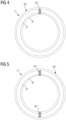
- Figure 4 shows the tire 1" of Figure 3 in a schematic sideview.
- Tire 1" is shown with the tread 10" and the rubber strip 12" extending (in a radial direction) from below the tread 10" along the sidewall 2" and the chafer 9".
- the rubber strip 12" extends in the present embodiment towards a radially innermost position of the tire 1"
- the strip is radially shorter, while still being in contact with a rim when the tire is mounted to the rim.
- a rubber strip is provided and/or visible on each (axial) side of the tire (not shown), preferably at the same circumferential position as described herein above. Two rubber strips may help to provide an even more reliable electrical pathway between a rim and the road.
- Figure 4 shows tire 1" as already depicted in Figure 3 , it is remarked that a sideview of tire 1 would be similar.
- Figure 5 shows another embodiment of a tire 1′′′ in a schematic side view.
- tire 1′′′ has two rubber strips 12′′′ (as such the same or similar to those described in previous embodiments).
- the tire 1′′′ has a tread 10''', a sidewall 2′′′ and a chafer 9'". Provision of two rubber strips 12′′′ at opposite angular positions on the same (axial) side of the tire 1′′′ helps to reduce imbalances and/or provides an even more reliable electrical pathway than by the provision of only one rubber strip.
- the electrical pathway through the tire has been indicated with the same shading in the Figures. However, this does not mean that members along that pathway, such as one or more of the tread strip, tread base layer, rubber strip, and chafer need to have the same rubber composition.
- the present invention provides an advanced electrical path between the bead portion and/or rim and the tread and/or road.
- Such an electrical path can be provided at limited costs and/or with a limited amount of material.
- tires can be manufactured efficiently.
Landscapes
- Engineering & Computer Science (AREA)
- Mechanical Engineering (AREA)
- Chemical & Material Sciences (AREA)
- Health & Medical Sciences (AREA)
- Chemical Kinetics & Catalysis (AREA)
- Medicinal Chemistry (AREA)
- Polymers & Plastics (AREA)
- Organic Chemistry (AREA)
- Compositions Of Macromolecular Compounds (AREA)
- Tires In General (AREA)
Applications Claiming Priority (1)
| Application Number | Priority Date | Filing Date | Title |
|---|---|---|---|
| US18/456,574 US20250074121A1 (en) | 2023-08-28 | 2023-08-28 | Tire having an electrically conductive rubber strip |
Publications (1)
| Publication Number | Publication Date |
|---|---|
| EP4516535A1 true EP4516535A1 (fr) | 2025-03-05 |
Family
ID=92503969
Family Applications (1)
| Application Number | Title | Priority Date | Filing Date |
|---|---|---|---|
| EP24195520.2A Pending EP4516535A1 (fr) | 2023-08-28 | 2024-08-21 | Pneu ayant une bande de caoutchouc électroconductrice |
Country Status (3)
| Country | Link |
|---|---|
| US (1) | US20250074121A1 (fr) |
| EP (1) | EP4516535A1 (fr) |
| CN (1) | CN119526941A (fr) |
Citations (9)
| Publication number | Priority date | Publication date | Assignee | Title |
|---|---|---|---|---|
| GB972804A (en) | 1962-02-23 | 1964-10-14 | Hardman & Holden Ltd | Improvements relating to metal-organic compounds |
| US5451646A (en) | 1994-12-05 | 1995-09-19 | The Goodyear Tire & Rubber Company | Technique for reducing the molecular weight and improving the processability of cis-1,4-polybutadiene |
| US5698643A (en) | 1982-04-26 | 1997-12-16 | The Goodyear Tire & Rubber Company | Controlling the molecular weight of polybutadiene |
| US20030130535A1 (en) | 2001-08-06 | 2003-07-10 | Degussa Ag, | Organosilicon compounds |
| US6608125B2 (en) | 1997-08-21 | 2003-08-19 | Crompton Corporation | Blocked mercaptosilane coupling agents for filled rubbers |
| US20050103412A1 (en) | 2003-11-18 | 2005-05-19 | Zanzig David J. | Tire with rubber sidewall containing internal electrically conductive rubber strip |
| EP2487052B1 (fr) * | 2011-02-10 | 2013-12-11 | Toyo Tire & Rubber Co., Ltd. | Pneu et son procédé de fabrication |
| EP2799247B1 (fr) * | 2013-05-01 | 2016-07-13 | Sumitomo Rubber Industries, Ltd. | Pneu |
| EP3307558B1 (fr) * | 2015-06-15 | 2020-11-18 | Bridgestone Americas Tire Operations, LLC | Pneu ayant un insert conducteur |
Family Cites Families (2)
| Publication number | Priority date | Publication date | Assignee | Title |
|---|---|---|---|---|
| JP2008308083A (ja) * | 2007-06-15 | 2008-12-25 | Sumitomo Rubber Ind Ltd | 空気入りタイヤ |
| JP5852401B2 (ja) * | 2011-10-20 | 2016-02-03 | 東洋ゴム工業株式会社 | 空気入りタイヤ |
-
2023
- 2023-08-28 US US18/456,574 patent/US20250074121A1/en not_active Abandoned
-
2024
- 2024-08-21 EP EP24195520.2A patent/EP4516535A1/fr active Pending
- 2024-08-28 CN CN202411190876.7A patent/CN119526941A/zh active Pending
Patent Citations (9)
| Publication number | Priority date | Publication date | Assignee | Title |
|---|---|---|---|---|
| GB972804A (en) | 1962-02-23 | 1964-10-14 | Hardman & Holden Ltd | Improvements relating to metal-organic compounds |
| US5698643A (en) | 1982-04-26 | 1997-12-16 | The Goodyear Tire & Rubber Company | Controlling the molecular weight of polybutadiene |
| US5451646A (en) | 1994-12-05 | 1995-09-19 | The Goodyear Tire & Rubber Company | Technique for reducing the molecular weight and improving the processability of cis-1,4-polybutadiene |
| US6608125B2 (en) | 1997-08-21 | 2003-08-19 | Crompton Corporation | Blocked mercaptosilane coupling agents for filled rubbers |
| US20030130535A1 (en) | 2001-08-06 | 2003-07-10 | Degussa Ag, | Organosilicon compounds |
| US20050103412A1 (en) | 2003-11-18 | 2005-05-19 | Zanzig David J. | Tire with rubber sidewall containing internal electrically conductive rubber strip |
| EP2487052B1 (fr) * | 2011-02-10 | 2013-12-11 | Toyo Tire & Rubber Co., Ltd. | Pneu et son procédé de fabrication |
| EP2799247B1 (fr) * | 2013-05-01 | 2016-07-13 | Sumitomo Rubber Industries, Ltd. | Pneu |
| EP3307558B1 (fr) * | 2015-06-15 | 2020-11-18 | Bridgestone Americas Tire Operations, LLC | Pneu ayant un insert conducteur |
Non-Patent Citations (2)
| Title |
|---|
| "Standard Methods for Analysis & Testing of Petroleum", 2003, INSTITUTE OF PETROLEUM |
| JOURNAL OF THE AMERICAN CHEMICAL SOCIETY, vol. 60, 1930, pages 304 |
Also Published As
| Publication number | Publication date |
|---|---|
| US20250074121A1 (en) | 2025-03-06 |
| CN119526941A (zh) | 2025-02-28 |
Similar Documents
| Publication | Publication Date | Title |
|---|---|---|
| EP3450205B1 (fr) | Pneumatique | |
| CN115044113B (zh) | 橡胶组合物和轮胎 | |
| EP4015237B1 (fr) | Composition de caoutchouc offrant une grande rigidité et une faible hystérèse, procédé de fabrication et pneu | |
| EP3838617B1 (fr) | Pneumatique | |
| EP4282913B1 (fr) | Composition de caoutchouc et pneumatique comprenant une composition de caoutchouc | |
| EP4311690B1 (fr) | Composition de caoutchouc pour pneu de camion | |
| EP3926009A1 (fr) | Composition de caoutchouc et pneumatique | |
| EP2730608B1 (fr) | Pneu avec toile et flanc | |
| EP4516535A1 (fr) | Pneu ayant une bande de caoutchouc électroconductrice | |
| EP4183595B1 (fr) | Pneu ayant une conception d'épaulement améliorée | |
| US12583952B2 (en) | Rubber composition and tire | |
| EP4159808B1 (fr) | Composition de caoutchouc et pneumatique | |
| EP4141062B1 (fr) | Composition de caoutchouc et pneumatique | |
| EP4159478A1 (fr) | Composition de caoutchouc et pneumatique | |
| EP4056643A1 (fr) | Composition de caoutchouc et pneumatique | |
| EP4527639A1 (fr) | Pneu avec chemin de conductivité asymétrique | |
| EP4253082A1 (fr) | Composition de caoutchouc pour pneu hivernal et pneu hivernal | |
| US20250001812A1 (en) | Tire having a sidewall with multiple layers | |
| EP4335659B1 (fr) | Pneumatique | |
| EP4311689A1 (fr) | Composition de caoutchouc et pneu de camion | |
| US20250091390A1 (en) | Dual layer tire tread | |
| EP4083076B1 (fr) | Élastomère à base de diène et composition de caoutchouc et procédé de fabrication d'un élastomère fonctionnalisé au benzoxazine | |
| EP4311691A1 (fr) | Composition de caoutchouc et pneu de camion | |
| EP4438328A1 (fr) | Pneumatique comportant une bande de roulement | |
| EP4566839A1 (fr) | Composition de revêtement |
Legal Events
| Date | Code | Title | Description |
|---|---|---|---|
| PUAI | Public reference made under article 153(3) epc to a published international application that has entered the european phase |
Free format text: ORIGINAL CODE: 0009012 |
|
| STAA | Information on the status of an ep patent application or granted ep patent |
Free format text: STATUS: THE APPLICATION HAS BEEN PUBLISHED |
|
| AK | Designated contracting states |
Kind code of ref document: A1 Designated state(s): AL AT BE BG CH CY CZ DE DK EE ES FI FR GB GR HR HU IE IS IT LI LT LU LV MC ME MK MT NL NO PL PT RO RS SE SI SK SM TR |
|
| STAA | Information on the status of an ep patent application or granted ep patent |
Free format text: STATUS: REQUEST FOR EXAMINATION WAS MADE |
|
| 17P | Request for examination filed |
Effective date: 20250905 |