EP4520188A1 - Procédé de préparation de tempeh, tempeh préparé par celui-ci, sauce contenant le tempeh préparé, et son procédé de préparation - Google Patents
Procédé de préparation de tempeh, tempeh préparé par celui-ci, sauce contenant le tempeh préparé, et son procédé de préparation Download PDFInfo
- Publication number
- EP4520188A1 EP4520188A1 EP23799721.8A EP23799721A EP4520188A1 EP 4520188 A1 EP4520188 A1 EP 4520188A1 EP 23799721 A EP23799721 A EP 23799721A EP 4520188 A1 EP4520188 A1 EP 4520188A1
- Authority
- EP
- European Patent Office
- Prior art keywords
- tempeh
- beans
- producing
- aged
- fungus
- Prior art date
- Legal status (The legal status is an assumption and is not a legal conclusion. Google has not performed a legal analysis and makes no representation as to the accuracy of the status listed.)
- Pending
Links
Images




Classifications
-
- A—HUMAN NECESSITIES
- A23—FOODS OR FOODSTUFFS; TREATMENT THEREOF, NOT COVERED BY OTHER CLASSES
- A23L—FOODS, FOODSTUFFS OR NON-ALCOHOLIC BEVERAGES, NOT OTHERWISE PROVIDED FOR; PREPARATION OR TREATMENT THEREOF
- A23L5/00—Preparation or treatment of foods or foodstuffs, in general; Food or foodstuffs obtained thereby; Materials therefor
- A23L5/10—General methods of cooking foods, e.g. by roasting or frying
- A23L5/13—General methods of cooking foods, e.g. by roasting or frying using water or steam
-
- A—HUMAN NECESSITIES
- A23—FOODS OR FOODSTUFFS; TREATMENT THEREOF, NOT COVERED BY OTHER CLASSES
- A23L—FOODS, FOODSTUFFS OR NON-ALCOHOLIC BEVERAGES, NOT OTHERWISE PROVIDED FOR; PREPARATION OR TREATMENT THEREOF
- A23L11/00—Pulses, i.e. fruits of leguminous plants, for production of food; Products from legumes; Preparation or treatment thereof
- A23L11/50—Fermented pulses or legumes; Fermentation of pulses or legumes based on the addition of microorganisms
-
- A—HUMAN NECESSITIES
- A23—FOODS OR FOODSTUFFS; TREATMENT THEREOF, NOT COVERED BY OTHER CLASSES
- A23B—PRESERVATION OF FOODS, FOODSTUFFS OR NON-ALCOHOLIC BEVERAGES; CHEMICAL RIPENING OF FRUIT OR VEGETABLES
- A23B2/00—Preservation of foods or foodstuffs, in general
- A23B2/40—Preservation of foods or foodstuffs, in general by heating loose unpacked materials
- A23B2/405—Preservation of foods or foodstuffs, in general by heating loose unpacked materials in solid state
-
- A—HUMAN NECESSITIES
- A23—FOODS OR FOODSTUFFS; TREATMENT THEREOF, NOT COVERED BY OTHER CLASSES
- A23B—PRESERVATION OF FOODS, FOODSTUFFS OR NON-ALCOHOLIC BEVERAGES; CHEMICAL RIPENING OF FRUIT OR VEGETABLES
- A23B75/00—Preservation of pulses; Preservation of products from legumes
-
- A—HUMAN NECESSITIES
- A23—FOODS OR FOODSTUFFS; TREATMENT THEREOF, NOT COVERED BY OTHER CLASSES
- A23L—FOODS, FOODSTUFFS OR NON-ALCOHOLIC BEVERAGES, NOT OTHERWISE PROVIDED FOR; PREPARATION OR TREATMENT THEREOF
- A23L11/00—Pulses, i.e. fruits of leguminous plants, for production of food; Products from legumes; Preparation or treatment thereof
- A23L11/40—Pulse curds
- A23L11/45—Soy bean curds, e.g. tofu
-
- A—HUMAN NECESSITIES
- A23—FOODS OR FOODSTUFFS; TREATMENT THEREOF, NOT COVERED BY OTHER CLASSES
- A23L—FOODS, FOODSTUFFS OR NON-ALCOHOLIC BEVERAGES, NOT OTHERWISE PROVIDED FOR; PREPARATION OR TREATMENT THEREOF
- A23L23/00—Soups; Sauces; Preparation or treatment thereof
-
- A—HUMAN NECESSITIES
- A23—FOODS OR FOODSTUFFS; TREATMENT THEREOF, NOT COVERED BY OTHER CLASSES
- A23L—FOODS, FOODSTUFFS OR NON-ALCOHOLIC BEVERAGES, NOT OTHERWISE PROVIDED FOR; PREPARATION OR TREATMENT THEREOF
- A23L27/00—Spices; Flavouring agents or condiments; Artificial sweetening agents; Table salts; Dietetic salt substitutes; Preparation or treatment thereof
- A23L27/10—Natural spices, flavouring agents or condiments; Extracts thereof
-
- A—HUMAN NECESSITIES
- A23—FOODS OR FOODSTUFFS; TREATMENT THEREOF, NOT COVERED BY OTHER CLASSES
- A23L—FOODS, FOODSTUFFS OR NON-ALCOHOLIC BEVERAGES, NOT OTHERWISE PROVIDED FOR; PREPARATION OR TREATMENT THEREOF
- A23L5/00—Preparation or treatment of foods or foodstuffs, in general; Food or foodstuffs obtained thereby; Materials therefor
- A23L5/20—Removal of unwanted matter, e.g. deodorisation or detoxification
- A23L5/21—Removal of unwanted matter, e.g. deodorisation or detoxification by heating without chemical treatment, e.g. steam treatment, cooking
-
- A—HUMAN NECESSITIES
- A23—FOODS OR FOODSTUFFS; TREATMENT THEREOF, NOT COVERED BY OTHER CLASSES
- A23L—FOODS, FOODSTUFFS OR NON-ALCOHOLIC BEVERAGES, NOT OTHERWISE PROVIDED FOR; PREPARATION OR TREATMENT THEREOF
- A23L5/00—Preparation or treatment of foods or foodstuffs, in general; Food or foodstuffs obtained thereby; Materials therefor
- A23L5/57—Chemical peeling or cleaning of harvested fruits, vegetables or other foodstuffs
-
- A—HUMAN NECESSITIES
- A23—FOODS OR FOODSTUFFS; TREATMENT THEREOF, NOT COVERED BY OTHER CLASSES
- A23P—SHAPING OR WORKING OF FOODSTUFFS, NOT FULLY COVERED BY A SINGLE OTHER SUBCLASS
- A23P30/00—Shaping or working of foodstuffs characterised by the process or apparatus
- A23P30/10—Moulding
-
- C—CHEMISTRY; METALLURGY
- C12—BIOCHEMISTRY; BEER; SPIRITS; WINE; VINEGAR; MICROBIOLOGY; ENZYMOLOGY; MUTATION OR GENETIC ENGINEERING
- C12N—MICROORGANISMS OR ENZYMES; COMPOSITIONS THEREOF; PROPAGATING, PRESERVING, OR MAINTAINING MICROORGANISMS; MUTATION OR GENETIC ENGINEERING; CULTURE MEDIA
- C12N1/00—Microorganisms; Compositions thereof; Processes of propagating, maintaining or preserving microorganisms or compositions thereof; Processes of preparing or isolating a composition containing a microorganism; Culture media therefor
- C12N1/14—Fungi; Culture media therefor
-
- C—CHEMISTRY; METALLURGY
- C12—BIOCHEMISTRY; BEER; SPIRITS; WINE; VINEGAR; MICROBIOLOGY; ENZYMOLOGY; MUTATION OR GENETIC ENGINEERING
- C12R—INDEXING SCHEME ASSOCIATED WITH SUBCLASSES C12C - C12Q, RELATING TO MICROORGANISMS
- C12R2001/00—Microorganisms ; Processes using microorganisms
- C12R2001/645—Fungi ; Processes using fungi
Definitions
- the production method may further include soaking the peeled beans before steaming.
- the step of steaming the peeled beans refers to a process of applying heat to beans by steam to cook the beans.
- the step of steaming the beans may kill microorganisms of beans, destruct a trypsin inhibitor or other nutrient-inhibiting materials, and increase nutrients required to grow a tempeh fungus.
- a process of steaming beans may prevent loss of water soluble nutrients of beans as compared with boiling in boiling water.
- the steaming step may be performed by a steam pressurization method.
- the steam pressurization method may use saturated steam in which water and steam are in equilibrium, and since the saturated steam emits heat without taking away moisture of beans, beans may be rapidly steamed using saturated steam.
- the pressure may be 0.5 kgf/cm 2 to 3 kgf/cm 2 , 0.6 kgf/cm 2 to 2.7 kgf/cm 2 , 0.7 kgf/cm 2 to 2.5 kgf/cm 2 , 0.8 kgf/cm 2 to 2.3 kgf/cm 2 , or 1.0 to 2.0 kgf/cm 2 .
- a steaming time in producing beans in the state of being appropriate for tempeh production may be shortened to 20 minutes or less, 17 minutes or less, 15 minutes or less, 13 minutes or less, 10 minutes or less, 8 minutes or less, 6 minutes or less, 5 minutes or less, or 3 minutes or less. Since the steam pressurization method has an effect of shortening the time to steam beans, it improves process efficiency, as compared with a boiling method or a simple steaming method. In the steaming step, the pressure, the temperature, and the steaming time of the saturated steam pressurization method may vary depending on the moisture content of beans and the like.
- the method of producing tempeh includes (c) inoculating a tempeh fungus into the steamed beans.
- the tempeh fungus is the strain of the genus Rhizopus, and for example, may be Rhizopus oligosporus.
- the tempeh fungus is an edible mushroom fungus which grows naturally on banana leaves, contains a large amount of superdismutase which decomposes lipids which are not good for the human body, and has an effect of activating intestinal immunity to inhibit malignant Escherichia coli and the like.
- the inoculation of the tempeh fungus may be addition of a tempeh starter including the tempeh fungus.
- the tempeh starter may be obtained by artificially inoculating purely cultured Rhizopus strains into steamed grains and culturing the grains, and for example, may be in the form of a mixture of flour or rice flour and a tempeh fungus or in the form of a seed koji in which a Rhizopus fungus is sporulated in flour or rice flour, and for example, may be a mixture of 90-99.9 wt% of rice flour and 0.1-10 wt% of a tempeh fungus, 95-99.9 wt% of rice flour and 0.1-5 wt% of a tempeh fungus, or 90-99.9 wt% of rice flour and 0.1-10 wt% of a tempeh fungus.
- the content of a tempeh fungus starter which is added to the steamed beans may be 1 wt% to 10 wt%, 1 wt% to 9 wt%, 1 wt% to 8 wt%, 2 wt% to 8 wt%, 3 wt% to 7 wt%, or 4 wt% to 6 wt% with respect to the weight of the steamed beans.
- the content of a tempeh fungus inoculated into the steamed beans may be 0.01 wt% to 0.1 wt%, 0.01 wt% to 0.09 wt%, 0.01 wt% to 0.08 wt%, 0.02 wt% to 0.08 wt%, 0.03 wt% to 0.07 wt%, or 0.04 wt% to 0.06 wt% with respect to the weight of the steamed beans.
- the tempeh fungus multiplies predominantly, and thus, the growth of pathogenic microorganisms including common microorganisms or food poisoning bacteria is inhibited and tempeh having excellent quality may be produced.
- the method of producing tempeh includes (d) fermenting the steamed beans inoculated with the tempeh fungus.
- the step of fermenting the steamed beans inoculated with the tempeh fungus may refer to a step of culturing beans inoculated with the tempeh fungus so that the tempeh fungus may multiply.
- the tempeh fungus culture may be performed at an appropriate temperature and humidity.
- the fermentation may be performed in a temperature range selected from any one lower limit selected from the group consisting of 10°C, 15°C, 18°C, 20°C, 22°C, 24°C, 25°C, 26°C, 28°C, and 30°C and any one upper limit selected from the group consisting of 30°C, 32°C, 33°C, 35°C, 38°C, 40°C, 43°C, 45°C, and 50°C.
- it may be performed at 15°C to 45°C, 18°C to 43°C, 20°C to 40°C, 22°C to 38°C, or 25°C to 35°C.
- a fermentation time may be 10 hours to 15 days, 15 hours to 15 days, 20 hours to 15 days, 1 day to 15 days, 1 day to 14 days, 1 day to 13 days, 1 day to 12 days, 1 day to 11 days, 1 day to 10 days, 1 day to 9 days, 1 day to 8 days, 1 day to 7 days, 1 day to 6 days, 1 day to 5 days, 1 day to 4 days, 1 day to 2 days, or 2 days to 4 days.
- a humidity during the fermentation may be 40% to 90%, 40% to 85%, 40% to 80%, 40% to 70%, 50% to 70%, 50% to 80%, 60% to 80%, 55% to 65%, or 65% to 75%.
- the fermentation When the fermentation is performed in the above conditions, the growth of a tempeh fungus predominates and microbial growth is inhibited, thereby improving the storage stability of tempeh excellently.
- the tempeh produced in the fermentation conditions has uniformly improved maturation and good quality, and thus, is suitable for mass production.
- the production method may further include cooling before fermenting the steamed beans.
- the cooling step may be performed in a product temperature range selected from any one lower limit selected from the group consisting of 10°C, 15°C, 18°C, 20°C, 22°C, 24°C, 26°C, 28°C, and 30°C and any one upper limit selected from the group consisting of 30°C, 32°C, 33°C, 35°C, 38°C, 40°C, 45°C, and 50°C so that the temperature is appropriate for fermentation.
- the steamed beans may be stirred or crushed into a smaller size for the convenience of tempeh fungus inoculation and tempeh molding before inoculating a tempeh fungus.
- the production method may further include adding an acid to the steamed beans in the step of (c) inoculating a tempeh fungus into the steamed beans.
- the acid refers to a material which is acidic and tastes sour when it is dissolved in water
- a usable acid may be, for example, vinegar, citric acid, lactic acid, lemon juice, malic acid, gluconic acid, and the like, but is not limited thereto, and is not limited as long as it is an edible acid.
- the acidity may be acidity at which the growth of a tempeh fungus is not inhibited and the growth of other microorganisms, for example, pathogenic microorganisms or fungi is not inhibited.
- the acidity (%) of the acid refers to the content (g) of the acid included in 100 mL of an acid solution, and the acidity may be in a range selected from any one lower limit selected from the group consisting of 5%, 6%, 7%, 9%, and 10%; and any one upper limit selected from the group consisting of 12%, 13%, 15%, 16%, 17%, 18%, 19%, 20%, and 25%, and specifically, the acidity may be in a range of 5% to 20%, 7% to 19%, 9% to 15%, 10% to 13%, or 10% to 12%.
- the acid may be added when the product temperature of the steamed beans is 50°C or lower.
- the acid may be inoculated into the steamed beans at a rate of 1 wt% to 10 wt%, 1 wt% to 9 wt%, 1 wt% to 8 wt%, 2 wt% to 8 wt%, 3 wt% to 7 wt%, or 4 wt% to 6 wt% with respect to the weight of raw material beans.
- the amount is not limited thereto and may correspond to any amount to create the environment to grow a tempeh fungus.
- the acid when the acid is added at a rate of 4 wt% to 6 wt% with respect to the total weight of the raw material beans, it was confirmed that microbial growth was more inhibited as compared with the case of adding the acid at 2 wt%.
- the acidity is identically maintained regardless of the type of added acid, it was confirmed that microbial growth was inhibited to the same level.
- the microorganisms of which the growth is inhibited may be microorganisms other than harmful microorganisms or a tempeh fungus.
- step of adding an acid to the steamed beans in step (c) may be performed before, after, or at the step of inoculating a tempeh fungus into the steamed beans.
- the production method may further include molding the steamed beans inoculated with the tempeh fungus in the step of (c) inoculating a tempeh fungus into the steamed beans.
- the steamed beans inoculated with the tempeh fungus may be referred to as "tempeh” even before fermenting the beans.
- the tempeh (steamed beans inoculated with the tempeh fungus) may be molded so that a height is 2 cm to 5 cm or 3 cm to 4.5 cm.
- tempeh When the height of tempeh is in the above range, the growth of a tempeh fungus is facilitated so that the mycelium extends evenly to a deep part so that fermentation is well done, and thus, tempeh having excellent quality which is hard, has good texture, and has a low microbial level may be efficiently produced.
- the beans inoculated with the tempeh fungus may be fermented after putting the beans in a perforated container made of any one or more materials selected from the group consisting of polyethylene (PE), polyethylene vinyl, or silicon.
- a perforated container made of any one or more materials selected from the group consisting of polyethylene (PE), polyethylene vinyl, or silicon.
- PE polyethylene
- the container made of the material heating may be easily adjusted and temper having good quality which is fermented well by a tempeh fungus may be produced.
- the container may be perforated. Since air may circulate by perforation in the container, the container has high oxygen permeability and may perform fermentation by a tempeh fungus effectively.
- tempeh produced by the method of producing tempeh is provided.
- the tempeh produced by the production method may have a moisture content of 20% to 45%, 25% to 40%, 26% to 39%, 27% to 38%, 28% to 39%, 29% to 38%, or 30% to 36% with respect to the total weight of tempeh.
- the moisture content included in tempeh is in the range described above, microbial stability is excellent.
- tempeh In the tempeh produced by the production method, growth of microorganisms is inhibited by dominant growth of a tempeh fungus, and thus, the tempeh has better storage stability and distribution stability than conventional handmade tempeh.
- the microorganisms of which the growth is inhibited may be Bacillus cereus, common bacteria, fungi, and the like.
- the Bacillus cereus is a kind of soil bacterium and is widely distributed in nature such as dust, sewage, and streams including a human living environment, and is called food poisoning bacteria, as bacteria which cause decay of plants and animals and disease in human and animals.
- the growth of a tempeh fungus predominates in the tempeh produced by the production method, and Bacillus cereus bacteria may be detected at 10 8 CFU/g or less, 10 7 CFU/g or less, 10 6 CFU/g or less, or 10 5 CFU/g or less.
- the common bacteria may be detected at 10 10 CFU/g or less, 10 9 CFU/g or less, or 10 8 CFU/g or less.
- a tempeh fungus starter when added at 4 wt% to 6 wt% with respect to the weight of the raw material beans, the growth of a tempeh fungus predominates, and thus, the Bacillus cereus bacteria may be detected at 10 5 CFU/g or less and common bacteria may be detected at 10 10 CFU/g or less.
- common bacteria when a tempeh fermentation temperature is 25°C to 35°C, common bacteria may be detected at 10 10 CFU/g or less.
- the Bacillus cereus bacteria may be detected at 10 5 CFU/g or less and the common bacteria may be detected at 10 9 CFU/g or less.
- the tempeh produced as described above is fermented food, and generally, it is eaten by heating.
- the tempeh produced by the production method of the present disclosure may be used as an aged product which has been further aged as described later or a sauce including an aged product.
- a composition for controlling microorganisms such as an alcohol, a natural antibacterial agent, and a preservative is added or an additional sterilization process such as a heating process is performed, thereby maintaining the microbial stability.
- Another aspect of the present disclosure provides a method of producing aged tempeh including: (a) producing tempeh by the method of producing tempeh described above; and (b) an aging step of aging a mixture in which at least one or more of saline and brine are added to the produced tempeh.
- a step of producing tempeh is producing tempeh by the method of producing bean tempeh described above, and as described above, may include peeling beans; steaming the peeled beans; inoculating a tempeh fungus into the steamed beans; and fermenting the steamed beans inoculated with the tempeh fungus. Since the details of the method of producing tempeh are the same as those in the method of producing tempeh described above, it is cited and the description is not duplicated.
- the method of producing aged tempeh includes (b) adding one or more of saline and brine to tempeh and aging the mixture.
- the aging is fermenting a mixture to which saline or brine is added according to a fermented flavor to be desired to produce the aged tempeh.
- the aged tempeh is produced by including a step of aging tempeh which is a fermented food, and thus, has an increased unique flavor of tempeh as compared with the tempeh itself and also has an effect of much increasing contents of amino acid, vitamins, and the like.
- the effect of the aged tempeh is not limited, but for example, tempeh produced by first fermentation by Rhizopus oligosporus strains is subjected to second fermentation, thereby further increasing the content of useful components of soybeans, such as amino acids, free sugars, and organic acids to further increase its nutritional value.
- the aging step may include stirring the mixture.
- the stirring may be performed by a stirrer, for example, an impeller, and a stirring speed may be 10 to 500 rpm, 25 to 450 rpm, 30 to 400 rpm, or specifically 50 to 300 rpm.
- the stirring may be performed for 1 minute to 1 hours once a day, twice a day, or continuously during an aging period.
- the moisture content of the mixture may be 40 to 80 wt%, 45 to 75 wt%, 50 to 70 wt%, 55 to 65 wt%, or 50 to 60 wt%.
- one or more of the saline or brine may be added so that a salt content is 5 to 15 wt%, for example, 5 to 10 wt%, 6 to 9 wt%, or 7 to 9 wt% with respect to the total weight of the mixture.
- the content of moisture and/or salt in the mixture is within the range, the nutritional component of the produced aged tempeh, specifically, an amino acid content may be improved excellently, and the microbial growth in the produced aged tempeh is inhibited to improve storage stability of food excellently.
- the aging step may include further adding one or more of steamed beans, steamed wheat rice, and steamed rice to the mixture.
- the aging degree of the steamed soybeans, the steamed wheat rice, or the steamed rice may be added as extra rice to the aged tempeh to adjust an aging degree.
- One or more of the steamed beans, the steamed wheat rice, and the steamed rice may be added in a content range selected from any one lower limit selected from the group consisting of 1 wt%, 2 wt%, 3 wt%, 4 wt%, 5 wt%, 6 wt%, 7 wt%, 8 wt%, 10 wt%, 12 wt%, 14 wt%, 16 wt%, 18 wt%, and 20 wt%; and any one upper limit selected from the group consisting of 25 wt%, 30 wt%, 35 wt%, 40 wt%, 50 wt%, 60 wt%, 70 wt%, 80 wt%, and 90 wt%, with respect to the total weight of the mixture, but is not limited thereto and may be appropriately adjusted depending on the aging degree or flavor to be desired.
- the aging may be performed at an appropriate temperature for an appropriate period of time. For example, it may be performed at 10°C to 60°C, for example, performed at 15°C to 55°C, 20°C to 50°C, 25°C to 55°C, or 25°C to 35°C.
- the aging may include fermentation for 1 day to 15 days, 1 day to 14 days, 1 day to 13 days, 1 day to 12 days, 1 day to 11 days, 1 day to 10 days, 1 day to 9 days, 1 day to 8 days, 1 day to 7 days, 1 day to 6 days, 1 day to 5 days, 1 day to 4 days, or 2 days to 4 days, depending on temperature conditions.
- the aging may be performed at a low temperature for a long time or a high temperature for a short time, depending on the state of an aged product or a stirring rotation speed, whereby an aging degree of the aged product may be adjusted.
- the aging step may be repeated once or more, twice or more, or three times or more, thereby adjusting the aging degree of the aged tempeh.
- Another aspect of the present disclosure provides aged tempeh produced by the production method.
- the content of amino-type nitrogen included in the aged tempeh may be 5 mg% or more and 1200 mg% or less, and specifically, in a range selected from a lower limit of 40 mg%, 80 mg%, 100 mg%, 150 mg%, 200 mg%, 250 mg%, 300 mg%, or 400 mg% and an upper limit of 1200 mg%, 1100 mg% or less, or 1000 mg%. More specifically, it may be 40 mg% to 1200 mg%, 100 mg% to 1100 mg%, or 200 mg% to 1000 mg%.
- the amino-type nitrogen is an indicator of an aging degree which shows the content of amino acid produced by decomposition of protein by an enzyme produced by microorganisms by aging, and since its content is important for the taste of soy sauces such as umami, it is generally a management standard of soy sauce.
- the aged tempeh of the present disclosure may be produced into an aged product having a desired aging degree (content of an amino-type nitrogen) by adjusting an aging period, an aging temperature, and a rotation speed during stirring, depending on the type of sauces to be produced.
- aged tempeh produced to have an aging degree of 100 to 300 mg% may be used
- ssamjang is to be produced
- aged tempeh produced to have an aging degree of 220 mg% or more may be used
- soybean sauce is to be produced
- aged tempeh produced to have an aging degree of 400 mg% or more may be used.
- the aging degree may be appropriately adjusted by the type of raw material beans, an aging period, an aging temperature, an aging method, or an inoculation amount.
- another aspect of the present disclosure provides a sauce including the tempeh produced by the production method or the aged product thereof.
- the sauce including the aged tempeh of the present disclosure may be used as a raw material for producing a new sauce beyond a simple food material, and thus, the field of application is broadened to increase tempeh utility.
- the "spice plant” is a plant to add for adding the taste and flavor of a sauce, and though it is not limited thereto, it may include chili pepper, garlic, ginger, black pepper, onion, green onion, shallot, and the like.
- the “processed spice” is obtained by simply processing leaves, stems, fruits, roots, or the like of spice plants or mix-processing food additives, and is used for increasing other food flavors.
- the processed spice is not limited, but may include, for example, natural spices such as red pepper powder, black pepper powder, cinnamon powder, oregano hall, and rosemary, and spice preparations such as mustard, curry, and tomato ketchup.
- the "composite seasoned food” is processed into powder, granules, or a solid shape by mixing food with sugars, salt, spices, protein hydrolysate, yeast or its extracts, or food additives, and for example, a chili pepper seasoning may be used, and the chili pepper seasoning is a paste made by mixing chili pepper powder, onion, garlic, water, salt, and the like.
- the "bean fermented food” is a product obtained by mixing and fermenting beans, specifically soybeans or soybean cake and sugar, and is a food having liquid physical properties having a sugar content of 30% or more.
- the "pastes” are obtained by manufacturing/processing aspergillus culture in animal/vegetable raw materials or fermented/aged mixture of fermented soybean lump as a raw material, salt, and the like, and though they are not limited, for example, they include Korean fermented soybean lump, modified soybean lump, Korean soy sauce, brewed soy sauce, acid-decomposed soy sauce, enzyme-decomposed soy sauce, mixed soy sauce, Korean soybean paste, soybean paste, chili pepper paste, chunjang, fast-fermented bean paste, mixed soybean paste, and the like.
- the "sugars” represent sugars obtained by processing starch raw materials or sugar solution, sugar syrups, oligosaccharides, glucose, fructose, taffy, or sugar products processed therefrom.
- flavor enhancer is for enhancing the taste or flavor of food, and may include, for example, sodium glutamate and the like.
- the "nuts” are not limited as long as they are edible nuts, and may include, for example, peanuts, almonds, walnuts, macadamia, hazelnuts, pine nuts, acorns, nutmegs, Brazil nuts, cashews, coffee beans, cocoa beans, pistachios, pecans, sunflower seeds, and the like.
- the tempeh-containing sauce may further include at least one or more of chili pepper powder, chili pepper, salt, soy sauce, tomato ketchup, and other spice plants, processed spices, sugars, flavor enhancers, composite seasonings, and nuts.
- the sauce including tempeh may not include additives other than the components described above, or may further include other additives. When other additives are further included, such additives may include preservatives and/or excipient acceptable for food.
- the preservatives acceptable for food are not limited, and may include, for example, sorbic acids, benzoic acids, dehydroacetic acids, paraoxybenzoic acids, propionic acids, and the like.
- the preserves may use, for example, a salt form such as potassium sorbate, calcium sorbate, sodium benzoate, sodium propionate, calcium propionate, and sodium paraoxybenzoate.
- excipients acceptable for food is not limited, and may be, for example, at least one selected from the group consisting of crosslinked sodium carboxymethylcellulose, gum ghatti, persimmon colorant, licorice extract, formic acid, geranyl formate, citronellyl formate, isoamyl formate, gum resin, geraniol, crystalline cellulose, cinnamic acid, methyl cinnamate, ethyl cinnamate, cinnamic aldehyde, cinnamon alcohol, kaoliang colorant, benzoyl peroxide, hydrogen peroxide, acetic acid peroxide, ammonium persulfate, guar gum, disodium 5'-guanylate, citric acid, manganese citrate, trisodium citrate, sodium ferrous citrate, iron citrate, ammonium iron citrate, potassium citrate, calcium citrate, magnesium silicate, calcium silicate, silicon resin, diatomaceous earth, gluconic
- Tempeh having an excellent nutritional value may be mass-produced by the method of producing tempeh of the present disclosure.
- the method of producing tempeh of the present disclosure is less likely to cross-contamination as compared with a conventional production method and may maintain tempeh quality uniformly.
- the method of producing tempeh of the present disclosure considers the characteristics of tempeh strains, and it has a low microbial level and excellent distribution stability and may efficiently mass produce hard tempeh having good quality.
- the method of producing tempeh of the present disclosure may use various types of beans.
- the present disclosure produces a sauce including aged tempeh, thereby using tempeh as a raw material for producing a novel sauce beyond conventionally using tempeh only as a food material to further broaden the field of application of tempeh and increase tempeh utility.
- raw grain soybeans which were neither heated nor hydrated were dry peeled using a peeler, and dust, bacteria, and foreign matter were removed from the soybeans by an aeration washing process.
- the peeling process of soybeans may be omitted after steaming soybeans, and thus, a possibility of cross-contamination may be reduced and process efficiency may be improved.
- the washed soybeans were soaked in water for 2 hours, transferred to a rotatable NK steaming tank, and steamed by applying 1.0 to 2.0 kgf/cm 2 of saturated steam at about 90°C for 2 minutes and 30 seconds.
- the steamed soybeans were discharged from the steaming tank, and passed through a cooler to be cooled to a product temperature of 25 to 30°C.
- a tempeh starter including 99 wt% of rice flour and 1 wt% of Rhizopus was inoculated at 6 wt% with respect to the raw material soybeans into the steamed and cooled soybeans, 4 wt% of citric acid with respect to the weight of the raw material soybeans was added, and stirring was performed for 3 minutes to produce a mixture.
- the mixture was put into a perforated polyethylene tray and molded to have a height of 3 cm.
- the tray containing the molded mixture was covered with a perforated board, and the mixture was fermented for 24 hours to 29 hours in a fermentation room in which air was circulated and a temperature of 27°C and a humidity of 60% were maintained, thereby producing soybean tempeh.
- the produced tempeh was kept refrigerated at 5°C for 7 days.
- Raw grain black beans which were neither heated nor hydrated were dry peeled using a peeler, and dust, bacteria, and foreign matter were removed from the black beans by an aeration washing process.
- the washed black beans were soaked in water for 2 hours, transferred to a rotatable NK steaming tank, and steamed by applying 1.0 to 2.0 kgf/cm 2 of saturated steam at about 90°C for 2 minutes and 30 seconds.
- the steamed black beans were discharged from the steaming tank, and passed through a cooler to be cooled to a product temperature of 25 to 30°C.
- a tempeh starter including 99 wt% of rice flour and 1 wt% of Rhizopus was inoculated at 6 wt% with respect to the raw material black beans into the steamed and cooled black beans, 4 wt% of citric acid with respect to the weight of the raw material black beans was added, and stirring was performed for 3 minutes to produce a mixture.
- the mixture was put into a perforated polyethylene tray and molded to have a height of 3 cm.
- the tray containing the molded mixture was covered with a perforated board, and the mixture was fermented for 24 hours to 29 hours in a fermentation room in which air was circulated and a temperature of 27°C and a humidity of 60% were maintained, thereby producing black bean tempeh.
- the produced black bean tempeh was kept refrigerated at 5°C for 7 days.
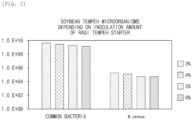
- Soybean tempeh was produced in the same manner as in Example 1, except that the added amount of tempeh fungus starter was changed to 3 wt% to 6 wt% with respect to the total weight of the raw grain soybeans. Bacillus cereus which is a food poisoning bacteria of the produced soybean tempeh and the total bacterial count of common bacteria were measured and microbial levels were compared.
- the total bacterial count was obtained by smearing a specimen on a standard agar medium and counting the viable bacterial count, and Bacillus cereus was counted after smearing a specimen on a selected medium.
- Table 1 and FIG. 2 As a result, as shown in the following Table 1 and FIG. 2 , as the inoculation amount of a tempeh fungus was increased, the growth of a tempeh fungus predominated, so that Bacillus cereus and the total bacterial count were decreased.
- Added amount (%) of tempeh starter as compared with weight of raw material soybeans B.
- CFU/g Total bacterial count (CFU/g) 3 wt% 2.2.E+05 6.1.E+09 4 wt% 1. 6. E+05 4.0.E+09 5 wt% 6.0.E+04 2.5.E+09 6 wt% 5.5.E+04 1.9.E+09
- Tempeh was produced in the same manner as in Example 1, except that 4 wt% of a tempeh fungus with respect to the total weight of the raw grain soybeans was added as a starter, and 2 wt% or 4 wt% of vinegar was added to produce tempeh.
- the inhibition of the growth of microorganisms depending on an acid content was compared by measuring the number of Bacillus cereus, which is food poisoning bacteria, the total bacterial count (CFU/g) of microorganisms and the fungal count in a TSA medium including kanamycin in the produced tempeh.
- Soybean tempeh was produced in the same manner as in Example 1, except that the type of acids (white vinegar, citric acid, or lactic acid) was changed with respect to the total weight of the raw grain soybeans. The three types of acids were added in amounts such that the same acidity (10.5 ⁇ 1%) was maintained.
- the numbers of Bacillus cereus which is food poisoning bacteria and common bacteria, the total bacterial count (CFU/g), and the fungal count in a TSA medium including kanamycin were measured, and then microbial levels were compared.
- CFU/g Common bacteria
- CFU/g Fungi (yeast, mold confirmed)
- CFU/g Total bacterial count
- White vinegar control
- Soybean tempeh was produced in the same manner as in Example 1, except that the height of tempeh was changed during tempeh molding.
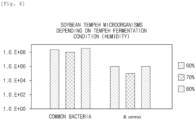
- Soybean tempeh was produced in the same manner as in Example 1, except that the fermentation humidity during tempeh fermentation was changed to 60%, 70%, or 80%. The total bacterial count of common bacteria of the produced soybean tempeh was counted and the microbial levels were compared.
- the tempeh fungus grew well in all conditions of relative humidity of 60 to 80% to complete tempeh which was hard and had good quality, but the level of food poisoning bacteria and common bacteria was the lowest at an optimal fermentation humidity of a tempeh fungus of 70%.
- Soybean tempeh was produced in the same manner as in Example 1, except that the fermentation temperature during tempeh fermentation was changed to 27°C, 30°C, and 33°C. The common bacterial count of the produced soybean tempeh was counted and the microbial level was compared.
- tempeh was produced using soybeans steamed by a steam pressurization method as in Example 1.
- soybeans which were soaked in water were boiled in boiling water for 1 hour or more, and then soybeans peeled by hand were used to produce conventional tempeh.
- the total bacterial count was obtained by counting the viable bacterial count after smearing a specimen on a standard agar medium (MYP medium and TSA medium), and the microbial level of tempeh depending on the steaming method of soybeans was evaluated.
- the aging degree and pH of the aged soybean tempeh produced according to Example 2 were measured.
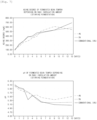
- soybean tempeh was produced according to the method described in Example 1, except that the added amount of tempeh starter inoculated into the steamed soybeans was changed into 4 wt%, 5 wt%, and 6 wt%.
- Brine having a salinity of 7% was added to the soybean tempeh produced above to produce soybean tempeh having a moisture content of 60%.
- the soybean tempeh prepared above to which brine was added was stirred and aged for 13 days to produce an aged product, and a formol titration method was used to compare the aging degree and pH of the aged product by aging days depending on the inoculation amount of a tempeh fungus (added amount of tempeh starter).
- the aging degree was evaluated by measuring the amino-type nitrogen content by the following method.
- the aged soybean tempeh was homogenized, a 1% phenolphthalein solution was added to 50 ml of a sample solution diluted 50 times in distilled water, and titration was performed with a 0.1 N sodium hydroxide solution until the color changed to a light red color.
- 30 ml of a 17.5% formalin solution was titrated by the same method.
- the aged soybean tempeh solution and the formalin solution were mixed, and then the amino-type nitrogen content (mg%) was measured with the amount (ml) titrated until a light red color was shown with the 0.1 N sodium hydroxide solution.
- the numerical value of the measured amino-type nitrogen content (mg%) was indicated as an aging degree and evaluated.
- soybean tempeh produced with different fermentation humidities during soybean tempeh production was aged, it was confirmed whether the aging degree of the aged product was changed depending on the fermentation humidity.
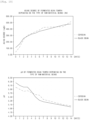
- Soybean tempeh was produced with different fermentation humidities of 60%, 70%, or 80% during tempeh production, brine having a salinity of 7% was added to the soybean tempeh produced to adjust the moisture content of the mixture to 60%, and the aging degree and pH of the aged product which was stirred and aged for 14 days were measured.
- soybean tempeh produced with different fermentation temperature during soybean tempeh production was aged, it was confirmed whether the aging degree of the aged product was changed depending on the fermentation humidity.
- soybean tempeh was produced with different temperatures of 27°C, 30°C, or 33°C during tempeh fermentation, brine having a salinity of 7% was added to the soybean tempeh produced to adjust the moisture content of the mixture to 60%, and the aging degree and pH of the aged product which was stirred and aged for 14 days were measured.
- brine having a salinity of 7% was added to each of the soybean tempeh produced in Example 1 and black bean tempeh produced in Example 3 so that the moisture content was about 60%, and aging was performed while stirring was performed at a speed of 50 to 300 rpm at room temperature, and the aging degrees of the produced aged products were compared.
- aged tempeh may be produced using various types of beans.
Landscapes
- Life Sciences & Earth Sciences (AREA)
- Engineering & Computer Science (AREA)
- Chemical & Material Sciences (AREA)
- Food Science & Technology (AREA)
- Polymers & Plastics (AREA)
- Health & Medical Sciences (AREA)
- Nutrition Science (AREA)
- Botany (AREA)
- Agronomy & Crop Science (AREA)
- Zoology (AREA)
- Wood Science & Technology (AREA)
- Biotechnology (AREA)
- Microbiology (AREA)
- Bioinformatics & Cheminformatics (AREA)
- Organic Chemistry (AREA)
- Genetics & Genomics (AREA)
- Manufacturing & Machinery (AREA)
- Mycology (AREA)
- Virology (AREA)
- Biomedical Technology (AREA)
- Tropical Medicine & Parasitology (AREA)
- Biochemistry (AREA)
- General Engineering & Computer Science (AREA)
- General Health & Medical Sciences (AREA)
- Medicinal Chemistry (AREA)
- Beans For Foods Or Fodder (AREA)
- Seasonings (AREA)
- Soy Sauces And Products Related Thereto (AREA)
- Seeds, Soups, And Other Foods (AREA)
Applications Claiming Priority (3)
| Application Number | Priority Date | Filing Date | Title |
|---|---|---|---|
| KR20220056156 | 2022-05-06 | ||
| KR1020230058023A KR102913861B1 (ko) | 2022-05-06 | 2023-05-03 | 템페의 제조방법, 이 방법에 의해 제조된 템페, 제조된 템페를 함유하는 소스 및 이의 제조방법 |
| PCT/KR2023/006157 WO2023214840A1 (fr) | 2022-05-06 | 2023-05-04 | Procédé de préparation de tempeh, tempeh préparé par celui-ci, sauce contenant le tempeh préparé, et son procédé de préparation |
Publications (2)
| Publication Number | Publication Date |
|---|---|
| EP4520188A1 true EP4520188A1 (fr) | 2025-03-12 |
| EP4520188A4 EP4520188A4 (fr) | 2026-04-29 |
Family
ID=88646733
Family Applications (1)
| Application Number | Title | Priority Date | Filing Date |
|---|---|---|---|
| EP23799721.8A Pending EP4520188A4 (fr) | 2022-05-06 | 2023-05-04 | Procédé de préparation de tempeh, tempeh préparé par celui-ci, sauce contenant le tempeh préparé, et son procédé de préparation |
Country Status (8)
| Country | Link |
|---|---|
| US (1) | US20250325008A1 (fr) |
| EP (1) | EP4520188A4 (fr) |
| JP (1) | JP2025515392A (fr) |
| CN (1) | CN119156141A (fr) |
| AU (1) | AU2023264432B2 (fr) |
| CA (1) | CA3250116A1 (fr) |
| TW (1) | TWI904429B (fr) |
| WO (1) | WO2023214840A1 (fr) |
Family Cites Families (11)
| Publication number | Priority date | Publication date | Assignee | Title |
|---|---|---|---|---|
| KR900008211B1 (ko) * | 1987-12-11 | 1990-11-06 | 주식회사 정식품 | 곰팡이와 효모의 혼합배양에 의한 템페의 제조방법 |
| EP1304043A1 (fr) * | 2001-10-19 | 2003-04-23 | Societe Des Produits Nestle S.A. | Liquéfaction d'un aliment |
| JP4828228B2 (ja) * | 2005-12-28 | 2011-11-30 | 株式会社登喜和食品 | テンペ様発酵食品の製造方法 |
| KR20080098204A (ko) * | 2007-05-04 | 2008-11-07 | 주식회사 비피도 | 홍국템페의 제조방법 |
| JP4934016B2 (ja) * | 2007-12-27 | 2012-05-16 | 壽 谷川 | 解しテンペ菌発酵食品の製造方法及び解しテンペ菌発酵食品 |
| JP4930484B2 (ja) * | 2008-10-06 | 2012-05-16 | 日本電気株式会社 | 液晶表示装置 |
| KR102523646B1 (ko) | 2017-11-01 | 2023-04-21 | 삼성디스플레이 주식회사 | 표시 장치 및 그 구동 방법 |
| CN111685272A (zh) * | 2019-03-12 | 2020-09-22 | 广东阳帆食品有限公司 | 一种即食豆豉及其制作方法 |
| JP2021042548A (ja) | 2019-09-09 | 2021-03-18 | ヤンマーパワーテクノロジー株式会社 | 建設機械 |
| KR102364859B1 (ko) * | 2019-10-30 | 2022-02-21 | 씨제이제일제당 (주) | 템페 함유 소스의 제조 방법 및 이로부터 제조된 소스 |
| KR102315879B1 (ko) * | 2021-01-22 | 2021-10-22 | 씨제이제일제당 주식회사 | 신규 리조푸스 올리고스포러스 균주 및 이를 포함하는 항균 조성물 |
-
2023
- 2023-05-04 WO PCT/KR2023/006157 patent/WO2023214840A1/fr not_active Ceased
- 2023-05-04 JP JP2024565330A patent/JP2025515392A/ja active Pending
- 2023-05-04 EP EP23799721.8A patent/EP4520188A4/fr active Pending
- 2023-05-04 AU AU2023264432A patent/AU2023264432B2/en active Active
- 2023-05-04 CN CN202380038922.9A patent/CN119156141A/zh active Pending
- 2023-05-04 US US18/863,556 patent/US20250325008A1/en active Pending
- 2023-05-04 CA CA3250116A patent/CA3250116A1/fr active Pending
- 2023-05-05 TW TW112116813A patent/TWI904429B/zh active
Also Published As
| Publication number | Publication date |
|---|---|
| CN119156141A (zh) | 2024-12-17 |
| WO2023214840A1 (fr) | 2023-11-09 |
| US20250325008A1 (en) | 2025-10-23 |
| AU2023264432B2 (en) | 2026-07-23 |
| EP4520188A4 (fr) | 2026-04-29 |
| TWI904429B (zh) | 2025-11-11 |
| JP2025515392A (ja) | 2025-05-14 |
| CA3250116A1 (fr) | 2025-06-17 |
| TW202404482A (zh) | 2024-02-01 |
| AU2023264432A1 (en) | 2024-11-14 |
Similar Documents
| Publication | Publication Date | Title |
|---|---|---|
| KR102364859B1 (ko) | 템페 함유 소스의 제조 방법 및 이로부터 제조된 소스 | |
| KR102255983B1 (ko) | 유산균을 이용한 묵은지 제조방법 및 그로부터 제조된 묵은지 | |
| CN111728039A (zh) | 一种酱油发酵腐乳及其制备方法 | |
| CZ291560B6 (cs) | Způsob výroby aromatizačního prostředku, aromatizační prostředek a jeho použití | |
| TWI532440B (zh) | 製備水解產物之方法 | |
| CN112971036A (zh) | 一种酱腐乳及其制作方法 | |
| KR101865842B1 (ko) | 천일염 함유 쌀유산균발효물, 그 제조방법 및 그로부터 제조된 김치소스 조성물 | |
| KR102345416B1 (ko) | 쌀누룩 된장 및 이의 제조방법 | |
| JP3569503B2 (ja) | おから加工食品およびその製造方法 | |
| KR20190127307A (ko) | 블루베리를 첨가한 김치 및 그 제조방법 | |
| KR102930979B1 (ko) | 누룩소금을 이용한 저염 어리굴젓의 제조 방법 | |
| US20250325008A1 (en) | Method for preparation of tempeh, tempeh prepared thereby, sauce containing prepared tempeh, and preparation method therefor | |
| KR102913861B1 (ko) | 템페의 제조방법, 이 방법에 의해 제조된 템페, 제조된 템페를 함유하는 소스 및 이의 제조방법 | |
| HK40118687A (en) | Method for preparation of tempeh, tempeh prepared thereby, sauce containing prepared tempeh, and preparation method therefor | |
| KR102590375B1 (ko) | 현미 요거트 및 이의 제조방법 | |
| US20250295148A1 (en) | Method for preparing grain tempeh, grain tempeh prepared by said method, sauce comprising prepared grain tempeh, and method for preparing same | |
| HK40118688A (en) | Method for preparing grain tempeh, grain tempeh prepared by said method, sauce comprising prepared grain tempeh, and method for preparing same | |
| KR100401811B1 (ko) | 대두된장의 제조방법 | |
| KR102869111B1 (ko) | 동결건조 녹두삼계 누룽지 스낵 및 이의 제조방법 | |
| KR20150129930A (ko) | 저온 초고압 처리를 이용한 저염 간장의 제조방법 | |
| CN107712642A (zh) | 一种增香型蒲笋菌菇豆瓣酱及其制备方法 | |
| KR101756286B1 (ko) | 김치를 첨가한 발효 죽 및 그 제조방법 | |
| JPS61152256A (ja) | 新規なテンペ食品 | |
| KR20220163097A (ko) | 고추장 조성물 및 그 제조 방법 | |
| JPS63273447A (ja) | 脱脂大豆を醗酵した食品加工用素材の製造方法 |
Legal Events
| Date | Code | Title | Description |
|---|---|---|---|
| STAA | Information on the status of an ep patent application or granted ep patent |
Free format text: STATUS: THE INTERNATIONAL PUBLICATION HAS BEEN MADE |
|
| PUAI | Public reference made under article 153(3) epc to a published international application that has entered the european phase |
Free format text: ORIGINAL CODE: 0009012 |
|
| STAA | Information on the status of an ep patent application or granted ep patent |
Free format text: STATUS: REQUEST FOR EXAMINATION WAS MADE |
|
| 17P | Request for examination filed |
Effective date: 20241113 |
|
| AK | Designated contracting states |
Kind code of ref document: A1 Designated state(s): AL AT BE BG CH CY CZ DE DK EE ES FI FR GB GR HR HU IE IS IT LI LT LU LV MC ME MK MT NL NO PL PT RO RS SE SI SK SM TR |
|
| REG | Reference to a national code |
Ref country code: HK Ref legal event code: DE Ref document number: 40118687 Country of ref document: HK |
|
| DAV | Request for validation of the european patent (deleted) | ||
| DAX | Request for extension of the european patent (deleted) | ||
| A4 | Supplementary search report drawn up and despatched |
Effective date: 20260401 |
|
| RIC1 | Information provided on ipc code assigned before grant |
Ipc: A23L 11/50 20210101AFI20260326BHEP Ipc: A23L 29/00 20160101ALI20260326BHEP Ipc: C12N 1/20 20060101ALI20260326BHEP Ipc: A23L 5/10 20160101ALI20260326BHEP Ipc: A23L 23/00 20160101ALI20260326BHEP Ipc: A23L 7/104 20160101ALI20260326BHEP Ipc: A23L 5/20 20160101ALI20260326BHEP Ipc: A23L 5/00 20160101ALI20260326BHEP |