EP4521505A2 - Électrodes de batterie au lithium-ion comprenant des particules de carbone graphénique - Google Patents
Électrodes de batterie au lithium-ion comprenant des particules de carbone graphénique Download PDFInfo
- Publication number
- EP4521505A2 EP4521505A2 EP25150341.3A EP25150341A EP4521505A2 EP 4521505 A2 EP4521505 A2 EP 4521505A2 EP 25150341 A EP25150341 A EP 25150341A EP 4521505 A2 EP4521505 A2 EP 4521505A2
- Authority
- EP
- European Patent Office
- Prior art keywords
- carbon particles
- lithium ion
- ion battery
- graphenic carbon
- lithium
- Prior art date
- Legal status (The legal status is an assumption and is not a legal conclusion. Google has not performed a legal analysis and makes no representation as to the accuracy of the status listed.)
- Pending
Links
Images



Classifications
-
- H—ELECTRICITY
- H01—ELECTRIC ELEMENTS
- H01M—PROCESSES OR MEANS, e.g. BATTERIES, FOR THE DIRECT CONVERSION OF CHEMICAL ENERGY INTO ELECTRICAL ENERGY
- H01M10/00—Secondary cells; Manufacture thereof
- H01M10/05—Accumulators with non-aqueous electrolyte
- H01M10/052—Li-accumulators
- H01M10/0525—Rocking-chair batteries, i.e. batteries with lithium insertion or intercalation in both electrodes; Lithium-ion batteries
-
- H—ELECTRICITY
- H01—ELECTRIC ELEMENTS
- H01M—PROCESSES OR MEANS, e.g. BATTERIES, FOR THE DIRECT CONVERSION OF CHEMICAL ENERGY INTO ELECTRICAL ENERGY
- H01M10/00—Secondary cells; Manufacture thereof
- H01M10/60—Heating or cooling; Temperature control
- H01M10/62—Heating or cooling; Temperature control specially adapted for specific applications
-
- H—ELECTRICITY
- H01—ELECTRIC ELEMENTS
- H01M—PROCESSES OR MEANS, e.g. BATTERIES, FOR THE DIRECT CONVERSION OF CHEMICAL ENERGY INTO ELECTRICAL ENERGY
- H01M4/00—Electrodes
- H01M4/02—Electrodes composed of, or comprising, active material
- H01M4/04—Processes of manufacture in general
- H01M4/0402—Methods of deposition of the material
- H01M4/0404—Methods of deposition of the material by coating on electrode collectors
-
- H—ELECTRICITY
- H01—ELECTRIC ELEMENTS
- H01M—PROCESSES OR MEANS, e.g. BATTERIES, FOR THE DIRECT CONVERSION OF CHEMICAL ENERGY INTO ELECTRICAL ENERGY
- H01M4/00—Electrodes
- H01M4/02—Electrodes composed of, or comprising, active material
- H01M4/13—Electrodes for accumulators with non-aqueous electrolyte, e.g. for lithium-accumulators; Processes of manufacture thereof
-
- H—ELECTRICITY
- H01—ELECTRIC ELEMENTS
- H01M—PROCESSES OR MEANS, e.g. BATTERIES, FOR THE DIRECT CONVERSION OF CHEMICAL ENERGY INTO ELECTRICAL ENERGY
- H01M4/00—Electrodes
- H01M4/02—Electrodes composed of, or comprising, active material
- H01M4/13—Electrodes for accumulators with non-aqueous electrolyte, e.g. for lithium-accumulators; Processes of manufacture thereof
- H01M4/131—Electrodes based on mixed oxides or hydroxides, or on mixtures of oxides or hydroxides, e.g. LiCoOx
-
- H—ELECTRICITY
- H01—ELECTRIC ELEMENTS
- H01M—PROCESSES OR MEANS, e.g. BATTERIES, FOR THE DIRECT CONVERSION OF CHEMICAL ENERGY INTO ELECTRICAL ENERGY
- H01M4/00—Electrodes
- H01M4/02—Electrodes composed of, or comprising, active material
- H01M4/13—Electrodes for accumulators with non-aqueous electrolyte, e.g. for lithium-accumulators; Processes of manufacture thereof
- H01M4/136—Electrodes based on inorganic compounds other than oxides or hydroxides, e.g. sulfides, selenides, tellurides, halogenides or LiCoFy
-
- H—ELECTRICITY
- H01—ELECTRIC ELEMENTS
- H01M—PROCESSES OR MEANS, e.g. BATTERIES, FOR THE DIRECT CONVERSION OF CHEMICAL ENERGY INTO ELECTRICAL ENERGY
- H01M4/00—Electrodes
- H01M4/02—Electrodes composed of, or comprising, active material
- H01M4/62—Selection of inactive substances as ingredients for active masses, e.g. binders, fillers
- H01M4/621—Binders
- H01M4/622—Binders being polymers
-
- H—ELECTRICITY
- H01—ELECTRIC ELEMENTS
- H01M—PROCESSES OR MEANS, e.g. BATTERIES, FOR THE DIRECT CONVERSION OF CHEMICAL ENERGY INTO ELECTRICAL ENERGY
- H01M4/00—Electrodes
- H01M4/02—Electrodes composed of, or comprising, active material
- H01M4/62—Selection of inactive substances as ingredients for active masses, e.g. binders, fillers
- H01M4/621—Binders
- H01M4/622—Binders being polymers
- H01M4/623—Binders being polymers fluorinated polymers
-
- H—ELECTRICITY
- H01—ELECTRIC ELEMENTS
- H01M—PROCESSES OR MEANS, e.g. BATTERIES, FOR THE DIRECT CONVERSION OF CHEMICAL ENERGY INTO ELECTRICAL ENERGY
- H01M4/00—Electrodes
- H01M4/02—Electrodes composed of, or comprising, active material
- H01M4/62—Selection of inactive substances as ingredients for active masses, e.g. binders, fillers
- H01M4/624—Electric conductive fillers
- H01M4/625—Carbon or graphite
-
- H—ELECTRICITY
- H01—ELECTRIC ELEMENTS
- H01M—PROCESSES OR MEANS, e.g. BATTERIES, FOR THE DIRECT CONVERSION OF CHEMICAL ENERGY INTO ELECTRICAL ENERGY
- H01M4/00—Electrodes
- H01M4/02—Electrodes composed of, or comprising, active material
- H01M4/64—Carriers or collectors
- H01M4/66—Selection of materials
- H01M4/661—Metal or alloys, e.g. alloy coatings
-
- B—PERFORMING OPERATIONS; TRANSPORTING
- B82—NANOTECHNOLOGY
- B82Y—SPECIFIC USES OR APPLICATIONS OF NANOSTRUCTURES; MEASUREMENT OR ANALYSIS OF NANOSTRUCTURES; MANUFACTURE OR TREATMENT OF NANOSTRUCTURES
- B82Y30/00—Nanotechnology for materials or surface science, e.g. nanocomposites
-
- C—CHEMISTRY; METALLURGY
- C01—INORGANIC CHEMISTRY
- C01B—NON-METALLIC ELEMENTS; COMPOUNDS THEREOF; METALLOIDS OR COMPOUNDS THEREOF NOT COVERED BY SUBCLASS C01C
- C01B2204/00—Structure or properties of graphene
- C01B2204/04—Specific amount of layers or specific thickness
-
- C—CHEMISTRY; METALLURGY
- C01—INORGANIC CHEMISTRY
- C01B—NON-METALLIC ELEMENTS; COMPOUNDS THEREOF; METALLOIDS OR COMPOUNDS THEREOF NOT COVERED BY SUBCLASS C01C
- C01B2204/00—Structure or properties of graphene
- C01B2204/06—Graphene nanoribbons
- C01B2204/065—Graphene nanoribbons characterized by their width or by their aspect ratio
-
- H—ELECTRICITY
- H01—ELECTRIC ELEMENTS
- H01M—PROCESSES OR MEANS, e.g. BATTERIES, FOR THE DIRECT CONVERSION OF CHEMICAL ENERGY INTO ELECTRICAL ENERGY
- H01M10/00—Secondary cells; Manufacture thereof
- H01M10/05—Accumulators with non-aqueous electrolyte
- H01M10/052—Li-accumulators
-
- H—ELECTRICITY
- H01—ELECTRIC ELEMENTS
- H01M—PROCESSES OR MEANS, e.g. BATTERIES, FOR THE DIRECT CONVERSION OF CHEMICAL ENERGY INTO ELECTRICAL ENERGY
- H01M4/00—Electrodes
- H01M4/02—Electrodes composed of, or comprising, active material
- H01M2004/021—Physical characteristics, e.g. porosity, surface area
-
- H—ELECTRICITY
- H01—ELECTRIC ELEMENTS
- H01M—PROCESSES OR MEANS, e.g. BATTERIES, FOR THE DIRECT CONVERSION OF CHEMICAL ENERGY INTO ELECTRICAL ENERGY
- H01M4/00—Electrodes
- H01M4/02—Electrodes composed of, or comprising, active material
- H01M4/13—Electrodes for accumulators with non-aqueous electrolyte, e.g. for lithium-accumulators; Processes of manufacture thereof
- H01M4/139—Processes of manufacture
-
- H—ELECTRICITY
- H01—ELECTRIC ELEMENTS
- H01M—PROCESSES OR MEANS, e.g. BATTERIES, FOR THE DIRECT CONVERSION OF CHEMICAL ENERGY INTO ELECTRICAL ENERGY
- H01M4/00—Electrodes
- H01M4/02—Electrodes composed of, or comprising, active material
- H01M4/36—Selection of substances as active materials, active masses, active liquids
- H01M4/58—Selection of substances as active materials, active masses, active liquids of inorganic compounds other than oxides or hydroxides, e.g. sulfides, selenides, tellurides, halogenides or LiCoFy; of polyanionic structures, e.g. phosphates, silicates or borates
- H01M4/5825—Oxygenated metallic salts or polyanionic structures, e.g. borates, phosphates, silicates, olivines
-
- Y—GENERAL TAGGING OF NEW TECHNOLOGICAL DEVELOPMENTS; GENERAL TAGGING OF CROSS-SECTIONAL TECHNOLOGIES SPANNING OVER SEVERAL SECTIONS OF THE IPC; TECHNICAL SUBJECTS COVERED BY FORMER USPC CROSS-REFERENCE ART COLLECTIONS [XRACs] AND DIGESTS
- Y02—TECHNOLOGIES OR APPLICATIONS FOR MITIGATION OR ADAPTATION AGAINST CLIMATE CHANGE
- Y02E—REDUCTION OF GREENHOUSE GAS [GHG] EMISSIONS, RELATED TO ENERGY GENERATION, TRANSMISSION OR DISTRIBUTION
- Y02E60/00—Enabling technologies; Technologies with a potential or indirect contribution to GHG emissions mitigation
- Y02E60/10—Energy storage using batteries
Definitions
- the present invention relates to lithium ion battery electrodes including graphenic carbon particles.
- Lithium ion batteries are well known. Lithium ion battery cathode coatings use conductive carbon to transport electrons from electroactive lithium compounds, such as lithium iron phosphate or nickel, cobalt doped lithium manganate, to a metal foil collector such as aluminum. Graphite anodes in lithium ion batteries also require conductive carbon to carry electrons to collectors such as copper. While essential for the performance of a lithium ion battery during the charge and discharge cycles, conductive carbon adds weight and volume to the electrode coating without contributing to the capacity, or energy density, of the battery. Since batteries are used for energy storage, energy density of a lithium ion battery should be maximized.
- a cathode coating would be comprised solely of materials that store energy without carrying the overhead associated with materials that serve other functions but do not store energy like conductive carbon and polymer binders, etc.
- the need to harvest energy from a battery at a high discharge current requires the coating to suffer the addition of conductive carbon to carry charge with maximum power density.
- This conductive carbon content lowers battery capacity.
- Using a more highly conductive electron transporting material like the highly conductive graphene evaluated for this invention can increase the percentage of energy storage material in the coating and consequently increase overall battery capacity.
- Another aspect of the invention provides a lithium ion battery cathode material comprising a lithium-containing active material, thermally produced graphenic carbon particles, and a binder.
- a further aspect of the present invention provides a lithium ion battery comprising an anode, a cathode, a separator between the anode and the cathode, and an electrolyte in contact with the anode and the cathode.
- the cathode comprises a coating of a lithium-containing active material, thermally produced graphenic carbon particles, and a binder.
- the electrolyte 30 of the lithium ion battery 100 may comprise any known electrolyte material conventionally used in lithium ion batteries, such as lithium-containing electrolyte salts dissolved in organic solvents.
- lithium-containing electrolyte salts include LiClO 4 , LiAsF 6 , LiPF 6 , LiBF 4 , LiB(C 6 H 5 ) 4 , LiB(C 2 O 4 ) 2 , CH 3 SO 3 Li, CF 3 SO 3 Li, LiCl, LiBr and the like.
- organic solvents examples include propylene carbonate, ethylene carbonate, diethyl carbonate, dimethyl carbonate, 1,2-dimethoxyethane, 1,2-diethoxyethane, ⁇ -butyrolactone, tetrahydrofuran, 2-methyl tetrahydrofuran, 1,3-dioxolane, 4-methyl-1,3-dioxolane, diethyl ether, sulfolane, methylsulfolane, acetonitrile, propionitrile, anisole, acetate, butyrate, propionate and the like.
- cyclic carbonates such as propylene carbonate, or chain carbonates such as dimethyl carbonate and diethyl carbonate may be used.
- the electrolyte 30 may also comprise additives or stabilizers such as VC (vinyl carbonate), VEC (vinyl ethylene carbonate), EA (ethylene acetate), TPP (triphenylphosphate), phosphazenes, LiBOB, LiBETI, LiTFSI, BP (biphenyl), PS (propylene sulfite), ES (ethylene sulfite), AMC (allylmethylcarbonate), and APV (divinyladipate).
- additives or stabilizers such as VC (vinyl carbonate), VEC (vinyl ethylene carbonate), EA (ethylene acetate), TPP (triphenylphosphate), phosphazenes, LiBOB, LiBETI, LiTFSI, BP (biphenyl), PS (propylene sulfite), ES (ethylene sulfite), AMC (allylmethylcarbonate), and APV (divinyladipate).
- the anode 20 of the lithium ion battery 100 may be of any known type such as lithium metal, graphite, lithium titanate, silicon and the like and may comprise a conductive substrate such as copper foil, or other metal foils, having conductive particles deposited on one or both sides thereof.
- the conductive particles may comprise graphenic carbon particles, for example, as disclosed in U.S. Application Serial No. 13/836,415 , which is incorporated herein by reference.
- the graphenic carbon particle-containing anode material may include a mixture of the graphenic carbon particles with lithium-reactive particles such as Si and/or Sn and a binder.
- the graphenic carbon particles comprise from 0.25 to 25 weight percent of the cured cathode coating material, for example, from 0.5 to 10 weight percent, or from 1 or 2 to 8 weight percent.
- the type and amount of graphenic carbon particles added to the cathode coating material are selected in order to reduce the electrical resistance of the cathode material to a level typically below 300 ohms/square, for example, below 250 ohms/square, or below 240 ohms/square, or below 200 ohms/square, or below 150 ohms/square.
- the resistance, in units of ohms/square, may be measured by a standard, commercially available four-point test probe.
- the cathode coating material may include optional additives such as non-thermally produced graphenic carbon particles in a total amount of 10 weight percent.
- the non-thermally produced graphenic carbon particles may be obtained from commercial sources, for example, from Angstron, XG Sciences and other commercial sources.
- Other optional additives include surfactants, rheology modifiers, corrosion inhibitors and the like in a total amount of 15 weight percent.
- graphenic carbon particles means carbon particles having structures comprising one or more layers of one-atom-thick planar sheets of sp 2 -bonded carbon atoms that are densely packed in a honeycomb crystal lattice.
- the average number of stacked layers may be less than 100, for example, less than 50. In certain embodiments, the average number of stacked layers is 30 or less, such as 20 or less, 10 or less, or, in some cases, 5 or less.
- the graphenic carbon particles may be substantially flat, however, at least a portion of the planar sheets may be substantially curved, curled, creased or buckled. The particles typically do not have a spheroidal or equiaxed morphology.
- the graphenic carbon particles present in the compositions of the present invention have a width and length, measured in a direction parallel to the carbon atoms layers, of at least 50 nanometers, such as more than 100 nanometers, in some cases more than 100 nanometers up to 500 nanometers, or more than 100 nanometers up to 200 nanometers.
- the graphenic carbon particles may be provided in the form of ultrathin flakes, platelets or sheets having relatively high aspect ratios (aspect ratio being defined as the ratio of the longest dimension of a particle to the shortest dimension of the particle) of greater than 3:1, such as greater than 10:1.
- at least a portion of the graphenic carbon particles may have lower aspect ratios, e.g., some of the particles may be substantially equiaxed or ball-like in shape.
- the graphenic carbon particles used in the electrode compositions of the present invention have a typical Raman spectroscopy (532 nm laser) 2D/G peak ratio of from 0.5: 1 to 1.5:1, for example, from 0.7: 1 to 1.4:1.
- 2D/G peak ratio refers to the ratio of the intensity of the 2D peak at 2692 cm -1 to the intensity of the G peak at 1,580 cm -1 .
- the graphenic carbon particles used in the electrode compositions of the present invention have a compressed density and a percent densification that is less than the compressed density and percent densification of graphite powder and certain types of substantially flat graphenic carbon particles.
- Lower compressed density and lower percent densification are each currently believed to contribute to better dispersion and/or rheological properties than graphenic carbon particles exhibiting higher compressed density and higher percent densification.
- the compressed density of the graphenic carbon particles is 0.9 or less, such as less than 0.8, less than 0.7, such as from 0.6 to 0.7.
- the percent densification of the graphenic carbon particles is less than 40%, such as less than 30%, such as from 25 to 30%.
- percolation may occur between the conductive graphenic carbon particles. Such percolation may reduce the resistivity of the coating compositions.
- the thermally produced graphenic particles may comprise particles having different morphologies, such as a bimodal distribution of plate-like particles having relatively high aspect ratios and generally equiaxed or ball-like particles having relatively low aspect ratios.
- the conductive graphenic particles may occupy a minimum volume within the coating such that the particles form a continuous, or nearly continuous, network.
- the aspect ratios of the graphenic carbon particles may affect the minimum volume required for percolation.
- the surface energy of the graphenic carbon particles may be the same or similar to the surface energy of the elastomeric rubber. Otherwise, the particles may tend to flocculate or demix as they are processed.
- the graphenic carbon particles utilized in the electrode compositions of the present invention can be made, for example, by thermal processes.
- thermally-produced graphenic carbon particles are made from carbon-containing precursor materials that are heated to high temperatures in a thermal zone such as a plasma.
- the carbon-containing precursor such as a hydrocarbon provided in gaseous or liquid form, is heated in the thermal zone to produce the graphenic carbon particles in the thermal zone or downstream therefrom.
- thermally-produced graphenic carbon particles may be made by the systems and methods disclosed in United States Patent Nos. 8,486,363 and 8,486,364 .
- the graphenic carbon particles may be made by using the apparatus and method described in United States Patent No. 8,486,363 at [0022] to [0048] in which (i) one or more hydrocarbon precursor materials capable of forming a two-carbon fragment species (such as n-propanol, ethane, ethylene, acetylene, vinyl chloride, 1,2-dichloroethane, allyl alcohol, propionaldehyde, and/or vinyl bromide) is introduced into a thermal zone (such as a plasma), and (ii) the hydrocarbon is heated in the thermal zone to a temperature of at least 1,000°C to form the graphenic carbon particles.
- one or more hydrocarbon precursor materials capable of forming a two-carbon fragment species such as n-propanol, ethane, ethylene, acetylene, vinyl chloride, 1,2-dichloroethane, allyl alcohol, propionaldehyde, and/or vinyl bromide
- a thermal zone such as a plasma
- the graphenic carbon particles may be made by using the apparatus and method described in United States Patent No. 8,486,364 at [0015] to [0042] in which (i) a methane precursor material (such as a material comprising at least 50 percent methane, or, in some cases, gaseous or liquid methane of at least 95 or 99 percent purity or higher) is introduced into a thermal zone (such as a plasma), and (ii) the methane precursor is heated in the thermal zone to form the graphenic carbon particles.
- a methane precursor material such as a material comprising at least 50 percent methane, or, in some cases, gaseous or liquid methane of at least 95 or 99 percent purity or higher
- a thermal zone such as a plasma
- a carbon-containing precursor is provided as a feed material that may be contacted with an inert carrier gas.
- the carbon-containing precursor material may be heated in a thermal zone, for example, by a plasma system.
- the precursor material is heated to a temperature ranging from 3,500°C to 20,000°C, such as 3,600°C to 10,000°C.
- the temperature of the thermal zone may range from 3,700 to 8,000°C, such as from 3,800 to 5,000°C.
- the thermal zone may be generated by a plasma system, it is to be understood that any other suitable heating system may be used to create the thermal zone, such as various types of furnaces including electrically heated tube furnaces and the like.
- the gaseous stream may be contacted with one or more quench streams that are injected into the plasma chamber through at least one quench stream injection port.
- the quench stream may cool the gaseous stream to facilitate the formation or control the particle size or morphology of the graphenic carbon particles.
- the ultrafine particles may be passed through a converging member. After the graphenic carbon particles exit the plasma system, they may be collected. Any suitable means may be used to separate the graphenic carbon particles from the gas flow, such as, for example, a bag filter, cyclone separator or deposition on a substrate.
- graphenic carbon particles are particularly suitable for producing graphenic carbon particles having relatively low thickness and relatively high aspect ratio in combination with relatively low oxygen content, as described above. Moreover, such methods are currently believed to produce a substantial amount of graphenic carbon particles having a substantially curved, curled, creased, buckled or equiaxed morphology (referred to herein as a "3D" morphology), as opposed to producing predominantly particles having a substantially two-dimensional (or flat) morphology.
- 3D substantially curved, curled, creased, buckled or equiaxed morphology
- the graphenic carbon particles may be treated in order to reduce or eliminate impurities.
- thermally produced graphenic carbon particles may be treated to remove any polycyclic aromatic hydrocarbons (PAHs) by methods such as Soxhlet extraction using toluene, or the like.
- PAHs polycyclic aromatic hydrocarbons
- the thermally-produced graphenic carbon particles of Sample Nos. 1-6 were further treated with a toluene solution to extract any residual low molecular weight hydrocarbon contaminants.
- the xGNP-C300 graphenic carbon particles used in Sample Nos. 7-12 and the xGNP-C700 graphenic carbon particles used in Sample Nos. 13-18 were commercially available from XG Sciences.
- the Graphene X Technology graphenic carbon particles used in Sample Nos. 19-24 were commercially available from Graphene Technologies.
- the carbon black particles used in Sample Nos. 4-6, 10-12, 16-18, 22-24 and 25-27 were C-Nergy Super C65 particles from Timcal.
- Each of the blends was placed in a dual-asymmetric centrifugal mixer and mixed at 2,350 rpm for 5 minutes.
- Lithium iron phosphate (LFP) was added to each mixed blend, and the resulting combination was subjected to a second mixing in a dual-asymmetric centrifugal mixer at 2,350 rpm for 5 minutes to produce formulated slurry.
- the electrically active lithium compound was lithium iron phosphate Life Power P2 lot# 1110GY195 from Phostech Lithium, Inc.
- the slurries were formulated to contain about 35 weight percent solid fraction. Weight ratios of the components of the solid fraction are listed in Table 1.
- a wet film was prepared on pre-cleaned aluminum foil by a draw-down application of the formulated slurry using a doctor blade.
- Aluminum foil alloy 1085 from Targray was cleaned with acetone before the slurry was applied.
- Formulations were applied as wet films on the aluminum foil using a large automatic film coater (MSK-AFA-II from MTI Corporation) using an adjustable doctor blade at a rate of 89 mm/sec. This wet film was heated in an oven to a maximum temperature of 120°C for at least 10 minutes. After cooling, an average dry film thickness (DFT) in microns was determined from five measurements with a micrometer and the average is shown in Table 1.
- DFT dry film thickness
- Sheet resistance was determined from three measurements made by firmly pressing a standard four-point probe (R-Check TM from EDTM, Inc.) on the coating surface. The average Rs is shown in Table 1.
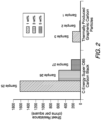
- Figs. 2-5 graphically illustrate sheet resistances of various samples listed in Table 1. Table 1 Sample No.
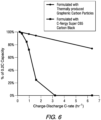
- the dry coated foils were passed through a roll calendar press (MTI Corporation) to achieve 25-30% compression. After vacuum drying, two coin-type half-cell batteries per dry coated foil were assembled using lithium metal as the anode and one-molar LiPF 6 in ethylene carbonate, diethyl carbonate and dimethyl carbonate solvents as the electrolyte. The coin cell batteries were then tested on a battery tester (Arbin Instruments) using a potential window of 4.1-2.5 Volts for 5 cycles each at currents corresponding to 0.2C, 1.6C, and 6.4C charge/discharge rates, followed by 24 cycles at the current corresponding to a 1C rate.
- C-rate refers to a current value that is required to fully discharge a cell having a constant electric capacitance in a time period equal to the inverse of the C-rate value in hours.
- discharge capacity at 0.2C refers to dry coated film capacity in milliamp-hours per gram of lithium iron phosphate at a current value required to fully discharge the battery in 5 hours.
- discharge capacity at 1C refers to dry coated film capacity in milliamp-hours per gram of lithium iron phosphate at a current value required to fully discharge the battery in 1 hour.
- Discharge capacity averages from the higher capacity coin-type half-cell of the two replicate cells for a given dry coated foil are listed in Table 2.
- Capacity retention was calculated from the quotient of the discharge capacity after the first charge-discharge cycle at 1C and the last charge-discharge cycle at 1C and reported as percentage according to the equation: 100 x first cycle capacity/last cycle capacity.
Landscapes
- Chemical & Material Sciences (AREA)
- Chemical Kinetics & Catalysis (AREA)
- Electrochemistry (AREA)
- General Chemical & Material Sciences (AREA)
- Engineering & Computer Science (AREA)
- Materials Engineering (AREA)
- Manufacturing & Machinery (AREA)
- Nanotechnology (AREA)
- Inorganic Chemistry (AREA)
- Physics & Mathematics (AREA)
- Condensed Matter Physics & Semiconductors (AREA)
- General Physics & Mathematics (AREA)
- Crystallography & Structural Chemistry (AREA)
- Composite Materials (AREA)
- Battery Electrode And Active Subsutance (AREA)
- Carbon And Carbon Compounds (AREA)
- Cell Electrode Carriers And Collectors (AREA)
Applications Claiming Priority (3)
| Application Number | Priority Date | Filing Date | Title |
|---|---|---|---|
| US14/530,007 US9761903B2 (en) | 2011-09-30 | 2014-10-31 | Lithium ion battery electrodes including graphenic carbon particles |
| EP15791200.7A EP3213362B1 (fr) | 2014-10-31 | 2015-10-30 | Électrodes de batterie au lithium-ion comprenant des particules de carbone graphénique |
| PCT/US2015/058235 WO2016069996A2 (fr) | 2014-10-31 | 2015-10-30 | Électrodes de batterie au lithium-ion comprenant des particules de carbone graphénique |
Related Parent Applications (2)
| Application Number | Title | Priority Date | Filing Date |
|---|---|---|---|
| EP15791200.7A Division EP3213362B1 (fr) | 2014-10-31 | 2015-10-30 | Électrodes de batterie au lithium-ion comprenant des particules de carbone graphénique |
| EP15791200.7A Division-Into EP3213362B1 (fr) | 2014-10-31 | 2015-10-30 | Électrodes de batterie au lithium-ion comprenant des particules de carbone graphénique |
Publications (2)
| Publication Number | Publication Date |
|---|---|
| EP4521505A2 true EP4521505A2 (fr) | 2025-03-12 |
| EP4521505A3 EP4521505A3 (fr) | 2025-04-16 |
Family
ID=54477390
Family Applications (2)
| Application Number | Title | Priority Date | Filing Date |
|---|---|---|---|
| EP25150341.3A Pending EP4521505A3 (fr) | 2014-10-31 | 2015-10-30 | Électrodes de batterie au lithium-ion comprenant des particules de carbone graphénique |
| EP15791200.7A Active EP3213362B1 (fr) | 2014-10-31 | 2015-10-30 | Électrodes de batterie au lithium-ion comprenant des particules de carbone graphénique |
Family Applications After (1)
| Application Number | Title | Priority Date | Filing Date |
|---|---|---|---|
| EP15791200.7A Active EP3213362B1 (fr) | 2014-10-31 | 2015-10-30 | Électrodes de batterie au lithium-ion comprenant des particules de carbone graphénique |
Country Status (7)
| Country | Link |
|---|---|
| EP (2) | EP4521505A3 (fr) |
| JP (3) | JP6937689B2 (fr) |
| KR (2) | KR20170069287A (fr) |
| CN (1) | CN107004829B (fr) |
| PL (1) | PL3213362T3 (fr) |
| TW (1) | TWI621297B (fr) |
| WO (1) | WO2016069996A2 (fr) |
Families Citing this family (3)
| Publication number | Priority date | Publication date | Assignee | Title |
|---|---|---|---|---|
| WO2020054615A1 (fr) * | 2018-09-10 | 2020-03-19 | 東レ株式会社 | Électrode pour batterie secondaire et batterie secondaire |
| CN113454022B (zh) * | 2019-02-20 | 2024-08-23 | Ppg工业俄亥俄公司 | 含有石墨烯碳纳米粒子和分散剂树脂的分散体 |
| CN118630217B (zh) * | 2024-08-02 | 2024-12-10 | 比亚迪股份有限公司 | 一种正极极片、电池正极、二次电池和用电设备 |
Citations (1)
| Publication number | Priority date | Publication date | Assignee | Title |
|---|---|---|---|---|
| US8486363B2 (en) | 2011-09-30 | 2013-07-16 | Ppg Industries Ohio, Inc. | Production of graphenic carbon particles utilizing hydrocarbon precursor materials |
Family Cites Families (18)
| Publication number | Priority date | Publication date | Assignee | Title |
|---|---|---|---|---|
| FR2701267B1 (fr) * | 1993-02-05 | 1995-04-07 | Schwob Yvan | Procédé pour la fabrication de suies carbonées à microstructures définies. |
| US20020182506A1 (en) * | 2001-05-29 | 2002-12-05 | Cagle Dawson W. | Fullerene-based secondary cell electrodes |
| JP4385589B2 (ja) * | 2002-11-26 | 2009-12-16 | 昭和電工株式会社 | 負極材料及びそれを用いた二次電池 |
| CN101990518A (zh) * | 2008-02-05 | 2011-03-23 | 普林斯顿大学理事会 | 包含官能化的石墨烯片的涂料以及用其涂覆的物品 |
| US8691441B2 (en) * | 2010-09-07 | 2014-04-08 | Nanotek Instruments, Inc. | Graphene-enhanced cathode materials for lithium batteries |
| US20120277360A1 (en) * | 2010-10-28 | 2012-11-01 | Vorbeck Materials Corp. | Graphene Compositions |
| CN102779985A (zh) * | 2011-05-12 | 2012-11-14 | 北京化工大学 | 一种石墨烯改性碳负极材料及其制备方法 |
| CN102306757B (zh) * | 2011-08-26 | 2014-07-02 | 上海交通大学 | 锂离子电池硅石墨烯复合负极材料及其制备方法 |
| WO2014070346A1 (fr) * | 2012-09-28 | 2014-05-08 | Ppg Industries Ohio, Inc. | Revêtements électroconducteurs contenant des particules de carbone de graphène |
| JP6077347B2 (ja) * | 2012-04-10 | 2017-02-08 | 株式会社半導体エネルギー研究所 | 非水系二次電池用正極の製造方法 |
| JP6097908B2 (ja) * | 2012-05-25 | 2017-03-22 | 国立研究開発法人物質・材料研究機構 | 剥離グラフェン膜の製造方法 |
| US9147874B2 (en) * | 2012-06-11 | 2015-09-29 | Nanotek Instruments, Inc. | Rechargeable lithium cell having a meso-porous conductive material structure-supported phthalocyanine compound cathode |
| WO2013192258A1 (fr) * | 2012-06-20 | 2013-12-27 | Cabot Corporation | Formulations d'électrode comportant des graphènes |
| JP6207923B2 (ja) * | 2012-08-27 | 2017-10-04 | 株式会社半導体エネルギー研究所 | 二次電池用正極の製造方法 |
| CN103700860B (zh) * | 2012-09-27 | 2016-04-06 | 比亚迪股份有限公司 | 一种锂离子电池 |
| US11430979B2 (en) * | 2013-03-15 | 2022-08-30 | Ppg Industries Ohio, Inc. | Lithium ion battery anodes including graphenic carbon particles |
| CN103194734B (zh) * | 2013-04-15 | 2015-05-13 | 西北工业大学 | 一种自组装三维碳化铪晶须网络结构的制备方法 |
| CN103956275A (zh) * | 2014-05-19 | 2014-07-30 | 常州立方能源技术有限公司 | 三维石墨烯网络增强活性炭超级电容器极片的制备方法 |
-
2015
- 2015-10-30 EP EP25150341.3A patent/EP4521505A3/fr active Pending
- 2015-10-30 JP JP2017522850A patent/JP6937689B2/ja active Active
- 2015-10-30 KR KR1020177014389A patent/KR20170069287A/ko not_active Ceased
- 2015-10-30 PL PL15791200.7T patent/PL3213362T3/pl unknown
- 2015-10-30 KR KR1020197026901A patent/KR102379403B1/ko active Active
- 2015-10-30 CN CN201580067177.6A patent/CN107004829B/zh active Active
- 2015-10-30 EP EP15791200.7A patent/EP3213362B1/fr active Active
- 2015-10-30 WO PCT/US2015/058235 patent/WO2016069996A2/fr not_active Ceased
- 2015-11-02 TW TW104136102A patent/TWI621297B/zh active
-
2019
- 2019-02-18 JP JP2019026472A patent/JP2019071304A/ja active Pending
-
2021
- 2021-06-22 JP JP2021103313A patent/JP2021144955A/ja not_active Withdrawn
Patent Citations (2)
| Publication number | Priority date | Publication date | Assignee | Title |
|---|---|---|---|---|
| US8486363B2 (en) | 2011-09-30 | 2013-07-16 | Ppg Industries Ohio, Inc. | Production of graphenic carbon particles utilizing hydrocarbon precursor materials |
| US8486364B2 (en) | 2011-09-30 | 2013-07-16 | Ppg Industries Ohio, Inc. | Production of graphenic carbon particles utilizing methane precursor material |
Non-Patent Citations (2)
| Title |
|---|
| D. R. DREYER ET AL., CHEM. SOC. REV., vol. 39, 2010, pages 228 - 240 |
| THE JOURNAL OF THE AMERICAN CHEMICAL SOCIETY, vol. 60, 1938, pages 309 |
Also Published As
| Publication number | Publication date |
|---|---|
| PL3213362T3 (pl) | 2025-09-01 |
| EP4521505A3 (fr) | 2025-04-16 |
| TW201622214A (zh) | 2016-06-16 |
| JP2017532748A (ja) | 2017-11-02 |
| KR102379403B1 (ko) | 2022-03-25 |
| JP2021144955A (ja) | 2021-09-24 |
| CN107004829B (zh) | 2022-07-12 |
| KR20170069287A (ko) | 2017-06-20 |
| JP2019071304A (ja) | 2019-05-09 |
| EP3213362A2 (fr) | 2017-09-06 |
| JP6937689B2 (ja) | 2021-09-22 |
| EP3213362B1 (fr) | 2025-07-09 |
| CN107004829A (zh) | 2017-08-01 |
| WO2016069996A3 (fr) | 2016-12-29 |
| TWI621297B (zh) | 2018-04-11 |
| WO2016069996A2 (fr) | 2016-05-06 |
| KR20190108195A (ko) | 2019-09-23 |
Similar Documents
| Publication | Publication Date | Title |
|---|---|---|
| US9761903B2 (en) | Lithium ion battery electrodes including graphenic carbon particles | |
| US12469841B2 (en) | Lithium ion battery anodes including graphenic carbon particles | |
| EP3062371B1 (fr) | Matériau actif d'électrode négative pour une batterie secondaire à électrolyte non aqueux, électrode négative pour une batterie secondaire à électrolyte non aqueux, batterie secondaire à electrolyte non aqueux et procédé de production dudit matériau actif d'électrode négative | |
| EP3057157B1 (fr) | Matériau actif d'électrode négative pour une batterie secondaire à électrolyte non-aqueux, batterie secondaire à électrolyte non-aqueux le contenant et procédé de préparation dudit matériau d'électrode | |
| EP3206244B1 (fr) | Matériau actif d'électrode négative pour batterie secondaire à électrolyte non aqueux, électrode négative pour batterie secondaire à électrolyte non aqueux, batterie secondaire à électrolyte non aqueux et procédé de production de matériau d'électrode négative pour batterie secondaire à électrolyte non aqueux | |
| EP3113261B1 (fr) | Matériau d'électrode négative pour batterie secondaire à électrolyte non aqueux, procédé de production de matériau d'électrode négative pour batterie secondaire à électrolyte non aqueux, et batterie secondaire à électrolyte non aqueux | |
| EP3718969A1 (fr) | Composite silicium-carbone amorphe, son procédé de préparation et batterie secondaire au lithium le comprenant | |
| ES2672305T3 (es) | Carbonos conductores para baterías de iones de litio | |
| WO2022015803A1 (fr) | Matériau d'électrode comprenant de l'oxyde de silicium et des nanotubes de carbone monoparois | |
| JP2021144955A (ja) | グラフェン系炭素粒子を含むリチウムイオンバッテリ電極 | |
| JP2017120710A (ja) | 二次電池用負極材料及びそれを用いた非水電解質二次電池 | |
| EP3471174A1 (fr) | Électrode négative pour batterie secondaire au lithium-ion, et batterie secondaire au lithium-ion |
Legal Events
| Date | Code | Title | Description |
|---|---|---|---|
| PUAI | Public reference made under article 153(3) epc to a published international application that has entered the european phase |
Free format text: ORIGINAL CODE: 0009012 |
|
| STAA | Information on the status of an ep patent application or granted ep patent |
Free format text: STATUS: THE APPLICATION HAS BEEN PUBLISHED |
|
| AC | Divisional application: reference to earlier application |
Ref document number: 3213362 Country of ref document: EP Kind code of ref document: P |
|
| AK | Designated contracting states |
Kind code of ref document: A2 Designated state(s): AL AT BE BG CH CY CZ DE DK EE ES FI FR GB GR HR HU IE IS IT LI LT LU LV MC MK MT NL NO PL PT RO RS SE SI SK SM TR |
|
| REG | Reference to a national code |
Ref country code: DE Ref legal event code: R079 Free format text: PREVIOUS MAIN CLASS: H01M0010052000 Ipc: H01M0004130000 |
|
| PUAL | Search report despatched |
Free format text: ORIGINAL CODE: 0009013 |
|
| AK | Designated contracting states |
Kind code of ref document: A3 Designated state(s): AL AT BE BG CH CY CZ DE DK EE ES FI FR GB GR HR HU IE IS IT LI LT LU LV MC MK MT NL NO PL PT RO RS SE SI SK SM TR |
|
| RIC1 | Information provided on ipc code assigned before grant |
Ipc: H01M 4/136 20100101ALN20250312BHEP Ipc: H01M 4/139 20100101ALN20250312BHEP Ipc: H01M 4/131 20100101ALN20250312BHEP Ipc: H01M 4/02 20060101ALN20250312BHEP Ipc: H01M 10/052 20100101ALN20250312BHEP Ipc: H01M 4/66 20060101ALN20250312BHEP Ipc: H01M 4/58 20100101ALN20250312BHEP Ipc: B82Y 30/00 20110101ALN20250312BHEP Ipc: H01M 4/62 20060101ALI20250312BHEP Ipc: H01M 4/13 20100101AFI20250312BHEP |
|
| STAA | Information on the status of an ep patent application or granted ep patent |
Free format text: STATUS: REQUEST FOR EXAMINATION WAS MADE |
|
| 17P | Request for examination filed |
Effective date: 20250825 |