EP4524269A2 - Verfahren zur selektiven adsorption und rückgewinnung von lithium aus natürlichen und synthetischen solen - Google Patents
Verfahren zur selektiven adsorption und rückgewinnung von lithium aus natürlichen und synthetischen solen Download PDFInfo
- Publication number
- EP4524269A2 EP4524269A2 EP24215362.5A EP24215362A EP4524269A2 EP 4524269 A2 EP4524269 A2 EP 4524269A2 EP 24215362 A EP24215362 A EP 24215362A EP 4524269 A2 EP4524269 A2 EP 4524269A2
- Authority
- EP
- European Patent Office
- Prior art keywords
- lithium
- brine
- solution
- stream
- zone
- Prior art date
- Legal status (The legal status is an assumption and is not a legal conclusion. Google has not performed a legal analysis and makes no representation as to the accuracy of the status listed.)
- Pending
Links
Images


Classifications
-
- C—CHEMISTRY; METALLURGY
- C01—INORGANIC CHEMISTRY
- C01D—COMPOUNDS OF ALKALI METALS, i.e. LITHIUM, SODIUM, POTASSIUM, RUBIDIUM, CAESIUM, OR FRANCIUM
- C01D15/00—Lithium compounds
- C01D15/02—Oxides; Hydroxides
-
- C—CHEMISTRY; METALLURGY
- C01—INORGANIC CHEMISTRY
- C01D—COMPOUNDS OF ALKALI METALS, i.e. LITHIUM, SODIUM, POTASSIUM, RUBIDIUM, CAESIUM, OR FRANCIUM
- C01D15/00—Lithium compounds
- C01D15/08—Carbonates; Bicarbonates
-
- C—CHEMISTRY; METALLURGY
- C22—METALLURGY; FERROUS OR NON-FERROUS ALLOYS; TREATMENT OF ALLOYS OR NON-FERROUS METALS
- C22B—PRODUCTION AND REFINING OF METALS; PRETREATMENT OF RAW MATERIALS
- C22B26/00—Obtaining alkali, alkaline earth metals or magnesium
- C22B26/10—Obtaining alkali metals
- C22B26/12—Obtaining lithium
-
- C—CHEMISTRY; METALLURGY
- C22—METALLURGY; FERROUS OR NON-FERROUS ALLOYS; TREATMENT OF ALLOYS OR NON-FERROUS METALS
- C22B—PRODUCTION AND REFINING OF METALS; PRETREATMENT OF RAW MATERIALS
- C22B3/00—Extraction of metal compounds from ores or concentrates by wet processes
- C22B3/20—Treatment or purification of solutions, e.g. obtained by leaching
- C22B3/22—Treatment or purification of solutions, e.g. obtained by leaching by physical processes, e.g. by filtration, by magnetic means, or by thermal decomposition
-
- C—CHEMISTRY; METALLURGY
- C22—METALLURGY; FERROUS OR NON-FERROUS ALLOYS; TREATMENT OF ALLOYS OR NON-FERROUS METALS
- C22B—PRODUCTION AND REFINING OF METALS; PRETREATMENT OF RAW MATERIALS
- C22B3/00—Extraction of metal compounds from ores or concentrates by wet processes
- C22B3/20—Treatment or purification of solutions, e.g. obtained by leaching
- C22B3/22—Treatment or purification of solutions, e.g. obtained by leaching by physical processes, e.g. by filtration, by magnetic means, or by thermal decomposition
- C22B3/24—Treatment or purification of solutions, e.g. obtained by leaching by physical processes, e.g. by filtration, by magnetic means, or by thermal decomposition by adsorption on solid substances, e.g. by extraction with solid resins
-
- C—CHEMISTRY; METALLURGY
- C22—METALLURGY; FERROUS OR NON-FERROUS ALLOYS; TREATMENT OF ALLOYS OR NON-FERROUS METALS
- C22B—PRODUCTION AND REFINING OF METALS; PRETREATMENT OF RAW MATERIALS
- C22B3/00—Extraction of metal compounds from ores or concentrates by wet processes
- C22B3/20—Treatment or purification of solutions, e.g. obtained by leaching
- C22B3/42—Treatment or purification of solutions, e.g. obtained by leaching by ion-exchange extraction
-
- Y—GENERAL TAGGING OF NEW TECHNOLOGICAL DEVELOPMENTS; GENERAL TAGGING OF CROSS-SECTIONAL TECHNOLOGIES SPANNING OVER SEVERAL SECTIONS OF THE IPC; TECHNICAL SUBJECTS COVERED BY FORMER USPC CROSS-REFERENCE ART COLLECTIONS [XRACs] AND DIGESTS
- Y02—TECHNOLOGIES OR APPLICATIONS FOR MITIGATION OR ADAPTATION AGAINST CLIMATE CHANGE
- Y02P—CLIMATE CHANGE MITIGATION TECHNOLOGIES IN THE PRODUCTION OR PROCESSING OF GOODS
- Y02P10/00—Technologies related to metal processing
- Y02P10/20—Recycling
Definitions
- This invention relates generally to a process for selective adsorption and recovery of lithium from natural and synthetic brines, and more particular to a process for recovering lithium from a natural or synthetic brine solution by contacting the brine solution with a lithium selective adsorbent using a continuous countercurrent adsorption and desorption (“CCAD”) process.
- CCAD continuous countercurrent adsorption and desorption
- Brines from the Salton Sea Known Geothermal Resource Area are unusually hot (up to at least 390°C at 2 km depth), hypersaline (up to 26 wt.%), and metalliferous (iron (Fe), zinc (Zn), lead (Pb), copper (Cu)).
- the brines are primarily sodium (Na), potassium (K), calcium (Ca) chlorides with up to 25 percent of total dissolved solids. While the chemistry and high temperature of the Salton Sea brines have led to the principal challenges to the development of the SSKGA, lithium and other brine elements typically maintain high commodity value and are used in a range of industrial and technological applications.
- CCIX Fixed-bed and continuous countercurrent ion exchange
- the process can also include the steps of removing impurities from the brine solution to form a polished brine solution, and then concentrating the lithium in the polished brine solution by cyclically and sequentially flowing the polished brine solution through a continuous countercurrent adsorption and desorption circuit to form an enhanced lithium product stream. Lithium is then recovered from the enhanced lithium product stream.
- the continuous countercurrent adsorption desorption circuit can have a plurality of process zones, with each of the process zones having an adsorbent bed or column containing a lithium selective adsorbent.
- the lithium selective absorbent can be a lithium alumina intercalate prepared from hydrated alumina, a lithium aluminum layered double hydroxide chloride, a layered double hydroxide modified activated alumina, a layered double hydroxide imbibed ion exchange resin or copolymer or molecular sieve or zeolite, layered aluminate polymer blends, a lithium manganese oxide, a titanium oxide, an immobilized crown ether, or a combination thereof.
- the process can also include dewatering the enhanced lithium product stream using a membrane separation, such as reverse osmosis or nano-filtration, in order to produce a high lithium concentration, enhanced lithium product stream and a recycle eluant solution.
- a membrane separation such as reverse osmosis or nano-filtration
- the enhanced lithium product stream, the high lithium concentration, enhanced lithium product stream or both can then be passed or provided to a lithium solvent extraction and electrowinning process, a solvent extraction and membrane electrolysis process, or a recovery process for production of high purity lithium hydroxide and lithium carbonate for battery production.
- the invention in general, in a second aspect, relates to a continuous countercurrent adsorption desorption circuit configured for the selective adsorption and recovery of lithium from a lithium-rich brine solution.
- the circuit has a plurality of process zones, with each of the process zones comprising a plurality of adsorbent beds or columns having a lithium selective adsorbent.
- the process zones include a brine displacement zone positioned upstream with respect to fluid flow of a brine loading zone, which is positioned upstream with respect to the fluid flow of and in fluid communication with an entrainment rejection zone.
- the entrainment rejection zone is positioned upstream with respect to fluid flow of and in fluid communication with an elution zone, and the elution zone in fluid communication with the brine displacement zone.
- the lithium-rich brine solution can be a natural brine, a synthetic brine, or a combination thereof, such as a continental brine, a geothermal brine, an oil field brine, a brine from hard rock lithium mining, or a combination thereof.
- the lithium selective absorbent may be a lithium alumina intercalate prepared from hydrated alumina, a lithium aluminum layered double hydroxide chloride, a layered double hydroxide modified activated alumina, a layered double hydroxide imbibed ion exchange resin or copolymer or molecular sieve or zeolite, layered aluminate polymer blends, a lithium manganese oxide, a titanium oxide, an immobilized crown ether, or a combination thereof.
- the invention in general, in a third aspect, relates to a continuous adsorption and desorption process for recovery of lithium from a brine solution.
- the process includes the steps of:
- the invention relates to a continuous adsorption and desorption process for recovery of lithium from a feed brine solution.
- An eluant solution passes through an elution zone and strips most of the lithium from the lithium loaded adsorbent.
- a portion of the lithium product solution is captured as the purified lithium concentrate, and a second portion is employed to displace latent brine from freshly loaded adsorbent.
- a portion of the lithium product solution along with the displaced brine is routed to the brine feed inlet and this recirculation of lithium via the displacement stream increases the effective lithium concentration in the brine feed stream.
- the brine feed solution along with the recycled product and displaced brine, passes through a plurality of adsorbent beds containing lithium selective adsorbent such that lithium is selectively loaded onto the adsorbent and produces a lithium-depleted brine raffinate.
- a portion of the lithium-depleted brine raffinate is introduced to the elution zone, displacing latent eluant solution so it is not lost to raffinate when the first adsorbent bed in the elution zone eventually transitions from the elution zone to the loading zone.
- the process can include membrane dewatering of the lithium product eluate to concentrate the product lithium and replenish the low concentration lithium eluant solution.
- This invention relates generally to a process for selective adsorption and recovery of lithium from natural and synthetic brines using CCAD. While the invention is particularly suited for geothermal brines, the source of the feed brine is not so limited.
- the feed brine source can be from any lithium brine deposit, such as continental sources, geothermal sources, oil field sources, or brine from hard rock lithium mining activity.
- the feed brine may be subject to a variety of preliminary treatment steps including the removal of solids and certain problem metals or metals of commerce (e.g., iron, manganese, zinc, silicon, etc.).
- the feed brine preferably has a pH between about 5.0 and about 7.0.
- the feed brine generally includes large quantities of chloride salts of sodium, potassium, and calcium. Higher temperature brines (about 50°C to about 100°C) improve the kinetic response of the lithium selective adsorbent; however, lower temperature brines can also be successfully treated (about 5°C to about 50°C) using the inventive process.
- existing power plant operations 1000 generally involve a liquid brine flow from geothermal production wells 1012 that is partially flashed into steam due to pressure losses as the liquid brine makes its way up the production well casing.
- the two-phase mixture of brine and steam is routed to a high-pressure separator 1014 where the liquid brine and high pressure steam are separated.
- High pressure steam 1016 is routed from the separator 1014 to a centrifugal type steam scrubber (not shown) that removes brine carryover from the steam, and from there the scrubbed high pressure steam 1016 is routed to the turbine generator 1020.
- the liquid brine from the high-pressure separator 1014 is flashed into a standard-pressure crystallizer 1022, and the standard pressure steam 1024 from the standard-pressure crystallizer 1022 is passed through a steam scrubber (not shown) and then the scrubbed standard pressure steam 1024 is routed to the turbine 1020.
- Precipitated solids from the clarifiers are mixed with the brine in the standard-pressure crystallizer 1022 and contact with the scaling materials, which reduces the scaling tendency in brine significantly.
- a brine slurry mixture from the standard-pressure crystallizer 1022 is flashed into a low-pressure crystallizer 1018.
- Low pressure steam 1025 from the low-pressure crystallizer 1018 flows through a steam scrubber (not shown) and then either to a low-pressure turbine or to the low-pressure side of a dual entry turbine 1020.
- the brine slurry mixture is flashed to atmospheric pressure in an atmospheric flash tank 1026 and then flows into the clarifiers.
- a primary clarifier 1028 comprising an internally recirculating reactor type clarifier precipitates silica down to close to equilibrium values for the various scaling constituents at the operating temperature of the brine, e.g., approximately 229°F.
- Primary Clarifier Overflow (“PCO”) refers to the clarified brine flowing out of the primary clarifier 1028
- Primary Clarifier Underflow (“PCU”) refers to the slurry flowing out of the bottom of the primary clarifier 1028.
- the precipitated solids are flocculated and settled to the bottom of the primary clarifier tank 1028.
- a relatively clear brine PCO passes from the primary clarifier 1028 to a secondary clarifier 1030 that removes additional suspended solids from the brine.
- Secondary Clarifier Overflow (“SCO”) 1038 refers to the clarified brine flowing out of the secondary clarifier 1030
- Secondary Clarifier Underflow (“SCU”) refers to the slurry flowing out of the bottom of the secondary clarifier 1030.
- Flocculent and scale inhibitor are added between the primary clarifier 1028 and the secondary clarifier 1030 to enhance solids settling and to prevent the precipitation of radioactive alkaline earth salts.
- the stable SCO 1038 from the secondary clarifier 1030 is pumped into injection wells 1032. A portion of the precipitated solids from the PCU and the SCU is recycled upstream to the standard-pressure crystallizer 1022 as seed material 1034. Accumulated solids in both the primary clarifier 1028 and the secondary clarifier 1030 are routed to a horizontal belt filter (“HBF”) 1036 for solids removal.
- HPF horizontal belt filter
- the HBF 1036 separates liquid from the solids in the slurry from the PCU and the SCU.
- the liquid can be separated from the solids by vacuum and passes through a filter cloth that rests on top of the carrier belt.
- the first stage of the HBF is a pH 1.0 acid wash of the slurry with hydrochloric acid to remove any lead precipitates from the filter cake.
- the second stage is a pH 9.5 condensate water wash to neutralize any residual acid in the filter cake.
- the third stage of the HBF steam dries the filter cake.
- the filter cake is transported to a local landfill for disposal.
- the polished brine 1038 that exits the SCO from the power plant 1000 with reduced amounts of scaling constituents is well suited for mineral extraction, and rather than injecting the polished brine 1038 into the injection well 1032, it is made available to the system and process 200 and/or to the CCAD process 400 for selective recovery of lithium and/or other minerals from the polished brine 1038.
- a feed brine such as a geothermal brine or the brine 1038 that exits the SCO from the power plant 1000 having reduced amounts of scaling constituents passes to the system and process 200 for mineral and/or lithium extraction.
- the feed brine is passed into the impurity removal circuit 300 having a first set of reaction tanks 302 and a first clarifier 304 to remove iron and silica followed by a second set of reaction tanks 306 and a second clarifier 308 to remove manganese and zinc primarily.
- a first or iron/silica precipitation stage 300A of the impurity removal circuit 300 includes adding limestone 310A and injecting air 310B into brine. The air causes the dissolved iron to oxidize and the pH to drop.
- the first clarifier 304 is positioned downstream of the first set of reaction tanks 302 to settle out the silica and iron in the brine. The precipitated solids are settled to the bottom of the first clarifier tank 304.
- the first stage 300A of the impurity removal circuit 300 reduces the iron concentration in the brine overflow from about 1,600 part per million (ppm) down to less than about 5 ppm and reduces the silica concentration in the brine overflow from about 60 ppm down to less than about 5 ppm.
- a relatively clear brine overflow passes from the first clarifier 304 to a second or zinc/manganese precipitation stage 300B of impurity removal circuit 300.
- the second stage 300B of the impurity removal circuit 300 includes adding limestone 312A and/or lime 312B to the brine in the second set of reaction tanks 306. This causes the brine pH to elevate to around 8.
- the second clarifier 308 is positioned downstream of the second set of reaction tanks 306 and allows the metals as oxides and/or hydroxides (primarily zinc and manganese) to settle.
- the manganese concentration in the brine is reduced from about 1700 ppm down to less than about 10 ppm, while zinc concentration is reduced about 600 ppm down to less than 5 ppm in the second stage 300B of the impurity removal circuit 300.
- Accumulated solids in the first clarifier 304 and the second clarifier 308 are respectively routed to a pneumapress filter HBF to prepare an Fe/Si filter cake 314 and a Mn/Zn filter cake 316.
- Acid is then added 318 to the brine from the second clarifier 308 to reduce the pH back down to between about 4.5 and about 6.0, with a brine temperature between about 5°C and about 100°C, which is suitable for the CCAD circuit 400.
- the dissolved solids in the polished brine at this point in the process comprise primarily salts (as chlorides) with high concentrations of sodium, potassium, and calcium. The lithium concentration is comparatively low at only ⁇ 250 ppm.
- the polished brine (stream 54 in Figure 4A ) can then passed to the CCAD circuit 400, which concentrates the lithium in the polished brine by approximately 10 times and simultaneously separates the lithium from the other salts (calcium is of particular concern for downstream operations).
- the target result is an enhanced lithium chloride product stream 342 in Figures 2 and 3 (stream 57 in Figure 4A ) (stream 417 or stream 420 in Figure 5 ) (with some residual impurities) of around approximately 2,500 to 3,000 ppm lithium.
- the residual brine can be returned for reinjection through injection wells 320.
- the brine feedstock can be passed directly to the CCAD circuit 400 with minimal pretreatment such as granular media filtration (GMF) and, if necessary, residual organic removal.
- GMF granular media filtration
- Salar or continental brines with low iron and silica content may require only minimal pretreatment before being passed to the CCAD circuit 400 for concentrating lithium when compared to brines from the Salton Sea Known Geothermal Resource Area (SSKGRA).
- the pretreatment process may include dilution with water to prevent solids precipitating from brines that are close to saturation.
- GMF can be used to reduce total suspended solids (TSS) to below 10 ppm before introducing the brine solution.
- Oil field brines may require pretreatment processing to remove any residual organic material before being passed to the CCAD circuit 400.
- the bulk of the organic material can be removed by a device such as an API oil-water separator. Any remaining organic materials can be removed with a mixed bed GMF that includes activated carbon as part of the mixed bed.
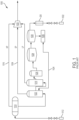
- the CCAD circuit 400 includes a series of sequential steps in a cyclic process.
- the CCAD circuit 400 has a plurality of adsorption beds or columns 402 each containing a lithium selective adsorbent.
- the adsorption beds 402 are sequentially subjected to individual process zones (A, B, C, D) as part of the CCAD circuit 400.
- Each of the process zones A, B, C, and D includes one or more of the adsorbent beds 402 configured in parallel, in series, or in combinations of parallel and series, flowing either in up flow or down flow modes.
- the process zones of the CCAD circuit 400 include an adsorption displacement zone A, an adsorption loading zone B, an entrainment rejection (ER) zone C, and an elution zone D.
- Brine fluid flow through the CCAD circuit 400 is controlled by pumping flow rates and/or predetermined indexing of a central multi-port valve system or of the adsorbent beds 402, creating a process where the adsorption beds 402 continually cycle through the individual process zones A, B, C and D.
- an elution volume of feed brine 412 is displaced from the adsorbent bed(s) 402 of the brine displacement zone A using a portion of high lithium concentration product eluate 411 from the elution zone D.
- the elution volume of displacement feed brine 412 drawn from the elution zone D into the brine displacement zone A is at least enough to displace one adsorbent bed void fraction during an index time (the time interval between rotary valve indexes).
- the feedstock brine 413 which can be the polished geothermal brine (stream 54 in Figure 4A ) or a salar, continental or other non-geothermal feedstock brine, is pumped to the adsorbent bed(s) 402 in the loading zone B with a predetermined elution time sufficient to completely or almost completely exhaust the lithium selective adsorbent, and the depleted brine exiting the loading zone B is sent to raffinate 414.
- the loading zone B is sized such that under steady state operation of the CCAD circuit 400, the complete lithium adsorption mass transfer zone is captured within the zone B. The steady state operation treats the feedstock brine 413 so that the maximum lithium loading is achieved without significant lithium leaving with the lithium depleted raffinate 414 as tails.
- raffinate 414A is pumped to the entrainment rejection (ER) zone C to displace latent eluate solution 415, which is carried forward as entrained fluid within the column transitioning from the loading zone C into the elution zone D in the cyclic process, back to the inlet of the elution zone D.
- the elution volume of the displacement fluid 414A drawn from the raffinate 414 to displace latent eluate solution 415 back into the ER zone C is at least enough to displace one adsorbent bed void fraction during the rotary valve index time.
- an eluant (stripping solution) 416 is pumped countercurrent to the adsorbent advance (fluid flow is illustrated as right to left, while the adsorbent beds movement is illustrated as left to right) into the elution zone D to produce an enhanced lithium product stream 417.
- Eluant 416 comprises a low concentration lithium product eluant (as neutral salts, generally lithium chloride) in water at a concentration from about 0 mg/kg to about 1000 mg/kg lithium and at temperatures of about 5°C to about 100°C.
- the enhanced lithium product stream 417 will have a lithium concentration 10- to 20-fold that of the eluant 416 and greater than 99.8% rejection of brine hardness ions and most other brine components.
- the portion of high lithium concentration product eluate 411 that is recycled and displaces the displacement feed brine 412 from the displacement zone A is enough fluid to completely displace brine salts from the adsorbent before the adsorbent enters the elution zone D.
- the displacement feed brine 412 may be recycled introduced to the loading zone B with the feedstock brine 413.
- the low lithium concentration in the recycled displacement feed brine 412 could significantly increase the effective concentration of lithium entering the loading zone B.
- This enhanced feed concentration results in significantly increased lithium capacity and greater lithium recovery efficiency, especially in the case of feedstock brines with low lithium concentrations (under 200 mg/kg).
- An optional membrane separation 418 can be inserted into stream 417, which includes but is not limited to, reverse osmosis or nano-filtration, to dewater and concentrate the lithium product solution 417 producing a product eluate with higher lithium concentration 420, while producing a recycle stream 419 suitable for use as make-up for fresh eluant 416.
- the optional membrane dewatering of the enhanced lithium product stream 417 would recycle a portion of the water 419 used in the preparation of the eluant solution 416.
- a portion of the lithium could pass through the membrane without passing multivalent brine components and become the lithium make-up for fresh eluant 416.
Landscapes
- Chemical & Material Sciences (AREA)
- Engineering & Computer Science (AREA)
- Materials Engineering (AREA)
- Organic Chemistry (AREA)
- Geology (AREA)
- Environmental & Geological Engineering (AREA)
- Manufacturing & Machinery (AREA)
- Life Sciences & Earth Sciences (AREA)
- General Life Sciences & Earth Sciences (AREA)
- Mechanical Engineering (AREA)
- Metallurgy (AREA)
- Geochemistry & Mineralogy (AREA)
- Inorganic Chemistry (AREA)
- Manufacture And Refinement Of Metals (AREA)
- Water Treatment By Sorption (AREA)
- Solid-Sorbent Or Filter-Aiding Compositions (AREA)
- Treatment Of Liquids With Adsorbents In General (AREA)
- Vaporization, Distillation, Condensation, Sublimation, And Cold Traps (AREA)
Applications Claiming Priority (4)
| Application Number | Priority Date | Filing Date | Title |
|---|---|---|---|
| US201862671489P | 2018-05-15 | 2018-05-15 | |
| US16/010,286 US10604414B2 (en) | 2017-06-15 | 2018-06-15 | System and process for recovery of lithium from a geothermal brine |
| EP19803715.2A EP3793945B1 (de) | 2018-05-15 | 2019-05-03 | Verfahren und system zur selektiven adsorption und rückgewinnung von lithium aus natürlichen und synthetischen solen |
| PCT/US2019/030634 WO2019221932A1 (en) | 2018-05-15 | 2019-05-03 | Process for selective adsorption and recovery of lithium from natural and synthetic brines |
Related Parent Applications (1)
| Application Number | Title | Priority Date | Filing Date |
|---|---|---|---|
| EP19803715.2A Division EP3793945B1 (de) | 2018-05-15 | 2019-05-03 | Verfahren und system zur selektiven adsorption und rückgewinnung von lithium aus natürlichen und synthetischen solen |
Publications (2)
| Publication Number | Publication Date |
|---|---|
| EP4524269A2 true EP4524269A2 (de) | 2025-03-19 |
| EP4524269A3 EP4524269A3 (de) | 2025-06-18 |
Family
ID=68540928
Family Applications (2)
| Application Number | Title | Priority Date | Filing Date |
|---|---|---|---|
| EP24215362.5A Pending EP4524269A3 (de) | 2018-05-15 | 2019-05-03 | Verfahren zur selektiven adsorption und rückgewinnung von lithium aus natürlichen und synthetischen solen |
| EP19803715.2A Active EP3793945B1 (de) | 2018-05-15 | 2019-05-03 | Verfahren und system zur selektiven adsorption und rückgewinnung von lithium aus natürlichen und synthetischen solen |
Family Applications After (1)
| Application Number | Title | Priority Date | Filing Date |
|---|---|---|---|
| EP19803715.2A Active EP3793945B1 (de) | 2018-05-15 | 2019-05-03 | Verfahren und system zur selektiven adsorption und rückgewinnung von lithium aus natürlichen und synthetischen solen |
Country Status (13)
| Country | Link |
|---|---|
| EP (2) | EP4524269A3 (de) |
| AR (2) | AR115103A1 (de) |
| CA (1) | CA3100313A1 (de) |
| CL (1) | CL2020002938A1 (de) |
| DK (1) | DK3793945T3 (de) |
| ES (1) | ES3013057T3 (de) |
| FI (1) | FI3793945T3 (de) |
| HU (1) | HUE070113T2 (de) |
| PL (1) | PL3793945T3 (de) |
| PT (1) | PT3793945T (de) |
| RS (1) | RS66520B1 (de) |
| SI (1) | SI3793945T1 (de) |
| WO (1) | WO2019221932A1 (de) |
Families Citing this family (40)
| Publication number | Priority date | Publication date | Assignee | Title |
|---|---|---|---|---|
| CA3071649C (en) | 2017-08-02 | 2025-05-20 | Lilac Solutions, Inc. | ION EXCHANGE SYSTEM FOR LITHIUM EXTRACTION |
| US11174532B1 (en) | 2018-03-09 | 2021-11-16 | Terralithium Llc | Processes for producing lithium compounds using reverse osmosis |
| CN111041201A (zh) * | 2019-12-30 | 2020-04-21 | 西安蓝晓科技新材料股份有限公司 | 一种盐湖卤水中提锂的新方法 |
| AU2021267295A1 (en) * | 2020-05-07 | 2022-12-08 | Prairie Lithium Corporation | Methods and systems for recovery of valuable target species from brine solutions |
| US12391566B2 (en) | 2020-08-21 | 2025-08-19 | Schlumberger Technology Corporation | Lithium extraction improvements |
| CN112239815A (zh) * | 2020-11-11 | 2021-01-19 | 陕西省膜分离技术研究院有限公司 | 一种采集锂铷的分级加热恒温吸附解吸设备及方法 |
| RU2751948C1 (ru) | 2021-02-09 | 2021-07-21 | Акционерное общество «Аксион - Редкие и Драгоценные Металлы» | Способ переработки гидроминерального литийсодержащего сырья |
| CN115558798B (zh) * | 2021-07-02 | 2023-12-01 | 浙江新化化工股份有限公司 | 锂化合物的制备方法 |
| PE20240598A1 (es) | 2021-07-30 | 2024-03-25 | Schlumberger Technology Bv | Gestion termica de recuperacion de litio |
| US20230032153A1 (en) | 2021-07-30 | 2023-02-02 | Schlumberger Technology Corporation | Lithium purification and conversion |
| US12215035B2 (en) | 2021-07-30 | 2025-02-04 | Schlumberger Technology Corporation | Lithium purification and conversion |
| RU2763955C1 (ru) | 2021-08-15 | 2022-01-11 | Акционерное общество "Аксион - Редкие и Драгоценные Металлы" | Способ сорбционного извлечения лития из литийсодержащих рассолов |
| AU2021468488A1 (en) * | 2021-10-12 | 2024-05-02 | Terralithium Llc | Processes for producing lithium compounds using reverse osmosis |
| CN116411167B (zh) * | 2021-12-31 | 2024-11-15 | 比亚迪股份有限公司 | 一种提锂装置和提锂方法 |
| US12590539B2 (en) | 2022-03-14 | 2026-03-31 | Schlumberger Technology Corporation | Systems and methods for analysis of drilling fluid |
| WO2023192192A1 (en) | 2022-03-28 | 2023-10-05 | Lilac Solutions, Inc. | Lithium extraction enhanced by an alternate phase |
| CA3245669A1 (en) | 2022-04-01 | 2023-10-05 | Lilac Solutions, Inc. | Extraction of lithium with chemical additives |
| FR3134317B1 (fr) * | 2022-04-07 | 2024-08-16 | Brgm | Simulation d’extraction de lithium |
| US12601076B2 (en) | 2022-05-03 | 2026-04-14 | Schlumberger Technology Corporation | Impurity control in lithium recovery |
| EP4519471A1 (de) * | 2022-05-04 | 2025-03-12 | Services Pétroliers Schlumberger | Lithiumrückgewinnung unter verwendung wässriger quellen |
| WO2024123398A1 (en) | 2022-12-07 | 2024-06-13 | Schlumberger Technology Corporation | Hydrocarbon and sulfide removal in direct aqueous extraction |
| US12421137B2 (en) | 2022-12-07 | 2025-09-23 | Schlumberger Technology Corporation | Hydrocarbon and sulfide removal in direct aqueous extraction |
| CN115739004B (zh) * | 2022-11-25 | 2024-04-16 | 中国科学院青海盐湖研究所 | 利用高镁锂比盐湖卤水制备的锂铝吸附材料及其方法 |
| CN116024440B (zh) * | 2023-01-09 | 2025-01-28 | 紫金矿业集团股份有限公司 | 一种从硫酸钠亚型盐湖卤水中吸附-萃取提锂的方法 |
| WO2024155572A2 (en) * | 2023-01-16 | 2024-07-25 | Schlumberger Technology Corporation | Nmr analysis for direct lithium extraction |
| CN116081658B (zh) * | 2023-02-14 | 2023-09-08 | 安徽鑫纪源科技有限公司 | 一种电解废渣制备工业级碳酸锂的提纯方法 |
| GB2627315A (en) * | 2023-02-17 | 2024-08-21 | Koch Tech Solutions Uk Limited | Process for selective purification of lithium from an aqueous lithium salt-containing solution |
| CN116377248B (zh) * | 2023-04-12 | 2025-08-22 | 紫金矿业集团股份有限公司 | 一种连续离交降低钛系吸附剂溶损的提锂方法 |
| US20240391787A1 (en) * | 2023-05-26 | 2024-11-28 | Koch Technology Solutions, Llc | Process for obtaining high purity lithium from an aqueous lithium salt-containing solution |
| WO2024259209A2 (en) * | 2023-06-16 | 2024-12-19 | Energy Exploration Technologies, Inc. | Compositions, apparatus, systems and methods for extracting a metal from an aqueous solution |
| CN116809011B (zh) * | 2023-06-28 | 2025-06-03 | 北京华特源科技有限公司 | 铝系锂离子筛的合成方法及其在盐湖提锂领域的应用 |
| WO2025018915A1 (ru) * | 2023-07-17 | 2025-01-23 | Акционерное общество "Аксион - Редкие и Драгоценные Металлы" | Способ сорбционного получения литиевого концентрата из литийсодержащего раствора |
| CN117004832A (zh) * | 2023-08-08 | 2023-11-07 | 河北工业大学 | 一种电化学提锂的模块化装置 |
| US12616955B2 (en) | 2023-11-28 | 2026-05-05 | Schlumberger Technology Corporation | Metal-organic frameworks for selective ion extraction |
| WO2025117136A1 (en) * | 2023-11-29 | 2025-06-05 | Iliad Ip Company, Llc | Process and circuit for selective adsorption and desorption of lithium from multivalent salt-containing solutions |
| US12491476B2 (en) | 2023-12-01 | 2025-12-09 | Schlumberger Technology Corporation | Method of recovering lithium from a lithium source |
| WO2025123138A1 (en) * | 2023-12-12 | 2025-06-19 | Saltworks Technologies Inc. | Process and system for recovering lithium carbonate from a saltwater |
| WO2025193121A1 (ru) * | 2024-03-12 | 2025-09-18 | Ирина Сергеевна Иванова | Многофункциональный душ |
| WO2026006546A1 (en) * | 2024-06-28 | 2026-01-02 | Ddp Specialty Electronic Materials Us, Llc | System and method for augmented lithium extraction |
| WO2026080108A1 (en) * | 2024-10-09 | 2026-04-16 | Aquatech International, Llc | Lithium extraction from saline brines |
Family Cites Families (9)
| Publication number | Priority date | Publication date | Assignee | Title |
|---|---|---|---|---|
| MXPA02009441A (es) * | 2000-03-27 | 2004-07-30 | Marcus E Rajchel | Metodo de produccion de sal de cianuro. |
| BE1013752A3 (nl) * | 2000-10-12 | 2002-07-02 | Puritech Bv Met Beperkte Aansp | Inrichting voor het behandelen van minstens een fluidum. |
| US20030155301A1 (en) * | 2002-01-04 | 2003-08-21 | General Electric Company | Method of purifying brine |
| US6764584B2 (en) * | 2002-10-22 | 2004-07-20 | Industrial Technology Research Institute | Process for producing lithium concentrate from brine or seawater |
| CN1243112C (zh) * | 2002-12-27 | 2006-02-22 | 中国科学院青海盐湖研究所 | 吸附法从盐湖卤水中提取锂的方法 |
| WO2010035956A2 (ko) * | 2008-09-29 | 2010-04-01 | 한국지질자원연구원 | 분리막 레저버를 이용하는 리튬 회수 장치, 이를 이용한 리튬 회수 방법, 및 이를 이용한 리튬 흡탈착 시스템 |
| KR101047986B1 (ko) | 2010-11-26 | 2011-07-13 | 한국지질자원연구원 | Ccd 공정을 이용한 리튬 이온의 흡착/탈착 장치 및 그 방법 |
| WO2014170863A1 (en) * | 2013-04-18 | 2014-10-23 | Ionex Separations Inc. | Ion exchange |
| CN107949541A (zh) * | 2015-08-28 | 2018-04-20 | 雅宝公司 | 从含锂卤水中回收锂值的方法 |
-
2019
- 2019-05-03 PT PT198037152T patent/PT3793945T/pt unknown
- 2019-05-03 ES ES19803715T patent/ES3013057T3/es active Active
- 2019-05-03 WO PCT/US2019/030634 patent/WO2019221932A1/en not_active Ceased
- 2019-05-03 EP EP24215362.5A patent/EP4524269A3/de active Pending
- 2019-05-03 RS RS20250174A patent/RS66520B1/sr unknown
- 2019-05-03 HU HUE19803715A patent/HUE070113T2/hu unknown
- 2019-05-03 CA CA3100313A patent/CA3100313A1/en active Pending
- 2019-05-03 DK DK19803715.2T patent/DK3793945T3/da active
- 2019-05-03 EP EP19803715.2A patent/EP3793945B1/de active Active
- 2019-05-03 SI SI201930878T patent/SI3793945T1/sl unknown
- 2019-05-03 PL PL19803715.2T patent/PL3793945T3/pl unknown
- 2019-05-03 FI FIEP19803715.2T patent/FI3793945T3/fi active
- 2019-05-15 AR ARP190101300A patent/AR115103A1/es active IP Right Grant
-
2020
- 2020-11-12 CL CL2020002938A patent/CL2020002938A1/es unknown
-
2023
- 2023-11-07 AR ARP230102994A patent/AR130996A2/es unknown
Also Published As
| Publication number | Publication date |
|---|---|
| PL3793945T3 (pl) | 2025-04-07 |
| EP3793945B1 (de) | 2024-11-27 |
| ES3013057T3 (en) | 2025-04-10 |
| RS66520B1 (sr) | 2025-03-31 |
| PT3793945T (pt) | 2025-02-17 |
| CL2020002938A1 (es) | 2021-02-26 |
| DK3793945T3 (da) | 2025-02-10 |
| EP3793945A4 (de) | 2021-06-23 |
| WO2019221932A1 (en) | 2019-11-21 |
| AR115103A1 (es) | 2020-11-25 |
| AR130996A2 (es) | 2025-02-05 |
| EP4524269A3 (de) | 2025-06-18 |
| SI3793945T1 (sl) | 2025-03-31 |
| EP3793945A1 (de) | 2021-03-24 |
| CA3100313A1 (en) | 2019-11-21 |
| FI3793945T3 (fi) | 2025-02-26 |
| HUE070113T2 (hu) | 2025-05-28 |
Similar Documents
| Publication | Publication Date | Title |
|---|---|---|
| US11958753B2 (en) | Process for selective adsorption and recovery of lithium from natural and synthetic brines | |
| EP3793945B1 (de) | Verfahren und system zur selektiven adsorption und rückgewinnung von lithium aus natürlichen und synthetischen solen | |
| US20250162893A1 (en) | Process for recovery of lithium from a geothermal brine | |
| US11396452B2 (en) | Method for preparing lithium concentrate from lithium-bearing natural brines and processing thereof into lithium chloride or lithium carbonate | |
| CN114196840B (zh) | 一种高钠含锂卤水中提锂的方法 | |
| US20230019776A1 (en) | Ion exchange system and method for conversion of aqueous lithium solution | |
| AU2011376865A1 (en) | Process for producing lithium carbonate from concentrated lithium brine | |
| US20230192503A1 (en) | Systems and Methods for Recovering Lithium from Brines | |
| US20250171877A1 (en) | Process and circuit for selective adsorption and desorption of lithium from multivalent salt-containing solutions | |
| US12630436B2 (en) | Process for selective adsorption and recovery of lithium from natural and synthetic brines | |
| US20250011957A1 (en) | Systems and methods for direct lithium extraction | |
| US12606886B2 (en) | Process and circuit for direct lithium extraction | |
| US20250197235A1 (en) | Method for the reduction of the orp, as well as increasing ph levels to neutral for the use in a dle process device | |
| US20260028250A1 (en) | Method and apparatus for disposing hydrogen sulfide | |
| US20250320580A1 (en) | Recycle stream for lithium extraction |
Legal Events
| Date | Code | Title | Description |
|---|---|---|---|
| PUAI | Public reference made under article 153(3) epc to a published international application that has entered the european phase |
Free format text: ORIGINAL CODE: 0009012 |
|
| STAA | Information on the status of an ep patent application or granted ep patent |
Free format text: STATUS: THE APPLICATION HAS BEEN PUBLISHED |
|
| AC | Divisional application: reference to earlier application |
Ref document number: 3793945 Country of ref document: EP Kind code of ref document: P |
|
| AK | Designated contracting states |
Kind code of ref document: A2 Designated state(s): AL AT BE BG CH CY CZ DE DK EE ES FI FR GB GR HR HU IE IS IT LI LT LU LV MC MK MT NL NO PL PT RO RS SE SI SK SM TR |
|
| REG | Reference to a national code |
Ref country code: DE Ref legal event code: R079 Free format text: PREVIOUS MAIN CLASS: C22B0003420000 Ipc: C01D0015080000 |
|
| PUAL | Search report despatched |
Free format text: ORIGINAL CODE: 0009013 |
|
| AK | Designated contracting states |
Kind code of ref document: A3 Designated state(s): AL AT BE BG CH CY CZ DE DK EE ES FI FR GB GR HR HU IE IS IT LI LT LU LV MC MK MT NL NO PL PT RO RS SE SI SK SM TR |
|
| RIC1 | Information provided on ipc code assigned before grant |
Ipc: C22B 3/42 20060101ALI20250515BHEP Ipc: C22B 3/22 20060101ALI20250515BHEP Ipc: C22B 26/12 20060101ALI20250515BHEP Ipc: C22B 3/24 20060101ALI20250515BHEP Ipc: C01D 15/02 20060101ALI20250515BHEP Ipc: C01D 15/08 20060101AFI20250515BHEP |
|
| STAA | Information on the status of an ep patent application or granted ep patent |
Free format text: STATUS: REQUEST FOR EXAMINATION WAS MADE |
|
| 17P | Request for examination filed |
Effective date: 20251218 |
|
| RAX | Requested extension states of the european patent have changed |
Extension state: BA Payment date: 20251218 Extension state: ME Payment date: 20251218 |