EP4524444A1 - Corps de bague, joint de tuyau et procédé pour raccorder des tuyaux à l'aide dudit corps de bague - Google Patents
Corps de bague, joint de tuyau et procédé pour raccorder des tuyaux à l'aide dudit corps de bague Download PDFInfo
- Publication number
- EP4524444A1 EP4524444A1 EP23831293.8A EP23831293A EP4524444A1 EP 4524444 A1 EP4524444 A1 EP 4524444A1 EP 23831293 A EP23831293 A EP 23831293A EP 4524444 A1 EP4524444 A1 EP 4524444A1
- Authority
- EP
- European Patent Office
- Prior art keywords
- socket
- spigot
- ring
- pipe
- circumferential surface
- Prior art date
- Legal status (The legal status is an assumption and is not a legal conclusion. Google has not performed a legal analysis and makes no representation as to the accuracy of the status listed.)
- Pending
Links
Images










Classifications
-
- F—MECHANICAL ENGINEERING; LIGHTING; HEATING; WEAPONS; BLASTING
- F16—ENGINEERING ELEMENTS AND UNITS; GENERAL MEASURES FOR PRODUCING AND MAINTAINING EFFECTIVE FUNCTIONING OF MACHINES OR INSTALLATIONS; THERMAL INSULATION IN GENERAL
- F16L—PIPES; JOINTS OR FITTINGS FOR PIPES; SUPPORTS FOR PIPES, CABLES OR PROTECTIVE TUBING; MEANS FOR THERMAL INSULATION IN GENERAL
- F16L21/00—Joints with sleeve or socket
- F16L21/08—Joints with sleeve or socket with additional locking means
-
- F—MECHANICAL ENGINEERING; LIGHTING; HEATING; WEAPONS; BLASTING
- F16—ENGINEERING ELEMENTS AND UNITS; GENERAL MEASURES FOR PRODUCING AND MAINTAINING EFFECTIVE FUNCTIONING OF MACHINES OR INSTALLATIONS; THERMAL INSULATION IN GENERAL
- F16L—PIPES; JOINTS OR FITTINGS FOR PIPES; SUPPORTS FOR PIPES, CABLES OR PROTECTIVE TUBING; MEANS FOR THERMAL INSULATION IN GENERAL
- F16L21/00—Joints with sleeve or socket
- F16L21/02—Joints with sleeve or socket with elastic sealing rings between pipe and sleeve or between pipe and socket, e.g. with rolling or other prefabricated profiled rings
-
- F—MECHANICAL ENGINEERING; LIGHTING; HEATING; WEAPONS; BLASTING
- F16—ENGINEERING ELEMENTS AND UNITS; GENERAL MEASURES FOR PRODUCING AND MAINTAINING EFFECTIVE FUNCTIONING OF MACHINES OR INSTALLATIONS; THERMAL INSULATION IN GENERAL
- F16L—PIPES; JOINTS OR FITTINGS FOR PIPES; SUPPORTS FOR PIPES, CABLES OR PROTECTIVE TUBING; MEANS FOR THERMAL INSULATION IN GENERAL
- F16L21/00—Joints with sleeve or socket
- F16L21/02—Joints with sleeve or socket with elastic sealing rings between pipe and sleeve or between pipe and socket, e.g. with rolling or other prefabricated profiled rings
- F16L21/04—Joints with sleeve or socket with elastic sealing rings between pipe and sleeve or between pipe and socket, e.g. with rolling or other prefabricated profiled rings in which sealing rings are compressed by axially-movable members
Definitions
- the present invention relates to a ring body provided in a pipe joint having a lock ring and a seal ring, a pipe joint equipped with the ring body, and a method for joining pipes using the ring body.
- a ring body 204 that is provided in a pipe joint 201 is known, as illustrated in Fig. 21 and Fig. 22 .
- a spigot 207 of a first pipe 206 is inserted into a socket 209 of a second pipe 208.
- a lock ring 202 is accommodated in a lock ring accommodation groove 210 formed in the inner circumference of the socket 209.
- a seal ring 203 is compressed in a pipe radial direction 211 to seal a space between the outer circumferential surface of the spigot 207 and the inner circumferential surface of the socket 209.
- the socket 209 has, at the inner circumference thereof, a socket sealing surface 212 with which the outer circumferential surface of the seal ring 203 contacts with pressure over the entire circumference, and a socket protrusion 213 which protrudes inward in the pipe radial direction from the interior part of the socket sealing surface 212.
- the ring body 204 has an annular ring main body portion 214 that can be inserted between the inner circumferential surface of the socket protrusion 213 and the outer circumferential surface of the spigot 207, and a deviation prevention member 215 that prevents the ring main body portion 214 from deviating toward a position closer to the opening end of the socket 209.
- the lock ring 202 is accommodated in the lock ring accommodation groove 210.
- the spigot 207 is inserted into the socket 209.
- the ring body 204 is inserted between the socket sealing surface 212 and the outer circumferential surface of the spigot 207 from the opening end of the socket 209, and the ring main body portion 214 of the ring body 204 is pushed in between the inner circumferential surface of the socket protrusion 213 and the outer circumferential surface of the spigot 207.
- the seal ring 203 is pushed in between the socket sealing surface 212 and the outer circumferential surface of the spigot 207 from the opening end of the socket 209.
- the ring main body portion 214 of the ring body 204 is inserted between the inner circumferential surface of the socket protrusion 213 and the outer circumferential surface of the spigot 207, a gap 216 between the socket sealing surface 212 and the outer circumferential surface of the spigot 207 in the pipe radial direction 211 is maintained at a predetermined size that allows the seal ring 203 to be pushed in.
- Japanese Patent Laid-Open No. 2021-67282 can be referred to for a description regarding the ring body 204 described above.
- An object of the present invention is to provide a ring body which, when the ring body is being inserted between a socket sealing surface and the outer circumferential surface of a spigot, even if an insertion amount of the ring body is insufficient, can prevent a seal ring from being excessively compressed in the pipe radial direction by maintaining an interval between the socket sealing surface and the outer circumferential surface of the spigot in the pipe radial direction at an appropriate size that allows the seal ring to be pushed in, and a method for joining pipes using the ring body.
- a ring body of the present invention is a ring body to be provided in a pipe joint, the pipe joint comprising:
- the spigot when joining the first pipe and the second pipe, the spigot is inserted into the socket, the ring body is inserted between the socket sealing surface and the outer circumferential surface of the spigot from the opening end of the socket, and the ring main body portion of the ring body is pushed in between the inner circumferential surface of the socket protrusion and the outer circumferential surface of the spigot.
- the ring body is mounted at the proper position, the interval maintaining parts of the ring body are arranged between the socket sealing surface and the outer circumferential surface of the spigot, and an interval between the socket sealing surface and the outer circumferential surface of the spigot in the pipe radial direction is maintained at a predetermined size that allows the seal ring to be pushed in.
- the seal ring when the seal ring is pushed in between the socket sealing surface and the outer circumferential surface of the spigot from the opening end of the socket, the seal ring can be easily pushed in between the socket sealing surface and the outer circumferential surface of the spigot from the opening end of the socket without the seal ring being excessively compressed in the pipe radial direction.
- the interval maintaining parts are arranged between the socket sealing surface and the outer circumferential surface of the spigot. Therefore, the interval between the socket sealing surface and the outer circumferential surface of the spigot in the pipe radial direction is maintained at a predetermined size that allows the seal ring to be pushed in.
- the seal ring can be easily pushed in between the socket sealing surface and the outer circumferential surface of the spigot from the opening end of the socket without the seal ring being excessively compressed in the pipe radial direction.
- the ring body when joining the first pipe and the second pipe, the ring body is inserted between the socket sealing surface and the outer circumferential surface of the spigot from the opening end of the socket, and the ring main body is pushed in between the inner circumferential surface of the socket protrusion and the outer circumferential surface of the spigot.
- the engagement surface of the ring body is caught on the socket protrusion in the insertion direction of the spigot so that the ring body is thus arranged at the proper position, and the position of the ring body does not deviate further into a deeper portion of the socket relative to the proper position thereof.
- a deeper end of the ring main body portion in a pipe axis direction is positioned closer to the socket opening end than a deeper end of the socket protrusion.
- the engagement surface of the interval maintaining part is caught on the socket protrusion, and the deeper end of the ring main body portion is positioned closer to the socket opening end than the deeper end of the socket protrusion. Therefore, contact between the ring main body portion and the lock ring is prevented, and the occurrence of damage to the ring main body portion can be prevented.
- a pipe joint that includes the ring body of the present invention has:
- the first pipe is joined in a straight condition to the second pipe.
- the first pipe is bent and joined to the second pipe.
- a clearance is formed between the ring body and the seal ring.
- the seal ring contacts the ring body.
- a method for joining pipes using the ring body of the present invention comprises:
- the interval maintaining parts of the ring body are sandwiched between the socket sealing surface and the outer circumferential surface of the spigot, and the interval between the socket sealing surface and the outer circumferential surface of the spigot in the pipe radial direction is maintained at a predetermined size that allows the seal ring to be pushed in.
- the interval maintaining parts are sandwiched between the socket sealing surface and the outer circumferential surface of the spigot, the interval between the socket sealing surface and the outer circumferential surface of the spigot in the pipe radial direction is maintained at a predetermined size that allows the seal ring to be pushed in.
- the seal ring can be easily pushed in between the socket sealing surface and the outer circumferential surface of the spigot from the opening end of the socket.
- the interval maintaining parts are sandwiched between the socket sealing surface and the outer circumferential surface of the spigot. Therefore, the interval between the socket sealing surface and the outer circumferential surface of the spigot in the pipe radial direction is maintained at a predetermined size that allows the seal ring to be pushed in. Thus, the seal ring can be easily pushed in between the socket sealing surface and the outer circumferential surface of the spigot.
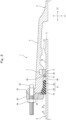
- a pipe joint 1 has a spigot 3 formed in a first pipe 2, and a socket 5 formed in a second pipe 4, with the spigot 3 being inserted into the socket 5.
- ductile iron pipes are used for these pipes 2 and 4.
- a lock ring accommodation groove 7 is formed over the entire circumference in the inner circumferential surface of the socket 5.
- a lock ring 8 is accommodated in the lock ring accommodation groove 7.
- the lock ring 8 is a ring having a split structure in which one portion has been cut at a location along the circumferential direction.
- the diameter of the lock ring 8 is expanded by expanding a gap 12 between the cut ends at a cut portion 11 using an expander 13, and the lock ring 8 has elasticity such that its diameter is reduced to return to the original diameter by removing the expander 13 from the cut portion 11.
- a spigot protrusion 15 is formed over the entire circumference at the outer circumference of the spigot 3.
- the spigot protrusion 15 can prevent the spigot 3 from separating from the socket 5 by the spigot protrusion 15 being caught on the lock ring 8 from the socket inner side in a separation direction 6 of the spigot 3.
- a seal ring 19 is provided that is compressed in a pipe radial direction 17 to seal a space between an outer circumferential surface 3a of the spigot 3 and the inner circumferential surface of the socket 5.
- the seal ring 19 is a ring made of rubber.
- the socket 5 has, at the inner circumference thereof, a socket sealing surface 21 with which the outer circumferential surface of the seal ring 19 contacts with pressure over the entire circumference, and a socket protrusion 22 that protrudes inward in the pipe radial direction from a deeper portion of the socket sealing surface 21.
- the socket sealing surface 21 has a tapered surface 25 that decreases in diameter gradually from an opening end face 24 of the socket 5 to the inner side, and an inner circumferential surface 26 that extends to the inner side from the deeper end of the tapered surface 25.
- the inner circumferential surface 26 is formed with a uniform inner diameter in a pipe axis direction 27 and is parallel to the outer circumferential surface 3a of the spigot 3.
- the socket protrusion 22 is formed in a circular shape over the entire circumference between the inner circumferential surface 26 of the socket sealing surface 21 and the lock ring accommodation groove 7.
- the socket protrusion 22 has a first end face 22b that extends from the deeper end of the inner circumferential surface 26 of the socket sealing surface 21 to an inner circumferential surface 22a of the socket protrusion 22, and a second end face 22c that extends from the inner circumferential surface 22a to the lock ring accommodation groove 7.
- the first end face 22b of the socket protrusion 22 is a tapered face whose diameter decreases as it approaches the inner circumferential surface 22a of the socket protrusion 22 from the deeper end of the inner circumferential surface 26 of the socket sealing surface 21.
- the second end face 22c of the socket protrusion 22 is a face which faces toward a deeper portion of the socket 5, and is located at the deeper end of the socket protrusion 22 in the pipe axis direction 27.
- the inner diameter of the inner circumferential surface 26 of the socket sealing surface 21 is set to a larger diameter than the inner diameter of the socket protrusion 22.
- a gland 30 that pushes the seal ring 19 into a deeper portion of the socket 5 is provided at the opening end part of the socket 5.
- the gland 30 has a contact portion 32 that contacts the opening end face 24 of the socket 5 in an insertion direction 31 of the seal ring 19.
- the gland 30 is connected to the opening end part of the socket 5 by a plurality of bolts 33 and nuts 34.
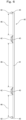
- a ring body 40 is provided between the lock ring 8 and the seal ring 19 in the pipe axis direction 27. As illustrated in Fig. 4 to Fig. 6 , the ring body 40 is made of a material that has elasticity, such as resin.
- the ring body 40 has an annular ring main body portion 41 that can be inserted between the inner circumferential surface 22a of the socket protrusion 22 and the outer circumferential surface 3a of the spigot 3, and a plurality of interval maintaining parts 42 that can be inserted between the inner circumferential surface 26 of the socket sealing surface 21 and the outer circumferential surface 3a of the spigot 3.
- the ring body 40 is a ring having a structure that is split at one location in the circumferential direction, in which any one of the interval maintaining parts 42 is cut at the center.
- the ring main body portion 41 has a quadrilateral cross section.
- the plurality of interval maintaining parts 42 are integrally provided on the ring main body portion 41 at predetermined intervals from each other in a pipe circumference direction 44.
- the interval maintaining part 42 is a protrusion that protrudes from the ring main body portion 41 at a position toward the socket opening end, and protrudes further outward in the pipe radial direction than the ring main body portion 41.
- the interval maintaining part 42 has an engagement surface 45 that is caught on the first end face 22b of the socket protrusion 22 in the insertion direction 31 of the spigot 3.
- the engagement surface 45 is a tapered surface that projects outward in the pipe radial direction 17 from the outer circumferential surface of the ring main body portion 41, and whose diameter increases as it approaches the outer circumferential surface of the interval maintaining part 42 from the outer circumferential surface of the ring main body portion 41.
- An inner diameter d1 of the interval maintaining part 42 is the same as an inner diameter d2 of the ring main body portion 41.
- An outer diameter D1 of the interval maintaining part 42 is larger than an outer diameter D2 of the ring main body portion 41.
- An escape space 46 into which a distal end portion of the seal ring 19 that is compressed can enter is formed at a location which is between one interval maintaining part 42 and another interval maintaining part 42 that are adjacent in the pipe circumference direction 44 and which is closer to the socket opening end than the ring main body portion 41.
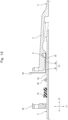
- the ring body 40, the seal ring 19, and the gland 30 are externally fitted to the first pipe 2 in advance. Further, the lock ring 8 is accommodated in the lock ring accommodation groove 7 of the second pipe 4. Then, as illustrated in Fig. 3 , the gap 12 of the cut portion 11 of the lock ring 8 is expanded using an expander 13 to thereby expand the diameter of the lock ring 8. Next, as illustrated in Fig. 12 , an L-shaped diameter expansion holder 50 is inserted into the cut portion 11 of the lock ring 8 and the expander 13 is removed, to thereby maintain the lock ring 8 in the state in which its diameter is expanded.
- the spigot 3 is inserted into the socket 5, and the spigot protrusion 15 is passed through from a position close to the socket opening end of the lock ring 8 to a deeper portion of the socket 52.
- the lock ring 8 is maintained in the state in which its diameter is expanded by the diameter expansion holder 50, the spigot protrusion 15 easily passes through the inner circumference of the lock ring 8.
- the diameter expansion holder 50 is removed from the cut portion 11 of the lock ring 8 to thereby cause the gap 12 at the cut portion 11 to be returned to its original size by the elasticity of the lock ring 8, and the lock ring 8 decreases in diameter and clings to the outer circumference of the spigot 3.
- Fig. 13 illustrates a state in which a narrow place has arisen at an upper part of the horizontal pipes 2 and 4.
- the interval 52 at a lower part of the pipes 2 and 4 is enlarged to a larger size than the predetermined size.
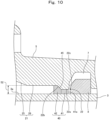
- the ring body 40 is moved in the pipe axis direction 27 and inserted between the socket sealing surface 21 and the outer circumferential surface 3a of the spigot 3 from the opening end of the socket 5, and mounted at the proper position.
- the ring main body portion 41 of the ring body 40 is inserted between the inner circumferential surface 22a of the socket protrusion 22 and the outer circumferential surface 3a of the spigot 3.
- the engagement surface 45 of the ring body 40 is caught on the first end face 22b of the socket protrusion 22.
- the interval maintaining parts 42 of the ring body 40 are inserted between the inner circumferential surface 26 of the socket sealing surface 21 and the outer circumferential surface 3a of the spigot 3, and thus the interval 52 between the inner circumferential surface 26 of the socket sealing surface 21 and the outer circumferential surface 3a of the spigot 3 in the pipe radial direction 17 is maintained at a predetermined size required in order to push in the seal ring 19.
- the ring body 40 Because the engagement surface 45 of the ring body 40 is caught on the first end face 22b of the socket protrusion 22, the ring body 40 is mounted at the proper position, and the position of the ring body 40 does not deviate further into a deeper portion of the socket 5 than the proper position.
- the seal ring 19 is inserted between the socket sealing surface 21 and the outer circumferential surface 3a of the spigot 3 from the opening end part of the socket 5, the gland 30 is connected to the opening end part of the socket 5 using the bolts 33 and the nuts 34, and the bolts 33 and the nuts 34 are tightened until the contact portion 32 of the gland 30 comes into contact with the opening end face 24 of the socket 5.
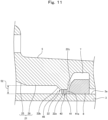
- the insertion amount of the ring body 40 may be insufficient and consequently the ring main body portion 41 does not reach the space between the inner circumferential surface 22a of the socket protrusion 22 and the outer circumferential surface 3a of the spigot 3, and is instead arranged between the inner circumferential surface 26 of the socket sealing surface 21 and the outer circumferential surface 3a of the spigot 3 at a location further toward the opening end than the socket protrusion 22.
- the seal ring 19 is not excessively compressed in the pipe radial direction 17 and the seal ring 19 can be easily pushed in between the socket sealing surface 21 and the outer circumferential surface 3a of the spigot 3 from the opening end part of the socket 5.
- the spigot 3 is inserted into the socket 5, and thereafter the ring body 40 is moved in the pipe axis direction 27 and inserted between the socket sealing surface 21 and the outer circumferential surface 3a of the spigot 3 from the opening end of the socket 5 and mounted at the proper position.
- the ring main body portion 41 of the ring body 40 is inserted between the inner circumferential surface 22a of the socket protrusion 22 and the outer circumferential surface 3a of the spigot 3, and the engagement surface 45 of the ring body 40 is caught on the first end face 22b of the socket protrusion 22.
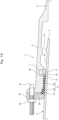
- the first pipe 2 is bent upward with respect to the horizontal second pipe 4.
- the interval 52 between the inner circumferential surface 26 of the socket sealing surface 21 and the outer circumferential surface 3a of the spigot 3 becomes narrower than the predetermined size at the upper part of the pipes 2 and 4 and becomes wider than the predetermined size at the lower part of the pipes 2 and 4.
- the seal ring 19 is pushed in between the socket sealing surface 21 and the outer circumferential surface 3a of the spigot 3 from the opening end part of the socket 5.
- the excessively compressed portion of the seal ring 19 enters the escape space 46 of the ring body 40 so that a situation in which the seal ring 19 is pushed in insufficiently can be prevented.
- a configuration is adopted so that when the ring body 40 is inserted as far as the proper position, a clearance is formed between the ring body 40 and the seal ring 19.
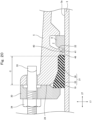
- a configuration is adopted in which a distance C from the opening end face 24 of the socket 5 to the socket protrusion 22 is shortened compared to the first embodiment, so that the seal ring 19 comes in contact with the ring body 40 when the ring body 40 is inserted as far as the proper position.
- the seal ring 19 is compressed in the pipe radial direction 17, and is also sandwiched between the interval maintaining parts 42 of the ring body 40 and the gland 30 and thereby compressed in the pipe axis direction 27.
- the escape space 46 is formed in the ring body 40, a sufficiently wide space necessary to prevent excessive compression of the seal ring 19 is secured between the socket sealing surface 21 and the outer circumferential surface 3a of the spigot 3. Accordingly, by the distal end portion of the seal ring 19 entering into the escape space 46 of the ring body 40, it is possible to prevent the seal ring 19 from being excessively compressed between the socket sealing surface 21 and the outer circumferential surface 3a of the spigot 3.
- the distance C from the opening end face 24 of the socket 5 to the socket protrusion 22 can be shortened, and the length of the socket 5 in the pipe axis direction 27 can be shortened.
- a configuration is adopted in which the ring body 40 is split at one place, a configuration may also be adopted in which the ring body 40 is divided into a plurality of arc-shaped ring pieces, and adjacent ring pieces are connected together with a connecting member to form the annular ring body 40.
Landscapes
- Engineering & Computer Science (AREA)
- General Engineering & Computer Science (AREA)
- Mechanical Engineering (AREA)
- Joints With Sleeves (AREA)
Applications Claiming Priority (2)
| Application Number | Priority Date | Filing Date | Title |
|---|---|---|---|
| JP2022103093A JP7745516B2 (ja) | 2022-06-28 | 2022-06-28 | リング体およびリング体を用いた管の接合方法 |
| PCT/JP2023/023298 WO2024004851A1 (fr) | 2022-06-28 | 2023-06-23 | Corps de bague, joint de tuyau et procédé pour raccorder des tuyaux à l'aide dudit corps de bague |
Publications (2)
| Publication Number | Publication Date |
|---|---|
| EP4524444A1 true EP4524444A1 (fr) | 2025-03-19 |
| EP4524444A4 EP4524444A4 (fr) | 2025-06-18 |
Family
ID=89382902
Family Applications (1)
| Application Number | Title | Priority Date | Filing Date |
|---|---|---|---|
| EP23831293.8A Pending EP4524444A4 (fr) | 2022-06-28 | 2023-06-23 | Corps de bague, joint de tuyau et procédé pour raccorder des tuyaux à l'aide dudit corps de bague |
Country Status (6)
| Country | Link |
|---|---|
| EP (1) | EP4524444A4 (fr) |
| JP (1) | JP7745516B2 (fr) |
| CN (1) | CN119404043A (fr) |
| CA (1) | CA3256928A1 (fr) |
| TW (1) | TW202409463A (fr) |
| WO (1) | WO2024004851A1 (fr) |
Cited By (1)
| Publication number | Priority date | Publication date | Assignee | Title |
|---|---|---|---|---|
| EP4524443A4 (fr) * | 2022-07-01 | 2025-06-25 | Kubota Corporation | Joint de tuyau |
Family Cites Families (12)
| Publication number | Priority date | Publication date | Assignee | Title |
|---|---|---|---|---|
| US5037144A (en) * | 1990-05-02 | 1991-08-06 | Amsted Industries Incorporated | Restrained pipe joint |
| FR2683609B1 (fr) * | 1991-11-07 | 1995-01-20 | Pont A Mousson | Joint verrouille pour canalisations. |
| JPH07260059A (ja) * | 1994-03-22 | 1995-10-13 | Kubota Corp | 離脱防止管継手 |
| JP3303069B2 (ja) * | 1997-05-29 | 2002-07-15 | 株式会社栗本鐵工所 | 離脱防止形管継手 |
| JP3339673B2 (ja) * | 1998-05-29 | 2002-10-28 | 株式会社栗本鐵工所 | 離脱防止形管継手 |
| CN100373085C (zh) * | 2001-10-04 | 2008-03-05 | 东京瓦斯株式会社 | 插入式管接头 |
| JP4212341B2 (ja) | 2002-11-15 | 2009-01-21 | 株式会社クボタ | 管継手用スペーサおよび管継手 |
| CN103148293B (zh) * | 2009-01-27 | 2015-07-29 | 株式会社久保田 | 管接头 |
| KR20130033633A (ko) * | 2011-09-27 | 2013-04-04 | 박강훈 | 파이프 연결구 |
| JP6525636B2 (ja) * | 2015-02-26 | 2019-06-05 | 株式会社クボタ | バックアップリング、継手および管の接続方法 |
| JP7382203B2 (ja) | 2019-10-18 | 2023-11-16 | 株式会社クボタ | 管継手および管の接合方法 |
| JP7393911B2 (ja) | 2019-10-18 | 2023-12-07 | 株式会社クボタ | 管継手 |
-
2022
- 2022-06-28 JP JP2022103093A patent/JP7745516B2/ja active Active
-
2023
- 2023-06-23 CA CA3256928A patent/CA3256928A1/fr active Pending
- 2023-06-23 CN CN202380048545.7A patent/CN119404043A/zh active Pending
- 2023-06-23 EP EP23831293.8A patent/EP4524444A4/fr active Pending
- 2023-06-23 WO PCT/JP2023/023298 patent/WO2024004851A1/fr not_active Ceased
- 2023-06-27 TW TW112123906A patent/TW202409463A/zh unknown
Cited By (1)
| Publication number | Priority date | Publication date | Assignee | Title |
|---|---|---|---|---|
| EP4524443A4 (fr) * | 2022-07-01 | 2025-06-25 | Kubota Corporation | Joint de tuyau |
Also Published As
| Publication number | Publication date |
|---|---|
| CN119404043A (zh) | 2025-02-07 |
| TW202409463A (zh) | 2024-03-01 |
| JP7745516B2 (ja) | 2025-09-29 |
| CA3256928A1 (fr) | 2025-03-19 |
| WO2024004851A1 (fr) | 2024-01-04 |
| EP4524444A4 (fr) | 2025-06-18 |
| JP2024003810A (ja) | 2024-01-16 |
Similar Documents
| Publication | Publication Date | Title |
|---|---|---|
| EP4043772B1 (fr) | Joint de tuyau, méthode pour joindre des tuyaux et utilisation d'un corps de bague dans un joint de tuyau | |
| US6427309B1 (en) | Method and forming element for producing a press connection between a fitting and a pipe and being inserted into the reception of the fitting | |
| JP6735123B2 (ja) | 管継手および管の接合方法 | |
| US6173994B1 (en) | Coupling assemblies for providing fluid connection | |
| EP0122509A1 (fr) | Raccord verrouillé pour tuyauterie | |
| US6497433B1 (en) | Coupling assemblies for providing fluid connection | |
| CN108884955B (zh) | 管接头、脱离防止构件、及管接合方法 | |
| EP4524444A1 (fr) | Corps de bague, joint de tuyau et procédé pour raccorder des tuyaux à l'aide dudit corps de bague | |
| JP7393911B2 (ja) | 管継手 | |
| US20040155464A1 (en) | Coupling for connection of a tube or hose by pushing-in | |
| JP2006118712A (ja) | 結合インジケータ付カップリングアセンブリ | |
| JP4286004B2 (ja) | 管の継手構造 | |
| US20250224054A1 (en) | Gland, pipe joint, and method for joining pipes | |
| JP6764668B2 (ja) | 管継手および管の接合方法 | |
| US12442472B2 (en) | Pipe joint, gland, and method for joining pipes | |
| JP6735124B2 (ja) | 管継手および離脱防止部材 | |
| JP2023069093A (ja) | 押輪、管継手および管の接合方法 | |
| JPH07332555A (ja) | 離脱防止管継手 | |
| JP7702313B2 (ja) | 押輪、管継手および管の接合方法 | |
| EP4038303B1 (fr) | Raccord d'extrémité serti pour tuyau flexible |
Legal Events
| Date | Code | Title | Description |
|---|---|---|---|
| STAA | Information on the status of an ep patent application or granted ep patent |
Free format text: STATUS: THE INTERNATIONAL PUBLICATION HAS BEEN MADE |
|
| PUAI | Public reference made under article 153(3) epc to a published international application that has entered the european phase |
Free format text: ORIGINAL CODE: 0009012 |
|
| STAA | Information on the status of an ep patent application or granted ep patent |
Free format text: STATUS: REQUEST FOR EXAMINATION WAS MADE |
|
| 17P | Request for examination filed |
Effective date: 20241209 |
|
| AK | Designated contracting states |
Kind code of ref document: A1 Designated state(s): AL AT BE BG CH CY CZ DE DK EE ES FI FR GB GR HR HU IE IS IT LI LT LU LV MC ME MK MT NL NO PL PT RO RS SE SI SK SM TR |
|
| A4 | Supplementary search report drawn up and despatched |
Effective date: 20250520 |
|
| RIC1 | Information provided on ipc code assigned before grant |
Ipc: F16L 21/04 20060101ALI20250514BHEP Ipc: F16L 21/02 20060101ALI20250514BHEP Ipc: F16L 21/08 20060101AFI20250514BHEP |
|
| DAV | Request for validation of the european patent (deleted) | ||
| DAX | Request for extension of the european patent (deleted) |