EP4527925A2 - Procédure pour surfaces formées dans du gel - Google Patents
Procédure pour surfaces formées dans du gel Download PDFInfo
- Publication number
- EP4527925A2 EP4527925A2 EP25155550.4A EP25155550A EP4527925A2 EP 4527925 A2 EP4527925 A2 EP 4527925A2 EP 25155550 A EP25155550 A EP 25155550A EP 4527925 A2 EP4527925 A2 EP 4527925A2
- Authority
- EP
- European Patent Office
- Prior art keywords
- wells
- gel
- nucleic acids
- array
- gel material
- Prior art date
- Legal status (The legal status is an assumption and is not a legal conclusion. Google has not performed a legal analysis and makes no representation as to the accuracy of the status listed.)
- Pending
Links
Images







Classifications
-
- B—PERFORMING OPERATIONS; TRANSPORTING
- B01—PHYSICAL OR CHEMICAL PROCESSES OR APPARATUS IN GENERAL
- B01J—CHEMICAL OR PHYSICAL PROCESSES, e.g. CATALYSIS OR COLLOID CHEMISTRY; THEIR RELEVANT APPARATUS
- B01J19/00—Chemical, physical or physico-chemical processes in general; Their relevant apparatus
- B01J19/0046—Sequential or parallel reactions, e.g. for the synthesis of polypeptides or polynucleotides; Apparatus and devices for combinatorial chemistry or for making molecular arrays
-
- C—CHEMISTRY; METALLURGY
- C12—BIOCHEMISTRY; BEER; SPIRITS; WINE; VINEGAR; MICROBIOLOGY; ENZYMOLOGY; MUTATION OR GENETIC ENGINEERING
- C12N—MICROORGANISMS OR ENZYMES; COMPOSITIONS THEREOF; PROPAGATING, PRESERVING, OR MAINTAINING MICROORGANISMS; MUTATION OR GENETIC ENGINEERING; CULTURE MEDIA
- C12N15/00—Mutation or genetic engineering; DNA or RNA concerning genetic engineering, vectors, e.g. plasmids, or their isolation, preparation or purification; Use of hosts therefor
- C12N15/09—Recombinant DNA-technology
- C12N15/10—Processes for the isolation, preparation or purification of DNA or RNA
- C12N15/1034—Isolating an individual clone by screening libraries
- C12N15/1068—Template (nucleic acid) mediated chemical library synthesis, e.g. chemical and enzymatical DNA-templated organic molecule synthesis, libraries prepared by non ribosomal polypeptide synthesis [NRPS], DNA/RNA-polymerase mediated polypeptide synthesis
-
- C—CHEMISTRY; METALLURGY
- C12—BIOCHEMISTRY; BEER; SPIRITS; WINE; VINEGAR; MICROBIOLOGY; ENZYMOLOGY; MUTATION OR GENETIC ENGINEERING
- C12Q—MEASURING OR TESTING PROCESSES INVOLVING ENZYMES, NUCLEIC ACIDS OR MICROORGANISMS; COMPOSITIONS OR TEST PAPERS THEREFOR; PROCESSES OF PREPARING SUCH COMPOSITIONS; CONDITION-RESPONSIVE CONTROL IN MICROBIOLOGICAL OR ENZYMOLOGICAL PROCESSES
- C12Q1/00—Measuring or testing processes involving enzymes, nucleic acids or microorganisms; Compositions therefor; Processes of preparing such compositions
- C12Q1/68—Measuring or testing processes involving enzymes, nucleic acids or microorganisms; Compositions therefor; Processes of preparing such compositions involving nucleic acids
- C12Q1/6813—Hybridisation assays
- C12Q1/6834—Enzymatic or biochemical coupling of nucleic acids to a solid phase
- C12Q1/6837—Enzymatic or biochemical coupling of nucleic acids to a solid phase using probe arrays or probe chips
-
- B—PERFORMING OPERATIONS; TRANSPORTING
- B01—PHYSICAL OR CHEMICAL PROCESSES OR APPARATUS IN GENERAL
- B01J—CHEMICAL OR PHYSICAL PROCESSES, e.g. CATALYSIS OR COLLOID CHEMISTRY; THEIR RELEVANT APPARATUS
- B01J2219/00—Chemical, physical or physico-chemical processes in general; Their relevant apparatus
- B01J2219/00274—Sequential or parallel reactions; Apparatus and devices for combinatorial chemistry or for making arrays; Chemical library technology
- B01J2219/00277—Apparatus
- B01J2219/00279—Features relating to reactor vessels
- B01J2219/00306—Reactor vessels in a multiple arrangement
- B01J2219/00313—Reactor vessels in a multiple arrangement the reactor vessels being formed by arrays of wells in blocks
- B01J2219/00315—Microtiter plates
- B01J2219/00317—Microwell devices, i.e. having large numbers of wells
-
- B—PERFORMING OPERATIONS; TRANSPORTING
- B01—PHYSICAL OR CHEMICAL PROCESSES OR APPARATUS IN GENERAL
- B01J—CHEMICAL OR PHYSICAL PROCESSES, e.g. CATALYSIS OR COLLOID CHEMISTRY; THEIR RELEVANT APPARATUS
- B01J2219/00—Chemical, physical or physico-chemical processes in general; Their relevant apparatus
- B01J2219/00274—Sequential or parallel reactions; Apparatus and devices for combinatorial chemistry or for making arrays; Chemical library technology
- B01J2219/00583—Features relative to the processes being carried out
- B01J2219/00603—Making arrays on substantially continuous surfaces
- B01J2219/00605—Making arrays on substantially continuous surfaces the compounds being directly bound or immobilised to solid supports
- B01J2219/00614—Delimitation of the attachment areas
- B01J2219/00621—Delimitation of the attachment areas by physical means, e.g. trenches, raised areas
-
- B—PERFORMING OPERATIONS; TRANSPORTING
- B01—PHYSICAL OR CHEMICAL PROCESSES OR APPARATUS IN GENERAL
- B01J—CHEMICAL OR PHYSICAL PROCESSES, e.g. CATALYSIS OR COLLOID CHEMISTRY; THEIR RELEVANT APPARATUS
- B01J2219/00—Chemical, physical or physico-chemical processes in general; Their relevant apparatus
- B01J2219/00274—Sequential or parallel reactions; Apparatus and devices for combinatorial chemistry or for making arrays; Chemical library technology
- B01J2219/00583—Features relative to the processes being carried out
- B01J2219/00603—Making arrays on substantially continuous surfaces
- B01J2219/00639—Making arrays on substantially continuous surfaces the compounds being trapped in or bound to a porous medium
- B01J2219/00644—Making arrays on substantially continuous surfaces the compounds being trapped in or bound to a porous medium the porous medium being present in discrete locations, e.g. gel pads
-
- B—PERFORMING OPERATIONS; TRANSPORTING
- B01—PHYSICAL OR CHEMICAL PROCESSES OR APPARATUS IN GENERAL
- B01J—CHEMICAL OR PHYSICAL PROCESSES, e.g. CATALYSIS OR COLLOID CHEMISTRY; THEIR RELEVANT APPARATUS
- B01J2219/00—Chemical, physical or physico-chemical processes in general; Their relevant apparatus
- B01J2219/00274—Sequential or parallel reactions; Apparatus and devices for combinatorial chemistry or for making arrays; Chemical library technology
- B01J2219/00718—Type of compounds synthesised
- B01J2219/0072—Organic compounds
- B01J2219/00722—Nucleotides
-
- C—CHEMISTRY; METALLURGY
- C12—BIOCHEMISTRY; BEER; SPIRITS; WINE; VINEGAR; MICROBIOLOGY; ENZYMOLOGY; MUTATION OR GENETIC ENGINEERING
- C12Q—MEASURING OR TESTING PROCESSES INVOLVING ENZYMES, NUCLEIC ACIDS OR MICROORGANISMS; COMPOSITIONS OR TEST PAPERS THEREFOR; PROCESSES OF PREPARING SUCH COMPOSITIONS; CONDITION-RESPONSIVE CONTROL IN MICROBIOLOGICAL OR ENZYMOLOGICAL PROCESSES
- C12Q2531/00—Reactions of nucleic acids characterised by
- C12Q2531/10—Reactions of nucleic acids characterised by the purpose being amplify/increase the copy number of target nucleic acid
-
- C—CHEMISTRY; METALLURGY
- C12—BIOCHEMISTRY; BEER; SPIRITS; WINE; VINEGAR; MICROBIOLOGY; ENZYMOLOGY; MUTATION OR GENETIC ENGINEERING
- C12Q—MEASURING OR TESTING PROCESSES INVOLVING ENZYMES, NUCLEIC ACIDS OR MICROORGANISMS; COMPOSITIONS OR TEST PAPERS THEREFOR; PROCESSES OF PREPARING SUCH COMPOSITIONS; CONDITION-RESPONSIVE CONTROL IN MICROBIOLOGICAL OR ENZYMOLOGICAL PROCESSES
- C12Q2563/00—Nucleic acid detection characterized by the use of physical, structural and functional properties
- C12Q2563/159—Microreactors, e.g. emulsion PCR or sequencing, droplet PCR, microcapsules, i.e. non-liquid containers with a range of different permeability's for different reaction components
-
- C—CHEMISTRY; METALLURGY
- C12—BIOCHEMISTRY; BEER; SPIRITS; WINE; VINEGAR; MICROBIOLOGY; ENZYMOLOGY; MUTATION OR GENETIC ENGINEERING
- C12Q—MEASURING OR TESTING PROCESSES INVOLVING ENZYMES, NUCLEIC ACIDS OR MICROORGANISMS; COMPOSITIONS OR TEST PAPERS THEREFOR; PROCESSES OF PREPARING SUCH COMPOSITIONS; CONDITION-RESPONSIVE CONTROL IN MICROBIOLOGICAL OR ENZYMOLOGICAL PROCESSES
- C12Q2565/00—Nucleic acid analysis characterised by mode or means of detection
- C12Q2565/50—Detection characterised by immobilisation to a surface
- C12Q2565/501—Detection characterised by immobilisation to a surface being an array of oligonucleotides
-
- C—CHEMISTRY; METALLURGY
- C12—BIOCHEMISTRY; BEER; SPIRITS; WINE; VINEGAR; MICROBIOLOGY; ENZYMOLOGY; MUTATION OR GENETIC ENGINEERING
- C12Q—MEASURING OR TESTING PROCESSES INVOLVING ENZYMES, NUCLEIC ACIDS OR MICROORGANISMS; COMPOSITIONS OR TEST PAPERS THEREFOR; PROCESSES OF PREPARING SUCH COMPOSITIONS; CONDITION-RESPONSIVE CONTROL IN MICROBIOLOGICAL OR ENZYMOLOGICAL PROCESSES
- C12Q2565/00—Nucleic acid analysis characterised by mode or means of detection
- C12Q2565/50—Detection characterised by immobilisation to a surface
- C12Q2565/513—Detection characterised by immobilisation to a surface characterised by the pattern of the arrayed oligonucleotides
Definitions
- the present disclosure provides an array including a solid support having a surface, the surface having a plurality of wells, the wells containing a gel material, the wells being separated from each other by interstitial regions on the surface, the interstitial regions segregating the gel material in each of the wells from the gel material in other wells of the plurality; and a library of target nucleic acids in the gel material, wherein the gel material in each of the wells comprises a single species of the target nucleic acids of the library.
- the substrate is configured as an array of wells and the analytes are nucleic acids.
- this disclosure provides an array that includes a solid support having a surface, the surface having a plurality of wells, the wells containing a gel material, the wells being separated from each other by interstitial regions on the surface, the interstitial regions segregating the gel material in each of the wells from the gel material in other wells of the plurality; and a library of target nucleic acids in the gel material, wherein the gel material in each of the wells includes a single species of the target nucleic acids of the library.
- the present disclosure also provides a method of making a substrate.
- the method can include the steps of (a) providing a solid support having a planar surface, wherein the planar surface is interrupted by one or more concave features and wherein the one or more concave features are bordered by one or more interstitial regions on the planar surface; (b) coating at least a portion of the solid support with a gel material, wherein the portion includes at least one of the concave features and at least one of the interstitial regions; and (c) polishing the planar surface to remove the gel material from the at least one interstitial regions and to maintain the gel material in the at least one concave feature.
- the method can include the steps of (a) providing a solid support having a planar surface, wherein the planar surface is interrupted by one or more concave features, wherein the concave features contain gel material, wherein the one or more concave features are bordered by one or more interstitial regions on the planar surface, the interstitial regions being substantially devoid of the gel material, and wherein the gel material is attached to or contains target analytes; (b) contacting the solid support with probes under conditions wherein the target analytes interact specifically with the probes; and (c) detecting the solid support to distinguish at least a subset of the target analytes that interact with one or more of the probes.
- nucleic acids are the analytes that are detected and the concave features are wells.
- a method of detecting nucleic acids can include the steps of (a) providing a solid support having a surface and a library of nucleic acids, the surface having a plurality of wells, the wells containing a gel material, the wells being separated from each other by interstitial regions on the surface, the interstitial regions segregating the gel material in each of the wells from the gel material in other wells of the plurality, a single species of the target nucleic acids of the library being attached to the gel material in each of the wells; (b) contacting the solid support with at least one probe that binds to the target nucleic acids; and (c) detecting the solid support to distinguish the wells having a target nucleic acid species that binds to the at least one probe.
- compositions, apparatus, and methods of the present disclosure are exemplified herein with regard to gel material.
- gel material is exemplary and can be replaced with other organic materials including, for example, polymers that may form a surface coating and may not necessarily be considered as gels, per se.
- Methods set forth herein for applying gel material to a surface, removing the gel material from interstitial regions, attaching analytes to the gel material, using the resulting arrays in analytical or preparative methods etc. can be readily adapted by replacing the gel material with non-gel materials.
- the substrates include a solid support having concave regions, such as wells, that contain gel material (e.g. being coated by the gel material).
- the gel material can in turn be attached to an analyte of interest, such as a nucleic acid.
- the gel-containing regions are discrete, being separated by interstitial regions that lack the ability to attach the analyte of interest.
- the interstitial regions may lack the gel material.
- the gel material in the interstitial regions may be inactivated or otherwise modified to lack an activity or characteristic of the gel material in the concave regions, such as the ability to support analyte attachment.
- the resulting segregation of the gel regions provides advantages when carrying out reactions on the analytes and/or detecting the analytes.
- An exemplary advantage can be demonstrated in the instance of an array of target nucleic acids distributed among gel-containing wells.
- an amplification reaction can be carried out on the structured substrate using the nucleic acids as templates to form nucleic acid colonies that grow in or on the gel (e.g. nucleic acid features of the array).
- the interstitial regions function to confine the area of growth for the colony.
- the individual features of the resulting array can be distinguished with relative ease due to the discrete pattern created by the gel-containing wells.
- the pattern can also provide benefits of increasing the density of features and reducing processing requirements for image registration as compared to random arrays of nucleic acids.
- FIG. 1 An exemplary process for making a patterned array of nucleic acids is shown in Fig. 1 .
- a profile view of a well-patterned substrate is shown diagrammatically.
- the wells have a pitch (center-to-center spacing) of 1.5 ⁇ m and the diameter of each well is 0.5 ⁇ m in the example.
- the well patterned substrate can be coated with a gel material such that material enters the wells and coats the interstitial regions.
- the resulting gel-coated substrate can be polished to remove gel material from the interstitial regions, leaving gel material in the wells, thereby forming a gel-patterned substrate.
- the gel can function to support capture of a DNA template and amplification of the template.
- the gel can be grafted with oligonucleotide primers prior to surface coating, after surface coating and before polishing, or after polishing.
- the primers can function to capture the DNA templates and to prime amplification using the captured templates.
- the resulting DNA-patterned substrate can be analyzed for example in a sequencing technique.
- a patterned array of nucleic acids in gel-containing wells provides multiple advantages for DNA sequencing. Examples of advantages compared to random arrays (i.e. arrays having a random pattern of features) include increased density of feature packing, increased control and tuning of feature density using concentration-independent template seeding, reduced processing requirements for image registration and increased ease of signal extraction. A further advantage can be derived from spatial confinement of nucleic acid populations provided by each feature. A feature of a patterned array of the present disclosure can function to restrict the area or volume within which a nucleic acid colony will grow (for example, via cluster amplification).
- nucleic acid colonies may amplify to a larger size than others due to differences in percent content of guanine and cytosine in their sequences (i.e. GC content) which influence relative amplification rates.
- the volume or area of individual features can be selected to prevent or minimize differences in nucleic acid colony sizes that would otherwise occur from an amplification reaction due to differences in GC content between the template species being amplified.
- the volume or area of the features can be sufficiently small to cap growth of the fastest growing colonies while allowing slower growing colonies to effectively fill the feature upon completion of the amplification reaction.
- this disclosure provides fabrication of wells (e.g. microwells or nanowells) on glass, silicon, plastic or other suitable solid supports with patterned, covalently-linked gel such as poly(N-(5-azidoacetamidylpentyl)acrylamide-co-acrylamide) (PAZAM, see, for example, US Prov. Pat. App. Ser. No. 61/753,833 , which is incorporated herein by reference).
- PAZAM poly(N-(5-azidoacetamidylpentyl)acrylamide-co-acrylamide)
- the process creates gel pads used for sequencing that can be stable over sequencing runs with a large number of cycles.
- the covalent linking of the polymer to the wells is helpful for maintaining the gel in the structured features throughout the lifetime of the structured substrate during a variety of uses.
- the gel need not be covalently linked to the wells.
- silane free acrylamide SFA, see, for example, US Pat. App. Pub. No. 2011/0059865 A1 , which is incorporated herein by reference
- the gel material can be used as the gel material.
- a structured substrate can be made by patterning a solid support material with wells (e.g. microwells or nanowells), coating the patterned support with a gel material (e.g. PAZAM, SFA or chemically modified variants thereof, such as the azidolyzed version of SFA (azido-SFA)) and polishing the gel coated support, for example via chemical or mechanical polishing, thereby retaining gel in the wells but removing or inactivating substantially all of the gel from the interstitial regions on the surface of the structured substrate between the wells.
- a gel material e.g. PAZAM, SFA or chemically modified variants thereof, such as the azidolyzed version of SFA (azido-SFA)
- a fragmented human genome can then be contacted with the polished substrate such that individual target nucleic acids will seed individual wells via interactions with primers attached to the gel material; however, the target nucleic acids will not occupy the interstitial regions due to absence or inactivity of the gel material. Amplification of the target nucleic acids will be confined to the wells since absence or inactivity of gel in the interstitial regions prevents outward migration of the growing nucleic acid colony.
- the process is conveniently manufacturable, being scalable and utilizing conventional micro- or nano-fabrication methods.
- fiducial markers are included on a structured substrate to facilitate identification and localization of individual features (e.g. wells or other gel-containing concave features). Fiducial markers are particularly useful for structured substrates having a spatially ordered pattern of features since the fiducial markers provide a point of reference for relative locations of other features. Fiducial markers can be used for registering images of random arrays as well, but the inherent disorder of clusters can be used instead, for example, as used with random arrays generated on commercial sequence platforms such as the HiSeq, Genome Analyzer or MiSeq platforms from Illumina, Inc. (San Diego, CA). Fiducial markers are especially beneficial for applications where the structured substrate is detected repeatedly to follow changes occurring at individual features over time. Fiducial markers allow individual nucleic acid clusters to be followed through sequential images obtained over multiple sequencing cycles, such that the sequence of individual clusters can be discretely determined.
- This disclosure provides a fiducial marker having a pattern of concave region(s) and interstitial region(s).
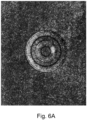
- An exemplary design for a fiducial marker is a set of concentric circles having an alternating pattern of two or more of the following: a concave ring, interstitial ring and a ring of wells or other concave features (e.g. a "bulls-eye").
- concave region(s) of a fiducial marker contain gel material, whereas interstitial regions do not. This differential location of the gel on the surface can be achieved using the gel coating and polishing methods set forth herein. Typically a detection method is used that can distinguish gel-containing regions from interstitial regions.
- the distinction can be based on the presence of a particular analyte in the gel regions that is absent from the interstitial regions.
- the gel-containing region of a fiducial marker can contain nucleic acids that are labeled via the same methods that are used to label target nucleic acids on the array.
- fiducial markers can be conveniently fabricated using the same methods used to fabricate analyte features. Accordingly, if desired, fiducial markers and analyte features can be fabricated simultaneously across one or more steps.
- fiducial marker that can be used in the structured substrates and methods set forth herein is one having sub-regions where the pattern of wells (or other concave features) in one subregion is rotated with respect to the pattern in another subregion.
- Such fiducial grids can be configured and used for image registration as set forth in US Ser. No. 13/267,565 , which is incorporated herein by reference.
- beads can be used as a fiducial.
- the beads can include a label such as a fluorophore.
- a surface can have at least two types of wells (or other concave features). Relatively large wells can accommodate one or more fiducial beads, whereas smaller wells, being too small to contain a bead, will only have gel material. Thus, the smaller wells function as analytical features for analysis and the larger, bead-filled wells function as fiducials.
- the fiducial features can be channels, such as those present in the bulls-eye configuration exemplified above, and the channels can have dimensions that accommodate the beads. As such, several beads can be placed in the channel to create a fiducial, for example, in the apparent shape of a string of beads.
- Patterned arrays, methods for their manufacture and methods for their use are exemplified herein with regard to a gel material that is used to attach analytes of interest.
- the gel material is exemplary and can be replaced with other organic materials that can be used to mediate localization of analytes to features on a surface.
- organic materials include for example, polymers that may form a surface coating and may not necessarily be considered as gels, per se.
- a specific example is a polymer formed by ATRP (atom transfer radical polymerization) or surface initiated polymerization processes.
- clonal population refers to a population of nucleic acids that is homogeneous with respect to a particular nucleotide sequence.
- the homogenous sequence is typically at least 10 nucleotides long, but can be even longer including for example, at least 50, 100, 250, 500, 1000 or 2500 nucleotides long.
- a clonal population can be derived from a single target nucleic acid or template nucleic acid.
- a clonal population can include at least 2, 5, 10, 100, 1000 or more copies of a target nucleotide sequence. The copies can be present in a single nucleic acid molecule, for example, as a concatamer or the copies can be present on separate nucleic acid molecules (i.e.
- a clonal population can include at least 2, 5, 10, 100, 1000 or more nucleic acid molecules having the same target nucleotide sequence). Typically, all of the nucleic acids in a clonal population will have the same nucleotide sequence. It will be understood that a negligible number of contaminant nucleic acids or mutations (e.g. due to amplification artifacts) can occur in a clonal population without departing from clonality. Thus, a population can be at least 80%, 90%, 95% or 99% clonal. In some cases 100% pure clonal populations may be present.
- the term "coat,” when used as a verb, is intended to mean providing a layer or covering on a surface. At least a portion of the surface can be provided with a layer or cover. In some cases the entire surface can be provided with a layer or cover. In alternative cases only a portion of the surface will be provided with a layer or covering.
- the term "coat,” when used to describe the relationship between a surface and a material, is intended to mean that the material is present as a layer or cover on the surface.
- the material can seal the surface, for example, preventing contact of liquid or gas with the surface. However, the material need not form a seal.
- the material can be porous to liquid, gas, or one or more components carried in a liquid or gas.
- Exemplary materials that can coat a surface include, but are not limited to, a gel, polymer, organic polymer, liquid, metal, a second surface, plastic, silica, or gas.
- concave feature when used in reference to a solid support, refers to a recess or indentation in the solid support.
- exemplary concave features include, but are not limited to, a well, pit, hole, depression, channel, or trough.
- a concave feature can optionally have a curved cross section (in the dimension orthogonal to the surface of the solid support); however, a cross section with one or more linear sections, angles or corners is also possible. Cross sections with combinations of curved and linear sections are also possible.
- a concave feature need not pass completely through the solid support, for example, instead having a bottom surface or point in the substrate.
- nucleic acids As used herein, the term "different", when used in reference to nucleic acids, means that the nucleic acids have nucleotide sequences that are not the same as each other. Two or more nucleic acids can have nucleotide sequences that are different along their entire length. Alternatively, two or more nucleic acids can have nucleotide sequences that are different along a substantial portion of their length. For example, two or more nucleic acids can have target nucleotide sequence portions that are different for the two or more molecules while also having a universal sequence portion that is the same on the two or more molecules.
- each when used in reference to a collection of items, is intended to identify an individual item in the collection but does not necessarily refer to every item in the collection. Exceptions can occur if explicit disclosure or context clearly dictates otherwise.
- fluidic access when used in reference to a molecule in a fluid and a site in contact with the fluid, refers to the ability of the molecule to move in or through the fluid to contact or enter the site. The term can also refer to the ability of the molecule to separate from or exit the site to enter the solution. Fluidic access can occur when there are no barriers that prevent the molecule from entering the site, contacting the site, separating from the site and/or exiting the site. However, fluidic access is understood to exist even if diffusion is retarded, reduced or altered so long as access is not absolutely prevented.
- gel material is intended to mean a semi-rigid material that is permeable to liquids and gases. Typically, gel material can swell when liquid is taken up and can contract when liquid is removed by drying.
- Exemplary gels include, but are not limited to those having a colloidal structure, such as agarose; polymer mesh structure, such as gelatin; or cross-linked polymer structure, such as polyacrylamide, SFA (see, for example, US Pat. App. Pub. No. 2011/0059865 A1 , which is incorporated herein by reference) or PAZAM (see, for example, US Prov. Pat. App. Ser. No. 61/753,833 , which is incorporated herein by reference).
- Particularly useful gel material will conform to the shape of a well or other concave feature where it resides.
- Some useful gel materials can both (a) conform to the shape of the well or other concave feature where it resides and (b) have a volume that does not substantially exceed the volume of the well or concave feature where it resides.
- an interstitial region refers to an area in a substrate or on a surface that separates other areas of the substrate or surface.
- an interstitial region can separate one concave feature of an array from another concave feature of the array.
- the two regions that are separated from each other can be discrete, lacking contact with each other.
- an interstitial region can separate a first portion of a feature from a second portion of a feature.
- the interstitial region is continuous whereas the features are discrete, for example, as is the case for an array of wells in an otherwise continuous surface.
- the separation provided by an interstitial region can be partial or full separation.
- Interstitial regions will typically have a surface material that differs from the surface material of the features on the surface.
- features of an array can have an amount or concentration of gel material or analytes that exceeds the amount or concentration present at the interstitial regions.
- the gel material or analytes may not be present at the interstitial regions.
- a library when used in reference to analytes, refers to a collection of analytes having different chemical compositions.
- the analytes in a library will be different species having a common feature or characteristic of a genera or class, but otherwise differing in some way.
- a library can include nucleic acid species that differ in nucleotide sequence, but that are similar with respect to having a sugar-phosphate backbone.
- nucleic acid and “nucleotide” are intended to be consistent with their use in the art and to include naturally occurring species or functional analogs thereof. Particularly useful functional analogs of nucleic acids are capable of hybridizing to a nucleic acid in a sequence specific fashion or capable of being used as a template for replication of a particular nucleotide sequence.
- Naturally occurring nucleic acids generally have a backbone containing phosphodiester bonds. An analog structure can have an alternate backbone linkage including any of a variety of those known in the art.
- Naturally occurring nucleic acids generally have a deoxyribose sugar (e.g. found in deoxyribonucleic acid (DNA)) or a ribose sugar (e.g.
- a nucleic acid can contain nucleotides having any of a variety of analogs of these sugar moieties that are known in the art.
- a nucleic acid can include native or non-native nucleotides.
- a native deoxyribonucleic acid can have one or more bases selected from the group consisting of adenine, thymine, cytosine or guanine and a ribonucleic acid can have one or more bases selected from the group consisting of uracil, adenine, cytosine or guanine.
- Useful non-native bases that can be included in a nucleic acid or nucleotide are known in the art.
- probe or "target,” when used in reference to a nucleic acid, are intended as semantic identifiers for the nucleic acid in the context of a method or composition set forth herein and does not necessarily limit the structure or function of the nucleic acid beyond what is otherwise explicitly indicated.
- probe and target can be similarly applied to other analytes such as proteins, small molecules, cells or the like.
- the term "random pattern,” when used in reference to wells on a surface, means that the relative locations of a subset of wells in one region of the surface is not known or predictable from the locations of a subset of wells in another region of the surface.
- the subset used for the measure will generally include at least 3 wells but can include at least, 4, 5, 6, 10 or more wells.
- a random pattern generally does not include multiple repetitions of any sub-patterns.
- the term can be applied to other concave features besides wells.
- the term "repeating pattern,” when used in reference to wells on a surface, means that the relative locations of a subset of wells in one region of the surface is the same as the relative locations of a subset of wells in at least one other region of the surface. Thus, the relative locations for wells in one region of a repeating pattern are generally predictable from the relative locations of wells in another region of the repeating pattern.
- the subset used for the measure will generally include at least 3 wells but can include at least, 4, 5, 6, 10 or more wells.
- Exemplary repeating patterns include rectilinear patterns and hexagonal patterns.
- a repeating pattern can include multiple repetitions of a sub-pattern. The term can be applied to other concave features besides wells.
- the term “segregate,” when used in reference to gel material in two wells (or at two other features), means to separate or isolate the gel material in one of the wells (or at one of the features) from the gel material in the other well (or at the other feature).
- the gel material in the first well (or at the first feature) is not in direct contact with the gel material in the other well (or at the other feature).
- the gel material in the two wells (or at the two features) is in indirect contact, for example, via a solution that contacts the two wells (or features).
- the gel material in the two wells (or at the two features) is not even in indirect contact.
- An interstitial region on a surface can segregate the gel material in two wells (or at two features) by being devoid of the gel material.
- a gel material can be discontinuous on a surface, being present at concave features, such as wells, but not present at interstitial regions between the features.
- the term "surface” is intended to mean an external part or external layer of a solid support or gel material.
- the surface can be in contact with another material such as a gas, liquid, gel, polymer, organic polymer, second surface of a similar or different material, metal, or coat.
- the surface, or regions thereof, can be substantially flat.
- the surface can have surface features such as wells, pits, channels, ridges, raised regions, pegs, posts or the like.
- single species means substantially one and only one species of a particular genera. The term is not necessarily intended to limit the number of representatives of a single species that are present. For example, a population of nucleic acid molecules each having the same nucleotide sequence comprise a single species of nucleic acid. The term "single” in this context is not intended to exclude the presence of other things that are not within the relevant genera. For example, a well that contains a single species of target nucleic acid from a library can include multiple nucleic acids having the same sequence, will exclude other target nucleic from the library, but need not necessarily exclude any other non-nucleic acid components.
- solid support refers to a rigid substrate that is insoluble in aqueous liquid.
- the substrate can be non-porous or porous.
- the substrate can optionally be capable of taking up a liquid (e.g. due to porosity) but will typically be sufficiently rigid that the substrate does not swell substantially when taking up the liquid and does not contract substantially when the liquid is removed by drying.
- a nonporous solid support is generally impermeable to liquids or gases.
- Solid supports can optionally be inert to a chemistry that is used to modify a gel.
- a solid support can be inert to chemistry used to attach analytes, such as nucleic acids, to gels in a method set forth herein.
- Exemplary solid supports include, but are not limited to, glass and modified or functionalized glass, plastics (including acrylics, polystyrene and copolymers of styrene and other materials, polypropylene, polyethylene, polybutylene, polyurethanes, Teflon TM , cyclic olefins, polyimides etc.), nylon, ceramics, resins, Zeonor, silica or silica-based materials including silicon and modified silicon, carbon, metals, inorganic glasses, optical fiber bundles, and polymers. Particularly useful solid supports for some embodiments are located within a flow cell apparatus. Exemplary flow cells are set forth in further detail below.
- the term "well” refers to a discrete concave feature in a solid support having a surface opening that is completely surrounded by interstitial region(s) of the surface.
- Wells can have any of a variety of shapes at their opening in a surface including but not limited to round, elliptical, square, polygonal, star shaped (with any number of vertices) etc.
- the cross section of a well taken orthogonally with the surface can be curved, square, polygonal, hyperbolic, conical, angular, etc.
- the present disclosure provides a substrate that includes a solid support having a surface, the surface having at least one concave feature, the at least one concave feature containing a gel material, the at least one concave feature being bordered by at least one interstitial region on the surface; and a library of analytes in the gel material, wherein the gel material in each of the wells includes a single species of the analytes of the library.
- the substrate is configured as an array of wells and the analytes are nucleic acids.
- this disclosure provides an array that includes a solid support having a surface, the surface having a plurality of wells, the wells containing a gel material, the wells being separated from each other by interstitial regions on the surface, the interstitial regions segregating the gel material in each of the wells from the gel material in other wells of the plurality; and a library of target nucleic acids in the gel material, wherein the gel material in each of the wells includes a single species of the target nucleic acids of the library.
- a solid support used in a structured substrate set forth herein can be made from any of a variety of materials set forth herein, for example, above in the definitions, below in the examples or immediately following.
- a particularly useful material is glass.
- suitable substrate materials may include polymeric materials, plastics, silicon, quartz (fused silica), borofloat glass, silica, silica-based materials, carbon, metals, an optical fiber or optical fiber bundles, sapphire, or plastic materials such as COCs and epoxies.
- the particular material can be selected based on properties desired for a particular use. For example, materials that are transparent to a desired wavelength of radiation are useful for analytical techniques that will utilize radiation of the desired wavelength, such as one or more of the techniques set forth herein.
- a material that does not pass radiation of a certain wavelength e.g. being opaque, absorptive or reflective.
- This can be useful for formation of a mask to be used during manufacture of the structured substrate, such as a method set forth herein; or to be used for a chemical reaction or analytical detection carried out using the structured substrate, such as those set forth herein.
- Other properties of a material that can be exploited are inertness or reactivity to certain reagents used in a downstream process, such as those set forth herein; or ease of manipulation or low cost during a manufacturing process manufacture, such as those set forth herein. Further examples of materials that can be used in the structured substrates or methods of the present disclosure are described in US Ser. No. 13/661,524 and US Pat. App. Pub. No. 2012/0316086 A1 , each of which is incorporated herein by reference.
- a Sol-Gel based substrate can be made and used.
- Sol-Gel based patterning can be accomplished by coating a rigid or flexible substrate, such as glass, silicon, plastic, metal or the like, with a Sol-Gel coating can be carried out, for example, through spin coating, dipping or spray coating.
- the Sol-Gel can be provided in a liquid state when applied to the substrate and can contain either photo- or thermal-initiators that enable curing (making the liquid a gel) through the exposure of the Sol-Gel to either light or heat.
- the Sol-Gel can be imprinted with a template (three dimensional stamp) that has either a single or plurality of protruding feature(s).
- the template can be made, for example, of silicon, glass (such as quartz), metal (such as nickel), plastic or polymer (such as PDMS). Imprinting of the stamp into the Sol-Gel can be accomplished by placing the template in contact with the Sol-Gel. When the template is in contact with the Sol-Gel, the Sol-Gel redistributes to conformally surround the structure of the template.
- the redistribution of the Sol-Gel can be driven either through an external force applied to the template or the substrate, or through capillary forces intrinsic to the nature of the patterned template.
- the stack of substrate + Sol-Gel + template can be exposed to light or heat to cure the Sol-Gel and to lock the pattern originally in the template into the Sol-Gel. This patterning process is conventionally referred to as nanoimprint lithography.
- the template can be separated from the substrate + Sol-Gel stack, and the template can be either discarded or re-used to pattern another substrate coated with un-cured Sol-Gel.
- the substrate with the cured, patterned Sol-Gel can then be taken into a chemical deposition process, or if a pure glass like surface is desired, the substrate + patterned Sol-Gel stack can be taken through a thermal process (sintering) that will remove organic material that was originally present in the Sol-Gel. This is not required but can make the substrate a pure SiO 2 material that has advantages in certain chemical attachment schemes.
- a substrate of plastic can be mounted on a chuck that has the ability to be temperature controlled.
- the plastic substrate can then be heated to a temperature such that the outer skin of the plastic exceeds the glass transition temperature.
- the template is put into hard contact with a template (e.g. quartz, silicon, polymeric or metallic).
- the template typically has an external force applied to ensure that the plastic completely conformally coats the structured template.
- the plastic While in contact at the elevated temperature, the plastic redistributes itself to become a negative replica of the template; for example if the template has an array of posts then the embossed plastic results in an array of wells. While the template is in contact with the plastic substrate, the temperature of the substrate is reduced thus locking the embossed pattern into the substrate.
- a concave feature that is on a substrate can have any of a variety of shapes.
- the feature can have curved sides, linear sides, corners or a combination thereof.
- the features can be wells having openings in the surface that are circular, oval, square, polygonal, star-shaped (with any number of vertices), or irregularly shaped.
- the features can be channels and the shape of the channels on the surface can include sides that are curved, linear, angled or a combination thereof.
- Other channel features can be linear, serpentine, rectangular, square, triangular, circular, oval, hyperbolic, or a combination thereof.
- the channels can have one or more branches or corners.
- the channels can connect two points on a surface, one or both of which can be the edge of the substrate.
- Fig. 3B and Fig. 3C shows exemplary channel features in bulls-eye fiducials along with wells within and surrounding the bulls-eye fiducials.
- the cross sectional shape of a concave feature taken orthogonal to the surface, can have walls that are curved, linear or a combination of the two.
- the cross-sectional shape can be a portion of a circle or oval (e.g. U-shaped), or can have two or more linear sides that meet at corners (e.g. V-, square-, polygonal- or star-shaped).
- the bottom of the concave feature can be narrower, wider, or roughly the same as the opening on the surface.
- cross sectional shapes can be illustrated for the case where the concave feature is a well, in which case, the opening in the surface will be roughly the same area as the bottom of the well when the well has a cylindrical cross section, whereas the bottom of the well will have a different area (typically smaller) than the area at the opening on the surface when the well has a conical cross section.
- the cross sections although illustrated for wells, can apply to channels also.
- each well can have any volume that is capable of confining a liquid.
- the minimum or maximum volume can be selected, for example, to accommodate the throughput (e.g. multiplexity), resolution, analyte composition, or analyte reactivity expected for downstream uses of the substrate.
- the volume can be at least 1 x 10 -3 ⁇ m 3 , 1 x 10 -2 ⁇ m 3 , 0.1 ⁇ m 3 , 1 ⁇ m 3 , 10 ⁇ m 3 , 100 ⁇ m 3 or more.
- the volume can be at most 1 x 10 4 ⁇ m 3 , 1 x 10 3 ⁇ m 3 , 100 ⁇ m 3 , 10 ⁇ m 3 , 1 ⁇ m 3 , 0.1 ⁇ m 3 or less.
- gel material can fill all or part of the volume of a well.
- the volume of gel in an individual well can be greater than, less than or between the values specified above.
- wells can be disposed in a hexagonal grid for close packing and improved density.
- Other layouts may include, for example, rectilinear (i.e., rectangular) layouts, triangular layouts, and so forth.
- the particular layouts, and differences between the layouts of different domains, if used, may follow the teachings of U.S. patent no. 7,813,013 , and/or of U.S. patent application no. 13/267,565 , each of which is hereby incorporated by reference. Any of a variety of crystalline or poly-crystalline patterns can be useful.
- a pattern of wells can be characterized in terms of the average pitch (i.e. center-to-center spacing) for the wells.
- the pattern can be regular such that the coefficient of variation around the average pitch is small or the pattern can be non-regular in which case the coefficient of variation can be relatively large.
- the average pitch can be, for example, at least 10 nm, 0.1 ⁇ m, 0.5 ⁇ m, 1 ⁇ m, 5 ⁇ m, 10 ⁇ m, 100 ⁇ m or more.
- the average pitch can be, for example, at most 100 ⁇ m, 10 ⁇ m, 5 ⁇ m, 1 ⁇ m, 0.5 ⁇ m 0.1 ⁇ m or less.
- the average pitch for a particular pattern of wells can be between one of the lower values and one of the upper values selected from the ranges above.
- a pattern of wells can also be characterized with respect to the density of wells (i.e. number of wells) in a defined area.
- the wells may be present at a density of approximately 2 million per mm 2 .
- the density can easily be tuned to different densities including, for example, a density of at least 100 per mm 2 , 1,000 per mm 2 , 0.1 million per mm 2 , 1 million per mm 2 , 2 million per mm 2 , 5 million per mm 2 or more.
- the density can be tuned to be no more than 5 million per mm 2 , 2 million per mm 2 , 1 million per mm 2 , 0.1 million per mm 2 , 1,000 per mm 2 , 100 per mm 2 or less.
- the density of wells on a substrate can be between one of the lower values and one of the upper values selected from the ranges above.
- a gel material is used.
- a gel-forming (e.g. polymerizable) material is provided to a solid support in a liquid state and subsequently converted to a gel.
- polymerizable materials include, without limitation, acrylamide, methacrylamide, hydroxyethyl methacrylate, N-vinyl pyrolidinone or derivatives thereof. Such materials are useful for preparing hydrogels.
- the polymerizable material can include two or more different species of compound that form a co-polymer.
- two or more different species of acrylamide, methacrylamide, hydroxyethyl methacrylate, N-vinyl pyrolidinone or derivatives thereof can function as co-monomers that polymerize to form a copolymer hydrogel.
- Useful hydrogels include, but are not limited to, silane-free acrylamide (SFA) polymer (see US Pat. App. Pub. No. 2011/0059865 A1 , which is incorporated herein by reference), poly(N-(5-azidoacetamidylpentyl)acrylamide-co-acrylamide) (PAZAM, see US Prov. Pat. App. Ser. No.
- Chemically treated variants of these gel materials are also useful, such as chemically treated SFA made to react with oligonucleotides having a corresponding reactive group (such as the azidolysis of SFA to produce azido-SFA which is reactive with a 5'- or 3'-alkynyl modified oligonucleotides)
- oligonucleotides having a corresponding reactive group such as the azidolysis of SFA to produce azido-SFA which is reactive with a 5'- or 3'-alkynyl modified oligonucleotides
- Exemplary hydrogels and polymerizable materials that can be used to form hydrogels are described, for example, in US Ser. No. 61/753,833 or US Pat. App. Pub. No. 2011/0059865 A1 , each of which is incorporated herein by reference.
- Other useful gels are those that are formed by a temperature dependent change in state from liquid to gelatinous. Examples include, but are not limited to
- the gel material that is in a well or other concave feature on the surface of a structured substrate can be covalently attached to the surface.
- PAZAM can be covalently attached to a surface using surface materials and other reagents set forth in US Ser. No. 61/753,833 , which is incorporated herein by reference, and as set forth in the Examples section herein.
- the gel material need not be covalently attached to wells or other concave features as exemplified for SFA in the Examples section below.
- One or more analytes can be present in or on the gel material that is present on a structured substrate.
- the gel-containing substrates of the present disclosure are particularly useful for detection of analytes, or for carrying out synthetic reactions with analytes.
- any of a variety of analytes that are to be detected, characterized, modified, synthesized, or the like can be present in or on gel material of a substrate set forth herein.
- Exemplary analytes include, but are not limited to, nucleic acids (e.g. DNA, RNA or analogs thereof), proteins, polysaccharides, cells, antibodies, epitopes, receptors, ligands, enzymes (e.g.
- a structured substrate can include multiple different species from a library of analytes.
- the species can be different antibodies from an antibody library, nucleic acids having different sequences from a library of nucleic acids, proteins having different structure and/or function from a library of proteins, drug candidates from a combinatorial library of small molecules etc.
- analytes can be distributed on a structured substrate such that they are individually resolvable. For example, a single molecule of each analyte can be present in each gel-containing well of a structured substrate. Alternatively, analytes can be present as colonies or populations such that individual molecules are not necessarily resolved. The colonies or populations can be homogenous with respect to containing only a single species of analyte (albeit in multiple copies). Taking nucleic acids as an example, each well on a structured substrate can include a colony or population of nucleic acids and every nucleic acid in the colony or population can have the same nucleotide sequence (either single stranded or double stranded).
- Such colonies can be created by cluster amplification or bridge amplification as set forth in further detail elsewhere herein. Multiple repeats of a target sequence can be present in a single nucleic acid molecule, such as a concatamer created using a rolling circle amplification procedure.
- the gel material in each well on a structured substrate can contain multiple copies of a single species of an analyte.
- a colony or population of analytes that are in a well can include two or more different species.
- one or more wells on a structured substrate can each contain a mixed colony having two or more different nucleic acid species (i.e. nucleic acid molecules with different sequences).
- the two or more nucleic acid species in a mixed colony can be present in non-negligible amounts, for example, allowing more than one nucleic acid to be detected in the mixed colony.
- Analytes can be attached to a gel material.
- the attachment can be covalent or non-covalent. Exemplary methods and reactants for attaching nucleic acids to gels are described, for example, in US Pat. App. Pub. No. 2011/0059865 A1 , or US Prov. Pat. App. Ser. No. 61/753,833 , each of which is incorporated herein by reference.
- the analytes can be nucleic acids and the nucleic acids can be attached to the gel via their 3' oxygen, 5' oxygen, or at other locations along their length such as via a base moiety of the 3' terminal nucleotide, a base moiety of the 5' nucleotide, and/or one or more base moieties elsewhere in the molecule.
- Non-covalent modes of attachment include, for example, ionic interactions between nucleic acid and gel, entrapment of nucleic acid within pores of a gel, protein-protein interactions, binding between receptors and ligands on the gel and/or nucleic acid, and other known modes.
- a gel coating that is applied to a surface contains one or more analytes prior to removal of gel material from interstitial regions.
- gel material can be present at the interstitial regions and the gel material at the interstitial regions can be attached to one or more different analytes.
- analytes are added to a gel material in concave features after removing gel material from the interstitial regions.
- a structured substrate of the present disclosure can occur in a flow cell.
- Exemplary flow cells, methods for their manufacture and methods for their use are described in US Pat. App. Publ. Nos. 2010/0111768 A1 or 2012-0270305 A1 ; or WO 05/065814 , each of which is incorporated herein by reference.
- Flow cells provide a convenient format for housing an array that is produced by the methods of the present disclosure and that is subjected to a sequencing-by-synthesis (SBS) or other technique that involves repeated delivery of reagents in cycles (e.g. synthesis techniques or detection techniques having repetitive or cyclic steps). Exemplary detection methods are set forth in further detail below.
- SBS sequencing-by-synthesis
- a flow-cell or other vessel having multiple surfaces is used. Vessels having multiple surfaces can be used such that only a single surface has gel-containing concave features (e.g. wells). Alternatively two or more surfaces present in the vessel can have gel-containing concave features.
- One or more surfaces of a flow cell can be selectively detected. For example, opposing surfaces in the interior of a flow cell can be selectively addressed with focused radiation using methods known in the art such as confocal techniques.
- Useful confocal techniques and devices for selectively directing radiation to multiple surfaces of a vessel are described, for example, in US Pat. App. Pub. No. 2009/0272914 A1 or US Pat. No. 8,039,817 , each of which is incorporated herein by reference.
- the present disclosure provides a method of making a substrate.
- the method can include the steps of (a) providing a solid support having a planar surface, wherein the planar surface is interrupted by one or more concave features and wherein the one or more concave features are bordered by one or more interstitial regions on the planar surface; (b) coating at least a portion of the solid support with a gel material, wherein the portion includes at least one of the concave features and at least one of the interstitial regions; and (c) polishing the planar surface to remove the gel material from the at least one interstitial regions and to maintain the gel material in the at least one concave feature.
- a substrate can be fabricated to have concave features using any of a variety of techniques known in the art.
- the concave features will be small, on the order of nanometer or micrometer dimensions.
- nanofabrication or microfabrication techniques can be used. Examples of these techniques are set forth elsewhere herein such as in Example II below. Further exemplary nanofabrication and microfabrication techniques are described in US Ser. No. 13/661,524 and US Pat. App. Publ. No. 2012/0316086 A1 , each of which is incorporated herein by reference.
- One or more concave features, such as wells, can be coated with preformed gel material or with a liquid that subsequently forms a gel material.
- An example of the former approach is the coating of a substrate with preformed PAZAM using spin coating, dipping, flow of the gel under positive or negative pressure or techniques set forth in US Prov. Pat. App. Ser. No. 61/753,833 , which is incorporated herein by reference. Coating of an array of wells with preformed PAZAM is demonstrated below in Example III.
- An example of applying liquid that subsequently forms a gel material is the coating of an array of wells with silane free acrylamide and N-[5-(2-bromoacetyl) aminopentyl] acrylamide (BRAPA) in liquid form and allowing the reagents to form a gel by polymerization on the surface. Coating of an array in this way is demonstrated in Example I below and can use chemical reagents and procedures as set forth in US Pat. App. Pub. No. 2011/0059865 A1 , which is incorporated herein by reference. In some embodiments, for example, when a well-containing substrate is dipped into a preformed gel material, the gel material may fill the wells selectively and polishing may not be necessary.
- BRAPA N-[5-(2-bromoacetyl) aminopentyl] acrylamide
- Analytes can be added to a gel material prior to contact with a solid support or afterward. Furthermore, analytes can be added to a gel (i.e. after the gel has formed from its precursor reagents) or analytes can be added to a gel forming reagent solution (i.e. prior to gel formation). In some embodiments various analytes can be added prior to gel formation and others can be added after gel formation. In one example, primer nucleic acids are added to a gel forming solution and the solution is then allowed to form into a gel (e.g. by polymerization as occurs for SFA and PAZAM). The gel formation may occur on a solid support or the gel may be preformed and then coated onto a solid support.
- primer nucleic acids are added to a gel forming solution and the solution is then allowed to form into a gel (e.g. by polymerization as occurs for SFA and PAZAM). The gel formation may occur on a solid support or the gel may be preformed and then coated onto a solid support
- primer nucleic acids that are attached to a gel can be used for capture and/or amplification of template nucleic acids.
- the primers can be universal primers that hybridize to a universal adapter sequence that is attached to different target nucleic acids in a library (i.e. each target nucleic acid includes a target region that differs from other target nucleic acids in the library and several target nucleic acids in the library have the same universal adapter sequence).
- a target nucleic acid can be attached to gel material, and primers (whether in solution or also attached to the gel) can be used to amplify the attached target nucleic acid (i.e. the target nucleic acid can serve as a template for amplification).
- a method set forth herein can use any of a variety of amplification techniques.
- Exemplary techniques that can be used include, but are not limited to, polymerase chain reaction (PCR), rolling circle amplification (RCA), multiple displacement amplification (MDA), or random prime amplification (RPA).
- PCR polymerase chain reaction
- RCA rolling circle amplification
- MDA multiple displacement amplification
- RPA random prime amplification
- one or more primers used for amplification can be attached to a gel material.
- one or both of the primers used for amplification can be attached to a gel material. Formats that utilize two species of attached primer are often referred to as bridge amplification because double stranded amplicons form a bridge-like structure between the two attached primers that flank the template sequence that has been copied.
- reagents and conditions that can be used for bridge amplification are described, for example, in U.S. Pat. No. 5,641,658 ; U.S. Patent Publ. No. 2002/0055100 ; U.S. Pat. No. 7,115,400 ; U.S. Patent Publ. No. 2004/0096853 ; U.S. Patent Publ. No. 2004/0002090 ; U.S. Patent Publ. No. 2007/0128624 ; and U.S. Patent Publ. No. 2008/0009420 , each of which is incorporated herein by reference.
- PCR amplification can also be carried out with one of the amplification primers attached to a gel material and the second primer in solution.
- An exemplary format that uses a combination of one solid phase-attached primer and a solution phase primer is emulsion PCR as described, for example, in Dressman et al., Proc. Natl. Acad. Sci. USA 100:8817-8822 (2003 ), WO 05/010145 , or U.S. Patent Publ. Nos. 2005/0130173 or 2005/0064460 , each of which is incorporated herein by reference.
- Emulsion PCR is illustrative of the format and it will be understood that for purposes of the methods set forth herein the use of an emulsion is optional and indeed for several embodiments an emulsion is not used.
- primers need not be attached directly to solid supports as set forth in the ePCR references and can instead be attached to a gel material as set forth herein.
- a target nucleic acid can be attached to a gel material and used as a template for amplification.
- RCA techniques can be modified for use in a method of the present disclosure.
- Exemplary components that can be used in an RCA reaction and principles by which RCA produces amplicons are described, for example, in Lizardi et al., Nat. Genet. 19:225-232 (1998 ) and US Pat. App. Pub. No. 2007/0099208 A1 , each of which is incorporated herein by reference.
- Primers used for RCA can be in solution or attached to a gel material.
- MDA techniques can be modified for use in a method of the present disclosure. Some basic principles and useful conditions for MDA are described, for example, in Dean et al., Proc Natl. Acad. Sci. USA 99:5261-66 (2002 ); Lü et al., Genome Research 13:294-307 (2003 ); Walker et al., Molecular Methods for Virus Detection, Academic Press, Inc., 1995 ; Walker et al., Nucl. Acids Res. 20: 1691-96 (1992 ); US Pat. Nos. 5,455,166 ; 5,130,238 ; and 6,214,587 , each of which is incorporated herein by reference. Primers used for MDA can be in solution or attached to a gel material.
- a combination of the above-exemplified amplification techniques can be used.
- RCA and MDA can be used in a combination wherein RCA is used to generate a concatameric amplicon in solution (e.g. using solution-phase primers).
- the amplicon can then be used as a template for MDA using primers that are attached to a gel material.
- amplicons produced after the combined RCA and MDA steps will be attached to the gel material.
- the amplicons will generally contain concatameric repeats of a target nucleotide sequence.
- Amplification techniques can be used to produce gel-containing features having multiple copies of target nucleic acids.
- An individual feature such as a well, can have a clonal population of nucleotide sequences in the form of a single molecule concatamer, such as those produced by RCA, or in the form of many nucleic acid molecules having the same sequence such as those produced by bridge PCR.
- the nucleic acid(s) having several copies of the amplified target will be attached to the gel material.
- an individual gel-containing well (or other concave feature) can be predominantly populated with amplicons from a first target nucleic acid and can also have a low level of contaminating amplicons from a second target nucleic acid or from a spontaneous mutation occurring during amplification.
- An array can have one or more amplification sites that have a sufficiently low level of contaminating amplicons so as to have an unacceptable impact on a subsequent use of the array. For example, when the array is to be used in a detection application, an acceptable level of contamination would be a level that does not impact signal to noise or resolution of the detection technique in an unacceptable way. Accordingly, apparent clonality will generally be relevant to a particular use or application of an array made by the methods set forth herein.
- Exemplary levels of contamination that can be acceptable at an individual well or other feature for particular applications include, but are not limited to, at most 0.1%, 0.5%, 1%, 5%, 10% or 25% contaminating amplicons.
- An array can include one or more wells or other features having these exemplary levels of contaminating amplicons. For example, up to 5%, 10%, 25%, 50%, 75%, or even 100% of the features in an array can have some contaminating amplicons.
- a gel material that has been coated on the surface of a solid support can be covalently attached to the support.
- the step of attaching an analyte, such as a nucleic acid, to gel material can be carried out at a variety of different stages in the manufacture of a structured substrate.
- a gel material can be attached to a solid support before or after attaching an analyte to the gel material.
- Attachment of gel material to a solid support can be carried out using any useful chemistry including without limitation those set forth in US Prov. Pat. App. Ser. No. 61/753,833 , which is incorporated herein by reference, or demonstrated in Example III below. It will be understood that covalent attachment of gel material to a solid support is not necessary in all embodiments.
- the subsequent steps of polishing a gel-coated support or using a polished substrate can be carried out for a substrate having gel material that is optionally, but not necessarily, covalently attached to concave features, such as wells.
- Polishing can involve chemical polishing such as hydrolysis or radical-based degradation of acrylamide (e.g. via exposure to benzoyl peroxide or dilute hydrogen peroxide as described in Kurenkov, et al., Russian Journal of Applied Chemistry , 75:1039-1050 (2002 ); Caulfield et al., Polym. 44:1331-1337 (2003 ); and Caulfield, et al., Chem. Rev. 102:3067-3083 (2002 ).
- chemical polishing such as hydrolysis or radical-based degradation of acrylamide (e.g. via exposure to benzoyl peroxide or dilute hydrogen peroxide as described in Kurenkov, et al., Russian Journal of Applied Chemistry , 75:1039-1050 (2002 ); Caulfield et al., Polym. 44:1331-1337 (2003 ); and Caulfield, et al., Chem. Rev. 102:3067-3083 (2002 ).
- Polishing can also involve a combination of chemical and mechanical polishing methods where a chemical slurry containing a colloidal suspension of particles is used to mechanically exfoliate and then chemically dissolve displaced portions of gel material from interstitial regions.
- Other methods to polish or clean the interstitial regions include adhesive based techniques, for example, techniques wherein a rigid, planar adhesive film with affinity to the gel material is coated on the surface thereby making intimate contact (e.g. via chemical linkage) with the gel material in interstitial regions. The mechanical removal/peeling of this adhesive film will result in the mechanical removal of the gel material from interstitial regions, while leaving gel material in concave features.
- a method of making an array can include the steps of (a) providing a solid support having a surface with a plurality of wells, the wells containing a gel material, the wells being separated from each other by interstitial regions on the surface, the interstitial regions segregating the gel material in each of the wells from the gel material in other wells of the plurality; (b) delivering a library of target nucleic acids to the wells of the solid support to produce an array of wells that have a single species of target nucleic acid attached to the gel material in each well, wherein different wells in the array have different target nucleic acid species from the library; and (c) amplifying the target nucleic acids attached to the gel material in the wells of the array to produce a clonal population of an individual target nucleic acid at each of the wells of the array.
- the size or volume of the wells can be adjusted to influence the purity of analytes captured.
- a well can have an area or volume of gel material that accommodates only a single analyte of a particular type such that steric exclusion prevents more than one analyte molecule from being captured or seeding the well.
- Steric exclusion can be particularly useful for large analytes such as nucleic acids.
- wells (or other concave features) can present a gel surface having an area that is equivalent to or smaller than the diameter of the excluded volume of the target nucleic acids that are to be seeded on the substrate.
- the excluded volume for a target nucleic acid and its diameter can be determined, for example, from the length of the target nucleic acid.
- Methods for determining the excluded volume of nucleic acids and the diameter of the excluded volume are described, for example, in US Pat. No. 7,785,790 ; Rybenkov et al., Proc. Natl. Acad. Sci. U.S.A. 90: 5307-5311 (1993 ); Zimmerman et al., J. Mol. Biol. 222:599-620 (1991 ); or Sobel et al., Biopolymers 31:1559-1564 (1991 ), each of which is incorporated herein by reference.
- Conditions for steric exclusion are set forth in US Ser. No. 13/661,524 and US Pat. No. 7,785,790 , each of which is incorporated herein by reference, and can be readily used for structured substrates of the present disclosure.
- wells can present a gel surface having an area that is substantially greater than the diameter of the excluded volume of the target nucleic acids that are transported to the amplification sites.
- the area for the features can be sufficiently large that steric exclusion does not occur.
- a library of target nucleic acids can be delivered to gel-containing wells (or other concave features) of a solid support prior to initiation of an amplification process.
- target nucleic acids can be delivered to a structured substrate under conditions to seed the gel material in the substrate with the target nucleic acids.
- the substrate can optionally be washed to remove target nucleic acids that do not seed the gel as well as any other materials that are unwanted for subsequent processing or use of the substrate.
- Amplification can include one or more of the techniques set forth previously herein.
- Structured substrates of the present disclosure that contain nucleic acid arrays can be used for any of a variety of purposes.
- a particularly desirable use for the nucleic acids is to serve as capture probes that hybridize to target nucleic acids having complementary sequences.
- the target nucleic acids once hybridized to the capture probes can be detected, for example, via a label recruited to the capture probe.
- Methods for detection of target nucleic acids via hybridization to capture probes are known in the art and include, for example, those described in US Pat. Nos.7,582,420 ; 6,890,741 ; 6,913,884 or 6,355,431 or US Pat. App. Pub. Nos.
- a label can be recruited to a capture probe by virtue of hybridization of the capture probe to a target probe that bears the label.
- a label can be recruited to a capture probe by hybridizing a target probe to the capture probe such that the capture probe can be extended by ligation to a labeled oligonucleotide (e.g. via ligase activity) or by addition of a labeled nucleotide (e.g. via polymerase activity).
- a nucleic acid array can also be used in a sequencing procedure, such as a sequencing-by-synthesis (SBS) technique.
- SBS can be initiated by contacting the target nucleic acids with one or more labeled nucleotides, DNA polymerase, etc.
- Those features where a primer is extended using the target nucleic acid as template will incorporate a labeled nucleotide that can be detected.
- the labeled nucleotides can further include a reversible termination property that terminates further primer extension once a nucleotide has been added to a primer.
- a nucleotide analog having a reversible terminator moiety can be added to a primer such that subsequent extension cannot occur until a deblocking agent is delivered to remove the moiety.
- a deblocking reagent can be delivered to the flow cell (before or after detection occurs). Washes can be carried out between the various delivery steps. The cycle can then be repeated n times to extend the primer by n nucleotides, thereby detecting a sequence of length n.
- Pyrosequencing detects the release of inorganic pyrophosphate (PPi) as particular nucleotides are incorporated into a nascent nucleic acid strand ( Ronaghi, et al., Analytical Biochemistry 242(1), 84-9 (1996 ); Ronaghi, Genome Res. 11(1), 3-11 (2001 ); Ronaghi et al. Science 281(5375), 363 (1998 ); US Pat. Nos. 6,210,891 ; 6,258,568 and 6,274,320 , each of which is incorporated herein by reference).
- PPi inorganic pyrophosphate
- Some embodiments can utilize methods involving the real-time monitoring of DNA polymerase activity.
- nucleotide incorporations can be detected through fluorescence resonance energy transfer (FRET) interactions between a fluorophore-bearing polymerase and ⁇ -phosphate-labeled nucleotides, or with zeromode waveguides.
- FRET fluorescence resonance energy transfer
- Techniques and reagents for FRET-based sequencing are described, for example, in Levene et al. Science 299, 682-686 (2003 ); Lundquist et al. Opt. Lett. 33, 1026-1028 (2008 ); Korlach et al. Proc. Natl. Acad. Sci. USA 105, 1176-1181 (2008 ), the disclosures of which are incorporated herein by reference.
- Some SBS embodiments include detection of a proton released upon incorporation of a nucleotide into an extension product.
- sequencing based on detection of released protons can use an electrical detector and associated techniques that are commercially available from Ion Torrent (Guilford, CT, a Life Technologies subsidiary) or sequencing methods and systems described in US Pat. App. Pub. Nos. 2009/0026082 A1 ; 2009/0127589 A1 ; 2010/0137143 A1 ; or 2010/0282617 A1 , each of which is incorporated herein by reference.
- the electrical detectors that are used to detect the released protons can be modified to include wells and the wells can contain gel material as set forth herein.
- RNA sequencing techniques can be carried out using sequencing methodologies known in the art such as those set forth above.
- Gene expression can also be detected or quantified using hybridization techniques carried out by direct hybridization to an array or using a multiplex assay, the products of which are detected on an array.
- An array of the present disclosure can also be used to determine genotypes for a genomic DNA sample from one or more individual. Exemplary methods for array-based expression and genotyping analysis that can be carried out on an array of the present disclosure are described in US Pat.
- This example demonstrates coating of nanowell substrates with silane free acrylamide (SFA), followed by grafting with thiophosphate primers and performing a hybridization of the gel-grafted primers to complimentary fluorescent oligonucleotide to confirm the success of the functionalization approach.
- SFA silane free acrylamide
- Chip substrates normally used for manufacture of BeadChips were obtained from Illumina (San Diego, CA). The chips were made of silicon or Zeonor (Zeon Corp., Tokyo, Japan) having 0.5 ⁇ m wells arranged in a hexagonal pattern having a pitch of 1.5 ⁇ m, but the wells did not contain beads beads. The chips were patterned with gel pads as set forth below and diagrammed in Fig. 1 .
- the chips were encased in a gasket sealed chamber and oxygen was removed by displacement with fluid reagents for formation of SFA.
- SFA was polymerized on the chips in the chamber.
- the reagents for formation of SFA and conditions for polymerization were otherwise as described in US Pat. App. Pub. No. 2011/0059865 A1 , which is incorporated herein by reference.
- the sealed chamber was used to place the polymerizing mix in direct contact with the chip and to ensure complete elimination of air since free radical polymerization of SFA is an air-sensitive process.
- primers were grafted to the SFA polymer in the sealed chamber as set forth in US Pat. App. Pub. No. 2011/0059865 A1 and as follows. A solution containing the primers was drawn across the polymer coated surface of the BeadChip and the mix was then incubated for 1.25h at 65°C (the entire sealed assembly was placed in a large oven).
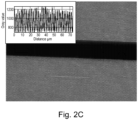
- FIG. 2 Panel A.
- the 'excess' polymer situated between the wells on the substrate was removed using a mechanical polishing technique using a slurry of aluminum oxide nanoparticles (300 nm diameter) in DI water.
- a 10 wt.% slurry of 3 micron silica particles can also be used.
- the surface was manually scrubbed with the nanoparticle slurry using a lint-free optical tissue. After washing to remove the slurry and polymer debris, a solution of fluorescently labeled probes was hybridized to the chip. Images captured using a fluorescence microscope showed that this approach was capable of yielding polymer features with clean interstitial regions ( Fig. 2 , Panels B through C ).
- the process can start with a blank substrate / wafer and a pattern is introduced into the substrate via micro- or nano-fabrication techniques.
- the material of the substrate / wafer can be conventional silicon, glass, plastic, COC or any of a variety of materials that can be structured.
- Exemplary techniques for introducing the patterning into the substrate include photolithography, nanoimprint lithography, embossing of the structures into a plastic / COC based material and injection molding of a plastic or COC into a master mold that has the structures patterned into it.
- Photolithography based approaches will typically involve use of a photoresist that is patterned with a stepper or mask aligner, exposed with radiation which transfers the pattern present on a reticle / photomask into the photoresist, and then the resist is developed to yield a structured film (photoresist) on top of the substrate.
- the structured resist is potentially the final substrate which can be used for subsequent gel coating or the pattern in the resist can be transferred into the substrate via follow on processing.
- the follow on process steps will typically include reactive ion etching (plasma based etching) or a wet etch (chemically based) process. If the pattern is transferred into the substrate, the patterned photoresist is subsequently removed to yield the patterned substrate for subsequent gel coating.
- a sacrificial film of a material such as Chrome or Titanium (a metal) under the photoresist and first transfer the pattern in the photoresist to the metal film and then use that film as a hard mask by which the pattern is transferred into the substrate. Following pattern transfer into the substrate, the films are removed and therefore considered sacrificial to the fabrication process.
- the imprinted photoresist can be a sacrificial material and similarly be used as an intermediate tool to transfer the patterned resist into the substrate or a variation of the resist can be used such that the imprinted resist serves as the input to a subsequent coating step.
- An example of a resist that would remain following patterning would be a Sol-Gel based material.
- FIG. 3 A diagrammatic representation of how a structured substrate may be fabricated is shown in Fig. 3 and described below. Images of patterned substrates are shown at various magnification levels in Fig. 3B and Fig. 3C .
- Creation of chemically specific gel pads on a sequencing substrate/flowcell can involve one or more of the nanofabrication techniques set forth previously in this Example.
- the process may optionally then include one or more chemical processing steps, such as silanization to allow subsequent linking of a gel polymer to the substrate via the silane.
- chemical/mechanical polishing CMP is used to remove all interstitial polymer on the surface of the substrate.
- CMP chemical/mechanical polishing
- the structures will retain the polymer coating and the interstitial regions will be void of the polymer.
- the patterned gel pad substrate is then grafted with primers, target nucleic acids are seeded at the gel pads and the target nucleic acids are used as templates for creation of nucleic acid clusters at the gel pads.
- This example shows the fabrication of an array of gel-containing wells, amplification of nucleic acid clusters in the wells and sequencing of the nucleic acids in the clusters.
- Substrates were fabricated as follows. A nanowell substrate (400 nm diameter 1.5 ⁇ m pitch, 300 nm depth well) was fabricated using nanoimprint lithography. An amino silane (APTES or APTMS) monolayer/multilayer was deposited on the entire surface of the substrate using chemical vapor deposition. Next, a 1 x phosphate buffered saline (pH 7.4) solution of acrylic acid N -hydroxysuccinimide ester (Aldrich PN 8060) at 100 mM concentration was reacted with the amino silane surface by adding 1 ml of the NHS acrylate solution to the surface, covering it with a thin glass coverslip and allowing the reaction to proceed for 1 hour at room temperature.
- APTES or APTMS amino silane
- a polymer was then applied to the surface by spin coating 500 ⁇ l of of a 2 wt.% PAZAM solution in water onto the newly formed acrylamide functionalized surface.
- PAZAM was synthesized as described in US Prov. Pat. App. Ser. No. 61/753,833 , which is incorporated herein by reference.
- Subsequent heating of the PAZAM-coated substrate at 60°C for 1 hour resulted in a covalent linkage between the polymer and surface.
- the interstitial covalently linked polymer was removed by polishing the surface with 10 wt.% of 3 ⁇ m SiO 2 micro particle slurry in water.
- a Janeway surface (acryloyl chloride with DIPEA in MeCN) can be used in place of the amino silane coated surface in the above procedure.
- the patterned polymer substrate was then grafted with primers as described in US Prov. Pat. App. Ser. No. 61/753,833 , which is incorporated herein by reference.
- dye-labeled (Cy5) reverse compliments of the grafted primers were exposed to the surface in a 1X PBS buffer solution at a compliment concentration of 20 ⁇ M, and then the surface was washed with 50 ml of 1PBS buffer applied with a squirt bottle.
- the labeled complements on the substrate were imaged with a FLA 9500Typhoon Imager set at the Cy5 scan channel and using a PMT setting of 450.
- the labeled compliments on the substrate were also imaged with a high resolution microscope, showing the patterning or polymer/primers with no interstitial polymer/primers remaining ( Fig. 4 ).
- the substrate was then seeded with phiX DNA, and clusters grown as described in US Ser. No. 61/715,478 , which is incorporated herein by reference.
- a flow cell containing the cluster-containing substrate was sequenced on a HiSeq 2000 (Illumina, Inc., San Diego, CA).
- An algorithm to extract the locations of the patterned sequencing clusters was employed, successfully giving high quality sequencing metrics ( Fig. 5 and Fig. 6 ).
- Sequencing results showed that the occupancy vs. clonality was surprisingly higher than expected for a standard Poisson distribution. Specifically, the average occupancy vs. clonality measure for the sequencing run, as indicated by the "x" in Fig. 7 , is above the boundaries of the Poisson curve and approaches closely to the line for the ideal clonal fraction).
Landscapes
- Chemical & Material Sciences (AREA)
- Life Sciences & Earth Sciences (AREA)
- Organic Chemistry (AREA)
- Health & Medical Sciences (AREA)
- Engineering & Computer Science (AREA)
- Genetics & Genomics (AREA)
- Wood Science & Technology (AREA)
- Zoology (AREA)
- Bioinformatics & Cheminformatics (AREA)
- General Engineering & Computer Science (AREA)
- Biotechnology (AREA)
- Biomedical Technology (AREA)
- Microbiology (AREA)
- Molecular Biology (AREA)
- General Health & Medical Sciences (AREA)
- Physics & Mathematics (AREA)
- Biochemistry (AREA)
- Biophysics (AREA)
- Proteomics, Peptides & Aminoacids (AREA)
- Bioinformatics & Computational Biology (AREA)
- Crystallography & Structural Chemistry (AREA)
- Plant Pathology (AREA)
- Immunology (AREA)
- Analytical Chemistry (AREA)
- Chemical Kinetics & Catalysis (AREA)
- Apparatus Associated With Microorganisms And Enzymes (AREA)
- Measuring Or Testing Involving Enzymes Or Micro-Organisms (AREA)
- Automatic Analysis And Handling Materials Therefor (AREA)
- Physical Or Chemical Processes And Apparatus (AREA)
Applications Claiming Priority (6)
| Application Number | Priority Date | Filing Date | Title |
|---|---|---|---|
| US201361769289P | 2013-02-26 | 2013-02-26 | |
| US13/787,396 US9512422B2 (en) | 2013-02-26 | 2013-03-06 | Gel patterned surfaces |
| EP21153884.8A EP3834924B1 (fr) | 2013-02-26 | 2014-02-21 | Procédure pour surfaces formées dans du gel |
| EP19174434.1A EP3603794B1 (fr) | 2013-02-26 | 2014-02-21 | Procédure pour surfaces formées dans du gel |
| PCT/US2014/017786 WO2014133905A1 (fr) | 2013-02-26 | 2014-02-21 | Surfaces formées dans du gel |
| EP14710688.4A EP2961524B1 (fr) | 2013-02-26 | 2014-02-21 | Surfaces formées dans du gel |
Related Parent Applications (4)
| Application Number | Title | Priority Date | Filing Date |
|---|---|---|---|
| EP14710688.4A Division EP2961524B1 (fr) | 2013-02-26 | 2014-02-21 | Surfaces formées dans du gel |
| EP21153884.8A Division-Into EP3834924B1 (fr) | 2013-02-26 | 2014-02-21 | Procédure pour surfaces formées dans du gel |
| EP21153884.8A Division EP3834924B1 (fr) | 2013-02-26 | 2014-02-21 | Procédure pour surfaces formées dans du gel |
| EP19174434.1A Division EP3603794B1 (fr) | 2013-02-26 | 2014-02-21 | Procédure pour surfaces formées dans du gel |
Publications (2)
| Publication Number | Publication Date |
|---|---|
| EP4527925A2 true EP4527925A2 (fr) | 2025-03-26 |
| EP4527925A3 EP4527925A3 (fr) | 2025-05-14 |
Family
ID=51388744
Family Applications (4)
| Application Number | Title | Priority Date | Filing Date |
|---|---|---|---|
| EP14710688.4A Active EP2961524B1 (fr) | 2013-02-26 | 2014-02-21 | Surfaces formées dans du gel |
| EP19174434.1A Active EP3603794B1 (fr) | 2013-02-26 | 2014-02-21 | Procédure pour surfaces formées dans du gel |
| EP25155550.4A Pending EP4527925A3 (fr) | 2013-02-26 | 2014-02-21 | Procédure pour surfaces formées dans du gel |
| EP21153884.8A Active EP3834924B1 (fr) | 2013-02-26 | 2014-02-21 | Procédure pour surfaces formées dans du gel |
Family Applications Before (2)
| Application Number | Title | Priority Date | Filing Date |
|---|---|---|---|
| EP14710688.4A Active EP2961524B1 (fr) | 2013-02-26 | 2014-02-21 | Surfaces formées dans du gel |
| EP19174434.1A Active EP3603794B1 (fr) | 2013-02-26 | 2014-02-21 | Procédure pour surfaces formées dans du gel |
Family Applications After (1)
| Application Number | Title | Priority Date | Filing Date |
|---|---|---|---|
| EP21153884.8A Active EP3834924B1 (fr) | 2013-02-26 | 2014-02-21 | Procédure pour surfaces formées dans du gel |
Country Status (12)
| Country | Link |
|---|---|
| US (5) | US9512422B2 (fr) |
| EP (4) | EP2961524B1 (fr) |
| JP (6) | JP6505608B2 (fr) |
| KR (5) | KR102208948B1 (fr) |
| CN (3) | CN104968427B (fr) |
| AU (1) | AU2014223783C1 (fr) |
| BR (1) | BR112015014793B1 (fr) |
| CA (1) | CA2895137C (fr) |
| DK (2) | DK3603794T3 (fr) |
| ES (2) | ES2874775T3 (fr) |
| PL (2) | PL3603794T3 (fr) |
| WO (1) | WO2014133905A1 (fr) |
Families Citing this family (257)
| Publication number | Priority date | Publication date | Assignee | Title |
|---|---|---|---|---|
| US8039817B2 (en) | 2008-05-05 | 2011-10-18 | Illumina, Inc. | Compensator for multiple surface imaging |
| US10787701B2 (en) | 2010-04-05 | 2020-09-29 | Prognosys Biosciences, Inc. | Spatially encoded biological assays |
| US20190300945A1 (en) | 2010-04-05 | 2019-10-03 | Prognosys Biosciences, Inc. | Spatially Encoded Biological Assays |
| AU2011237729B2 (en) | 2010-04-05 | 2014-04-03 | Prognosys Biosciences, Inc. | Spatially encoded biological assays |
| GB201106254D0 (en) | 2011-04-13 | 2011-05-25 | Frisen Jonas | Method and product |
| US9593365B2 (en) | 2012-10-17 | 2017-03-14 | Spatial Transcriptions Ab | Methods and product for optimising localised or spatial detection of gene expression in a tissue sample |
| US9512422B2 (en) * | 2013-02-26 | 2016-12-06 | Illumina, Inc. | Gel patterned surfaces |
| US20160023208A1 (en) | 2013-03-13 | 2016-01-28 | Illumina, Inc. | Multilayer fluidic devices and methods for their fabrication |
| EP3249057B1 (fr) * | 2013-03-14 | 2019-05-01 | Life Technologies Corporation | Réseaux matriciels et leurs procédés de fabrication |
| DK3013983T3 (da) | 2013-06-25 | 2023-03-06 | Prognosys Biosciences Inc | Spatialt kodede biologiske assays ved brug af en mikrofluidisk anordning |
| MX363806B (es) * | 2013-07-01 | 2019-04-03 | Illumina Inc | Funcionalización de superficies sin catalizador e injerto de polímeros.. |
| US9352315B2 (en) * | 2013-09-27 | 2016-05-31 | Taiwan Semiconductor Manufacturing Company, Ltd. | Method to produce chemical pattern in micro-fluidic structure |
| US10540783B2 (en) * | 2013-11-01 | 2020-01-21 | Illumina, Inc. | Image analysis useful for patterned objects |
| WO2015095291A1 (fr) * | 2013-12-19 | 2015-06-25 | Illumina, Inc. | Substrats comprenant des surfaces à nano-motifs et procédés de préparation associés |
| KR102333635B1 (ko) * | 2013-12-23 | 2021-11-30 | 일루미나, 인코포레이티드 | 광 방출의 검출을 개선시키기 위한 구조화 기판 및 이와 관련한 방법 |
| EP3169803B1 (fr) | 2014-07-18 | 2019-11-20 | Illumina, Inc. | Diagnostic prénatal non invasif d'affection génétique foetale à l'aide d'adn cellulaire et d'adn acellulaire |
| EP3183577B1 (fr) | 2014-08-21 | 2020-08-19 | Illumina Cambridge Limited | Fonctionnalisation de surface réversible |
| CN114805710B (zh) | 2014-10-31 | 2023-11-17 | 伊鲁米纳剑桥有限公司 | 聚合物以及dna共聚物涂层 |
| WO2016075204A1 (fr) | 2014-11-11 | 2016-05-19 | Illumina, Inc. | Procédés et compositions pour produire et séquencer des ensembles monoclonaux d'acide nucléique |
| EP3234187B1 (fr) | 2014-12-15 | 2021-02-17 | Illumina, Inc. | Procédé de positionnement de molécules individuelles sur un substrat |
| CN120425026A (zh) | 2015-04-10 | 2025-08-05 | 十程基因技术瑞典公司 | 生物样本的空间区别、多重核酸分析 |
| CN108449971B (zh) | 2015-04-14 | 2020-10-16 | 亿明达股份有限公司 | 用于改进对光发射的检测的结构化基底及涉及其的方法 |
| JP2018518157A (ja) | 2015-05-11 | 2018-07-12 | イラミーナ インコーポレーテッド | 治療薬剤の発見および分析のためのプラットフォーム |
| CN107924121B (zh) | 2015-07-07 | 2021-06-08 | 亿明达股份有限公司 | 经由纳米压印的选择性表面图案化 |
| WO2017015018A1 (fr) | 2015-07-17 | 2017-01-26 | Illumina, Inc. | Feuilles polymères pour applications de séquençage |
| WO2017123533A1 (fr) | 2016-01-11 | 2017-07-20 | Illumina, Inc. | Appareil de détection à microfluoromètre, système fluidique et module bride de verrouillage de cuve à circulation |
| SG11201805787YA (en) | 2016-03-24 | 2018-10-30 | Illumina Inc | Photonic superlattice-based devices and compositions for use in luminescent imaging, and methods of using the same |
| PL3377226T3 (pl) * | 2016-03-28 | 2021-07-26 | Illumina, Inc. | Wielopłaszczyznowe mikromacierze |
| WO2017184997A1 (fr) | 2016-04-22 | 2017-10-26 | Illumina, Inc. | Dispositifs et compositions basés sur une structure photonique et destinés à être utilisés dans l'imagerie luminescente de plusieurs sites à l'intérieur d'un pixel, et procédés d'utilisation de ces dispositifs et compositions |
| SG11201809376WA (en) | 2016-05-18 | 2018-12-28 | Illumina Inc | Self assembled patterning using patterned hydrophobic surfaces |
| KR102475710B1 (ko) | 2016-07-22 | 2022-12-08 | 오레곤 헬스 앤드 사이언스 유니버시티 | 단일 세포 전체 게놈 라이브러리 및 이의 제조를 위한 조합 인덱싱 방법 |
| US20210371782A1 (en) * | 2016-08-05 | 2021-12-02 | President And Fellows Of Harvard College | Methods for optical micropatterning of hydrogels and uses thereof |
| CA3046532A1 (fr) | 2016-12-22 | 2018-06-28 | Illumina, Inc. | Reseaux comprenant un film de resine et une couche de polymere a motifs |
| RU2765075C2 (ru) | 2016-12-22 | 2022-01-25 | Иллюмина, Инк. | Биочип, включающий праймер секвенирования и несеквенирующую единицу |
| CN110325651B (zh) * | 2016-12-22 | 2024-03-15 | 伊鲁米那股份有限公司 | 具有质量控制示踪剂的阵列 |
| RU2753172C2 (ru) * | 2016-12-22 | 2021-08-12 | Иллюмина, Инк. | Устройство для выдавливания рельефа |
| CA3046659A1 (fr) | 2016-12-22 | 2018-06-28 | Illumina, Inc. | Boitier de cellule d'ecoulement et son procede de fabrication |
| KR20190104041A (ko) | 2016-12-29 | 2019-09-05 | 아도르 디아그노스틱스 에스.알.엘. | 전기 영동 애플리케이션을 위한 전기 영동 칩 |
| GB201704754D0 (en) | 2017-01-05 | 2017-05-10 | Illumina Inc | Kinetic exclusion amplification of nucleic acid libraries |
| GB201701688D0 (en) | 2017-02-01 | 2017-03-15 | Illumia Inc | System and method with fiducials in non-recliner layouts |
| GB201701689D0 (en) | 2017-02-01 | 2017-03-15 | Illumia Inc | System and method with fiducials of non-closed shapes |
| GB201701691D0 (en) | 2017-02-01 | 2017-03-15 | Illumina Inc | System and method with reflective fiducials |
| US11896944B2 (en) | 2017-02-01 | 2024-02-13 | Illumina, Inc. | System and method with fiducials responding to multiple excitation frequencies |
| GB201701686D0 (en) | 2017-02-01 | 2017-03-15 | Illunina Inc | System & method with fiducials having offset layouts |
| IL268613B2 (en) * | 2017-02-24 | 2023-10-01 | Illumina Inc | Calcium carbonate suspension |
| AU2018259202B2 (en) | 2017-04-23 | 2022-03-24 | Illumina Cambridge Limited | Compositions and methods for improving sample identification in indexed nucleic acid libraries |
| ES2937929T3 (es) | 2017-04-23 | 2023-04-03 | Illumina Inc | Composiciones y métodos para mejorar la identificación de muestras en bibliotecas de ácido nucleico indexadas |
| ES2893528T3 (es) | 2017-04-23 | 2022-02-09 | Illumina Cambridge Ltd | Composiciones y métodos para mejorar la identificación de muestras en colecciones de ácidos nucleicos indexadas |
| NL2019044B1 (en) * | 2017-05-11 | 2018-11-15 | Illumina Inc | Protective surface coatings for flow cells |
| KR102628035B1 (ko) | 2017-06-07 | 2024-01-22 | 오레곤 헬스 앤드 사이언스 유니버시티 | 메틸화 서열결정을 위한 단일 세포 전체 게놈 라이브러리 |
| EP3662482A1 (fr) | 2017-07-31 | 2020-06-10 | Illumina Inc. | Système de séquençage comportant une agrégation d'échantillons biologiques multiplexés |
| FI3662083T3 (fi) | 2017-08-01 | 2024-11-20 | Illumina Inc | Geneettisen materiaalin ja kirjastovalmisteen spatiaalinen indeksointi hydrogeelihelmiä ja virtauskennoja käyttämällä |
| US11499962B2 (en) | 2017-11-17 | 2022-11-15 | Ultima Genomics, Inc. | Methods and systems for analyte detection and analysis |
| US10273528B1 (en) | 2017-11-17 | 2019-04-30 | Ultima Genomics, Inc. | Methods and systems for analyte detection and analysis |
| NZ759626A (en) * | 2017-12-21 | 2023-03-31 | Illumina Inc | Flow cells with hydrogel coating |
| RU2741805C1 (ru) | 2017-12-22 | 2021-01-28 | Иллюмина, Инк. | Каталитически активные вещества |
| EP4253562A3 (fr) * | 2018-02-13 | 2023-10-25 | Illumina, Inc. | Séquençage d'adn à l'aide de billes d'hydrogel |
| CN110832086A (zh) | 2018-04-02 | 2020-02-21 | 伊鲁米那股份有限公司 | 用于制造用于基于序列的遗传检验的对照的组合物和方法 |
| AU2019257320B2 (en) | 2018-04-20 | 2022-04-07 | Illumina, Inc. | Methods of encapsulating single cells, the encapsulated cells and uses thereof |
| WO2019213254A1 (fr) * | 2018-05-02 | 2019-11-07 | The General Hospital Corporation | Évaluation d'abondance de macromolécules spatiales à haute résolution |
| KR102738305B1 (ko) * | 2018-05-15 | 2024-12-03 | 바이오카피 게엠베하 | 마이크로어레이 변환기 |
| KR102640255B1 (ko) | 2018-05-17 | 2024-02-27 | 일루미나, 인코포레이티드 | 감소된 증폭 편향을 갖는 고속-대량 단일 세포 서열분석 |
| KR102507415B1 (ko) | 2018-06-04 | 2023-03-07 | 일루미나, 인코포레이티드 | 고속 대량 단일 세포 전사체 라이브러리 그리고 이의 제조 및 사용 방법 |
| AU2019275675A1 (en) | 2018-06-29 | 2020-01-16 | Illumina Cambridge Limited | Flow cells |
| NL2021377B1 (en) | 2018-07-03 | 2020-01-08 | Illumina Inc | Interposer with first and second adhesive layers |
| TWI730352B (zh) * | 2018-08-06 | 2021-06-11 | 英商伊路米納劍橋有限公司 | 流體槽與定序系統及製備用於其之基板的方法 |
| EP4603594A3 (fr) | 2018-08-28 | 2025-11-12 | 10X Genomics, Inc. | Augmentation de la résolution d'un réseau spatial |
| US11519033B2 (en) | 2018-08-28 | 2022-12-06 | 10X Genomics, Inc. | Method for transposase-mediated spatial tagging and analyzing genomic DNA in a biological sample |
| EP3844308A1 (fr) | 2018-08-28 | 2021-07-07 | 10X Genomics, Inc. | Résolution de réseaux spatiaux |
| AU2019391274B2 (en) | 2018-12-05 | 2025-10-30 | Illumina Cambridge Limited | Methods and compositions for cluster generation by bridge amplification |
| US10512911B1 (en) | 2018-12-07 | 2019-12-24 | Ultima Genomics, Inc. | Implementing barriers for controlled environments during sample processing and detection |
| US12239980B2 (en) | 2018-12-07 | 2025-03-04 | Ultima Genomics, Inc. | Implementing barriers for controlled environments during sample processing and detection |
| US12529094B2 (en) | 2018-12-10 | 2026-01-20 | 10X Genomics, Inc. | Imaging system hardware |
| US20220290217A1 (en) | 2018-12-10 | 2022-09-15 | 10X Genomics, Inc. | Resolving spatial arrays using deconvolution |
| JP7587425B2 (ja) | 2018-12-18 | 2024-11-20 | イルミナ ケンブリッジ リミテッド | 単一表面プライマーを使用したペアエンドシーケンシングのための方法および組成物 |
| BR112020026667A2 (pt) | 2018-12-19 | 2021-07-27 | Illumina, Inc. | métodos para melhorar a prioridade de clonalidade do agrupamento de polinucleotídeo |
| US11926867B2 (en) | 2019-01-06 | 2024-03-12 | 10X Genomics, Inc. | Generating capture probes for spatial analysis |
| US11649485B2 (en) | 2019-01-06 | 2023-05-16 | 10X Genomics, Inc. | Generating capture probes for spatial analysis |
| TWI873119B (zh) * | 2019-01-29 | 2025-02-21 | 美商伊路米納有限公司 | 流通槽及製備其之方法 |
| TWI857001B (zh) * | 2019-01-29 | 2024-10-01 | 美商伊路米納有限公司 | 定序套組 |
| TWI857000B (zh) | 2019-01-29 | 2024-10-01 | 美商伊路米納有限公司 | 流體槽以及將複合物引入至流體槽之方法 |
| CN114174531A (zh) | 2019-02-28 | 2022-03-11 | 10X基因组学有限公司 | 用空间条码化寡核苷酸阵列对生物分析物进行概况分析 |
| US12624350B2 (en) | 2019-03-01 | 2026-05-12 | Illumina, Inc. | High-throughput single-nuclei and single-cell libraries and methods of making and of using |
| US10852518B1 (en) | 2019-03-14 | 2020-12-01 | Ultima Genomics, Inc. | Methods, devices, and systems for analyte detection and analysis |
| US10830703B1 (en) | 2019-03-14 | 2020-11-10 | Ultima Genomics, Inc. | Methods, devices, and systems for analyte detection and analysis |
| US10900078B2 (en) | 2019-03-14 | 2021-01-26 | Ultima Genomics, Inc. | Methods, devices, and systems for analyte detection and analysis |
| US11118223B2 (en) | 2019-03-14 | 2021-09-14 | Ultima Genomics, Inc. | Methods, devices, and systems for analyte detection and analysis |
| CN114127309A (zh) | 2019-03-15 | 2022-03-01 | 10X基因组学有限公司 | 使用空间阵列进行单细胞测序的方法 |
| WO2020191389A1 (fr) | 2019-03-21 | 2020-09-24 | Illumina, Inc. | Génération de données d'apprentissage pour séquençage à base d'intelligence artificielle |
| NL2023316B1 (en) | 2019-03-21 | 2020-09-28 | Illumina Inc | Artificial intelligence-based sequencing |
| US11210554B2 (en) | 2019-03-21 | 2021-12-28 | Illumina, Inc. | Artificial intelligence-based generation of sequencing metadata |
| NL2023311B9 (en) | 2019-03-21 | 2021-03-12 | Illumina Inc | Artificial intelligence-based generation of sequencing metadata |
| NL2023310B1 (en) | 2019-03-21 | 2020-09-28 | Illumina Inc | Training data generation for artificial intelligence-based sequencing |
| WO2020198071A1 (fr) | 2019-03-22 | 2020-10-01 | 10X Genomics, Inc. | Analyse spatiale tridimensionnelle |
| WO2020219901A1 (fr) | 2019-04-26 | 2020-10-29 | 10X Genomics, Inc. | Dispositifs de support en imagerie |
| AU2020270139A1 (en) * | 2019-05-09 | 2021-11-18 | EMULATE, Inc. | Compositions and methods of using partial gel layers in a microfluidic device |
| EP3976820A1 (fr) | 2019-05-30 | 2022-04-06 | 10X Genomics, Inc. | Procédés de détection de l'hétérogénéité spatiale d'un échantillon biologique |
| WO2020243075A1 (fr) | 2019-05-31 | 2020-12-03 | Illumina, Inc. | Dispositif de stockage, système, et procédé |
| EP3976827A4 (fr) | 2019-05-31 | 2023-10-18 | Illumina, Inc. | Obtention d'informations à partir d'un échantillon biologique dans un cytomètre de flux |
| CN112673251A (zh) | 2019-05-31 | 2021-04-16 | 伊鲁米那股份有限公司 | 核苷酸选择性沉积或激活的流通池 |
| SG11202012826XA (en) | 2019-05-31 | 2021-01-28 | Illumina Inc | Systems and methods for information storage and retrieval using flow cells |
| WO2020243077A1 (fr) | 2019-05-31 | 2020-12-03 | Illumina, Inc. | Cytomètre en flux avec une ou plusieurs fonctionnalités de barrière |
| SG11202012810TA (en) | 2019-05-31 | 2021-01-28 | Illumina Inc | System and method for storage |
| CN117036248A (zh) | 2019-10-01 | 2023-11-10 | 10X基因组学有限公司 | 用于识别组织样品中的形态学模式的系统和方法 |
| EP4055185A1 (fr) | 2019-11-08 | 2022-09-14 | 10X Genomics, Inc. | Agents de capture d'analytes marqués spatialement pour le multiplexage d'analytes |
| WO2021092433A2 (fr) | 2019-11-08 | 2021-05-14 | 10X Genomics, Inc. | Amélioration de la spécificité de la liaison d'un analyte |
| ES3024383T3 (en) | 2019-11-13 | 2025-06-04 | 10X Genomics Inc | Generating capture probes for spatial analysis |
| CA3158603A1 (fr) | 2019-11-18 | 2021-05-27 | Neil Ira WEISENFELD | Systemes et procedes de classification de tissu |
| US20210155982A1 (en) | 2019-11-21 | 2021-05-27 | 10X Genomics, Inc. | Pipeline for spatial analysis of analytes |
| WO2021102005A1 (fr) | 2019-11-22 | 2021-05-27 | 10X Genomics, Inc. | Systèmes et procédés d'analyse spatiale d'analytes à l'aide d'un alignement de repères |
| PH12021552313A1 (en) | 2019-11-27 | 2022-06-27 | Illumina Inc | On-flow cell three-dimensional polymer structures |
| PH12021552314A1 (en) | 2019-12-02 | 2022-06-27 | Illumina Cambridge Ltd | Hydrogel |
| MX2021011847A (es) | 2019-12-19 | 2021-11-17 | Illumina Inc | Genotecas de celulas unicas de alto rendimiento y metodos para elaborarlas y usarlas. |
| EP3969178A2 (fr) | 2019-12-20 | 2022-03-23 | Illumina, Inc. | Cuves de circulation |
| CN121022991A (zh) | 2019-12-23 | 2025-11-28 | 10X基因组学有限公司 | 使用rna模板化连接进行空间分析的方法 |
| EP4081656A1 (fr) | 2019-12-23 | 2022-11-02 | 10X Genomics, Inc. | Compositions et méthodes d'utilisation d'échantillons biologiques fixés dans des dosages basés sur des compartiments |
| EP4081777B1 (fr) | 2019-12-23 | 2026-02-18 | 10X Genomics, Inc. | Réactifs de fixation réversibles et méthodes d'utilisation |
| US12365942B2 (en) | 2020-01-13 | 2025-07-22 | 10X Genomics, Inc. | Methods of decreasing background on a spatial array |
| US12405264B2 (en) | 2020-01-17 | 2025-09-02 | 10X Genomics, Inc. | Electrophoretic system and method for analyte capture |
| US11732299B2 (en) | 2020-01-21 | 2023-08-22 | 10X Genomics, Inc. | Spatial assays with perturbed cells |
| US11702693B2 (en) | 2020-01-21 | 2023-07-18 | 10X Genomics, Inc. | Methods for printing cells and generating arrays of barcoded cells |
| US20210230681A1 (en) | 2020-01-24 | 2021-07-29 | 10X Genomics, Inc. | Methods for spatial analysis using proximity ligation |
| US11821035B1 (en) | 2020-01-29 | 2023-11-21 | 10X Genomics, Inc. | Compositions and methods of making gene expression libraries |
| US12076701B2 (en) | 2020-01-31 | 2024-09-03 | 10X Genomics, Inc. | Capturing oligonucleotides in spatial transcriptomics |
| US11898205B2 (en) | 2020-02-03 | 2024-02-13 | 10X Genomics, Inc. | Increasing capture efficiency of spatial assays |
| US12110541B2 (en) | 2020-02-03 | 2024-10-08 | 10X Genomics, Inc. | Methods for preparing high-resolution spatial arrays |
| US12110548B2 (en) | 2020-02-03 | 2024-10-08 | 10X Genomics, Inc. | Bi-directional in situ analysis |
| US12112833B2 (en) | 2020-02-04 | 2024-10-08 | 10X Genomics, Inc. | Systems and methods for index hopping filtering |
| US11732300B2 (en) | 2020-02-05 | 2023-08-22 | 10X Genomics, Inc. | Increasing efficiency of spatial analysis in a biological sample |
| WO2021158925A1 (fr) | 2020-02-07 | 2021-08-12 | 10X Genomics, Inc. | Évaluation quantitative et automatisée de la performance de perméabilisation pour la transcriptomique spatiale |
| US12421558B2 (en) | 2020-02-13 | 2025-09-23 | 10X Genomics, Inc. | Systems and methods for joint interactive visualization of gene expression and DNA chromatin accessibility |
| US12281357B1 (en) | 2020-02-14 | 2025-04-22 | 10X Genomics, Inc. | In situ spatial barcoding |
| CN115485391A (zh) | 2020-02-17 | 2022-12-16 | 10X基因组学有限公司 | 染色质相互作用的原位分析 |
| EP4484571A3 (fr) | 2020-02-21 | 2025-03-19 | 10X Genomics, Inc. | Procédés et compositions pour un dosage spatial in situ intégré |
| US11891654B2 (en) | 2020-02-24 | 2024-02-06 | 10X Genomics, Inc. | Methods of making gene expression libraries |
| US12188085B2 (en) | 2020-03-05 | 2025-01-07 | 10X Genomics, Inc. | Three-dimensional spatial transcriptomics with sequencing readout |
| CN114026250B (zh) | 2020-03-09 | 2025-05-16 | 因美纳有限公司 | 核酸测序的改善 |
| WO2021216708A1 (fr) | 2020-04-22 | 2021-10-28 | 10X Genomics, Inc. | Procédés d'analyse spatiale utilisant un appauvrissement d'arn ciblée |
| US20230203592A1 (en) | 2020-05-05 | 2023-06-29 | Akershus Universitetssykehus Hf | Compositions and methods for characterizing bowel cancer |
| US11188778B1 (en) | 2020-05-05 | 2021-11-30 | Illumina, Inc. | Equalization-based image processing and spatial crosstalk attenuator |
| EP4150065A2 (fr) | 2020-05-12 | 2023-03-22 | Illumina Inc | Génération d'acides nucléiques avec des bases modifiées au moyen de désoxynucléotidyl transférase terminale recombinante |
| WO2021237087A1 (fr) | 2020-05-22 | 2021-11-25 | 10X Genomics, Inc. | Analyse spatiale pour détecter des variants de séquence |
| EP4414459B1 (fr) | 2020-05-22 | 2025-09-03 | 10X Genomics, Inc. | Mesure spatio-temporelle simultanée de l'expression génique et de l'activité cellulaire |
| WO2021242834A1 (fr) | 2020-05-26 | 2021-12-02 | 10X Genomics, Inc. | Procédé de réinitialisation d'un réseau |
| KR102468839B1 (ko) * | 2020-06-03 | 2022-11-18 | 주식회사 제노헬릭스 | Rna 검출 방법 |
| US12031177B1 (en) | 2020-06-04 | 2024-07-09 | 10X Genomics, Inc. | Methods of enhancing spatial resolution of transcripts |
| WO2021252499A1 (fr) | 2020-06-08 | 2021-12-16 | 10X Genomics, Inc. | Méthodes de détermination de marge chirurgicale et méthodes d'utilisation associées |
| WO2021252617A1 (fr) | 2020-06-09 | 2021-12-16 | Illumina, Inc. | Procédés pour augmenter le rendement de bibliothèques de séquençage |
| EP4446430A3 (fr) | 2020-06-10 | 2024-12-18 | 10X Genomics, Inc. | Procédés de détermination d'un emplacement d'un analyte dans un échantillon biologique |
| US12209273B2 (en) | 2020-06-12 | 2025-01-28 | 10X Genomics, Inc. | Nucleic acid assays using click chemistry bioconjugation |
| WO2021263111A1 (fr) | 2020-06-25 | 2021-12-30 | 10X Genomics, Inc. | Analyse spatiale de la méthylation de l'adn |
| EP4172364A1 (fr) | 2020-06-30 | 2023-05-03 | Illumina, Inc. | Séquençage à commande catalytique par synthèse pour produire de l'adn sans scarification |
| US12168801B1 (en) | 2020-07-02 | 2024-12-17 | 10X Genomics, Inc. | Hybrid/capture probe designs for full-length cDNA |
| CN111760601B (zh) * | 2020-07-03 | 2022-04-22 | 中国科学院合肥物质科学研究院 | 一种集成液路切换阀的微流控芯片及核酸检测方法 |
| US11981960B1 (en) | 2020-07-06 | 2024-05-14 | 10X Genomics, Inc. | Spatial analysis utilizing degradable hydrogels |
| US11761038B1 (en) | 2020-07-06 | 2023-09-19 | 10X Genomics, Inc. | Methods for identifying a location of an RNA in a biological sample |
| US12209280B1 (en) | 2020-07-06 | 2025-01-28 | 10X Genomics, Inc. | Methods of identifying abundance and location of an analyte in a biological sample using second strand synthesis |
| BR112023000073A2 (pt) | 2020-07-08 | 2023-04-11 | Illumina Inc | Microesferas como transportadores de transpossomos |
| US11981958B1 (en) | 2020-08-20 | 2024-05-14 | 10X Genomics, Inc. | Methods for spatial analysis using DNA capture |
| US12580044B1 (en) | 2020-09-02 | 2026-03-17 | 10X Genomics, Inc. | Systems and methods for identifying cells that are antigen-specific for an immunogenic feature |
| US11926822B1 (en) | 2020-09-23 | 2024-03-12 | 10X Genomics, Inc. | Three-dimensional spatial analysis |
| WO2022098810A1 (fr) | 2020-11-06 | 2022-05-12 | 10X Genomics, Inc. | Dispositifs de support de dosage |
| US11827935B1 (en) | 2020-11-19 | 2023-11-28 | 10X Genomics, Inc. | Methods for spatial analysis using rolling circle amplification and detection probes |
| US12509717B2 (en) | 2020-12-11 | 2025-12-30 | 10X Genomics, Inc. | Methods and compositions for multimodal in situ analysis |
| EP4121555B1 (fr) | 2020-12-21 | 2026-02-25 | 10X Genomics, Inc. | Procédés pour capturer des sondes et/ou des codes à barres |
| US20220195498A1 (en) | 2020-12-23 | 2022-06-23 | 10X Genomics, Inc. | Methods and compositions for analyte detection |
| EP4271996B1 (fr) | 2020-12-31 | 2025-12-24 | 3M Innovative Properties Company | Films nanométriques à chimie de surface à motifs |
| KR20230128281A9 (ko) | 2021-01-05 | 2024-11-13 | 일루미나, 인코포레이티드 | 기재에 결합된 작용기를 포함하는 조성물 및 이의 제조 방법 |
| JP2024502618A (ja) | 2021-01-08 | 2024-01-22 | セラノーム, インコーポレイテッド | 生体試料を分析するためのデバイスおよび方法 |
| US12576400B2 (en) | 2021-01-08 | 2026-03-17 | Cellanome, Inc. | Methods for incubating and analyzing a cell in a compartment of a fluidic device |
| EP4284945B1 (fr) | 2021-01-26 | 2024-10-23 | 10X Genomics, Inc. | Sondes analogiques d'acide nucléique pour analyse in situ |
| KR20230154303A (ko) | 2021-01-29 | 2023-11-07 | 일루미나, 인코포레이티드 | 폴리뉴클레오티드로 플로우 셀의 시딩 효율을 개선하기위한 방법, 조성물 및 키트 |
| EP4421491A3 (fr) | 2021-02-19 | 2024-11-27 | 10X Genomics, Inc. | Procédé d'utilisation d'un dispositif de support d'analyse modulaire |
| US12275984B2 (en) | 2021-03-02 | 2025-04-15 | 10X Genomics, Inc. | Sequential hybridization and quenching |
| EP4301873A1 (fr) | 2021-03-03 | 2024-01-10 | 10X Genomics, Inc. | Détection d'analytes in situ à l'aide d'origami d'acide nucléique |
| CA3210451A1 (fr) | 2021-03-22 | 2022-09-29 | Illumina Cambridge Limited | Procedes d'amelioration de la clonalite de groupes d'acides nucleiques |
| EP4428246B1 (fr) | 2021-04-14 | 2025-12-24 | 10X Genomics, Inc. | Procédés de mesure de la localisation erronée d'un analyte |
| EP4320271B1 (fr) | 2021-05-06 | 2025-03-19 | 10X Genomics, Inc. | Procédés pour augmenter la résolution d'une analyse spatiale |
| WO2022234360A1 (fr) * | 2021-05-06 | 2022-11-10 | 3M Innovative Properties Company | Dépôt physique en phase vapeur destiné au revêtement de substrats |
| EP4348252A1 (fr) * | 2021-05-27 | 2024-04-10 | SomaLogic Operating Co., Inc. | Capture de molécule unique de phase en solution et techniques associées |
| EP4347877A1 (fr) | 2021-06-01 | 2024-04-10 | 10X Genomics, Inc. | Procédés et compositions pour la détection d'analytes et la résolution de sondes |
| EP4347880B1 (fr) | 2021-06-02 | 2026-02-04 | 10X Genomics, Inc. | Analyse d'échantillon à l'aide de sondes circularisables asymétriques |
| WO2022256503A1 (fr) | 2021-06-03 | 2022-12-08 | 10X Genomics, Inc. | Procédés, compositions, kits et systèmes pour améliorer la capture d'analytes pour une analyse spatiale |
| US12570831B2 (en) | 2021-06-15 | 2026-03-10 | Illumina, Inc. | Hydrogel-free surface functionalization for sequencing |
| WO2022271689A1 (fr) | 2021-06-25 | 2022-12-29 | Illumina, Inc. | Repères destinés à être utilisés dans l'enregistrement d'une surface à motifs |
| AU2022296802A1 (en) | 2021-06-25 | 2024-01-04 | Illumina, Inc. | Linear fourier fiducial |
| WO2023283442A1 (fr) | 2021-07-09 | 2023-01-12 | 10X Genomics, Inc. | Procédés de détection d'analytes à l'aide d'un marquage épars |
| US20230026886A1 (en) | 2021-07-13 | 2023-01-26 | 10X Genomics, Inc. | Methods for preparing polymerized matrix with controllable thickness |
| US11455487B1 (en) | 2021-10-26 | 2022-09-27 | Illumina Software, Inc. | Intensity extraction and crosstalk attenuation using interpolation and adaptation for base calling |
| WO2023003757A1 (fr) | 2021-07-19 | 2023-01-26 | Illumina Software, Inc. | Extraction d'intensité avec interpolation et adaptation pour appel de base |
| US12139751B2 (en) | 2021-07-30 | 2024-11-12 | 10X Genomics, Inc. | Circularizable probes for in situ analysis |
| CA3224093A1 (fr) | 2021-07-30 | 2023-02-02 | Jorge Ivan Hernandez Neuta | Procedes et compositions pour la synchronisation de reactions in situ |
| WO2023015192A1 (fr) | 2021-08-03 | 2023-02-09 | 10X Genomics, Inc. | Concatémères d'acide nucléique et procédés de stabilisation et/ou de compactage de ceux-ci |
| US12529096B2 (en) | 2021-08-03 | 2026-01-20 | 10X Genomics, Inc. | Stabilization and/or compaction of nucleic acid structures |
| US12391984B2 (en) | 2021-08-03 | 2025-08-19 | 10X Genomics, Inc. | Compositions and methods for rolling circle amplification |
| US12460251B2 (en) | 2021-08-03 | 2025-11-04 | 10X Genomics, Inc. | Stabilization and/or compaction of nucleic acid molecules |
| WO2023023484A1 (fr) | 2021-08-16 | 2023-02-23 | 10X Genomics, Inc. | Sondes comprenant une région de code-barres divisée et procédés d'utilisation |
| CN118103750A (zh) | 2021-08-31 | 2024-05-28 | 伊鲁米纳公司 | 具有增强的孔成像分辨率的流动池 |
| EP4196605B1 (fr) | 2021-09-01 | 2024-12-04 | 10X Genomics, Inc. | Procédés pour bloquer une sonde de capture sur un réseau spatial |
| WO2023086880A1 (fr) | 2021-11-10 | 2023-05-19 | 10X Genomics, Inc. | Procédés, compositions et kits pour déterminer l'emplacement d'un analyte dans un échantillon biologique |
| WO2023102118A2 (fr) | 2021-12-01 | 2023-06-08 | 10X Genomics, Inc. | Procédés, compositions et systèmes pour la détection améliorée d'analytes in situ et analyse spatiale |
| US20230242974A1 (en) | 2021-12-27 | 2023-08-03 | 10X Genomics, Inc. | Methods and compositions for rolling circle amplification |
| WO2023141588A1 (fr) | 2022-01-21 | 2023-07-27 | 10X Genomics, Inc. | Signaux de lecture multiples pour analyser un échantillon |
| EP4479927B1 (fr) | 2022-02-17 | 2026-04-01 | Illumina, Inc. | Amélioration de signal d'images de séquençage pilotée par ia |
| WO2023158809A1 (fr) | 2022-02-17 | 2023-08-24 | Illumina, Inc. | Amélioration commandée par ia d'images animées floues de séquençage |
| US11795505B2 (en) | 2022-03-10 | 2023-10-24 | Singular Genomics Systems, Inc. | Nucleic acid delivery scaffolds |
| AU2023243205A1 (en) | 2022-04-01 | 2024-09-19 | 10X Genomics, Inc. | Compositions and methods for targeted masking of autofluorescence |
| EP4504969A1 (fr) | 2022-04-06 | 2025-02-12 | 10X Genomics, Inc. | Procédés d'analyse multiplex de cellules |
| EP4504930A1 (fr) | 2022-04-07 | 2025-02-12 | Illumina, Inc. | Cytidine désaminases modifiées et méthodes d'utilisation |
| EP4519674A1 (fr) | 2022-05-06 | 2025-03-12 | 10X Genomics, Inc. | Analyse d'un antigène et des interactions antigène-récepteur |
| US12559791B2 (en) | 2022-05-06 | 2026-02-24 | 10X Genomics, Inc. | Methods and compositions for in situ analysis of V(D)J sequences |
| WO2023220300A1 (fr) | 2022-05-11 | 2023-11-16 | 10X Genomics, Inc. | Compositions et procédés de séquençage in situ |
| JP2025526537A (ja) | 2022-06-09 | 2025-08-15 | イルミナ インコーポレイテッド | フローセル傾斜に対する塩基コーリングの依存性 |
| EP4540607A1 (fr) | 2022-06-17 | 2025-04-23 | 10X Genomics, Inc. | Dé-réticulation catalytique d'échantillons pour analyse in situ |
| WO2024003100A1 (fr) * | 2022-06-30 | 2024-01-04 | Illumina Cambridge Limited | Nanoparticules de séquençage et leurs procédés de fabrication |
| US20240033738A1 (en) | 2022-07-27 | 2024-02-01 | Illumina, Inc. | Flow cell based motion system calibration and control methods |
| WO2024072799A1 (fr) | 2022-09-26 | 2024-04-04 | Illumina, Inc. | Procédés d'étalonnage et de commande de système de mouvement basé sur des cuves à circulation |
| EP4594482A1 (fr) | 2022-09-30 | 2025-08-06 | Illumina, Inc. | Cytidine désaminases et procédés d'utilisation dans la cartographie de nucléotides cytosine modifiés |
| CN120153070A (zh) | 2022-09-30 | 2025-06-13 | 因美纳有限公司 | 解旋酶-胞苷脱氨酶复合物及其使用方法 |
| US20250388894A1 (en) | 2022-09-30 | 2025-12-25 | Illumina, Inc. | Methods of using cpg binding proteins in mapping modified cytosine nucleotides |
| CN120129825A (zh) | 2022-10-14 | 2025-06-10 | 10X基因组学有限公司 | 用于评估生物样品质量的方法、组合物和系统 |
| WO2024102736A1 (fr) | 2022-11-08 | 2024-05-16 | 10X Genomics, Inc. | Procédés et compositions d'immobilisation pour détection in situ |
| WO2024102809A1 (fr) | 2022-11-09 | 2024-05-16 | 10X Genomics, Inc. | Procédés, compositions et kits pour déterminer l'emplacement de plusieurs analytes dans un échantillon biologique |
| EP4573210B1 (fr) | 2022-11-16 | 2026-05-06 | 10X Genomics, Inc. | Procédé pour analyser l'expression des gènes dans un pellet des céllules |
| WO2024129969A1 (fr) | 2022-12-14 | 2024-06-20 | Illumina, Inc. | Systèmes et procédés de capture et d'enrichissement de billes en grappe sur des substrats de cuve à circulation |
| US20240218437A1 (en) | 2022-12-16 | 2024-07-04 | 10X Genomics, Inc. | Methods and compositions for assessing performance |
| EP4638789A1 (fr) | 2022-12-21 | 2025-10-29 | 10X Genomics, Inc. | Procédés d'accroche d'acides ribonucléiques dans des échantillons biologiques |
| EP4646492A1 (fr) | 2023-01-06 | 2025-11-12 | 10X Genomics, Inc. | Procédés et compositions pour l'analyse in situ de séquences variantes |
| KR20250137503A (ko) | 2023-01-27 | 2025-09-18 | 일루미나, 인코포레이티드 | 지터 보정 이미지 분석 |
| WO2024163948A2 (fr) | 2023-02-03 | 2024-08-08 | 10X Genomics, Inc. | Analyse in situ de séquences variantes dans des échantillons biologiques |
| KR20250169957A (ko) | 2023-03-30 | 2025-12-04 | 일루미나, 인코포레이티드 | 저해상도 이미지의 ai 주도 신호 강화 |
| WO2024229260A1 (fr) | 2023-05-03 | 2024-11-07 | 10X Genomics, Inc. | Procédés et compositions pour dosage spatial |
| US20240376521A1 (en) | 2023-05-10 | 2024-11-14 | 10X Genomics, Inc. | Boronic acid compositions and methods for tethering ribonucleic acids in biological samples |
| EP4720334A1 (fr) | 2023-05-26 | 2026-04-08 | Illumina, Inc. | Procédés de conservation de l'état de méthylation pendant le regroupement |
| US20250001542A1 (en) | 2023-06-09 | 2025-01-02 | Illumina, Inc. | Method for polishing a substrate |
| WO2025029831A1 (fr) | 2023-07-31 | 2025-02-06 | 10X Genomics, Inc. | Procédés et systèmes de clivage d'arn ciblé et d'amplification de cercle roulant amorcé par arn cible |
| WO2025072783A1 (fr) | 2023-09-28 | 2025-04-03 | Illumina, Inc. | Cytidine désaminases modifiées et méthodes d'utilisation |
| WO2025081064A2 (fr) | 2023-10-11 | 2025-04-17 | Illumina, Inc. | Désaminase thermophile et procédés d'identification de cytosine modifiée |
| WO2025101377A1 (fr) | 2023-11-09 | 2025-05-15 | 10X Genomics, Inc. | Analyse spatiale assistée par matrice d'échantillons biologiques |
| WO2025101864A1 (fr) | 2023-11-09 | 2025-05-15 | 10X Genomics, Inc. | Procédés, compositions et kits pour réduire la mauvaise localisation des analytes dans les dosages d'analyse spatiale |
| US20250163502A1 (en) | 2023-11-22 | 2025-05-22 | 10X Genomics, Inc. | Methods for processing ribonucleic acids in biological samples |
| EP4567128A1 (fr) | 2023-12-07 | 2025-06-11 | Max-Delbrück-Centrum für Molekulare Medizin in der Helmholtz-Gemeinschaft | Procede et moyens ameliores de detection spatiale d'acides nucleiques in situ |
| WO2025137222A1 (fr) | 2023-12-19 | 2025-06-26 | Illumina, Inc. | Dosage de détection de méthylation |
| US20250207203A1 (en) | 2023-12-20 | 2025-06-26 | 10X Genomics, Inc. | In situ detection of copy number variations in biological samples |
| US20250269376A1 (en) | 2024-02-22 | 2025-08-28 | 10X Genomics, Inc. | Systems and methods for thermal, evaporation and volume control in a flow cell |
| WO2025240905A1 (fr) | 2024-05-17 | 2025-11-20 | The Broad Institute, Inc. | Reconstruction d'abondance de macromolécules spatiales à haute résolution sans imagerie |
| WO2025240918A1 (fr) | 2024-05-17 | 2025-11-20 | 10X Genomics, Inc. | Systèmes et procédés de génération de livres de codes |
| WO2025264836A1 (fr) | 2024-06-18 | 2025-12-26 | Illumina, Inc. | Procédés pour augmenter la qualité de séquençage de régions riches en gc |
| WO2025264702A1 (fr) | 2024-06-18 | 2025-12-26 | 10X Genomics, Inc. | Hydrogels 3d pour le séquençage d'acides nucléiques |
| WO2025264831A1 (fr) | 2024-06-18 | 2025-12-26 | Illumina, Inc. | Procédés pour augmenter la qualité de séquençage de régions riches en gc |
| WO2026006314A1 (fr) | 2024-06-28 | 2026-01-02 | Illumina, Inc. | Marquage de régions cibles avant le séquençage de nucléotides |
| WO2026006774A1 (fr) | 2024-06-28 | 2026-01-02 | Illumina, Inc. | Cytidine désaminases modifiées et procédés d'utilisation |
| WO2026030369A1 (fr) | 2024-07-31 | 2026-02-05 | 10X Genomics, Inc. | Procédés et compositions pour la détection d'analytes in situ |
| WO2026043885A1 (fr) | 2024-08-20 | 2026-02-26 | 10X Genomics, Inc. | Procédés et systèmes de préparation d'une bibliothèque d'acides nucléiques |
| WO2026055487A1 (fr) | 2024-09-06 | 2026-03-12 | 10X Genomics, Inc. | Nucléotides modifiés avec espaceurs oligomères |
| WO2026090042A1 (fr) | 2024-10-21 | 2026-04-30 | The Broad Institute, Inc. | Mesures de méthylation d'adn unicellulaire et spatial |
| WO2026097020A1 (fr) | 2024-11-04 | 2026-05-07 | 10X Genomics, Inc. | Polymérase pour séquençage par synthèse |
Citations (65)
| Publication number | Priority date | Publication date | Assignee | Title |
|---|---|---|---|---|
| WO1989010977A1 (fr) | 1988-05-03 | 1989-11-16 | Isis Innovation Limited | Analyse de sequences de polynucleotides |
| WO1991006678A1 (fr) | 1989-10-26 | 1991-05-16 | Sri International | Sequençage d'adn |
| US5130238A (en) | 1988-06-24 | 1992-07-14 | Cangene Corporation | Enhanced nucleic acid amplification process |
| US5324633A (en) | 1991-11-22 | 1994-06-28 | Affymax Technologies N.V. | Method and apparatus for measuring binding affinity |
| US5455166A (en) | 1991-01-31 | 1995-10-03 | Becton, Dickinson And Company | Strand displacement amplification |
| US5599675A (en) | 1994-04-04 | 1997-02-04 | Spectragen, Inc. | DNA sequencing by stepwise ligation and cleavage |
| US5624711A (en) | 1995-04-27 | 1997-04-29 | Affymax Technologies, N.V. | Derivatization of solid supports and methods for oligomer synthesis |
| US5641658A (en) | 1994-08-03 | 1997-06-24 | Mosaic Technologies, Inc. | Method for performing amplification of nucleic acid with two primers bound to a single solid support |
| US5744305A (en) | 1989-06-07 | 1998-04-28 | Affymetrix, Inc. | Arrays of materials attached to a substrate |
| US5750341A (en) | 1995-04-17 | 1998-05-12 | Lynx Therapeutics, Inc. | DNA sequencing by parallel oligonucleotide extensions |
| US6022963A (en) | 1995-12-15 | 2000-02-08 | Affymetrix, Inc. | Synthesis of oligonucleotide arrays using photocleavable protecting groups |
| WO2000031148A2 (fr) | 1998-11-25 | 2000-06-02 | Motorola, Inc. | Hydrogels de polyacrylamide obtenus a partir de prepolymeres reactifs |
| WO2000053812A2 (fr) | 1999-03-12 | 2000-09-14 | President And Fellows Of Harvard College | Amplification par replique de reseaux d'acides nucleiques |
| WO2001001143A2 (fr) | 1999-06-25 | 2001-01-04 | Motorola Inc. | Procedes et compositions permettant de fixer des biomolecules a des supports solides, a des hydrogels et a des matrices d'hydrogels |
| US6210891B1 (en) | 1996-09-27 | 2001-04-03 | Pyrosequencing Ab | Method of sequencing DNA |
| US6214587B1 (en) | 1994-03-16 | 2001-04-10 | Gen-Probe Incorporated | Isothermal strand displacement nucleic acid amplification |
| US6258568B1 (en) | 1996-12-23 | 2001-07-10 | Pyrosequencing Ab | Method of sequencing DNA based on the detection of the release of pyrophosphate and enzymatic nucleotide degradation |
| US6274320B1 (en) | 1999-09-16 | 2001-08-14 | Curagen Corporation | Method of sequencing a nucleic acid |
| WO2001062982A2 (fr) | 2000-02-25 | 2001-08-30 | Mosaic Technologies, Inc. | Procedes destines a une amplification en phase solide en plusieurs etapes d'acides nucleiques |
| US6291183B1 (en) | 1989-06-07 | 2001-09-18 | Affymetrix, Inc. | Very large scale immobilized polymer synthesis |
| US6337393B1 (en) | 1997-11-13 | 2002-01-08 | Protogene Laboratories, Inc. | Method and composition for chemical synthesis on an open environment support surface using high boiling point organic solvents to control evaporation |
| US6355431B1 (en) | 1999-04-20 | 2002-03-12 | Illumina, Inc. | Detection of nucleic acid amplification reactions using bead arrays |
| US20020055100A1 (en) | 1997-04-01 | 2002-05-09 | Kawashima Eric H. | Method of nucleic acid sequencing |
| US6416949B1 (en) | 1991-09-18 | 2002-07-09 | Affymax, Inc. | Method of synthesizing diverse collections of oligomers |
| US6420180B1 (en) | 2000-01-26 | 2002-07-16 | Agilent Technologies, Inc. | Multiple pass deposition for chemical array fabrication |
| US6419883B1 (en) | 1998-01-16 | 2002-07-16 | University Of Washington | Chemical synthesis using solvent microdroplets |
| US6465178B2 (en) | 1997-09-30 | 2002-10-15 | Surmodics, Inc. | Target molecule attachment to surfaces |
| WO2003014392A2 (fr) | 2001-08-09 | 2003-02-20 | Amersham Biosciences Ab | Utilisation et evaluation d'une photoaddition [2+2] dans l immobilisation d'oligonucleotides sur une matrice d'hydrogel tridimensionnelle |
| US20040002090A1 (en) | 2002-03-05 | 2004-01-01 | Pascal Mayer | Methods for detecting genome-wide sequence variations associated with a phenotype |
| US6689319B1 (en) | 1999-10-29 | 2004-02-10 | Agilent Technologies, Ind. | Apparatus for deposition and inspection of chemical and biological fluids |
| WO2004018497A2 (fr) | 2002-08-23 | 2004-03-04 | Solexa Limited | Nucleotides modifies |
| US20040096853A1 (en) | 2000-12-08 | 2004-05-20 | Pascal Mayer | Isothermal amplification of nucleic acids on a solid support |
| WO2005010145A2 (fr) | 2003-07-05 | 2005-02-03 | The Johns Hopkins University | Procede et compositions de detection et d'enumeration de variations genetiques |
| US20050053980A1 (en) | 2003-06-20 | 2005-03-10 | Illumina, Inc. | Methods and compositions for whole genome amplification and genotyping |
| US20050064460A1 (en) | 2001-11-16 | 2005-03-24 | Medical Research Council | Emulsion compositions |
| US6890741B2 (en) | 2000-02-07 | 2005-05-10 | Illumina, Inc. | Multiplexed detection of analytes |
| US20050130173A1 (en) | 2003-01-29 | 2005-06-16 | Leamon John H. | Methods of amplifying and sequencing nucleic acids |
| US6913884B2 (en) | 2001-08-16 | 2005-07-05 | Illumina, Inc. | Compositions and methods for repetitive use of genomic DNA |
| WO2005065814A1 (fr) | 2004-01-07 | 2005-07-21 | Solexa Limited | Arrangements moleculaires modifies |
| US20050181440A1 (en) | 1999-04-20 | 2005-08-18 | Illumina, Inc. | Nucleic acid sequencing using microsphere arrays |
| US7057026B2 (en) | 2001-12-04 | 2006-06-06 | Solexa Limited | Labelled nucleotides |
| US7115400B1 (en) | 1998-09-30 | 2006-10-03 | Solexa Ltd. | Methods of nucleic acid amplification and sequencing |
| US7211414B2 (en) | 2000-12-01 | 2007-05-01 | Visigen Biotechnologies, Inc. | Enzymatic nucleic acid synthesis: compositions and methods for altering monomer incorporation fidelity |
| US20070099208A1 (en) | 2005-06-15 | 2007-05-03 | Radoje Drmanac | Single molecule arrays for genetic and chemical analysis |
| US20070128624A1 (en) | 2005-11-01 | 2007-06-07 | Gormley Niall A | Method of preparing libraries of template polynucleotides |
| US7244559B2 (en) | 1999-09-16 | 2007-07-17 | 454 Life Sciences Corporation | Method of sequencing a nucleic acid |
| WO2007123744A2 (fr) | 2006-03-31 | 2007-11-01 | Solexa, Inc. | Systèmes et procédés pour analyse de séquençage par synthèse |
| US7315019B2 (en) | 2004-09-17 | 2008-01-01 | Pacific Biosciences Of California, Inc. | Arrays of optical confinements and uses thereof |
| US20080009420A1 (en) | 2006-03-17 | 2008-01-10 | Schroth Gary P | Isothermal methods for creating clonal single molecule arrays |
| US7329492B2 (en) | 2000-07-07 | 2008-02-12 | Visigen Biotechnologies, Inc. | Methods for real-time single molecule sequence determination |
| US20080108082A1 (en) | 2006-10-23 | 2008-05-08 | Pacific Biosciences Of California, Inc. | Polymerase enzymes and reagents for enhanced nucleic acid sequencing |
| US7405281B2 (en) | 2005-09-29 | 2008-07-29 | Pacific Biosciences Of California, Inc. | Fluorescent nucleotide analogs and uses therefor |
| US20090026082A1 (en) | 2006-12-14 | 2009-01-29 | Ion Torrent Systems Incorporated | Methods and apparatus for measuring analytes using large scale FET arrays |
| US20090127589A1 (en) | 2006-12-14 | 2009-05-21 | Ion Torrent Systems Incorporated | Methods and apparatus for measuring analytes using large scale FET arrays |
| US20090186349A1 (en) | 1999-04-20 | 2009-07-23 | Illumina, Inc. | Detection of nucleic acid reactions on bead arrays |
| US7582420B2 (en) | 2001-07-12 | 2009-09-01 | Illumina, Inc. | Multiplex nucleic acid reactions |
| US7595883B1 (en) | 2002-09-16 | 2009-09-29 | The Board Of Trustees Of The Leland Stanford Junior University | Biological analysis arrangement and approach therefor |
| US20090272914A1 (en) | 2008-05-05 | 2009-11-05 | Illumina, Inc. | Compensator for multiple surface imaging |
| US20100137143A1 (en) | 2008-10-22 | 2010-06-03 | Ion Torrent Systems Incorporated | Methods and apparatus for measuring analytes |
| US7785790B1 (en) | 1997-10-10 | 2010-08-31 | President And Fellows Of Harvard College | Replica amplification of nucleic acid arrays |
| US7813013B2 (en) | 2006-11-21 | 2010-10-12 | Illumina, Inc. | Hexagonal site line scanning method and system |
| US20100282617A1 (en) | 2006-12-14 | 2010-11-11 | Ion Torrent Systems Incorporated | Methods and apparatus for detecting molecular interactions using fet arrays |
| US20110312529A1 (en) | 2010-06-18 | 2011-12-22 | Illumina, Inc. | Conformational probes and methods for sequencing nucleic acids |
| US20120270305A1 (en) | 2011-01-10 | 2012-10-25 | Illumina Inc. | Systems, methods, and apparatuses to image a sample for biological or chemical analysis |
| US20120316086A1 (en) | 2011-06-09 | 2012-12-13 | Illumina, Inc. | Patterned flow-cells useful for nucleic acid analysis |
Family Cites Families (60)
| Publication number | Priority date | Publication date | Assignee | Title |
|---|---|---|---|---|
| US3554704A (en) * | 1969-02-10 | 1971-01-12 | Cordis Corp | Biological assay cell |
| US5223414A (en) | 1990-05-07 | 1993-06-29 | Sri International | Process for nucleic acid hybridization and amplification |
| US6214745B1 (en) * | 1998-11-19 | 2001-04-10 | United Microelectronics Corp. | Method of improving surface planarity of chemical-mechanical polishing operation by forming shallow dummy pattern |
| WO2000046408A1 (fr) | 1999-02-04 | 2000-08-10 | Sloan-Kettering Institute For Cancer Research | Procede de replication d'adn |
| US6699693B1 (en) | 1999-02-04 | 2004-03-02 | Sloan-Kettering Institute For Cancer Research | Process for DNA replication |
| US20020150909A1 (en) * | 1999-02-09 | 2002-10-17 | Stuelpnagel John R. | Automated information processing in randomly ordered arrays |
| US6692915B1 (en) * | 1999-07-22 | 2004-02-17 | Girish N. Nallur | Sequencing a polynucleotide on a generic chip |
| AU2728601A (en) * | 1999-12-17 | 2001-06-25 | Motorola, Inc. | Devices and methods for making bioarrays |
| KR100792021B1 (ko) * | 2000-03-30 | 2008-01-04 | 가부시키가이샤 에바라 세이사꾸쇼 | 반응성 탐식자 칩 및 그 제조방법 |
| JP4314725B2 (ja) * | 2000-05-31 | 2009-08-19 | 株式会社島津製作所 | ゲル処理プレート |
| JP2004515219A (ja) * | 2000-06-15 | 2004-05-27 | ボード・オブ・リージェンツ,ザ・ユニヴァーシティ・オヴ・テキサス・システム | 調節可能な触媒活性な核酸 |
| AU2001296809A1 (en) * | 2000-10-10 | 2002-04-22 | Biotrove, Inc. | Apparatus for assay, synthesis and storage, and methods of manufacture, use, and manipulation thereof |
| US20050100951A1 (en) * | 2000-10-26 | 2005-05-12 | Biocept, Inc. | 3D format biochips and method of use |
| DE60226856D1 (de) | 2001-04-20 | 2008-07-10 | Penn State Res Found | Verfahren zur manipulation von nukleinsäuren |
| US6682702B2 (en) * | 2001-08-24 | 2004-01-27 | Agilent Technologies, Inc. | Apparatus and method for simultaneously conducting multiple chemical reactions |
| AU2002329864B2 (en) * | 2001-08-27 | 2008-07-31 | Surface Logix, Inc. | Immobilization of biological molecules onto surfaces coated with monolayers |
| US7399590B2 (en) | 2002-02-21 | 2008-07-15 | Asm Scientific, Inc. | Recombinase polymerase amplification |
| US20040175845A1 (en) * | 2003-03-03 | 2004-09-09 | Molla Jaynal A. | Method of forming a flux concentrating layer of a magnetic device |
| SE0301058D0 (sv) * | 2003-04-10 | 2003-04-10 | Biacore Ab | Method and kit for cell analyte assay |
| CN1580278A (zh) * | 2003-07-31 | 2005-02-16 | 王进科 | NF-κB检测双链DNA微阵列芯片及制备 |
| CN2699279Y (zh) * | 2004-04-16 | 2005-05-11 | 武汉理工大学 | 一种可用于固定生物样本的载体 |
| CN1721547A (zh) * | 2004-07-16 | 2006-01-18 | 王进科 | 核酸外切酶ⅲ消化包被在微孔板上的含有特殊标记的双链核酸分子检测转录因子蛋白 |
| US7875426B2 (en) * | 2005-02-04 | 2011-01-25 | University Of South Florida | DNA biochip and methods of use |
| CN100334229C (zh) * | 2005-06-17 | 2007-08-29 | 东南大学 | 基于凝胶固定核酸的dna微阵列芯片制备方法 |
| EP1929049B1 (fr) | 2005-07-25 | 2013-04-10 | Alere San Diego, Inc. | Procédés d'amplification multiple par recombinase-polymérase |
| ATE525482T1 (de) * | 2005-12-23 | 2011-10-15 | Nanostring Technologies Inc | Nanoreporter und verfahren zu deren herstellung und verwendung |
| JP2009535053A (ja) | 2006-05-04 | 2009-10-01 | エーエスエム サイエンティフィック, インコーポレイテッド | レコンビナーゼポリメラーゼ増幅 |
| US20080241836A1 (en) * | 2006-08-07 | 2008-10-02 | Gafur Zainiev | Process for self-assembly of structures in a liquid |
| US7687103B2 (en) * | 2006-08-31 | 2010-03-30 | Gamida For Life B.V. | Compositions and methods for preserving permeation layers for use on active electronic matrix devices |
| CN1944675A (zh) * | 2006-10-20 | 2007-04-11 | 东南大学 | 一种高效率全基因组固定方法 |
| US9063133B2 (en) * | 2007-01-30 | 2015-06-23 | The Regents Of The University Of California | Methods and devices for biomolecular arrays |
| WO2008093098A2 (fr) | 2007-02-02 | 2008-08-07 | Illumina Cambridge Limited | Procedes pour indexer des echantillons et sequencer de multiples matrices nucleotidiques |
| WO2008157640A2 (fr) * | 2007-06-18 | 2008-12-24 | Illumina, Inc. | Procédés de microfabrication pour le modelage optimal de substrats |
| BRPI0813718A2 (pt) | 2007-07-13 | 2014-12-30 | Univ Leland Stanford Junior | Método e aparelho que utilizam um campo elétrico para ensaios biológicos aperfeiçoados |
| WO2009029728A1 (fr) * | 2007-08-29 | 2009-03-05 | Applied Biosystems Inc. | Procédé de séquençage alternatif d'acide nucléique |
| JP2009092651A (ja) | 2007-09-20 | 2009-04-30 | Fujifilm Corp | 担体およびその製造方法 |
| CN100590204C (zh) * | 2008-02-27 | 2010-02-17 | 东南大学 | 一种无需激发剂三维凝胶微阵列芯片的制备方法 |
| US8343773B2 (en) * | 2008-05-29 | 2013-01-01 | Agency For Science, Technology And Research | Array of microcapsules for controlled loading of macromolecules, nanoparticles and other nanoscale items and a method of fabricating it |
| WO2010003132A1 (fr) * | 2008-07-02 | 2010-01-07 | Illumina Cambridge Ltd. | Utilisation de populations de billes dans la fabrication de matrices sur des surfaces |
| US20110244448A1 (en) * | 2008-09-08 | 2011-10-06 | Masataka Shirai | Dna detecting apparatus, dna detecting device and dna detecting method |
| CA2739166C (fr) * | 2008-10-10 | 2013-12-31 | Julio Font Perez | Nouveau biomateriau a base de gelee de wharton de cordon ombilical humain |
| WO2010050379A1 (fr) * | 2008-10-31 | 2010-05-06 | 昭和電工株式会社 | Composition durcissable pour matériau de transfert et procédé de formation de motifs |
| CN101463182B (zh) * | 2009-01-06 | 2012-02-08 | 清华大学 | 一种超微细压电陶瓷阵列结构复合材料及其制备方法 |
| GB2466816A (en) * | 2009-01-08 | 2010-07-14 | Ge Healthcare Ltd | High throughput DNA damage assay and separable multi-well plate apparatus |
| US20110287951A1 (en) * | 2009-01-30 | 2011-11-24 | Emmert-Buck Michael R | Methods and systems for purifying, transferring, and/or manipulating nucleic acids |
| DE102009012169B3 (de) * | 2009-03-06 | 2010-11-04 | Albert-Ludwigs-Universität Freiburg | Vorrichtung und Verfahren zum Herstellen eines Replikats oder eines Derivats aus einem Array von Molekülen und Anwendungen derselben |
| JP4930544B2 (ja) | 2009-04-24 | 2012-05-16 | 大日本印刷株式会社 | 細胞培養用担体の製造方法 |
| US8574835B2 (en) | 2009-05-29 | 2013-11-05 | Life Technologies Corporation | Scaffolded nucleic acid polymer particles and methods of making and using |
| DE102010004741B4 (de) * | 2010-01-14 | 2023-02-23 | Schott Ag | Verfahren zur Herstellung eines Verbundmaterials sowie Küchengerät |
| DE202010010860U1 (de) | 2010-07-30 | 2011-11-02 | Geka Gmbh | Applikator und Kosmetikeinheit aufweisend den Applikator |
| US20120045368A1 (en) * | 2010-08-18 | 2012-02-23 | Life Technologies Corporation | Chemical Coating of Microwell for Electrochemical Detection Device |
| US9671344B2 (en) * | 2010-08-31 | 2017-06-06 | Complete Genomics, Inc. | High-density biochemical array chips with asynchronous tracks for alignment correction by moiré averaging |
| EP2632593B1 (fr) | 2010-10-27 | 2021-09-29 | Illumina, Inc. | Cellules d'écoulement pour analyse biologique ou chimique |
| US20130344540A1 (en) | 2011-02-03 | 2013-12-26 | Mark T. Reed | Methods for minimizing sequence specific bias |
| CN102277294B (zh) * | 2011-08-03 | 2013-04-17 | 浙江大学 | 一种用于数字核酸扩增的高密度阵列芯片装置 |
| US9566560B2 (en) | 2011-10-06 | 2017-02-14 | Illumina, Inc. | Array domains having rotated patterns |
| CA3003082C (fr) | 2011-10-28 | 2020-12-15 | Illumina, Inc. | Systeme et procede de fabrication de micropuces |
| US9012022B2 (en) | 2012-06-08 | 2015-04-21 | Illumina, Inc. | Polymer coatings |
| US8895249B2 (en) | 2012-06-15 | 2014-11-25 | Illumina, Inc. | Kinetic exclusion amplification of nucleic acid libraries |
| US9512422B2 (en) | 2013-02-26 | 2016-12-06 | Illumina, Inc. | Gel patterned surfaces |
-
2013
- 2013-03-06 US US13/787,396 patent/US9512422B2/en active Active
-
2014
- 2014-02-21 KR KR1020157017243A patent/KR102208948B1/ko active Active
- 2014-02-21 CN CN201480007014.4A patent/CN104968427B/zh active Active
- 2014-02-21 WO PCT/US2014/017786 patent/WO2014133905A1/fr not_active Ceased
- 2014-02-21 EP EP14710688.4A patent/EP2961524B1/fr active Active
- 2014-02-21 BR BR112015014793-3A patent/BR112015014793B1/pt active IP Right Grant
- 2014-02-21 KR KR1020227011635A patent/KR102709282B1/ko active Active
- 2014-02-21 DK DK19174434.1T patent/DK3603794T3/da active
- 2014-02-21 AU AU2014223783A patent/AU2014223783C1/en active Active
- 2014-02-21 KR KR1020257035856A patent/KR20250161648A/ko active Pending
- 2014-02-21 CA CA2895137A patent/CA2895137C/fr active Active
- 2014-02-21 KR KR1020217002184A patent/KR102386250B1/ko active Active
- 2014-02-21 EP EP19174434.1A patent/EP3603794B1/fr active Active
- 2014-02-21 ES ES19174434T patent/ES2874775T3/es active Active
- 2014-02-21 EP EP25155550.4A patent/EP4527925A3/fr active Pending
- 2014-02-21 KR KR1020237040232A patent/KR102879579B1/ko active Active
- 2014-02-21 DK DK14710688.4T patent/DK2961524T3/da active
- 2014-02-21 ES ES14710688T patent/ES2734006T3/es active Active
- 2014-02-21 PL PL19174434T patent/PL3603794T3/pl unknown
- 2014-02-21 EP EP21153884.8A patent/EP3834924B1/fr active Active
- 2014-02-21 CN CN202210793784.2A patent/CN115125100B/zh active Active
- 2014-02-21 CN CN201710888139.8A patent/CN107557269B/zh active Active
- 2014-02-21 PL PL14710688T patent/PL2961524T3/pl unknown
- 2014-02-21 JP JP2015559012A patent/JP6505608B2/ja active Active
-
2016
- 2016-11-22 US US15/358,846 patent/US10668444B2/en active Active
-
2018
- 2018-08-30 US US16/118,307 patent/US11173466B2/en active Active
-
2019
- 2019-03-27 JP JP2019061257A patent/JP6828075B2/ja active Active
-
2021
- 2021-01-20 JP JP2021007157A patent/JP2021072817A/ja not_active Withdrawn
- 2021-06-03 US US17/338,576 patent/US12528067B2/en active Active
-
2023
- 2023-01-05 JP JP2023000554A patent/JP2023058485A/ja active Pending
- 2023-12-27 JP JP2023220397A patent/JP7562822B2/ja active Active
-
2024
- 2024-09-25 JP JP2024165813A patent/JP7830586B2/ja active Active
-
2025
- 2025-12-30 US US19/436,749 patent/US20260124594A1/en active Pending
Patent Citations (69)
| Publication number | Priority date | Publication date | Assignee | Title |
|---|---|---|---|---|
| WO1989010977A1 (fr) | 1988-05-03 | 1989-11-16 | Isis Innovation Limited | Analyse de sequences de polynucleotides |
| US5130238A (en) | 1988-06-24 | 1992-07-14 | Cangene Corporation | Enhanced nucleic acid amplification process |
| US5744305A (en) | 1989-06-07 | 1998-04-28 | Affymetrix, Inc. | Arrays of materials attached to a substrate |
| US6291183B1 (en) | 1989-06-07 | 2001-09-18 | Affymetrix, Inc. | Very large scale immobilized polymer synthesis |
| WO1991006678A1 (fr) | 1989-10-26 | 1991-05-16 | Sri International | Sequençage d'adn |
| US5455166A (en) | 1991-01-31 | 1995-10-03 | Becton, Dickinson And Company | Strand displacement amplification |
| US6416949B1 (en) | 1991-09-18 | 2002-07-09 | Affymax, Inc. | Method of synthesizing diverse collections of oligomers |
| US5324633A (en) | 1991-11-22 | 1994-06-28 | Affymax Technologies N.V. | Method and apparatus for measuring binding affinity |
| US6214587B1 (en) | 1994-03-16 | 2001-04-10 | Gen-Probe Incorporated | Isothermal strand displacement nucleic acid amplification |
| US5599675A (en) | 1994-04-04 | 1997-02-04 | Spectragen, Inc. | DNA sequencing by stepwise ligation and cleavage |
| US5641658A (en) | 1994-08-03 | 1997-06-24 | Mosaic Technologies, Inc. | Method for performing amplification of nucleic acid with two primers bound to a single solid support |
| US5750341A (en) | 1995-04-17 | 1998-05-12 | Lynx Therapeutics, Inc. | DNA sequencing by parallel oligonucleotide extensions |
| US5624711A (en) | 1995-04-27 | 1997-04-29 | Affymax Technologies, N.V. | Derivatization of solid supports and methods for oligomer synthesis |
| US6022963A (en) | 1995-12-15 | 2000-02-08 | Affymetrix, Inc. | Synthesis of oligonucleotide arrays using photocleavable protecting groups |
| US6210891B1 (en) | 1996-09-27 | 2001-04-03 | Pyrosequencing Ab | Method of sequencing DNA |
| US6258568B1 (en) | 1996-12-23 | 2001-07-10 | Pyrosequencing Ab | Method of sequencing DNA based on the detection of the release of pyrophosphate and enzymatic nucleotide degradation |
| US20020055100A1 (en) | 1997-04-01 | 2002-05-09 | Kawashima Eric H. | Method of nucleic acid sequencing |
| US6465178B2 (en) | 1997-09-30 | 2002-10-15 | Surmodics, Inc. | Target molecule attachment to surfaces |
| US7785790B1 (en) | 1997-10-10 | 2010-08-31 | President And Fellows Of Harvard College | Replica amplification of nucleic acid arrays |
| US6337393B1 (en) | 1997-11-13 | 2002-01-08 | Protogene Laboratories, Inc. | Method and composition for chemical synthesis on an open environment support surface using high boiling point organic solvents to control evaporation |
| US6419883B1 (en) | 1998-01-16 | 2002-07-16 | University Of Washington | Chemical synthesis using solvent microdroplets |
| US7115400B1 (en) | 1998-09-30 | 2006-10-03 | Solexa Ltd. | Methods of nucleic acid amplification and sequencing |
| WO2000031148A2 (fr) | 1998-11-25 | 2000-06-02 | Motorola, Inc. | Hydrogels de polyacrylamide obtenus a partir de prepolymeres reactifs |
| WO2000053812A2 (fr) | 1999-03-12 | 2000-09-14 | President And Fellows Of Harvard College | Amplification par replique de reseaux d'acides nucleiques |
| US6355431B1 (en) | 1999-04-20 | 2002-03-12 | Illumina, Inc. | Detection of nucleic acid amplification reactions using bead arrays |
| US20050191698A1 (en) | 1999-04-20 | 2005-09-01 | Illumina, Inc. | Nucleic acid sequencing using microsphere arrays |
| US20090186349A1 (en) | 1999-04-20 | 2009-07-23 | Illumina, Inc. | Detection of nucleic acid reactions on bead arrays |
| US20050181440A1 (en) | 1999-04-20 | 2005-08-18 | Illumina, Inc. | Nucleic acid sequencing using microsphere arrays |
| WO2001001143A2 (fr) | 1999-06-25 | 2001-01-04 | Motorola Inc. | Procedes et compositions permettant de fixer des biomolecules a des supports solides, a des hydrogels et a des matrices d'hydrogels |
| US6274320B1 (en) | 1999-09-16 | 2001-08-14 | Curagen Corporation | Method of sequencing a nucleic acid |
| US7244559B2 (en) | 1999-09-16 | 2007-07-17 | 454 Life Sciences Corporation | Method of sequencing a nucleic acid |
| US6689319B1 (en) | 1999-10-29 | 2004-02-10 | Agilent Technologies, Ind. | Apparatus for deposition and inspection of chemical and biological fluids |
| US6420180B1 (en) | 2000-01-26 | 2002-07-16 | Agilent Technologies, Inc. | Multiple pass deposition for chemical array fabrication |
| US6890741B2 (en) | 2000-02-07 | 2005-05-10 | Illumina, Inc. | Multiplexed detection of analytes |
| WO2001062982A2 (fr) | 2000-02-25 | 2001-08-30 | Mosaic Technologies, Inc. | Procedes destines a une amplification en phase solide en plusieurs etapes d'acides nucleiques |
| US7329492B2 (en) | 2000-07-07 | 2008-02-12 | Visigen Biotechnologies, Inc. | Methods for real-time single molecule sequence determination |
| US7211414B2 (en) | 2000-12-01 | 2007-05-01 | Visigen Biotechnologies, Inc. | Enzymatic nucleic acid synthesis: compositions and methods for altering monomer incorporation fidelity |
| US20040096853A1 (en) | 2000-12-08 | 2004-05-20 | Pascal Mayer | Isothermal amplification of nucleic acids on a solid support |
| US7582420B2 (en) | 2001-07-12 | 2009-09-01 | Illumina, Inc. | Multiplex nucleic acid reactions |
| WO2003014392A2 (fr) | 2001-08-09 | 2003-02-20 | Amersham Biosciences Ab | Utilisation et evaluation d'une photoaddition [2+2] dans l immobilisation d'oligonucleotides sur une matrice d'hydrogel tridimensionnelle |
| US6913884B2 (en) | 2001-08-16 | 2005-07-05 | Illumina, Inc. | Compositions and methods for repetitive use of genomic DNA |
| US20050064460A1 (en) | 2001-11-16 | 2005-03-24 | Medical Research Council | Emulsion compositions |
| US7057026B2 (en) | 2001-12-04 | 2006-06-06 | Solexa Limited | Labelled nucleotides |
| US20040002090A1 (en) | 2002-03-05 | 2004-01-01 | Pascal Mayer | Methods for detecting genome-wide sequence variations associated with a phenotype |
| WO2004018497A2 (fr) | 2002-08-23 | 2004-03-04 | Solexa Limited | Nucleotides modifies |
| US7595883B1 (en) | 2002-09-16 | 2009-09-29 | The Board Of Trustees Of The Leland Stanford Junior University | Biological analysis arrangement and approach therefor |
| US20050130173A1 (en) | 2003-01-29 | 2005-06-16 | Leamon John H. | Methods of amplifying and sequencing nucleic acids |
| US20050053980A1 (en) | 2003-06-20 | 2005-03-10 | Illumina, Inc. | Methods and compositions for whole genome amplification and genotyping |
| WO2005010145A2 (fr) | 2003-07-05 | 2005-02-03 | The Johns Hopkins University | Procede et compositions de detection et d'enumeration de variations genetiques |
| US20110059865A1 (en) | 2004-01-07 | 2011-03-10 | Mark Edward Brennan Smith | Modified Molecular Arrays |
| WO2005065814A1 (fr) | 2004-01-07 | 2005-07-21 | Solexa Limited | Arrangements moleculaires modifies |
| US7315019B2 (en) | 2004-09-17 | 2008-01-01 | Pacific Biosciences Of California, Inc. | Arrays of optical confinements and uses thereof |
| US20070099208A1 (en) | 2005-06-15 | 2007-05-03 | Radoje Drmanac | Single molecule arrays for genetic and chemical analysis |
| US7405281B2 (en) | 2005-09-29 | 2008-07-29 | Pacific Biosciences Of California, Inc. | Fluorescent nucleotide analogs and uses therefor |
| US20070128624A1 (en) | 2005-11-01 | 2007-06-07 | Gormley Niall A | Method of preparing libraries of template polynucleotides |
| US20080009420A1 (en) | 2006-03-17 | 2008-01-10 | Schroth Gary P | Isothermal methods for creating clonal single molecule arrays |
| WO2007123744A2 (fr) | 2006-03-31 | 2007-11-01 | Solexa, Inc. | Systèmes et procédés pour analyse de séquençage par synthèse |
| US20100111768A1 (en) | 2006-03-31 | 2010-05-06 | Solexa, Inc. | Systems and devices for sequence by synthesis analysis |
| US20080108082A1 (en) | 2006-10-23 | 2008-05-08 | Pacific Biosciences Of California, Inc. | Polymerase enzymes and reagents for enhanced nucleic acid sequencing |
| US7813013B2 (en) | 2006-11-21 | 2010-10-12 | Illumina, Inc. | Hexagonal site line scanning method and system |
| US20090127589A1 (en) | 2006-12-14 | 2009-05-21 | Ion Torrent Systems Incorporated | Methods and apparatus for measuring analytes using large scale FET arrays |
| US20100282617A1 (en) | 2006-12-14 | 2010-11-11 | Ion Torrent Systems Incorporated | Methods and apparatus for detecting molecular interactions using fet arrays |
| US20090026082A1 (en) | 2006-12-14 | 2009-01-29 | Ion Torrent Systems Incorporated | Methods and apparatus for measuring analytes using large scale FET arrays |
| US20090272914A1 (en) | 2008-05-05 | 2009-11-05 | Illumina, Inc. | Compensator for multiple surface imaging |
| US8039817B2 (en) | 2008-05-05 | 2011-10-18 | Illumina, Inc. | Compensator for multiple surface imaging |
| US20100137143A1 (en) | 2008-10-22 | 2010-06-03 | Ion Torrent Systems Incorporated | Methods and apparatus for measuring analytes |
| US20110312529A1 (en) | 2010-06-18 | 2011-12-22 | Illumina, Inc. | Conformational probes and methods for sequencing nucleic acids |
| US20120270305A1 (en) | 2011-01-10 | 2012-10-25 | Illumina Inc. | Systems, methods, and apparatuses to image a sample for biological or chemical analysis |
| US20120316086A1 (en) | 2011-06-09 | 2012-12-13 | Illumina, Inc. | Patterned flow-cells useful for nucleic acid analysis |
Non-Patent Citations (22)
| Title |
|---|
| BAINS ET AL., JOURNAL OF THEORETICAL BIOLOGY, vol. 135, no. 3, 1988, pages 303 - 7 |
| BENTLEY ET AL., NATURE, vol. 456, 2008, pages 53 - 59 |
| CAULFIELD ET AL., CHEM. REV., vol. 102, 2002, pages 3067 - 3083 |
| CAULFIELD ET AL., POLYM., vol. 44, 2003, pages 1331 - 1337 |
| DEAN ET AL., PROC NATL. ACAD. SCI. USA, vol. 99, 2002, pages 5261 - 66 |
| DRESSMAN ET AL., PROC. NATL. ACAD. SCI. USA, vol. 100, 2003, pages 8817 - 8822 |
| DRMANAC ET AL., NATURE BIOTECHNOLOGY, vol. 16, 1998, pages 54 - 58 |
| FODOR ET AL., SCIENCE, vol. 251, no. 4995, 1995, pages 767 - 773 |
| KORLACH ET AL., PROC. NATL. ACAD. SCI., vol. 105, 2008, pages 1176 - 1181 |
| KURENKOV ET AL., RUSSIAN JOURNAL OF APPLIED CHEMISTRY, vol. 75, 2002, pages 1039 - 1050 |
| LAGE ET AL., GENOME RESEARCH, vol. 13, 2003, pages 294 - 307 |
| LEVENE ET AL., SCIENCE, vol. 299, 2003, pages 682 - 686 |
| LIZARDI ET AL., NAT. GENET., vol. 19, 1998, pages 225 - 232 |
| LUNDQUIST ET AL., OPT. LETT., vol. 33, 2008, pages 1026 - 1028 |
| RONAGHI ET AL., ANALYTICAL BIOCHEMISTRY, vol. 242, no. 1, 1996, pages 84 - 9 |
| RONAGHI ET AL., SCIENCE, vol. 281, no. 5375, 1998, pages 363 |
| RONAGHI, GENOME RES., vol. 11, no. 1, 2001, pages 3 - 11 |
| RYBENKOV ET AL., PROC. NATL. ACAD. SCI. U.S.A, vol. 90, 1993, pages 5307 - 5311 |
| SHENDURE ET AL., SCIENCE, vol. 309, 2005, pages 1728 - 1732 |
| SOBEL ET AL., BIOPOLYMERS, vol. 31, 1991, pages 1559 - 1564 |
| WALKER ET AL., NUCL. ACIDS RES., vol. 20, 1992, pages 1691 - 96 |
| ZIMMERMAN ET AL., J. MOL. BIOL., vol. 222, 1991, pages 599 - 620 |
Also Published As
Similar Documents
| Publication | Publication Date | Title |
|---|---|---|
| US12528067B2 (en) | Gel patterned surfaces | |
| HK1212944B (en) | Gel patterned surfaces | |
| HK40079379B (zh) | 凝胶模式化的表面 | |
| HK1248751B (en) | Gel patterned surfaces |
Legal Events
| Date | Code | Title | Description |
|---|---|---|---|
| PUAI | Public reference made under article 153(3) epc to a published international application that has entered the european phase |
Free format text: ORIGINAL CODE: 0009012 |
|
| STAA | Information on the status of an ep patent application or granted ep patent |
Free format text: STATUS: THE APPLICATION HAS BEEN PUBLISHED |
|
| AC | Divisional application: reference to earlier application |
Ref document number: 2961524 Country of ref document: EP Kind code of ref document: P Ref document number: 3603794 Country of ref document: EP Kind code of ref document: P Ref document number: 3834924 Country of ref document: EP Kind code of ref document: P |
|
| AK | Designated contracting states |
Kind code of ref document: A2 Designated state(s): AL AT BE BG CH CY CZ DE DK EE ES FI FR GB GR HR HU IE IS IT LI LT LU LV MC MK MT NL NO PL PT RO RS SE SI SK SM TR |
|
| REG | Reference to a national code |
Ref country code: DE Ref legal event code: R079 Free format text: PREVIOUS MAIN CLASS: C12N0015100000 Ipc: B01J0019000000 |
|
| PUAL | Search report despatched |
Free format text: ORIGINAL CODE: 0009013 |
|
| RIN1 | Information on inventor provided before grant (corrected) |
Inventor name: TSAY, JAMES Inventor name: BROWN, ANDREW A. Inventor name: GEORGE, WAYNE N. Inventor name: ROGERT BACIGALUPO, MARIA CANDELARIA Inventor name: BOWEN, M. SHANE Inventor name: BARNARD, STEVEN M. |
|
| AK | Designated contracting states |
Kind code of ref document: A3 Designated state(s): AL AT BE BG CH CY CZ DE DK EE ES FI FR GB GR HR HU IE IS IT LI LT LU LV MC MK MT NL NO PL PT RO RS SE SI SK SM TR |
|
| RIC1 | Information provided on ipc code assigned before grant |
Ipc: C12N 15/10 20060101ALI20250404BHEP Ipc: C12Q 1/6837 20180101ALI20250404BHEP Ipc: G01N 27/447 20060101ALI20250404BHEP Ipc: C12Q 1/68 20180101ALI20250404BHEP Ipc: B01J 19/00 20060101AFI20250404BHEP |
|
| STAA | Information on the status of an ep patent application or granted ep patent |
Free format text: STATUS: REQUEST FOR EXAMINATION WAS MADE |
|
| 17P | Request for examination filed |
Effective date: 20251008 |
|
| STAA | Information on the status of an ep patent application or granted ep patent |
Free format text: STATUS: EXAMINATION IS IN PROGRESS |