EP4528082A2 - Carter de turbocompresseur coulée en alliage austénitique à base de fer - Google Patents
Carter de turbocompresseur coulée en alliage austénitique à base de fer Download PDFInfo
- Publication number
- EP4528082A2 EP4528082A2 EP25156438.1A EP25156438A EP4528082A2 EP 4528082 A2 EP4528082 A2 EP 4528082A2 EP 25156438 A EP25156438 A EP 25156438A EP 4528082 A2 EP4528082 A2 EP 4528082A2
- Authority
- EP
- European Patent Office
- Prior art keywords
- turbocharger housing
- less
- iron
- mpa
- austenitic alloy
- Prior art date
- Legal status (The legal status is an assumption and is not a legal conclusion. Google has not performed a legal analysis and makes no representation as to the accuracy of the status listed.)
- Pending
Links
Images



Classifications
-
- C—CHEMISTRY; METALLURGY
- C21—METALLURGY OF IRON
- C21D—MODIFYING THE PHYSICAL STRUCTURE OF FERROUS METALS; GENERAL DEVICES FOR HEAT TREATMENT OF FERROUS OR NON-FERROUS METALS OR ALLOYS; MAKING METAL MALLEABLE, e.g. BY DECARBURISATION OR TEMPERING
- C21D1/00—General methods or devices for heat treatment, e.g. annealing, hardening, quenching or tempering
- C21D1/18—Hardening; Quenching with or without subsequent tempering
-
- C—CHEMISTRY; METALLURGY
- C21—METALLURGY OF IRON
- C21D—MODIFYING THE PHYSICAL STRUCTURE OF FERROUS METALS; GENERAL DEVICES FOR HEAT TREATMENT OF FERROUS OR NON-FERROUS METALS OR ALLOYS; MAKING METAL MALLEABLE, e.g. BY DECARBURISATION OR TEMPERING
- C21D6/00—Heat treatment of ferrous alloys
- C21D6/004—Heat treatment of ferrous alloys containing Cr and Ni
-
- C—CHEMISTRY; METALLURGY
- C21—METALLURGY OF IRON
- C21D—MODIFYING THE PHYSICAL STRUCTURE OF FERROUS METALS; GENERAL DEVICES FOR HEAT TREATMENT OF FERROUS OR NON-FERROUS METALS OR ALLOYS; MAKING METAL MALLEABLE, e.g. BY DECARBURISATION OR TEMPERING
- C21D6/00—Heat treatment of ferrous alloys
- C21D6/005—Heat treatment of ferrous alloys containing Mn
-
- C—CHEMISTRY; METALLURGY
- C21—METALLURGY OF IRON
- C21D—MODIFYING THE PHYSICAL STRUCTURE OF FERROUS METALS; GENERAL DEVICES FOR HEAT TREATMENT OF FERROUS OR NON-FERROUS METALS OR ALLOYS; MAKING METAL MALLEABLE, e.g. BY DECARBURISATION OR TEMPERING
- C21D9/00—Heat treatment, e.g. annealing, hardening, quenching or tempering, adapted for particular articles; Furnaces therefor
- C21D9/0062—Heat-treating apparatus with a cooling or quenching zone
-
- C—CHEMISTRY; METALLURGY
- C22—METALLURGY; FERROUS OR NON-FERROUS ALLOYS; TREATMENT OF ALLOYS OR NON-FERROUS METALS
- C22C—ALLOYS
- C22C38/00—Ferrous alloys, e.g. steel alloys
- C22C38/001—Ferrous alloys, e.g. steel alloys containing N
-
- C—CHEMISTRY; METALLURGY
- C22—METALLURGY; FERROUS OR NON-FERROUS ALLOYS; TREATMENT OF ALLOYS OR NON-FERROUS METALS
- C22C—ALLOYS
- C22C38/00—Ferrous alloys, e.g. steel alloys
- C22C38/005—Ferrous alloys, e.g. steel alloys containing rare earths, i.e. Sc, Y, Lanthanides
-
- C—CHEMISTRY; METALLURGY
- C22—METALLURGY; FERROUS OR NON-FERROUS ALLOYS; TREATMENT OF ALLOYS OR NON-FERROUS METALS
- C22C—ALLOYS
- C22C38/00—Ferrous alloys, e.g. steel alloys
- C22C38/02—Ferrous alloys, e.g. steel alloys containing silicon
-
- C—CHEMISTRY; METALLURGY
- C22—METALLURGY; FERROUS OR NON-FERROUS ALLOYS; TREATMENT OF ALLOYS OR NON-FERROUS METALS
- C22C—ALLOYS
- C22C38/00—Ferrous alloys, e.g. steel alloys
- C22C38/18—Ferrous alloys, e.g. steel alloys containing chromium
- C22C38/32—Ferrous alloys, e.g. steel alloys containing chromium with boron
-
- C—CHEMISTRY; METALLURGY
- C22—METALLURGY; FERROUS OR NON-FERROUS ALLOYS; TREATMENT OF ALLOYS OR NON-FERROUS METALS
- C22C—ALLOYS
- C22C38/00—Ferrous alloys, e.g. steel alloys
- C22C38/18—Ferrous alloys, e.g. steel alloys containing chromium
- C22C38/34—Ferrous alloys, e.g. steel alloys containing chromium with more than 1.5% by weight of silicon
-
- C—CHEMISTRY; METALLURGY
- C22—METALLURGY; FERROUS OR NON-FERROUS ALLOYS; TREATMENT OF ALLOYS OR NON-FERROUS METALS
- C22C—ALLOYS
- C22C38/00—Ferrous alloys, e.g. steel alloys
- C22C38/18—Ferrous alloys, e.g. steel alloys containing chromium
- C22C38/40—Ferrous alloys, e.g. steel alloys containing chromium with nickel
- C22C38/42—Ferrous alloys, e.g. steel alloys containing chromium with nickel with copper
-
- C—CHEMISTRY; METALLURGY
- C22—METALLURGY; FERROUS OR NON-FERROUS ALLOYS; TREATMENT OF ALLOYS OR NON-FERROUS METALS
- C22C—ALLOYS
- C22C38/00—Ferrous alloys, e.g. steel alloys
- C22C38/18—Ferrous alloys, e.g. steel alloys containing chromium
- C22C38/40—Ferrous alloys, e.g. steel alloys containing chromium with nickel
- C22C38/44—Ferrous alloys, e.g. steel alloys containing chromium with nickel with molybdenum or tungsten
-
- C—CHEMISTRY; METALLURGY
- C22—METALLURGY; FERROUS OR NON-FERROUS ALLOYS; TREATMENT OF ALLOYS OR NON-FERROUS METALS
- C22C—ALLOYS
- C22C38/00—Ferrous alloys, e.g. steel alloys
- C22C38/18—Ferrous alloys, e.g. steel alloys containing chromium
- C22C38/40—Ferrous alloys, e.g. steel alloys containing chromium with nickel
- C22C38/46—Ferrous alloys, e.g. steel alloys containing chromium with nickel with vanadium
-
- C—CHEMISTRY; METALLURGY
- C22—METALLURGY; FERROUS OR NON-FERROUS ALLOYS; TREATMENT OF ALLOYS OR NON-FERROUS METALS
- C22C—ALLOYS
- C22C38/00—Ferrous alloys, e.g. steel alloys
- C22C38/18—Ferrous alloys, e.g. steel alloys containing chromium
- C22C38/40—Ferrous alloys, e.g. steel alloys containing chromium with nickel
- C22C38/48—Ferrous alloys, e.g. steel alloys containing chromium with nickel with niobium or tantalum
-
- C—CHEMISTRY; METALLURGY
- C22—METALLURGY; FERROUS OR NON-FERROUS ALLOYS; TREATMENT OF ALLOYS OR NON-FERROUS METALS
- C22C—ALLOYS
- C22C38/00—Ferrous alloys, e.g. steel alloys
- C22C38/18—Ferrous alloys, e.g. steel alloys containing chromium
- C22C38/40—Ferrous alloys, e.g. steel alloys containing chromium with nickel
- C22C38/54—Ferrous alloys, e.g. steel alloys containing chromium with nickel with boron
-
- C—CHEMISTRY; METALLURGY
- C22—METALLURGY; FERROUS OR NON-FERROUS ALLOYS; TREATMENT OF ALLOYS OR NON-FERROUS METALS
- C22C—ALLOYS
- C22C38/00—Ferrous alloys, e.g. steel alloys
- C22C38/18—Ferrous alloys, e.g. steel alloys containing chromium
- C22C38/40—Ferrous alloys, e.g. steel alloys containing chromium with nickel
- C22C38/58—Ferrous alloys, e.g. steel alloys containing chromium with nickel with more than 1.5% by weight of manganese
-
- C—CHEMISTRY; METALLURGY
- C22—METALLURGY; FERROUS OR NON-FERROUS ALLOYS; TREATMENT OF ALLOYS OR NON-FERROUS METALS
- C22C—ALLOYS
- C22C38/00—Ferrous alloys, e.g. steel alloys
- C22C38/60—Ferrous alloys, e.g. steel alloys containing lead, selenium, tellurium, or antimony, or more than 0.04% by weight of sulfur
-
- F—MECHANICAL ENGINEERING; LIGHTING; HEATING; WEAPONS; BLASTING
- F01—MACHINES OR ENGINES IN GENERAL; ENGINE PLANTS IN GENERAL; STEAM ENGINES
- F01D—NON-POSITIVE DISPLACEMENT MACHINES OR ENGINES, e.g. STEAM TURBINES
- F01D25/00—Component parts, details, or accessories, not provided for in, or of interest apart from, other groups
- F01D25/24—Casings; Casing parts, e.g. diaphragms, casing fastenings
-
- F—MECHANICAL ENGINEERING; LIGHTING; HEATING; WEAPONS; BLASTING
- F02—COMBUSTION ENGINES; HOT-GAS OR COMBUSTION-PRODUCT ENGINE PLANTS
- F02M—SUPPLYING COMBUSTION ENGINES IN GENERAL WITH COMBUSTIBLE MIXTURES OR CONSTITUENTS THEREOF
- F02M26/00—Engine-pertinent apparatus for adding exhaust gases to combustion-air, main fuel or fuel-air mixture, e.g. by exhaust gas recirculation [EGR] systems
- F02M26/02—EGR systems specially adapted for supercharged engines
- F02M26/04—EGR systems specially adapted for supercharged engines with a single turbocharger
-
- C—CHEMISTRY; METALLURGY
- C21—METALLURGY OF IRON
- C21D—MODIFYING THE PHYSICAL STRUCTURE OF FERROUS METALS; GENERAL DEVICES FOR HEAT TREATMENT OF FERROUS OR NON-FERROUS METALS OR ALLOYS; MAKING METAL MALLEABLE, e.g. BY DECARBURISATION OR TEMPERING
- C21D2211/00—Microstructure comprising significant phases
- C21D2211/001—Austenite
-
- F—MECHANICAL ENGINEERING; LIGHTING; HEATING; WEAPONS; BLASTING
- F05—INDEXING SCHEMES RELATING TO ENGINES OR PUMPS IN VARIOUS SUBCLASSES OF CLASSES F01-F04
- F05D—INDEXING SCHEME FOR ASPECTS RELATING TO NON-POSITIVE-DISPLACEMENT MACHINES OR ENGINES, GAS-TURBINES OR JET-PROPULSION PLANTS
- F05D2220/00—Application
- F05D2220/40—Application in turbochargers
-
- F—MECHANICAL ENGINEERING; LIGHTING; HEATING; WEAPONS; BLASTING
- F05—INDEXING SCHEMES RELATING TO ENGINES OR PUMPS IN VARIOUS SUBCLASSES OF CLASSES F01-F04
- F05D—INDEXING SCHEME FOR ASPECTS RELATING TO NON-POSITIVE-DISPLACEMENT MACHINES OR ENGINES, GAS-TURBINES OR JET-PROPULSION PLANTS
- F05D2300/00—Materials; Properties thereof
- F05D2300/10—Metals, alloys or intermetallic compounds
- F05D2300/12—Light metals
- F05D2300/123—Boron
-
- F—MECHANICAL ENGINEERING; LIGHTING; HEATING; WEAPONS; BLASTING
- F05—INDEXING SCHEMES RELATING TO ENGINES OR PUMPS IN VARIOUS SUBCLASSES OF CLASSES F01-F04
- F05D—INDEXING SCHEME FOR ASPECTS RELATING TO NON-POSITIVE-DISPLACEMENT MACHINES OR ENGINES, GAS-TURBINES OR JET-PROPULSION PLANTS
- F05D2300/00—Materials; Properties thereof
- F05D2300/10—Metals, alloys or intermetallic compounds
- F05D2300/13—Refractory metals, i.e. Ti, V, Cr, Zr, Nb, Mo, Hf, Ta, W
- F05D2300/131—Molybdenum
-
- F—MECHANICAL ENGINEERING; LIGHTING; HEATING; WEAPONS; BLASTING
- F05—INDEXING SCHEMES RELATING TO ENGINES OR PUMPS IN VARIOUS SUBCLASSES OF CLASSES F01-F04
- F05D—INDEXING SCHEME FOR ASPECTS RELATING TO NON-POSITIVE-DISPLACEMENT MACHINES OR ENGINES, GAS-TURBINES OR JET-PROPULSION PLANTS
- F05D2300/00—Materials; Properties thereof
- F05D2300/10—Metals, alloys or intermetallic compounds
- F05D2300/13—Refractory metals, i.e. Ti, V, Cr, Zr, Nb, Mo, Hf, Ta, W
- F05D2300/132—Chromium
-
- F—MECHANICAL ENGINEERING; LIGHTING; HEATING; WEAPONS; BLASTING
- F05—INDEXING SCHEMES RELATING TO ENGINES OR PUMPS IN VARIOUS SUBCLASSES OF CLASSES F01-F04
- F05D—INDEXING SCHEME FOR ASPECTS RELATING TO NON-POSITIVE-DISPLACEMENT MACHINES OR ENGINES, GAS-TURBINES OR JET-PROPULSION PLANTS
- F05D2300/00—Materials; Properties thereof
- F05D2300/10—Metals, alloys or intermetallic compounds
- F05D2300/17—Alloys
- F05D2300/171—Steel alloys
-
- Y—GENERAL TAGGING OF NEW TECHNOLOGICAL DEVELOPMENTS; GENERAL TAGGING OF CROSS-SECTIONAL TECHNOLOGIES SPANNING OVER SEVERAL SECTIONS OF THE IPC; TECHNICAL SUBJECTS COVERED BY FORMER USPC CROSS-REFERENCE ART COLLECTIONS [XRACs] AND DIGESTS
- Y02—TECHNOLOGIES OR APPLICATIONS FOR MITIGATION OR ADAPTATION AGAINST CLIMATE CHANGE
- Y02T—CLIMATE CHANGE MITIGATION TECHNOLOGIES RELATED TO TRANSPORTATION
- Y02T10/00—Road transport of goods or passengers
- Y02T10/10—Internal combustion engine [ICE] based vehicles
- Y02T10/12—Improving ICE efficiencies
Definitions
- the invention relates to a turbocharger housing for an internal combustion engine which comprises an iron-based austenitic alloy.
- the invention further relates to a process for preparing such a turbocharger housing.
- Exhaust-gas turbochargers are systems intended to increase the power of piston engines.
- an exhaust-gas turbocharger the energy of the exhaust gases is used to increase the power.
- the increase in power is a result of the increase in the throughput of mixture per working stroke.
- a turbocharger consists essentially of an exhaust-gas turbine with a shaft and a compressor, wherein the compressor arranged in the intake tract of the engine is connected to the shaft and the blade wheels located in the casing of the exhaust-gas turbine and the compressor rotate.
- adjusting blades are additionally mounted rotatably in a blade bearing ring and are moved by means of an adjusting ring arranged in the turbine casing of the turbocharger.
- turbocharger components have to meet extremely high demands. Moreover, these demands vary from component to component, i.e. the requirements for blade wheels differ quite substantially to those for a turbine housing. For this reason, in modern day turbochargers, the materials used for different parts of a turbocharger are made from different materials which are each optimized to the task.
- a turbocharger housing is exposed to high exhaust gas temperatures and, thus, the materials of its components have to be heat- and corrosion-resistant.
- the dimensional stability of the turbocharger housing at ambient to operating temperatures of up to about 1050°C has to be excellent.
- the housing is exposed to rapid temperature changes while being exposed to mechanical loads and, thus, has to be sufficiently resistant to thermal-mechanical fatiguing.
- the housing makes up a very substantial mass-portion of the turbocharger and, thus, the cost of the material is an important consideration as well.
- materials which were used for very-high-temperature turbocharger housings included austenitic iron-based alloys having a relatively high nickel content.
- High nickel contents of more than 20% by weight are common in austenitic iron-based alloys commonly used for this type of application (e.g. steel 1.4848 in accordance with DIN EN 10295, available from Eisenwerk Hasenclever & Sohn GmbH, Germany).
- Nickel stabilizes the austenitic structure and makes it possible for such an alloy to have a high thermal stability.
- the disadvantage is that the material costs of nickel are very high and, furthermore, are subject to high fluctuations, which makes long-term cost planning difficult.
- WO 2012/158332 A2 suggests a turbocharger housing consisting of the following elements: C: 0.25 to 0.35% by weight, Cr: 15 to 16.5% by weight, Mn: 15 to 17% by weight, Si: 0.5 to 1.2% by weight, Nb: 0.5 to 1.2% by weight, W: 2 to 3% by weight, N: 0.2 to 0.4% by weight, remainder: Fe.
- the alloys of WO 2012/158332 A2 may represent an adequate replacement of standard nickel-containing housing alloys such as the steel 1.4848 (in accordance with DIN EN 10295).
- the present disclosure relates to a turbocharger housing for an internal combustion engine comprising an iron-based austenitic alloy consisting of the following composition: C: about 0.2 to about 0.6 wt.-%, Cr: about 17 to about 25 wt.-%, Mn: about 8 to about 13 wt.-%, Ni: about 2 to about 6 wt.-%, Si: about 0.5 to about 3 wt.-%, Nb: about 0.2 to about 1 wt.-%, V: about 0.2 to about 1 wt.-%, Mo: about 0.2 to about 1.5 wt.-% N: about 0.01 to about 0.6 wt.-%; optionally one or more of the following elements in the following amounts: W: about 0.01 to about 3 wt.-%, B: about 0.01 to about 0.1 wt.-%, Cu: about 0.01 to about 0.5 wt.-%; Ce: about 0.01 to about 0.3 wt.-% optionally other elements in
- the present disclosure relates to a process for preparing a turbocharger housing as defined in any one of the preceding claims, comprising: a) melt mixing elements of the following composition: C: about 0.2 to about 0.6 wt.-%, Cr: about 17 to about 25 wt.-%, Mn: about 8 to about 13 wt.-%, Ni: about 2 to about 6 wt.-%, Si: about 0.5 to about 3 wt.-%, Nb: about 0.2 to about 1 wt.-%, V: about 0.2 to about 1 wt.-%, Mo: about 0.2 to about 1.5 wt.-%, N: about 0.01 to about 0.6 wt.-%; optionally one or more of the following elements in the following amounts: W: about 0.01 to about 3 wt.-%, B: about 0.01 to about 0.1 wt.-%, Cu: about 0.01 to about 0.5 wt.-%; Ce: about 0.01 to about 0.3 w
- turbocharger housings prepared from these alloys may have a particularly smooth surface in the as-cast state. Providing a smooth surface on the inner surface of the turbine housing reduces (exhaust) gas friction and, thus, increases efficiency of the turbocharger. They may also require less processing after being cast.
- the iron-based austenitic alloy may comprise one or more of the following elements in the following amounts: N: about 0.01 to about 0.6 wt.-%, in particular about 0.1 to about 0.5 wt.-%.
- W about 0.01 to about 3 wt.-%, in particular about 0.5 to about 2 wt.-%
- B about 0.01 to about 0.1 wt.-%, in particular about 0.01 to about 0.05 wt.-%
- Cu about 0.01 to about 0.5 wt.-%, in particular about 0.1 to about 0.3 wt.-%
- Ce about 0.01 to about 0.3 wt.-%, in particular about 0.1 to about 0.2 wt.-%.
- the iron-based austenitic alloy may comprise other elements in a total amount of less than about 3 wt.-% (impurities), in particular less than about 2 wt.-%, more specifically less than about 1 wt.-%.
- impurities in particular less than about 3 wt.-%, more specifically less than about 1 wt.-%.
- Fe forms the balance of the alloy.
- the turbocharger housing may be cast from the iron-based austenitic alloy.
- Carbon (C) may be a strong austenite former that also significantly increases mechanical strength. It may also improve the flow properties of the alloy melt. If it is present in an amount of less than about 0.2 % by weight, the alloy melt may have low flowability. This may make it difficult to produce the iron-based alloy according to the disclosure. If the carbon content is higher than about 0.6% by weight, coarse-grained graphite particles may form, which may have a negative effect on the elongation properties. It may be particularly beneficial to use C in amounts between about 0.25 and about 0.5 % by weight, and specifically between about 0.3 and about 0.45 % by weight.
- Chromium may be a strong carbide former and may increase the temperature resistance of the material, in particular the high-temperature strength and high-temperature dimensional stability. Cr furthermore may have the ability to form a Cr-containing oxide surface layer which may promote the resistance of the alloy to oxidation. The oxidation resistance may be sufficient if about 17 % by weight is used. In high concentrations of more than about 23 % by weight, the element chromium may act as a ferrite stabilizer which may have disadvantageous effects on the stability of the austenitic iron-based alloy or hinders the formation of the austenitic structure. It may be particularly beneficial to use Cr in amounts between about 19 and about 22.5 % by weight, and specifically between about 20 and about 22 % by weight.
- Si may improve the flowability of the alloy melt and, furthermore, may form a passivating oxide layer on the surface of the material which may increase its oxidation resistance.
- Si may promote the formation of destabilizing sigma phases.
- Sigma phases are brittle, intermetallic phases of high hardness. They arise when a body-centered cubic metal and a face-centered cubic metal, whose atomic radii match with only a slight discrepancy, encounter one other. Sigma phases of this type are undesirable since they have an embrittling effect and may deplete the iron matrix of Cr. Therefore, it may be beneficial to set the range of Si to between about 0.5 % by weight and about 3 % by weight, in particular between about 1.4 and about 2.3 % by weight, and specifically between about 1.6 and about 2.2 % by weight.
- Niobium may be carbide former, which may contribute to the stabilization of the austenitic structure of the alloys according to the present disclosure.
- Nb may be carbide former, which may contribute to the stabilization of the austenitic structure of the alloys according to the present disclosure.
- higher amounts of Nb may promote the formation of sigma phases in an austenitic iron-based alloy. Therefore, it may be beneficial to set the range of Nb to between about 0.2 % by weight and about 1 % by weight, in particular between about 0.3 and about 0.8 % by weight, and specifically between about 0.4 and about 0.6 % by weight.
- Vanadium (V) may provide surface smoothness. Moreover, V may be used to refine grain size. V may decrease the rate of grain growth during heat treating processes and may raise the temperature at which grain coarsening sets in, thus, may improve the strength and toughness of the alloy. However, larger amounts of V may reduce the hardenability of the alloy due to excessive formation of carbides. Therefore, it may be beneficial to set the range of V to between about 0.2 % by weight and about 1 % by weight, in particular between about 0.25 and about 0.8 % by weight, and specifically between about 0.3 and about 0.6 % by weight.
- the iron-based austenitic alloy may contain about 0.3 to about 0.5 wt.-% C, about 19 to about 23 wt.-% Cr, about 9 to about 12 wt.-% Mn, about 3 to about 5 wt.-% Ni, about 1.0 to about 2.2 wt.-% Si, about 0.3 to about 0.7 wt.-% Nb, about 0.2 to about 0.8 wt.-% V, about 0.2 to about 0.8 wt.-% Mo, and about 0.01 to about 0.6 wt.-% N, if used, in particular about 0.1 to about 0.5 wt.-% N.
- the alloys according to the present disclosure may optionally comprise other elements as well, in particular one or more of W, B, N, Cu, or Ce.
- B into the alloy in amounts of about 0.01 to about 0.1 wt.-%, more specifically about 0.01 wt.-% to about 0.05 wt.-%, and in particular about 0.01 to about 0.02 wt.-%. Such amounts may be beneficial to reduce the torque required to drill holes into the turbocharger housing.
- the iron-based austenitic alloy contains less than 0.5 wt.-%, more specifically less than 0.2 wt.-%, and in particular less than about 0.05 wt.-% W.
- N Nitrogen
- N may promote the stabilizing effect which Mn has on the austenitic iron-based alloy.
- the combination of manganese and nitrogen is therefore particularly preferable.
- Nitrogen - like nickel - is a strong gammagenic element which may have an advantageous influence on the temperature resistance, in particular high temperature oxidation and corrosion resistance.
- N may embrittle the alloy and may be difficult to cast due to outgassing. Therefore, it may be beneficial to set the range of N to between about 0.01 % by weight and about 0.6 % by weight.
- the iron-based austenitic alloy may contain less than about 0.1 wt.-% S, more specifically less than about 0.06 wt.-% S, and in particular less than about 0.04 wt.-% S.
- the iron-based austenitic alloy may contain less than about 0.1 wt.-% P, more specifically less than about 0.07 wt.-% P, and in particular less than about 0.07 wt.-% P.
- the iron-based austenitic alloy may have less than about 4 %, more specifically less than about 3 %, and in particular less than about 2 %, sigma phases.
- sigma phases can be readily identified by the skilled person, for instance by morphologically analyzing a sample of the alloy.
- the reference to % refers to the area-% of sigma phases occupying a given surface area of a morphological sample.
- the iron-based austenitic alloy may have a microstructure with an average grain size number of between about 2 and about 4, measured according to ASTM E112-12.
- the average grain size number may be between about 2 and about 4, measured according to ISO 643.
- the iron-based austenitic alloy may have one or more, in particular all, of the following mechanical properties:
- the iron-based austenitic alloy may consist of the following composition: C: about 0.3 to about 0.5 wt.-%, Cr: about 19 to about 23 wt.-%, Mn: about 9 to about 12 wt.-%, Ni: about 3 to about 5 wt.-%, Si: about 1.0 to about 2.2 wt.-%, Nb: about 0.3 to about 0.7 wt.-%, V: about 0.2 to about 0.8 wt.-%, Mo: about 0.2 to about 0.8 wt.-%; optionally one or more of the following elements in the following amounts: N: about 0.1 to about 0.5 wt.-%, W: about 0.5 to about 2 wt.-%, B: about 0.01 to about 0.05 wt.-%, Cu: about 0.1 to about 0.3 wt.-%, Ce: about 0.1 to about 0.2 wt.-%; optionally other elements in a total amount of less than about 3 wt.-
- the iron-based austenitic alloy may consist of the following composition: C: about 0.3 to about 0.5 wt.-%, Cr: about 19 to about 23 wt.-%, Mn: about 9 to about 12 wt.-%, Ni: about 3 to about 5 wt.-%, Si: about 1.0 to about 2.2 wt.-%, Nb: about 0.3 to about 0.7 wt.-%, V: about 0.2 to about 0.8 wt.-%, Mo: about 0.2 to about 0.8 wt.-%, N: about 0.1 to about 0.5 wt.-%; optionally one or more of the following elements in the following amounts: W: about 0.5 to about 2 wt.-%, B: about 0.01 to about 0.05 wt.-%, Cu: about 0.1 to about 0.3 wt.-%, Ce: about 0.1 to about 0.2 wt.-%; optionally other elements in a total amount of less than about 3 wt.-
- the iron-based austenitic alloy may have a melting temperature of less than about 1550°C, more specifically in the range of about 1450 to about 1530 °C, in particular in the range of about 1450 °C to about 1525 °C.
- the present inventors have surprisingly found that the melting temperature of the alloys of the present disclosure may be substantially reduced in comparison to the melting temperature of both conventional nickel-containing austenitic steels and the alloys disclosed in WO 2012/158332 A2 .
- These austenitic steels have melting temperatures of about 1600 °C to about 1650 °C. Therefore, alloys according to this embodiment of the disclosure may be cast at a lower temperature and may be subject to less oxidation during the casting process. This may further facilitate obtaining a smooth surface of the turbocharger housing when the housing is cast from such an alloy.
- the turbocharger housing may have relatively smooth inner surface, in particular an inner surface of the turbocharger housing may have a surface roughness Rz of less than about 100, more specifically less than about 80, and in particular less than about 60.
- the surface roughness Rz may be determined according to DIN 4768:1990-05.
- a process for preparing a turbocharger housing using an alloy as defined in any one of the preceding embodiments comprising a) melt mixing elements of the following composition: C: about 0.2 to about 0.6 wt.-%, Cr: about 17 to about 25 wt.-%, Mn: about 8 to about 13 wt.-%, Ni: about 2 to about 6 wt.-%, Si: about 0.5 to about 3 wt.-%, Nb: about 0.2 to about 1 wt.-%, V: about 0.2 to about 1 wt.-%, Mo: about 0.2 to about 1.5 wt.-%; optionally one or more of the following elements in the following amounts: N: about 0.01 to about 0.6 wt.-%, in particular about 0.1 to about 0.5 wt.-%, W: about 0.01 to about 3 wt.-%
- the process according to the present disclosure may comprise subjecting the turbocharger housing to a heat treatment.
- a heat treatment include thermal aging at about 1000 °C to about 1060 °C, in particular about 1010 °C to about 1050°C, for about 2 to about 6 hours, followed by cooling at a rate of up to about 80°C/h, in particular about 60 to about 80 °C/h.
- the cooling may be continued until reaching a temperature of about 500 °C to about 700°C, in particular about 550 °C to about 650 °C.
- the alloy may than be allowed to reach ambient temperatures by e.g. air cooling.
- the casting in the process according to the present disclosure may be an investment casting or a sand casting process.
- the process according to the present disclosure may be a process wherein an inner surface of the turbocharger housing that is in contact with exhaust gas or compressed air is not subjected to an ablating procedure for at least partially removing an oxide layer on said inner surface.
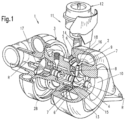
- FIG. 1 shows a perspective view, shown partially in section, of an exhaust-gas turbocharger according to the invention.
- the components referred to in FIG. 1 are as follows:
- FIG. 1 shows a turbocharger 1, which has a turbine casing 2 and a compressor casing 3 which is connected to the latter via a bearing casing 28.
- the casings 2, 3 and 28 are arranged along an axis of rotation R.
- the turbine casing is shown partially in section in order to illustrate the arrangement of a blade bearing ring 6 and a radially outer guide grate 18, which is formed by said ring and has a plurality of adjusting blades 7 which are distributed over the circumference and have rotary axles 8.
- nozzle cross sections are formed which, depending on the position of the adjusting blades 7, are larger or smaller and act to a greater or lesser extent upon the turbine rotor 4, positioned in the center on the axis of rotation R, with the exhaust gas from an engine, said exhaust gas being supplied via a supply duct 9 and discharged via a central connection piece 10, in order to drive a compressor rotor 17 seated on the same shaft using the turbine rotor 4.
- an actuating device 11 is provided in order to control the movement or the position of the adjusting blades 7, in order to control the movement or the position of the adjusting blades 7, in order to control the movement or the position of the adjusting blades 7, an actuating device 11 is provided.
- both the turbine casing 2 and a compressor casing 3 may represent, independently or jointly, a turbine housing according to the present disclosure.
- the alloy of the present disclosure in particular the excellent resistance to oxidation and thermal shocks as well as the smoothness of casts made from the alloy, it is also contemplated to use the alloy of the present invention in manifolds, in particular in manifolds for an internal combustion engine.
- manifolds in particular in manifolds for an internal combustion engine.
- a turbocharger housing was prepared by a conventional sand-casting process using a casting temperature of about 1498 °C.
- the iron-based austenitic alloy used in the cast process contained, besides impurities, the following elements: C: 0.3 to 0.45 wt.-%, Cr: 20 to 22 wt.-%, Mn: 9.5 to 11.5 wt.-%, Ni: 3 to 4 wt.-%, Si: 1.2 to 2 wt.-%, Nb: 0.4 to 0.6 wt.-%, V: 0.3 to 0.6 wt.-%, Mo: 0.3 to 0.6 wt.-%, N: 0.15 to 0.35wt.-%; Fe as balance.
- FIG. 2 shows the V2a-etched austenitic morphology of the alloy according to Example 1.
- a turbocharger housing was prepared by a conventional sand-casting process using a casting temperature of about 1550°C.
- the iron-based austenitic alloy used in the cast process corresponds to the alloy disclosed in the example of WO 2012/158332 A2 . It contained, besides impurities, the following elements: C: 0.25 to 0.35% by weight, Cr: 15 to 16.5% by weight, Mn: 15 to 17% by weight, Si: 0.5 to 1.2% by weight, Nb: 0.5 to 1.2% by weight, W: 2 to 3% by weight, N: 0.2 to 0.4% by weight, Fe as balance
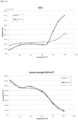
- the mechanical performance (tensile strength, yield strength, and E-modulus) of both alloys was found to be acceptable and within ranges with are suitable for a turbocharger housing, in particular at operating temperatures of 950-1000°C.
- the alloy of Example 1 had a substantially improved performance with respect to the elongation at operating temperatures: The elongation of Example 1 was only about 45% in comparison to about 70 to 80% for Comparative Example 1. The excellent elongation at operating temperatures can be expected to positively contribute to TMF performance.
- FIG.s 3A and 3B show the results of the mechanical performance.
- the oxidation resistance of the alloy was tested by exposing a sample of the alloy to simulated exhaust gas (85% N 2 and 15 % CO 2 ) in a 24h-temperature cycle of 1000°C (about 16 h) and 1020°C (about 8 h). Overall exposure time was 15 days/cycles (360 h). Samples were cooled to ambient temperatures while flushing the samples with argon. The degree of oxidation was determined by measuring the weight change of the samples.
- Example 1 Further investigation of cross-sectional cuts of the test samples revealed that the oxidation depth of the Example 1 was only about 159 ⁇ m and the surface appeared relatively smooth. Comparative Example 1 showed an oxidation depth of about 341 ⁇ m and the surface appeared relatively rough.
- a turbocharger housing prepared from the alloy according to Example 1 was subjected to a thermal shock test.
- the test conditions were as follows: temperature 980°C (970 - 995°C) and duration 300h / 1800 cycles (cycle time 300 sec.). Afterwards, the housing was inspected for oxidation, scaling and microcracks. The housing passed the test and performed on a comparable level to approved commercial turbocharger housings.
- Turbocharger housings according to Examples 1 and 2 were compared with respect to their surface smoothness in the as-cast state.
- the surface smoothness of the turbocharger housings was substantially improved for the housing according to Example 1, in comparison to the housing according to Comparative Example 1.
- a turbocharger housing was prepared by a conventional sand-casting process using a casting temperature of similar to that of Example 1.
- the iron-based austenitic alloy used in the cast process contained, besides impurities, the following elements: C: 0.3 to 0.45 wt.-%, Cr: 20 to 22 wt.-%, Mn: 9.5 to 11.5 wt.-%, Ni: 3 to 4 wt.-%, Si: 1.6 to 2.1 wt.-%, Nb: 0.4 to 0.6 wt.-%, V: 0.3 to 0.6 wt.-%, Mo: 0.3 to 0.6 wt.-%, N: 0.1 to 0.25wt.-%; Fe as balance.
- the alloy performed similarly well, and in parts even better, than the alloy of Example 1, see properties shown in FIG. 4 .
- a turbocharger housing for an internal combustion engine comprising an iron-based austenitic alloy consisting of the following composition: C: about 0.2 to about 0.6 wt.-%, Cr: about 17 to about 25 wt.-%, Mn: about 8 to about 13 wt.-%, Ni: about 2 to about 6 wt.-%, Si: about 0.5 to about 3 wt.-%, Nb: about 0.2 to about 1 wt.-%, V: about 0.2 to about 1 wt.-%, Mo: about 0.2 to about 1.5 wt.-%; optionally one or more of the following elements in the following amounts: N: about 0.01 to about 0.6 wt.-%, in particular about 0.1 to about 0.5 wt.-%, W: about 0.01 to about 3 wt.-%, B: about 0.01 to about 0.1 wt.-%, Cu: about 0.01 to about 0.5 wt.-%; Ce: about 0.01 to about 0.3 wt.
- the iron-based austenitic alloy consists of the following composition: C: about 0.3 to about 0.5 wt.-%, Cr: about 19 to about 23 wt.-%, Mn: about 9 to about 12 wt.-%, Ni: about 3 to about 5 wt.-%, Si: about 1.0 to about 2.2 wt.-%, Nb: about 0.3 to about 0.7 wt.-%, V: about 0.2 to about 0.8 wt.-%, Mo: about 0.2 to about 0.8 wt.-%, N: about 0.1 to about 0.5 wt.-%; optionally one or more of the following elements in the following amounts: W: about 0.5 to about 2 wt.-%, B: about 0.01 to about 0.05 wt.-%, Cu: about 0.1 to about 0.3 wt.-%, Ce: about 0.1 to about 0.2 wt.-%; optionally other elements
- a process for preparing a turbocharger housing as defined in any one of the preceding embodiments comprising a) melt mixing elements of the following composition: C: about 0.2 to about 0.6 wt.-%, Cr: about 17 to about 25 wt.-%, Mn: about 8 to about 13 wt.-%, Ni: about 2 to about 6 wt.-%, Si: about 0.5 to about 3 wt.-%, Nb: about 0.2 to about 1 wt.-%, V: about 0.2 to about 1 wt.-%, Mo: about 0.2 to about 1.5 wt.-%; optionally one or more of the following elements in the following amounts: N: about 0.01 to about 0.6 wt.-%, in particular about 0.1 to about 0.5 wt.-%, W: about 0.01 to about 3 wt.-%, B: about 0.01 to about 0.1 wt.-%, Cu: about 0.01 to about 0.5 wt.-%; Ce: about 0.01
- turbocharger housing is subjected to a heat treatment, in particular thermal aging at about 1000 °C to about 1060 °C for at least about 1 hour, followed by cooling at a rate of up to about 80°C/h.
- a heat treatment in particular thermal aging at about 1000 °C to about 1060 °C for at least about 1 hour, followed by cooling at a rate of up to about 80°C/h.
- casting is an investment casting or a sand casting process.
- an inner surface of the turbocharger housing that is in contact with exhaust gas or compressed air is not subjected to an ablating procedure for at least partially removing an oxide layer on said inner surface.
Landscapes
- Chemical & Material Sciences (AREA)
- Engineering & Computer Science (AREA)
- Mechanical Engineering (AREA)
- Materials Engineering (AREA)
- Metallurgy (AREA)
- Organic Chemistry (AREA)
- Physics & Mathematics (AREA)
- Thermal Sciences (AREA)
- Crystallography & Structural Chemistry (AREA)
- General Engineering & Computer Science (AREA)
- Combustion & Propulsion (AREA)
- Supercharger (AREA)
Applications Claiming Priority (2)
| Application Number | Priority Date | Filing Date | Title |
|---|---|---|---|
| EP18200214 | 2018-10-12 | ||
| EP19202817.3A EP3636792B1 (fr) | 2018-10-12 | 2019-10-11 | Carter de turbocompresseur coulée en alliage austénitique à base de fer |
Related Parent Applications (2)
| Application Number | Title | Priority Date | Filing Date |
|---|---|---|---|
| EP19202817.3A Division EP3636792B1 (fr) | 2018-10-12 | 2019-10-11 | Carter de turbocompresseur coulée en alliage austénitique à base de fer |
| EP19202817.3A Division-Into EP3636792B1 (fr) | 2018-10-12 | 2019-10-11 | Carter de turbocompresseur coulée en alliage austénitique à base de fer |
Publications (2)
| Publication Number | Publication Date |
|---|---|
| EP4528082A2 true EP4528082A2 (fr) | 2025-03-26 |
| EP4528082A3 EP4528082A3 (fr) | 2025-10-22 |
Family
ID=63915176
Family Applications (2)
| Application Number | Title | Priority Date | Filing Date |
|---|---|---|---|
| EP19202817.3A Active EP3636792B1 (fr) | 2018-10-12 | 2019-10-11 | Carter de turbocompresseur coulée en alliage austénitique à base de fer |
| EP25156438.1A Pending EP4528082A3 (fr) | 2018-10-12 | 2019-10-11 | Carter de turbocompresseur coulée en alliage austénitique à base de fer |
Family Applications Before (1)
| Application Number | Title | Priority Date | Filing Date |
|---|---|---|---|
| EP19202817.3A Active EP3636792B1 (fr) | 2018-10-12 | 2019-10-11 | Carter de turbocompresseur coulée en alliage austénitique à base de fer |
Country Status (5)
| Country | Link |
|---|---|
| US (1) | US11434556B2 (fr) |
| EP (2) | EP3636792B1 (fr) |
| JP (1) | JP7477278B2 (fr) |
| KR (1) | KR102869769B1 (fr) |
| CN (1) | CN111041386B (fr) |
Families Citing this family (2)
| Publication number | Priority date | Publication date | Assignee | Title |
|---|---|---|---|---|
| DE102020128883A1 (de) | 2020-11-03 | 2022-05-05 | BMTS Technology GmbH & Co. KG | Austenitische Stahllegierung und Turbinengehäuse oder Turbinengehäusebauteil für einen Abgasturbolader |
| DE102020128884A1 (de) | 2020-11-03 | 2022-05-05 | BMTS Technology GmbH & Co. KG | Austenitische Stahllegierung und Turbinengehäuse oder Turbinengehäusebauteil für einen Abgasturbolader |
Citations (4)
| Publication number | Priority date | Publication date | Assignee | Title |
|---|---|---|---|---|
| US4191094A (en) | 1978-04-26 | 1980-03-04 | Sundstrand Corporation | Power drive unit |
| US4532974A (en) | 1981-07-03 | 1985-08-06 | Rolls-Royce Limited | Component casting |
| US4608094A (en) | 1984-12-18 | 1986-08-26 | United Technologies Corporation | Method of producing turbine disks |
| WO2012158332A2 (fr) | 2011-05-19 | 2012-11-22 | Borgwarner Inc. | Alliage austénitique à base de fer, turbocompresseur et composant fabriqué avec celui-ci |
Family Cites Families (19)
| Publication number | Priority date | Publication date | Assignee | Title |
|---|---|---|---|---|
| US2602738A (en) * | 1950-01-30 | 1952-07-08 | Armco Steel Corp | High-temperature steel |
| GB1116279A (en) * | 1966-06-16 | 1968-06-06 | Swift Levick & Sons Ltd | Improvements in or relating to the manufacture of valves from austenitic steels |
| US3561953A (en) * | 1968-03-19 | 1971-02-09 | Toyota Motor Co Ltd | Austenitic heat-resisting steel containing nickel, chromium and manganese |
| JPS6077964A (ja) * | 1983-10-04 | 1985-05-02 | Toyota Motor Corp | 弁用鋼 |
| WO2004024970A1 (fr) | 2002-09-16 | 2004-03-25 | Borgwarner, Inc. | Alliage hautes temperatures convenant particulierement pour un distributeur de turbine a grande longevite de turbocompresseur |
| JP2005281855A (ja) * | 2004-03-04 | 2005-10-13 | Daido Steel Co Ltd | 耐熱オーステナイト系ステンレス鋼及びその製造方法 |
| US7744813B2 (en) * | 2007-01-04 | 2010-06-29 | Ut-Battelle, Llc | Oxidation resistant high creep strength austenitic stainless steel |
| KR101576194B1 (ko) | 2008-09-25 | 2015-12-10 | 보르그워너 인코퍼레이티드 | 터보차저 및 이를 위한 조정 블레이드 |
| JP2012503718A (ja) * | 2008-09-25 | 2012-02-09 | ボーグワーナー インコーポレーテッド | ターボチャージャ及びそのブレード軸受リング |
| CN101660097B (zh) * | 2009-08-13 | 2011-05-04 | 丁家伟 | 高硼高铬低碳耐磨合金钢及其制备方法 |
| CN102337481B (zh) * | 2010-07-20 | 2013-11-13 | 宝山钢铁股份有限公司 | 一种耐蚀性优良的含钼节镍奥氏体不锈钢及其制造方法 |
| US8431072B2 (en) * | 2011-05-24 | 2013-04-30 | Ut-Battelle, Llc | Cast alumina forming austenitic stainless steels |
| JP2014515436A (ja) * | 2011-05-26 | 2014-06-30 | ユナイテッド・パイプラインズ・アジア・パシフィック・プライベイト・リミテッド | オーステナイト系ステンレス鋼 |
| US10975718B2 (en) * | 2013-02-12 | 2021-04-13 | Garrett Transportation I Inc | Stainless steel alloys, turbocharger turbine housings formed from the stainless steel alloys, and methods for manufacturing the same |
| US20140261918A1 (en) * | 2013-03-15 | 2014-09-18 | Exxonmobil Research And Engineering Company | Enhanced wear resistant steel and methods of making the same |
| US9534281B2 (en) * | 2014-07-31 | 2017-01-03 | Honeywell International Inc. | Turbocharger turbine housings formed from the stainless steel alloys, and methods for manufacturing the same |
| US10894995B2 (en) | 2016-03-23 | 2021-01-19 | Nippon Steel & Sumikin Stainless Steel Corporation | Austenitic stainless steel sheet for exhaust component having excellent heat resistance and workability, turbocharger component, and method for producing austenitic stainless steel sheet for exhaust component |
| CN106244940A (zh) | 2016-08-26 | 2016-12-21 | 天津新伟祥工业有限公司 | 一种铬锰氮系奥氏体耐热钢及其制备方法 |
| KR101809853B1 (ko) * | 2016-11-25 | 2017-12-26 | 포항공과대학교 산학협력단 | 고온강도가 우수한 오스테나이트강 |
-
2018
- 2018-11-09 CN CN201811328516.3A patent/CN111041386B/zh active Active
-
2019
- 2019-10-11 JP JP2019187347A patent/JP7477278B2/ja active Active
- 2019-10-11 EP EP19202817.3A patent/EP3636792B1/fr active Active
- 2019-10-11 EP EP25156438.1A patent/EP4528082A3/fr active Pending
- 2019-10-14 KR KR1020190127356A patent/KR102869769B1/ko active Active
- 2019-10-14 US US16/600,772 patent/US11434556B2/en active Active
Patent Citations (4)
| Publication number | Priority date | Publication date | Assignee | Title |
|---|---|---|---|---|
| US4191094A (en) | 1978-04-26 | 1980-03-04 | Sundstrand Corporation | Power drive unit |
| US4532974A (en) | 1981-07-03 | 1985-08-06 | Rolls-Royce Limited | Component casting |
| US4608094A (en) | 1984-12-18 | 1986-08-26 | United Technologies Corporation | Method of producing turbine disks |
| WO2012158332A2 (fr) | 2011-05-19 | 2012-11-22 | Borgwarner Inc. | Alliage austénitique à base de fer, turbocompresseur et composant fabriqué avec celui-ci |
Also Published As
| Publication number | Publication date |
|---|---|
| CN111041386B (zh) | 2022-07-29 |
| JP2020059920A (ja) | 2020-04-16 |
| CN111041386A (zh) | 2020-04-21 |
| KR102869769B1 (ko) | 2025-10-10 |
| JP7477278B2 (ja) | 2024-05-01 |
| EP3636792A1 (fr) | 2020-04-15 |
| US20200115784A1 (en) | 2020-04-16 |
| KR20200042430A (ko) | 2020-04-23 |
| EP4528082A3 (fr) | 2025-10-22 |
| US11434556B2 (en) | 2022-09-06 |
| EP3636792B1 (fr) | 2025-03-19 |
Similar Documents
| Publication | Publication Date | Title |
|---|---|---|
| JP5938469B2 (ja) | オーステナイト鉄ベース合金、それから製造されたターボチャージャ及び構成要素 | |
| CN103827463B (zh) | 涡轮增压器以及用于该涡轮增压器的部件 | |
| KR101576194B1 (ko) | 터보차저 및 이를 위한 조정 블레이드 | |
| CN102149837B (zh) | 涡轮增压器及其对应的叶片支承环 | |
| EP2765214B1 (fr) | Alliages d'acier inoxydable, carters de turbine de turbocompresseur formés à partir des alliages d'acier inoxydable et procédés de fabrication associés | |
| US20140086755A1 (en) | Turbocharger and component therefor | |
| US20090269235A1 (en) | Production method for sintered machine components | |
| EP3636792B1 (fr) | Carter de turbocompresseur coulée en alliage austénitique à base de fer | |
| US20050006006A1 (en) | High temperature alloy particularly suitable for a long-life turbocharger nozzle ring | |
| US20110171008A1 (en) | Turbocharger and adjustment ring therefor | |
| KR20110063660A (ko) | 터보차저 및 그 지지 디스크 |
Legal Events
| Date | Code | Title | Description |
|---|---|---|---|
| PUAI | Public reference made under article 153(3) epc to a published international application that has entered the european phase |
Free format text: ORIGINAL CODE: 0009012 |
|
| STAA | Information on the status of an ep patent application or granted ep patent |
Free format text: STATUS: REQUEST FOR EXAMINATION WAS MADE |
|
| 17P | Request for examination filed |
Effective date: 20250207 |
|
| AC | Divisional application: reference to earlier application |
Ref document number: 3636792 Country of ref document: EP Kind code of ref document: P |
|
| AK | Designated contracting states |
Kind code of ref document: A2 Designated state(s): AL AT BE BG CH CY CZ DE DK EE ES FI FR GB GR HR HU IE IS IT LI LT LU LV MC MK MT NL NO PL PT RO RS SE SI SK SM TR |
|
| REG | Reference to a national code |
Ref country code: DE Ref legal event code: R079 Free format text: PREVIOUS MAIN CLASS: F01D0025240000 Ipc: C22C0038580000 |
|
| PUAL | Search report despatched |
Free format text: ORIGINAL CODE: 0009013 |
|
| AK | Designated contracting states |
Kind code of ref document: A3 Designated state(s): AL AT BE BG CH CY CZ DE DK EE ES FI FR GB GR HR HU IE IS IT LI LT LU LV MC MK MT NL NO PL PT RO RS SE SI SK SM TR |
|
| RIC1 | Information provided on ipc code assigned before grant |
Ipc: C22C 38/58 20060101AFI20250917BHEP Ipc: C22C 38/44 20060101ALI20250917BHEP Ipc: C22C 38/46 20060101ALI20250917BHEP Ipc: C22C 38/48 20060101ALI20250917BHEP Ipc: C22C 38/02 20060101ALI20250917BHEP Ipc: C22C 38/00 20060101ALI20250917BHEP Ipc: C22C 38/42 20060101ALI20250917BHEP Ipc: C22C 38/54 20060101ALI20250917BHEP Ipc: C21D 6/00 20060101ALI20250917BHEP Ipc: C21D 1/18 20060101ALI20250917BHEP Ipc: F01D 25/24 20060101ALI20250917BHEP |