EP4529806A1 - Composition d'hygiène buccale - Google Patents
Composition d'hygiène buccale Download PDFInfo
- Publication number
- EP4529806A1 EP4529806A1 EP23200987.8A EP23200987A EP4529806A1 EP 4529806 A1 EP4529806 A1 EP 4529806A1 EP 23200987 A EP23200987 A EP 23200987A EP 4529806 A1 EP4529806 A1 EP 4529806A1
- Authority
- EP
- European Patent Office
- Prior art keywords
- stimulation
- massage
- application unit
- oral hygiene
- stem
- Prior art date
- Legal status (The legal status is an assumption and is not a legal conclusion. Google has not performed a legal analysis and makes no representation as to the accuracy of the status listed.)
- Pending
Links
Images




Classifications
-
- A—HUMAN NECESSITIES
- A46—BRUSHWARE
- A46D—MANUFACTURE OF BRUSHES
- A46D1/00—Bristles; Selection of materials for bristles
- A46D1/02—Bristles details
- A46D1/0284—Bristles having rounded ends
-
- A—HUMAN NECESSITIES
- A46—BRUSHWARE
- A46B—BRUSHES
- A46B9/00—Arrangements of the bristles in the brush body
- A46B9/02—Position or arrangement of bristles in relation to surface of the brush body, e.g. inclined, in rows, in groups
- A46B9/025—Position or arrangement of bristles in relation to surface of the brush body, e.g. inclined, in rows, in groups the bristles or the tufts being arranged in an angled position relative to each other
-
- A—HUMAN NECESSITIES
- A46—BRUSHWARE
- A46B—BRUSHES
- A46B9/00—Arrangements of the bristles in the brush body
- A46B9/02—Position or arrangement of bristles in relation to surface of the brush body, e.g. inclined, in rows, in groups
- A46B9/04—Arranged like in or for toothbrushes
-
- A—HUMAN NECESSITIES
- A46—BRUSHWARE
- A46B—BRUSHES
- A46B9/00—Arrangements of the bristles in the brush body
- A46B9/06—Arrangement of mixed bristles or tufts of bristles, e.g. wire, fibre, rubber
-
- A—HUMAN NECESSITIES
- A46—BRUSHWARE
- A46B—BRUSHES
- A46B2200/00—Brushes characterized by their functions, uses or applications
- A46B2200/10—For human or animal care
- A46B2200/1066—Toothbrush for cleaning the teeth or dentures
-
- A—HUMAN NECESSITIES
- A46—BRUSHWARE
- A46B—BRUSHES
- A46B3/00—Brushes characterised by the way in which the bristles are fixed or joined in or on the brush body or carrier
- A46B3/04—Brushes characterised by the way in which the bristles are fixed or joined in or on the brush body or carrier by mouldable materials, e.g. metals, cellulose derivatives, plastics
-
- A—HUMAN NECESSITIES
- A46—BRUSHWARE
- A46B—BRUSHES
- A46B3/00—Brushes characterised by the way in which the bristles are fixed or joined in or on the brush body or carrier
- A46B3/06—Brushes characterised by the way in which the bristles are fixed or joined in or on the brush body or carrier by welding together bristles made of metal wires or plastic materials
-
- A—HUMAN NECESSITIES
- A46—BRUSHWARE
- A46B—BRUSHES
- A46B3/00—Brushes characterised by the way in which the bristles are fixed or joined in or on the brush body or carrier
- A46B3/16—Brushes characterised by the way in which the bristles are fixed or joined in or on the brush body or carrier by wires or other anchoring means, specially for U-shaped bristle tufts
Definitions
- the invention relates to an oral hygiene product.
- An oral hygiene product in particular a toothbrush, has already been proposed, comprising at least one application unit which has a base body and at least one stimulation and/or massage element connected to the base body, and comprising at least one handle unit which can be connected, in particular firmly connected, to the application unit and which has a handle body.
- the object of the invention is, in particular, to provide a generic device with improved properties in terms of functionality and manufacturability. This object is achieved according to the invention by the features of patent claim 1, while advantageous embodiments and further developments of the invention can be found in the subclaims.
- the invention is based on an oral hygiene device, in particular a toothbrush, with at least one application unit which has a base body and at least one stimulation and/or massage element connected to the base body, and with at least one handle unit which can be connected to the application unit, in particular is firmly connected, and which has a handle body.
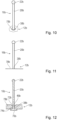
- the at least one stimulation and/or massage element comprise a stem and at least one stimulation head, wherein a cross-section of the stimulation head is enlarged compared to a cross-section of the stem.
- the stem and the stimulation head are formed as a single piece.
- the inventive design of the oral hygiene product makes it possible to provide advantageous properties with regard to the functionality of the oral hygiene product.
- at least one advantageous stimulation and/or massage element can be provided.
- This makes it possible to provide, in particular, a stimulation and/or massage function.
- advantageously high comfort can be provided.
- a cleaning result can be positively influenced.
- this makes it possible to provide, in particular, a stimulation and/or massage element that is advantageously easy to manufacture. Due to the structure of the stimulation and/or massage element, existing fastening methods, in particular for toothbrush bristles, can preferably be used to fix the stimulation and/or massage element to the base body.
- oral hygiene product is understood to mean, in particular, a toothbrush and/or an interdental cleaner and/or a flosser and/or a tongue cleaner and/or a toothpick.
- the oral hygiene product is advantageously designed as a toothbrush, in particular a manual toothbrush.
- the oral hygiene product can be designed as an electric toothbrush.
- the oral hygiene product can be designed as a disposable toothbrush, a reusable toothbrush, or even a replaceable-head toothbrush.
- the oral hygiene product is, in particular, formed by an oral hygiene brush.
- oral hygiene brushes examples include manual toothbrushes such as reusable toothbrushes, replaceable-head toothbrushes, disposable toothbrushes, or single-tuft brushes; electric toothbrushes, as well as hybrid toothbrushes; interdental cleaners, in particular with twisted bristles (also called interdental brushes), in injected form; or as a flosser and/or tongue cleaner.
- the oral hygiene device can be designed with an oscillating oral hygiene brush.
- the brush head can oscillate with a rotation axis perpendicular or parallel to the longitudinal axis. Round, oval, or elongated shaped oral hygiene brushes can be used.
- the movement of the brush head from the basic position i.e. the angle of rotation of the bristle carrier in the unloaded state
- the movement of the brush head (from the basic position) comprises a Angle range from +/- 1° to +/- 15°, preferably from +/- 3° to +/- 10°. This is achieved at 15,000 to 25,000 movements per minute. Left and right rotations from the center position of the brush head are counted as movements.
- the oral hygiene brush can also be operated with a vibration drive.
- a vibration drive the movement consists of a vibration generated by a motor with a connected eccentric.
- the motor speed ranges from 8,000 rpm to 15,000 rpm.
- the oral hygiene brush is designed with a replaceable head.
- the oral hygiene product can also be generally interpreted as a brush product.
- a "brush product” is understood to mean, in particular, an oral hygiene brush and/or a personal care or cosmetic brush and/or a hairbrush and/or a household brush.
- personal care or cosmetic brushes include mascara brushes, nail polish brushes, facial brushes, applicators, in particular hair dye applicators, massage devices, makeup brushes, shaving brushes and/or wet razors, or other personal care products.
- household brushes include dishwashing brushes, floor mops, and/or brooms. Consequently, the statements regarding oral hygiene products also apply to the aforementioned brush products.
- the oral hygiene device has, in particular, a longitudinal axis that is advantageously arranged at least substantially parallel to a main direction of extension of the oral hygiene device.
- the longitudinal axis preferably runs at least partially within the oral hygiene device and in particular through its center of gravity.
- the longitudinal axis of the oral hygiene device is a central axis of the oral hygiene device and/or a central axis of the handle unit.
- a "central axis" of an object is to be understood in particular as an imaginary axis that runs within the object parallel to a main direction of extension of the object and intersects the object at a maximum of two points.
- At least substantially parallel is to be understood here in particular as an orientation of a direction relative to a reference direction, in particular in a plane, wherein the direction has a deviation from the reference direction of in particular less than 8°, advantageously less than 5°, and particularly advantageously less than 2°.
- a "main direction of extension" of an object is to be understood in particular as In particular, this should be understood as a direction that runs parallel to the longest edge of the smallest imaginary cuboid that just completely encloses the object.
- a “main extension” of an object should be understood as the extension of the longest edge of the smallest imaginary cuboid that just completely encloses the object.
- the oral hygiene device in the manual embodiment has a length, in particular parallel to the longitudinal axis of the oral hygiene device and measured parallel to the contact surface, of 130 mm to 210 mm and preferably of 180 mm to 200 mm, although other, in particular smaller or larger, lengths are of course also conceivable. Smaller versions can be used for children's or adolescents' toothbrushes.
- the oral hygiene device has a maximum width, in particular parallel to a width axis of the oral hygiene device, advantageously perpendicular to the longitudinal axis and/or parallel to a main extension plane of the oral hygiene device and/or the handle unit, of 10 mm to 25 mm and preferably of 18 mm to 21 mm.
- the oral hygiene device has a minimum width of 4 mm to 10 mm, preferably of 5 mm to 7 mm, in a neck region of the application unit.
- the oral hygiene product without bristles has a height, in particular measured parallel to the height axis perpendicular to the support surface, of 10 mm to 22 mm and preferably of 12 mm to 18 mm. The highest point is in particular in a thumb grip area or holding area of the handle unit of the oral hygiene product.
- the term “height” refers in particular to a state of the oral hygiene product in which it is placed, for example, on a flat surface such as a tabletop, a sink, the top of a piece of furniture, or the like, in particular such that the longitudinal axis is arranged parallel to the surface and the back of the oral hygiene product rests on the flat surface.
- a "main extension plane" of an object is to be understood in particular as a plane that is parallel to a largest side surface of a smallest imaginary cuboid that just completely encloses the object and that runs through the center of the cuboid.
- the application unit has at least one cleaning area which is suitable for a tooth and/or tongue cleaning application, in particular in a mouth of the user.
- the cleaning area preferably comprises at least one cleaning unit, in particular at least one brush head, advantageously a toothbrush head, preferably with a plurality of bristles and/or bundles of bristles and/or injected cleaning elements or injected bristles and/or soft-elastic cleaning elements.
- the cleaning unit can also be designed, for example, as an interdental brush and/or as a single tuft (e.g. a single large bundle of bristles) and/or as a bow covered with dental floss, in particular as a flosser, or the like.
- the application unit advantageously has at least the neck element, which is preferably connected to the cleaning area, in particular directly and/or integrally.
- “Integral” should be understood in particular to mean at least materially bonded, for example by a welding process, an adhesive process, an injection molding process, and/or another process deemed appropriate by a person skilled in the art, and/or advantageously formed in one piece, such as by production from a single casting and/or by production using a single- or multi-component injection molding process, and advantageously from a single blank.
- "Intended” should be understood in particular to mean specially designed and/or equipped. The fact that an object is intended for a specific function should be understood in particular to mean that the object fulfills and/or performs this specific function in at least one application and/or operating state.
- the oral hygiene product has, in particular, a front side and a back side, which are arranged in particular facing away from one another.
- the cleaning area is preferably arranged on the front side of the oral hygiene product.
- the front side is, in particular, a side of the oral hygiene product that is visible in a viewing direction perpendicular to the longitudinal axis of the oral hygiene product and perpendicular to the width axis of the oral hygiene product.
- the front side of the oral hygiene product is, in particular, that side of the brush on which the thumb is placed.
- the front side is normally also the side towards which the bristle area is directed.
- the back side advantageously corresponds to a side of the oral hygiene product that is visible in a viewing direction opposite thereto.
- the back side of the oral hygiene product is the side of the toothbrush opposite the bristle area.
- the left side of the oral hygiene product is, in particular, a side that is on the left when viewed perpendicular to the front side of the
- the right side of the oral hygiene device is specifically referred to as the side that is on the right when viewed perpendicularly from the front of the oral hygiene device.
- the top side is specifically referred to as the end of the oral hygiene device where the cleaning area is located.
- the bottom side is specifically referred to as the end of the oral hygiene device opposite the top side, which is closest to the handle area.
- the handle unit preferably has at least one handle element, which is advantageously intended for holding with one hand.
- the handle element is preferably tapered at least in some areas. This advantageously allows a secure grip and optimizes ergonomics.
- the handle element is particularly preferably elongated, with a longitudinal axis of the handle element advantageously corresponding to the longitudinal axis of the oral hygiene device.
- the handle element is formed at least partially, in particular completely, from at least one hard component. It would also be conceivable for the handle element to additionally be formed from one or more soft components.
- the material volume body is formed at least largely, in particular completely, from at least one hard component.
- the handle element advantageously comprises at least one thumb grip region and/or at least one handle region.
- the thumb grip region is advantageously arranged on the front side of the oral hygiene device and in particular on a front side of the handle element. It is conceivable for the thumb grip region and/or the handle region to have at least one element and/or a surface structuring made of at least one soft component and/or at least one hard component.
- the gripping region has at least one handle element.
- a main extension direction of the handle element is arranged at least substantially parallel to the longitudinal axis of the oral hygiene device.
- the handle element has at least one surface structure element, particularly advantageously a plurality of surface structure elements, which are at least substantially identical or at least geometrically similar to the above-described surface structure elements of the thumb grip region.
- the surface structure elements of the handle element in particular at least arranged in pairs, each grouped one behind the other along the longitudinal axis of the oral hygiene product.
- the materials used can be recyclable. Recyclable materials are advantageous if they can be recycled after use. Materials that can be integrated into an existing recycling stream, such as polyester (PET), polyethylene (PE), and polypropylene (PP), are particularly preferred.
- PET polyester
- PE polyethylene
- PP polypropylene
- the materials used can be recycled. Materials that originate from a recycling stream, such as polyester (rPET), polyethylene (rPE), and polypropylene (rPP), are particularly preferred.
- a hard component can comprise polyolefins such as polypropylene (PP), polyethylene (PE), or the like, in particular also in the form of high-density polyethylene (HDPE) or low-density polyethylene (LDPE).
- SAN styreneacrylonitrile
- PS polystyrene
- ABS acrylonitrile butadiene styrene
- SMMA styrene methyl methacrylate
- SB styrene butadiene
- a hard component can comprise polyolefins such as polypropylene (PP), polyethylene (PE), or the like, in particular also in the form of high-density polyethylene (HDPE) or low-density polyethylene (LDPE).
- HDPE high-density polyethylene
- LDPE low-density polyethylene
- Polyesters such as polyethylene terephthalate (PET), particularly in the form of acid-modified polyethylene terephthalate (PETA), glycol-modified polyethylene terephthalate (PETG), polybutylene terephthalate (PBT), acid-modified polycyclohexylenedimethylene terephthalate (PCT-A), glycol-modified polycyclohexylenedimethylene terephthalate (PCT-G), or the like, are also suitable.
- cellulose derivatives such as cellulose acetate (CA), cellulose acetobutyrate (CAB), cellulose propionate (CP), cellulose acetate phthalate (CAP), cellulose butyrate (CB), or the like is conceivable.
- a hard component can comprise, for example, polyamides (PA) such as PA 6.6, PA 6.10, PA 6.12 or the like, polymethyl methacrylate (PMMA), polycarbonate (PC), polyoxymethylene (POM), polyvinyl chloride (PVC), polyurethane (PUR), polyamide (PA) or the like.
- PA polyamide
- PE polyethylene
- PU polyurethane
- a hard component has a modulus of elasticity of at least 1000 N/mm 2 and advantageously of at least 1300 N/mm 2 and/or of at most 2400 N/mm 2 and advantageously of at most 1800 N/mm 2.
- Polypropylene (PP) is preferably used as the hard component. At least certain materials mentioned under the hard component can be sustainable materials. In particular, materials with a cellulose content are at least partially bio-based.
- Hard components are advantageously used for stable and/or structural elements, in particular in the handle element and/or in a support element of the application unit (e.g. the bristle support plate) and/or the fastening unit or the like.
- the oral hygiene product or at least one base body of the oral hygiene product has a single hard component, which can be made from one of the materials mentioned or from a mixture thereof.
- combinations of different hard components are also conceivable, wherein these can be processed, for example, in a two- and/or multi-component injection molding process and/or glued and/or welded to one another, in particular ultrasonically welded.
- hard components can be used which do not form a material bond in a two- and/or multi-component injection molding process.
- a positive connection for example in the form of at least one undercut and/or at least one opening and/or at least an at least partial overmolding or the like, is created between hard components.
- a second hard component which is in particular injection-molded onto a first hard component, shrinks and/or shrinks after injection molding and advantageously forms a shrinkage connection.
- Suitable combinations can include polypropylene-polyester, polypropylene-sustainable material, polypropylene-styrene-acrylonitrile, or other combinations. In this combination, polypropylene serves to create a material-tight bond with the soft component.
- Suitable soft components include, for example, thermoplastic styrene elastomers (TPE-S) such as a styrene-ethylene-butylene-styrene copolymer (SEBS), a styrene-butadiene-styrene copolymer (SBS), or the like.
- TPE-S thermoplastic styrene elastomers
- SEBS styrene-ethylene-butylene-styrene copolymer
- SBS styrene-butadiene-styrene copolymer
- TPE-U thermoplastic polyurethane elastomers
- TPE-A thermoplastic polyamide elastomers
- TPE-O thermoplastic polyolefin elastomers
- TPE-E thermoplastic polyester elastomers
- a soft component can comprise, for example, at least one silicone.
- a soft component has a Shore A hardness of at most 90, advantageously of at most 50, and particularly advantageously of at most 30.
- at least one soft component forms at least one material bond with at least one hard component, in particular in at least one two- and/or multi-component injection molding, advantageously by means of at least one overmolding and/or insert molding.
- the materials mentioned under the soft component can at least partially be sustainable Materials.
- the soft component can be a material mixture of sustainable material and a non-sustainable soft component.
- the soft component can be a mixture of recycled polypropylene (rPP) and a soft component.
- Recycled polypropylene (rPP) can be a raw material for producing a soft component.
- the weight fraction of recycled polypropylene in the soft component is more than 10%, preferably more than 20%, and particularly preferably more than 30%.
- a hard component used and a soft component used have different colors, so that surface structures, inscriptions, motifs and the like can be realized by means of a suitable design of the base body and the soft element.
- the at least one application unit comprise a brush head, in particular a toothbrush head.
- the application unit advantageously comprises at least one cleaning unit, in particular a toothbrush head, with bristles.
- the cleaning unit also advantageously comprises at least one bristle carrier, for example a brush head base body.
- At least some or all of the bristles are advantageously conventional extruded bristles.
- Bristles can in particular comprise at least one hard component and/or at least one soft component.
- the bristles are made at least partially or entirely from polyamide (PA) and/or polyester (e.g., PBT, PET), although any other materials or components (hard component or soft component) are conceivable, and sustainable materials such as chitosan are also possible.
- the bristles can be made from a degradable material. Furthermore, it is conceivable that at least some of the bristles have a tapered portion and/or a variable cross-section. Preferably, the bristles are formed from a single, in particular also mixed, material. However, bristles consisting of multiple components or materials are also conceivable, which can be produced and/or manufactured in particular by means of at least one coextrusion. The bristles can be manufactured and/or produced, for example, by extrusion, cutting, and/or post-processing.
- conventional bristles are extruded, cut, processed, and inserted or attached to the toothbrush handle using a customized process.
- Stimulation and/or massage elements are also extruded and partially prefabricated and then inserted or anchored using a customized process, such as the anchor punching process, the AFT process, the PTt process, and/or the IMT process.
- the bristles can be processed before and/or after anchoring (e.g., tapered, rounded, thermally treated, etc.).
- cylindrical or pointed bristles are suitable, with any cross-sections such as polygonal, triangular, rectangular, square, elliptical, star-shaped, trapezoidal, parallelogram-shaped, rhombus-shaped or any other cross-sections being conceivable.
- different bristles can be used in a bristle bundle, but also different bristle bundles, in particular each with a specific type of bristle. Bristles and/or bristle bundles can be arranged regularly or irregularly.
- bristles and/or bristle bundles arranged in groups and/or adjacently can differ, in particular alternating, with regard to at least one feature such as a length, a diameter, a material, a color, a material hardness, a geometry, a point and the like.
- the bristles preferably have a diameter, in particular perpendicular to their longitudinal axis, of at least 0.075 mm and/or of at most 0.25 mm.
- the bristles advantageously have a cross-sectional area, in particular perpendicular to their longitudinal axis, of at least 0.002 mm 2 and/or of at most 0.2 mm 2 .
- bristles used in the cosmetics sector for example bristles of an additional application element
- thinner bristles and/or bristles with a smaller cross-section can also be used, in particular bristles with a diameter, in particular perpendicular to their longitudinal axis, of at least 0.025 mm and/or of at most 0.2 mm and/or with a cross-sectional area, in particular perpendicular to their longitudinal axis, of at least 0.001 mm 2 and/or of at most 0.15 mm 2 .
- polyester e.g. PBT, PET or PTT
- PTT is particularly suitable as a material, although sustainable materials are also possible, whereby a pointed edge can be produced mechanically and/or chemically.
- the bristles are preferably straight in the longitudinal direction, but wavy and/or twisted and/or helical and/or twisted bristles are also conceivable, as are, in particular, combinations of different bristles. Furthermore, bristles with a smooth surface are conceivable, as are bristles with a textured surface.
- the bristles in particular as bristle bundles, or also the stimulation and massage elements are preferably processed using at least one anchor punching process, an anchorless process such as the anchor-free tufting (AFT) process, an in-mold tufting (IMT) process, a PTt process, or the like, in particular are attached to the base body/bristle carrier or bristle support plate.
- the bristle carrier preferably has a plurality of bristle receptacles, in particular holes for bristle bundles, in particular drilled and/or formed during injection molding.
- a base body in particular from a hard component, preferably the brush head, is first manufactured by injection molding, wherein blind holes for bristle bundles are advantageously formed during injection molding.
- blind holes for bristle bundles are advantageously formed during injection molding.
- subsequent drilling of blind holes is also conceivable.
- bristles or bristle bundles, or even individual or bundled stimulation and massage elements are then folded and secured in a blind hole by means of at least one anchor, in particular by means of a punch. Loop punching is also conceivable.
- anchorless processes are also conceivable, whereby bristles or bristle bundles or stimulation and/or massage elements are advantageously not folded.
- bristles or bristle bundles are approximately half the length compared to anchor punching.
- the bristle bundles are first separated, fused, and/or their bristle ends are subsequently overmolded for their attachment.
- bristle bundles can advantageously be brought together.
- stimulation and/or massage elements it is preferably the case that the stems are individually inserted into individual recesses and secured.
- a base body for example the brush head and/or the handle unit and/or the attachment unit, is advantageously formed during the overmolding of the bristle ends/ends of the stimulation and/or massage elements.
- bristles are first coated with platelets or the like. are overmolded and these platelets are then overmolded again, for example to form the brush head and/or the handle unit.
- Bristle bundles consist of at least one bristle, preferably several bristles.
- the bristle(s) may be folded for anchoring (anchor punching method) or not (anchorless method).
- the application unit may be composed of a base body and a bristle plate equipped with bristles/stimulation and/or massage elements and/or alternative cleaning elements.
- bristle plates with through holes are first manufactured by injection molding, through which bristles/stimulation and/or massage elements are then guided.
- the bristles/stimulation and/or massage elements are then connected, in particular fused, on a rear side, preferably at least partially to one another and/or to the corresponding bristle plate.
- bristle-covered bristle platelets can then be welded and/or glued to a base body, in particular a brush head, preferably by means of ultrasonic welding.
- the base body in particular the brush head, has in particular a recess into which the bristle plate can be inserted.
- a known manufacturing method in this context is the anchor-free tufting process, which in particular enables the merging of bristle bundles.
- the underside of the bristle plate is specifically the side that is placed into a recess in the base body and faces toward the back of the oral hygiene product. Accordingly, the top side of the bristle plate faces toward the top of the oral hygiene product.
- Another possible method for anchorless bristle application is the production, in particular injection molding, of a brush head with through holes for bristles. Bristles/stimulation and/or massage elements can then be guided through the through holes and fused to a back surface, in particular to each other and/or to the brush head. Preferably, the fused areas and/or the brush head are then overmolded, in particular with at least one soft component.
- bristles/stimulation and/or massage elements can in particular be combined to form bristle bundles and melted or fused at one end and/or connected in some other way.
- the brush head is then heated, in particular to a glass transition temperature of its material.
- Individual bristles or bristle bundles can then advantageously be inserted into the blind holes and anchored to the brush head by pressing them down.
- the heated blind holes or their surroundings are deformed in the process, so that the individual bristles or bristle bundles/stimulation and/or massage elements are anchored therein.
- injection-molded bristles are also conceivable. These can be manufactured, in particular, during multi-component injection molding together with the application unit, the handle unit, and/or the fastening unit, or can be subsequently injection-molded onto a base body of the application unit.
- filament is fed from a roll, with several filament strands wound onto a roll.
- Several rolls are pre-tensioned for machine feeding, as each filament in the brush corresponds to a filament strand.
- the filaments are spread out correctly in width so that they have the width at which they are fed into the brush.
- the filaments are pre-pulled so that they are free for the next step, i.e. so that a wire can be fed over them.
- a wire is then fed from a roll onto the machine, i.e. unwound and introduced into the process.
- the wire is cut to a length that is greater than the unwound length of the twisted-in brush; the final cutting takes place after twisting.
- the wire is bent into a U so that the open side can then be pushed over the filaments to thread the bristles.
- the wire is held at the bottom of the U.
- the open wire end is then clamped to hold the filaments between the wire pieces.
- the filaments are cut to a length that is longer than the final length in the brush so that the brush Then, once the filaments are twisted in, they can be cut correctly.
- the wire is twisted so that the filaments are clamped between the wire and thus secured. Once the filaments are fixed in the wire, they are cut to the correct length and profiled. After the brush section is finished, the excess wire is trimmed off.
- materials of injected bristles do not form a material bond with other soft components and/or hard components and/or sustainable materials of the oral hygiene product during an injection molding process, in particular a two-component and/or multi-component injection molding.
- injected bristles are preferably connected to soft components and/or hard components by means of a positive connection, for example by means of at least one undercut and/or at least one opening and/or by means of at least partial overmolding, wherein a shrinkage connection and/or a shrinkage connection are particularly conceivable.
- a connection by means of at least one material bond is also conceivable.
- the application unit can also comprise at least one tongue cleaner and/or at least one alternative cleaning and/or massaging element.
- These can each be formed from a soft component, a hard component, or a combination of soft and hard components and/or can advantageously be manufactured and/or produced by injection molding.
- injection-molded bristles are formed at least partially and advantageously completely from a thermoplastic polyurethane elastomer (TPE-U).
- TPE-U thermoplastic polyurethane elastomer
- TPE-E thermoplastic polyester elastomers
- TPE-A thermoplastic polyamide elastomers
- PE polyethylene
- LLDPE linear low-density polyethylene
- Materials for injected bristles advantageously have a Shore D hardness of at least 0 and particularly advantageously of at least 30 and/or of at most 100 and advantageously of at most 80.
- the Shore hardness of a material for injected bristles is advantageously higher than the Shore hardness of other soft components used, for example for handle elements, massage elements, other cleaning elements or the like.
- the materials used for the production of injected bristles can be sustainable materials.
- the hard or soft components already mentioned can also be used for injected bristles.
- water-soluble polymers are also conceivable, for example for hard components, soft components, injected bristles or other elements of the oral hygiene product.
- sustainable materials can be used for the hard component, the soft component, and/or the material for injected and/or conventionally extruded bristles.
- These materials can be obtained from renewable resources.
- Suitable raw materials include, in particular, corn, hemp, sugar, castor oil, palm oil, potatoes, wheat, sugar cane, sugar beets, rice husks, rubber, wood, the castor oil plant, and the like.
- Possible base materials could include, for example, cellulose, starch, lactic acid (PLA), glucose, chitin, chitosan, lignin, casein, gelatin, or the like, from which corresponding bioplastics can be synthesized.
- bioplastics preferred here include starch-based bioplastics, cellulose-based bioplastics, polyhydroxyalkanoates (e.g. polyhydroxybutyric acid (PHB)), polylactic acid (PLA) or aliphatic/aromatic Copolyesters.
- PHB polyhydroxybutyric acid
- PLA polylactic acid
- aliphatic/aromatic Copolyesters Other preferred bioplastics include lignin-based bioplastics.
- a “stimulation and/or massage element” is understood to mean, in particular, an element intended to massage and/or stimulate a surface, in particular a skin area, in particular a skin area in the oral cavity, of a user.
- the stimulation and/or massage element is preferably intended to stimulate and/or massage a user's gums and/or tongue during use of the oral hygiene product.
- the stimulation and/or massage element is intended to stimulate blood circulation in the user's gums during tooth cleaning.
- the stimulation and/or massage element can also at least partially assume a cleaning function of the oral hygiene product.
- the stimulation and/or massage element is, in particular, formed by a single element protruding from the base body of the application unit.
- the application unit preferably comprises a plurality of stimulation and/or massage elements.
- the stimulation and/or massage element comprises, in particular, a stem.
- the stem is, in particular, directly connected to the base body of the application unit.
- the trunk preferably extends away from the base body as an elongated element.
- the trunk is preferably formed from a particularly straight cylindrical element. Alternatively, it would also be conceivable for the trunk to be pointed.
- the trunk consists in particular of a filament.
- the trunk can preferably be hollow or filled. Alternatively or additionally, it would also be conceivable for the trunk to have a wavy, helical, or spiral shape along its main extent. In particular, the trunk can have various roughnesses or surface structures.
- the trunk can have various cross-sectional shapes that appear appropriate to a person skilled in the art, such as round, particularly circular, triangular, rectangular, square, elliptical, polygonal, trapezoidal, parallelogram-shaped, or rhombus-shaped.
- the trunk in particular has a closed, rounded, or n-sided cross-sectional shape.
- the trunk particularly preferably has a circular cross-section.
- the stimulation and/or massage element has a stimulation head.
- the stimulation head is particularly a free end of the stimulation and/or massage element.
- the stimulation head in particular forms a termination adjoining the stem.
- the stimulation head forms a spherical or mushroom-like termination.
- the stimulation head is in particular spherical or mushroom-like.
- the stimulation head has a round shape.
- the shape of the stimulation head is in particular not angular. Any edges or corners are rounded by melting/melting.
- a transition between the stem and the stimulation head is in particular continuous.
- a transition is in particular free of edges with a very small radius at the transition.
- the stimulation head and the stem are, in particular, connected in one piece.
- “Integral” is understood to mean, in particular, at least materially connected, for example, by a melting process, welding process, adhesive process, injection molding process, and/or another process deemed appropriate by a person skilled in the art, and/or advantageously formed in one piece, such as by production from a single casting and/or by production using a single- or multi-component injection molding process, and advantageously from a single blank.
- the stem be formed from an extruded bristle.
- the entire stimulation and/or massage element is made from an extruded bristle.
- the stem consists in particular of an extruded filament.
- the stimulation and/or massage element consists in particular of a single material.
- the stem consists of polyamide or polyester.
- the stem consists of one component. Alternatively, however, a two-component structure of the stem would also be conceivable.
- the stem can, for example, be produced in a co-extrusion, e.g., with a core and a shell, or from two portions arranged side by side in the cross-section made of two different components.
- a structure with two different colors or materials can influence the stimulation head during melting, for example in the form of the color or hardness.
- the stimulation head consists in particular of the same material as the stem.
- the stimulation head consists of a soft component. This makes it possible to provide, in particular, a stimulation and/or massage element that is advantageously easy to manufacture. Due to the design of the stimulation and/or massage element, existing fastening methods, in particular for toothbrush bristles, can preferably be used to fix the stimulation and/or massage element to the base body.
- the at least one stimulation head of the stimulation and/or massage element be formed by melting the stem.
- the stimulation head is in particular formed from the material of the stem.
- the stimulation head is in particular formed by subsequently melting a tip or end of the stem from the material of the stem.
- a length of 1.4 mm of the stem is melted to create the stimulation head.
- longer or shorter melting times are also possible, with an additional volume of melt being created depending on the diameter of the stem, from which the stimulation head is formed.
- a free end of the stem is melted by heating, in particular contactless heating. Contact heating could in particular lead to the plastic sticking to contact and forming threads.
- Heating is carried out in particular by means of a heating plate or infrared radiation.
- the heating plate When using multiple stimulation and/or massage elements, the heating plate must be the same distance from the ends of the stem to ensure that they melt evenly and form uniform stimulation heads or crowns across the multiple stimulation and/or massage elements.
- shielding elements can be provided during production to shield the heat.
- the heating elements can be designed to be focused.
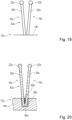
- a bristle hole in the base body of the application unit must be large enough to allow the stems to spread or curl sufficiently and form an angle between the stems.
- the stems must not touch each other. If the stems are too close or essentially run parallel and touch each other, the stimulation heads or even the stems will connect during heating.
- the ends of the stems are preferably spaced at least twice the diameter of the stimulation heads.
- the diameter of the bristle holes or recesses for the stimulation and/or massage elements must be selected for the anchor punching process so that, on the one hand, the stimulation and/or massage elements are well secured and, on the other hand, the desired spacing between the stems is achieved.
- the diameter of the bristle holes or recesses depends on the number of stimulation and/or massage elements and the diameter of the respective stems.
- the diameter of the bristle holes can therefore be between 0.8 mm and 2.5 mm, preferably between 1.2 mm and 1.9 mm, at the exit from the base body.
- the at least one stimulation and/or massage element be formed in one piece.
- the term “one piece” should also be understood to mean “one-piece.”
- “One-piece” should be understood, in particular, to mean “molded in one piece.”
- This one piece is preferably produced from a single blank, a mass, and/or a cast, particularly preferably using an injection molding process, in particular a single- and/or multi-component injection molding process. This makes it possible, in particular, to provide a stimulation and/or massage element that can be advantageously produced.
- the at least one stimulation head of the stimulation and/or massage element be injection-molded onto the stem of the stimulation and/or massage element.
- the entire stimulation and/or massage element can also be injection-molded, so that melting is no longer necessary.
- the stem is injection-molded, and the stimulation head is formed by melting, as described above.
- the stimulation and/or massage element can be designed in the form of an injection-molded bristle.
- the stem has a groove to allow demolding.
- the final shape is then Stimulation and/or massage element, in particular conical with a spherical or mushroom-shaped end.
- the stimulation and/or massage element can be manufactured directly on or together with the base body of the application unit.
- the stimulation and/or massage element can be manufactured separately and subsequently fixed by assembly.
- the stimulation head can consist of a different component than the stem, such as in particular a soft component. This requires, in particular, a different manufacturing method, whereby the stem and the stimulation head could in particular be formed from different components and/or colors.
- the contacting part of the stimulation and/or massage element i.e. in particular the stimulation head
- the stimulation head could be possible, in particular, for the contacting part of the stimulation and/or massage element, i.e. in particular the stimulation head, to have a different, in particular lower, (Shore) hardness. This makes it possible, in particular, to advantageously vary the design or improve the massage effect of the stimulation head.
- the at least one stimulation and/or massage element be connected to the base body of the application unit by means of punches, in particular anchor punches.
- the at least one stimulation and/or massage element is in particular fixed individually or as a group in a recess, i.e. in a bristle hole.
- the application unit has a plurality of stimulation and/or massage elements, wherein the stimulation and/or massage elements are each fixed individually or in groups as a group in one or more bristle holes on the base body of the application unit. Fixing can be achieved by means of anchors, by means of loops, without anchors, for example by melting, or by means of an assembly geometry.
- the at least one stimulation and/or massage element is provided alone or several stimulation and/or massage elements as a bundle.
- the stem of the stimulation and/or massage element is fixed in a recess or a bristle hole by means of an anchor, and subsequently the stimulation head is created by heating or melting.
- the stimulation and/or massage elements are displaced and other bristle bundles are fixed and processed, e.g. rounded, pointed, etc. Displacing the stimulation and/or massage elements can be dispensed with if the other bristle bundles are displaced relative to the stimulation and/or massage element 6 mm or more longer.
- the rounding unit does not reach the respective stimulation and/or massage element.
- ready-made stimulation and/or massage elements i.e. the stimulation head is formed before the stimulation and/or massage elements are fixed to the brush head
- the normal filaments, in particular bristles are first punched and then processed, and only then are the stimulation and/or massage elements fixed.
- Post-processing of the fixed stimulation and/or massage elements is no longer necessary.
- the at least one stimulation and/or massage element can be fixed or anchored using an anchorless process, e.g. using an AFT process. In an AFT process, the at least one stimulation and/or massage element is provided in a first step.
- the stem and the stimulation head are already formed, i.e. the stimulation head is shaped/formed before the anchoring process.
- the stimulation and/or massage element has a fastening section for attachment to the base body of the application unit.
- the stimulation and/or massage element and additional bristle bundles are then fixed using an AFT process in the same or in successive process steps.
- the AFT process can in particular be carried out as a standard process.
- a bristle support plate used must in particular be adapted.
- a bristle hole in the bristle support plate for the at least one stimulation and/or massage element cannot be shaped as a straight cylinder.
- the bristle hole must form a tapered cone from the bristle side.
- the bristle hole has a cylindrical part adjoining the cone.
- the diameter of the cylindrical part is in particular insignificantly larger than the diameter of the stem.
- the conical part of the bristle hole serves as an insertion aid towards the cylindrical part, while the cylindrical part ensures sealing when the bristles are melted.
- handling and insertion of at least one stimulation and/or massage element into the matrix must be carried out specifically.
- the bristles and also the stimulation and/or massage elements are provided in a matrix before being inserted into the bristle holes.
- one or more bristles and/or one or more stimulation and/or massage elements are inserted into recesses/holes in a so-called matrix, from which they are later inserted in the method towards the Bristle hole, with the said conical part of the bristle hole serving for precise insertion.
- Additional plates can be provided between the matrix and the bristle hole, which control the guidance of the one or more bristles and/or one or more stimulation and/or massage elements towards the bristle hole, whereby, for example, certain holes can be brought together.
- the difficulty of handling an element with a stimulation head that is somewhat larger in diameter than the stem must be taken into account.
- a hole spacing spacing of the recesses or bristle holes
- existing or known fastening methods can be used.
- the application unit has at least one cleaning element formed from a conventional, extruded bristle.
- the application unit has a plurality of cleaning elements in the form of bristle filaments, which are combined to form a plurality of bristle bundles.
- the bundles of stimulation and/or massage elements and the bristle bundles are designed separately.
- the stimulation and/or massage elements can be mixed into the bristles and arranged in a bundle.
- the heights and lengths of the bristles and stimulation and/or massage elements can be identical or different. In particular, both the bristles and the stimulation and/or massage elements can be longer.
- the prerequisite for a corresponding variant is, in particular, that all bristles and stimulation and/or massage elements are fully assembled (i.e., the stimulation heads are formed before anchoring and the bristles have already been rounded or tapered) and do not require any post-treatment after fixation.
- the bristles can be pre-finished (e.g., rounded or pointed), while the stimulation and/or massage elements require further treatment.
- the stimulation and/or massage elements must be positioned higher than the bristles so that the stimulation head can still be created by heating without damaging the bristles.
- the stimulation and/or massage elements can be pre-finished, while the bristles still need to be treated.
- the stimulation and/or massage elements must be positioned lower than the bristles so that the bristles can still be rounded without damaging the stimulation and/or massage elements.
- the number of bristles is preferably significantly greater than the number of stimulation and/or massage elements.
- Each bundle can contain 10-200 conventional, preferably 15-100, particularly preferably 20-60 bristle ends and 1-5, preferably 1-2, particularly preferably 1 stimulation and/or massage elements. The stated number refers to the use-side ends of the bristles or the stimulation and/or massage elements.
- the at least one stimulation and/or massage element can, in particular, be post-processed.
- the stimulation head can be colored, for example, by dipping it in a fluid.
- the stimulation head can be provided with an oral care product, for example, by dipping it in a fluid.
- the stimulation head can be roughened, for example, by mechanical processing such as grinding.
- the at least one stimulation and/or massage element be arranged in at least one stimulation zone of the application unit, wherein the stimulation zone of the application unit is arranged on a front side of the application unit.
- a stimulation zone is to be understood as meaning, in particular, a defined, imaginary zone, in particular a partial area of the cleaning area, in a head area, in particular in a cleaning area, of the application unit, wherein the zone is intended, in particular, to stimulate and/or massage a user's gums and/or tongue during use of the oral hygiene product.
- several bundles of stimulation and/or massage elements are arranged in the stimulation zone.
- a predominant proportion of the bundles in the stimulation zone consist of stimulation and/or massage elements.
- an entire cleaning area of the application unit is divided into zones, wherein, in particular, at least one zone, preferably several zones, of the zones is formed by a stimulation zone, in particular several stimulation zones.
- a stimulation zone in particular several stimulation zones.
- only one stimulation zone, or several Stimulation zones may be provided.
- individual bundles with stimulation and/or massage elements may be distributed over the entire bristle field. This distribution can be either regular or random.
- Other elements on the brush head are in particular arranged around it.
- the stimulation zone is preferably arranged in a cleaning area of the application unit.
- at least one bundle with one or more stimulation and/or massage elements is arranged in the stimulation zone.
- the stimulation zones can preferably be arranged in a distributed manner.
- stimulation zones can be adjacent to one another and form a larger stimulation zone group.
- all stimulation and/or massage elements are of identical design.
- the bundles therefore each consist of identical individual stimulation and/or massage elements.
- the stimulation heads i.e. the ends of the stimulation and/or massage elements per bundle, are all arranged at the same height.
- different stimulation and/or massage elements within a bundle would also be conceivable.
- Different overall lengths of the stimulation and/or massage elements could, for example, be made possible by asymmetrical punching or stems of different lengths.
- Asymmetrical or offset punching means that the anchor is not attached centrally in the folded element, e.g.
- the folded bristle or the folded stimulation and/or massage element during anchor punching, i.e. in the anchor punching process. Due to the off-center attachment of the anchor, the two ends of the respective bristle or the respective stimulation and/or massage element protrude unequally. This means that the respective ends are at different distances from the anchor. Furthermore, the stems of the stimulation and/or massage elements could differ in diameter and thus in hardness or stiffness or in cross-sectional shape. The stimulation heads can differ in size or diameter or in shape. Furthermore, different colors of the stimulation and/or massage elements would also be conceivable. This makes it possible, in particular, to achieve an advantageous arrangement of the at least one stimulation and/or massage element.
- the stimulation zone be arranged at an upper end of the application unit.
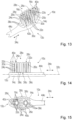
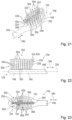
- the cleaning area of the application unit has nine zones on a front side of the application unit, and a first zone at the top left, a second zone at the top center, a third zone at the top right, a fourth zone at the center left, a fifth zone in the center, a sixth zone at the center right, a seventh zone at the bottom left, an eighth zone at the bottom center, and a ninth zone at the bottom right.
- the stimulation zone is preferably arranged at least in the first zone at the top left, the second zone at the top center, and/or the third zone at the top right.
- the stimulation zone is particularly preferably arranged at least in the second zone at the top center.
- the stimulation zone could be arranged in any of the described zones of the cleaning area of the application unit.
- the stimulation and/or massage elements can in particular also be arranged in one or more stimulation zones, whereby the stimulation zones can be formed in directly adjacent zones.
- the stimulation zones can also be formed in non-adjacent zones.
- both a stimulation zone with stimulation and massage elements and other cleaning elements, for example, bristle bundles with conventional bristles, can be arranged in one zone.
- the arrangement of the stimulation and/or massage elements or the bundles of stimulation and/or massage elements is particularly preferably symmetrical to the longitudinal axis.
- the stimulation and/or massage elements or the bundles of stimulation and/or massage elements are preferably arranged peripherally on the application unit to enable the gums to be reached by the stimulation and/or massage elements.
- an arrangement in combination with other cleaning elements would also be conceivable.
- other cleaning elements or bundles of cleaning elements can extend around the stimulation and/or massage elements and/or alternate with them.
- cleaning elements include tapered bristles, cylindrical bristles, "tapered and rounded"T&R bristles, i.e., in particular, bristles that are tapered on one side while the other is rounded, and/or cleaning elements made of soft components.
- Examples of combinations of stimulation and/or massage elements with cleaning elements can be stimulation and/or massage elements and cylindrical bristles, stimulation and/or massage elements and pointed bristles, stimulation and/or massage elements and cylindrical and pointed bristles, stimulation and/or massage elements and cylindrical bristles and sprayed bristles and/or injected cleaning elements made of soft components or stimulation and/or massage elements and pointed bristles and injected bristles and/or injected cleaning elements made of soft components.
- the stimulation and/or massage elements are preferably arranged individually or in multiple bundles in specific stimulation zones.
- the stimulation and/or massage elements can be arranged in individual bundles arranged next to one another, in particular in the form of a group of bundles.
- the group of bundles can then in turn be arranged in specific zones or across multiple zones, thus forming one or more stimulation zones.
- the stimulation and/or massage elements can be uniform or different. For example, a height gradient can be achieved so that the stimulation and/or massage elements are not all at the same height.
- several groups of grouped bundles of stimulation and/or massage elements can be provided.
- the groups of grouped bundles of stimulation and/or massage elements can then in turn be arranged in a specific stimulation zone or across multiple zones.
- the grouped bundles can be arranged, for example, in a linear or circular pattern. In a circular arrangement, other elements can be enclosed, or a center can remain free. This allows, in particular, an advantageous arrangement of the at least one stimulation and/or massage element to be achieved.
- the at least one stimulation and/or massage element be arranged in at least one stimulation zone of the application unit, and that the application unit have at least two cleaning zones, in each of which at least one cleaning element is arranged, wherein the stimulation zone is arranged between the at least two cleaning zones.
- a "cleaning zone” is to be understood as a defined, imaginary zone, in particular a partial area of the cleaning area, in a head area, in particular in a cleaning area, of the application unit, wherein the zone is intended in particular to clean the teeth of a user during use of the oral hygiene product.
- several bundles of cleaning elements are arranged in the cleaning zone.
- a predominant proportion of the bundles in the stimulation zone consist of cleaning elements.
- an entire cleaning area of the The application unit is divided into zones, wherein in particular at least one zone, preferably several zones, of the zones is formed by a cleaning zone, in particular several cleaning zones.
- the cleaning zones are preferably formed by the left and right zones of the cleaning area, while the stimulation zones are formed by the central zones.
- the at least one stimulation and/or massage element is arranged in at least one stimulation zone of the application unit, and the application unit has at least one cleaning zone in which at least one cleaning element is arranged, wherein the at least one cleaning zone at least partially encompasses the at least one stimulation zone.
- the at least one stimulation and/or massage element is arranged in at least two stimulation zones of the application unit, and the application unit has at least one cleaning zone in which at least one cleaning element is arranged, wherein the at least one cleaning zone lies between the at least two stimulation zones.
- various arrangements of the stimulation zones that would appear expedient to a person skilled in the art are conceivable. For example, it would be conceivable for the stimulation zones to be arranged at the top in the first, second, and third zones, the first and third zones, or only in the second zone. Alternatively, it would be conceivable, for example, for the stimulation zones to be arranged centrally in the fifth zone or in the fourth, fifth, and sixth zones.
- the stimulation zones could be arranged centrally at the bottom in the fifth and eighth zones.
- the stimulation zones could be arranged at the bottom in the seventh, eighth, and ninth zones, in the seventh and ninth zones, or only in the eighth zone.
- the stimulation zones it would also be conceivable, for example, for the stimulation zones to be arranged laterally in the first, third, fourth, sixth, seventh, and ninth zones, in the first, third, fourth, and sixth zones, in the fourth and sixth zones, or at corners in the first, third, seventh, and ninth zones. This makes it possible, in particular, to achieve an advantageous arrangement of the at least one stimulation and/or massage element.
- the arrangement of the stimulation and/or massage elements in zones can be used for manual toothbrushes, for electric toothbrushes with oscillating oral hygiene brushes with a rotation axis perpendicular to the longitudinal axis, for electric toothbrushes with oscillating oral hygiene brushes with a rotation axis parallel to the longitudinal axis as well as for electric Toothbrushes with vibration drive are used.
- the base surface is more oval or rectangular in the direction of the longitudinal axis.
- the base surface is preferably round or only slightly oval.
- the arrangement examples shown can be directly transferred to the various applications or floor areas.
- the application unit comprise at least a first stimulation and/or massage element having a first length and a second stimulation and/or massage element having a second length that is substantially different from the first length.
- the first stimulation and/or massage element and the second stimulation and/or massage element are arranged in different stimulation zones.
- the first stimulation and/or massage element and the second stimulation and/or massage element are arranged in the same stimulation zone and/or the same bundle.
- Different overall lengths of the stimulation and/or massage elements could be made possible, for example, via asymmetric or offset punching (as described above) or stems of different lengths.
- the stems of the stimulation and/or massage elements could differ in diameter and thus in hardness or cross-sectional shape.
- the stimulation heads can differ in size or diameter or in shape.
- the difference in length (measured from the exit from the application unit up to and including the stimulation head) between the first length and the second length is at least 5%, preferably at least 8%, and particularly preferably at least 12% of the shorter length.
- the stimulation and/or massage elements have a total length of 5 mm to 16 mm, preferably 8 mm to 13 mm, from the exit from the base body of the application unit to a free end. This enables, in particular, advantageously distributed stimulation.
- the at least one stimulation head of the at least one stimulation and/or massage element is mushroom-shaped or spherical.
- other forms are also conceivable, allowing for particularly beneficial massage and/or stimulation.
- the at least one stimulation and/or massage element has at least two stimulation heads.
- the at least one stimulation and/or massage element has several spheres per stimulation and/or massage element.
- the stimulation and/or massage element is designed in particular such that a total of 2 to 5, preferably 2 to 4 stimulation heads in the form of balls are located along the stem.
- the stimulation heads do not form just one sphere at the end.
- the stimulation heads can be at least partially injection-molded, for example.
- An uppermost stimulation head i.e., at the end of the stem
- the stems can in particular be brought together such that they are close together or touch each other at the ends.
- the stems can be connected to a stimulation head accordingly by heating.
- the stimulation and/or massage element is positioned essentially straight or perpendicular to the upper side of the base body or bristle support plate of the application unit.
- an arrangement in which the at least one stimulation and/or massage element is positioned at an angle to the base body of the application unit would also be conceivable.
- the number of stimulation and/or massage elements per bundle is in particular 1 to 8, preferably 2 to 4.
- the number refers to the number of usage-side ends of the stimulation and/or massage elements.
- the number of stimulation and/or massage elements on the application unit is in particular from 2 to 32, preferably from 4 to 24, particularly preferably from 6 to 20.
- the distances between the stimulation heads of the stimulation and/or massage elements in the bundle are in particular from 0.5 mm to 3 mm, preferably from 1 mm to 2 mm.
- the angles of the stems of the stimulation and/or massage elements of a bundle between each other are in particular from 2° to 15°, preferably from 5° to 12°. Instead of being at an angle, the stems in a bundle can also be essentially parallel with a corresponding distance. In this case too, the Distances between the stimulation heads of the stimulation and/or massage elements in the bundle in particular from 0.5 mm to 3 mm, preferably from 1 mm to 2 mm.
- the number of bundles with stimulation and/or massage elements across the entire application unit is in particular from 2 to 12, preferably from 2 to 8.
- the stem of the at least one stimulation and/or massage element in particular when mounted in the product, has a length of 2 mm to 15 mm.
- the stem of the at least one stimulation and/or massage element preferably has a length of 4 mm to 12 mm from the exit from the base body to the attachment of the stimulation head.
- the stem of the at least one stimulation and/or massage element preferably has a diameter of 0.1 mm to 0.7 mm, preferably of 0.2 mm to 0.6 mm, particularly preferably 0.3 mm to 0.5 mm. This makes it possible, in particular, to provide an advantageous stimulation and/or massage element.
- the at least one stimulation head of the at least one stimulation and/or massage element has a diameter of 0.4 mm to 1.2 mm.
- the at least one stimulation head of the at least one stimulation and/or massage element has a diameter of 0.50 mm to 1 mm, particularly preferably 0.6 mm to 0.9 mm.
- the dimensional range of the diameter can also be used as a range for the length and/or width of the stimulation head. This makes it possible, in particular, to provide an advantageous stimulation and/or massage element.
- the ratio between the diameter of a cleaning element in the brush head and the diameter of the stem of the stimulation and/or massage element be from 1:1.2 to 1:8.
- the ratio is from 1:1.3 to 1:3, particularly preferably from 1:1.5 to 1:2.5.
- the stem of the stimulation and/or massage element is always larger in diameter than the conventional bristles of the cleaning elements.
- the ratio of these diameters is 1:1.5 to 1.8, preferably 1:1.7 to 1:6, particularly preferably 1:2 to 1:4.
- Differences in stiffness between stimulation and/or massage elements and/or between the at least one stimulation and/or massage element and the other cleaning elements arise in particular from the differences in diameter and/or cross-section.
- the stimulation and/or massage elements are in particular shorter than the cleaning elements, so that optimal cleaning with the cleaning elements is possible without intervention of the stimulation and/or massage elements.
- the difference in length between the stimulation and/or massage elements and the cleaning elements is preferably 1 mm to 4 mm, preferably 1.5 mm to 2.5 mm.
- the stimulation and/or massage elements and the cleaning elements can also be the same length, or the stimulation and/or massage elements can be longer.
- the stimulation and/or massage elements can also have different lengths, either in the same or in different bundles. This makes it possible, in particular, to provide an advantageous stimulation and/or massage element. In particular, an advantageous stimulation and/or massage effect can be achieved.
- the application unit comprise a plurality of stimulation and/or massage elements and a plurality of cleaning elements, wherein the number of stimulation and/or massage elements corresponds to 0.3% to 4% of the number of cleaning elements.
- the number of stimulation and/or massage elements relative to the total number of bristle ends of the application unit is preferably from 0.3% to 4%, preferably from 0.45% to 3%. This makes it possible, in particular, to provide an advantageous stimulation and/or massage element.
- the application head can achieve an advantageous or balanced cleaning, stimulation, and/or massage effect.
- the at least one stimulation and/or massage element is provided for cleaning teeth and/or tongue.
- the at least one stimulation and/or massage element is provided in addition to massaging gums.
- the at least one stimulation and/or massage element is particularly intended for use on a toothbrush.
- the stimulation and/or massage elements can also be used as a tongue cleaner or for local intensive treatment.
- the stimulation and/or massage elements are particularly shorter if they form a tongue cleaner or an intensive treatment part, in particular regardless of whether the tongue cleaner or the intensive treatment part is on the back of a toothbrush or whether it is designed as a tongue cleaner only or as an intensive treatment part only.
- the Stimulation and/or massage elements are arranged in particular on a surface of the main body of the application unit, wherein the arrangement can form a pattern, cover a large area, or can also be arranged only partially.
- the stimulation and/or massage elements can be arranged, for example, in a linear, arrow-shaped, semicircular manner or the like.
- the stimulation and/or massage elements are arranged distributed over a large area over the surface of the main body of the application unit.
- An arrangement of the stimulation and/or massage elements is in particular preferably symmetrical to the longitudinal axis, ie in particular to the extension of the handle unit.
- the invention is based on a method for producing the oral hygiene product. It is proposed that the at least one stimulation head of the stimulation and/or massage element is produced by melting the stem.
- the stimulation head is formed, in particular, from the material of the stem.
- the stimulation head is formed, in particular, by subsequently melting a tip of the stem from the material of the stem.
- a length of 1.4 mm of the stem is melted to produce the stimulation head.
- longer or shorter melting times can also be realized, wherein, depending on the diameter of the stem, a volume of melt is additionally created, from which the stimulation head is formed.
- a free end of the stem is melted by heating, in particular contactless heating.
- Heating could, in particular, lead to the plastic sticking to contact and forming threads. Heating is carried out, in particular, by means of a heating plate or infrared radiation.
- the heating plate When using multiple stimulation and/or massage elements, the heating plate must be at the same distance from the ends of the stem to ensure that the stems melt evenly and form uniform stimulation heads or crowns across the multiple stimulation and/or massage elements.
- shielding elements can be provided during production to shield the heat.
- the heating elements can be designed to be focused.
- a bristle hole in the base body of the application unit must be large enough to allow the stems to melt evenly. spread or curl and form an angle between the stems.
- one or more stimulation and/or massage elements are provided in at least one step. Furthermore, the stimulation and/or massage elements are fixed in the base body of the application unit.
- the stimulation and/or massage elements can be provided ready-made.
- the stimulation and/or massage elements are provided in the correct length with a spherical stimulation head already attached or realized for fixation.
- precise assembly i.e. in particular precise punching, is necessary. In particular, no post-processing takes place after assembly/punching.
- the stimulation and/or massage elements have in particular a fixing section, in particular at an end of the stem facing away from the stimulation head.
- the fixing section is intended in particular for a direct connection to the base body of the application unit.
- a corresponding stimulation and/or massage element can, in particular, be directly and fully fixed.
- One method of fixing is preferably anchorless, by melting, overmolding, gluing, or the like.
- two stimulation and/or massage elements can be connected to one another as one piece.
- two stimulation and/or massage elements can be connected via a common fixing section.
- a corresponding double stimulation and/or massage element consists, in particular, of a first stimulation head, a first stem connected to the stimulation head, a fixing section connected to the stem, a second stem connected to the fixing section, and a second stimulation head connected to the second stem.
- a corresponding double stimulation and/or massage element can, in particular, be directly and fully fixed.
- One method of fixing is preferably by means of anchor punches, loop punches, or the like.
- the stimulation and/or massage elements can be provided as prefabricated elements.
- the stimulation and/or massage elements are, in particular, manufactured in the form of thicker bristles.
- a stem is supplied which is processed into a stimulation and/or massage element.
- the stimulation and/or massage elements have, in particular, a fixing section at an end of the stem facing away from the stimulation head.
- the fixing section is particularly intended for direct connection to the base body of the application unit.
- a corresponding stimulation and/or massage element can, in particular, be directly fixed in place.
- two stimulation and/or massage elements can be connected to one another as a single piece.
- two stimulation and/or massage elements can be connected via a common fixing section.
- a corresponding double stimulation and/or massage element consists in particular of a first stimulation head, a first stem connected to the stimulation head, a fixing section connected to the stem, a second stem connected to the fixing section, and a second stimulation head connected to the second stem.
- a corresponding double stimulation and/or massage element can, in particular, be directly fixed in place.
- One fixing method is preferably by means of anchor punching, loop punching, or the like.
- the stimulation and/or massage elements are cut to length, taking into account any additional parts for the stimulation head.
- the stimulation head is then created by melting, with the melting taking place in particular in a contactless manner by heating.
- the stimulation head can be made by attaching another material.
- the oral hygiene product according to the invention is not intended to be limited to the applications and embodiments described above.
- the oral hygiene product according to the invention may comprise a number of individual elements, components, and units that differs from the number stated herein and/or any reasonable combination thereof.
- values within the stated limits are also to be considered disclosed and can be used arbitrarily.
- the Figure 1 shows a front side 28a of an oral hygiene device 10a in a schematic perspective view.
- the oral hygiene device 10a is designed in the present case as a toothbrush.
- the oral hygiene device 10a can be designed as a disposable toothbrush or as a replaceable head toothbrush.
- the oral hygiene device 10a could be designed as a flosser, a single-tuft brush, an interdental cleaner, a tongue cleaner, or the like.
- combined oral hygiene devices 10a are conceivable, which combine at least two different functions, for example a toothbrush with a tongue cleaner, a Toothbrush with massage elements, an interdental cleaner with flosser or the like.
- the oral hygiene device 10a has at least one application unit 12a. Furthermore, the oral hygiene device 10a has at least one handle unit 18a.
- the at least one handle unit 18a consists of a single material.
- the handle unit 18a consists of a hard component. In principle, however, it would also be conceivable for the handle unit 18a to be formed partially from a soft component and partially from a hard component. In general, the design of the handle unit 18a with one or more hard components and/or one or more soft components is also possible.
- Figures 1 to 3 show different views of the oral hygiene device 10a. Due to the different views, some elements are not shown in all figures and accordingly are not provided with reference symbols in all figures.
- Figure 2 shows a side view of the oral hygiene device 10a.
- the Figure 3 shows the front side 28a of the oral hygiene device 10a in a schematic representation.
- the oral hygiene device 10a has a longitudinal axis 32a, a height axis, and a width axis.
- the longitudinal axis 32a is arranged parallel to a main extension direction 34a of the oral hygiene device 10a. If the oral hygiene device 10a is placed with its back side on a flat surface so that the longitudinal axis 32a is arranged parallel to the surface, the height axis is arranged perpendicular to the longitudinal axis 32a and perpendicular to the surface and the width axis.
- the width axis is arranged perpendicular to the longitudinal axis 32a and perpendicular to the height axis.
- the oral hygiene device 10a has a length, in particular parallel to the longitudinal axis 32a and measured parallel to the support surface, of 130 mm to 210 mm and preferably of 180 mm to 200 mm.
- the at least one application unit 12a has a head region 36a.
- the head region 36a forms a brush head of the oral hygiene device 10a.
- the head region 36a is designed as a toothbrush head.
- the head region 36a has, in particular, a base body 14a designed as a bristle carrier.
- the application unit 12a has the base body 14a.
- the base body 14a is formed entirely from a hard component. However, it would also be conceivable that the base body 14a is formed from one or more hard components and one or more soft components.
- the base body 14a of the application unit 12a forms a bristle carrier.
- the head region 36a of the oral hygiene device 10a has, for example, a width of 8 mm to 17 mm and preferably of 10 mm to 15 mm.
- At least one recess 38a is formed on the front side 28a of the base body 14a.
- the at least one recess 38a is provided for receiving a bristle bundle 40a and/or a stimulation and/or massage bundle 42a.
- the application unit 12a has a plurality of bristle bundles 40a.
- the bristle bundles 40a each consist of a plurality of cleaning elements 24a.
- the cleaning elements 24a are formed from conventional bristles. Examples of cleaning elements 24a include tapered bristles, cylindrical bristles, and "tapered and rounded" bristles, i.e., in particular, bristles that are tapered on one side while the other side is rounded.
- cleaning elements 24a made of soft components can be integrated into the application unit 12a.
- the application unit 12a has at least one stimulation and/or massage element 16a connected to the base body 14a.
- the application unit 12a has several stimulation and/or massage elements 16a connected to the base body 14a.
- the base body 14a has a plurality of recesses 38a.
- the recesses 38a are formed by bristle holes.
- a hole spacing between the recesses 38a of between 1 mm and 3 mm, preferably between 1.2 mm and 2 mm, must be maintained.
- the cleaning elements 24a are fixed in the recesses 38a by means of an anchor wire.
- the anchor wire is formed, in particular, by a metallic anchor wire. In principle, however, a plastic anchor would also be possible.
- the structure of the head region 36a or the base body 14a is different in other bristle methods. In principle, the use of anchorless bristle methods would also be conceivable. This could provide an anchorless oral hygiene device 10a and thus an oral hygiene device 10a without metal, since the anchor wire can be dispensed with.
- a recess is provided in the head region 36a, which is intended to receive a plate parallel to the handle unit 18a.
- the plate is produced, in particular, by means of an injection molding process, wherein the plate is already is covered with bristles.
- the plate is intended to be anchored in the recess of the head region 36a, in particular by welding.
- Bristle bundles 40a can differ in terms of their length, their composition, their number of bristles, a bristle material, a color, a surface structuring and the like.
- angles at which the cleaning elements 24a and/or the bristle bundles 40a are arranged relative to one another or to a surface of the base body 14a can vary between cleaning elements 24a and/or the bristle bundles 40a.
- the application unit 12a in the present case comprises a neck region 44a, which in particular connects the head region 36a to the handle unit 18a.
- the neck region 44a forms a neck.
- the neck region 44a forms a transition between the application unit 12a and the handle unit 18a.
- the neck region 44a is formed from the hard component.
- the lower end of the neck region 44a is at least partially resilient.
- the handle unit 18a is firmly connected to the application unit 12a.
- the handle unit 18a has a handle body.
- the handle unit 18a has at least one gripping surface, which forms a surface of the handle body.
- the gripping surface runs on the front side 28a from the neck region 44a to the lower end of the oral hygiene device 10a on the underside.
- the gripping surface forms, for example, a curved or concave shape along the longitudinal axis 32a.
- the curved shape is along the longitudinal axis 32a is reversed on the back.
- the handle unit 18a is only partially shown.
- the stimulation and/or massage elements 16a are identically designed. Only one of the stimulation and/or massage elements 16a is described below, although the description of the stimulation and/or massage element 16a is also generally applicable to the other stimulation and/or massage elements 16a.
- the stimulation and/or massage element 16a has a stem 20a and a stimulation head 22a, wherein a cross-section of the stimulation head 22a is enlarged compared to a cross-section of the stem 20a.
- the stem 20a and the stimulation head 22a are formed as a single piece.
- the stem 20a extends as an elongated element away from the base body 14a.
- the stem 20a is formed from a straight cylindrical element. Alternatively, it would also be conceivable for the stem 20a to be tapered.
- the stem 20a consists in particular of a filament.
- the stem 20a is formed from an extruded bristle.
- the stem 20a can have various cross-sectional shapes that appear appropriate to a person skilled in the art, such as round, in particular circular, triangular, rectangular, square, elliptical, polygonal, trapezoidal, parallelogram-shaped, or rhombus-shaped.
- the stem 20a has, for example, a circular cross-section.
- the stimulation head 22a is arranged at a free end of the stimulation and/or massage element 16a.
- the stimulation head 22a forms a termination adjoining the stem 20a.
- the stimulation head 22a forms a spherical or mushroom-like termination.
- the stimulation head 22a is spherical or mushroom-like.
- the stimulation head 22a of the stimulation and/or massage element 16a is spherical.
- the stimulation and/or massage element 16a further has a fixing section 46a at an end of the stem 20a facing away from the stimulation head 22a.
- the fixing section 46a is provided for a direct connection to the base body 14a of the application unit 12a.
- the stimulation and/or massage element 16a is intended to be connected to the base body 14a of the application unit 12a by means of punches, in particular anchor punches.
- the fixing section 46a is connected to the base body 14a of the application unit 12a by means of anchor punches.
- the stem 20a of the stimulation and/or massage element 16a particularly when mounted in the product, has a length of 2 mm to 15 mm.
- the stem 20a of the stimulation and/or massage element 16a has a length of 4 mm to 12 mm from the exit from the base body 14a to the attachment of the stimulation head 22a.
- the stem 20a of the stimulation and/or massage element 16a has a diameter of 0.1 mm to 0.7 mm, preferably 0.2 mm to 0.6 mm, particularly preferably 0.3 mm to 0.5 mm.
- the stimulation head 22a of the stimulation and/or massage element 16a has a diameter of 0.4 mm to 1.2 mm.
- the stimulation head 22a of the stimulation and/or massage element 16a preferably has a diameter of 0.5 mm to 1 mm.
- the ratio between a diameter of a cleaning element 24a in the brush head and a diameter of the stem 20a of the stimulation and/or massage element 16a is from 1:1.2 to 1:8. Preferably, the ratio is from 1:1.3 to 1:3, particularly preferably from 1:1.5 to 1:2.5.
- the stimulation and/or massage element 16a is always larger in diameter than the bristles of the cleaning elements 24a. Differences in stiffness between stimulation and/or massage elements 16a and/or between the at least one stimulation and/or massage element 16a and the other cleaning elements 24a result from the differences in diameter and/or cross-section.
- the stimulation head 22a of the stimulation and/or massage element 16a is formed by melting the stem 20a.
- the stimulation head 22a is formed from the material of the stem 20a.
- the stimulation and/or massage element 16a is formed in one piece.
- the stimulation head 22a is formed by subsequently melting a tip of the stem 20a from the material of the stem 20a.
- a length of 1.4 mm of the stem 20a is melted to produce the stimulation head 22a.
- a free end of the stem 20a is melted by heating, in particular contactless heating. Heating is carried out using a heating plate or infrared.
- the heating plate When using multiple stimulation and/or massage elements 16a, the heating plate must be at the same distance from the ends of the stems 20a so that they melt evenly and form uniform crowns across the multiple stimulation and/or massage elements 16a. To protect unaffected parts and to For targeted heat exposure, shielding elements can be provided during production to shield the heat. Furthermore, the heating elements can be designed in a focused manner. If there are multiple stimulation and/or massage elements 16a in a recess 38a, the recess 38a for the stimulation and/or massage elements 16a in the base body 14a of the application unit 12a must be sufficiently large to allow the stems 20a to spread or curl sufficiently. In particular, the stems 20a must not touch each other during production of the stimulation heads 22a.
- the stimulation and/or massage elements 16a are connected to the base body 14a as stimulation and/or massage bundles 42a by means of anchor punches.
- the stimulation and/or massage elements 16a are fixed in the fixing section 46a by means of an anchor 66a in one of the recesses 38a.
- the number of stimulation and/or massage elements 16a per stimulation and/or massage bundle 42a is in particular 1 to 8, preferably 2 to 4.
- only one stimulation and/or massage element 16a per stimulation and/or massage bundle 42a is shown in the drawings.
- the number of stimulation and/or massage elements 16a on the application unit 12a is in particular from 2 to 32, preferably from 4 to 24, particularly preferably from 6 to 20.
- the distances between the stimulation heads 22a of the stimulation and/or massage elements 16a in the stimulation and/or massage bundle 42a are in particular from 0.5 mm to 3 mm, preferably from 1 mm to 2 mm.
- the angles of the stems 20a of the stimulation and/or massage elements 16a of a stimulation and/or massage bundle 42a between each other are in particular from 2° to 15°, preferably from 5° to 12°.
- the number of stimulation and/or massage bundles 42a with stimulation and/or massage elements 16a is in particular from 2 to 12, preferably from 2 to 8, across the entire application unit 12a.
- the oral hygiene device 10a of the Figures 1 to 3 has, for example, nine stimulation and/or massage bundles 42a, each with a stimulation and/or massage element 16a.
- the stimulation and/or massage elements 16a are arranged in at least one stimulation zone 26a of the application unit 12a, wherein the stimulation zone 26a of the application unit 12a is arranged on a front side 28a of the application unit 12a.
- the stimulation zones 26a are arranged in a cleaning area of the application unit 12a.
- several stimulation and/or massage bundles 42a with several stimulation and/or massage elements 16a are arranged.
- the stimulation zones 26a are in particular free of bristle bundles 40a from conventional cleaning elements 24a.
- all stimulation and/or massage elements 16a are of identical design.
- the stimulation and/or massage bundles 42a therefore each consist of identical individual stimulation and/or massage elements 16a.
- the stimulation heads 22a of the stimulation and/or massage elements 16a per stimulation and/or massage bundle 42a are, for example, all arranged at the same height.
- different stimulation and/or massage elements 16a within a stimulation and/or massage bundle 42a would also be conceivable.
- Different total lengths of the stimulation and/or massage elements 16a could be achieved, for example, through asymmetrical punching or stems 20a of different lengths.
- the stems 20a of the stimulation and/or massage elements 16a could differ in diameter and thus in hardness or cross-sectional shape.
- the stimulation heads 22a can differ in size, diameter, or shape.
- the stimulation zone 26a is arranged at an upper end of the application unit 12a.
- the cleaning area of the application unit 12a has nine zones 48a, 50a, 52a, 54a, 56a, 58a, 60a, 62a, 64a (see Figure 7 ), namely a first zone 48a top left, a second zone 50a top center, a third zone 52a top right, a fourth zone 54a center left, a fifth zone 56a in the center, a sixth zone 58a center right, a seventh zone 60a bottom left, an eighth zone 62a bottom center and a ninth zone 64a bottom right.
- the stimulation zone 26a in the first example in the Figures 1 to 3 is arranged, for example, in the first zone 48a at the top left, the second zone 50a at the top center, and the third zone 52a at the top right.
- another arrangement of the stimulation zone 26a that would appear sensible to a person skilled in the art would also be conceivable.
- the stimulation zone 26a could be arranged in any of the described zones 48a, 50a, 52a, 54a, 56a, 58a, 60a, 62a, 64a of the cleaning area of the application unit 12a.
- An arrangement of the stimulation and/or Massage elements 16a or the stimulation and/or massage bundles 42a of stimulation and/or massage elements 16a are symmetrical to the longitudinal axis 32a.
- the stimulation and/or massage elements 16a or the stimulation and/or massage bundles 42a are arranged peripherally on the application unit 12a to enable the gums to be reached by the stimulation and/or massage elements 16a.
- an arrangement in combination with other cleaning elements 24a would also be conceivable.
- the application unit 12a has cleaning elements 24a formed from conventional bristles.
- the cleaning elements 24a or the bristle bundles 40a are arranged in the further zones 54a, 56a, 58a, 60a, 62a, 64a, in particular zones 54a, 56a, 58a, 60a, 62a, 64a four to nine.
- the further zones four to nine 54a, 56a, 58a, 60a, 62a, 64a form cleaning zones 30a.
- the application unit 12a has a plurality of stimulation and/or massage elements 16a and a plurality of cleaning elements 24a, wherein a number of stimulation and/or massage elements 16a corresponds to 0.3% to 4% of a number of cleaning elements 24a.
- the number of stimulation and/or massage elements 16a to a total number of bristle ends of the application unit 12a is from 0.3% to 4%, preferably from 0.45% to 3%.
- the stimulation and/or massage elements 16a are shorter than the cleaning elements 24a to enable optimal cleaning with the cleaning elements 24a without engagement of the stimulation and/or massage elements 16a.
- a length difference between the stimulation and/or massage elements 16a and the cleaning elements 24a is 1 mm to 4 mm, preferably 1.5 mm to 2.5 mm.
- the stimulation and/or massage elements 16a and the cleaning elements 24a can be of equal length, or the stimulation and/or massage elements 16a can be longer. Furthermore, the stimulation and/or massage elements 16a can also have different lengths, either in the same or in different stimulation and/or massage bundles 42a.
- the stimulation and/or massage elements 16a serve to stimulate and/or massage the gums of a user.
- the stimulation and/or massage elements 16a can, in particular, be provided in addition to cleaning the teeth.
- a plurality of stimulation and/or massage elements 16a are provided in at least one step. Furthermore, the stimulation and/or massage elements 16a are fixed in the base body 14a of the application unit 12a.
- the stimulation and/or massage elements 16a are provided as prefabricated elements.
- the stimulation and/or massage elements 16a are manufactured in the form of thicker bristles ( Figure 4, 5 ).
- a stem 20a is supplied, which is processed into a stimulation and/or massage element 16a.
- the stimulation and/or massage elements 16a have the fixing section 46a at an end of the stem 20a facing away from the stimulation head 22a.
- the fixing section 46a corresponds to a partial section of the stem 20a.
- the fixing section 46a is provided for a direct connection to the base body 14a of the application unit 12a.
- the fixing section 46a is connected to the base body 14a in a fixing step.
- the connection between the stimulation and massage element 16a and the base body 14a of the application unit 12a takes place in the recess 38a.
- One method of fixing is by means of anchor punches ( Figure 6 ), loop punching or the like.
- the stimulation and/or massage elements 16a are cut to length after fixing, whereby an addition for the stimulation head 22a is also taken into account.
- the stimulation head 22a is then created by melting, whereby the melting takes place in particular in a contactless manner by heating.
- one stimulation head 22a of the stimulation and/or massage elements 16a is produced by melting the stem 20a of the respective stimulation and/or massage element 16a.
- the stimulation head 22a of the stimulation and/or massage elements 16a is formed from the material of the stem 20a.
- the stimulation head 22a of the stimulation and/or massage elements 16a is formed by subsequently melting a tip of the stem 20a from the material of the stem 20a.
- the stimulation head 22a forms a spherical tip of the stem 20a ( Figure 6 ). With a stem diameter of 0.4 mm, a length of 1.4 mm of the stem 20a is melted to produce the stimulation head 22a of the stimulation and/or massage elements 16a.
- a free end of the stems 20a is melted by contactless heating. Heating is carried out by means of a heating plate or by means of infrared. There must be an equal distance between the heating plate and the ends of the stems 20a so that they melt evenly and are distributed over the multiple stimulation and/or Form uniform crowns across the massage elements 16a. To protect unaffected parts and to ensure targeted heat application, shielding elements can be provided during production to shield the heat. For the multiple stimulation and/or massage elements 16a, the recess 38a in the base body 14a of the application unit 12a must be sufficiently large to allow the stems 20a to spread or curl sufficiently.
- FIGS 8 to 12 show an alternative stimulation and/or massage element 16b of an application unit 12b of an alternative oral hygiene product according to the invention.
- the application unit 12b has a base body 14b and a bristle support plate 78b.
- the base body consists of a handle unit with a large recess in a head region 36b, which serves to accommodate a bristle support plate 78b.
- the bristle support plate 78b once fully prepared and equipped, is inserted into the recess in the head region 36b of the handle unit 18b and firmly connected.
- the bristle support plate 78b has a plurality of recesses 38b.
- the recesses 38b are formed by bristle holes.
- the recesses 38b are provided for receiving a bristle bundle 40b and/or a stimulation and/or massage bundle 42b.
- the recesses 38b have a bevel at the entrance.
- the recesses 38b must form a tapered cone 72b from the bristle side. Furthermore, the recesses 38b have a cylindrical part 74b adjoining the cone 72b. The diameter of the cylindrical part 74b is in particular slightly larger than the diameter a stem 20b of stimulation and/or massage elements 16b. The cylindrical part 74b must ensure sealing during the melting of the stimulation and/or massage elements 16b.
- bristle bundles are fixed in the correspondingly shaped recesses 38b in a known manner without anchors. Both the stimulation and/or massage elements 16b and the bristle bundles are fixed to the bristle support plate 78b by melting them from the back (the end that is being fixed).
- a hole spacing of between 1 mm and 3 mm, preferably between 1.2 mm and 2 mm, must be maintained between the recesses 38b.
- the application unit 12b has a plurality of stimulation and/or massage elements 16b, with only one stimulation and/or massage element 16b being shown by way of example.
- the stimulation and/or massage elements 16b are identically designed. Only one of the stimulation and/or massage elements 16b is described below, although the description of the stimulation and/or massage element 16b is also generally applicable to the other stimulation and/or massage elements 16b.
- the stimulation and/or massage element 16b has a stem 20b and a stimulation head 22b, wherein a cross-section of the stimulation head 22b is enlarged compared to a cross-section of the stem 20b.
- the stem 20b and the stimulation head 22b are formed as a single piece.
- the stem 20b extends as an elongated element away from the bristle support plate 78b.
- the stem 20b is formed from a straight cylindrical element.
- the stem 20b consists in particular of a filament.
- the stem 20b is formed from an extruded bristle.
- the stem 20b has a circular cross-section.
- the stimulation head 22b is arranged at a free end of the stimulation and/or massage element 16b.
- the stimulation head 22b forms a termination adjoining the stem 20b.
- the stimulation head 22b forms a spherical termination.
- the stimulation head 22b of the stimulation and/or massage element 16b is spherical.
- the stimulation and/or massage element 16b further comprises a fixing section 46b at an end of the stem 20b facing away from the stimulation head 22b.
- the fixing section 46b is provided for direct connection to the bristle support plate 78b of the application unit 12b.
- a fixing method is preferably anchorless, such as melting, overmolding, gluing, or the like.
- the stimulation and/or massage element 16b is provided for connection to the bristle support plate 78b using an AFT process, which in turn is subsequently connected to the base body 14b of the application unit 12b.
- the fixing section 46b is connected to the bristle support plate 78b of the application unit 12b using the AFT process.
- the stimulation head 22b of the stimulation and/or massage element 16b is, for example, molded or fused onto the stem 20b of the stimulation and/or massage element 16b.
- the stimulation head 22b is molded or fused onto a tip of the stem 20b.
- the stimulation head 22b can consist of a different component than the stem 20b, such as, in particular, a soft component.
- the stem 20b and the stimulation head 22b can, in particular, be formed in different colors.
- the stimulation and/or massage elements 16b are provided pre-assembled.
- the stimulation and/or massage elements 16b are supplied in the correct length with the spherical stimulation head 22b already attached or implemented ( Figures 8 and 9 ).
- precise assembly ie, precise fixing, is particularly necessary.
- no post-processing is required.
- a corresponding stimulation and/or massage element 16b can, in particular, be fixed directly.
- the stimulation and/or massage elements 16b are fixed by melting.
- the stimulation and/or massage elements 16b are guided with the fixing section 46b through the recesses 38b of the bristle support plate 78b and then fixed on the back, in particular by the action of heat, to a free end of the Fixing section 46b, for example, fused to a fixing mushroom 76b ( Figures 10 and 12 ).
- the Figure 13 shows a front side 28c of an oral hygiene device 10c in a schematic perspective view.
- the oral hygiene device 10c is designed as a toothbrush.
- the oral hygiene device 10c has at least one application unit 12c.
- the at least one application unit 12c has a head region 36c.
- the head region 36c forms a brush head of the oral hygiene device 10c.
- the head region 36c has, in particular, a base body 14c designed as a bristle carrier.
- the application unit 12c has the base body 14c.
- a plurality of recesses 38c are formed on the front side 28c of the base body 14c.
- the recesses 38c are provided for receiving bristle bundles 40c and/or a stimulation and/or massage bundle 42c.
- the application unit 12c has a plurality of bristle bundles 40c.
- the bristle bundles 40c each consist of a plurality of cleaning elements 24c.
- the cleaning elements 24c are formed from conventional bristles.
- the application unit 12c has a plurality of stimulation and/or massage elements 16c.
- the stimulation and/or massage elements 16c are identically designed. Only one of the stimulation and/or massage elements 16c is described below, although the description of the stimulation and/or massage element 16c is also generally applicable to the other stimulation and/or massage elements 16c.
- the stimulation and/or massage element 16c has a stem 20c and a stimulation head 22c, wherein a cross-section of the stimulation head 22c is enlarged compared to a cross-section of the stem 20c.
- the stem 20c and the stimulation head 22c are formed integrally.
- the stem 20c extends as an elongated element away from the base body 14c.
- the stem 20c is formed from a straight cylindrical element.
- the stem 20c consists in particular of a filament.
- the stem 20c is formed from an extruded bristle.
- the stem 20c has a circular cross-section.
- the stimulation head 22c is arranged at a free end of the stimulation and/or massage element 16c.
- the stimulation head 22c forms a termination adjoining the stem 20c.
- the stimulation head 22c forms a spherical termination.
- the stimulation head 22c of the stimulation and/or massage element 16c is spherical.
- the stimulation and/or massage element 16c further has a fixing section 46c at an end of the stem 20c facing away from the stimulation head 22c.
- the fixing section 46c is provided for direct connection to the base body 14c of the application unit 12c.
- the stimulation and/or massage element 16c is provided to be connected to the base body 14c of the application unit 12c by means of punches, in particular anchor punches.
- the fixing section 46c is connected to the base body 14c of the application unit 12c by means of anchor punches.
- the stimulation head 22c of the stimulation and/or massage element 16c is formed by melting the stem 20c.
- the stimulation head 22c is formed from the material of the stem 20c.
- the stimulation and/or massage element 16c is formed in one piece.
- the stimulation head 22c is formed by subsequently melting a tip of the stem 20c from the material of the stem 20c.
- two stimulation and/or massage elements 16c are always connected to one another in one piece.
- Two stimulation and/or massage elements 16c of the stimulation and/or massage elements 16c are always connected to one another via a common fixing section 46c.
- a corresponding double stimulation and/or massage element 16c consists of a first stimulation head 22c, a first stem 20c connected to the stimulation head 22c, a fixing section 46c connected to the stem 20c, a second stem 20c connected to the fixing section 46c, and a second stimulation head 22c connected to the second stem 20c.
- a double stimulation and/or massage element 16c can be directly fixed ( Figures 16 and 17 ).
- One method of fixation is preferably by means of anchor punches, loop punches, or the like.
- the stimulation and/or massage elements 16c are connected to the base body 14c as stimulation and/or massage bundles 42c by means of anchor punches.
- the stimulation and/or massage elements 16c are fixed in the fixing section 46c by means of an anchor 66c in one of the recesses 38c ( Figures 18 to 20 ).
- the stimulation and/or massage elements 16c can have at least two stimulation heads 22c.
- the stimulation and/or massage elements 16c can preferably have multiple spheres per stimulation and/or massage element 16c.
- the stimulation and/or massage elements 16c are designed in particular such that a total of 2 to 5, preferably 2 to 4, stimulation heads 22c in the form of spheres are located along the stem 20c.
- the stimulation heads 22c do not form a single sphere at the end.
- the stimulation heads 22c can be at least partially molded or fused, for example.
- the stimulation and/or massage elements 16c are arranged in at least one stimulation zone 26c of the application unit 12c, wherein the stimulation zone 26c of the application unit 12c is arranged on a front side 28c of the application unit 12c.
- the stimulation zones 26c are arranged in a cleaning area of the application unit 12c.
- several stimulation and/or massage bundles 42c with several stimulation and/or massage elements 16c are arranged.
- the stimulation zones 26c are in particular free of bristle bundles 40c from conventional cleaning elements 24c. However, a mixed arrangement would also be conceivable.
- all stimulation and/or massage elements 16c are of identical design.
- the stimulation and/or massage bundles 42c therefore each consist of identical, double stimulation and/or massage elements 16c.
- the stimulation heads 22c of the stimulation and/or massage elements 16c per stimulation and/or massage bundle 42c are, for example, all arranged at the same height.
- different stimulation and/or massage elements 16c within a stimulation and/or massage bundle 42c would also be conceivable.
- Different overall lengths of the stimulation and/or massage elements 16c could be achieved, for example, via asymmetric punching.
- the application unit 12c it would be conceivable for the application unit 12c to have a first stimulation and/or massage element 16c, which has a first length, and a second stimulation and/or massage element 16c, which has a second length that is significantly different from the first length.
- the stimulation zones 26c each consist of a group of grouped stimulation and/or massage bundles 42c of stimulation and/or massage elements 16c.
- the stimulation zones 26c are arranged centrally.
- the stimulation zones 26c are surrounded by cleaning elements 24c.
- the application unit 12c has at least one cleaning zone 30c, in which the cleaning elements 24c or the bristle bundles 40c are arranged, wherein the at least one cleaning zone 30c at least partially encompasses the stimulation zones 26c.
- the stimulation zones 26c are surrounded by the at least one cleaning zone 30c.
- the grouped stimulation and/or massage bundles 42c of the stimulation zones 26c are each arranged, for example, in a circle.
- the grouped stimulation and/or massage bundles 42c of the stimulation zones 26c each form a ring of stimulation and/or massage bundles 42c.
- other elements such as, in particular, cleaning elements 24c
- a center of the rings of grouped stimulation and/or massage bundles 42c is free of further elements, such as, in particular, cleaning elements 24c.
- the stimulation zones 26c each consist of three to eight grouped stimulation and/or massage bundles 42c.
- the stimulation zones 26c each consist, for example, of five grouped stimulation and/or massage bundles 42c.
- the Figure 21 shows a front side 28d of an oral hygiene device 10d in a schematic perspective view.
- the oral hygiene device 10d is designed as a toothbrush.
- the oral hygiene device 10d has at least one application unit 12d.
- the at least one application unit 12d has a head region 36d.
- the head region 36d forms a brush head of the oral hygiene device 10d.
- the head region 36d has, in particular, a base body 14d designed as a bristle carrier.
- the application unit 12d has the base body 14d.
- a plurality of recesses 38d are formed on the front side 28d of the base body 14d.
- the recesses 38d are provided for receiving bristle bundles 40d and/or a stimulation and/or massage bundle 42d.
- the application unit 12d has a plurality of bristle bundles 40d.
- the bristle bundles 40d each consist of from a plurality of cleaning elements 24d.
- the cleaning elements 24d are formed from conventional bristles.
- the application unit 12d has a plurality of stimulation and/or massage elements 16d.
- the stimulation and/or massage elements 16d are identically designed. Only one of the stimulation and/or massage elements 16d is described below, although the description of the stimulation and/or massage element 16d is also generally applicable to the other stimulation and/or massage elements 16d.
- the stimulation and/or massage element 16d has a stem 20d and a stimulation head 22d, wherein a cross-section of the stimulation head 22d is enlarged compared to a cross-section of the stem 20d.
- the stem 20d and the stimulation head 22d are formed in one piece.
- the stem 20d extends as an elongated element away from the base body 14d.
- the stem 20d is formed from a straight cylindrical element.
- the stem 20d consists in particular of a filament.
- the stem 20d is formed from an extruded bristle.
- the stem 20d has a circular cross-section.
- the stimulation head 22d is arranged at a free end of the stimulation and/or massage element 16d.
- the stimulation head 22d forms a termination adjoining the stem 20d.
- the stimulation head 22d forms a spherical termination.
- the stimulation head 22d of the stimulation and/or massage element 16d is spherically shaped.
- the stimulation and/or massage element 16d further has a fixing section 46d at an end of the stem 20d facing away from the stimulation head 22d.
- the fixing section 46d is provided for direct connection to the base body 14d of the application unit 12d.
- the stimulation head 22d of the stimulation and/or massage element 16d is, for example, molded or fused onto the stem 20d of the stimulation and/or massage element 16d.
- the stimulation head 22d is molded or fused onto a tip of the stem 20d. Additionally or alternatively, the stimulation head 22d can consist of a different component than the stem 20d, such as, in particular, a soft component.
- two stimulation and/or massage elements 16d are connected to each other in one piece.
- Stimulation and/or massage elements 16d of the stimulation and/or massage elements 16d are connected to one another via a common fixing section 46d.
- a corresponding double stimulation and/or massage element 16d consists of a first stimulation head 22d, a first stem 20d connected to the stimulation head 22d, a fixing section 46d connected to the stem 20d, a second stem 20d connected to the fixing section 46d, and a second stimulation head 22d connected to the second stem 20d.
- a double stimulation and/or massage element 16d can be fixed directly ( Figures 24, 25 ).
- the stimulation and/or massage elements 16d are provided pre-assembled.
- the stimulation and/or massage elements 16d are supplied as double stimulation and/or massage elements 16d in the correct length with pre-attached or realized spherical stimulation heads 22d ( Figures 24 and 25 ).
- the stimulation and/or massage elements 16d are arranged at an angle to the base body 14d of the application unit 12d.
- the stimulation and/or massage bundles 42d all have the same angle to the base body 14d.
- the angle is in particular between 60° and 85°, preferably between 65° and 80°.
- the stimulation and/or massage elements 16d are arranged in at least one stimulation zone 26d of the application unit 12d, wherein the stimulation zone 26d of the application unit 12d is arranged on a front side 28d of the application unit 12d.
- the stimulation zones 26d are arranged in a cleaning area of the application unit 12d.
- several stimulation and/or massage bundles 42d with several stimulation and/or massage elements 16d are arranged.
- the stimulation zones 26d are in particular free of bristle bundles 40d from conventional cleaning elements 24d. However, a mixed arrangement would also be conceivable.
- stimulation and/or massage bundles 42d of stimulation and/or massage elements 16d all stimulation and/or massage elements 16d are of identical design.
- the stimulation and/or massage bundles 42d therefore each consist of identical, double stimulation and/or Massage elements 16d.
- the stimulation heads 22d of the stimulation and/or massage elements 16d per stimulation and/or massage bundle 42d are, for example, all arranged at the same height.
- the stimulation zone 26d is arranged in three zones, namely a second zone 50d, a fifth zone 56d, and an eighth zone 62d.
- the stimulation zones 26d consist of a group of grouped stimulation and/or massage bundles 42d made up of stimulation and/or massage elements 16d.
- the stimulation zones 26d are arranged centrally.
- the stimulation zones 26d are partially surrounded by cleaning elements 24d.
- the application unit 12d has at least one cleaning zone 30d, in which the cleaning elements 24d or the bristle bundles 40d are arranged.
- the grouped stimulation and/or massage bundles 42d of the stimulation zones 26d are arranged, for example, in a line.
- the grouped stimulation and/or massage bundles 42d extend over several stimulation zones 26d.
- the stimulation zones 26d are arranged between the cleaning zones 30d.
- the cleaning zones 30d are formed by left and right zones 48a, 52a, 54a, 58a, 60a, 64a of the cleaning area, while the stimulation zones 26d are formed by the middle zones 50d, 56d, 62d.
- Zone 50d is a combined cleaning and stimulation zone.
- the stimulation and/or massage elements 16d are, for example, fixed transversely, so that at least one stimulation and/or massage element 16d is arranged on the left and at least one stimulation and/or massage element 16d is arranged on the right in the recesses 38d.
- the left and right stimulation and/or massage element 16d is formed in particular by a double stimulation and/or massage element 16d ( Figure 23 ).
- the Figure 26 shows a front side 28e of an oral hygiene device 10e in a schematic perspective view.
- the oral hygiene device 10e is designed as a toothbrush.
- the oral hygiene device 10e has at least one application unit 12e.
- the at least one application unit 12e has a head region 36e.
- the head region 36e forms a brush head of the oral hygiene device 10e.
- the head region 36e has, in particular, a base body 14e designed as a bristle carrier.
- the application unit 12e has the base body 14e.
- a plurality of recesses 38e are formed on the front side 28e of the base body 14e.
- the Recesses 38e are provided for receiving bristle bundles 40e and/or a stimulation and/or massage bundle 42e.
- the application unit 12e has a plurality of bristle bundles 40e.
- the bristle bundles 40e each consist of a plurality of cleaning elements 24e.
- the cleaning elements 24e are formed from conventional bristles.
- the application unit 12e has a plurality of stimulation and/or massage elements 16e.
- the stimulation and/or massage elements 16e are identically designed. Only one of the stimulation and/or massage elements 16e is described below, although the description of the stimulation and/or massage element 16e is also generally applicable to the other stimulation and/or massage elements 16e.
- the stimulation and/or massage element 16e has a stem 20e and a stimulation head 22e, wherein a cross-section of the stimulation head 22e is enlarged compared to a cross-section of the stem 20e.
- the stem 20e and the stimulation head 22e are formed as a single piece.
- the stem 20e extends as an elongated element away from the base body 14e.
- the stem 20e is formed from a straight cylindrical element.
- the stem 20e consists in particular of a filament.
- the stem 20e is formed from an extruded bristle.
- the stem 20e has a circular cross-section.
- the stimulation head 22e is arranged at a free end of the stimulation and/or massage element 16e.
- the stimulation head 22e forms a termination adjoining the stem 20e.
- the stimulation head 22e forms a spherical termination.
- the stimulation head 22e of the stimulation and/or massage element 16e is spherically shaped.
- the stimulation and/or massage element 16e further has a fixing section 46e at an end of the stem 20e facing away from the stimulation head 22e.
- the fixing section 46e is provided for direct connection to the base body 14e of the application unit 12e.
- two stimulation and/or massage elements 16e are always connected to one another in one piece.
- Two stimulation and/or massage elements 16e of the stimulation and/or massage elements 16e are always connected to one another via a common fixing section 46e.
- a corresponding double stimulation and/or massage element 16e consists of a first stimulation head 22e, a second stimulation head 22e connected to the stimulation head 22e connected first stem 20e, a fixing section 46e connected to the stem 20e, a second stem 20e connected to the fixing section 46e and a second stimulation head 22e connected to the second stem 20e.
- the stimulation and/or massage elements 16e are arranged in at least one stimulation zone 26e of the application unit 12e, wherein the stimulation zone 26e of the application unit 12e is arranged on a front side 28e of the application unit 12e.
- the stimulation zones 26e are arranged in a cleaning area of the application unit 12e.
- exactly one stimulation and/or massage bundle 42e with several stimulation and/or massage elements 16e is arranged in the stimulation zones 26e.
- the stimulation zones 26e are, in particular, free of bristle bundles 40e from conventional cleaning elements 24e. However, a mixed arrangement would also be conceivable.
- stimulation and/or massage elements 16e are of identical design.
- the stimulation and/or massage bundles 42e therefore each consist of identical, double stimulation and/or massage elements 16e.
- the stimulation heads 22e of the stimulation and/or massage elements 16e per stimulation and/or massage bundle 42e are, for example, all arranged at the same height.
- the stimulation zones 26e are provided.
- the stimulation zones 26e are distributed along an outer edge of the cleaning area of the application unit 12e.
- three stimulation zones 26e are arranged on a left edge and three stimulation zones 26e are arranged on a right edge ( Figure 28 ).
- the stimulation zones 26e form parts of zones 48e, 52e, 54e, 58e, 60e and 64e.
- the Figure 29 shows a rear side 68f of an oral hygiene device 10f in a schematic perspective view.
- the oral hygiene device 10f is designed as a toothbrush.
- the oral hygiene device 10f has at least one application unit 12f.
- the at least one application unit 12f has a head region 36f.
- the head region 36f forms a brush head of the oral hygiene device 10f.
- the head region 36f has, in particular, a base body 14f designed as a bristle carrier.
- the application unit 12f has the base body 14f.
- a plurality of recesses are formed on a front side 28f of the base body 14f.
- the recesses are provided for receiving bristle bundles 40f.
- the application unit 12f has a plurality of bristle bundles 40f.
- the bristle bundles 40f each consist of a plurality of cleaning elements 24f.
- the cleaning elements 24f are formed from conventional bristles.
- a plurality of recesses 70f are formed on the rear side 68f of the base body 14f.
- the recesses 70f are provided for receiving stimulation and/or massage bundles 42f.
- the stimulation and/or massage bundles 42f consist of one or more stimulation and/or massage elements 16f.
- the stimulation and/or massage bundles 42f each consist, for example, of a stimulation and/or massage element 16f.
- the application unit 12f has a plurality of stimulation and/or massage elements 16f.
- the stimulation and/or massage elements 16f are identically designed. Only one of the stimulation and/or massage elements 16f is described below, although the description of the stimulation and/or massage element 16f is also generally applicable to the other stimulation and/or massage elements 16f.
- the stimulation and/or massage element 16f has a stem 20f and a stimulation head 22f, wherein a cross-section of the stimulation head 22f is enlarged compared to a cross-section of the stem 20f.
- the stem 20f and the stimulation head 22f are formed in one piece.
- the stem 20f extends as an elongated element away from the base body 14f.
- the stem 20f is formed from a straight cylindrical element.
- the stem 20f consists in particular of a filament.
- the stem 20f is formed from an extruded bristle.
- the stem 20f has a circular cross-section.
- the stimulation head 22f is arranged at a free end of the stimulation and/or massage element 16f.
- the stimulation head 22f forms a termination adjoining the stem 20f.
- the stimulation head 22f forms a spherical termination.
- the stimulation head 22f of the stimulation and/or massage element 16f is spherical.
- the stimulation and/or massage element 16f further has, at an end facing away from the stimulation head 22f, of the stem 20f has a fixing section 46f.
- the fixing section 46f is intended for direct connection to the base body 14f of the application unit 12f.
- the stimulation and/or massage elements 16f are arranged in a stimulation zone 26f of the application unit 12f, wherein the stimulation zone 26f of the application unit 12f is arranged on the rear side 68f of the application unit 12f. In particular, only one stimulation zone 26f or several stimulation zones 26f can be provided.
- the application unit 12f has, for example, one stimulation zone 26f.
- the stimulation zone 26f is arranged on a rear side 68f of the application unit 12f facing away from the cleaning area of the application unit 12f.
- seven stimulation and/or massage bundles 42f each with, for example, one stimulation and/or massage element 16f, are arranged.
- the stimulation zone 26f is, in particular, free of bristle bundles 40f from conventional cleaning elements 24f.
- the stimulation zone 26f is arranged at an upper end of the application unit 12f.
- the stimulation and/or massage elements 16f are provided for cleaning the tongue.
- the stimulation and/or massage elements 16f form a tongue cleaner.
- the stimulation and/or massage elements 16f are shorter when they form a tongue cleaner, in particular regardless of whether the tongue cleaner is on the back 68f of a toothbrush or whether it is designed as a tongue cleaner only.
- the stimulation and/or massage elements 16f are arranged on the back 68f of the base body 14f of the application unit 12f, wherein the arrangement can form a pattern, cover a large area, or be arranged only partially.
- An arrangement of the stimulation and/or massage elements 16f is symmetrical to the longitudinal axis 32f.
- Figure 32 shows an application unit 12g of an oral hygiene device 10g, which is formed by an oscillating, electric toothbrush with a rotation axis 82g perpendicular to the longitudinal axis 32g of the oral hygiene device 10g.
- the application unit 12g has a base body 14g and a bristle carrier 80g rotatably mounted on the base body 14g.
- Figure 32 shows an indicated zone division for the 80g bristle carrier in a schematic front view. Shown is the zone division into nine zones: 48g, 50g, 52g, 54g, 56g, 58g, 60g, 62g, 64g for an oscillating electric toothbrush.
- the arrangements can occur in the same zones as for the manual toothbrush, as shown for example by Figure 7 are explained.
- the application unit 12g has, for example, at least one stimulation zone and one cleaning zone.
- the stimulation zone and the cleaning zone can be arranged in any of the described zones 48g, 50g, 52g, 54g, 56g, 58g, 60g, 62g, 64g of the cleaning area of the application unit 12g.
- An arrangement of stimulation and/or massage elements 16g or the stimulation and/or massage bundles 42g of stimulation and/or massage elements 16g is in particular symmetrical to the rotation axis 82g.
Landscapes
- Brushes (AREA)
Priority Applications (2)
| Application Number | Priority Date | Filing Date | Title |
|---|---|---|---|
| EP23200987.8A EP4529806A1 (fr) | 2023-09-29 | 2023-09-29 | Composition d'hygiène buccale |
| PCT/EP2024/077356 WO2025068561A1 (fr) | 2023-09-29 | 2024-09-27 | Produit d'hygiène bucco-dentaire |
Applications Claiming Priority (1)
| Application Number | Priority Date | Filing Date | Title |
|---|---|---|---|
| EP23200987.8A EP4529806A1 (fr) | 2023-09-29 | 2023-09-29 | Composition d'hygiène buccale |
Publications (1)
| Publication Number | Publication Date |
|---|---|
| EP4529806A1 true EP4529806A1 (fr) | 2025-04-02 |
Family
ID=88237658
Family Applications (1)
| Application Number | Title | Priority Date | Filing Date |
|---|---|---|---|
| EP23200987.8A Pending EP4529806A1 (fr) | 2023-09-29 | 2023-09-29 | Composition d'hygiène buccale |
Country Status (2)
| Country | Link |
|---|---|
| EP (1) | EP4529806A1 (fr) |
| WO (1) | WO2025068561A1 (fr) |
Citations (4)
| Publication number | Priority date | Publication date | Assignee | Title |
|---|---|---|---|---|
| US4724569A (en) * | 1986-05-28 | 1988-02-16 | Kao Corporation | Toothbrush |
| US5500975A (en) * | 1994-04-15 | 1996-03-26 | Taihei Kogyo Co., Ltd. | Toothbrush |
| US5836033A (en) * | 1993-09-10 | 1998-11-17 | Berge; Harald | Toothbrush for brushing teeth and massaging gums |
| US20060080799A1 (en) * | 2004-10-18 | 2006-04-20 | Frank Lucente | Toothbrush featuring bristles with raised annular portions |
-
2023
- 2023-09-29 EP EP23200987.8A patent/EP4529806A1/fr active Pending
-
2024
- 2024-09-27 WO PCT/EP2024/077356 patent/WO2025068561A1/fr active Pending
Patent Citations (4)
| Publication number | Priority date | Publication date | Assignee | Title |
|---|---|---|---|---|
| US4724569A (en) * | 1986-05-28 | 1988-02-16 | Kao Corporation | Toothbrush |
| US5836033A (en) * | 1993-09-10 | 1998-11-17 | Berge; Harald | Toothbrush for brushing teeth and massaging gums |
| US5500975A (en) * | 1994-04-15 | 1996-03-26 | Taihei Kogyo Co., Ltd. | Toothbrush |
| US20060080799A1 (en) * | 2004-10-18 | 2006-04-20 | Frank Lucente | Toothbrush featuring bristles with raised annular portions |
Also Published As
| Publication number | Publication date |
|---|---|
| WO2025068561A1 (fr) | 2025-04-03 |
Similar Documents
| Publication | Publication Date | Title |
|---|---|---|
| EP4042902B1 (fr) | Produit de brosse | |
| EP2605683B1 (fr) | Brosse à dents dotée d'une topographie particulière des soies | |
| EP2028969B1 (fr) | Brosse à dents et tête de brosse à dents ainsi que soie de nettoyage dentaire pour celle-ci | |
| EP2605682B1 (fr) | Brosse à dents avec des touffes orientées asymétriquement | |
| DE602004001252T2 (de) | Bürste und Vorrichtung zur Aufnahme und zum Auftrag mit einer solchen Bürste | |
| WO1997009907A1 (fr) | Brosse a dents et procede de fabrication correspondant | |
| EP3804560A1 (fr) | Produit d'hygiène buccale | |
| EP3413748A1 (fr) | Dispositif brosse ménager ou d'hygiène | |
| EP4153004A1 (fr) | Produit d'hygiène, en particulier produit d'hygiène bucco-dentaire | |
| EP3833219B1 (fr) | Moyen d'hygiène buccale, en particulier brosse à dents | |
| EP3644787B1 (fr) | Brosse à dents | |
| EP3174434B1 (fr) | Applicateur à âme en fil métallique comprenant des poils à plusieurs matériaux | |
| EP4106667B1 (fr) | Dispositif de brosse enfichable | |
| EP4529806A1 (fr) | Composition d'hygiène buccale | |
| EP4712816A1 (fr) | Produit d'hygiène bucco-dentaire | |
| EP4477108A1 (fr) | Produit de soin personnel, en particulier un produit d'hygiène buccale | |
| EP4509013A1 (fr) | Produit de soins personnels, en particulier produit d'hygiène buccale |
Legal Events
| Date | Code | Title | Description |
|---|---|---|---|
| PUAI | Public reference made under article 153(3) epc to a published international application that has entered the european phase |
Free format text: ORIGINAL CODE: 0009012 |
|
| STAA | Information on the status of an ep patent application or granted ep patent |
Free format text: STATUS: THE APPLICATION HAS BEEN PUBLISHED |
|
| AK | Designated contracting states |
Kind code of ref document: A1 Designated state(s): AL AT BE BG CH CY CZ DE DK EE ES FI FR GB GR HR HU IE IS IT LI LT LU LV MC ME MK MT NL NO PL PT RO RS SE SI SK SM TR |
|
| STAA | Information on the status of an ep patent application or granted ep patent |
Free format text: STATUS: REQUEST FOR EXAMINATION WAS MADE |
|
| 17P | Request for examination filed |
Effective date: 20250930 |