EP4530337A1 - Procédé de préparation de granules tensioactifs de sucre anhydres - Google Patents
Procédé de préparation de granules tensioactifs de sucre anhydres Download PDFInfo
- Publication number
- EP4530337A1 EP4530337A1 EP23200870.6A EP23200870A EP4530337A1 EP 4530337 A1 EP4530337 A1 EP 4530337A1 EP 23200870 A EP23200870 A EP 23200870A EP 4530337 A1 EP4530337 A1 EP 4530337A1
- Authority
- EP
- European Patent Office
- Prior art keywords
- roller
- temperature
- dryer
- drying
- dried
- Prior art date
- Legal status (The legal status is an assumption and is not a legal conclusion. Google has not performed a legal analysis and makes no representation as to the accuracy of the status listed.)
- Withdrawn
Links
Images
Classifications
-
- C—CHEMISTRY; METALLURGY
- C11—ANIMAL OR VEGETABLE OILS, FATS, FATTY SUBSTANCES OR WAXES; FATTY ACIDS THEREFROM; DETERGENTS; CANDLES
- C11D—DETERGENT COMPOSITIONS; USE OF SINGLE SUBSTANCES AS DETERGENTS; SOAP OR SOAP-MAKING; RESIN SOAPS; RECOVERY OF GLYCEROL
- C11D1/00—Detergent compositions based essentially on surface-active compounds; Use of these compounds as a detergent
- C11D1/66—Non-ionic compounds
- C11D1/662—Carbohydrates or derivatives
-
- C—CHEMISTRY; METALLURGY
- C11—ANIMAL OR VEGETABLE OILS, FATS, FATTY SUBSTANCES OR WAXES; FATTY ACIDS THEREFROM; DETERGENTS; CANDLES
- C11D—DETERGENT COMPOSITIONS; USE OF SINGLE SUBSTANCES AS DETERGENTS; SOAP OR SOAP-MAKING; RESIN SOAPS; RECOVERY OF GLYCEROL
- C11D11/00—Special methods for preparing compositions containing mixtures of detergents
Definitions
- the invention relates to a process for drying aqueous sugar surfactant pastes using a vacuum double roller dryer.
- the aim is to offer concentrated solutions or water-free raw materials in the production of cosmetic and personal care products, which can be directly filled with water before further processing.
- the main aim is to avoid (plastic) packaging.
- Sugar surfactants such as alkyl polyglycosides (APG - here synonymous with alkyl and/or alkenyl polyglycosides), are characterized by excellent detergent properties and high ecotoxicological compatibility.
- APG alkyl polyglycosides
- the good dermatological compatibility that characterizes these surfactants is particularly required in cosmetics.
- sufficient water solubility, good compatibility with as many active ingredients and excipients as possible, good foaming ability, and good thickenability are generally desired.
- surfactants that can be produced from biogenic sources and, in particular, renewable raw materials is essential. Surfactants that do not contain alkoxylated groups are desirable, thus eliminating the use of ethylene oxide in their production.
- alkyl polyglycosides are predominantly used in liquid formulations such as dishwashing detergents or hair shampoos, but there is also a growing market demand for solid, water-free formulations that can be incorporated into powder detergents or synthetic soaps, for example.
- liquid surfactant preparations are usually carried out on an industrial scale by conventional spray drying, in which the aqueous surfactant paste is sprayed at the top of a tower in the form of fine droplets, which are counteracted by hot drying gases.
- this technology is not readily applicable to sugar surfactant pastes.
- spray drying the product results in a sticky, non-flowing mass, most of which adheres to the walls, in the tube systems, and on the cyclone walls of the spray dryer, ultimately clogging the lines and cyclones.
- powder resulting from this type of process flows poorly from the dryer due to its fineness and loses its flowability due to caking during storage in drums.
- the complex task of the present invention was to convert highly concentrated aqueous alkyl polyglycoside sugar surfactant pastes into virtually water-free, highly concentrated, easily comminuted drying products without the use of inorganic or organic carriers, under low temperature stress, with the least possible technical effort and lower energy consumption.
- the drying products should be characterized by acceptable color quality, good storage stability, good redispersibility, and comparable application properties to prior art products.
- the invention relates to a process for the production of anhydrous sugar surfactant granules, in which an aqueous paste of alkyl and/or alkenyl polyglycosides with a solids content of 40 - 60 wt.%, heated to at least 40°C, is dried in a vacuum double-roller dryer with a specific drying capacity of 3 to 7 kg/m 2 /h at a roll temperature of 100 to 130 °C.
- the specific drying performance for the concentrated alkyl polyglycoside solution heated to 40 to 70°C with a solids content of 40 to 60 wt. (a) can be achieved by the double roller dryer is fed with the aqueous, tempered, pasty solution (a) at a continuous speed, the counter-rotating rollers of the double roller dryer having a temperature of 100 to 135 °C and a vacuum of 5 to 25 mbar absolute pressure being applied.
- a drying product is obtained with a residual water content of less than 2 wt.%, which is easy to store and redispersible and is not inferior to conventional products in terms of its application properties.
- the process can be run as a batch process or as a continuous process.
- non-caking solid products of alkyl polyglycosides can be produced by drying without product discoloration or caking on the walls.
- the product passes through a temperature zone determined by the temperature of the rollers. It has a short residence time there, cooling after the rollers scrape at the interior temperature of the dryer, which results from the roller and jacket temperature, and further after the dried product is removed from the dryer.
- the temperature stress on the product is significantly lower than with prior art processes.
- the process is less energy-intensive, without the need for setting a temperature gradient and complex cooling. The result is an easily comminuted dried product with a low residual moisture content.
- Low residual moisture is understood to mean a water content of a maximum of 2% by weight, preferably a maximum of 1.5% by weight and in particular a maximum of 1% by weight, based on the dried product.
- the formation of bubbles prevents effective drying, as a continuous moist film is not formed on the rollers, which, through water removal through temperature and vacuum, produces a uniformly dried product.
- the process according to the invention enables pasty alkyl polyglycosides to be converted into virtually water- and dust-free, highly concentrated, easily comminuted, and readily redispersible dried products using a robust, simply constructed vacuum dryer without high energy consumption.
- the process according to the invention can provide a dry, solid form of APG in less than 1 minute from initial contact with the roller.
- the temperature load on the material to be dried is therefore only for a very short period of time at a maximum of 130°C, determined by the roller temperature, and is thus significantly lower than in prior art processes.
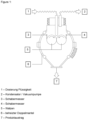
- the vacuum double roller dryer (see Figure 1 ) is a subtype of the vacuum contact dryer. It features a pair of rotating hollow rollers whose surfaces are scraped by a knife.
- a liquid bath is maintained in the space between the two rotating rollers by a feed system.
- the feed solution is heated to a temperature that ensures optimal viscosity before being applied to the roller gap between the rotating drums.
- the drying or water evaporation process of the thin layer on the rollers is determined by the roller temperature of the dryer and the applied vacuum.
- the process can basically be divided into three parts: the feeding of the material to be dried, the drying of the material and the removal/recovery of the dried material.
- the pasty alkyl polyglycoside mass is heated to a temperature of 40°C to 70°C, preferably 50°C to 55°C, before being fed into the drum dryer.
- the solids content of the APG-containing solution to be loaded onto the drum dryer should be between 40 and 60 wt. %, particularly preferably 50 to 55 wt. %.
- the solids content corresponds to the dry residue (determined by the dry residue balance).
- the anhydrous alkyl polyglycoside mass contains, in addition to pure APG, by-products such as salts or polydextrose due to the production process. It is possible to prepare lower concentration solutions of the sugar surfactants. Dry.
- the drying process becomes more effective and the process more economical if the solids content of the feed material is at least 35 wt.%.
- the upper limit of the solids content is determined by the processability of the mass—especially the pumpability, which must be present.
- rollers rotate in opposite directions, and a portion of the pasty, liquid, heated APG preparation is applied to the roller surface via the roller gap, where it boils.
- the thin film of water evaporates into the steam vent, leaving a solid film that is scraped off the rotating roller surfaces using sharp knives.
- the conveying quantity of the material to be dried must be coordinated with the size and speed of the rollers, the gap width and the vacuum power, since these parameters determine the collection and removal of the supplied material to be dried.
- the specific drying capacity is 3 to 7 kg/m 2 /h, preferably 3.3 to 5.5 kg/m 2 /h, and in particular 3.5 to 4.5 kg/m 2 /h, where the unit is to be read as kg of the aqueous paste of alkyl and/or alkenyl polyglycosides to be dried with a solids content of 40 - 60 wt.% per square meter of the roller area available for drying per hour.
- the specific drying capacity is given per m 2 of roller area of the dryer and is a specific value for the corresponding drying material depending on the set process parameters.
- the set gap width between the double rollers determines the layer thickness of the material to be dried on the rollers.
- the layer must be sufficiently thin so that the temperature of the rollers quickly reaches the applied layer on both the bottom and top sides, where it can be converted into evaporation energy.
- the distance between the rollers is 0.05 to 5 mm, preferably 0.06 to 1.0 mm, particularly preferably 0.08 to 0.5 mm, in particular 0.1 to 0.3 mm.
- Vacuum contact dryers have the disadvantage that the material to be dried often begins to foam due to the applied negative pressure. This depends on the ingredients of the material, but especially on the viscosity of the solution to be dried. High-viscosity solutions develop a more stable foam and release the trapped air bubbles only slowly, so that these are still present in the film when applied to the rollers or are just escaping, resulting in an irregular film. Surprisingly, however, it was still possible to use a vacuum double-roller dryer for the highly viscous, pasty alkyl polyglycoside solutions and produce a uniform film on the rollers. Foam development can be reduced by setting a lower vacuum. However, a higher vacuum helps to accelerate the evaporation of the water and thus keep the drying temperature and the corresponding thermal stress on the material to be dried low.
- the process according to the invention is carried out at an absolute pressure of 5 to 30 mbar. If no interventions are made in the system, such as changing the dosage of the material to be dried, removing the dried material, or briefly opening a closed drying system, an absolute pressure of 15 ⁇ 5 mbar, particularly preferably 15 ⁇ 3 mbar, is preferably maintained.
- the roller rotation speed determines the residence time of the material to be dried, from application to the roller until the dried film is scraped off, and is primarily dependent on the selected roller temperature.
- the residence time should be as short as possible in view of the temperature load, but long enough to achieve the desired residual moisture content.
- the roller rotation speed is 1 to 6 revolutions per minute, preferably 2 to 5 rpm, and particularly preferably 3 to 5 rpm.
- the selected roller temperature is the most important parameter for the successful drying process of the sugar surfactant solution.
- the applied roller temperature of a contact dryer causes direct drying through temperature transfer to the material on top. It is essential that the heat introduced via the roller is only available to evaporate the water and should not lead to excessive heating of the material being dried. Drying of the material must therefore be completed precisely at the time the dried layer ('curtain') is detached from the roller. This avoids, on the one hand, a sticky product (drying too briefly) with excessive residual moisture and, on the other hand, discoloration due to excessive temperature stress (drying too long). Surprisingly, foam formation during dosing was highly dependent on the roller temperature, with the higher roller temperature being advantageous.
- a roller temperature of 100 to 135 °C, preferably 105 to 120 °C and particularly preferably 112 ⁇ 4 °C is used.
- the dryer's jacket temperature setting has only a minor influence on the drying process. Heating the dryer jacket serves only to prevent condensation of the water drawn from the drying material on the cooler interior walls of the dryer, so the jacket temperature should be between 40 and 80 °C, preferably 50 ⁇ 5 °C.
- roller area (total) 0.56 m2 Roller area (approx. net) 0.40 m2 Roller length 0.37 m Roller diameter 0.24 m
- Possible max. roller temp. 160 °C (depending on the thermostat's power) Gap width between the rollers 0.1 mm to 0.3 mm Print area 10 mbar - ambient pressure speed 0.5 rpm to 3.0 rpm
- Plantacare 1200 UP (BASF) - INCI: Lauryl Glucoside, a cloudy, highly viscous aqueous solution of C12-C16 fatty alcohol polyglycosides with a dry residue of 53.0 wt.%.
- Test series 2.1, 2.2, 2.3 and 2.4 were carried out on a larger double-roller dryer to determine the optimal printing range.
- the first dried products (tests 2.5 and 2.6) exhibited a glassy, very solid material that resembled a melt. This high strength also meant that the product required higher energy consumption for milling. By reducing the roller temperature from 120 °C to 112 °C, the product quality improved significantly.
- test series 1 and 2 The dried material of test series 1 and 2 was mechanically treated by grinding after the end of the process in order to obtain uniform, free-flowing powders.
Landscapes
- Chemical & Material Sciences (AREA)
- Life Sciences & Earth Sciences (AREA)
- Engineering & Computer Science (AREA)
- Chemical Kinetics & Catalysis (AREA)
- Oil, Petroleum & Natural Gas (AREA)
- Wood Science & Technology (AREA)
- Organic Chemistry (AREA)
- Health & Medical Sciences (AREA)
- Molecular Biology (AREA)
- Vaporization, Distillation, Condensation, Sublimation, And Cold Traps (AREA)
Priority Applications (3)
| Application Number | Priority Date | Filing Date | Title |
|---|---|---|---|
| EP23200870.6A EP4530337A1 (fr) | 2023-09-29 | 2023-09-29 | Procédé de préparation de granules tensioactifs de sucre anhydres |
| PCT/EP2024/076005 WO2025067964A1 (fr) | 2023-09-29 | 2024-09-18 | Procédé de production de granulés de tensioactif de type sucre sans eau |
| CN202480062060.8A CN121925471A (zh) | 2023-09-29 | 2024-09-18 | 用于生产无水糖表面活性剂颗粒的方法 |
Applications Claiming Priority (1)
| Application Number | Priority Date | Filing Date | Title |
|---|---|---|---|
| EP23200870.6A EP4530337A1 (fr) | 2023-09-29 | 2023-09-29 | Procédé de préparation de granules tensioactifs de sucre anhydres |
Publications (1)
| Publication Number | Publication Date |
|---|---|
| EP4530337A1 true EP4530337A1 (fr) | 2025-04-02 |
Family
ID=88237441
Family Applications (1)
| Application Number | Title | Priority Date | Filing Date |
|---|---|---|---|
| EP23200870.6A Withdrawn EP4530337A1 (fr) | 2023-09-29 | 2023-09-29 | Procédé de préparation de granules tensioactifs de sucre anhydres |
Country Status (3)
| Country | Link |
|---|---|
| EP (1) | EP4530337A1 (fr) |
| CN (1) | CN121925471A (fr) |
| WO (1) | WO2025067964A1 (fr) |
Citations (9)
| Publication number | Priority date | Publication date | Assignee | Title |
|---|---|---|---|---|
| EP0301298A1 (fr) | 1987-07-18 | 1989-02-01 | Henkel Kommanditgesellschaft auf Aktien | Procédé de préparation de glucosides d'alkyle |
| WO1990003977A1 (fr) | 1988-10-05 | 1990-04-19 | Henkel Kommanditgesellschaft Auf Aktien | Procede de production directe d'alkylglucosides |
| DE4102745A1 (de) | 1991-01-30 | 1992-08-06 | Henkel Kgaa | Pulverfoermige tensidmischung |
| DE4139551A1 (de) | 1991-11-30 | 1993-06-03 | Henkel Kgaa | Pulverfoermige tensidmischung |
| DE4340015A1 (de) * | 1993-11-24 | 1995-06-01 | Henkel Kgaa | Verfahren zur Herstellung wasserfreier, rieselfähiger Zuckertensidpulver |
| WO1995014519A1 (fr) | 1993-11-24 | 1995-06-01 | Henkel Kommanditgesellschaft Auf Aktien | Procede de production de poudres tensioactives contenant du sucre, coulantes, exemptes d'eau |
| WO1995022595A1 (fr) * | 1994-02-18 | 1995-08-24 | Henkel Kommanditgesellschaft Auf Aktien | Procede de production d'agents tensioactifs saccharins pratiquement exempts d'eau |
| DE19534371C1 (de) | 1995-09-15 | 1997-02-20 | Henkel Kgaa | Verfahren zur Herstellung wasser- und staubfreier Zuckertensidgranulate |
| WO2009141203A1 (fr) * | 2008-05-22 | 2009-11-26 | Unilever Plc | Fabrication de granulés de détergent par neutralisation à sec |
-
2023
- 2023-09-29 EP EP23200870.6A patent/EP4530337A1/fr not_active Withdrawn
-
2024
- 2024-09-18 WO PCT/EP2024/076005 patent/WO2025067964A1/fr active Pending
- 2024-09-18 CN CN202480062060.8A patent/CN121925471A/zh active Pending
Patent Citations (9)
| Publication number | Priority date | Publication date | Assignee | Title |
|---|---|---|---|---|
| EP0301298A1 (fr) | 1987-07-18 | 1989-02-01 | Henkel Kommanditgesellschaft auf Aktien | Procédé de préparation de glucosides d'alkyle |
| WO1990003977A1 (fr) | 1988-10-05 | 1990-04-19 | Henkel Kommanditgesellschaft Auf Aktien | Procede de production directe d'alkylglucosides |
| DE4102745A1 (de) | 1991-01-30 | 1992-08-06 | Henkel Kgaa | Pulverfoermige tensidmischung |
| DE4139551A1 (de) | 1991-11-30 | 1993-06-03 | Henkel Kgaa | Pulverfoermige tensidmischung |
| DE4340015A1 (de) * | 1993-11-24 | 1995-06-01 | Henkel Kgaa | Verfahren zur Herstellung wasserfreier, rieselfähiger Zuckertensidpulver |
| WO1995014519A1 (fr) | 1993-11-24 | 1995-06-01 | Henkel Kommanditgesellschaft Auf Aktien | Procede de production de poudres tensioactives contenant du sucre, coulantes, exemptes d'eau |
| WO1995022595A1 (fr) * | 1994-02-18 | 1995-08-24 | Henkel Kommanditgesellschaft Auf Aktien | Procede de production d'agents tensioactifs saccharins pratiquement exempts d'eau |
| DE19534371C1 (de) | 1995-09-15 | 1997-02-20 | Henkel Kgaa | Verfahren zur Herstellung wasser- und staubfreier Zuckertensidgranulate |
| WO2009141203A1 (fr) * | 2008-05-22 | 2009-11-26 | Unilever Plc | Fabrication de granulés de détergent par neutralisation à sec |
Also Published As
| Publication number | Publication date |
|---|---|
| WO2025067964A1 (fr) | 2025-04-03 |
| CN121925471A (zh) | 2026-04-24 |
Similar Documents
| Publication | Publication Date | Title |
|---|---|---|
| DE69726309T2 (de) | Zuckerderivate, geliermittel, geliermittelzubereitungen, verfahren zu ihrer herstellung und gelzubereitungen | |
| EP2979751B1 (fr) | Procédé pour la préparation des agents réfrigérée solides | |
| DE1938756C3 (de) | Poröses rasch lösliches Produkt auf Basis von hydratisiertem, kristallinem Natriumsilikat P. Q. Corp, Philadelphia, Pa | |
| DE1929006A1 (de) | Verfahren zur Herstellung eines freifliessenden koernigen Glukoseerzeugnisses und Vorrichtung zur Durchfuehrung desselben | |
| DE69310968T2 (de) | Verfahren zur Herstellung von pulverförmigem kristallinem Maltitol | |
| EP1288281A2 (fr) | Tensioactifs gémini et polyéthylène glycol | |
| DE69125803T2 (de) | Melassehaltiges maltitolkristall und herstellung desselben | |
| EP1253193A2 (fr) | Compositions solides de détergents, leur procédé de préparation et leur utilisation | |
| EP0837923A1 (fr) | Procede de preparation de granules tensioactifs de saccharose | |
| EP0863979B1 (fr) | Procede de fabrication de granules tensioactifs de sucre sans eau ni poussiere | |
| EP1081219B1 (fr) | Détergents sous forme solide | |
| EP0859048B1 (fr) | Procédé pour la fabrication de granules tensioactifs | |
| EP4530337A1 (fr) | Procédé de préparation de granules tensioactifs de sucre anhydres | |
| DE68902657T2 (de) | Verfahren zur herstellung von festem sorbit. | |
| DE1299260B (de) | Verfahren zur Herstellung von trockenen, kristallinen Staerke-Umwandlungsprodukten | |
| DE19629640C1 (de) | Verfahren zur Herstellung von kristallinem D-Sorbit | |
| DE10021113A1 (de) | Partikuläre Compounds, enthaltend nichtionische Tenside | |
| EP0966516B1 (fr) | Procede de production de granules tensioactifs de type sucre neutres | |
| EP1012221A1 (fr) | Procede pour la production de detergents particulaires | |
| EP3059009B1 (fr) | Procédé pour le stockage d'agents rafraîchissants | |
| DE19543990C2 (de) | Flüssige Vorprodukte für Wasch-, Spül- und Reinigungsmittel | |
| DE2406965A1 (de) | Verfahren zur herstellung von pulverfoermigen quaternaeren ammonium-salzen | |
| DE19641275C1 (de) | Verfahren zur Herstellung wasser- und staubfreier Aniontensidgranulate | |
| DE602004006480T2 (de) | Verfahren zur Herstellung einer Bleichaktivatorzusammensetzung | |
| DE1617246B2 (de) | Verfahren zur Herstellung von rieselfähigen Waschpulvermischungen |
Legal Events
| Date | Code | Title | Description |
|---|---|---|---|
| PUAI | Public reference made under article 153(3) epc to a published international application that has entered the european phase |
Free format text: ORIGINAL CODE: 0009012 |
|
| STAA | Information on the status of an ep patent application or granted ep patent |
Free format text: STATUS: THE APPLICATION HAS BEEN PUBLISHED |
|
| AK | Designated contracting states |
Kind code of ref document: A1 Designated state(s): AL AT BE BG CH CY CZ DE DK EE ES FI FR GB GR HR HU IE IS IT LI LT LU LV MC ME MK MT NL NO PL PT RO RS SE SI SK SM TR |
|
| STAA | Information on the status of an ep patent application or granted ep patent |
Free format text: STATUS: THE APPLICATION HAS BEEN WITHDRAWN |
|
| 18W | Application withdrawn |
Effective date: 20250404 |