EP4531479A1 - Prédiction améliorée de débit cible - Google Patents
Prédiction améliorée de débit cible Download PDFInfo
- Publication number
- EP4531479A1 EP4531479A1 EP24202412.3A EP24202412A EP4531479A1 EP 4531479 A1 EP4531479 A1 EP 4531479A1 EP 24202412 A EP24202412 A EP 24202412A EP 4531479 A1 EP4531479 A1 EP 4531479A1
- Authority
- EP
- European Patent Office
- Prior art keywords
- data transmission
- measured
- transmission rate
- radio modules
- radio
- Prior art date
- Legal status (The legal status is an assumption and is not a legal conclusion. Google has not performed a legal analysis and makes no representation as to the accuracy of the status listed.)
- Pending
Links
Images

Classifications
-
- H—ELECTRICITY
- H04—ELECTRIC COMMUNICATION TECHNIQUE
- H04W—WIRELESS COMMUNICATION NETWORKS
- H04W4/00—Services specially adapted for wireless communication networks; Facilities therefor
- H04W4/02—Services making use of location information
-
- H—ELECTRICITY
- H04—ELECTRIC COMMUNICATION TECHNIQUE
- H04W—WIRELESS COMMUNICATION NETWORKS
- H04W24/00—Supervisory, monitoring or testing arrangements
- H04W24/02—Arrangements for optimising operational condition
-
- H—ELECTRICITY
- H04—ELECTRIC COMMUNICATION TECHNIQUE
- H04W—WIRELESS COMMUNICATION NETWORKS
- H04W28/00—Network traffic management; Network resource management
- H04W28/02—Traffic management, e.g. flow control or congestion control
-
- H—ELECTRICITY
- H04—ELECTRIC COMMUNICATION TECHNIQUE
- H04W—WIRELESS COMMUNICATION NETWORKS
- H04W36/00—Hand-off or reselection arrangements
- H04W36/24—Reselection being triggered by specific parameters
- H04W36/32—Reselection being triggered by specific parameters by location or mobility data, e.g. speed data
- H04W36/324—Reselection being triggered by specific parameters by location or mobility data, e.g. speed data by mobility data, e.g. speed data
-
- H—ELECTRICITY
- H04—ELECTRIC COMMUNICATION TECHNIQUE
- H04W—WIRELESS COMMUNICATION NETWORKS
- H04W36/00—Hand-off or reselection arrangements
- H04W36/24—Reselection being triggered by specific parameters
- H04W36/32—Reselection being triggered by specific parameters by location or mobility data, e.g. speed data
- H04W36/326—Reselection being triggered by specific parameters by location or mobility data, e.g. speed data by proximity to another entity
-
- H—ELECTRICITY
- H04—ELECTRIC COMMUNICATION TECHNIQUE
- H04W—WIRELESS COMMUNICATION NETWORKS
- H04W64/00—Locating users or terminals or network equipment for network management purposes, e.g. mobility management
- H04W64/006—Locating users or terminals or network equipment for network management purposes, e.g. mobility management with additional information processing, e.g. for direction or speed determination
Definitions
- the invention relates to a method for predicting a control parameter, a vehicle for carrying out the method, a computer program and a computer-readable medium.
- predetermined requirement profiles regarding this data transmission can be reliably met.
- different qualities of service also known by the abbreviation "QoS”
- QoS quality of service
- the target rate is a control parameter that is based on the maximum available data transmission rate. Determining the target rate for a fixed-line application is generally straightforward, since the maximum available data transfer rate is known. In contrast, the maximum available data transfer rate fluctuates regularly in the case of a mobile application. However, from the user's perspective, these fluctuations in the mobile data transfer rate can only be predicted with a very high degree of uncertainty. The reason for this is that the fluctuations are caused both by the temporally changing utilization of a radio cell and by changes in connection quality and/or mobile network coverage along a direction of movement.
- the object of the invention is to reliably predict an available data transmission rate.
- This object is achieved by a method having the features of claim 1. Furthermore, this object is achieved by a vehicle having the features of the subordinate vehicle claim.
- the invention is based on the object of specifying a computer program and a computer-readable medium.
- an available data transmission rate is measured. Furthermore, a location associated with the measured data transmission rate is determined. The control parameter is determined based on the measured data transmission rate and the location associated with this measured data transmission rate.
- queue management is understood as queue management in the computer science sense. Queue management temporarily stores data for transmission and sorts it according to predetermined criteria. In this way, the sequence of data to be transmitted can be determined according to predetermined aspects. Queue management preferably involves traffic shaping, which is also referred to as traffic shaping in technical circles. Traffic shaping typically involves delaying or discarding selected data packets according to predetermined criteria. This allows data transmission to be realized that meets a predetermined requirement profile.
- an available data transmission rate is measured repeatedly, in particular at regular time intervals.
- the method according to the invention enables queue management to be controlled location-dependently. This allows easy access to data transmission rate values already measured at a predetermined location. Before reaching a considered location This makes it possible to provide an initial forecast of the expected available data transmission rate. For predetermined locations, already known measured values can therefore be used to control queue management. A time offset between a measured available data transmission rate and the application of a control parameter determined on the basis of this measurement can thus be avoided. Furthermore, this makes it possible to provide a control parameter which, with only a slight deviation from the actually available data transmission rate, can be used to control queue management. In individual applications, a target rate for a traffic recorder can thus be reliably predicted and adjusted. This allows queue management control to be optimized.
- an available data transmission rate is measured using a plurality of radio modules. For each of the measured data transmission rates, a location linked to this measured data transmission rate is determined.
- the radio module should be understood in the sense of electrical engineering.
- a radio module is an assembly comprising a radio receiver and/or a radio transmitter.
- the radio module expediently comprises a control device by means of which the radio module can be operated.
- the radio module is configured to transmit data via a mobile radio network.
- the radio module is preferably configured to measure an available data transmission rate.
- spatially resolved data can be provided for the purpose of controlling queue management. This makes it possible to quickly detect changes in the data transmission rate available at a predetermined location. This can improve the quality of queue management control.
- control parameter is determined based on at least a portion of the data transmission rates measured by the multiple radio modules, as well as the location associated with these measured data transmission rates. This enables efficient and reliable queue management. Spatial variations in the available data transmission rate can thus be quickly detected and taken into account when controlling queue management.
- a further advantageous embodiment provides that queue management of a first radio module of the plurality of radio modules is controlled by means of a control parameter, which is determined based on a data transmission rate measured by at least one further radio module of the plurality of radio modules and a location linked to this measured data transmission rate.
- a control parameter which is determined based on a data transmission rate measured by at least one further radio module of the plurality of radio modules and a location linked to this measured data transmission rate.
- an advantageous embodiment provides that the multiple radio modules are provided as radio modules of a vehicle.
- the multiple radio modules are provided as radio modules of a rail-bound vehicle. This allows a reliable and minimally inaccurate forecast of the control parameters for fast-moving communication participants to be provided. Based on this forecast, the queue management can then be be controlled particularly efficiently and reliably. Such queue management control can provide for adjustments before a change in the available data transmission speed occurs via the affected radio module.
- An advantageous embodiment provides that a movement of the first radio module follows a movement of the at least one further radio module. This allows spatial variations in an available data transmission rate along a route of the vehicle to be quickly determined by leading radio modules. This information can be provided to downstream radio modules for controlling a respective queue management. The influence of temporal variations in the available data transmission rate can be almost neglected in practice due to the relatively small spatial distance between the multiple radio modules and the vehicle's movement speed. Control parameters subject to large errors can thus be prevented.
- the measured data transfer rate and the location linked to the measured data transfer rate are stored in a database system.
- the measured data transfer rate and the location linked to the measured data transfer rate are stored in a ring buffer.
- a database system enables reliable and structured storage of the measured and determined data.
- this data can be made available to a large number of interested parties using the database system. For example, this can be used to centrally store the data on a stationary server. In individual applications, the available storage capacity can be limited using the ring buffer.
- the ring buffer is to be understood in the sense of computer science, according to which the ring buffer refers to a process in which data is continuously Memory of a predetermined size is stored. Once the memory is full with stored data, the oldest content is overwritten with new content.
- An advantageous embodiment provides that the database system provides stored data regarding an available data transmission rate associated with a location to several radio modules for the purpose of determining the control parameter. Based on information stored in a database system, queue management can thus be quickly controlled individually for each radio module.
- a further advantageous embodiment provides that the database system provides radio modules of various vehicles with stored data relating to an available data transmission rate linked to a location for the purpose of determining the control parameter.
- This allows temporally and spatially resolved historical measurement data relating to an available data transmission rate to be provided.
- Data transmission rates measured by radio modules of a first vehicle can thus be used by following or oncoming vehicles. Based on such historical information, plausibility checks of current measurements can be performed. Furthermore, the historical information can be used alongside current measurements for the purpose of controlling queue management.
- the measured data transmission rate is linked to additional information relating to an environment and/or a movement of a radio module.
- the additional information relating to an environment is expediently meteorological data, such as an outside temperature, air humidity, wind force, wind direction, or information relating to precipitation.
- the additional information relating to a movement of a radio module is This is preferably a direction of movement and/or a driving speed.
- the additional information can be used to further improve the accuracy of the forecast. This makes it easy to identify patterns in deviations and variations in the maximum available, measured data transmission rate.
- An advantageous embodiment provides for the additional information to be stored in the database system for the purpose of determining the control parameter. This allows the additional information to be easily provided to other radio modules as well as radio modules of other vehicles. This opens up the possibility of taking environmental influences and influences from driving into account.
- the method according to the invention can be carried out by means of the vehicle according to the invention.
- the vehicle according to the invention has several radio modules.
- the method according to the invention can be implemented using these radio modules.
- a spatial and temporal variation in the available data transmission rate that occurs in mobile applications can thus be reliably predicted.
- queue management and the associated data transmission via a mobile network can then be controlled. In this way, a reliable and stable method for data transmission using queue management can be realized.
- An advantageous development of the vehicle provides for the multiple radio modules to be arranged one behind the other at predetermined intervals along a designated direction of travel of the vehicle. This allows a location linked to the measured data transmission rate at a location of a radio module to be easily determined based on a centrally recorded position of the vehicle. This further simplifies the method for predicting the control parameter.
- the method according to the invention can be easily implemented by means of the computer program according to the invention.
- the computer program according to the invention When executed, the computer program according to the invention causes a data processing device to carry out the method according to the invention by means of at least one radio module of the plurality of radio modules of the vehicle according to the invention.
- the data processing device mentioned can be, for example, a computer, a microcontroller, a processor, or another programmable hardware component.
- the data processing device is expediently configured to read, receive, write, transmit, and/or manage data.
- the vehicle preferably has a plurality of data processing devices which are jointly configured to carry out the method according to the invention.
- the method according to the invention can thus be carried out in a decentralized manner.
- the method can be carried out on the basis of so-called edge computing. This allows free computing capacities of various data processing devices provided in the vehicle to be used to carry out the method.
- Edge computing is to be understood in the sense of information technology.
- the invention further provides a computer-readable medium.
- This medium has instructions that cause a data processing device to carry out the method according to the invention using at least one of the multiple radio modules of the vehicle according to the invention.
- Said data processing device is, in particular, the data processing device previously described in connection with the computer program.
- the computer-readable medium is, for example, a CD-ROM, a DVD, a USB or flash memory or a non-physical medium, such as a data stream and/or a digital carrier signal.
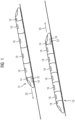
- FIG 1 shows a schematic representation of two rail-bound vehicles 10, 12.
- Each of these rail-bound vehicles 10, 12 has a plurality of radio modules 14, 16.
- the plurality of radio modules 14, 16 are arranged at predetermined intervals along an intended direction of travel 20 of the respective vehicle 10, 12.
- the plurality of radio modules 14, 16 are each embodied as a mobile radio modem.
- Each of the mobile radio modems is designed to implement packet-switched data transmission and to measure a maximum available data transmission rate.
- each of the rail-bound vehicles 10, 12 shown as examples has a database system 18 and a data processing device 22.
- the database system 18 and the data processing device 22 By means of the database system 18 and the data processing device 22, the following in connection with FIG 2 described in more detail example of the method 100 can be carried out.
- FIG 2 illustrates an example of a method 100 for predicting a control parameter for the purpose of controlling queue management in a schematic representation.
- Queue management is implemented here, for example, using traffic shaping.
- a target rate is therefore determined as a control parameter, for example.
- the target rate is determined individually for each of the radio modules 14, 16 based on a maximum available data transmission rate 106. This makes it possible to provide efficient queue management, which enables stable and reliable data transmission while taking into account the data transmission rate actually available at a predetermined location.
- the example of the method 100 provides for measuring an available data transmission rate 102. In this case This is done, for example, by means of the plurality of radio modules 14, 16 of the rail-bound vehicle 10. Furthermore, the example of the method 100 provides that a location linked to the measured 102 data transmission rate is determined 104. For this purpose, for example, a position of the vehicle 10 is determined 104 centrally using the data processing device 22. Relative to this centrally determined 104 position, a position of each of the plurality of radio modules 14, 16 relative to the central reference point is known due to the predetermined arrangement of the plurality of radio modules 14, 16 on the rail-bound vehicle 10.
- a location present at the time of the measurement can be determined 104 for each of the plurality of radio modules 14, 16.
- each of the 102 data transmission rates measured by means of one of the plurality of radio modules 14, 16 is linked to a measurement location.
- the presently described example of the method 100 provides that the 102 data transmission rate measured by means of the plurality of radio modules 14, 16 is linked 114 to additional information.
- the measured 102 data transmission rate is linked 114 to both environmental information and information relating to a movement of the rail-bound vehicle 10.
- the environmental information is preferably an air humidity and/or an outside temperature.
- the measured 102 data transmission rate is linked 114 to information relating to a travel speed and a travel direction 20.
- the target rate is determined 106 for the purpose of controlling the queue management.
- the presently described example of the method 100 provides that by means of a radio module 14 leading in the direction of travel 20, the available data transmission rate is measured 102.
- Information concerning the measured 102 data transmission rate as well as the location linked to the measured 102 data transmission rate is stored 110 in the database system 18 of the vehicle 10.
- the linked 114 additional information of the type described above is stored 110 in the database system 18.
- the database system 18 is designed as a ring buffer.
- the measured 102 data transmission rate as well as the location linked thereto and the additional information 114 linked thereto can be made available 112 to the remaining radio modules 16 of the plurality of radio modules 14, 16 of the vehicle 10.
- This enables the remaining radio modules 16, which follow the leading radio module 14 due to their arrangement on the rail-bound vehicle 10, to use the already measured 102 data transmission rate as a forecast value for a data transmission rate available at the location linked to the data transmission rate.
- the target rate intended for the application at this location is determined 106 by means of this radio module 16 on the basis of the 102 data transmission rate measured by the leading radio module 14.
- each radio module of the plurality of radio modules 14, 16 can use the 112 data provided to the respective radio module of the plurality of radio modules 14, 16 preceding the radio module of the plurality of radio modules 14, 16 for the purpose of determining 106 the target rate.
- the 110 data stored in the database system 18 of the rail-bound vehicle 10 are made available 112 to radio modules 14, 16 of other vehicles.
- the 110 data stored in the database system 18 of the previously considered rail-bound vehicle 10 are made available to the further FIG 1 schematically illustrated rail-bound vehicle 12 is made available 112.
- This further rail-bound vehicle 12 has a direction of travel 20 which is opposite to the direction of travel 20 of the previously considered rail-bound vehicle 10.
- the 110 data relating to a measured 102 data transmission rate, the location linked thereto and the intended additional information linked 114 to the measured 102 data transmission rate which are recorded by means of the plurality of radio modules 14, 16 and stored in the database system 18 of the further rail-bound vehicle 12, are made available 112 to the oncoming rail-bound vehicle 10. Accordingly, it is provided that the 110 data relating to a measured 102 data transmission rate, the location linked thereto and the intended additional information linked 114 to the measured 102 data transmission rate, which are stored 112 in the database system 18 of the rail-bound vehicle 10, are made available 112 to the oncoming further rail-bound vehicle 12.
- a queue management control 108 This allows a queue management control 108 to be prepared for locations for which no data of their own is available, but for which the oncoming rail-bound vehicle 10, 12. It is also conceivable that this is data which is recorded and made available by radio modules of a preceding, not shown rail-bound vehicle were 112. Using such data, a target rate for controlling 108 the queue management for a predetermined location can be predicted with a high degree of accuracy before reaching that location.
Landscapes
- Engineering & Computer Science (AREA)
- Computer Networks & Wireless Communication (AREA)
- Signal Processing (AREA)
- Mobile Radio Communication Systems (AREA)
Applications Claiming Priority (1)
| Application Number | Priority Date | Filing Date | Title |
|---|---|---|---|
| DE102023209376.6A DE102023209376A1 (de) | 2023-09-26 | 2023-09-26 | Verbesserte Prognose einer Zielrate |
Publications (1)
| Publication Number | Publication Date |
|---|---|
| EP4531479A1 true EP4531479A1 (fr) | 2025-04-02 |
Family
ID=92909522
Family Applications (1)
| Application Number | Title | Priority Date | Filing Date |
|---|---|---|---|
| EP24202412.3A Pending EP4531479A1 (fr) | 2023-09-26 | 2024-09-25 | Prédiction améliorée de débit cible |
Country Status (2)
| Country | Link |
|---|---|
| EP (1) | EP4531479A1 (fr) |
| DE (1) | DE102023209376A1 (fr) |
Citations (3)
| Publication number | Priority date | Publication date | Assignee | Title |
|---|---|---|---|---|
| US20130035083A1 (en) * | 2011-08-04 | 2013-02-07 | Deutsche Telekom Ag | Method and system for proactive and dynamic cross-layer optimization of data transmission to vehicles |
| US20160269966A1 (en) * | 2013-12-19 | 2016-09-15 | Intel Corporation | Moving ad hoc network small cell relay handover |
| US20220217574A1 (en) * | 2019-04-12 | 2022-07-07 | Volkswagen Aktiengesellschaft | System, Vehicle, Apparatuses, Methods, and Computer Programs for User Equipment and for Service Provision in a Mobile Communication System |
-
2023
- 2023-09-26 DE DE102023209376.6A patent/DE102023209376A1/de active Pending
-
2024
- 2024-09-25 EP EP24202412.3A patent/EP4531479A1/fr active Pending
Patent Citations (3)
| Publication number | Priority date | Publication date | Assignee | Title |
|---|---|---|---|---|
| US20130035083A1 (en) * | 2011-08-04 | 2013-02-07 | Deutsche Telekom Ag | Method and system for proactive and dynamic cross-layer optimization of data transmission to vehicles |
| US20160269966A1 (en) * | 2013-12-19 | 2016-09-15 | Intel Corporation | Moving ad hoc network small cell relay handover |
| US20220217574A1 (en) * | 2019-04-12 | 2022-07-07 | Volkswagen Aktiengesellschaft | System, Vehicle, Apparatuses, Methods, and Computer Programs for User Equipment and for Service Provision in a Mobile Communication System |
Also Published As
| Publication number | Publication date |
|---|---|
| DE102023209376A1 (de) | 2025-03-27 |
Similar Documents
| Publication | Publication Date | Title |
|---|---|---|
| EP3042368B1 (fr) | Procede, systeme d'evaluation et vehicule pour anticiper au moins un parametre d'un bouchon | |
| EP3284296B1 (fr) | Procédé de détermination d'une charge de canal et procédé de réglage d'un prétraitement dans une communication entre véhicules c2x, système de communication entre véhicules c2x et support d'enregistrement lisible par ordinateur | |
| DE102015222962A1 (de) | Verfahren zur Aggregation von Fahrspurinformationen für digitale Kartendienste | |
| EP0419959A2 (fr) | Circuit pour contrôler le respet de débits préétablis lors de la transmission de cellules de données | |
| DE102017205479A1 (de) | Verfahren zur Vorhersage einer Mobilfunksignalstärke einer Mobilfunkanbindung eines Kraftfahrzeugs und Servervorrichtung zum Ausführen des Verfahrens | |
| DE102009007244B4 (de) | Verfahren und Vorrichtung zum Bewerten mindestens einer von einem jeweiligen Fahrzeug gesendeten Nachricht | |
| WO2010139807A1 (fr) | Procédé permettant de déterminer la qualité de transmission d'une communication c2x et dispositif correspondant | |
| EP1466140A1 (fr) | Procede de determination d'un temps de trajet | |
| DE69015759T2 (de) | Vorrichtung zur Auswertung der Rate von virtuellen Verbindungen aus einer asynchronen Zeit-Multiplexlinie. | |
| DE69015165T2 (de) | Einrichtung zur Bewertung der Übertragungsqualität. | |
| EP1501321A2 (fr) | Procédé et système pour obtenir des données d'informations | |
| DE102023209376A1 (de) | Verbesserte Prognose einer Zielrate | |
| EP2338248B1 (fr) | Procédé pour exploiter un système de communication à plusieurs n uds et système de communication associé | |
| DE102013223022A1 (de) | Vorhersage der Signale einer Ampel | |
| EP1601128B1 (fr) | Procédé et système d'estimation de bruit avec compensation du mouvement dans des systèmes de transmission mobiles sans fil | |
| EP0021062A2 (fr) | Procédé pour effectuer un test de plausibilité sur des informations de temps reçues en succession dans des installations de feux de signalisation routière | |
| DE102020214797A1 (de) | Kommunikationsverfahren | |
| EP0406741B1 (fr) | Méthode de décision quasi-synchrone pour changement de canal | |
| WO1990009711A1 (fr) | Procede permettant de reduire la longueur d'une file d'attente repartie | |
| DE69932325T2 (de) | Verfahren zur aufforderung und zuteilung von reservierungen über ein übertragungsmedium | |
| DE102009031321A1 (de) | Verfahren und System zur Ermittlung von Verkehrsinformationen | |
| EP0958563B1 (fr) | Procede de detection de l'etat du trafic routier, detecteur et centrale | |
| EP0911780B1 (fr) | Procédé de transmission de données entre des appareils télématiques pour la circulation | |
| EP2015026A2 (fr) | Procédé de navigation dynamique de transport privé, ainsi que dispositif, installation et système correspondants | |
| DE3507029A1 (de) | Verfahren zum normieren von signalkanaelen auf einen tdma-rahmen in einem mobilfunksystem |
Legal Events
| Date | Code | Title | Description |
|---|---|---|---|
| PUAI | Public reference made under article 153(3) epc to a published international application that has entered the european phase |
Free format text: ORIGINAL CODE: 0009012 |
|
| STAA | Information on the status of an ep patent application or granted ep patent |
Free format text: STATUS: THE APPLICATION HAS BEEN PUBLISHED |
|
| AK | Designated contracting states |
Kind code of ref document: A1 Designated state(s): AL AT BE BG CH CY CZ DE DK EE ES FI FR GB GR HR HU IE IS IT LI LT LU LV MC ME MK MT NL NO PL PT RO RS SE SI SK SM TR |
|
| STAA | Information on the status of an ep patent application or granted ep patent |
Free format text: STATUS: REQUEST FOR EXAMINATION WAS MADE |
|
| RAP3 | Party data changed (applicant data changed or rights of an application transferred) |
Owner name: SIEMENS MOBILITY GMBH |
|
| 17P | Request for examination filed |
Effective date: 20250929 |