EP4534595A2 - Films coulés présentant une ténacité améliorée - Google Patents
Films coulés présentant une ténacité améliorée Download PDFInfo
- Publication number
- EP4534595A2 EP4534595A2 EP25159155.8A EP25159155A EP4534595A2 EP 4534595 A2 EP4534595 A2 EP 4534595A2 EP 25159155 A EP25159155 A EP 25159155A EP 4534595 A2 EP4534595 A2 EP 4534595A2
- Authority
- EP
- European Patent Office
- Prior art keywords
- composition
- ethylene
- film
- cast film
- polymer
- Prior art date
- Legal status (The legal status is an assumption and is not a legal conclusion. Google has not performed a legal analysis and makes no representation as to the accuracy of the status listed.)
- Pending
Links
Images



Classifications
-
- B—PERFORMING OPERATIONS; TRANSPORTING
- B32—LAYERED PRODUCTS
- B32B—LAYERED PRODUCTS, i.e. PRODUCTS BUILT-UP OF STRATA OF FLAT OR NON-FLAT, e.g. CELLULAR OR HONEYCOMB, FORM
- B32B27/00—Layered products comprising a layer of synthetic resin
- B32B27/06—Layered products comprising a layer of synthetic resin as the main or only constituent of a layer, which is next to another layer of the same or of a different material
-
- B—PERFORMING OPERATIONS; TRANSPORTING
- B32—LAYERED PRODUCTS
- B32B—LAYERED PRODUCTS, i.e. PRODUCTS BUILT-UP OF STRATA OF FLAT OR NON-FLAT, e.g. CELLULAR OR HONEYCOMB, FORM
- B32B27/00—Layered products comprising a layer of synthetic resin
- B32B27/06—Layered products comprising a layer of synthetic resin as the main or only constituent of a layer, which is next to another layer of the same or of a different material
- B32B27/08—Layered products comprising a layer of synthetic resin as the main or only constituent of a layer, which is next to another layer of the same or of a different material of synthetic resin
-
- B—PERFORMING OPERATIONS; TRANSPORTING
- B32—LAYERED PRODUCTS
- B32B—LAYERED PRODUCTS, i.e. PRODUCTS BUILT-UP OF STRATA OF FLAT OR NON-FLAT, e.g. CELLULAR OR HONEYCOMB, FORM
- B32B27/00—Layered products comprising a layer of synthetic resin
- B32B27/30—Layered products comprising a layer of synthetic resin comprising vinyl (co)polymers; comprising acrylic (co)polymers
- B32B27/306—Layered products comprising a layer of synthetic resin comprising vinyl (co)polymers; comprising acrylic (co)polymers comprising vinyl acetate or vinyl alcohol (co)polymers
-
- B—PERFORMING OPERATIONS; TRANSPORTING
- B32—LAYERED PRODUCTS
- B32B—LAYERED PRODUCTS, i.e. PRODUCTS BUILT-UP OF STRATA OF FLAT OR NON-FLAT, e.g. CELLULAR OR HONEYCOMB, FORM
- B32B27/00—Layered products comprising a layer of synthetic resin
- B32B27/30—Layered products comprising a layer of synthetic resin comprising vinyl (co)polymers; comprising acrylic (co)polymers
- B32B27/308—Layered products comprising a layer of synthetic resin comprising vinyl (co)polymers; comprising acrylic (co)polymers comprising acrylic (co)polymers
-
- B—PERFORMING OPERATIONS; TRANSPORTING
- B32—LAYERED PRODUCTS
- B32B—LAYERED PRODUCTS, i.e. PRODUCTS BUILT-UP OF STRATA OF FLAT OR NON-FLAT, e.g. CELLULAR OR HONEYCOMB, FORM
- B32B27/00—Layered products comprising a layer of synthetic resin
- B32B27/32—Layered products comprising a layer of synthetic resin comprising polyolefins
-
- C—CHEMISTRY; METALLURGY
- C08—ORGANIC MACROMOLECULAR COMPOUNDS; THEIR PREPARATION OR CHEMICAL WORKING-UP; COMPOSITIONS BASED THEREON
- C08F—MACROMOLECULAR COMPOUNDS OBTAINED BY REACTIONS ONLY INVOLVING CARBON-TO-CARBON UNSATURATED BONDS
- C08F210/00—Copolymers of unsaturated aliphatic hydrocarbons having only one carbon-to-carbon double bond
- C08F210/16—Copolymers of ethene with alpha-alkenes, e.g. EP rubbers
-
- C—CHEMISTRY; METALLURGY
- C08—ORGANIC MACROMOLECULAR COMPOUNDS; THEIR PREPARATION OR CHEMICAL WORKING-UP; COMPOSITIONS BASED THEREON
- C08L—COMPOSITIONS OF MACROMOLECULAR COMPOUNDS
- C08L23/00—Compositions of homopolymers or copolymers of unsaturated aliphatic hydrocarbons having only one carbon-to-carbon double bond; Compositions of derivatives of such polymers
- C08L23/02—Compositions of homopolymers or copolymers of unsaturated aliphatic hydrocarbons having only one carbon-to-carbon double bond; Compositions of derivatives of such polymers not modified by chemical after-treatment
- C08L23/04—Homopolymers or copolymers of ethene
- C08L23/08—Copolymers of ethene
- C08L23/0807—Copolymers of ethene with unsaturated hydrocarbons only containing four or more carbon atoms
- C08L23/0815—Copolymers of ethene with unsaturated hydrocarbons only containing four or more carbon atoms with aliphatic 1-olefins containing one carbon-to-carbon double bond
-
- B—PERFORMING OPERATIONS; TRANSPORTING
- B32—LAYERED PRODUCTS
- B32B—LAYERED PRODUCTS, i.e. PRODUCTS BUILT-UP OF STRATA OF FLAT OR NON-FLAT, e.g. CELLULAR OR HONEYCOMB, FORM
- B32B2250/00—Layers arrangement
- B32B2250/24—All layers being polymeric
-
- B—PERFORMING OPERATIONS; TRANSPORTING
- B32—LAYERED PRODUCTS
- B32B—LAYERED PRODUCTS, i.e. PRODUCTS BUILT-UP OF STRATA OF FLAT OR NON-FLAT, e.g. CELLULAR OR HONEYCOMB, FORM
- B32B2270/00—Resin or rubber layer containing a blend of at least two different polymers
-
- B—PERFORMING OPERATIONS; TRANSPORTING
- B32—LAYERED PRODUCTS
- B32B—LAYERED PRODUCTS, i.e. PRODUCTS BUILT-UP OF STRATA OF FLAT OR NON-FLAT, e.g. CELLULAR OR HONEYCOMB, FORM
- B32B2307/00—Properties of the layers or laminate
- B32B2307/40—Properties of the layers or laminate having particular optical properties
-
- B—PERFORMING OPERATIONS; TRANSPORTING
- B32—LAYERED PRODUCTS
- B32B—LAYERED PRODUCTS, i.e. PRODUCTS BUILT-UP OF STRATA OF FLAT OR NON-FLAT, e.g. CELLULAR OR HONEYCOMB, FORM
- B32B2307/00—Properties of the layers or laminate
- B32B2307/50—Properties of the layers or laminate having particular mechanical properties
- B32B2307/54—Yield strength; Tensile strength
-
- B—PERFORMING OPERATIONS; TRANSPORTING
- B32—LAYERED PRODUCTS
- B32B—LAYERED PRODUCTS, i.e. PRODUCTS BUILT-UP OF STRATA OF FLAT OR NON-FLAT, e.g. CELLULAR OR HONEYCOMB, FORM
- B32B2307/00—Properties of the layers or laminate
- B32B2307/50—Properties of the layers or laminate having particular mechanical properties
- B32B2307/558—Impact strength, toughness
-
- B—PERFORMING OPERATIONS; TRANSPORTING
- B32—LAYERED PRODUCTS
- B32B—LAYERED PRODUCTS, i.e. PRODUCTS BUILT-UP OF STRATA OF FLAT OR NON-FLAT, e.g. CELLULAR OR HONEYCOMB, FORM
- B32B2307/00—Properties of the layers or laminate
- B32B2307/70—Other properties
- B32B2307/72—Density
-
- B—PERFORMING OPERATIONS; TRANSPORTING
- B32—LAYERED PRODUCTS
- B32B—LAYERED PRODUCTS, i.e. PRODUCTS BUILT-UP OF STRATA OF FLAT OR NON-FLAT, e.g. CELLULAR OR HONEYCOMB, FORM
- B32B2439/00—Containers; Receptacles
- B32B2439/70—Food packaging
-
- B—PERFORMING OPERATIONS; TRANSPORTING
- B32—LAYERED PRODUCTS
- B32B—LAYERED PRODUCTS, i.e. PRODUCTS BUILT-UP OF STRATA OF FLAT OR NON-FLAT, e.g. CELLULAR OR HONEYCOMB, FORM
- B32B2553/00—Packaging equipment or accessories not otherwise provided for
-
- B—PERFORMING OPERATIONS; TRANSPORTING
- B32—LAYERED PRODUCTS
- B32B—LAYERED PRODUCTS, i.e. PRODUCTS BUILT-UP OF STRATA OF FLAT OR NON-FLAT, e.g. CELLULAR OR HONEYCOMB, FORM
- B32B27/00—Layered products comprising a layer of synthetic resin
- B32B27/32—Layered products comprising a layer of synthetic resin comprising polyolefins
- B32B27/327—Layered products comprising a layer of synthetic resin comprising polyolefins comprising polyolefins obtained by a metallocene or single-site catalyst
-
- C—CHEMISTRY; METALLURGY
- C08—ORGANIC MACROMOLECULAR COMPOUNDS; THEIR PREPARATION OR CHEMICAL WORKING-UP; COMPOSITIONS BASED THEREON
- C08F—MACROMOLECULAR COMPOUNDS OBTAINED BY REACTIONS ONLY INVOLVING CARBON-TO-CARBON UNSATURATED BONDS
- C08F4/00—Polymerisation catalysts
- C08F4/42—Metals; Metal hydrides; Metallo-organic compounds; Use thereof as catalyst precursors
- C08F4/44—Metals; Metal hydrides; Metallo-organic compounds; Use thereof as catalyst precursors selected from light metals, zinc, cadmium, mercury, copper, silver, gold, boron, gallium, indium, thallium, rare earths or actinides
- C08F4/60—Metals; Metal hydrides; Metallo-organic compounds; Use thereof as catalyst precursors selected from light metals, zinc, cadmium, mercury, copper, silver, gold, boron, gallium, indium, thallium, rare earths or actinides together with refractory metals, iron group metals, platinum group metals, manganese, rhenium technetium or compounds thereof
- C08F4/62—Refractory metals or compounds thereof
- C08F4/64—Titanium, zirconium, hafnium or compounds thereof
- C08F4/659—Component covered by group C08F4/64 containing a transition metal-carbon bond
-
- C—CHEMISTRY; METALLURGY
- C08—ORGANIC MACROMOLECULAR COMPOUNDS; THEIR PREPARATION OR CHEMICAL WORKING-UP; COMPOSITIONS BASED THEREON
- C08F—MACROMOLECULAR COMPOUNDS OBTAINED BY REACTIONS ONLY INVOLVING CARBON-TO-CARBON UNSATURATED BONDS
- C08F4/00—Polymerisation catalysts
- C08F4/42—Metals; Metal hydrides; Metallo-organic compounds; Use thereof as catalyst precursors
- C08F4/44—Metals; Metal hydrides; Metallo-organic compounds; Use thereof as catalyst precursors selected from light metals, zinc, cadmium, mercury, copper, silver, gold, boron, gallium, indium, thallium, rare earths or actinides
- C08F4/60—Metals; Metal hydrides; Metallo-organic compounds; Use thereof as catalyst precursors selected from light metals, zinc, cadmium, mercury, copper, silver, gold, boron, gallium, indium, thallium, rare earths or actinides together with refractory metals, iron group metals, platinum group metals, manganese, rhenium technetium or compounds thereof
- C08F4/62—Refractory metals or compounds thereof
- C08F4/64—Titanium, zirconium, hafnium or compounds thereof
- C08F4/659—Component covered by group C08F4/64 containing a transition metal-carbon bond
- C08F4/65908—Component covered by group C08F4/64 containing a transition metal-carbon bond in combination with an ionising compound other than alumoxane, e.g. (C6F5)4B-X+
-
- C—CHEMISTRY; METALLURGY
- C08—ORGANIC MACROMOLECULAR COMPOUNDS; THEIR PREPARATION OR CHEMICAL WORKING-UP; COMPOSITIONS BASED THEREON
- C08F—MACROMOLECULAR COMPOUNDS OBTAINED BY REACTIONS ONLY INVOLVING CARBON-TO-CARBON UNSATURATED BONDS
- C08F4/00—Polymerisation catalysts
- C08F4/42—Metals; Metal hydrides; Metallo-organic compounds; Use thereof as catalyst precursors
- C08F4/44—Metals; Metal hydrides; Metallo-organic compounds; Use thereof as catalyst precursors selected from light metals, zinc, cadmium, mercury, copper, silver, gold, boron, gallium, indium, thallium, rare earths or actinides
- C08F4/60—Metals; Metal hydrides; Metallo-organic compounds; Use thereof as catalyst precursors selected from light metals, zinc, cadmium, mercury, copper, silver, gold, boron, gallium, indium, thallium, rare earths or actinides together with refractory metals, iron group metals, platinum group metals, manganese, rhenium technetium or compounds thereof
- C08F4/62—Refractory metals or compounds thereof
- C08F4/64—Titanium, zirconium, hafnium or compounds thereof
- C08F4/659—Component covered by group C08F4/64 containing a transition metal-carbon bond
- C08F4/65912—Component covered by group C08F4/64 containing a transition metal-carbon bond in combination with an organoaluminium compound
-
- C—CHEMISTRY; METALLURGY
- C08—ORGANIC MACROMOLECULAR COMPOUNDS; THEIR PREPARATION OR CHEMICAL WORKING-UP; COMPOSITIONS BASED THEREON
- C08L—COMPOSITIONS OF MACROMOLECULAR COMPOUNDS
- C08L2203/00—Applications
- C08L2203/16—Applications used for films
-
- C—CHEMISTRY; METALLURGY
- C08—ORGANIC MACROMOLECULAR COMPOUNDS; THEIR PREPARATION OR CHEMICAL WORKING-UP; COMPOSITIONS BASED THEREON
- C08L—COMPOSITIONS OF MACROMOLECULAR COMPOUNDS
- C08L2205/00—Polymer mixtures characterised by other features
- C08L2205/02—Polymer mixtures characterised by other features containing two or more polymers of the same C08L -group
- C08L2205/025—Polymer mixtures characterised by other features containing two or more polymers of the same C08L -group containing two or more polymers of the same hierarchy C08L, and differing only in parameters such as density, comonomer content, molecular weight, structure
-
- C—CHEMISTRY; METALLURGY
- C08—ORGANIC MACROMOLECULAR COMPOUNDS; THEIR PREPARATION OR CHEMICAL WORKING-UP; COMPOSITIONS BASED THEREON
- C08L—COMPOSITIONS OF MACROMOLECULAR COMPOUNDS
- C08L2207/00—Properties characterising the ingredient of the composition
- C08L2207/06—Properties of polyethylene
- C08L2207/062—HDPE
-
- C—CHEMISTRY; METALLURGY
- C08—ORGANIC MACROMOLECULAR COMPOUNDS; THEIR PREPARATION OR CHEMICAL WORKING-UP; COMPOSITIONS BASED THEREON
- C08L—COMPOSITIONS OF MACROMOLECULAR COMPOUNDS
- C08L2207/00—Properties characterising the ingredient of the composition
- C08L2207/06—Properties of polyethylene
- C08L2207/064—VLDPE
-
- C—CHEMISTRY; METALLURGY
- C08—ORGANIC MACROMOLECULAR COMPOUNDS; THEIR PREPARATION OR CHEMICAL WORKING-UP; COMPOSITIONS BASED THEREON
- C08L—COMPOSITIONS OF MACROMOLECULAR COMPOUNDS
- C08L2207/00—Properties characterising the ingredient of the composition
- C08L2207/06—Properties of polyethylene
- C08L2207/066—LDPE (radical process)
-
- C—CHEMISTRY; METALLURGY
- C08—ORGANIC MACROMOLECULAR COMPOUNDS; THEIR PREPARATION OR CHEMICAL WORKING-UP; COMPOSITIONS BASED THEREON
- C08L—COMPOSITIONS OF MACROMOLECULAR COMPOUNDS
- C08L2314/00—Polymer mixtures characterised by way of preparation
- C08L2314/02—Ziegler natta catalyst
-
- C—CHEMISTRY; METALLURGY
- C08—ORGANIC MACROMOLECULAR COMPOUNDS; THEIR PREPARATION OR CHEMICAL WORKING-UP; COMPOSITIONS BASED THEREON
- C08L—COMPOSITIONS OF MACROMOLECULAR COMPOUNDS
- C08L2314/00—Polymer mixtures characterised by way of preparation
- C08L2314/06—Metallocene or single site catalysts
Definitions
- the present invention relates generally to cast films and in some aspects, cast films having improved toughness.
- the present invention utilizes ethylene-based polymers exhibiting certain features in the formation of cast films with desirable properties.
- the cast films have improved toughness (e.g., as measured by dart impact strength) as compared to cast films formed from other ethylene-based polymers, while maintaining a good balance of other properties (e.g., tear strength, optical properties, etc.).
- the present invention provides a cast film comprising a layer formed from a composition comprising a first composition, wherein the first composition comprises at least one ethylene-based polymer and wherein the first composition comprises a MWCDI value greater than 0.9, and a melt index ratio (I10/I2) that meets the following equation: I10/I2 ⁇ 7.0 - 1.2 x log (I2).
- inventive compositions can be used to form inventive films with improved toughness.
- Such compositions contain an ethylene-based polymer that has a superior comonomer distribution, which is significantly higher in comonomer concentration, and a good distribution of comonomer, in the high molecular weight polymer molecules, and is significantly lower in comonomer concentration in the low molecular weight polymer molecules, as compared to conventional polymers of the art at the same overall density.
- the ethylene-based polymer has low LCB (Long Chain Branches), as indicated by low ZSVR, as compared to conventional polymers.
- the inventive compositions have more tie chains, and thus, improved film toughness.
- the inventive compositions can be useful in forming the inventive cast films of the present invention.
- the invention provides a composition comprising a first composition, comprising at least one ethylene-based polymer, wherein the first composition comprises a MWCDI value greater than 0.9, and a melt index ratio (I10/I2) that meets the following equation: I 10 / I 2 ⁇ 7.0 ⁇ 1.2 ⁇ log I 2 .
- the inventive composition may comprise a combination of two or more embodiments described herein.
- the first composition may comprise a combination of two or more embodiments as described herein.
- the ethylene-based polymer may comprise a combination of two or more embodiments as described herein.
- the first composition has a MWCDI value less than, or equal to, 10.0, further less than, or equal to, 8.0, further less than, or equal to, 6.0.
- the first composition has a MWCDI value less than, or equal to, 5.0, further less than, or equal to, 4.0, further less than, or equal to, 3.0.
- the first composition has a MWCDI value greater than, or equal to, 1.0, further greater than, or equal to, 1.1, further greater than, or equal to, 1.2.
- the first composition has a MWCDI value greater than, or equal to, 1.3, further greater than, or equal to, 1.4, further greater than, or equal to, 1.5.
- the first composition has a melt index ratio I10/I2 greater than, or equal to, 7.0, further greater than, or equal to, 7.1, further greater than, or equal to, 7.2, further greater than, or equal to, 7.3.
- the first composition has a melt index ratio I10/I2 less than, or equal to, 9.2, further less than, or equal to, 9.0, further less than, or equal to, 8.8, further less than, or equal to, 8.5.
- the first composition has a ZSVR value from 1.2 to 3.0, further from 1.2 to 2.5, further 1.2 to 2.0.
- the first composition has a vinyl unsaturation level greater than 10 vinyls per 1,000,000 total carbons. For example, greater than 20 vinyls per 1,000,000 total carbons, or greater than 50 vinyls per 1,000,000 total carbons, or greater than 70 vinyls per 1,000,000 total carbons, or greater than 100 vinyls per 1,000,000 total carbons.
- the first composition has a density in the range of 0.910 to 0.940 g/cm 3 , for example from 0.910 to 0.930, or from 0.910 to 0.925 g/cm 3 .
- the first composition has a melt index (I 2 or I2; at 190°C / 2.16kg) from 0.1 to 50 g/10 minutes, for example from 0.1 to 30 g/10 minutes, or from 0.1 to 20 g/10 minutes, or from 0.1 to 10 g/10 minutes.
- the melt index (I 2 or I2; at 190°C / 2.16 kg) can be from a lower limit of 0.1, 0.2, or 0.5 g/10 minutes, to an upper limit of 1.0, 2.0, 3.0, 4.0, 5.0, 10, 15, 20, 25, 30, 40, or 50 g/10 minutes.
- the first composition has a molecular weight distribution, expressed as the ratio of the weight average molecular weight to number average molecular weight (M w /M n ; as determined by conv. GPC) in the range of from 2.2 to 5.0.
- the molecular weight distribution (M w /M n ) can be from a lower limit of 2.2, 2.3, 2.4, 2.5, 3.0, 3.2, or 3.4, to an upper limit of 3.9, 4.0, 4.1, 4.2, 4.5, 5.0.
- the first composition has a number average molecular weight (M n ; as determined by conv. GPC) in the range from 10,000 to 50,000 g/mole.
- M n number average molecular weight
- the number average molecular weight can be from a lower limit of 10,000, 20,000, or 25,000 g/mole, to an upper limit of 35,000, 40,000, 45,000, or 50,000 g/mole.
- the first composition has a weight average molecular weight (M w ; as determined by conv. GPC) in the range from 70,000 to 200,000 g/mole.
- M w weight average molecular weight
- the number average molecular weight can be from a lower limit of 70,000, 75,000, or 78,000 g/mole, to an upper limit of 120,000, 140,000, 160,000, 180,000 or 200,000 g/mole.
- the first composition has a melt viscosity ratio, Eta*0.1 / Eta*100, in the range from 2.2 to 7.0.
- the number average molecular weight can be from a lower limit of 2.2, 2.3, 2.4 or 2.5, to an upper limit of 6.0, 6.2, 6.5, or 7.0.
- the ethylene-based polymer is an ethylene/ ⁇ -olefin interpolymer, and further an ethylene/ ⁇ -olefin copolymer.
- the first ethylene-based polymer is an ethylene/ ⁇ -olefin interpolymer, and further an ethylene/ ⁇ -olefin copolymer.
- the ⁇ -olefin has less than, or equal to, 20 carbon atoms.
- the ⁇ -olefin comonomers may preferably have 3 to 10 carbon atoms, and more preferably 3 to 8 carbon atoms.
- Exemplary ⁇ -olefin comonomers include, but are not limited to, propylene, 1-butene, 1-pentene, 1-hexene, 1-heptene, 1-octene, 1-nonene, 1-decene, and 4-methyl-1-pentene.
- the one or more ⁇ -olefin comonomers may, for example, be selected from the group consisting of propylene, 1-butene, 1-hexene, and 1-octene; or in the alternative, from the group consisting of 1-butene, 1-hexene and 1-octene, and further 1-hexene and 1-octene.
- the ethylene-based polymer, or first ethylene-based polymer has a molecular weight distribution (M w /M n ; as determined by conv. GPC) in the range from 1.5 to 4.0, for example, from 1.5 to 3.5, or from 2.0 to 3.0.
- M w /M n can be from a lower limit of 1.5, 1.7, 2.0, 2.1, or 2.2, to an upper limit of 2.5, 2.6, 2.8, 3.0, 3.5, or 4.0.
- the first composition further comprises a second ethylene-based polymer.
- the second ethylene-based polymer is an ethylene/ ⁇ -olefin interpolymer, and further an ethylene/ ⁇ -olefin copolymer, or a LDPE.
- the ⁇ -olefin has less than, or equal to, 20 carbon atoms.
- the ⁇ -olefin comonomers may preferably have 3 to 10 carbon atoms, and more preferably 3 to 8 carbon atoms.
- Exemplary ⁇ -olefin comonomers include, but are not limited to, propylene, 1-butene, 1-pentene, 1-hexene, 1-heptene, 1-octene, 1-nonene, 1-decene, and 4-methyl-1-pentene.
- the one or more ⁇ -olefin comonomers may, for example, be selected from the group consisting of propylene, 1-butene, 1-hexene, and 1-octene; or in the alternative, from the group consisting of 1-butene, 1-hexene and 1-octene, and further 1-hexene and 1-octene.
- the second ethylene-based polymer is a heterogeneously branched ethylene/ ⁇ -olefin interpolymer, and further a heterogeneously branched ethylene/ ⁇ -olefin copolymer.
- Heterogeneously branched ethylene/ ⁇ -olefin interpolymers and copolymers are typically produced using Ziegler/Natta type catalyst system, and have more comonomer distributed in the lower molecular weight molecules of the polymer.
- the second ethylene-based polymer has a molecular weight distribution (M w /M n ) in the range from 3.0 to 5.0, for example from 3.2 to 4.6.
- the molecular weight distribution (M w /M n ) can be from a lower limit of 3.2, 3.3, 3.5, 3.7, or 3.9, to an upper limit of 4.6, 4.7, 4.8, 4.9, or 5.0.
- the composition comprises from 50 to 80 wt%, or from 50 to 85 wt%, or from 50 to 90 wt%, or from 50 to 95 wt% of the first composition, based on the weight of the composition.
- the composition comprises greater than or equal to 80 wt%, or greater than or equal to 85 wt%, or greater than or equal to 90 wt%, or greater than or equal to 95 wt%, or greater than or equal to 98 wt% of the first composition, based on the weight of the composition.
- the composition further comprises another polymer.
- the polymer is selected from the following: a LLDPE, a VLDPE (a very low density polyethylene), a MDPE, a LDPE, a HDPE, a HMWHDPE (a high molecular weight HDPE), a propylene-based polymer, a polyolefin plastomer, a polyolefin elastomer, an olefin block copolymer, an ethylene vinyl acetate, an ethylene acrylic acid, an ethylene methacrylic acid, an ethylene methyl acrylate, an ethylene ethyl acrylate, an ethylene butyl acrylate, a polyisobutylene, a maleic anhydride-grafted polyolefin, an ionomer of any of the foregoing, or a combination thereof.
- the composition further comprises a LDPE.
- the LDPE is present in an amount from 5 to 50 wt%, further from 10 to 40 wt%, further from 15 to 30 wt%, based on the weight of the composition.
- the LDPE has a density from 0.915 to 0.930 g/cc, and a melt index (I2) from 0.15 to 30 g/10 min, further from 0.25 to 20 g/10 min.
- the composition further comprises one or more additives.
- the invention also provides an article comprising at least one component formed from an inventive composition as described herein.
- the article is a film or a coating.
- the present invention relates to a cast film formed from any of the inventive compositions as described herein.
- the cast film is a monolayer film.
- the cast film in some embodiments, is a multilayer film. In some embodiments, the cast film comprises up to 35 layers.
- a cast film of the present invention has a thickness of up to 30 mils.
- the cast film can have a thickness from a lower limit of 0.2 mils, 0.3 mils, 0.5 mils, 1.0 mil, 1.75 mils, or 2.0 mils to an upper limit of 10 mils, 15 mils, 20 mils, 25 mils, or 30 mils.
- a cast film of the present invention in some embodiments, comprises at least 20 percent by weight of the inventive composition, preferably at least 30 percent by weight of the inventive composition, and more preferably at least 40 percent by weight of the inventive composition.
- the film can further comprise a second layer, wherein the second layer comprises a polymer selected from the following: the inventive composition, a LLDPE, a VLDPE (a very low density polyethylene), a MDPE, a LDPE, a HDPE, a HMWHDPE (a high molecular weight HDPE), a propylene-based polymer, a polyolefin plastomer, a polyolefin elastomer, an olefin block copolymer, an ethylene vinyl acetate, an ethylene acrylic acid, an ethylene methacrylic acid, an ethylene methyl acrylate, an ethylene ethyl acrylate, an ethylene butyl acrylate, an isobutylene, a maleic anhydride-grafted polyolefin, an ionomer of any of the foregoing, or a combination thereof.
- the inventive composition a LLDPE, a VLDPE (a very low density polyethylene), a MDPE,
- the cast film in some embodiments, can comprise a third layer, wherein the third layer comprises a polymer selected from the following: the first composition, a LLDPE, a VLDPE, a LDPE, a MDPE, a HDPE, a HMWHDPE, a propylene-based polymer, a polyolefin plastomer, a polyolefin elastomer, an olefin block copolymer, an ethylene vinyl acetate, an ethylene acrylic acid, an ethylene methacrylic acid, an ethylene methyl acrylate, an ethylene ethyl acrylate, an ethylene butyl acrylate, an isobutylene, a maleic anhydride-grafted polyolefin, an ionomer of any of the foregoing, or a combination thereof.
- the third layer comprises a polymer selected from the following: the first composition, a LLDPE, a VLDPE, a LDPE, a MDPE
- a multilayer cast film can comprise up to 2, 3, 4, 5, 6, 7, 8, 9, 10, or 11 layers in various embodiments.
- the inventive composition used in the layer of cast film has a density in the range of 0.885 to 0.945 g/cm 3 , for example from 0.895 to 0.940, or from 0.905 to 0.935 g/cm 3 , or from 0.910 to 0.928 g/cm 3 .
- the inventive composition used in the layer of cast film has a melt index (I 2 or I2; at 190°C / 2.16kg) from 0.5 to 30 g/10 minutes, for example from 1 to 15 g/10 minutes, or from 2 to 10 g/10 minutes.
- the melt index (I 2 or I2; at 190°C / 2.16 kg) can be from a lower limit of 0.5, 1, or 2 g/10 minutes, to an upper limit of 10, 15, or 30 g/10 minutes.
- the cast film can be stretched up to 300% elongation in machine direction.
- the cast film comprising a layer formed from the inventive composition can be laminated to another film or a woven structure.
- a cast film of the present invention can comprise coextruded multilayer films comprising a core component that is a nanolayer structure.
- the core component can be a layer comprising any of the inventive compositions disclosed herein.
- the core component comprises 15 to 4,000 layers (sublayers). Each layer (sublayer) can have a thickness of 10 nanometers to 10 microns in some embodiments.
- the layers (sublayers) in the core component comprise two or more types of films.
- Cast films of the present invention can be incorporated into a variety of articles including, for example, food packages, industrial and consumer packaging materials, foamed films, and others.
- Food packages can comprise a cast film according to the present invention.
- a variety of food items known to those of skill in the art can be provided in such food packages including, for example, solid foods, liquids, beverages, cooking ingredients (e.g., sugar, flour, etc.), etc.
- Exemplary food packaging materials include films for packaging baked goods, candy wrap, cheese, and others.
- Industrial and consumer packaging materials can comprise a cast film according to the present invention.
- Exemplary industrial and consumer packaging materials include stretch wrap, silage wrap, protective films, and others.
- the silage wrap can further comprise polyisobutylene.
- Polymerization processes include, but are not limited to, solution polymerization processes, using one or more conventional reactors, e.g., loop reactors, isothermal reactors, adiabatic reactors, stirred tank reactors, autoclave reactors in parallel, series, and/or any combinations thereof.
- the ethylene based polymer compositions may, for example, be produced via solution phase polymerization processes, using one or more loop reactors, adiabatic reactors, and combinations thereof.
- the solution phase polymerization process occurs in one or more well mixed reactors, such as one or more loop reactors and/or one or more adiabatic reactors at a temperature in the range from 115 to 250°C; for example, from 135 to 200°C, and at pressures in the range of from 300 to 1000 psig, for example, from 450 to 750 psig.
- well mixed reactors such as one or more loop reactors and/or one or more adiabatic reactors at a temperature in the range from 115 to 250°C; for example, from 135 to 200°C, and at pressures in the range of from 300 to 1000 psig, for example, from 450 to 750 psig.
- the ethylene based polymer composition (e.g., the first composition of claim 1) may be produced in two loop reactors in series configuration, the first reactor temperature is in the range from 115 to 200°C, for example, from 135 to 165°C, and the second reactor temperature is in the range from 150 to 210°C, for example, from 185 to 200°C.
- the ethylene based polymer composition may be produced in a single reactor, the reactor temperature is in the range from 115 to 200°C, for example from 130 to 190°C.
- the residence time in a solution phase polymerization process is typically in the range from 2 to 40 minutes, for example from 5 to 20 minutes.
- Ethylene, solvent, one or more catalyst systems, optionally one or more cocatalysts, and optionally one or more comonomers are fed continuously to one or more reactors.
- exemplary solvents include, but are not limited to, isoparaffins.
- such solvents are commercially available under the name ISOPAR E from ExxonMobil Chemical.
- ISOPAR E isoparaffins
- the resultant mixture of the ethylene based polymer composition and solvent is then removed from the reactor or reactors, and the ethylene based polymer composition is isolated.
- Solvent is typically recovered via a solvent recovery unit, i.e., heat exchangers and separator vessel, and the solvent is then recycled back into the polymerization system.
- the ethylene based polymer composition may be produced, via a solution polymerization process, in a dual reactor system, for example a dual loop reactor system, wherein ethylene, and optionally one or more ⁇ -olefins, are polymerized in the presence of one or more catalyst systems, in one reactor, to produce a first ethylene-based polymer, and ethylene, and optionally one or more ⁇ -olefins, are polymerized in the presence of one or more catalyst systems, in a second reactor, to produce a second ethylene-based polymer. Additionally, one or more cocatalysts may be present.
- a dual reactor system for example a dual loop reactor system
- ethylene, and optionally one or more ⁇ -olefins are polymerized in the presence of one or more catalyst systems, in one reactor, to produce a first ethylene-based polymer
- ethylene, and optionally one or more ⁇ -olefins are polymerized in the presence of one or more catalyst systems, in a second
- the ethylene based polymer composition may be produced via a solution polymerization process, in a single reactor system, for example, a single loop reactor system, wherein ethylene, and optionally one or more ⁇ -olefins, are polymerized in the presence of one or more catalyst systems. Additionally, one or more cocatalysts may be present.
- the invention provides a process to form a composition comprising at least two ethylene-based polymers, said process comprising the following:
- An inventive process may comprise a combination of two or more embodiments as described herein.
- said process comprises polymerizing ethylene, and optionally at least one ⁇ -olefin, in solution, in the presence of a catalyst system comprising a metal-ligand complex of Structure I, to form a first ethylene-based polymer; and polymerizing ethylene, and optionally at least one ⁇ -olefin, in the presence of a catalyst system comprising a Ziegler/Natta catalyst, to form a second ethylene-based polymer.
- each ⁇ -olefin is independently a C1-C8 ⁇ -olefin.
- two or more R groups from R 9 through R 13 , or R 4 through R 8 can combine together into one or more ring structures, with such ring structures each, independently, having from 3 to 50 atoms in the ring, excluding any hydrogen atom.
- M is hafnium
- R 3 and R 14 are each independently an alkyl, and further a C1-C3 alkyl, and further methyl.
- R 1 and R 16 are each as follows:
- each of the aryl, heteroaryl, hydrocarbyl, heterohydrocarbyl, Si(R C ) 3 , Ge(R C ) 3 , P(R P ) 2 , N(R N ) 2 , OR C , SR C , R C S(O)-, R C S(O) 2 -, (R C ) 2 C N-, R C C(O)O-, R C OC(O)-, R C C(O)N(R)-, (R C ) 2 NC(O)-, hydrocarbylene, and heterohydrocarbylene groups, independently, is unsubstituted or substituted with one or more R S substituents; and each R S independently is a halogen atom, polyfluoro substitution, perfluoro substitution, unsubstituted (C 1 -C 18 )alkyl, F 3 C-, FCH 2 O-, F 2 HCO-, F 3 CO-, R 3 Si-, R 3 Ge-
- two or more of R 1 through R 16 do not combine to form one or more ring structures.
- the catalyst system suitable for producing the first ethylene/ ⁇ -olefin interpolymer is a catalyst system comprising bis((2-oxoyl-3-(dibenzo-1H-pyrrole-1-yl)-5-(methyl)phenyl)-2-phenoxymethyl)-methylene-1,2-cyclohexanediylhafnium (IV) dimethyl, represented by the following Structure: IA:
- the Ziegler/Natta catalysts suitable for use in the invention are typical supported, Ziegler-type catalysts, which are particularly useful at the high polymerization temperatures of the solution process.
- Examples of such compositions are those derived from organomagnesium compounds, alkyl halides or aluminum halides or hydrogen chloride, and a transition metal compound. Examples of such catalysts are described in U.S. Pat Nos. 4,612,300 ; 4,314,912 ; and 4,547,475 ; the teachings of which are incorporated herein by reference.
- Particularly suitable organomagnesium compounds include, for example, hydrocarbon soluble dihydrocarbylmagnesium, such as the magnesium dialkyls and the magnesium diaryls.
- Exemplary suitable magnesium dialkyls include, particularly, n-butyl-sec-butylmagnesium, diisopropylmagnesium, di-n-hexylmagnesium, isopropyl-n-butyl-magnesium, ethyl-n-hexylmagnesium, ethyl-n-butylmagnesium, di-n-octylmagnesium, and others, wherein the alkyl has from 1 to 20 carbon atoms.
- Exemplary suitable magnesium diaryls include diphenylmagnesium, dibenzylmagnesium and ditolylmagnesium.
- Suitable organomagnesium compounds include alkyl and aryl magnesium alkoxides and aryloxides and aryl and alkyl magnesium halides, with the halogen-free organomagnesium compounds being more desirable.
- Halide sources include active non-metallic halides, metallic halides, and hydrogen chloride.
- Suitable non-metallic halides are represented by the formula R'X, wherein R' is hydrogen or an active monovalent organic radical, and X is a halogen.
- Particularly suitable non-metallic halides include, for example, hydrogen halides and active organic halides, such as t-alkyl halides, allyl halides, benzyl halides and other active hydrocarbyl halides.
- an active organic halide is meant a hydrocarbyl halide that contains a labile halogen at least as active, i.e., as easily lost to another compound, as the halogen of sec-butyl chloride, preferably as active as t-butyl chloride.
- organic monohalides it is understood that organic dihalides, trihalides and other polyhalides that are active, as defined hereinbefore, are also suitably employed.
- Examples of preferred active non-metallic halides include hydrogen chloride, hydrogen bromide, t-butyl chloride, t-amyl bromide, allyl chloride, benzyl chloride, crotyl chloride, methylvinyl carbinyl chloride, a-phenylethyl bromide, diphenyl methyl chloride, and the like. Most preferred are hydrogen chloride, t-butyl chloride, allyl chloride and benzyl chloride.
- Suitable metallic halides include those represented by the formula MRy-a Xa, wherein: M is a metal of Groups IIB, IIIA or IVA of Mendeleev's periodic Table of Elements; R is a monovalent organic radical; X is a halogen; y has a value corresponding to the valence of M; and "a" has a value from 1 to y.
- Preferred metallic halides are aluminum halides of the formula AlR 3-a X a , wherein each R is independently hydrocarbyl, such as alkyl; X is a halogen; and a is a number from 1 to 3.
- alkylaluminum halides such as ethylaluminum sesquichloride, diethylaluminum chloride, ethylaluminum dichloride, and diethylaluminum bromide, with ethylaluminum dichloride being especially preferred.
- a metal halide such as aluminum trichloride, or a combination of aluminum trichloride with an alkyl aluminum halide, or a trialkyl aluminum compound may be suitably employed.
- the transition metal component is a compound of a Group IVB, VB, or VIB metal.
- the transition metal component is generally, represented by the formulas: TrX' 4-q (OR1)q, TrX' 4-q (R2)q, VOX' 3 and VO(OR) 3 .
- Tr is a Group IVB, VB, or VIB metal, preferably a Group IVB or VB metal, preferably titanium, vanadium or zirconium; q is 0 or a number equal to, or less than, 4; X' is a halogen, and R1 is an alkyl group, aryl group or cycloalkyl group having from 1 to 20 carbon atoms; and R2 is an alkyl group, aryl group, aralkyl group, substituted aralkyls, and the like.
- the aryl, aralkyls and substituted aralkys contain 1 to 20 carbon atoms, preferably 1 to 10 carbon atoms.
- the hydrocarbyl group will preferably not contain an H atom in the position beta to the metal carbon bond.
- aralkyl groups are methyl, neopentyl, 2,2-dimethylbutyl, 2,2-dimethylhexyl; aryl groups such as benzyl; cycloalkyl groups such as 1-norbornyl. Mixtures of these transition metal compounds can be employed if desired.
- transition metal compounds include TiCl 4 , TiBr 4 , Ti(OC 2 H 5 ) 3 Cl, Ti(OC 2 H 3 )Cl 3 , Ti(OC 4 H 9 ) 3 Cl, Ti(OC 3 H 7 ) 2 Cl .2 , Ti(OC 6 H 13 ) 2 Cl 2 , Ti(OC 8 H 17 ) 2 Br 2 , and Ti(OC 12 H 23 )Cl 3 , Ti(O-iC 3 H 7 ) 4 , and Ti(O-nC 4 H 9 ) 4 .
- vanadium compounds include VCl 4 , VOCl 3 , VO(OC 2 H 5 ) 3 , and VO(OC 4 H 9 ) 3 .
- zirconium compounds include ZrCl 4 , ZrCl 3 (OC 2 H 5 ), ZrCl 2 (OC 2 H 5 ) 2 , ZrCl(OC 2 H 5 ) 3 , Zr(OC 2 H 5 ) 4 , ZrCl 3 (OC 4 H 9 ), ZrCl 2 (OC 4 H 9 ) 2 , and ZrCl(OC 4 H 9 )3.
- An inorganic oxide support may be used in the preparation of the catalyst, and the support may be any particulate oxide, or mixed oxide which has been thermally or chemically dehydrated, such that it is substantially free of adsorbed moisture. See U. S. Pat Nos. 4,612,300 ; 4,314,912 ; and 4,547,475 ; the teachings of which are incorporated herein by reference.
- the composition comprises a MWCDI value greater than 0.9.
- the composition comprises a melt index ratio (I10/I2) that meets the following equation: I10/I2 ⁇ 7.0 - 1.2 x log (I2).
- composition may comprise one embodiment, or a combination of two or more embodiments, as listed above for the "first composition.”
- An inventive process may comprise a combination of two or more embodiments described herein.
- the above described catalyst systems can be rendered catalytically active by contacting it to, or combining it with, the activating co-catalyst, or by using an activating technique, such as those known in the art, for use with metal-based olefin polymerization reactions.
- Suitable activating co-catalysts include alkyl aluminums; polymeric or oligomeric alumoxanes (also known as aluminoxanes); neutral Lewis acids; and non-polymeric, non-coordinating, ion-forming compounds (including the use of such compounds under oxidizing conditions).
- a suitable activating technique is bulk electrolysis. Combinations of one or more of the foregoing activating co-catalysts and techniques are also contemplated.
- alkyl aluminum means a monoalkyl aluminum dihydride or monoalkylaluminum dihalide, a dialkyl aluminum hydride or dialkyl aluminum halide, or a trialkylaluminum.
- Aluminoxanes and their preparations are known at, for example, U.S. Patent 6,103,657 .
- Examples of preferred polymeric or oligomeric alumoxanes are methylalumoxane, triisobutylaluminum-modified methylalumoxane, and isobutylalumoxane.
- Exemplary Lewis acid activating co-catalysts are Group 13 metal compounds containing from 1 to 3 hydrocarbyl substituents as described herein.
- exemplary Group 13 metal compounds are tri(hydrocarbyl)-substituted-aluminum or tri(hydrocarbyl)-boron compounds.
- exemplary Group 13 metal compounds are tri(hydrocarbyl)-substituted-aluminum or tri(hydrocarbyl)-boron compounds are tri((C 1 -C 10 )alkyl)aluminum or tri((C 6 -C 18 )aryl)boron compounds and halogenated (including perhalogenated) derivatives thereof.
- exemplary Group 13 metal compounds are tris(fluoro-substituted phenyl)boranes, in other embodiments, tris(pentafluorophenyl)borane.
- the activating co-catalyst is a tris((C 1 -C 20 )hydrocarbyl) borate (e.g., trityl tetrafluoroborate) or a tri((C 1 -C 20 )hydrocarbyl)ammonium tetra((C 1 -C 20 )hydrocarbyl)borane (e.g., bis(octadecyl)methylammonium tetrakis(pentafluorophenyl)borane).
- ammonium means a nitrogen cation that is a ((C 1 -C 20 )hydrocarbyl) 4 N + , a ((C 1 -C 20 )hydrocarbyl) 3 N(H) + , a ((C 1 -C 20 )hydrocarbyl) 2 N(H) 2 + , (C 1 -C 20 )hydrocarbylN(H) 3 + , or N(H) 4 + , wherein each (C 1 -C 20 )hydrocarbyl may be the same or different.
- Exemplary combinations of neutral Lewis acid activating co-catalysts include mixtures comprising a combination of a tri((C 1 -C 4 )alkyl)aluminum and a halogenated tri((C 6 -C 18 )aryl)boron compound, especially a tris(pentafluorophenyl)borane.
- Other exemplary embodiments are combinations of such neutral Lewis acid mixtures with a polymeric or oligomeric alumoxane, and combinations of a single neutral Lewis acid, especially tris(pentafluorophenyl)borane with a polymeric or oligomeric alumoxane.
- ratios of numbers of moles of (metal-ligand complex):(tris(pentafluoro-phenylborane): (alumoxane) are from 1:1:1 to 1:10:30, other exemplary embodiments are from 1:1:1.5 to 1:5:10.
- Examples of suitable Bronsted acid salts for addition polymerization catalysts are disclosed in US 5,064,802 ; US 5,919,983 ; US 5,783,512 .
- Examples of suitable salts of a cationic oxidizing agent and a non-coordinating, compatible anion, as activating co-catalysts for addition polymerization catalysts are disclosed in US 5,321,106 .
- Examples of suitable carbenium salts as activating co-catalysts for addition polymerization catalysts are disclosed in US 5,350,723 .
- Examples of suitable silylium salts, as activating co-catalysts for addition polymerization catalysts are disclosed in US 5,625,087 .
- the above described catalyst systems can be activated to form an active catalyst composition by combination with one or more cocatalyst, such as a cation forming cocatalyst, a strong Lewis acid, or a combination thereof.
- cocatalysts for use include polymeric or oligomeric aluminoxanes, especially methyl aluminoxane, as well as inert, compatible, noncoordinating, ion forming compounds.
- Suitable cocatalysts include, but are not limited to, modified methyl aluminoxane (MMAO), bis(hydrogenated tallow alkyl)methyl, tetrakis(pentafluorophenyl)borate(1-) amine, triethyl aluminum (TEA), and any combinations thereof.
- MMAO modified methyl aluminoxane
- TOA triethyl aluminum
- one or more of the foregoing activating co-catalysts are used in combination with each other.
- a combination of a mixture of a tri((C 1 -C 4 )hydrocarbyl)aluminum, tri((C 1 -C 4 )hydrocarbyl)borane, or an ammonium borate with an oligomeric or polymeric alumoxane compound can be used.
- An inventive composition may comprise one or more additives.
- Additives include, but are not limited to, antistatic agents, color enhancers, dyes, lubricants, fillers (for example,TiO 2 or CaCO 3 ), opacifiers, nucleators, processing aids, pigments, primary anti-oxidants, secondary anti-oxidants, UV stabilizers, anti-blocks, slip agents, tackifiers, fire retardants, anti-microbial agents, odor reducer agents, anti-fungal agents, and combinations thereof.
- An inventive composition may comprise from about 0.001 to about 10 percent by the combined weight of such additives, based on the weight of the composition including such additives. In some embodiments, such as applications where fire resistance is important, the combined weight of such additives can be up to 40 weight percent.
- An inventive composition may further comprise one or more other polymers.
- one or more other ethylene-based polymers such polymers differ in one or more properties from the ethylene-based polymer of the first composition and the second ethylene-based polymer; i.e., density, melt index, comonomer, Mn, Mw, and/or MWD), or one or more propylene-based polymers, or combinations thereof.
- Such compositions may be blended via any method, known to a person of ordinary skill in the art, including, but not limited to, dry blending, and melt blending via any suitable equipment, for example, an extruder.
- the invention provides for an article comprising at least one component formed from an inventive composition.
- Articles includes, but are not limited to, film, sheets, coatings, and multilayer structures.
- Multilayer structures typically comprise one or more film layers or sheets comprising an inventive composition.
- the multilayer structure may further comprise one or more layers comprising one or more polyamides, one or more polyesters, one or more olefin-based polymers, and combinations thereof.
- the inventive compositions according to the present invention are characterized by one or more of the followings: (a) having a Dart impact A of at least 400 g, measured according to ASTM D1709 (Method A), when said composition is formed into a monolayer blown film having a thickness of 1 mil; and/or (b) having a normalized machine direction Elmendorf tear of at least 250 g/mil, measured according to ASTM D1922, when said polyolefin composition is formed into a monolayer blown film having a thickness of 1 mil.
- an inventive composition further comprises from 5 to 20 percent by weight of low density polyethylene (LDPE).
- LDPE low density polyethylene
- the composition has a Dart Impact A greater than 275 g, preferably greater than 300 g, measured according to ASTM D1709, when said composition is formed into a monolayer blown film having a thickness of 1 mil.
- the present invention relates to a cast film formed from any of the inventive compositions as described herein.
- the cast film is a monolayer film.
- the cast film in some embodiments, is a multilayer film. Cast films can be formed from inventive compositions using methods and equipment well-known to those of skill in the art.
- a cast film of the present invention comprises at least 20 percent by weight of the inventive composition, preferably at least 30 percent by weight of the inventive composition, and more preferably at least 40 percent by weight of the inventive composition.
- Cast films of the present invention can have a variety of thicknesses.
- the thickness of the cast film can depend on a number of factors including, for example, whether the film is a monolayer or multilayer film, the other layers in the film if it is a multilayer film, the desired properties of the film, the end use application of the film, the desired properties of the film, the equipment available to manufacture the film, and others.
- a cast film of the present invention has a thickness of up to 30 mils.
- the cast film can have a thickness from a lower limit of 0.2 mils, 0.3 mils, 0.5 mils, 1.0 mil, 1.75 mils, or 2.0 mils to an upper limit of 10 mils, 15 mils, 20 mils, 25 mils, or 30 mils.
- the number of layers in the film can depend on a number of factors including, for example, the desired properties of the film, the desired thickness of the film, the content of the other layers of the film, whether any of the layers in the film are to be foamed, the end use application of the film, the equipment available to manufacture the film, and others.
- a multilayer cast film can comprise up to 2, 3, 4, 5, 6, 7, 8, 9, 10, or 11 layers in various embodiments.
- the inventive composition in some embodiments, can be used in more than one layer of the film.
- Other layers within a multilayer film of the present invention can comprise, in various embodiments, a polymer selected from the following: the inventive composition, a LLDPE, a VLDPE (a very low density polyethylene), a MDPE, a LDPE, a HDPE, a HMWHDPE (a high molecular weight HDPE), a propylene-based polymer, a polyolefin plastomer, a polyolefin elastomer, an olefin block copolymer, an ethylene vinyl acetate, an ethylene acrylic acid, an ethylene methacrylic acid, an ethylene methyl acrylate, an ethylene ethyl acrylate, an ethylene butyl acrylate, an isobutylene, a maleic anhydride-grafted polyolefin, an ionomer of any of the foregoing, or a combination thereof.
- the layer in a cast film comprising a layer formed from the composition comprising the inventive composition, can be a sealant layer and/or an abuse layer.
- the cast film comprising a layer formed from the inventive composition can be laminated to another film or a woven structure.
- Cast films of the present invention in some embodiments, can be corona treated and/or printed (e.g., reverse or surface printed) using techniques known to those of skill in the art.
- the cast films of the present invention may be subjected to a post-quench orientation step where the film is stretched at a temperature below the melting point of any polyethylene used in the film.
- the degree of stretching could be from 1.1 : 1 to 5 : 1 in the machine direction or the cross (transverse) direction or both directions.
- the degree of stretching is the ratio of the original film thickness to that of the film thickness of the stretched portion of the film. So the portion of the film that originally was 100 micron after a 3:1 stretch ratio in one direction (for example, the machine direction) would be 33 micron.
- the post-quench stretching is less than 4.5:1, 4:1, or 3.5: 1 in the machine direction, the cross direction or both directions.
- the stretching is done in only one direction (that is, monoaxial orientation). In such cases, it may be preferred that the orientation be only in the machine direction. In some embodiments where the cast films are to be oriented, the orientation can be performed in-line (i.e., just after extrusion), or off-line as part of a separate process or at a different location.
- the stretching can be conducted in the machine direction using a set of rolls and in the cross direction using a tenter frame, or using other methods which uniformly stretch the films.
- the films may be stretched by techniques which stretch the film in a non-uniform manner such that localized regions of the film remain unstretched. Such techniques include local stretching, interdigitized rollers or embossing techniques. It should be understood that with such localized stretching, the degree of stretching referred to above for some embodiments (that is from 1.1 to 3.5 to 1) refers to the stretch in the area which were subjected to the stretching and not the overall film.
- Cast films of the present invention can be incorporated into a variety of articles including, for example, food packages, industrial and consumer packaging materials, foamed films, and others. Cast films of the present invention might be particularly useful in applications that require a film with high dart, puncture and/or tear resistance properties.
- cast films of the present invention can be used to form laminates by laminating the film to a substrate (e.g., paperboard, metallic films, and other substrates to which cast films can be laminated).
- a substrate e.g., paperboard, metallic films, and other substrates to which cast films can be laminated.
- Food packages can comprise a cast film according to the present invention.
- a variety of food items known to those of skill in the art can be provided in such food packages including, for example, solid foods, liquids, beverages, cooking ingredients (e.g., sugar, flour, etc.), etc.
- Exemplary food packaging materials include films for packaging baked goods, candy wrap, cheese, and others.
- Industrial and consumer packaging materials can comprise a cast film according to the present invention.
- Exemplary industrial and consumer packaging materials include stretch wrap, silage wraps, protective films, and others.
- the silage wrap can further comprise polyisobutylene.
- composition includes material(s) which comprise the composition, as well as reaction products and decomposition products formed from the materials of the composition.
- compositions claimed herein through use of the term “comprising” may include any additional additive, adjuvant, or compound, whether polymeric or otherwise, unless stated to the contrary.
- the term, “consisting essentially of” excludes from the scope of any succeeding recitation any other component, step or procedure, excepting those that are not essential to operability.
- the term “consisting of” excludes any component, step or procedure not specifically delineated or listed.
- polymer refers to a polymeric compound prepared by polymerizing monomers, whether of the same or a different type.
- the generic term polymer thus embraces the term homopolymer (employed to refer to polymers prepared from only one type of monomer, with the understanding that trace amounts of impurities can be incorporated into the polymer structure), and the term interpolymer as defined hereinafter. Trace amounts of impurities may be incorporated into and/or within the polymer.
- interpolymer refers to a polymer prepared by the polymerization of at least two different types of monomers.
- the generic term interpolymer thus includes copolymers (employed to refer to polymers prepared from two different types of monomers), and polymers prepared from more than two different types of monomers.
- olefin-based polymer refers to a polymer that comprises, in polymerized form, a majority amount of olefin monomer, for example ethylene or propylene (based on the weight of the polymer), and optionally may comprise at least one polymerized comonomer.
- ethylene-based polymer refers to a polymer that comprises a majority amount of polymerized ethylene monomer (based on the total weight of the polymer), and optionally may comprise at least one polymerized comonomer.
- ethylene/ ⁇ -olefin interpolymer refers to an interpolymer that comprises, in polymerized form, a majority amount of ethylene monomer (based on the weight of the interpolymer), and at least one ⁇ -olefin.
- ethylene/ ⁇ -olefin copolymer refers to a copolymer that comprises, in polymerized form, a majority amount of ethylene monomer (based on the weight of the copolymer), and an ⁇ -olefin, as the only two monomer types.
- propylene-based polymer refers to a polymer that comprises, in polymerized form, a majority amount of propylene monomer (based on the total weight of the polymer) and optionally may comprise at least one polymerized comonomer.
- Samples for density measurement were prepared according to ASTM D4703. Measurements were made, according to ASTM D792, Method B, within one hour of sample pressing.
- Each sample was compression-molded into "3 mm thick x 25 mm diameter" circular plaque, at 177°C, for five minutes, under 10 MPa pressure, in air. The sample was then taken out of the press and placed on a counter top to cool.
- Constant temperature, frequency sweep measurements were performed on an ARES strain controlled rheometer (TA Instruments), equipped with 25 mm parallel plates, under a nitrogen purge. For each measurement, the rheometer was thermally equilibrated, for at least 30 minutes, prior to zeroing the gap. The sample disk was placed on the plate, and allowed to melt for five minutes at 190°C. The plates were then closed to 2 mm, the sample trimmed, and then the test was started. The method had an additional five minute delay built in, to allow for temperature equilibrium. The experiments were performed at 190°C, over a frequency range from 0.1 to 100 rad/s, at five points per decade interval. The strain amplitude was constant at 10%.
- the stress response was analyzed in terms of amplitude and phase, from which the storage modulus (G'), loss modulus (G"), complex modulus (G*), dynamic viscosity ( ⁇ * or Eta*), and tan ⁇ (or tan delta) were calculated.
- a GPC-IR high temperature chromatographic system from PolymerChar (Valencia, Spain), was equipped with a Precision Detectors (Amherst, MA), 2-angle laser light scattering detector Model 2040, an IR5 infra-red detector and a 4-capillary viscometer, both from PolymerChar. Data collection was performed using PolymerChar Instrument Control software and data collection interface. The system was equipped with an on-line, solvent degas device and pumping system from Agilent Technologies (Santa Clara, CA).
- Injection temperature was controlled at 150 degrees Celsius.
- the columns used were three, 10-micron "Mixed-B” columns from Polymer Laboratories (Shropshire, UK).
- the solvent used was 1,2,4-trichlorobenzene.
- the samples were prepared at a concentration of "0.1 grams of polymer in 50 milliliters of solvent.”
- the chromatographic solvent and the sample preparation solvent each contained "200 ppm of butylated hydroxytoluene (BHT)." Both solvent sources were nitrogen sparged. Ethylene-based polymer samples were stirred gently at 160 degrees Celsius for three hours.
- the injection volume was "200 microliters," and the flow rate was “1 milliliters/minute.”
- the GPC column set was calibrated by running 21 "narrow molecular weight distribution” polystyrene standards.
- the molecular weight (MW) of the standards ranges from 580 to 8,400,000 g/mole, and the standards were contained in six "cocktail” mixtures. Each standard mixture had at least a decade of separation between individual molecular weights.
- the standard mixtures were purchased from Polymer Laboratories.
- the polystyrene standards were prepared at "0.025 g in 50 mL of solvent" for molecular weights equal to, or greater than, 1,000,000 g/mole, and at "0.050 g in 50 mL of solvent” for molecular weights less than 1,000,000 g/mole.
- the polystyrene standards were dissolved at 80°C, with gentle agitation, for 30 minutes. The narrow standards mixtures were run first, and in order of decreasing "highest molecular weight component," to minimize degradation.
- Mn(conv gpc) Number-average molecular weight (Mn(conv gpc)), weight average molecular weight (Mw-conv gpc), and z-average molecular weight (Mz(conv gpc)) were calculated according to Equations 2-4 below.
- Equation 2-4 the RV is column retention volume (linearly-spaced), collected at "1 point per second," the IR is the baseline-subtracted IR detector signal, in Volts, from the IR5 measurement channel of the GPC instrument, and M PE is the polyethylene-equivalent MW determined from Equation 1. Data calculation were performed using "GPC One software (version 2.013H)" from PolymerChar.
- Zero-shear viscosities were obtained via creep tests, which were conducted on an AR-G2 stress controlled rheometer (TA Instruments; New Castle, Del), using "25-mm-diameter" parallel plates, at 190°C.
- the rheometer oven was set to test temperature for at least 30 minutes, prior to zeroing the fixtures.
- a compression molded sample disk was inserted between the plates, and allowed to come to equilibrium for five minutes.
- the upper plate was then lowered down to 50 ⁇ m (instrument setting) above the desired testing gap (1.5 mm). Any superfluous material was trimmed off, and the upper plate was lowered to the desired gap. Measurements were done under nitrogen purging, at a flow rate of 5 L/min.
- the default creep time was set for two hours.
- Each sample was compression-molded into a "2 mm thick x 25 mm diameter" circular plaque, at 177°C, for five minutes, under 10 MPa pressure, in air. The sample was then taken out of the press and placed on a
- the steady state shear rate was determined from the slope of the linear regression of all of the data points, in the last 10% time window of the plot of " ⁇ vs. t," where ⁇ was strain.
- the zero-shear viscosity was determined from the ratio of the applied stress to the steady state shear rate.
- the ZSV value was obtained from creep test, at 190°C, via the method described above.
- the Mw(conv gpc) value was determined by the conventional GPC method (Equation 3), as discussed above.
- the correlation between ZSV of linear polyethylene and its Mw(conv gpc) was established based on a series of linear polyethylene reference materials.
- a description for the ZSV-Mw relationship can be found in the ANTEC proceeding: Karjala et al., Detection of Low Levels of Long-chain Branching in Polyolefins, Annual Technical Conference - Society of Plastics Engineers (2008), 66th 887-891 .
- a stock solution (3.26 g) was added to "0.133 g of the polymer sample" in 10 mm NMR tube.
- the stock solution was a mixture of tetrachloroethane-d 2 (TCE) and perchloroethylene (50:50, w:w) with 0.001M Cr 3+ .
- the solution in the tube was purged with N 2 , for 5 minutes, to reduce the amount of oxygen.
- the capped sample tube was left at room temperature, overnight, to swell the polymer sample.
- the sample was dissolved at 110°C with periodic vortex mixing.
- the samples were free of the additives that may contribute to unsaturation, for example, slip agents such as erucamide.
- Each 1 H NMR analysis was run with a 10 mm cryoprobe, at 120°C, on Bruker AVANCE 400 MHz spectrometer.
- the signal from residual 1 H of TCE was set to 100, and the corresponding integrals for unsaturations (I vinylene , I trisubstituted , I vinyl and I vinylidene ) were integrated. It is well known to use NMR spectroscopic methods for determining polyethylene unsaturation, for example, see Busico, V., et al., Macromolecules, 2005, 38, 6988 .
- N vinylene I vinylene / 2
- N trisubstituted I trisubstitute
- N vinyl I vinyl / 2
- N vinylidene I vinylidene / 2
- the chemical shift reference was set at 6.0 ppm for the 1 H signal from residual proton from TCE-d2.
- Samples are prepared by adding approximately 3g of a 50/50 mixture of tetra-chloroethane-d2/orthodichlorobenzene, containing 0.025 M Cr(AcAc) 3 , to a "0.25 g polymer sample" in a 10 mm NMR tube. Oxygen is removed from the sample by purging the tube headspace with nitrogen. The samples are then dissolved, and homogenized, by heating the tube and its contents to 150°C, using a heating block and heat gun. Each dissolved sample is visually inspected to ensure homogeneity.
- a GPC-IR, high temperature chromatographic system from PolymerChar (Valencia, Spain) was equipped with a Precision Detectors' (Amherst, MA) 2-angle laser light scattering detector Model 2040, and an IR5 infra-red detector (GPC-IR) and a 4-capillary viscometer, both from PolymerChar.
- the "15-degree angle" of the light scattering detector was used for calculation purposes.
- Data collection was performed using PolymerChar Instrument Control software and data collection interface.
- the system was equipped with an on-line, solvent degas device and pumping system from Agilent Technologies (Santa Clara, CA).
- Injection temperature was controlled at 150 degrees Celsius.
- the columns used were four, 20-micron "Mixed-A” light scattering columns from Polymer Laboratories (Shropshire, UK).
- the solvent was 1,2,4-trichlorobenzene.
- the samples were prepared at a concentration of "0.1 grams of polymer in 50 milliliters of solvent.”
- the chromatographic solvent and the sample preparation solvent each contained "200 ppm of butylated hydroxytoluene (BHT)." Both solvent sources were nitrogen sparged.
- BHT butylated hydroxytoluene
- the polystyrene standards were dissolved at 80 degrees Celsius, with gentle agitation, for 30 minutes. The narrow standards mixtures were run first, and in order of decreasing "highest molecular weight component," to minimize degradation.
- NBS 1475A NIST linear polyethylene weight-average molecular weight corresponded to 52,000 g/mole, as calculated by Equation 3B, below:
- RV column retention volume (linearly-spaced), collected at "1 point per second.”
- the IR is the baseline-subtracted IR detector signal, in Volts, from the measurement channel of the GPC instrument, and the M PE is the polyethylene-equivalent MW determined from Equation 1B. Data calculation were performed using "GPC One software (version 2.013H)" from PolymerChar.
- SCB short chain branching
- a series of "linear baseline-subtracted chromatographic heights" for the chromatogram generated by the "IR5 methyl channel sensor” was established as a function of column elution volume, to generate a baseline-corrected chromatogram (methyl channel).
- a series of "linear baseline-subtracted chromatographic heights" for the chromatogram generated by the "IR5 measurement channel” was established as a function of column elution volume, to generate a baseline-corrected chromatogram (measurement channel).
- the "IR5 Height Ratio" of "the baseline-corrected chromatogram (methyl channel)” to "the baseline-corrected chromatogram (measurement channel)” was calculated at each column elution volume index (each equally-spaced index, representing 1 data point per second at 1 ml/min elution) across the sample integration bounds.
- the "IR5 Height Ratio” was multiplied by the coefficient A 1 , and the coefficient A 0 was added to this result, to produce the predicted SCB frequency of the sample.
- Each elution volume index was converted to a molecular weight value (Mw i ) using the method of Williams and Ward (described above; Eqn. 1B).
- the "Mole Percent Comonomer (y axis)" was plotted as a function of Log(Mw i ), and the slope was calculated between Mw i of 15,000 and Mw i of 150,000 g/mole (end group corrections on chain ends were omitted for this calculation).
- the SCB f was plotted as a function of polyethylene-equivalent molecular weight, as determined using Equation 1B, as discussed above. See Figure 3 (Log Mwi used as the x-axis).
- the SCB f was converted into "Mole Percent Comonomer” via Equation 5B.
- the Elmendorf Tear test determines the average force to propagate tearing through a specified length of plastic film or non rigid sheeting, after the tear has been started, using an Elmendorf-type tearing tester.
- the force, in grams, required to propagate tearing across a film or sheeting specimen was measured using a precisely calibrated pendulum device.
- the pendulum acting by gravity, the pendulum swung through an arc, tearing the specimen from a precut slit.
- the specimen was held on one side by the pendulum and on the other side by a stationary member.
- the loss in energy by the pendulum was indicated by a pointer or by an electronic scale.
- the scale indication was a function of the force required to tear the specimen.
- the sample specimen geometry used in the Elmendorf tear test was the 'constant radius geometry," as specified in ASTM D1922. Testing is typically carried out on specimens that have been cut from both the film MD and CD directions. Prior to testing, the film specimen thickness was measured at the sample center. A total of 15 specimens per film direction were tested, and the average tear strength and average thickness reported. The average tear strength was normalized to the average thickness.
- the Puncture test determines the resistance of a film to the penetration of a probe at a standard low rate, a single test velocity.
- the puncture test method is based on ASTM D5748. After film production, the film was conditioned for at least 40 hours at 23°C (+/- 2°C) and 50% R.H (+/-5), as per ASTM standards. Standard testing conditions are 23°C (+/- 2°C) and 50% R.H (+/- 5), as per ASTM standards. Puncture was measured on a tensile testing machine.
- the film Dart Drop test determines the energy that causes a plastic film to fail, under specified conditions of impact by a free falling dart.
- the test result is the energy, expressed in terms of the weight of the missile falling from a specified height, which would result in the failure of 50% of the specimens tested.
- Ultimate stretch is tested on a Highlight Film Test System from Highlight Industries.
- a film roll is placed on the unwind section of the machine and the film is passed through a set of rollers. The film is then unwound with increasing force until it reaches its ultimate stretch point.
- Load cells measure the amount of force applied and a calculation is made to determine the amount of stretch present in the film, measured in percent. The stretch force @200% is also determined.
- first compositions 1, 2 and 3 each contain two ethylene-octene copolymers. Each composition was prepared, via solution polymerization, in a dual series loop reactor system according to U.S. Pat. No. 5,977,251 (see Figure 2 of this patent), in the presence of a first catalyst system, as described below, in the first reactor, and a second catalyst system, as described below, in the second reactor.
- the second catalyst system comprised a Ziegler-Natta type catalyst (CAT 2).
- the heterogeneous Ziegler-Natta type catalyst-premix was prepared substantially according to U.S. Pat. No. 4,612,300 , by sequentially adding to a volume of ISOPAR E, a slurry of anhydrous magnesium chloride in ISOPAR E, a solution of EtAlCl 2 in heptane, and a solution of Ti(O-iPr) 4 in heptane, to yield a composition containing a magnesium concentration of 0.20M, and a ratio of Mg/Al/Ti of 40/12.5/3.
- Comparative compositions A and B each contain two ethylene-octene copolymers, and each was prepared, via solution polymerization, in a dual loop reactor system, in the presence of a first catalyst system, as described below, in the first reactor, and a second catalyst system, as described below, in the second reactor.
- the first catalyst system comprised titanium, [ N -(1,1-dimethylethyl)-1,1-dimethyl-1-[(1,2,3,3a,8a- ⁇ )-1,5,6,7-tetrahydro-2-methyl- s -indacen-1-yl]silanaminato(2-)- ⁇ N [(1,2,3,4- ⁇ )-1,3-pentadiene]- (CAT 3, a constrained geometry catalyst).
- the second catalyst system comprised the Ziegler-Natta premix (CAT 2), as discussed above.
- Comparative C is an ethylene-hexene copolymer composition, commercially available under the commercial designation EXCEED 1018CA from EXXONMOBIL Chemical Company, and having a density of approximately 0.918 g/cm 3 , a melt index (I 2 or I2), measured at 190°C and 2.16 kg, of approximately 1.0 g/10 minutes. Additional properties of the comparative example C were measured, and are reported in Table 2.
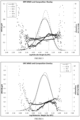
- the GPC MWD profile, and corresponding comonomer distribution overlay, is shown in Figure 5 .
- Monolayer cast films of inventive composition 3 and comparative composition D were fabricated on a 5 layer, Egan Davis Standard coextrusion cast film line. Film thickness was maintained at 0.8 mil (0.0008 in or 0.02 mm).
- the cast line consisted of three 2-1/2" and two 2" "30:1 L/D Egan Davis Standard MAC extruders," which are air cooled. All extruders had moderate work DSB (Davis Standard Barrier) type screws.
- a CMR 2000 microprocessor monitored and controlled the operations. The extrusion process was monitored by pressure transducers, located before, and after, the breaker plate, as well as by four heater zones on each barrel, one each at the adapter and the block and two zones on the die. The microprocessor also tracked the extruder RPM, %FLA, HP, rate, line speed, % draw, primary and secondary chill roll temperatures, gauge deviation, layer ratio, rate/RPM, and melt temperature for each extruder.
- inventive example 3 showed significantly higher toughness (as indicated by dart drop impact values) than comparative composition D. It is believed that the improved film toughness from the inventive compositions is a result of their high MWCDI values. From a molecular structure standpoint, a high MWCDI value indicates comonomers are more favorably incorporated (a higher incorporation of comonomer and a better distribution of comonomer) in the high molecular weight polymer molecules, rather than in the low molecular weight polymer molecules.
- the inventive compositions also have low LCB, as indicated by low ZSVR, as compared to conventional polymers. As a result the polymer contains more tie chains, and therefore, provides better film toughness.
- the inventive compositions also have significantly high I 10 /I 2 values, indicating good processability of these compositions.
- inventive composition 4 is the same as inventive composition 3 (above) and was prepared in the same way as inventive composition 3.
- inventive composition 4 is referred to as inventive composition 4 in this example because a different cast film is formed from it.
- inventive composition 5 contains an ethylene-octene copolymer.
- inventive composition 5 was prepared in the same manner and using the same catalyst system as inventive compositions 1-3, with the exception of the polymerization conditions which are reported in Table 4.
- Comparative composition E is an ethylene-octene copolymer composition, commercially available under the commercial designation ELITE 5230G from the Dow Chemical Company, and having a density of approximately 0.916 g/cm 3 and a melt index (I 2 or I2), measured at 190°C and 2.16 kg, of approximately 4.0 g/10 minutes. Additional properties of the comparative composition E were measured, and are reported in Table 5.
- Monolayer cast films of inventive compositions 4 and 5, and of comparative composition E were fabricated on a 5 layer Egan Davis Standard coextrusion cast film line.
- the cast line consisted of three 2-1/2" and two 2" 30:1 L/D Egan Davis Standard MAC extruders, which are air cooled. All extruders had moderate work DSB (Davis Standard Barrier) type screws.
- a CMR 2000 microprocessor monitored and controlled the operations. The extrusion process was monitored by pressure transducers, located before, and after, the breaker plate, as well as by four heater zones on each barrel, one each at the adapter and the block and two zones on the die.
- the microprocessor also tracked the extruder RPM, %FLA, HP, rate, line speed, % draw, primary and secondary chill roll temperatures, gauge deviation, layer ratio, rate/RPM, and melt temperature for each extruder.
- Monolayer cast films for inventive compositions 4 and 5, and for comparative composition E were fabricated based on the following conditions to provide films having a nominal thickness of 0.8 mils (0.0008 inches):
- Monolayer cast films for inventive compositions 4 and 5, and for comparative composition E were also fabricated based on the following conditions to provide films having a nominal thickness of 0.5 mils (0.0005 inches):
- Table 6A and 6B Film properties are shown in Table 6A and 6B.
- Table 6A Cast Film Properties Unit Inv. Comp. 4 Inv. Comp. 5 Comp. Comp. E Nominal film thickness mil 0.8 0.8 0.8 Dart Drop Impact (Method-A) g 700 559 472 Tear (MD) g 297 297 276 Tear (CD) g 460 387 507 Puncture Strength ft*lbf/in 3 294 243 264 Ultimate Stretch % 369 387 349 Lantech Puncture @250% prestretch lbs 8 10 9 Stretch Force @200% lbs 53 53 56 Tensile Strength- MD psi 4483 3790 5032 Tensile Strength - CD psi 3649 3708 3760
- Table 6B Cast Film Properties Unit Inv.
- Comp. 4 Inv. Comp. 5 Comp. Comp. E Nominal film thickness mil 0.5 0.5 0.5 0.5 Dart Drop Impact (Method-A) g 727 763 409 Tear (MD) g 255 228 177 Tear (CD) g 426 403 391 Puncture Strength ft*lbf/in 3 330 260 - - Ultimate Stretch % 316 340 268 Lantech Puncture @200% prestretch lbs 9 9 11 Stretch Force @200% lbs 34 35 40 Tensile Strength- MD psi 4605 4187 5704 Tensile Strength - CD psi 3701 3445 3594
- inventive examples 4 and 5 showed significantly higher toughness (as indicated by dart drop impact values) than comparative composition E. It is believed that the improved film toughness from the inventive compositions is a result of their high MWCDI values. From a molecular structure standpoint, a high MWCDI value indicates comonomers are more favorably incorporated (a higher incorporation of comonomer and a better distribution of comonomer) in the high molecular weight polymer molecules, rather than in the low molecular weight polymer molecules.
- the inventive compositions also have low LCB, as indicated by low ZSVR, as compared to conventional polymers. As a result the polymer contains more tie chains, and therefore, provides better film toughness.
- the inventive compositions also have significantly high I 10 /I 2 values, indicating good processability of these compositions.
Landscapes
- Chemical & Material Sciences (AREA)
- Health & Medical Sciences (AREA)
- Chemical Kinetics & Catalysis (AREA)
- Medicinal Chemistry (AREA)
- Polymers & Plastics (AREA)
- Organic Chemistry (AREA)
- Addition Polymer Or Copolymer, Post-Treatments, Or Chemical Modifications (AREA)
- Laminated Bodies (AREA)
- Transition And Organic Metals Composition Catalysts For Addition Polymerization (AREA)
- Manufacture Of Macromolecular Shaped Articles (AREA)
- Compositions Of Macromolecular Compounds (AREA)
Applications Claiming Priority (4)
| Application Number | Priority Date | Filing Date | Title |
|---|---|---|---|
| US201462017525P | 2014-06-26 | 2014-06-26 | |
| US201562152414P | 2015-04-24 | 2015-04-24 | |
| EP15742149.6A EP3160742B1 (fr) | 2014-06-26 | 2015-06-26 | Films coûlés ayant une ténacité améliorée |
| PCT/US2015/037871 WO2015200742A1 (fr) | 2014-06-26 | 2015-06-26 | Films coulés présentant une meilleure ténacité |
Related Parent Applications (2)
| Application Number | Title | Priority Date | Filing Date |
|---|---|---|---|
| EP15742149.6A Division EP3160742B1 (fr) | 2014-06-26 | 2015-06-26 | Films coûlés ayant une ténacité améliorée |
| EP15742149.6A Division-Into EP3160742B1 (fr) | 2014-06-26 | 2015-06-26 | Films coûlés ayant une ténacité améliorée |
Publications (2)
| Publication Number | Publication Date |
|---|---|
| EP4534595A2 true EP4534595A2 (fr) | 2025-04-09 |
| EP4534595A3 EP4534595A3 (fr) | 2025-07-09 |
Family
ID=53724448
Family Applications (2)
| Application Number | Title | Priority Date | Filing Date |
|---|---|---|---|
| EP25159155.8A Pending EP4534595A3 (fr) | 2014-06-26 | 2015-06-26 | Films coulés présentant une ténacité améliorée |
| EP15742149.6A Active EP3160742B1 (fr) | 2014-06-26 | 2015-06-26 | Films coûlés ayant une ténacité améliorée |
Family Applications After (1)
| Application Number | Title | Priority Date | Filing Date |
|---|---|---|---|
| EP15742149.6A Active EP3160742B1 (fr) | 2014-06-26 | 2015-06-26 | Films coûlés ayant une ténacité améliorée |
Country Status (10)
| Country | Link |
|---|---|
| US (1) | US20170129230A1 (fr) |
| EP (2) | EP4534595A3 (fr) |
| JP (1) | JP6824043B2 (fr) |
| CN (1) | CN106470838B (fr) |
| BR (1) | BR112016029258B1 (fr) |
| CA (1) | CA2952031C (fr) |
| ES (1) | ES3032493T3 (fr) |
| MX (1) | MX2016016600A (fr) |
| MY (1) | MY177077A (fr) |
| WO (1) | WO2015200742A1 (fr) |
Families Citing this family (26)
| Publication number | Priority date | Publication date | Assignee | Title |
|---|---|---|---|---|
| US20170152377A1 (en) * | 2014-06-26 | 2017-06-01 | Dow Global Technologies Llc | Breathable films and articles incorporating same |
| JP6825917B2 (ja) | 2014-06-26 | 2021-02-03 | ダウ グローバル テクノロジーズ エルエルシー | 改善された靭性を有するブローフィルム |
| WO2016003880A1 (fr) * | 2014-06-30 | 2016-01-07 | Dow Global Technologies Llc | Polymères éthyléniques |
| CA2868640C (fr) * | 2014-10-21 | 2021-10-26 | Nova Chemicals Corporation | Procede de polymerisation de solution |
| CN108495875B (zh) * | 2016-02-12 | 2021-10-15 | 陶氏环球技术有限责任公司 | 流延膜和由其制成的制品 |
| US20170342249A1 (en) * | 2016-05-26 | 2017-11-30 | Exxonmobil Chemical Patents Inc. | Multilayer Films and Methods of Making the Same |
| WO2018063581A1 (fr) * | 2016-09-27 | 2018-04-05 | Dow Global Technologies Llc | Films ayant des propriétés mécaniques souhaitables et articles fabriqués à partir de ceux-ci |
| EP3519189B9 (fr) | 2016-09-29 | 2022-04-20 | Dow Global Technologies LLC | Films étirables multicouche et leurs procédés de fabrication |
| BR112019005809B1 (pt) * | 2016-09-30 | 2023-02-28 | Dow Global Technologies Llc | Resina para uso como camada de ligação em uma estrutura multicamada, pelete, estrutura multicamada e artigo |
| AR111718A1 (es) * | 2017-04-19 | 2019-08-14 | Dow Global Technologies Llc | Estructuras de laminados y materiales de empaque flexibles que las incluyen |
| AR112359A1 (es) * | 2017-06-30 | 2019-10-23 | Dow Global Technologies Llc | Laminados de polietileno para usar en materiales de embalaje flexibles |
| JP7221942B2 (ja) * | 2017-09-22 | 2023-02-14 | ダウ グローバル テクノロジーズ エルエルシー | 熱成形プロセス後の強化された靭性を有する熱成形フィルム組成物 |
| KR102133030B1 (ko) * | 2017-12-18 | 2020-07-10 | 주식회사 엘지화학 | 올레핀 중합체, 이의 제조 방법, 그리고 이를 이용한 필름 |
| MX2020005377A (es) * | 2017-12-20 | 2020-08-17 | Dow Global Technologies Llc | Peliculas fundidas multicapa y metodos para elaborarlas. |
| US11603452B2 (en) | 2017-12-26 | 2023-03-14 | Dow Global Technologies Llc | Multimodal ethylene-based polymer compositions having improved toughness |
| EP3732215B8 (fr) | 2017-12-26 | 2022-04-27 | Dow Global Technologies LLC | Procédé en solution à double réacteur pour la production d'un polymère multimodal à base d'éthylène |
| SG11202005777XA (en) | 2017-12-26 | 2020-07-29 | Dow Global Technologies Llc | Multimodal ethylene-based polymer processing systems and methods |
| SG11202005779SA (en) | 2017-12-26 | 2020-07-29 | Dow Global Technologies Llc | Compositions comprising multimodal ethylene based polymers and low density polyethylene (ldpe) |
| EP3732216B1 (fr) | 2017-12-26 | 2023-04-19 | Dow Global Technologies LLC | Procédé de production de polymères à base d'éthylène multimodaux |
| US11180682B2 (en) | 2018-10-05 | 2021-11-23 | Voxel Evolution, Llc | Method and system to provide a repositionable translucent cast vinyl film with an air-egress adhesive layer |
| WO2021243145A1 (fr) * | 2020-05-29 | 2021-12-02 | Dow Global Technologies Llc | Catalyseurs convertis par voie chimique |
| US12606696B2 (en) * | 2020-10-14 | 2026-04-21 | Dow Global Technologies Llc | Polyethylene compositions suitable for use in cast stretch films |
| KR20230155453A (ko) * | 2021-02-15 | 2023-11-10 | 다우 글로벌 테크놀로지스 엘엘씨 | 역상 공단량체 분포를 갖는 폴리(에틸렌-코-1-알켄) 공중합체의 제조 방법 |
| CN121443682A (zh) | 2023-06-28 | 2026-01-30 | 陶氏环球技术有限责任公司 | 三峰的基于乙烯的聚合物 |
| KR20260028696A (ko) | 2023-06-28 | 2026-03-04 | 다우 글로벌 테크놀로지스 엘엘씨 | 가공성 및 남용 저항성의 우수한 조합을 갖는 중합체 필름 |
| CN121399176A (zh) | 2023-06-28 | 2026-01-23 | 陶氏环球技术有限责任公司 | 用于制备多峰的基于乙烯的聚合物的方法 |
Citations (27)
| Publication number | Priority date | Publication date | Assignee | Title |
|---|---|---|---|---|
| US4314912A (en) | 1977-02-03 | 1982-02-09 | The Dow Chemical Company | High efficiency, high temperature catalyst for polymerizing olefins |
| US4547475A (en) | 1984-09-07 | 1985-10-15 | The Dow Chemical Company | Magnesium halide catalyst support and transition metal catalyst prepared thereon |
| US4612300A (en) | 1985-06-06 | 1986-09-16 | The Dow Chemical Company | Novel catalyst for producing relatively narrow molecular weight distribution olefin polymers |
| US5064802A (en) | 1989-09-14 | 1991-11-12 | The Dow Chemical Company | Metal complex compounds |
| US5153157A (en) | 1987-01-30 | 1992-10-06 | Exxon Chemical Patents Inc. | Catalyst system of enhanced productivity |
| US5296433A (en) | 1992-04-14 | 1994-03-22 | Minnesota Mining And Manufacturing Company | Tris(pentafluorophenyl)borane complexes and catalysts derived therefrom |
| US5321106A (en) | 1990-07-03 | 1994-06-14 | The Dow Chemical Company | Addition polymerization catalyst with oxidative activation |
| US5350723A (en) | 1992-05-15 | 1994-09-27 | The Dow Chemical Company | Process for preparation of monocyclopentadienyl metal complex compounds and method of use |
| US5425872A (en) | 1993-06-24 | 1995-06-20 | The Dow Chemical Company | Electrochemical preparation of addition polymerization catalysts |
| US5625087A (en) | 1994-09-12 | 1997-04-29 | The Dow Chemical Company | Silylium cationic polymerization activators for metallocene complexes |
| US5677383A (en) | 1991-10-15 | 1997-10-14 | The Dow Chemical Company | Fabricated articles made from ethylene polymer blends |
| US5721185A (en) | 1991-06-24 | 1998-02-24 | The Dow Chemical Company | Homogeneous olefin polymerization catalyst by abstraction with lewis acids |
| US5783512A (en) | 1996-12-18 | 1998-07-21 | The Dow Chemical Company | Catalyst component dispersion comprising an ionic compound and solid addition polymerization catalysts containing the same |
| US5844045A (en) | 1993-01-29 | 1998-12-01 | The Dow Chemical Company | Ethylene interpolymerizations |
| US5869575A (en) | 1995-08-02 | 1999-02-09 | The Dow Chemical Company | Ethylene interpolymerizations |
| US5883204A (en) | 1996-03-27 | 1999-03-16 | The Dow Chemical Company | Solution polymerization process with dispersed catalyst activator |
| US5919983A (en) | 1996-03-27 | 1999-07-06 | The Dow Chemical Company | Highly soluble olefin polymerization catalyst activator |
| US5977251A (en) | 1996-04-01 | 1999-11-02 | The Dow Chemical Company | Non-adiabatic olefin solution polymerization |
| US6103657A (en) | 1997-07-02 | 2000-08-15 | Union Carbide Chemicals & Plastics Technology Corporation | Catalyst for the production of olefin polymers |
| US6111023A (en) | 1991-10-15 | 2000-08-29 | The Dow Chemical Company | Fabricated articles made from ethylene polymer blends |
| US6448341B1 (en) | 1993-01-29 | 2002-09-10 | The Dow Chemical Company | Ethylene interpolymer blend compositions |
| US6515155B1 (en) | 1999-12-10 | 2003-02-04 | Dow Global Technologies Inc. | Substituted group 4 metal complexes, catalysts and olefin polymerization process |
| US6566446B1 (en) | 1991-12-30 | 2003-05-20 | Dow Global Technologies Inc. | Ethylene interpolymer polymerizations |
| US6696379B1 (en) | 1997-09-19 | 2004-02-24 | The Dow Chemical Company | Supported modified alumoxane catalyst activator |
| US7163907B1 (en) | 1987-01-30 | 2007-01-16 | Exxonmobil Chemical Patents Inc. | Aluminum-free monocyclopentadienyl metallocene catalysts for olefin polymerization |
| WO2014058639A1 (fr) | 2012-10-09 | 2014-04-17 | Dow Global Technologies Llc | Composition d'étanchéité |
| US20150148490A1 (en) | 2012-12-27 | 2015-05-28 | Dow Global Technologies Llc | Polyolefin composition |
Family Cites Families (17)
| Publication number | Priority date | Publication date | Assignee | Title |
|---|---|---|---|---|
| US5399426A (en) * | 1992-10-19 | 1995-03-21 | The Dow Chemical Company | Polyethylene stretch films |
| JPH09309926A (ja) * | 1996-05-17 | 1997-12-02 | Dow Chem Co:The | エチレン共重合体の製造方法 |
| NZ336307A (en) * | 1996-12-12 | 2001-11-30 | Dow Chemical Co | Interpolymer composition containing ethylene/alpha olefin interpolymer and cast stretch film therefrom |
| BRPI0711690B1 (pt) * | 2006-06-15 | 2018-05-08 | Dow Global Technologies Inc | composição e artigo |
| EP2052857A1 (fr) * | 2007-10-22 | 2009-04-29 | Dow Global Technologies Inc. | Films multicouches |
| WO2010015402A1 (fr) * | 2008-08-07 | 2010-02-11 | Cryovac, Inc. | Structures multicouches comprenant une séquence de microcouches |
| CN102227449A (zh) * | 2008-12-11 | 2011-10-26 | Lg化学株式会社 | 复合载体茂金属催化剂、制备该催化剂的方法以及使用该催化剂制备基于烯烃的聚合物的方法 |
| US8829115B2 (en) * | 2009-07-01 | 2014-09-09 | Dow Global Technologies Llc | Ethylene-based polymer composition |
| US8784996B2 (en) * | 2009-11-24 | 2014-07-22 | Dow Global Technologies Llc | Extrusion coating composition |
| BR112012005698B1 (pt) * | 2010-11-02 | 2021-05-25 | Dow Global Technologies Llc | composição seladora, método para produzir uma composição seladora, camada selante, artigo e método para formar um artigo |
| MX350943B (es) * | 2011-10-05 | 2017-09-26 | Dow Global Technologies Llc | Telas no tejidas hiladas por adhesión. |
| JP2015523446A (ja) * | 2012-07-20 | 2015-08-13 | ダウ グローバル テクノロジーズ エルエルシー | キャストフィルムに好適な直鎖状低密度ポリエチレン組成物 |
| WO2014081505A1 (fr) * | 2012-11-21 | 2014-05-30 | Exxonmobil Chemical Patents Inc. | Films comportant des polymères à base d'éthylène et procédés de fabrication de ceux-ci |
| ES2663020T3 (es) * | 2012-12-14 | 2018-04-10 | Nova Chemicals (International) S.A. | Composiciones, película y procesos de la polimerización de copolímeros de etileno |
| CA2800056A1 (fr) * | 2012-12-24 | 2014-06-24 | Nova Chemicals Corporation | Compositions de melange de polyethylene |
| JP6825917B2 (ja) * | 2014-06-26 | 2021-02-03 | ダウ グローバル テクノロジーズ エルエルシー | 改善された靭性を有するブローフィルム |
| US20170152377A1 (en) * | 2014-06-26 | 2017-06-01 | Dow Global Technologies Llc | Breathable films and articles incorporating same |
-
2015
- 2015-06-26 BR BR112016029258-8A patent/BR112016029258B1/pt active IP Right Grant
- 2015-06-26 JP JP2016573124A patent/JP6824043B2/ja active Active
- 2015-06-26 EP EP25159155.8A patent/EP4534595A3/fr active Pending
- 2015-06-26 WO PCT/US2015/037871 patent/WO2015200742A1/fr not_active Ceased
- 2015-06-26 CN CN201580032877.1A patent/CN106470838B/zh active Active
- 2015-06-26 US US15/318,162 patent/US20170129230A1/en not_active Abandoned
- 2015-06-26 MY MYPI2016002228A patent/MY177077A/en unknown
- 2015-06-26 EP EP15742149.6A patent/EP3160742B1/fr active Active
- 2015-06-26 CA CA2952031A patent/CA2952031C/fr active Active
- 2015-06-26 ES ES15742149T patent/ES3032493T3/es active Active
- 2015-06-26 MX MX2016016600A patent/MX2016016600A/es unknown
Patent Citations (28)
| Publication number | Priority date | Publication date | Assignee | Title |
|---|---|---|---|---|
| US4314912A (en) | 1977-02-03 | 1982-02-09 | The Dow Chemical Company | High efficiency, high temperature catalyst for polymerizing olefins |
| US4547475A (en) | 1984-09-07 | 1985-10-15 | The Dow Chemical Company | Magnesium halide catalyst support and transition metal catalyst prepared thereon |
| US4612300A (en) | 1985-06-06 | 1986-09-16 | The Dow Chemical Company | Novel catalyst for producing relatively narrow molecular weight distribution olefin polymers |
| US7163907B1 (en) | 1987-01-30 | 2007-01-16 | Exxonmobil Chemical Patents Inc. | Aluminum-free monocyclopentadienyl metallocene catalysts for olefin polymerization |
| US5153157A (en) | 1987-01-30 | 1992-10-06 | Exxon Chemical Patents Inc. | Catalyst system of enhanced productivity |
| US5064802A (en) | 1989-09-14 | 1991-11-12 | The Dow Chemical Company | Metal complex compounds |
| US5321106A (en) | 1990-07-03 | 1994-06-14 | The Dow Chemical Company | Addition polymerization catalyst with oxidative activation |
| US5721185A (en) | 1991-06-24 | 1998-02-24 | The Dow Chemical Company | Homogeneous olefin polymerization catalyst by abstraction with lewis acids |
| US6111023A (en) | 1991-10-15 | 2000-08-29 | The Dow Chemical Company | Fabricated articles made from ethylene polymer blends |
| US5677383A (en) | 1991-10-15 | 1997-10-14 | The Dow Chemical Company | Fabricated articles made from ethylene polymer blends |
| US6566446B1 (en) | 1991-12-30 | 2003-05-20 | Dow Global Technologies Inc. | Ethylene interpolymer polymerizations |
| US5296433A (en) | 1992-04-14 | 1994-03-22 | Minnesota Mining And Manufacturing Company | Tris(pentafluorophenyl)borane complexes and catalysts derived therefrom |
| US5350723A (en) | 1992-05-15 | 1994-09-27 | The Dow Chemical Company | Process for preparation of monocyclopentadienyl metal complex compounds and method of use |
| US5844045A (en) | 1993-01-29 | 1998-12-01 | The Dow Chemical Company | Ethylene interpolymerizations |
| US6448341B1 (en) | 1993-01-29 | 2002-09-10 | The Dow Chemical Company | Ethylene interpolymer blend compositions |
| US5425872A (en) | 1993-06-24 | 1995-06-20 | The Dow Chemical Company | Electrochemical preparation of addition polymerization catalysts |
| US5625087A (en) | 1994-09-12 | 1997-04-29 | The Dow Chemical Company | Silylium cationic polymerization activators for metallocene complexes |
| US5869575A (en) | 1995-08-02 | 1999-02-09 | The Dow Chemical Company | Ethylene interpolymerizations |
| US5919983A (en) | 1996-03-27 | 1999-07-06 | The Dow Chemical Company | Highly soluble olefin polymerization catalyst activator |
| US5883204A (en) | 1996-03-27 | 1999-03-16 | The Dow Chemical Company | Solution polymerization process with dispersed catalyst activator |
| US5977251A (en) | 1996-04-01 | 1999-11-02 | The Dow Chemical Company | Non-adiabatic olefin solution polymerization |
| US5783512A (en) | 1996-12-18 | 1998-07-21 | The Dow Chemical Company | Catalyst component dispersion comprising an ionic compound and solid addition polymerization catalysts containing the same |
| US6103657A (en) | 1997-07-02 | 2000-08-15 | Union Carbide Chemicals & Plastics Technology Corporation | Catalyst for the production of olefin polymers |
| US6696379B1 (en) | 1997-09-19 | 2004-02-24 | The Dow Chemical Company | Supported modified alumoxane catalyst activator |
| US6515155B1 (en) | 1999-12-10 | 2003-02-04 | Dow Global Technologies Inc. | Substituted group 4 metal complexes, catalysts and olefin polymerization process |
| WO2014058639A1 (fr) | 2012-10-09 | 2014-04-17 | Dow Global Technologies Llc | Composition d'étanchéité |
| US20150148490A1 (en) | 2012-12-27 | 2015-05-28 | Dow Global Technologies Llc | Polyolefin composition |
| US20150148491A1 (en) | 2012-12-27 | 2015-05-28 | Dow Global Technologies Llc | Polyolefin composition |
Non-Patent Citations (7)
| Title |
|---|
| "Am. Chem. Soc.", 1984 |
| BUSICO, V. ET AL., MACROMOLECULES, vol. 38, 2005, pages 6988 |
| J. C. RANDALL ET AL.: "NMR and Macromolecules", ACS SYMPOSIUM, pages 247 |
| J. C. RANDALL: "Polymer Sequence Determination", 1977, ACADEMIC PRESS |
| KARJALA ET AL.: "Detection of Low Levels of Long-chain Branching in Polyolefins", ANNUAL TECHNICAL CONFERENCE - SOCIETY OF PLASTICS ENGINEERS, 2008, pages 887 - 891 |
| WILLIAMSWARD, J. POLYM. SCI., POLYM. LET., vol. 6, 1968, pages 621 |
| WILLIAMSWARD, J. POLYM. SCI., POLYM. LETTERS, vol. 6, 1968, pages 621 |
Also Published As
| Publication number | Publication date |
|---|---|
| EP4534595A3 (fr) | 2025-07-09 |
| EP3160742A1 (fr) | 2017-05-03 |
| MY177077A (en) | 2020-09-04 |
| CA2952031C (fr) | 2022-10-04 |
| JP6824043B2 (ja) | 2021-02-03 |
| ES3032493T3 (en) | 2025-07-21 |
| BR112016029258B1 (pt) | 2022-06-07 |
| WO2015200742A1 (fr) | 2015-12-30 |
| EP3160742B1 (fr) | 2025-04-30 |
| JP2017522409A (ja) | 2017-08-10 |
| CA2952031A1 (fr) | 2015-12-30 |
| BR112016029258A2 (pt) | 2017-08-22 |
| US20170129230A1 (en) | 2017-05-11 |
| CN106470838B (zh) | 2019-05-17 |
| CN106470838A (zh) | 2017-03-01 |
| MX2016016600A (es) | 2017-04-27 |
Similar Documents
| Publication | Publication Date | Title |
|---|---|---|
| EP3160742B1 (fr) | Films coûlés ayant une ténacité améliorée | |
| EP3160740B1 (fr) | Films préparés en extrusion soufflage ayant une ténacité améliorée | |
| EP3160739B1 (fr) | Composition polymère à base d'éthylène pour films ayant une ténacité accrue | |
| US20230079895A1 (en) | Resins for use as tie layers in multilayer films and multilayer films comprising the same | |
| EP3645271B1 (fr) | Polyéthylène laminés à utiliser dans des matériaux d'emballage flexibles | |
| EP3519190B1 (fr) | Films soufflés possédant des propriétés améliorées | |
| EP3645272B1 (fr) | Lamines de polyéthylène multicouches et films destinés à être utilisés dans des matériaux d'emballage flexibles | |
| EP3946938B1 (fr) | Films multicouches, stratifiés et articles comprenant des films multicouches | |
| US20200047460A1 (en) | Laminate structures and flexible packaging materials incorporating same | |
| EP3684850B1 (fr) | Compositions de film thermoformé présentant une ténacité améliorée après des procédés de thermoformage |
Legal Events
| Date | Code | Title | Description |
|---|---|---|---|
| PUAI | Public reference made under article 153(3) epc to a published international application that has entered the european phase |
Free format text: ORIGINAL CODE: 0009012 |
|
| STAA | Information on the status of an ep patent application or granted ep patent |
Free format text: STATUS: REQUEST FOR EXAMINATION WAS MADE |
|
| 17P | Request for examination filed |
Effective date: 20250220 |
|
| AC | Divisional application: reference to earlier application |
Ref document number: 3160742 Country of ref document: EP Kind code of ref document: P |
|
| AK | Designated contracting states |
Kind code of ref document: A2 Designated state(s): AL AT BE BG CH CY CZ DE DK EE ES FI FR GB GR HR HU IE IS IT LI LT LU LV MC MK MT NL NO PL PT RO RS SE SI SK SM TR |
|
| REG | Reference to a national code |
Ref country code: DE Ref legal event code: R079 Free format text: PREVIOUS MAIN CLASS: C08L0023080000 Ipc: B32B0027060000 |
|
| PUAL | Search report despatched |
Free format text: ORIGINAL CODE: 0009013 |
|
| AK | Designated contracting states |
Kind code of ref document: A3 Designated state(s): AL AT BE BG CH CY CZ DE DK EE ES FI FR GB GR HR HU IE IS IT LI LT LU LV MC MK MT NL NO PL PT RO RS SE SI SK SM TR |
|
| RIC1 | Information provided on ipc code assigned before grant |
Ipc: C08L 23/08 20250101ALI20250603BHEP Ipc: C08F 4/64 20060101ALI20250603BHEP Ipc: C08F 210/16 20060101ALI20250603BHEP Ipc: B32B 27/32 20060101ALI20250603BHEP Ipc: B32B 27/06 20060101AFI20250603BHEP |