EP4541920A1 - Matériau d'acier inoxydable ferritique pour composants de batterie, son procédé de production et composant de batterie - Google Patents
Matériau d'acier inoxydable ferritique pour composants de batterie, son procédé de production et composant de batterie Download PDFInfo
- Publication number
- EP4541920A1 EP4541920A1 EP23871733.4A EP23871733A EP4541920A1 EP 4541920 A1 EP4541920 A1 EP 4541920A1 EP 23871733 A EP23871733 A EP 23871733A EP 4541920 A1 EP4541920 A1 EP 4541920A1
- Authority
- EP
- European Patent Office
- Prior art keywords
- stainless steel
- steel material
- ferritic stainless
- battery components
- content
- Prior art date
- Legal status (The legal status is an assumption and is not a legal conclusion. Google has not performed a legal analysis and makes no representation as to the accuracy of the status listed.)
- Pending
Links
Images
Classifications
-
- C—CHEMISTRY; METALLURGY
- C21—METALLURGY OF IRON
- C21D—MODIFYING THE PHYSICAL STRUCTURE OF FERROUS METALS; GENERAL DEVICES FOR HEAT TREATMENT OF FERROUS OR NON-FERROUS METALS OR ALLOYS; MAKING METAL MALLEABLE, e.g. BY DECARBURISATION OR TEMPERING
- C21D9/00—Heat treatment, e.g. annealing, hardening, quenching or tempering, adapted for particular articles; Furnaces therefor
- C21D9/46—Heat treatment, e.g. annealing, hardening, quenching or tempering, adapted for particular articles; Furnaces therefor for sheet metals
-
- C—CHEMISTRY; METALLURGY
- C21—METALLURGY OF IRON
- C21D—MODIFYING THE PHYSICAL STRUCTURE OF FERROUS METALS; GENERAL DEVICES FOR HEAT TREATMENT OF FERROUS OR NON-FERROUS METALS OR ALLOYS; MAKING METAL MALLEABLE, e.g. BY DECARBURISATION OR TEMPERING
- C21D1/00—General methods or devices for heat treatment, e.g. annealing, hardening, quenching or tempering
- C21D1/26—Methods of annealing
-
- C—CHEMISTRY; METALLURGY
- C21—METALLURGY OF IRON
- C21D—MODIFYING THE PHYSICAL STRUCTURE OF FERROUS METALS; GENERAL DEVICES FOR HEAT TREATMENT OF FERROUS OR NON-FERROUS METALS OR ALLOYS; MAKING METAL MALLEABLE, e.g. BY DECARBURISATION OR TEMPERING
- C21D8/00—Modifying the physical properties of ferrous metals or ferrous alloys by deformation combined with, or followed by, heat treatment
- C21D8/02—Modifying the physical properties of ferrous metals or ferrous alloys by deformation combined with, or followed by, heat treatment during manufacturing of plates or strips
-
- C—CHEMISTRY; METALLURGY
- C21—METALLURGY OF IRON
- C21D—MODIFYING THE PHYSICAL STRUCTURE OF FERROUS METALS; GENERAL DEVICES FOR HEAT TREATMENT OF FERROUS OR NON-FERROUS METALS OR ALLOYS; MAKING METAL MALLEABLE, e.g. BY DECARBURISATION OR TEMPERING
- C21D8/00—Modifying the physical properties of ferrous metals or ferrous alloys by deformation combined with, or followed by, heat treatment
- C21D8/02—Modifying the physical properties of ferrous metals or ferrous alloys by deformation combined with, or followed by, heat treatment during manufacturing of plates or strips
- C21D8/0221—Modifying the physical properties of ferrous metals or ferrous alloys by deformation combined with, or followed by, heat treatment during manufacturing of plates or strips characterised by the working steps
- C21D8/0236—Cold rolling
-
- C—CHEMISTRY; METALLURGY
- C21—METALLURGY OF IRON
- C21D—MODIFYING THE PHYSICAL STRUCTURE OF FERROUS METALS; GENERAL DEVICES FOR HEAT TREATMENT OF FERROUS OR NON-FERROUS METALS OR ALLOYS; MAKING METAL MALLEABLE, e.g. BY DECARBURISATION OR TEMPERING
- C21D8/00—Modifying the physical properties of ferrous metals or ferrous alloys by deformation combined with, or followed by, heat treatment
- C21D8/02—Modifying the physical properties of ferrous metals or ferrous alloys by deformation combined with, or followed by, heat treatment during manufacturing of plates or strips
- C21D8/0247—Modifying the physical properties of ferrous metals or ferrous alloys by deformation combined with, or followed by, heat treatment during manufacturing of plates or strips characterised by the heat treatment
- C21D8/0273—Final recrystallisation annealing
-
- C—CHEMISTRY; METALLURGY
- C22—METALLURGY; FERROUS OR NON-FERROUS ALLOYS; TREATMENT OF ALLOYS OR NON-FERROUS METALS
- C22C—ALLOYS
- C22C38/00—Ferrous alloys, e.g. steel alloys
- C22C38/001—Ferrous alloys, e.g. steel alloys containing N
-
- C—CHEMISTRY; METALLURGY
- C22—METALLURGY; FERROUS OR NON-FERROUS ALLOYS; TREATMENT OF ALLOYS OR NON-FERROUS METALS
- C22C—ALLOYS
- C22C38/00—Ferrous alloys, e.g. steel alloys
- C22C38/002—Ferrous alloys, e.g. steel alloys containing In, Mg, or other elements not provided for in one single group C22C38/001 - C22C38/60
-
- C—CHEMISTRY; METALLURGY
- C22—METALLURGY; FERROUS OR NON-FERROUS ALLOYS; TREATMENT OF ALLOYS OR NON-FERROUS METALS
- C22C—ALLOYS
- C22C38/00—Ferrous alloys, e.g. steel alloys
- C22C38/004—Very low carbon steels, i.e. having a carbon content of less than 0,01%
-
- C—CHEMISTRY; METALLURGY
- C22—METALLURGY; FERROUS OR NON-FERROUS ALLOYS; TREATMENT OF ALLOYS OR NON-FERROUS METALS
- C22C—ALLOYS
- C22C38/00—Ferrous alloys, e.g. steel alloys
- C22C38/005—Ferrous alloys, e.g. steel alloys containing rare earths, i.e. Sc, Y, Lanthanides
-
- C—CHEMISTRY; METALLURGY
- C22—METALLURGY; FERROUS OR NON-FERROUS ALLOYS; TREATMENT OF ALLOYS OR NON-FERROUS METALS
- C22C—ALLOYS
- C22C38/00—Ferrous alloys, e.g. steel alloys
- C22C38/008—Ferrous alloys, e.g. steel alloys containing tin
-
- C—CHEMISTRY; METALLURGY
- C22—METALLURGY; FERROUS OR NON-FERROUS ALLOYS; TREATMENT OF ALLOYS OR NON-FERROUS METALS
- C22C—ALLOYS
- C22C38/00—Ferrous alloys, e.g. steel alloys
- C22C38/02—Ferrous alloys, e.g. steel alloys containing silicon
-
- C—CHEMISTRY; METALLURGY
- C22—METALLURGY; FERROUS OR NON-FERROUS ALLOYS; TREATMENT OF ALLOYS OR NON-FERROUS METALS
- C22C—ALLOYS
- C22C38/00—Ferrous alloys, e.g. steel alloys
- C22C38/04—Ferrous alloys, e.g. steel alloys containing manganese
-
- C—CHEMISTRY; METALLURGY
- C22—METALLURGY; FERROUS OR NON-FERROUS ALLOYS; TREATMENT OF ALLOYS OR NON-FERROUS METALS
- C22C—ALLOYS
- C22C38/00—Ferrous alloys, e.g. steel alloys
- C22C38/06—Ferrous alloys, e.g. steel alloys containing aluminium
-
- C—CHEMISTRY; METALLURGY
- C22—METALLURGY; FERROUS OR NON-FERROUS ALLOYS; TREATMENT OF ALLOYS OR NON-FERROUS METALS
- C22C—ALLOYS
- C22C38/00—Ferrous alloys, e.g. steel alloys
- C22C38/18—Ferrous alloys, e.g. steel alloys containing chromium
- C22C38/20—Ferrous alloys, e.g. steel alloys containing chromium with copper
-
- C—CHEMISTRY; METALLURGY
- C22—METALLURGY; FERROUS OR NON-FERROUS ALLOYS; TREATMENT OF ALLOYS OR NON-FERROUS METALS
- C22C—ALLOYS
- C22C38/00—Ferrous alloys, e.g. steel alloys
- C22C38/18—Ferrous alloys, e.g. steel alloys containing chromium
- C22C38/22—Ferrous alloys, e.g. steel alloys containing chromium with molybdenum or tungsten
-
- C—CHEMISTRY; METALLURGY
- C22—METALLURGY; FERROUS OR NON-FERROUS ALLOYS; TREATMENT OF ALLOYS OR NON-FERROUS METALS
- C22C—ALLOYS
- C22C38/00—Ferrous alloys, e.g. steel alloys
- C22C38/18—Ferrous alloys, e.g. steel alloys containing chromium
- C22C38/24—Ferrous alloys, e.g. steel alloys containing chromium with vanadium
-
- C—CHEMISTRY; METALLURGY
- C22—METALLURGY; FERROUS OR NON-FERROUS ALLOYS; TREATMENT OF ALLOYS OR NON-FERROUS METALS
- C22C—ALLOYS
- C22C38/00—Ferrous alloys, e.g. steel alloys
- C22C38/18—Ferrous alloys, e.g. steel alloys containing chromium
- C22C38/26—Ferrous alloys, e.g. steel alloys containing chromium with niobium or tantalum
-
- C—CHEMISTRY; METALLURGY
- C22—METALLURGY; FERROUS OR NON-FERROUS ALLOYS; TREATMENT OF ALLOYS OR NON-FERROUS METALS
- C22C—ALLOYS
- C22C38/00—Ferrous alloys, e.g. steel alloys
- C22C38/18—Ferrous alloys, e.g. steel alloys containing chromium
- C22C38/28—Ferrous alloys, e.g. steel alloys containing chromium with titanium or zirconium
-
- C—CHEMISTRY; METALLURGY
- C22—METALLURGY; FERROUS OR NON-FERROUS ALLOYS; TREATMENT OF ALLOYS OR NON-FERROUS METALS
- C22C—ALLOYS
- C22C38/00—Ferrous alloys, e.g. steel alloys
- C22C38/18—Ferrous alloys, e.g. steel alloys containing chromium
- C22C38/30—Ferrous alloys, e.g. steel alloys containing chromium with cobalt
-
- C—CHEMISTRY; METALLURGY
- C22—METALLURGY; FERROUS OR NON-FERROUS ALLOYS; TREATMENT OF ALLOYS OR NON-FERROUS METALS
- C22C—ALLOYS
- C22C38/00—Ferrous alloys, e.g. steel alloys
- C22C38/18—Ferrous alloys, e.g. steel alloys containing chromium
- C22C38/32—Ferrous alloys, e.g. steel alloys containing chromium with boron
-
- C—CHEMISTRY; METALLURGY
- C22—METALLURGY; FERROUS OR NON-FERROUS ALLOYS; TREATMENT OF ALLOYS OR NON-FERROUS METALS
- C22C—ALLOYS
- C22C38/00—Ferrous alloys, e.g. steel alloys
- C22C38/18—Ferrous alloys, e.g. steel alloys containing chromium
- C22C38/34—Ferrous alloys, e.g. steel alloys containing chromium with more than 1.5% by weight of silicon
-
- C—CHEMISTRY; METALLURGY
- C22—METALLURGY; FERROUS OR NON-FERROUS ALLOYS; TREATMENT OF ALLOYS OR NON-FERROUS METALS
- C22C—ALLOYS
- C22C38/00—Ferrous alloys, e.g. steel alloys
- C22C38/18—Ferrous alloys, e.g. steel alloys containing chromium
- C22C38/38—Ferrous alloys, e.g. steel alloys containing chromium with more than 1.5% by weight of manganese
-
- C—CHEMISTRY; METALLURGY
- C22—METALLURGY; FERROUS OR NON-FERROUS ALLOYS; TREATMENT OF ALLOYS OR NON-FERROUS METALS
- C22C—ALLOYS
- C22C38/00—Ferrous alloys, e.g. steel alloys
- C22C38/18—Ferrous alloys, e.g. steel alloys containing chromium
- C22C38/40—Ferrous alloys, e.g. steel alloys containing chromium with nickel
- C22C38/42—Ferrous alloys, e.g. steel alloys containing chromium with nickel with copper
-
- C—CHEMISTRY; METALLURGY
- C22—METALLURGY; FERROUS OR NON-FERROUS ALLOYS; TREATMENT OF ALLOYS OR NON-FERROUS METALS
- C22C—ALLOYS
- C22C38/00—Ferrous alloys, e.g. steel alloys
- C22C38/18—Ferrous alloys, e.g. steel alloys containing chromium
- C22C38/40—Ferrous alloys, e.g. steel alloys containing chromium with nickel
- C22C38/44—Ferrous alloys, e.g. steel alloys containing chromium with nickel with molybdenum or tungsten
-
- C—CHEMISTRY; METALLURGY
- C22—METALLURGY; FERROUS OR NON-FERROUS ALLOYS; TREATMENT OF ALLOYS OR NON-FERROUS METALS
- C22C—ALLOYS
- C22C38/00—Ferrous alloys, e.g. steel alloys
- C22C38/18—Ferrous alloys, e.g. steel alloys containing chromium
- C22C38/40—Ferrous alloys, e.g. steel alloys containing chromium with nickel
- C22C38/48—Ferrous alloys, e.g. steel alloys containing chromium with nickel with niobium or tantalum
-
- C—CHEMISTRY; METALLURGY
- C22—METALLURGY; FERROUS OR NON-FERROUS ALLOYS; TREATMENT OF ALLOYS OR NON-FERROUS METALS
- C22C—ALLOYS
- C22C38/00—Ferrous alloys, e.g. steel alloys
- C22C38/18—Ferrous alloys, e.g. steel alloys containing chromium
- C22C38/40—Ferrous alloys, e.g. steel alloys containing chromium with nickel
- C22C38/50—Ferrous alloys, e.g. steel alloys containing chromium with nickel with titanium or zirconium
-
- C—CHEMISTRY; METALLURGY
- C22—METALLURGY; FERROUS OR NON-FERROUS ALLOYS; TREATMENT OF ALLOYS OR NON-FERROUS METALS
- C22C—ALLOYS
- C22C38/00—Ferrous alloys, e.g. steel alloys
- C22C38/18—Ferrous alloys, e.g. steel alloys containing chromium
- C22C38/40—Ferrous alloys, e.g. steel alloys containing chromium with nickel
- C22C38/58—Ferrous alloys, e.g. steel alloys containing chromium with nickel with more than 1.5% by weight of manganese
-
- C—CHEMISTRY; METALLURGY
- C22—METALLURGY; FERROUS OR NON-FERROUS ALLOYS; TREATMENT OF ALLOYS OR NON-FERROUS METALS
- C22C—ALLOYS
- C22C38/00—Ferrous alloys, e.g. steel alloys
- C22C38/60—Ferrous alloys, e.g. steel alloys containing lead, selenium, tellurium, or antimony, or more than 0.04% by weight of sulfur
-
- C—CHEMISTRY; METALLURGY
- C21—METALLURGY OF IRON
- C21D—MODIFYING THE PHYSICAL STRUCTURE OF FERROUS METALS; GENERAL DEVICES FOR HEAT TREATMENT OF FERROUS OR NON-FERROUS METALS OR ALLOYS; MAKING METAL MALLEABLE, e.g. BY DECARBURISATION OR TEMPERING
- C21D2211/00—Microstructure comprising significant phases
- C21D2211/004—Dispersions; Precipitations
-
- C—CHEMISTRY; METALLURGY
- C21—METALLURGY OF IRON
- C21D—MODIFYING THE PHYSICAL STRUCTURE OF FERROUS METALS; GENERAL DEVICES FOR HEAT TREATMENT OF FERROUS OR NON-FERROUS METALS OR ALLOYS; MAKING METAL MALLEABLE, e.g. BY DECARBURISATION OR TEMPERING
- C21D2211/00—Microstructure comprising significant phases
- C21D2211/005—Ferrite
-
- H—ELECTRICITY
- H01—ELECTRIC ELEMENTS
- H01M—PROCESSES OR MEANS, e.g. BATTERIES, FOR THE DIRECT CONVERSION OF CHEMICAL ENERGY INTO ELECTRICAL ENERGY
- H01M50/00—Constructional details or processes of manufacture of the non-active parts of electrochemical cells other than fuel cells, e.g. hybrid cells
- H01M50/10—Primary casings; Jackets or wrappings
- H01M50/116—Primary casings; Jackets or wrappings characterised by the material
- H01M50/117—Inorganic material
- H01M50/119—Metals
-
- H—ELECTRICITY
- H01—ELECTRIC ELEMENTS
- H01M—PROCESSES OR MEANS, e.g. BATTERIES, FOR THE DIRECT CONVERSION OF CHEMICAL ENERGY INTO ELECTRICAL ENERGY
- H01M50/00—Constructional details or processes of manufacture of the non-active parts of electrochemical cells other than fuel cells, e.g. hybrid cells
- H01M50/10—Primary casings; Jackets or wrappings
- H01M50/14—Primary casings; Jackets or wrappings for protecting against damage caused by external factors
Definitions
- the present invention relates to a ferritic stainless steel material, a method for producing the same, and a battery component. More particularly, the present invention relates to a ferritic stainless steel material used for battery components of transportation equipment, a method for producing the same, and a battery component including the ferritic stainless steel material.
- the "transportation equipment” means equipment for transporting luggage or passengers for automobiles, motorcycles, tricycles, bicycles, buses, rail cars and the like.
- the “battery components” mean components of batteries, such as battery cases, battery packs, battery modules, and battery covers.
- the carbon steel is assumed to be heavily coated due to its low corrosion resistance capacity. Therefore, the carbon steel cannot be applied to uncoated components or lightly coated components, or has increased cost due to heavy coating.
- the carbon steel also has low heat resistance and cannot withstand thermal runaway that may occur in battery components.
- thermal runaway refers to a phenomenon in which heat inside a battery becomes uncontrollable for some reason, resulting in abnormal heat generation and, in some cases, ignition.
- a stainless steel material containing Cr has improved corrosion resistance compared to the carbon steel, and so it is expected to reduce weight by reducing a rust allowance (a thickness including anticipated rust) and omit coating.
- the stainless steel material also has improved heat resistance compared to the carbon steel, so that the former also has resistant to thermal runaway. Hence, safety can be improved by suppressing ignition and fire spread. Therefore, the use of the stainless steel material provides significant advantages such as improved fuel efficiency due to lighter body weight, simplification of coating, and improved safety.
- the electric vehicles are equipped with large-capacity batteries and run by motor drive, and are provided with many battery components. Since the electric vehicles are equipped with multiple batteries, a thermal runaway of one battery can easily lead to a chain reaction of thermal runaway of other batteries, possibly resulting in a vehicle fire.
- Materials used for battery components include stainless steel materials, aluminum, resins, and Ni plated steel materials.
- Patent Literature 1 discloses a method for producing a case for lithium ion batteries that use austenitic stainless steel foil as a material.
- Patent Literature 2 discloses that an austenitic stainless steel sheet is applied to a battery case for use in electric vehicles, which have improved heat resistance.
- Patent Literature 3 discloses a ferritic stainless steel material doped with 16.0 to 32.0% by mass of Cr, which is used as an electrode material and an electrode case for large-capacity batteries.
- Patent Literature 4 proposes a technique for providing an insulating layer to a laminate seal that makes up a case for rechargeable batteries. Also, each of Patent Literatures 5 to 7 also proposes a technique for suppressing thermal runaway of batteries by installing a member formed from mica in the battery components.
- an object of the present invention is to provide a ferritic stainless steel material for battery components that has improved protection performance and resistance to thermal runaway when the batteries are subjected to impacts due to collision accidents or the like; a method for producing the same; and a battery component.
- ferritic stainless steel materials with controlled compositions and amounts of predetermined deposits can solve the above problems.
- the present inventors have also found that the ferritic stainless steel material having such features can be obtained by annealing a cold-rolled material having a specific composition and cooling it under specific conditions.
- the present invention was completed on the basis of these findings.
- the present invention relates to a ferritic stainless steel material for battery components, the ferritic stainless steel material having a composition comprising, on a mass basis, C: 0.001 to 0.050%, Si: 0.01 to 2.00%, Mn: 0.01 to 2.00%, P: 0.010 to 0.050%, S: 0.0001 to 0.0100%, Cr: 10.0 to 30.0%, N: 0.001 to 0.050%, and further comprising one or more selected from Ti: 0.01 to 0.50% and Nb: 0.01 to 0.60%, the balance being Fe and impurities, wherein the ferritic stainless steel material comprises 0.010% by volume or more of Ti-based deposits and/or Nb-based deposits.
- the present invention also relates to a method for producing a ferritic stainless steel material for battery components, comprising: annealing a cold-rolled material at 850 to 1050°C, the cold-rolling member having a composition comprising, on a mass basis, C: 0.001 to 0.050%, Si: 0.01 to 2.00%, Mn: 0.01 to 2.00%, P: 0.010 to 0.050%, S: 0.0001 to 0.0100%, Cr: 10.0 to 30.0%, N: 0.001 to 0.050%, and further comprising one or more selected from Ti: 0.01 to 0.50% and Nb: 0.01 to 0.60%, the balance being Fe and impurities; and cooling it at a cooling rate of 10°C/second or less to 800°C.
- the present invention relates to a battery component comprising the ferritic stainless steel material for battery components.
- a ferritic stainless steel material for battery components that has improved protection performance and resistance to thermal runaway of batteries when they are subjected to impacts due to collision accidents or the like; a method for producing the same; and a battery component.
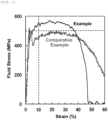
- FIG. 1 is a graph showing a relationship between strain and flow stress in a tensile test at a strain rate of 10 3 /second for a ferritic stainless steel material containing 0.010% by volume of Ti-based deposits and/or Nb-based deposits and a ferritic stainless steel material that does not contain Ti-based deposits and/or Nb-based deposits.
- an impact absorption property impact resistance
- a ferritic stainless steel material that will be a material for battery components
- a high-temperature stiffness of the ferritic stainless steel material should be improved.
- the flow stress at 10% strain in a tensile test at a strain rate of 10 3 /second was used to evaluate the impact absorption property during high-speed deformation
- Young's modulus at 900°C was used to evaluate the high-temperature stiffness
- various ferritic stainless steel materials were prepared, and analyzed and studied in detail.
- the present inventors have found that the impact absorption property during high-speed deformation and the high-temperature stiffness can be improved by controlling the composition of the ferritic stainless steel material and amounts of predetermined deposits.
- the ferritic stainless steel material for battery components according to an embodiment of the present invention (which may be, hereinafter, abbreviated as a "ferritic stainless steel material”) has a composition containing C: 0.001 to 0.050%, Si: 0.01 to 2.00%, Mn: 0.01 to 2.00%, P: 0.010 to 0.050%, S: 0.0001 to 0.0100%, Cr: 10.0 to 30.0%, N: 0.001 to 0.050%, and further containing one or more selected from Ti: 0.01 to 0.50% and Nb: 0.01 to 0.60%, the balance being Fe and impurities.
- the term "impurities" as used herein refers to components which are contaminated by raw materials such as ores and scraps, and various factors in the production steps, when the ferritic stainless steel materials are industrially produced, and which are permissible in a range that does not adversely affect the present invention.
- the impurities include unavoidable impurities.
- the impurities include O, As, Pb and the like. The impurities are preferably reduced as much as possible.
- the term "stainless steel material” as used herein means a material formed of stainless steel, and a shape of the material is not particularly limited. Examples of the shape of the material include a sheet shape (including a strip shape), a rod shape, and a tubular shape. Further, the material may be various shaped steels having cross-sectional shapes such as T-shape and I-shape.
- the term "ferritic” as used herein means that the metallographic structure is mainly made of a ferrite phase at ordinary temperature. Therefore, the “ferritic” includes those containing minor amounts of phases other than the ferrite phase (for example, an austenite phase and a martensite phases, etc.). However, the term “ferritic” does not include a duplex structure of the ferrite phase and the austenite phase, a duplex structure of the ferrite phase and the martensite phase, or a duplex structure of the ferrite phase, the austenite phase, and the martensite phase. Although these stainless steel materials having these duplex structures have high strength, they have an insufficient impact absorption property (flow stress during high-speed deformation) and insufficient workability during high-speed deformation.
- the ferritic stainless steel material according to the embodiment of the present invention can further contain one or more selected from Ni: 0.01 to 2.00%, Al: 0.001 to 1.000%, Cu: 0.01 to 2.00%, Mo: 0.01 to 3.00%, V: 0.01 to 0.50%, Zr: 0.01 to 0.50%, B: 0.0002 to 0.0050%, Ca: 0.0005 to 0.0100%, W: 0.10 to 3.00%, Sn: 0.01 to 0.50%, Co: 0.03 to 0.30%, Mg: 0.0002 to 0.0100%, Sb: 0.005 to 0.300%, REM: 0.002 to 0.200%, Ga: 0.0002 to 0.3000%, Ta: 0.001 to 1.000%, Hf: 0.001 to 1.000%, and Bi: 0.001 to 0.020%.
- Ni 0.01 to 2.00%
- Al 0.001 to 1.000%
- Cu 0.01 to 2.00%
- Mo 0.01 to 3.00%
- V 0.01 to 0.50%
- Zr 0.01 to
- the content of C is 0.050% or less.
- the lower limit of the content of C should be 0.001%.
- the lower limit of the content of C is preferably 0.003% or more.
- the upper limit of the content of C is preferably 0.010% or less.
- the content of C is preferably 0.003 to 0.008% is more.
- Si is a deoxidizing element.
- the content of Si is 0.01% or more because Si is a solid solution strengthening element and an effective element for improving the impact absorption property (flow stress during high-speed deformation).
- the upper limit of the content of Si is 2.00%.
- the content of Si is preferably 0.05 to 0.90%.
- the content of Si is more preferably 0.10 to 0.40%.
- Mn is a deoxidizing element. Since Mn is also a solid solution strengthening element and an effective element for improving the impact absorption property (flow stress during high-speed deformation), the content of Mn should be 0.01% or more. However, since excessive addition of Mn leads to a decrease in corrosion resistance, the upper limit of the content of Mn should be 2.00%. Also, in view of oxidation resistance and strength, the content of Mn is preferably 0.10 to 1.00%. Furthermore, in view of manufacturability and weldability, the content of Mn is more preferably 0.20 to 0.50%.
- the content of P is preferably 0.020 to 0.030%.
- the content of S is preferably 0.0005 to 0.0020%.
- Cr is an element added to improve the corrosion resistance and heat resistance.
- the content of Cr should be 10.0% or more to omit the coating and the like, and to improve the high-temperature rigidity.
- an excessively high content of Cr will significantly deteriorate the toughness, and therefore, the upper limit of the content of Cr should be 30.0%.
- the content of Cr is preferably 11.0 to 18.0%.
- the content of N should be 0.050% or less.
- the lower limit of the content of N should be 0.001%.
- the lower limit of the content of N is preferably 0.003% or more.
- the upper limit of the content of N is preferably 0.010% or less.
- the content of N of 0.003 to 0.008% is more preferred.
- Ti and Nb combine with C and N to prevent grain boundary corrosion by inhibiting the formation of coarse Cr carbonitrides, and also promote the development of a ⁇ 111 ⁇ aggregate structure, which will contribute to improved workability (e.g., deep drawability).
- Ti and Nb are also elements necessary to form Ti-based deposits and Nb-based deposits that are effective in improving the shock absorption property (flow stress during high-speed deformation).
- Ti-based deposits and Nb-based deposits means Ti and Nb carbides and nitrides as well as phosphides (FeTiP, FeNbP) and sulfides (TiS, Ti 4 C 2 S 2 ).
- the content of Ti should be 0.01% or more and the content of Nb should be 0.01% or more. Excessive addition of Ti and Nb, however, will cause the Ti-based deposits and Nb-based deposits to become too coarse, resulting in a reduction in toughness. Therefore, the upper limit of the content of Ti is 0.50% and the upper limit of the content of Nb is 0.60%. From the viewpoints of workability, manufacturability, and cost, each of the content of Ti and the content of Nb is preferably 0.05 to 0.30% or less. Furthermore, from the viewpoint of production cost, each of the content of Ti and the content of Nb is preferably 0.05 to 0.20%.
- Ni is an element that contributes to high strength and is effective in improving the impact absorption property (flow stress during high-speed deformation), and is added as needed in an amount of 0.01% or more.
- the upper limit of the content of Ni should be 2.00%, because excessive addition of Ni reduces high-temperature stiffness (high-temperature Young's modulus), increases component costs, and reduces formability by causing the formation of the austenite phase and the martensite phase.
- the content of Ni is preferably 0.10 to 1.00%.
- the content of Ni is more preferably 0.20 to 0.50%.
- Si is added as a deoxidizing element. To exert this effect efficiently, 0.001% or more of Si is added as needed.
- Al is also an effective element for improving workability due to the formation of nitrides, increasing strength due to solid solution strengthening, and improving oxidation resistance. Excessive addition of Al, however, leads to reduced high-temperature stiffness, generation of surface defects, poor weldability, and reduced ductility due to coarse AlN. Therefore, the upper limit of the content of Al should be 1.000%. Also, in view of a deoxidizing efficiency and toughness, the content of Al is preferably 0.020 to 0.500%. Furthermore, in view of weldability, the content of Al is more preferably 0.020 to less than 0.100%.
- Cu is optionally added in an amount of 0.01% or more to improve corrosion resistance and to increase high-temperature stiffness and high-temperature strength due to ⁇ -Cu deposition.
- an excessively high content of Cu will significantly deteriorate the ductility, and therefore, the upper limit of the content of Cu should be 2.00%.
- the content of Cu is preferably 0.05 to 1.50%.
- the content of Cu is preferably 0.10 to 0.50%.
- Mo is an element for improving the corrosion resistance. Mo is also a solid solution strengthening element and is effective in improving the impact absorption property during high-speed deformation (flow stress during high-speed deformation). Therefore, Mo is optionally added in an amount of 0.01% or more. However, the upper limit of the content of Mo should be 3.00%, because excessive addition of Mo will reduce workability and increase costs, and will also significantly reduce toughness. From the viewpoint of high-temperature stiffness and oxidation resistance, the content of Mo is preferably 0.10 to 1.50%. Furthermore, from the viewpoint of cost reduction, the content of Mo is more preferably 0.10 to 1.20%.
- V and Zr are elements that combine with C and N to inhibit the formation of coarse Cr carbonitrides.
- V and Zr are also effective elements in the formation of micro-precipitates (Zr(C,N) and V(C,N)) to improve the shock absorption property during high-speed deformation (flow stress during high-speed deformation). Therefore, each of V and Zr is added in an amount of 0.01% or more.
- the upper limit of each of the contents of V and Zr is 0.50%. From the viewpoint of formability, each of the contents of V and Zr is preferably 0.05 to 0.30%.
- each of the contents of V and Zr is preferably 0.1 to 0.2%.
- B is an element that is effective for increasing strength and also suppresses secondary work cracking. B may also form borides, and may be effective for improving the shock absorption property during high-speed deformation (flow stress during high-speed deformation). Therefore, B is added in an amount of 0.0002% or more as needed.
- the upper limit of the content of B should be 0.0050%, because excessive addition of B can be a starting point for void formation, resulting in reduced formability and toughness.
- the content of B is preferably 0.0002 to 0.0020%.
- the content of B is more preferably 0.0005 to 0.0010%.
- Ca is added in an amount of 0.0005% or more as needed, in order to fix S and to improve hot workability.
- the upper limit of the content of Ca should be 0.0100%. From the viewpoint of manufacturability, the content of Ca is preferably 0.0005 to 0.0010%.
- W is an element for improving the corrosion resistance and is also a solid solution strengthening element. Therefore, it is added in an amount of 0.10% or more depending on the level of corrosion resistance in the operating environment. However, since excessive addition of W leads to decreases in workability and toughness and an increase in cost, the upper limit of the content of W should be 3.00%.
- the content of W is preferably 0.10 to 1.50%.
- Sn is added as needed in an amount of 0.01% or more to improve corrosion resistance and high-temperature strength.
- excessive addition of Sn may cause slab cracking during production, as well as significant intergranular cracking during processing (e.g., during hole expansion). Therefore, the upper limit of the content of Sn should be 0.50%.
- the content of Sn is preferably 0.01 to 0.30%.
- Co is added as needed in an amount of 0.03% or more to improve high-temperature strength.
- excessive addition of Co leads to reduced toughness during production, increased costs, and reduced workability (e.g., reduced a hole-expanding property). Therefore, the upper limit of the content of Co should be 0.30%.
- the content of Co is preferably 0.03 to 0.10%.
- Mg is added as a deoxidizing element. Mg also contributes to improved manufacturability by refining ferrite grains, improvement of surface defects known as ridging, and improvement of workability at welded portions. Therefore, to exert these effects, the content of Mg is 0.0002% or more. Excessive addition of Mg, however, significantly reduces corrosion resistance and also decreases workability (e.g., the hole expanding property) due to coarse MgO. Therefore, the upper limit of the content of Mg should be 0.0100%. In view of manufacturability, the content of Mg is preferably 0.0002 to 0.0020%.
- Sb is an element that segregates at grain boundaries to increase high-temperature strength.
- the content of Sb should be 0.005% or more.
- excessive addition of Sb may cause intergranular cracking during processing (e.g., during a hole expanding process) and cracking during welding due to segregation of Sb, and therefore, the upper limit of the content of Sb should be 0.300%.
- the content of Sb is preferably 0.030 to 0.200%, and more preferably 0.050 to 0.100%.
- REM rare earth elements
- the upper limit of the content of REM should be 0.200%, because excessive addition of REM saturates its effect and reduces corrosion resistance and hole expanding property due to granules of REM.
- the content of REM is preferably 0.002 to 0.100%.
- REM is in accordance with the general definition.
- REM is a generic term for two elements, scandium (Sc) and yttrium (Y), and 15 elements (lanthanoide) ranging from lanthanum (La) to lutetium (Lu).
- REM may be added alone or in a mixture.
- Ga is an element that is optionally added in order to improve corrosion resistance and inhibit hydrogen embrittlement.
- the lower limit of the content of Ga should be 0.0002% in terms of the formation of sulfides and hydrides that are effective for achieving these effects.
- the content of Ga is preferably 0.0020% or more.
- the upper limit of the content of Ga should be 0.3000%, because excessive addition of Ga can cause the formation of coarse sulfides and deteriorate workability (e.g., hole-expanding property).
- Ta and Hf are elements that are effective for improving the high-temperature strength and are optionally added.
- each of the contents of Ta and Hf is preferably 0.001 to 1.000%.
- each of the content of Ta and the content of Hf is preferably 0.100% or less, and more preferably 0.010% or less.
- Bi is an element that is effective for improving machinability and is optionally added. To achieve this effect, the contents of Bi should be 0.001 to 0.020%. From the viewpoint of improving machinability, the content of Bi is preferably 0.015% or less.
- the ferritic stainless steel material according to an embodiment of the present invention contains 0.010% by volume or more of Ti-based deposits and/or Nb-based deposits. That is, the ferritic stainless steel material according to the embodiment of the present invention may contain 0.010% by volume or more of Ti-based deposits, or 0.010% by volume or more of Nb-based deposits, or 0.010% by volume or more of Ti-based deposits and Nb-based deposits in total. By controlling the amounts of Ti-based deposits and/or Nb-based deposits to these range, the impact absorption property during high-speed deformation and high-temperature stiffness can be improved.
- the upper limits of the amounts of Ti-based deposits and/or Nb-based deposits are not particularly limited, but excessively high amounts may lead to forming defects due to void formation.
- the amounts of Ti-based deposits and/or Nb-based deposits are preferably 0.200% by volume or less. Also, in view of low-temperature toughness and weldability, the amounts of Ti-based deposits and/or Nb-based deposits are more preferably 0.020 to 0.100% by volume.
- the amounts of Ti-based deposits and/or Nb-based deposits in the ferritic stainless steel material can be determined from area ratios of the Ti-based deposits and/or the Nb-based deposits in the entire structure by microscopic observation of a cross section of the ferritic stainless steel material according to the point counting method defined in JIS G0555: 2003.
- the grain sizes of the Ti-based deposits and/or the Nb-based deposits are not particularly limited, but they may preferably be 10 ⁇ m or less, and more preferably 9 ⁇ m or less. By controlling the grain sizes of the Ti-based deposits and/or the Nb-based deposits to this range, void formation during forming, in addition to the impact absorption property during high-speed deformation and high-temperature stiffness, can be suppressed to improve corrosion resistance. It should be noted that the lower limits of the grain sizes of the Ti-base deposits and/or the Nb-based deposits are not particularly limited, but they may typically be 0.1 ⁇ m, and more preferably 1 ⁇ m.
- the grain sizes of the Ti-based deposits and/or the Nb-based deposits can be measured by observing the cross section of the ferritic stainless steel material with a scanning electron microscope.
- the grain sizes of the Ti-based deposits and/or the Nb-based deposits are determined as area-equivalent circular diameters.
- the ferritic stainless steel material according to the embodiment of the present invention preferably has a flow stress of 500 MPa or more at 10% strain in a tensile test at a strain rate of 10 3 /second.
- the flow stress at 10% strain in the tensile test at the strain rate of 10 3 /second is an index for the shock absorption property during high-speed deformation, which assumes impacts due to collision accidents and the like. If the flow stress is 500 MPa or more, it can be said that the material has an improved shock absorption property during high-speed deformation and is at a level that ensures collision safety for battery components in general automobiles. In view of weight reduction by reducing the thickness of the battery component composed of the ferritic stainless steel material, the flow stress is preferably 550 MPa or more, and more preferably 600 MPa or more.
- FIG. 1 shows results of tensile tests conducted at a strain rate of 10 3 /second for a ferritic stainless steel material containing 0.010% by volume of Ti-based deposits and/or Nb-based deposits (referred to as “Example”) and a ferritic stainless steel material that does not contain Ti-based deposits and/or Nb-based deposits (referred to as "Comparative Example”).
- FIG. 1 is a graph showing a relationship between strain (x-axis) and flow stress (y-axis). It should be noted that the ferritic stainless steel material according to each of Example and Comparative Example had a composition containing 17% Cr-0.01% C-0.01% N.
- Example has a higher flow stress of 500 Mpa or more at 10% strain and an improved shock absorption property during high-speed deformation, while Comparative Example has a flow stress of less than 500 MPa at 10% strain.
- the ferritic stainless steel material according to the embodiment of the present invention preferably has a Young's modulus at 900°C of 80 GPa or more.
- the Young's modulus at 900°C is an index representing high-temperature stiffness. In the event of the collision accidents and the like, the interior of the destroyed battery will momentarily reach a temperature of about 900°C, and the battery components that make up the other batteries will also be exposed to the elevated temperature. If the Young's modulus at 900°C is less than 80 GPa in this case, the battery components will be deformed and easily develop thermal runaway. In contrast, if the Young's modulus at 900°C is 80 GPa or more, deformation of the battery components can be suppressed and thermal runaway can be prevented.
- the Young's modulus at 900°C is preferably 90 GPa or more.
- the upper limit of the Young's modulus at 900°C is not particularly limited, but it may be, for example, 200 GPa, and generally 150 GPa, since a higher Young's modulus at 900°C can be said to provide superior high-temperature stiffness.
- the Young's modulus at 900°C can be determined by the resonance method in accordance with the method defined in JIS Z2280: 1993.
- the ferritic stainless steel material according to the embodiment of the present invention preferably has an elongation at break at ordinary temperature (25°C) of 30% or more.
- the elongation at break at ordinary temperature is an index of workability.
- the elongation at break at ordinary temperature of 30% or more ensures the workability for battery components having various shapes.
- the upper limit of the elongation at break at ordinary temperature is not particularly limited, but it may be, for example, 50%.
- the elongation at break at ordinary temperature can be determined by conducting a tensile test in accordance with JIS Z2241: 2011 using a JIS No. 13 B specimen sampled so that the rolling direction of the ferritic stainless steel material is parallel to the parallel portion.
- the ferritic stainless steel material according to the embodiment of the present invention preferably has a maximum pitting depth of less than 200 ⁇ m.
- the maximum pitting depth is an index of corrosion resistance.
- the maximum pitting corrosion depth of less than 200 ⁇ m can be considered to be excellent in terms of corrosion resistance.
- the maximum pitting depth can be determined by subjecting the ferritic stainless steel material to a rust removal treatment by conducting 30 cycles of the JASO-CCT test, and then performing measurement by a focal depth method using a microscope.
- the thickness of the ferritic stainless steel material according to the embodiment of the present invention may be set as needed depending on properties of products for which the ferritic stainless steel material is used, and is not particularly limited.
- the thickness of the ferritic stainless steel material is preferably 1.0 mm or less.
- the thickness of the ferritic stainless steel is more preferably 0.1 mm or more.
- the thickness of the ferritic stainless steel material is even more preferably 0.2 to 0.8 mm.
- the thickness of the ferritic stainless steel material is even more preferably 0.3 to 0.6 mm.
- the ferritic stainless steel material according to the embodiment of the present invention has an improved impact absorption property during high-speed deformation and high-temperature stiffness, because the compositions and the amounts of the defined deposits are controlled as described above. Therefore, the ferritic stainless steel material according to the embodiment of the present invention has improved protection performance and resistance to thermal runaway when the batteries are subjected to impacts due to collision accidents and the like. Also, the ferritic stainless steel according to the embodiment of the present invention contributes to lower costs of battery components because it eliminates the need to form an insulation layer or apply mica, which would be required for conventional arts to suppress thermal runaway of batteries due to impacts.
- the use of the ferritic stainless steel material according to the embodiment of the present invention as a material for battery components in transportation equipment can achieve environmental measures through weight reduction, improvement of collision safety, measures against thermal runaway, and cost reduction.
- the method for producing the ferritic stainless steel material according to the embodiment of the present invention is not particularly limited as long as it is a method that can produce a ferritic stainless steel material having the above features.
- the method for producing the ferritic stainless steel material according to the embodiment of the present invention is performed by annealing a cold-rolled material having the above composition at 850 to 1050°C, and then cooling it at a cooling rate of 10°C/second or less to 800°C .
- the control to these conditions allows the ferritic stainless steel material having the above features to be produced.
- a pickling treatment may be performed if necessary.
- the cold-rolled material can be produced by ordinary methods. Specifically, stainless steel having the above composition is first smelted, and forged or cast, and then hot-rolled to obtain a hot-rolled material. The hot-rolled material is then annealed, washed with an acid, and cold-rolled in this order to obtain a cold-rolled material.
- each step can be carried out using existing facilities, and conditions thereof can be adjusted according to the composition of the stainless steel material and the like. Existing treatments (e.g., surface polishing, temper rolling, treatment with a tension leveler, etc.) may also be performed if necessary.
- the cold-rolled material obtained as described above is annealed at 850 to 1050°C.
- annealing temperature is preferably 880 to 1000°C.
- the grain size number in accordance with JIS G0551: 2013 can be controlled to 5 to 9, preferably 6 to 8.
- the annealing can be performed in ordinary annealing equipment, such as a continuous annealing line.
- the cold-rolled material is typically cooled by an air cooling process, and in order to produce 0.010% by volume or more of the Ti-based deposits and/or the Nb-based deposits (which are, hereinafter, abbreviated as "deposits") in the cooling process, the cooling rate to 800°C is 10°C/second or less.
- the cooling rate is not particularly limited, but if it is excessively slow, the deposits may become too coarse, resulting in degradation of toughness. Therefore, the lower limit of the cooling rate is preferably 3°C/second. In view of productivity and steel shape, the cooling rate is more preferably 4 to 8°C/second.
- the annealed, cold-rolled material cooled to 800°C is preferably cooled at a cooling rate of more than 10°C/second to 400°C (i.e., the temperature range from 800°C to 400°C), more preferably at 12°C/second or more, and even more preferably at 15°C/second or more.
- the upper limit of the cooling rate is not limited, but an excessive high rate may result in a significant deterioration of steel shape. Therefore, the upper limit of the cooling rate is preferably 100°C/second. In view of pickling properties of the subsequent step and the shape of the steel material, the cooling rate is more preferably 20 to 80°C/second.
- the battery component includes the ferritic stainless steel material as described above.
- the above ferritic stainless steel has an improved shock absorption property during high-speed deformation and improved high-temperature stiffness. Therefore, the battery component has improved protection performance and resistance to thermal runaway when the battery is subjected to impacts due to collision accidents and the like.
- Examples of the battery components include, but not limited to, for example, battery cases, battery packs, battery modules, and battery covers.
- Ferritic stainless steel sheets were prepared according to the following procedure.
- Each of stainless steels having the compositions shown in Tables 1 and 2 was smelted and hot-rolled to obtain a hot-rolled sheet having a thickness of 3.8 mm, and then pickled to obtain a hot-rolled pickled sheet.
- the hot-rolled pickled sheet was cold-rolled to obtain a cold-rolled sheet having a thickness of 0.6 mm.
- the cold-rolled sheet was annealed and cooled under the conditions shown in Tables 3 and 4, and then pickled to obtain cold-rolled annealed sheet (ferritic stainless steel sheet).
- Table 1 Steel Class Nos.
- the amounts of the deposits were determined from area ratios of regions where deposits were present in the entire structure by microscopic observation of a cross section of the cold-rolled annealed plate according to the point counting method defined in JIS G0555: 2003. Specifically, the cold-rolled annealed sheet was subjected to filling with a resin so that the cross-section in the thickness direction parallel to the rolling direction became the observation surface, and subjected to mirror polishing, and inclusions were then observed at 1/4 to 3/4 of the thickness using an optical microscope at magnifications of 400.
- the grain size of the deposits was determined by observing the deposits at 1/4 to 3/4 of the thickness using a scanning electron microscope at magnifications of 3000 after the cold-rolled annealed sheet was subjected to filling with a resin and mirror polishing so that the cross section in the thickness direction parallel to the rolling direction of the cold-rolled annealed sheet became the observation surface. The observation was performed in 10 fields of view, and the maximum area of the deposits was calculated and its circular-equivalent diameter was determined to be the grain size of the deposits.
- the deposits were determined to be deposits when the content of Ti and/or the content of Nb of the deposits were higher than the content of the base metal by EDS analysis attached to the scanning electron microscope.
- a tensile test specimen having a parallel portion width of 2.0 mm and a gauge length of 4.8 mm were taken from each cold-rolled annealed so that the tensile direction was in the rolling direction, and a high-speed tensile test was conducted.
- the high-speed tensile test was conducted using a high-speed tensile tester (sensing block type high-speed tensile tester manufactured by SAGINOMIYA SEISAKUSHO, INC.) at a strain rate of 10 3 /second to determine the relationship between flow stress and strain. The flow stress at 10% strain was then determined.
- the Young's modulus at 900°C was determined by the resonance method in accordance with the method defined in JIS Z2280: 1993. Specifically, a measuring specimen having a rolling direction length of 60 mm and a width direction length 10 mm was taken from each cold-rolled annealed sheet, and the measurement was performed at 900°C by the resonance method using an elastic modulus measuring device (EG-HT elastic modulus measuring device manufactured by Nihon Techno-Plus Co., Ltd.).
- EG-HT elastic modulus measuring device manufactured by Nihon Techno-Plus Co., Ltd.
- a measuring specimen was taken from each cold-rolled annealed sheet having a rolling direction length of 150 mm and a width direction length of 75 mm. Subsequently, 30 cycles of the JASO-CCT test (one cycle of salt spray (35°C, 5% concentration, 2 hours), drying (60°C, 25% RH, 4 hours), and wetting (50°C, 95% RH, 2 hours) according to the conditions of M609-91) were conducted, and a rust removal treatment was then performed. The maximum pitting depth was then measured by the focal depth method using a microscope. In this evaluation, the specimen having a maximum pitting depth of less than 200 ⁇ m was evaluated as circle, and the specimen having a maximum pitting depth of 200 ⁇ m or more was evaluated as x.
- the present invention can be in accordance with the following aspects:
Landscapes
- Chemical & Material Sciences (AREA)
- Engineering & Computer Science (AREA)
- Mechanical Engineering (AREA)
- Materials Engineering (AREA)
- Metallurgy (AREA)
- Organic Chemistry (AREA)
- Physics & Mathematics (AREA)
- Thermal Sciences (AREA)
- Crystallography & Structural Chemistry (AREA)
- Heat Treatment Of Sheet Steel (AREA)
Applications Claiming Priority (2)
| Application Number | Priority Date | Filing Date | Title |
|---|---|---|---|
| JP2022152950 | 2022-09-26 | ||
| PCT/JP2023/031981 WO2024070493A1 (fr) | 2022-09-26 | 2023-08-31 | Matériau d'acier inoxydable ferritique pour composants de batterie, son procédé de production et composant de batterie |
Publications (2)
| Publication Number | Publication Date |
|---|---|
| EP4541920A1 true EP4541920A1 (fr) | 2025-04-23 |
| EP4541920A4 EP4541920A4 (fr) | 2025-10-08 |
Family
ID=90477243
Family Applications (1)
| Application Number | Title | Priority Date | Filing Date |
|---|---|---|---|
| EP23871733.4A Pending EP4541920A4 (fr) | 2022-09-26 | 2023-08-31 | Matériau d'acier inoxydable ferritique pour composants de batterie, son procédé de production et composant de batterie |
Country Status (5)
| Country | Link |
|---|---|
| EP (1) | EP4541920A4 (fr) |
| JP (1) | JPWO2024070493A1 (fr) |
| KR (1) | KR20250040037A (fr) |
| CN (1) | CN119895064A (fr) |
| WO (1) | WO2024070493A1 (fr) |
Families Citing this family (1)
| Publication number | Priority date | Publication date | Assignee | Title |
|---|---|---|---|---|
| CN119542632A (zh) * | 2024-11-04 | 2025-02-28 | 中创新航科技集团股份有限公司 | 一种电池及包括该电池的用电装置 |
Family Cites Families (21)
| Publication number | Priority date | Publication date | Assignee | Title |
|---|---|---|---|---|
| JPS6090923U (ja) | 1983-11-28 | 1985-06-21 | 日本特殊陶業株式会社 | セラミツクフイルタ |
| JPH10188922A (ja) | 1996-12-26 | 1998-07-21 | Nisshin Steel Co Ltd | 電気自動車搭載用電池ケース |
| JP4210097B2 (ja) * | 2002-10-15 | 2009-01-14 | 日新製鋼株式会社 | フェライト系ステンレス鋼製角筒容器 |
| JP4519505B2 (ja) * | 2004-04-07 | 2010-08-04 | 新日鐵住金ステンレス株式会社 | 成形性に優れるフェライト系ステンレス鋼板およびその製造方法 |
| JP5178157B2 (ja) * | 2007-11-13 | 2013-04-10 | 日新製鋼株式会社 | 自動車排ガス経路部材用フェライト系ステンレス鋼材 |
| JP5178156B2 (ja) * | 2007-11-13 | 2013-04-10 | 日新製鋼株式会社 | 自動車排ガス経路部材用フェライト系ステンレス鋼材 |
| JP2009167486A (ja) | 2008-01-18 | 2009-07-30 | Nisshin Steel Co Ltd | 電池構成部材用フェライト系ステンレス鋼 |
| US8440029B2 (en) * | 2009-07-30 | 2013-05-14 | Jfe Steel Corporation | Stainless steel having good conductivity and ductility for use in fuel cell and method for producing the same |
| JP5658893B2 (ja) * | 2010-03-11 | 2015-01-28 | 新日鐵住金ステンレス株式会社 | 耐熱性に優れたフェライト系ステンレス鋼板およびその製造方法 |
| EP2546378A4 (fr) * | 2010-03-11 | 2017-08-16 | Nippon Steel & Sumikin Stainless Steel Corporation | Plaque d'acier ferritique à haute résistance à l'oxydation, plaque d'acier ferritique à haute résistance à la chaleur et procédé de fabrication correspondant |
| JP5152387B2 (ja) * | 2010-10-14 | 2013-02-27 | Jfeスチール株式会社 | 耐熱性と加工性に優れるフェライト系ステンレス鋼 |
| JP6090923B2 (ja) | 2013-05-15 | 2017-03-08 | 日新製鋼株式会社 | リチウムイオン二次電池用ケースの製造方法 |
| JP6159208B2 (ja) * | 2013-09-25 | 2017-07-05 | 日新製鋼株式会社 | ステンレス鋼製リチウムイオン二次電池電解液保管容器 |
| EP3163648B1 (fr) | 2014-09-26 | 2021-08-18 | LG Chem, Ltd. | Bac pour batterie secondaire comprenant une couche isolante et batterie secondaire au lithium comprenant celui-ci |
| JP6157664B1 (ja) * | 2016-02-23 | 2017-07-05 | 新日鐵住金ステンレス株式会社 | フェライト系ステンレス鋼およびその製造方法 |
| KR20180126064A (ko) * | 2016-03-30 | 2018-11-26 | 닛신 세이코 가부시키가이샤 | Nb 함유 페라이트계 스테인레스 강판 및 이의 제조방법 |
| WO2018131221A1 (fr) | 2017-01-13 | 2018-07-19 | 株式会社村田製作所 | Couvercle pour plateau de cellule, plateau de cellule fixé à un couvercle, et procédé de fabrication de cellule |
| MX2019011210A (es) * | 2017-03-29 | 2019-11-05 | Nippon Steel Stainless Steel Corp | Acero inoxidable ferritico que tiene resistencia al desgaste superior a alta temperatura, metodo de produccion para lamina de acero inoxidable ferritico, componentes de escape, componentes de deslizamiento de alta temperatura y componentes de turbocompresor. |
| EP3748713B1 (fr) | 2018-01-31 | 2025-11-19 | Panasonic Energy Co., Ltd. | Bloc-batterie |
| CN109913758B (zh) * | 2019-03-29 | 2020-08-11 | 东北大学 | 高温强度和成形性能良好的铁素体不锈钢板及其制备方法 |
| PL3809487T3 (pl) | 2019-04-08 | 2022-12-19 | Contemporary Amperex Technology Co., Limited | Płyta ochronna, zespół ogniwa akumulatorowego, moduł akumulatorowy i pojazd |
-
2023
- 2023-08-31 JP JP2024549929A patent/JPWO2024070493A1/ja active Pending
- 2023-08-31 CN CN202380062299.0A patent/CN119895064A/zh active Pending
- 2023-08-31 WO PCT/JP2023/031981 patent/WO2024070493A1/fr not_active Ceased
- 2023-08-31 KR KR1020257005257A patent/KR20250040037A/ko active Pending
- 2023-08-31 EP EP23871733.4A patent/EP4541920A4/fr active Pending
Also Published As
| Publication number | Publication date |
|---|---|
| JPWO2024070493A1 (fr) | 2024-04-04 |
| EP4541920A4 (fr) | 2025-10-08 |
| WO2024070493A1 (fr) | 2024-04-04 |
| KR20250040037A (ko) | 2025-03-21 |
| CN119895064A (zh) | 2025-04-25 |
Similar Documents
| Publication | Publication Date | Title |
|---|---|---|
| US10752973B2 (en) | Ferrite-based stainless steel with high resistance to corrosiveness caused by exhaust gas and condensation and high brazing properties and method for manufacturing same | |
| EP3441494B1 (fr) | Tôle d'acier inoxydable austénitique pour un composant d'échappement présentant une excellente résistance à la chaleur et une excellente aptitude au façonnage, composant de turbocompresseur et procédé permettant de produire une tôle d'acier inoxydable austénitique pour un composant d'échappement | |
| US20200232062A1 (en) | Rolled ferritic stainless steel sheet, method for producing the same, and flange part | |
| KR101187511B1 (ko) | 고압 수소 가스 환경용 저합금강 및 고압 수소용 용기 | |
| EP2474635A1 (fr) | Acier inoxydable ferritique ayant une excellente résistance à la chaleur | |
| JP7329984B2 (ja) | ステンレス鋼 | |
| EP2692889A1 (fr) | Feuille d'acier inoxydable ferritique présentant d'excellentes résistance à la chaleur et aptitude au traitement, et son procédé de production | |
| EP3018230B1 (fr) | Tôle d'acier laminée à froid, tôle d'acier laminée à froid et galvanisée, et procédé de fabrication de celle-ci | |
| EP2987888A1 (fr) | Feuille d'acier inoxydable ferritique | |
| EP2980274A1 (fr) | Feuille d'acier inoxydable ferritique ayant une excellente aptitude au brasage, échangeur de chaleur, feuille d'acier inoxydable ferritique pour des échangeurs de chaleur, acier inoxydable ferritique, acier inoxydable ferritique pour des éléments de systèmes d'alimentation en carburant et élément de système d'alimentation en carburant | |
| EP4130325A1 (fr) | Tôle en acier, élément, et procédés de fabrication de ceux-ci | |
| JP7701864B2 (ja) | 高強度部材および高強度部材の製造方法 | |
| EP3875624A1 (fr) | Tôle d'acier inoxydable austénitique | |
| EP4130326A1 (fr) | Tôle en acier, élément, et procédés de fabrication de ceux-ci | |
| EP2837713B1 (fr) | Tôle d'acier pour galvanisation, tôle d'acier galvanisée et procédés pour sa fabrication | |
| EP3587610B1 (fr) | Tôle d'acier inoxydable ferritique laminée à chaud et recuite et son procédé de production | |
| WO2024053736A1 (fr) | Tôle d'acier et son procédé de fabrication | |
| EP2578714B1 (fr) | Tôle d'acier haute résistance laminée à chaud, et son procédé de production | |
| US11286547B2 (en) | Ferritic stainless steel having excellent salt corrosion resistance | |
| KR102748708B1 (ko) | 강판 및 그 제조 방법 | |
| EP4541920A1 (fr) | Matériau d'acier inoxydable ferritique pour composants de batterie, son procédé de production et composant de batterie | |
| KR100496830B1 (ko) | 연질의 Cr함유강 | |
| EP4043594A1 (fr) | Tôle en acier hautement résistante ainsi que procédé de fabrication de celle-ci, et élément d'absorption de chocs | |
| US20210363604A1 (en) | Hot-rolled and annealed ferritic stainless steel sheet and method for producing the same | |
| EP4043593A1 (fr) | Tôle en acier hautement résistante ainsi que procédé de fabrication de celle-ci, et élément d'absorption de chocs |
Legal Events
| Date | Code | Title | Description |
|---|---|---|---|
| STAA | Information on the status of an ep patent application or granted ep patent |
Free format text: STATUS: THE INTERNATIONAL PUBLICATION HAS BEEN MADE |
|
| PUAI | Public reference made under article 153(3) epc to a published international application that has entered the european phase |
Free format text: ORIGINAL CODE: 0009012 |
|
| STAA | Information on the status of an ep patent application or granted ep patent |
Free format text: STATUS: REQUEST FOR EXAMINATION WAS MADE |
|
| 17P | Request for examination filed |
Effective date: 20250114 |
|
| AK | Designated contracting states |
Kind code of ref document: A1 Designated state(s): AL AT BE BG CH CY CZ DE DK EE ES FI FR GB GR HR HU IE IS IT LI LT LU LV MC ME MK MT NL NO PL PT RO RS SE SI SK SM TR |
|
| REG | Reference to a national code |
Ref country code: DE Ref legal event code: R079 Free format text: PREVIOUS MAIN CLASS: C22C0038000000 Ipc: C22C0038260000 |
|
| A4 | Supplementary search report drawn up and despatched |
Effective date: 20250908 |
|
| RIC1 | Information provided on ipc code assigned before grant |
Ipc: C22C 38/26 20060101AFI20250902BHEP Ipc: C22C 38/28 20060101ALI20250902BHEP Ipc: C21D 1/26 20060101ALI20250902BHEP Ipc: C21D 9/46 20060101ALI20250902BHEP Ipc: C22C 38/60 20060101ALI20250902BHEP Ipc: C22C 38/00 20060101ALI20250902BHEP Ipc: C21D 8/02 20060101ALI20250902BHEP Ipc: C22C 38/02 20060101ALI20250902BHEP Ipc: C22C 38/04 20060101ALI20250902BHEP Ipc: C22C 38/06 20060101ALI20250902BHEP Ipc: C22C 38/20 20060101ALI20250902BHEP Ipc: C22C 38/22 20060101ALI20250902BHEP Ipc: C22C 38/24 20060101ALI20250902BHEP Ipc: C22C 38/32 20060101ALI20250902BHEP Ipc: C22C 38/34 20060101ALI20250902BHEP Ipc: C22C 38/38 20060101ALI20250902BHEP Ipc: C22C 38/42 20060101ALI20250902BHEP Ipc: C22C 38/44 20060101ALI20250902BHEP Ipc: C22C 38/48 20060101ALI20250902BHEP Ipc: C22C 38/50 20060101ALI20250902BHEP |
|
| DAV | Request for validation of the european patent (deleted) | ||
| DAX | Request for extension of the european patent (deleted) | ||
| RAP1 | Party data changed (applicant data changed or rights of an application transferred) |
Owner name: NIPPON STEEL CORPORATION |