EP4545312A1 - Pneumatique - Google Patents
Pneumatique Download PDFInfo
- Publication number
- EP4545312A1 EP4545312A1 EP23827203.3A EP23827203A EP4545312A1 EP 4545312 A1 EP4545312 A1 EP 4545312A1 EP 23827203 A EP23827203 A EP 23827203A EP 4545312 A1 EP4545312 A1 EP 4545312A1
- Authority
- EP
- European Patent Office
- Prior art keywords
- rubber
- tire
- mass
- carbon black
- oil
- Prior art date
- Legal status (The legal status is an assumption and is not a legal conclusion. Google has not performed a legal analysis and makes no representation as to the accuracy of the status listed.)
- Pending
Links
Images
Classifications
-
- C—CHEMISTRY; METALLURGY
- C08—ORGANIC MACROMOLECULAR COMPOUNDS; THEIR PREPARATION OR CHEMICAL WORKING-UP; COMPOSITIONS BASED THEREON
- C08L—COMPOSITIONS OF MACROMOLECULAR COMPOUNDS
- C08L9/00—Compositions of homopolymers or copolymers of conjugated diene hydrocarbons
-
- B—PERFORMING OPERATIONS; TRANSPORTING
- B60—VEHICLES IN GENERAL
- B60C—VEHICLE TYRES; TYRE INFLATION; TYRE CHANGING; CONNECTING VALVES TO INFLATABLE ELASTIC BODIES IN GENERAL; DEVICES OR ARRANGEMENTS RELATED TO TYRES
- B60C1/00—Tyres characterised by the chemical composition or the physical arrangement or mixture of the composition
- B60C1/0008—Compositions of the inner liner
-
- B—PERFORMING OPERATIONS; TRANSPORTING
- B60—VEHICLES IN GENERAL
- B60C—VEHICLE TYRES; TYRE INFLATION; TYRE CHANGING; CONNECTING VALVES TO INFLATABLE ELASTIC BODIES IN GENERAL; DEVICES OR ARRANGEMENTS RELATED TO TYRES
- B60C1/00—Tyres characterised by the chemical composition or the physical arrangement or mixture of the composition
- B60C1/0025—Compositions of the sidewalls
-
- B—PERFORMING OPERATIONS; TRANSPORTING
- B60—VEHICLES IN GENERAL
- B60C—VEHICLE TYRES; TYRE INFLATION; TYRE CHANGING; CONNECTING VALVES TO INFLATABLE ELASTIC BODIES IN GENERAL; DEVICES OR ARRANGEMENTS RELATED TO TYRES
- B60C1/00—Tyres characterised by the chemical composition or the physical arrangement or mixture of the composition
- B60C1/0041—Compositions of the carcass layers
-
- C—CHEMISTRY; METALLURGY
- C08—ORGANIC MACROMOLECULAR COMPOUNDS; THEIR PREPARATION OR CHEMICAL WORKING-UP; COMPOSITIONS BASED THEREON
- C08K—Use of inorganic or non-macromolecular organic substances as compounding ingredients
- C08K3/00—Use of inorganic substances as compounding ingredients
- C08K3/02—Elements
- C08K3/04—Carbon
-
- C—CHEMISTRY; METALLURGY
- C08—ORGANIC MACROMOLECULAR COMPOUNDS; THEIR PREPARATION OR CHEMICAL WORKING-UP; COMPOSITIONS BASED THEREON
- C08K—Use of inorganic or non-macromolecular organic substances as compounding ingredients
- C08K3/00—Use of inorganic substances as compounding ingredients
- C08K3/34—Silicon-containing compounds
- C08K3/36—Silica
-
- C—CHEMISTRY; METALLURGY
- C08—ORGANIC MACROMOLECULAR COMPOUNDS; THEIR PREPARATION OR CHEMICAL WORKING-UP; COMPOSITIONS BASED THEREON
- C08K—Use of inorganic or non-macromolecular organic substances as compounding ingredients
- C08K5/00—Use of organic ingredients
- C08K5/01—Hydrocarbons
-
- C—CHEMISTRY; METALLURGY
- C08—ORGANIC MACROMOLECULAR COMPOUNDS; THEIR PREPARATION OR CHEMICAL WORKING-UP; COMPOSITIONS BASED THEREON
- C08L—COMPOSITIONS OF MACROMOLECULAR COMPOUNDS
- C08L23/00—Compositions of homopolymers or copolymers of unsaturated aliphatic hydrocarbons having only one carbon-to-carbon double bond; Compositions of derivatives of such polymers
- C08L23/02—Compositions of homopolymers or copolymers of unsaturated aliphatic hydrocarbons having only one carbon-to-carbon double bond; Compositions of derivatives of such polymers not modified by chemical after-treatment
- C08L23/18—Homopolymers or copolymers of hydrocarbons having four or more carbon atoms
- C08L23/20—Homopolymers or copolymers of hydrocarbons having four or more carbon atoms having four to nine carbon atoms
- C08L23/22—Copolymers of isobutene; Butyl rubber; Homopolymers or copolymers of other iso-olefins
-
- B—PERFORMING OPERATIONS; TRANSPORTING
- B60—VEHICLES IN GENERAL
- B60C—VEHICLE TYRES; TYRE INFLATION; TYRE CHANGING; CONNECTING VALVES TO INFLATABLE ELASTIC BODIES IN GENERAL; DEVICES OR ARRANGEMENTS RELATED TO TYRES
- B60C1/00—Tyres characterised by the chemical composition or the physical arrangement or mixture of the composition
- B60C2001/0066—Compositions of the belt layers
-
- B—PERFORMING OPERATIONS; TRANSPORTING
- B60—VEHICLES IN GENERAL
- B60C—VEHICLE TYRES; TYRE INFLATION; TYRE CHANGING; CONNECTING VALVES TO INFLATABLE ELASTIC BODIES IN GENERAL; DEVICES OR ARRANGEMENTS RELATED TO TYRES
- B60C13/00—Tyre sidewalls; Protecting, decorating, marking, or the like, thereof
- B60C2013/005—Physical properties of the sidewall rubber
- B60C2013/007—Thickness
-
- C—CHEMISTRY; METALLURGY
- C08—ORGANIC MACROMOLECULAR COMPOUNDS; THEIR PREPARATION OR CHEMICAL WORKING-UP; COMPOSITIONS BASED THEREON
- C08L—COMPOSITIONS OF MACROMOLECULAR COMPOUNDS
- C08L2205/00—Polymer mixtures characterised by other features
- C08L2205/02—Polymer mixtures characterised by other features containing two or more polymers of the same C08L -group
- C08L2205/025—Polymer mixtures characterised by other features containing two or more polymers of the same C08L -group containing two or more polymers of the same hierarchy C08L, and differing only in parameters such as density, comonomer content, molecular weight, structure
Definitions
- the present invention relates to a tire.
- Patent Document 1 discloses that, regarding carbon black that is a high-end material, a hydroxyl group or a carboxyl group is supplemented on a surface of a recovered carbon black obtained from pyrolysis of a used tire and the recovered carbon black is used as a part of a usual carbon black.
- Patent Document 1 EP 3173251 A
- the present invention relates to a tire below:
- a tire having improved durability using recovered carbon black can be provided.
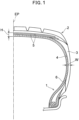
- FIG. 1 is a schematic view showing a part of a cross section of a tire relating to one embodiment of the present invention taken along a tire meridian line (the upper right-side part of the cross section).
- the tire of the present invention is a tire comprising a pair of sidewall rubbers arranged on both sides of a tread part, a carcass cord topping rubber constituting a carcass that is arranged on the inner sides of the sidewall rubbers in a tire width direction, an inner liner rubber arranged on the inner side of the carcass in a tire radial direction, and a breaker topping rubber constituting a breaker that is arranged on the outer side of the carcass in the tire radial direction and on the inner side of the tread part, wherein at least one rubber selected from the group consisting of the sidewall rubbers, the carcass cord topping rubber, the breaker topping rubber, and the inner liner rubber comprises a recovered carbon black, wherein at least one rubber member constituting the tire comprises an oil, and wherein A and B satisfy the following inequality (1), A / B ⁇ 100 > 1 where A represents a total amount, in g, of the recovered carbon black comprised in the sidewall rubbers, the carcass cord topping rubber, the breaker topping rubber, and the inner
- a mechanism by which durability of the tire is improved in the present invention is considered as follows, although the following consideration is not intended to be bound by any theory. That is, a recovered carbon black comprising a predetermined amount or more of ash is characterized in that the recovered carbon black is less likely to absorb oil. A rubber in which such a recovered carbon black is compounded has a low thermal diffusivity and is less likely to suffer thermal-oxidative degradation, so that it is considered that its durability is improved.
- At least one rubber of sidewall rubbers, a carcass cord topping rubber, a breaker topping rubber, and an inner liner rubber may comprise a recovered carbon black, and at least one rubber of the sidewall rubbers, the carcass cord topping rubber, the breaker topping rubber, and the inner liner rubber may comprise oil.
- the right side of the inequality (1) is preferably 5.
- the right side of the inequality (1) is preferably 6.
- A, B, and W preferably satisfy the following inequality (2), A / B / W ⁇ 1000 > 5
- H a total thickness of the breaker topping rubber, the carcass cord topping rubber, and the inner liner rubber at a position on a tire equatorial plane
- A, B, and H preferably satisfy the following inequality (3), A / B / H ⁇ 1000 > 6
- the at least one rubber comprising the recovered carbon black preferably comprises the oil as well.
- the at least one rubber comprising the recovered carbon black is preferably a carcass cord topping rubber.
- the carcass cord topping rubber can adjoin any of the sidewall rubbers, the inner liner rubber, and the breaker topping rubber, it is considered that the effects of the present invention are easily exhibited.
- a rubber comprising the recovered carbon black is preferably at least two rubbers selected from the group consisting of the sidewall rubbers, the carcass cord topping rubber, the breaker topping rubber, and the inner liner rubber.
- the rubber comprising the recovered carbon black is preferably at least three rubbers selected from the group consisting of the sidewall rubbers, the carcass cord topping rubber, the breaker topping rubber, and the inner liner rubber.
- the rubber comprising the recovered carbon black is preferably all of the sidewall rubbers, the carcass cord topping rubber, the breaker topping rubber, and the inner liner rubber.
- a rubber comprising the oil is preferably at least two rubbers selected from the group consisting of the sidewall rubbers, the carcass cord topping rubber, the breaker topping rubber, and the inner liner rubber.
- the rubber comprising the oil is preferably at least three rubbers selected from the group consisting of the sidewall rubbers, the carcass cord topping rubber, the breaker topping rubber, and the inner liner rubber.
- the rubber comprising the oil is preferably all of the sidewall rubbers, the carcass cord topping rubber, the breaker topping rubber, and the inner liner rubber.
- At least one rubber selected from the group consisting of the sidewall rubbers, the carcass cord toping rubber, the breaker topping rubber, and the inner liner rubber preferably comprises a filler, and when a total amount, in g, of fillers comprised in the sidewall rubbers, the carcass cord toping rubber, the breaker topping rubber, and the inner liner rubber is referred to as C, A and C preferably satisfy the following inequality (4), A / C ⁇ 100 > 1.0
- At least one rubber member constituting the tire preferably comprises a plasticizing agent other than oil, and when a total amount, in g, of plasticizing agents other than the oil which are comprised in the tire is referred to as D, A and D preferably satisfy the following inequality (5), A / A + D ⁇ 100 > 16.0
- a "size or the like of each part of a tire” is defined as a value specified in a standardized state where a tire is rim-assembled to a standardized rim, filled with air at a standardized internal pressure, and applied with no load.
- the "standardized rim” is a rim, in a standard system including a standard on which the tire is based, defined for each tire by the standard.
- the standardized rim refers to, for example, a "standard rim” in applicable sizes described in "JATMA YEAR BOOK” in JATMA (Japan Automobile Tyre Manufacturers Association, Inc), "Measuring Rim” described in “STANDARDS MANUAL” in ETRTO (The European Tyre and Rim Technical Organisation), or “Design Rim” described in "YEAR BOOK” in TRA (The Tire and Rim Association, Inc.).
- JATMA, ETRTO, and TRA are referred to in this order, and when an applicable size is found during reference to the standard, a standardized rim is based on that standard. Additionally, if the tire is not defined in the above-described standard system, the "standardized rim" refers to a rim having the smallest rim diameter and secondly having the narrowest rim width among rims that can be rim-assembled to the tire and retain internal pressure, that is, rims that do not cause air leakage between the rim and the tire.
- a “standardized internal pressure” is an air pressure, in a standard system including a standard on which the tire is based, defined for each tire by the standard.
- the "MAXIMUM AIR PRESSURE” in JATMA, the “maximum value” described in the table “TIRE LOAD LIMITS AT VARIOUS COLD INFLATION PRESSURES" in TRA, or “INFLATION PRESSURE” in ETRTO is defined as the standardized internal pressure.
- JATMA, ETRTO, and TRA are referred to in this order, and when an applicable size is found during reference to the standard, a standardized internal pressure is based on that standard.
- the standardized internal pressure refers to a standardized internal pressure (provided that the standardized internal pressure is 250 kPa or more) for another tire size for which the standardized rim is described as a standard rim (and which is defined by the standard).
- the standardized internal pressure refers to the minimum value among them.
- a “standardized load” means a load defined in a standard system including a standard on which the tire is based.
- the standardized load refers to, for example, the "maximum value” described in the table "TIRE LOAD LIMITS AT VARIOUS COLD INFLATION PRESSURES" in TRA, "LOAD CAPACITY” in ETRTO, or "MAXIMUN LOAD CAPACITY” in JATMA.
- JATMA, ETRTO, and TRA are referred to in this order, and when an applicable size is found during reference to the standard, a standardized load is based on that standard.
- a “recovered carbon black” refers to carbon black that is obtained from a pyrolysis process of a product comprising carbon black such as a used tire and the like, wherein a ratio of a mass of ash (ash content) which is a component that does not combust is 13% by mass or more when the product is subjected to oxidative combustion by heating in the air, using a thermal weight measurement method according to JIS K 6226-2:2003. That is, a mass (carbon amount) to be lost by the oxidative combustion is less than 87% by mass.
- the recovered carbon black is also referred to as a recycled carbon and may also be expressed by rCB.
- a carbon black that is obtained from a pyrolysis process and in which a ratio of ash content is less than 13% by mass is distinguished from recovered carbon black and is simply referred to as a pyrolytic carbon black in the present specification.
- a “total amount (A) of recovered carbon black” means a total amount, in g, of recovered carbon black comprised in a sidewall rubber, a carcass cord topping rubber, a breaker topping rubber, and an inner liner rubber and is obtained by summing up amounts, in g, of recovered carbon black comprised in the respective rubbers.
- total amount (B) of oil means a total amount, in g, of oil comprised in a tire.
- at least one rubber member constituting the tire may comprise oil.
- a “total amount (C) of a filler” means a total amount, in g, of fillers comprised in a sidewall rubber, a carcass cord topping rubber, a breaker topping rubber, and an inner liner rubber and is obtained by summing up amounts, in g, of fillers comprised in the respective rubbers.
- a "total amount (D) of a plasticizing agent other than oil” means a total amount, in g, of plasticizing agents other than oil which are comprised in a tire. Besides, at least one rubber member constituting the tire may comprise a plasticizing agent other than oil.
- total thickness W refers to a total thickness, in mm, of a sidewall rubber, a carcass cord topping rubber, and an inner liner rubber at a position at which a width of a tire becomes maximum in a tire rotation axis direction. After a tire is cut along a surface including a rotation axis, the total thickness W is measured in a state where this tire is held by a standardized rim. For example, W in FIG. 1 corresponds to the total thickness W. Besides, a thickness W S , in mm, of the sidewall rubber, a thickness Wc, in mm, of the carcass cord topping rubber, and a thickness W IL , in mm, of the inner liner rubber, are measured in the same manner as well.
- total thickness H refers to a total thickness, in mm, of a breaker topping rubber, a carcass cord topping rubber, and an inner liner rubber at a position on a tire equatorial plane. After a tire is cut along the tire equatorial plane, the total thickness H is measured in a state where this tire is held by a standardized rim. For example, H in FIG. 1 corresponds to the total thickness H. Besides, a thickness H B , in mm, of the breaker topping rubber, a thickness H C , in mm, of the carcass cord topping rubber, and a thickness H IL , in mm, of the inner liner rubber, are measured in the same manner as well.
- a “filler” refers to a reinforcing filler and comprises a usual carbon black as well as a recovered carbon black in the present invention. Furthermore, as a filler other than carbon black, silica or any of reinforcing fillers other than silica that are used in the tire industry are included. A specific example of the filler will be described later.
- plasticizing agent other than oil refers to a plasticizing agent other than oil, which is used in the tire industry, and a specific example of such a plasticizing agent will be described later.
- a "vinyl bond amount (1,2-bond butadiene unit amount)" is measured by infrared absorption spectrometry.
- a "weight-average molecular weight (Mw)" can be calculated in terms of a standard polystyrene based on measurement values obtained by a gel permeation chromatography (GPC) (GPC-8000 Series manufactured by Tosoh Corporation, detector: differential refractometer, column: TSKGEL SUPERMULTIPORE HZ-M manufactured by Tosoh Corporation).
- GPC gel permeation chromatography
- a "cis content (cis-1,4-bond butadiene unit amount)" is measured by infrared absorption spectrometry.
- An "ash content of recovered carbon black” is measured by a thermal weight measurement method of JIS K 6226-2:2003.
- a "N 2 SA of carbon black” is a value calculated by JIS K 6217-2:2017.
- N 2 SA of silica is a value measured by a BET method according to ASTM D3037-93.
- a "softening point of resin or the like” is a temperature at which a sphere drops when the softening point specified in JIS K 6220-1:2015 is measured with a ring and ball softening point measuring device. A softening point measured by another method will be described accordingly.
- FIG. 1 is a schematic view showing a part of a cross section of a tire relating to one embodiment of the present invention taken along a tire meridian line (the upper right-side part of the cross section).
- a tire 1 comprises a pair of sidewall rubbers 3 arranged on both sides of a tread part 2, a carcass cord topping rubber 4 constituting a carcass that is arranged on the inner sides of the sidewall rubbers 3 in a tire width direction, a breaker topping rubber 5 constituting a breaker that is arranged on the outer side of the carcass cord topping rubber in a tire radial direction and on the inner side of the tread part 2, and an inner liner rubber 6 arranged on the inner side of the carcass cord topping rubber in the tire radial direction.
- At least one rubber selected from the group consisting of the sidewall rubbers, the carcass cord topping rubber, the breaker topping rubber, and the inner liner rubber comprises a recovered carbon black.
- at least one rubber member constituting the tire comprises oil.
- the rubber comprising the recovered carbon black may be identical to or different from the rubber comprising oil.
- the tire may be a form in which a recovered carbon black and oil are comprised in one rubber. Accordingly, at least one rubber comprising a recovered carbon black may comprise oil as well.
- At least one rubber comprising a recovered carbon black is a carcass cord topping rubber.
- at least one rubber comprising oil is a carcass cord topping rubber.
- the rubber comprising the recovered carbon black is at least two rubbers selected from the group consisting of the sidewall rubbers, the carcass cord topping rubber, the breaker topping rubber, and the inner liner rubber, at least three rubbers selected from the above-described group, or all of the sidewall rubbers, the carcass cord topping rubber, the breaker topping rubber, and the inner liner rubber.
- the rubber comprising oil is at least two rubbers selected from the group consisting of the sidewall rubbers, the carcass cord topping rubber, the breaker topping rubber, and the inner liner rubber, at least three rubbers selected from the above-described group, or all of the sidewall rubbers, the carcass cord topping rubber, the breaker topping rubber, and the inner liner rubber.
- the carcass cord topping rubber adjoins the sidewall rubbers. In a preferred embodiment, the carcass cord topping rubber adjoins the inner liner rubber. In a preferred embodiment, the carcass cord topping rubber adjoins the breaker topping rubber.
- a and B satisfy the following inequality (1), A / B ⁇ 100 > 1
- the right side of the inequality (1) is preferably 5, more preferably 6, further preferably 10, further preferably 30, further preferably 50, further preferably 60.
- an upper limit of the value on the left side of the inequality (1) may be, but not particularly limited to, usually about 150, about 120, or about 100.
- W is a value obtained by summing up a thickness W S , in mm, of the sidewall rubber, a thickness Wc, in mm, of the carcass cord topping rubber, and a thickness W IL , in mm, of the inner liner rubber at the position at which a width of the tire becomes maximum in the tire rotation axis direction (where W S , Wc, and W IL are not shown in the drawing), A / B / W ⁇ 1000 > 5
- the right side of the inequality (2) is preferably 10, more preferably 13, further preferably 15, further preferably 30, further preferably 50, further preferably 70.
- an upper limit of the value on the left side of the inequality (2) may be, but not particularly limited to, usually about 250, about 200, or about 180.
- H is a value obtained by summing up a thickness H B , in mm, of the breaker topping rubber, a thickness H C , in mm, of the carcass cord topping rubber, and a thickness H IL , in mm, of the inner liner rubber at the position on the tire equatorial plane (where H B , H C , and H IL are not shown in the drawing), A / B / H ⁇ 1000 > 6
- the right side of the inequality (3) is preferably 12, more preferably 14, further preferably 18, further preferably 36, further preferably 50, further preferably 70, further preferably 90, further preferably 100.
- an upper limit of the value on the left side of the inequality (3) may be, but not particularly limited to, usually about 300, about 250, or about 200.
- At least one rubber selected from the group consisting of the sidewall rubbers, the carcass cord topping rubber, the breaker topping rubber, and the inner liner rubber comprises a filler.
- a and C preferably satisfy the following inequality (4), A / C ⁇ 100 > 1.0
- the right side of the inequality (4) is preferably 2.0, more preferably 2.2, further preferably 8.0, further preferably 12.0, further preferably 15.0.
- an upper limit of the value on the left side of the inequality (4) may be, but not particularly limited to, usually about 70, about 60, or about 50.
- At least one rubber member constituting the tire comprises a plasticizing agent other than oil.
- a plasticizing agent other than oil which are comprised in the tire.
- a and D preferably satisfy the following inequality (5), A / A + D ⁇ 100 > 16.0
- the right side of the inequality (5) is preferably 30.0, more preferably 50.0, further preferably 70.0, further preferably 80.0, further preferably 90.0.
- an upper limit of the value on the left side of the inequality (5) may be, but not particularly limited to, usually about 160, about 140, or about 120.
- a thickness W S , in mm, of a sidewall rubber, a thickness Wc, in mm, of a carcass cord topping rubber, and a thickness W IL , in mm, of an inner liner rubber at a position at which a width of the tire becomes maximum in a tire rotation axis direction, and a total thickness W, in mm, that is a total of these thicknesses will be described.
- W S is preferably larger than 1.5 mm, more preferably larger than 1.8 mm, further preferably larger than 2.1 mm. Moreover, W S is preferably smaller than 3.5 mm, more preferably smaller than 3.2 mm, further preferably smaller than 2.9 mm.
- Wc is preferably larger than 0.5 mm, more preferably larger than 0.7 mm, further preferably larger than 0.9 mm. Moreover, Wc is preferably smaller than 2.0 mm, more preferably smaller than 1.7 mm, further preferably smaller than 1.4 mm.
- W IL is preferably larger than 0.1 mm, more preferably larger than 0.5 mm, further preferably larger than 1.0 mm. Moreover, W IL is preferably smaller than 5.0 mm, more preferably smaller than 4.0 mm, further preferably smaller than 3.0 mm.
- W is preferably larger than 2.1 mm, more preferably larger than 3.0 mm, further preferably larger than 4.0 mm. Moreover, W is preferably smaller than 10.5 mm, more preferably smaller than 8.9 mm, further preferably smaller than 7.3 mm.
- a thickness H B , in mm, of a breaker topping rubber, a thickness H C , in mm, of the carcass cord topping rubber, and a thickness H IL , in mm, of an inner liner rubber at a position on a tire equatorial plane, and a total thickness H, in mm, that is a total of these thicknesses will be described.
- H B is preferably larger than 1.5 mm, more preferably larger than 1.8 mm, further preferably larger than 2.1 mm. Moreover, H B is preferably smaller than 4.0 mm, more preferably smaller than 3.2 mm, further preferably smaller than 2.9 mm.
- H C is preferably larger than 0.5 mm, more preferably larger than 0.7 mm, further preferably larger than 0.9 mm. Moreover, H C is preferably smaller than 2.0 mm, more preferably smaller than 1.7 mm, further preferably smaller than 1.4 mm.
- H IL is preferably larger than 0.1 mm, more preferably larger than 0.5 mm, further preferably larger than 1.0 mm. Moreover, H IL is preferably smaller than 5.0 mm, more preferably smaller than 4.0 mm, further preferably smaller than 3.0 mm.
- H is preferably larger than 2.1 mm, more preferably larger than 3.0 mm, further preferably larger than 4.0 mm. Moreover, H is preferably smaller than 11.0 mm, more preferably smaller than 8.9 mm, further preferably smaller than 7.3 mm.
- Rubber compositions constituting sidewall rubbers, a carcass cord topping rubber, a breaker topping rubber, and an inner liner rubber of the present invention will be described.
- a rubber component preferably comprises an isoprene-based rubber (IR-based rubber) and a butadiene rubber (BR).
- the rubber component can comprise a rubber component other than the IR-based rubber and the BR.
- the rubber component may be one consisting of an IR-based rubber and a BR. Explanation for each rubber that can constitute the rubber component is as follows.
- Examples of the isoprene-based rubber include a natural rubber (NR), an isoprene rubber (IR), a refined NR, a modified NR, a modified IR, and the like.
- NR natural rubber
- IR isoprene rubber
- the IR is not particularly limited, and as the IR, for example, those common in the tire industry can be used, such as IR2200 and the like.
- Examples of the refined NR include a deproteinized natural rubber (DPNR), an ultra pure natural rubber (UPNR), and the like.
- modified NR examples include an epoxidized natural rubber (ENR), a hydrogenated natural rubber (HNR), a grafted natural rubber, and the like.
- modified IR examples include an epoxidized isoprene rubber, a hydrogenated isoprene rubber, a grafted isoprene rubber, and the like.
- the isoprene-based rubbers may be used alone, or two or more thereof may be used in combination.
- the BR is not particularly limited, and examples of the BR include those common in the tire industry, such as, for example, a BR having a high cis content, a BR containing a 1,2-syndiotactic polybutadiene crystal (SPBcontaining BR), a butadiene rubber synthesized using a rare-earth elementbased catalyst (a rare-earth-based BR), a tin-modified butadiene rubber modified by a thin compound (tin-modified BR), a modified butadiene rubber other than these BRs (modified BR), and the like.
- SPBcontaining BR 1,2-syndiotactic polybutadiene crystal
- SPBcontaining BR 1,2-syndiotactic polybutadiene crystal
- SPBcontaining BR 1,2-syndiotactic polybutadiene crystal
- SPBcontaining BR 1,2-syndiotactic polybutadiene crystal
- SPBcontaining BR
- the modified BR may be a BR having a functional group interacting with a filler such as silica and the like.
- the modified BR include, for example, a terminal-modified BR obtained by modifying at least one terminal of a BR with a compound (a modifying agent) having the above-described functional group (terminal-modified BR having the above-described functional group at its terminal), a main chain modified BR whose main chain has the above-described functional group, a main chain terminal-modified BR having the above-described functional groups at its main chain and its terminal (for example, a main chain terminal-modified BR whose main chain has the above-described functional group and at least one terminal of which is modified with the above-described modifying agent), a terminal-modified BR which is modified (coupled) with a polyfunctional compound having two or more epoxy groups in a molecule and into which a hydroxyl group or an epoxy group is introduced, and the like.
- Examples of the above-described functional group include, for example, an amino group, an amido group, a silyl group, an alkoxysilyl group, an isocyanate group, an imino group, an imidazole group, an urea group, an ether group, a carbonyl group, an oxycarbonyl group, a mercapto group, a sulfide group, a disulfide group, a sulfonyl group, a sulfinyl group, a thiocarbonyl group, an ammonium group, an imide group, a hydrazo group, an azo group, a diazo group, a carboxyl group, a nitrile group, a pyridyl group, an alkoxy group, a hydroxyl group, an oxy group, an epoxy group, and the like.
- these functional groups may have a substituent.
- an amino group preferably an amino group whose hydrogen atom is substituted with an alkyl group having 1 to 6 carbon atoms
- an alkoxy group preferably an alkoxy group having 1 to 6 carbon atoms
- an alkoxysilyl group preferably an alkoxysilyl group having 1 to 6 carbon atoms
- a cis amount (cis content) of a BR is preferably greater than 90% by mass, more preferably greater than 93% by mass, further preferably greater than 95% by mass, further preferably 97% by mass or more.
- the cis amount of the BR can be measured by infrared absorption spectrometry.
- BR for example, products manufactured by Ube Industries, Ltd., JSR Corporation, Asahi Kasei Corporation, Ltd., Zeon Corporation, etc. can be used.
- the BR may be used alone, or two or more thereof may be used in combination.
- the styrene-butadiene rubber is not particularly limited, examples of which include, for example, an unmodified emulsion-polymerized styrene-butadiene rubber (E-SBR), an unmodified solution-polymerized styrene-butadiene rubber (S-SBR), and modified SBRs obtained by modifying these SBRs, such as a modified emulsion-polymerized styrene-butadiene rubber (modified E-SBR) and a modified solution-polymerized styrene-butadiene rubber (modified S-SBR), and the like.
- E-SBR unmodified emulsion-polymerized styrene-butadiene rubber
- S-SBR unmodified solution-polymerized styrene-butadiene rubber
- modified SBRs obtained by modifying these SBRs, such as a modified emulsion-polymerized
- modified SBR examples include a modified SBR modified at its terminal and/or main chain, a modified SBR coupled with tin, a silicon compound, etc. (a modified SBR of condensate or having a branched structure, etc.), and the like.
- types of the SBR include an oil-extended type whose flexibility is adjusted by addition of an extending oil and a non-oil-extended type to which no extending oil is added, any of which can be used.
- an SBR for example, products manufactured by Ube Industries, Ltd., JSR Corporation, Asahi Chemicals Co., Ltd., Zeon Corporation, ZS Elastomer Co., Ltd., etc. can be used.
- the SBR may be used alone, or two or more thereof may be used in combination.
- a vinyl content (1,2-bond butadiene unit amount) of an SBR is preferably greater than 10.0%, more preferably greater than 15.0%, more preferably 18.0% or more, from the viewpoints of rubber strength and grip performance. Moreover, the vinyl content is preferably less than 80.0%, preferably less than 50.0%, more preferably less than 30.0%, from the viewpoint of fuel efficiency. Besides, the vinyl content of the SBR is a value measured by infrared absorption spectrometry.
- Other usable rubbers other than the above-described rubbers are not particularly limited, and rubbers used in the tire field and the like can be used as such other rubbers.
- the other usable rubbers include, for example, diene-based rubbers such as an acrylonitrile-butadiene rubber (NBR), a chloroprene rubber (CR), a styrene-isoprene-butadiene copolymer rubber (SIBR), and the like. These other rubbers may be used alone, or two or more thereof may be used in combination.
- a content of an IR-based rubber in 100% by mass of the rubber component is preferably greater than 5% by mass, more preferably greater than 10% by mass, further preferably greater than 20% by mass, further preferably greater than 30% by mass.
- the content is preferably less than 80% by mass, more preferably less than 70% by mass, further preferably less than 60% by mass, further preferably less than 50% by mass.
- a content of a BR in 100% by mass of the rubber component is preferably greater than 15% by mass, more preferably greater than 30% by mass, further preferably greater than 40% by mass, further preferably greater than 50% by mass.
- the content is preferably less than 90% by mass, more preferably less than 80% by mass, further preferably less than 70% by mass, further preferably less than 60% by mass.
- a total content of the IR-based rubber and the BR in 100% by mass of the rubber component is preferably greater than 80% by mass, more preferably greater than 90% by mass, further preferably greater than 95% by mass, or may be 100% by mass.
- a filler can comprise a recovered carbon black (rCB). Moreover, the filler can comprise carbon black other than rCB, and silica. In a case where the filler comprises silica, the filler can further comprise a silane coupling agent. The filler can further comprise another filler other than carbon black and silica.
- rCB recovered carbon black
- the filler can comprise carbon black other than rCB, and silica.
- the filler can further comprise a silane coupling agent.
- the filler can further comprise another filler other than carbon black and silica.
- a total content of carbon black comprising a recovered carbon black when compounded based on 100 parts by mass of the rubber component is preferably greater than 30 parts by mass, more preferably greater than 40 parts by mass, further preferably greater than 50 parts by mass.
- the total content is preferably less than 150 parts by mass, more preferably less than 110 parts by mass, further preferably less than 80 parts by mass.
- a content of a recovered carbon black in a total content of carbon black is preferably less than 60% by mass, more preferably less than 50% by mass, further preferably less than 45% by mass, from the viewpoint of reinforcing property.
- the content is preferably greater than 1% by mass, more preferably greater than 5% by mass, further preferably greater than 10% by mass, further preferably greater than 20% by mass, further preferably greater than 30% by mass, further preferably greater than 35% by mass, from the viewpoint of the effects of the present invention.
- the content of the recovered carbon black in the total content of carbon black may be further lower and may be less than 30% by mass, less than 20% by mass, or less than 10 % by mass, or may be 0% by mass. This is because another member may comprise a recovered carbon black.
- a content of silica when compounded based on 100 parts by mass of the rubber component is, but not particularly limited to, preferably greater than 1 part by mass, preferably greater than 5 parts by mass, more preferably greater than 10 parts by mass, further preferably greater than 20 parts by mass, from the viewpoints of fuel efficiency, wet grip performance, and securement of a sufficient reinforcing property.
- the content is preferably less than 150 parts by mass, more preferably less than 100 parts by mass, further preferably less than 50 parts by mass, further preferably less than 30 parts by mass, from the viewpoints of dispersibility of silica, processability, and wet grip performance.
- a content of a silane coupling agent when compounded based on 100 parts by mass of silica is preferably greater than 1 part by mass, more preferably greater than 3 parts by mass, further preferably greater than 5 parts by mass, further preferably greater than 7 parts by mass.
- the content is preferably less than 20 parts by mass, more preferably less than 18 parts by mass, further preferably less than 16 parts by mass, further preferably less than 14 parts by mass.
- a "recovered carbon black” refers to carbon black obtained from a pyrolysis process of a product comprising carbon black such as a used tire and the like, wherein a ratio of a mass of ash (ash content), which is a component that does not combust, is 13% by mass or more when the product is subjected to oxidative combustion by heating in the air, using a thermal weight measurement method according to JIS K 6226-2:2003.
- the recovered carbon black has much ash content and thus is characterized in that it is less likely to absorb oil.
- the ash content of the recovered carbon black is preferably 14% by mass or more, more preferably 15% by mass or more, further preferably 16% by mass or more, further preferably 17% by mass or more.
- a recovered carbon black can be obtained from a pyrolysis process of a used pneumatic tire.
- EP 3427975 A refers to " Rubber Chemistry and Technology", vol. 85, No. 3, pp.408-449 (2012 ), particularly, pages 438, 440, and 442 and describes that a recovered carbon black can be obtained by pyrolysis of an organic material at 550 to 580°C where oxygen is eliminated or by vacuum pyrolysis at a relatively low temperature ([0027]).
- the recovered carbon black of the present invention may be one that lacks a functional group on its surface or may be one treated so as to include a functional group on its surface.
- the treatment that the recovered carbon black includes a functional group on its surface can be performed by a usual method.
- carbon black obtained from a pyrolysis process is treated with potassium permanganate under an acidic condition, thereby obtaining carbon black including a hydroxyl group and/or a carboxyl group on its surface.
- JP 6856781 B carbon black obtained from a pyrolysis process is treated with an amino acid compound including at least one thiol group or disulfide group, thereby obtaining carbon black whose surface is activated.
- Examples of the recovered carbon black of the present invention also include carbon black treated so as to include a functional group on its surface.
- Examples of carbon black other than rCB include, but not particularly limited to, N134, N110, N220, N234, N219, N339, N330, N326, N351, N550, N600, N660, N762, and the like.
- products from ASAHI CARBON CO., LTD., Cabot Japan K.K., TOKAI CARBON CO., LTD., Mitsubishi Chemical Corporation., Lion Corporation., NIPPON STEEL Carbon Co., Ltd., Columbia Carbon Corporation., etc. can be used. These carbon black may be used alone, or two or more thereof may be used in combination.
- a nitrogen adsorption specific surface area (N 2 SA) of carbon black is, but not particularly limited to, preferably greater than 30 m 2 /g, more preferably greater than 40 m 2 /g, further preferably greater than 50 m 2 /g, further preferably greater than 60 m 2 /g, further preferably greater than 70 m 2 /g, from the viewpoint that a sufficient reinforcing property and a good abrasion resistance can be obtained.
- the N 2 SA is preferably less than 300 m 2 /g, more preferably less than 200 m 2 /g, further preferably less than 150 m 2 /g, further preferably less than 120 m 2 /g, further preferably less than 110 m 2 /g, further preferably less than 100 m 2 /g, further preferably less than 90 m 2 /g, from the viewpoint that carbon black is excellent in dispersibility and is less likely to generate heat.
- the N 2 SA of carbon black in the present invention is a value measured according to JIS K 6217-2:2017.
- a nitrogen adsorption specific surface area (N 2 SA) of silica is preferably greater than 50 m 2 /g, more preferably greater than 100 m 2 /g, further preferably greater than 150 m 2 /g, particularly preferably greater than 170 m 2 /g.
- an upper limit of the N 2 SA of silica is, but not particularly limited to, preferably less than 350 m 2 /g, more preferably less than 250 m 2 /g, further preferably less than 200 m 2 /g.
- cut resistance tends to be improved.
- the N 2 SA of silica is a value measured by a BET method according to ASTM D3037-93.
- a rubber composition preferably further comprises a silane coupling agent.
- silane coupling agent include, but not particularly limited to, for example, sulfide-based ones such as bis(3-triethoxysilylpropyl)tetrasulfide, bis(2-triethoxysilylethyl)tetrasulfide, bis(4-triethoxysilylbutyl)tetrasulfide, bis(3-trimethoxysilylpropyl)tetrasulfide, bis(2-trimethoxysilylethyl)tetrasulfide, bis(2-triethoxysilylethyl)trisulfide, bis(4-trimethoxysilylbutyl)trisulfide, bis(3-triethoxysilylpropyl)disulfide, bis(2-triethoxysilylethyl)disulfide, bis(2-triethoxysilylethyl)d
- silane coupling agents may be used alone, or two or more thereof may be used in combination.
- Another filler is not particularly limited, and materials known in the field of the tire industry can be used as another filler.
- examples of such another filler include, for example, inorganic fillers such as calcium carbonate, talc, alumina, clay, aluminum hydroxide, aluminum oxide, and mica, and the like. They may be used alone, or two or more thereof may be used in combination.
- Oil is not particularly limited, and any of those commonly used in the tire industry can be appropriately used as oil.
- oil include, for example, process oils such as paraffinic process oils, aromatic process oils, naphthenic process oils, and the like.
- PCA polycyclic aromatic compound
- the process oils each having a low content of a PCA include treated distillate aromatic extracts (TDAE) obtained by re-extracting an aromatic process oil, aroma alternative oils that are blended oils of asphalt and naphthenic oil, mild extraction solvates (MES), heavy naphthenic oil, and the like.
- TDAE treated distillate aromatic extracts
- MES mild extraction solvates
- heavy naphthenic oil and the like.
- the aromatic process oils are preferable, and the TDAE oils are more preferable.
- Oil for example, those manufactured and sold by H&R Group, JXTG Nippon Oil & Energy Corporation, Idemitsu Kosan Co., Ltd., Sankyo Yuka Kogyo K. K., etc., and the like can be used. Oil may be used alone, or two or more thereof may be used in combination.
- a content of oil when compounded based on 100 parts by mass of the rubber component is preferably greater than 1 part by mass, more preferably greater than 3 parts by mass, further preferably greater than 5 parts by mass, from the viewpoint of the effects of the present invention. Moreover, the content is preferably less than 20 parts by mass, more preferably less than 15 parts by mass, further preferably less than 10 parts by mass. Besides, the content of oil shall also include an amount of oil contained as an extending oil in a rubber component or oil contained in another component such as sulfur.
- a plasticizing agent other than oil can be compounded in the rubber composition.
- the plasticizing agent other than oil include resin and an ester-based plasticizing agent, as well as a liquid polymer, a liquid resin, and the like.
- a resin is not particularly limited, and any of those commonly used in the rubber industry can be appropriately used as resin, examples of which include, for example, an adhesive resin described below. These resins may be used alone, or two or more thereof may be used in combination.
- Softening points of these resins are preferably within a range of temperatures lower than 180°C from the viewpoint that a function as a plasticizing agent is appropriately exhibited.
- An upper limit of the softening points is preferably lower than 170°C, more preferably lower than 150°C, further preferably lower than 130°C.
- the scope of the "resin” stated here does not include any liquid resins that are in a liquid state at normal temperature (25°C).
- a softening point of resin is a temperature at which a sphere drops when the softening point specified in JIS K 6220-1 is measured with a ring and ball softening point measuring device.
- An ester-based plasticizing agent is not particularly limited, and as an ester-based plasticizing agent, any of those commonly used in the rubber industry can be appropriately used, examples of which include, for example, dibutyl adipate (DBA), diisobutyl adipate (DIBA), dioctyl adipate (DOA), di(2-ethylhexyl) azelate (DOZ), dibutyl sebacate (DBS), diisononyl adipate (DINA), diethyl phthalate (DEP), dioctyl phthalate (DOP), diundecyl phthalate (DUP), dibutyl phthalate (DBP), dioctyl sebacate (DOS), tributyl phosphate (TBP), trioctyl phosphate (TOP), triethyl phosphate (TEP), trimethyl phosphate (TMP), thymidine triphosphate (TTP), tricres
- the DOS and the TOP are preferable due to a balance between a plasticizing effect and abrasion resistance at a low temperature, and the DOS is preferable for the reason that it is excellent in fuel efficiency.
- the ester-based plasticizing agents may be used alone, or two or more thereof may be used in combination.
- a liquid polymer is a polymer in a liquid state at normal temperature (25°C), examples of which include, for example, a liquid diene-based polymer.
- the liquid diene-based polymer include a liquid styrene-butadiene copolymer (liquid SBR), a liquid butadiene polymer (liquid BR), a liquid isoprene polymer (liquid IR), a liquid styrene-isoprene copolymer (liquid SIR), and the like.
- a number average molecular weight (Mn) of the liquid diene-based polymer which is measured with a gel permeation chromatography (GPC) and calculated in terms of polystyrene, is preferably greater than 1000, more preferably greater than 3000. On the other hand, the Mn is preferably less than 100000, more preferably less than 15000.
- a Mn of the liquid polymer is a value measured with a gel permeation chromatography (GPC) and calculated in terms of polystyrene.
- GPC gel permeation chromatography
- As a liquid diene-based polymer for example, products from Sartomer, Kuraray Co., Ltd., etc. can be used. The liquid polymer may be used alone, or two or more thereof may be used in combination.
- the liquid resin is a resin in a liquid state at normal temperature (25°C), examples of which include, but not particularly limited to, for example, a liquid aromatic vinyl polymer, a liquid coumarone-indene resin, a liquid indene resin, a liquid terpene resin, a liquid rosin resin, hydrogenated ones thereof, and the like.
- liquid resin for example, products from Maruzen Petrochemical Co., Ltd., SUMITOMO BAKELITE CO., LTD., YASUHARA CHEMICAL CO., LTD., Tosoh Corporation, RÜTGERS Chemicals GmbH, BASF, Arizona Chemical Company, NITTO Chemical CO., LTD., Nippon Shokubai Co., Ltd., ENEOS Corporation, Arakawa Chemical Industries, Ltd., Taoka Chemical Co., Ltd., etc. can be used. These liquid resins may be used alone, or two or more thereof may be used in combination.
- a content of the plasticizing agent is preferably an amount within a range satisfying the above-described inequality (5).
- resin an antioxidant, wax, stearic acid, zinc oxide, a vulcanizing agent, a vulcanization accelerator, and the like can be used.
- resin is a resin that is in a solid state at normal temperature (25°C).
- a resin is not particularly limited, and as such a resin, resin commonly used in the tire industry, such as an aromatic petroleum resin, can be used.
- the aromatic petroleum resin include, for example, a phenol-based resin, a coumarone-indene resin, a styrene-based resin, a terpene-based resin, an acrylic resin, a rosin-based resin, a dicyclopentadiene resin (DCPD resin), and the like.
- Resin may be used alone, or two or more thereof may be used in combination.
- a content of resin when compounded based on 100 parts by mass of the rubber component is preferably greater than 2 parts by mass, more preferably greater than 3 parts by mass, further preferably greater than 4 parts by mass.
- the content is preferably less than 20 parts by mass, more preferably less than 15 parts by mass, further preferably less than 10 parts by mass.
- An antioxidant is not particularly limited, and any of those commonly used in the tire industry can be appropriately used.
- the antioxidant include, for example, quinoline-based antioxidants, quinone-based antioxidants, phenol-based antioxidants, phenylenediamine-based antioxidants, a carbamic acid metal salt, and the like.
- the phenylenediamine-based antioxidants are preferable for the reason that they can better exhibit an effect of improving ozone resistance.
- a content of an antioxidant when compounded based on 100 parts by mass of the rubber component is preferably greater than 0.5 parts by mass, more preferably greater than 0.8 parts by mass, further preferably greater than 1.0 parts by mass.
- the content is preferably less than 7.0 parts by mass, more preferably less than 5.0 parts by mass, further preferably 3.0 parts by mass or less.
- Wax is not particularly limited, and any of those commonly used in the tire industry can be appropriately used as wax, examples of which include, for example, a petroleum-based wax, a mineral-based wax, a synthetic wax, and the like.
- the petroleum-based wax is preferable.
- the petroleum-based wax include, for example, a paraffin wax, a microcrystalline wax, a specially selected wax thereof, and the like.
- the paraffin wax is preferable.
- wax for example, those manufactured and sold by Ouchi Shinko Chemical Industry Co., Nippon Seiro Co., Ltd., PARAMELT, etc. can be used. Wax may be used alone, or two or more thereof may be used in combination.
- a content of wax when compounded based on 100 parts by mass of the rubber component is preferably greater than 0.3 parts by mass, more preferably greater than 0.7 parts by mass, further preferably greater than 1.0 parts by mass.
- the content is preferably less than 4.0 parts by mass, more preferably less than 3.0 parts by mass, further preferably less than 2.5 parts by mass.
- a content of stearic acid when compounded based on 100 parts by mass of the rubber component is preferably greater than 0.5 parts by mass, more preferably greater than 0.7 parts by mass, further preferably 1.0 parts by mass or more, from the viewpoint of processability.
- the content is preferably less than 10 parts by mass, more preferably less than 5 parts by mass, further preferably less than 3 parts by mass, from the viewpoint of vulcanization rate.
- a content of zinc oxide when compounded based on 100 parts by mass of the rubber component is preferably greater than 0.5 parts by mass, more preferably greater than 0.7 parts by mass, further preferably greater than 1 part by mass, from the viewpoint of processability.
- the content is preferably 10 parts by mass or less, more preferably less than 7 parts by mass, further preferably 5 parts by mass or less, from the viewpoint of abrasion resistance.
- a vulcanizing agent is not particularly limited, and known vulcanizing agents can be used, examples of which include, for example, organic peroxide, a sulfur-based vulcanizing agent, a resin vulcanizing agent, metallic oxide such as magnesium oxide and the like, etc. Among them, the sulfur-based vulcanizing agent is preferable.
- the sulfur-based vulcanizing agent for example, sulfur donors such as sulfur, morpholine disulfide, and the like, etc. can be used. Among them, it is preferable that sulfur is used.
- the vulcanizing agent can be used alone, or two or more thereof can be used in combination.
- sulfur examples include a powdery sulfur, a precipitated sulfur, a colloidal sulfur, a surface-treated sulfur (an oil processing sulfur, a special sulfur treated with a dispersing agent, a masterbatch-type sulfur, and the like), an insoluble sulfur (an oil processing insoluble sulfur and the like), and the like, and any of them can be appropriately used.
- the powdery sulfur is preferable.
- sulfur for example, those manufactured and sold by Tsurumi Chemical Industry Co., Itd., Karuizawa Sulfur Co, Ltd., SHIKOKU CHEMICALS CORPORATION, Flexsys, Nippon Kanryu Industry Co., Ltd., Hosoi Chemical Industry Co., Ltd., etc., and the like can be used.
- a content of a vulcanizing agent when compounded based on 100 parts by mass of the rubber component is preferably greater than 0.4 parts by mass, more preferably greater than 0.5 parts by mass, further preferably greater than 1.0 parts by mass, further preferably greater than 1.5 parts by mass.
- the content is preferably less than 6.0 parts by mass, more preferably 5.0 parts by mass or less, further preferably less than 4.0 parts by mass.
- a vulcanization accelerator is not particularly limited, and known vulcanization accelerators can be used, examples of which include, for example, sulfenamide-based, thiazole-based, thiuram-based, thiourea-based, guanidine-based, dithiocarbamic acid-based, aldehyde-amine-based or aldehydeammonia-based, imidazoline-based, xanthate-based vulcanization accelerators, and the like.
- the sulfenamide-based vulcanization accelerator, the thiuram-based vulcanization accelerator, and the guanidine-based vulcanization accelerator are preferable, and the sulfenamide-based vulcanization accelerator is more preferable.
- the vulcanization accelerator for example, those manufactured and sold by Ouchi Shinko Chemical Industry Co., Ltd., Sanshin Chemical Industry Co., Ltd., etc., and the like can be used. These vulcanization accelerators may be used alone, or two or more thereof may be used in combination.
- Examples of the sulfenamide-based vulcanization accelerator include, for example, N-tert-butyl-2-benzothiazolyl sulfenamide (TBBS), N-cyclohexyl-2-benzothiazolyl sulfenamide (CBS), N,N'-dicyclohexyl-2-benzothiazolyl sulfenamide (DZ), and the like.
- Examples of the thiuram-based vulcanization accelerator include, for example, tetramethylthiuram monosulfide, tetramethylthiuram disulfide, tetrabenzylthiuram disulfide (TBzTD), and the like.
- Examples of the guanidine-based vulcanization accelerator include, for example, 1,3-diphenylguanidine (DPG), diorthotrilguanidine, orthotrilbiguanidine, and the like.
- a content of a vulcanization accelerator based on 100 parts by mass of the rubber component is preferably greater than 0.3 parts by mass, more preferably greater than 0.4 parts by mass, further preferably greater than 0.5 part by mass.
- the content is preferably less than 4.0 parts by mass, more preferably less than 3.0 parts by mass, further preferably less than 2.0 parts by mass.
- a rubber component preferably comprises an IR-based rubber and an SBR.
- the rubber component can comprise a rubber component other than IR-based rubbers and SBRs.
- the rubber component may be one consisting of an IR-based rubber and an SBR. Explanation for each component that can constitute the rubber component is as described above in the column " ⁇ Rubber composition for sidewall rubbers>".
- a content of an IR-based rubber in 100% by mass of the rubber component is preferably greater than 35% by mass, more preferably greater than 40% by mass, further preferably greater than 50% by mass, further preferably greater than 60% by mass.
- the content is preferably less than 95% by mass, more preferably less than 90% by mass, further preferably less than 85% by mass, further preferably less than 80% by mass.
- a content of an SBR in 100% by mass of the rubber component is preferably greater than 5% by mass, more preferably greater than 10% by mass, further preferably greater than 15% by mass, further preferably greater than 20% by mass.
- the content is preferably less than 60% by mass, more preferably less than 50% by mass, further preferably less than 40% by mass, further preferably less than 35% by mass.
- a total content of the IR-based rubber and the SBR in 100% by mass of the rubber component is preferably greater than 80% by mass, more preferably greater than 90% by mass, further preferably greater than 95% by mass, or may be 100% by mass.
- a filler can comprise a recovered carbon black (rCB). Moreover, the filler can comprise carbon black other than rCB, and silica. In a case where the filler comprises silica, the filler can further comprise a silane coupling agent. The filler can further comprise another filler other than carbon black and silica. Explanation for each component that can constitute the filler is as described above in the column " ⁇ Rubber composition for sidewall rubbers>".
- a total content of carbon black comprising a recovered carbon black when compounded based on 100 parts by mass of the rubber component is preferably greater than 30 parts by mass, more preferably greater than 40 parts by mass, further preferably greater than 50 parts by mass.
- the total content is preferably less than 150 parts by mass, more preferably less than 110 parts by mass, further preferably less than 80 parts by mass.
- a content of a recovered carbon black in a total content of carbon black is preferably less than 60% by mass, more preferably less than 50% by mass, further preferably less than 45% by mass, further preferably less than 35% by mass, further preferably less than 25% by mass, from the viewpoint of reinforcing property.
- the content is preferably greater than 1% by mass, more preferably greater than 5% by mass, further preferably greater than 10% by mass, further preferably greater than 20% by mass, from the viewpoint of the effects of the present invention.
- the content of the recovered carbon black in the total content of carbon black may be further lower and may be less than 20% by mass or less than 10 % by mass, or may be 0% by mass. This is because another member may comprise a recovered carbon black.
- a content of silica when compounded based on 100 parts by mass of the rubber component is, but not particularly limited to, preferably greater than 1 part by mass, preferably 5 parts by mass or more, more preferably greater than 10 parts by mass, further preferably greater than 20 parts by mass, from the viewpoints of fuel efficiency, wet grip performance, and securement of a sufficient reinforcing property.
- the content is preferably less than 150 parts by mass, more preferably less than 100 parts by mass, further preferably less than 50 parts by mass, further preferably less than 30 parts by mass, from the viewpoints of dispersibility of silica, processability, and wet grip performance.
- a rubber component preferably comprises an isoprene-based rubber (IR-based rubber).
- the rubber component can comprise a rubber component other than IR-based rubbers.
- the rubber component may be one consisting of an IR-based rubber. Explanation for each component that can constitute the rubber component is as described above in the column " ⁇ Rubber composition for sidewall rubbers>".
- a content of an IR-based rubber in 100% by mass of the rubber component is preferably greater than 80% by mass, more preferably greater than 90% by mass, further preferably greater than 95% by mass, or may be 100% by mass.
- a filler can comprise a recovered carbon black (rCB). Moreover, the filler can comprise carbon black other than rCB, and silica. In a case where the filler comprises silica, the filler can further comprise a silane coupling agent. The filler can further comprise another filler other than carbon black and silica. Explanation for each component that can constitute the filler is as described above in the column " ⁇ Rubber composition for sidewall rubbers>".
- a total content of carbon black comprising a recovered carbon black when compounded based on 100 parts by mass of the rubber component is preferably greater than 30 parts by mass, more preferably greater than 35 parts by mass, further preferably greater than 40 parts by mass.
- the total content is preferably less than 150 parts by mass, more preferably less than 110 parts by mass, further preferably less than 80 parts by mass.
- a content of a recovered carbon black in a total content of carbon black is preferably less than 60% by mass, more preferably less than 50% by mass, further preferably less than 45% by mass, further preferably less than 35% by mass, further preferably less than 25% by mass, from the viewpoint of reinforcing property.
- the content is preferably greater than 1% by mass, more preferably greater than 5% by mass, further preferably greater than 10% by mass, further preferably greater than 20% by mass, from the viewpoint of the effects of the present invention.
- the content of the recovered carbon black in the total content of carbon black may be further lower and may be less than 20% by mass or less than 10 % by mass, or may be 0% by mass. This is because another member may comprise a recovered carbon black.
- a content of silica when compounded based on 100 parts by mass of the rubber component is, but not particularly limited to, preferably greater than 1 part by mass, preferably greater than 5 parts by mass, more preferably 10 parts by mass or more, further preferably greater than 20 parts by mass, from the viewpoints of fuel efficiency, wet grip performance, and securement of a sufficient reinforcing property.
- the content is preferably less than 150 parts by mass, more preferably less than 100 parts by mass, further preferably less than 50 parts by mass, further preferably less than 30 parts by mass, from the viewpoints of dispersibility of silica, processability, and wet grip performance.
- the present rubber composition can comprise an organic acid cobalt. Since an organic acid cobalt plays a role in crosslinking between a cord and a rubber, adhesiveness between the cord and the rubber can be improved by compounding this component in the rubber composition.
- the organic acid cobalt include, for example, cobalt stearate, cobalt naphthenate, cobalt neodecanoate, cobalt boron 3 neodecanoate, and the like.
- cobalt stearate is preferable in that it functions as processing aid (lowers viscosity).
- a content of organic acid cobalt based on 100 parts by mass of the rubber component, which is calculated in terms of cobalt, is preferably greater than 0.05 parts by mass, more preferably greater than 0.08 parts by mass, further preferably greater than 0.09 parts by mass, from the viewpoint of adhesiveness.
- the content is preferably less than 0.30 parts by mass, more preferably less than 0. 25 parts by mass, further preferably less 0.20 part by mass, from the viewpoint of breaking property of a rubber.
- the present rubber composition can comprise a thermosetting resin.
- a thermosetting resin include a cashew oil-modified phenol resin, a resorcinol resin, a modified resorcinol resin, and the like.
- the rubber composition comprises at least one of these compounds, an elongation at break and a complex elastic modulus can be improved.
- the thermosetting resin may be used alone, or two or more thereof may be used in combination.
- the cashew oil-modified phenol resin is a resin obtained, for example, by modifying, using cashew oil, a phenol resin that is obtained by reacting phenol with aldehydes such as formaldehyde, acetaldehyde, furfural, and the like using an acid catalyst or an alkali catalyst, and examples of the cashew oil-modified phenol resin include those manufactured by SUMITOMO BAKELITE CO., LTD., and the like.
- the resorcinol resin is, for example, a resorcinol-formaldehyde condensate or the like, examples of which includes those manufactured by Sumitomo Chemical Industry Company Limited, and the like.
- the modified resorcinol resin is, for example, one in which a part of a repeating unit of a resorcinol resin is alkylated, examples of which include those manufactured by INDSPEC CHEMICAL CORPORATION, those manufactured by Taoka Chemical Co., Ltd., those manufactured by Uniroyal Chemical Co., those manufactured by Schenectady Chemicals, Inc., those manufactured by Ashland Chemical Company, and the like.
- a content of a thermosetting resin when compounded based on 100 parts by mass of the rubber component is preferably greater than 0.5 parts by mass, more preferably greater than 0.7 parts by mass, further preferably greater than 1.2 parts by mass, from the viewpoints of a complex elastic modulus and durability.
- the content is preferably less than 10 parts by mass, more preferably less than 7 parts by mass, further preferably less than 3 parts by mass, from the viewpoints of fuel efficiency, an elongation at break, processability (sheet rollability), and durability.
- thermoplastic resin can be used in combination with a curing agent, thereby enabling enforcement of adhesiveness between the cord and the rubber.
- the curing agent include, but not particularly limited to, partial condensates of hexamethoxymethylolmelamine (HMMM), hexamethylolmelamine pentamethyl ether (HMMPME), and the like. Among them, the partial condensate of hexamethylolmelamine pentamethyl ether (HMMPME) is preferable.
- the curing agent may be used alone, or two or more thereof may be used in combination.
- a content of a curing agent when compounded based on 100 parts by mass of the rubber component is preferably greater than 0.5 parts by mass, more preferably greater than 1.0 parts by mass, further preferably greater than 1.5 parts by mass, from the viewpoint of a complex elastic modulus (E*).
- the content is preferably less than 5 parts by mass, more preferably less than 3 parts by mass, further preferably less than 2 parts by mass, from the viewpoint of an elongation at break.
- the explanation made for the rubber composition for sidewall rubbers can similarly apply to a plasticizing agent other than oil as long as the explanation made for the rubber composition for sidewall rubbers does not contradict the explanation of the rubber composition for breaker topping rubber.
- an organic thiosulfate compound can be used as a vulcanizing agent in combination with sulfur.
- the organic thiosulfate compound is not particularly limited, and a compound represented by the following chemical formula (1) and/or a hydrate thereof are preferable as the organic thiosulfate compound.
- MO 3 S-S-(CH 2 ) q -S-SO 3 M (1) (wherein, q represents an integer of 3 to 10, and M are the same or different and represents lithium, potassium, sodium, magnesium, calcium, barium, zinc, nickel, or cobalt.)
- q is preferably an integer of 3 to 6, and M is more preferably potassium or sodium.
- M is more preferably potassium or sodium.
- a hydrate of a compound represented by the chemical formula (1) for example, sodium salt monohydrate, sodium salt dihydrate, or the like is preferable.
- derivatives derived from sodium thiosulfate for example, sodium hexamethylene-1,6-bisthiosulfate dihydrate are preferable.
- a rubber component composition preferably comprises a butyl-based rubber and an isoprene-based (IR-based rubber).
- the rubber component can comprise a rubber component other than butyl-based rubbers and IR-based rubbers.
- the rubber component may be one consisting of a butyl-based rubber and an IR-based rubber.
- butyl-based rubber examples include a butyl rubber (IIR); a halogenated butyl rubber such as a brominated butyl rubber (Br-IIR) and chlorinated butyl rubber (CI-IIR); and the like.
- IIR butyl rubber
- Br-IIR brominated butyl rubber
- CI-IIR chlorinated butyl rubber
- a halogenated butyl rubber is preferable and a brominated butyl rubber and a chlorinated butyl rubber are more preferable, from the viewpoint that sheet processability and air barrier property can be improved with good balance. They may be used alone, or two or more thereof may be used in combination.
- a usual butyl-based rubber (a butyl-based rubber other than recycled butyl-based rubbers) as well as a recycled butyl-based rubber can be used as a butyl-based rubber in combination. Since a content of a nonhalogenated butyl rubber (regular butyl rubber) in a recycled butyl-based rubber is usually high, a good air barrier property and a good vulcanization rate can be secured by using the recycled butyl rubber in combination with a halogenated butyl rubber.
- the recycled butyl-based rubbers may be used alone, or two or more thereof may be used in combination.
- the rubber component may comprise another rubber component other than butyl-based rubbers and isoprene-based rubbers.
- another rubber component include, for example, diene-based rubbers such as a butadiene rubber (BR), a styrene-butadiene rubber (SBR), a styrene-isoprene-butadiene rubber (SIBR), a chloroprene rubber (CR), an acrylonitrile-butadiene rubber (NBR), and the like.
- BR butadiene rubber
- SBR styrene-butadiene rubber
- SIBR styrene-isoprene-butadiene rubber
- CR chloroprene rubber
- NBR acrylonitrile-butadiene rubber
- a content of a butyl-based rubber in 100% by mass of the rubber component is preferably greater than 70% by mass, more preferably greater than 75% by mass, further preferably 80% by mass or more, from the viewpoint of a sufficient air barrier property.
- a content of a recycled butyl-based rubber in 100% by mass of the rubber component is preferably greater than 5% by mass, more preferably greater than 8% by mass, further preferably greater than 10% by mass, from the viewpoint of sufficiently bringing out merit of use of the recycled butyl-based rubber.
- the content is preferably less than 50% by mass, more preferably less than 30% by mass, further preferably less than 20% by mass, from the viewpoints of a sufficient fracture characteristics and vulcanization rate.
- a content of an isoprene-based rubber in 100% by mass of the rubber component is preferably less than 25% by mass, more preferably less than 23% by mass, further preferably 20% by mass or less, from the viewpoint of securing a sufficient air barrier property.
- a filler can comprise a recovered carbon black (rCB). Moreover, the filler can comprise carbon black other than rCB, and silica. In a case where the filler comprises silica, the filler can further comprise a silane coupling agent. The filler can further comprise another filler other than carbon black and silica. Explanation for each component that can constitute the filler is as described above in the column " ⁇ Rubber composition for sidewall rubbers>".
- the present rubber composition may further comprise a bituminous coal pulverized product as a filler from the viewpoints of sheet processability and air permeation resistance.
- a content of recovered carbon black in the total content of carbon black is preferably less than 60% by mass, more preferably less than 50% by mass, further preferably less than 45% by mass, further preferably less than 35% by mass, further preferably less than 25% by mass, from the viewpoint of reinforcing property.
- the content is preferably greater than 1% by mass, more preferably greater than 5% by mass, further preferably greater than 10% by mass, further preferably greater than 15% by mass, from the viewpoint of the effects of the present invention.
- the content of the recovered carbon black in the total content of carbon black may be further lower and may be less than 15% by mass or less than 10% by mass, or may be 0% by mass. This is because another member may comprise a recovered carbon black.
- the explanation made for the rubber composition for sidewall rubbers can similarly apply to a content of a silane coupling agent when compounded.
- a content of a bituminous coal pulverized product when compounded based on 100 parts by mass of the rubber component is preferably greater than 1 part by mass, more preferably greater than 5 parts by mass, further preferably greater than 10 parts by mass.
- the content is preferably less than 20 parts by mass, more preferably less than 15 parts by mass, further preferably less than 12 parts by mass.
- the present rubber composition can comprise an adhesive resin.
- the adhesive resin include a mixed resin, a nonreactive alkylphenol resin, a C5-based petroleum resin, a coumarone-indene resin, and the like.
- a mixed resin is preferably included in the rubber composition for the reason that air barrier property and molding adhesiveness are improved.
- a mixed resin refers to a resin obtained by copolymerizing an aromatic hydrocarbon-based structure monomer and an aliphatic hydrocarbon-based structure monomer.
- the aromatic hydrocarbon-based structure monomer used for the mixed resin include a monomer having a phenol structure, a coumarone structure, an indene structure, a coumarone-indene structure, and the like
- examples of the aliphatic hydrocarbon-based structure monomer include monomers having structures of aliphatic hydrocarbons such as C2, C3, C5, C8, and C9, and the like.
- a mixed resin those manufactured by STRUKTOL, Rhein Chemie Corp., Flow Polymers Inc., etc. can be used.
- a nonreactive alkylphenol resin refers to one having an alkyl chain at an ortho position and a para position (particularly a para position) of hydroxyl groups of a benzene ring in a chain and contributing less to a crosslinking reaction during vulcanization, and for example, those manufactured by STRUKTOL, Schenectady, etc. can be used as a nonreactive alkylphenol resin.
- Examples of the C5-based petroleum resin include those manufactured by Maruzen Petrochemical Co., etc.
- a coumarone-indene resin is a resin comprising coumarone and indene, and those manufactured by NITTO Chemical CO., LTD., RÜTGERS Chemicals GmbH, etc. can be used as a coumarone-indene resin.
- a content of an adhesive resin based on 100 parts by mass of the rubber component when used is preferably greater than 1 part by mass, more preferably greater than 3 parts by mass, further preferably 5 parts by mass or more, from the viewpoints of an air barrier property and molding adhesiveness.
- the content is preferably less than 30 parts by mass, more preferably less than 20 parts by mass, further preferably less than 10 parts by mass, from the viewpoints of molding adhesiveness and embrittlement resistance at a low temperature.
- the explanation made for the rubber composition for sidewall rubbers can similarly apply to a plasticizing agent other than oil as long as the explanation made for the rubber composition for sidewall rubbers does not contradict the explanation of the rubber composition for inner liner rubber.
- the tire relating to the present invention can comprise another rubber member other than the above-described rubber members.
- Such another rubber member is not particularly limited, and a variety of such rubber members commonly used for a tire can be used.
- such another rubber member can comprise oil.
- the explanation made for the rubber composition for sidewall rubbers can similarly apply to oil.
- such another rubber member can comprise a plasticizing agent other than oil.
- the explanation made for the rubber composition for sidewall rubbers can similarly apply to the plasticizing agent other than oil.
- the tire relating to the present invention can be appropriately used as a pneumatic tire, although the tire may be a pneumatic tire or a non-pneumatic tire. Moreover, the tire of the present invention can be used for various applications, such as a tire for a passenger car, a heavy-duty tire such as for a truck/bus, a motorcycle tire, a high-performance tire, and the like.
- the tire of the present invention can be produced by a known method.
- each rubber composition relating to the tire of the present invention is produced.
- Each of these rubber compositions can be produced by a known method. For example, they can be produced by kneading each of the above-described components with a rubber kneading apparatus such as an open roll, a sealed type kneader (a Banbury mixer, a kneader, etc.), and the like.
- a kneading step includes, for example, a base kneading step of kneading compounding agents and additives other than a vulcanizing agent and a vulcanization accelerator, and a final kneading (F-kneading) step of adding the vulcanizing agent and the vulcanization accelerator to the kneaded product obtained in the base kneading step and kneading them.
- the base kneading step can also be divided into multiple steps as necessary.
- Examples of a kneading condition include, but not particularly limited to, for example, a method of kneading at a discharge temperature of 150°C to 170°C for 3 to 10 minutes in the base kneading step and kneading at 50°C to 110°C for 1 to 5 minutes in the final kneading step.
- Each rubber composition obtained as described above is extruded into a shape of each of desired tire members or is once extruded into a shape of a sheet or the like to be used as a topping rubber in a case of the use of the rubber composition as a topping rubber, at an unvulcanized stage, respectively, thereby producing desired tire members.
- Each tire member thus obtained is molded together with other tire members on a tire forming machine by a usual method, so that an unvulcanized tire can be produced.
- the tire of the present invention can be obtained by heating and pressurizing (vulcanizing) this unvulcanized tire in a vulcanizing machine.
- a vulcanization condition include, but not particularly limited to, for example, a method of vulcanizing at 150 to 200°C for 5 to 30 minutes.
- an unvulcanized rubber composition is obtained by performing a process in the same manner as the case for the rubber composition for sidewall rubbers.
- Table 3 (Breaker topping) Rubber 5 Rubber 6 Rubber 7 Rubber 17 Rubber 18 Rubber 19 Compounding (part by mass) Isoprene-based rubber 100 100 100 100 100 100 Carbon black 4 40 38 40 20 40 40 Silica 10 10 10 10 10 10 rCB - 3 0.5 25 - - Cobalt stearate 1 1 1 1 1 1 1 1 1 Silane coupling agent 1 1 1 1 1 1 1 Organic thiosulfate compound 0.5 0.5 0.5 0.5 0.5 0.5 0.5 0.5 0.5 0.5 0.5 0.5 0.5 0.5 0.5 0.5 0.5 0.5 Thermosetting resin 1 1.5 1.5 1.5 1.5 1.5 1.5 1.5 1.5 Curing agent 1.8 1.8 1.8 1.8 1.8 1.8 1.8 1.8 1.8 1.8 1.8 1.8 1.8 1.8 1.8 1.8 Antioxidant 1 1 1 1 1 1 1 1 Zinc oxide 10 10 10 10 10 10 10 Oil -
- each member of a tire is molded using the above-described unvulcanized rubber composition and attached together with other members to produce an unvulcanized tire, and the unvulcanized tire is press-vulcanized at 170°C for 12 minutes, thereby obtaining a test tire (tire total weight: 8.2 kg).
- each test tire is mounted on all wheels of a vehicle (domestic FF passenger vehicle with a displacement of 2000 cc) and is filled with air so that an internal pressure becomes 250 kPa
- the vehicle runs 10 laps at a speed of 50 km/h on a test course with a dry road surface in an overloaded state, and then, a motion of the vehicle running onto irregularities provided on the road surface at a speed of 80 km/h is repeated, thereby causing a predetermined damage to each tire.
- the vehicle runs around the test course at a speed of 50 km/h, and then gradually increases the speed, until a driver feels something unusual, a speed at which is measured.
Landscapes
- Chemical & Material Sciences (AREA)
- Health & Medical Sciences (AREA)
- Chemical Kinetics & Catalysis (AREA)
- Medicinal Chemistry (AREA)
- Polymers & Plastics (AREA)
- Organic Chemistry (AREA)
- Engineering & Computer Science (AREA)
- Mechanical Engineering (AREA)
- Compositions Of Macromolecular Compounds (AREA)
- Tires In General (AREA)
Applications Claiming Priority (2)
| Application Number | Priority Date | Filing Date | Title |
|---|---|---|---|
| JP2022101011 | 2022-06-23 | ||
| PCT/JP2023/022804 WO2023249020A1 (fr) | 2022-06-23 | 2023-06-20 | Pneumatique |
Publications (1)
| Publication Number | Publication Date |
|---|---|
| EP4545312A1 true EP4545312A1 (fr) | 2025-04-30 |
Family
ID=89380022
Family Applications (1)
| Application Number | Title | Priority Date | Filing Date |
|---|---|---|---|
| EP23827203.3A Pending EP4545312A1 (fr) | 2022-06-23 | 2023-06-20 | Pneumatique |
Country Status (5)
| Country | Link |
|---|---|
| US (1) | US20250376580A1 (fr) |
| EP (1) | EP4545312A1 (fr) |
| JP (1) | JP7666743B2 (fr) |
| CN (1) | CN118804842A (fr) |
| WO (1) | WO2023249020A1 (fr) |
Family Cites Families (7)
| Publication number | Priority date | Publication date | Assignee | Title |
|---|---|---|---|---|
| CA2689855C (fr) * | 2009-03-24 | 2011-01-04 | Recycling International Petroleum Products Inc. | Methode de recuperation de matieres carbonees contenues dans des pneumatiques mis au rebut |
| WO2016105932A1 (fr) * | 2014-12-23 | 2016-06-30 | Bridgestone Americas Tire Operations, Llc | Composition de caoutchouc et pneu comprenant des ressources renouvelables et procédés associés |
| ITUB20155971A1 (it) | 2015-11-27 | 2017-05-27 | Bridgestone Corp | Mescole in gomma per pneumatici comprendenti nero di carbonio riciclato |
| IT201700073075A1 (it) | 2017-06-29 | 2018-12-29 | Bridgestone Corp | Mescole in gomma per pneumatici comprendenti nero di carbonio riciclato |
| DE102017211926A1 (de) | 2017-07-12 | 2019-01-17 | Continental Reifen Deutschland Gmbh | Kautschukmischung für die Innenschicht oder den Schlauch von Fahrzeugluftreifen und Fahrzeugluftreifen |
| JP7543051B2 (ja) | 2020-09-24 | 2024-09-02 | Toyo Tire株式会社 | ゴム組成物およびゴム組成物を加硫成形してなる防振ゴム |
| JP2022146475A (ja) | 2021-03-22 | 2022-10-05 | 横浜ゴム株式会社 | タイヤ用ゴム組成物およびタイヤ |
-
2023
- 2023-06-20 EP EP23827203.3A patent/EP4545312A1/fr active Pending
- 2023-06-20 JP JP2024529032A patent/JP7666743B2/ja active Active
- 2023-06-20 US US18/877,659 patent/US20250376580A1/en active Pending
- 2023-06-20 CN CN202380024746.3A patent/CN118804842A/zh active Pending
- 2023-06-20 WO PCT/JP2023/022804 patent/WO2023249020A1/fr not_active Ceased
Also Published As
| Publication number | Publication date |
|---|---|
| CN118804842A (zh) | 2024-10-18 |
| WO2023249020A1 (fr) | 2023-12-28 |
| JPWO2023249020A1 (fr) | 2023-12-28 |
| JP7666743B2 (ja) | 2025-04-22 |
| US20250376580A1 (en) | 2025-12-11 |
Similar Documents
| Publication | Publication Date | Title |
|---|---|---|
| EP4201705A1 (fr) | Pneu | |
| EP4389457B1 (fr) | Pneu pour poids lourds | |
| EP3549784B1 (fr) | Composition de caoutchouc pour bande de roulement et pneu | |
| EP4357154B1 (fr) | Pneumatique | |
| CN117325593A (zh) | 重载用轮胎 | |
| JP2023083910A (ja) | タイヤ用ゴム組成物及びタイヤ | |
| EP4190587A1 (fr) | Pneumatique | |
| JP7830914B2 (ja) | タイヤ用ゴム組成物及びタイヤ | |
| EP3988609B1 (fr) | Composition de caoutchouc vulcanisé et pneumatique | |
| JP7618970B2 (ja) | タイヤ用ゴム組成物及びタイヤ | |
| JP2023084930A (ja) | タイヤ用ゴム組成物及びタイヤ | |
| JP2023071373A (ja) | タイヤ用ゴム組成物及びタイヤ | |
| EP4382314B1 (fr) | Pneumatique | |
| EP4335657B1 (fr) | Pneumatique | |
| EP4309917A1 (fr) | Pneumatique | |
| US12358323B2 (en) | Tire | |
| JP7559419B2 (ja) | タイヤ用ゴム組成物及びタイヤ | |
| JP7516944B2 (ja) | タイヤ用ゴム組成物及びタイヤ | |
| JP7516943B2 (ja) | タイヤ用ゴム組成物及びタイヤ | |
| JP7589456B2 (ja) | タイヤ用ゴム組成物及びタイヤ | |
| JP7543753B2 (ja) | タイヤ用ゴム組成物及びタイヤ | |
| JP7532938B2 (ja) | タイヤ用ゴム組成物及びタイヤ | |
| US20250376580A1 (en) | Tire | |
| EP4338980A1 (fr) | Pneumatique | |
| JP7543761B2 (ja) | タイヤ用ゴム組成物及びタイヤ |
Legal Events
| Date | Code | Title | Description |
|---|---|---|---|
| STAA | Information on the status of an ep patent application or granted ep patent |
Free format text: STATUS: THE INTERNATIONAL PUBLICATION HAS BEEN MADE |
|
| PUAI | Public reference made under article 153(3) epc to a published international application that has entered the european phase |
Free format text: ORIGINAL CODE: 0009012 |
|
| STAA | Information on the status of an ep patent application or granted ep patent |
Free format text: STATUS: REQUEST FOR EXAMINATION WAS MADE |
|
| 17P | Request for examination filed |
Effective date: 20250122 |
|
| AK | Designated contracting states |
Kind code of ref document: A1 Designated state(s): AL AT BE BG CH CY CZ DE DK EE ES FI FR GB GR HR HU IE IS IT LI LT LU LV MC ME MK MT NL NO PL PT RO RS SE SI SK SM TR |
|
| DAV | Request for validation of the european patent (deleted) | ||
| DAX | Request for extension of the european patent (deleted) | ||
| P01 | Opt-out of the competence of the unified patent court (upc) registered |
Free format text: CASE NUMBER: UPC_APP_0005151_4545312/2026 Effective date: 20260212 |