EP4545476A1 - Craquage de combustible pour la production d'un combustible ayant des propriétés de combustion stables à partir d'ammoniac - Google Patents
Craquage de combustible pour la production d'un combustible ayant des propriétés de combustion stables à partir d'ammoniac Download PDFInfo
- Publication number
- EP4545476A1 EP4545476A1 EP23205624.2A EP23205624A EP4545476A1 EP 4545476 A1 EP4545476 A1 EP 4545476A1 EP 23205624 A EP23205624 A EP 23205624A EP 4545476 A1 EP4545476 A1 EP 4545476A1
- Authority
- EP
- European Patent Office
- Prior art keywords
- fuel stream
- gas
- fuel
- enhanced
- cracking reaction
- Prior art date
- Legal status (The legal status is an assumption and is not a legal conclusion. Google has not performed a legal analysis and makes no representation as to the accuracy of the status listed.)
- Withdrawn
Links
Images

Classifications
-
- C—CHEMISTRY; METALLURGY
- C01—INORGANIC CHEMISTRY
- C01B—NON-METALLIC ELEMENTS; COMPOUNDS THEREOF; METALLOIDS OR COMPOUNDS THEREOF NOT COVERED BY SUBCLASS C01C
- C01B3/00—Hydrogen; Gaseous mixtures containing hydrogen; Separation of hydrogen from mixtures containing it; Purification of hydrogen; Reversible storage of hydrogen
- C01B3/02—Production of hydrogen; Production of gaseous mixtures containing hydrogen
- C01B3/04—Production of hydrogen; Production of gaseous mixtures containing hydrogen by decomposition of inorganic compounds
- C01B3/047—Decomposition of ammonia
-
- B—PERFORMING OPERATIONS; TRANSPORTING
- B01—PHYSICAL OR CHEMICAL PROCESSES OR APPARATUS IN GENERAL
- B01J—CHEMICAL OR PHYSICAL PROCESSES, e.g. CATALYSIS OR COLLOID CHEMISTRY; THEIR RELEVANT APPARATUS
- B01J8/00—Chemical or physical processes in general, conducted in the presence of fluids and solid particles; Apparatus for such processes
- B01J8/02—Chemical or physical processes in general, conducted in the presence of fluids and solid particles; Apparatus for such processes with stationary particles, e.g. in fixed beds
- B01J8/0285—Heating or cooling the reactor
-
- C—CHEMISTRY; METALLURGY
- C01—INORGANIC CHEMISTRY
- C01B—NON-METALLIC ELEMENTS; COMPOUNDS THEREOF; METALLOIDS OR COMPOUNDS THEREOF NOT COVERED BY SUBCLASS C01C
- C01B2203/00—Integrated processes for the production of hydrogen or synthesis gas
- C01B2203/08—Methods of heating or cooling
- C01B2203/0805—Methods of heating the process for making hydrogen or synthesis gas
- C01B2203/0833—Heating by indirect heat exchange with hot fluids, other than combustion gases, product gases or non-combustive exothermic reaction product gases
-
- Y—GENERAL TAGGING OF NEW TECHNOLOGICAL DEVELOPMENTS; GENERAL TAGGING OF CROSS-SECTIONAL TECHNOLOGIES SPANNING OVER SEVERAL SECTIONS OF THE IPC; TECHNICAL SUBJECTS COVERED BY FORMER USPC CROSS-REFERENCE ART COLLECTIONS [XRACs] AND DIGESTS
- Y02—TECHNOLOGIES OR APPLICATIONS FOR MITIGATION OR ADAPTATION AGAINST CLIMATE CHANGE
- Y02E—REDUCTION OF GREENHOUSE GAS [GHG] EMISSIONS, RELATED TO ENERGY GENERATION, TRANSMISSION OR DISTRIBUTION
- Y02E60/00—Enabling technologies; Technologies with a potential or indirect contribution to GHG emissions mitigation
- Y02E60/30—Hydrogen technology
- Y02E60/36—Hydrogen production from non-carbon containing sources, e.g. by water electrolysis
Definitions
- the present invention relates to a process for the production of an enhanced fuel gas containing at least hydrogen gas from a fuel stream.
- the invention also relates to an apparatus configured to perform such a process.
- the invention also relates to a use of the enhanced fuel gas produced by such a process.
- Hydrogen is renowned for its lightweight nature and optimal combustion properties as a fuel and its environment-friendliness during its combustion, i.e., no emission of any carbon dioxide (CO2), particulate or sulfur. This makes hydrogen a vector for the energy transition.
- CO2 carbon dioxide
- ammonia containing three atoms of hydrogen and facilitating the transport of hydrogen, is a good alternative as a fuel to pure hydrogen gas (H2).
- ammonia has poor combustion properties, such as small explosion limits window, high ignition temperature, and slow kinetics.
- the invention relates to a process for the production of an enhanced fuel gas containing at least hydrogen gas from a fuel stream, in particular from an ammonia fuel stream, said process comprising the following steps:
- a condensable medium can be chosen among a variety of condensable media in order to provide a necessary heat for the endothermic reaction.
- the temperature at which the cracking reaction takes place can be precisely adjusted with the pressure of the condensable medium.
- a downstream gas purification of the flue gas generated by the combustion of the enhanced fuel gas can be smaller in size. This represents an eco-friendly and cost-effective solution.
- the condensable medium can be produced in the same industrial zone as the zone in which the cracking reaction occurs and the logistics of said condensable medium can be simplified.
- the invention allows to circumvent a complex integration of the cracker unit in a flue gas duct or a complex integration of the cracker unit with a process gas, such as a synthesis gas from an endothermal process.
- a process gas such as a synthesis gas from an endothermal process.
- a condensable medium as a heat transfer medium allows a safe, simple and compact design. This allows to decouple the process during which the condensing medium is vaporized and the process of producing the enhanced fuel gas during which the condensable medium is partially condensed.
- the invention allows to produce an enhanced fuel gas from a fuel stream which has improved combustion properties and to emit less nitrogen oxides from said enhanced fuel gas combustion, while improving the cost-effectiveness and the compactness of the cracker unit.
- the condensable medium is meant a substance, for example, water steam, or a vapor, from which a heat, in particular a latent heat as well as possibly a sensible heat, is released for the endothermic reaction of the fuel stream during the phase change of the condensable medium, in particular during the condensation of the condensable medium.
- Said condensable medium becomes a "condensed medium" when the condensable medium has at least partially undergone the phase change, in particular during the condensation of the condensable medium, so as to provide the heat for the endothermic reaction of the fuel stream. That is to say, a partially transformed "condensable medium", for example condensed steam, wherein gas (vapor) and liquid coexist, will be hereafter qualified as a “condensed medium”.
- enhanced fuel gas is used to denote the gas product produced by the endothermic cracking reaction of the fuel stream, in particular ammonia fuel stream.
- the enhanced fuel gas advantageously comprises hydrogen gas, nitrogen gas and potentially some uncracked fuel stream, in particular uncracked ammonia fuel .
- the invention may comprise at least one of the following features, taken independently or in combination.
- the enhanced fuel gas comprises hydrogen gas, and potentially uncracked fuel.
- the enhanced fuel gas advantageously comprises hydrogen gas, nitrogen gas and optionally some uncracked fuel, in particular uncracked ammonia fuel .
- the process comprises condensing at least partially the condensable medium to provide said heat for the endothermic reaction of the fuel stream simultaneously as performing said endothermic cracking reaction of the fuel stream in the cracker unit.
- the process further comprises controlling the pressure of the condensable medium so as to regulate an amount of said heat supplied to the endothermic cracking reaction.
- the condensable medium is water steam.
- the condensable medium is partially condensed to become a partially condensed medium after providing said heat for said endothermic reaction.
- a part of the condensable medium remains as less dense state, for example at a vapor state, a gas state or water steam state in comparison with liquid or liquid water state.
- the provided condensable medium is at a superheated or saturated state.
- said condensable medium allows to provide sensible and latent heat.
- the process further comprises a desuperheating step so as to provide a condensable medium at a saturated state for cracking said fuel stream.
- the condensed medium for example condensed steam, comprises a liquid fraction between 70 and 100 % .
- the pressure of the fuel stream is comprised between 1 and 10 barg, preferably comprised between 2 and 8 barg, more preferably comprised between 3 and 5 barg during said endothermic cracking reaction.
- the condensable medium pressure is comprised between 35 and 115 barg during said at least partial condensation of said condensable medium.
- the ammonia molar fraction in the enhanced fuel gas is comprised between 0 and 80%, preferably comprised between 0 and 50%.
- the hydrogen molar fraction in the enhanced fuel gas is comprised between 10 and 50%, preferably comprised between 15 and 30%.
- the conversion rate of the endothermic cracking reaction is higher than 10% , preferably higher than 50%.
- the conversion rate of the endothermic cracking reaction is up to 20%, preferably up to 50%.
- a part of the fuel stream can be transformed into the enhanced fuel gas comprising hydrogen.
- the fuel stream can comprise a methanol fuel stream.
- the resulting enhanced fuel gas may comprise uncracked methanol fuel stream and hydrogen gas.
- the fuel stream is preheated at a temperature range comprised between 200 and 350 °C, preferably comprised between 250 and 300 °C.
- the process further comprises a vaporizing step comprising vaporizing the provided fuel stream prior to the step of performing the endothermic cracking reaction of the fuel stream in the cracker unit.
- the vaporizing step is prior to the pre-heating step.
- the pre-heating step can be powered by a hot gas stream or by a water steam.
- the vaporizing step can be powered by a hot gas stream or by a water steam.
- the process comprises at least two successive steps of performing an endothermic cracking reaction of the enhanced fuel gas so as to produce said enhanced fuel gas.
- a pre-enhanced fuel gas from a first step of performing an endothermic cracking reaction can be fed to the second cracker unit, in order to produce the enhanced fuel gas comprising a higher content of hydrogen gas.
- the temperature of the condensable medium is comprised between 100 and 515 °C, preferably between 20 0 and 45 0°C, more preferably between 250 and 33 0 °C during said endothermic cracking reaction.
- a hydrogen gas content in the enhanced fuel gas is comprised between 20 and 45 mol %, preferably comprised between 20 and 30 mol %, more preferably comprised between 25 and 30 mol %.
- an ammonia content in the enhanced fuel gas is comprised between 0 and 25 mol %, preferably comprised between 15 and 20 mol %.
- the cracker unit comprises a catalyst bed comprising said catalyst.
- the catalyst is suitable for cracking said fuel stream at a temperature comprised between 20 0 and 4 00 °C, preferably between 250 and 32 0 °C.
- the invention also relates to an apparatus configured to perform a process of the invention, said apparatus comprising:
- catalyst bed refers to a layer formed by at least one catalyst. It is typically a packed or structured arrangement of solid catalytic particles or a catalyst-coated surface through which reactant gases or liquids, such as the fuel stream, flow, thereby enabling chemical reactions, for example an endothermic cracking reaction, to occur.
- the invention may comprise at least one of the following features, taken independently or in combination.
- the cracker unit comprises a heat exchanger, in particular a shell-and-tube heat exchanger, said heat exchanger comprising a bundle of circulation channels.
- said circulation channels have the shape of tubes, in particular straight or bent tubes, or coils, comprising said at least one catalyst bed.
- Said bundle comprises a plurality of circulation channels.
- Said bundle is configured to increase a heat exchange with the condensable medium, in particular water steam.
- the condensable medium circulation section comprises:
- the cracker unit comprises a gas inlet configured to receive said fuel stream.
- the cracker unit comprises a gas outlet configured to discharge said enhanced fuel gas from the cracker unit.
- the cracker unit comprises an inlet manifold arranged in fluid communication with said gas inlet and with the bundle for distributing the fuel stream among said circulation channels of said bundle.
- the cracker unit comprises an outlet manifold arranged in fluid communication with said gas outlet and with the bundle for collecting the at least partially cracked fuel stream from said circulation channels of said bundle.
- the bundle is extending between the inlet manifold and the outlet manifold.
- the apparatus comprises: a boiler connected with the condensable medium circulation section.
- the apparatus comprises:
- the apparatus comprises:
- the apparatus comprises a desuperheater upstream of the fuel cracker to so as to provide the condensable medium at a saturated state for cracking said fuel stream.
- the boiler comprises a heating device configured to provide the heat to boiler liquid, in particular to water, so as to supply condensable medium, in particular water steam from said boiler.
- Said heating device can comprise at least one electrical heating element, for example based on Joule effect, at least one radiation heating element and/or at least one convective heating element.
- the apparatus comprises:
- controlling the pressure of steam in the boiler allows to finely adjust the temperature level within the cracker unit. Therefore, the conversion rate of endothermic cracking reaction, as well as a predetermined ratio of uncracked ammonia, hydrogen gas and nitrogen gas can be precisely adjusted with said pressure controller.
- the boiler comprises an inlet for a liquid feed, for example boiling water feed.
- the boiler comprises an outlet for saturated condensed medium, for example for saturated condensed steam.
- the boiler comprises a safety reducing valve in order to release excess steam pressure in the boiler.
- the apparatus further comprises an inlet for a start-up steam.
- start-up steam refers to the steam used during the initial stages of said apparatus operation to heat up and pressurize said apparatus before achieving full power operation.
- the catalyst bed comprises ruthenium, nickel, aluminum and the oxides thereof, or a combination thereof.
- the catalyst bed comprises nickel as catalytically active material, in particular as a catalytically active material on a carrier, for example an aluminum oxide (Al2O3) carrier.
- a carrier for example an aluminum oxide (Al2O3) carrier.
- the catalyst bed comprises from 20 to 50 wt% of nickel, preferably comprises from 2 5 to 45 wt% of nickel, preferably comprises from 30 to 45 wt% of nickel.
- the catalyst bed comprises rare transition metal belonging to the platinum group, such as ruthenium as catalytically active material, preferably above 1.5 wt % of ruthenium.
- the cracker unit comprises a catalyst support layer and the catalyst bed is lying on said catalyst support layer.
- Said catalyst support layer may comprise, for example, a packed bed of inert particles supporting said catalyst bed.
- said packed bed of inert particles is arranged in said outlet manifold.
- inert particles is meant as particles not inducing any catalytic activity for endothermal cracking reaction.
- the apparatus further comprises a catalyst discharge configured to evacuate the catalyst of the catalyst bed.
- the invention also relates to a plant comprising a fired equipment and the apparatus as previously described, wherein said apparatus is connected to the fired equipment to provide said enhanced fuel gas to said fired equipment, said fired equipment being configured for the combustion of the enhanced fuel gas.
- Said fired equipment may be configured for performing a fired industrial process, for example in the fields of glasswork, oil refining, and metallurgy.
- Said fired equipment may be a turbine, for example in a gas turbine.
- Said fired equipment may be configured to perform an endothermic reaction, such as a hydrocarbon reforming reaction or an ammonia splitting reaction.
- said fired equipment comprises a furnace configured for the combustion of the enhanced fuel to provide heat to said endothermic reaction.
- the invention also relates to a use of the enhanced fuel gas for the startup of a plant comprising a fired equipment, said fired equipment being, for example configured to perform an endothermic reaction, providing said enhanced fuel gas to the fired equipment during the startup of said plant.
- the invention also relates to a use of the enhanced fuel gas produced by a process of the invention for a combustion.
- a combustion of the enhanced fuel gas can take place in a turbine, for example in a gas turbine, for example for generating electrical power.
- Said electrical power may be used to provide additional heat to the endothermic cracking reaction of the fuel stream. Additional heat may also be provided by said pre-heating step of the fuel stream.
- the combustion of the enhanced fuel gas can take place for a fired industrial process, for example in the fields of glasswork, oil refining, chemical processing and metallurgy.
- the combustion of the enhanced fuel gas can take place to provide heat to an endothermic reaction, such as a hydrocarbon reforming reaction or an ammonia splitting reaction.
- the invention also relates to the use of the apparatus as previously described for the production of an enhanced fuel gas containing at least hydrogen gas from a fuel stream, in particular from an ammonia fuel stream.
- the produced enhanced fuel is combusted, for example in a turbine, for example in a gas turbine, for example for generating electrical power, or in a fired industrial process, for example in the fields of glasswork, oil refining, chemical processing and metallurgy.
- the enhanced fuel is combusted to provide heat to an endothermic reaction, such as a hydrocarbon reforming reaction or an ammonia splitting reaction.
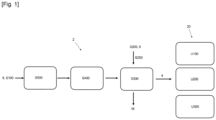
- FIG. 1 an example of a process 2 for the production of an enhanced fuel gas 4 containing hydrogen gas from an ammonia fuel stream 6 is represented.
- Said process 2 comprises the following steps:
- condensable medium 8 is meant a substance, for example, water steam 8, or a vapor, from which a heat, in particular a latent heat as well as possibly a sensible heat, is released for the endothermic reaction of the ammonia fuel stream during the phase change of the condensable medium 8, in particular during the condensation of the condensable medium 8.
- Said condensable medium 8 becomes a "condensed medium 16" when at least partially condensable medium 8 has undergone the phase change, in particular during the condensation of the condensable medium 8, so as to provide the heat for the endothermic reaction of the ammonia fuel stream. That is to say, a partially transformed "condensable medium 8", for example condensed steam 16, wherein gas (vapor) and liquid coexist, will be hereafter qualified as a "condensed medium 16".
- the enhanced fuel gas 4 advantageously comprises hydrogen gas, nitrogen gas and uncracked ammonia fuel .
- the molar ratio of nitrogen to hydrogen of the enhanced fuel gas 4 is 1:3.
- the process 2 further comprises controlling the pressure of water steam 8 so as to regulate an amount of said heat supplied to the endothermic cracking reaction.
- controlling the pressure of the water steam 8 allows to finely adjust the temperature level within the cracker unit 10. Therefore, the conversion rate of endothermic cracking reaction, as well as a predetermined ratio of uncracked ammonia, hydrogen gas and nitrogen gas can be precisely adjusted. This way, it is possible - on the one hand - to have an energy efficient process (waste heat integration) and - on the other hand - to ensure lower NOx formation and stable combustion.
- the condensed steam 16 comprises a liquid fraction between 70 and 100 %.
- the pressure of the ammonia fuel stream 6, is comprised between 1 and 10 barg, preferably comprised between 2 and 8 barg, more preferably comprised between 3 and 5 barg during said endothermic cracking reaction.
- the water steam pressure is comprised between 35 and 115 barg during said endothermic cracking reaction.
- the ammonia molar fraction in the enhanced fuel gas 4 is comprised between 0 and 80%, preferably comprised between 0 and 50%.
- the hydrogen molar fraction in the enhanced fuel gas 4 is comprised between 10 and 50%, preferably comprised between 15 and 30%.
- the conversion rate of the endothermic cracking reaction is higher than 10%, preferably higher than 50%.
- the conversion rate of the endothermic cracking reaction is up to 20%, preferably up to 50%.
- a part of the ammonia fuel stream 6 can be transformed into the enhanced fuel gas 4 comprising hydrogen.
- the enhanced fuel gas 4 may still comprise a part of the ammonia fuel stream 6.
- the process further comprises a pre-heating step comprising pre-heating the provided fuel stream 6 before performing (S300) the endothermic cracking reaction of the fuel stream in the cracker unit 10 (S400).
- the ammonia fuel stream 6 is preheated at a temperature range comprised between 200 and 350 °C, preferably comprised between 250 and 300 °C.
- the process 2 further comprises a vaporizing step (S500) comprising vaporizing the provided ammonia fuel stream 6 prior to the step of performing (S300) the endothermic cracking reaction of the ammonia fuel stream 6 in the cracker unit 10.
- a vaporizing step S500 comprising vaporizing the provided ammonia fuel stream 6 prior to the step of performing (S300) the endothermic cracking reaction of the ammonia fuel stream 6 in the cracker unit 10.
- the vaporizing step (S500) is prior to the pre-heating step (S400).
- the pre-heating step (S400) can be powered by a hot gas stream or by a water steam.
- the vaporizing step (S500) can be powered by a hot gas stream or by a water steam.
- the temperature of the water steam temperature is comprised between 100 and 515°C, preferably between 200 and 450°C, more preferably between 250 and 330 °C during said endothermic cracking reaction.
- a hydrogen gas content in the enhanced fuel gas 4 is comprised between 20 and 45 mol %, preferably comprised between 20 and 30 mol %, more preferably comprised between 25 and 30 mol %.
- An ammonia content in the enhanced fuel gas 4 is comprised between 0 and 25 mol %, preferably comprised between 15 and 20 mol %.
- the catalyst 12 is suitable for cracking said ammonia fuel stream 6 at a temperature comprised between 200 and 400 °C, preferably between 250 and 320 °C.
- a combustion of the enhanced fuel gas 4 can take place in a gas turbine for generating electrical power (U100).
- Said electrical power may be used to provide additional heat to the endothermic cracking reaction of the ammonia fuel stream 6. Additional heat may also be provided by said pre-heating step (S400) of the ammonia fuel stream 6.
- the combustion of the enhanced fuel gas 4 can take place for a fired industrial process (U200), for example in the fields of glasswork, oil refining, chemical processing and metallurgy.
- U200 fired industrial process
- the combustion of the enhanced fuel gas 4 can take place to provide heat to an endothermic reaction (U300), such as a hydrocarbon reforming reaction or an ammonia splitting reaction.
- U300 an endothermic reaction
- FIG 2 an example of an apparatus 200 configured to perform a process of the invention is represented.
- Said apparatus 30 comprises:
- catalyst bed 32 refers to a layer formed by one catalyst 12. It is typically a packed or structured arrangement of solid catalytic particles or a catalyst-coated surface through which reactant gases or liquids, such as the ammonia fuel stream 6, flow, thereby enabling an endothermic cracking reaction, to occur.
- the condensable medium circulation section 34 is configured to condense at least partially water steam 8, to provide said heat for the endothermic cracking reaction of the ammonia fuel stream 6.
- the cracker unit 10 comprises a shell-and-tube heat exchanger 40, said heat exchanger comprising a bundle of circulation channels 42, said channels having the shape of tubes, in particular straight or bent tubes, or coils, comprising said at least one catalyst bed 32.
- Said circulation channels 42 are spaced with a regular gap parallelly to each other.
- Said bundle is configured to increase a heat exchange with water steam 8.
- the condensable medium circulation section 34 comprises:
- the cracker unit 10 comprises a gas inlet 50 configured to receive said ammonia fuel stream 6.
- the cracker unit 10 comprises a gas outlet 52 configured to discharge said enhanced fuel gas 4 from the cracker unit 10.
- the cracker unit 10 comprises an inlet manifold 60 arranged in fluid communication with said gas inlet 50 and with the bundle for distributing the fuel stream among said circulation channels 34 of said bundle.
- the cracker unit 10 comprises an outlet manifold 70 arranged in fluid communication with said gas outlet 52 and with the bundle for collecting the at least partially cracked ammonia fuel stream from said circulation channels 42 of said bundle.
- the bundle is extending between the inlet manifold 60 and the outlet manifold 70.
- the apparatus 30 comprises a water steam reactor, said apparatus 30 further comprising: a boiler 80 connected with the condensable medium circulation section 34.
- the boiler 80 comprises:
- the boiler 80 comprises:
- the boiler 80 comprises a heating device 90 configured to provide the heat to the water 86, so as to supply water steam 8 from said boiler 80.
- the boiler 80 comprises a downstream valve (not represented) so as to reduce the pressure of condensable medium 8, in particular condensable steam, water steam 8.
- Said heating device 90 can comprise at least one electrical heating element, for example based on Joule effect, at least one radiation heating element and/or at least one convective heating element.
- the boiler 80 comprises:
- controlling the pressure of water steam 8 in the boiler 80 allows to finely adjust the temperature level within the cracker unit 10. Therefore, the conversion rate of endothermic cracking reaction, as well as a predetermined ratio of uncracked ammonia, hydrogen gas and nitrogen gas can be precisely adjusted with said pressure controller 92.
- the boiler 80 comprises an inlet for boiling water feed 98.
- the boiler 80 comprises an outlet for saturated condensed steam 100.
- the boiler 80 comprises a safety reducing valve 102 in order to release excess steam pressure in the boiler 80.
- start-up steam 104" refers to the steam used during the initial stages of said apparatus operation to heat up and pressurize said apparatus 30 before achieving full power operation.
- the catalyst bed 32 comprises ruthenium, nickel, aluminum and the oxides thereof, or a combination thereof.
- the catalyst bed 32 comprises nickel as catalytically active material, in particular as a catalytically active material on a carrier, for example an aluminum oxide (AI2O3) carrier.
- a carrier for example an aluminum oxide (AI2O3) carrier.
- the catalyst bed 32 comprises from 20 to 50 wt% of nickel, preferably comprises from 25 to 45 wt% of nickel, preferably comprises from 30 to 45 wt% of nickel.
- the catalyst bed 32 comprises rare transition metal belonging to the platinum group, such as ruthenium as catalytically active material, preferably above 1.5 wt % of ruthenium.
- the cracker unit 10 comprises a catalyst support layer 106 and the catalyst bed 32 is lying on said catalyst support layer 106.
- Said catalyst support layer 106 may comprise, for example, a packed bed of inert particles supporting said catalyst bed 32.
- said packed bed of inert particles is arranged in said outlet manifold.
- inert particles is meant as particles not inducing any catalytic activity for endothermal cracking reaction.
- the apparatus 30 further comprises a catalyst discharge 108 configured to evacuate the catalyst 12 of the catalyst bed 32.
Landscapes
- Chemical & Material Sciences (AREA)
- Organic Chemistry (AREA)
- Chemical Kinetics & Catalysis (AREA)
- Health & Medical Sciences (AREA)
- General Health & Medical Sciences (AREA)
- Engineering & Computer Science (AREA)
- Combustion & Propulsion (AREA)
- Inorganic Chemistry (AREA)
- Hydrogen, Water And Hydrids (AREA)
Priority Applications (2)
| Application Number | Priority Date | Filing Date | Title |
|---|---|---|---|
| EP23205624.2A EP4545476A1 (fr) | 2023-10-24 | 2023-10-24 | Craquage de combustible pour la production d'un combustible ayant des propriétés de combustion stables à partir d'ammoniac |
| PCT/EP2024/075799 WO2025087614A1 (fr) | 2023-10-24 | 2024-09-16 | Craqueur de combustible pour la production d'un combustible ayant des propriétés de combustion stables à partir d'ammoniac |
Applications Claiming Priority (1)
| Application Number | Priority Date | Filing Date | Title |
|---|---|---|---|
| EP23205624.2A EP4545476A1 (fr) | 2023-10-24 | 2023-10-24 | Craquage de combustible pour la production d'un combustible ayant des propriétés de combustion stables à partir d'ammoniac |
Publications (1)
| Publication Number | Publication Date |
|---|---|
| EP4545476A1 true EP4545476A1 (fr) | 2025-04-30 |
Family
ID=88511220
Family Applications (1)
| Application Number | Title | Priority Date | Filing Date |
|---|---|---|---|
| EP23205624.2A Withdrawn EP4545476A1 (fr) | 2023-10-24 | 2023-10-24 | Craquage de combustible pour la production d'un combustible ayant des propriétés de combustion stables à partir d'ammoniac |
Country Status (2)
| Country | Link |
|---|---|
| EP (1) | EP4545476A1 (fr) |
| WO (1) | WO2025087614A1 (fr) |
Citations (4)
| Publication number | Priority date | Publication date | Assignee | Title |
|---|---|---|---|---|
| US5869011A (en) * | 1994-02-01 | 1999-02-09 | Lee; Jing Ming | Fixed-bed catalytic reactor |
| US20220154646A1 (en) * | 2019-03-15 | 2022-05-19 | Mitsubishi Power, Ltd. | Ammonia decomposition facility, gas turbine plant equipped with same, and ammonia decomposition method |
| KR20220148374A (ko) * | 2021-04-28 | 2022-11-07 | 대우조선해양 주식회사 | 연료전지 발전시스템 및 동 시스템을 구비한 선박 |
| WO2023016879A1 (fr) * | 2021-08-13 | 2023-02-16 | Basf Se | Méthode et dispositif pour obtenir de l'hydrogène de haute pureté à partir de méthanol ou d'ammoniac pour faire fonctionner des piles à combustible |
-
2023
- 2023-10-24 EP EP23205624.2A patent/EP4545476A1/fr not_active Withdrawn
-
2024
- 2024-09-16 WO PCT/EP2024/075799 patent/WO2025087614A1/fr active Pending
Patent Citations (4)
| Publication number | Priority date | Publication date | Assignee | Title |
|---|---|---|---|---|
| US5869011A (en) * | 1994-02-01 | 1999-02-09 | Lee; Jing Ming | Fixed-bed catalytic reactor |
| US20220154646A1 (en) * | 2019-03-15 | 2022-05-19 | Mitsubishi Power, Ltd. | Ammonia decomposition facility, gas turbine plant equipped with same, and ammonia decomposition method |
| KR20220148374A (ko) * | 2021-04-28 | 2022-11-07 | 대우조선해양 주식회사 | 연료전지 발전시스템 및 동 시스템을 구비한 선박 |
| WO2023016879A1 (fr) * | 2021-08-13 | 2023-02-16 | Basf Se | Méthode et dispositif pour obtenir de l'hydrogène de haute pureté à partir de méthanol ou d'ammoniac pour faire fonctionner des piles à combustible |
Also Published As
| Publication number | Publication date |
|---|---|
| WO2025087614A1 (fr) | 2025-05-01 |
Similar Documents
| Publication | Publication Date | Title |
|---|---|---|
| CA2413388C (fr) | Dispositif ameliore de production d'hydrogene par reformage a la vapeur d'hydrocarbures et reacteur chimique integre servant a la production d'hydrogene a partir d'hydrocarbures | |
| US6497856B1 (en) | System for hydrogen generation through steam reforming of hydrocarbons and integrated chemical reactor for hydrogen production from hydrocarbons | |
| JP5048054B2 (ja) | 液体炭化水素の製造方法 | |
| JP4869696B2 (ja) | 小型円筒状改質装置 | |
| FI3878806T3 (fi) | Menetelmä vedyn tai vetypitoisten polttoaineiden valmistamiseksi katalyyttisella ammoniakin hajotuksella | |
| JP7473532B2 (ja) | 炭化水素の水蒸気改質又は乾式改質 | |
| RU2411075C2 (ru) | Компактный риформинг-реактор | |
| US20070186471A1 (en) | Steam reforming apparatus and method for steam reforming using the same, and industrial furnace | |
| JP2015517175A (ja) | 燃料電池のための触媒を支持する置換可能な構造化支持部を含む触媒加熱式燃料処理装置 | |
| CN119403758A (zh) | 氨离解方法和系统 | |
| RU2415073C2 (ru) | Компактный реактор реформинга | |
| WO2024105393A1 (fr) | Procédé de production d'hydrogène gazeux à partir du craquage catalytique d'ammoniac | |
| CN119233941A (zh) | 用于裂解氨的方法 | |
| JP2024544188A (ja) | アンモニアをクラッキングする方法 | |
| AU2023422608A1 (en) | Method and device for generating heat | |
| EP4545476A1 (fr) | Craquage de combustible pour la production d'un combustible ayant des propriétés de combustion stables à partir d'ammoniac | |
| JPH0794322B2 (ja) | メタノール改質装置 | |
| JPS5826002A (ja) | スチ−ムリホ−ミング法及びスチ−ムリホ−ミング用反応管 | |
| CA2354927A1 (fr) | Dispositifs de transformation et de regulation du combustible | |
| EP4620905A1 (fr) | Craquage d'ammoniac à l'aide d'un milieu de condensation | |
| EP4566988A1 (fr) | Procédé de craquage adiabatique d'ammoniac à chauffage électrique à plusieurs étages | |
| TWI885872B (zh) | 使用復熱式熱交換反應器之氨裂解程序 | |
| WO2025215366A1 (fr) | Procédé et installation | |
| GB2626862A (en) | Process | |
| TW202606952A (zh) | 方法及設備 |
Legal Events
| Date | Code | Title | Description |
|---|---|---|---|
| PUAI | Public reference made under article 153(3) epc to a published international application that has entered the european phase |
Free format text: ORIGINAL CODE: 0009012 |
|
| STAA | Information on the status of an ep patent application or granted ep patent |
Free format text: STATUS: THE APPLICATION HAS BEEN PUBLISHED |
|
| AK | Designated contracting states |
Kind code of ref document: A1 Designated state(s): AL AT BE BG CH CY CZ DE DK EE ES FI FR GB GR HR HU IE IS IT LI LT LU LV MC ME MK MT NL NO PL PT RO RS SE SI SK SM TR |
|
| STAA | Information on the status of an ep patent application or granted ep patent |
Free format text: STATUS: THE APPLICATION IS DEEMED TO BE WITHDRAWN |
|
| 18D | Application deemed to be withdrawn |
Effective date: 20251031 |